
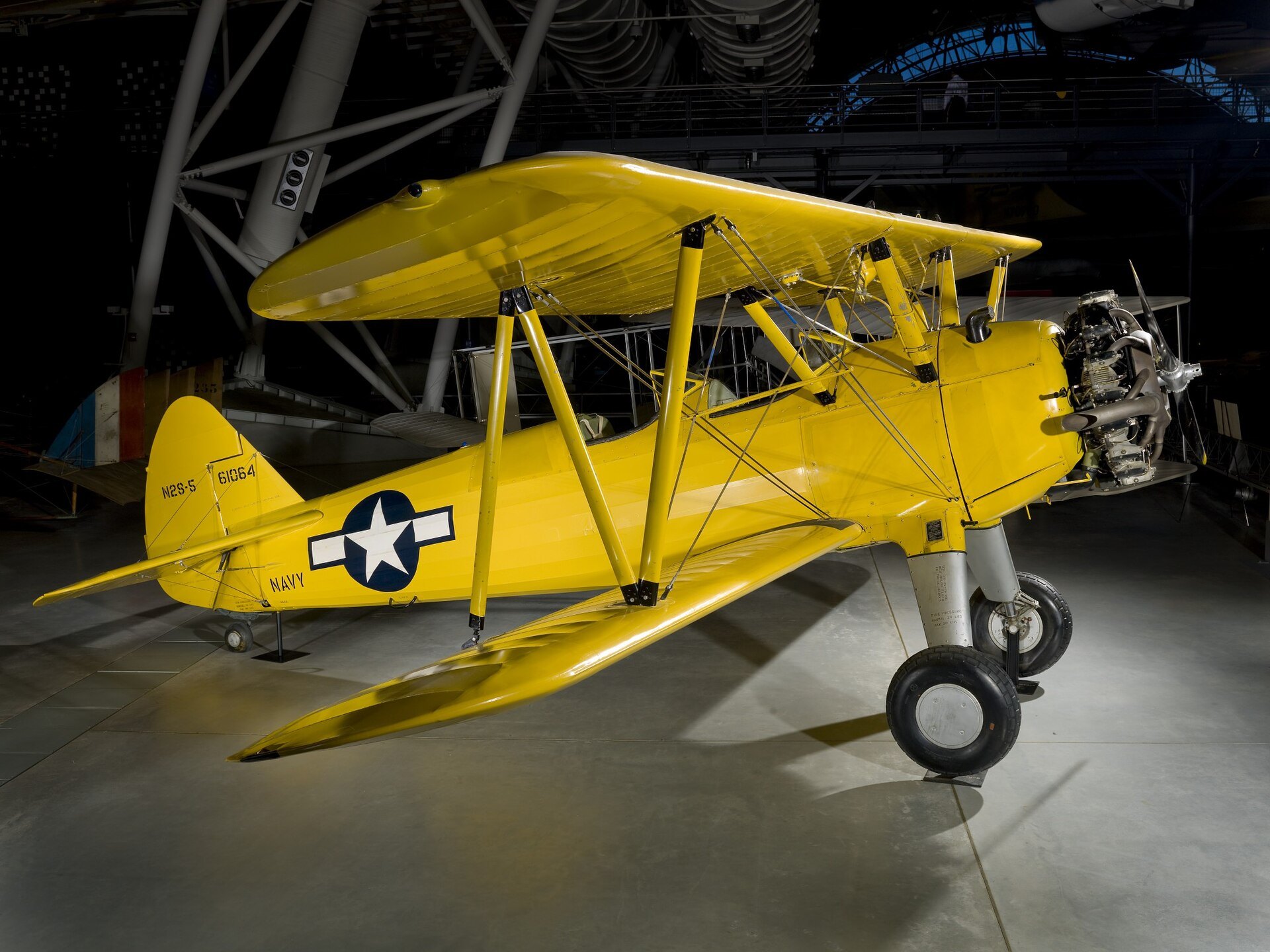
Boeing-Stearman Kaydet
PT-17 / N2S Primary Trainer
The yellow biplane on which most American Army and Navy pilots of the Second World War first flew solo, from the Tuskegee Airmen to a future president, and still the classic open-cockpit warbird.
The Stearman: how a Wichita biplane taught America’s wartime pilots to fly
The Stearman Kaydet was already old-fashioned when it was new. In the early 1930s the Stearman Aircraft Company of Wichita, Kansas, refined an earlier design into the Model 70, a fabric-covered biplane with a welded steel-tube fuselage, wooden wings and two open cockpits. Engineers Mac Short, Harold Zipp and Jack Clark shaped it, and it first flew on 1 January 1934. It was rugged, simple and stable, and it had a wide-track undercarriage that would forgive a student almost anything. The US Navy ordered it first; in 1936 the Army Air Corps adopted it as the PT-13. Two years later Boeing took over Stearman, and the aircraft became the Boeing-Stearman Model 75, built in its tens of thousands at Wichita.
From the late 1930s to the end of the Second World War the Stearman was the aircraft on which American military aviation began. Army cadets flew the PT-13 with a Lycoming engine, the PT-17 with a Continental and the PT-18 with a Jacobs. Navy cadets flew the same aircraft as the N2S and called it the Yellow Peril. The PT-13D and N2S-5 became the only complete standardisation of an Army and Navy production design during the war. More than 10,000 were ordered, including 300 winterised PT-27s with cockpit canopies for Canada. At Moton Field in Alabama the Tuskegee Airmen learned to fly in PT-13s and PT-17s, and at Minneapolis a Navy cadet named George H. W. Bush logged his first hours in an N2S in mid-winter.
Most primary schools judged a cadet by how he handled the Stearman: whether he could land a narrow-visibility taildragger, recover from a spin and keep the aircraft straight on the ground. Those who passed moved on to the BT-13 and the AT-6 Texan, and eventually to the P-51, the Corsair or the B-17. When peace came, thousands of surplus Stearmans were sold for a few hundred dollars and became crop dusters, often re-engined with a 450 hp Pratt & Whitney radial. Later they became the classic airshow and sport biplane. Wing walkers stand on their top wings, and every Labor Day week dozens gather at Galesburg, Illinois, for the National Stearman Fly-In, held since 1972.
01The Stearman at war: a training machine on an industrial scale
Between 1939 and 1945 the United States expanded its pilot training system from a few hundred graduates a year to tens of thousands. Primary training, the first stage, was largely contracted to civilian flying schools under military supervision, and the Stearman, alongside Fairchild and Ryan monoplanes, was the aircraft they used. A cadet typically arrived at a primary field with no flying experience and spent about two months learning to take off, land, stall, spin and fly basic aerobatics before moving on to basic and advanced trainers.
The Stearman suited this conveyor belt. Its steel-tube fuselage and fabric-covered wooden wings could be patched in a hangar overnight, its seven-cylinder radial was simple to maintain, and its wide undercarriage tolerated heavy landings. It was no pushover. Its tailwheel layout and the long nose that blocked the view ahead punished a lazy student with a ground loop, and instructors used it to separate natural pilots from those who would not make it.
The Navy’s N2S flew from fields across the Midwest and South, including Naval Air Station Ottumwa in Iowa and Wold-Chamberlain in Minneapolis, where cadets trained through winters in open cockpits. Boeing’s Wichita Division turned out the aircraft at a remarkable rate until production ended in 1945, by which time the Stearman had become, as the National Museum of the US Air Force puts it, the primary trainer from the late 1930s to the end of the Second World War.
02The Stearman after the war: crop duster, wing-walking stage and warbird
When the war ended, the military had thousands of trainers it no longer needed. Surplus Stearmans were sold off cheaply, and their strong airframes and slow, stable handling made them ideal agricultural aircraft. Operators fitted hoppers in the front cockpit and often replaced the 220 hp engine with a 450 hp Pratt & Whitney Wasp Junior. For two decades a Stearman spraying fields at treetop height was a familiar sight across rural America.
As purpose-built agricultural aircraft took over, restored Stearmans moved into sport flying and airshows. The extra power that suited crop dusting also suited display flying: AeroSuperBatics, the British wingwalking team, flies Stearmans with 450 hp Pratt & Whitney radials and extra ailerons, so that the pilot can fly a full display without constantly diving for speed.
In 1972 Tom Lowe and Jim Leahy organised a one-off gathering of Stearman owners at Galesburg, Illinois. Twenty-seven aircraft came. The experiment became the annual National Stearman Fly-In, the largest gathering of the type anywhere, and it was still drawing more than 60 Stearmans nearly half a century later.
What makes the Stearman special
The Stearman’s airframe: built to absorb student landings
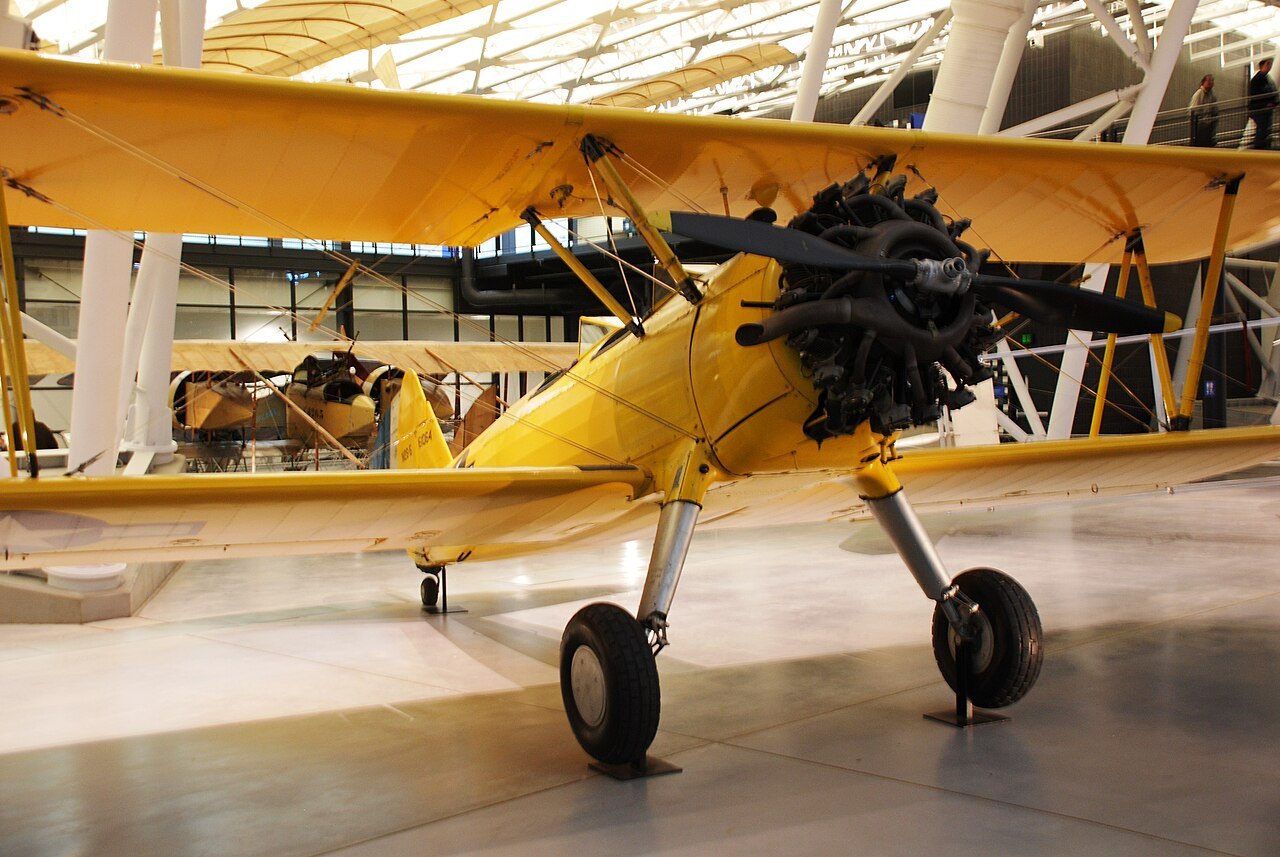
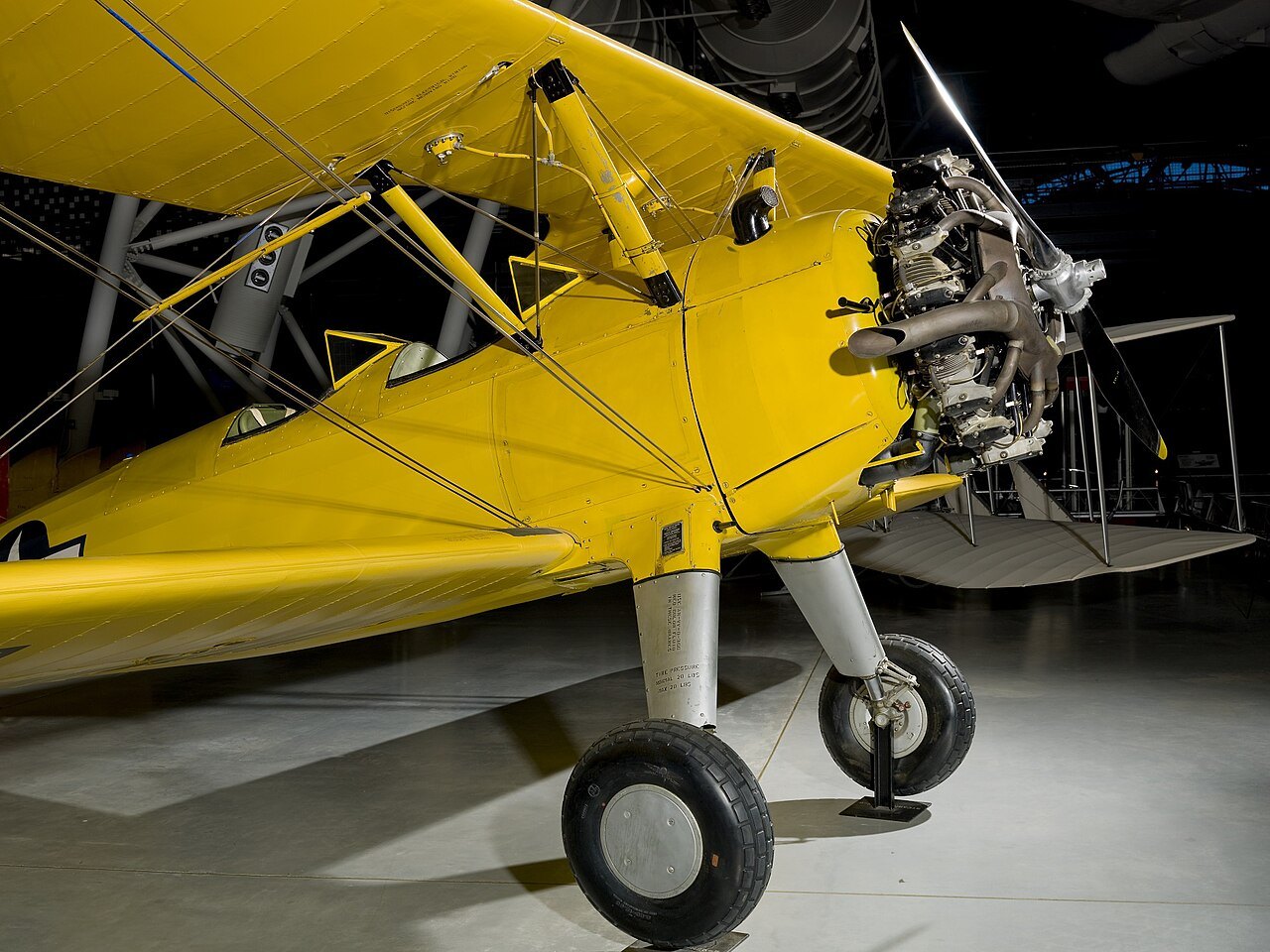
The Kaydet combines a welded steel-tube fuselage with wooden wing spars and ribs, all covered in doped fabric. The wide-track, fixed undercarriage with oleo struts was designed to take hard arrivals day after day. That robustness explains why so many survived to become crop dusters, and why restorers can still rebuild aircraft that have spent decades in barns. It is also why the structure is heavier than a sport biplane’s, giving the Stearman its stable, deliberate feel.
The Stearman’s engines: three radials, one airframe
The Model 75 was designed to take whichever engine was available, and the designation changed with it. The Army’s PT-13 used a Lycoming R-680, the PT-17 a 220 hp Continental R-670 and the PT-18 a Jacobs R-755. The Navy’s N2S series used the same engines under its own designations. This flexibility kept production running whenever one engine maker fell behind, and it is why surviving Stearmans carry several different radials today.
The Stearman’s handling: a teacher with standards
In the air the Stearman is stable and honest, with heavy-ish controls and a clean, predictable stall. It loops, rolls and spins well enough to teach basic aerobatics. On the ground it is more demanding: the tailwheel layout and the long nose blocking the forward view mean a pilot must keep it straight with constant rudder until it stops. That combination, gentle in the air and unforgiving on landing, made it an effective filter for the training system.
03The Stearman’s cockpits: two open seats and a speaking tube
The Kaydet seats student and instructor in tandem open cockpits. In most military training the student flew from the rear seat, with the instructor in front, and both had a full set of controls. Instruments were minimal: airspeed, altimeter, compass, engine gauges and little else, because primary training was about flying by feel and by looking outside. Communication was through a Gosport tube, a speaking tube that carried the instructor’s voice to the student’s helmet.
Open cockpits made winter training at northern fields an ordeal; cadets at Minneapolis trained in February in heavy flying suits. Canada’s 300 PT-27s addressed the problem with a sliding canopy and cold-weather equipment.
Many restored Stearmans have since been modified with electrical systems, radios, starters and higher-powered engines, but the essential layout remains the one that confronted wartime cadets: a long nose, a big radial and a lot of wind.
Boeing-Stearman Model 75 Kaydet (PT-17) specifications
Specifications
- Crew
- 2 (tandem open cockpits)
- Length
- 7.54 m (24 ft 9 in)
- Wingspan
- 9.80 m (32 ft 2 in)
- Height
- 2.95 m (9 ft 8 in)
- Empty weight
- 876 kg (1,931 lb)
- Max take-off weight
- 1,195 kg (2,635 lb)
- Powerplant
- 1 × Continental R-670-5 7-cylinder radial, 220 hp (164 kW) (PT-17)
- Maximum speed
- about 200 km/h (124 mph)
- Cruise speed
- about 155–171 km/h (96–106 mph), by source
- Range
- about 725 km (450 mi) (PT-13D)
- Service ceiling
- about 3,400–4,270 m (11,200–14,000 ft), by variant and source
- Climb rate
- 3,050 m (10,000 ft) in about 17 min 18 s
- Armament
- None (trainer)
Costs & production
- Cost per flight hour
- Estimate only: roughly US$250–450 per hour for a privately operated example today, based on a 220 hp radial burning around 10–12 US gal of avgas per hour plus oil, engine overhaul reserve and insurance
- Production
- Commonly given as about 10,000 including spares; complete airframes roughly 8,400–8,600 (1934 to 1945)
- Programme
- Adopted by the US Army Air Corps as the PT-13 in 1936; Army and Navy standardised on the PT-13D / N2S-5
04The Stearman’s variants: one airframe, many designations
- Model 70: the prototype, first flown on 1 January 1934.
- PT-13 / PT-13A / PT-13B / PT-13D: US Army versions with Lycoming R-680 radials; the NMUSAF gives over 2,100 PT-13s for the USAAF.
- PT-17: the most numerous Army version, with the 220 hp Continental R-670.
- PT-18: a small batch with the Jacobs R-755.
- PT-27: 300 winterised aircraft with cockpit canopies for the Royal Canadian Air Force; the Canadian name Kaydet spread to the whole family.
- N2S-1 to N2S-5: US Navy versions, with engines matching the Army variants; the N2S-5 was identical to the PT-13D.
05The Stearman’s operating costs: an affordable warbird
The Stearman is one of the least expensive ways to own and fly a genuine Second World War military aircraft. Its seven-cylinder radial typically burns around 10 to 12 US gallons of avgas an hour, and the airframe is simple enough for many owners to maintain with an experienced mechanic. Adding oil consumption, an engine overhaul reserve, hangarage and insurance, a reasonable estimate for a private owner is in the order of US$250 to US$450 per flying hour. That is an estimate based on typical fuel burn and general-aviation operating costs, not a published figure.
Re-engined aircraft with 450 hp Pratt & Whitney radials, such as display and ex-agricultural Stearmans, burn considerably more and cost more to run.
The Stearman from Wichita prototype to Galesburg fly-in
Model 70 flies
The Stearman Model 70 prototype makes its first flight on 1 January 1934 in Wichita.
Army adoption
The US Army Air Corps adopts the type as the PT-13.
Boeing takes over
Boeing acquires Stearman, which becomes its Wichita Division; the trainer becomes the Boeing-Stearman Model 75.
Tuskegee begins
Tuskegee Army Air Field is established on 23 July; primary training of Black cadets runs at nearby Moton Field.
A future president learns to fly
Navy cadet George H. W. Bush begins flight training at Wold-Chamberlain, Minneapolis, on 21 November.
Pearl Harbor anniversary
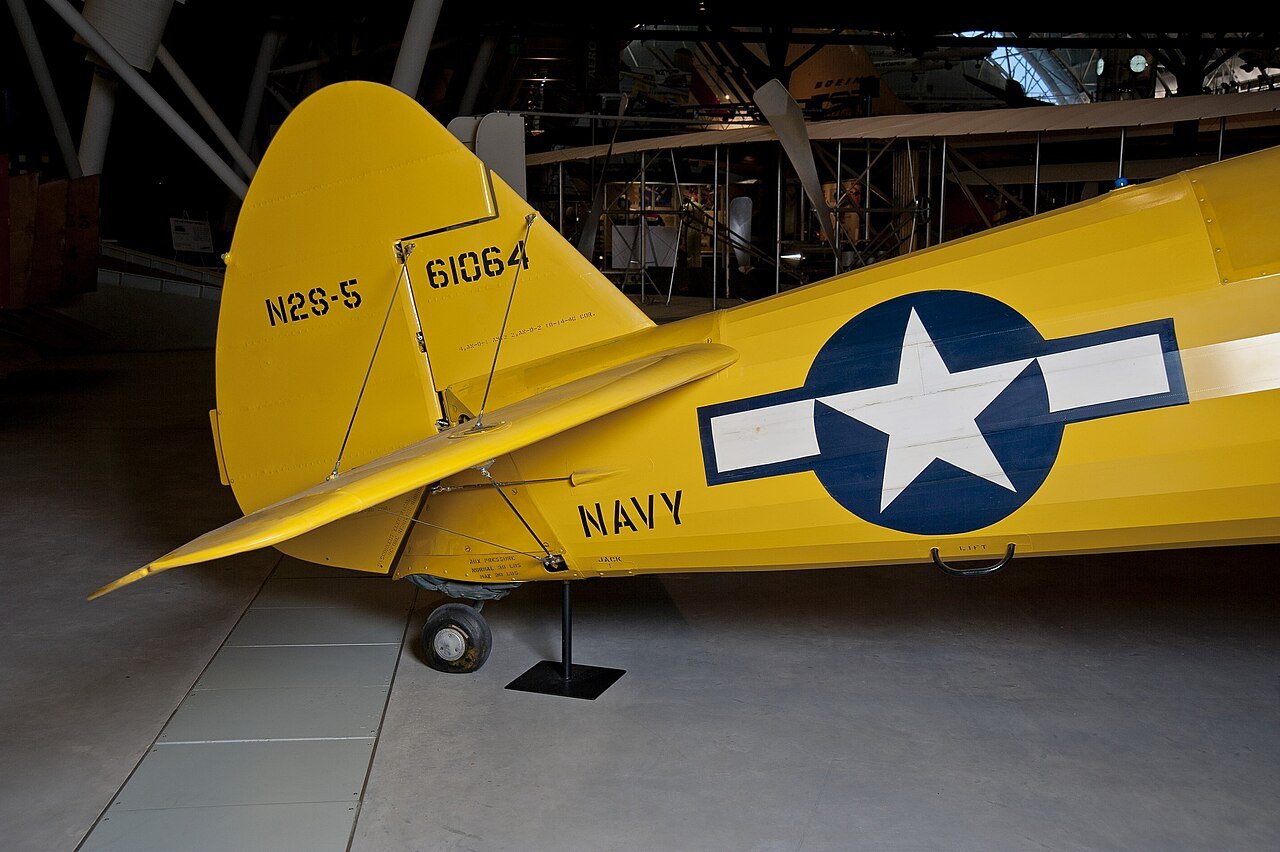
The Navy accepts N2S-5 now held by the Smithsonian on 7 December 1943, two years to the day after Pearl Harbor.
Production ends
Wartime production at Wichita ends after more than 10,000 Kaydets had been ordered.
Museum piece
Boeing donates a PT-13D to the National Museum of the US Air Force.
First National Stearman Fly-In
Twenty-seven Stearmans gather at Galesburg, Illinois, for what was meant to be a one-time event.
Tuskegee trainer on display
A PT-17 that trained Tuskegee Airmen is transferred from the Collings Foundation to the NMUSAF for its WWII Gallery.
Stories & eyewitnesses: the Stearman in training, war and peace
Moton Field: where the Tuskegee Airmen first flew
Nearly a thousand Black aviators began their careers in Stearmans in Alabama.
Read the full story
Cadet Bush in a Minnesota winter
A future president learned to fly in an open cockpit at minus temperatures.
Read the full story
The Yellow Peril
The Navy’s nickname reflected both the paint and the students.
Read the full story
Accepted on Pearl Harbor day
The Smithsonian’s N2S-5 entered service two years to the day after the attack.
Read the full story
Canada’s winterised Kaydets
Three hundred PT-27s gave the trainer its name.
Read the full story
The PT-13D at Dayton
Boeing gave one back to the Air Force in 1959.
Read the full story
From trainer to crop duster
Surplus Stearmans sprayed America’s farms for a generation.
Read the full story
Standing on the top wing
Britain’s wingwalkers chose the Stearman for its strength and power.
Read the full story
Galesburg: the Stearman’s annual reunion
A one-off fly-in in 1972 became a tradition.
Read the full story
The Stearman in pictures
Where the Stearman flies and flew
The Stearman’s record
The Stearman was never a combat aircraft and no significant combat use is documented. Its record is in training: from the late 1930s to 1945 it was the standard primary trainer of the US Army and Navy, and it taught the first hours of flying to a large share of the American aircrew who fought the Second World War.
See how training and combat types compare in the military aircraft statistics database. Figures are approximate.
Everything people ask about the Stearman
Can I fly in a Boeing-Stearman Model 75 Kaydet (PT-17)?
What is the difference between the PT-13, PT-17 and N2S?
How many Stearman trainers were built?
Why is the Stearman called the Kaydet?
Did the Tuskegee Airmen train on the Stearman?
Is the Stearman hard to fly?
Where can I see a Stearman Kaydet?
You can’t fly the Stearman.
These, you can.
Most of this museum you can only look at. These genuine military jets you can fly yourself with MiGFlug — with aerobatics and time on the controls.
 Fly the L-39 AlbatrosThe world’s most-flown jet trainer — aerobatics included
 Fly the F-104 Starfighter“The missile with a man in it”
 Fly the MiG-21The Cold War’s most-produced jet
 Fly the T-33 Shooting StarAmerica’s first jet trainer
 Fly the DH VampireA piece of early jet history
 Fly the S.211Agile Italian jet trainer
 Fly the MB-326The classic Aermacchi jet
 Fly the MiG-15The Soviet legend of the Korean War
Continue the tour
Every fact, checked
- Stearman PT-13D KaydetNational Museum of the US Air Force fact sheet: variants, numbers, specs
- Boeing-Stearman N2S-5 KaydetSmithsonian NASM: Army-Navy standardisation and this airframe’s history
- National USAF Museum acquires rare PT-17 that trained Tuskegee AirmenGeneral Aviation News via GlobalAir: Moton Field training
- Stearman Bu.No. 3347AirCorps Aviation: N2S-1 flown by cadet George H. W. Bush and its restoration
- Boeing/Stearman KaydetPlane & Pilot: performance figures and the origin of the Kaydet name
- 2018 National Stearman Fly-InGeneral Aviation News, W. M. Tarrant: history of the Galesburg fly-in
- Breitling Wingwalkers and the Boeing StearmanFlightline Weekly: display Stearman modifications
- Stearman PT-13A KaydetThe Museum of Flight, Seattle: collection aircraft
- Tuskegee Airmen National Historic Site, Hangar 1US National Park Service: Moton Field