
Westland Sea King
From Sikorsky SH-3 to Commando
Born as Sikorsky’s SH-3 submarine hunter and rebuilt by Westland with British engines and avionics, the Sea King flew the Falklands surrender, Apollo recoveries and half a century of rescues.
The Sea King: how a Sikorsky submarine hunter became a British institution
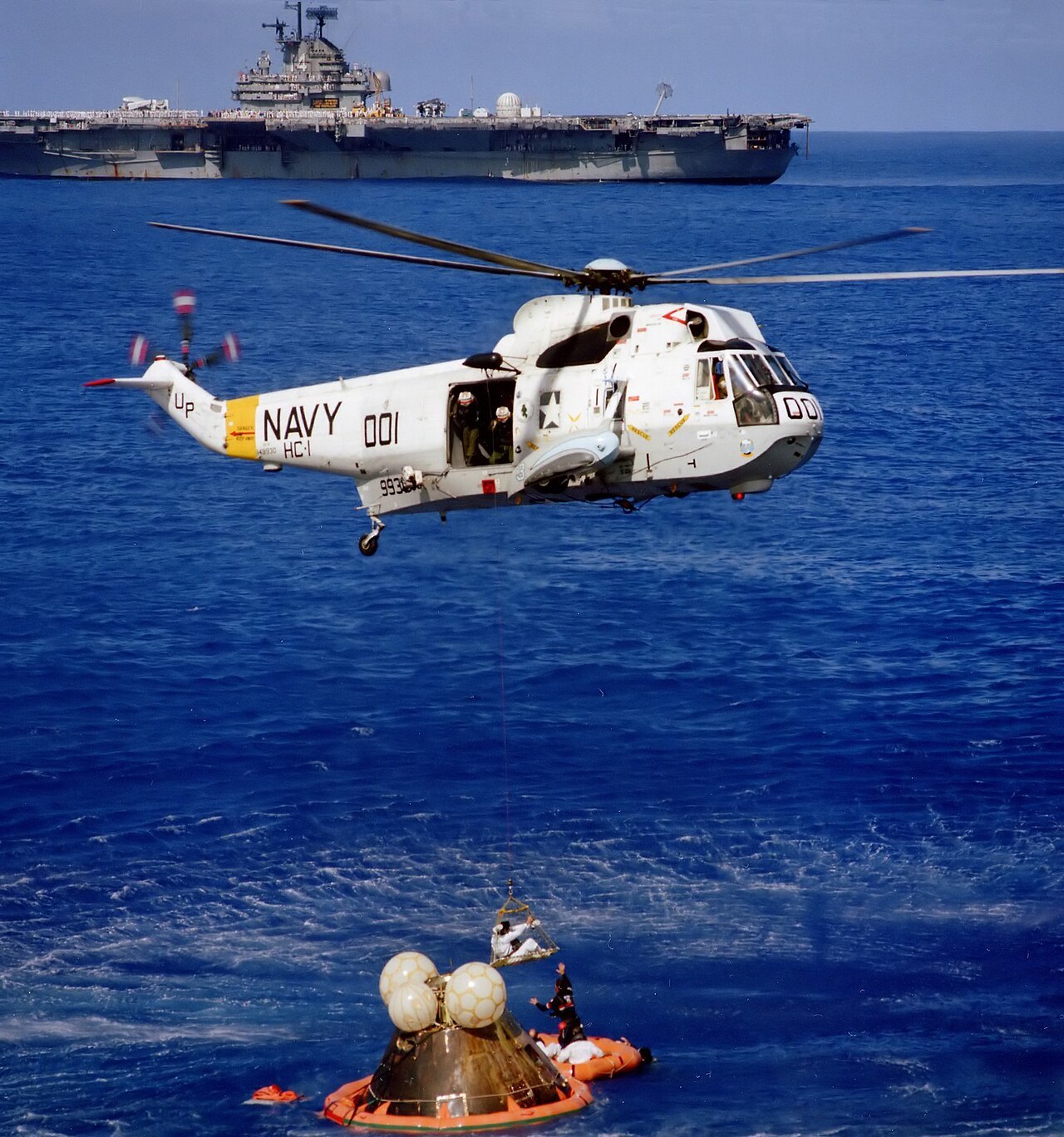
The Sea King began in Connecticut. Facing a growing Soviet submarine fleet, the US Navy asked Sikorsky for a turbine-powered helicopter that could both find and attack submarines, roles that had needed two piston helicopters. The answer, the HSS-2, later SH-3, flew on 11 March 1959. Its two General Electric T58 turboshafts sat on the cabin roof, freeing the hull below for a Bendix dipping sonar, torpedoes and four hours’ endurance, and its boat hull and sponsons owed much to Sikorsky’s flying boats. Sikorsky built 794 S-61s, licensees in Britain, Japan, Canada and Italy another 679, and the type served as a submarine hunter, Apollo recovery helicopter and, in its VH-3 form, as Marine One.
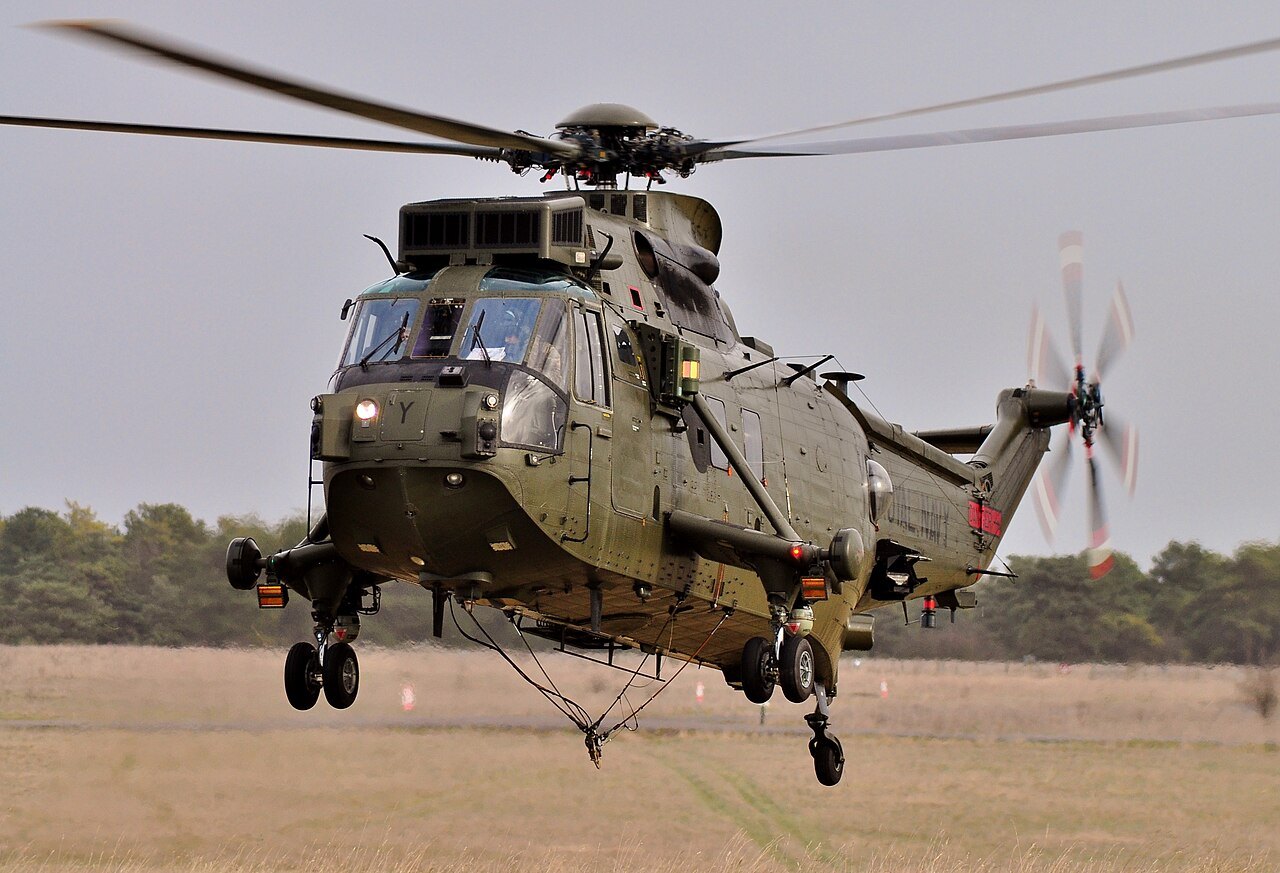
Westland took a licence soon after the first flight, and in June 1966 the Royal Navy ordered 60 to replace the Wessex. They became a very different aircraft. Westland fitted Rolls-Royce Gnome engines, a fully automatic flight control system, British sonar and a search radar in a dorsal hump, because the Navy wanted its helicopters to hunt independently, with an observer running the battle rather than the pilot. The first Westland-built Sea King HAS1 flew at Yeovil on 7 May 1969. Successive marks followed: the RAF’s yellow HAR3 rescue helicopter from 1978, the 28-seat Commando and HC4 assault transport, and the radar-carrying airborne early warning version that the Falklands made urgent.
Westland built about 330, and exports went to India, Germany, Norway, Belgium, Australia, Pakistan, Egypt and Qatar. British Sea Kings flew in the Falklands, the Gulf, the Balkans, Sierra Leone, Iraq and Afghanistan, and for decades the RAF and Royal Navy rescue helicopters were a reassuring sight over Britain’s coasts and mountains. The RAF retired its last in 2015 and the Royal Navy on 26 September 2018, after almost half a century. Germany followed in March 2024 and India’s Sea King Mk 42B in June 2026. Yet the type is not finished: Britain and Germany have given Sea Kings to Ukraine, where they rescue downed pilots and carry troops along the Black Sea coast.
01The Sea King in the Falklands: decoys, surrender and the worst day for the SAS
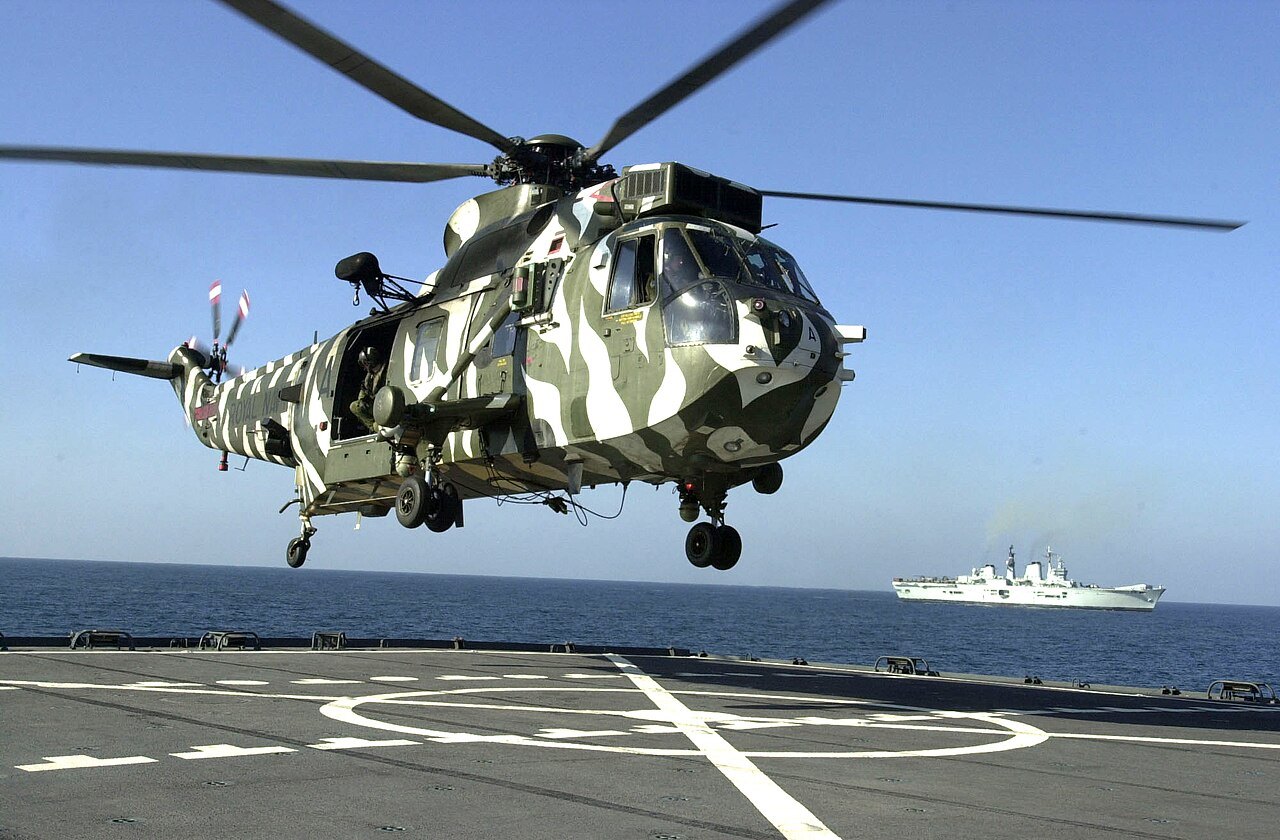
Sea Kings were everywhere in 1982. Anti-submarine HAS5s of 820 Naval Air Squadron in HMS Invincible kept at least one helicopter airborne on surface search, flying 1,650 sorties; 826 Squadron in HMS Hermes kept at least three airborne continuously from Ascension to the surrender. 825 Squadron was formed for the war with ten HAS2s stripped of sonar and fitted with troop seats, two of them embarked in the liner Queen Elizabeth 2. Commando HC4s moved troops, guns and special forces ashore, and Sea Kings even flew as decoys against incoming Exocet missiles, some sorties flown by the then Prince Andrew.
There were heavy losses. On 19 May 1982 a Sea King carrying SAS soldiers from Hermes to HMS Intrepid crashed into the sea; 22 men died and nine survived. The SAS lost 18 men, its worst single day since the Second World War, and bird feathers in the wreckage suggested a bird strike, though the inquiry was inconclusive. On 14 June, with no other aircraft able to fly through a storm, a Sea King from the squadron commanded by Ralph Wickes-Sneyd carried Major General Jeremy Moore into Port Stanley to accept the Argentine surrender. The war also exposed the fleet’s lack of airborne early warning, and two HAS2s were fitted with Searchwater radars in an inflatable dome and flying within 11 weeks.
02The Sea King in rescue: yellow helicopters, black beauties and Norwegian queens
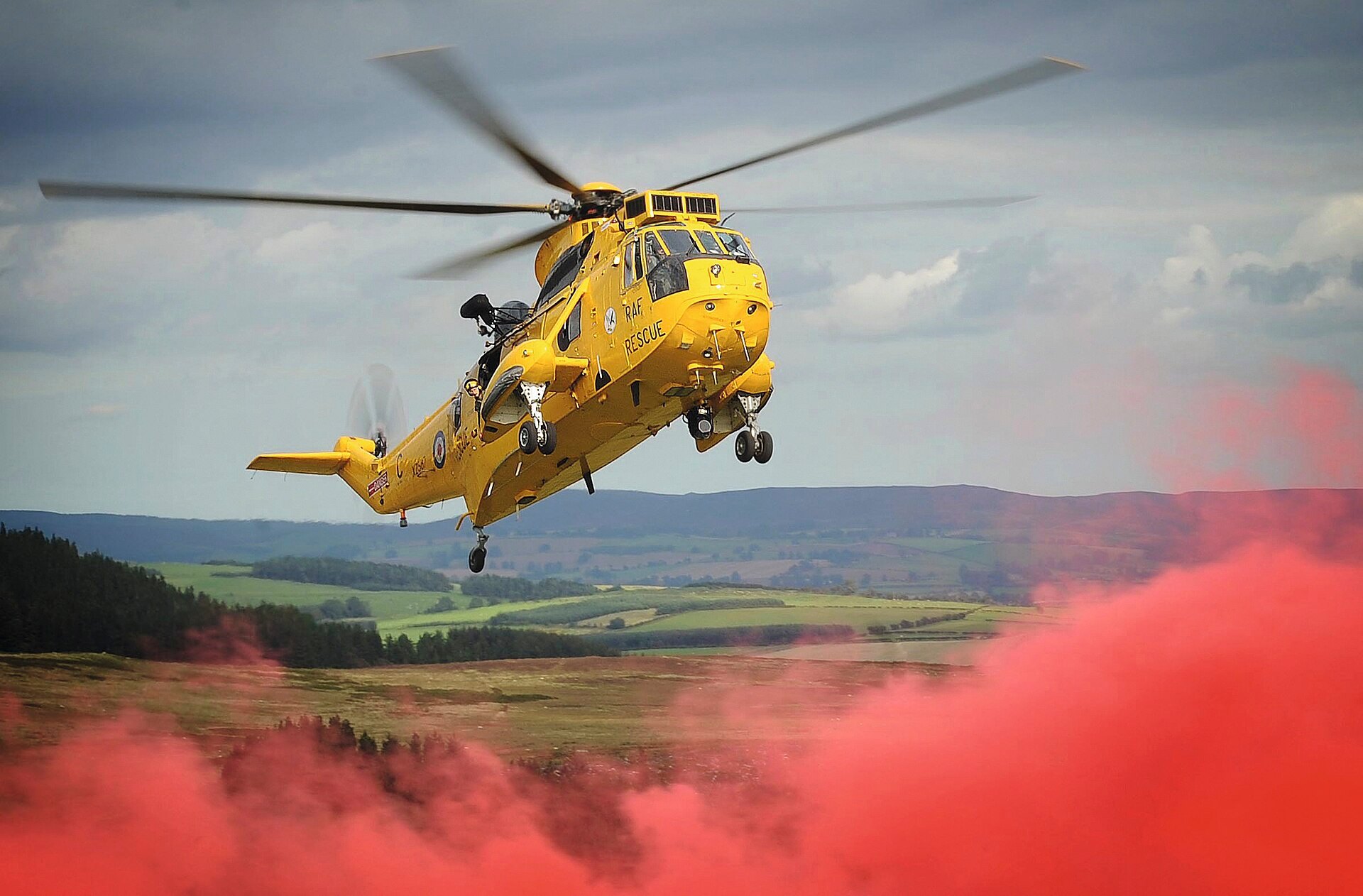
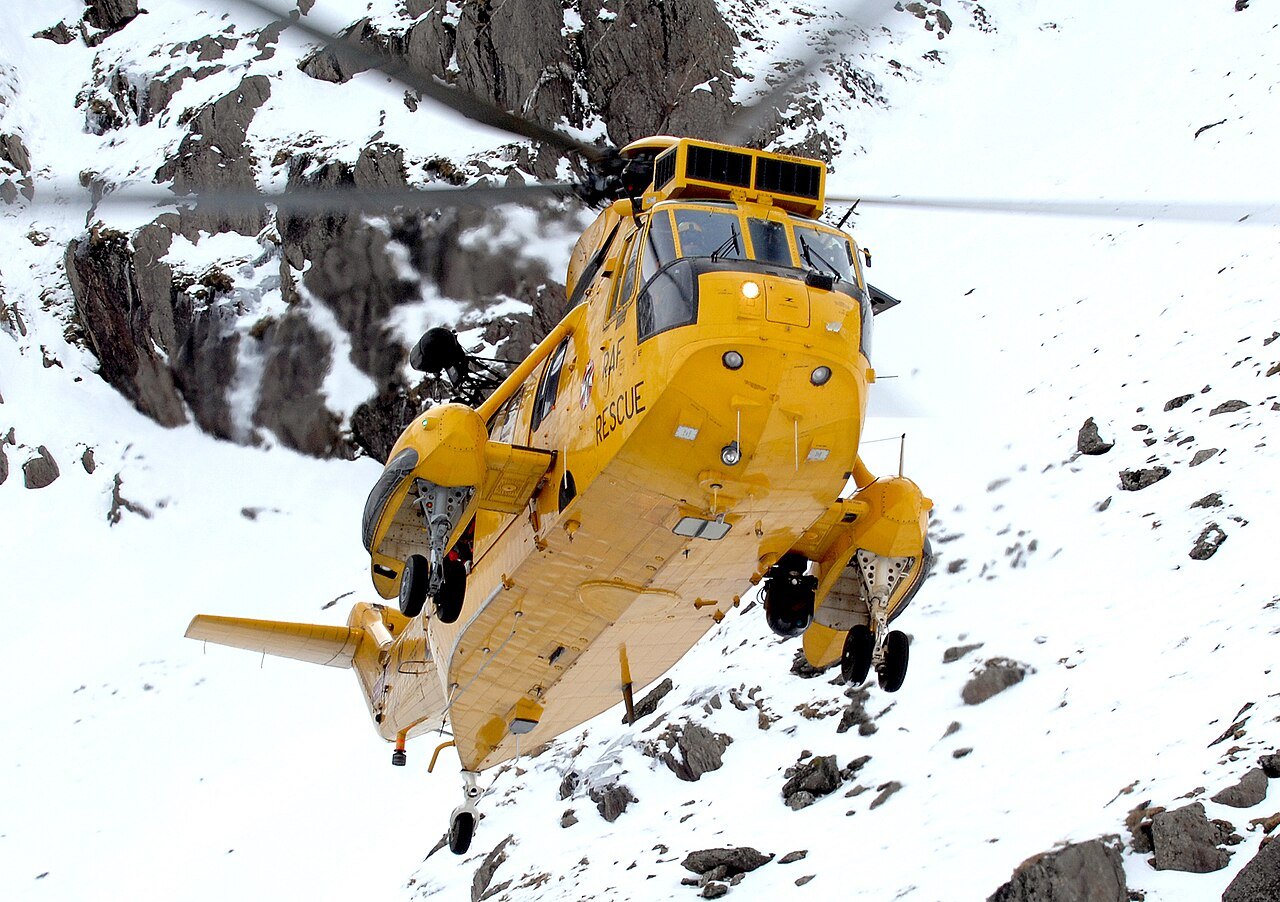
The RAF’s Sea King HAR3 entered service in 1978 to replace the Whirlwind and Wessex. With a lengthened cabin, extra fuel and bulged observation windows, it flew from bases around the UK and in the Falklands, day and night, for military aircrew and civilian walkers, climbers and sailors alike, until search and rescue passed to civilian contractors in 2015. Royal Navy Sea Kings did the same from Culdrose and Prestwick; both Prince Andrew and Prince William flew front-line search and rescue in the type.
Abroad the story was similar. Germany’s Mk 41, ordered in 1969 to replace the Albatross flying boat, was the first dedicated rescue Sea King. Norway’s 330 Squadron flew Mk 43s from 1973 along the whole coast, from Bodø to Sola and Banak, until the AW101 took over. Belgium’s five Mk 48s, one of them the black-painted RS-05, flew 60,000 hours and saved 1,757 people in 3,309 rescue missions before the last retired in March 2019. Canada’s Sikorsky-built CH-124s, pioneers of the “Beartrap” haul-down system for landing on small frigates, served from 1963 to 2018.
What makes the Sea King special
Engines on the roof
The original S-61 was designed around the compact T58 turboshaft, so Sikorsky put the engines, main gearbox and drive train on top of the fuselage, leaving the cabin free for sonar, weapons, troops or stretchers and making it quieter and safer. Two engines meant a Sea King could keep flying if one failed over the sea. Westland’s version used the licence-built Rolls-Royce Gnome, and later Sea Kings received the composite BERP rotor blades that Westland developed with the Royal Aircraft Establishment, improving fatigue life and performance.
A boat hull with wings of floats
The Sea King’s hull borrowed from Sikorsky’s flying boats, with sponsons on each side to hold the retracting main wheels and give stability on the water, and inflatable bags added for buoyancy. Main rotor blades and tail fold for stowage aboard ship. Floating was not always safe in practice, as crews learned: the hole in the hull for the dipping sonar could flood quickly. The Commando version, designed for Egypt’s desert, dropped the floats and carried its wheels on stub sponsons instead.
An observer’s helicopter
The Royal Navy wanted a Sea King that could hunt alone, far from a carrier. Westland gave it a search radar in a dorsal radome, a computerised automatic flight control system that could hold a hover above the sonar, and a crew in which an observer, not the pilot, ran the tactical picture. With four Sting Ray torpedoes or depth charges it could find and kill a submarine by itself, and Indian and Pakistani versions carried Sea Eagle or Exocet anti-ship missiles, making the Mk 42B a “flying frigate”.
03The Sea King’s airborne early warning radar: a lesson from the Falklands
When the last conventional carrier and its Fairey Gannet radar aircraft left service in 1978, the Royal Navy lost its own airborne early warning, and in 1982 ships were sunk by low-flying aircraft the fleet could not see in time. Westland and Thorn-EMI rushed two Sea King HAS2s into service with a Searchwater radar on a swinging arm, protected by an inflatable bag that could be lowered beneath the fuselage in flight and raised for landing. They flew within 11 weeks and joined HMS Illustrious after the fighting.
Production AEW2s entered service with 849 Naval Air Squadron in 1985. They were upgraded to the ASaC7 (Airborne Surveillance and Control Mk 7), with Searchwater 2000 able to track up to 400 targets and a Link 16 data link, and flew from HMS Ark Royal in the 2003 invasion of Iraq. They outlived every other British Sea King, the last seven serving until 2018, when the Merlin-mounted Crowsnest system replaced them.
Westland Sea King HAS5 specifications
Specifications
- Crew
- 2–4
- Capacity
- Up to 28 troops in the Commando and HC4; up to 22 survivors in rescue configuration
- Length
- 17.02 m (55 ft 10 in)
- Main rotor diameter
- 18.90 m (62 ft)
- Height
- 5.13 m (16 ft 10 in)
- Empty weight
- 6,373 kg (14,051 lb)
- Max take-off weight
- 9,707 kg (21,400 lb)
- Powerplant
- 2 × Rolls-Royce Gnome H.1400-2 turboshafts, 1,238 kW (1,660 shp) each
- Cruise speed
- 207 km/h (129 mph; 112 kn) at sea level
- Range
- 1,230 km (764 mi; 664 nmi)
- Climb rate
- 10.3 m/s (2,020 ft/min)
- Armament
- 4 × Mk 44, Mk 46 or Sting Ray torpedoes, or 4 × depth charges; door machine gun; Sea Eagle or Exocet on some export versions
Costs & production
- Cost per flight hour
- Belgium’s defence ministry put its Sea Kings at about €5,000 per flight hour shortly before retirement (2020 comparison with the NH90); other operators’ costs varied widely with age and role, so treat this as one reported figure, not a general rate
- Production
- About 330 Westland Sea Kings (1969–1995); 794 S-61s built by Sikorsky and 679 by licensees in Britain, Japan, Canada and Italy
- Programme
- Sikorsky HSS-2 first flight 11 March 1959; Royal Navy order June 1966; first Westland HAS1 flight 7 May 1969; Royal Navy retirement September 2018
04The Sea King’s variants: HAS1 to ASaC7 and the export marks
- Sikorsky SH-3A/D/G/H: US Navy anti-submarine and utility versions; VH-3A/D presidential transports; Agusta, Mitsubishi and United Aircraft of Canada (CH-124) licence builds.
- HAS1: first Royal Navy anti-submarine version, 56 built.
- HAS2: more powerful Gnomes and a six-bladed tail rotor; some converted for AEW.
- AEW2 / ASaC7: airborne early warning with Searchwater, later Searchwater 2000; 13 in the final fleet.
- HAR3 / HAR3A: RAF search and rescue, 19 plus six.
- HC4 / Commando: assault transport for up to 28 troops; 42 HC4s for the Royal Navy, Commandos for Egypt and Qatar.
- HAS5 / HAS6: improved anti-submarine versions with Sea Searcher radar and new sonar processing; HAR5 and HU5 rescue and utility conversions.
- Mk 41: German Navy rescue, later armed with Sea Skua.
- Mk 42, 42A, 42B, 42C: Indian Navy anti-submarine, anti-ship (Sea Eagle) and utility versions.
- Mk 43: Norwegian rescue.
- Mk 45: Pakistan Navy, with Exocet.
- Mk 47: Egyptian Navy.
- Mk 48: Belgian rescue.
- Mk 50: Royal Australian Navy.
05The Sea King’s operating costs: old, simple and cheaper than its successors
One of the few published comparisons comes from Belgium. In 2020 its defence ministry said the Sea Kings retired in 2019 had cost about €5,000 per flight hour, while the NH90s that replaced them cost more than double, about €12,000. An old helicopter with simple, well-understood systems and a mature spares network can be cheap to run even when its airframe hours are high, as Canada found: its crews told Vertical that serviceability improved in the type’s fifth decade thanks to techniques such as vibration analysis.
The other side of age is availability. After the 1998 US sanctions India had 60 per cent of its fleet grounded for lack of spares, and keeping Sea Kings flying in Ukraine depends on donated airframes and parts. The figure in the table is a single reported number, not a universal cost.
The Sea King from HSS-2 to Ukraine
Sikorsky first flight
The HSS-2 prototype, later SH-3, flies on 11 March.
US Navy service
The Sea King becomes operational as the Navy’s first all-weather production helicopter.
Royal Navy order
Britain orders 60 Westland-built Sea Kings in June.
Westland first flight
The first Westland Sea King HAS1 flies at Yeovil on 7 May.
India’s Harpoons
INAS 330 is commissioned on 17 April and lands on INS Vikrant on 26 July.
RAF rescue
The yellow Sea King HAR3 enters RAF search and rescue service.
Falklands
Sea Kings fly anti-submarine, transport and special forces missions; AEW versions are rushed into service.
Gulf War
Commando HC4s of 845 and 848 Squadrons support the ground advance.
US Navy farewell
The SH-3 is ceremonially retired at NAS Norfolk on 27 January.
Royal Navy farewell
The last British military Sea Kings, ASaC7s, retire on 26 September.
To Ukraine
Britain announces three ex-Royal Navy Sea Kings for Ukraine in November.
Germany retires the type
German Navy Sea Kings make their last flight on 20 March; six are pledged to Ukraine.
Stories & eyewitnesses: the Sea King at war, at sea and in space history
Into Stanley for the surrender
On 14 June 1982 only a Sea King could fly.
Read the full story
Nineteenth of May
The SAS’s worst day since 1945.
Read the full story
Helo 66 and the Moon
The SH-3 that fished Apollo crews from the Pacific.
Read the full story
The black beauty of Koksijde
Belgium’s five Sea Kings saved 1,757 people.
Read the full story
Under fire in Bosnia
Commando Sea Kings were shelled while evacuating UN casualties.
Read the full story
Collision over the Gulf
Two airborne early warning Sea Kings were lost in 2003.
Read the full story
The Harpoons
India’s first Sea King squadron served for 55 years.
Read the full story
Behind the lines for Ukraine
A Falklands veteran rescues downed pilots over southern Ukraine.
Read the full story
Canada’s fifty-year Sea Kings
CH-124s and the Beartrap that tamed small decks.
Read the full story
Yellow birds in museums
Where to see a Sea King today.
Read the full story
The Sea King in pictures
Where the Sea King flies and flew
The Sea King’s record
British Sea Kings flew in the Falklands, the Gulf, the Balkans, Sierra Leone, Iraq and Afghanistan, and Sea Kings of many nations spent decades on rescue duty. In Ukraine the type is at war again.
See how training and combat types compare in the military aircraft statistics database. Figures are approximate.
Everything people ask about the Sea King
Can I fly in a Westland Sea King?
What is the difference between the Westland Sea King and the Sikorsky SH-3?
When did the Sea King leave British service?
Which Sea King flew the Falklands surrender?
Did Sea Kings recover the Apollo astronauts?
How many troops can a Sea King carry?
Is the Sea King still in service?
You can’t fly the Sea King.
These, you can.
Most of this museum you can only look at. These genuine military jets you can fly yourself with MiGFlug — with aerobatics and time on the controls.
 Fly the L-39 AlbatrosThe world’s most-flown jet trainer — aerobatics included
 Fly the F-104 Starfighter“The missile with a man in it”
 Fly the MiG-21The Cold War’s most-produced jet
 Fly the T-33 Shooting StarAmerica’s first jet trainer
 Fly the DH VampireA piece of early jet history
 Fly the S.211Agile Italian jet trainer
 Fly the MB-326The classic Aermacchi jet
 Fly the MiG-15The Soviet legend of the Korean War
Continue the tour
Every fact, checked
- Westland Sea King HAR3Royal Air Force Museum: the HAR3 in RAF search and rescue, 1978–2015
- Royal Navy Bids Farewell to the Sea KingAviation International News on the 2018 retirement after 49 years
- The 40-year-old British helicopter flying in UkraineBBC on Ukraine’s Sea Kings and the Falklands surrender flight
- Britain sending helicopters to Ukraine for first time – Ben WallaceBBC, November 2022, on the first Sea Kings for Ukraine
- Germany decommissions Sea King helicoptersMilitarnyi on the German Navy’s last Sea King flight in March 2024
- Westland Sea King – Indian NavyBharat Rakshak on Indian Sea Kings, the 1998 sanctions and overhaul programme
- After 55-year service, legendary Sea King 42B helicopter squadron retiresTimes of India on INAS 330’s history and June 2026 retirement
- The last flight of Helo 66Dwayne A. Day in The Space Review on the Apollo recovery Sea King
- Sikorsky S-61 (HSS-2)Igor I. Sikorsky Historical Archives on the HSS-2 design and production totals
- SeaKing RS-05 als lesmateriaal naar VLOC te OostendeFlemish aviation training centre on RS-05 and Belgian Sea King rescue totals
- The king at seaVertical on Canada’s CH-124 Sea Kings at 50
- Bid to home retired Sea King in Moray is successfulBBC on Sea King HAR3 XZ592 going to Morayvia