
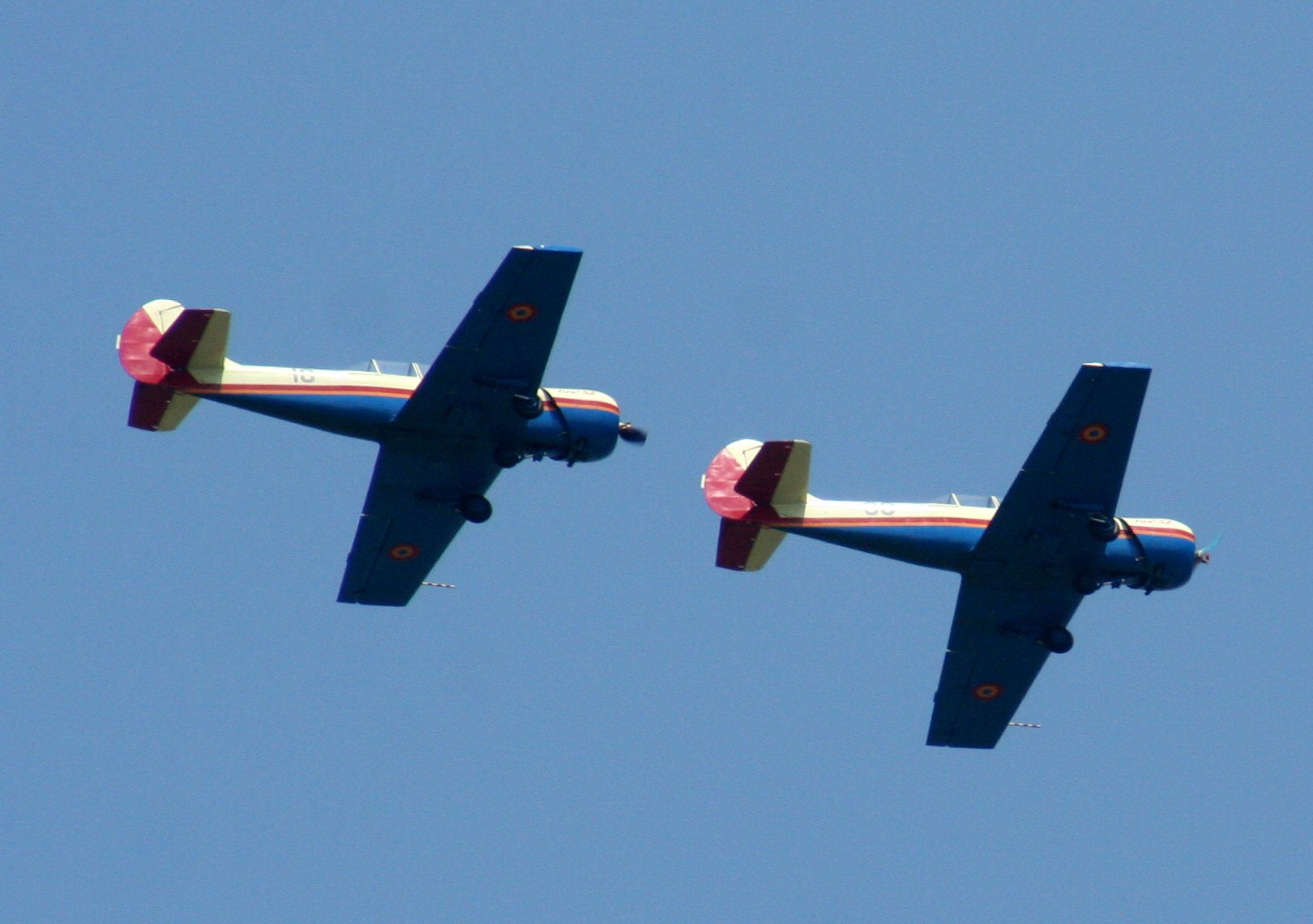
Yakovlev Yak-52
Radial Trainer of the Eastern Bloc
The rugged Soviet-designed, Romanian-built aerobatic trainer that gave a generation of Eastern Bloc pilots their first taste of flying, became a Western warbird favourite, and is now hunting drones over Ukraine.
The Yak-52: how a Soviet club trainer outlived the Cold War
The Yak-52 was born out of a competition. For the 1976 World Aerobatic Championships in Kiev, the Yakovlev bureau produced the single-seat Yak-50, a compact low-wing monoplane with a 360 hp radial, and Soviet pilots flew it to a crushing result, taking the top places in both the men’s and women’s events. The obvious next step was a two-seat version that could teach those same skills to beginners. The result, the Yak-52, flew in 1976 and replaced the long line of Yak-18 trainers in the Soviet system. It was small, tough and simple, and it was meant to be flown hard by teenagers on grass airfields from the Baltic to the Pacific, with the minimum of ground support and the maximum of aerobatic training.
Its customer was DOSAAF, the vast Soviet volunteer society that ran flying clubs across the USSR and gave young people their first hours before they went on to military pilot schools or sport aviation. That shaped the design: tandem seats under a sliding canopy, an extensive pneumatic system for starting, undercarriage, flaps and brakes, a semi-exposed retracting tricycle gear that protects the aircraft in a wheels-up landing, and a Vedeneyev M-14P nine-cylinder radial strong enough for full aerobatics. Under COMECON’s division of labour, production went to Aerostar at Bacău in Romania, which built the type as the Iak-52 until 1998. The Soviet Union supplied the design and the engines; Romania supplied the factory and the workforce.
Well over 1,800 were built, with some counts exceeding 1,900. After the Soviet Union collapsed, hundreds were sold west, and the Yak-52 became one of the cheapest ways to own a genuinely aerobatic ex-military aircraft. In the UK, Australia, New Zealand and the United States it gathered a devoted following of private owners, display pilots and racers. The Romanian Air Force still uses it for ab initio training, and since 2024 both Ukraine and Russia have pressed it into an entirely new role: chasing reconnaissance drones with a gunner in the back seat. Few trainers of its generation have had a stranger third career, and fewer still have stayed so busy nearly half a century after their first flight.
01The Yak-52’s ancestry: from the Yak-18 to the Yak-50
Yakovlev had built Soviet basic trainers since before the Second World War, and the Yak-18 family dominated DOSAAF clubs for a quarter of a century. By the 1970s it was outclassed by Western aerobatic aircraft, and the bureau’s answer was the Yak-50 of 1975, a single-seat competition machine designed around the M-14P radial. Its triumph at the 1976 World Championships in Kiev, where Soviet pilots took the leading places, proved the formula.
The Yak-52 kept the Yak-50’s engine, wing concept and aerobatic strength, added a second cockpit, and borrowed details from earlier Yakovlev two-seaters, including the tandem layout and tricycle gear. The result was heavier and less agile than the single-seater but forgiving enough for students and strong enough to be cleared to +7 and −5 g. The bureau later built further single-seat derivatives, but it was the two-seat Yak-52 that went into large-scale production and became, for millions of people across the Eastern Bloc, the archetypal sound of a Sunday at the local aero club.
02The Yak-52 in Romania: Aerostar and the Iak-52
Within COMECON, light aircraft production was often allocated away from the Soviet Union. Romania’s factory at Bacău, today Aerostar, received the Yak-52 and built it from the late 1970s until 1998, the aircraft carrying the Romanian spelling Iak-52. By the early 1990s more than 1,700 had been built, according to Australian aviation reference Aeropedia, and Aerostar was still producing around 100 a year.
As DOSAAF funding dried up, Aerostar turned to the West. It offered the Iak-52W with western instruments and radios and the tailwheel Iak-52TW with larger tanks, and studied a Lycoming-powered version. These variants helped make the Yak-52 a familiar sight at Western airfields, and Romania itself kept the type for military pilot selection and training. Production finally ended in 1998, by which time the Iak-52 had become one of the most numerous aerobatic trainers ever built, and spares from Romania kept fleets flying on several continents long afterwards.
What makes the Yak-52 special
The M-14P radial
The Vedeneyev M-14P is a supercharged nine-cylinder radial of 360 hp, driving a two-blade constant-speed propeller. It gives the light Yak-52 a strong power-to-weight ratio for vertical aerobatics and is tolerant of being flown inverted for short periods. The engine is also used in Sukhoi aerobatic aircraft. Its sound, a deep clattering bark, is one of the reasons owners love it; its oil consumption and overhaul costs are among the reasons they budget carefully.
Air-powered everything
Unusually for a trainer, the Yak-52 uses compressed air for engine start, undercarriage, flaps and brakes. A compressor on the engine charges the system, with an emergency bottle as back-up. The arrangement suited Soviet clubs operating from grass fields with minimal ground equipment, but it surprises Western pilots: steering is by differential braking through the rudder pedals and a lever on the control stick, and running out of air pressure means running out of brakes.
Gear that forgives
The tricycle undercarriage retracts forwards but leaves the wheels partly exposed. That adds drag, which helps in descending manoeuvres, and it means a pilot who forgets the gear, or has to land on rough ground with it up, will usually slide in on the wheels with limited damage. The robust structure, designed for a 30-year calendar life, and an ability to operate from grass, unprepared surfaces and snow made the aircraft well suited to its club-trainer role.
03The Yak-52’s variants: from Iak-52TW to Yak-52M
- Yak-52 / Iak-52: the standard tricycle-gear trainer with the M-14P.
- Yak-52B: light attack version with two UB-32 rocket pods.
- Iak-52W: Aerostar’s westernised version with western instruments.
- Iak-52TW: tailwheel version with larger fuel capacity and western instruments.
- Yak-52M: Russian modernisation with M-14X engine, three-blade propeller, new avionics, integral wing tanks and an escape system; first flew on 16 April 2004.
- Yak-52TD: Lithuanian tailwheel modification.
- UTL-450: Ukrainian Motor Sich conversion with an AI-450S turboprop, 2016.
- Yak-52B2: Russian drone-hunting conversion with a semi-automatic shotgun and sensor turret, reported in 2025.
Yakovlev Yak-52 specifications
Specifications
- Crew
- 2 (tandem)
- Length
- 7.745 m (25 ft 5 in)
- Wingspan
- 9.30 m (30 ft 6 in)
- Height
- 2.70 m (8 ft 10 in)
- Wing area
- 15.0 m² (161.5 sq ft)
- Empty weight
- 1,015 kg (2,238 lb)
- Max take-off weight
- 1,305 kg (2,877 lb)
- Powerplant
- 1 × Vedeneyev M-14P 9-cylinder radial, 360 hp (270 kW)
- Maximum speed
- 285 km/h (177 mph) at sea level; never-exceed 360 km/h (224 mph)
- Cruise speed
- 190 km/h (118 mph)
- Range
- 550 km (340 mi)
- Service ceiling
- 4,000 m (13,100 ft)
- Climb rate
- 5 m/s (985 ft/min)
- g limits
- +7 / −5
- Armament
- None as a trainer; Yak-52B with two rocket pods; improvised rifles and shotguns in Ukrainian and Russian drone-hunting use
Costs & production
- Cost per flight hour
- Hedged estimate: roughly £300–500 (about US$400–650) for a privately owned example, based on an M-14P burning on the order of 60 litres of avgas an hour plus oil and an engine overhaul reserve; figures vary widely
- Production
- 1,800+ built, mainly by Aerostar at Bacău, Romania; some counts exceed 1,900
- Programme
- 1976 first flight; Romanian production late 1970s to 1998; Yak-52M modernisation 2004
04The Yak-52’s operating costs: cheap to buy, not free to run
The Yak-52’s appeal in the West has always been price. Compared with any other ex-military aerobatic aircraft it is inexpensive to buy, and parts were plentiful after the Cold War. Running costs are another matter: the M-14P is thirsty for an aircraft of this size, commonly burning in the region of 60 litres of avgas an hour in normal flying and more in aerobatics, and like any radial it uses oil. The engine and propeller need overhaul reserves, and the pneumatic system demands attention. Owners commonly estimate total costs of a few hundred pounds per flying hour; we give a range rather than a single figure because insurance, hangarage and usage differ so much.
The Yak-52 from Kiev to the drone war
Yak-50 flies
Yakovlev’s single-seat competition aircraft makes its first flight.
Kiev triumph and Yak-52 first flight
The Yak-50 dominates the World Aerobatic Championships; the two-seat Yak-52 flies the same year.
Romanian production
Aerostar at Bacău begins series production for DOSAAF.
Westward exports
With DOSAAF in decline, Yak-52s reach private owners in the UK, Australia and the United States.
Production ends
Aerostar ends Iak-52 production after more than 1,800 aircraft.
The Yakovlevs
A UK display team forms around Yak-50s and Yak-52s; it will perform for more than two decades.
Yak-52M
The modernised Yak-52M, with an M-14X engine and escape system, first flies on 16 April.
Turboprop conversion
Ukraine’s Motor Sich shows the UTL-450 with an AI-450S turboprop.
Drone hunter
Ukrainian Yak-52s begin shooting down Russian reconnaissance drones over the Odesa region.
Russia copies the idea
A Russian Yak-52B2 with an underwing shotgun and sensor turret is reported in testing.
Stories & eyewitnesses: the Yak-52 in clubs, airshows and war
Kiev, 1976: the parent’s triumph
The Yak-52 inherited its engine and spirit from a world-beater.
Read the full story
Boboc: where Romanian pilots start
The Romanian Air Force still begins fixed-wing training on the Iak-52.
Read the full story
A shotgun in the back seat
Ukrainian crews turned the trainer into a drone hunter.
Read the full story
Russia builds its own
The drone-hunting Yak-52 was copied by the other side.
Read the full story
The Yakovlevs
A UK team flew Yaks at more than 2,000 displays.
Read the full story
The warbird for everyone
The Yak-52 opened ex-military flying to private pilots.
Read the full story
One design, one world championship
The FAI runs a world championship just for the Yak-52.
Read the full story
A screwdriver in the controls
A loose tool caused a fatal crash in New Zealand.
Read the full story
Highwood, 2014
A UK investigation that could not find the answer.
Read the full story
The modernised Yak-52M
Russia tried to give the old trainer a second career.
Read the full story
Where the Yak-52 flies and flew
The Yak-52’s record
The Yak-52 was designed for flying clubs and spent most of its life teaching students. A rocket-armed Yak-52B existed, but the type’s only real combat has come in the Russo-Ukrainian war, where both sides use it to shoot down drones with guns fired from the rear cockpit.
See how training and combat types compare in the military aircraft statistics database. Figures are approximate.
Everything people ask about the Yak-52
Can I fly in a Yakovlev Yak-52?
Who built the Yak-52?
How many Yak-52s were built?
Is the Yak-52 still in military service?
How does a Yak-52 shoot down drones?
What engine does the Yak-52 have?
How aerobatic is the Yak-52?
You can’t fly the Yak-52.
These, you can.
Most of this museum you can only look at. These genuine military jets you can fly yourself with MiGFlug — with aerobatics and time on the controls.
 Fly the L-39 AlbatrosThe world’s most-flown jet trainer — aerobatics included
 Fly the F-104 Starfighter“The missile with a man in it”
 Fly the MiG-21The Cold War’s most-produced jet
 Fly the T-33 Shooting StarAmerica’s first jet trainer
 Fly the DH VampireA piece of early jet history
 Fly the S.211Agile Italian jet trainer
 Fly the MB-326The classic Aermacchi jet
 Fly the MiG-15The Soviet legend of the Korean War
Continue the tour
Every fact, checked
- Yak-52Production, Aerostar versions, Yak-52M modernisation and performance data
- Yakovlev Yak-52Design origins, 1976 championships, production by 1993 and Western imports
- Russia testing shotgun-armed Yak-52 trainer aircraft to down Ukrainian dronesThe War Zone (Thomas Newdick, 2025) on Ukrainian kills and the Russian Yak-52B2
- Fatal accident report ZK-YTW, 23 January 2012Civil Aviation Authority of New Zealand investigation
- AAIB investigation to Yak-52, G-YAKRUK Air Accidents Investigation Branch report on the 2014 Highwood accident
- Aurel Vlaicu flight school, BobocRomanian Air Force training sequence on the Iak-52
- 25 June 1975: first flight of Yakovlev Yak-50The Yak-50 parent design
- Ukraine’s canary-yellow vintage Yak-52 is hunting Russian dronesEuromaidan Press summary of Forbes reporting on Ukrainian drone hunting