
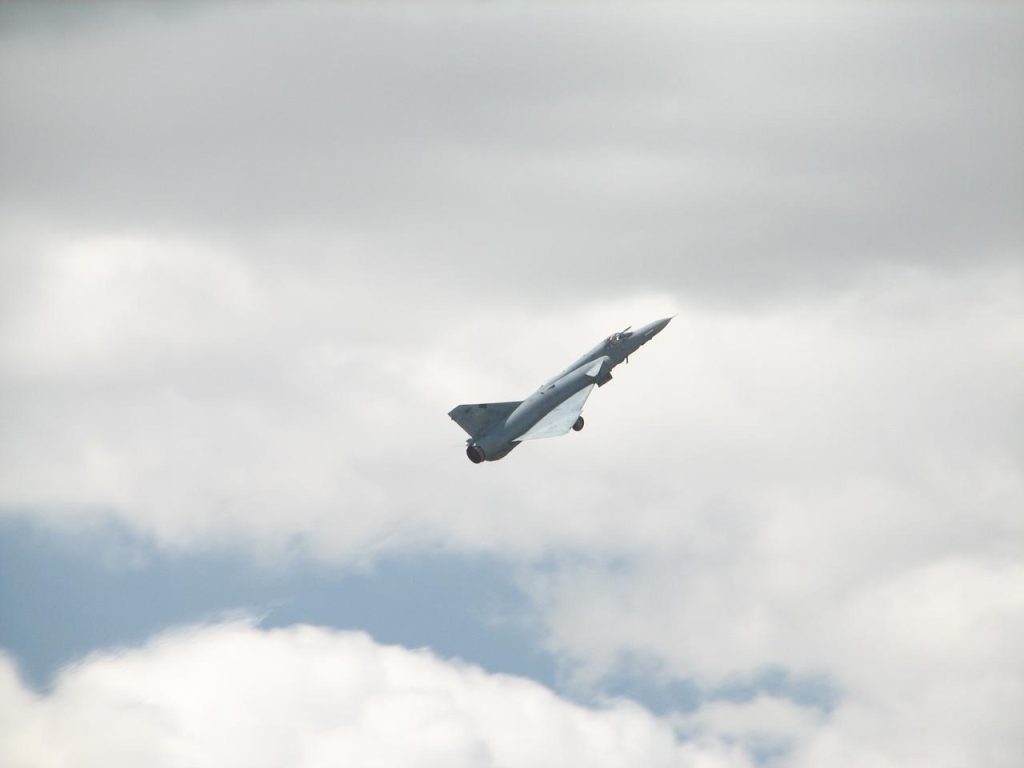
Atlas Cheetah
Mirage III, reborn under embargo
South Africa’s answer to a UN arms embargo — a 1960s Mirage III rebuilt with canards, a modern radar and quiet Israeli know-how into a capable, if late-arriving, multirole fighter.
Built because the world said no
By the early 1980s South Africa was in a corner. Its French-built Mirage III fighters, bought in the 1960s, were ageing fast, and a United Nations arms embargo — voluntary from 1963 and made mandatory by Security Council Resolution 418 on 4 November 1977 in response to apartheid — had closed the door on buying or licence-building modern Western replacements. A planned Mirage F1 production licence had been revoked. The country could either design a clean-sheet fighter it could not afford, or rebuild what it already had.
The state-owned Atlas Aircraft Corporation chose the second path. From 1984 it began taking the SAAF’s surviving Mirage III airframes apart and rebuilding them into a substantially new aircraft: the Cheetah. Reports commonly cite roughly half the components being replaced. The reworked jet gained fixed canard foreplanes, a re-profiled “dogtooth” wing leading edge, nose strakes, a lengthened nose, new avionics and an in-flight refuelling probe — changes that closely mirror Israel’s Mirage-derived IAI Kfir.
That resemblance is no accident, though it was never officially admitted at the time. Two internationally isolated states — apartheid South Africa and Israel — are widely understood to have cooperated on the programme, but South African authorities would “neither confirm nor deny” Israeli assistance, and the exact scope of the exchange remains partly unresolved in open sources. Treat the Kfir link as strongly evidenced but deliberately kept murky to sidestep the embargo.
The first Cheetah — a two-seat Cheetah D — was rolled out on 16 July 1986, followed by interim single-seat Cheetah E interceptors and, from 1993, the definitive multirole Cheetah C with a modern Israeli pulse-Doppler radar. The type arrived as the South African Border War in Angola and Namibia was already winding down; Cheetah Es stood quick-reaction alert in 1987–89 but, according to SAAF sources, no Cheetah variant engaged in Border War combat. Its career was one of peacetime air defence, deterrence and training. The SAAF retired the Cheetah on 1 April 2008 as Saab Gripen fighters arrived; retired airframes later flew on with Ecuador and were contracted to the US adversary-training firm Draken International.
01The Atlas Cheetah and the arms embargo: how sanctions forced a home-grown fighter
UN Security Council Resolution 418 made the arms embargo against South Africa mandatory in November 1977, cutting off imports of combat aircraft and, crucially, a Mirage F1 production licence. Rather than go without, Pretoria leaned on domestic industry — Atlas Aircraft Corporation, which already assembled Aermacchi trainers under licence — and on quiet foreign technical help to rebuild its Mirage IIIs. The Cheetah became a case study in sanctions-driven aerospace: extensive airframe re-lifing, roughly 50% component replacement, locally developed missiles and integrated avionics. The embargo was lifted only in 1994, the same year apartheid ended — by which time the Cheetah was already the SAAF’s front-line fighter.
What makes it special
Canards and a dogtooth wing
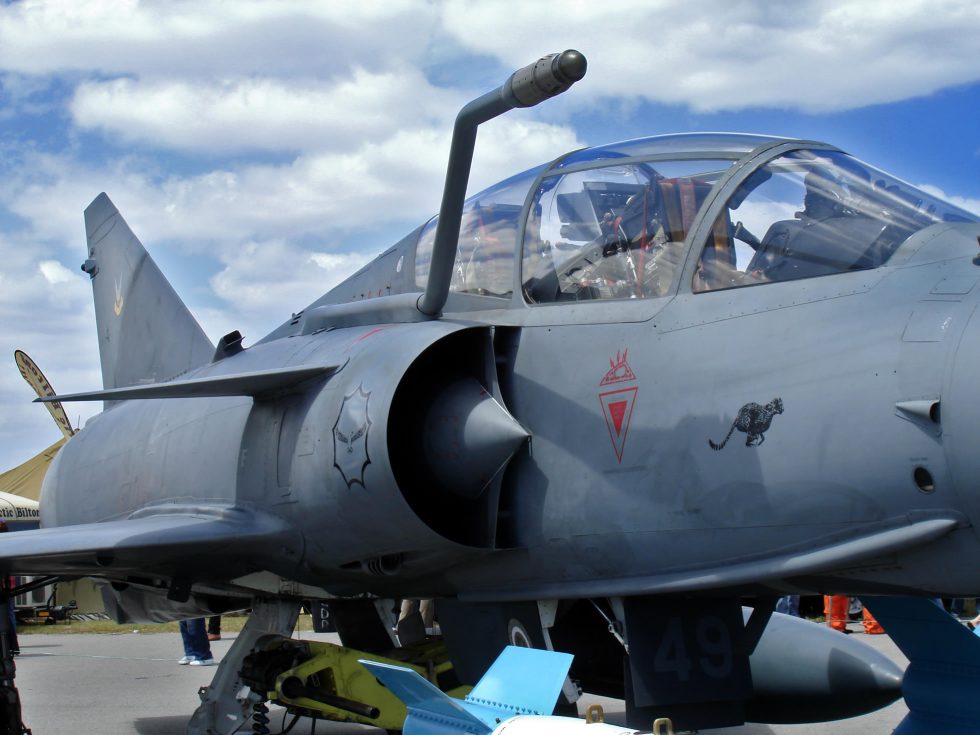
The most visible change from the Mirage III is a pair of fixed canard foreplanes mounted high on the intakes, plus a dogtooth (saw-tooth) extension on the wing leading edge and small nose strakes. Together they generate extra lift and vortex energy at high angle of attack, sharpening instantaneous turn, low-speed handling and takeoff performance — transforming the pure-interceptor manners of the delta Mirage into something far more controllable in a dogfight.
Rebuilt under embargo
The Cheetah is what an isolated country builds when it cannot buy a fighter. State-owned Atlas Aircraft Corporation stripped and rebuilt 1960s Mirage III airframes — commonly cited as roughly half the components replaced — drawing on features shared with Israel’s IAI Kfir. The cooperation was never officially confirmed; authorities would “neither confirm nor deny” it. South Africa paired the airframe with its own missiles, making the whole weapon system as self-reliant as sanctions demanded.
A modern radar, avionics and a probe
The definitive Cheetah C fitted a modern Israeli Elta pulse-Doppler radar (commonly cited as the EL/M-2035), a glass cockpit with HUD and helmet-mounted sight, a data-link and a fixed in-flight refuelling probe. Combined with the radar-guided R-Darter missile, this turned an early-1960s point-defence interceptor into a genuine 1990s multirole fighter able to fly beyond-visual-range air-to-air and precision air-to-ground missions.
02The Atlas Cheetah’s canards and dogtooth wing: taming the delta
A tailless delta like the Mirage III trades agility for high-speed efficiency: it bleeds energy hard in a turn and lands fast. The Cheetah’s canards, dogtooth leading edge and nose strakes attack exactly those weaknesses. The foreplanes and the vortices shed by the dogtooth energise airflow over the wing at high angle of attack, improving controllability, turn rate and takeoff and landing behaviour. It is the single most recognisable Kfir-derived change, and the reason a Cheetah looks meaner than the Mirage it was built from.
03The Atlas Cheetah’s Kfir connection: the cooperation nobody would confirm
The Cheetah’s canards, dogtooth wing, nose strakes and refuelling probe closely echo Israel’s IAI Kfir, itself a Mirage derivative. Two internationally isolated states are widely understood to have cooperated to evade the embargo, but neither government documented the arrangement, and South African officials would “neither confirm nor deny” Israeli assistance. Historians treat the link as strongly evidenced; contemporaneously it was an open secret kept deliberately vague. Just how much technology and hardware crossed over — and whether the Cheetah is essentially a licence-built Kfir or a parallel design — remains debated in open sources.
Full specifications
Baseline note: the figures below describe the Cheetah C, the definitive single-seat South African Air Force version — 38 aircraft, the first rolled out in January 1993, every one of them serving with 2 Squadron at AFB Louis Trichardt (renamed AFB Makhado in 2003) until the last was retired on 2 April 2008. Deltas for the two-seat Cheetah D of 1986 and the interim single-seat Cheetah E of 1988 are in grey. Five warnings have to come before the tables, because the published Cheetah data set is unusually contaminated by numbers inherited from the Mirage III rather than measured on the aeroplane that replaced it. First, the airframes do not add up. South Africa bought 41 single-seat Mirage IIIs in all — 16 IIICZ interceptors delivered from December 1962, 17 IIIEZ fighter-bombers from 1965, 4 IIIRZ and 4 IIIR2Z reconnaissance machines. Sixteen became Cheetah Es, 38 more emerged as Cheetah Cs, and even if every surviving single-seater in the inventory had been fed through the line, reconnaissance airframes included, and even allowing for the Cheetah Es withdrawn in 1992 to have gone round a second time, the sum does not close after two decades of accidents and a border war. The standing explanation is Israel, and the strongest documentary thread is the Kfir C.9 — an Atar 9K50-powered Kfir offered to Argentina, cancelled, and afterwards developed into the Atlas Cheetah. Neither Pretoria nor Jerusalem has ever confirmed a transfer of airframes, and any flat statement that the Cheetah C is simply a rebuilt SAAF Mirage IIIEZ should be treated as unproven. Second, the weights. An empty weight of 6,600 kg and a maximum take-off weight of 13,700 kg are the Mirage IIIC and IIIE figures verbatim. A rebuild that replaced something like half the structure, stretched the nose, added canards, a refuelling probe, two more pylons and a complete electronic-warfare suite did not come out of the shop lighter than the aeroplane it started from; treat the weight column as inherited paperwork, not as weighing-bay data. Third, the radar. The Cheetah C carried an Elta multi-mode pulse-Doppler set that is almost universally identified as the EL/M-2032, but that identification was never confirmed by the SAAF, by Denel or by Elta while the aircraft was in service. Fourth, the stations. The standard reference block credits five external hardpoints, yet the same sources describe two extra pylons added at the wing roots during the rebuild, which gives seven; both numbers are reproduced below rather than averaged. Fifth, the performance column. Maximum speed, ceiling and rate of climb below are Mirage III-family figures carried forward. A Cheetah C is heavier and draggier than a Mirage IIIE, and no independently published flight-test set exists for it.
Dimensions & weights
- Crew
- 1 — the Cheetah D seated two in tandem and was a full combat aircraft rather than a trainer, the SAAF’s designated carrier for the H2 glide bomb and its stand-off successors
- Length
- 15.55 m (51 ft 0 in) including the extended nose. The Mirage IIIE it grew from was 15.03 m; the IAI Kfir, whose nose profile the Cheetah copies almost exactly, was 15.65 m
- Wingspan
- 8.22 m (27 ft 0 in) — untouched from the Mirage III and identical to the Kfir. The delta was reworked, not replaced
- Height
- 4.5 m (14 ft 9 in) to the fin tip
- Wing area
- 35 m2 (377 sq ft), a shade up on the Mirage III’s 34.85 m2 because of the dogtooth and the extended, drooped leading edge
- Canard area
- 1.66 m2 (17.9 sq ft) — fixed foreplanes on the intake shoulders, not all-moving. The Cheetah D and E wore canards roughly 70 per cent smaller, which is the quickest way to tell the marks apart in a photograph
- Wing planform
- Tailless delta, 60.5° leading-edge sweep, dogtooth incision and drooped leading edge — the dogtooth and the droop together bought a usable increase in lift and manoeuvre margin at high angles of attack, which is exactly what a delta interceptor lacks in a turning fight
- Empty weight
- 6,600 kg (14,550 lb) as published — but this is the Mirage IIIC number and is very unlikely to describe a Cheetah C. See the baseline note above
- Max take-off weight
- 13,700 kg (30,200 lb), again the Mirage IIIE figure. If the Cheetah C really lifted 4,000 kg of stores from an empty weight of 6,600 kg, the fuel load implied is unrealistically small
- Max external stores
- ~4,000 kg (8,800 lb) — roughly three times what a Mirage IIIEZ carried in SAAF service, and the single most convincing argument for the rebuild having been worth the money
- Hardpoints
- 5 published, 7 in practice — one centreline, two inboard and two outboard wing stations from the Mirage III, plus a pair added at the wing roots during the rebuild for air-to-air missiles. Reference blocks that say five have simply not counted the new pair
- Wing loading
- 250 kg/m2 (51.2 lb/sq ft) at the quoted gross weight. High by fourth-generation standards and the inescapable price of a 1950s delta, however cleverly it is rebuilt
- Internal fuel
- Not reliably published — no figure for the Cheetah C has ever appeared that can be traced to a primary source. The Mirage III baseline was about 3,300 litres, and the Cheetah is generally said to have gained a little in the fuselage plug, but the number is genuinely unknown outside Denel
Performance
- Max speed, altitude
- 2,350 km/h (1,460 mph, 1,270 kn) at 12,000 m, Mach 2.2 — an inherited Mirage III figure and an academic one. No SAAF Cheetah went to war, and a fully equipped C with canards, strakes and a probe will not have matched a clean 1965 Mirage IIIE
- Max speed, sea level
- 1,390 km/h (864 mph, 751 kn), Mach 1.13 — the number that actually mattered for the low-level strike profile the SAAF flew
- Rate of climb
- 233.5 m/s (46,000 ft/min) initial, clean. The Atar 9K50 gave the Cheetah C a genuinely brisk climb; this is one area where the rebuild was an improvement on the Mirage IIIEZ rather than a restatement of it
- Service ceiling
- 17,000 m (55,800 ft) — with zoom climbs well above it, as with every Atar-powered delta
- Range
- 1,300 km (810 miles, 700 nmi) on internal fuel. The Mirage F1AZ, which the SAAF flew alongside the Cheetah, was meaningfully better on fuel and range, and the SAAF said so openly
- Ferry range
- 2,600 km (1,615 miles, 1,400 nmi) with external tanks
- Combat radius
- ~600 km (370 miles, 325 nmi) on a hi-lo-hi strike with two 1,300-litre tanks and a modest bomb load. No official radius figure has ever been released; this is a reconstruction from the range figures and should be read as an order of magnitude
- Thrust-to-weight
- 0.53 at maximum take-off weight — rising to roughly 0.8 in a clean air-defence fit at combat weight. Respectable for a rebuilt delta; well short of an F-16 or a MiG-29
- Approach and landing
- Fast, and the Cheetah’s known weakness — a tailless delta bleeds energy in the flare and lands nose-high and quick. A braking parachute was standard, as on the Mirage III
- In-flight refuelling
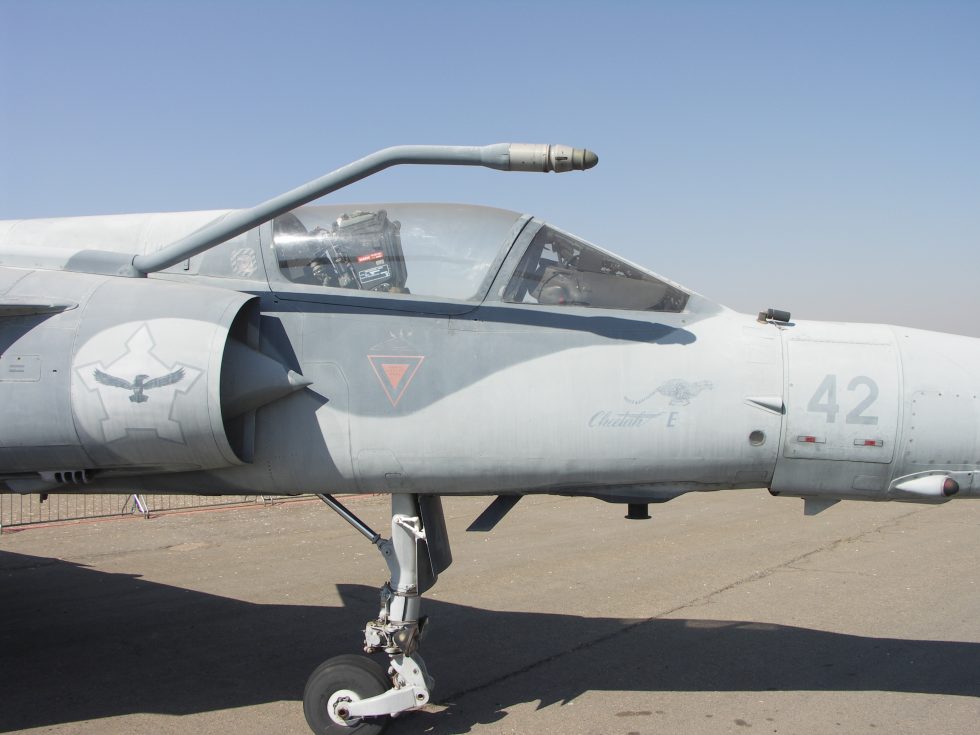
- Fixed probe, starboard forward fuselage — the SAAF tanked from converted Boeing 707s. Squadron experience was that the Cheetah was markedly harder to refuel in flight than the Mirage F1, a handling penalty that is rarely mentioned in the aircraft’s publicity
- Endurance on station
- Short — the Cheetah C was a point interceptor and a first-pass striker, not a patrol aeroplane. This was the central operational argument for replacing it with the Gripen rather than upgrading it again
Propulsion & systems
- Engine
- One SNECMA Atar 9K50 single-shaft afterburning turbojet — the Mirage F1 engine, licence-built and overhauled in South Africa through the embargo years. The Cheetah E kept the older Atar 9C-3, and 10 of the 16 Cheetah Ds were re-engined with the Atar 09K50C-11 under Project Recipient
- Thrust
- 49.2 kN dry (11,100 lbf), 70.6 kN with afterburner (15,900 lbf). The Atar 9C-3 of the Cheetah D and E gave 60.8 kN (13,700 lbf) in reheat, a difference of roughly 16 per cent that shows up directly in climb and acceleration
- Intakes
- Fixed side intakes with translating half-cone shock bodies — unaltered Mirage III geometry, and the item that ultimately capped the aeroplane’s speed and its scope for a bigger engine
- Radar
- Elta multi-mode pulse-Doppler, look-down/shoot-down, widely identified as the EL/M-2032 — the radar family that came out of the cancelled IAI Lavi programme. The Cheetah E carried only a simple ranging set, usually named as the EL/M-2001B, which is why the E was an interim aeroplane rather than a real fighter
- Helmet-mounted sight
- Indigenous South African design, integrated with the V3 missile family — the significant point, and the one most often missed: South Africa had helmet-cued missile shots in operational squadron service from about 1980 on the Mirage F1CZ, roughly contemporaneous with the Soviet Shchel-3UM on the MiG-29 and a full generation before NATO fielded JHMCS
- Cockpit
- Wide-angle head-up display, multi-function displays, HOTAS controls, one-piece wrap-around windscreen — the wrap-around screen is the fastest external identifier of a Cheetah C. The D and E kept the framed Mirage III canopy
- Navigation and data
- Inertial navigation with later satellite update, air data computer, tactical data link — the data link let a pair of Cheetah Cs share a radar picture, which is a serious capability for a 1993 aeroplane derived from a 1956 design
- Self-protection
- Radar warning receiver, missile approach warning, internal jammer, automatic chaff and flare dispensers — specified against the SA-2, SA-3, SA-6 and SA-8 belt the SAAF expected to meet over Angola, and all of it South African
- Flight controls
- Mechanical elevons with twin-computer augmentation, plus nose strakes — the strakes and canards together were what made the high-alpha behaviour tolerable. This is not a fly-by-wire aeroplane and never pretended to be
- Structure
- New main wing spar, new skinning, revised fuselage; around half the original airframe replaced — which is why the word "upgrade" undersells it. A Cheetah C is closer to a new aeroplane built to Mirage III drawings than to a modified Mirage III
- Ejection seat
- New zero-zero seat replacing the Mirage III original — the specific mark is not consistently reported in open sources
- Alternative engine
- SMR-95, a Klimov RD-33 derivative, flown in Cheetah D serial 847 — performance was reportedly impressive, but centre-of-gravity problems and budget cuts killed it. Had it gone ahead it would have been one of the strangest powerplant marriages in aviation: a Soviet fighter engine in a French delta rebuilt with Israeli help by an apartheid state
04The Atlas Cheetah’s operating costs: why no clean figure exists
The Cheetah was never sold on an open market as a new aircraft — it was a state rebuild of existing SAAF Mirage IIIs under sanctions — so no flyaway unit price or credible cost-per-flight-hour figure exists in the public record. Later export deals give the only hard numbers: Denel’s sale of about a dozen retired Cheetahs to Ecuador was reported at roughly US$78 million including spares and training, and the troubled Draken International contract was valued in the tens of millions of US dollars. Any precise operating-cost figure attached to a Cheetah should be read as an estimate.
Armament & payload
The Cheetah C carried an almost entirely South African weapon set, because by 1993 nobody else would sell one
Two nomenclature corrections have to be made first, because the usual shorthand collapses four distinct weapons into two. The V3B is the Kukri, not a Darter: it is the 1980-vintage helmet-cued infra-red missile that the Mirage F1CZ took into combat over Angola. The Darter name begins with the V3C, and the family then runs on through the imaging-infra-red U-Darter to the active-radar R-Darter. Separately, the H2 and the Raptor are not two weapons but one — H2 is the SAAF service name for the Kentron Raptor I glide bomb; the Raptor II is the longer-ranged export development, and the Pakistani H-2 and H-4 are widely held to be licence-built Raptor I and Raptor II. Weapon fits differed sharply between marks: the Cheetah E was a gun-and-Kukri stopgap with no radar worth the name, the Cheetah D was the SAAF’s designated glide-bomb carrier, and only the Cheetah C could shoot beyond visual range.
What makes the Cheetah’s armament interesting is not any individual weapon but the fact of the set existing at all. UN Security Council Resolution 418 of November 1977 made the arms embargo mandatory, and South Africa responded by building a complete air-combat weapons industry from the gun outwards: its own infra-red missiles, its own seeker technology, its own helmet sight, its own glide bomb, its own jammers and dispensers. By the 1990s a 2 Squadron Cheetah C could fly a full air-defence or strike mission without a single component whose supply a foreign government could switch off, the engine and the airframe drawings excepted. Very few air forces of any size have ever managed that, and none did it while under sanction.
The cost was breadth. The Cheetah never acquired a targeting pod, so it had no organic laser designation and no autonomous laser-guided-bomb capability of the sort that was routine in NATO by 1995. Its precision weapon was the H2, a television-guided glide bomb steered by a weapons officer down a data link from the back seat of a Cheetah D, which is a workable answer and a narrow one. And the whole arsenal was theoretical: there is no evidence that any Cheetah of any mark ever fired a shot in anger. The aeroplane was declared operational as the Border War was ending, and it spent the next twenty years as an extremely well-armed deterrent that never had anything to deter.
Gun — two 30 mm DEFA revolver cannon, unchanged since 1962
- Two DEFA 552 30 mm revolver cannon in the lower forward fuselage, 125 rounds per gun, about 1,300 rounds a minute each.
- The installation is pure Mirage III and was left alone through the rebuild: the guns were reliable, the ammunition was made locally, and there was no reason to spend embargo-era money on the one system that already worked.
- 250 rounds in total is a short magazine — something like five seconds of firing across both guns. This is a missile aeroplane with cannon attached, not a gunfighter.
- The 30 mm round is heavy and slow compared with the American 20 mm M61, which suits a single well-aimed pass and suits a low-level strafing run against vehicles even better.
- The Cheetah D kept both guns, unusually for a two-seat conversion trainer, because it was expected to fight.
Air-to-air — the V3 family, and the helmet that aimed it
- V3B Kukri: rear-aspect infra-red missile cued by a helmet-mounted sight, in squadron service from about 1980. Its pairing with the Mirage F1CZ gave the SAAF off-boresight missile shots years before most Western air forces had the concept.
- V3C Darter: the improved seeker and airframe that carried the family into the Cheetah era and became the C’s standard short-range round.
- U-Darter: imaging infra-red, all-aspect, high off-boresight, the last of the line to reach SAAF service and the direct ancestor of the A-Darter now carried by the Gripen.
- R-Darter: the active-radar beyond-visual-range missile, closely related to the Rafael Derby and the reason the Cheetah C’s Elta radar existed. Fielded on the Cheetah C alone; withdrawn with the aircraft in 2008.
- Rafael Python 3, locally designated V3S Snake, and the older Matra R.530 inherited from the Mirage III were also cleared, the R.530 being of no practical value by the 1990s.
Air-to-surface guided — one glide bomb and a shelf of cancelled successors
- H2, the SAAF name for the Kentron Raptor I: a television-guided glide bomb with a two-way data link, released at altitude and flown to the target by an operator, range on the order of 60 km (37 miles).
- The H2 was cleared on the two-seat Cheetah D rather than the C, because the mission needs a second crew member watching the seeker picture. This is the single most important reason the D was not merely a trainer.
- Raptor II, the 120 km (75 mile) development with an imaging-infra-red terminal seeker, was an export product; Pakistan’s H-4 is generally taken to be its licence-built equivalent.
- MUPSOW, a modular powered stand-off weapon, was flown on Cheetah D serial 845 and never entered service. The TORGOS cruise missile went the same way when the money stopped.
- No targeting pod was ever fielded, so laser-guided weapons were not an organic Cheetah capability. Claims that the Cheetah C routinely carried 250 kg laser- and satellite-guided bombs describe an intention and a marketing brochure, not a squadron fit.
Bombs — South African iron, mostly for the low pass
- South African 120 kg, 250 kg and 460 kg general-purpose bombs (265 lb, 550 lb and 1,015 lb), in slick and retarded forms, all produced domestically under the embargo.
- Retarded tails mattered more than usual: SAAF doctrine over Angola was low and fast, and a slick bomb dropped from 60 m kills the aeroplane that dropped it.
- CB-470 cluster bombs, the South African runway- and area-attack weapon of the Border War period.
- Practice bombs and carriers for the vast majority of the Cheetah’s actual flying, which was training.
- Total external load about 4,000 kg (8,800 lb) — roughly triple the Mirage IIIEZ, and the clearest single measure of what the rebuild bought.
Rockets — inherited French pods, retained because they worked
- Matra rocket pods, each with 18 SNEB 68 mm unguided rockets, carried on the wing pylons.
- Matra JL-100 combined pods, a 250-litre fuel tank with 19 SNEB rockets built into the nose — a very 1960s idea that suited a short-legged delta attacking soft targets.
- South African 68 mm rocket production kept the pods fed after the French supply ended.
- By the Cheetah C era rockets were a secondary and increasingly nominal capability; the aeroplane was a fighter first.
- Unguided rockets against a defended target require a shallow dive at predictable speed, which by 1990 was close to suicidal against SA-8 and radar-directed anti-aircraft artillery.
Pods & other stores — fuel, cameras and jamming
- Vinten Vicon 18 Series 610 reconnaissance pod, carried on the Cheetah C centreline. The SAAF chose this over a dedicated reconnaissance conversion and accordingly built only one Cheetah R prototype.
- Supersonic drop tanks of 1,300 and 1,700 litres (343 and 449 US gal) on the inboard wing stations, essential on almost any mission of consequence.
- Internal electronic countermeasures rather than a pod, which is unusual for the class and freed a station; podded jammers were available as an alternative fit.
- Automatic chaff and flare dispensers built into the rear fuselage, cued by the missile approach warner.
- The refuelling probe is not a store but behaves like one aerodynamically, and it stayed fitted permanently.
Three typical loadouts
- Air defence, Cheetah C
- Two R-Darter on the wing-root stations, two V3C Darter or U-Darter on the outboard pylons, two 1,300-litre tanks inboard, full 250 rounds of 30 mm. The configuration 2 Squadron sat alert in, and the one the whole rebuild was ultimately for.
- Low-level strike, Cheetah C
- Four 460 kg retarded bombs on the wing pylons, two 1,300-litre tanks, a pair of V3C for self-defence, guns loaded. Hi-lo-hi, first pass, no loitering — the delta has neither the fuel nor the survivability for a second run.
- Stand-off precision, Cheetah D
- One H2 glide bomb on the centreline, data-link pod, two tanks, two V3C. Released from altitude outside the defended ring and steered onto the aim point by the back-seater. The SAAF’s only real precision-attack option until the Gripen and the Hawk arrived.
Sourcing caveat: no operational Cheetah loadout table has ever been published by the SAAF, and the three fits above are reconstructions from cleared-weapon lists, squadron photographs and the Denel export literature rather than from a stores manual. Several weapons routinely listed against the Cheetah — the Nord AS-12 in particular, which appears on the SAAF’s own obsolete-systems list against the Cheetah C and D — sit badly with the aircraft’s mission set and may be catalogue artefacts. The MUPSOW and TORGOS entries describe development programmes, not fielded weapons.
Variants
The Cheetah was three different aeroplanes wearing one name, built in the wrong order
Most upgrade programmes start with the fighter and add the trainer afterwards. Project Cushion did the reverse, and for a reason: the two-seat Cheetah D came first because South Africa had the fewest two-seat Mirage III airframes to lose, because a trainer conversion was the safest place to prove Israeli-derived avionics that nobody would admit to supplying, and because the programme had to show a flying result before the money ran out. The single-seat Cheetah E followed as a stopgap with an old engine and a ranging radar, and the definitive Cheetah C — the one the whole exercise was aimed at — did not appear until January 1993, by which time the war it was designed for had ended, Namibia was independent and the apartheid state was negotiating its own dissolution.
The verdict on the programme depends entirely on what you measure. As an engineering achievement it is remarkable: an isolated country of 35 million people rebuilt a 1950s French interceptor into a radar-equipped, data-linked, helmet-cued multi-role fighter with domestic missiles and a domestic glide bomb, and did it well enough that Ecuador was still flying the result in 2024. As a piece of defence policy it was expensive, late and strategically pointless, delivering a first-class fighter to a country that by then had no enemies and no intention of fighting anyone.
The Israeli thread runs through every mark and is never quite admitted. The extended nose, the fixed canards on the intake shoulders, the dogtooth and the drooped leading edge are Kfir features; the radar family descends from the cancelled IAI Lavi; the R-Darter is a close relation of the Rafael Derby; and the Kfir C.9, an Atar-engined Kfir shopped to Argentina and dropped, is described in the reference literature as having been "later developed as South Africa’s Atlas Cheetah". Both governments were under embargo, both had reasons to keep quiet, and thirty years later the paperwork has still not surfaced. What can be said with confidence is that the Cheetah is not a South African aircraft in the sense that the Rooivalk is: it is a South African rebuild, executed with South African avionics and weapons, of a French design reworked along Israeli lines.
The end came quickly and for the ordinary reason. By 2000 the Cheetah C was a fine fighter attached to an obsolete airframe: short on fuel, short on endurance, expensive per flying hour, and with no growth left in an intake and wing designed in 1956. South Africa ordered 26 Gripens — 17 single-seat C and 9 two-seat D — and the last Cheetahs of 2 Squadron flew on 2 April 2008, the first Gripen D arriving later the same month. It was a clean, well-managed retirement, and one the SAAF has had cause to regret only in the sense that the Gripen fleet has since spent long periods grounded for want of a support contract.
- Cheetah D (unveiled 16 July 1986; 16 converted, line closed 1991)
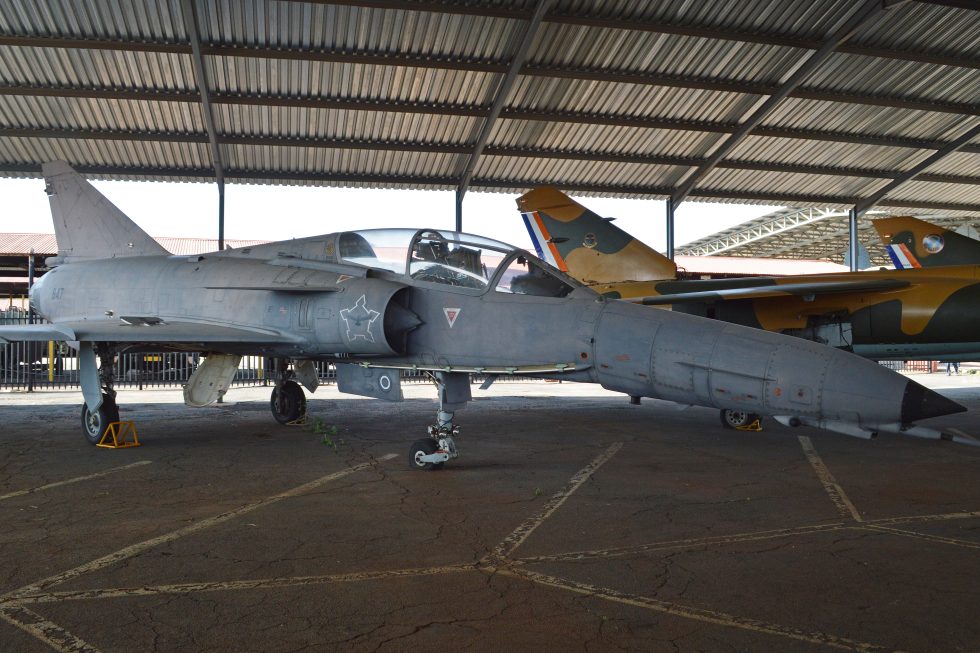
- Two-seat rebuild of the Mirage IIID2Z and IIIDZ, in service with 89 Combat Flying School at AFB Pietersburg from 1987 and later with 2 Squadron. Small canards, Atar 9C initially, and the SAAF’s designated H2 glide-bomb carrier — a strike aircraft that also trained pilots, not the other way round.
- Cheetah D, Project Recipient (10 aircraft, 1990s)
- Ten of the sixteen Ds re-engined with the Atar 09K50C-11 to bring them closer to Cheetah C performance. The other six kept the Atar 9C and were correspondingly sluggish.
- Cheetah E (16 converted; withdrawn 1992)
- Single-seat interim fighter on Mirage IIIEZ airframes, small canards, Atar 9C-3 and a simple ranging radar. Flown by 5 Squadron at AFB Louis Trichardt as a standby interceptor with V3B and V3C missiles, and dropped the moment the Cheetah C arrived. The shortest-lived mark and the least capable.
- Cheetah C (38 aircraft; rolled out January 1993, retired 2 April 2008)
- The definitive version: Atar 9K50, full-size fixed canards, Elta multi-mode pulse-Doppler radar, helmet-mounted sight, HOTAS, wrap-around windscreen, data link and the R-Darter. Sole equipment of 2 Squadron, the SAAF’s only front-line jet squadron from 1993 until the Gripen replaced it. The airframe origins remain officially unexplained.
- Cheetah R (one prototype, serial 855)
- Reconnaissance conversion of a Mirage IIIR2Z with the Atar 9K50 and Cheetah E radar. Never adopted — the SAAF took the cheaper route of hanging a Vinten Vicon pod under a Cheetah C, which was the right call.
- Cheetah D testbeds (serials 844, 845, 847)
- Aircraft 845 flew MUPSOW stand-off weapon trials at the Test Flight and Development Centre; 844 was Denel’s systems testbed; 847 flew the SMR-95 engine, a Klimov RD-33 derivative, before centre-of-gravity trouble and budget cuts ended the programme.
- Kfir C.9 (proposed, never built)
- The unbuilt ancestor: an Atar 9K50-powered Kfir offered to Argentina and cancelled, subsequently developed into the Atlas Cheetah. It is the clearest public thread linking the Cheetah to Israel Aircraft Industries, and the closest thing to an admission that exists.
- Chilean Cheetah E (5 aircraft, 2003; serials 819, 820, 827, 832, 833)
- Sold to the Chilean Air Force purely as spares donors for its ENAER Pantera fleet, itself an Israeli-assisted Mirage 50 upgrade. They were never flown as Cheetahs in Chile and the last use ended by about 2007.
- Ecuadorian Cheetah C and D (12 aircraft: 10 C and 2 D, contracted 2010)
- The only export sale that put the aircraft into a front-line fighter squadron abroad, flown by Escuadrón de Combate 2112 "Cheetah" of the Fuerza Aérea Ecuatoriana. Grounded and formally retired on 28 July 2024 for want of spares, which quietly ended the Mirage III’s 63-year career as a combat aeroplane.
Closing note on survivors, and on what still exists. Every Cheetah is an original airframe; there are no replicas of this type and there never will be, since the airframe is a rebuilt Mirage III and the value lies in the rebuild. No Cheetah is in front-line military service anywhere as of 2026. Denel Aviation retained two Cheetah D systems testbeds, based at O. R. Tambo International Airport and still flown occasionally. Draken International of the United States contracted in December 2017 for twelve ex-SAAF Cheetahs as adversary aircraft; only three had been delivered by 2025, and the company has sued Denel over the balance. The last Cheetah E, serial 842, is preserved at the SAAF Museum at AFB Swartkop in its non-standard test scheme, and further airframes are held by South African museums and at Makhado. The great majority of the retired fleet was stored rather than scrapped, so the number of complete airframes in existence is comfortably above forty; the number capable of flight next week is very probably fewer than six. Figures for the Draken deliveries and for the stored South African aircraft come from company statements and defence-press reporting rather than from any register, and should be treated as approximate.
From embargo to export
The embargo bites
UN Security Council Resolution 418 makes the arms embargo against South Africa mandatory, cutting off modern Western fighters and a Mirage F1 licence.
Programme launched
State-owned Atlas Aircraft Corporation begins rebuilding the SAAF’s Mirage III fleet into a new type, drawing on Kfir-related features.
First Cheetah unveiled
The two-seat Cheetah D is publicly rolled out on 16 July, presented as a refurbished Mirage III.
Border War alert
Interim single-seat Cheetah Es stand quick-reaction alert during the final phase of the South African Border War, but see no confirmed combat.
Cheetah E retired
The interim Cheetah E is withdrawn and 5 Squadron disbands as the far more capable Cheetah C nears service.
Definitive Cheetah C
The multirole Cheetah C, with a modern Elta radar and glass cockpit, enters service with 2 Squadron.
Gripen ordered
South Africa selects the Saab JAS 39 Gripen under its Strategic Defence Package — the Cheetah’s eventual replacement.
Retired by the SAAF
The Cheetah C and D are officially withdrawn on 1 April 2008 as Gripens take over.
A second life abroad
About a dozen Cheetahs go to Ecuador (~2010–11); in 2017 Draken International contracts for twelve as US adversary jets — a deal that later ends in litigation.
From embargo to aggressor: twelve Cheetah stories
Built because the world said no
An arms embargo forced South Africa to rebuild its own fighter from scratch.
Read the full story
The Kfir connection nobody would admit
The Cheetah looks like Israel’s Kfir — and for good reason.
Read the full story
Unveiled in July 1986
The first Cheetah shown to the world was a two-seater.
Read the full story
On alert, but never fired a shot
The Cheetah stood guard in the war’s final phase yet saw no confirmed combat.
Read the full story
The radar that changed everything
The Cheetah C got a modern radar that made beyond-visual-range combat possible.
Read the full story
A probe for longer legs
In-flight refuelling extended the Cheetah’s short delta-wing range.
Read the full story
Python, Kukri and Darter
South Africa built its own missiles to arm the jet.
Read the full story
The two-seat Cheetah D
The dual-seat version did far more than train pilots.
Read the full story
Why the Cheetah E bowed out early
One variant was designed to be temporary — and was.
Read the full story
Replaced by the Gripen
A Swedish jet ended the Cheetah’s SAAF career in 2008.
Read the full story
A second life in Ecuador
Retired Cheetahs flew again over the Andes.
Read the full story
American adversary — and a lawsuit
Draken International bought Cheetahs to play the enemy, then sued.
Read the full story
The Cheetah in pictures
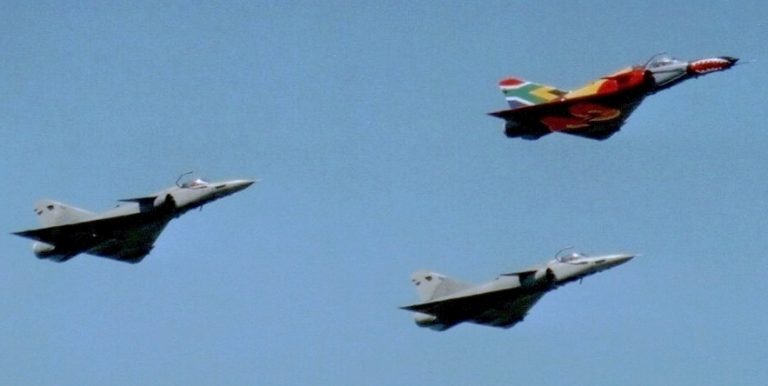
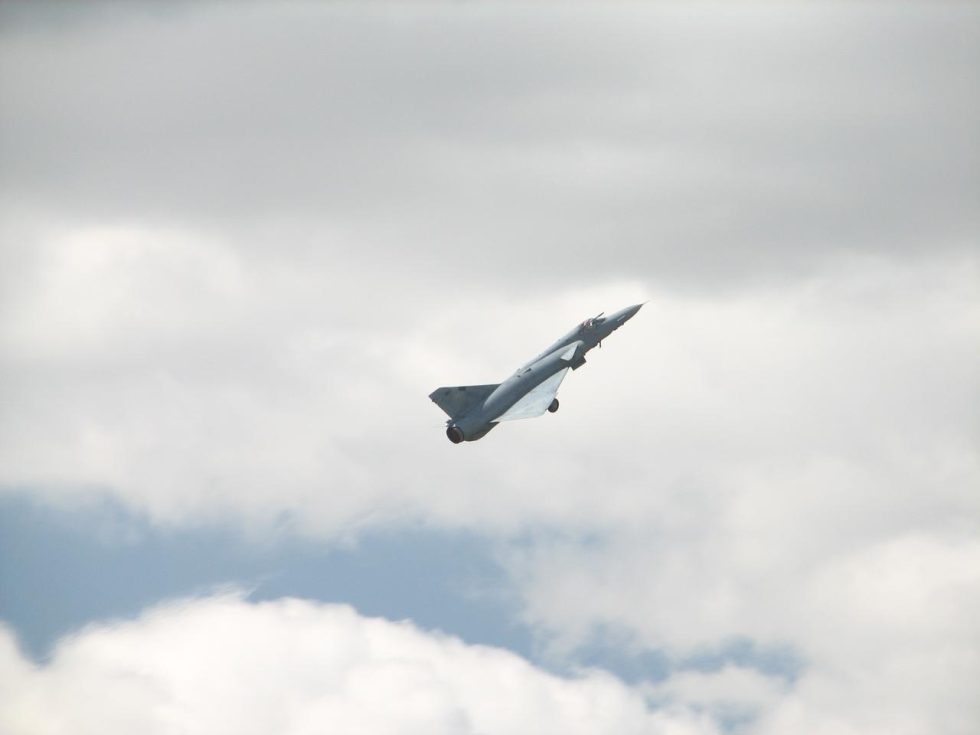
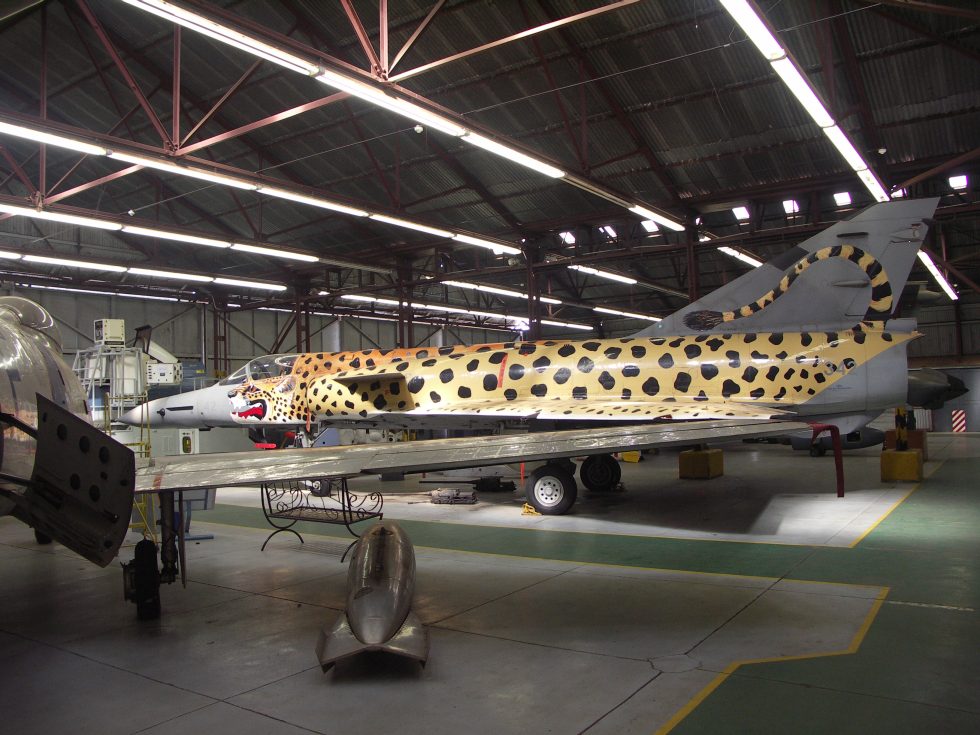
The Cheetah in motion
A verified, high-authority video feature on the Atlas Cheetah is coming soon.
Where the Cheetah flew
The score that defines it
The Cheetah is a rare modern fighter with no confirmed air-to-air kills — not for lack of capability, but of timing. It entered service as the South African Border War was already ending, and the definitive combat-capable Cheetah C arrived in 1993, years after the fighting stopped. Its record is one of deterrence, alert duty and training rather than victories.
According to SAAF sources, no Cheetah variant engaged in Border War combat; the air war over Angola was flown mainly by Mirage F1s and Buccaneers. Compare the combat record of every military aircraft. Figures as of July 2026.
Everything people ask about the Atlas Cheetah
Can I fly in a Cheetah?
How fast is the Atlas Cheetah?
Is the Cheetah the same as the Israeli Kfir?
Why was the Cheetah built?
What radar does the Cheetah C carry?
Did the Cheetah fight in the Border War?
Where are the Cheetahs now?
What replaced the Cheetah?
You can’t fly the Cheetah.
These, you can.
Some legends only live in museums — others are fuelled and waiting. MiGFlug has put civilians in real military jet cockpits since 2004.
 Fly the L-39 AlbatrosThe world’s most-flown jet trainer — aerobatics included
 Fly the F-104 Starfighter“The missile with a man in it”
 Fly the MiG-21The Cold War’s most-produced jet
 Fly the T-33 Shooting StarAmerica’s first jet trainer
 Fly the DH VampireA piece of early jet history
 Fly the S.211Agile Italian jet trainer
 Fly the MB-326The classic Aermacchi jet
 Fly the MiG-15The Soviet legend of the Korean War
Continue the tour
Every fact, checked
- South African Air Force reference — Cheetah CSAAF service dates, squadrons, radar and the statement that no Cheetah saw Border War combat.
- GlobalSecurity.org — Atlas CheetahEmbargo dates (1977–1994), 1984 programme start, official “neither confirm nor deny” on Israel, variant numbers, 2008 retirement.
- AeroTime — Atlas CheetahEmbargo and Mirage F1 licence context, ~50% component replacement, Kfir resemblance, export history.
- Airforce Technology — CheetahVariant production, armament (DEFA 552, Python, Darter family), Ecuador delivery.
- MilitaryFactory — Atlas Cheetah CConsolidated specifications: length, wingspan, MTOW, thrust and speed.
- defenceWeb — Draken CheetahsDraken acquisition (twelve aircraft, nine C and three D) and the first US Cheetah flight in 2018.
- Military Africa — Draken v DenelThe troubled Draken contract, deliveries and the 2025 lawsuit; Ecuador deal value.
- Scramble — Aggressor CheetahsUS civil registrations and ex-SAAF serials of the Draken Cheetah airframes.