
Baykar Bayraktar TB3
The Shipborne Combat Drone
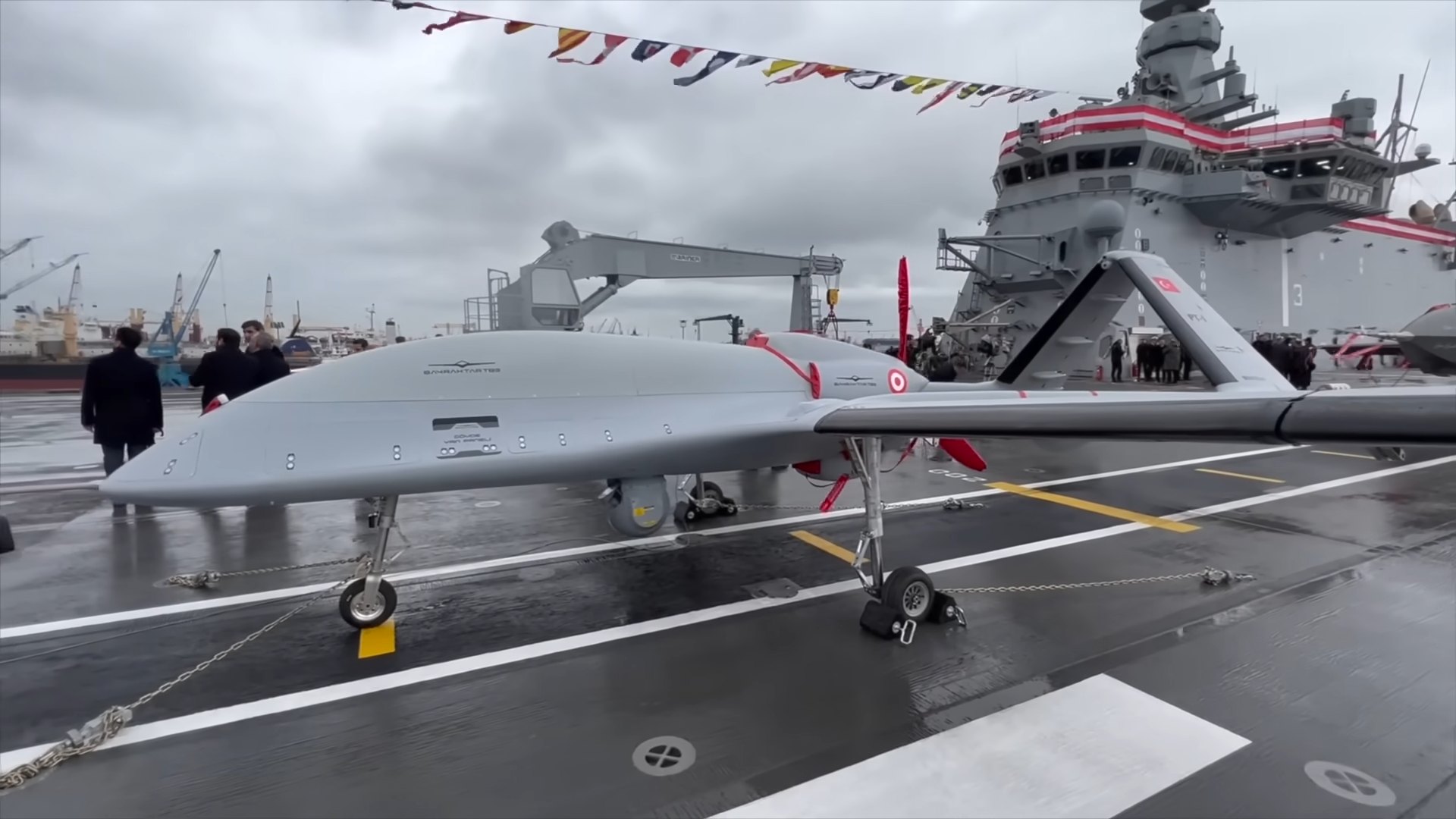
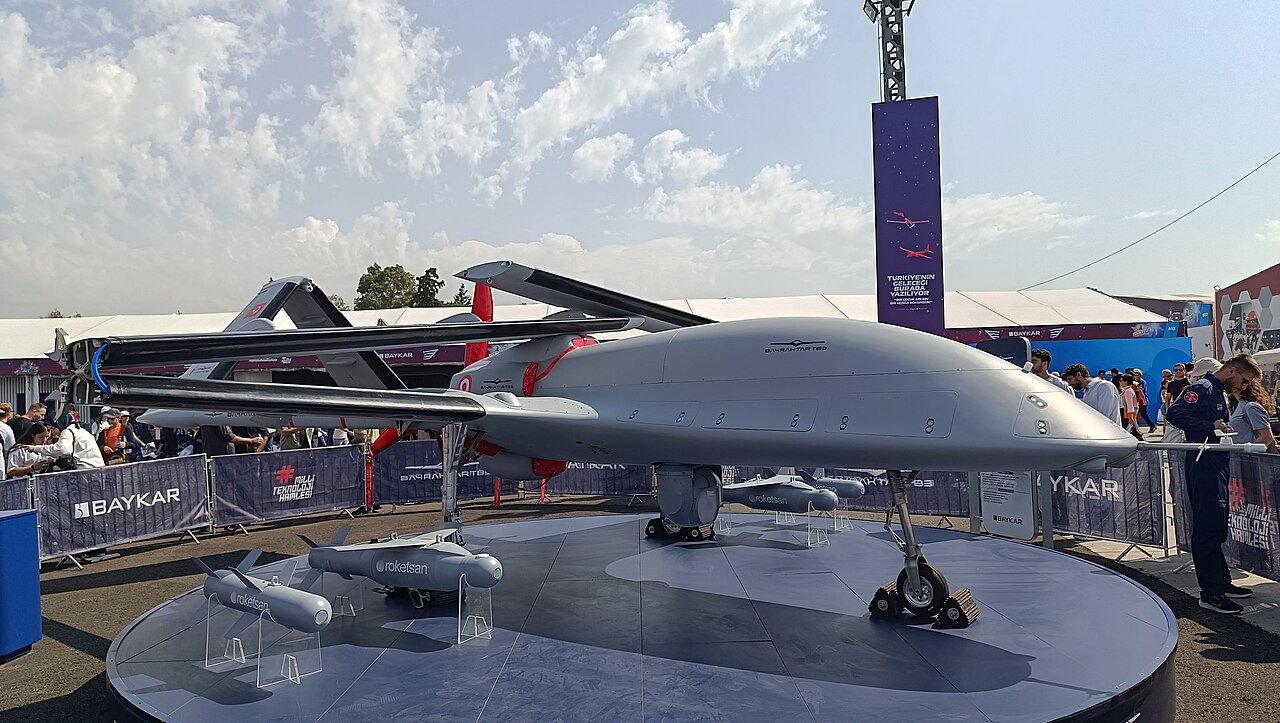
The TB3 is a folding-wing armed drone built to take off from the short, ski-jump deck of Turkey’s TCG Anadolu, a ship once meant for F-35Bs, and the first of its size to operate from such a deck.
The TB3: how a drone was made to fit a ship built for jump jets
On 19 November 2024, near the point where the Aegean meets the Mediterranean, a grey drone with a long, slender wing rolled down the flight deck of the Turkish Navy flagship TCG Anadolu, left the 12-degree ski-jump at the bow and climbed away. Forty-six minutes later it came back and landed on the same deck without arresting gear or any landing aid. Baykar announced that its Bayraktar TB3 had become the first armed drone of its kind to take off and land on a short-deck ship. For the Turkish Navy it was the moment a long-planned idea finally became practical: a carrier air wing made, for now, of drones rather than jets.
The ship had been designed for something else. TCG Anadolu is based on the Spanish Juan Carlos I, a large amphibious assault ship with a ski-jump bow, and Turkey had once intended to fly F-35B jump jets from it. When Turkey was removed from the F-35 programme in 2019, after buying the Russian S-400 air defence system, the deck needed a new purpose. Baykar, the family firm that had made its name with the Bayraktar TB2, proposed a navalised drone. Its wings fold so that it fits below deck, and it takes off and lands automatically on a deck far shorter than a runway. The first prototype flew on 27 October 2023, two days before the centenary of the Turkish Republic.
The TB3 is a modest aircraft by fighter standards: 8.35 m long, a 14 m wing, a maximum take-off weight of 1,600 kg according to Baykar, and a single 170 hp turbodiesel built by the Turkish engine maker TEI. Unlike the TB2 it was designed from the start to be controlled beyond line of sight through satellite links, which matters at sea, far from a ground station. Turkey’s defence ministry announced in September 2025 that the Land Forces Command had accepted its first TB3s. Indonesia ordered 60 in February 2025, and Italy’s Leonardo is building a version called Astore Levante through a joint venture with Baykar. As of this writing, no combat use of the TB3 has been publicly confirmed.
01The TB3’s development: from computer image to ski-jump
Selçuk Bayraktar, Baykar’s chief technology officer, first spoke publicly about a shipborne version of the company’s drones in October 2020, and computer images followed in July 2021. The first prototype was shown in March 2023, made its first engine runs and taxi tests that October, and flew for the first time on 27 October 2023. In early tests the undercarriage stayed down; the first flight with the gear retracted came in November 2023. On 20 December 2023, according to Baykar figures reported by Naval News, a TB3 stayed aloft for 32 hours and covered about 5,700 km.
Before risking the ship, Baykar built a land-based ramp replicating the bow of TCG Anadolu and made the first ski-jump take-off from it on 1 June 2024. Later that month a TB3 reached 36,310 ft. By the time of the first deck landing in November 2024, the prototypes had flown more than 700 hours. The design priorities show in the airframe: a long, high aspect-ratio wing for endurance, folding outer panels for hangar stowage, a stronger undercarriage for deck landings and automatic take-off and landing so that the aircraft does not depend on a pilot’s judgement in the last seconds of an approach to a moving deck.
02The TB3 at sea: Steadfast Dart and the Seawolf exercise
The TB3 has spent much of its early life proving it can work alongside other forces. In February 2026, during NATO’s Steadfast Dart 2026 exercise in the Baltic near Kiel, TB3s operated from TCG Anadolu in temperatures of around −5°C, heavy snow and strong winds. Baykar said the drone flew when weather had grounded other aircraft, and Turkish reporting described an eight-hour joint sortie with German Air Force Eurofighters. Baykar’s release also referred to recent live firings in which surface targets were hit with MAM-L munitions, without saying they took place during the exercise.
In September 2026, in Turkey’s Seawolf exercise in the Eastern Mediterranean, a TB3 launched from Anadolu dropped two sonobuoys from a Baykar pod and shared underwater data with a crewed maritime patrol aircraft. That points to a role well beyond strike: the anti-submarine and maritime surveillance work that small navies struggle to cover with crewed aircraft. These are exercise results reported by the manufacturer and Turkish media; they say what the system has been shown to do, not how it would fare against a capable opponent.
What makes the TB3 special
Folding wings and a short deck
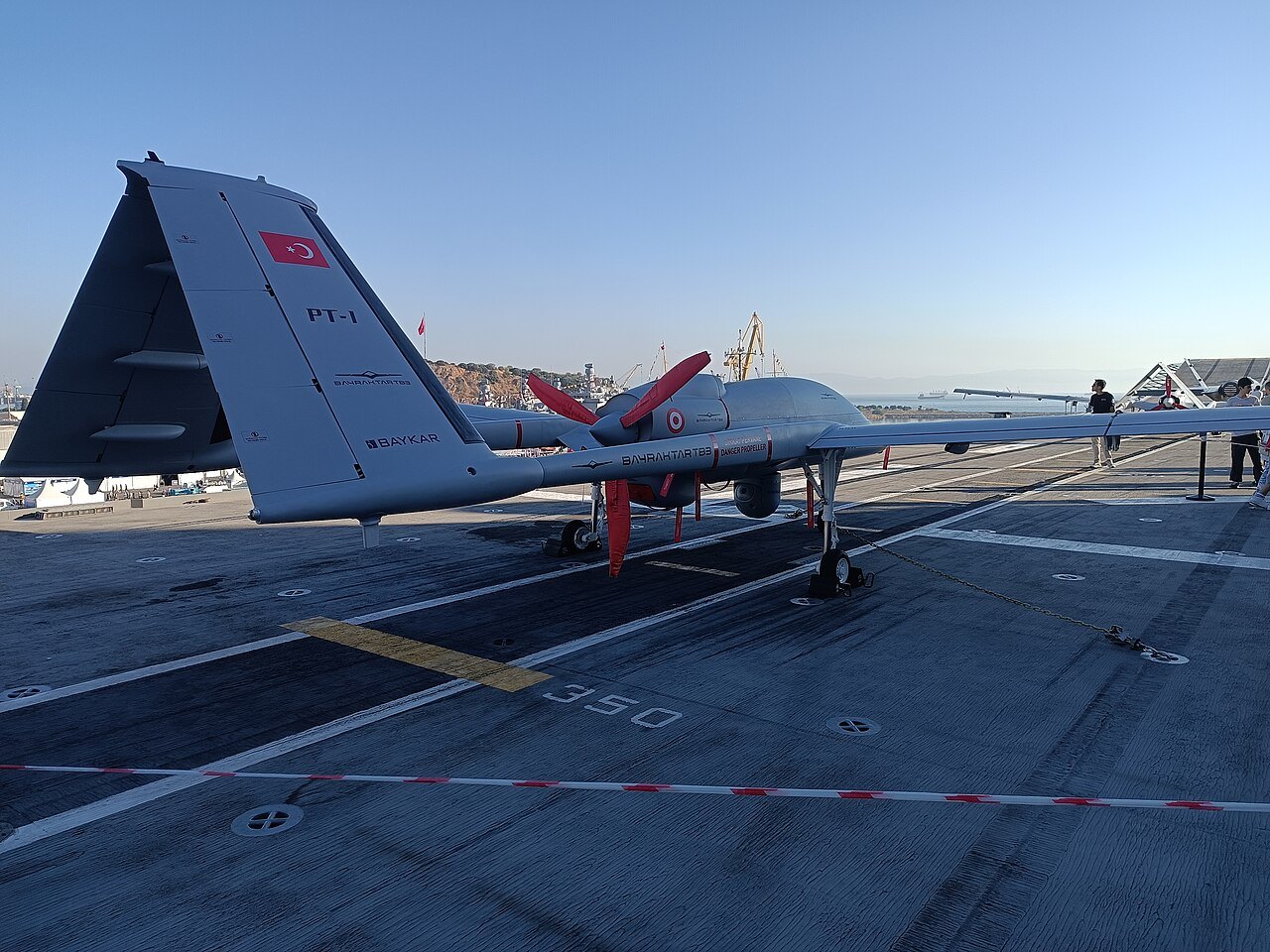
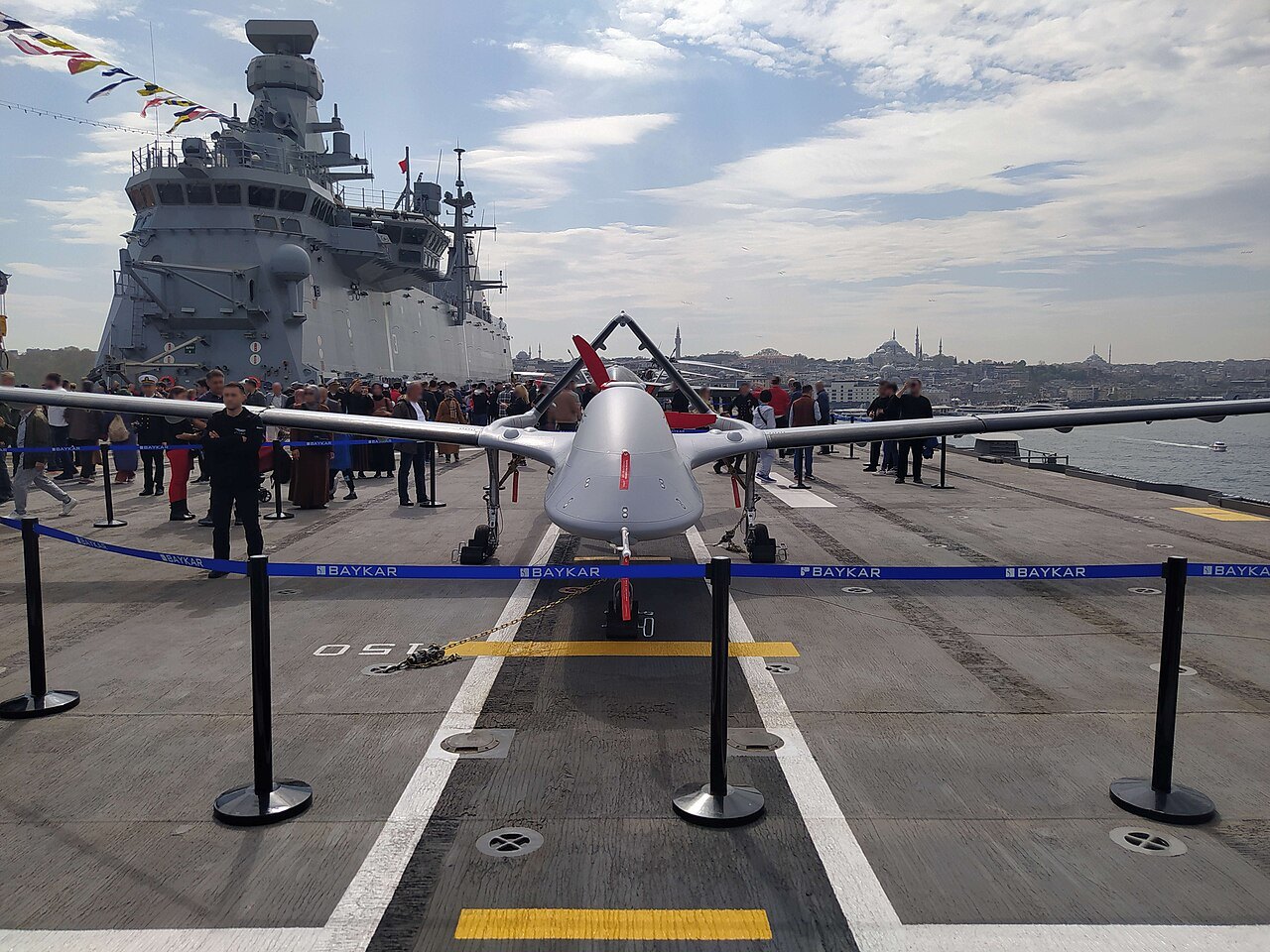
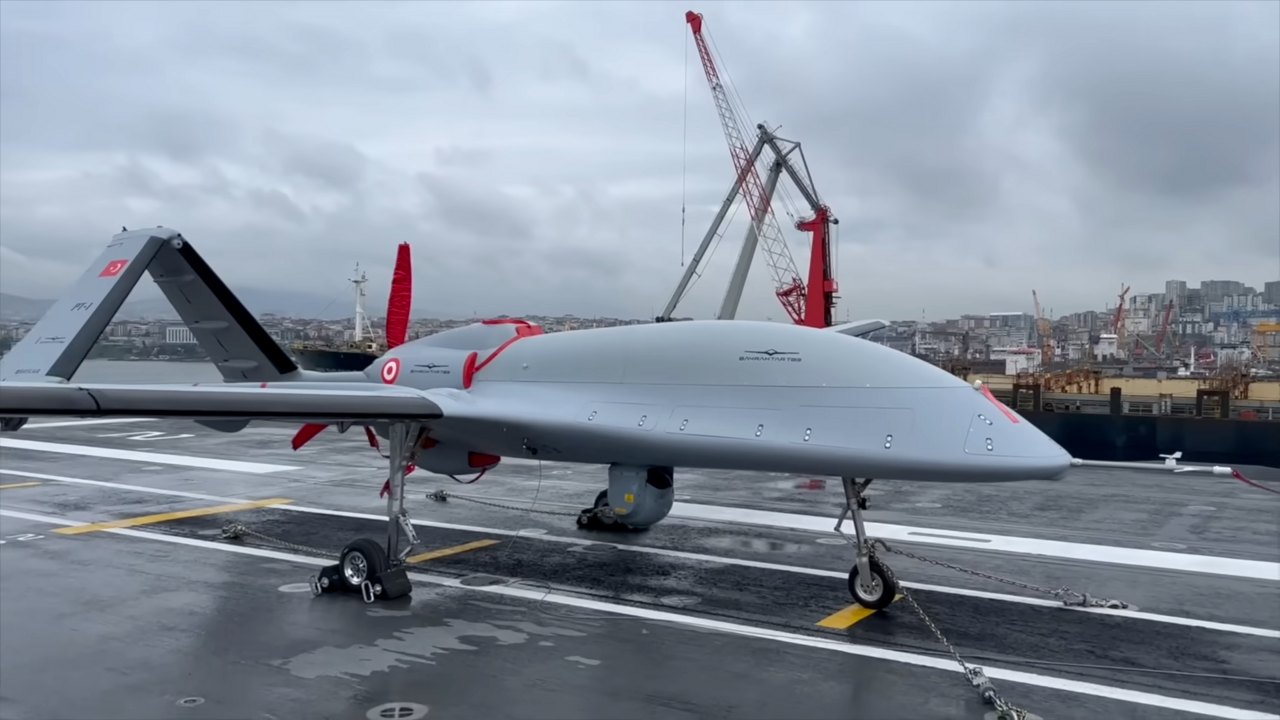
Most drones of this size need a runway of several hundred metres. The TB3 was designed to leave a ship from a short take-off run up a ski-jump, the same principle the Royal Navy used for its Sea Harriers. Its outer wing panels fold, so the 14 m span can be stowed in a hangar deck shared with helicopters. Take-off and landing are fully automatic, which Baykar presents as essential for repeatable recoveries onto a pitching deck without arresting wires.
A Turkish engine
The TB3 is powered by the PD170, a 170 hp turbodiesel developed by TEI, the Turkish engine company. Turkey had earlier depended on foreign engines and sensors for its drones, and some suppliers had restricted exports to Turkey. A home-built engine that burns heavy fuel also suits ship operations, where carrying petrol is unwelcome. The diesel gives the TB3 its long endurance: Baykar quotes more than 24 hours, and a prototype flew for 32 hours in 2023.
Satellite control from the start
The TB2 was built around a line-of-sight radio link to a ground station, which limits how far it can go. The TB3 has both line-of-sight and satellite communications, so it can be flown from the ship or from shore far beyond the horizon. Baykar lists electro-optical and infrared cameras, laser designation, electronic intelligence and surveillance radar among its payloads, which makes it as much a long-endurance scout for the fleet as an armed aircraft.
03The TB3’s variants and partners: Turkey, Indonesia and Italy
Baykar offers the TB3 in land and naval versions. In Turkey the first acceptance was by the Land Forces Command, announced on 4 September 2025, alongside the naval aircraft flying from TCG Anadolu. In February 2025 Indonesia signed for 60 TB3s and nine Akıncıs with a plan for a joint venture in Indonesia to manufacture, assemble and maintain drones. In Italy, Leonardo and Baykar formed LBA Systems, which in July 2026 said it had reached full operational readiness; its Astore Levante combines the TB3 airframe with Leonardo systems and is intended for short-runway carriers, with first deliveries to an Italian end-user planned for 2026.
Baykar Bayraktar TB3 specifications
Specifications
- Crew
- None on board; flown from a ground or ship control station
- Length
- 8.35 m (27 ft 5 in)
- Wingspan
- 14 m (45 ft 11 in); outer panels fold for stowage
- Height
- 2.6 m (8 ft 6 in)
- Max take-off weight
- 1,600 kg (3,527 lb) (Baykar); 1,450 kg (3,197 lb) quoted at the time of the first deck trials
- Payload
- 280 kg (617 lb)
- Powerplant
- 1 × TEI PD170 turbodiesel, 170 hp
- Cruise speed
- 110 to 130 kt (204 to 241 km/h) true airspeed
- Endurance
- 24+ hours (Baykar); 32 hours flown in a December 2023 test
- Service ceiling
- 25,000 ft (7,620 m); operating altitude 20,000 ft (6,096 m); 36,310 ft (11,067 m) reached in a June 2024 test
- Armament
- Up to six underwing stations for small guided munitions
Costs & production
- Unit cost
- Not published by Baykar or its customers; the Indonesian order for 60 TB3s and 9 Akıncıs in 2025 was signed without a public value
- Cost per flight hour
- Hedged estimate: probably in the order of a few hundred to a low few thousand US dollars per hour, based on a single 170 hp diesel engine, satellite link time and ground crew; no official figure exists and this is an order of magnitude only
- Production
- In series production since 2025 for Turkey; export production planned in Indonesia and, as Astore Levante, in Italy
- Programme
- First flight October 2023; first deck take-off and landing November 2024; Turkish service acceptance September 2025
04The TB3’s operating costs: what a small deck drone saves
Neither Baykar nor the Turkish Navy has published flight-hour costs for the TB3. What can be said is structural. A single diesel engine of 170 hp burns a small fraction of the fuel of any crewed jet, there is no ejection seat or life-support system to maintain, and the ship needs no catapult or arresting gear. The main running costs are likely to be people (pilots, payload operators and maintainers in shifts for long sorties), satellite bandwidth and sensor upkeep. For a navy that could not obtain the F-35B, the attraction is a way to put persistent eyes in the air from Anadolu at a cost per hour that is far below that of jets, accepting far lower speed and payload.
The TB3 from first sketch to fleet service
F-35B plan collapses
Turkey is removed from the F-35 programme, leaving TCG Anadolu without the jump jets it was designed around.
Idea announced
On 29 October Selçuk Bayraktar speaks publicly about a drone for the ship.
First flight
The first prototype is shown in March and flies on 27 October; on 20 December a TB3 flies for 32 hours.
Ski-jump trials
First take-off from a land-based ramp on 1 June; 36,310 ft reached on 25 June.
First deck landing
On 19 November a TB3 takes off from and lands on TCG Anadolu after a 46-minute flight.
Indonesian order
Indonesia signs for 60 TB3s in February, with a joint venture for local production.
Service acceptance
On 4 September Turkey announces that the Land Forces Command has accepted its first TB3s.
NATO exercise
TB3s fly from Anadolu in the Baltic during Steadfast Dart 2026 in February.
Anti-submarine trial
In September a TB3 drops sonobuoys during the Seawolf exercise in the Eastern Mediterranean.
Stories & eyewitnesses: the TB3 at sea
Forty-six minutes off Anadolu
The first deck take-off and landing came in November 2024.
Read the full story
A ramp on dry land
Before the ship, Baykar copied its bow ashore.
Read the full story
Thirty-two hours
Endurance was proved within two months of the first flight.
Read the full story
A navy without its jets
Why Anadolu ended up as a drone carrier.
Read the full story
Accepted by the army first
The first formal acceptance came from the Land Forces.
Read the full story
Snow in the Baltic
Steadfast Dart 2026 took the TB3 far north.
Read the full story
Listening for submarines
In September 2026 the TB3 dropped sonobuoys.
Read the full story
Sixty for Indonesia
The first big export deal came within months of the deck trials.
Read the full story
An Italian cousin
Leonardo builds the TB3 as the Astore Levante.
Read the full story
The TB3 in pictures
Where the TB3 flies and flew
The TB3’s record
As of this writing the TB3 has no publicly confirmed combat record. Its record so far is one of trials and exercises: the first deck take-off and landing in November 2024, NATO and Turkish exercises in 2026, and service acceptance in Turkey in 2025. It is an armed aircraft, and like the TB2 before it, its use in any future conflict will be judged on what it is used for.
See how training and combat types compare in the military aircraft statistics database. Figures are approximate.
Everything people ask about the TB3
Can I fly in a Baykar Bayraktar TB3?
How is the TB3 different from the TB2?
Which ship does the TB3 fly from?
Has the TB3 been used in combat?
Who has ordered the TB3?
How long can the TB3 stay airborne?
You can’t fly the TB3.
These, you can.
Most of this museum you can only look at. These genuine military jets you can fly yourself with MiGFlug — with aerobatics and time on the controls.
 Fly the L-39 AlbatrosThe world’s most-flown jet trainer — aerobatics included
 Fly the F-104 Starfighter“The missile with a man in it”
 Fly the MiG-21The Cold War’s most-produced jet
 Fly the T-33 Shooting StarAmerica’s first jet trainer
 Fly the DH VampireA piece of early jet history
 Fly the S.211Agile Italian jet trainer
 Fly the MB-326The classic Aermacchi jet
 Fly the MiG-15The Soviet legend of the Korean War
Continue the tour
Every fact, checked
- Baykar: Bayraktar TB3 product pageManufacturer dimensions, weight, engine, endurance, ceiling and payload options.
- Naval News: Bayraktar TB3 takes off and lands aboard Turkish carrier (November 2024)First deck flight on 19 November 2024, 46 minutes; test milestones and flight hours.
- TWZ: TB3 operates from Turkey’s drone carrier amphibious assault ship for the first timeBackground on TCG Anadolu, the F-35B plan and Turkey’s removal from the programme.
- Breaking Defense: Indonesia procures 60 Bayraktar TB3 drones (February 2025)Indonesian order and joint venture.
- Türkiye Today: Bayraktar TB3 armed drone enters Türkiye’s land forces inventoryMinistry of National Defence acceptance announcement, 4 September 2025.
- Baykar: Flawless performance by Bayraktar TB3 UCAV in the harsh conditions of the Baltic Sea (February 2026)Steadfast Dart 2026 exercise from TCG Anadolu.
- Baykar: Bayraktar TB3 UCAV successfully launches sonobuoys during Seawolf exercise (September 2026)Anti-submarine trial and Baykar export figures.
- Leonardo: LBA Systems joint venture achieves full operational readiness (July 2026)Astore Levante, the Italian TB3-based system.