
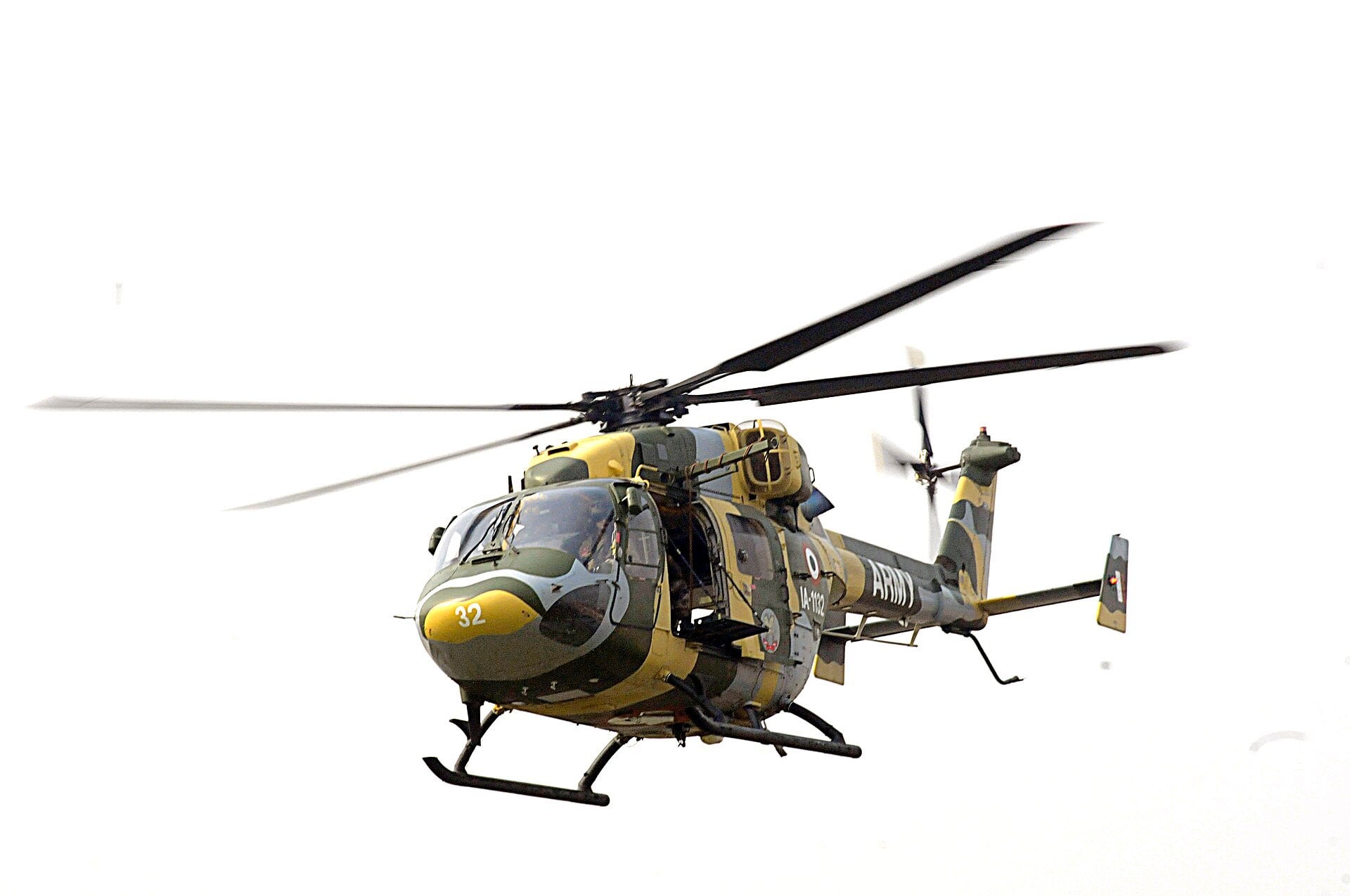
HAL Dhruv
India’s Advanced Light Helicopter
India’s first home-grown helicopter, built in more than 400 examples, flies rescues from Siachen to the Arabian Sea, spawned the armed Rudra and the Sarang team, and carries a hard-won safety record.
The Dhruv: how India learned to build its own helicopter
The idea took shape in May 1979, when the Indian Air Force and the Navy’s air arm asked for a light helicopter that India could design itself. In 1984 Hindustan Aeronautics Limited received the contract, with Germany’s MBB as design consultant. The plan was for a first flight in 1989, but design changes, tight budgets and, later, the sanctions that followed India’s 1998 nuclear tests stretched the timetable badly. The first prototype, Z-3182, finally lifted off at Bengaluru on 20 August 1992. It was a 5-tonne twin with a four-blade composite main rotor, a high tail boom that left the rear clamshell doors clear, and an airframe in which roughly 29 percent of the empty weight was composite material.
Service began in March 2002, when the Army received its first three aircraft on 20 March. The early years were hard. The first crash came in 2005, traced to the tail rotor, and the fleet was grounded until a redesign was certified in 2006. The answer to the Army’s demand for real high-altitude power was the Shakti engine, developed by HAL with Turbomeca. The Shakti-powered Dhruv Mk III was cleared for the Siachen sector in September 2007 and that October climbed to 27,500 ft over the glacier. Glass cockpits, an Israeli-supplied avionics suite and, for the Navy and Coast Guard, radar, electro-optics and a medical intensive-care module followed. Each step answered a complaint from the users, and each added to the Dhruv’s weight and complexity.
By early 2024 more than 400 Dhruvs and armed Rudras had been built, flying roughly 340,000 hours with the Army, Air Force, Navy, Coast Guard and Border Security Force, with civil users and with export customers from Nepal and Mauritius to the Maldives. The Dhruv has flown some of India’s biggest rescues, notably the 2013 Uttarakhand floods, and four of them form the IAF’s Sarang display team. It has also suffered more than 20 crashes and repeated fleet groundings, including a long one after a Coast Guard crash at Porbandar in January 2025. It is India’s most important helicopter and its most debated. Few aircraft in Indian service have been so heavily used, so widely exported or so closely scrutinised.
01The Dhruv’s troubled record: crashes, groundings and control rods
The Dhruv has never been short of critics. The first crash, on a ferry flight in November 2005, led to a fleet grounding and a redesign of the tail rotor; the aircraft returned to service in 2006. A 2009 Army report complained that early aircraft could not deliver the promised performance at altitude, a problem the Shakti engine was meant to cure. The Ecuadorian Air Force, the first significant export customer, lost several of its seven aircraft and cancelled its contract with HAL in 2015, although India later said two of the crashes were due to pilot error.
The hardest period began in March 2023. A Navy Dhruv ditched off Mumbai on 8 March, a Coast Guard Mk III crashed at Kochi on 26 March and an Army aircraft came down in Kishtwar on 4 May, killing a technician. The fleet was grounded while investigators examined defective booster control rods, and HAL began replacing components across the fleet in 2024. Then on 5 January 2025 a Coast Guard Dhruv crashed at Porbandar, killing three including both pilots, and the fleet was grounded again. By then The Tribune counted 23 major accidents and 17 pilots killed in 23 years. Government figures given in 2016 attributed 12 of the first 16 accidents to human error and environmental factors and four to technical causes.
02The Dhruv at sea: Navy, Coast Guard and the Maldives
The Navy was a reluctant early customer, and in 2008 a senior officer said publicly that the type had a long way to go before it could take on basic naval roles. The answer was a dedicated maritime version of the Mk III. In February 2021, at Aero India, HAL handed three to the Navy and two to the Coast Guard from a contract for 16, each fitted with Shakti engines, a glass cockpit, surveillance radar, an electro-optical pod, a 12.7 mm gun and a removable medical intensive-care unit.
On 30 November 2022 the Coast Guard commissioned 840 Squadron at Chennai, one of its ALH Mk III units; by then 16 aircraft had been inducted. In March 2023 the Defence Acquisition Council approved more Mk IIIs for the Coast Guard, valued for their night and instrument-flight capability. Abroad, an Indian Navy Dhruv was stationed at Kadhdhoo in the Maldives in April 2016 for search and rescue, casualty evacuation and surveillance. The naval fleet has also borne some of the type’s worst accidents, from the Mumbai ditching in 2023 to the Porbandar crash of 2025.
What makes the Dhruv special
Composite from the start
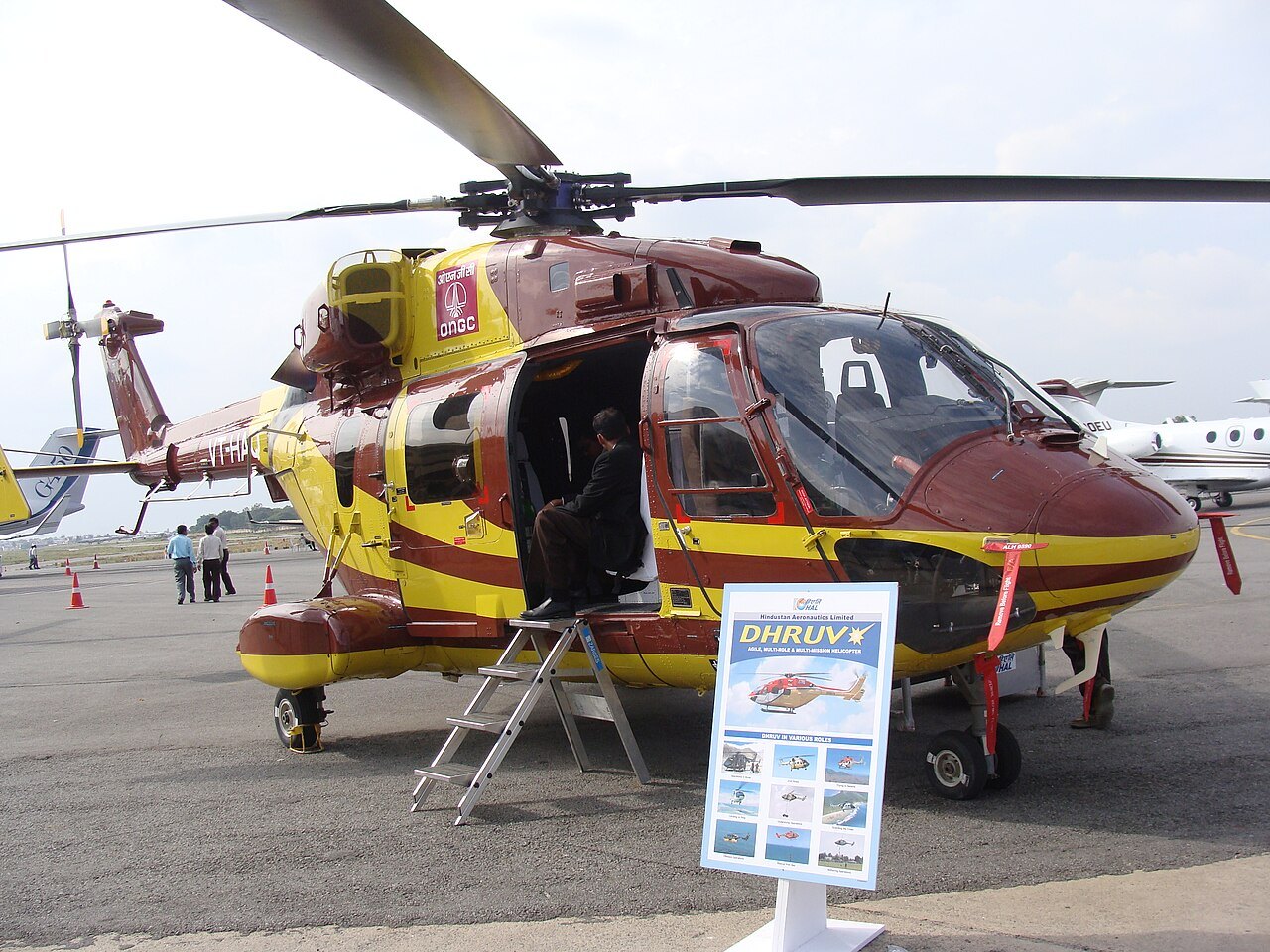
When the Dhruv was designed in the 1980s, India had little experience with composites. HAL used them extensively: about 29 percent of the empty weight, covering some 60 percent of the airframe’s surface, is composite material. The four-blade main rotor has composite blades on a fibre-elastomer hub and folds manually for stowage. A Kevlar and carbon-fibre cockpit with crumple zones and a crashworthy undercarriage were meant to protect crews in a hard landing, and the high tail boom keeps the rear clamshell doors clear for loading stretchers and cargo.
Shakti: power for the Himalaya
The original Turbomeca TM333-2B2 engines struggled to meet the Army’s high-altitude demands. HAL and Turbomeca responded with the Shakti, a joint development rated at about 900 kW for take-off, against about 740 kW for the earlier engine. It powers the Dhruv Mk III and Mk IV, as well as the Prachand attack helicopter. In 2007 a Shakti-powered Dhruv was cleared for operations in the Siachen sector after six months of trials and reached 27,500 ft above the glacier. It turned a struggling programme into a genuine mountain helicopter.
One airframe, many jobs
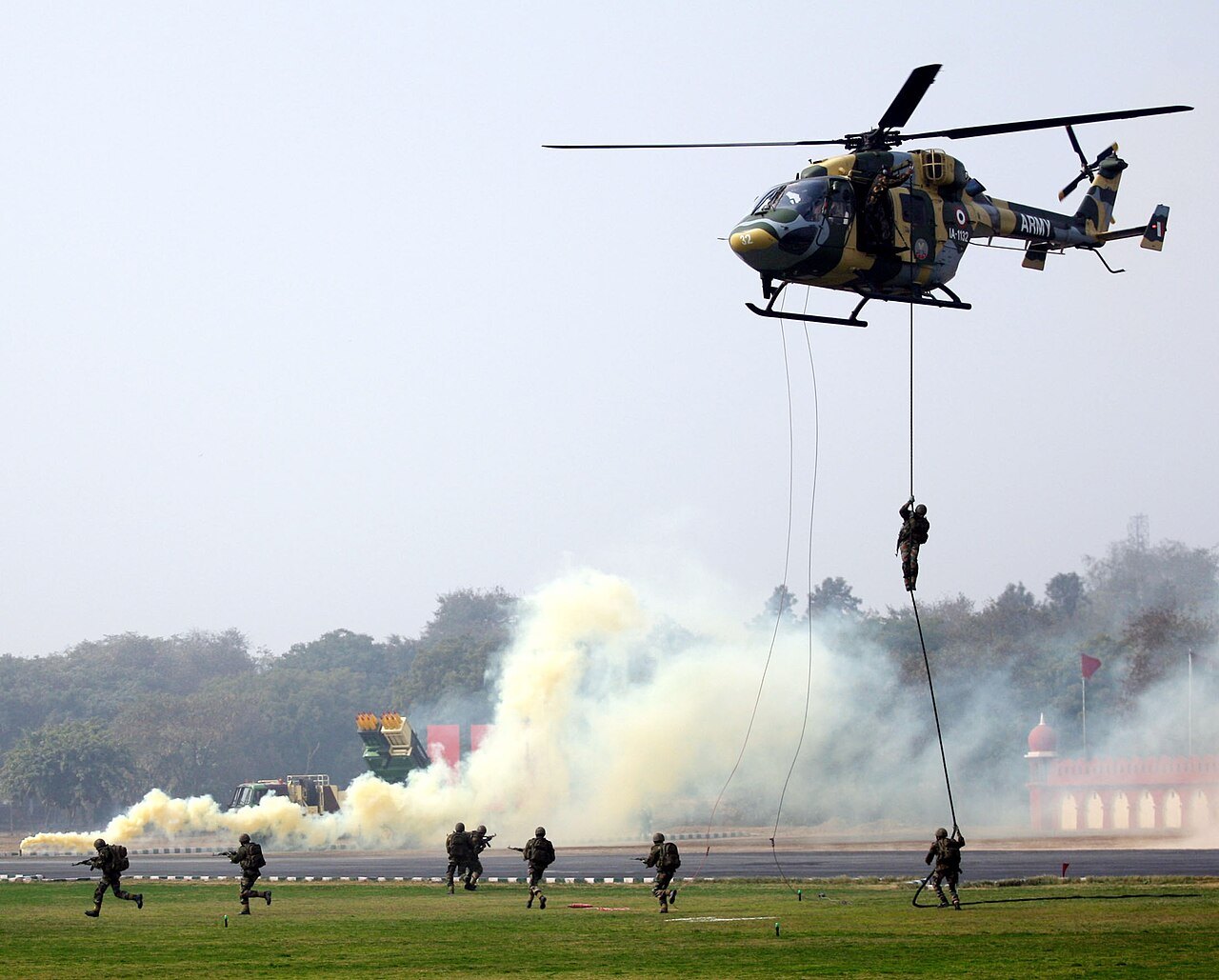
The same basic helicopter carries 12 to 14 passengers, lifts about a tonne underslung, flies stretcher cases with medical staff, or, in Navy and Coast Guard form, carries surveillance radar, an electro-optical turret and a heavy machine gun. Civil versions were certified with skids, wheels or retractable gear, and one, the Garuda Vasudha, flies geophysical surveys. The weaponised derivative, the Rudra, adds a 20 mm turret gun, rockets and missiles. Few helicopters of its size have been asked to cover so many roles for one country.
03The Dhruv’s cockpit and systems: from dials to glass
The first production standard, the Mk I, had conventional dials. In 2004 HAL signed a contract worth about US$33 million with Israel Aerospace Industries to supply avionics for at least 100 helicopters, and the Mk II introduced a HAL-IAI glass cockpit. The Mk III brought the Shakti engines together with Saab’s integrated display system, a digital moving map, an electro-optical pod, infrared suppression, health and usage monitoring and an electronic warfare suite with automatic chaff and flare dispensers.
A four-axis automatic flight control system eases the workload in cloud and at night, which mattered to the Coast Guard’s requirement for full night and instrument flying. The naval Mk III MR adds a nose-mounted surveillance radar with synthetic-aperture and moving-target modes, and can be fitted to carry two anti-submarine torpedoes. Operators have repeatedly asked for more from the airframe, and the long-running control-rod problems of 2023 to 2025 showed how much a single component can matter to a fleet of hundreds.
HAL Dhruv specifications
Specifications
- Crew
- 2 pilots
- Capacity
- 12 to 14 passengers, or stretcher cases with medical staff
- Length
- 15.87 m (52 ft 1 in) rotors turning
- Main rotor diameter
- 13.2 m (43 ft 4 in)
- Height
- 4.98 m (16 ft 4 in) rotors turning
- Empty weight
- 2,550 kg (5,620 lb), early versions
- Max take-off weight
- 4,500 kg (9,920 lb) early versions; 5,500 kg (12,125 lb) on later versions
- Powerplant
- 2 × Turbomeca TM333-2B2 (about 740 kW each), or 2 × HAL/Turbomeca Shakti-1H (about 900 kW each) on Mk III and later
- Maximum cruise speed
- 265 km/h (165 mph)
- Range
- about 700 km (435 mi)
- Service ceiling
- about 6,500 m (21,300 ft) quoted maximum altitude
- Climb rate
- 780 m/min (2,560 ft/min)
- Underslung load
- 1,000 kg (2,200 lb)
- Armament
- Usually unarmed; naval Mk III with 12.7 mm gun and provision for two torpedoes; Rudra with 20 mm turret gun, 70 mm rockets and air-to-air and anti-tank missiles
Costs & production
- Unit cost
- About US$7 million each implied by Ecuador’s 2008 order of seven for US$50.7 million; later military contracts are larger packages including support
- Cost per flight hour
- No official figure. Hedged estimate: a few thousand US dollars per hour, based on comparable 5-tonne twin-turbine helicopters; groundings and component replacement have added unpredictable costs
- Production
- More than 400 Dhruvs and Rudras built since series production began (over 410 by early 2025, according to The Tribune)
- Programme
- Requirement 1979; HAL contract 1984; first flight 20 August 1992; Army deliveries from March 2002
04The Dhruv’s variants: Mk I to Mk IV Rudra and the civil Dhruv NG
- Dhruv Mk I: initial production standard with conventional cockpit and TM333-2B2 engines.
- Dhruv Mk II: HAL-IAI glass cockpit.
- Dhruv Mk III: Shakti engines, integrated glass cockpit, electronic warfare suite; the standard for most later Army, Air Force, Navy and Coast Guard aircraft.
- Mk III MR: maritime reconnaissance version with surveillance radar, electro-optical pod, 12.7 mm gun and medical intensive-care unit.
- Rudra (Mk IV): armed version, first flown on 16 August 2007 and cleared for service in February 2013, with a 20 mm turret gun, rockets, Mistral air-to-air missiles and anti-tank missiles; about 90 serve with the Army and Air Force.
- Civil Dhruv: certified with retractable gear, wheels or skids; the Garuda Vasudha carries a geophysical survey system.
- Dhruv NG: a 14-seat civil version with Shakti engines, which first flew at the end of 2025.
The Prachand light combat helicopter is a new, narrow tandem-seat design, but it uses the Dhruv’s dynamic system and Shakti engines.
05The Dhruv’s operating costs: what the groundings really cost
HAL and the Indian services do not publish a cost per flight hour for the Dhruv, so any figure is an estimate. A 5-tonne twin-turbine helicopter of this class typically costs a few thousand US dollars an hour to operate once fuel, spares and maintenance are counted, and Indian labour costs make the Dhruv cheaper to support at home than an imported equivalent.
The larger cost has been availability. Fleet-wide groundings in 2005 and 2006, in 2023 and again in 2025 left hundreds of aircraft parked, forced the Army and Coast Guard to restrict operations and, in 2023, led to inspection intervals being shortened to 100 flying hours while control rods were replaced. Ecuador’s cancellation in 2015 cost HAL its showcase export customer. For India the strategic value of an indigenous helicopter that can be supported, modified and produced at home has so far outweighed those costs, and orders for new Mk IIIs and the civil Dhruv NG have continued.
The Dhruv from drawing board to 400 helicopters
HAL gets the contract
HAL is contracted to design the Advanced Light Helicopter, with MBB of Germany as consultant.
First flight
Prototype Z-3182 flies at Bengaluru on 20 August, three years later than planned.
Into service
The Army receives its first three Dhruvs on 20 March.
First crash and grounding
A ferry-flight crash traced to the tail rotor grounds the fleet until 2006.
Siachen and Rudra
The Shakti-powered Mk III is cleared for Siachen and reaches 27,500 ft; the armed Rudra flies on 16 August.
Export to Ecuador
Ecuador buys seven Dhruvs for US$50.7 million; the Sarang team displays at Farnborough.
Uttarakhand floods
Army and Air Force Dhruvs fly hundreds of hours of rescue missions; the Rudra is cleared for service in February.
Ecuador cancels
After losing several aircraft, Ecuador ends its contract with HAL.
Coast Guard squadron
840 Squadron, a Coast Guard ALH Mk III unit, is commissioned at Chennai on 30 November.
Control-rod grounding
Three accidents in two months lead to fleet-wide inspections and component replacement.
Porbandar crash
A Coast Guard Dhruv crashes on 5 January, killing three; the fleet is grounded again.
Stories & eyewitnesses: the Dhruv in the mountains, over the sea and in the air show
27,500 feet over Siachen
The Shakti engine finally gave the Army the altitude it wanted.
Read the full story
The Uttarakhand airlift
In June 2013 Dhruvs worked the valleys after catastrophic floods.
Read the full story
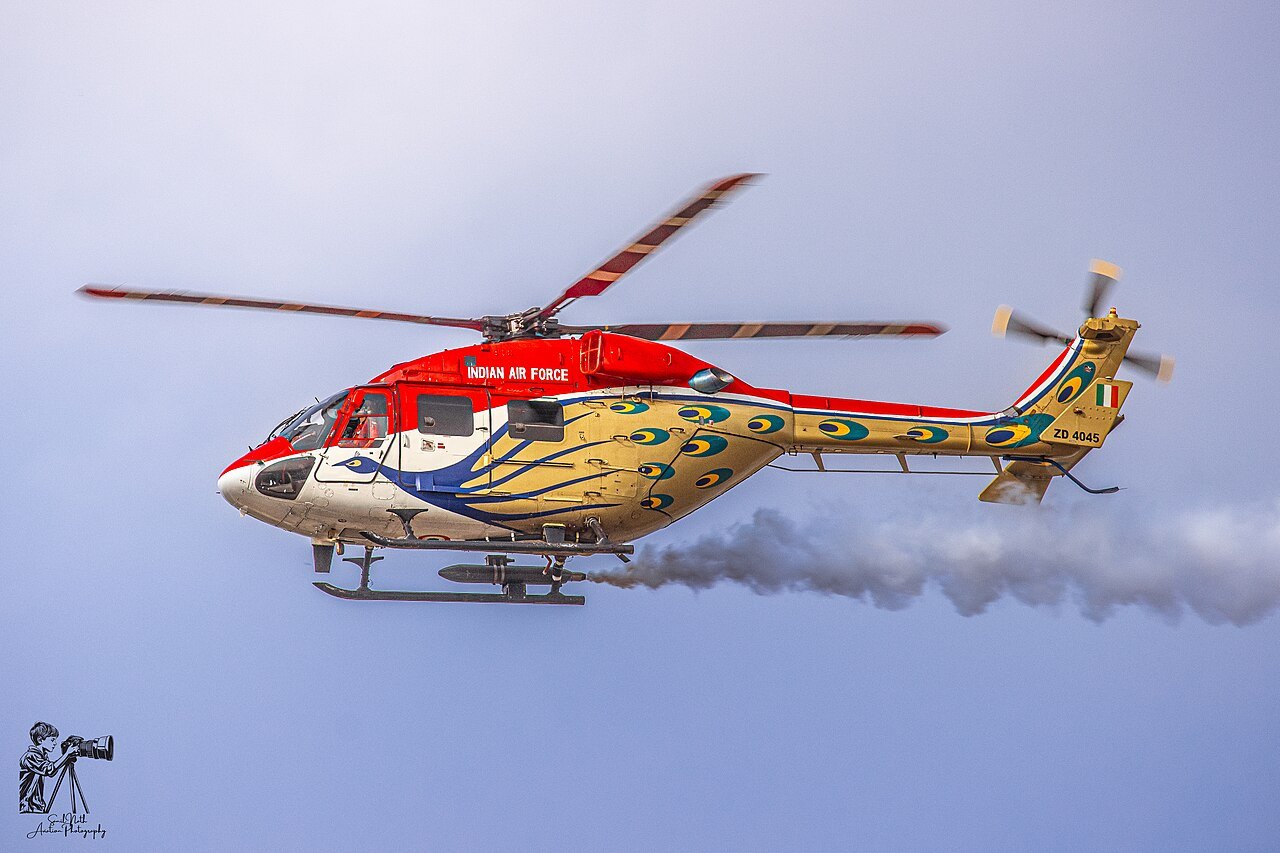
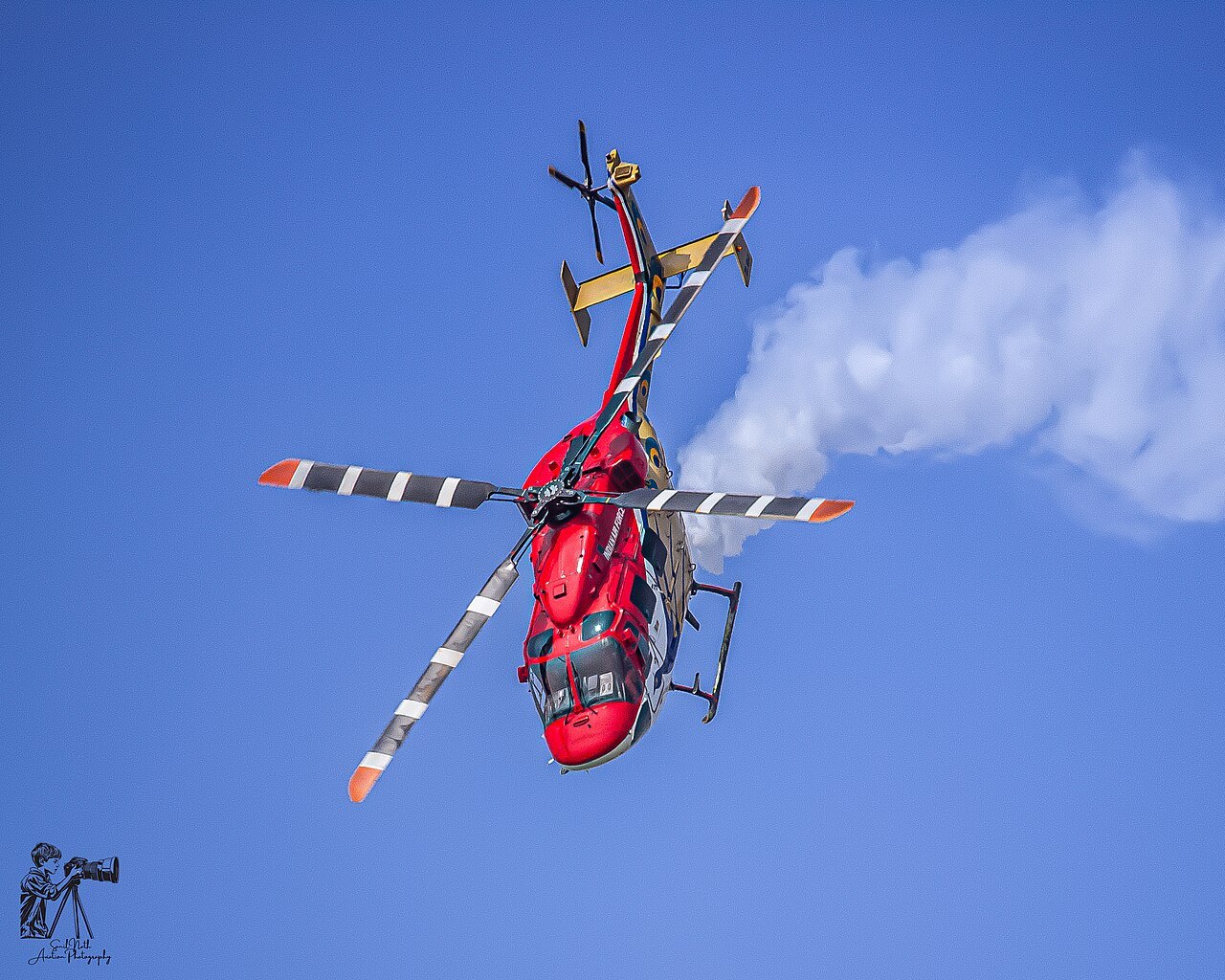
Sarang: the peacock team
Four Dhruvs form one of the world’s few military helicopter display teams.
Read the full story
Yelahanka, February 2007
A Sarang rehearsal crash cost the team two of its pilots.
Read the full story
Ecuador’s lost Dhruvs
India’s first big export order ended in cancellation.
Read the full story
The Rudra: a Dhruv with teeth
The armed derivative gave Army Aviation its first home-grown gunship.
Read the full story
840 Squadron stands up
The Coast Guard’s first Mk III squadron was commissioned at Chennai.
Read the full story
Porbandar, January 2025
A Coast Guard crash grounded the fleet again.
Read the full story
A helicopter India built for itself
The Dhruv became the foundation of HAL’s helicopter industry.
Read the full story
The Dhruv in pictures
Where the Dhruv flies and flew
The Dhruv’s record
The Dhruv has not flown in a declared war, but it has carried much of India’s peacetime helicopter work: Army logistics in the high Himalaya, flood and earthquake relief, maritime search and rescue, and armed reconnaissance in its Rudra form. Its record also includes more than 20 crashes and several fleet-wide groundings.
See how training and combat types compare in the military aircraft statistics database. Figures are approximate.
Everything people ask about the Dhruv
Can I fly in a HAL Dhruv?
What is the difference between the Dhruv and the Rudra?
How many Dhruvs have been built?
Who flies the Dhruv?
Why has the Dhruv fleet been grounded?
Which display team flies the Dhruv?
You can’t fly the Dhruv.
These, you can.
Most of this museum you can only look at. These genuine military jets you can fly yourself with MiGFlug — with aerobatics and time on the controls.
 Fly the L-39 AlbatrosThe world’s most-flown jet trainer — aerobatics included
 Fly the F-104 Starfighter“The missile with a man in it”
 Fly the MiG-21The Cold War’s most-produced jet
 Fly the T-33 Shooting StarAmerica’s first jet trainer
 Fly the DH VampireA piece of early jet history
 Fly the S.211Agile Italian jet trainer
 Fly the MB-326The classic Aermacchi jet
 Fly the MiG-15The Soviet legend of the Korean War
Continue the tour
Every fact, checked
- Over 400 indigenous Dhruv and its variant helicopters built since 2002, but at least 23 crashedThePrint, October 2022: production, flying hours, Rudra numbers and accident record
- Explainer: In 23 years since induction, Dhruv fleet suffers 23 crashes, several groundingsThe Tribune, January 2025: Porbandar crash, accident and grounding history
- Dhruv Advanced Light HelicopterArmy Technology: dimensions, performance, engines and operators
- Aero India: Indian Army accepts first five Shakti-powered DhruvsFlightGlobal on the Dhruv Mk III and the Shakti engine
- HAL hands over ALH Dhruv Mk III to the Indian Navy and Coast GuardNaval News, February 2021: maritime Mk III equipment and contract
- Commissioning of 840 Squadron (CG)Press Information Bureau, Ministry of Defence, November 2022
- DAC approves capital acquisition proposals worth Rs 70,500 crorePress Information Bureau, March 2023: ALH Mk III for the Coast Guard