
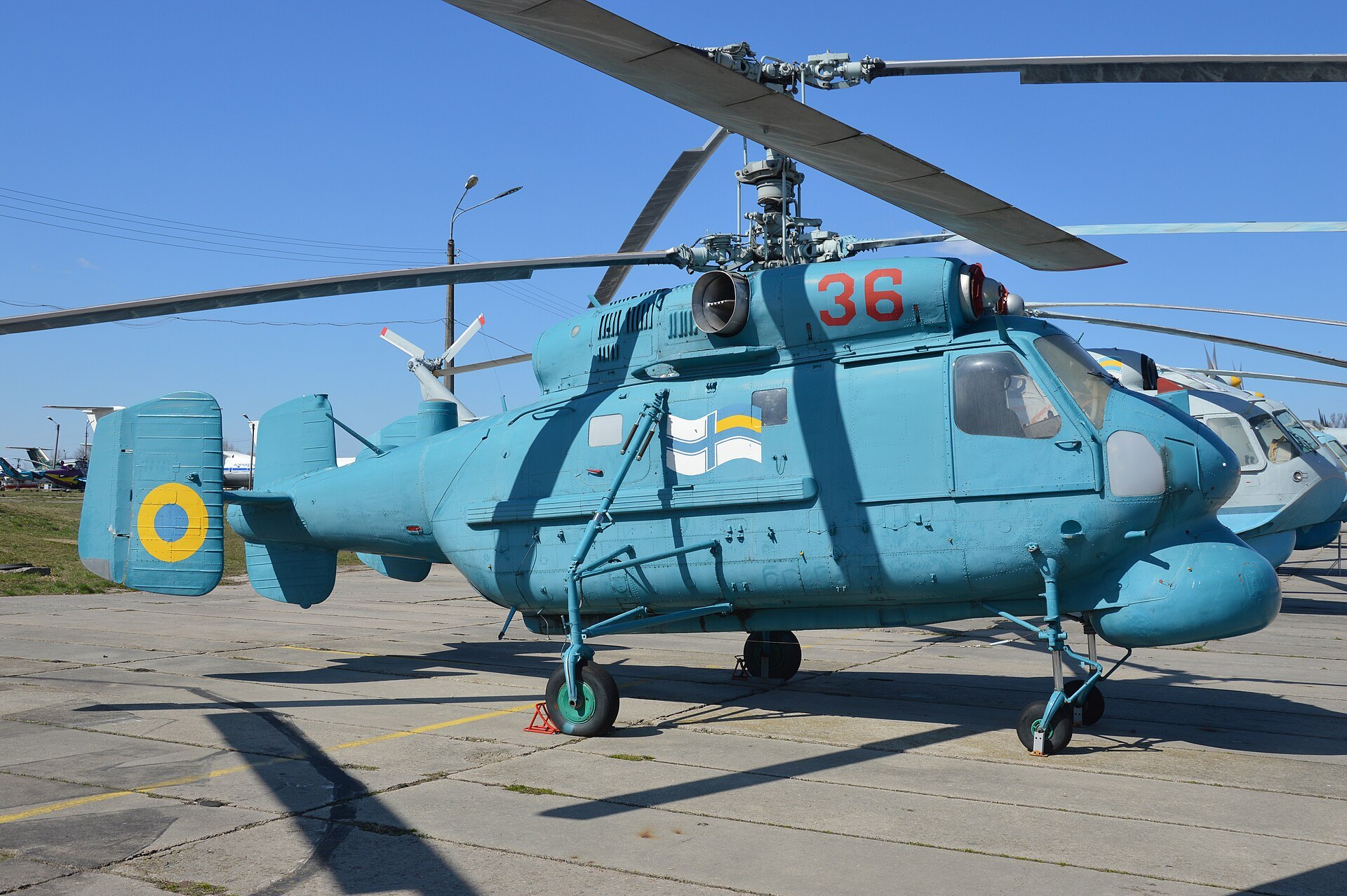
Kamov Ka-25
Hormone
The compact coaxial helicopter that took the Soviet Navy’s submarine hunt to sea, it flew from the cruisers Moskva and Leningrad, cleared mines from Suez and guided cruise missiles over the horizon.
The Ka-25: how Kamov put a submarine hunter on every Soviet warship
By the late 1950s American nuclear-powered submarines armed with homing torpedoes and ballistic missiles had become the Soviet Navy’s gravest problem, and its ships needed eyes that could see beyond the horizon and below the surface. On 20 February 1958 the Soviet government ordered Nikolai Kamov’s design bureau to create a new shipborne helicopter, known internally as product D. Kamov had long specialised in coaxial designs, with two contra-rotating rotors on one mast, which need no tail rotor and so fit on a small deck and in a short hangar. Two variants were planned from the start: the DB anti-submarine helicopter and the DTs target-designation aircraft, because no single airframe of the permitted size could carry both sets of equipment.
The prototype flew in the spring of 1961, and in July it appeared at the Tushino air display hung with crude dummy missiles. Western analysts, misreading it, called it the Ka-20, a designation it never had; NATO later named the production aircraft Hormone. Development was slow. Ground resonance damaged early aircraft, the gearbox and rotor column gave trouble, and the submarine-hunting equipment was not ready. The first production machine flew at Ulan-Ude on 25 April 1965, but quality problems meant only a fraction of the expected aircraft were delivered in 1965 and 1966. The helicopter was formally accepted into service only on 2 December 1971, long after it had gone to sea.
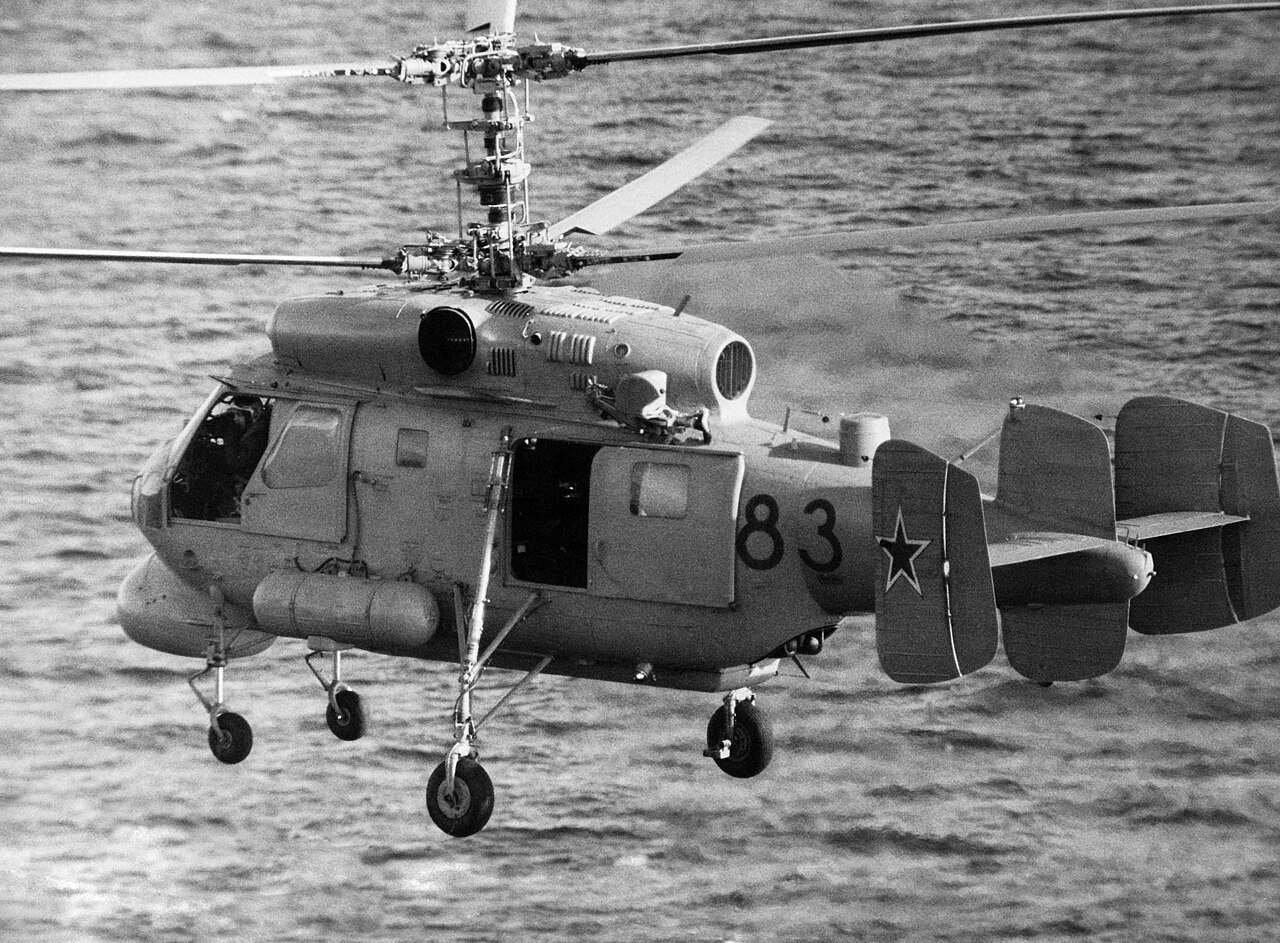
By then the Ka-25 was everywhere. The helicopter cruisers Moskva and Leningrad, commissioned in 1967 and 1969, each carried up to a squadron, and up to about 40 other Soviet ships carried a single machine. Moskva’s helicopters made their first operational cruise in the Mediterranean in August 1968. About 460 were built in variants for anti-submarine work, over-the-horizon missile targeting, search and rescue, minesweeping and even space-capsule recovery, and they were exported to India, Syria, Vietnam, Yugoslavia and Bulgaria. The Ka-27 began replacing them in the 1980s, but the Ka-25Ts targeting version, which had no direct successor, served on into the mid-1990s. Its compact coaxial layout lives on in every Ka-27 and Ka-29 at sea today.
01The Ka-25 at sea: Moskva, Leningrad and the long cruises
The Ka-25 was conceived together with the ships that would carry it. Under a 1958 decision, Leningrad designers began work on an anti-submarine helicopter cruiser, Project 1123, and two were built at Nikolaev on the Black Sea: Moskva, commissioned on 25 December 1967, and Leningrad, commissioned on 22 April 1969. Each could carry a full helicopter squadron. State trials of Moskva’s helicopter armament ran from September to December 1967, when crews first worked out the limits and procedures for starting engines and flying from a ship.
Single-ship operation was tested the hard way. In April 1967 a Ka-25PL and two Black Sea Fleet crews sailed from Murmansk aboard a converted support ship on a long voyage with a submarine group, code-named Priliv. The expedition lasted 175 days and the helicopter flew about 100 hours at sea, but on inspection afterwards its structure was so corroded that it had to be written off, an early lesson in the price of salt air. In August 1968 Ka-25s of the 872nd anti-submarine helicopter squadron aboard Moskva made the type’s first operational deployment, to the Mediterranean, and Ka-25s later flew from the carriers Kiev and Minsk until the Ka-27 replaced them.
02The Ka-25 at Suez: clearing the canal, 1974
After the 1973 Arab-Israeli war the Gulf of Suez and the approaches to the Suez Canal were littered with mines, and an international effort was launched to clear them so that the canal could reopen. The Soviet contribution included minesweeping helicopters of the Ka-25 family, operating from the helicopter cruiser Leningrad between June and November 1974. These aircraft towed sweeps or charges through the water to detonate magnetic, acoustic and bottom mines.
Russian sources disagree on the scale. One account says six Ka-25BShZ helicopters took part from Leningrad; another credits twelve minesweeping Ka-25s with 188 sorties. Either way, Suez was one of the few occasions when the Ka-25 operated on a real task in a foreign theatre, alongside Western navies doing the same job, and it showed the value of a helicopter-carrying cruiser far from home. Minesweeping remained a minor role for the type, with only a handful of dedicated aircraft built.
What makes the Ka-25 special
Two rotors, no tail
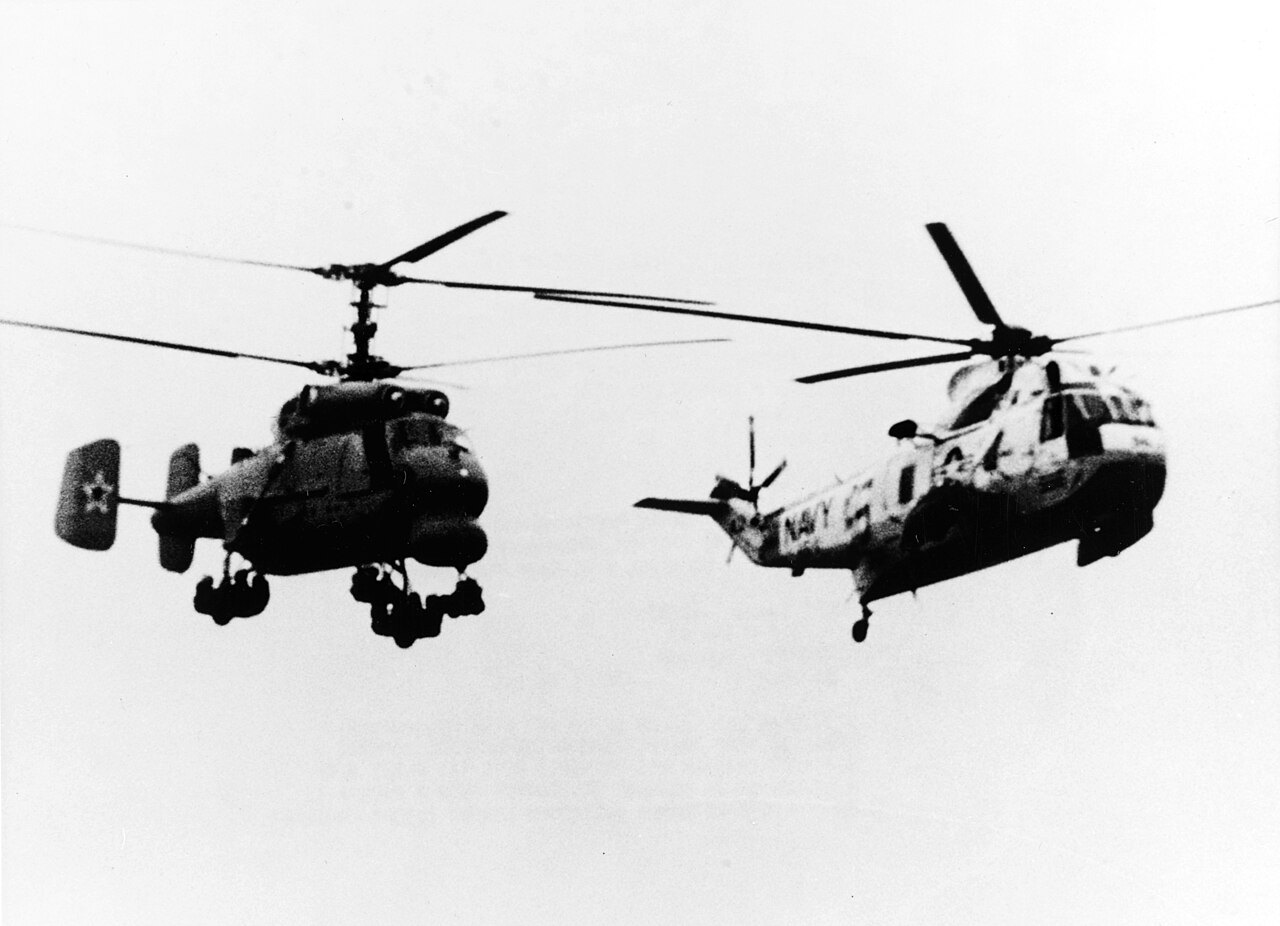
The Ka-25’s defining feature is its pair of three-bladed rotors, 15.74 m across, turn in opposite directions on a single mast, cancelling each other’s torque. With no tail rotor, the fuselage could be short, just 9.75 m, and the helicopter fitted into small hangars on cruisers and destroyers. The rotors folded for stowage, the tail carried three fins for directional control. The Ka-27 that replaced it kept the same coaxial formula, a sign of how well it suited life at sea.
Engines built for it
The Ka-25 needed a compact, light turbine at a time when the Soviet Union had little experience of them. In 1956 a special design bureau was created at the Omsk engine plant to develop the GTD-3 turboshaft and its gearbox. Engineers used original features such as a combined axial-centrifugal compressor and rotating fuel injectors, and the uprated GTD-3F gave about 900 hp each. The two engines sit side by side above the cabin, driving the rotors through a common gearbox.
A hunter’s kit
The anti-submarine Ka-25PL carried a search radar in a chin radome, a dipping sonar lowered from the rear fuselage, a magnetic anomaly detector and up to 36 sonobuoys. Its weapons bay could hold AT-1 homing torpedoes or depth charges, and some aircraft were adapted for a nuclear depth bomb. It was a lot to pack into a seven-tonne helicopter, and the Navy later judged the PL’s submarine-finding ability inadequate, one of the reasons it ordered the Ka-27. The crew of two sat side by side, pilot on the left and navigator on the right.
03The Ka-25’s over-the-horizon eye: the Ka-25Ts and Uspekh
Soviet anti-ship cruise missiles of the 1960s could fly 200 km or more, but a ship’s own radar could see only about 30 to 40 km before the curvature of the earth hid the target. The answer was to lift the radar into the sky. The Ka-25Ts, known to NATO as Hormone-B, carried a large surveillance radar in an enlarged chin radome and a data link that sent target information back to the ship as part of the Uspekh reconnaissance and targeting system.
The Ts first flew on 21 March 1962. To make room for its equipment it lost the bomb bay, which was replaced by extra fuel, and its undercarriage retracted in flight so that the wheels would not shadow the radar. It could patrol up to about 200 km from its ship, provide radar coverage and targeting out to about 250 km and relay communications. About 50 were built. Russian assessments regarded it as the most successful version of the Ka-25, and because no equivalent Ka-27 was produced it remained in service until the mid-1990s.
Kamov Ka-25 specifications
Specifications
- Crew
- 2 to 4 (pilot and navigator, plus systems operators or rescue crew by variant)
- Capacity
- 12 passengers (Ka-25PS)
- Fuselage length
- 9.75 m (32 ft 0 in)
- Main rotor diameter
- 15.74 m (51 ft 8 in), two coaxial three-bladed rotors
- Height
- 5.37 m (17 ft 7 in)
- Empty weight
- 4,765 kg (10,505 lb)
- Max take-off weight
- about 7,140 to 7,500 kg (15,740 to 16,530 lb); sources differ
- Powerplant
- 2 × Glushenkov GTD-3F turboshafts, 900 hp (671 kW) each
- Maximum speed
- about 209 to 220 km/h (130 to 137 mph)
- Cruise speed
- about 185 to 193 km/h (115 to 120 mph)
- Range
- about 400 to 450 km (250 to 280 mi); 650 km (400 mi) with external tanks
- Service ceiling
- about 3,350 to 4,000 m (11,000 to 13,100 ft)
- Armament
- Ka-25PL: AT-1 homing torpedoes or depth charges, up to about 1,100 kg; some aircraft adapted for a nuclear depth bomb
Costs & production
- Cost per flight hour
- No Soviet figure was published. Hedged estimate only: in today’s terms a few thousand US dollars per hour, by analogy with Western twin-turbine naval helicopters of similar weight; corrosion at sea added heavily to maintenance
- Production
- About 460 built at Ulan-Ude between the mid-1960s and mid-1970s, including about 275 Ka-25PL and about 50 Ka-25Ts
- Programme
- Government decision 20 February 1958; first flight 1961; first production aircraft 25 April 1965; formal acceptance 2 December 1971
04The Ka-25’s variants: from submarine hunter to flying crane
- Ka-25PL (Hormone-A): the main anti-submarine version, with search radar, dipping sonar, sonobuoys, torpedoes and depth charges; about 275 built.
- Ka-25Ts (Hormone-B): over-the-horizon radar targeting and relay for anti-ship missiles, retractable undercarriage; about 50 built.
- Ka-25PS (Hormone-C): search and rescue and utility version with a rescue winch and basket, often painted red and white; also used for space-capsule recovery.
- Ka-25BT and Ka-25BShZ: minesweeping versions towing sweeps or line charges.
- Ka-25IV: six aircraft converted to track ballistic missile warheads at splashdown.
- Ka-25PLS: version for the wire-guided Strizh torpedo, accepted in 1976.
- Ka-25K: civil flying crane with a gondola under the nose for a load operator; shown at the Paris Air Show in 1967.
- Ka-25F and Ka-25Sh: armed army support proposals with guns and rockets, not adopted.
05The Ka-25’s operating costs: the price of salt air
No Soviet cost data for the Ka-25 has been published, so the cost per hour in the table is only an analogy with Western naval helicopters of similar size and power. What is documented is the scale of maintenance at sea. The Priliv cruise of 1967 ended with the helicopter written off for corrosion after about 100 flying hours in 175 days, and the airframes were treated with protective primer throughout because of shipboard basing.
Early production also proved costly in time: quality problems at Ulan-Ude meant only 13 of an expected 40 aircraft were delivered in 1965 and 1966. Against that, the Ka-25 was compact, used a single engine type across the fleet and could be supported from ships with small hangars, which kept the Soviet Navy’s helicopter force affordable enough to spread across dozens of vessels, from cruisers to small single-helicopter ships.
The Ka-25 from Tushino to the mid-1990s
Programme ordered
On 20 February the Soviet government orders Kamov to develop a shipborne anti-submarine helicopter.
First flight and Tushino
The prototype flies in spring and is shown in July with dummy missiles; the West calls it the Ka-20.
Targeting version flies
The Ka-25Ts radar targeting helicopter makes its first flight on 21 March.
Production begins
The first production aircraft flies at Ulan-Ude on 25 April.
Moskva commissioned
The helicopter cruiser joins the fleet on 25 December; the Ka-25K is shown at Le Bourget.
First operational cruise
Ka-25s aboard Moskva deploy to the Mediterranean in August.
Formal acceptance
The Ka-25 is officially accepted into service on 2 December.
Suez minesweeping
Ka-25 minesweepers from the cruiser Leningrad help clear the Gulf of Suez, June to November.
Indian service
Seven Ka-25s are delivered to the Indian Navy’s INAS 333.
Successor appears
The Ka-27PL begins to replace the anti-submarine Ka-25.
Black Sea Fleet split
Ukraine receives 28 Ka-25s in the division of the fleet; the Ts has already left Russian service by the mid-1990s.
Stories & eyewitnesses: the Ka-25 on the world’s oceans
The Ka-20 that never was
A parade appearance fooled Western analysts.
Read the full story
175 days at sea
The Priliv cruise of 1967 tested single-ship operation to destruction.
Read the full story
Moskva goes to the Mediterranean
In 1968 the helicopter cruiser made its first operational cruise.
Read the full story
Fishing spacecraft from the sea
Some Ka-25s were adapted to find and recover space capsules.
Read the full story
Guiding missiles over the horizon
The Ka-25Ts gave Soviet cruisers eyes beyond their radar.
Read the full story
Sweeping the Gulf of Suez
In 1974 Soviet helicopters helped clear the mines of the October War.
Read the full story
Hormone at night
A US assessment saw a key weakness.
Read the full story
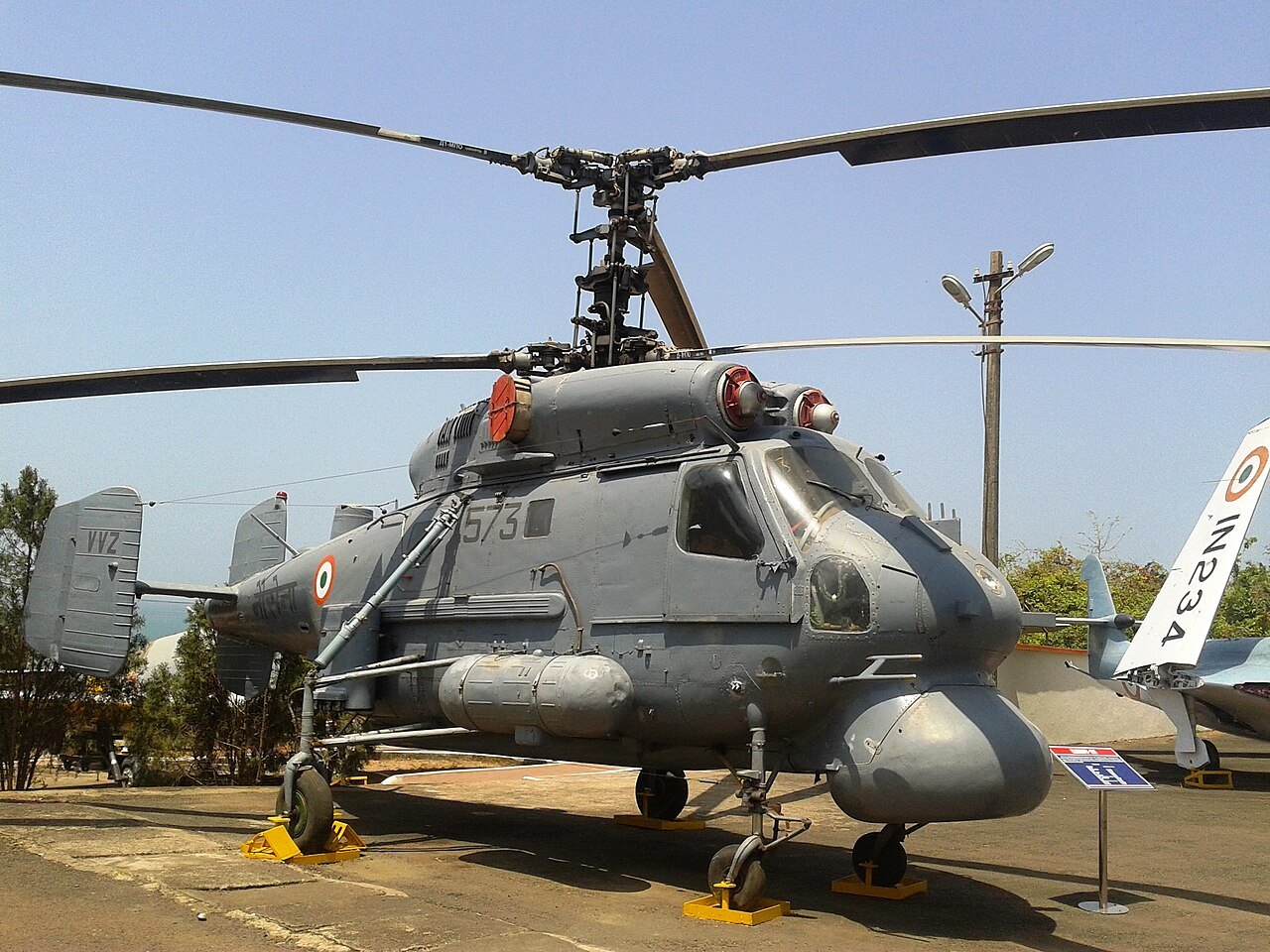
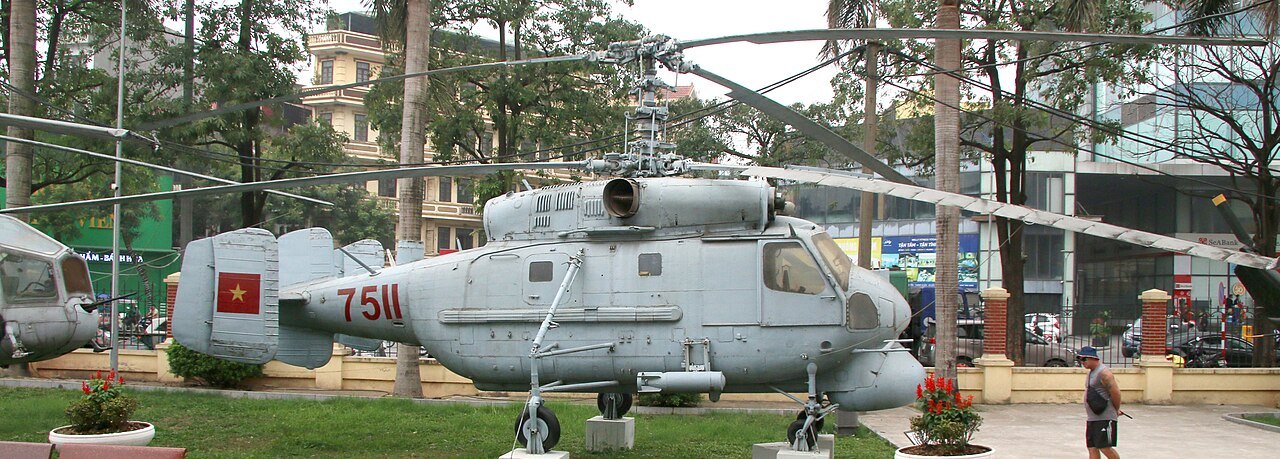
Ka-25s you can see today
Museums in India and Vietnam preserve examples.
Read the full story
The Ka-25 in pictures
Where the Ka-25 flies and flew
The Ka-25’s record
The Ka-25 spent its career in the Cold War at sea, shadowing Western submarines and fleets rather than fighting them. Its best-documented real-world task was minesweeping in the Gulf of Suez in 1974; Yugoslav Ka-25s were also in service when the country’s wars began in 1991.
See how training and combat types compare in the military aircraft statistics database. Figures are approximate.
Everything people ask about the Ka-25
Can I fly in a Kamov Ka-25?
Why does the Ka-25 have no tail rotor?
What does Hormone mean?
What was the Ka-20?
How many Ka-25s were built?
What replaced the Ka-25?
Where can I see a Ka-25?
You can’t fly the Ka-25.
These, you can.
Most of this museum you can only look at. These genuine military jets you can fly yourself with MiGFlug — with aerobatics and time on the controls.
 Fly the L-39 AlbatrosThe world’s most-flown jet trainer — aerobatics included
 Fly the F-104 Starfighter“The missile with a man in it”
 Fly the MiG-21The Cold War’s most-produced jet
 Fly the T-33 Shooting StarAmerica’s first jet trainer
 Fly the DH VampireA piece of early jet history
 Fly the S.211Agile Italian jet trainer
 Fly the MB-326The classic Aermacchi jet
 Fly the MiG-15The Soviet legend of the Korean War
Continue the tour
Every fact, checked
- Ka-25Russian reference site: development dates, production, Suez operation, first Mediterranean deployment
- Kamov Ka-25Ugolok Neba (airwar.ru) encyclopedia: history, variants and specifications
- Kamov Ka-25TsUgolok Neba on the targeting version and the Uspekh system
- Kamov Ka-25PSUgolok Neba on the search and rescue version
- Ka-25 HormoneFederation of American Scientists summary of the US assessment
- Ka-25 HormoneRIN.ru military aviation reference: 1958 decision, 1971 acceptance, early production problems