
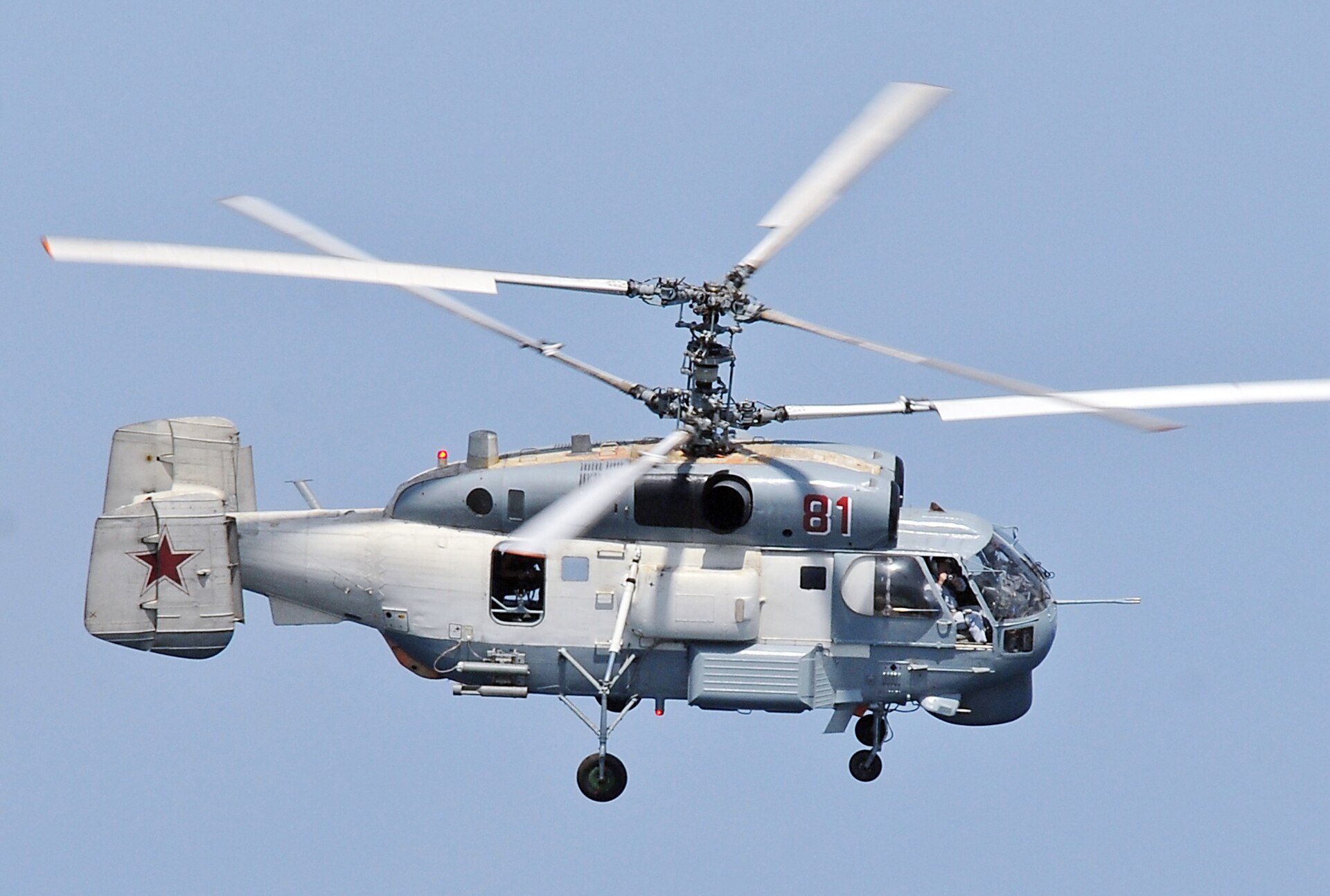
Kamov Ka-27 / Ka-29 / Ka-32 Helix
The Fleet’s Workhorse
Built to fit the hangars of the Ka-25 it replaced, Kamov’s compact coaxial Helix has hunted submarines, landed marines, served as the Ka-31 radar picket and fought forest fires for more than four decades.
The Ka-27: how Kamov packed a bigger helicopter into a Ka-25’s hangar
On 26 December 1968 a Soviet government directive told the Kamov bureau to begin work on a successor to the Ka-25, the small coaxial helicopter that hunted submarines from Soviet cruisers. The brief was demanding. The new machine had to carry far more fuel, sensors and weapons, yet fit into the same shipboard hangars and deck lifts built for the Ka-25. Kamov’s answer was its trademark layout: two contra-rotating three-blade rotors on one mast, no tail rotor and a short tail with twin fins, so that the whole aircraft stayed compact with its blades folded. Designers called it a self-contained ‘compact truck’. Test pilot Yevgeniy Laryushin made the first hover of the prototype, designated Ka-252, on 8 August 1973, and its first circuit on 24 December 1973.
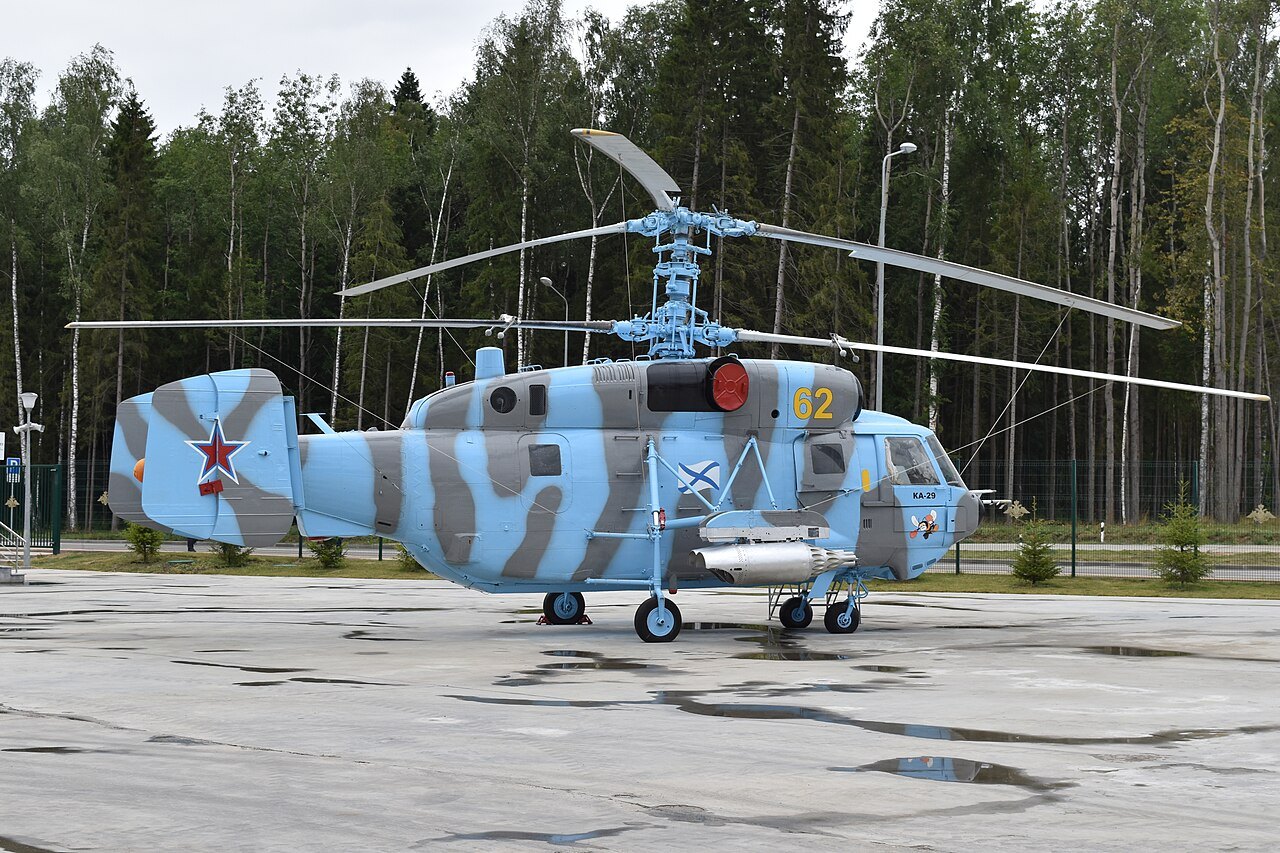
Series production began at Kumertau in Bashkortostan in July 1979, and on 14 April 1981 the helicopter officially entered Soviet Navy service as the Ka-27, NATO reporting name Helix. The first version, the Ka-27PL, hunted submarines with a dipping sonar, a magnetic anomaly detector and sonobuoys, usually working in pairs, one tracking the target while the other attacked. A search-and-rescue Ka-27PS followed, and from the basic airframe Kamov built the Ka-29 assault helicopter for naval infantry, with a wider cockpit, a cabin for 16 troops and weapon pylons, and the Ka-31 radar picket, whose rotating antenna unfolds beneath the fuselage. The export Ka-28 went to India, China, Vietnam, Syria, Cuba and the former Yugoslavia.
The civil Ka-32 took the design further still. The first one flew on 8 October 1980, and from 1986 Kumertau built versions for ice reconnaissance from Soviet icebreakers, offshore supply, logging, construction and, above all, firefighting. South Korea acquired more than 60 from 1993, and operators in Canada, Switzerland, Spain, Portugal, Indonesia and Japan used the type’s lifting power to hang heavy loads with precision, its coaxial rotors making it steady in a hover. The war in Ukraine brought the family’s strangest chapter: Western sanctions grounded Ka-32 fleets in Europe, while in the Black Sea Russian Ka-29s hunted Ukrainian sea drones and the open-source analysts of Oryx confirmed three Ka-27s and Ka-29s lost.
01The Ka-27’s submarine hunt: dipping sonar on a pitching deck
The Ka-27PL was built for one of the Cold War’s most demanding jobs. Its mission was to detect, track and destroy submarines running as deep as 500 m and as fast as 75 km/h, in any season and weather, operating up to sea state 5 and as far as about 200 km from its ship. The helicopter lowers a VGS-3 dipping sonar into the sea in a hover, passes target data to its ship semi-automatically, and can also use a magnetic anomaly detector and a receiver for sonobuoy signals. In Soviet practice the helicopters normally worked in pairs: one tracked the submarine while the other dropped depth charges or a torpedo.
The coaxial layout was ideal for this work. With no tail rotor, all power goes into lift, the helicopter can hold a hover precisely over a moving sea, and a mixing system in the controls keeps total rotor thrust constant in turns, easing landings on a pitching deck. Kamov designed it to keep flying on one engine at maximum take-off weight. A heated weapons bay keeps torpedoes reliable in Arctic cold, and corrosion-resistant materials protect the airframe from salt air.
Russia began modernising its fleet to the Ka-27M standard in 2016, adding an active electronically scanned array radar, new acoustic and magnetometric systems and a radio reconnaissance suite. The rebuilt helicopters now fly from ships such as the cruiser Admiral Nakhimov, designed to carry up to three Ka-27s or Ka-31s below deck.
02The Ka-31: Kamov’s radar picket for India and Russia
Kamov began development of the Ka-31 airborne early warning helicopter in 1980, and it first flew in 1987. Based on the Ka-27 airframe, it carries the E-801M Oko (Eye) radar developed by the Nizhny Novgorod Radio Engineering Institute. Its 6 m² antenna lies flat against the underside of the fuselage until deployed, then swings down and rotates, and the landing gear retracts to keep out of its way. The radar can track 40 targets at once, giving a warship a view of low-flying aircraft and helicopters far beyond the reach of its own masthead radar. A crew of two, pilot and navigator, sit on a wider flight deck than the Ka-27’s.
The Indian Navy became the main foreign customer, ordering four in 1999 and five more in 2001; the first batch entered service in April 2003. India later sought ten more for its new carrier INS Vikrant, a deal worth about US$520 million, but halted negotiations in 2022 over doubts about Russia’s ability to deliver after the invasion of Ukraine. China also bought Ka-31s for its navy.
What makes the Ka-27 special
Small outside, big inside
The Ka-27 had to fit into hangars and deck lifts designed for the much smaller Ka-25. Coaxial rotors made that possible: with no tail rotor and only a short tail boom with twin fins, the folded helicopter has about the same overall dimensions as its predecessor, yet carries a longer, roomier fuselage, much more fuel and two far more powerful turbines. The engines and auxiliary power unit sit above the cabin, leaving the interior clear, and the lower fuselage is sealed so the helicopter can float.
Rock-steady in the hover
Coaxial rotors cancel each other’s torque, so a Ka-27 or Ka-32 needs no tail rotor and has no power-hungry anti-torque system to manage. Yaw is controlled by varying the pitch of the two rotors differentially through the pedals. The result is a helicopter that holds a precise hover in gusty conditions, which made the type valuable for dipping sonar work at sea and later for lifting heavy loads and dropping water on fires, where civilian pilots prized its stability in smoke and turbulence.
One airframe, many jobs
From one basic design Kamov produced a submarine hunter, a rescue helicopter, an assault transport for 16 marines, an airborne early warning radar picket and a family of civil workhorses. The civil Ka-32S carried an undernose radar for guiding ships through ice; the Ka-32K flying crane had a retractable gondola for a second pilot to watch the load. Kamov’s ability to reuse one rotor system and airframe kept costs down and kept Kumertau busy for three decades.
03The Ka-27’s variants: Helix-A to Ka-32A11BC
- Ka-252: prototype, first hovered 8 August 1973.
- Ka-27PL (Helix-A): anti-submarine version with dipping sonar, MAD and sonobuoys; three crew.
- Ka-27PS (Helix-D): search and rescue and plane guard version with winch and external fuel tanks.
- Ka-27M: modernised ASW version with AESA radar, from 2016.
- Ka-28 (Helix-A): export ASW version with TV3-117VK engines and more fuel.
- Ka-29 (Helix-B): naval assault transport with wider cockpit, 16 troops and four weapon stations.
- Ka-31 (Helix-B airframe): airborne early warning with rotating E-801M Oko radar; first flight 1987.
- Ka-32T / Ka-32S (Helix-C): civil utility and shipborne ice-patrol versions, in production from 1987.
- Ka-32K: flying crane with retractable observation gondola.
- Ka-32A family: certificated civil versions for firefighting, police, rescue and heavy lift, including the widely exported Ka-32A11BC.
Kamov Ka-27PL Helix specifications
Specifications
- Crew
- 3 (pilot, navigator, sonar operator); Ka-29: 2 pilots plus 16 troops
- Length
- 11.3 m (37 ft 1 in) fuselage
- Main rotor diameter
- 2 × 15.8 m (51 ft 10 in), coaxial contra-rotating
- Height
- 5.5 m (18 ft 1 in)
- Empty weight
- 6,500 kg (14,330 lb)
- Max take-off weight
- 12,000 kg (26,455 lb)
- Powerplant
- 2 × Isotov TV3-117 series turboshafts (TV3-117KM on Ka-27), about 1,660 kW (2,230 shp) each
- Maximum speed
- 270 km/h (168 mph)
- Cruise speed
- 205 km/h (127 mph)
- Operational radius
- about 200 km (124 mi) from the ship
- Service ceiling
- 5,000 m (16,400 ft)
- Armament
- Ka-27PL: one homing torpedo or torpedo rocket, depth bombs, up to 36 sonobuoys; Ka-29: 7.62 mm machine gun or 30 mm cannon, rockets and missiles on four stations
Costs & production
- Cost per flight hour
- No official military figure published. Hedged estimate: several thousand US dollars per hour, based on two TV3-117 turbines and the maintenance of a coaxial transmission in a salt-water environment; civil Ka-32 operators charge commercial heavy-lift rates that vary by contract
- Production
- Built at Kumertau from July 1979; Ka-32 series production from 1986; Ka-27M modernisation at Kumertau from 2016
- Programme
- Directive 26 December 1968; first hover 8 August 1973; first circuit 24 December 1973; Soviet Navy service 14 April 1981
04The Ka-32 in civil service: firefighting, logging and sanctions
The civil Ka-32 found a niche wherever heavy loads had to be placed precisely. Versions were certificated for passenger and freight work, firefighting with a suspended bucket, police and rescue duties. South Korea became the largest civil and government user: Ka-32s have been supplied to Korean operators since 1993, more than 60 operate there, and the coastguard uses them to patrol inshore waters. Operators in Canada used them for selective logging, and others in Europe, Japan, Indonesia and South America for construction and firefighting.
Sanctions after Russia’s invasion of Ukraine ended the type’s European career. Spain’s fleet of Ka-32A11BC firefighters could no longer be supported: in 2023 only three of the eight helicopters contracted were available, by 2024 none, and by the end of 2024 Spain had ended all firefighting missions with the type, as reported in February 2025, the last airframes being sold to China.
05The Ka-27’s operating costs: what we know
Russia does not publish military operating costs, and civil Ka-32 rates are set contract by contract. The two TV3-117 turboshafts belong to the same family that powers the Mi-8 and Mi-24, and the coaxial rotor system, with six blades and a complex gearbox, demands careful maintenance, especially at sea. An hour of military flying almost certainly costs several thousand US dollars. For civil operators in the West, the bigger cost after 2022 was the loss of spare parts and engine overhauls under sanctions, which grounded fleets that were still airworthy.
The Ka-27 from Ka-252 to the Black Sea
Directive
A government directive of 26 December starts work on a Ka-25 successor.
First flight
The Ka-252 prototype hovers on 8 August and flies its first circuit on 24 December.
Production
Series production begins at Kumertau in July.
Civil Ka-32
The first Ka-32 flies on 8 October.
Navy service
The Ka-27 officially enters Soviet Navy service on 14 April.
Ka-31 flies
The airborne early warning version makes its first flight.
Korea
Ka-32s begin to reach South Korean operators.
Indian Ka-31s
The Indian Navy’s first four Ka-31s enter service in April.
Ka-27M
The first modernised Ka-27M leaves Kumertau at the end of December.
Black Sea loss
A Ka-29 is reportedly shot down by a Russian Pantsir over Crimea on 21 June; four crew are killed.
Spain grounds Ka-32s
Reports in February confirm that Spain ended Ka-32 firefighting at the end of 2024; the airframes are sold to China.
Yeysk strike
Ukrainian drones strike a Ka-27 at Yeysk, Russia, in May.
Stories & eyewitnesses: the Ka-27 at sea and ashore
Laryushin’s first hover
August 1973: the new Kamov leaves the ground.
Read the full story
Built to fit an old hangar
A bigger helicopter in a Ka-25’s parking space.
Read the full story
Hunting in pairs
How the Soviet Navy used its Helixes.
Read the full story
The Eye under the fuselage
The Ka-31’s radar unfolds in flight.
Read the full story
Korea’s Kamovs
More than 60 Ka-32s in one country.
Read the full story
The end of Spain’s Kamovs
Sanctions grounded a firefighting fleet.
Read the full story
Shot down by its own side
Crimea, June 2024.
Read the full story
Strike at Yeysk
Drones reach a Russian naval air base.
Read the full story
From Havana to Pyongyang
The strange journey of Cuba’s Helixes.
Read the full story
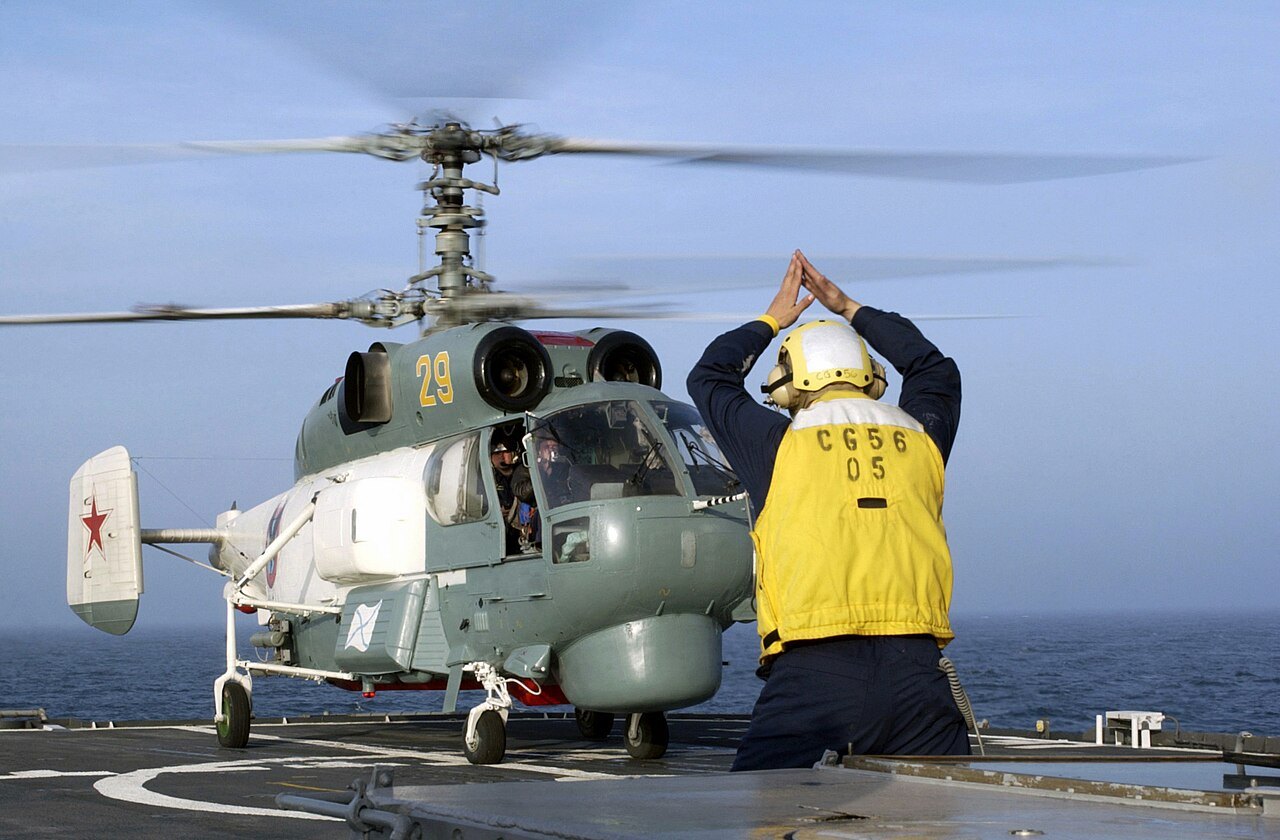
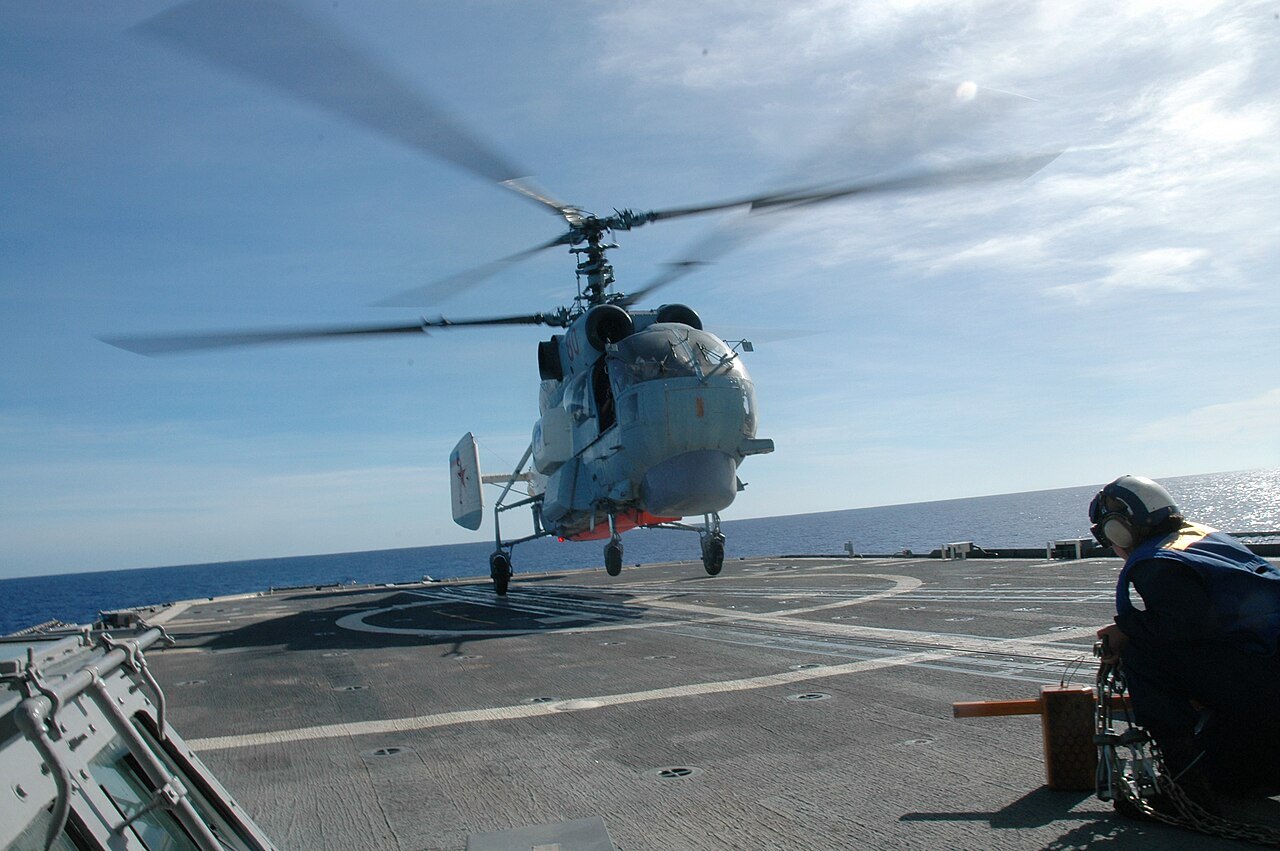
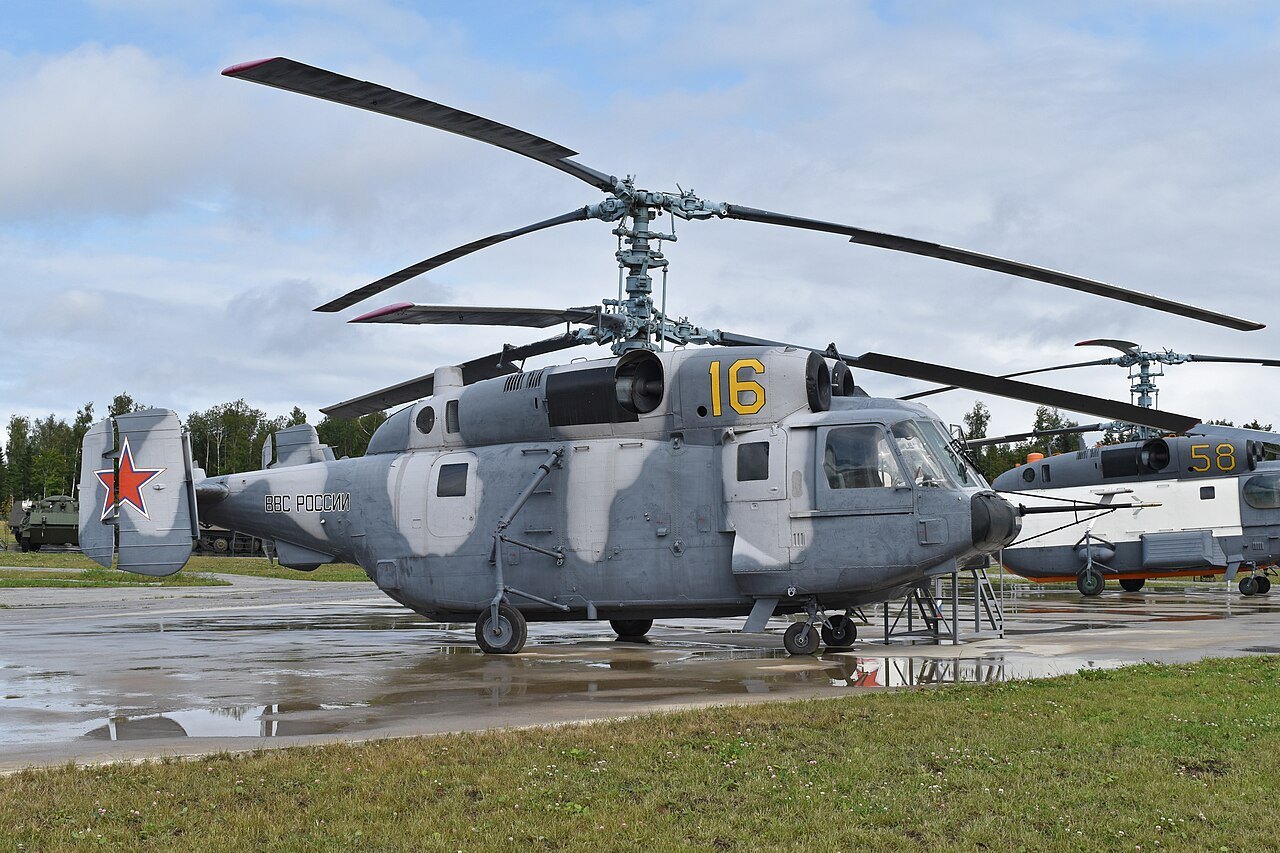
The Ka-27 in pictures
Where the Ka-27 flies and flew
The Ka-27’s record
For most of its life the Helix has been a Cold War submarine hunter and a rescue and utility helicopter, with a long civil career as a firefighter and heavy lifter. In the war in Ukraine, Russian Ka-27s and Ka-29s have flown against sea drones over the Black Sea, and open-source analysts have confirmed losses on the ground and in the air.
See how training and combat types compare in the military aircraft statistics database. Figures are approximate.
Everything people ask about the Ka-27
Can I fly in a Kamov Ka-27 / Ka-29 / Ka-32 Helix?
Why does the Ka-27 have two main rotors?
What is the difference between the Ka-27, Ka-29, Ka-31 and Ka-32?
When did the Ka-27 first fly?
Who uses the Ka-31?
Why did Spain stop flying the Ka-32?
Has the Ka-27 family been used in combat?
You can’t fly the Ka-27.
These, you can.
Most of this museum you can only look at. These genuine military jets you can fly yourself with MiGFlug — with aerobatics and time on the controls.
 Fly the L-39 AlbatrosThe world’s most-flown jet trainer — aerobatics included
 Fly the F-104 Starfighter“The missile with a man in it”
 Fly the MiG-21The Cold War’s most-produced jet
 Fly the T-33 Shooting StarAmerica’s first jet trainer
 Fly the DH VampireA piece of early jet history
 Fly the S.211Agile Italian jet trainer
 Fly the MB-326The classic Aermacchi jet
 Fly the MiG-15The Soviet legend of the Korean War
Continue the tour
Every fact, checked
- Ka-27/28 and Ka-29 Helix Multirole Naval HelicopterAirforce Technology: ASW mission, sonar, weapons, operators, Ka-29
- Ka-31 Radar Picket Airborne Early Warning (AEW) HelicopterAirforce Technology: Ka-31 development, Oko radar, Indian orders
- [Actu] Modernisation des Kamov Ka-27PLRed Samovar (French): 1968 directive, 1973 first flights, Laryushin, 1979 production, 1981 service entry, Ka-27M
- Kamov Ka-27Variants and design features compiled from Jane’s and R. Simpson, Airlife’s Helicopters and Rotorcraft (1998)
- Kamov Ka-32Ka-32 first flight 8 October 1980, civil versions and design features, from Jane’s and G. Kuznetsov, OKB Kamov: 50 years (1999)
- Modernized Ka-27M helicopters for the Russian Ministry of DefenseAviation News, August 2017, on the Ka-27M upgrade
- India halts Ka-31 helicopter deal with RussiaDefense News, May 2022
- Russian Helicopters visit South KoreaHelicopter Investor: Ka-32s in Korea since 1993, more than 60 in service
- Spain stops flying Kamov KA32sHeliOps Magazine, 8 February 2025
- Russia reportedly loses Ka-29 helicopter to friendly fireDefence Blog, 21 June 2024
- Ukrainian drones destroy Be-200 amphibious aircraft and strike Ka-27 helicopter in Yeysk, RussiaUkrinform, 15 May 2026
- Russia Equips the World’s Largest Combat Ship Air Wing with New Submarine Hunting HelicoptersMilitary Watch Magazine on the Ka-27M aboard Admiral Nakhimov