
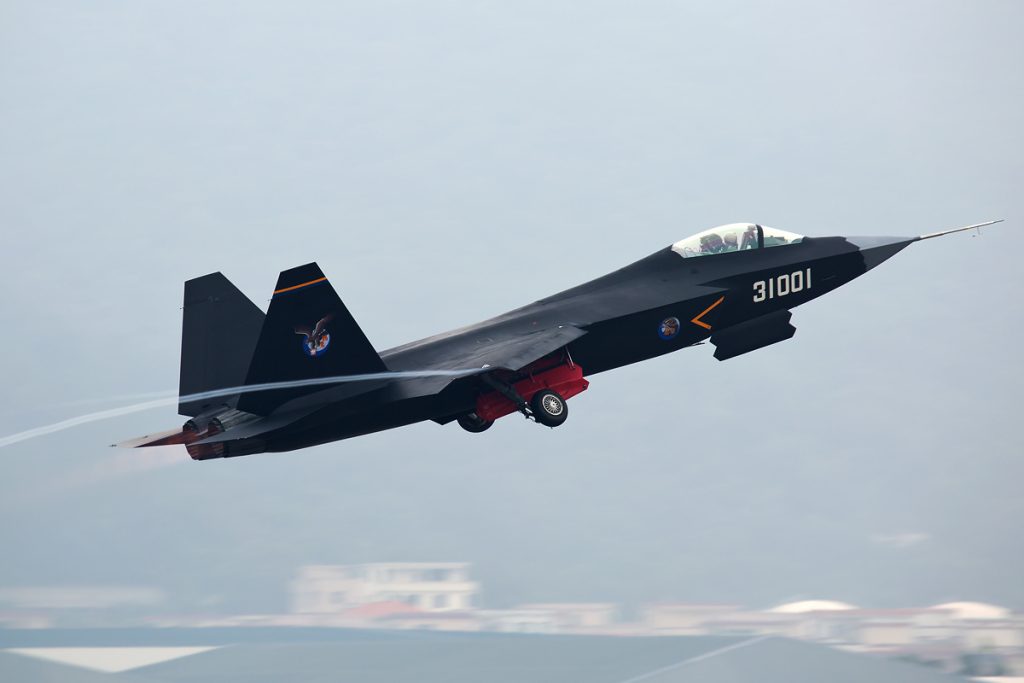
Shenyang FC-31 / J-35
China’s second stealth fighter
A twin-engine, medium-weight fifth-generation design developed by Shenyang into the carrier-based J-35 and the land-based J-35A. Much about it is unconfirmed — almost every figure below is a reported estimate, not official data.
The FC-31 / J-35: China’s second stealth fighter
The aircraft now generally known as the J-35 began life as the FC-31, a twin-engine stealth-fighter demonstrator built by the Shenyang Aircraft Corporation (SAC). Reported to have first flown on 31 October 2012, the demonstrator was widely described as a company-funded project rather than an aircraft formally commissioned by the Chinese military at that stage. It made China the second country, after the United States, to fly more than one stealth-fighter design — alongside the larger, heavier Chengdu J-20.
Over the following decade the design evolved. A revised second prototype flew in 2016, and the programme is reported to have shifted toward a naval future: a carrier-capable variant, the J-35, is said to have first flown around 2021, apparently intended to operate from the PLA Navy’s catapult-equipped carrier Fujian. A land-based variant, the J-35A, was publicly unveiled at the Zhuhai Airshow in November 2024 — the clearest official sign that the design had moved beyond a demonstrator toward a fielded fighter.
Analysts frequently frame the J-35 as a smaller, more numerous complement to the J-20, loosely echoing the way the F-35 sits alongside the F-22 in American service. That comparison is an outside interpretation, not an official Chinese statement, and it should not be read as a claim of capability parity. The aircraft’s general shape — a faceted, blended forebody, side intakes and an internal weapons bay — also invites frequent comparison with Lockheed Martin’s F-35. Similar silhouettes, however, can reflect convergent stealth-design choices as much as anything else, and outward resemblance reveals little about internal systems.
What is genuinely established is fairly limited: the aircraft exists, has flown in several prototype forms, has a carrier variant (J-35) and a land variant (J-35A), and is reported to be entering PLA Navy service in the mid-2020s. Almost everything else — its engines, weight, radar, weapons load, true stealth signature, cost and production numbers — rests on photographs, airshow appearances, satellite imagery and Chinese state media rather than independently verified data. For that reason, careful coverage hedges nearly every performance figure as reported, estimated or believed, and this page does the same.
01The FC-31, J-31 and J-35: untangling the designations
The name history is genuinely confusing, and much of it is unofficial. FC-31 (“Fighter China”) was an export-oriented company designation for the original demonstrator. J-31 was a tentative label widely used by outside observers, but it was reportedly never confirmed as an official PLA designation. J-35 refers to the more mature operational programme; the carrier variant is the J-35, and the land-based air-force variant, publicly shown in 2024, is the J-35A. In short, the shifting names track the aircraft’s evolution from a private demonstrator toward a fielded military type — and some designation details are still not fully pinned down by independent analysts.
What makes the FC-31 / J-35 notable
A twin-engine medium stealth design
Unlike the single-engine F-35, the FC-31 / J-35 uses two engines. It shows the visible hallmarks of a low-observable fighter — a faceted, blended airframe, edge-aligned surfaces, angled tails, diverterless supersonic inlets and an internal ventral weapons bay to carry munitions without signature-spoiling external stores. These traits indicate stealth intent; the aircraft’s actual radar cross-section, which depends on coatings, materials and tolerances that cannot be judged from photographs, has not been publicly established.
An engine that keeps changing
The powerplant has been one of the programme’s most persistent open questions. Early demonstrators reportedly flew on Russian RD-93 engines (an RD-33 derivative), later said to give way to the domestic WS-13, with reporting increasingly pointing to a newer WS-19 (and in some accounts a WS-21). Which engine actually equips production aircraft is not firmly confirmed, and at least one leaked assessment reportedly questioned the newer engines’ performance. Treat any thrust, speed or supercruise claim as an estimate.
Adapted for the carrier deck
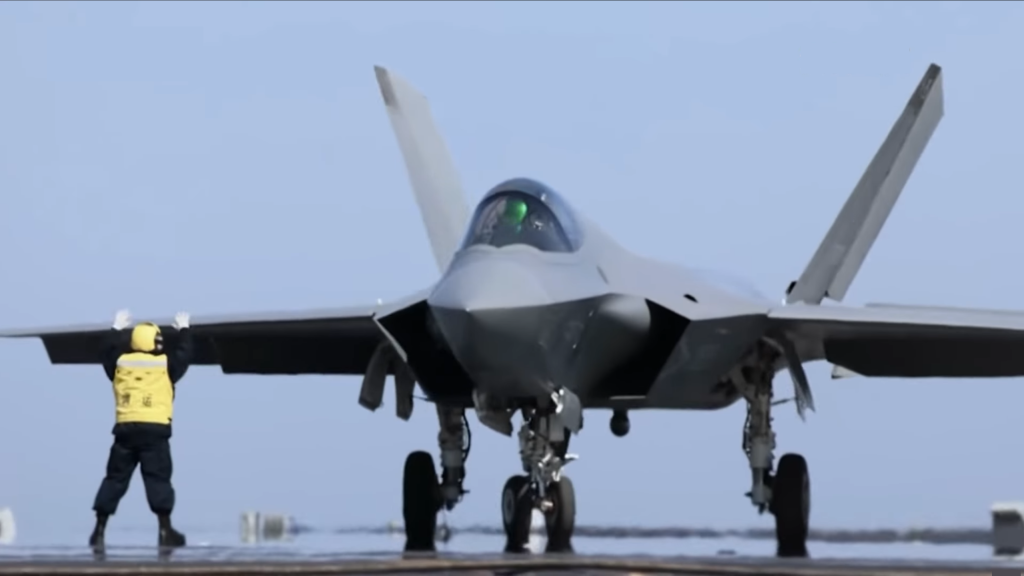
The naval J-35 is reported to add folding wings, strengthened dual-wheel nose gear with a catapult launch bar, and reinforced structure for catapult launch and arrested recovery — for operation from Fujian (Type 003), the only non-US carrier fitted with electromagnetic catapults. The land-based J-35A visibly differs, with a lighter structure, a single nose wheel and no catapult bar. Catapult launches of the J-35 from Fujian have been shown in PLA Navy footage, though full operational readiness is harder to verify independently.
02The FC-31 / J-35’s engines: why the powerplant is still a question mark
Engine maturity has long been viewed as a potential constraint on Chinese fighter programmes, and the J-35 is a case in point. The lineage most often reported runs from the Russian RD-93, to the domestic WS-13 family, toward a more capable WS-19 (“Huangshan”), with a WS-21 mentioned in some accounts as an interim step. Sources disagree over which engine flies on current aircraft, and whether it enables supercruise. None of this is officially confirmed by China, and independent analysts caution that leaked performance claims — positive or negative — are difficult to verify. Any specific thrust figure attached to the type should be read as an estimate.
03The FC-31 / J-35 and the F-35: similar shape, different machine
The J-35 is routinely compared to the F-35, and some commentators allege design influence aided by cyber-espionage. Analysts urge caution: broadly similar stealth silhouettes recur across fifth-generation designs — the South Korean KF-21 and Indian AMCA share comparable layouts — because similar requirements tend to produce similar shapes. A clear configuration difference is that the J-35 is twin-engine while the F-35 is single-engine. Claims that the two aircraft are equivalent in stealth, sensors, software or networking, or that one is simply a copy of the other, are not supported by public evidence, and should be treated with caution in either direction.
Full specifications (estimated)
China has released almost no official data on the FC-31 / J-35. Every figure below is a reported estimate — many trace back to the original FC-31 demonstrator and may no longer hold for the J-35A. Treat them as order-of-magnitude, not confirmed.
Baseline note: the figures below describe the Shenyang J-35 family as it is publicly understood in 2026, and the first honest thing to say about them is that almost none are official. The only specification AVIC has ever put its name to belongs to the FC-31 export demonstrator — the company datasheet archived from 2018, and the briefings given to Aviation Week and FlightGlobal at Dubai in November 2015 — and those numbers describe a private-venture prototype that differs from the production aircraft in wing, canopy, structure, engines and mission systems. Neither the PLA nor Shenyang has released a specification for the J-35 or J-35A now in service. Where a row below is an AVIC brochure figure it is treated as the best available; where it is an estimate it says so; where nothing has been published, the row says so rather than repeating an internet consensus. Deltas for the two FC-31 prototypes, the naval J-35 and the export J-35AE are in grey. Four published disagreements are worth settling before the tables start. Maximum take-off weight: Janes reported 25,000 kg for the first FC-31 prototype and 28,000 kg for the second, while Chinese-language sources give 30,000 kg for the J-35, and all three circulate as "the J-35 figure". Maximum speed: the AVIC datasheet gives Mach 1.8, Chinese-language sources give Mach 2.2, and neither is a test report. Engine thrust: the 116 kN routinely quoted for the WS-19 is an estimate that has hardened into a fact by repetition, because Guizhou has published nothing at all. Empty weight: it has never been published by anybody, and every figure in circulation is somebody’s arithmetic.
Dimensions & weights
- Crew
- 1 — single-seat throughout. No two-seat J-35 has been photographed, which separates the type from the J-20, whose two-seat J-20S flew in 2021 and led a formation over Beijing in September 2025. Whether Shenyang intends a two-seater is simply unknown
- Length
- 17.3 m (56 ft 9 in) — the AVIC figure, quoted indiscriminately for the FC-31 demonstrator, the naval J-35 and the J-35A, which cannot be true of all three given the airframe changes between them. For scale: the F-35A is 15.7 m (51 ft 4 in) and the J-20 roughly 20 m (66 ft)
- Wingspan
- 11.5 m (37 ft 9 in) — against 10.7 m (35 ft 0 in) for the F-35A. The naval J-35 has a wing of greater chord and area than the land-based J-35A; the folded span has never been published
- Height
- 4.8 m (15 ft 9 in)
- Wing area
- not published — estimates cluster near 40 m² (430 sq ft) for the land aircraft, but none traces to a Chinese figure. What is well attested is only relative: the naval J-35 carries the larger, clipped, folding wing and the J-35A a smaller unclipped one
- Nose landing gear
- twin-wheel on the FC-31 and naval J-35, single-wheel on the J-35A — the twin nose wheel on the 2012 demonstrator was the tell that Shenyang had carrier work in mind from the start; it is a deck-load and catapult feature with no purpose on a runway. The naval J-35 adds a launch bar to it
- Carrier equipment
- folding wings, launch bar and arrestor hook on the J-35 only — the J-35A and the export J-35AE have none of it. A full-size J-35 mock-up was placed aboard Liaoning in February 2024, which suggests the design is meant to work off the older ski-jump carriers as well as off Fujian’s catapults
- Empty weight
- not published — Western estimates run 12,000–13,500 kg (26,500–29,800 lb). No Chinese source has ever given one, and any table that prints a precise empty weight for this aeroplane has invented it
- Normal take-off weight
- 17,500 kg (38,600 lb) — the FC-31 brochure figure. Chinese-language sources give 22,200 kg (48,900 lb) for the J-35, nearly five tonnes more, and nobody has explained the gap
- Maximum take-off weight
- 28,000 kg (61,700 lb) — Janes’s figure for the second FC-31 prototype, up from 25,000 kg (55,100 lb) on the first. Chinese-language sources give 30,000 kg (66,100 lb) for the J-35, which is the only one of the three that could plausibly describe an aircraft with folding wings, a hook and a strengthened deck structure
- Internal fuel
- ~7,200 kg (~15,900 lb) — a large fraction for a medium fighter, and close to the F-35A’s 8,278 kg (18,250 lb) in an airframe with two engines to feed. The clamshell canopy adopted on the J-35 freed volume behind the cockpit and is generally read as a fuel and avionics decision
- Maximum weapon load
- ~8,000 kg (~17,600 lb) in total — ~2,000 kg (~4,400 lb) on six stations inside the long ventral bay and ~6,000 kg (~13,200 lb) on six wing pylons. The external figure only exists in a world where nobody is looking for the aircraft on radar
Performance
- Maximum speed
- Mach 1.8 (about 1,910 km/h; 1,190 mph at altitude) — AVIC’s number. Chinese-language sources give Mach 2.2 and gloss it as 2,200 km/h, a figure whose two halves do not agree with each other, since Mach 2.2 in the stratosphere is about 2,340 km/h (1,455 mph)
- Speed at sea level
- Mach 1.14, 1,400 km/h (870 mph; 756 kt)
- Supercruise
- not demonstrated — claimed for the WS-19-engined production aircraft by Chinese commentary and by nobody with data. Sustained supersonic cruise without reheat is a thrust-and-drag problem that no photograph can settle, and no Chinese authority has asserted it in an official document
- Combat radius, internal fuel
- ~1,250 km (~780 mi; ~675 nmi) — the 2015 Dubai briefing gave ~1,200 km (~745 mi). Both describe a hi-lo-hi profile on a brochure, not a measured sortie
- Combat radius, one refuelling
- ~1,900 km (~1,180 mi; ~1,025 nmi) — a retractable probe is fitted, and the figure is only as good as the PLA’s tanker fleet of Y-20U and H-6U aircraft, which is small but growing fast
- Combat radius, external tanks
- ~2,000 km (~1,240 mi; ~1,080 nmi) — and the moment tanks go on the wing the low-observable argument for the aeroplane ends. This is a ferry and peacetime-presence number, not a first-day-of-war one
- Service ceiling
- 16,000 m (52,500 ft)
- g limits
- +9 / −3 — the standard modern fighter envelope, and one of the few numbers on this page that is not controversial because every fifth-generation type quotes it
- Take-off distance
- 400 m (1,310 ft) per the AVIC datasheet; 450 m (1,480 ft) is also widely quoted, and the difference is probably a loading assumption rather than a disagreement about the aircraft
- Landing distance
- 700 m (2,300 ft)
- Rate of climb
- not published — nor time to altitude, nor turn rates, nor specific excess power at any condition. For an aircraft that has been flying for fourteen years this is a remarkable silence, and it is deliberate
- Thrust-to-weight ratio
- not published — two WS-19 at an estimated 116 kN each against a 22,200 kg normal take-off weight would give roughly 1.07, which is arithmetic performed on two numbers that are themselves estimates
Propulsion & systems
- Engines, production standard
- 2 × Guizhou WS-19, ~116 kN (~26,100 lbf) each with reheat — the intended powerplant, sometimes called Huangshan. The thrust figure is an estimate carried by FlightGlobal and repeated everywhere; Guizhou has published no rating and no photograph has confirmed which engine any given production airframe carries
- Engines, interim
- 2 × Guizhou WS-21, 93.2 kN (20,950 lbf) with reheat — also called the WS-13X, a stretched development of the WS-13E fitted to the J-35 prototypes from 350003 in July 2022 and to early production aircraft. An interim engine in a Chinese fighter programme is a familiar sight; the J-20 spent a decade on one
- Engines, FC-31 second prototype
- 2 × Guizhou WS-13E, 87.2 kN (19,600 lbf) with reheat — the domestic derivative of the JF-17’s WS-13, smokeless and more efficient than what it replaced
- Engines, FC-31 first prototype
- 2 × Klimov RD-93, ~84.4 kN (~19,000 lbf) with reheat — the RD-33 of the MiG-29 with a relocated gearbox. It smoked visibly, which spectators at Zhuhai in 2014 could see from the ground, and it left China dependent on Russian export consent for an aircraft it wanted to sell abroad. Replacing it was as much a political fix as a technical one
- Intakes and nozzles
- diverterless supersonic inlets with serpentine S-ducts — the ducts hide the compressor faces from radar, which is why no fifth-generation fighter has a straight intake. Serrated exhaust nozzles appeared from the 350003 prototype onwards to cut rearward radar and infrared return; the first FC-31 had plain round nozzles and a hot, obvious tail
- Radar
- active electronically scanned array, type unidentified — the set advertised for the export FC-31 was the Nanjing institute’s KLJ-7A, which Chinese marketing compared to the AN/APG-81. That was a sales claim about a demonstrator. Nothing is publicly known about the array actually fitted to a serving J-35A: not its aperture, not its module count, not its power
- Electro-optics
- chin-mounted EOTS turret and a distributed aperture system — the faceted turret under the nose is visible in photographs and its function is not in doubt; its performance is entirely unknown. The A-Star EOTS-86 infra-red search and track was marketed for the FC-31 in 2015. The DAS apertures around the airframe follow the same layout logic as the F-35’s, because the requirement is the same
- Cockpit
- large-format touchscreen panel, HUD and helmet-mounted display — the mock-up shown by AVIC used a single 510 × 200 mm (20 × 8 in) touchscreen. A side stick is fitted to the FC-31 and J-35A; the naval J-35 has a conventional centre stick, which is a deck-landing decision
- Flight control
- triple-redundant digital fly-by-wire on a twin data bus — described in AVIC material for the FC-31. Chinese sources state that the naval and land variants run different software and avionics tailored to their services while sharing the platform
- Low-observable treatment
- edge-aligned control surfaces, sawtooth panel and bay-door edges, embedded antennas, radar-absorbent material both baked into the structure and applied externally — AVIC claims effectiveness against L-band and Ku-band radars and low observability across multi-spectrum sensors. There is no measured radar cross-section for this aircraft in the public domain and there will not be one. Chinese commentary that the return is "smaller than a palm" is a slogan, not a measurement
- Signature management in peacetime
- Luneburg lens reflectors, bolted on for the J-35 prototypes and reportedly retractable on the J-35A — their purpose is to make the aircraft conspicuous, inflating its radar return so that anyone watching a routine sortie learns nothing about the real signature. Every operational stealth type does this
- Manufacture
- 3D-printed titanium primary structure — Chinese sources claim the parts count is around half, and the tooling and die count around 46 per cent, of what a fighter in the J-10 and J-11 class required, with corresponding cuts in build time and cost. Shenyang and Chengdu both pioneered laser additive manufacture of large titanium airframe components, and this is the one area where Chinese practice may genuinely lead
04The FC-31 / J-35’s cost: why no reliable price exists
There is no reliable public unit-cost or cost-per-flight-hour figure for the FC-31 / J-35. It is a Chinese state programme, not sold on an open market, and Beijing has disclosed neither procurement prices nor operating costs. Any dollar figure circulating online — whether for the aircraft or a reported export version — is speculative. The same caution applies to production numbers: some 2025–26 reports infer roughly 30 airframes built in under a year from apparent serial numbers, but those are estimates drawn from imagery, not official data.
Armament & payload
Nobody outside China has seen a J-35 fire anything, so the list below is an inventory of what fits rather than a record of what works
The J-35’s armament is better documented than most of its systems, which is not saying a great deal. AVIC’s export material gives six hardpoints inside a single long ventral bay and six more under the wings, with 2,000 kg internal and 6,000 kg external, and the bay photographs released around the 2024 Zhuhai show are consistent with that. Everything more specific — which missile on which rail, how many of each, what the doors can actually close on — is inference from Chinese weapons already carried by the J-16 and J-20 and from models on airshow stands. The internal bay is long, which points at a strike role as much as an air-to-air one, and the six-round air-to-air fit it is credited with matches the J-20’s. No J-35 or J-35A has been publicly photographed with a weapon loaded, no live firing has been released, and Chinese sources state that the naval and land variants run different mission software, so a fit credited to one is not evidence about the other.
Gun
- No gun port has been positively identified in any published photograph of the FC-31, the J-35 or the J-35A, and the English-language specification tables record the gun as unknown.
- Chinese-language descriptions of the J-35 state flatly that a cannon is fitted, without naming it. Neither claim can be checked from outside China.
- If a gun is carried, the plausible candidates are the twin-barrel 23 mm Type 23-3 of the J-10 and J-11 family or a 30 mm weapon of the sort fitted to the J-20. Neither has been seen on this airframe.
- A buried gun and its ammunition cost internal volume that a medium fighter carrying seven tonnes of fuel can ill afford. That is the practical case for scepticism: the F-35A has an internal gun, the F-35B and F-35C do not, and the argument was fought on exactly these grounds.
Air-to-air
- PL-10, short-range imaging infrared with high off-boresight capability and helmet cueing — the Chinese answer to the AIM-9X and ASRAAM, and the weapon the outer bay stations are sized for.
- PL-15, long-range with an active AESA seeker and a dual-pulse motor. The domestic round is credited with well over 200 km; the export PL-15E supplied to Pakistan is rated at about 145 km. This is the missile the ventral bay is built around.
- PL-12, the earlier active-radar weapon, appears in Chinese listings for the type but would be an odd choice for a new-build stealth fighter and is probably a legacy entry.
- PL-17, a very-long-range active-radar weapon of roughly 400 km class, is listed as planned. At a reported six metres it will not fit the ventral bay and would have to go on a wing pylon, which defeats the point.
- PL-21, described as a ramjet-sustained long-range missile in development, has not been seen on any aircraft and should be treated as a programme rather than a weapon.
Air-to-surface guided
- KD-88, a turbojet-powered stand-off missile with television or imaging-infrared guidance out to roughly 180–200 km, already operational on the J-16 and JH-7A.
- YJ-91, the Chinese development of the Russian Kh-31, in both anti-radiation and anti-ship forms; the LD-10 is a separate anti-radiation weapon derived from the PL-12 airframe.
- YJ-83K air-launched anti-ship missile is listed in Chinese sources. At roughly 6.4 m and 700 kg it is unambiguously an external store, which for a carrier strike fighter is an awkward admission about the limits of the bay.
- Published tables credit the aircraft with eight supersonic land-attack, eight anti-radiation and eight anti-ship missiles apiece. Those are statements of what twelve hardpoints could theoretically take, not a fit anyone has observed.
Bombs
- LS-6 family of satellite- and laser-guided glide bombs in 50, 100, 250 and 500 kg sizes — China’s equivalent of the JDAM and Small Diameter Bomb, and by far the most likely internal store.
- The published internal figure is four 500 kg-class weapons, with four more externally; alternatively twelve small bombs internally and eighteen externally.
- The 500 kg deep-penetration weapon mentioned in Chinese descriptions is the one store that would justify the length of the ventral bay, and the one that makes the J-35A a runway-cratering aeroplane rather than only a fighter.
- No guided bomb has been publicly photographed inside a J-35 bay. The imagery released so far shows empty rails and closed doors.
Rockets
- There is no public evidence that any FC-31, J-35 or J-35A has ever carried an unguided rocket pod, and no Chinese source lists one among the type’s stores.
- The card is kept rather than quietly deleted because its emptiness is informative: unguided rockets are a close-air-support weapon for airspace nobody is contesting, and this aircraft was not designed for that war.
- China fields 57 mm and 90 mm pods on the JH-7 and on armed helicopters. Nothing physically prevents hanging one on a J-35 wing pylon; nothing suggests any intention to.
- Any external pod at all forfeits the low-observable qualities that are the entire argument for buying the aeroplane, so the trade only makes sense once the air defences are gone.
Pods & other stores
- External fuel tanks on the wing pylons, credited with lifting the combat radius from about 1,250 km to about 2,000 km. Fitting them is the point at which the aircraft becomes a conventional fighter with an expensive skin.
- A retractable air-refuelling probe is fitted, which is what makes the 1,900 km refuelled radius meaningful and ties the type to the PLA’s growing Y-20U tanker force.
- Luneburg lens reflectors, bolted on for the naval prototypes and reportedly retractable on the J-35A. They exist to make the aircraft visible, concealing the real signature from anyone watching a training sortie.
- No targeting pod has been seen and none should be expected. The chin EOTS turret is the internal answer to that requirement, in the same way and for the same reasons as on the F-35.
Three typical loadouts
- Fleet air defence, naval J-35, clean
- Four PL-15 and two PL-10 on the six internal stations, wing pylons bare, Luneburg lenses removed. This is the configuration the aeroplane exists for: pushing the outer air battle a few hundred kilometres further from a Chinese carrier group than the J-15 ever could, and doing it without announcing itself. Radius on internal fuel is around 1,250 km, extended by tanking.
- Maritime strike, naval J-35, first day
- Two KD-88 or YJ-91 in the bay with two PL-10 for self-defence, pylons empty. Anti-ship work is where the bay’s length pays and also where its limits show, because the heavy Chinese anti-ship missiles that matter most, the YJ-83K among them, will not fit inside and must be hung outside.
- Maximum load, permissive airspace
- Six air-to-air missiles internally plus the full six wing pylons carrying tanks and LS-6 bombs to the quoted 8,000 kg total. The Chinese equivalent of the F-35’s beast mode, usable only after somebody else has taken the air defences down, and a configuration in which radar cross-section has stopped being a design feature and become a liability nobody is measuring.
Sourcing caveat: every loadout above is a reconstruction. They are built from AVIC’s published hardpoint and payload figures, from the dimensions of Chinese weapons in service elsewhere, and from bay photographs, and not one of them has been publicly demonstrated by the PLA. Where a weapon is listed as planned or in development it is flagged as such. Treat the whole section as the best available reading of an aircraft whose operators have released no weapons documentation whatever.
Variants
The FC-31 was a company-funded punt at the export market that nobody bought for a decade, and it is now a Chinese front-line fighter
Shenyang lost. That is the fact the whole programme grows out of. When the PLA ran its next-generation fighter competition in the 2000s, Chengdu’s proposal won and became the J-20, and Shenyang Aircraft Corporation — the older house, the one that had built China’s MiG copies and the J-11 and the carrier-borne J-15 — was left without a fifth-generation programme. Rather than accept it, the 601 Institute and SAC built one on the company’s own money, aimed at foreign customers rather than at the PLA. A model appeared as the "F-60" at a Beijing innovation competition in September 2011. In June 2012 an airframe wrapped in camouflage sheeting was photographed on a lorry under police escort on a Chinese motorway, and observers initially guessed it was a trainer. On 31 October 2012 it flew, with a J-11 as chase, and China became the second country ever to have two stealth fighter designs in flight test at once.
Then nothing happened for ten years. The aircraft appeared as a model at Zhuhai in 2012, flew a public display there on 12 November 2014 under the name Gyrfalcon, and went to the Dubai Airshow in 2015 as an export offering with an AVIC official openly telling Aviation Week that the company was hunting a customer while simultaneously negotiating with its own government for further development. No customer came. A private-venture fighter with no launch operator, no state backing and a Russian engine subject to re-export consent was a difficult thing to sell, and for most of a decade the FC-31 was the aviation world’s standing example of a fine-looking aeroplane nobody wanted. What rescued it was the PLA Navy: by November 2018 Aviation Week was reporting PLA interest, in 2015 the chief designer Sun Cong had already said publicly that the type would succeed the J-15 on China’s carriers, and the navy’s need for something that could fly off the new catapult carrier Fujian gave the design the requirement it had never had.
The claim that the aeroplane was built on stolen F-35 data is the most repeated thing anyone says about it and the thing with the least evidence behind it. The documented part is real. Su Bin, a Chinese businessman running an aviation-technology firm with a Canadian office, was arrested in Canada in July 2014, brought to the United States in February 2016, and pleaded guilty on 23 March 2016 to a conspiracy running from October 2008 to March 2014 to break into American defence contractors’ networks and export what was taken to China; the case papers named the C-17 and American fighter programmes including the F-22 and F-35, and he was sentenced that July. In 2013 the American defence acquisitions chief Frank Kendall told a Senate hearing that stolen F-35 data had helped rivals accelerate their own fifth-generation projects, and documents published by Der Spiegel in January 2015 from the Snowden material described the theft of many terabytes of Joint Strike Fighter material. None of that is in dispute.
The conclusion does not follow from it. Nobody has ever publicly shown a line of stolen F-35 data in an FC-31 drawing. The two aircraft are not the same design: the F-35 is a single-engine aeroplane laid out around a lift-fan bay in one of its three variants and around 8,278 kg of internal fuel, and the FC-31 is a twin-engine aeroplane of similar length with a different wing, different tail volumes and a different mission. The resemblances people point at — the chined nose, the diverterless intakes, the chin turret, the general proportions — are what the requirement and the physics produce, and several of them appear on the J-20 as well. Vladimir Barkovsky of Russia’s MiG, who had every commercial reason to be unkind, said after inspecting it that although it used features already seen on American fifth-generation aircraft it was "not a copy, but a well-done indigenous design". The defensible position is that Chinese intelligence unquestionably stole F-35 material, that this almost certainly saved Chinese industry time and money somewhere, and that nobody outside a very small circle knows where.
The airframe itself changed radically across the programme. Prototype 31001 was a demonstrator and looked like one: two-piece canopy with a heavy bow frame, large near-trapezoidal fins, a long nose probe, plain round nozzles and Klimov RD-93s that trailed black smoke visible from the crowd line at Zhuhai. Prototype 31003, first flown on 23 December 2016, corrected most of it — a one-piece bubble canopy, clipped and more sharply swept fins of reduced area, a reworked forward fuselage, far better surface finish and panel fit, and domestic WS-13E engines that were smokeless. Maximum take-off weight rose from 25,000 to 28,000 kg. The navalised aircraft that flew on 29 October 2021 went further and became a different aeroplane: folding wings of greater chord, a launch bar on the twin nose gear, an arrestor hook, a rear-hinged clamshell canopy freeing volume behind the cockpit, a chin EOTS turret, and WS-21 engines with pronounced sawtooth nozzles. The land-based J-35A followed on 26 September 2023 with a single nose wheel, a smaller unclipped wing, different fins and a side stick in place of the naval aircraft’s centre stick.
- F-60 (model only, September 2011)
- Scale model shown at a Beijing innovation competition, the first public sight of the configuration. It attracted almost no attention at the time.
- FC-31 No. 31001 (first flight 31 October 2012; 1 built)
- The company-funded demonstrator, commonly called FC-31 V1. Two-piece canopy, twin nose wheel, RD-93 engines, plain nozzles, nose probe. Flew the public display at Zhuhai on 12 November 2014 and was exhibited at Dubai in 2015.
- FC-31 No. 31003 (first flight 23 December 2016; 1 built)
- The FC-31 V2, effectively a second design. Bubble canopy, clipped swept fins, cleaner surfaces, WS-13E engines and maximum take-off weight raised to 28,000 kg. Everything that followed descends from this aircraft rather than from 31001.
- J-35 naval prototype, 350001 and 350003 (first flights 29 October 2021 and 22 July 2022)
- The carrier-borne development: folding wings, launch bar, hook, clamshell canopy, chin EOTS. 350003 introduced PLAN grey camouflage, sawtooth panel edges and the serrated-nozzle WS-21, and was the first prototype to look like a service aircraft.
- J-35 Blue Shark (PLA Navy; announced in service September 2025)
- Production carrier fighter with the larger-chord wing, centre stick and naval mission software. Certified for catapult launch and arrested recovery on 22 September 2025, the first stealth fighter anywhere to operate from an electromagnetic catapult at sea.
- J-35A Cloud Dragon (PLA Air Force; first flight 26 September 2023)
- Land-based variant: single nose wheel, smaller unclipped wing, revised fins, side stick, retractable Luneburg lens fittings and no carrier equipment. Publicly unveiled at Zhuhai on 12 November 2024, which by the PLAAF’s own account meant it was already formal equipment.
- J-35AE (export; prototype 001 rolled out 1 May 2026)
- Export derivative of the land-based J-35A rather than of the naval aircraft, with a modified cockpit layout, boarding ladder, wing area and operating software adapted to air-force bases. China’s first fifth-generation fighter offered for export in a definite form.
- J-31B Gyrfalcon (state-media video, July 2024; status unresolved)
- Shown as noticeably larger than the FC-31, with side weapons bays for at least two missiles each in addition to a main bay. Nikkei read it as a further naval type for Fujian; an expert quoted by the South China Morning Post thought it more likely an air-force aircraft. It has not been explained since.
Closing caveat: there is no licence-built J-35 anywhere, no offset assembly line and no second source, and reports of Pakistani local assembly are speculation rather than announced fact. The naming has been chaotic throughout: the serial 31001 on the first prototype produced the widely used but never-official designation J-31; FC-31 is an export number in the same series as the FC-1 and FC-20; J-35 and J-35A are the PLA designations, applied years after the aircraft first flew; and the J-31B of the 2024 video has never been reconciled with any of them. Production is given by open sources as 57 or more airframes by October 2025, a figure assembled from serial-number observation rather than from any Chinese statement.
Operators today
China is the only country flying the J-35, and it has only been doing so since 2025
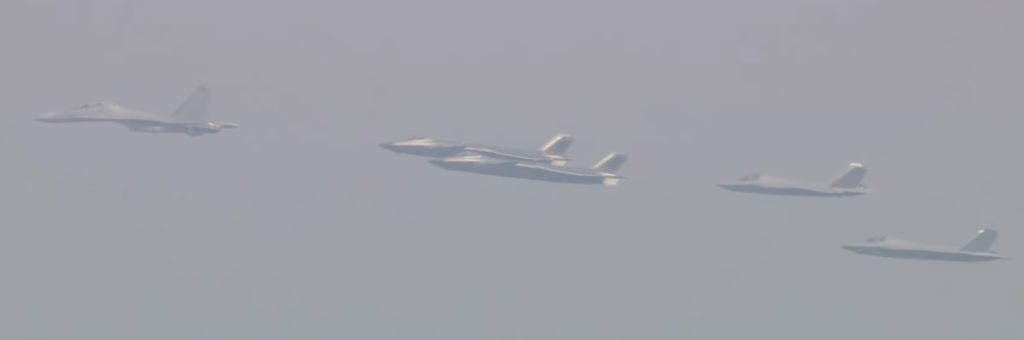
The chart below has one bar because the type has one operator, and saying so plainly is more useful than padding it. The J-35 and J-35A were shown as serving equipment on 3 September 2025, when several five-aircraft arrowheads flew over Beijing for the eightieth-anniversary victory parade, each pairing a J-35 and a J-35A with J-20 variants, and China Daily described both as part of the navy’s and air force’s inventories. The PLAAF’s own position was that the J-35A’s appearance at Zhuhai in November 2024 had already meant it was formal equipment. Nineteen days after the parade, on 22 September 2025, state television released a complete catapult launch and arrested recovery sequence from the carrier Fujian, making the J-35 the first stealth fighter in the world to be launched and recovered by electromagnetic catapult at sea — ahead of the F-35C, which flies from steam catapults, and ahead of any American EMALS stealth deployment.
How many exist is a harder question than it looks. Two airframes carrying the serials 61820 and 61821 were identified in May 2025 by the analyst Andreas Rupprecht as belonging to the PLAAF’s 1st Air Brigade at Shenyang, the first sign of early production and limited service; a prototype numbered 3506 approaching production standard was seen in June 2025; Chinese state media showed a line of airframes inside the Shenyang plant in July 2025. Open-source tallies put total production at 57 or more by October 2025, with standard reference listings crediting the PLAAF with around 54 J-35A. The naval J-35 holding has never been separately quantified in any source worth citing, so it is folded into the single figure below rather than invented. Unit cost is quoted in Chinese sources at roughly 54 to 70 million US dollars, which if true would make it markedly cheaper than an F-35A and is exactly the sort of number a seller likes to see repeated.
Pakistan is the one export prospect that has produced actual reporting, and the reporting contradicts itself. In January 2024 the air chief Zaheer Ahmad Babar announced an intention to acquire the FC-31 and said preparations were under way. Reports in December 2024 had a forty-aircraft purchase approved. On 4 June 2025 a Pakistani official told Janes that pilots had begun training in China, with three aircraft under consideration and possibly more, armed with PL-17. Later the same month the defence minister Khawaja Asif dismissed the whole thing as speculative. In May 2026 a sale of up to forty J-35AE was widely reported again, and on 1 May 2026 AVIC rolled out J-35AE prototype 001 on a television programme. Through all of it, neither government has published a contract and no aircraft has been delivered. Egypt was reported in May 2025 to be interested; Russian commentary in July 2025 floated the J-35 for a future carrier after the decision to scrap Admiral Kuznetsov. None of that is a fleet, so none of it is charted.
These are estimates, and the single row is the honest shape of the data rather than a failure to research it. China has published no inventory figure for either variant; the number here is an open-source lower bound assembled from serial-number tracking and standard reference works, and airframes counted on paper include prototypes, trials aircraft and machines not yet with operational units. Sources: IISS The Military Balance and FlightGlobal World Air Forces, with serial observations collated by Andreas Rupprecht and The War Zone. The PLA Navy’s own J-35 holding could not be corroborated separately and is not broken out. Pakistan’s reported forty J-35AE are an order at most, not a fleet, and are omitted.
From demonstrator to carrier fighter
FC-31 demonstrator flies
The Shenyang FC-31 technology demonstrator (serial 31001) is reported to make its first flight on 31 October, a company-funded project rather than a commissioned military programme.
Public debut at Zhuhai
The FC-31 / J-31 appears publicly at Airshow China in Zhuhai, giving outside observers their first close look at the aircraft.
Revised prototype
A reworked second prototype flies with aerodynamic and airframe refinements over the original demonstrator.
Naval J-35 first flight
A navalised prototype, later associated with the J-35 designation, is reported to fly, apparently aimed at carrier operations.
J-35A unveiled
China publicly presents the land-based J-35A at the Zhuhai Airshow in November, near the PLA Air Force’s 75th anniversary — the first official acknowledgement of an air-force variant.
Carrier catapult tests
PLA Navy footage shows a J-35 launching from the carrier Fujian via electromagnetic catapult; analysts note the trials likely occurred earlier in the year.
Fujian commissioned
The Type 003 carrier Fujian is commissioned, with the J-35 reported as part of its intended air wing.
Reported export talk
Pakistan is widely reported as a prospective first export customer for a J-35 derivative, though no deliveries have been independently confirmed.
Twelve things to know about the FC-31 / J-35
A 2012 debut over Shenyang
The aircraft that became the J-35 first flew as a company-funded demonstrator in 2012.
Read the full story
From FC-31 to J-31 to J-35
The jet has carried at least three labels, and observers often used them interchangeably.
Read the full story
Two stealth fighters, one new member
With the J-35 alongside the J-20, China is reported to be the only nation besides the US fielding two stealth-fighter designs.
Read the full story
Built for the deck of the Fujian
The naval J-35 is reported to be designed for catapult launches from China’s newest carrier.
Read the full story
The J-35A takes the stage at Zhuhai
In November 2024, China publicly unveiled a land-based version of the fighter.
Read the full story
The powerplant puzzle
What actually powers the J-35 has been one of its most persistent open questions.
Read the full story
Familiar silhouette, different machine
The J-35 is often compared to the F-35, but the two are not equivalents.
Read the full story
A fighter wrapped in secrecy
Much of what is said about the J-35 remains unconfirmed or state-sourced.
Read the full story
The reported Pakistan deal
Pakistan is widely reported to be pursuing the J-35, but no delivery has been confirmed.
Read the full story
Angles, coatings and an internal bay
The design shows the hallmarks of a low-observable fighter, though its true signature is unknown.
Read the full story
What a stealthy carrier jet could mean
If it matures as reported, the J-35 would change the shape of Chinese naval aviation.
Read the full story
Reports of a fast assembly line
Some accounts suggest the J-35 is being built at a notable pace, though numbers are unverified.
Read the full story
The FC-31 / J-35 in pictures
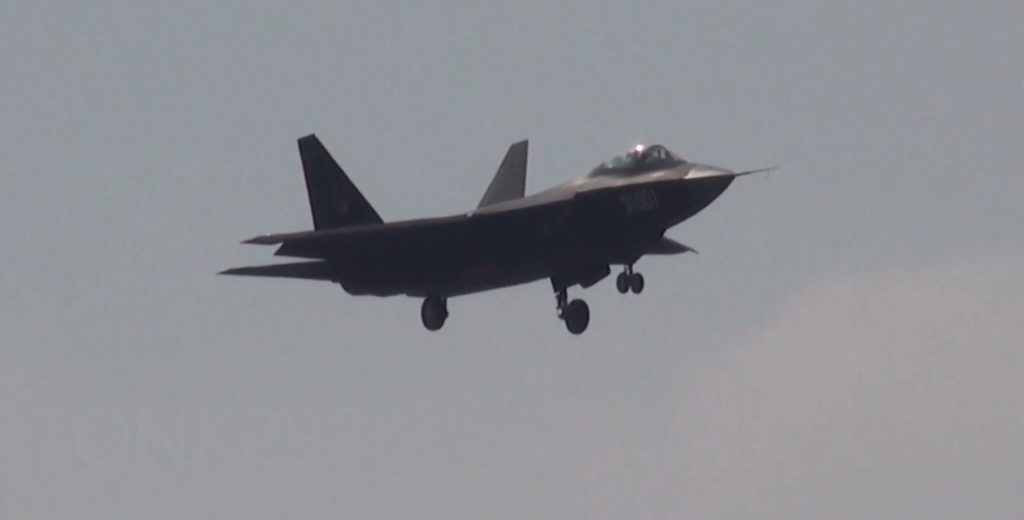
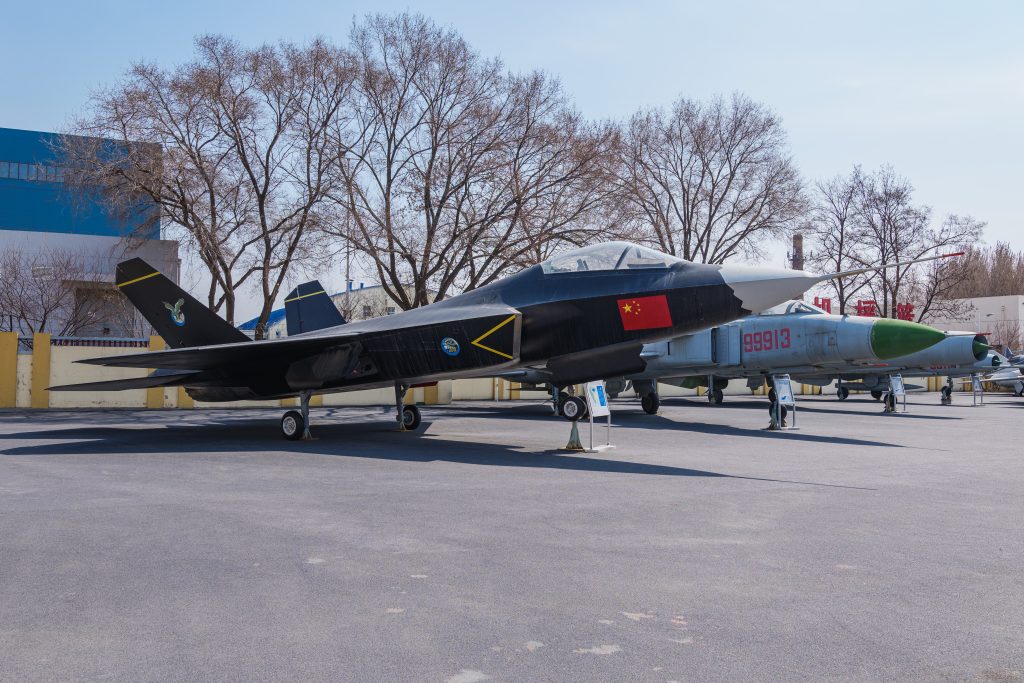
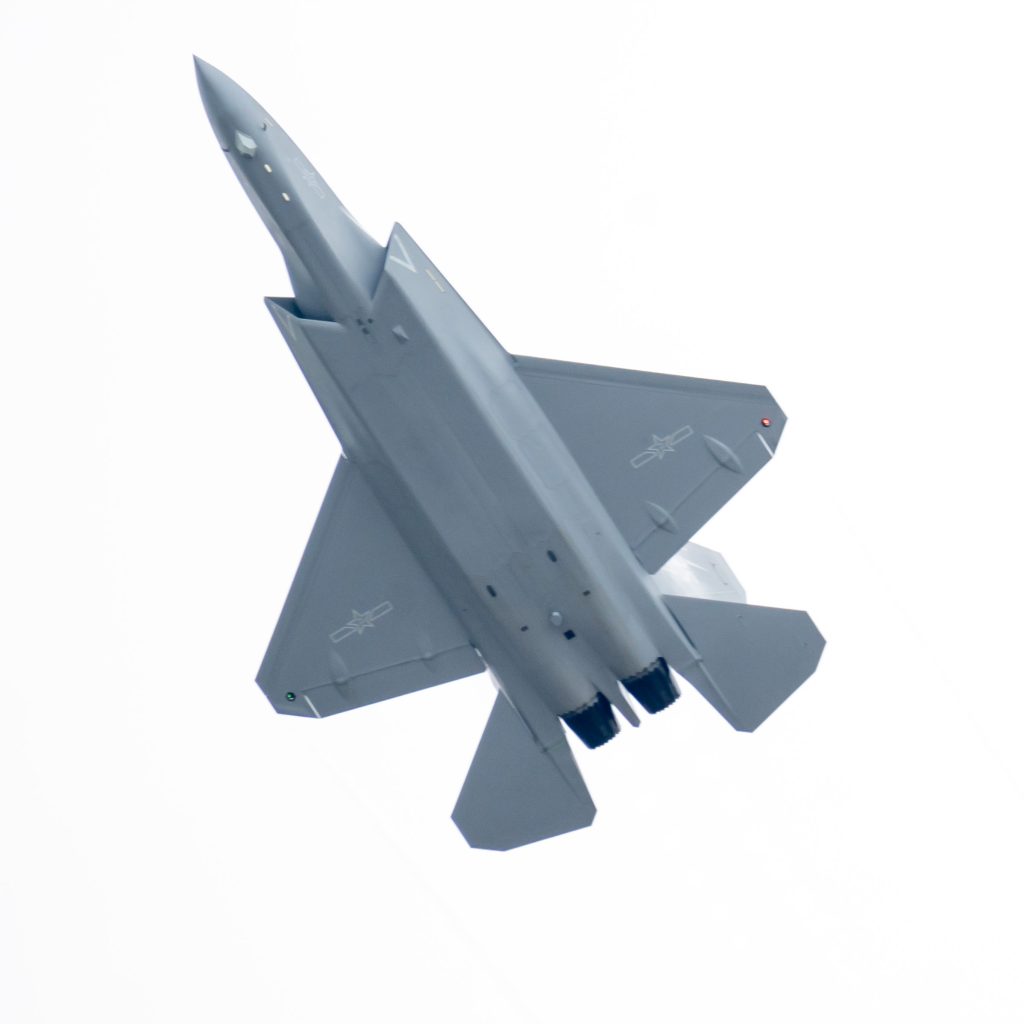
Where the FC-31 / J-35 operates
An unproven newcomer
The FC-31 / J-35 has no known combat record. It has never been reported in action, and its real-world effectiveness is untested in the public record. What can be said is deliberately narrow, and every figure here is reported or estimated rather than confirmed.
Compare the combat record of every military aircraft. Figures as of July 2026; all J-35 data is reported or estimated.
Everything people ask about the FC-31 / J-35
Can I fly in an FC-31/J-35?
What is the difference between the FC-31, J-31 and J-35?
Is the J-35 a copy of the F-35?
What engines does it use?
Is it in service yet?
Can it operate from Chinese aircraft carriers?
Did Pakistan order it?
How stealthy is it, and how good is it really?
You can’t fly the J-35.
These, you can.
Some legends only live in museums — others are fuelled and waiting. MiGFlug has put civilians in real military jet cockpits since 2004.
 Fly the L-39 AlbatrosThe world’s most-flown jet trainer — aerobatics included
 Fly the F-104 Starfighter“The missile with a man in it”
 Fly the MiG-21The Cold War’s most-produced jet
 Fly the T-33 Shooting StarAmerica’s first jet trainer
 Fly the DH VampireA piece of early jet history
 Fly the S.211Agile Italian jet trainer
 Fly the MB-326The classic Aermacchi jet
 Fly the MiG-15The Soviet legend of the Korean War
Continue the tour
Every fact, checked
- The War Zone — China’s J-35A Officially Breaks CoverThe clearest account of the FC-31 to J-31 to J-35 to J-35A designation history and the land-versus-naval airframe differences.
- The Diplomat — Assessing the J-35ARigorous, well-hedged analysis of role, engines, spec caveats and the “F-35 copy” debate.
- Defense News — J-35A at ZhuhaiReporting on the official public debut of the land-based variant in November 2024.
- The Aviationist — Carrier J-35 First FlightContemporaneous record of the navalised prototype’s first flight and its carrier features.
- USNI News — Fujian Catapult TestsConfirms J-35 electromagnetic-catapult launches from the carrier Fujian.
- Naval News — Fujian CommissionedThe carrier’s commissioning, with the J-35 named as part of its intended air wing.
- Breaking Defense — Reported Pakistan OfferPrimary sourcing on the reported, unconfirmed Pakistan export offer.
- 19FortyFive — Reported Production RampOpen-source estimates of production pace, with explicit “estimates, not confirmed” caveats.