
On 22 December 1941, an Australian sergeant named Gregory Board half-rolled his Brewster Buffalo onto what he took to be a “Zero” over Kuala Lumpur. Before he could line up the shot, his instrument panel blew apart and fire gushed from his fuel tanks. He bailed out and survived.
The fighter that got him was not a Zero at all. It was a Nakajima Ki-43 of the Imperial Japanese Army’s 64th Sentai, a type so new that Allied pilots did not yet have a name for it. They would come to call it “Oscar”. In Japan the Nakajima Ki-43 Hayabusa took its name from the peregrine falcon, and by August 1945 Nakajima and Tachikawa had built 5,919 of them.
That made the Ki-43 the most-produced fighter of the Japanese Army, and second only to the Navy’s Mitsubishi A6M Zero among all Japanese fighters of the war. It fought on every front the Army fought on, from China to New Guinea, and it was flying in combat on the last days of the war.
Quick Facts
- Type: Single-seat, single-engine Army fighter
- Designer: Nakajima team led by Hideo Itokawa
- First flight: January 1939
- In service: 1941 to 1945
- Built: 5,919 by Nakajima and Tachikawa (plus the 1st Army Air Arsenal)
- Engine (Ki-43-II): Nakajima Ha-115 14-cylinder radial
- Top speed (Ki-43-IIb): About 530 km/h (330 mph) at 4,000 m
- Armament: Two 12.7 mm Ho-103 machine guns; two bombs
- Allied codename: Oscar
A fighter nobody wanted
The Ki-43 began in December 1937 as a replacement for the Nakajima Ki-27, the nimble fixed-gear monoplane the Army loved. The Army did not even put the job out to competition. It handed it to Nakajima, where a team led by Hideo Itokawa, later famous as the father of Japanese rocketry, designed a slim, light fighter with a one-piece wing and retractable landing gear.
The first prototype flew in January 1939, and the Army’s test pilots were unimpressed. It was barely faster than the Ki-27 and less agile. The retractable gear struck them as an unnecessary luxury, and the programme came close to being shelved.
Nakajima saved it with a long series of modified prototypes: weight cuts, a slimmer fuselage, new tail surfaces and, most importantly, Fowler-type “butterfly” combat flaps that could be lowered in a dogfight to tighten the turn. The pilots were won over, and production began in late 1939.
“The plane was a disaster”
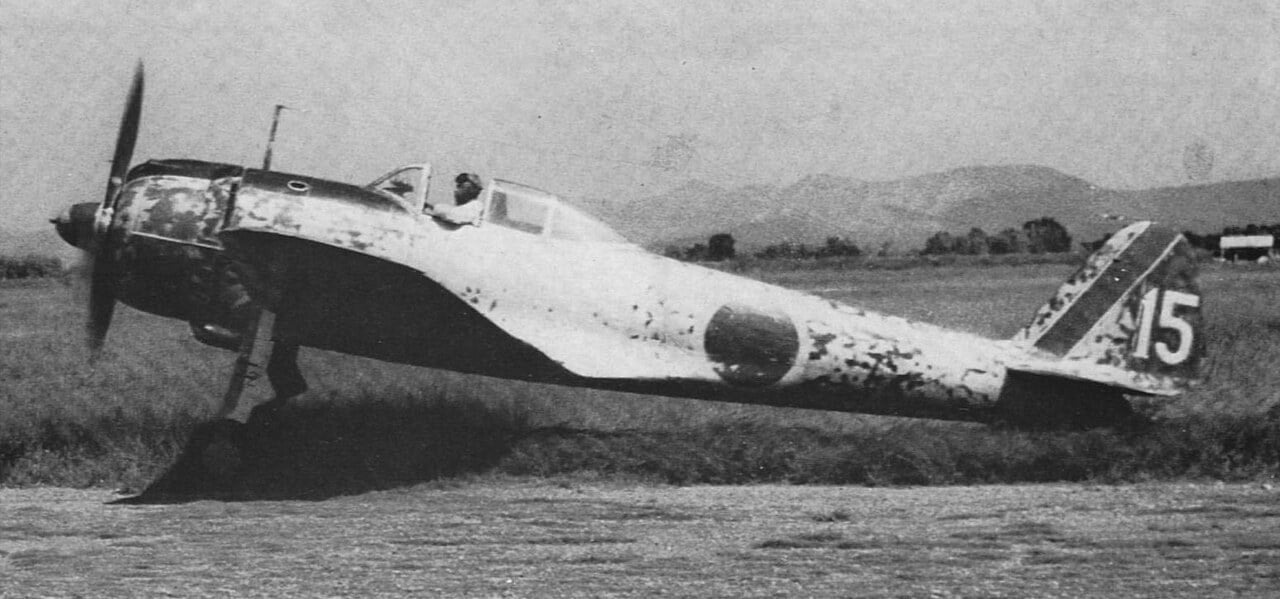
The first Ki-43-Is reached the 59th and 64th Sentai in 1941, just months before Japan went to war, and they arrived with serious problems. To save weight, the wing had been built too lightly. A rash of structural failures in dives followed, and the wings had to be hurriedly strengthened.
Lieutenant Yohei Hinoki, a squadron leader in the 64th under its commander Major Tateo Kato, told interviewers after the war that pilots had to fly gently or risk breaking the aircraft. The armament was another weakness: the earliest versions often carried only two rifle-calibre 7.7 mm machine guns, and the new 12.7 mm Ho-103 was not yet reliable.
None of this slowed the opening offensive. From 8 December 1941 the 64th Sentai covered the landings in Malaya, and its experienced pilots took full advantage of an Allied air force equipped with Brewster Buffaloes, Hurricanes and Bristol Blenheims in small numbers.
Greg’s Airplanes and Automobiles on how the Ki-43 dominated the early months of the Pacific War.
The new fighter was so often mistaken for its Navy cousin that Americans nicknamed it the “Army Zero”. Recognition instructors taught pilots to tell them apart by the Ki-43’s finer tail and its lightly framed canopy.
The falcon gets its name
The name Hayabusa first appeared in print on 8 March 1942, the idea of an Army public-affairs officer, Major Masaru Nishihara. It came with a hero. Tateo Kato’s 64th Sentai became famous in Japan as the “Kato Hayabusa Fighter Unit”, and Kato himself was a national figure.
He did not live to enjoy it. On 22 May 1942, Kato was one of five Ki-43 pilots who chased an RAF Blenheim that had bombed his airfield at Akyab in Burma. The Blenheim’s gunner, Flight Sergeant “Jock” McLuckie, damaged two of the fighters and set Kato’s on fire. The commander, credited at the time with 18 victories, dived into the Bay of Bengal.
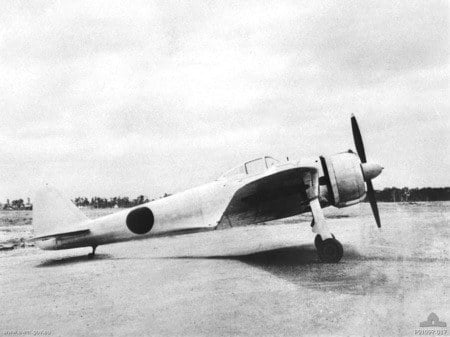
In September 1943, the Allies rebuilt a captured Ki-43 in Brisbane from wrecks found at Lae in New Guinea, and finally got a close look at the fighter their pilots had been dogfighting for nearly two years.
Better armour, worse odds
The Ki-43-II, which reached the units from late 1942, fixed many of the early problems. A two-stage supercharged Nakajima Ha-115 engine drove a three-bladed propeller, the wing was shorter and stronger, and the pilot finally received armour plate behind his head and back, a reflector gunsight and crude self-sealing fuel tanks. Two 12.7 mm guns became standard.
The trouble was that the war had moved on. Over Burma, Ki-43 pilots now had to intercept B-24 Liberators with two machine guns, and they learned to attack head-on in trail, each Hayabusa firing in turn. Over New Guinea, the P-38 Lightning and P-47 Thunderbolt could dive away from it and hit hard enough to make its light structure a liability.
Dark Skies on the Ki-43, the light and agile fighter that paid for its manoeuvrability with fragility.
Still deadly in the right hands
Even outclassed, the Oscar could punish a careless opponent. On 5 March 1944, a Ki-43 of the 77th Sentai shot up the cockpit of Lieutenant Colonel Neel Kearby’s P-47 over New Guinea, and the Medal of Honor ace died of his wounds after bailing out.
On 7 January 1945 over Negros, a single Ki-43 flown by Master Sergeant Akira Sugimoto of the 54th Sentai tangled with four P-38s. Major Thomas McGuire, America’s second-ranking ace, pulled into a tight low-level turn to save a comrade, stalled and crashed. The Japanese Army’s top-scoring pilot, Sergeant Satoshi Anabuki, was credited with 39 victories, almost all of them in the Ki-43.
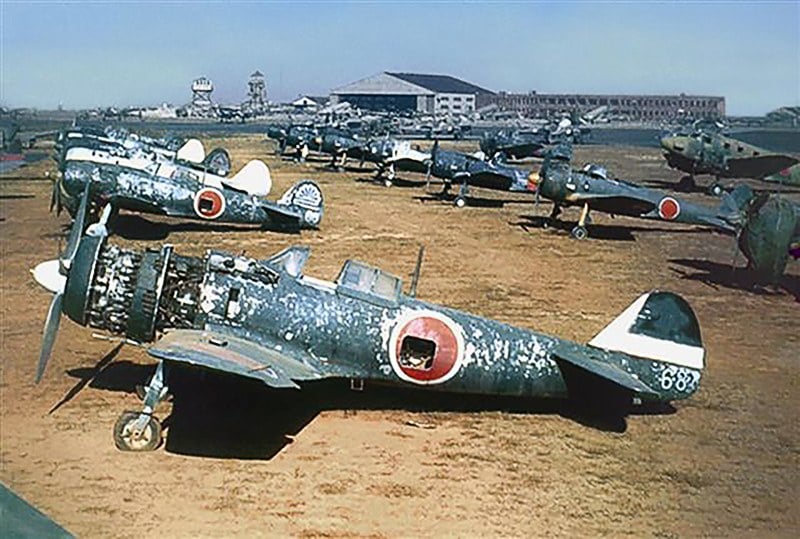
Nakajima switched its Ota factory to the Ki-84 Hayate in mid-1944, as Afterburner told in its story of the Army’s best fighter. Tachikawa kept building the Ki-43, including the faster Ki-43-III, right up to the surrender. In the final months, hundreds of Hayabusas were expended in kamikaze attacks.
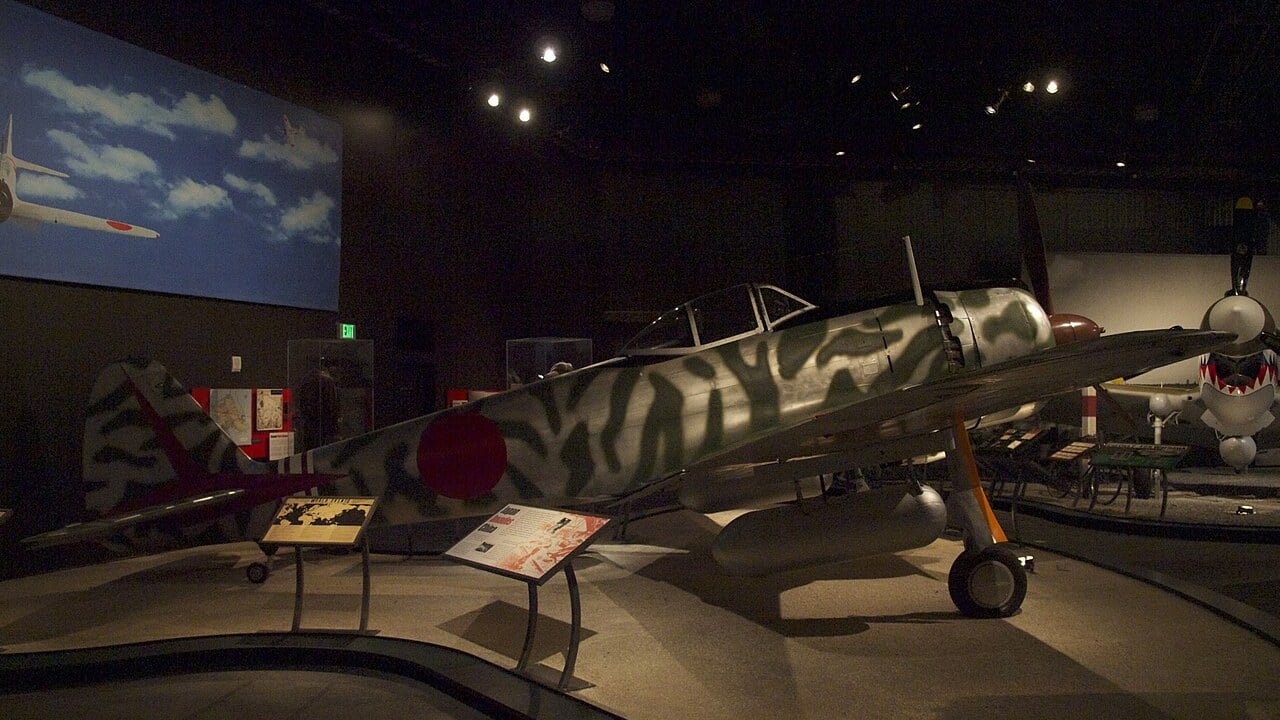
A close look at the Ki-43-IIIa reproduction at the Museum of Flight in Seattle, built from parts of four wrecks.
A long afterlife
The falcon outlived its empire. Captured Ki-43s were flown in limited numbers by the French Air Force in Indochina, and abandoned examples in the Dutch East Indies were pressed into service by the newly declared Indonesian republic against the Dutch. The Royal Thai Air Force had received Hayabusas during the war, too.
Today the survivors are few and mostly rebuilt. The Australian War Memorial holds an unrestored Ki-43-II recovered from New Guinea in 1984, the Flying Heritage Collection has a Ki-43-I once restored to flying condition, and the Museum of Flight in Seattle displays a reproduction built from four wrecks recovered in the Kuril Islands.
The Ki-43 was never the best fighter of the Pacific War. It was the one Japan’s Army had, in the numbers that mattered, on the days that counted. It made Allied pilots believe they were fighting Zeros, and it was still fighting when the Zero’s legend had long since cracked.
Sources: Wikipedia (Nakajima Ki-43), HistoryNet (Aviation History), Museum of Flight, Australian War Memorial, Military Aviation Museum
0 Comments