
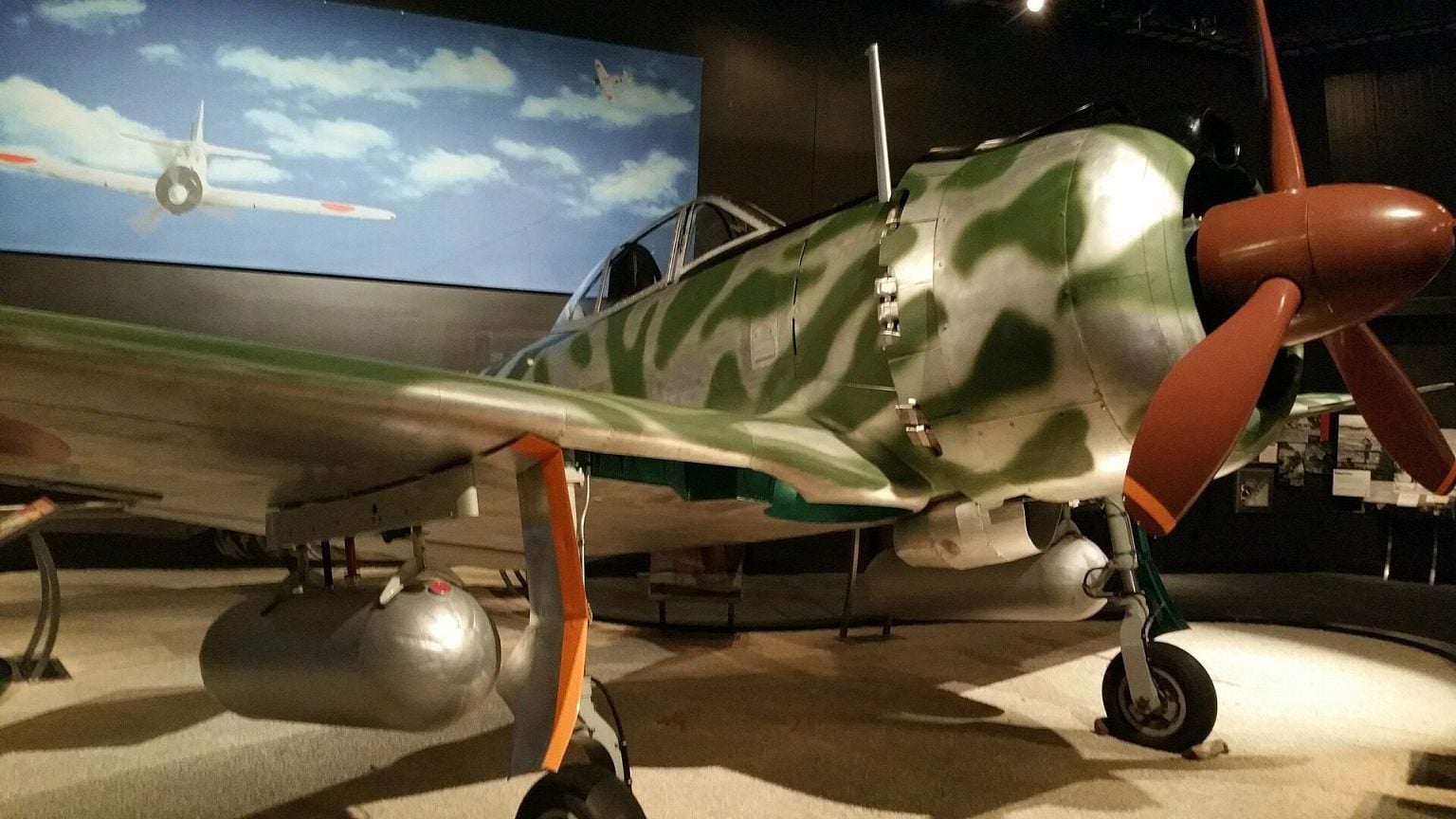
Nakajima Ki-43 Hayabusa
“Oscar”
The Imperial Japanese Army’s most-produced fighter of the Second World War — a featherweight dogfighter so nimble Allied pilots were warned never to turn with it, and so often mistaken for the Navy’s Zero that it earned its own code name.
The Army’s falcon, and the fighter mistaken for a Zero
By the late 1930s the Imperial Japanese Army needed a modern fighter to replace the fixed-undercarriage Nakajima Ki-27 “Nate.” In December 1937 it turned directly to Nakajima, and a design team led by engineer Hideo Itokawa — later a pioneer of Japanese rocketry — produced a slim, retractable-gear monoplane. The prototype first flew in January 1939.
The Army was not immediately impressed. Test pilots found the new machine heavier on the controls and no more agile than the beloved Ki-27, and the programme was nearly rejected. What saved it was a series of revised airframes that shed weight and, decisively, added a set of Fowler-type “butterfly” combat flaps the pilot could deploy in a turning fight to add lift and tighten the circle. With them the lightly loaded aircraft became extraordinarily manoeuvrable, and it was accepted as the Army Type 1 Fighter, named Hayabusa (“Peregrine Falcon”).
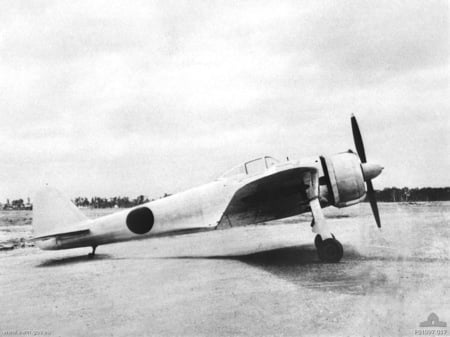
The Ki-43 entered service in 1941 and made its combat debut over Burma and Malaya in the final weeks of that year, in the same period as the attack on Pearl Harbor. Because its slender radial-engined silhouette closely resembled the Navy’s A6M Zero, Allied airmen repeatedly logged Army Ki-43s as “Zeros.” Under the Allied reporting-name system it was assigned its own designation — “Oscar” — yet the confusion with the Zero shadowed its reputation for the rest of the war.
Its agility, however, was bought at a steep price. The Oscar was lightly armed — typically just two machine guns — and early examples lacked pilot armour, self-sealing fuel tanks and structural robustness, with wing failures reported during hard manoeuvring. Armour and protected tanks arrived with the improved Ki-43-II, but firepower and toughness remained persistent shortcomings as sturdier, faster Allied fighters such as the P-38, F6F, P-47 and P-51 reached the theatre.
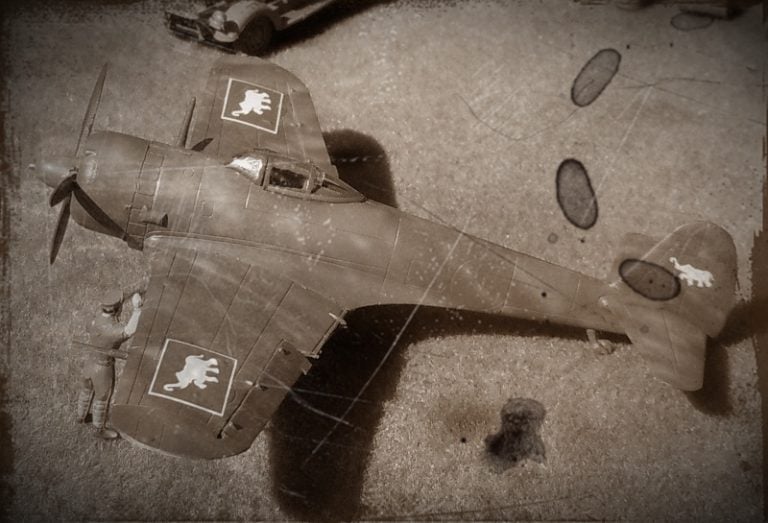
The Hayabusa nonetheless served on nearly every front the Army air force fought over — China, Burma, Malaya and Singapore, the Netherlands East Indies, New Guinea, the Philippines and the defence of the home islands. Increasingly outclassed, it was pushed into home-defence interception and, in the war’s final months, into kamikaze (special-attack) missions. With roughly 5,900 built by Nakajima and Tachikawa, it was the most-produced fighter of the Imperial Japanese Army. It was also flown by allied and client states of the period — notably Thailand and Manchukuo — and, after Japan’s surrender, a handful of captured airframes briefly served other nations.
01Why the Nakajima Ki-43 was nearly rejected — and how the “butterfly” flaps saved it
When the first Ki-43 prototypes flew in 1939, Army test pilots were disappointed: the aircraft felt stiff and unremarkable next to the highly manoeuvrable Ki-27 it was meant to replace, and there was serious talk of abandoning the design. Nakajima’s answer, developed across a run of revised airframes, was a set of Fowler-type combat flaps — the so-called “butterfly” flaps — that could be extended mid-turn to increase wing area and lift.
The effect was transformative. With the flaps deployed, the lightly loaded Hayabusa could out-turn essentially any fighter it met in 1941–42. It is the single engineering change most often credited with turning a near-cancelled prototype into one of the most feared close-in dogfighters of the early Pacific war.
What makes it special
The Ki-43’s “butterfly” combat flaps
The Hayabusa’s signature was its turn. Fowler-type “butterfly” combat flaps could be deployed in a dogfight to add lift, letting the very lightly loaded fighter tighten its circle inside almost any Allied opponent early in the war. It was the specific fix that converted an unloved prototype into a feared close-in fighter — and the reason Allied pilots were warned never to turn with it.
Extreme lightness — and its cost
That agility came from radical weight-saving, which bred real weaknesses. Armament was light — typically just two 12.7 mm Ho-103 machine guns — modest against rugged Allied aircraft. Early Ki-43s also lacked pilot armour and self-sealing fuel tanks, and the thin structure was fragile, with wing failures reported in hard manoeuvres. Armour and protected tanks arrived with the Ki-43-II, but firepower stayed a persistent shortcoming.
The most-produced Army fighter
With roughly 5,900 built by Nakajima and the Tachikawa works, the Hayabusa was the numerical backbone of the Army fighter force. Its scale of production and its presence on every Army air-force front — China, Burma, New Guinea, the Philippines and home defence — make it, statistically, the Imperial Japanese Army’s defining fighter of the war, much as the Zero was for the Navy.
02The Nakajima Ki-43’s fragility: why some early Oscars broke in the air
The weight-saving that made the Hayabusa so agile also left early aircraft structurally delicate. Ground crews reportedly found cracked wings on some airframes after hard combat manoeuvring, and Japanese pilots recalled that abrupt inputs at speed could damage the aircraft. Combined with the absence of armour and self-sealing tanks, this made the early Ki-43-I dangerous to its own pilots as well as lethal to opponents. The strengthened wing, pilot armour and protected fuel tanks of the Ki-43-II addressed the worst of it, but the type never shed its reputation for lightness over toughness.
03The Nakajima Ki-43 variants: from the Ki-43-I to the late-war Ki-43-III
The Ki-43-I (1941) used the lower-output Nakajima Ha-25 radial of about 980–990 hp and carried mixed, often rifle-calibre armament with no protection. The definitive Ki-43-II (from late 1942) fitted the uprated Ha-115 engine of roughly 1,150 hp, added pilot armour and protected tanks, strengthened the wing and standardised twin 12.7 mm guns with bomb racks. The final Ki-43-III, built largely by Tachikawa late in the war, fitted a further-uprated engine (commonly cited around 1,230 hp) for a modest speed gain; a cannon-armed sub-variant was developed but saw little service.
Full specifications
Baseline note: the figures below describe the Ki-43-II (Army Type 1 Fighter Model 2, Hayabusa), the mark built in the largest numbers, the one that carried the Japanese Army Air Service through Burma, China, New Guinea and the Philippines from late 1942, and the first to be given armour and properly self-sealing tanks. Deltas for the Ki-43-I of 1941 and for the Tachikawa-built Ki-43-III of 1944–45 are given in grey. Japanese Army data were quoted at normal loaded weight; English-language references derive almost entirely from Francillon and from post-war Allied technical intelligence reports, and where those disagree with Japanese sources the disagreement is flagged where it occurs.
Dimensions & weights
- Crew
- 1
- Length
- 8.92 m (29 ft 3 in); Ki-43-I 8.83 m (28 ft 11 in)
- Wingspan
- 10.84 m (35 ft 7 in); Ki-43-I 11.44 m (37 ft 6 in) — the Model 2 lost about 600 mm of span, clipped to raise roll rate and dive strength at the cost of the turn
- Height
- 3.27 m (10 ft 9 in)
- Wing area
- 21.4 m² (230.4 sq ft); Ki-43-I 22.0 m² (236.8 sq ft)
- Aerofoil
- Nakajima house section of the same NN family used on the Ki-27, thick at the root and sharply tapered outboard — published section data for Japanese wartime types are patchy and this should be read as indicative rather than exact
- Wing structure
- Cantilever low wing, all-metal two-spar stressed skin built as a single unit with the fuselage centre section; fabric-covered control surfaces
- Combat flaps
- Butterfly-type Fowler flaps, extending aft and down on curved tracks to add both area and camber; selected by the pilot in a turn and the single feature that saved the design
- Empty weight
- 1,910 kg (4,211 lb); Ki-43-I 1,580 kg (3,483 lb)
- Loaded weight
- 2,590 kg (5,710 lb); Ki-43-I 2,048 kg (4,515 lb)
- Maximum take-off weight
- 2,925 kg (6,450 lb) with two drop tanks or two 250 kg bombs
- Wing loading
- 121 kg/m² (24.8 lb/sq ft) at loaded weight; the Ki-43-I sat at 93 kg/m² (19.1 lb/sq ft), barely above the fixed-gear Ki-27 — the whole story of the type is in the gap between those two numbers
- Power loading
- 2.25 kg/hp (4.96 lb/hp); 3.02 kg/kW
- Protection
- 13 mm face-hardened plate behind the pilot’s head and shoulders, about 48 kg of steel, introduced on the Model 2. The Ki-43-I carried no pilot armour at all, and Allied gun-camera assessments of the Model 2 found the plate covered the head and upper torso only — nothing protected the pilot from the front, from below, or from a deflection shot
- Undercarriage
- Inward-retracting hydraulic main legs and a retractable tailwheel; the retractable gear was itself controversial, Army test pilots in 1939 calling it an unnecessary luxury on a fighter
Performance
- Maximum speed
- 530 km/h (329 mph) at 4,000 m (13,120 ft)
- Maximum speed, Ki-43-I
- 495 km/h (308 mph) at 4,000 m — roughly 30 km/h better than the Ki-27 it replaced, which is precisely why the Army nearly cancelled it
- Maximum speed, Ki-43-III Ko
- 576 km/h (358 mph) at 6,000 m in Western references; Japanese sources quote 560 km/h (348 mph) at 5,850 m, and the difference turns on whether the water-methanol boost is assumed available
- Cruising speed
- 440 km/h (273 mph)
- Climb to 5,000 m
- 5 min 49 s (to 16,400 ft); Ki-43-I 5 min 30 s, the Model 2 paying for its armour and heavier guns
- Climb to 8,000 m
- 11 min 9 s (to 26,250 ft) — the collapse in the second half of that figure is the single-stage supercharger giving up
- Service ceiling
- 11,200 m (36,750 ft), a paper figure; the aeroplane was not a usable fighting machine much above 6,000 m (19,700 ft)
- Normal range
- 1,760 km (1,095 miles) on internal fuel
- Maximum ferry range
- ~3,200 km (~1,990 miles) with two 200-litre drop tanks — exceptional reach for a single-seat fighter of its weight, and the reason the type could escort Ki-21s and Ki-48s to targets no Allied fighter of 1942 could have reached
- Turning performance
- With butterfly flaps deployed the Ki-43 out-turned the A6M Zero and every Allied fighter it met; Allied technical intelligence confirmed it after testing captured examples, and Allied fighter units in Burma and New Guinea were formally instructed never to enter a turning fight with it
- Dive limitation
- Poor. Ki-43-I airframes suffered wing skin and structural failures in high-speed dives and pull-outs; the Model 2 wing was strengthened but the type still could not follow a P-38, P-47 or Spitfire VIII downhill, which became the standard Allied counter
- Handling
- Docile, short-field, and almost universally liked; the JAAS regarded it as the pleasantest fighter of the war to fly, which is not the same as the best to fight in
Propulsion & systems
- Engine
- 1 × Nakajima Ha-115, a fourteen-cylinder two-row air-cooled radial of the Sakae family (Ha-35 Model 22 in the unified 1943 designation system; the same basic engine as the Navy’s A6M2 and A6M3 Zero, which is a large part of why the two aeroplanes looked and sounded alike)
- Displacement
- 27.9 l (1,703 cu in); bore 130 mm × stroke 150 mm (5.12 in × 5.91 in)
- Take-off power
- 1,150 hp (858 kW); some English infobox data quote materially higher outputs for this engine, which are not supported by Japanese production records
- Power at altitude
- 1,100 hp (820 kW) at 2,850 m; about 980 hp (731 kW) at 6,000 m
- Supercharger
- Single-stage, two-speed, gear-driven. No two-stage blower was ever fitted to a production Hayabusa, and this one omission is why the type could not fight the P-47 or the Spitfire VIII in their own air
- Engine, Ki-43-I
- 1 × Nakajima Ha-25 of 950 hp (708 kW); sources give between 940 and 990 hp for take-off depending on fuel octane assumed, Japanese figures separating 87- and 92-octane ratings explicitly
- Engine, Ki-43-III Ko
- 1 × Nakajima Ha-115-II with water-methanol injection, about 1,230 hp (917 kW) on boost, fed from a 70-litre methanol tank giving only a few minutes of use
- Propeller
- Three-blade constant-speed metal unit, 2.79 m (9 ft 2 in) diameter; the Ki-43-I had a two-blade two-position propeller, later a constant-speed unit
- Internal fuel
- ~530 l (~117 imp gal); the Ki-43-I carried about 564 l (124 imp gal), the Model 2 giving up some capacity to the protection it gained. English references commonly quote 550 l for the Model 2
- Fuel protection
- Model 2 tanks used a swelling natural-rubber self-sealing layer rated against 12.7 mm strikes. The Ki-43-I is normally described in English as having none; Japanese sources record a three-ply rubber and silk-felt external covering rated only against rifle-calibre fire, which is close enough to none to explain why Allied pilots kept reporting Hayabusas that burned on the first burst
- Radio
- Type 96 set on the Ki-43-I, Type 99 on the Model 2 and Model 3, nominally good for about 100 km by day. Unshielded ignition harnesses made them so noisy that pilots reverted to wing-rocking and hand signals
- Gunsight
- Telescopic tube sight on the Ki-43-I; Type 100 reflector sight standard from the Model 2, a genuine improvement in deflection shooting
- Other systems
- Oxygen for high-altitude work; ski undercarriage trialled on Model 2 KAI and Model 3 aircraft for Manchurian winter operations; no armoured windscreen, no fire-suppression system and no armour glass at any point in the type’s life
04The Nakajima Ki-43’s operating costs: why no reliable price exists
Unlike modern military aircraft, no credible public unit-cost or cost-per-flight-hour figure exists for the Ki-43. It was a 1940s Imperial Japanese wartime product, and Japanese procurement prices from the period were never published in any form comparable to today’s accounting. Any specific monetary figure attached to a Ki-43 should be treated as unsupported. What is well documented is scale rather than price: roughly 5,900 airframes were built, making the Hayabusa the most numerous fighter the Imperial Japanese Army ever fielded.
Armament & payload
The Ki-43 fought the entire Pacific War with two machine guns, and never got a third option
From the Ki-43-I Hei of 1942 onwards the Hayabusa’s armament was fixed: two 12.7 mm Ho-103 machine guns in the upper cowling, synchronised to fire through the propeller disc, with roughly 250 to 270 rounds apiece. That was it. No wing guns were ever fitted to a production aircraft, no cannon reached production, and the aeroplane that Nakajima and Tachikawa were still building in 1945 carried the same two guns it had carried in 1942. Against a Hurricane or a Buffalo that was survivable; against a B-24, a B-29 or a P-47 with eight fifties it was close to futile, and Japanese Army pilots responded with head-on attacks (taishin kogeki) precisely because a frontal pass was the only geometry in which two guns had a chance.
The Ho-103 itself was better than its calibre suggests. It fired the 12.7 × 81 mm round derived from Italian Breda-SAFAT practice, chosen deliberately over the heavier American 12.7 × 99 mm because the lighter cartridge allowed a higher cyclic rate on a lighter gun. Japanese armourers loaded it largely with explosive and incendiary ammunition — the fuzed Ma-103 and the fuzeless Ma-102, the latter carrying roughly double the filler — and Allied pilots more than once recorded 20 mm damage from a type that carried nothing of the kind. The catch was synchronisation: a nominal 900 rounds per minute fell to something nearer 400 when the gun had to fire between propeller blades, so two Ho-103s in the cowling delivered a fraction of the throw-weight the calibre implies. Ammunition capacities are quoted at anywhere between 230 and 270 rounds per gun; the Ho-103 fit on Ki-43-I Otsu and Hei aircraft varied between factories and between rebuilt airframes, and Thai, Manchukuo and Wang Jingwei aircraft are especially poorly documented.
Gun
- Definitive fit: 2 × 12.7 mm Ho-103 (Army Type 1) synchronised machine guns in the upper cowling, about 250–270 rounds per gun
- Ki-43-I Ko: 2 × 7.7 mm Type 89, a Vickers-derived rifle-calibre gun and the same armament the 1936 Ki-27 had carried — obsolete before the type entered service
- Ki-43-I Otsu: 1 × 12.7 mm Ho-103 plus 1 × 7.7 mm Type 89, a transitional mix forced by slow Ho-103 deliveries
- Ki-43-IIIb (Model 3 Otsu): 2 × 20 mm Ho-5 cannon — the armament the type needed from 1943, fitted to exactly two prototypes and never produced
- Both guns sat within reach of the pilot, so stoppages could sometimes be cleared in flight; against that, synchronisation roughly halved the practical rate of fire
Air-to-air
- No guided air-to-air weapon existed during the Hayabusa’s service life; the guns and the turn were the entire air-to-air armament
- The turn was the weapon. With butterfly flaps deployed the Ki-43 could out-turn the Zero, and Allied units in Burma, China and New Guinea were ordered to dive away rather than engage in the horizontal
- Home-defence units are recorded dropping 30 kg Ta-Dan air-burst cluster bombs into B-29 formations from above, a Japanese Army expedient born of inadequate fighter armament (Ki-43 use of this weapon is less well attested than Ki-45 and Ki-44 use)
- Ramming was a recognised last resort; Satoru Anabuki survived one such action and received an individual unit citation while still alive, which was close to unheard of
- All claim totals attributed to this type are claims. Historians working from Allied loss records have failed to corroborate a substantial share of Burma-theatre Japanese Army claims.
Air-to-surface guided
- None, and the card is kept because the absence marks the period rather than the aeroplane
- No guided air-to-surface weapon was carried by any Japanese Army fighter in the Second World War
- Ground attack meant strafing with two cowling guns, or the small bomb loads listed alongside — adequate against trucks and sampans, useless against anything armoured
- The nearest thing to a guided weapon the type ever carried was the pilot: hundreds of Hayabusas were expended on tokko special-attack sorties from late 1944, and the type’s docility and range made it disproportionately favoured for the role
Bombs
- Ki-43-I: 2 × 30 kg (66 lb) bombs on underwing racks, a harassment load and nothing more
- Ki-43-II onwards: 2 × 250 kg (551 lb), a maximum of ~500 kg (~1,100 lb), carried on strengthened wing racks that doubled as drop-tank pylons
- The Model 2 KAI rearranged those racks so a single station could take either a tank or a bomb without changing fittings
- In practice the common Burma and New Guinea load was 2 × 250 kg against airfields and river traffic, flown by fighter units because the Army had too few dedicated attack aircraft left
- Special-attack aircraft carried a single bomb of up to 250 kg on a one-way flight, sometimes with the racks locked
Rockets
- None. No production Ki-43 carried rocket projectiles in any air force, Japanese or post-war
- Japanese Army air-launched rockets appeared late and went to twin-engined and heavier single-engined types with the structure and power to carry them
- A 1,150 hp engine and a wing sized for turning left no margin for the weight and drag of rocket rails
- Post-war French, Indonesian, Chinese and North Korean operators flew captured Hayabusas as they found them and added nothing
Pods & other stores
- 2 × 200 l (44 imp gal) jettisonable drop tanks, the store that gave the type its extraordinary reach and made escort of Ki-21 and Ki-48 formations practical
- No gun pods, no reconnaissance pods, no external sensors — there was neither the electrical provision nor the power margin
- Ski undercarriage trialled on Model 2 KAI and Model 3 airframes for winter operations in Manchuria
- Camera-gun provision for gunnery training and claim assessment, fitted inconsistently and rarely available where claims most needed checking
- Drop-tank capacities of 200 l and 130 l both appear in the literature; the larger pair is the one associated with the quoted ferry range.
Three typical loadouts
- Bomber escort, Burma 1943
- 2 × 12.7 mm Ho-103 with full ammunition, 2 × 200 l drop tanks. The classic 64th Sentai mission: shepherd Ki-21 or Ki-48 formations to Imphal, Chittagong or the Assam airfields and back, at ranges no Hurricane or early Spitfire could contest.
- Airfield and river interdiction, New Guinea 1943–44
- 2 × 12.7 mm Ho-103, 2 × 250 kg bombs, no tanks. Short-radius strikes on Allied strips and coastal traffic, flown by fighter sentai because the Army’s attack units had been consumed.
- Home and Formosa air defence, 1944–45
- 2 × 12.7 mm Ho-103, clean, maximum internal fuel, head-on attack profile against B-24 and B-29 formations. On paper an interception; in practice two machine guns against a four-engined bomber at an altitude where the Ha-115 had already run out of breath.
Sourcing caveat: Japanese Army armament records were extensively destroyed in August 1945, and much of the English-language detail derives from post-war Allied technical intelligence examination of captured airframes plus René Francillon’s reconstruction. Round counts, Ho-103 fit dates and bomb clearances should be treated as well-supported rather than documentary.
Variants
Nakajima built the Hayabusa in three marks, and the only one with adequate armament never left the prototype shop
The Ki-43 nearly did not happen. The Army ordered it from Nakajima in December 1937 as a Ki-27 replacement, demanding 500 km/h, five minutes to 5,000 m, 800 km of range and manoeuvrability at least equal to the fixed-gear fighter it was to succeed — a specification that asks for speed and turn in the same breath and gets neither. The prototype, designed under Yoshisada Oyama with Hideo Itokawa responsible for the aerodynamics, was completed at the end of 1938 and flown at Ojima in the first days of 1939. Army test pilots hated it: barely faster than the Ki-27, worse in the turn, and burdened with retractable undercarriage they regarded as a luxury. The programme was effectively dead, and Nakajima was told to develop an improved Ki-27 as insurance.
What saved it was a flap. Nakajima built ten pre-production aircraft while stripping weight, slimming the fuselage, fitting a new canopy and moving the tail; the eleventh airframe carried Itokawa’s butterfly-type Fowler flaps, which extended aft and down to add wing area and camber and could be selected by the pilot inside a turn. The transformation was immediate and the pilots who had condemned the aeroplane now endorsed it. The thirteenth machine gathered every change together and was accepted in November 1939, entering service as the Army Type 1 Fighter in October 1941, six weeks before Pearl Harbor.
From there the story is one of adding weight to an airframe designed to have none. The Ki-43-I was so light and so unprotected that a single burst was usually decisive; the Ki-43-II bought back survivability with armour, a strengthened clipped wing and self-sealing tanks, and paid for it in climb and wing loading; the Ki-43-III added water-methanol boost and arrived when the type’s problem was no longer speed but firepower. Total output reached 5,919 aircraft — more than any other Japanese Army aeroplane, and second among all Japanese types only to the Navy’s Zero.
- Ki-43 prototypes and pre-production (1938–40 / 3 prototypes plus 10 pre-production)
- Ha-25 engine, two 7.7 mm guns. Rejected by Army test pilots as insufficiently manoeuvrable; the eleventh airframe introduced the butterfly combat flaps and the thirteenth consolidated the redesign that won acceptance in November 1939.
- Ki-43-I Ko, Otsu and Hei (1941–42 / about 716 built)
- Ha-25 of 950 hp, two-blade propeller, telescopic sight, no pilot armour. Armament stepped up across the three sub-marks from two 7.7 mm Type 89, to one 7.7 mm plus one 12.7 mm Ho-103, to two Ho-103 on the Hei. The mark that swept Malaya, the Dutch East Indies and Burma, and the mark that broke up in dives.
- Ki-43-II Ko and Otsu (1942–45 / the bulk of production)
- Ha-115 of 1,150 hp, three-blade constant-speed propeller, wings clipped by about 600 mm and strengthened for bombs and tanks, 13 mm head-and-shoulder armour, 12.7 mm-rated self-sealing tanks, taller canopy and reflector sight. The Otsu added fuel-cooling and thrust-augmenting exhaust stacks.
- Ki-43-II KAI (1944–45)
- Individual ejector exhaust stacks worth roughly 30 hp of residual thrust, revised wing racks taking either a drop tank or a bomb on the same fitting, and a ski undercarriage trialled for Manchurian winter operations.
- Ki-43-III Ko (1944–45 / Tachikawa production only)
- Ha-115-II with water-methanol injection and a 70-litre methanol tank, lifting maximum speed to 560–576 km/h depending on source. Armament unchanged at two 12.7 mm Ho-103, which by 1944 was the type’s real deficiency.
- Ki-43-III Otsu (Ki-43-IIIb) (1945 / 2 built)
- Mitsubishi Ha-112-II engine and two 20 mm Ho-5 cannon — the Hayabusa that could have fought B-29s. Two prototypes only; the war ended first.
- Tachikawa-built Ki-43-II and III (1943–45 / 2,629 aircraft)
- Tachikawa Hikoki became the principal source of Hayabusas from 1944, out-producing Nakajima in that year and building the only Model 3 production run.
- 1st Army Air Arsenal production (October 1943 – November 1944 / 49 Ki-43-II)
- A third line at Tachikawa’s Army arsenal, abandoned after 49 airframes because the skilled labour to run it did not exist.
- Ki-62 and Ki-43-IV (proposals only / none built)
- A heavy-cannon derivative and a re-engined Model 4 respectively; both were overtaken by the Ki-84 Hayate, which was what the Army actually needed.
- Foreign and post-war operators (1942–52)
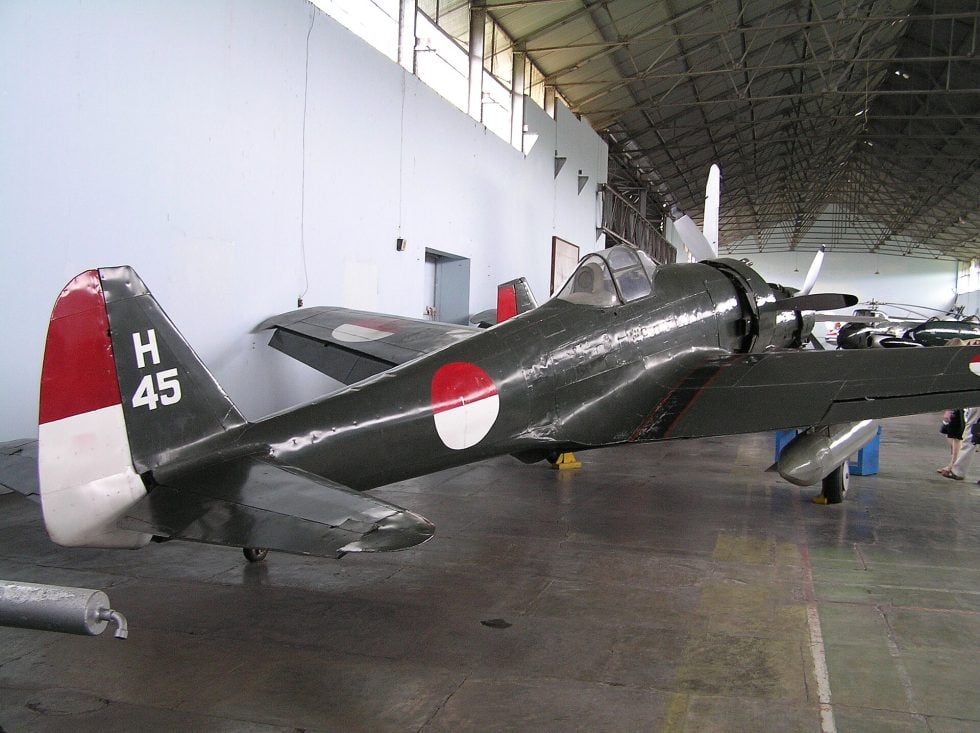
- Wartime deliveries to the Royal Thai Air Force (24 Ki-43-II), to Manchukuo and to the Wang Jingwei government in China. Post-war, France flew salvaged Hayabusas with Escadron de Chasse 1/7 in Indochina in 1945–46, Indonesian nationalists rebuilt derelicts against the Dutch, and Nationalist Chinese, Chinese Communist and North Korean units all operated small numbers into the early 1950s.
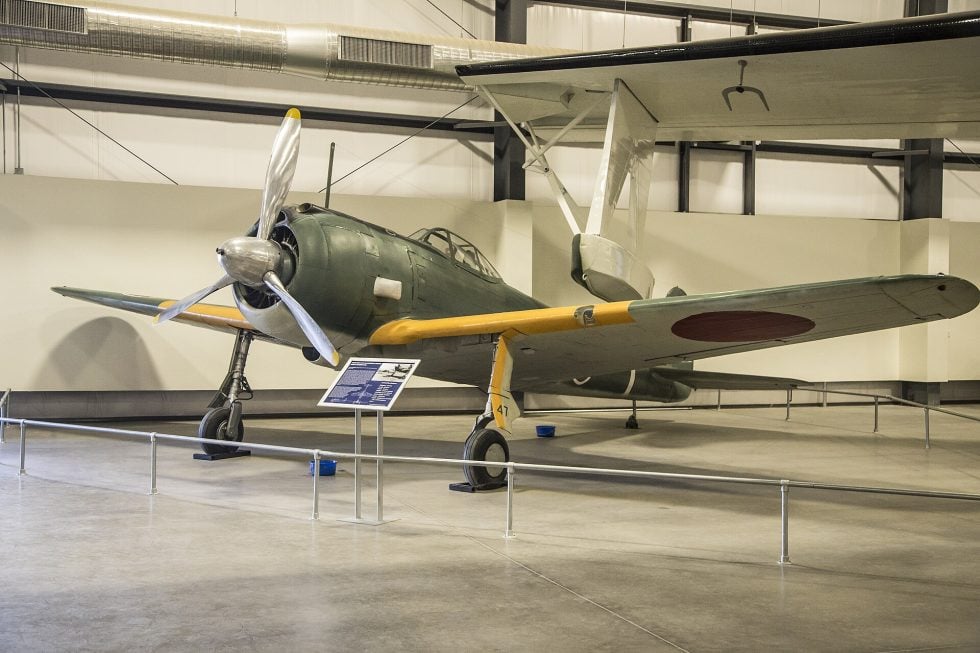
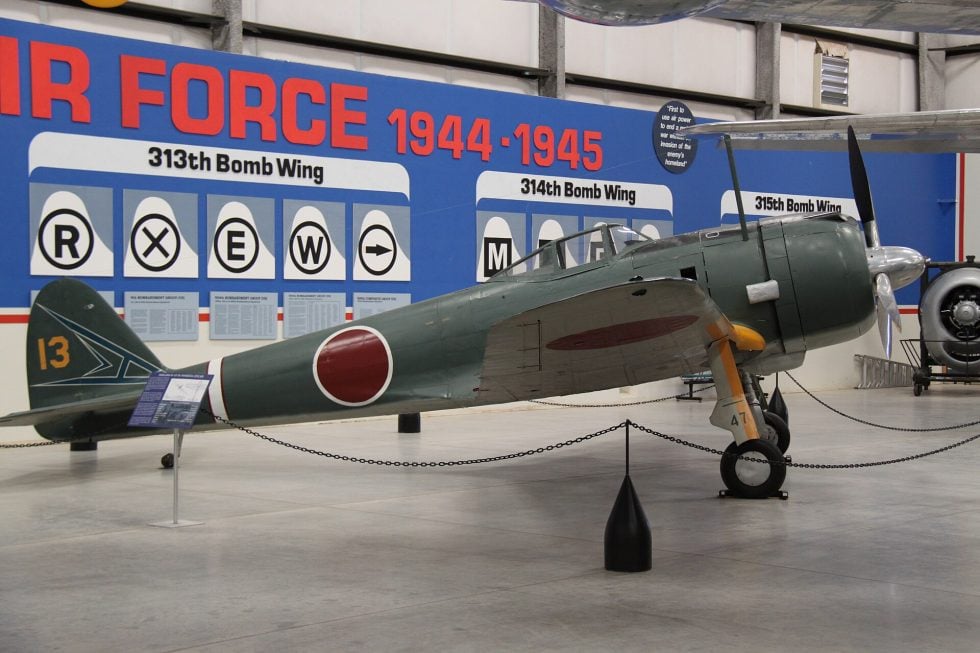
Closing caveat, and the survivors. Production totals do not reconcile: the commonly quoted 5,919 built sits alongside a delivery-and-acceptance figure of 5,751 airframes to August 1945 (3,185 Nakajima, 2,544 Tachikawa, 22 Arsenal), and Nakajima and Tachikawa annual outputs of 3,190 and 2,629 sum to 5,868 with the Arsenal’s 49 added. All three figures appear in reputable sources and none is obviously wrong. On survivors: no Ki-43 is airworthy anywhere in the world, and the number of genuinely original airframes is very small. The substantially original examples are the Ki-43-I usually quoted as manufacturer’s number 750, held by the Flying Heritage and Combat Armor Museum at Everett, Washington — restored in New Zealand by Tim Wallis’s Alpine Fighter Collection, flown there as ZK-OSC in the 1990s and long since grounded; the Ki-43-IIb serial 6430 owned by the Smithsonian National Air and Space Museum and displayed on loan at the Pima Air and Space Museum in Tucson; and the unrestored Ki-43-II serial 5465 at the Australian War Memorial, whose nose and tail are on display in Canberra with the wings and centre section in store. Separately, and importantly, several complete-looking Hayabusas are rebuilds assembled around original components rather than survivors: the Ki-43-IIIa aircraft at the Museum of Flight in Seattle and at the Erickson Aircraft Collection in Madras, Oregon were each constructed from the remains of four different wrecks, begun by the Texas Airplane Factory and completed by GossHawk Unlimited of Casa Grande, Arizona, which has held further airframes from the same programme. They contain real Japanese material in a largely new structure and should not be counted with the Everett, Pima and Canberra machines. The Chiran Peace Museum in Kagoshima displays a reproduction, the Dirgantara Mandala Museum at Yogyakarta holds an aircraft of unrecorded serial, the Kawaguchiko Motor Museum has one under restoration, and The Fighter Collection at Duxford holds a further airframe awaiting restoration by Nobuo Harada for eventual Japanese display. Serial identities across the rebuild programmes are genuinely contested and no single authority reconciles them.
From near-rejection to the war’s last flights
Requirement issued
The Army asks Nakajima for a successor to the Ki-27 “Nate”; Hideo Itokawa leads the design of what becomes the Ki-43.
First flight
The prototype flies in January. Army test pilots are unimpressed, and the design is nearly abandoned.
The flaps that saved it
Revised airframes shed weight and add the “butterfly” combat flaps; the type is accepted as the Army Type 1 Fighter, Hayabusa.
Combat debut
The Ki-43-I enters service and first fights over Malaya and Burma in the final weeks of 1941, led by the 59th and 64th Sentai.
Katō falls, and the Ki-43-II arrives
Lt Col Tateo Katō of the celebrated 64th Sentai is killed over the Bay of Bengal in May; the better-protected Ki-43-II enters production late in the year.
Outclassed but everywhere
Heavy use over New Guinea, China and the Philippines as newer Allied fighters — P-38, F6F, P-47, P-51 — steadily erode the Oscar’s early edge.
Home defence and kamikaze
Increasingly withdrawn to defend the home islands; in the war’s final phase some Hayabusas are flown in kamikaze special-attack missions.
Post-war afterlife
Production ends at roughly 5,900. Captured Ki-43s briefly serve France in Indochina and Indonesian nationalist forces before spares run out.
From the record: twelve Hayabusa stories
The Army fighter mistaken for a Zero
Allied pilots kept reporting “Zeros” that were really Army Ki-43s.
Read the full story
The butterfly turn
One modification turned a rejected fighter into a dogfighting terror.
Read the full story
“Do not dogfight the Oscar”
Allied pilots learned that turning with the Hayabusa was a losing game.
Read the full story
Two guns and no more
The Oscar could catch you — but struggled to bring you down.
Read the full story
The fragile falcon
Built so light that some examples came apart in the sky.
Read the full story
Satoru Anabuki
The Army’s top-scoring falcon pilot — and a still-argued tally.
Read the full story
“Katō’s Falcons”
Japan’s most famous fighter regiment — and a fallen commander.
Read the full story
Debut over the jungle
The Oscar’s war opened over Malaya and Rangoon.
Read the full story
From dogfighter to special-attack aircraft
Outclassed and outnumbered, some Oscars were sent on one-way flights.
Read the full story
Flown by the other side
Allied crews test-flew the Oscar to learn its gifts and its flaws.
Read the full story
The Oscar in other colours
Japan’s wartime partners flew the Hayabusa too.
Read the full story
French and Indonesian Oscars
The Hayabusa’s last flights were flown under other flags.
Read the full story
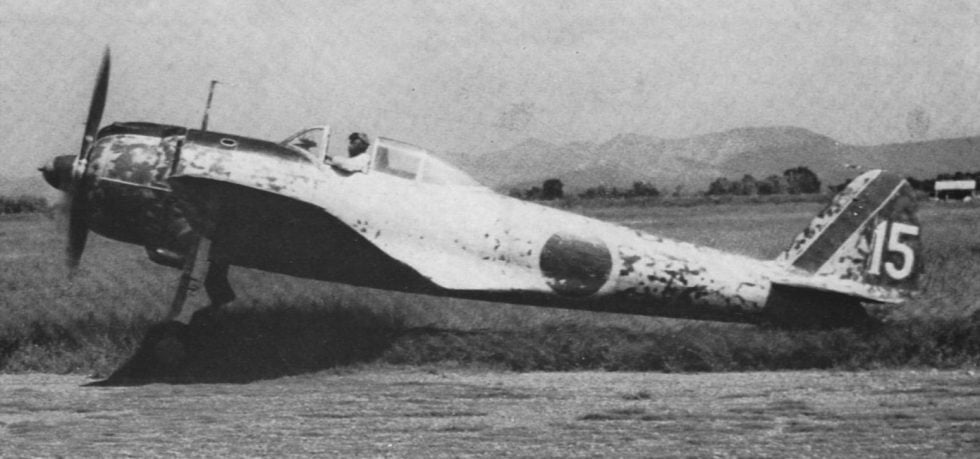
The Hayabusa in pictures
The Hayabusa in motion
A featured video for the Ki-43 Hayabusa is coming soon. In the meantime, explore the photo gallery above and the operations map below.
Where the Hayabusa flew
The score that defines it
The Ki-43’s record is a study in a single virtue and its limits. In 1941–42 its agility made it a dominant close-in dogfighter over Southeast Asia; as the war turned and sturdier, faster Allied fighters arrived, the lightly armed Oscar was steadily outmatched. It remained, throughout, the Imperial Japanese Army’s most numerous and most widely deployed fighter.
Compare the combat record of every military aircraft. Historical figures are commonly cited and vary by source.
Everything people ask about the Ki-43 Hayabusa
Can I fly in a Ki-43?
How agile was the Ki-43?
Why is it called “Oscar”?
How was the Ki-43 different from the Zero?
How many Ki-43s were built?
Was the Ki-43 well armed?
Who was the top Ki-43 ace?
Are there any Ki-43 survivors?
What replaced the Ki-43?
You can’t fly the Hayabusa.
These, you can.
Some legends only live in museums — others are fuelled and waiting. MiGFlug has put civilians in real military jet cockpits since 2004.
 Fly the L-39 AlbatrosThe world’s most-flown jet trainer — aerobatics included
 Fly the F-104 Starfighter“The missile with a man in it”
 Fly the MiG-21The Cold War’s most-produced jet
 Fly the T-33 Shooting StarAmerica’s first jet trainer
 Fly the DH VampireA piece of early jet history
 Fly the S.211Agile Italian jet trainer
 Fly the MB-326The classic Aermacchi jet
 Fly the MiG-15The Soviet legend of the Korean War
Continue the tour
Every fact, checked
- Smithsonian National Air & Space Museum — Ki-43-IIbAuthoritative museum record: development, service history and specifications.
- HistoryOfWar.org — Nakajima Ki-43 HayabusaDetailed development, variant specifications and production breakdown.
- Warfare History Network — Nakajima Ki-43Combat debut, the 64th Sentai, aces and late-war use.
- HistoryNet — “Nakajima’s Fragile Falcon”Structural weaknesses, armament limits and pilot recollections.
- Pacific Eagles — Ki-43 Type 1 HayabusaDevelopment and combat overview of the type.
- Pacific War Online Encyclopedia — Ki-43 “Oscar”Concise technical and tactical reference.
- wwiiafterwwii — Japanese aircraft in post-war French serviceThe French Indochina Ki-43 operation: units, dates and numbers.
- War History Online — Top Japanese fighter acesSatoru Anabuki’s record and the dispute over his tally.