
Brewster F2A Buffalo
America's first monoplane carrier fighter — condemned as a "flying coffin" over Midway, yet crowned the "Pearl of the Sky" over Finland. The Buffalo is the ultimate proof that an aircraft's reputation is written by its weight, its enemy, and its pilots.
The Brewster Buffalo's two lives: the same fighter, two opposite legends
Few aircraft carry a reputation as split as the Brewster F2A Buffalo. To American Marines who flew it against the Japanese at Midway and to the Commonwealth pilots shot down over Singapore, it was a death trap. To the Finnish pilots who took its lighter export cousin into battle against the Soviet Union, it was the finest fighter they had ever flown. Both verdicts are true — and the gap between them is the whole story.
The Buffalo was born from a 1930s United States Navy competition for a modern carrier fighter to replace the fabric biplanes then filling flight decks. Brewster Aeronautical Corporation — a small firm better known for building automobile bodies and floats than warplanes — answered with the XF2A-1: a stubby, barrel-bodied monoplane with retractable landing gear, an enclosed cockpit and an all-metal, mid-wing layout. It first flew on 2 December 1937. In a fly-off the Navy judged it superior to Grumman's competing XF4F-1 (which Grumman would rework into the F4F Wildcat), and in 1939 the F2A-1 became the first monoplane fighter to enter US Navy carrier service, equipping squadron VF-3.
On paper it was a leap forward — fast, compact, and armed with heavy machine guns. Wind-tunnel work by NACA had cleaned up the airframe and squeezed extra speed from the Wright R-1820 Cyclone radial. Early production Buffalos were genuinely nimble. Then came the fatal habit of every wartime fighter: growth. Successive US variants gained self-sealing fuel tanks, armour plate, a heavier engine, more ammunition, radios and naval equipment. Each addition was sensible; together they were ruinous. The F2A-3 that reached the Pacific in 1942 was hundreds of kilograms heavier than the sprightly F2A-1, with sluggish climb, a tired engine and landing gear that had a reputation for collapsing.
That verdict was earned in the worst possible circumstances. At Midway on 4 June 1942, Marine squadron VMF-221 threw its Buffalos and a handful of Wildcats against an incoming Japanese carrier strike. Flown by inexperienced pilots, using outdated tactics, against the fast and phenomenally agile Mitsubishi A6M Zero, the squadron was slaughtered. Over Malaya, Singapore and the Netherlands East Indies the same story played out: overloaded Buffalos, thin pilot training, poor maintenance in tropical heat, and an enemy — the Zero and the Nakajima Ki-43 — that could out-turn and out-climb them. The Buffalo's name was ruined.
And yet, at almost the same moment, on the other side of the world, the very same design was building a record that reads like fiction. Finland had bought 44 examples of the lighter Brewster Model 239 — an export B-model without the naval weight penalties. Flown by superbly trained Finnish pilots using disciplined pair-and-flight tactics against early-war Soviet types, the little Brewster ran up a kill-to-loss ratio frequently cited around 26 to 1. Finnish crews loved it and nicknamed it "Taivaan helmi" — the Pearl of the Sky. Aces including Hans Wind and Ilmari Juutilainen scored heavily on it. The contrast could not be sharper, and it is the reason the Buffalo remains one of aviation history's most argued-over aircraft.
The export story is central to understanding this. As war engulfed Europe in 1939–40, orders poured in for a fighter that was available now: Finland took the Model 239, Belgium ordered the 339B (most of which were diverted to Britain after the fall of France), Britain equipped its Far East squadrons with the Buffalo Mk I, and the Netherlands armed its East Indies air force with the Model 339. Each customer received a slightly different aircraft, at a different weight, for a different war. The Finns, flying the lightest version against the weakest opposition with the best training, drew the winning hand; almost everyone else drew the losing one.
It is worth stressing that the Finnish success was not a fluke of a single lucky day but a sustained, years-long record achieved by a whole air arm. That is what makes the Buffalo unique. Plenty of aircraft flew well in one battle and badly in another; very few compiled a genuinely great combat record in one air force while compiling a genuinely catastrophic one in another, at the same moment in history, from essentially the same blueprint.
01The Brewster Buffalo's origins: how a car-body maker beat Grumman to the Navy's first monoplane fighter+
Brewster Aeronautical Corporation was an unlikely fighter builder. Its roots lay in coachwork and marine components, and it had no experience mass-producing combat aircraft. When the US Navy issued its requirement for a carrier fighter in the mid-1930s, Brewster's design team — led by Dayton Brown — produced a compact monoplane that embraced every modern feature the Navy wanted: monoplane wing, retractable gear, enclosed cockpit, all-metal structure and a powerful radial engine.
In the fly-off, the XF2A-1 beat Grumman's XF4F-1, which had begun life as a biplane. Grumman went back to the drawing board, produced the monoplane XF4F-3, and eventually fielded the far more successful F4F Wildcat. But in 1939 it was Brewster, not Grumman, that put the US Navy's first monoplane fighter onto a carrier deck. Brewster's undoing was not the design so much as the company: chaotic management, labour trouble and slow, poor-quality production at its cramped multi-storey Long Island factory meant deliveries were late and inconsistent — a problem that would dog every Buffalo operator.
02The Brewster Buffalo's weight spiral: why the same airframe became a liability+
The single most important fact about the Buffalo is that "the Buffalo" was never one aircraft. The lightweight F2A-1 and the Finnish Model 239 weighed far less than the final F2A-3. As the war approached, the US Navy demanded self-sealing tanks, cockpit and head armour, heavier armament with more ammunition, extra fuel for range, and full carrier equipment. Empty and loaded weights climbed sharply while engine power did not keep pace.
The results were predictable: slower climb, poorer high-altitude performance, degraded manoeuvrability and increased stress on the notoriously weak main landing gear, which could fail on hard carrier landings. A fighter that had felt light and responsive in 1939 handled like a heavily laden truck by 1942. This is why any honest verdict on the Buffalo has to name the variant first — averaging its reputation across all marks is meaningless.
03The Brewster Buffalo's contested reputation: separating the myth of the "worst fighter" from the record+
The Buffalo is routinely listed among the "worst fighters of World War II." That label is a half-truth. In the Pacific and over Malaya, heavily loaded late-model Buffalos, flown by under-trained crews with poor tactics against the best carrier fighter in the world, performed disastrously — the reputation is deserved for those specific circumstances.
But the Finnish experience with the lighter Model 239 shows the same basic design, in the right weight, with the right pilots and tactics, against the right opposition, was an outstanding success. Modern aviation historians — and the Military Aviation History documentary embedded further down this page, titled "In Defense Of The Worst Plane of WW2" — increasingly argue the Buffalo was not intrinsically bad, but catastrophically mismatched to the Pacific war it was thrown into. The lesson is a general one: a fighter's record is a product of weight, opposition, training and tactics at least as much as raw design.
The Brewster Buffalo's design: a modern fighter that ran out of margin
A single Wright Cyclone radial
The Buffalo was built around the nine-cylinder Wright R-1820 Cyclone. The Finnish B-239 used the R-1820-G5 of roughly 950 hp; the final F2A-3 carried a more powerful R-1820-40 of about 1,200 hp — but the extra power was swallowed by the aircraft's rising weight, so real-world performance barely improved.
Stubby, barrel-bodied and compact
Its short, rotund fuselage and mid-mounted wing gave the Buffalo an unmistakable silhouette and good cockpit visibility. Retractable main gear and an arrester hook made it carrier-capable. The airframe was strong, but the main undercarriage was a known weak point, prone to collapse under the punishment of heavy landings.
Heavy machine guns, by variant
Armament grew with the marks. The first F2A-1 carried one .50-calibre and one .30-calibre Browning; later US and export models typically mounted four .50-calibre M2 Brownings — two in the cowl and one in each wing — a genuinely heavy battery for its day, though the added guns and ammunition contributed to the weight problem.
04The Brewster Buffalo's handling: nimble when light, leaden when loaded+
Pilots of the early, light Buffalo praised its responsiveness, forgiving stall and excellent cockpit view — qualities the Finns exploited to the full. The same airframe, burdened with armour, fuel and equipment, lost that edge. Sustained climb suffered most, and above medium altitudes the overloaded F2A-3 struggled against the thin air and against opponents built for agility. In a turning fight with a Zero, the heavy Buffalo was simply outclassed; the only viable tactic was to dive away and use speed and firepower in slashing attacks — exactly the approach disciplined Finnish flights used successfully against slower Soviet types.
05The Brewster Buffalo's operating costs: what a WWII Buffalo cost to buy and fly+
Reliable unit-cost figures for the Buffalo are not well documented in the surviving public record, and wartime accounting mixed airframe, engine and government-furnished equipment differently for each contract and export customer. Any single "price" quoted online should be treated with caution. What is clear is that Brewster's troubled, slow production made the type expensive in the currency that mattered most in 1941–42: time and reliability.
There is no meaningful "cost per flight hour" for a Buffalo today, because there is no airworthy original anywhere in the world. The handful of aircraft associated with the type are static museum exhibits or reproductions. For that reason the cost table below records the purchase price as not reliably documented, and the operating cost per hour as not applicable.
06The Brewster Buffalo's variants: from lightweight F2A-1 to the export Model 239, 339 and 439+
F2A-1 — first production model, light and relatively nimble; small US Navy batch, most later diverted to Finland as the Model 239. F2A-2 — uprated engine and propeller, considered by many the best-balanced US Buffalo. F2A-3 — the definitive US variant: more fuel, more armour, more weight, and the poorest performer. Export models included the Finnish Model 239 (B-239), the Belgian Model 339B (largely diverted to Britain), the British Commonwealth Model 339E / Buffalo Mk I, and the Netherlands East Indies Model 339C/D and later Model 439. The lighter export marks generally performed better than the heavy late US aircraft.
07The Brewster Buffalo vs the A6M Zero and F4F Wildcat: how the three compared+
The Buffalo's Pacific reputation only makes sense next to the aircraft it actually fought. The Mitsubishi A6M Zero was the finest carrier fighter in the world in 1941–42: astonishingly light, with a phenomenal turn rate, long range and heavy cannon armament, though it paid for that agility with fragile construction and no pilot armour. Against a fully-loaded F2A-3 the Zero could out-turn, out-climb and out-range it comprehensively.
The Grumman F4F Wildcat — the very aircraft Brewster had beaten in the original contest — was also outclassed by the Zero in a turning fight, but it was tougher, better armoured, and, crucially, its pilots developed sound team tactics such as the "Thach Weave" that let it trade blows on more even terms. The Buffalo had neither the Wildcat's rugged survivability nor, in US and Commonwealth service, the disciplined tactics that might have made it competitive. The comparison is a reminder that in 1942 raw specifications mattered less than survivability and doctrine.
08The Brewster company's collapse: how the manufacturer helped doom its own fighter+
Part of the Buffalo's failure had nothing to do with aerodynamics. Brewster Aeronautical Corporation was one of the most troubled aircraft manufacturers of the war. Its factory on Long Island was a cramped, multi-storey building never designed for mass aircraft production — completed airframes reportedly had to be lowered from upper floors. Management was chaotic, labour relations were poor, and quality control was inconsistent.
The consequences rippled outward to every customer. Deliveries ran late, aircraft arrived with defects, and spares were short — problems that hit the British, Dutch and American operators hardest just as they needed serviceable fighters most. The US Navy eventually placed the company under naval management, and Brewster was liquidated before the war's end. A better-run manufacturer might not have saved the F2A-3 from the Zero, but it would have given the type a fairer chance.
09The Brewster Buffalo in the Far East: the RAF, RAAF and RNZAF disaster+
Britain bought the Buffalo Mk I (Model 339E) as a stop-gap for the Far East, reasoning that Japanese air power was overrated and that a second-rate fighter would suffice against it. That assumption proved catastrophic. When Japan invaded Malaya in December 1941, RAF, Royal Australian Air Force and Royal New Zealand Air Force Buffalo squadrons found themselves facing first-line Japanese fighters flown by combat-experienced pilots.
The aircraft were worn and overloaded, ammunition and spares were short, many pilots were newly trained, and early-warning and control arrangements were poor. Some Commonwealth pilots nonetheless fought with great courage and claimed victories, but the campaign was a rout that ended with the fall of Singapore in February 1942. The Far East debacle, more than any single dogfight, fixed the Buffalo's reputation as a death trap in the English-speaking world.
10The Brewster Buffalo's Finnish kill ratio: what the famous 26:1 figure really means+
The Finnish Brewster's kill-to-loss ratio is one of the most cited — and most debated — statistics in fighter history. Figures around 26 to 1 (some sources cite even higher) come from Finnish victory claims set against Brewster combat losses during the Continuation War. As with all wartime claims, over-counting is possible and the exact number should be treated as an estimate rather than a precise accounting.
Even discounted heavily, however, the record is extraordinary. The Finnish Air Force flew the type intensively for years against the Soviet Union and rated it among its most effective fighters. The reasons were structural, not lucky: the light Model 239, excellent pilot training, disciplined tactics, and an early-war opponent the Brewster could genuinely out-fight. The figure endures because it captures a real and remarkable truth — the same basic aircraft that failed in the Pacific thrived over Karelia.
11The Brewster Buffalo's legacy: the fighter that proved context is everything+
The Buffalo's real legacy is not a technology or a tactic but a lesson. No other WWII fighter demonstrates so starkly that an aircraft's reputation is contingent — that the same design can be a "flying coffin" in one theatre and a "Pearl of the Sky" in another, separated only by weight, opposition, training and tactics. Historians reach for the Buffalo whenever they want to warn against judging a weapon by a single campaign.
It also stands as a cautionary tale about procurement and industry: a promising design was undermined by a weight spiral driven by well-meaning requirements and by a manufacturer that could not deliver. For enthusiasts, finally, it is a reminder of how nearly the record can vanish — with no airworthy original left, the Buffalo survives on the edge of living memory, in a handful of museum airframes and a lake-recovered survivor.
Brewster F2A Buffalo specifications, performance and cost
Figures below are representative and vary considerably by variant and source; the Buffalo changed weight and performance dramatically between the light F2A-1 / Model 239 and the heavy F2A-3. Contested or estimated figures are flagged.
Baseline note: figures describe the Brewster F2A-3 of 1941, the last and heaviest version and the one that fought at Midway. It is the right anchor precisely because it is the aeroplane the Buffalo’s reputation was built on — but it is not the aeroplane the Finns flew, and the difference is the whole argument. Deltas in grey for the light early F2A-1 and its Finnish export equivalent, the Model 239, and for the F2A-2. Weights are the load-bearing numbers on this page: the same wing carried 5,820 lb in Finnish hands and up to 7,159 lb in United States Marine Corps hands. Figures follow Swanborough and Bowers for the F2A-3 and Baugher for the 239; where sources disagree the disagreement is stated.
Dimensions & weights
- Crew
- 1
- Length
- 8.03 m (26 ft 4 in) — very short for a fighter, which is where the barrel-shaped look comes from and part of why it was directionally twitchy
- Wingspan
- 10.67 m (35 ft 0 in)
- Height
- 3.66 m (12 ft 0 in)
- Wing area
- 19.41 m² (209 sq ft) — unchanged across every variant from the 1937 prototype to the F2A-3, which is the mechanical reason the type could not absorb weight
- Aerofoil
- NACA 23018 at the root, NACA 23009 at the tip
- Empty weight
- 2,146 kg (4,732 lb); Model 239 1,769 kg (3,900 lb)
- Normal loaded weight
- ~2,867 kg (~6,321 lb) — commonly quoted but not firmly attested; F2A-2 2,695 kg (5,942 lb); Model 239 as flown in Finland 2,640 kg (5,820 lb)
- Maximum take-off weight
- 3,247 kg (7,159 lb)
- Wing loading
- 167 kg/m² (34.3 lb/sq ft) at maximum weight; 148 kg/m² (30.2 lb/sq ft) at normal load. The Model 239 flew at 136 kg/m² (27.8 lb/sq ft), close to an A6M2 Zero — this is the single number that separates the Finnish aeroplane from the Midway one
- Power loading
- 2.39 kg/hp (5.27 lb/hp) at normal load, 2.71 kg/hp (5.97 lb/hp) at maximum. The Model 239 was worse on paper at 2.78 kg/hp (6.13 lb/hp) — proof that the F2A-3’s problem was not a shortage of power but weight in the wrong places and the drag that came with it
- Internal fuel
- ~908 litres (~240 US gal, 200 imp gal) in a wet wing with self-sealing features plus an enlarged fuselage tank — roughly 303 litres (80 US gal) more than the F2A-2, and the fuel alone accounted for nearly 227 kg (500 lb) of the F2A-3’s weight growth
- Undercarriage
- Hydraulically retracted main gear of notoriously slender construction. Failures during carrier landings were common on the F2A-2 and got worse as the F2A-3 grew heavier; VMF-211 lost one to gear collapse simply landing aboard USS Long Island off Palmyra in July 1942
Performance
- Maximum speed
- 517 km/h (321 mph); F2A-2 520 km/h at 5,030 m (323 mph at 16,500 ft); Model 239 as modified by Finland 478 km/h at 4,780 m (297 mph at 15,675 ft); Buffalo Mk I 504 km/h (313 mph)
- Cruising speed
- 259 km/h (161 mph)
- Initial rate of climb
- 12.4 m/s (2,440 ft/min), and less than that with full tanks. F2A-2 12.7 m/s (2,500 ft/min); F2A-1 13.2 m/s (2,600 ft/min); the 1937 XF2A-1 prototype 14.0 m/s (2,750 ft/min); the British Buffalo Mk I 11.7 m/s (2,300 ft/min) — the type got steadily worse at the one thing an interceptor must do
- Service ceiling
- 10,120 m (33,200 ft); Model 239 9,910 m (32,500 ft)
- Range
- 1,553 km (965 miles) — the one respect in which the F2A-3’s extra fuel bought something. It was conceived as a long-range reconnaissance fighter, and its Cyclone was an excellent cruising engine
- Altitude performance
- Fell away sharply. The single-stage supercharger ran out of work above about 4,500 m (15,000 ft), and British testing found fuel starvation above that height. The advertised 323 mph at 21,000 ft was never seen in combat by anyone
- Manoeuvrability
- Excellent when light, poor when heavy, and the change was abrupt. Gregory Boyington said the early aircraft "could turn and roll in a phone booth"; British Buffalo Mk Is at combat weight could not be looped
- Stability
- Marginal. The short fuselage and the far-forward centre of gravity of the loaded aircraft made it a tiring gun platform, and the type was widely described as unstable at weight
- Engine cooling
- The Cyclone overheated badly in the tropics, throwing oil over the windscreen and forcing aborted sorties over Malaya and the Indies. In Finland the cold air solved the problem, and Finnish mechanics solved the rest by inverting one piston ring per cylinder
- Against the A6M2 Zero
- Outclassed in climb, speed and turn at every weight the F2A-3 was flown at. The tactics that worked were the ones later formalised for the Wildcat: never turn, dive away, and take head-on passes. Captain William Humberd shot down a Zero at Midway doing exactly that
- Against the Nakajima Ki-27 and Ki-43
- Competitive against the fixed-gear Ki-27 "Nate" if warned in time to climb. Against the Ki-43 "Oscar" it was beaten, though the Dutch found that halving the wing fuel and ammunition let their lighter 339s stay with an Oscar in a turn — the Finnish lesson, rediscovered under fire
- Protection
- F2A-3: pilot armour plate and self-sealing tank features — though Marine Corps reports from Midway record aircraft delivered without the back armour fitted. F2A-1, F2A-2 and Model 239: neither. Finland added armoured backrests locally
Propulsion & systems
- Engine
- 1 × Wright R-1820-40 Cyclone 9, nine-cylinder single-row air-cooled radial of 29.9 litres (1,823 cu in)
- Power
- 895 kW (1,200 hp) for take-off. F2A-1: R-1820-34 of 701 kW (940 hp). Model 239: R-1820-G5 of 708 kW (950 hp) — more power than the F2A-1 it was derived from. Export 339B, 339C and 339E: the de-rated G-105 of 746 kW (1,000 hp), and many British aircraft flew on secondhand Cyclones pulled from DC-3 airliners and rebuilt by Wright
- Supercharger
- Two-speed single-stage on the -40. Good for economical cruise, inadequate for combat above 4,500 m
- Propeller
- Three-blade constant-speed. The F2A-2 introduced a better unit than the F2A-1 and gained most of its speed from it
- Gunsight
- Reflector sight. Finland fitted the Väisälä T.h.m.40; British aircraft the Mk III reflector sight with a gun camera; the Dutch received new sights and tracer ammunition only in February 1942, and both measurably improved their hit rate
- Naval equipment
- Arrester hook, flotation gear and a life-raft container on Navy aircraft. All three were stripped from the export models, which is part of why the Model 239 was lighter than the F2A-1 it was built from — the Finns bought a de-navalised fighter and never had to carry the sea with them
- Instruments
- Finnish aircraft were converted to metric instrumentation on arrival, assembled by SAAB at Trollhättan in Sweden after being shipped in crates to Bergen
- First flight
- 2 December 1937 (XF2A-1). Langley full-scale wind-tunnel work in 1938 cleaned up the cowling and intakes and raised top speed from 447 to 489 km/h (277.5 to 304 mph) on unchanged power — a ten per cent gain that persuaded the whole American industry to start using wind tunnels
- Service entry
- Ten aircraft to VF-3 aboard USS Saratoga on 8 December 1939 — the United States Navy’s first monoplane fighter
- Number built
- 509 of all variants, 1938–41: 11 F2A-1, 43 F2A-2, 108 F2A-3, and the rest exports — 44 Model 239 for Finland, 40 339B for Belgium, 24 339C and 48 339D for the Netherlands East Indies, 170 339E for Britain, and 20 339-23
- Delivery record
- The number that condemns the company: of the 54 F2A-1s ordered, Brewster delivered eleven. The rest of the contract was diverted to Finland and the Navy took F2A-2s in compensation. Brewster ranked 84th among American corporations by value of wartime contracts and could not fulfil them
- Retirement
- Withdrawn from United States front-line service after Midway, June 1942, and used as an advanced trainer thereafter. Finland flew Brewsters until 14 September 1948; the last five were stored and scrapped in 1953
Armament & payload
Four half-inch Brownings were enough gun; the Buffalo’s problem was everything bolted on around them
On paper the F2A-3’s armament was competitive with anything flying in 1941: four 0.50 in M2 Brownings, two synchronised in the cowl and two in the wings, comparable in weight of fire to a Zero’s two 20 mm and two 7.7 mm, and delivered with better ballistics and far more rounds. In practice the installation was unreliable. Marine Corps combat reports from Midway record nose guns that simply would not fire, a fault later put down to frayed wiring in the synchronising gear, and pilots going into a fight with a Zero on two guns instead of four.
The export picture was worse and more revealing. British Buffalo Mk Is were nominally armed with 0.50 in guns but many carried 0.303 in Brownings on electric solenoids that failed in the damp; 243 Squadron in Malaya was supplied with armour-piercing ammunition and no incendiary, against Japanese aircraft that had neither armour nor self-sealing tanks and would have burned readily. The Dutch flew 339Cs with rifle-calibre guns and said openly that their success rate suffered for it. Finland, given a free hand, tore the factory armament out and rebuilt it, which is what a competent operator does with an adequate airframe.
Nothing here was decisive by itself. The decisive thing was weight. Ammunition capacity, armour fit and gun calibre all varied by mark, by operator and sometimes by squadron, and any single armament statement for the Buffalo describes one batch rather than the type.
Gun
- F2A-3: 4 × 0.50 in (12.7 mm) M2 Browning — two synchronised in the cowl just ahead of the cockpit, two in the wings, with ammunition capacity increased over the F2A-2 as part of the weight growth.
- XF2A-1 and F2A-1: as first delivered, 1 × 0.50 in with 200 rounds and 1 × 0.30 in with 600 rounds, both in the nose, with provision for two 0.50 in wing guns that the Navy specified and whose weight cut the climb rate from 2,750 to 2,600 ft/min.
- Model 239 (Finland): delivered with the capacity for four guns and completed in Finland with four 0.50 in Brownings — the same battery as an F2A-3 on an airframe 500 lb lighter. This is the aircraft that ran up the kill ratios.
- Buffalo Mk I (339E): four guns nominally 0.50 in, in practice frequently 0.303 in on unreliable electric firing solenoids. At least one squadron stripped armour, armoured glass, radio and gun camera and downgraded to 0.303 in guns to save 454 kg (1,000 lb). It made very little difference.
- XF2A-4 and the cannon project: the Navy began replacing the wing 0.50s with two 20 mm M2 cannon; at least eight wing sets were completed and at least one F2A-3 flew with them before the type was written off entirely.
Air-to-air
- No guided weapon existed; the guns were the aircraft. The record they produced is the most extreme spread of any fighter of the war.
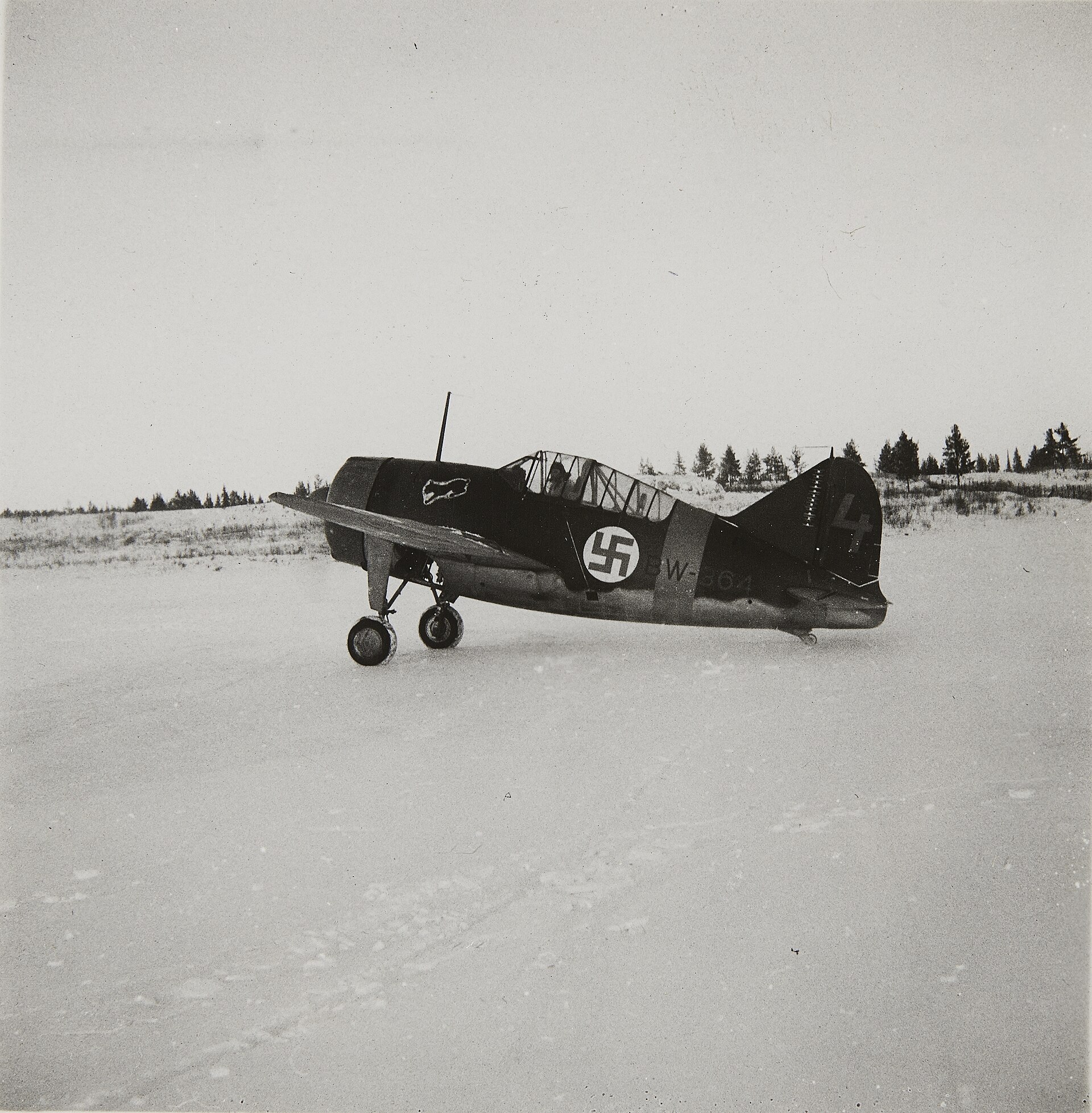
- Finland: Lentolaivue 24 claimed 477 Soviet aircraft on Model 239s for 19 Buffalos lost in combat, a ratio of about 26 to 1, and 36 Finnish pilots became aces on the type. Hans Wind claimed 39 of his 75 on Brewsters, Ilmari Juutilainen 34 of his 94½, Jorma Karhunen 25½ of his 31½. Airframe BW-364 is credited with 42½ victories by all its pilots, arguably the highest-scoring individual fighter airframe in history.
- Malaya and Singapore: of roughly 150 Buffalo Mk Is in theatre in December 1941, more than 60 were shot down, 40 destroyed on the ground and about 20 lost in accidents; some 20 escaped to India or the Indies. The last airworthy Buffalo left Singapore on 10 February 1942, five days before the island fell. Four Commonwealth pilots still made ace on the type, led by Geoff Fisken with six.
- Midway, 4 June 1942: VMF-221 put up 21 F2A-3s and seven F4F-3s against Japanese formations escorted by 36 Zeros. Fourteen of the squadron’s aviators were killed, including the commander, Major Floyd Parks, who was strafed in his parachute; only two of the 13 aircraft that returned were serviceable. The squadron ceased to exist as a combat unit in about twenty minutes.
- Netherlands East Indies: ML-KNIL pilots claimed 55 Japanese aircraft; 30 Buffalos were shot down, 15 destroyed on the ground and 17 pilots killed. On 19 February 1942 eight Dutch Brewsters intercepted around 35 bombers with 20 Zeros over Semplak and claimed eleven for four lost.
Air-to-surface guided
- None carried. No guided air-to-surface weapon existed in service anywhere the Buffalo flew.
- The nearest equivalent was the Dutch practice of using 339s as improvised dive bombers against Japanese troopships in the Indies — an act of desperation with two light bombs and a gunsight, not a capability the aircraft was designed for.
- Commonwealth Buffalos flew ground-attack and strafing sorties from the first day of the Malayan campaign: Flying Officer Maurice Holder’s 8 December 1941 sortie against landing barges on the Kelantan River was the type’s first combat mission of the Pacific War.
- Australian-operated ex-Dutch B-339-23s ended their days on photo-reconnaissance with 1 PRU and as gunnery targets — the honest final use of the airframe.
Bombs
- F2A-3: 2 × 45 kg (100 lb) bombs on underwing racks. That is the entire designed bomb capability of the type.
- Dutch 339s carried light bombs on the same racks for anti-shipping work over the Java Sea.
- No dive brakes, no bombsight worth the name, and an aircraft that handled poorly at weight. Bombing was done in shallow dives from low level and accuracy came from getting close.
- The Buffalo was never a fighter-bomber and no operator seriously tried to make it one.
Rockets
- None carried, by any operator, at any time.
- Air-to-ground rockets reached Allied squadron service in 1942–43. By then the Buffalo had been withdrawn from every front-line role except the Finnish one, and Finland had no such weapon.
- The wing had no spare structural margin and no spare drag budget for external stores. That is the practical answer, and it applies to drop tanks as much as to rockets.
Pods & other stores
- Essentially none. Beyond the two 100 lb bomb racks the Buffalo carried nothing externally — no drop tanks, no gun pods, no reconnaissance pods.
- Naval equipment counted against the same weight budget: arrester hook, flotation gear and life-raft container, all deleted on export aircraft.
- British aircraft added a gun camera, a larger battery, engine shutters, a fire extinguisher, armoured glass and a large fixed pneumatic tailwheel in place of the semi-retractable Navy unit — about 408 kg (900 lb) of additions on 200 hp less engine than an F2A-2. This list, not the guns, is why the Buffalo Mk I was the worst Buffalo.
- The 1 PRU aircraft in Australia carried cameras internally for photo-reconnaissance, the only sensor fit the type ever received.
Three typical loadouts
- Interception, Lentolaivue 24, Karelian Isthmus, 1942
- Model 239, four 0.50 in Brownings, Väisälä sight, armoured backrest, no external stores, take-off weight about 2,640 kg (5,820 lb). Flown in the four-aircraft parvi swarm: a low pair as bait, a high pair to dive on whatever came down after them. The Soviet Air Force never found an answer to it.
- Interception, VMF-221, Midway, 4 June 1942
- F2A-3, four 0.50 in with full ammunition, full internal fuel of about 908 litres, pilot armour where fitted, take-off weight near the 3,247 kg (7,159 lb) maximum. Worn-out Navy hand-me-down airframes, pilots fresh from training, a single climbing pass at the bombers and then thirty-six Zeros.
- Airfield defence, 453 Squadron RAAF, Sembawang, December 1941
- Buffalo Mk I with four guns of mixed calibre, armour-piercing ammunition only, fuselage tanks filled to a minimum and armour sometimes removed to claw back climb rate. Scrambled without useful radar warning against Ki-21s and Ki-27s already overhead. Flight Lieutenant Doug Vanderfield shot down three bombers over Butterworth on 13 December with his undercarriage still down, which says something about both the pilot and the aeroplane.
Sourcing caveat: the Finnish figures are claims, and Finnish claims — like every air force’s — exceed the losses recorded in Soviet archives. The often-quoted 32-to-1 ratio for the first phase of the Continuation War and the 26-to-1 for Lentolaivue 24 as a whole should be read as upper bounds. So should the 55 Dutch claims and the 27 claimed by No. 67 Squadron over Burma. The comparative point survives every correction that has been applied to the numbers: on the same basic airframe, the light early Brewster in Finnish hands achieved something the heavy late Brewster in American and Commonwealth hands never came close to.
Variants
Every Buffalo after the first one was heavier than the one before, and the company that built them was seized by the United States Navy
The Buffalo is the clearest case in aviation history of a design ruined by growth. The XF2A-1 of 1937 was a light, clean, agile little fighter that beat the biplane Grumman F4F-1 fair and square and, after wind-tunnel cleaning at Langley, gained ten per cent in speed on unchanged power. Every subsequent variant added equipment to a wing that never grew. The F2A-3 put on more than 227 kg (500 lb) of fuel and tankage alone in pursuit of a long-range reconnaissance-fighter requirement, plus armour and ammunition on top, and the Navy discovered it had made the aircraft slower, worse-climbing and far less manoeuvrable than the F2A-2 it replaced. There was no way back: the limits of the airframe had been reached and a larger engine would not physically fit.
The company deserves its share of the blame and has always received it. Brewster Aeronautical was bought out of a carriage-builder’s aviation division for 30,000 dollars in 1932 and grew into a defence contractor in under a decade without acquiring the management to run one. Its salesmen, the brothers Alfred and Ignacio Miranda, had served two years in prison for illicit arms dealing with Bolivia and over-promised the factory’s capacity to every customer they met. The Long Island City plant was cramped and inefficient. Eleven of 54 F2A-1s were delivered. The Navy installed its own president, was outmanoeuvred when James Work regained control in early 1942, and on 18 April 1942 gave up and seized the company outright, putting the former head of the Naval Aircraft Factory in charge. Brewster went on to build Corsairs under licence badly enough that the Navy cancelled the contract on 1 July 1944, and the firm folded in 1946.
It is worth saying what this does and does not excuse. A better-managed Brewster would have delivered more Buffalos, sooner, and probably better-finished ones. It would not have made the F2A-3 into a Zero-killer. The design was at the end of its development in 1940 and the people responsible knew it.
- XF2A-1 (1937, 1 built)
- Wright R-1820-22 of 950 hp, 2,750 ft/min climb, 277.5 mph. After the Langley tunnel work, 304 mph at 16,000 ft on the same power. The best Buffalo, and the only one that was ahead of its competition.
- F2A-1 (1939–40, 11 delivered of 54 ordered)
- R-1820-34 of 940 hp, larger fin, one 0.50 in and one 0.30 in nose gun with provision for two 0.50 in in the wings. Ten went to VF-3 aboard USS Saratoga in December 1939. Brewster could not build the rest; the balance of the order went to Finland.
- F2A-2 (1940–41, 43 built)
- R-1820-40 of 1,200 hp, better propeller, integral flotation gear, four guns, no armour and no self-sealing tanks. 323 mph at 16,500 ft, 2,500 ft/min. The best of the Navy versions and the one Navy and Marine pilots actually liked.
- F2A-3 (1941, 108 built)
- Long-range reconnaissance fighter: wet wing with self-sealing features, enlarged fuselage tank, pilot armour, more ammunition, two 100 lb bomb racks. Over 500 lb heavier, slower, worse in climb and manoeuvre. Ordered largely to keep Brewster’s lines open. Derided by Marine pilots as a "flying coffin".
- Model 239 (1939–40, 44 built for Finland, BW-351 to BW-394)
- Export F2A-1 with the more powerful 950 hp R-1820-G5, four guns, and the tailhook, life-raft container and other naval fittings deleted. Lighter and better-powered than the aircraft it derived from. Shipped to Bergen, railed to Sweden, assembled by SAAB at Trollhättan, fitted in Finland with armoured backrests, metric instruments and Väisälä sights. Known in Finland only as the Brewster, never the Buffalo, and nicknamed Taivaan helmi, pearl of the sky.
- Model 339B (1940, 40 built for Belgium)
- De-navalised F2A-2 with the export-approved 1,000 hp G-105 and a slightly longer tail. One reached France before the German invasion and was captured intact; six were dumped on a hillside in Martinique and never flew. The remaining 32 were passed to Britain.
- Model 339C and 339D (1940–41, 24 and 48 built for the Netherlands East Indies)
- 339C with rebuilt G-105 engines supplied by the Dutch, 339D with new 1,200 hp R-1820-40s. Lighter than the British Mk I and correspondingly better: Dutch pilots could engage a Ki-43 on something like even terms once they halved the wing fuel and ammunition.
- Model 339E, Buffalo Mk I (1940–41, 170 built for Britain)
- The worst version. The 1,000 hp G-105 instead of the F2A-2’s 1,200 hp Cyclone, plus roughly 900 lb of British-specified additions and a large fixed tailwheel in place of the retractable one. 313 mph at best, 2,300 ft/min, and unable to loop. Flown by two RAF, two RAAF and one RNZAF squadron over Malaya, Singapore and Burma, and destroyed there.
- Model 339-23 (1942, 20 built)
- Export F2A-3 with 1,200 hp GR-1820-G205A engines for the Indies. Seventeen were diverted to the Fifth Air Force in Australia after the Dutch surrender on 8 March 1942 and lent to the RAAF as the A51 series, flying air defence over Perth, photo-reconnaissance with 1 PRU and gunnery training until 1944.
- VL Humu (1944, 1 built)
- Finland’s attempt to build its own Brewster from plywood and other non-strategic materials when spares ran out. It flew, it was heavier than the original, and it was obsolete before it left the ground. One prototype only, and a fair emblem of how far the design had been stretched.
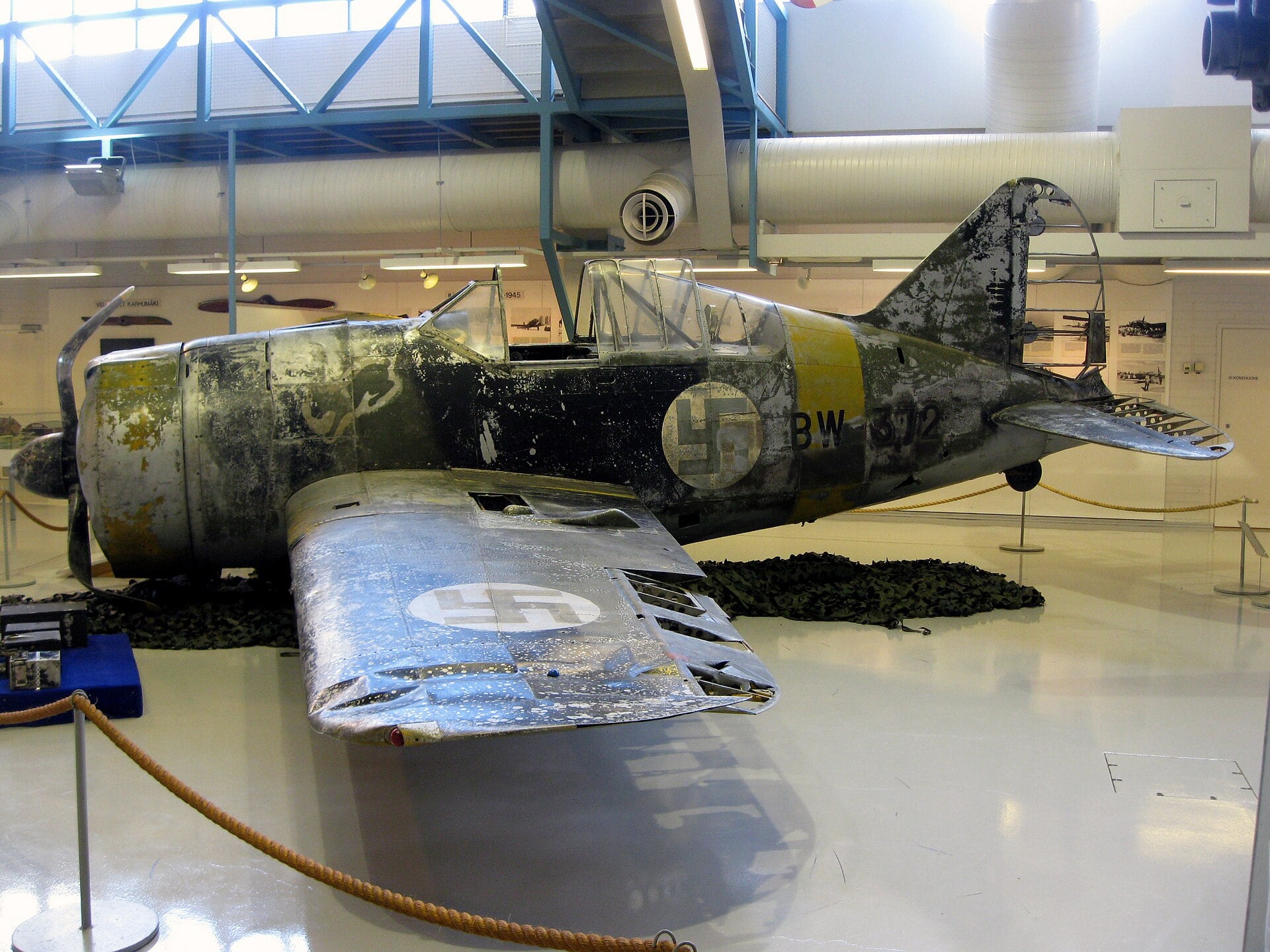
Survivors and reproductions: exactly one substantially complete original Buffalo exists anywhere in the world, and it is Finnish. Model 239 BW-372, flown by Lieutenant Lauri Pekuri, was damaged by a Soviet-flown Hawker Hurricane and force-landed on the ice of Lake Big Kolejärvi in 1942; it was recovered in 1998 and is displayed at the Aviation Museum of Central Finland at Tikkakoski, which also holds components of BW-393. The same museum has VL Humu HM-671 — an original airframe, but of the Finnish plywood derivative rather than of the Buffalo itself. The other two aircraft usually shown as Buffalos are full-scale static reproductions, not original airframes: a 339C built by the Cradle of Aviation Museum in 2008 for the Dutch national military museum at Soesterberg in the markings of Lieutenant Gerard Bruggink, and an F2A-2 replica retained by the Cradle of Aviation Museum itself in the United States Navy markings of VS-201. Partial wreckage of a Marine Corps F2A-3 ditched off Midway in February 1942 was found in shallow water in June 2012 and left in place. No Buffalo of any mark is airworthy, and no United States Navy-built F2A survives.
Brewster Buffalo vs Zero vs Wildcat: the 1942 match-up
The heavy F2A-3's Pacific failure is clearest when set beside the two fighters it met most often: the aircraft that shattered it, the Mitsubishi A6M Zero, and the aircraft it had beaten in the Navy contest, the Grumman F4F Wildcat. Figures are representative and vary by sub-variant and source.
| Brewster F2A-3 | A6M2 Zero | F4F-4 Wildcat | |
| Origin | USA | Japan | USA |
| Engine | Wright R-1820 radial | Nakajima Sakae radial | Pratt & Whitney R-1830 radial |
| Max speed (approx.) | ~520 km/h, less when loaded | ~530 km/h | ~515 km/h |
| Manoeuvrability | Poor when overloaded | Exceptional turn rate | Modest, but sound tactics |
| Pilot armour / protection | Yes (added, heavy) | Minimal — fragile | Yes — rugged |
| Pacific 1942 verdict | Outclassed | Dominant early-war | Competitive with tactics |
The table also explains the Finnish exception: strip the F2A-3's added weight back to the light Model 239, swap the Zero for early Soviet types, and put a superbly trained pilot in the cockpit, and the same basic airframe moves from the bottom row to the top.
The Brewster Buffalo's timeline: from Navy contest to a lake in Karelia
The US Navy runs a design competition for a modern carrier fighter to replace its biplanes; Brewster, Grumman and Seversky compete.
Brewster's monoplane XF2A-1 is judged superior to Grumman's biplane XF4F-1 prototype. The XF2A-1 makes its first flight on 2 December 1937.
NACA wind-tunnel testing refines the airframe's aerodynamics, adding speed to the production design.
The F2A-1 enters US Navy service with squadron VF-3 — the first monoplane fighter to operate from American carriers.
Export orders arrive from Finland (Model 239), Belgium (339B), Britain (339E / Buffalo Mk I) and the Netherlands (339C/D) as war spreads in Europe and Asia.
Finland's B-239 enters combat in the Continuation War against the Soviet Union and immediately begins running up an extraordinary kill record.
Commonwealth Buffalos meet the Japanese invasion of Malaya; overloaded and outclassed, they suffer heavy losses.
Singapore falls; Dutch Model 339s fight on over Java and Sumatra in the Netherlands East Indies before being overwhelmed.
At the Battle of Midway, Marine squadron VMF-221's Buffalos are decimated by Japanese Zeros — effectively the type's last major US combat action.
Finnish Buffalos remain highly effective until newer Soviet fighters arrive; the type is progressively withdrawn from front-line duty.
Finnish Model 239 BW-372 is recovered from a lake in Russian Karelia after decades underwater.
Restored, BW-372 is displayed at the National Naval Aviation Museum in Pensacola, Florida — one of the very few tangible Buffalos left on Earth.
Twelve Brewster Buffalo stories: from Midway to the Pearl of the Sky
How Brewster beat Grumman to the deck
In the mid-1930s fly-off, Brewster's modern monoplane XF2A-1 outpointed Grumman's biplane XF4F-1.
Read the full story
The US Navy of the mid-1930s was still a biplane force, and its call for a modern carrier fighter drew designs from Brewster, Grumman and Seversky. Brewster's answer embraced everything modern at once: a monoplane wing, retractable gear, an enclosed cockpit and all-metal construction.
Grumman's initial entry was still a biplane, and the Navy judged Brewster's monoplane the superior aircraft. Grumman regrouped, reworked its design into the monoplane XF4F-3 and eventually fielded the war-winning F4F Wildcat. But it was Brewster that first put a monoplane fighter on a US carrier deck in 1939. The irony would only deepen: the aircraft Brewster beat became a legend, while the Buffalo's American career collapsed within three years.
VF-3 and the monoplane revolution
Squadron VF-3 took the F2A-1 to sea — the first American monoplane fighter unit afloat.
Read the full story
For pilots raised on open-cockpit biplanes, the enclosed, fast, retractable-gear Buffalo was a glimpse of the future. The early F2A-1 handled well, offered excellent visibility over its short nose and was genuinely popular with the aviators who first flew it.
The seeds of trouble were financial and industrial, not aerodynamic. Brewster simply could not build enough good aircraft quickly enough, and many early Navy Buffalos were soon diverted abroad — a number going to Finland as the Model 239. Meanwhile the Navy's growing appetite for armour, fuel and equipment was about to reshape the design into something heavier and far less forgiving.
How a nimble fighter got fat
Armour, self-sealing tanks, fuel, radios and ammunition piled weight onto an airframe whose power did not grow to match.
Read the full story
Every addition was justified in isolation. Self-sealing tanks and armour saved lives; more ammunition and fuel extended combat power and range; radios and naval gear were essential. Together, though, they crippled the F2A-3.
Climb rate collapsed, high-altitude performance faded, and the notoriously weak main gear — already a liability — grew even more fragile under the extra load. The uprated engine could not keep pace with the weight it now had to haul. The Buffalo that reached the Pacific in 1942 was a very different, and far worse, machine than the one VF-3 had flown three years earlier.
VMF-221's ordeal, 4 June 1942
Marine squadron VMF-221 launched its Buffalos and Wildcats against a Japanese carrier strike — and was shattered.
Read the full story
On the morning of 4 June 1942, the Marine fighters of VMF-221 rose from Midway to meet an incoming Japanese carrier strike. The bulk of the squadron flew Brewster F2A-3s, with a handful of Wildcats alongside.
Outnumbered, flown by many inexperienced pilots using outdated tactics, and hopelessly outclassed by the A6M Zero, the squadron was cut apart in minutes; a large proportion of its aircraft and pilots were lost. It was the single event that sealed the Buffalo's American reputation, and the source of the most damning pilot reports ever written about a US fighter — including the notorious "flying coffin" assessment.
The "flying coffin" report
A Midway survivor's after-action report is among the most-quoted condemnations in aviation history.
Read the full story
The report bluntly stated that any commander ordering a pilot into combat in the F2A-3 should consider that pilot lost before he even left the ground. It is genuine, and it is quoted endlessly — often as proof that the Buffalo was simply the worst fighter of the war.
But context is everything. The words describe the overloaded late US variant, flown by green pilots with poor tactics, in the worst tactical situation imaginable against the finest carrier fighter in the world. Set beside the Finnish record with the lighter Model 239, the same sentence becomes a lesson about circumstances rather than a simple epitaph for a design.
The Commonwealth's losing fight
RAF, RAAF and RNZAF Buffalos met the Japanese invasion of Malaya in December 1941.
Read the full story
Britain had sent the Buffalo east in the belief that Japanese air power was second-rate and that a modest fighter would be enough to hold the line. When Japan invaded Malaya in December 1941, that assumption collapsed.
Plagued by overloaded aircraft, worn engines, tropical maintenance problems, short supplies and thin pilot training, Commonwealth Buffalo squadrons were ground down by the more agile Ki-43 and Zero. Individual pilots fought bravely and scored victories, but the campaign ended with the fall of Singapore in February 1942 — and the Buffalo's reputation in tatters across the Far East.
The Dutch last stand over Java
The largest export combat user, the Netherlands East Indies, flew Model 339s against Japan in 1941–42.
Read the full story
The Netherlands East Indies Army Air Force (ML-KNIL) was the single largest export combat operator of the Buffalo, fielding scores of Model 339s to defend the vast Dutch colony against Japanese invasion.
Dutch pilots fought hard over Java, Sumatra and Borneo and occasionally claimed successes against Japanese aircraft. But numbers, logistics and the relentless Japanese advance were overwhelming, and the surviving Buffalos were steadily lost or destroyed as the Indies fell in early 1942 — another chapter in the type's grim Pacific record.
The lighter Buffalo goes to war
Finland's 44 Model 239s were the light, export B-model — without the naval weight penalties.
Read the full story
Finland took delivery of 44 Brewster Model 239s around 1940 — the light export B-model, stripped of the carrier equipment and heavy armour that would later burden the US F2A-3. In this form the Brewster was quick, agile and, relative to the early-war Soviet fighters it faced, heavily armed.
Rugged and reliable in harsh sub-zero conditions, it proved an ideal front-line fighter for a small air force that had to make every aircraft and every pilot count. From the opening of the Continuation War in 1941, the type began building a record that would astonish the aviation world.
The "Pearl of the Sky"
Finnish crews nicknamed the Brewster "Taivaan helmi" — the Pearl of the Sky.
Read the full story
The affection in the nickname was earned. Flown with disciplined pair-and-flight tactics against Soviet types it could out-fight, the Finnish Brewster ran up a kill-to-loss ratio frequently cited around 26 to 1 — a figure so remarkable it is still debated today.
Even allowing for the usual uncertainty in wartime victory claims, the Finnish Brewster's record stands in staggering contrast to its Pacific reputation. Same basic aircraft, opposite legend: the clearest proof in all of fighter history that weight, opposition, training and tactics decide an aircraft's fate.
Hans Wind and Ilmari Juutilainen
Several of Finland's greatest aces scored heavily while flying the Brewster.
Read the full story
Ilmari Juutilainen — the top-scoring non-German fighter ace of all time — and Hans Wind, one of Finland's highest scorers, both racked up victories flying the Brewster before moving on to later types.
Their success underlines the central lesson of the Buffalo. Put the right, lightly loaded aircraft in the hands of superbly trained pilots using sound tactics against a beatable enemy, and even a fighter branded the "worst of the war" becomes deadly. The Finnish aces did not succeed despite the Brewster; for a crucial period, they succeeded because of it.
BW-364 — the top-scoring Buffalo
Individual airframe BW-364 "Orange 4" became famous as the highest-scoring Buffalo of them all.
Read the full story
No single Buffalo airframe scored more victories than the Finnish Model 239 coded BW-364, remembered as "Orange 4". Flown by several pilots including Ilmari Juutilainen, it accumulated an astonishing tally — more than any other individual Buffalo in any air force.
A full-scale replica of "Orange 4" is preserved in Finland as a tribute to the type's remarkable Continuation War career, and the aircraft has become a symbol of the gulf between the Buffalo's two reputations. In the gallery above you can see a wartime photograph of the real BW-364.
BW-372 — from a Russian lake to Pensacola
One of the last real Buffalos was pulled from a lake in Russian Karelia in 1998.
Read the full story
Model 239 BW-372 had come down on a frozen lake in Russian Karelia during the war and sunk beneath the ice, where it lay forgotten for decades. In 1998 it was located and recovered — a genuine wartime Brewster, remarkably complete.
Painstakingly conserved and restored, BW-372 is now displayed at the National Naval Aviation Museum in Pensacola, Florida. With no airworthy original left anywhere in the world, this lake-recovered survivor stands in for an entire type that otherwise exists only in photographs, replicas and memory.
The Brewster Buffalo in photographs
Genuine wartime and museum photographs, credited and licensed. Click any image to enlarge.
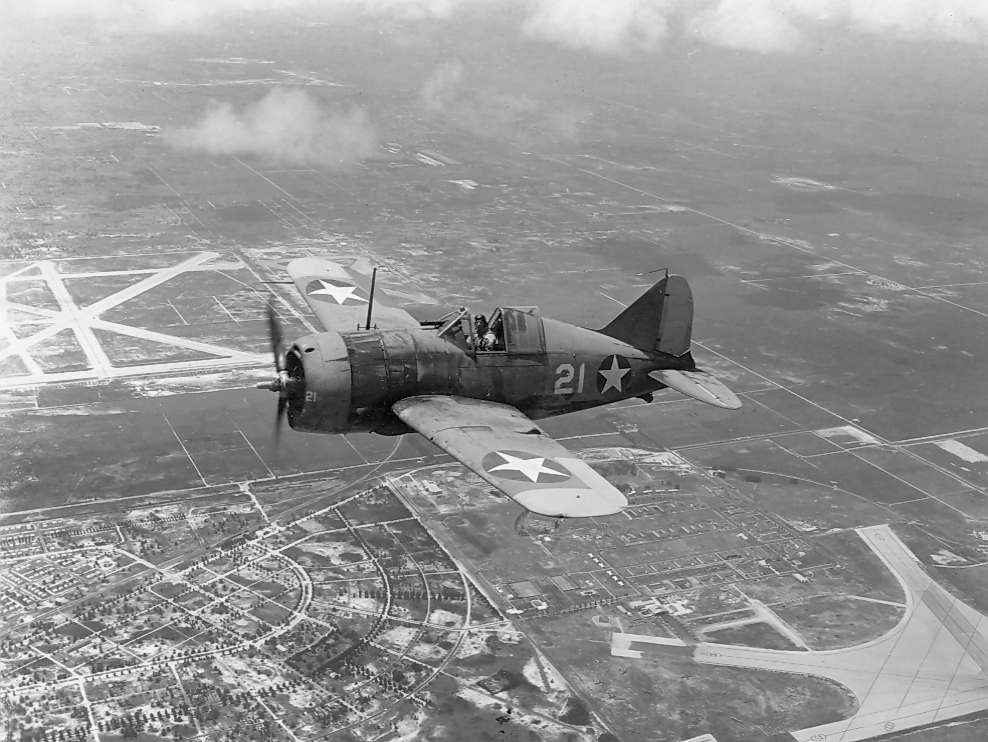
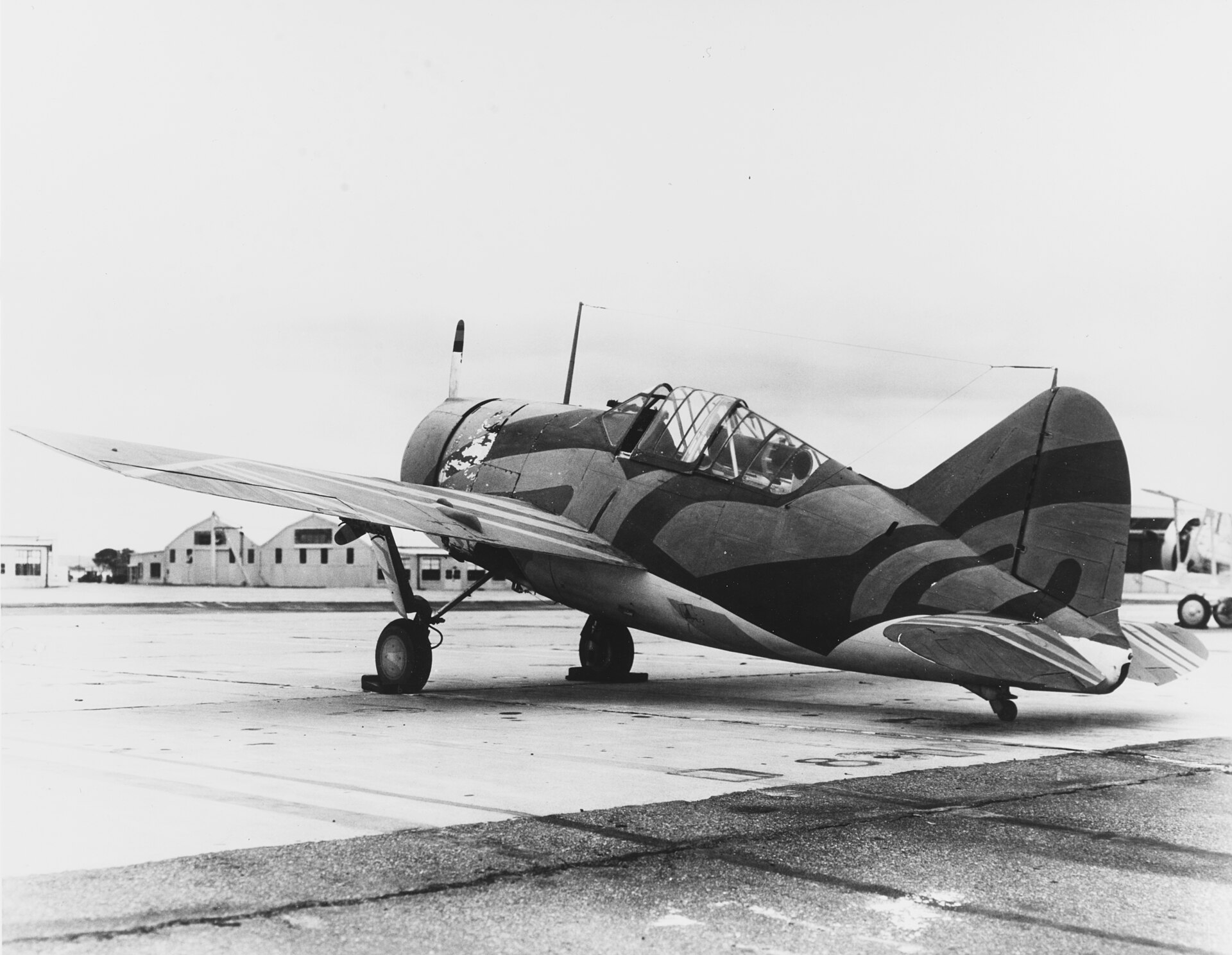
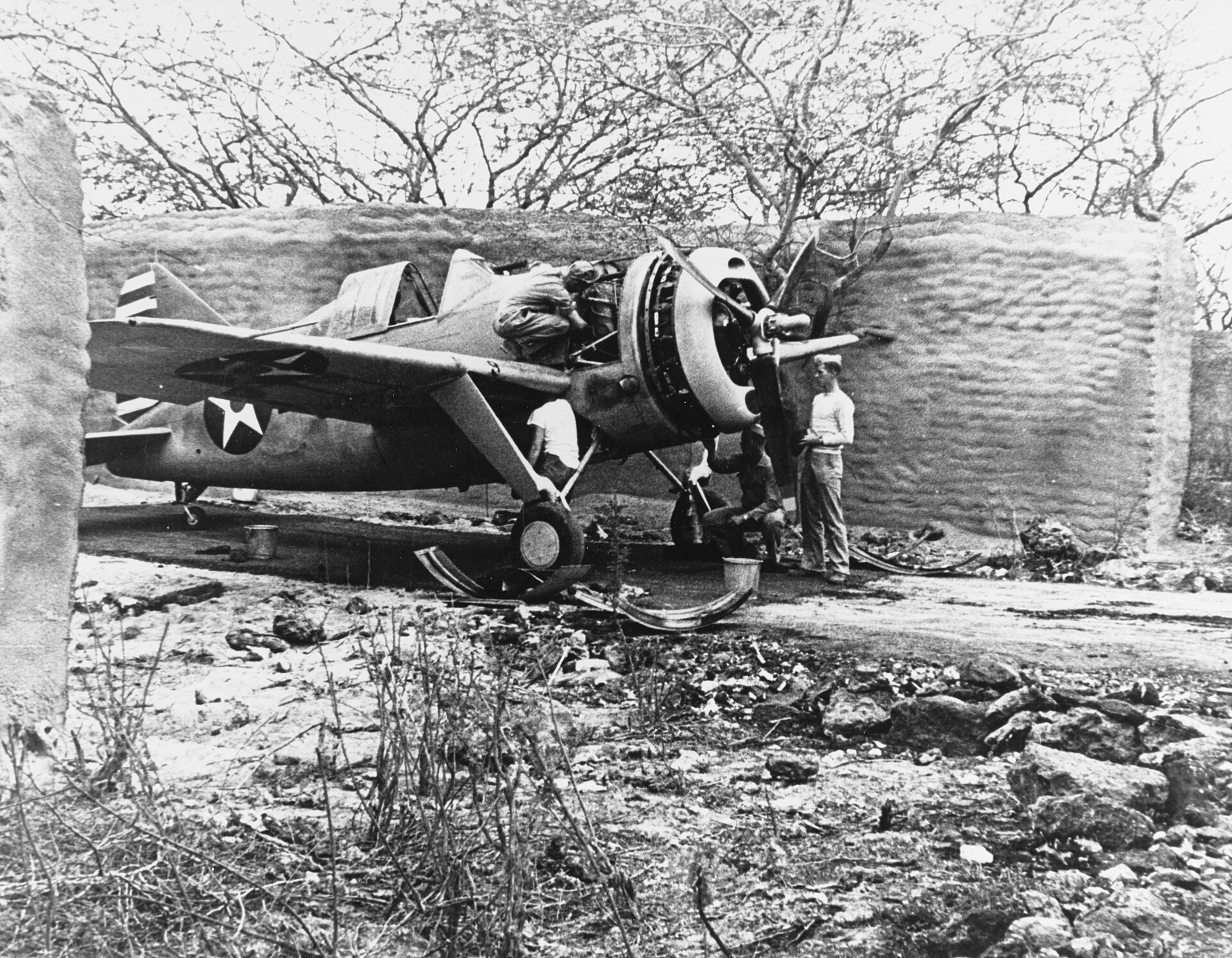
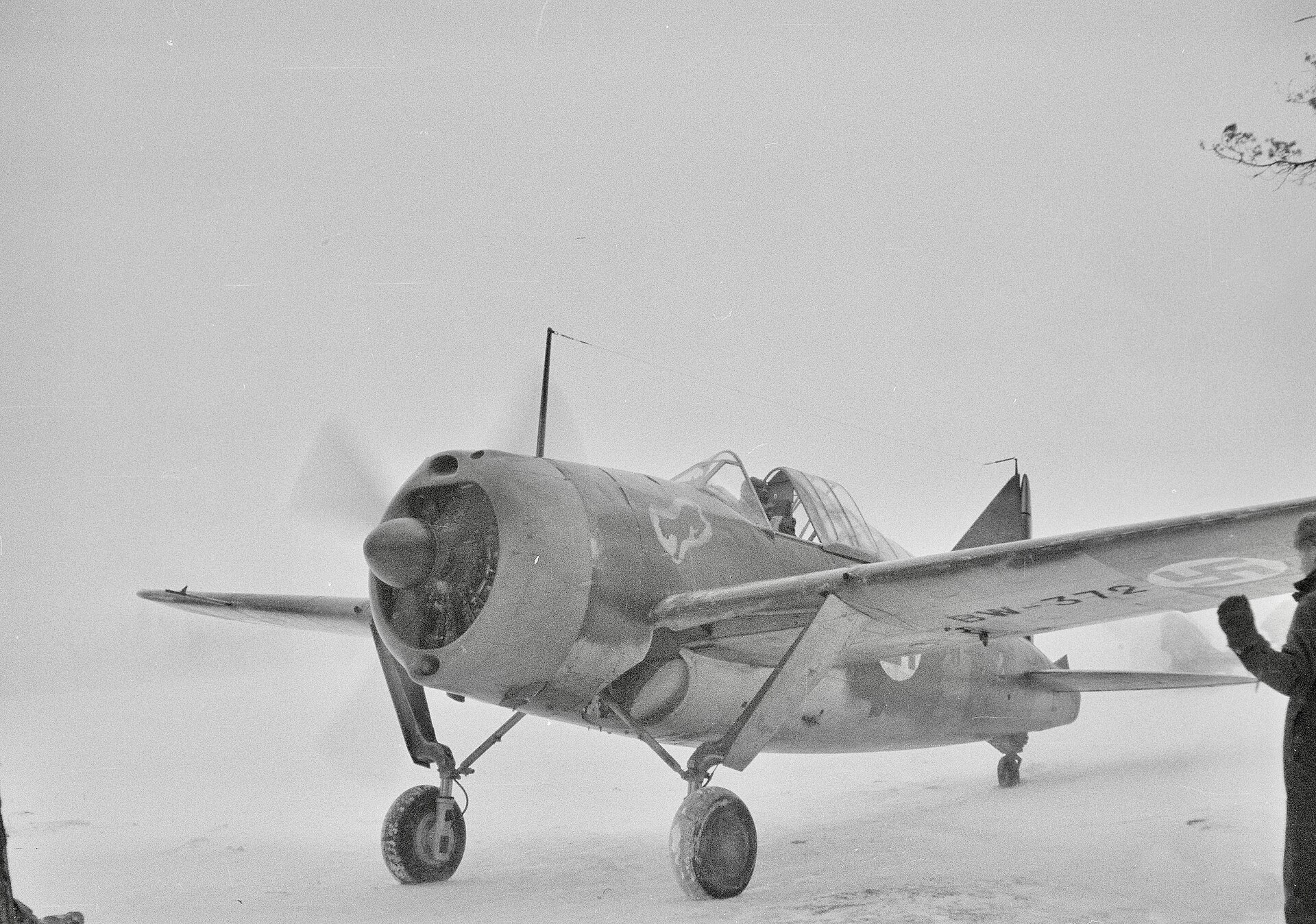
The Brewster Buffalo on film: the case for the "worst" fighter
"In Defense Of The Worst Plane of WW2 — Brewster Buffalo" by Military Aviation History — a well-researched 41-minute deep dive (~464,000 views at time of writing) that examines the type's disastrous Pacific record alongside its Finnish success, and argues the Buffalo was mismatched rather than simply bad.
Where the Brewster Buffalo flew and fought
Built in the United States, the Buffalo saw combat with the US Navy and Marines in the Pacific, with British Commonwealth forces in Malaya, Singapore and Burma, and with the Netherlands East Indies — and, most famously, with Finland against the Soviet Union in the Continuation War. Toggle the categories to explore.
Who flew the Brewster Buffalo — and how it fared
The Buffalo served five main air arms, each with a different variant, a different enemy and a very different outcome. Read together, they explain the map above and the paradox at the heart of this aircraft.
The first monoplane on the deck, the last to survive combat
The Buffalo entered US Navy service in 1939 with VF-3 as America's first carrier monoplane fighter. By 1942 the heavy F2A-3 had been eclipsed by the Wildcat aboard ship and was relegated largely to Marine land squadrons. Its defining — and final — major action came at Midway on 4 June 1942, where VMF-221 was decimated by Japanese Zeros. After Midway the type was withdrawn from front-line US combat and used for training.
The Pearl of the Sky and a record like no other
Finland's 44 light Model 239s became the great success story of the entire programme. Flown against early-war Soviet fighters by superbly trained pilots using disciplined tactics through the Continuation War of 1941–44, the type ran up a kill-to-loss ratio frequently cited around 26:1. Finnish aces including Ilmari Juutilainen and Hans Wind scored heavily on it, and the individual airframe BW-364 "Orange 4" became the highest-scoring Buffalo of all.
A stop-gap that failed in the Far East
Britain fielded the Buffalo Mk I in Malaya, Singapore and Burma, expecting it to be adequate against supposedly second-rate Japanese air power. Instead, overloaded aircraft, worn engines, tropical maintenance troubles and thin training left Commonwealth squadrons — including Australian and New Zealand units — badly outmatched by the Ki-43 and Zero. The campaign ended with the fall of Singapore in February 1942.
The largest export combat user's last stand
The Netherlands East Indies Army Air Force was the biggest export combat operator, flying Model 339s to defend the Dutch colony. Its pilots fought hard over Java, Sumatra and Borneo in 1941–42 and claimed some successes, but were overwhelmed by numbers and logistics as the Indies fell to Japan.
An order overtaken by the fall of France
Belgium ordered 40 Model 339B fighters, but the German invasion of May 1940 overtook the contract. Most of the Belgian aircraft were diverted to Britain, where they were used largely for training and second-line duties — a small footnote that nonetheless added to the pool of Buffalos scattered across the Allied war effort.
Almost nothing left — and nothing that flies
Genuine Buffalos are among the rarest of WWII fighters. The restored Finnish Model 239 BW-372, recovered from a Russian lake in 1998, is displayed at the National Naval Aviation Museum in Pensacola. Finland preserves relics and a full-scale replica of BW-364. Crucially, there is no airworthy original anywhere — any flying "Buffalo" is a reproduction.
The Brewster Buffalo's combat record in numbers
These numbers capture the paradox in a single row. The Buffalo posted one of the most lopsided success ratios of any WWII fighter in Finnish service, and one of the most one-sided defeats in American and Commonwealth service — within roughly the same two years. The difference was weight, opposition, training and tactics.
Brewster Buffalo: frequently asked questions
Can I fly in a Brewster Buffalo?+
No. There is no airworthy original Brewster Buffalo anywhere in the world — the type survives only as static museum exhibits and reproductions, so there is no genuine Buffalo you can book a ride in, and MiGFlug does not offer Buffalo flights. However, you can fly in several genuine ex-military jets today: MiGFlug arranges real fighter-jet flights in aircraft such as the L-39 Albatros, the Hawker Hunter and the MiG-29. See the full list and prices at migflug.com/flights-prices/.
Was the Brewster Buffalo really the worst fighter of World War II?+
Only in part. The heavy late-model F2A-3, flown by under-trained American and Commonwealth pilots with poor tactics against the superb Japanese A6M Zero and Ki-43, performed disastrously — and that is where the "worst fighter" label comes from. But the lighter Finnish Model 239, flown by expertly trained pilots against early-war Soviet types, was an outstanding success. The honest answer is that the Buffalo was catastrophically mismatched to the Pacific war, not intrinsically the worst fighter of the conflict.
Why did the Finnish Buffalo do so well when the American and British ones failed?+
Four reasons, all pulling the same way. First, weight: Finland flew the light export Model 239, without the armour, extra fuel and naval equipment that made the US F2A-3 sluggish. Second, opposition: the Finns faced early-war Soviet fighters the Buffalo could out-fight, whereas the Americans and Commonwealth faced the world's best carrier fighter. Third, pilots: Finnish crews were exceptionally well trained. Fourth, tactics: disciplined pair-and-flight formations and slashing attacks played to the Buffalo's strengths. Change any one of these and the story changes.
What engine did the Brewster Buffalo use?+
A single Wright R-1820 Cyclone nine-cylinder radial. The Finnish B-239 used the R-1820-G5 of about 950 hp, while the final US F2A-3 carried a more powerful R-1820-40 of roughly 1,200 hp — though the extra power was largely absorbed by the aircraft's increased weight.
How many Brewster Buffalos were built?+
Approximately 509 aircraft of all types, though sources vary. This includes US Navy F2A-1, F2A-2 and F2A-3 models plus export variants for Finland, Belgium, Britain and the Netherlands East Indies. Finland received 44 Model 239s.
What happened to VMF-221 at Midway?+
On 4 June 1942 the Marine squadron VMF-221 launched its Brewster Buffalos and a few Grumman Wildcats to intercept an incoming Japanese carrier strike. Outnumbered, outdated in tactics and hopelessly outclassed by the Zero, the squadron lost the majority of its aircraft and many pilots within minutes. The disaster produced the famous "flying coffin" after-action reports and effectively ended the Buffalo's US combat career.
Are there any surviving Brewster Buffalos?+
Genuine survivors are extremely rare. The best known is the Finnish Model 239 BW-372, recovered from a lake in Russian Karelia in 1998, restored, and now displayed at the National Naval Aviation Museum in Pensacola, Florida. Finland preserves Buffalo relics and a full-scale replica of ace Juutilainen's BW-364 "Orange 4". Any Buffalo seen flying at airshows is a reproduction, not an original.
Where does the "Pearl of the Sky" nickname come from?+
"Taivaan helmi" — literally "the Pearl of the Sky" — was the affectionate Finnish nickname for the Brewster Model 239, reflecting how highly Finnish pilots rated it. Combined with its remarkable kill record, the nickname captures just how different the Buffalo's reputation was in Finland compared with the Pacific.
How fast was the Brewster Buffalo?+
It depended heavily on the variant. The lighter F2A-2 could reach roughly 520 km/h (about 323 mph) at altitude, and the Finnish B-239 around 480 km/h (about 298 mph). The heavy, fully-equipped F2A-3 was slower still, its top speed and — more importantly — its climb and acceleration eroded by the weight of armour, fuel and equipment. All of these figures are approximate and vary by source.
Who was Ilmari Juutilainen and what did he fly?+
Ilmari Juutilainen was a Finnish fighter pilot and the highest-scoring non-German fighter ace of all time. He scored a significant portion of his early victories flying the Brewster Model 239 during the Continuation War before converting to later types. His success on the Buffalo is one of the clearest illustrations of how far the right pilot could take the aircraft.
Why is the Brewster Buffalo called a "flying coffin"?+
The phrase comes from the after-action reports of US Marine pilots who survived the Battle of Midway in June 1942, flying the overloaded F2A-3 against the Japanese Zero. It reflects the desperation of that specific situation — a heavy, under-performing variant flown by inexperienced pilots against a superior enemy — rather than a fair verdict on every version of the aircraft, as the Finnish record makes plain.
The Brewster Buffalo is grounded forever. A real fighter flight isn't.
No original Buffalo will ever fly again. But you can still strap into a genuine ex-military jet, pull real g and take the controls yourself. MiGFlug arranges authentic fighter-jet and warbird experiences around the world — from Cold War jet trainers to supersonic interceptors.