
Avro Canada CF-105
“Arrow”
Canada’s Mach-2 interceptor was one of the most advanced aircraft on Earth when it flew — and then, on a single afternoon in 1959, the government cancelled it and ordered every airframe cut to scrap. It became a national wound that has never fully healed.
The interceptor that was too good to survive
In the early 1950s the fear that shaped Canadian defence planning was simple: waves of Soviet jet bombers flying the polar route over the Arctic toward North America. To meet them, the Royal Canadian Air Force wanted an interceptor that could scramble, climb high and fast, and destroy the bombers far out over the ice. Avro Canada, in Malton, Ontario, answered with the CF-105 Arrow — a large twin-engine delta designed from the start for sustained Mach-2 flight.
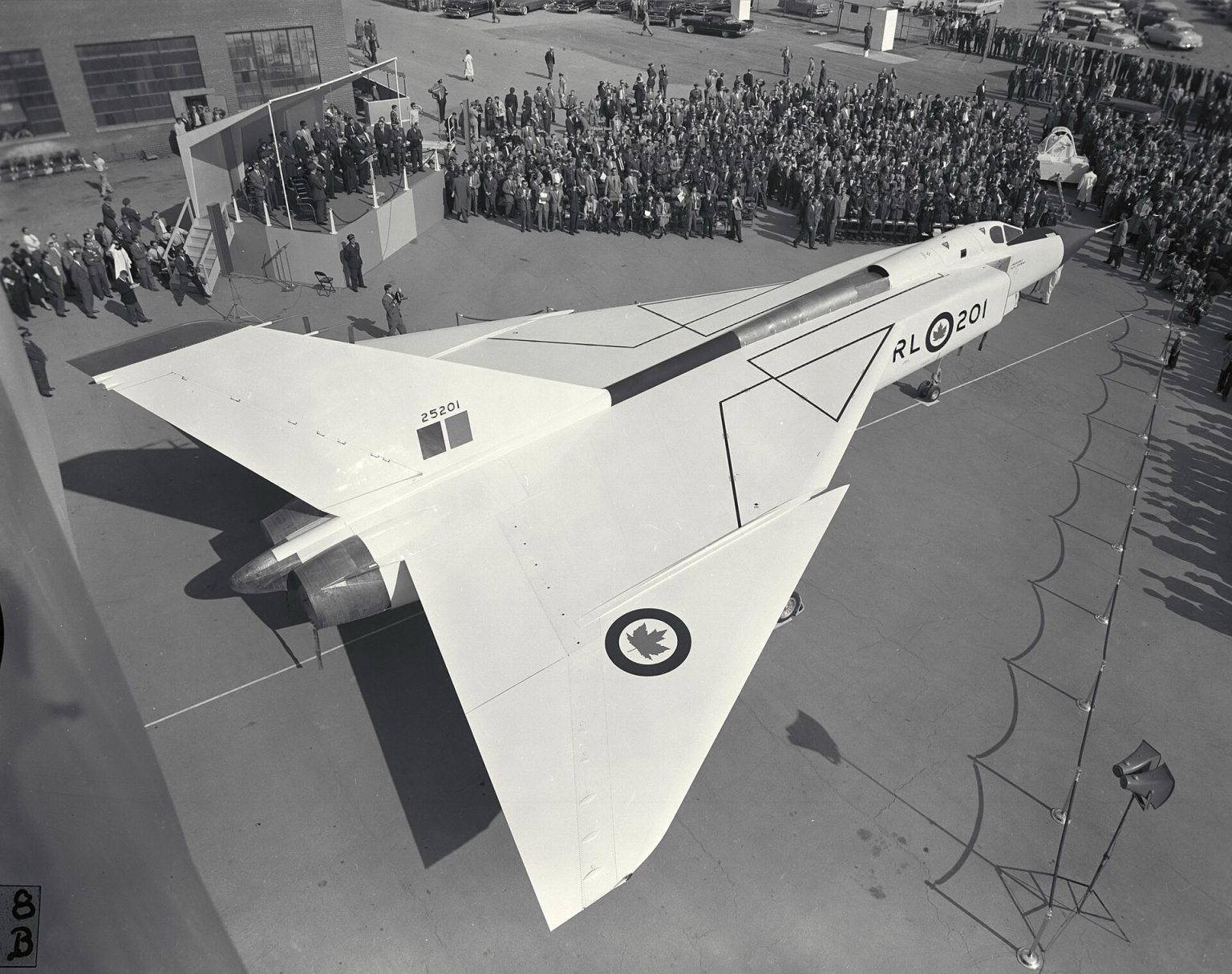
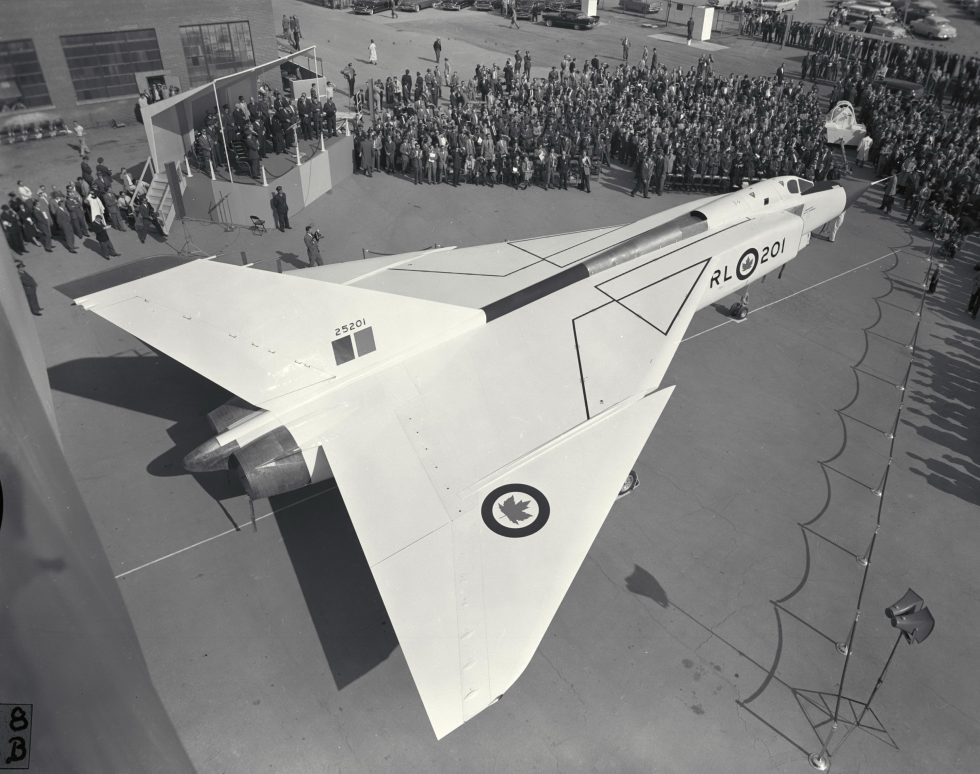
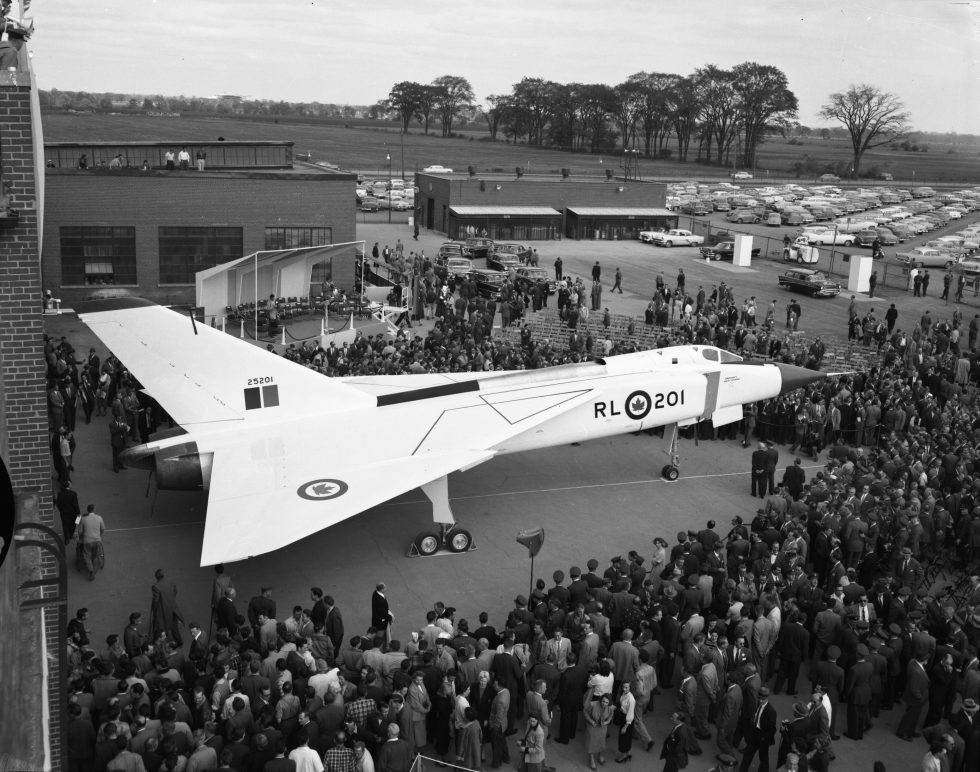
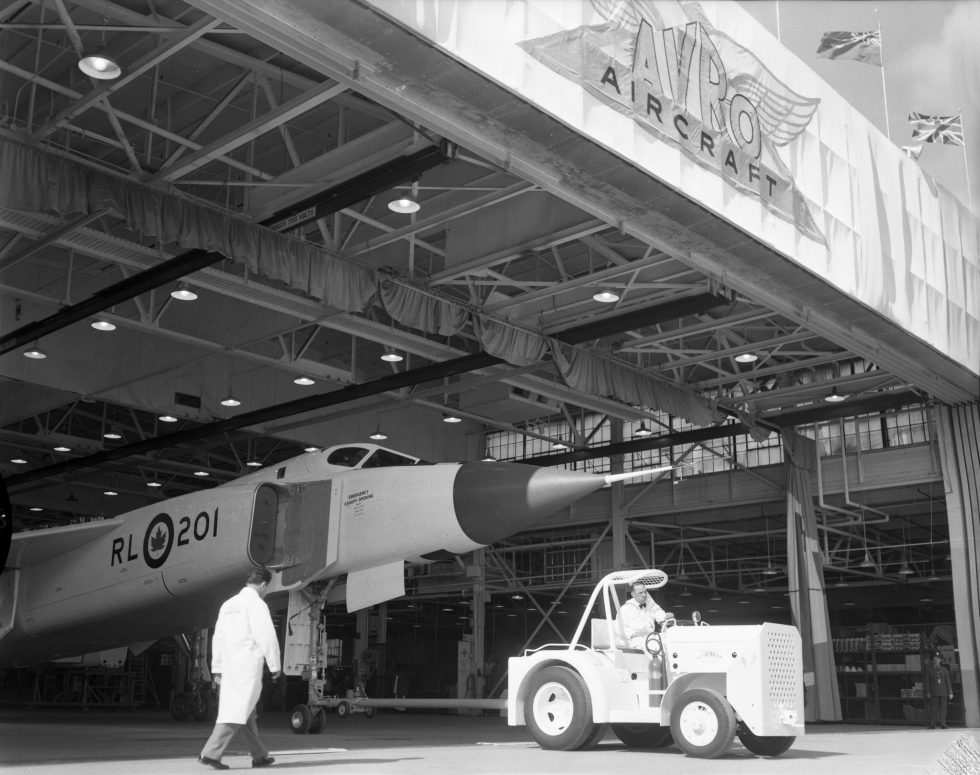
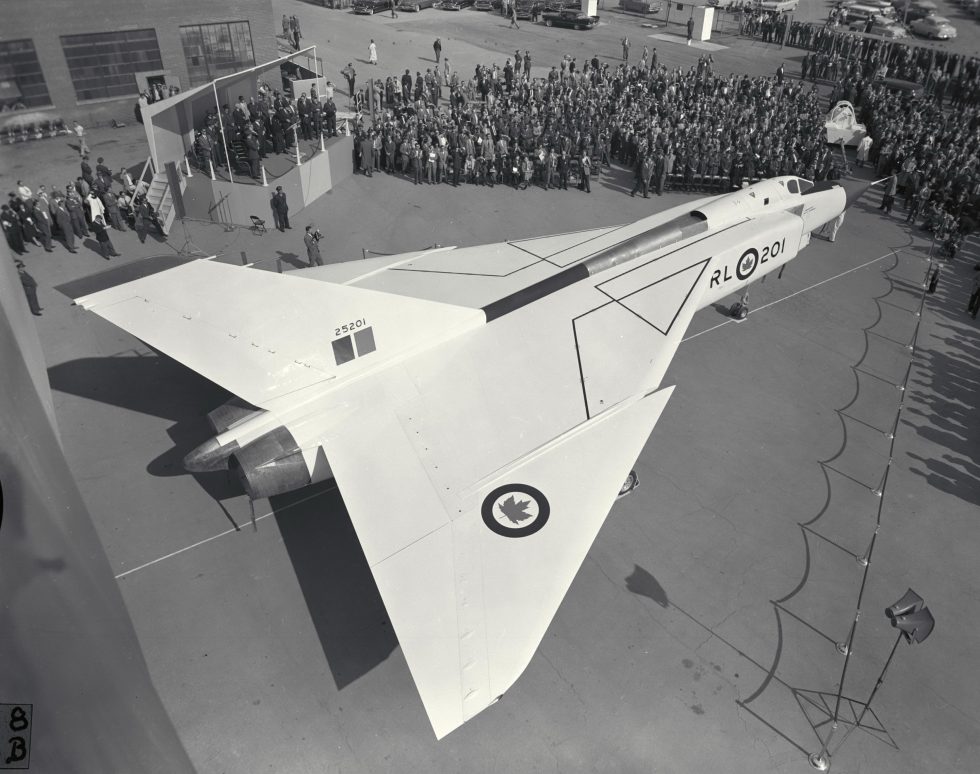
What Avro built was startlingly advanced. The Arrow had a thin high-mounted delta wing, an internal weapons bay, and control systems that pointed toward the future — including early fly-by-wire elements rare for the era. The first prototype, RL-201, rolled out to a crowd on 4 October 1957 and first flew on 25 March 1958 with test pilot Janusz Žurakowski at the controls. Even on interim Pratt & Whitney J75 engines it reached close to Mach 2; the purpose-built Orenda Iroquois engine promised more.
Then it ended. On 20 February 1959 — remembered in Canada as “Black Friday” — the Diefenbaker government cancelled the entire programme. Rising costs, a shift toward missiles, and a small home market were all cited. Weeks later came an order that still stuns: the five flying aircraft, the nearly complete airframes, the production jigs and the tooling were all to be cut up and destroyed. Roughly 14,000 Avro workers were dismissed that afternoon; tens of thousands more jobs vanished down the supply chain.
01Black Friday: how the Avro Arrow was cancelled and destroyed in a matter of weeks
The cancellation on 20 February 1959 was abrupt and total. Prime Minister John Diefenbaker announced in the House of Commons that the Arrow and its Iroquois engine were finished, and Avro dismissed its workforce the same afternoon. The official reasons were cost and strategy: the programme was expensive, the RCAF was the only customer, and defence thinking was moving toward the Bomarc surface-to-air missile and the belief that the manned bomber threat was fading.
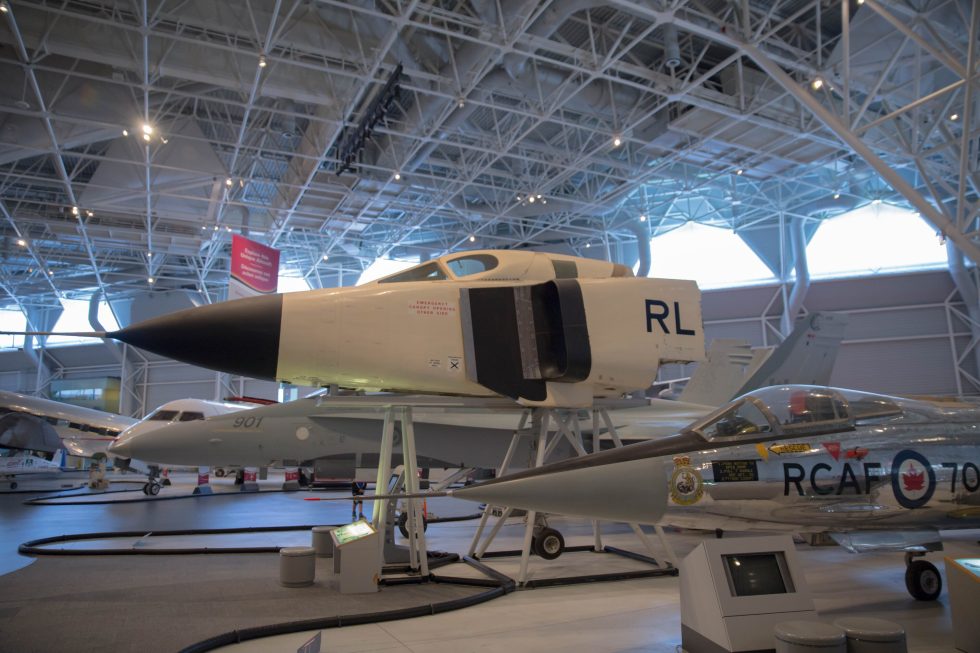
What turned a cancellation into a national trauma was what followed. In the weeks after, orders came to physically destroy everything — the flying prototypes, the airframes on the line, the jigs, drawings and tooling. Crews torched the aircraft apart and sold the metal for scrap. No complete Arrow was preserved. The most-repeated explanation is that the destruction was meant to prevent classified technology from leaking, though the thoroughness of it has fed suspicion and myth ever since. All that survives today are fragments — most notably the nose section of the unfinished Mk 2 aircraft RL-206, now at the Canada Aviation and Space Museum in Ottawa.
What made the Arrow special
A big delta built for Mach 2
The Arrow’s thin, high-mounted delta wing and area-ruled fuselage were shaped for sustained supersonic flight, not tight turning. It carried its missiles in an internal bay to keep the airframe clean. In testing the aircraft reached about Mach 1.98 on interim engines and handled well at high speed — and the design was expected to push past Mach 2 once the more powerful Iroquois engines were fitted.
Fly-by-wire ahead of its time
The Arrow used an advanced automatic flight-control system with electronic (fly-by-wire) signalling to its hydraulic controls — a concept that would not become common in fighters for another two decades. Combined with an ambitious integrated fire-control and weapons system, it was one of the most technologically forward interceptors of the 1950s, though the parallel avionics programme proved troubled and costly.
The Orenda Iroquois engine
Avro’s sister company Orenda developed the PS-13 Iroquois, a large afterburning turbojet built largely from titanium and among the most powerful engines of its day. It was meant to give the Mk 2 Arrow true Mach-2-plus performance. The Iroquois was cancelled alongside the aircraft — a home-grown engine that never reached the service that was designed around it.
02The Avro Arrow’s fly-by-wire and fire-control ambitions
The Arrow was designed to fight as a system, not just as an airframe. Its flight controls were signalled electronically to the hydraulic actuators — an early form of fly-by-wire with mechanical backup — and it was to be paired with the American RCA-Victor Astra fire-control system and Sparrow missiles. That avionics-and-weapons package was one of the biggest drivers of cost and delay. When the government looked at the total programme bill, the electronics were a large part of what made the Arrow look unaffordable, and the Astra/Sparrow combination had already been dropped in favour of a simpler system before the end came.
03The Iroquois engine: Canada’s world-class turbojet that died with the Arrow
The Orenda Iroquois was an extraordinary achievement for a country of Canada’s size — a large, titanium-rich afterburning turbojet in the same power class as the best American engines of the late 1950s. It was flight-tested slung under the fuselage of a modified B-47 bomber. The Mk 1 Arrows flew on interim Pratt & Whitney J75 engines while the Iroquois matured; the Mk 2, with Iroquois power, was expected to be genuinely faster. Both engine and aircraft were cancelled together on 20 February 1959, and the completed Iroquois engines were scrapped.
Avro Arrow Mk 1 — full specifications
Baseline note: the figures below describe the Arrow Mk 1 as it was actually flown — the five airframes RL-201 to RL-205, each with two Pratt & Whitney J75-P-3 turbojets, the only CF-105s that ever left the ground. That distinction matters more on this page than on almost any other in this encyclopedia, because most of the Arrow’s reputation rests on figures that were never demonstrated. What was flown: roughly 66 flights and about 70 hours 30 minutes of air time across five aircraft between 25 March 1958 and 19 February 1959, the day before the cancellation. No Arrow ever carried a weapon, an operational fire-control radar, or the engine it was designed around. What was designed: a Mach 2 interceptor with Orenda Iroquois engines, a Canadian fire-control system and an active-radar missile, none of which ever flew together in anything. Every Mk 2 and Mk 3 entry below is a projection, and is marked as such. Three disagreements are worth settling before the tables begin. First, top speed. The best-attested demonstrated figures are Mach 1.90 in steady level flight and Mach 1.95 indicated in a dive. The Mach 1.98 quoted in almost every popular account does appear in Avro test summaries, but a peak reading is not the same class of evidence as a stabilised level-flight point, and Janusz Żurakowski’s own best over 21 flights and 23.75 hours was Mach 1.89 at 50,000 ft. Second, altitude. No Arrow is documented above roughly 50,000 ft; the 53,000 ft service ceiling below is a calculated Mk 1 figure, and the 62,000 ft repeated everywhere is a Mk 2 estimate. Third, thrust. Published J75-P-3 ratings differ between sources, and the engines in the flying aircraft were early units installed in an airframe sized for something considerably lighter and more powerful. Deltas for the Iroquois-engined Mk 2 and for the paper Mk 3 are in grey.
Dimensions & weights
- Crew
- 2 — pilot and radar observer in tandem under separate canopies, on Martin-Baker ejection seats
- Length
- 23.70 m (77 ft 9 in)
- Wingspan
- 15.24 m (50 ft 0 in)
- Height
- 6.45 m (21 ft 2 in) — a few reference tables give 6.25 m (20 ft 6 in)
- Wing area
- 113.8 m2 (1,225 sq ft)
- Wing form
- Shoulder-mounted tailless delta with a dog-tooth notch at half-span, drooped and slightly negatively cambered leading edge outboard, no tailplane and a single fin
- Aerofoil
- NACA 0003.5 modified at the root, NACA 0003.8 modified at the tip — a wing 3.5 per cent thick, which is the single most demanding number on the aircraft
- Empty weight
- 22,244 kg (49,040 lb)
- Gross weight
- 25,818 kg (56,920 lb) — the normal combat weight used for the manoeuvre guarantees
- Maximum take-off weight
- 31,119 kg (68,605 lb)
- Internal fuel
- ~11,650 l (~2,564 imp gal, ~3,079 US gal) in integral wing and fuselage tanks — rarely published directly; this is consistent with the 9,000 kg (19,800 lb) gap between empty weight and maximum take-off weight
- Armament bay
- A single interchangeable belly pack running roughly a third of the fuselage length, designed to be lowered and swapped complete rather than reloaded in place
- Wing loading
- 227 kg/m2 (46.5 lb/sq ft) at gross weight
- Undercarriage
- Tricycle, with a narrow-track main gear whose legs shortened and rotated as they retracted so that they would fit inside a 3.5 per cent wing — the mechanism failed twice in testing
Performance
- Maximum speed demonstrated
- Mach 1.90 in steady level flight at about 50,000 ft, roughly 2,020 km/h (1,255 mph, 1,090 kn); Mach 1.95 indicated in a dive — Mach 1.98 is the figure in general circulation and appears in Avro summaries; Mk 2 design target Mach 2.0 and above, never flown
- Cruise speed
- 976 km/h (606 mph, 527 kn), Mach 0.91 at 36,000 ft
- Maximum altitude reached in test
- About 15,240 m (50,000 ft) — no Arrow flight is documented meaningfully above this
- Service ceiling
- 16,150 m (53,000 ft) calculated for the Mk 1 — 18,900 m (62,000 ft) projected for the Mk 2, on a 500 ft/min residual climb rate
- Climb
- On the seventh flight the aircraft passed 1,000 mph at 50,000 ft while still climbing; Avro did not publish a comparable Mk 1 sea-level climb rate — the Mk 2 estimate was 4.1 min from brake release to 50,000 ft
- Combat range
- 483 km (300 mi, 261 nmi) at high speed
- Combat radius
- ~740 km (~460 mi, ~400 nmi) on a high-speed intercept — Mk 2 estimate; ~1,165 km (~630 nmi) on a low-speed profile. Both are calculations, not flight results
- Maximum range
- ~2,400 km (~1,490 mi, ~1,295 nmi) ferry, on internal fuel
- Sustained manoeuvre
- A 2 g turn at Mach 1.5 and 50,000 ft with no loss of speed or altitude — the AIR 7-3 requirement, which the Mk 1 was not asked to demonstrate
- Time to height, as specified
- 5 minutes from engine start to 50,000 ft and Mach 1.5, with a ground turn-round of under 10 minutes — requirement figures, not test figures
- Runway
- Designed to operate from a 1,830 m (6,000 ft) runway
- Thrust-to-weight
- 0.825 at gross weight with the J75 — a little over 1.0 was projected with the Iroquois
Propulsion & systems
- Engines, Mk 1 as flown
- 2 × Pratt & Whitney J75-P-3 axial-flow turbojets with afterburner — an American interim engine, chosen because the Canadian one was not ready
- Rated thrust
- 73.4 kN (16,500 lbf) dry and 104.5 kN (23,500 lbf) with afterburner, each — ratings quoted for the -3 vary between sources, and the flying aircraft carried early units
- Engine, Mk 2 as designed
- 2 × Orenda PS-13 Iroquois: 89–98 kN (20,000–22,000 lbf) dry, 133 kN (30,000 lbf) with afterburner — and about 500 kg lighter than the J75 it replaced
- Iroquois particulars
- 2,110 kg (4,650 lb) dry, 6.45:1 thrust-to-weight, 5.87 m (231 in) long, 1.07 m (42 in) diameter; titanium made up a fifth of it by weight, saving an estimated 386 kg (850 lb) over steel
- Iroquois test status
- Over 5,000 hours of ground running by 1958 and about 35 hours in the air slung on the side of a Canadair-modified Boeing B-47B, the CL-52 — but never once in an Arrow
- Intakes
- Sharp-lipped rectangular side intakes with boundary-layer splitters, fixed on the Mk 1; a variable-geometry intake was planned for the Mk 2
- Fire control, as re-planned
- Hughes MX-1179, the system that became the MA-1, with Falcon missiles — reverted to in September 1958 after the Canadian alternative collapsed. No Arrow ever flew with a fire-control radar fitted
- Fire control, as originally intended
- RCA Victor ASTRA I, a Canadian-developed system designed from scratch around the Sparrow II. It was late, over budget and never tested in the air; it was cancelled with the missile on 23 September 1958
- Flight controls
- Electrically signalled, hydraulically powered irreversible controls — one of the earliest fly-by-wire installations on a production-intent aircraft — with artificial feel and a three-axis stability augmentation system
- Hydraulics
- 276 bar (4,000 psi), the first system of that pressure in aviation, adopted because a 3.5 per cent wing left no room for larger jacks
- Structure
- Semi-monocoque fuselage, multi-spar wing, aluminium alloy throughout with magnesium panels; titanium restricted to the engine bay and fasteners because it was expensive and hard to machine
04What did the Avro Arrow cost — and why is there no clean price?
There is no reliable single flyaway price for the Arrow, because it never reached series production and its cost was a moving target. The programme — aircraft plus the Iroquois engine and the troubled Astra/Sparrow weapons system — ran to roughly a billion late-1950s dollars, and projected per-aircraft costs climbed steeply as the export market failed to appear and the RCAF remained the only customer. The Diefenbaker government pointed to those rising costs, and to a strategic bet on the Bomarc missile, as the core justification for cancellation. Any precise dollar-per-Arrow figure you see should be read as an estimate shaped by which costs are counted.
Armament & payload
The Arrow never carried a weapon, and the two systems it was designed around were both dead before it stopped flying
Every entry below is design intent. The five Mk 1s flew with instrumentation and ballast in the armament bay, and no CF-105 ever carried, still less fired, a missile of any kind. The interception system — radar, computer and weapon together — was the part of the programme that went wrong, and it went wrong long before the politics did.
The layout itself was genuinely advanced. Instead of a bomb bay with racks, the Arrow had a complete interchangeable armament pack occupying about a third of the fuselage: a sealed module lowered out on jacks and replaced as a unit, so that a squadron could re-role an aircraft in minutes rather than rearm it in hours. Packs were drawn for missiles, for reconnaissance cameras, for extra fuel and for electronic countermeasures. It is a modular-payload idea that would not become common for another thirty years, and none of the packs was ever built in operational form.
What killed the weapons fit was ambition compounded by dependency. In 1955 the RCAF rejected the off-the-shelf American Hughes MX-1179 and Falcon combination in favour of ASTRA I, a fire-control system RCA Victor would develop in Canada from a blank sheet, married to Sparrow II, an active-radar missile Douglas had started and then abandoned. Canadair inherited a missile the US Navy had walked away from in 1956; Canada was now developing an interceptor, its engine, its radar and its missile simultaneously, and paying for all four alone. On 23 September 1958 the government cancelled ASTRA and Sparrow II and ordered a reversion to MX-1179 and Falcon — a saving of roughly CA$330 million by the estimate of the day, and an admission that the most expensive part of the programme had produced nothing. Nothing here was ever released to service. Stores lists differ between RCAF requirement papers, Avro brochures and later reconstructions, and several weapons named below — Sparrow II above all — were themselves unfinished in 1959.
Gun
- None. The Arrow had no internal cannon, no gun pack and no cleared gun pod, and none of the six airframes was stressed or plumbed for one.
- This was doctrine, not oversight. AIR 7-3 described a machine that would be vectored onto Soviet bombers over the Arctic by ground radar and destroy them with missiles at range; a gun was mass that bought nothing on that mission.
- Its contemporaries agreed. Neither the Convair F-106 Delta Dart as delivered nor the English Electric Lightning F.3 nor the McDonnell CF-101 Voodoo that Canada eventually bought carried a gun in the interceptor role.
- The judgement looks worse in hindsight than it was. The Arrow was never intended to dogfight, and there is no serious argument that a cannon would have changed its fate.
Air-to-air
- Sparrow II (AAM-N-3), 3 rounds in the armament pack: an active-radar missile with its own transmitter and receiver, so that the launching aircraft need not illuminate the target. Douglas gave up on it; the US Navy dropped it in 1956; Canadair carried it on for the Arrow and had completed five missiles on Douglas airframes and two built from scratch when it was cancelled in September 1958.
- Hughes GAR-1 and GAR-2 Falcon (later AIM-4A and AIM-4C), up to 8 rounds: small missiles of about 8 km reach with a 3.4 kg warhead, in semi-active radar and infrared pairs. This was the fallback adopted after ASTRA died, and it is what an operational Arrow would most likely have carried.
- Douglas AIR-2A Genie, 2 rounds: an unguided rocket with a 1.5 kt W25 nuclear warhead and a reach of about 9.6 km, aimed by flying the aircraft and detonated on a timer. Canada eventually took the Genie on its CF-101s, and the nuclear-weapons row it caused helped bring down the Diefenbaker government in 1963.
- Canadair Velvet Glove, 4 rounds: the Canadian beam-riding missile of the early 1950s, listed in early Arrow studies. It was judged unsuitable for supersonic launch and cancelled in 1956 after some CA$26 million.
- None of these was ever loaded into an Arrow. The number in circulation — eight Falcons, or three Sparrows, or two Genies — describes pack capacity on a drawing.
Air-to-surface guided
- None, at any stage. The Arrow was a bomber-destroyer for the Canadian and northern approaches, and no guided air-to-surface weapon was ever specified, integrated or proposed for it in a serious document.
- The fire-control system reinforced this. ASTRA I and MX-1179 were both interception systems with no air-to-ground modes and no guidance channel for a surface-attack weapon.
- Avro did sketch strike and reconnaissance packs as part of the interchangeable-bay concept, partly to widen the aircraft’s appeal to Britain and the United States. They remained sketches.
- Accounts that present the Arrow as a would-be strike aircraft, or as a competitor to the TSR-2 or F-111, are reading a later argument backwards into a 1953 requirement.
Bombs
- Not an armament the RCAF wanted, but a capacity the bay had. Company documents note that the pack volume could take four general-purpose 1,000 lb bombs.
- No bomb rack, release gear, sighting system or ballistic table was ever developed for the aircraft.
- The figure survives because it appears in export brochures, where it was there to suggest flexibility to buyers who were not shopping for an interceptor.
- Treat it as an estimate of what would fit, not as a capability. No CF-105 ever carried an inert store of any kind.
Rockets
- The one unguided weapon seriously planned was the AIR-2A Genie, which is a rocket in the strict sense: no guidance at all, just a nuclear warhead and a stopwatch.
- Batteries of folding-fin aircraft rockets, the standard 1950s interceptor armament used by the CF-100 Canuck and the F-89 Scorpion, were considered in early pack studies and dropped.
- The reason was closing speed. Against a target approached at Mach 1.5 and above, an unguided rocket salvo has an aiming problem that no fire-control system of the period could solve at useful range.
- By 1957 the RCAF had already accepted that its next interceptor would be a missile aircraft. The Arrow was designed on that premise from the start.
Pods & other stores
- The interchangeable armament pack is the store that matters. A complete lower-fuselage module, dropped on jacks and replaced as a unit, rather than a bay with pylons in it.
- Planned packs: an armament pack in Sparrow, Falcon and Genie fits; a reconnaissance pack with cameras; a ferry pack carrying fuel instead of weapons; and an electronic countermeasures pack.
- No external pylons and no drop tanks. Everything the Arrow was to carry went inside the fuselage, which is why its very thin wing could stay clean and why its drag rise was so gentle.
- The test aircraft flew with a ballast and instrumentation pack in the bay, which is the only pack that ever existed in metal and flew.
Three typical loadouts
- Long-range intercept, as originally intended (Mk 2, never flown)
- 3 × Sparrow II active-radar missiles in the armament pack, ASTRA I fire control, full internal fuel. This is the configuration the Arrow was designed around and the one every published performance figure for the Mk 2 assumes.
- Point intercept, as re-planned after September 1958 (never flown)
- 8 × GAR-1 and GAR-2 Falcon in semi-active radar and infrared pairs, or 2 × AIR-2A Genie with 4 × Falcon, on the Hughes MX-1179 system. The cheap, available, off-the-shelf fit the RCAF had rejected in 1955 and returned to three years and a great deal of money later.
- As actually flown, 1958–59
- Ballast and flight-test instrumentation in the armament bay, no radar in the nose, no weapons of any kind. All 66 or so Arrow flights were made in this condition.
Sourcing caveat: because the aircraft, tooling and much of the paperwork were destroyed in 1959, weapon fits for the Arrow are reconstructed from RCAF requirement documents, Avro brochures, surviving technical reports (595 of which the National Research Council digitised in 2021) and the recollections of participants. Round counts in particular vary between accounts, and no release-to-service document exists for any weapon on this aircraft, because there was never a service to release it to.
Variants
Six airframes were built, five flew, and on one Friday morning in 1959 all of them were ordered cut up
The requirement came first. In April 1953 the RCAF issued AIR 7-3, asking for a two-seat, twin-engined all-weather interceptor able to cruise at Mach 1.5 at 50,000 ft, pull 2 g there without losing speed or height, go from engine start to that altitude in five minutes, turn round in under ten, and work from a 6,000 ft strip. The RCAF study team concluded that nothing existing or planned, anywhere, would meet it. That was probably true, and it should also have been a warning: Canada was proposing to build, alone, an aircraft more demanding than anything the United States or Britain had in service.
Jim Floyd was chief engineer of the design; Jim Chamberlin was chief aerodynamicist and led the technical design office, and it was Chamberlin who later led the group of Avro men to NASA. What they produced was, on the evidence of its own flight tests, very good. Nine one-eighth-scale free-flight models were fired over Lake Ontario on Nike boosters before metal was cut. The programme used the Cook-Craigie method — no prototypes, production tooling from the start, the first aircraft built as a production article — which is fast and cheap if the design is right and ruinous if it is not. RL-201 was rolled out on 4 October 1957, the same day Sputnik went up, and flew on 25 March 1958. Jack Woodman, the only RCAF pilot to fly it, reported that it was meeting its guarantees.
Then on the morning of 20 February 1959 — Black Friday — John Diefenbaker rose in the House and killed the Arrow and the Iroquois together, five weeks before the review that had been scheduled for 31 March. Avro laid off 14,528 people that day, and something close to 15,000 more went in the supply chain. Within two months every airframe, every engine, the jigs and the tooling had been ordered scrapped, and they were: cut up with torches in the open at Malton. The stated reason was the destruction of classified material, and the RCMP’s fear of a Soviet source inside the programme was real enough to be corroborated decades later in the Mitrokhin archive. It remains the most consequential act of industrial destruction in Canadian history.
What Canada lost in engineers it gave to the United States. Chamberlin took twenty-five Avro engineers to NASA’s Space Task Group; the number eventually reached about thirty-two, and they were not passengers. Owen Maynard ran lunar module engineering in the Apollo Programme Office. John Hodge became a flight director. Tecwyn Roberts was Mercury’s first flight dynamics officer and later director of networks at Goddard. Chamberlin himself designed the Gemini spacecraft. Jim Floyd went the other way, to Britain, where his supersonic transport work fed into Concorde.
The argument about whether the cancellation was right has never been settled in Canada, and this page will not settle it. The case that it was a national tragedy: a demonstrably excellent aircraft was destroyed at the moment it was working, an entire advanced industry and its people were dispersed permanently, and Canada bought instead the Bomarc missile, which was useless, and second-hand CF-101 Voodoos, a design the RCAF had already rejected as inferior to the Arrow. The case that it was an unaffordable white elephant: a country of eighteen million was funding an airframe, an engine, a fire-control system and a missile at once, with no export customer — Britain declined in 1957, France walked away in October 1958 — against a threat that was visibly shifting from bombers to ballistic missiles that no interceptor could touch; unit-cost estimates had risen to a level where a small Canadian-only production run cost several times what a Voodoo cost, and Diefenbaker’s own advisers put the eventual bill beyond what the defence budget could carry. Both positions are held by serious people with the documents in front of them. The strongest thing that can be said with confidence is that the destruction of the airframes served no purpose that the cancellation had not already served.
- Avro C-104/1 and C-104/2 (1952–53 / paper)
- Private-venture studies that preceded AIR 7-3: a single-engined and a twin-engined supersonic interceptor. The twin, with two crew and a large internal weapons bay, is recognisably the Arrow in embryo.
- CF-105 Arrow Mk 1 (1957–59 / 5 built, 5 flown)
- RL-201 to RL-205 with Pratt & Whitney J75-P-3 engines, no radar and no armament: flight-test airframes built on production tooling. Every demonstrated figure for the Arrow comes from these five.
- CF-105 Arrow Mk 2 (1959 / 1 near-complete, never flew)
- RL-206 with Orenda Iroquois engines, ready for taxi trials in February 1959 and expected to be the aircraft that took the Arrow past Mach 2. It was days from running when the programme was cancelled.
- CF-105 Arrow Mk 2A and Mk 3 (1958–59 / paper)
- Company projections for uprated Iroquois engines, more internal fuel and a variable-geometry intake, with speeds up to about Mach 2.5 mentioned in studies. No agreed set of figures survives and none should be quoted as specification.
- CF-105 armament and role packs (1955–59 / none built)
- Interchangeable belly modules for missiles, reconnaissance cameras, ferry fuel or electronic countermeasures. The concept was sound and thirty years early; only the ballast pack was ever made.
- Delta Test Vehicles (1954–57 / 11 fired)
- One-eighth-scale free-flight models, about 3 m long, boosted on Nike rockets: nine from Point Petre over Lake Ontario and two from NASA Wallops Island, instrumented, flown past Mach 1.7 and then ditched.
- Canadair CL-52 (1956–59 / 1 converted)
- A Boeing B-47B on loan from the USAF, modified to carry an Iroquois on an outrigger on the starboard rear fuselage. It logged about 35 hours of Iroquois flight running, and was the only aeroplane the engine ever flew on.
- Arrow for the RAF (1956–57 / not proceeded with)
- In April 1956 the RAF Air Council recommended buying 144 Arrows against Operational Requirement F.155, with Bristol Olympus, Rolls-Royce Conway or de Havilland Gyron engines. The 1957 Defence White Paper cancelled Britain’s fighter programmes and the interest with it.
- Iroquois for the Mirage IVB (1958 / not proceeded with)
- France examined the Iroquois for an enlarged Mirage IV and considered an order for 300 engines. Negotiations ended in October 1958, reportedly because Paris doubted the engine would survive Canadian politics. It did not.
- Arrow revival proposals (2011–12 / rejected)
- A privately promoted modern Arrow was floated as an alternative to buying the F-35. Ottawa rejected it in 2012 as too risky, too costly and too slow, which was the correct answer to a proposal to restart a 1950s airframe with no surviving tooling, drawings or industrial base.
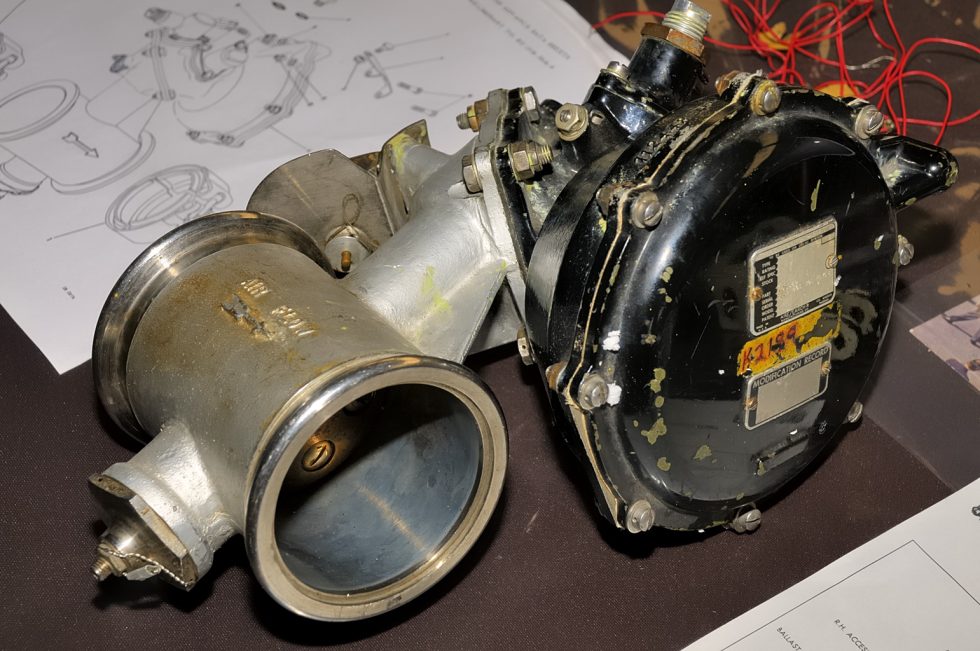
Survivors: no complete Avro Arrow exists, and no part of any Arrow that flew survives as a major assembly. The Canada Aviation and Space Museum in Ottawa holds the genuine relics: the nose section of RL-206 — the cockpit and forward fuselage of the unflown first Mk 2 — together with its nose undercarriage leg, plus two outer wing panels from RL-203 and an Orenda Iroquois engine. These pieces were removed from Malton unofficially by RCAF personnel during the scrapping and kept privately for decades before being formally transferred. A one-eighth-scale free-flight test model, recovered from the bed of Lake Ontario in August 2018 by the Raise the Arrow project and restored, is also displayed there; it is a rocket-boosted model, not an aircraft, and should not be confused with one. Everything else described as an Arrow is a replica containing no original structure: the full-size non-flying replica built by volunteers at Downsview, rolled out on 28 September 2006 in RL-203 markings and now hangared at Edenvale Airport, Ontario; the full-size replica built by Allan Jackson from 1989 and used in the 1997 CBC miniseries, donated to the Reynolds-Alberta Museum at Wetaskiwin, damaged in a 2009 windstorm and no longer on public display; and a two-thirds-scale flying replica under long-term construction at Springbank, Alberta. The documentation fared slightly better than the aircraft: the destruction order was not completely carried out, senior draughtsman Ken Barnes kept a set of blueprints in his basement for decades, and the National Research Council digitised 595 surviving Arrow technical reports in 2021.
From Arctic shield to national myth
The requirement
The RCAF issues a specification for a supersonic all-weather interceptor to stop Soviet bombers over the Canadian Arctic.
Rollout
The first Arrow, RL-201, is unveiled to a crowd at Malton on 4 October — the same day the USSR launches Sputnik.
First flight
On 25 March test pilot Janusz Žurakowski takes RL-201 into the air; the type soon approaches Mach 2 on interim engines.
Black Friday
On 20 February the Diefenbaker government cancels the Arrow and the Iroquois engine; Avro dismisses ~14,000 workers that day.
The destruction order
Weeks later, all five flying aircraft, the airframes on the line, the jigs and tooling are ordered cut up and sold for scrap.
Engineers to NASA
Dozens of Avro engineers are recruited by the newborn US space programme; the first 25 report to NASA Langley on 9 April.
The Arrow returns as legend
The CBC miniseries The Arrow, starring Dan Aykroyd, cements the aircraft’s place in Canadian popular memory.
Recovered from the lake
Searchers raise a delta test vehicle from Lake Ontario, part of the free-flight model programme that helped shape the Arrow.
Twelve stories of the Avro Arrow
A shield over the Pole
The Arrow was born from the fear of Soviet bombers crossing the Arctic toward North America.
Read the full story
Unveiled the day of Sputnik
RL-201 was shown to the public on 4 October 1957 — hours before the USSR launched Sputnik.
Read the full story
Žurakowski takes it up
On 25 March 1958 chief test pilot Janusz Žurakowski flew the Arrow for the first time.
Read the full story
The afternoon it all ended
On 20 February 1959 the government cancelled the Arrow — and Avro fired ~14,000 people that day.
Read the full story
Everything cut to scrap
No complete Arrow survives — the aircraft, jigs and drawings were deliberately destroyed.
Read the full story
The engineers who reached the Moon
Dozens of Avro’s best engineers were hired by NASA and helped put astronauts on the Moon.
Read the full story
A world-class engine, scrapped
The Orenda Iroquois was one of the finest engines of its era — and it never entered service.
Read the full story
Fired into Lake Ontario
Instrumented free-flight models of the Arrow were rocketed out over Lake Ontario for aerodynamic testing.
Read the full story
“The Arrow lives”
A durable legend holds that one Arrow secretly escaped the torches. There is no evidence it did.
Read the full story
Aykroyd and the miniseries
The 1997 CBC miniseries The Arrow turned the aircraft into a lasting piece of Canadian identity.
Read the full story
The interceptor that never served
The Arrow never entered squadron service or fired a shot — its record is entirely one of promise.
Read the full story
Canada buys the Starfighter instead
Having cancelled the Arrow, Canada equipped the RCAF with the licence-built CF-104 Starfighter.
Read the full story
The Arrow in pictures
The Arrow on film
Video coming soon. We are preparing a curated video feature on the Avro Arrow — its rollout, its brief flying career and the story of Black Friday. In the meantime, the photo gallery above and the twelve stories capture the aircraft and its afterlife.
Where the Arrow belonged
A record written only in what-ifs
The Avro Arrow has no combat record at all. Only five aircraft ever flew, every one of them a test machine, and the type was cancelled before a single Arrow reached an operational RCAF squadron. There are no kills, no losses in action, no missions — just flight-test data and the performance the design was projected to reach. Its entire reputation rests on promise rather than proof, which is precisely what makes it a national legend.
For aircraft that did see action, compare the combat record of every military aircraft. Figures as of July 2026.
Everything people ask about the Avro Arrow
Can I fly in an Avro Arrow?
Why was the Avro Arrow cancelled?
Why were all the aircraft destroyed?
Did an Avro Arrow secretly survive?
How fast was the Avro Arrow?
Is it true Avro engineers went to NASA?
Can I see an Avro Arrow today?
You can’t fly the Arrow.
These, you can.
Some legends only live in museums — others are fuelled and waiting. MiGFlug has put civilians in real military jet cockpits since 2004.
 Fly the L-39 AlbatrosThe world’s most-flown jet trainer — aerobatics included
 Fly the F-104 Starfighter“The missile with a man in it”
 Fly the MiG-21The Cold War’s most-produced jet
 Fly the T-33 Shooting StarAmerica’s first jet trainer
 Fly the DH VampireA piece of early jet history
 Fly the S.211Agile Italian jet trainer
 Fly the MB-326The classic Aermacchi jet
 Fly the MiG-15The Soviet legend of the Korean War
Continue the tour
Every fact, checked
- Royal Canadian Air Force — CF-105 ArrowOfficial RCAF aircraft page: specifications, crew and the February 1959 termination.
- Ingenium / Canada Aviation and Space MuseumThe free-flight models fired over Lake Ontario and the 2018 recovery.
- CBC NewsRecovery of an Arrow-programme test vehicle from Lake Ontario.
- CNN TravelOverview of the Arrow’s development, cancellation and enduring myth.
- The War Zone (TWZ)The Arrow as a Cold War legend, the technology and the conspiracy lore.
- 19FortyFiveBlack Friday, the destruction order and the Avro engineers who joined NASA.
- Canada Aviation and Space Museum — collectionThe surviving RL-206 nose section and Iroquois engine in the national collection.