
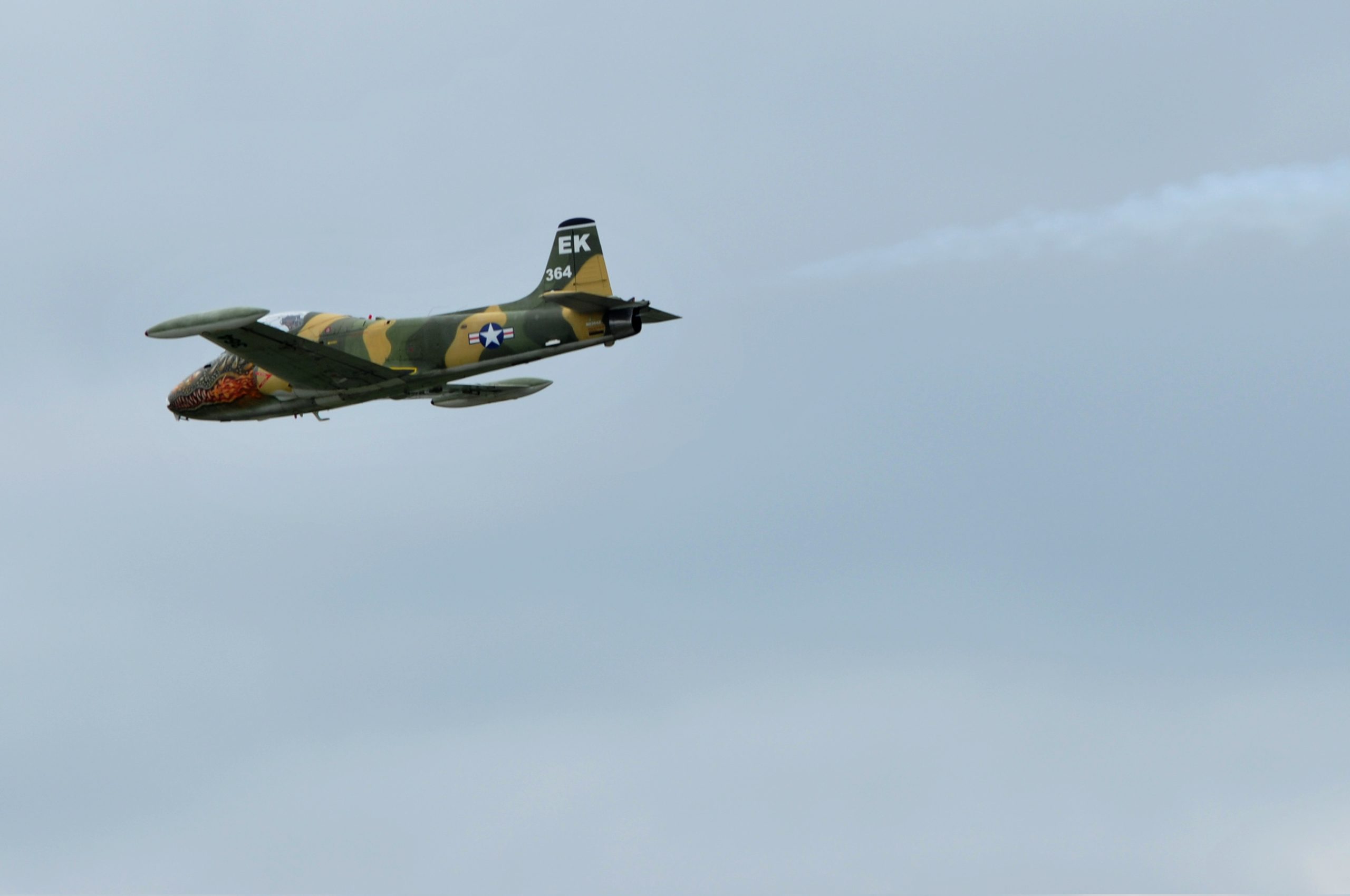
BAC 167
Strikemaster
A jet trainer turned into a cut-price warplane — Britain’s armed development of the Jet Provost, sold to a dozen air forces and flown in anger from the mountains of Oman to the jungles of the Andes.
The trainer that went to war
By the mid-1960s the British Aircraft Corporation had a proven jet trainer on its hands: the Jet Provost, a docile side-by-side two-seater that had taught a generation of RAF pilots. What BAC did next was quietly shrewd. Newly independent nations and small air forces wanted air power they could actually afford — something to patrol borders, chase insurgents and train pilots, without the cost of a supersonic fighter. So BAC took the Jet Provost T.5, gave it an up-rated engine, a strengthened airframe, wing hardpoints, an armoured cockpit and simple gunsights, and called it the Model 167 Strikemaster.
It first flew on 26 October 1967, and it was almost entirely an export product — the RAF never bought it. Powered by a single Rolls-Royce Viper turbojet, it was subsonic, rugged and cheap, able to lift a useful load of rockets, bombs and gun pods from short, rough strips. Two 7.62 mm machine guns were built in; underwing pylons carried the rest. It was never fast or glamorous, but it was reliable, easy to fly and easy to maintain — and it sold. Saudi Arabia, Oman, Kuwait, Singapore, New Zealand, South Yemen, Ecuador, Kenya, Sudan and Botswana all bought the type, and repeat orders came in numbers unusual for a light jet.
Where it earned its name was in combat. The Sultan of Oman’s Air Force flew Strikemasters hard throughout the Dhofar War of the 1970s, strafing and rocketing guerrillas across the jebel — most famously providing decisive air support at the Battle of Mirbat on 19 July 1972. Decades later, on the far side of the world, Ecuadorian Strikemasters were bombing Peruvian positions in the 1995 Cenepa War. When military fleets finally retired, the type found a thriving second life: dozens survive today as privately owned warbirds on the airshow circuits of Britain, the United States and Australia.
01The BAC Strikemaster’s origins: how a British trainer became an export warplane
The Strikemaster’s lineage runs straight back to the piston-engined Percival Provost of the early 1950s, which became the jet-powered Hunting Jet Provost, in turn absorbed into BAC. The definitive Jet Provost T.5 gained a pressurised cockpit and more power; the Strikemaster was its weaponised cousin. BAC read the market correctly: in the 1960s and 70s a wave of newly independent states and Gulf monarchies needed affordable, multi-role air power. A jet that could train pilots on Monday and fly a counter-insurgency strike on Tuesday — from a dirt strip, on a modest budget — was exactly what they wanted. GlobalSecurity notes the type went on to set what was described as a record for repeat export orders, a testament to how well it fitted that niche.
What makes the Strikemaster special
A trainer’s airframe, toughened for war
The Strikemaster kept the Jet Provost’s layout but added muscle: a strengthened airframe, an up-rated engine, an armoured cockpit and hardpoints under each wing. It could carry rockets, bombs, napalm and gun pods — up to around 1,360 kg (3,000 lb) of external stores — plus two built-in 7.62 mm machine guns, all from short and unpaved airstrips.
The unusual side-by-side cockpit
Almost every dedicated strike aircraft seats its crew in tandem. The Strikemaster, inherited from its trainer roots, sits them side by side on two ejection seats. It made the aircraft a superb dual-role machine — instructor and student, or pilot and observer, shoulder to shoulder — blurring the line between advanced trainer and light attack jet.
Cheap, rugged and simple to keep flying
A single Rolls-Royce Viper turbojet, straightforward systems and a period unit price reportedly under US$500,000 made the Strikemaster affordable to buy and to operate. That simplicity is why small air forces ordered it in numbers — and why so many still fly today in private hands.
02The BAC Strikemaster’s engine: the rugged Rolls-Royce Viper
Power came from a single Rolls-Royce Viper Mk 535 turbojet of about 3,410 lbf (15.2 kN) thrust — a development of an engine originally designed as an expendable powerplant for target drones. That heritage made the Viper simple, robust and cheap to run, if unremarkable in output. It gave the Strikemaster a top speed around 450 knots (roughly 834 km/h, comfortably subsonic) and the ability to loiter over a battlefield and make repeated firing passes — exactly what a counter-insurgency aircraft needs, and a very different priority from raw speed.
03The BAC Strikemaster’s wing: the fatigue that grounded fleets
The Strikemaster’s wing carried its fuel and its weapons, and years of low-level, high-g strike flying took a toll. The Royal New Zealand Air Force, which operated 16 Mk 88s, retired its fleet around 1992 in part because of wing-fatigue cracking — a common issue for hard-worked light-attack jets. Those same airframes, refurbished, went on to become prized warbirds in Australia and elsewhere. Warbird operators today watch wing life carefully; it is one of the defining maintenance considerations of owning the type.
Full BAC Strikemaster specifications
Baseline: the standard production BAC 167 Strikemaster as delivered to the Sultan of Oman's Air Force and the RNZAF — the Mk 82A and Mk 88 — with the Rolls-Royce Viper Mk 535. This is the honest baseline because, uniquely among the aircraft in this encyclopedia, the Strikemaster's twelve mark numbers describe customers rather than standards. Every one of them shared the same airframe, the same wing, the same engine and the same four pylons; what changed between a Mk 80 and a Mk 90 was the radio fit, the instrument markings, the ejection-seat sub-mark and whose roundel went on the side. Deltas against the unarmed Jet Provost T.5 the aircraft was derived from are in grey, because that comparison is the whole point of the type. Two warnings before the figures. First, the production total. The type is almost always credited with 146 aircraft, yet the customer-by-customer tallies in general circulation add to somewhere between 151 and 158 depending on which source you take for Oman, Kenya and Ecuador. Nobody has published a reconciled airframe-by-airframe list, and part of the gap is certainly attrition replacements and second-hand transfers counted twice. Both the round number and its failure to add up are given here rather than one being quietly preferred. Second, the combat radius. The published 145 miles is a lo-lo-lo figure with a full 3,000 lb of stores, and it is the single most important number on this page: it describes an aeroplane that could hit hard only within sight of its own airfield.
Dimensions & weights
- Crew
- 2, side by side an oddity for a combat aircraft and a direct inheritance from the Provost trainer line. On operations in Dhofar and Ecuador the aeroplane was normally flown single-pilot with the right seat empty, or with a second pilot acting as lookout and target-marker in country where the enemy was a few men among rocks
- Length
- 10.27 m (33 ft 8.5 in) the Jet Provost T.5 is usually published at 10.36 m (34 ft 0 in). The reason for the small discrepancy between two aircraft with the same fuselage is not documented; treat both as about 10.3 m
- Wingspan
- 11.23 m (36 ft 10 in) over the permanent wingtip tanks. The T.5 spans 10.77 m (35 ft 4 in) without them, so the tanks account for the whole 46 cm difference
- Height
- 3.34 m (10 ft 11.5 in)
- Wing area
- 19.85 m² (213.7 sq ft) identical to the Jet Provost. The Strikemaster wing was restressed, not redesigned, which is why the planform and area never changed
- Aerofoil
- NACA 23015 (modified) at the root, NACA 4412 (modified) at the tip a straight, thick, unswept trainer wing. It gave docile handling and a low stall, and it capped the aeroplane at high subsonic speeds it was never going to reach anyway
- Empty weight
- 2,810 kg (6,195 lb) the T.5 empties at 2,217 kg (4,888 lb). The Strikemaster is 593 kg heavier before a single round is loaded, and that mass is the strengthening, the guns, the pylons, the seats and the tanks
- Gross weight, training
- 4,220 kg (9,303 lb) the weight at which the published climb and speed figures were measured, and not a weight at which the aeroplane ever went to war
- Maximum take-off weight
- 5,216 kg (11,500 lb) against 4,173 kg (9,200 lb) for the T.5. An extra 1,043 kg of permitted weight on a wing of unchanged area, which is the arithmetic behind everything the Strikemaster did badly in hot air
- Internal fuel
- 1,660 litres (366 imp gal, 440 US gal) integral wing tanks plus the tip tanks. Generous for the size of the aeroplane, which is why the ferry range looks so much better than the combat radius
- External fuel
- up to four 341-litre tanks (75 imp gal each) carried on the same four pylons as the weapons, so fuel and ordnance competed directly for stations. In Oman the tanks generally stayed at home
- Maximum external stores
- 1,400 kg (3,000 lb) across four underwing hardpoints. Published per-station limits are not in the open literature; in practice the inboard points took the heavier stores
Performance
- Maximum speed
- 774 km/h (481 mph, 418 kt) at 5,500 m (18,000 ft), clean. The T.5 managed 707 km/h (440 mph). The Strikemaster was faster than its parent and still slower than a Second World War Tempest
- Never-exceed speed
- 834 km/h (518 mph, 450 kt) indicated. The limit that mattered on a Dhofar attack run, where the aeroplane was diving with stores and the airframe, not the engine, set the pace
- Stall speed
- 158 km/h (98 mph, 85 kt) flaps down. A very low number, and the reason the type could work off short desert strips and could be pulled round tightly enough to re-attack a target inside a valley
- Rate of climb
- 26.7 m/s (5,250 ft/min) at sea level, clean and light. With four rocket pods and full guns in 40 °C air over Salalah it was a fraction of that
- Service ceiling
- 12,000 m (40,000 ft) against 11,200 m (36,750 ft) for the T.5. Irrelevant to the work the aeroplane actually did, all of which happened below 3,000 m
- Ferry range
- 2,224 km (1,382 miles, 1,201 nm) clean, at altitude, on internal and tip fuel. This is the delivery-flight number and it is the figure most often quoted in brochures
- Combat radius
- ~233 km (145 miles, 126 nm) low-low-low with the full 1,400 kg of stores. The gap between this and the ferry range is the truth about the type: a hard-hitting aeroplane with a very short arm
- Endurance
- roughly 4 hours clean at economical cruise derived from the published range and cruise figures rather than quoted directly. Armed sorties in Dhofar were far shorter, typically well under the hour, and were limited by ordnance and by how long a pilot could keep attacking into ground fire
- Wing loading
- 213 kg/m² (43.6 lb/sq ft) at training gross weight rising to 263 kg/m² (53.8 lb/sq ft) at maximum take-off weight. Computed from the published weights and wing area, not quoted by the manufacturer
- Thrust-to-weight ratio
- 0.34 at training gross weight falling to 0.27 fully loaded. Computed. At the lower figure, in hot and high conditions, acceleration off the target was the aeroplane's worst characteristic and the one that killed pilots
- Field performance
- cleared for unpaved strips low-pressure tyres, a robust tricycle undercarriage and a low approach speed let the type operate from graded desert surfaces at places such as Thumrait and from short forward strips. No published take-off run figure at maximum weight appears in the open sources, and any single number would be misleading given the temperatures involved
Propulsion & systems
- Engine
- 1 × Rolls-Royce Viper Mk 535 turbojet the Viper began life as a short-life expendable engine for target drones and grew into one of the most widely exported small turbojets ever built. Early Strikemaster documentation still calls it a Bristol Siddeley or Armstrong Siddeley Viper, reflecting where the company sat in the mergers of the period
- Rated thrust
- 14.0 kN (3,140 lbf) dry the Jet Provost T.5's Viper Mk 201/202 gave 11.1 kN (2,500 lbf). A 26 per cent increase, and the single most important change made to the aeroplane
- Engine layout
- single-spool axial turbojet, no reheat simple, cheap, tolerant of poor fuel and dusty air, and easy for a small air force to maintain. It was also thirsty at low level and produced a large, undisguised infra-red signature from a plain tailpipe
- Intakes
- wing-root, one each side the 7.62 mm guns were let into the lower intake lips, an installation that kept the barrels clear of the pilots' eyeline and put the muzzle blast unhelpfully close to the compressor face
- Fuel system
- integral wing tanks plus permanent wingtip tanks all four underwing stations plumbed for drop tanks. The tip tanks are the quickest way to tell a Strikemaster from an RAF Jet Provost T.5 at a distance
- Cockpit
- side-by-side, pressurised and air-conditioned inherited from the T.5 and genuinely useful in the Gulf. It also gave the type a wide, blunt nose and a cross-section far larger than a single-seat attack aircraft needed, with all the drag and all the target area that implies
- Escape system
- Martin-Baker lightweight ejection seats, both stations cleared for escape at ground level above a modest forward speed rather than true zero-zero. Sources disagree on the exact sub-mark fitted, and it varied by customer and by refit. This was a real advance over the earliest Jet Provosts and it saved lives in Dhofar
- Sighting and recording
- fixed reflector gunsight, optional gun camera no ranging radar, no computing sight, no laser. Weapon delivery was dive-angle, airspeed and the pilot's judgement, which is why accuracy depended so heavily on flying low and straight at exactly the moment the gunners wanted
- Defensive aids
- none no radar warning receiver, no chaff or flare dispensers, no infra-red suppression and no meaningful armour. Against rifles and machine guns this mattered less than it sounds. Against the SA-7 it was decisive
- Navigation and radio
- VHF and UHF radio, ADF, VOR/ILS fit varied by customer. Adequate for map-and-stopwatch navigation over known ground and no help at all in cloud over mountains, which is how several aircraft were lost in accidents
- Airframe changes from the T.5
- strengthened wing, local structural reinforcement, four hardpoints this is the whole conversion in one line. The Strikemaster is a Jet Provost that was allowed to carry things, and the price was paid in empty weight and in fatigue life
04The BAC Strikemaster’s operating costs: what a cut-price warplane cost
The Strikemaster’s entire selling point was affordability. Period sources put its flyaway price at under US$500,000 in the late 1960s and 70s — a fraction of a supersonic fighter — which is precisely why small air forces bought it in quantity. That figure should be read as an approximate, era-dependent estimate rather than a firm catalogue price, and it varied with mark and customer. No reliable public cost-per-flight-hour figure exists for the type; warbird owners today report their own running costs anecdotally, and second-hand airframes have changed hands remarkably cheaply — one UK dealer once offered two complete ex-RNZAF examples, with a spare engine and spares, for around £130,000. Any precise dollar figure attached to a Strikemaster is, in practice, an estimate.
Armament & payload
The Strikemaster carried two rifle-calibre guns, four pylons and not one guided weapon of any kind
The armament of the BAC 167 is the armament of 1943 hung on an aeroplane sold in 1968: two 7.62 mm machine guns, iron bombs, unguided rockets and napalm. That was not an oversight. The type was sold to air forces whose enemies were men on foot in mountains and scrub, and against that enemy a cheap aeroplane that could put 3,000 lb of rockets and bombs onto a hillside from 200 feet was worth more than a sophisticated one that could not be kept flying. The four hardpoints were the real product; the guns were the trainer's guns, and the two of them together threw less metal in a second than a single cannon on any contemporary fighter. What the aeroplane never had, in any mark, for any customer, was a guided weapon, a radar, a computing sight or a defensive-aids system. It hit what the pilot could see, from close enough that the enemy could see him back. Store fits varied considerably by operator and by decade: the Swiss SURA rocket appears mainly in the early brochure literature, the French SNEB in Omani and Ecuadorian service, and several customers cleared local or American ordnance never listed by the manufacturer.
Gun
- 2 × FN 7.62 mm machine guns, one in each lower intake lip, 550 rounds per gun
- Rifle-calibre only. No cannon was ever fitted to any production Strikemaster, and there was no provision for one
- Adequate against men in the open and against soft-skinned vehicles; useless against anything with armour, and short-ranged enough that firing passes brought the aeroplane inside effective small-arms range
- At Mirbat in July 1972 the cloud base was so low that guns and light rockets were all that could be used, and they were enough
Air-to-air
- None. No air-to-air missile of any kind was ever integrated on the Strikemaster
- The card is kept because the omission is the point: several customers bought the type as their only combat aircraft, which left them with no air-to-air capability beyond two machine guns and an optimistic pilot
- The fixed reflector sight had no radar ranging and no lead computation, so even a gun engagement against a manoeuvring target was guesswork
- Ecuador flew its Strikemasters in 1995 strictly as bombers, with Kfir and Mirage F1 fighters providing the cover the BAC 167 could not provide for itself
Air-to-surface guided
- None. No anti-tank missile, no television or laser-guided bomb, no anti-radiation weapon
- Contemporary light attack types were being cleared for wire-guided weapons such as the Nord AS.11 and AS.12 in the same period; the Strikemaster was not, and no operator appears to have funded such an integration
- In Dhofar this meant every attack on a cave mouth, a mortar base plate or a machine-gun sangar was a visual dive attack with unguided ordnance
- The absence is the clearest line between the Strikemaster and the aircraft that replaced it in Omani service, the Hunter and then the Jaguar
Bombs
- Up to four 500 lb (227 kg) general-purpose bombs, one per station, the heaviest load the type could take
- Napalm tanks, used in Dhofar against caves and dug-in positions on the jebel
- Light practice and training natures: 25 lb practice bombs and 20 lb fragmentation bombs, up to eight of each on carriers
- No retarded-tail or low-drag high-drag family was standard, which forced attacks either from a dive or from a level pass at a height the ground fire could reach
Rockets
- SNEB 68 mm rockets in Matra-pattern 18-tube pods, up to four pods, the most-used store in Omani and Ecuadorian service
- SURA R80 80 mm rockets, up to 24 carried on rails, listed prominently in the manufacturer's literature
- Rockets, not bombs, were the type's characteristic weapon: enough to break up an ambush, cheap enough to expend freely and accurate enough at the ranges these wars were fought at
- A full four-pod fit cost speed and climb badly in hot air, and pilots frequently flew with two pods to keep something in reserve for the escape
Pods & other stores
- Gun pods of 0.5 in (12.7 mm) calibre, a pair, giving the aeroplane a heavier gun than the ones built into it
- Four 75 imp gal (341-litre) drop tanks, competing directly with weapons for the same four stations
- Gun camera installation, optional and fitted by several customers for weapons training and for post-strike assessment
- No reconnaissance pod, no electronic-warfare pod and no targeting pod was ever a standard fit
Three typical loadouts
- Dhofar close air support, Sultan of Oman's Air Force, 1972
- Two SNEB 68 mm rocket pods inboard, full ammunition for both 7.62 mm guns, no drop tanks. Flown from Salalah at a radius of a few tens of kilometres, under a monsoon cloud base that often forced attacks from below 500 feet. The short legs did not matter because the war was happening within sight of the runway.
- Maximum-effort strike, Ecuadorian Air Force, Cenepa valley, February 1995
- Four 500 lb bombs or a mixed bomb and rocket fit against Peruvian positions in triple-canopy jungle, with Kfir or Mirage F1 top cover and A-37Bs working the same targets. Loaded to something close to the 3,000 lb limit, and therefore flying at a thrust-to-weight ratio of about 0.27 over mountains.
- Weapons training, Royal New Zealand Air Force, No. 14 Squadron
- Carriers of 25 lb practice bombs, a light rocket fit and a gun camera, on a range sortie of well under an hour. This, not war, was what most of the 146 aircraft did for most of their lives, and it is why so many airframes survived to reach the civil market.
Sourcing caveat: the store list above is assembled from manufacturer literature and from standard reference works, and manufacturer literature always describes what could be cleared rather than what was carried. Per-station weight limits, fuzing options and the exact bomb natures used by each customer are not in the open sources. Where an operator used ordnance from its own stocks, as Ecuador and Saudi Arabia both did, the fit almost certainly departed from anything BAC ever printed.
Variants
Twelve mark numbers, one aeroplane: the Strikemaster was catalogued by customer, not by capability
There is no development history to tell here, because there was almost no development. BAC drew a block of mark numbers, allotted one to each export customer and built essentially the same aircraft for all of them from 1967 to the early 1980s. No mark introduced a new engine, a new wing or a new weapon. This is what a purely export product looks like when the manufacturer has no home air force pushing it forward: the Strikemaster was never bought by the RAF, never carried a British serial in squadron service, and consequently never received the mid-life update that a domestic customer would have paid for.
The gaps in the sequence are as revealing as the entries. Nothing was ever delivered as a Mk 85 or Mk 86, blocks set aside for sales that did not happen. The commercial logic ran the other way too: Kuwait and Kenya both moved on quickly, and their airframes were refurbished and resold to Botswana, which resold two more to the Ivory Coast. A single Strikemaster could pass through three air forces and end on a civil register.
One mark did the fighting that matters, and it is worth stating plainly what happened to it. The Sultan of Oman's Air Force took its Strikemasters into the Dhofar Rebellion from October 1969 and flew them for the better part of seven years against an insurgency supplied across the border from South Yemen. In the early years the aeroplane was close to ideal: the enemy had rifles and a few heavy machine guns, the war was fought inside a hundred kilometres of Salalah, and a cheap jet that could turn round in twenty minutes and come back with more rockets was worth more than range or sophistication. Then the threat climbed the ladder — 12.7 mm, then 23 mm cannon, and from the mid-1970s the Soviet SA-7 shoulder-launched infra-red missile, used in Dhofar in one of its earliest appearances anywhere. A single-engined jet with a plain unshrouded tailpipe, no infra-red suppression, no radar warning receiver, no flares and a thrust-to-weight ratio around 0.3 is an SA-7's ideal customer. Three Strikemasters were shot down over the course of the war, one of them attributed to an SA-7; against a fleet of roughly two dozen aircraft that is an eighth of the force lost to enemy action alone, before accidents, and hits that merely holed an aeroplane and sent it home were routine. Oman's response was to buy Hunters from Jordan, and the reason given in the standard accounts is exactly the one the numbers imply: the SA-7 was much less effective against the bigger, faster, twin-crew-trained Hunter than it had been against the Strikemaster. The BAC 167 was not driven out of Dhofar by a better aeroplane. It was driven out by one man with a tube on his shoulder.
Everything else in the type's combat record is smaller but points the same way. At Mirbat on 19 July 1972, four Strikemasters flew under a monsoon cloud base so low that only guns and light rockets could be used, one of them taking enough fire to break off early, and their attacks helped nine SAS soldiers and a handful of Omani gendarmes hold a fort against some 250 to 300 insurgents. Ecuador put the type into a real inter-state war in February 1995, bombing Peruvian positions in the Cenepa valley alongside A-37Bs under Kfir and Mirage F1 cover, and lost no Strikemaster in combat — largely because by then it was being used as one bomber among several rather than as the whole air force. Sudan took four in 1983 into a civil war that would run for two decades. In each case the aeroplane did useful work in exactly the conditions it was designed for, and in each case the moment the other side acquired anything modern the argument was over.
- BAC 167 Strikemaster (first flight 26 October 1967 from Warton; 146 built, or rather more, to 1983)
- The armed conversion of the Jet Provost T.5, which had flown on 28 February 1967 with a pressurised cockpit, a Viper 201/202 of 2,500 lbf, no tip tanks, no pylons and no guns. The Strikemaster added the Viper 535 of 3,140 lbf, a restressed wing, four plumbed hardpoints, permanent tip tanks, two 7.62 mm FN guns in the intake lips, ejection seats and revised electrics. The name was formally adopted in October 1968. Final assembly moved from Warton to Hurn late in the 1970s.
- Mk 80 and Mk 80A (Saudi Arabia, 25 and 22)
- The largest single block built, and the customer that made the programme viable. Used for advanced and weapons training rather than for war.
- Mk 81 (South Yemen, 4, from 1970)
- Delivered to the newly independent People's Democratic Republic of Yemen — a Marxist state that within a few years was the rear base, arms conduit and sanctuary for the Dhofar rebels that Omani Strikemasters were bombing across the border. The same British aeroplane sat on both sides of that frontier.
- Mk 82 and Mk 82A (Oman, 12 and 13; the Omani air force's own history gives 24 acquired from 1968)
- The combat mark that matters, and the only Strikemasters to fight a long war. Flown by No. 1 Squadron of the Sultan of Oman's Air Force from Salalah and from Thumrait, largely by seconded RAF officers and contract pilots, from the first reported strikes in October 1969 until ex-Jordanian Hunters took over the hardest work in the mid-1970s. Three were shot down, one of them credited to an SA-7. Their disposal, years later, is what created the type's warbird fleet.
- Mk 83 (Kuwait, 12)
- Short-lived in Kuwaiti hands; the survivors were refurbished and passed to Botswana in the 1980s.
- Mk 84 (Singapore, 16, retired 1984)
- The founding jet of the Republic of Singapore Air Force's strike training, retired after a decade in favour of the SIAI-Marchetti S.211. Several airframes went straight into museums and collections.
- Mk 87 and Mk 88 (Kenya, 6; New Zealand, 16 from 1972)
- Kenya's aircraft also ended up in Botswana. New Zealand's served with No. 14 Squadron, were nicknamed "Blunties" against the pointed noses of the Skyhawks, and were withdrawn around 1991–92 when the Aermacchi MB-339 replaced them — a decision hastened by fatigue cracking found in the wings.
- Mk 89 and Mk 89A (Ecuador, figures vary between 16 and 22, plus 6)
- The last combat operator of the type and the last customer to take deliveries. Ecuadorian Strikemasters bombed Peruvian positions in the Cenepa valley from 3 February 1995 and stayed in service long enough that one was lost with its pilot in a training accident on 25 March 2009.
- Mk 90 (Sudan, 4, delivered 1983)
- The final production block, joining a Sudanese fleet that already flew armed Jet Provost T.51, T.52 and T.55s. They arrived exactly as the Second Sudanese Civil War reopened and are generally reported as having been used in counter-insurgency work in the south, though published operational detail is thin to the point of absence.
- Second-hand and civil (Botswana 9, Ivory Coast 2, and the warbird fleet)
- Botswana's Air Wing operated nine refurbished ex-Kuwaiti Mk 83s and ex-Kenyan Mk 87s and later sold two on to the Ivory Coast, where one was destroyed in the French-Ivorian clashes of November 2004 — the type's last combat loss.
Survivors, and where they came from. No Strikemaster reproduction exists and none ever will: every surviving example is an original BAC-built airframe, which makes the type unusually clean to account for compared with the pre-war aircraft elsewhere in this encyclopedia. The civil fleet exists because of Oman. When the Sultan of Oman's Air Force finally released its Strikemasters after the Hunters, Jaguars and Hawks had taken over, the surplus airframes were low-houred, dry-stored in desert air and available in a single block, and they became the backbone of the type's entry into the warbird market from the 1990s onward, alongside the New Zealand aircraft disposed of after 1992 and airframes released by Botswana, Saudi Arabia and Singapore. Today a small number fly privately and commercially: Strikemaster Ltd operates three ex-RNZAF Mk 88s, and firms including Global Aviation in the United Kingdom and Blue Air Training in the United States have used the type for contracted training work, including simulated close air support for ground controllers — the same job, flown for money. That population is now shrinking for unglamorous reasons: by the end of the 2010s brakes and starter-generators had become hard to find, and the wing fatigue that grounded New Zealand's fleet is a limit on every airframe. No reliable consolidated register of airworthy and preserved Strikemasters has been published, and any precise count — including this one — should be treated as an estimate rather than a tally.
From drawing board to airshow warbird
An armed Jet Provost
BAC develops the Model 167 as a strengthened, weaponised combat derivative of the Jet Provost T.5, aimed squarely at the export market.
First flight
The Strikemaster prototype flies on 26 October 1967, powered by a single Rolls-Royce Viper turbojet.
First customers
Deliveries begin to Saudi Arabia and to Singapore, whose air force adopts the type as its very first jet.
First combat
Saudi Strikemasters are used against incursions along the Yemen border — the type’s baptism of fire.
The Battle of Mirbat
Sultan of Oman’s Air Force Strikemasters strafe attacking guerrillas through low cloud at Mirbat, helping a tiny garrison hold out in the Dhofar War.
The Dhofar campaign
Omani Strikemasters fly relentless close-support strikes across the jebel; rebel SA-7 missiles later make low-level attacks far more dangerous.
War in the Andes
Ecuadorian Strikemasters bomb Peruvian positions in the Cenepa War — combat use nearly three decades after the type first flew.
Retirement and rebirth
Military operators retire the type (Singapore 1984, New Zealand ~1992 over wing fatigue), feeding a thriving civilian warbird market and display teams such as Team Viper.
From the flight line: twelve Strikemaster stories
From classroom to cockpit of war
The Strikemaster began life as the RAF’s side-by-side Jet Provost trainer.
Read the full story
The side-by-side warplane
Unusually for a strike jet, crew sit shoulder to shoulder rather than in tandem.
Read the full story
Britain’s jet the RAF never flew
The Strikemaster was built almost entirely for export customers.
Read the full story
Air support at Mirbat
SOAF Strikemasters helped save a tiny garrison during the Dhofar War.
Read the full story
Flying low against the Strela
Rebel SA-7 missiles turned the Dhofar sky deadly for low-level jets.
Read the full story
A warplane in the Andes
Ecuadorian Strikemasters bombed Peruvian positions in the 1995 Cenepa War.
Read the full story
“Blunty”
The RNZAF’s crews gave their Strikemasters an affectionate nickname.
Read the full story
A young air force’s first jet
The Strikemaster was the Republic of Singapore Air Force’s very first jet aircraft.
Read the full story
Baptism over the border
Saudi Strikemasters saw the type’s first combat in 1969.
Read the full story
A second life on the airshow circuit
Retired Strikemasters became some of the more affordable classic jets to own.
Read the full story
Four jets in formation
A British display team keeps a formation of Strikemasters on the airshow circuit.
Read the full story
The cut-price warplane that endured
Cheap, simple and tough, the Strikemaster outlasted flashier contemporaries.
Read the full story
The Strikemaster in pictures
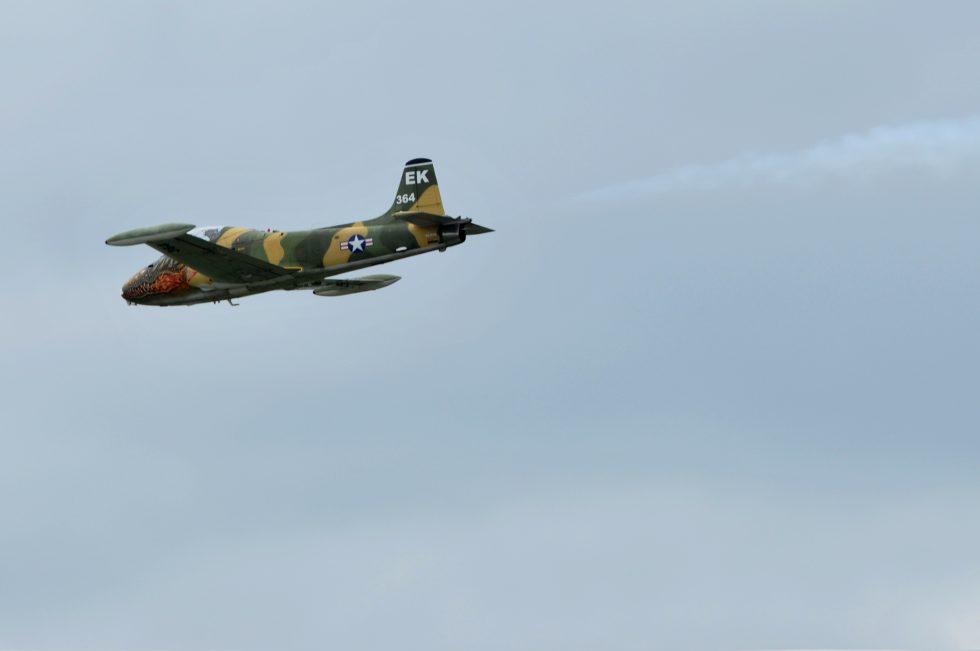
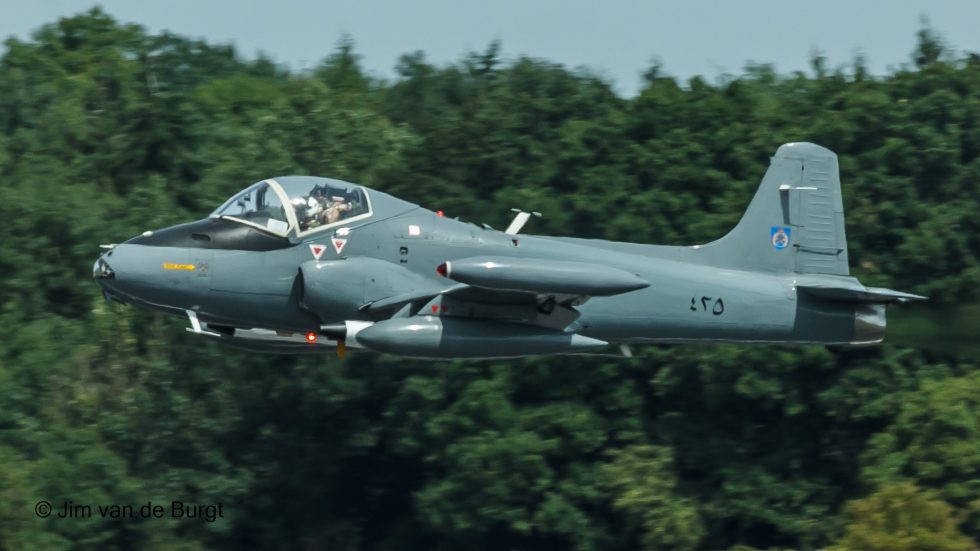
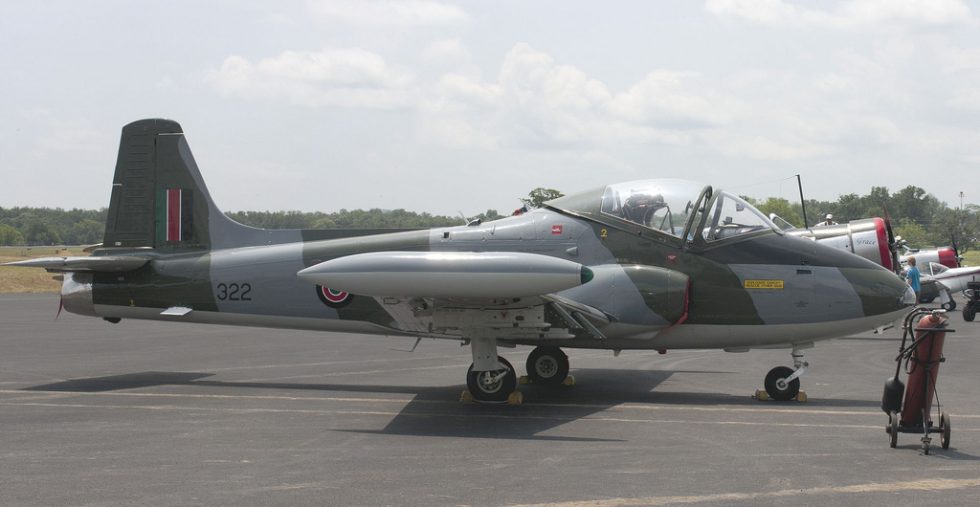
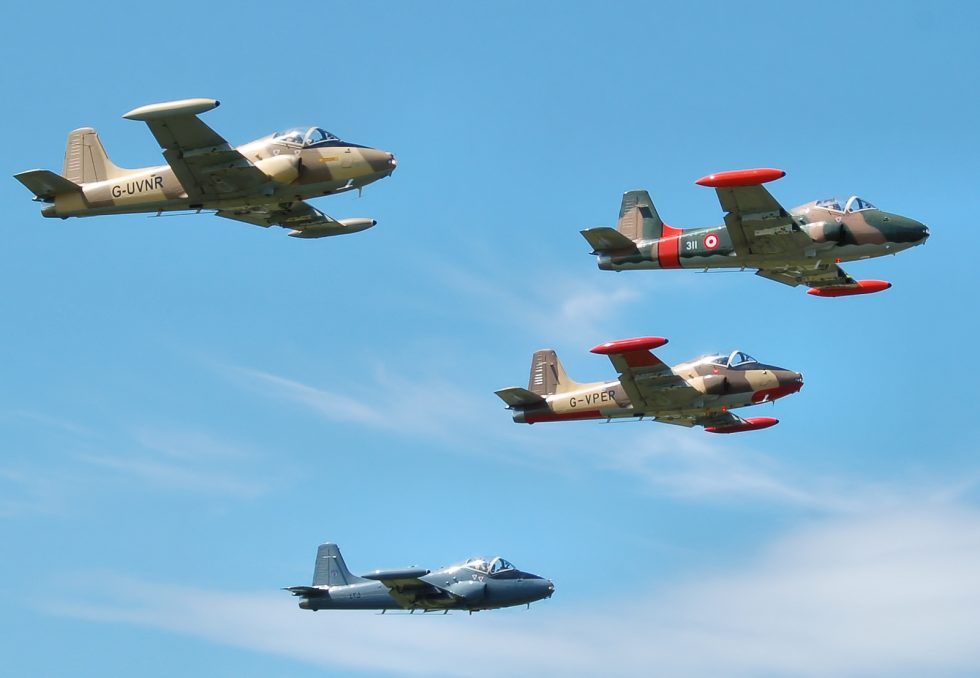
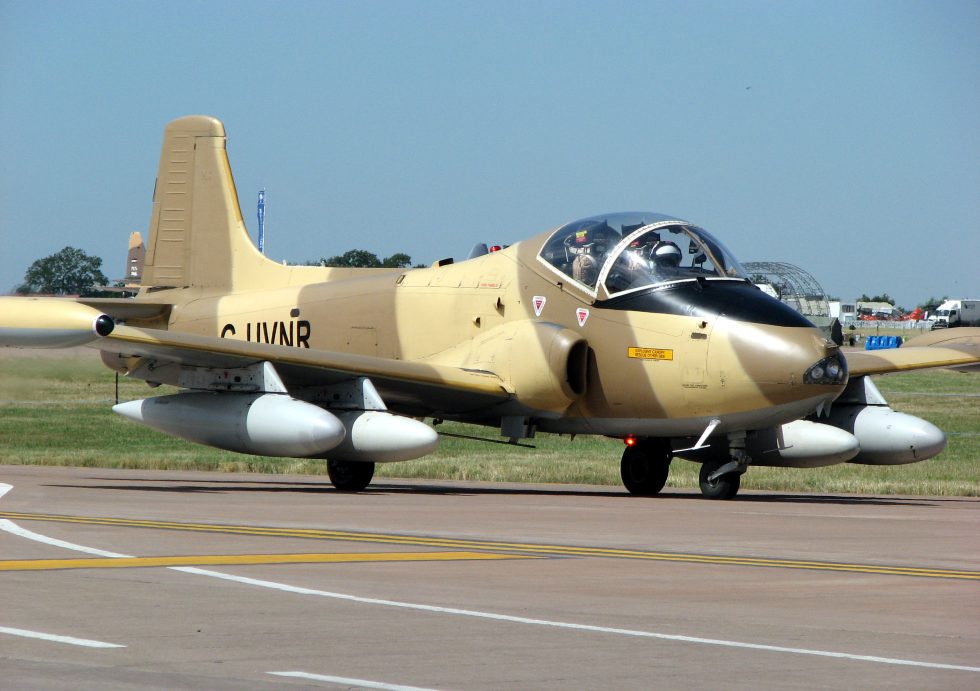
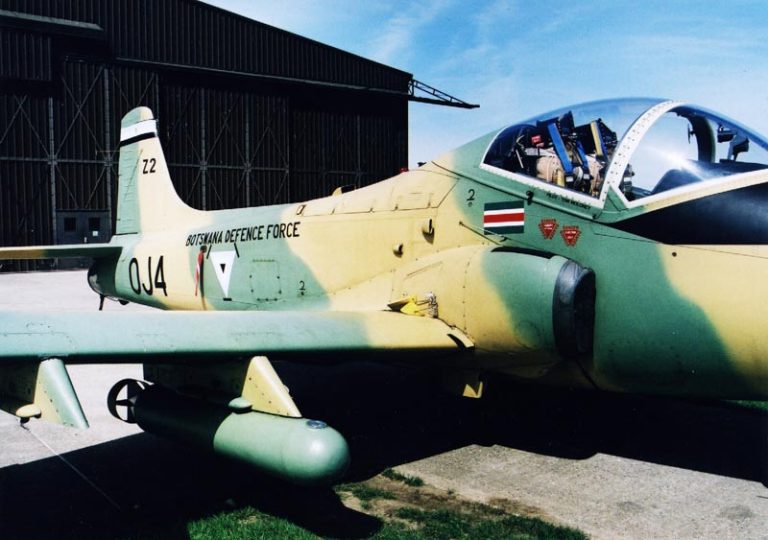
The Strikemaster in motion
Historical Aviation Film Unit: a well-shot display flight of a civilian-operated Strikemaster, including in-cockpit views. A specialist aviation channel; this is a niche type, so views are modest rather than millions.
Where the Strikemaster flew
The Strikemaster in action
The Strikemaster never fought other aircraft — that was never its job. Its record is written in ground-attack: patient, low-level strikes in support of troops, from the mountains of Dhofar to the jungles of the Cenepa. It is a record of a cheap aircraft doing hard, unglamorous work over three decades and three continents.
Compare the combat record of every military aircraft. Figures as of August 2026.
Everything people ask about the BAC Strikemaster
Can I fly in a BAC Strikemaster?
What is the BAC Strikemaster?
How fast is the Strikemaster?
Did the Strikemaster ever see combat?
How many Strikemasters were built?
Why does the Strikemaster have side-by-side seats?
Are any Strikemasters still flying?
You can’t fly the BAC Strikemaster.
These, you can.
Some legends only live in museums — others are fuelled and waiting. MiGFlug has put civilians in real military jet cockpits since 2004.
 Fly the L-39 AlbatrosThe world’s most-flown jet trainer — aerobatics included
 Fly the F-104 Starfighter“The missile with a man in it”
 Fly the MiG-21The Cold War’s most-produced jet
 Fly the T-33 Shooting StarAmerica’s first jet trainer
 Fly the DH VampireA piece of early jet history
 Fly the S.211Agile Italian jet trainer
 Fly the MB-326The classic Aermacchi jet
 Fly the MiG-15The Soviet legend of the Korean War
Continue the tour
Every fact, checked
- GlobalSecurity.org — BAC 167 StrikemasterOrigins, the Jet Provost lineage, export record and combat use.
- Royal Air Force MuseumReference for the Jet Provost family and preserved airframes.
- Imperial War MuseumsBackground on the Dhofar War and the Battle of Mirbat.
- BAE Systems HeritageCorporate heritage of the British Aircraft Corporation and its aircraft.
- AirVectors (Greg Goebel)Technical development history of the Jet Provost and Strikemaster.
- Air Combat Information GroupAccounts of the Strikemaster’s use in the 1995 Cenepa War.
- Thunder & LightningsBritish military aircraft reference, including surviving Strikemasters.
- New Zealand Defence ForceReference for RNZAF Strikemaster service and retirement.