
CASC CH-4 Rainbow
China’s Export Strike Drone
A Reaper look-alike at a fraction of the price, the Chinese CH-4 Rainbow brought armed drones to air forces the United States would not sell to, and has flown in the wars against Islamic State and in Yemen.
The CH-4 Rainbow: how a Chinese drone found the customers America turned away
In December 2015 Iraq’s defence ministry released video of a grey, V-tailed drone firing a missile at a target held by the Islamic State group. To many viewers it looked like an American MQ-9 Reaper. It was not. It was a CH-4 Rainbow, or Caihong, built by the China Academy of Aerospace Aerodynamics, part of the state-owned China Aerospace Science and Technology Corporation (CASC). Iraq had chosen it in 2014, according to CSIS, because it was cheaper than a US Predator. Within a few years Iraqi authorities were claiming more than 260 strikes against Islamic State targets. Those claims cannot be independently checked, but the footage did more than any brochure to sell Chinese drones abroad.
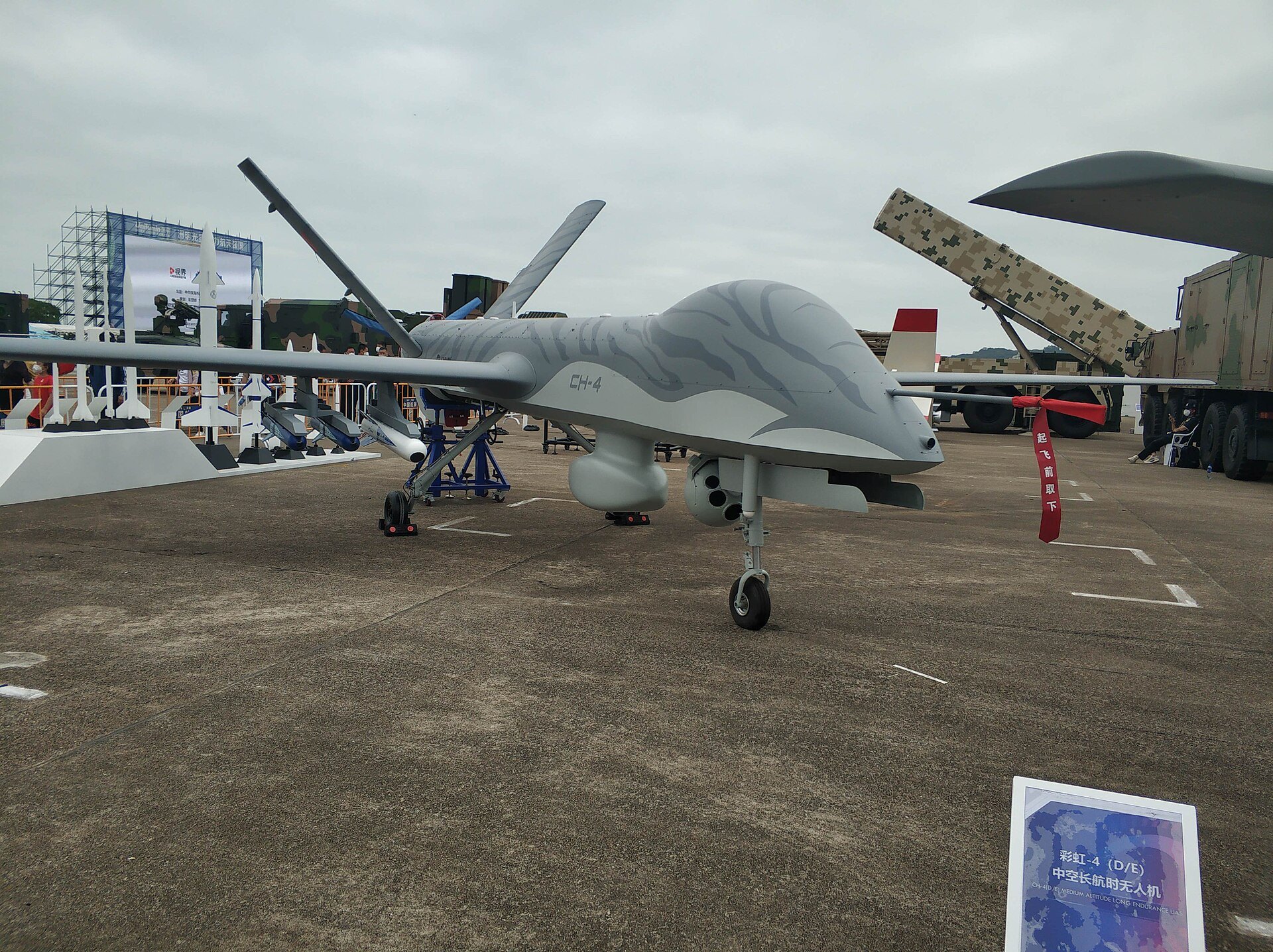
Externally the CH-4 resembles the Reaper closely; the most obvious difference is the lack of a fin below the V-tail. Underneath it is a smaller and less powerful aircraft. Commonly quoted figures give a wingspan of 18 m, a maximum take-off weight of about 1,300 kg and a single piston engine of about 100 hp, against the Reaper’s much larger turboprop. It comes in two main versions: the CH-4A, a reconnaissance aircraft with long endurance, and the CH-4B, which trades some endurance for underwing weapon stations. CSIS has estimated the CH-4 and the rival Wing Loong II at between one and two million dollars each, a fraction of the price of American equivalents.
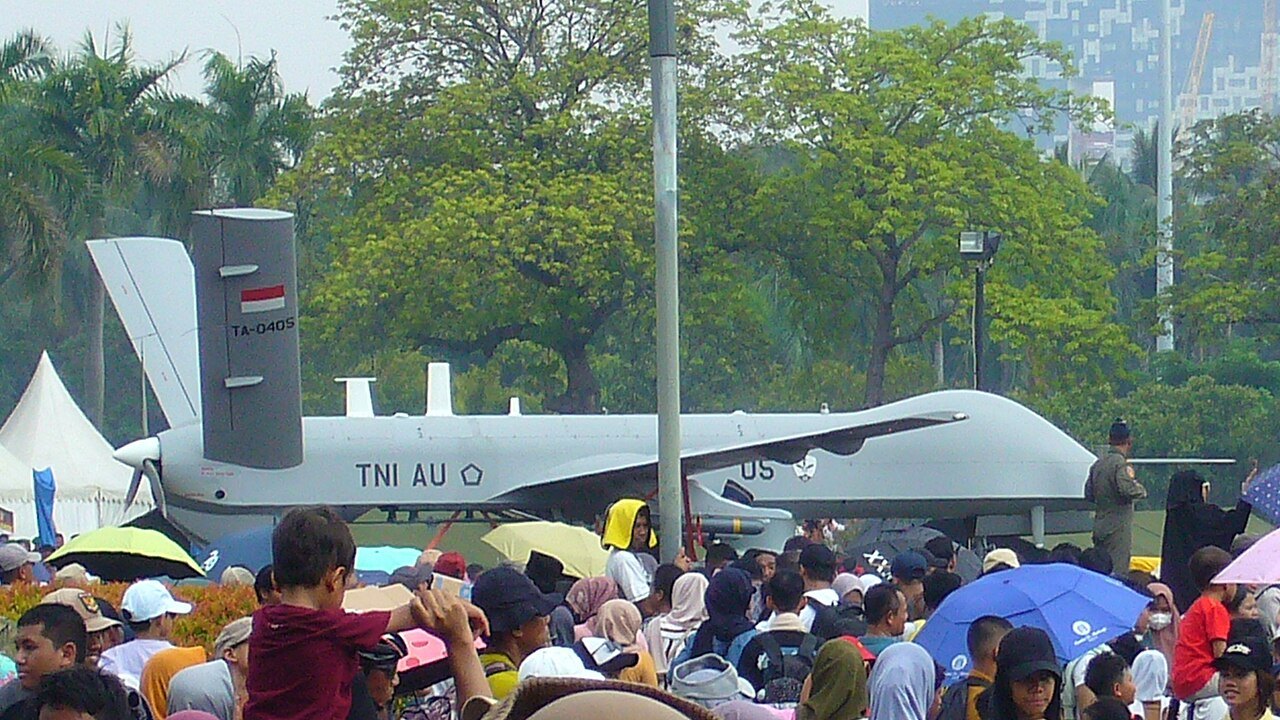
That price, and China’s willingness to sell where the United States restricted armed drone exports under the Missile Technology Control Regime, built a customer list in the Middle East, Africa and Asia. Iraq, Saudi Arabia, the United Arab Emirates, Jordan, Algeria, Sudan, Pakistan, Indonesia, Myanmar and the Democratic Republic of the Congo are among the reported operators, and CASC has a factory in Myanmar that builds the type. The record has been uneven. Iraq’s fleet was grounded within two years by maintenance problems, and Saudi Arabia lost more than a dozen CH-4s over Yemen, according to a US Army analysis. The CH-4 has been used in civil wars where accountability for strikes is limited.
01The CH-4 in Iraq: strikes, storage and a second life
Iraq was the CH-4’s first and best-documented combat user. The Iraqi Ministry of Defence unveiled its CH-4s in October 2015 without saying how many it had, and released strike footage that December. Through the campaign against the Islamic State group Iraqi officials claimed hundreds of strikes. Balad Air Base north of Baghdad became the fleet’s best-known home.
The fleet did not last well. Janes reported that the aircraft were placed in storage in 2017, and that in 2019 the US-led coalition counted more than ten CH-4s in Iraq with only one fully operational, largely because of maintenance and contract problems. In 2021 Iraq signed a contract with the manufacturer for restoration, and in August 2022 the Iraqi defence minister, Juma Enad Saadoun, visited Balad to show the first CH-4 returned to service. He said the drones had played a large role in the war against the Islamic State group. Iraq has since reportedly ordered the larger CH-5.
02The CH-4 in Yemen: losses over a long war
Saudi Arabia, leading the coalition fighting the Houthi movement in Yemen, bought both the CH-4 and the rival Chinese Wing Loong II, and signed a co-production agreement for the CH-4. The aircraft were used over Yemen for surveillance and strikes. They also proved vulnerable. A 2022 analysis by the US Army’s Foreign Military Studies Office counted more than two dozen Saudi drones lost over Yemen, including over a dozen CH-4s. In a single week in May 2022 the Houthis claimed to have shot down a Turkish-built Karayel, a CH-4 over Sana’a and a Wing Loong II on the border.
Slow, medium-altitude drones are relatively easy targets for even improvised surface-to-air missiles, and the Yemen losses showed it. The strikes carried out by coalition aircraft over Yemen, crewed and uncrewed, have been the subject of repeated reports by human rights organisations about civilian casualties. Individual incidents are rarely attributable to a specific aircraft type, and no public record attributes particular strikes to the CH-4.
What makes the CH-4 special
A familiar shape
The CH-4 follows the layout made famous by the American Predator and Reaper: a slender fuselage, a long straight wing, a V-tail and a pusher propeller at the back. A sensor turret sits under the nose and the satellite antenna in a bulged upper nose. The shape is practical rather than copied for its own sake: it suits long, slow surveillance flights. The obvious external difference from the Reaper is the absence of a ventral fin under the tail.
Two versions, two jobs
The CH-4A is the reconnaissance version, quoted with endurance of 30 to 40 hours. The CH-4B adds weapon stations under the wings, which cuts endurance when loaded; Janes gives about 14 hours for the strike version. Reported endurance for the A version is long because the aircraft is light and its piston engine economical. Satellite links let it be flown well beyond the range of its ground station.
Priced to sell
The CH-4’s real innovation was commercial. CSIS estimated the CH-4 and Wing Loong II at $1 to 2 million each, and said China delivered 163 drones of the Rainbow and Wing Loong families between 2008 and 2018. Packages typically included training and support, and CASC has offered local production, including a factory in Myanmar. Buyers accepted a smaller, less capable aircraft in exchange for price and fewer conditions.
03The CH-4’s family: from CH-3 to CH-5
- CH-3: the earlier, smaller Rainbow with a canard layout, sold to Nigeria, Myanmar and others.
- CH-4A: reconnaissance version with long endurance.
- CH-4B: armed reconnaissance version with underwing stations.
- CH-4C: reported by Janes as an improved version under test, with more payload and updated electronics.
- CH-5: a larger successor, which Iraq has reportedly ordered.
CASC CH-4 Rainbow specifications
Specifications
- Crew
- None on board; flown from a ground control station
- Length
- 8.5 m (27 ft 11 in) (commonly quoted)
- Wingspan
- 18 m (59 ft) (commonly quoted)
- Max take-off weight
- About 1,300 kg (2,866 lb) (commonly quoted)
- Payload
- Up to about 345 kg (761 lb) on the CH-4B (Janes)
- Powerplant
- 1 × piston engine, about 100 hp, pusher propeller (commonly quoted)
- Cruise speed
- About 180 kt (333 km/h) (commonly quoted)
- Endurance
- Up to 30 to 40 hours (CH-4A); about 14 hours (CH-4B, armed)
- Armament
- CH-4B: underwing stations for small guided missiles and bombs
Costs & production
- Unit cost
- About $1 to 2 million per aircraft (CSIS estimate covering the CH-4 and Wing Loong II)
- Cost per flight hour
- Hedged estimate: in the order of a few hundred to a low few thousand US dollars per hour, based on a single small piston engine, satellite link time and ground crews; no official figure has been published and this is an order of magnitude only
- Production
- Built by CASC in China and under licence in Myanmar; total numbers not published
- Programme
- Exported from about 2015; China delivered 163 Rainbow and Wing Loong drones between 2008 and 2018 (CSIS)
04The CH-4’s operating costs: cheap to buy, harder to keep flying
The CH-4’s purchase price was its selling point, but Iraq’s experience shows the other side of the ledger. Its fleet was grounded within about two years, with only one aircraft fully serviceable in 2019, and getting the drones back into service required a separate restoration contract with the manufacturer. Operating costs for drones of this class are dominated by support: spare parts, contractor technicians, satellite bandwidth and training. A small piston engine keeps fuel costs low, so an order-of-magnitude estimate of a few hundred to a few thousand dollars per hour is plausible. No customer has published a real figure.
The CH-4 from export debut to the Yemen war
Iraq chooses the CH-4
Iraq’s defence ministry selects the Chinese drone, CSIS says because it was cheaper than a US Predator.
Unveiled in Iraq
The Iraqi Ministry of Defence shows its CH-4s in October; strike footage follows in December.
Iraq’s fleet stored
Maintenance and contract problems lead to the aircraft being placed in storage.
One serviceable
The US-led coalition reports Iraq has more than ten CH-4s, only one fully operational.
Pakistan takes delivery
Pakistan receives five CH-4s in mid-January; Iraq signs a restoration contract.
Losses over Yemen
Houthi forces claim a CH-4 shot down over Sana’a in May; a US Army study counts over a dozen Saudi CH-4s lost.
Back in Iraqi service
In August Iraq’s defence minister presents the first restored CH-4 at Balad Air Base.
Stories & eyewitnesses: the CH-4 in other people’s wars
The video that sold a drone
Iraq’s December 2015 strike footage.
Read the full story
Cheaper than a Predator
Why Iraq went to China.
Read the full story
Grounded by spares
Iraq’s CH-4s spent years in storage.
Read the full story
The minister at Balad
A restored drone was shown off in 2022.
Read the full story
A dozen lost over Yemen
Saudi CH-4s proved vulnerable.
Read the full story
Five for Pakistan
A delivery revealed by trade records.
Read the full story
A factory in Myanmar
CASC builds CH-4s in Myanmar.
Read the full story
One rule for the US, another for China
How export controls shaped the market.
Read the full story
The CH-4 in pictures
Where the CH-4 flies and flew
The CH-4’s record
The CH-4 has been used in combat by Iraq against the Islamic State group from 2015, and by Saudi Arabia over Yemen, where more than a dozen were lost. Other buyers have used it in internal conflicts, but strike totals are mostly official claims that cannot be independently checked.
See how training and combat types compare in the military aircraft statistics database. Figures are approximate.
Everything people ask about the CH-4
Can I fly in a CASC CH-4 Rainbow?
Is the CH-4 a copy of the MQ-9 Reaper?
Who makes the CH-4?
Which countries use the CH-4?
Where has the CH-4 been used in combat?
How much does a CH-4 cost?
You can’t fly the CH-4.
These, you can.
Most of this museum you can only look at. These genuine military jets you can fly yourself with MiGFlug — with aerobatics and time on the controls.
 Fly the L-39 AlbatrosThe world’s most-flown jet trainer — aerobatics included
 Fly the F-104 Starfighter“The missile with a man in it”
 Fly the MiG-21The Cold War’s most-produced jet
 Fly the T-33 Shooting StarAmerica’s first jet trainer
 Fly the DH VampireA piece of early jet history
 Fly the S.211Agile Italian jet trainer
 Fly the MB-326The classic Aermacchi jet
 Fly the MiG-15The Soviet legend of the Korean War
Continue the tour
Every fact, checked
- CSIS ChinaPower: Is China at the forefront of drone technology?Price estimate, Iraqi strike claims, export totals 2008 to 2018.
- CSIS: Tatmadaw deploys Chinese-made UAVs (2021)CASC factory in Myanmar building CH-4s.
- US Army Foreign Military Studies Office: UAV technologies proliferating in Yemen and Saudi Arabia (Lucas Winter, 2022)Saudi CH-4 losses over Yemen.
- Janes: Iraq returns CH-4 UAV to service (2022)Iraqi fleet history, storage, restoration and minister’s visit to Balad.
- Janes: Pakistan receives five CH-4 UAVs from China (2021)Pakistani delivery and CH-4 variant endurance and payload.