
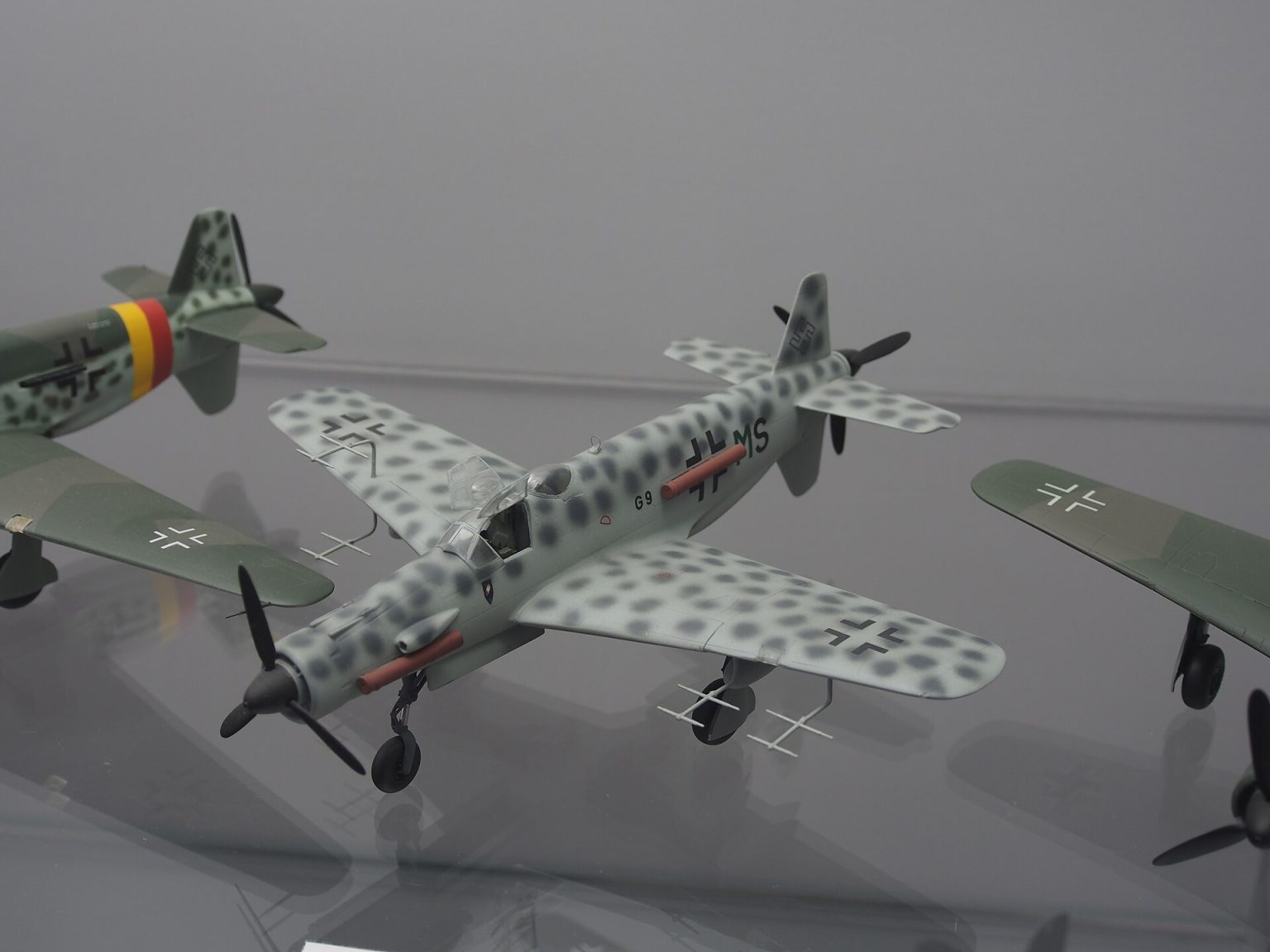
Do 335 Pfeil
The fastest piston fighter of the war
Dornier’s push-pull “Arrow” — two engines in line, a propeller front and back, and a top speed no other piston fighter could match. It came too late to fight.
The Arrow: Germany’s fastest piston fighter that never fought
The Dornier Do 335 solved an old problem in a radical way. Twin-engined fighters were fast and powerful, but their wing-mounted engines added drag and, if one failed, dangerous asymmetric thrust. Claudius Dornier’s answer, patented decades earlier, was “centreline thrust”: put both engines in the fuselage, one behind the other, driving a propeller at each end.
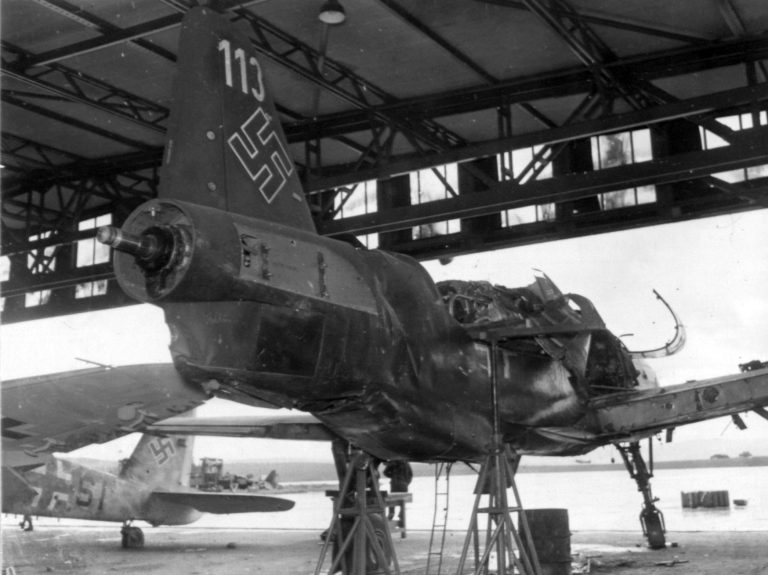
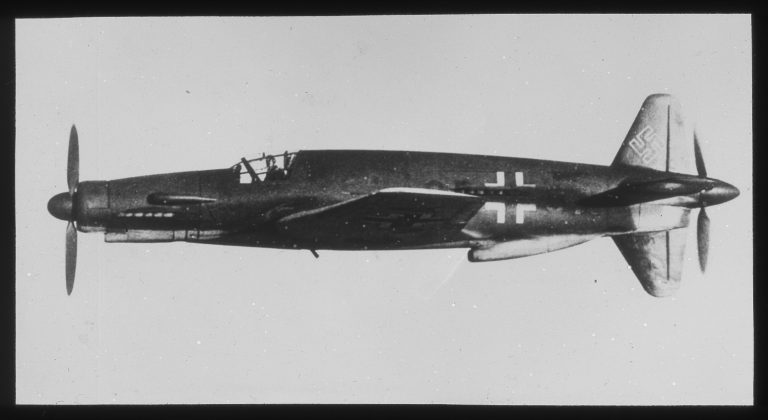
The result looked like nothing else in the sky. A conventional tractor engine and propeller sat in the nose; a second engine sat behind the cockpit, driving a pusher propeller at the tail through a long extension shaft. A cruciform tail, with a fin below the fuselage as well as above, kept that rear propeller clear of the runway on take-off.
The payoff was speed. With two 1,800-horsepower Daimler-Benz V-12s working in line and remarkably little drag, the Pfeil reached about 770 km/h (480 mph) — the fastest piston-engined aircraft of the entire war, quicker than a Mustang or a Tempest.
That rear propeller posed a lethal problem: a pilot bailing out the normal way would be cut to pieces. So Dornier fitted the Do 335 with one of the world’s first ejection seats, together with explosive bolts to blow off the rear propeller and the upper fin before the pilot was fired clear. Few aircraft of the era took crew survival so seriously.
Hitler ordered the Pfeil built as a priority in 1944, but it was already too late. Engine shortages, Allied bombing and the collapse of German industry meant only a few dozen were ever completed, and the type never saw meaningful combat. The one documented Allied encounter came in April 1945, when the French ace Pierre Clostermann met a Do 335 that his Hawker Tempests simply could not catch.
The jet age made the Pfeil obsolete almost before it flew, and it was a technological dead-end — but a brilliant one. A single Do 335 survives today, restored by Dornier itself and preserved at the Smithsonian, the last of the arrows that never got to fly.
01Why the Do 335 mattered: the piston fighter’s last great leap
The Pfeil represents the outer limit of what piston-engined fighter design could achieve. By stacking two engines in line, Dornier extracted twin-engine power with something close to single-engine drag, and pushed level speed past every other propeller fighter of the war.
It arrived, though, at the exact moment the jet engine made that achievement irrelevant. The Do 335 is therefore a kind of magnificent full stop: the piston fighter refined almost to perfection, just as the technology it perfected was being swept aside. Its real legacy is not combat but engineering ambition — and a handful of ideas, like the ejection seat, that outlived it.
How Dornier built the fastest propeller fighter of the war
Centreline thrust
Instead of hanging two engines on the wings, Dornier put them in the fuselage, one behind the other, driving a propeller at each end. The aircraft had all the power of a twin with something close to the drag of a single — and none of the deadly asymmetric handling if one engine failed.
The cruciform tail
A rear-mounted pusher propeller needed protection from the runway, so the Pfeil grew a fin below the fuselage as well as above, forming a cross. The rear engine drove its propeller through a long extension shaft running the length of the aft fuselage.
Escape from the pusher
That rear propeller would have killed any pilot who bailed out normally. Dornier’s answer was strikingly modern: one of the world’s first ejection seats, paired with explosive bolts that blew off the rear propeller and the upper fin an instant before the pilot was fired clear.
02Two engines in line: the physics of speed
The Do 335’s speed came from a simple insight. Drag rises sharply with frontal area and with the interference between engine nacelles and the wing; by burying both engines in a single slender fuselage, Dornier all but eliminated that penalty. The nose engine pulled, the tail engine pushed, and their thrust lines ran straight through the aircraft’s centre.
The reward was a level speed of around 770 km/h — faster than any other piston fighter of the war, and enough that Allied fighters which met the type simply could not close the gap. It was, in effect, the piston engine’s answer to the coming jets, delivered a few months too late to matter.
Dornier Do 335 Pfeil — by the numbers
Baseline note: the figures below describe the Do 335 A-1 (single-seat fighter-bomber, two DB 603E-1, the only armed mark completed in more than token numbers). Deltas for the A-0 pre-production machines, the twin-cannon B-2 Zerstörer and the two-seaters are in grey. Three corrections before the tables. First, the explosive charges did not blow off the lower fin: they blew off the dorsal fin and the rear propeller so that the pilot could eject through the gap, and the ventral fin was a separate, separately jettisonable item meant to be dropped before a wheels-up landing so it would not dig in. Second, the surviving aeroplane was not restored by the Smithsonian in Washington; the Smithsonian shipped it back to its builder in Bavaria and Dornier restored it, several of the men on the job having built the type in 1944. Third, the popular claim that the Do 335 was the fastest piston-engined aircraft ever to reach production survives scrutiny, but only just, and the words "reach production" are carrying the weight — see the speed rows.
Dimensions & weights
- Crew
- 1 — the A-6 night fighter, A-10, A-11 and A-12 seated a second man in a raised, entirely separate cockpit stepped up behind the pilot’s, an arrangement that gave the two-seater its official name, Ameisenbär (anteater), against Pfeil (arrow) for the single-seater
- Length
- 13.85 m (45 ft 5 in) — almost exactly the span, which is what happens when you put two V-12s end to end
- Wingspan
- 13.80 m (45 ft 3 in). A longer-span wing was drawn for the B-3, B-4 and Do 435; no completed aircraft flew with it
- Height
- 5.00 m (16 ft 5 in) — extraordinary for a single-seat fighter, and a direct consequence of a nose leg long enough to keep a 3.2 m rear propeller off the runway
- Wing area
- 38.5 m² (414 sq ft)
- Aspect ratio
- 4.95 — a short, low-aspect wing carrying no engines, no radiators and no guns; everything heavy lived in the fuselage
- Aerofoil
- NACA 23018-630 at the root, NACA 23012-635 at the tip
- Empty weight
- 6,550 kg (14,440 lb)
- Equipped weight
- 7,400 kg (16,314 lb) — the German Rüstmasse, and the figure the Smithsonian publishes for the surviving airframe. It is often mistaken for the empty weight, which is 850 kg lighter
- Loaded weight
- 9,600 kg (21,164 lb); B-2 Zerstörer 10,400 kg (22,928 lb) — heavier than a loaded Bf 110 G, on the frontal area of a large single-seater
- Wing loading
- 249 kg/m² (51.1 lb/sq ft) at loaded weight — very high for 1944, and the reason the Do 335 was a fast interceptor and a poor turning fighter
- Power loading
- 2.67 kg/PS (5.96 lb/hp) on 3,600 PS of take-off power
- Internal fuel
- 1,230 l (325 US gal, 271 imp gal) in the main tank of the single-seater, with additional tankage in the weapons bay and wings depending on mark. A bay tank was the normal alternative to a bomb
Performance
- Maximum speed
- 770 km/h (478 mph, 416 kn) at 8,600 m (28,200 ft) at combat power, 2,500 rpm. B-2: 750 km/h (466 mph) at the same height
- Speed at sea level
- 608 km/h (378 mph) at combat power. B-2: 590 km/h (367 mph)
- The production-record claim
- The best rival is the North American P-51H at 760 km/h (470 mph) at 6,900 m, of which 555 were delivered before VJ-Day. The Do 335 beats it by about 10 km/h on paper — a margin smaller than the gap between German factory figures and Allied flight-test practice. It is fair to call the Pfeil the fastest piston-engined aeroplane to reach production; it is not fair to imply the question is settled by a wide margin, and about 37 aircraft is a thin definition of production
- Measured, not calculated
- The V1 recorded 754 km/h (468 mph) at 8,600 m at combat power on 23 May 1944, and 732 km/h (455 mph) at 8,000 m at maximum cruise — the figures that make the type’s reputation defensible rather than merely advertised
- Dive testing
- The V6 was dived to 910 km/h and, on 9 June 1944, to 966 km/h at 6,200 m. Whether the higher figure is true or indicated airspeed is not clear from the surviving report, and at that height and Mach number the distinction matters a great deal; treat it as evidence of a strong airframe rather than as a speed record
- Economical cruise
- 485 km/h (301 mph) at 6,000 m (19,700 ft), quoted for the B-2
- Climb to 2,000 m
- 2.5 minutes (6,560 ft) — an initial rate of roughly 13 m/s, 2,600 ft/min
- Climb to 8,000 m
- 12 minutes (26,250 ft). German sources give 11 minutes for the lighter fits and 14.3 minutes for a fully equipped machine; the spread reflects weight and engine mark, not measurement error
- Service ceiling
- 11,900 m (39,000 ft). German references commonly give 11,400 m (37,400 ft)
- Range
- 1,550 km (963 miles, 837 nmi) on internal fuel at maximum cruise. 1,700 km (1,056 miles) for the B-2 at economical cruise; ~1,800 km (1,118 miles) with two 300 l drop tanks
- Asymmetric handling
- None — with both engines on the centreline, losing one produced no yaw at all, only a loss of thrust. This is the single largest flying-qualities advantage of the layout and the reason a pilot could shut down the rear engine and cruise on the nose engine alone to stretch endurance
- Verdict of the test unit
- Erprobungskommando 335 at Rechlin reported on 23 January 1945 that the aircraft was, as it then stood, far from suitable for combat: a badly conceived nose undercarriage, unreliable new flap hydraulics, poor regulation of engine cooling, poor visibility, and a canopy made awkward to open and close by the ejection seat installation. Against this must be set the fact that development and construction were being carried out under acute time pressure and material shortage
Propulsion & systems
- Engines
- Two Daimler-Benz DB 603E-1, inverted V-12, liquid-cooled, direct fuel injection, 44.52 l (2,717 cu in) displacement, 920 kg (2,030 lb) dry — the largest inverted V-12s Germany mass-produced
- Ratings
- 1,800 PS (1,324 kW, 1,776 hp) each for take-off at 2,700 rpm, rated altitude 7,000 m; 1,580 PS (1,162 kW) each for combat and climb. Prototypes flew on DB 603A (1,750 PS) and pre-production DB 603G-0 (1,900 PS); the English-language specification tables that give 1,342 kW per engine are quoting 1,800 horsepower rather than 1,800 PS, which is a slightly different number
- Layout
- One engine conventionally in the nose driving a tractor propeller; the second buried in the centre fuselage behind the cockpit, driving the pusher propeller behind the tail through an extension shaft roughly 3 m (9 ft 10 in) long. Frontal area barely greater than a single-engined fighter’s, which is the entire argument for the aeroplane
- Propellers
- Two VDM three-blade constant-speed units, 3.50 m (11 ft 6 in) front and 3.20 m (10 ft 6 in) rear. The rear is the smaller because there is only so much ground clearance to be had behind a tricycle undercarriage
- Cooling
- An annular radiator ring behind the front spinner in the manner of a unitised DB 603 installation, and a large ventral radiator bath under the centre fuselage for the buried rear engine, with an oil cooler in a chin intake. The rear engine had no clean airflow of its own and its cooling regulation was never made satisfactory; it is the single most damaging cost of the tandem layout, and the fire that destroyed the Farnborough aircraft in January 1946 started in the rear engine
- Undercarriage
- Retractable tricycle, one of the first German combat types to use one, with a very long nose leg. The gear was weak from the first flight onwards; the V1 flew the rest of its 27-flight programme with the mainwheel doors removed after they gave trouble, and the nose leg design was still being criticised in January 1945
- Ventral fin
- The lower arm of the cruciform tail existed to protect the rear propeller from striking the runway on rotation, and carried a bumper for the same purpose. It was jettisonable, so that a pilot forced into a wheels-up landing could drop it rather than have it dig in
- Ejection seat
- A compressed-air catapult seat — among the earliest fitted to any production aeroplane, and fitted for a specific reason rather than as an advance in safety generally: a man who went over the side of a Do 335 in the ordinary way would go through the rear propeller
- Escape sequence
- Jettison the canopy using either of two levers, one on each side of the cockpit below the windscreen sills; fire the explosive bolts that blow the dorsal fin and the rear propeller clear; then fire the seat. The Dornier employees who restored the surviving airframe in 1975 found the charges still installed and still live. The system was not reliable: on 26 April 1945 Fliegerstabsing Heinz Fischer had both the seat and the tail jettison fail on him over the Vosges and got out by hand
- Radio and equipment
- Late-war Luftwaffe standard: FuG 16ZY VHF radio with homing, FuG 25a IFF, and a blind-landing receiver. The projected A-6 and B-6 night fighters were to add FuG 217 or FuG 218 Neptun radar with a second crewman to work it; some accounts substitute FuG 220 Lichtenstein SN-2 with FuG 350 Naxos passive homing. No radar-equipped Do 335 is known to have been completed
- Structure
- All-metal stressed-skin low-wing monoplane with a cruciform tail, an internal weapons bay in the lower fuselage, and two wing hardpoints. Conventional construction throughout — the aircraft is radical in arrangement and entirely orthodox in the way it is built
03Why so few were built
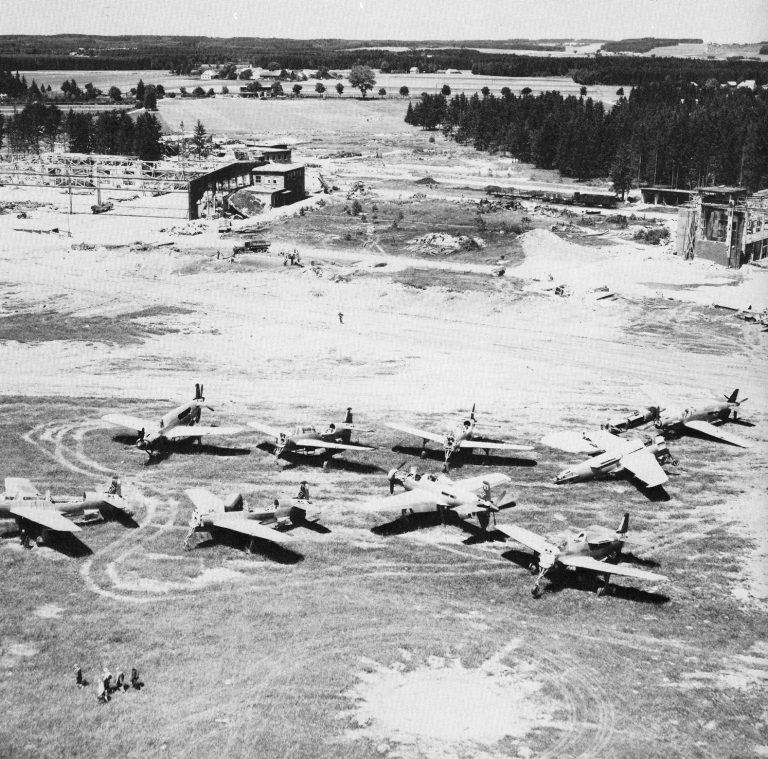
The Pfeil was ordered into priority production in 1944, but that meant little in the last year of the war. The DB 603 engines were in short supply and needed elsewhere; Allied bombing wrecked factories and transport; and skilled labour and materials were vanishing. When US troops reached the Oberpfaffenhofen works in April 1945 they found only a handful of finished aircraft. The numbers above reflect a programme that never really started.
Armament & payload
The Pfeil carried a heavy centreline battery and a bomb bay, and never fired a shot in anger
The armament of the Do 335 is easy to describe and slightly unreal to write about, because no version of it was ever used against an enemy. The standard fit was a single 30 mm MK 103 firing through the hollow shaft of the front propeller and two 20 mm MG 151/20 synchronised over the nose engine — a genuinely heavy nose battery with no dispersion problem at all, since every barrel lay within centimetres of the aircraft’s centreline. Below the cockpit sat a weapons bay that could take one 500 kg bomb, two 250 kg bombs, cameras, or, most often in practice, a fuel tank; two wing hardpoints took another 250 kg apiece or the standard 300 l drop tank.
What the aeroplane conspicuously did not carry is as revealing as what it did. Germany in 1945 had guided anti-ship weapons, wire-guided air-to-air missiles and the R4M rocket in service or in trials, and none of them was ever integrated with the Do 335. The type had been ordered as a Schnellbomber, redefined as a multi-role fighter in autumn 1942, and then chased through fighter, Zerstörer, reconnaissance, night-fighter and trainer roles without ever being finished as any of them. Weapon fits below are those specified in the Baubeschreibung and the surviving variant documentation. Because so few airframes were completed, and because several were fitted out for testing rather than for a role, almost nothing here can be checked against an operational aircraft.
Gun
- One 30 mm MK 103 as a Motorkanone, firing through the front propeller hub, 70 rounds. A long-recoil, belt-fed weapon of about 145 kg, roughly 360–420 rounds/min, around 860 m/s with the thin-walled Minengeschoss high-explosive shell. Two hits were normally reckoned enough to bring down a four-engined bomber
- Two 20 mm MG 151/20 above the nose engine, synchronised to fire through the front propeller disc, 200 rounds per gun. About 700 rounds/min unsynchronised, rather less through the disc; the standard German fighter cannon of the second half of the war
- B-2 Zerstörer only: two further 30 mm MK 103 in the wings with 140 rounds each, giving three 30 mm and two 20 mm. Two aircraft, the M13 and M14, were completed to this standard
- Some sources give the cowl guns as 15 mm MG 151/15 rather than the 20 mm version. The 20 mm is the figure in the Baubeschreibung and in the mainstream literature; the 15 mm reading appears to be a carry-over from earlier project documents
- The whole battery sits on the centreline, so there is no harmonisation distance and no convergence cone — a real advantage over a wing-gunned fighter that the aircraft never got to demonstrate
Air-to-air
- None. The Do 335 had no air-to-air missile capability of any kind, and none was ever planned for it
- The Ruhrstahl X-4 wire-guided air-to-air missile was under test in Germany during the same months, cleared for trials on the Fw 190 and Ju 88. There is no documented Do 335 integration, and the programme was effectively dead by February 1945 when the Stargard motor factory was bombed
- The air-to-air weapon was the gun battery above, and it was a good one for the intended target — unescorted or lightly escorted bombers approached fast from behind and left before the escort could react
- No oblique Schräge Musik installation is documented on any completed Do 335. The upward-firing pair appears only in the paper P 256 turbojet night fighter, as a field conversion kit
Air-to-surface guided
- None, at any stage of the programme
- Germany’s guided anti-ship weapons of the period — the Hs 293 rocket-boosted glide bomb and the Fritz X armour-piercing glide bomb — were carried by Do 217s, He 177s and Fw 200s and needed a separate operator with a control station and a clear view of the weapon. Nothing about the Do 335 suited that work
- The weapons bay was sized for a 500 kg bomb and could not have taken a Fritz X, which weighed about 1,400 kg
- The mission the Do 335 was actually designed for was the unguided, high-speed, single-pass attack: come in fast, drop, and leave before an interceptor can be brought to bear
Bombs
- Internal bay: one 500 kg (1,102 lb) bomb, or two of 250 kg (551 lb). The bay is the reason the fuselage is as deep as it is under the cockpit
- Two wing hardpoints, each 250 kg (551 lb), giving a maximum of ~1,000 kg (2,205 lb) of bombs
- The original 1942 P.231 requirement asked for a 1,000 kg bomb load, so the aircraft as built met its founding specification only by using the wings as well as the bay
- Carrying bombs internally at 700 km/h was the whole point: no external drag, no pylon interference, and a bomber that could not be intercepted by anything with a propeller
- In practice most completed aircraft carried a bay fuel tank rather than a bomb, because they were flying test and training sorties
Rockets
- None fitted, and no unguided rocket armament is documented for any Do 335 mark
- The R4M 55 mm folding-fin rocket that armed the Me 262 in 1945 was never trialled on the Pfeil. Its wooden underwing racks were a jet-fighter expedient; the Do 335 had bay volume and a 30 mm Motorkanone instead
- The only rocket hardware associated with the family is a pair of Walter Starthilfe monopropellant assisted-take-off units, planned for the twin-fuselage Do 635 reconnaissance aircraft to get its very high weight off the ground
- No Werfer-Granate 21 mortar tube installation, no anti-shipping rocket, nothing
Pods & other stores
- Two 300 l (66 imp gal, 79 US gal) standard Luftwaffe drop tanks on the wing hardpoints, specified for the B-2 and available to the other armed marks
- An auxiliary fuel tank in the weapons bay, the usual alternative to a bomb, taking the aircraft towards the ~1,800 km ferry figure
- Reconnaissance fit: Rb-series vertical cameras in the weapons bay for the A-3 and A-4, the A-4 using the smaller camera pair. The A-4 is described in German sources as an unarmed long-range reconnaissance aircraft; the A-3 was to be converted from A-1 airframes
- Night-fighter fit, projected only: Neptun radar aerials on the wings and nose and a second crew station. No completed airframe is known to have carried them
- No gun pods, no conformal packs, no external cannon gondolas of the Bf 110 and Bf 109 sort. There was nowhere sensible to put them without wrecking the drag argument that justified the aeroplane
Three typical loadouts
- Fast fighter-bomber, the role it was ordered for
- One MK 103 with 70 rounds and two MG 151/20 with 200 rounds each; one SC 500 in the internal bay; nothing external; full internal fuel for about 1,550 km. Cross the target area at 600 km/h at low level, or 770 km/h high, and outrun anything with a propeller
- Zerstörer, the B-2 as completed on two airframes
- Three MK 103 — one in the nose, two in the wings with 140 rounds each — plus the two cowl MG 151/20; a fuel tank in the bay and two 300 l drop tanks on the wings; 10,400 kg loaded, 750 km/h at 8,600 m, 1,700 km at economical cruise. A bomber-destroyer that could not be caught by escorts
- Night fighter, the A-6 as specified and never delivered
- Two crew in stepped tandem cockpits, Neptun radar with wing and nose aerials, the standard nose gun battery, bay fuel for endurance. Eric Brown, who flew the type after the war, thought this the version that would have worked, on the strength of its steadiness, its long endurance and its high basic speed
Sourcing caveat: gun and ammunition figures come from the Baubeschreibung Do 335 B-0 Zerstörer of 31 May 1944 and from Smith and Creek. Because the type never entered squadron service, there are no armourers’ returns, no expenditure records and no combat reports to check them against — unusually for a Second World War aircraft, every armament figure here is a specification rather than an observation.
Variants
Dornier spent thirty years arguing for tandem engines and got five months of production out of the argument
Claude Dornier began putting engines nose-to-tail in 1915, in the tandem nacelles of his wartime flying boats, and never stopped: the Do J Wal of 1922 and the twelve-engined Do X of 1929 both used the layout, because for a flying boat it keeps propellers out of spray and machinery on a single strut structure. In 1937 he patented the specific refinement that made the Do 335 possible — a pusher propeller driven by a remote engine through a long extension shaft — and in 1939 he had Ulrich Hütter and Schempp-Hirth build a validator for it. The Göppingen Gö 9 was a 40 per cent scale Do 17 fuselage and wing with no nacelles, a retractable tricycle undercarriage and an 80 hp Hirth HM 60 buried amidships turning a tail propeller through a tube. It first flew in June 1941, reached about 220 km/h, and showed no unexpected vices at all. The idea worked.
The aerodynamic case was and remains sound. Two engines in the fuselage present roughly the frontal area of one, so a twin-engined aircraft can have a single-engined aircraft’s drag. The mass sits on the centreline, so the roll inertia is low and the roll rate high. There is no torque couple in normal flight and no asymmetry when an engine quits. The costs are equally real, and every one of them showed up: a buried rear engine with no clean airflow is hard to cool; a rear propeller means an ejection seat, explosive bolts and a tall undercarriage; a 3 m driveshaft is another thing to build, balance and maintain; and the whole rear fuselage becomes an engine bay, which is where the Farnborough aeroplane’s fatal fire began. The layout is not wrong. It is simply expensive in exactly the ways that a country losing a war cannot afford.
Production tells the story. Hitler gave the Do 335 maximum priority under the Jägernotprogramm on 23 May 1944; Friedrichshafen was to deliver 120 pre-production machines by March 1946 and Munich over 2,000; a bombing raid destroyed the Manzell tooling and forced a new line at Oberpfaffenhofen; the He 219 was ordered cancelled to free DB 603 engines and capacity for it, an order Ernst Heinkel simply ignored. When the US Army reached Oberpfaffenhofen in late April 1945 the yard held rows of Do 335s, most of them without engines.
- Prototypes V1–V12, M13–M17 (1943–45 / at least 16 flown)
- W.Nr 230001–230017. V1 CP+UA first flew at Mengen-Hohentengen on 26 October 1943 with Hans Dieterle and made 27 flights. V2 followed on 31 December 1943 with DB 603A-2s, V3 on 20 January 1944 with pre-production DB 603G-0s and a revised canopy. V6 did the dive testing; V9 was still at Rechlin in April 1945 and flew one of the last recorded sorties of the type. Engine marks varied across the batch: DB 603A, A-2, G-0, E and E-1
- Do 335 A-0 (from July 1944 / 10 aircraft, W.Nr from 240101)
- Pre-production single-seaters, the first VG+PG delivered in July 1944. Roughly eleven A-0 airframes were later converted to A-11 trainer standard
- Do 335 A-1 (deliveries from January 1945 / 11 completed)
- The production single-seat fighter-bomber: DB 603E-1, MK 103 and two MG 151/20, internal bay, two wing hardpoints. Eleven were complete at Oberpfaffenhofen when the plant was overrun
- Do 335 A-3 and A-4 (1944–45 / conversions and prototypes)
- Reconnaissance. The A-3 was to be converted from A-1 airframes with cameras in the weapons bay; the A-4 was an unarmed long-range machine with a smaller camera pair. A high-speed unarmed reconnaissance aircraft was arguably the role the Do 335 was best suited to and least developed for
- Do 335 A-6 (1944–45 / not completed)
- Two-seat night fighter with a second cockpit raised behind and above the pilot’s, and FuG 217 or FuG 218 Neptun radar. The reason the He 219 cancellation order was issued in the first place; the reason it was a mistake is that the A-6 never appeared and the He 219 did
- Do 335 A-10, A-11 and A-12 (1944–45 / roughly 11 A-11 conversions, 2 A-12 completed)
- Two-seat trainers, the Ameisenbär. The A-10 and A-11 were conversions of prototype and A-0 airframes; the A-12 was the production trainer, of which exactly two were finished. That a type with barely three dozen airframes devoted a third of them to conversion training says everything about how hard it was thought to be to fly
- Do 335 B-1 to B-6 (1944–45 / two airframes, both B-2)
- The heavy series: B-1 fighter, B-2 Zerstörer with two extra wing MK 103 (M13 and M14, the only ones built), B-3 and B-4 with the long wing and DB 603L engines, B-5 and B-12 two-seat trainers, B-6 two-seat night fighter. None reached service
- Do 435, Do 535 and P 256 (1944–45 / one possible airframe, otherwise paper)
- The successor projects, and the arc of an idea being abandoned. The Do 435 is described in English sources as a Do 335 with the redesigned longer wing and in German ones as a lengthened fuselage with Jumo 213 engines; Allied intelligence reported sighting one at the Dornier field at Löwenthal in early May 1945, the only physical evidence either way. The Do 535 was the Dornier P 254 handed to Heinkel in October 1944 and properly called the He 535, with the rear piston engine replaced by a turbojet. The P 256, drawn against a requirement of 27 February 1945, gave up centreline thrust altogether for two podded HeS 011 turbojets and four MK 108 — the layout’s own house conceding the argument
- Do 635 (1944–45 / mock-up and wind-tunnel model only)
- Also called Do 335 Zwilling or Junkers Ju 8-635: two Do 335 fuselages on a common centre section, four DB 603s, two Rb 50 cameras in the port hull and provision for five 60 kg photoflash bombs. Junkers took the work over under Heinrich Hertel, who planned a first flight in late 1945; the Japanese delegation reviewing German projects at the end of 1944 was impressed by it. Landing wheels were shared with the Ju 352
- Licence production and exports (none)
- There were none, and there is no export designation to record. Second and third assembly sites were selected inside Germany — the Weingut II bunker in the Welfen barracks at Landsberg am Lech, and the Heinkel works at Oranienburg — but no Do 335 was ever built outside Dornier, and none was ever supplied to another air force
On totals and on combat, the honest position is a range and a qualified negative. The most-quoted production figure is 37 aircraft; German sources count 28 pre-series and 11 series machines complete at the surrender, with parts or advanced structures for about 50 more, which is where the round figure of roughly 90 airframes started comes from. English-language accounts give at least 16 prototypes flown and about 22 pre-production machines completed, and those counts do not reconcile cleanly with each other. As for combat: the Luftwaffe never used the Do 335 operationally, and no Do 335 is credited with a victory or recorded as lost to enemy action in the air. The single persistent story is Pierre Clostermann’s, who described leading four Tempests of No. 3 Squadron over northern Germany in April 1945 and meeting an aircraft answering the Pfeil’s description at treetop level and full speed; two of his pilots fired, the German reversed course, and Clostermann judged it too fast to chase. The encounter is not corroborated by any German record, and Clostermann’s memoir has been questioned elsewhere on points of detail. It is the best evidence there is, and it is not good evidence. Exactly one original Do 335 survives, and it is not a reproduction, a composite or a rebuild: Do 335 A-02, the second pre-production A-0, Werknummer 240102, Stammkennzeichen VG+PH, completed at Dornier’s Mengen plant on 30 September 1944 and flown through the winter of 1944–45. Hans-Werner Lerche flew it from Rechlin back to Oberpfaffenhofen by way of Prague and Lechfeld between 20 and 23 April 1945; Allied troops found it there on 29 April. In mid-June it was flown to Cherbourg by the German test pilot Hans Padell and shipped to the United States aboard HMS Reaper. The US Navy tested it at Patuxent River from 1945 to 1948, after which it lay outdoors at Norfolk; it was transferred to the Smithsonian in 1961 and continued to deteriorate. In October 1974 the Smithsonian sent it back to Oberpfaffenhofen — by then building Alpha Jets — and in 1975 Dornier restored it, many of the workers being men who had built the type in the war; they were startled to find the explosive charges for the dorsal fin and rear propeller still in place. It was shown at the Hannover air show from 1 to 9 May 1976 and then lent to the Deutsches Museum in Munich. Sources disagree on when it came home: the Smithsonian’s own record says 1986, several English-language and German accounts say 1988. It is now on public display in the World War II German Aviation area at the Steven F. Udvar-Hazy Center in Chantilly, Virginia, inventory number A19610129000, alongside the only surviving Arado Ar 234 B-2 and the only complete Heinkel He 219 A. The other Do 335 shipped to the United States, FE-1012, went to the USAAF and was tested at Freeman Field, Indiana, in early 1946; its fate is unrecorded. The A-12 two-seater at Farnborough, W.Nr 240112, RP+UB, taken on charge as AM 223, was destroyed in January 1946 when its rear engine caught fire in flight, burned through the tail controls and dropped the aircraft onto the field behind Cove Junior School, killing Group Captain A. F. Hards of the Royal Aircraft Establishment on his first solo in the type and injuring people on the ground. Nothing else remains.
From an old patent to the last piston fighter
An old idea revived
Dornier develops its long-held centreline-thrust concept into a real fighter. The Do 335 V1 prototype makes its first flight on 26 October 1943.
Fast, but delayed
Testing confirms the Pfeil as extraordinarily fast, but engine shortages and shifting priorities slow the programme badly.
Hitler’s priority
Hitler orders the Do 335 built as a priority aircraft — but German industry is already breaking down under the Allied bombing campaign.
Too few to matter
Only a few dozen airframes are completed. The Pfeil never reaches operational units in any meaningful strength and sees no real combat.
The one encounter
French ace Pierre Clostermann reports meeting a Do 335 that easily outruns his Hawker Tempests — the only well-documented Allied sighting.
Captured and preserved
US forces capture surviving Pfeils. One is later restored by Dornier itself and preserved at the Smithsonian — the sole survivor.
Eight chapters in the Arrow’s brief life
An engine at each end
The Do 335’s defining feature was an engine in the nose and another behind the cockpit, driving propellers front and rear.
The full story
Quicker than a Mustang
With two 1,800-horsepower V-12s in line and remarkably low drag, the Pfeil was the fastest piston-engined aircraft of the war.
The full story
Why the Arrow needed an ejection seat
A pilot bailing out of a normal aircraft simply jumped. In the Do 335, the rear propeller would have killed him.
The full story
Ordered too late
In 1944 Hitler ordered the Pfeil built as a priority fighter — but the order came as German industry was collapsing.
The full story
Clostermann’s Tempests can’t catch it
The best-known Allied encounter with a Do 335 ended with the German aircraft simply flying away.
The full story
Nicknames for an odd shape
Officially the Do 335 was the “Pfeil” — Arrow — but its long nose earned it a less flattering name.
The full story
A programme that never started
For all its promise, only a few dozen Do 335s were ever completed — and most of those were unfinished or untested when the war ended.
The full story
One survivor at the Smithsonian
Of every Do 335 built, exactly one complete example survives today.
The full story
The Pfeil in pictures
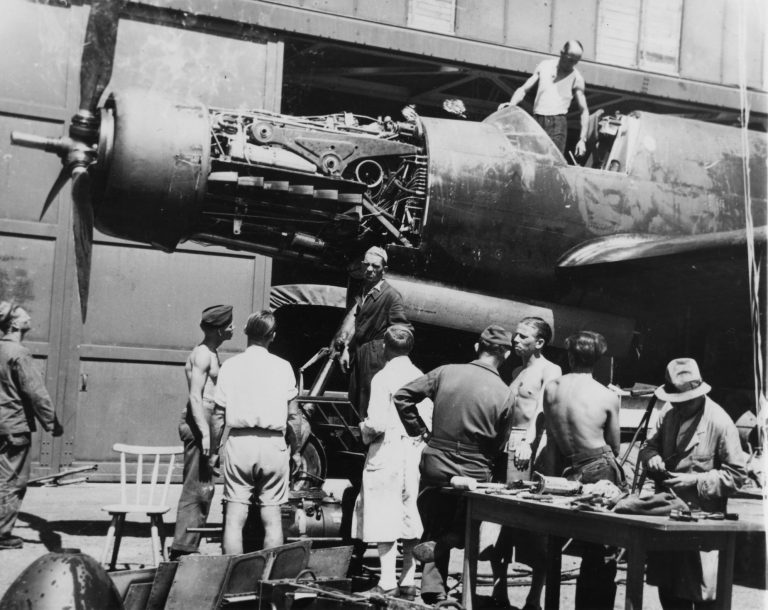
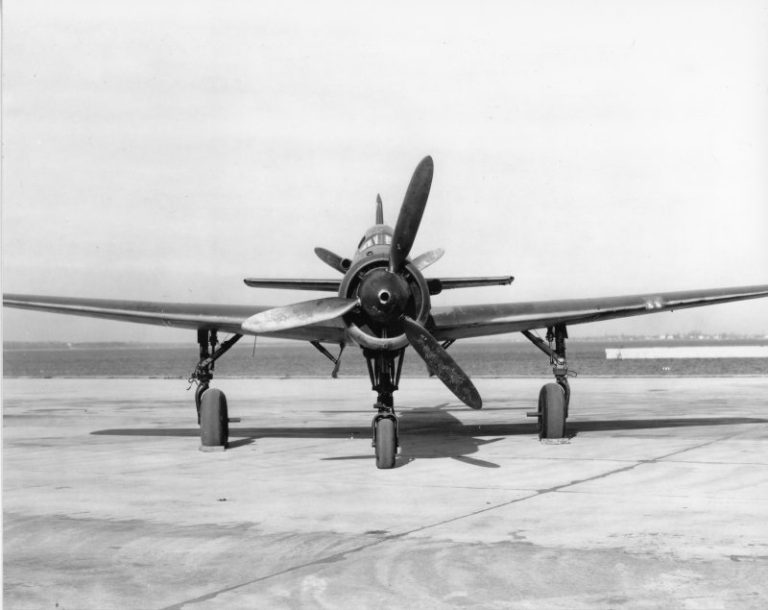
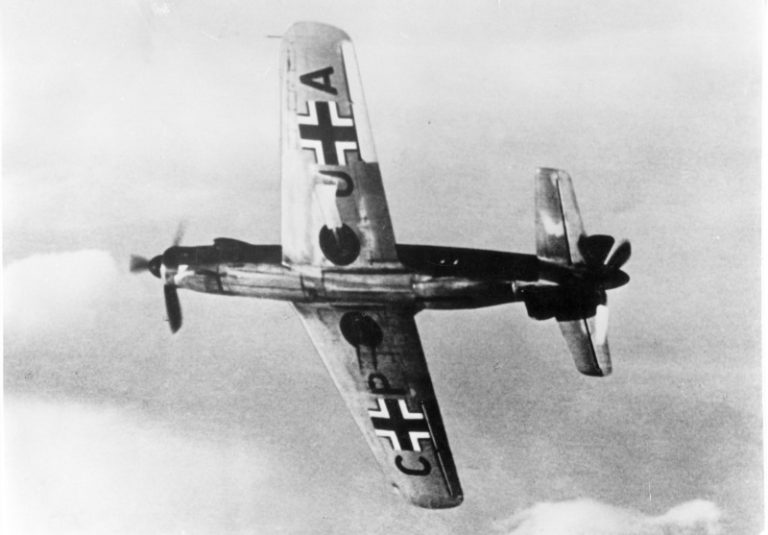
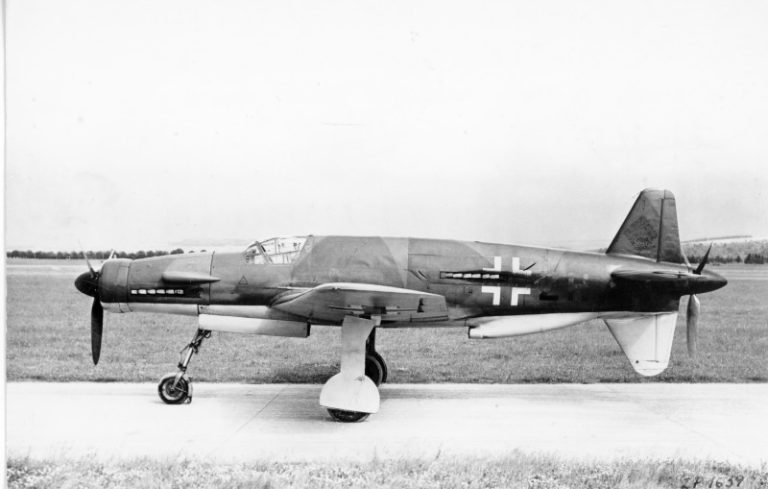
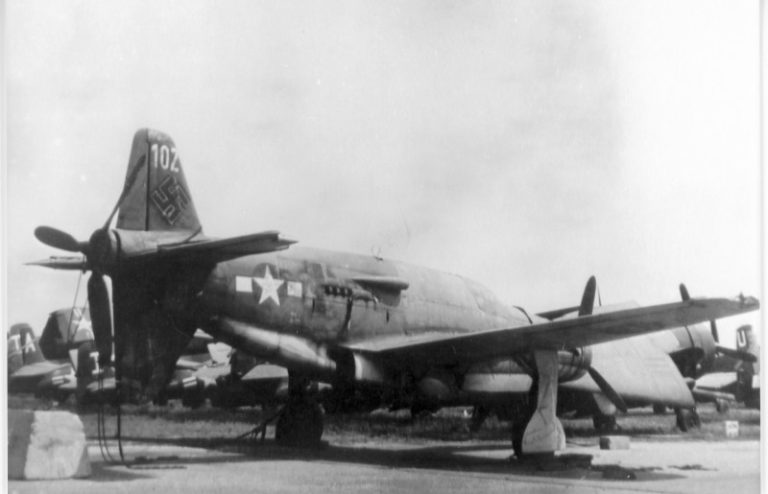
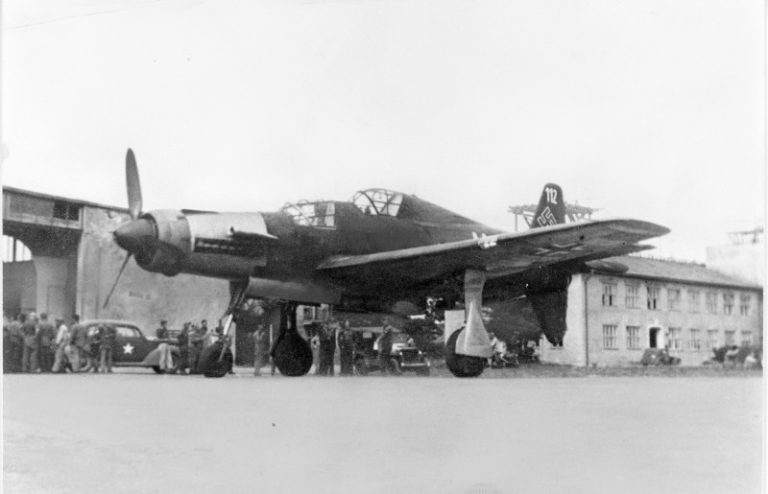
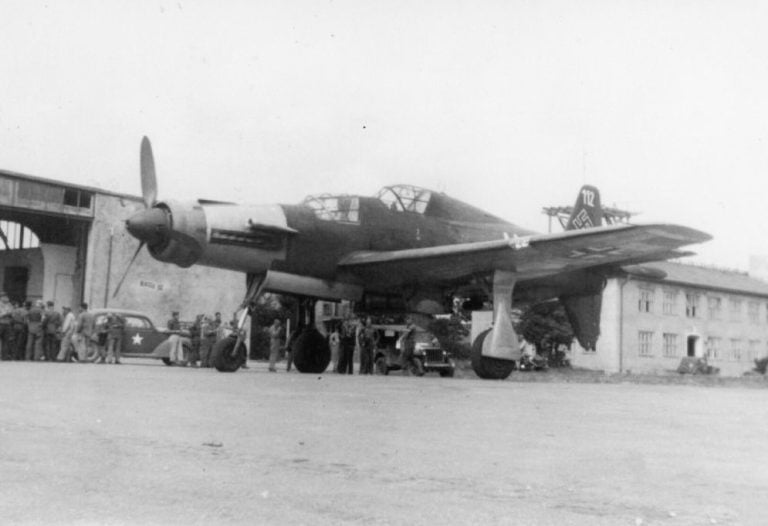
See the Arrow in context
Was the Do 335 the best piston fighter of the war — or a brilliant answer to a question the jet age had already made obsolete? This short history traces the Arrow from Dornier’s drawing board to its single surviving airframe.
Video: “Dornier Do 335 Pfeil: The Best Plane of WWII?” by IHYLS (~331,000 views). Embedded via YouTube.
Where the Pfeil was built and flown
The Pfeil, by the numbers
The Do 335 has almost no combat record — and that is precisely its story. Here was one of the most advanced fighters of the war, faster than anything the Allies could put against it, that arrived far too late and in far too small a number to matter. Its record is a measure of lost potential rather than of victories won.
The Do 335 never reached operational service in strength, and its handful of flights were largely trials and ferry sorties; the figures above reflect a fighter that was captured almost before it could fight.
Dornier Do 335 Pfeil — questions & answers
Can you fly a Dornier Do 335 today?
No. Only one Do 335 survives — a static exhibit at the Smithsonian’s Udvar-Hazy Center — and none are airworthy. If you want to fly a real fighter yourself, MiGFlug offers cockpit experiences in genuine jet fighters you can actually strap into.
Why did the Do 335 have two propellers?
It used a “centreline-thrust” layout, with one engine and propeller in the nose and a second engine driving a pusher propeller at the tail. This gave the power of a twin-engined fighter with far less drag and none of the dangerous handling if one engine failed.
Was the Do 335 really the fastest piston fighter of the war?
Yes. At roughly 770 km/h (480 mph) in level flight, the Pfeil was faster than any other piston-engined fighter of the Second World War, including the P-51 Mustang and Hawker Tempest.
Did the Do 335 ever see combat?
Effectively no. Only a few dozen were completed, and the type never reached operational units in strength. The best-documented Allied encounter, in April 1945, ended with the Do 335 simply outrunning the Tempests that spotted it.
How many Do 335s survive?
Just one complete example survives, preserved at the Smithsonian National Air and Space Museum in the United States — restored by Dornier’s own staff in the 1970s.
You can’t fly a Pfeil — but you can fly a fighter jet
The Arrow’s war belongs to history, but the thrill of flying a real fighter doesn’t. With MiGFlug you can strap into a genuine jet — from the L-39 Albatros to a MiG-29 at the edge of space — with an experienced fighter pilot beside you.
 Fly the L-39 AlbatrosThe world’s most-flown jet trainer — aerobatics included
 Fly the F-104 Starfighter“The missile with a man in it”
 Fly the MiG-21The Cold War’s most-produced jet
 Fly the T-33 Shooting StarAmerica’s first jet trainer
 Fly the DH VampireA piece of early jet history
 Fly the S.211Agile Italian jet trainer
 Fly the MB-326The classic Aermacchi jet
 Fly the MiG-15The Soviet legend of the Korean War
Related aircraft
Where these facts come from
- Smithsonian NASM — Do 335 A-0 PfeilThe sole surviving Pfeil, restored by Dornier
- San Diego Air & Space MuseumArchive photography of the type
- WW2 Weapons — Do 335 ArrowTechnical data & variants
- Imperial War MuseumsCaptured-aircraft context
Figures are drawn from museum and reference sources and cross-checked; where sources differ, the most commonly cited value is given. Production totals for the Do 335 vary between sources because so many airframes were incomplete at war’s end.