
Douglas B-66 Destroyer
The US Air Force’s twin-jet tactical bomber, reconnaissance and electronic-warfare aircraft — born from the Navy’s Skywarrior, remade for the land, and turned in Vietnam into an indispensable radar-jammer that shielded the strike packages from the SAMs.
The Story
The Douglas B-66 Destroyer: from Navy bomber to Vietnam jammer
The Douglas B-66 Destroyer is one of those Cold War aircraft that is far less famous than the work it did. Ordered as a straightforward tactical bomber for the United States Air Force in the early 1950s, it ended its career as something quite different and far more important: the electronic-warfare aircraft that, in the skies over North Vietnam, jammed enemy radar and surface-to-air missiles and helped keep American strike aircraft alive. Along the way it served as a bomber, a photographic and electronic reconnaissance platform and even a weather aircraft. It was never glamorous, and never built in large numbers, but the Destroyer earned a quiet, vital place in the history of air warfare.
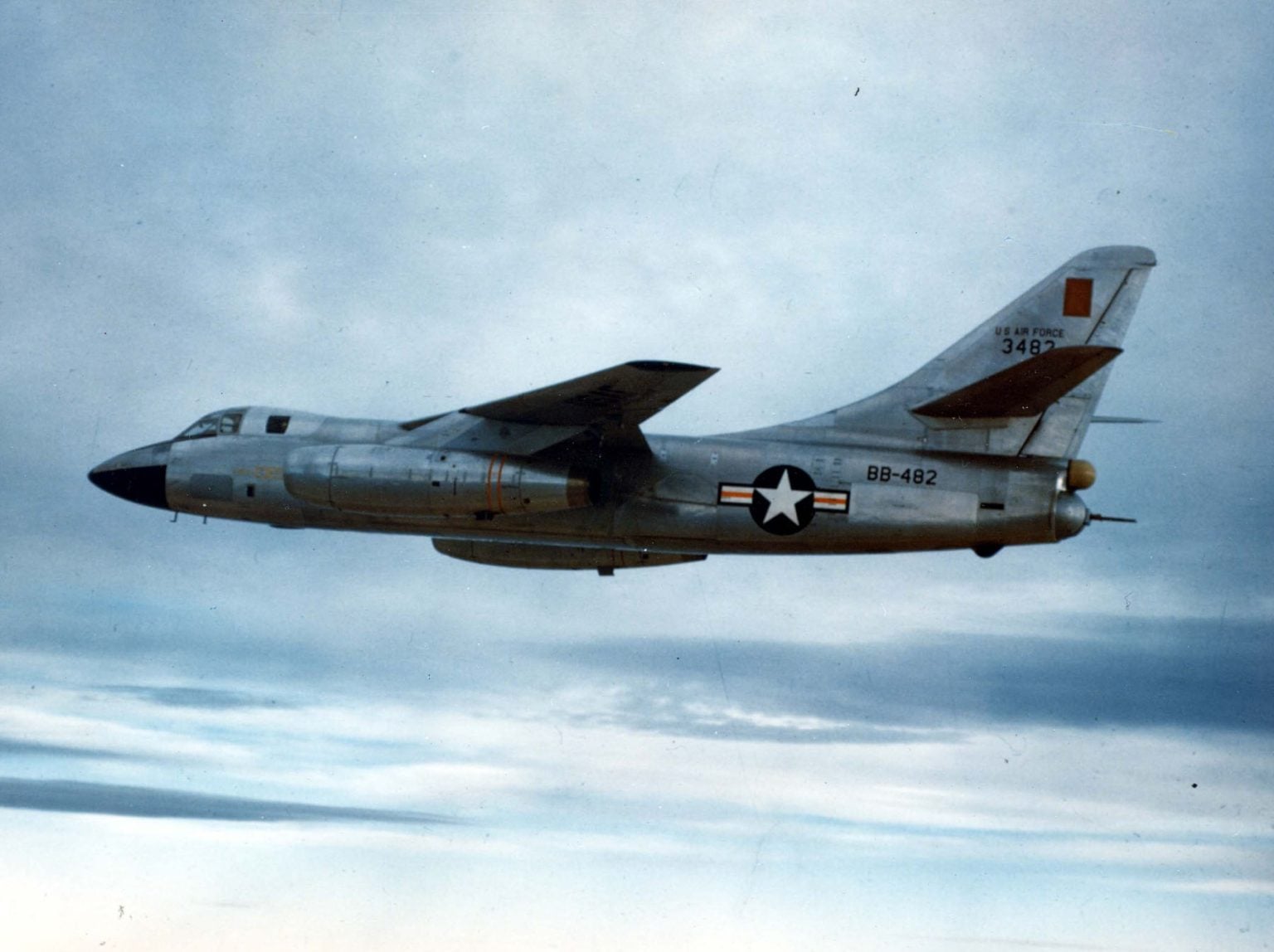
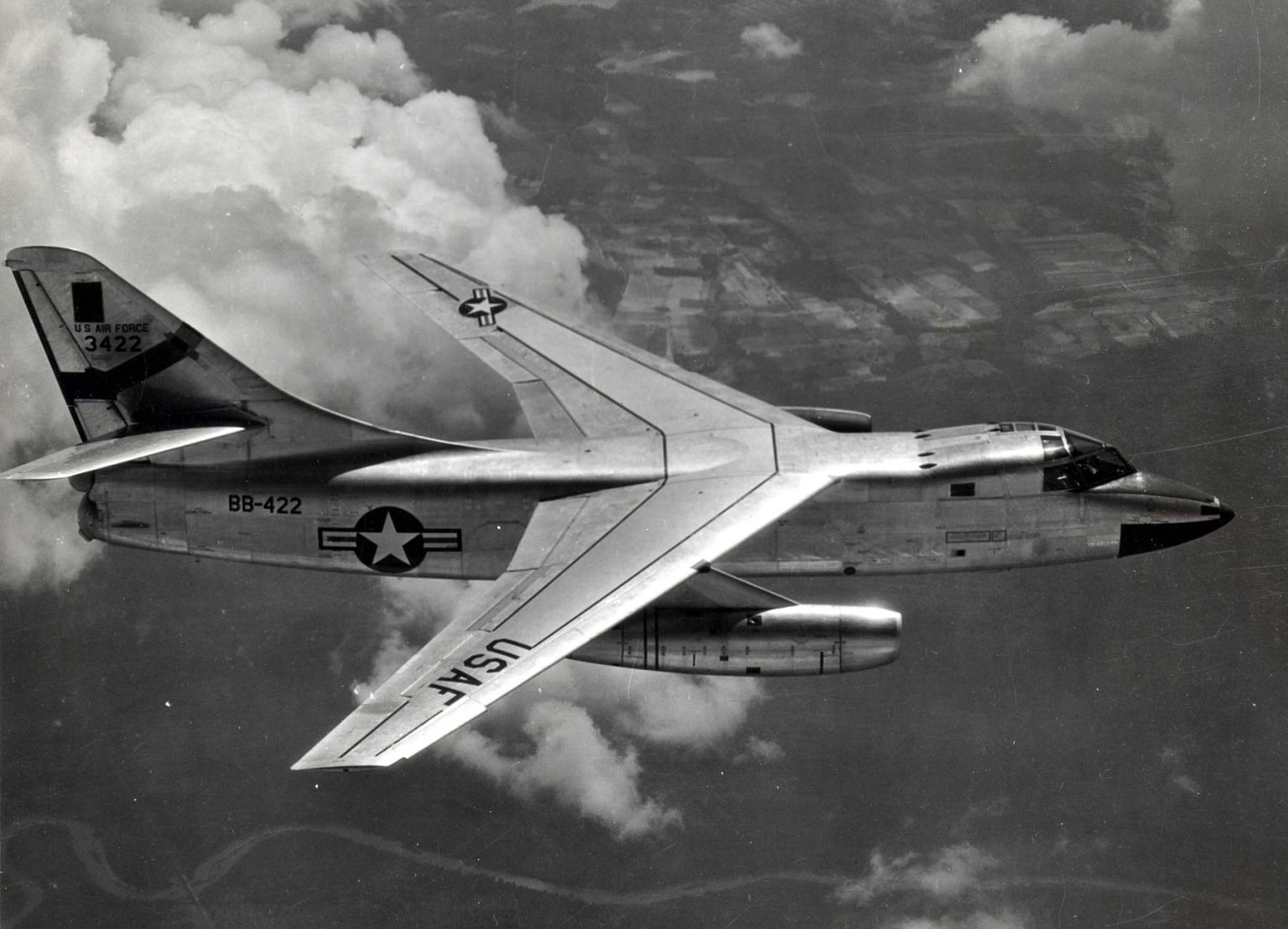
The B-66’s origins lie with a very different aircraft: the US Navy’s Douglas A-3 Skywarrior, a big carrier-based strategic bomber. When the Air Force wanted a modern twin-jet tactical bomber, adapting the existing Skywarrior looked like a fast, low-risk route to it. In practice, though, the land-based Air Force aircraft was redesigned so extensively that it shared surprisingly few parts with its naval parent. The two aircraft look like close cousins, and they share a basic configuration, but under the skin the Destroyer was very much its own machine.
There is a telling detail in the aircraft’s development: the very first Destroyer to fly, in 1954, was not a bomber at all but a reconnaissance prototype, the RB-66A. From the outset the Air Force wanted the type as much for its cameras as for its bombs, and the reconnaissance versions were developed in parallel with the bomber rather than as an afterthought. It was an early sign of where the Destroyer’s real value would lie — in gathering information, and later in manipulating the electronic spectrum, rather than in dropping ordnance.
“Built as a bomber, remembered as a jammer — the Destroyer’s finest hour came protecting other aircraft over Vietnam.”— the B-66’s place in history, in a sentence
The changes ran deep. The Destroyer used different engines — Allison J71 turbojets in place of the Skywarrior’s Pratt & Whitney units — and was given equipment for the low-level tactical mission the Air Force had in mind. Most significantly for the men who flew it, the B-66 was fitted with ejection seats for all three of its crew. The Navy’s Skywarrior famously lacked them, a grim distinction that gave that aircraft a dark reputation among its crews; the Air Force insisted its Destroyer would let its men get out. It was a humane and important difference between the two designs.
The pure bomber version, the B-66B, was actually the smallest part of the story: only a modest number were built as tactical and nuclear-capable bombers. Far more numerous, and arguably more important from the start, were the reconnaissance versions. The RB-66B was a dedicated photographic-reconnaissance aircraft, including a night-photography capability, and it formed the largest single production batch. The RB-66C was a specialised electronic-reconnaissance and intelligence aircraft, carrying extra operators to gather and analyse enemy electronic emissions. A weather-reconnaissance version, the WB-66D, rounded out the family. For much of its early career, in other words, the Destroyer was more a set of eyes and ears than a bomb-carrier.
The reconnaissance mission carried Cold War risks of its own. In one notable incident in the 1960s, an RB-66 strayed across the border into East German airspace and was shot down; its crew ejected and were held for a time before being returned. Episodes like this were a reminder that, even away from open war, the Destroyer’s reconnaissance crews operated at the tense edge of the Cold War, where a navigational error near a hostile frontier could have grave consequences.
It was the electronic side of the aircraft that would define its legacy. As the science of electronic warfare matured through the late 1950s and 1960s, the Destroyer’s roomy airframe and reconnaissance heritage made it a natural platform for jamming equipment. Reconnaissance aircraft were converted, and new-build capability added, to create the EB-66 series — aircraft packed with powerful jammers and electronic-countermeasures gear designed to blind and confuse enemy radar. When the United States went to war in Vietnam, the EB-66 was ready, and it found itself at the very centre of one of the most intense electronic battles ever fought.
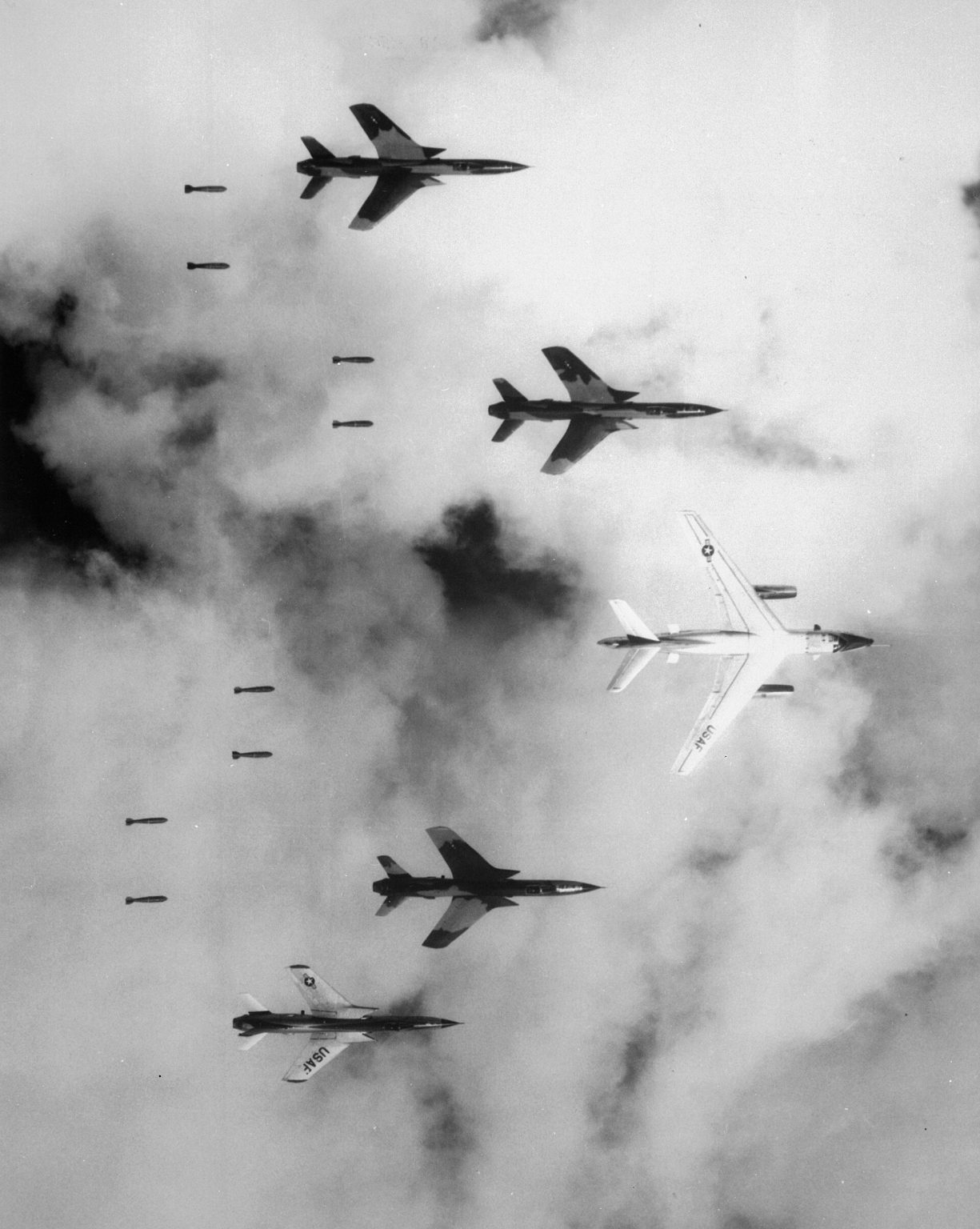
North Vietnam built one of the densest air-defence networks the world had yet seen, thick with radar-guided anti-aircraft guns and, above all, the Soviet-supplied SA-2 surface-to-air missile. American strike aircraft — F-105 Thunderchiefs and F-4 Phantoms laden with bombs — had to fly into this lethal environment day after day. The EB-66 was one of their most important protectors. Flying with the strike packages, or orbiting at stand-off distance, the Destroyers jammed the enemy’s early-warning and missile-guidance radars, degrading the defences and giving the strike crews vital warning and cover. Where the EB-66 jammed, the SAMs and radars struggled to see.
The electronic contest was never static. As the EB-66s jammed, the North Vietnamese refined their radars and tactics to work around the interference, and the Americans in turn modified their equipment and methods — changing orbits, frequencies and formations. Early in the war the Destroyers could sometimes accompany strikes fairly closely; as the missile threat grew, they were increasingly pushed to jam from safer stand-off distances. It was a running technological duel, fought in the invisible spectrum, and the Destroyer was one of its central protagonists.
This made the EB-66 a high-value target, and the North Vietnamese hunted it. The aircraft’s work took it into the heart of the defended airspace, and some were lost — to the very SA-2 missiles they existed to counter, and at least one to a MiG interceptor. The most famous of these losses came in 1972, when an EB-66 was shot down and the days-long effort to rescue its sole survivor became one of the largest and most costly search-and-rescue operations of the entire war — a story later told in books and on film, and remembered for the many lives risked, and lost, in the attempt to bring one man home. It is a sombre reminder of how dangerous the electronic-warfare mission had become.
By the standards of fighters and strategic bombers the Destroyer was not fast — a subsonic aircraft with a top speed around Mach 0.8 — and it was never intended to fight its way out of trouble. Its value lay in what it carried and what it could do to the enemy’s electronics, not in performance. That made it vulnerable, and utterly dependent on tactics and on the fighters around it, but it also made it indispensable: in the missile age, a strike package without electronic protection was a package in mortal danger.
For the crews, the electronic-warfare mission was a peculiar kind of ordeal. Where the strike pilots dived in, dropped their bombs and left, the EB-66 often had to hold a steady orbit for long minutes so its jammers could do their work — a large, unarmed, subsonic aircraft loitering near some of the deadliest air defences on earth, knowing all the while that it was a priority target. It demanded a particular sort of nerve, and the men who flew the Destroyer in that role earned a quiet respect from the strike crews whose lives their jamming helped protect.
The Destroyer’s deeper legacy lies in what it proved. The EB-66 helped establish the dedicated electronic-warfare escort as an essential part of any modern strike — the principle that specialised jamming aircraft must go in alongside the bombers if the force is to survive against radar-guided defences. That lesson, learned the hard way over North Vietnam, shaped the aircraft that came after it, from the EF-111 Raven to the carrier-borne Prowler and, later, the Growler. When those newer jammers fly today, they carry forward a doctrine the unglamorous Destroyer did much to write.
The B-66’s front-line career was relatively short. Only around 294 were built in all versions, and by the mid-1970s the survivors were worn out and being replaced by newer, more capable electronic-warfare and reconnaissance aircraft. The type was retired, its Vietnam service its lasting monument. A number of Destroyers are preserved today in museums in the United States, the only country ever to operate the type, where they stand as reminders of an aircraft that did difficult, dangerous and largely unseen work — the bomber that became a jammer, and helped a generation of American aircrew survive the deadliest air defences of their war.
01From Skywarrior to Destroyer: the A-3 origin+
The B-66 began as an adaptation of the US Navy’s Douglas A-3 Skywarrior, a large carrier-based strategic bomber. When the US Air Force wanted a modern twin-jet tactical bomber in the early 1950s, taking the proven Skywarrior design and reworking it for land-based use promised a quicker, cheaper path than an all-new aircraft.
The two aircraft are close relatives and share a family resemblance — a shoulder-mounted swept wing, two podded engines and a glazed nose — but the B-66 was intended for a different service, a different basing concept and a different mission. That gap between the two, greater than it first appears, shaped everything about the Destroyer’s design.
02So redesigned it shared few parts+
Although it looks like a Skywarrior, the B-66 was redesigned so thoroughly for Air Force tactical use that it ended up sharing surprisingly few components with its naval parent. It received different engines, a revised structure freed from the demands of carrier operations, and equipment tailored to the low-level tactical role the Air Force envisaged.
This is a common point of confusion: the A-3 and B-66 are often assumed to be near-identical, but they are better thought of as separate aircraft from a common ancestor. What began as a straightforward adaptation became, in effect, a new design — a reminder of how different the Navy’s carrier world and the Air Force’s land-based world really were.
03Ejection seats for all three crew+
One of the most significant differences between the Destroyer and the Skywarrior was a matter of life and death. The Navy’s A-3 famously lacked ejection seats, its crews relying on a bail-out hatch that was notoriously hard to use in an emergency — a shortcoming that earned the aircraft a dark nickname among the men who flew it.
The Air Force would not accept that. The B-66 was fitted with ejection seats for all three of its crew, giving them a real chance of escape if the aircraft was hit or failed. In an era when the electronic-warfare mission would take the Destroyer into the most heavily defended airspace on earth, that decision mattered enormously, and it stands as one of the clearest distinctions between the two related designs.
04The B-66B tactical and nuclear bomber+
The version that gave the aircraft its designation — the pure bomber, the B-66B — was in fact the smallest part of the family. A modest number were built as tactical bombers, capable of carrying conventional or nuclear weapons in an internal bomb bay, intended to strike battlefield and interdiction targets in a European war.
In the event, the bomber role was overshadowed almost from the start by the reconnaissance and, later, electronic-warfare versions. The Destroyer is one of those aircraft whose name reflects its original intent rather than its actual career: designated a bomber, it is remembered far more for reconnaissance and, above all, for jamming.
05The RB-66: reconnaissance, the most important early role+
From the beginning, reconnaissance was arguably the Destroyer’s most important role. The RB-66B was a dedicated photographic-reconnaissance aircraft, and it was built in the largest numbers of any version — carrying cameras for day and, notably, night photography, using photo-flash equipment to illuminate targets in darkness.
This gave the Air Force a fast, jet-powered tactical reconnaissance capability at a time when knowing what lay over the next ridge, or behind enemy lines, was vital. For much of its early service the Destroyer earned its keep not by dropping bombs but by bringing back film, and the RB-66 was the backbone of US tactical photo-reconnaissance in the later 1950s.
06The RB-66C: electronic reconnaissance and intelligence+
Alongside the camera-carrying RB-66B came a very different, more secretive version: the RB-66C, a specialised electronic-reconnaissance and intelligence aircraft. Instead of cameras it carried receivers and analysis equipment, and a larger crew of electronic-warfare operators, to detect, locate and study enemy radar and electronic emissions.
The RB-66C was the aircraft that first turned the Destroyer decisively toward the electronic mission. Gathering the electronic order of battle — mapping where enemy radars were and how they worked — was essential intelligence in the Cold War, and it laid the groundwork for the jamming role the type would take on in Vietnam. These aircraft were the ancestors of the EB-66 jammers.
07The WB-66D weather-reconnaissance version+
The Destroyer family even included a weather aircraft, the WB-66D. Fitted with meteorological equipment, these aircraft gathered weather data over potential operational areas — information that was crucial for planning strike and reconnaissance missions, since weather could make or break an operation.
The WB-66D is a reminder of how versatile the basic airframe proved to be. A design conceived as a tactical bomber was adapted into photo-reconnaissance, electronic-reconnaissance and weather roles, each drawing on the aircraft’s range, speed and internal volume. The weather version was a small part of the fleet, but it rounded out a remarkably broad family of variants.
08The EB-66: electronic warfare is born+
The Destroyer’s defining role emerged as the science of electronic warfare matured. The aircraft’s spacious airframe, generous power and reconnaissance heritage made it an ideal platform for the bulky, power-hungry jamming equipment of the era. Reconnaissance aircraft were converted and capability was expanded to create the EB-66 series — dedicated electronic-warfare and countermeasures aircraft.
The EB-66 carried powerful jammers designed to swamp enemy radar with noise, along with equipment to detect and analyse threats. Its job was not to destroy the enemy but to blind him — to deny his radar operators a clear picture and his missiles a clean lock. As American involvement in Vietnam deepened, this capability would prove not merely useful but essential.
09Vietnam: jamming radar and the SAMs+
North Vietnam assembled one of the densest and most modern air-defence systems the world had yet seen: layered radar-guided guns, interceptors and, most dangerous of all, the Soviet SA-2 surface-to-air missile. Into this the United States had to send waves of strike aircraft, and the EB-66 became one of their key protectors.
Flying with the strike force or orbiting at stand-off range, the EB-66s jammed the enemy’s early-warning and missile-guidance radars, degrading the defences and buying the strike crews time and warning. In the cat-and-mouse of measure and countermeasure that followed — as the North Vietnamese adapted their tactics and the Americans adapted their jamming — the Destroyer sat at the heart of one of the most intense electronic-warfare campaigns in history.
10Escorting the strike packages+
The EB-66 rarely worked alone; it was woven into the strike “package” — the carefully organised formation of bombers, fighters, defence-suppression aircraft and support aircraft that went into North Vietnam together. The Destroyer’s jamming was one layer of protection among several, coordinated with the flak-suppressing “Wild Weasel” aircraft and the fighter escort.
This made the EB-66 a force multiplier: a single jammer could help protect many aircraft at once. But it also tied the Destroyer’s fortunes to the package it served — it had to be there, in the danger zone, when the strike went in. The electronic-warfare crews flew some of the most demanding and least visible missions of the air war, their success measured in the strike aircraft that came home.
11A high-value target: losses, and the 1972 rescue+
Because the EB-66 was so valuable, the North Vietnamese did their utmost to destroy it, and the mission took the aircraft into the most dangerous airspace of the war. Some Destroyers were lost — to the very SA-2 missiles they were built to counter, and at least one to a MiG interceptor. The electronic-warfare aircraft, for all its power, could not always protect itself.
The most famous loss came in 1972, when an EB-66 was shot down and the effort to rescue its sole survivor grew into one of the largest and most costly search-and-rescue operations of the whole war, later recounted in books and on film. Many aircraft and aircrew were risked, and lives were lost, in the days-long attempt to bring one downed airman home. The episode is remembered with great respect, and it stands as a stark measure of the risks the Destroyer’s crews accepted.
12The Allison J71 and the aircraft’s performance+
The Destroyer was powered by two Allison J71 turbojets, mounted in underwing pods. They gave the aircraft respectable range and a top speed of around Mach 0.8 — subsonic, in keeping with a tactical bomber and reconnaissance aircraft of its generation rather than a fighter.
The J71 was not the most celebrated of engines, and the Destroyer was never a high-performance aircraft. But raw speed was not the point. Its worth lay in its payload, its sensors and, above all, its jammers. In the electronic-warfare role the EB-66 needed endurance and electrical power far more than it needed speed, and the aircraft delivered what its mission actually demanded.
13Retirement and surviving Destroyers+
The B-66’s career was relatively short. Only around 294 were built across all versions, and by the mid-1970s the surviving aircraft were worn out and increasingly outclassed. They were retired as newer electronic-warfare and reconnaissance aircraft took over the mission, ending the Destroyer’s two decades of service.
A number of Destroyers are preserved today, all in the United States — the only country ever to operate the type. Examples can be seen in American aviation museums, including the National Museum of the United States Air Force, where they represent an aircraft whose importance far outran its fame: the tactical bomber that became one of the most important electronic-warfare aircraft of the Vietnam War.
Design & Engineering
How the Destroyer was built: a Skywarrior remade for the land
The B-66 took the layout of the Navy’s Skywarrior and reworked it so thoroughly — new engines, ejection seats, tactical and electronic equipment — that it became a distinct aircraft, and ultimately a first-rate jamming platform.
Skywarrior roots, new machine
A shoulder-wing twin-jet derived from the A-3 Skywarrior, but redesigned so heavily for land-based Air Force use that it shared few parts with its naval parent.
Seats that saved lives
Unlike the Skywarrior, the Destroyer gave all three crew ejection seats — a humane, vital difference for an aircraft bound for the deadliest airspace of Vietnam.
A platform for electronics
Roomy, powerful and long-ranged, the airframe proved ideal for cameras, sensors and above all the bulky jammers that made the EB-66 indispensable.
Specifications
Douglas B-66 Destroyer specifications: dimensions, performance and cost
Baseline: the Douglas B-66B Destroyer as delivered to Tactical Air Command and to USAFE from 1956 — two Allison J71 turbojets, a 6,800 kg internal weapons bay, a radar-directed twin 20 mm tail barbette and a crew of three — because it is the mark the published specification tables describe, and because it is the airframe from which the Vietnam-era EB-66B and EB-66E jammers were cut. Deltas for the five pre-production RB-66A, the 145 RB-66B night photo-reconnaissance aircraft, the 36 RB-66C electronic reconnaissance aircraft, the 36 WB-66D weather machines, the EB-66B/C/E electronic warfare conversions and the two X-21A laminar-flow testbeds are in grey. Five cautions before the figures. First, the production total. Five RB-66A, 145 RB-66B, 72 B-66B, 36 RB-66C and 36 WB-66D come to 294, which is the number nearly every authority gives; the English Wikipedia variant list currently says 149 RB-66B, which would make 298 and does not reconcile with its own total. Take 294 and treat 149 as a slip. Second, the description "tactical bomber" fits fewer than a quarter of the aeroplanes built. Only 72 B-66B bombers were completed out of 141 ordered, the other 69 cancelled, and the type spent the overwhelming majority of its nineteen-year career carrying cameras, receivers and transmitters rather than bombs. Calling the B-66 a bomber is accurate about its designation and misleading about its life. Third, the performance below is clean-airframe, standard-day, best-case manufacturer data. An operational Destroyer flew with a bomb bay full of vacuum-tube transmitters, wingtip antenna pods that ruined the span loading, and, in Southeast Asia, an orbit it was not allowed to leave; nobody in the 42nd Tactical Electronic Warfare Squadron saw 548 knots. Fourth, the aeroplane is universally introduced as a minimally modified A3D Skywarrior, and that is the single most misleading sentence written about it. The fuselage was redesigned, the wing was redesigned, the undercarriage was redesigned, the engines were changed for worse ones and the accessory drives were relocated; Bill Gunston and Peter Gilchrist concluded that an objective assessment might find 98 per cent of the changes unnecessary. The commonality between an A3D and a B-66 is roughly the wingspan and the general idea. Fifth, the B-66 has a bad safety reputation and it is largely deserved, but a consolidated USAF Class A mishap rate for the type is not available in open sources; what follows says what is documented and declines to invent a rate.
Dimensions & weights
- Crew
- 3 — pilot, navigator/bombardier and a third man who worked the tail guns The third seat is the whole story of the type in miniature. In the B-66B he was a gunner aiming a radar-laid barbette he almost never fired. In the RB-66B he ran the cameras. In the RB-66C and EB-66C the former bomb bay became a pressurised compartment holding four electronic warfare officers — Ravens — taking the crew to seven, and in the WB-66D two weather observers took the crew to five. The airframe was a container, and what went in it changed more often than the aeroplane did.
- Length
- 22.91 m (75 ft 2 in) The A3D-2 was 23.27 m (76 ft 4 in). Almost, but not quite, the same aeroplane — which is the pattern throughout.
- Wingspan
- 22.10 m (72 ft 6 in) Identical to the A3D, and one of the very few dimensions that genuinely carried across. The wing itself did not: the USAF machine had a new structure sized for low-level work the Navy aeroplane was never asked to do, and the carrier wing-fold and folding fin were deleted, along with the arrester hook and catapult fittings.
- Height
- 7.19 m (23 ft 7 in) Against 6.95 m (22 ft 9.5 in) for the A3D, the difference being the deleted folding fin and revised undercarriage.
- Wing area
- 72.5 m² (780 sq ft) The A3D wing measured 75.4 m² (812 sq ft). Same span, thirty-two square feet less area: conclusive evidence, if any more were needed, that the wing was drawn again rather than adapted.
- Wing sweep
- 35° at quarter chord The standard American answer of the period, shared with the B-47, the B-52 and the A3D. It bought Mach 0.85 and cost a great deal of low-speed lift, which is why the approach was fast and the runway requirement long.
- Aspect ratio
- 6.7 Derived from span and area. High for a combat aeroplane and exactly right for what the B-66 actually became: a machine built to loiter for hours holding a jamming orbit, not to fight.
- Empty weight
- 19,300 kg (42,549 lb) Some 1,400 kg heavier than an empty A3D-2 at 17,876 kg (39,409 lb), for an aeroplane a foot shorter with a smaller wing. The extra mass is ejection seats, land-based structure, relocated accessories and USAF avionics.
- Gross weight
- 26,218 kg (57,800 lb)
- Maximum take-off weight
- 37,648 kg (83,000 lb) Ed Heinemann fought the US Navy down from a 100,000 lb requirement to a 68,000 lb aeroplane so it would fit existing carrier decks. The land-based derivative promptly grew past 83,000 lb, because nothing on an Air Force base cares what a lift can take. The discipline that made the A3D remarkable was thrown away the moment the aeroplane came ashore.
- Fuel and disposable load
- 18,348 kg (40,451 lb) between empty and maximum take-off weight Derived, and quoted because published internal fuel figures for the B-66 vary between sources by enough that no single number deserves to be printed as fact. What the figure does establish is that roughly half the Destroyer’s maximum weight was fuel and mission equipment — a very high fraction for the mid-1950s and the reason the airframe absorbed jamming suites nobody had imagined when it was drawn.
- Internal weapons bay
- 6,800 kg (15,000 lb) capacity Against 12,000 lb for the A3D. In the ECM variants the bay stopped being a weapons bay altogether: in the RB-66C and EB-66C it held the pressurised Raven compartment, and in the EB-66B and EB-66E it held transmitters. No B-66 that mattered in Vietnam could carry a bomb.
- Undercarriage
- Retractable tricycle gear, steerable nosewheel, no arrester hook Redesigned outright rather than de-navalised, with new door geometry — one of the changes Gunston and Gilchrist counted among the unnecessary ones. There was no catapult fitting and no hook: whatever else the B-66 was, it could not go back to sea.
Performance
- Maximum speed
- 1,015 km/h (631 mph, 548 kn) at 1,800 m (6,000 ft) Note the altitude at which the figure is quoted. This is a low-level number, not a high-altitude one, and it reflects what the aeroplane was restructured to do: run in fast and low under a radar horizon with a tactical nuclear weapon. It is also comfortably faster than the B-57 it was meant to supplement.
- Corresponding Mach number
- About Mach 0.87 at that height Derived from the quoted true airspeed and the standard-atmosphere speed of sound at 6,000 ft. The airframe was a subsonic one and no version of it was ever supersonic; the swept wing bought high subsonic cruise, not a dash through the transonic.
- Cruise speed
- 850 km/h (528 mph, 459 kn)
- Rate of climb
- 25.4 m/s (5,000 ft/min) at sea level Adequate at gross weight and clean. On one engine at heavy weight it was not, and that is the beginning of the Destroyer’s accident story rather than the end of it.
- Service ceiling
- 12,010 m (39,400 ft) Some 3,000 ft below the A3D on more thrust-hungry engines. The J71 swap cost altitude as well as range.
- Typical jamming orbit, Southeast Asia
- About 9,150 m (30,000 ft) The altitude at which Bat 21 was flying when an SA-2 reached it on 2 April 1972. A standoff jammer must be high to see over the terrain into the enemy radar’s beam, must be steady to keep its antennas pointed, and must therefore fly a predictable racetrack. Every one of those requirements is also a targeting solution for a surface-to-air missile battery, and the EB-66’s entire tactical problem is contained in that sentence.
- Combat range
- 1,448 km (900 mi, 782 nmi)
- Combat radius
- ~700 km (~380 nmi) unrefuelled Derived and approximate. The A3D had demonstrated an unrefuelled combat radius of nearly 1,000 miles, which was the performance that persuaded the USAF to want a land-based version in the first place. The B-66 did not match it, because the J71 burned more fuel than the J57 to produce less thrust.
- Ferry range
- 3,974 km (2,470 mi, 2,146 nmi) Which is why trans-Pacific deployments needed tankers, and why Operation Mobile Zebra went the way it did in November 1957: nine B-66s set out from California for the Philippines and three arrived, the rest defeated by missed tanker rendezvous and mechanical failures. It is the single best-documented episode in the type’s reliability record and it is not a flattering one.
- Wing loading
- 362 kg/m² (74.1 lb/sq ft) at gross weight High for the period, and the direct cause of a fast approach. Combined with a swept wing that lost lift abruptly and two engines whose thrust response was leisurely, this produced an aeroplane with very little margin in the landing configuration.
- Thrust-to-weight
- 0.35 at gross weight Derived: 20,400 lbf against 57,800 lb. At maximum take-off weight it falls to 0.25, which is the figure that matters on a hot day at the end of a long runway with one engine failing.
- Asymmetric performance
- Poor, and the type’s persistent weakness Two engines slung well outboard on a swept wing, high wing loading, an unspectacular thrust margin and a heavy airframe give an aeroplane in which an engine failure at low speed and high weight is a serious emergency rather than an inconvenience. The B-66 at least gave its crews ejection seats, which the A3D never did — Navy crews called the Skywarrior "All Three Dead" for exactly that reason — and that single change is the most valuable thing the USAF redesign produced.
- Low-level capability
- Structurally cleared for sustained low-altitude operation This was the requirement that forced most of the redesign, because the A3D was drawn as a high-altitude carrier bomber and low-level flight loads the structure in the opposite sense. It also meant the RB-66B could do the night photo-reconnaissance job at heights where flash illumination worked, which is what made it the USAF’s primary night photographic aeroplane for a decade.
Propulsion & systems
- Engines
- Two Allison J71-A-11 axial-flow turbojets, the J71-A-13 on later production The single worst decision in the programme. The A3D flew on Pratt & Whitney J57s and flew well on them; the USAF specified the Allison J71, an engine that produced less thrust, consumed more fuel and, in Gunston and Gilchrist’s judgement, offered no apparent advantage whatever. It cost the B-66 range, ceiling and single-engine margin, and it bought nothing.
- Rated thrust
- 45.4 kN (10,200 lbf) each, dry Against 10,500 lbf dry for the A3D’s J57-P-10, and 12,400 lbf with water injection. The Skywarrior therefore had up to a fifth more thrust available on take-off than the aeroplane that was supposed to be its cheap derivative.
- Engine installation
- Underwing pylon-mounted pods Carried over in concept from the A3D and one of the few genuinely sensible pieces of continuity: podded engines are easy to change, easy to inspect and keep the fire risk outside the wing structure. It is also why a pair of X-21A airframes could be re-engined with General Electric J79s without touching the fuselage.
- Accessory drives
- Hydraulic pumps and generators moved to engine-mounted pads The A3D drove its accessories from fuselage-mounted units on engine bleed air. The USAF wanted them on the engines. It works, it is arguably better practice, and it is precisely the sort of change that turns a "minimal modification" into a new aeroplane while nobody is counting.
- Escape system
- Upward-firing ejection seats for all crew The most important difference between the B-66 and the A3D, and the only major change that unambiguously earned its cost. All three men of the RB-66C shot down over East Germany on 10 March 1964 got out; Lieutenant Colonel Iceal Hambleton got out of Bat 21 over Quang Tri in 1972. Neither would have been possible in a Skywarrior.
- Radar and bombing system
- AN/APS-27 search and navigation radar with the K-5 bombing-navigation system Conventional American tactical fit of the mid-1950s, adequate for radar bombing and for low-level navigation at night, and thoroughly obsolete by the time the surviving airframes were fighting in Southeast Asia.
- Tail defence
- Remotely operated, radar-directed barbette with two 20 mm M24A1 cannon A rear-facing turret aimed from inside the pressure cabin by a crewman watching a scope — the same philosophy as the A3D’s Aero 21 installation and the B-52’s tail guns. It was deleted from every electronic warfare conversion, and the space and weight went to transmitters.
- Photographic fit, RB-66B
- Multi-camera installation in the former weapons bay with night photoflash illumination The RB-66B was the USAF’s principal night photographic reconnaissance aeroplane through the late 1950s and early 1960s, and at 145 aircraft it was by a wide margin the most numerous version built. The bomber the type is named after was outnumbered two to one by the camera aeroplane.
- Electronic reconnaissance fit, RB-66C
- Pressurised four-station operator compartment in the weapons bay, plus wingtip antenna pods The distinguishing recognition feature of the C model, and a genuine first: the RB-66C is usually credited as the first American aeroplane designed from the outset as a dedicated electronic intelligence platform rather than converted into one. Several deployed around Cuba during the missile crisis of October 1962 to map Soviet radar emissions.
- Jamming fit, EB-66B and EB-66E
- Banks of ALT-series noise jammers in the former weapons bay, with chaff dispensing Exact fits varied continuously through the war as the SA-2’s Fan Song guidance radar was modified and re-modified; the whole point of an electronic warfare aeroplane is that its equipment list is never stable. What did not vary was the power available: a big airframe with two engines driving big generators could radiate far more jamming power than any pod hung on a fighter, and that is the EB-66’s entire reason for existing.
- Weather fit, WB-66D
- Crew compartment rebuilt for two weather observers with atmospheric sampling and sounding equipment Thirty-six built, an unglamorous variant and an obscure one, and it is worth remembering why it existed: tactical nuclear strike planning depended on knowing winds and cloud along the route, and in 1956 there was no other way to get that data over hostile ground.
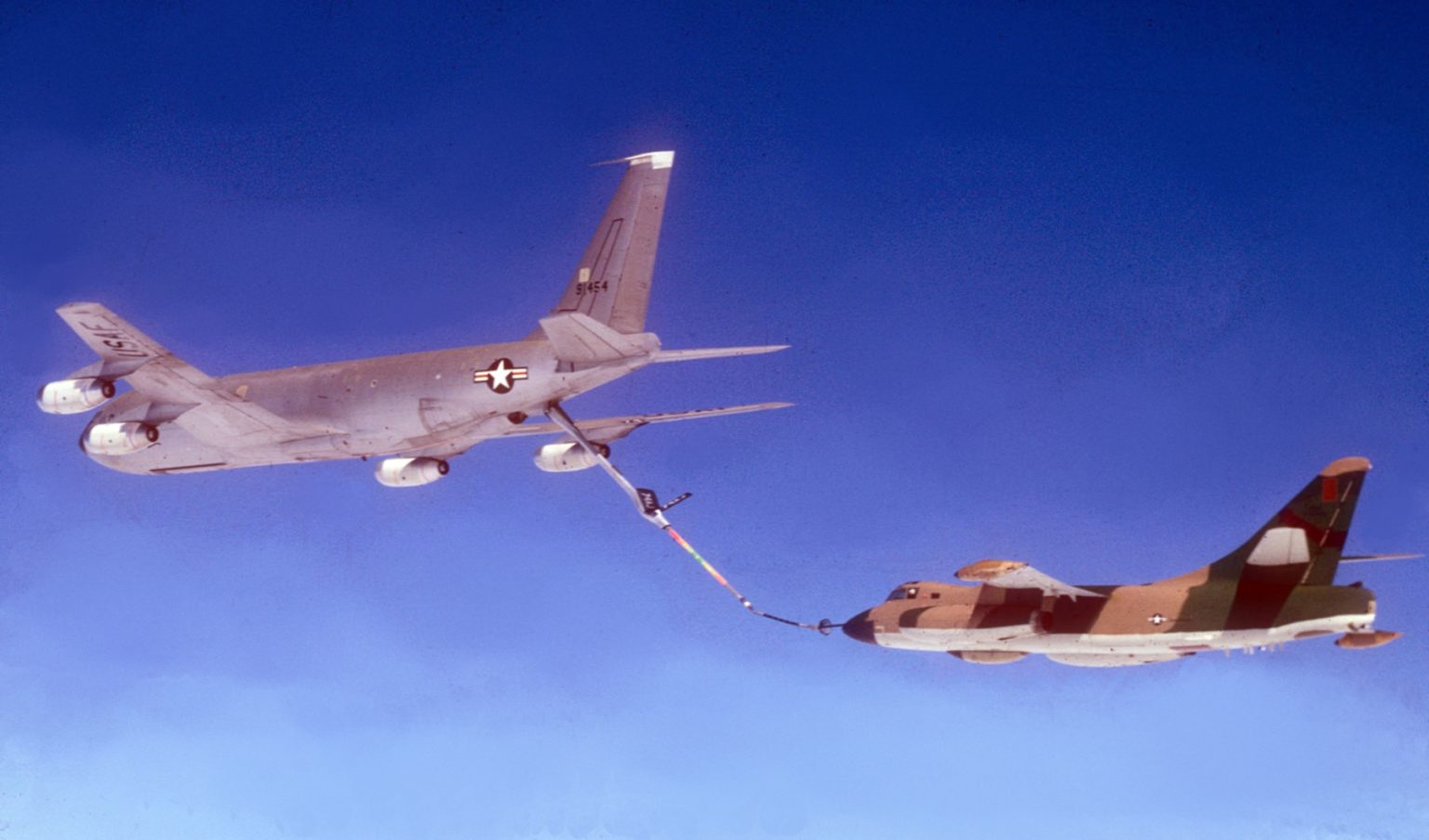
- In-flight refuelling
- Fitted, and essential for any deployment beyond theatre range Mobile Zebra in 1957 demonstrated how thin the margin was: on a tanker-dependent Pacific crossing, two-thirds of the formation failed to arrive.
- X-21A laminar-flow wing
- Entirely new suction wing with roughly 800,000 spanwise slots, General Electric J79 engines Two WB-66D airframes, 55-0408 and 55-0410, rebuilt by Northrop and flown from April 1963. Bleed air from the J79s fed underwing turbines that sucked the boundary layer through the slots. It worked in clean air and stopped working the moment the slots met insects, dust, rain or ice crystals — the finding that killed practical laminar-flow control for a generation, and an honest negative result worth more than most positive ones.
14The Destroyer’s variants, from B-66B to EB-66+
The Destroyer family was small in numbers but broad in role. The B-66B was the pure bomber; the RB-66A and RB-66B were photographic-reconnaissance aircraft; the RB-66C was an electronic-reconnaissance and intelligence version with a larger crew; and the WB-66D was a weather-reconnaissance aircraft. The largest single batch was the camera-carrying RB-66B.
Later, many of the reconnaissance aircraft were converted into the EB-66 electronic-warfare series — the B, C and E jamming variants that saw such intense use over Vietnam. This progression, from bomber to reconnaissance aircraft to dedicated jammer, traces the Destroyer’s evolution from its intended role to the one for which it is actually remembered.
15The Douglas B-66’s cost: what the records show+
As with most 1950s military aircraft, there is no single reliable, transparent public figure for the B-66’s unit cost, cost per flight hour or total programme cost. It was procured through Air Force contracts in the mid-1950s, and consistent lifetime cost data for a type produced in modest numbers and repeatedly reconfigured is not available in a usable form.
Rather than repeat an invented figure, we list the cost fields here as “not reliably recorded.” What can be said is that the Destroyer was a specialised aircraft built in relatively small numbers — around 294 of all versions — and that its later electronic-warfare conversions represented a further significant investment in capability that proved its worth many times over in Vietnam.
16B-66 versus A-3 Skywarrior: telling them apart+
The B-66 and the A-3 Skywarrior are frequently confused, and understandably so — they share a designer, a basic layout and a strong family resemblance. But they are separate aircraft. The A-3 was a US Navy carrier-based strategic bomber; the B-66 was a US Air Force land-based tactical aircraft, and it was redesigned so heavily that it shared few actual parts with the Navy machine.
The key practical differences: the B-66 had different engines, structure suited to land rather than carrier operation, tactical mission equipment and, crucially, ejection seats for all its crew — which the A-3 lacked. Think of them as close cousins rather than the same aircraft in different colours. The Navy flew the Skywarrior; the Air Force flew the Destroyer.
17Surviving B-66 Destroyers and where to see them+
Because the type was built in modest numbers, retired decades ago and flown only by the United States, surviving Destroyers are relatively rare and are found in American museums. Preserved examples — including electronic-warfare and reconnaissance variants — can be seen at US aviation collections, among them the National Museum of the United States Air Force.
These survivors are valuable precisely because the aircraft was never famous. They preserve the memory of a type that did essential, largely unseen work — the reconnaissance flights, and above all the electronic-warfare missions over Vietnam that helped so many other aircraft survive. For anyone wishing to see a Destroyer, the United States is the place.
Armament & payload
The Destroyer’s decisive payload was not a weapon but a transmitter
The B-66B was armed as a tactical bomber of its decade: a 15,000 lb internal bay for conventional or nuclear stores, and a radar-directed pair of 20 mm cannon in the tail to discourage a stern attack. It fired those cannon in anger essentially never, and it dropped bombs in anger never at all. What the airframe turned out to be extraordinarily good at was carrying electrical power and volume to altitude and holding them there, and by 1965 that had become the more valuable capability by a distance: an EB-66 flew into North Vietnamese airspace with no gun, no missile and no bomb, and made the difference between a Thunderchief strike package getting through and a Thunderchief strike package being cut to pieces. Fits varied continuously by mark, by squadron and by month, and the jamming equipment lists in particular were classified at the time and are still incompletely published; treat any single tabulated EB-66 fit as a snapshot rather than a standard.
Gun
- Two 20 mm M24A1 cannon in a remotely operated tail barbette, aimed by radar from a station inside the pressure cabin.
- Defensive only, rear hemisphere only. There was no forward-firing armament of any kind on any B-66.
- Deleted from every electronic warfare conversion. On the EB-66B, EB-66C and EB-66E the guns came out and the gunner’s trade disappeared into the electronic warfare officer’s.
- The installation was a straight descendant of the A3D’s tail turret, and the US Navy had reached the same conclusion first: it removed the Skywarrior’s guns in favour of countermeasures equipment.
Air-to-air
- None. The B-66 never carried an air-to-air missile and was never intended to.
- The tail barbette was the whole of its air-to-air capability, and against a MiG-21 closing from the rear quarter with a missile it was decoration.
- The EB-66 solved the problem by not attempting to solve it: jamming orbits were flown under F-4 Phantom escort, and when escort was thin the orbits moved back.
- Over the course of Rolling Thunder and again in 1972, the standoff orbits were pushed progressively further from the target — out over Laos, out over the Gulf of Tonkin — because the airframe had no answer to a fighter or a missile that reached it.
Air-to-surface guided
- None, on any variant, at any point in the type’s career. This is the most consequential blank in the table.
- An RB-66C or EB-66C could locate, identify and classify a Fan Song guidance radar with precision, and could then do nothing to it but jam it.
- No AGM-45 Shrike, no AGM-78 Standard ARM. Killing SAM radars was the Wild Weasel’s job, flown by F-100F, F-105F/G and later F-4C aircraft; the Destroyer was the other half of a two-part system and never the shooting half.
- The division of labour was deliberate and it was sound. It also meant the EB-66 had to be in the threat envelope, unable to shoot back, for as long as the strike package needed cover.
Bombs
- Up to 6,800 kg (15,000 lb) in the internal bay of the B-66B — conventional general-purpose stores for the theatre bombing role.
- The real reason the bomber existed was nuclear: a single tactical weapon delivered by radar bombing or by low-level toss, with the K-5 system and the aircraft’s low-altitude clearance built for exactly that profile.
- Only 72 B-66B bombers were completed against 141 ordered. Tactical Air Command decided it had enough tactical nuclear delivery in other types and cancelled the remaining 69.
- The RB-66B carried photoflash cartridges and flash bombs in place of weapons — ordnance whose purpose was to make light, not damage.
- No B-66 ever dropped a bomb in combat.
Rockets
- None. No B-66 variant carried unguided rockets, and no provision for them was ever made.
- The card is kept here because its emptiness is informative: the Destroyer was never a ground-attack aeroplane in the close-support sense, despite the "tactical bomber" label.
- Its low-level structural clearance was for nuclear delivery and for night photography, not for strafing passes.
Pods & other stores
- Chaff dispensing pods, fitted for Southeast Asia and used to lay corridors of reflective foil ahead of and around strike formations.
- Wingtip antenna pods on the RB-66C and EB-66C — the recognition feature of the electronic reconnaissance line, and aerodynamically expensive.
- Underwing pylons for external fuel on ferry and long-range sorties.
- Camera and photoflash installations on the RB-66B, carried internally in the space the bomber used for weapons.
- The ALT-series noise jammer suites of the EB-66B and EB-66E were internal rather than podded, which is exactly why they mattered: internal volume plus engine-driven generator power gave radiated power no fighter pod could approach.
Three typical loadouts
- Victor alert, USAFE, 1958
- B-66B. One tactical nuclear weapon in the internal bay, full internal fuel, tail barbette loaded, crew of three sitting alert at Spangdahlem or Chelveston against a target folder they had memorised. This is the mission the aeroplane was bought for and the mission it never flew.
- Night photographic reconnaissance, 1959
- RB-66B. Multi-camera fit in the former weapons bay, a bay of photoflash cartridges, no bombs, run in at low level in darkness with the flash firing on a timed sequence. For most of a decade this was the USAF’s standard answer to the question of what an enemy was doing after dark.
- Standoff jamming, Rolling Thunder, 1966–68
- EB-66C or EB-66E. No guns, no bombs, no missiles. Internal jammer bank tuned against Fan Song and against North Vietnamese early-warning and GCI radars, chaff dispensers loaded, orbiting at around 30,000 ft on a fixed racetrack while F-105 Thunderchiefs ran the target and Wild Weasels hunted the sites. Two to four aircraft could cover a whole strike package; without them the package flew into an unblinded missile belt.
Sourcing caveat: the bomb and gun figures are from the standard published specification for the B-66B and are firm. The electronic warfare fits are not. Jamming equipment was modified in the field, changed with each North Vietnamese counter-modification of the Fan Song radar, and differed between the EB-66B, EB-66C and EB-66E in ways that contemporary documents describe only in general terms. Where this page names equipment families rather than specific transmitter types, that is deliberate.
Variants
The B-66 was cheap only on paper, and useful only in the role nobody ordered it for
The programme began as an accounting argument. The US Navy had paid to develop the A3D Skywarrior; the Skywarrior had proved it could match a B-47 Stratojet’s radius from a carrier deck; the Korean War had left the USAF wanting a fast tactical bomber quickly. Buying a de-navalised Skywarrior looked like getting a modern aeroplane for the cost of a modification programme, and the Air Force was so confident of this that when Douglas received its contract in June 1952 no prototypes were ordered at all — only five pre-production RB-66A reconnaissance aircraft, the reconnaissance version having been given the highest priority.
What followed is the standard cautionary tale of the industry, and the B-66 is the case usually cited. Requirement by requirement, the Air Force asked for changes: a new crew station with a deep glazed nose position, ejection seats the Navy had done without, structure for sustained low-level flight the Skywarrior had never needed, a redesigned undercarriage with new door geometry, accessories moved off fuselage bleed air onto engine-mounted pads, and — least defensibly — Allison J71 engines in place of the Pratt and Whitney J57s, an exchange that delivered less thrust on more fuel. The fuselage was redrawn. The wing was redrawn: same span, smaller area. Bill Gunston and Peter Gilchrist judged that an objective assessment might conclude 98 per cent of the changes introduced in the RB-66A were unnecessary, and attributed a good many of them to inter-service rivalry rather than to any operational need. The first RB-66A flew from Long Beach on 28 June 1954. Deliveries began in the early spring of 1956 — 1 February by some accounts, 16 March by others — and the USAF had spent the money and the years to obtain an aeroplane meaningfully worse than the one it had set out to copy.
Then the type was rescued by its bay. The B-66B bomber was cut to 72 aircraft, but the reconnaissance and electronic versions multiplied: 145 RB-66Bs became the USAF’s standard night photographic aeroplane, 36 RB-66Cs became the first American aircraft designed from the outset for electronic intelligence, and 36 WB-66Ds flew weather reconnaissance for a nuclear strike plan that needed to know the winds. In Europe these aircraft flew the Cold War’s routine and dangerous work along the inner German border. On 10 March 1964 an RB-66C of the 19th Tactical Reconnaissance Squadron, flying from Toul-Rosières in France, crossed into East German airspace after a compass failure and was shot down by a Soviet MiG-19 near Gardelegen. All three crew ejected, were detained, and were repatriated later that month. The incident is frequently and wrongly described in the plural, and it is frequently conflated with the shooting down of a USAF T-39 Sabreliner near Erfurt six weeks earlier, on 28 January 1964, in which all three aboard were killed. Two shootdowns in one bad winter, one aircraft type each; only one of them was a Destroyer, and its crew lived because the USAF redesign had put in the ejection seats the Navy had left out.
Vietnam is where the aeroplane earned its place. From 1965 the surviving airframes went to Takhli and later Korat as EB-66B, EB-66C and EB-66E, unarmed, and flew standoff jamming for Rolling Thunder. The problem they solved was specific and lethal: the S-75 Dvina, known to NATO as the SA-2 Guideline, guided by the Fan Song radar, of which the Soviet Union supplied 95 systems and over 7,600 missiles to North Vietnam. A big, high, generator-rich airframe radiating noise into Fan Song’s receiver could break the guidance solution for an entire strike package at once, in a way no self-protection pod on an individual F-105 could. It was one component of a system — chaff, self-protection pods, Wild Weasel anti-radiation shooters, MiGCAP — but it was the component that covered everybody. The measured result is stark: North Vietnamese SAM effectiveness fell from roughly one kill per thirty launches at the end of 1966 to one per fifty at the end of 1967, and jamming was central to that collapse. Very few aircraft in the war did more to keep other people alive.
It was also defenceless, and the defencelessness was structural rather than fixable. To jam, the EB-66 had to be high, steady and predictable, which is the definition of a target. As the missile belt thickened the orbits were pushed further out, degrading the jamming they existed to provide, and on 2 April 1972 an EB-66C of the 42nd Tactical Electronic Warfare Squadron, callsign Bat 21, was destroyed by an SA-2 at about 30,000 ft near the Demilitarised Zone during the Easter Offensive. Only the navigator, Lieutenant Colonel Iceal Hambleton, ejected. Recovering him took eleven and a half days and became the largest and most complex search and rescue operation of the war, at a cost of five aircraft shot down, eleven airmen killed and two captured, with nine more aircraft badly damaged — a rescue that cost several times what it saved, and which is now better known through a book and a film than the aeroplane itself is. Sources differ on whether Bat 21 carried three or six men; the six-man figure, matching the EB-66C’s normal complement of pilot, navigator and four Ravens, is the better-attested one. The last EB-66 lost was not lost to the enemy at all: an EB-66E went down on 23 December 1972 during Linebacker II with engine failure, the only electronic warfare aircraft lost in that campaign, and a fitting end for a type whose engines had been the wrong choice since 1952. The 42nd TEWS sent its aircraft to storage on 15 March 1974; the last airframes left USAF service by 1975.
- RB-66A (Model 1326; first flight 28 June 1954; 5 built)
- Pre-production all-weather photographic reconnaissance aircraft, ordered instead of prototypes on the assumption that little development would be needed. They were the aircraft on which the assumption collapsed.
- RB-66B (Model 1329; 1955–58; 145 built)
- Production night photographic reconnaissance version with J71-A-13 engines and higher gross weight; the most numerous Destroyer by a wide margin and the USAF’s primary night photo aircraft of the late 1950s. Sources give its first flight as 4 January 1955 or as March 1955; both dates are in print.
- B-66B (Model 1327A; 1956–58; 72 built of 141 ordered)
- The tactical bomber the whole programme was nominally about: internal bay, K-5 bombing system, tail barbette, nuclear-capable. Sixty-nine were cancelled and none ever bombed anything in anger. It survives in history as the donor airframe for the EB-66B and EB-66E.
- RB-66C (1956–57; 36 built)
- Electronic reconnaissance version with the weapons bay converted into a pressurised compartment for four electronic warfare officers, wingtip antenna pods and a crew of seven; generally credited as the first US aircraft designed from the outset as an ELINT platform. Deployed around Cuba during the missile crisis of 1962.
- WB-66D (1957–58; 36 built)
- Weather reconnaissance version with the crew compartment rebuilt for two weather observers, supporting tactical nuclear strike planning. The least remembered variant and, for a few years, one of the more genuinely necessary ones.
- EB-66B (converted from B-66B, early 1960s; 13 aircraft)
- Bombers stripped of armament and bombing gear and rebuilt as dedicated jammers, the conversion work initiated within the 42nd Tactical Reconnaissance Squadron. The first Destroyers whose entire purpose was radiating rather than carrying.
- EB-66C (redesignation of RB-66C from 1966; 36 aircraft)
- The electronic reconnaissance aircraft renamed to reflect what it had actually become, with progressively uprated countermeasures equipment. Bat 21 was one of these. The four Ravens in the belly compartment were what distinguished the C from the pure jammers.
- EB-66E (converted from B-66B and RB-66B, from the mid-1960s)
- The definitive Vietnam jammer: bomber and photo airframes rebuilt with the heaviest internal noise-jamming fit the type carried, no reconnaissance function and no armament. Conversion totals differ between accounts; 52 is the figure most often quoted and it is not one this page can corroborate.
- NB-66B (2 aircraft)
- Permanent test conversions — one B-66B for general trials and one RB-66B used as a flying testbed for F-111 radar development. A useful reminder that the Destroyer’s roomy nose and bay made it a natural laboratory.
- X-21A (converted from WB-66D, 55-0408 and 55-0410; flying from April 1963)
- Northrop laminar-flow control testbeds with entirely new suction wings of roughly 800,000 spanwise slots and General Electric J79 engines. Laminar flow was achieved and then repeatedly destroyed by insects, dust, rain and ice crystals; the programme was cancelled, and its negative result shaped thinking on laminar-flow control for decades.
Production and survivors. Five RB-66A, 145 RB-66B, 72 B-66B, 36 RB-66C and 36 WB-66D give 294 aircraft built, all by Douglas, all original airframes; there are no reproductions of this type and never will be. Six are known to survive, all genuine airframes and all in the United States: RB-66B 53-0466 at the Dyess Linear Air Park, Dyess AFB, Texas; RB-66B 53-0475 at the National Museum of the United States Air Force, Wright-Patterson AFB, Ohio; RB-66C 54-0465 at Shaw AFB, South Carolina; WB-66D 55-0390 at the USAF Airman Heritage Museum, Lackland AFB, Texas; WB-66D 55-0392 at the Museum of Aviation, Robins AFB, Georgia; and WB-66D 55-0395 at the Pima Air and Space Museum, Tucson, Arizona. Two further airframes exist but are not preserved aircraft in any meaningful sense: the X-21A conversions 55-0408 and 55-0410 remain on the ranges at Edwards AFB, California, where they were abandoned after the programme ended and have decayed into derelicts used as photographic targets. That is six survivors from 294 built, and not one of them is an EB-66 in the configuration that made the type matter — the aircraft that flew the Rolling Thunder jamming orbits went to storage at Davis-Monthan in 1974 and were scrapped. On the safety record, this page states plainly what it can support: the type’s reputation is poor, the J71 engine choice was bad and cost margin at every weight and altitude, Operation Mobile Zebra in November 1957 saw six of nine aircraft fail to complete a Pacific deployment, and the last Destroyer lost in the Vietnam War went down to an engine failure rather than to the enemy. A consolidated USAF accident rate for the B-66 is not available in the open sources consulted here, and no figure has been invented to fill the gap.
Timeline
The Douglas B-66 Destroyer through the years
The USAF seeks a modern twin-jet tactical bomber and turns to an adaptation of the Navy’s A-3 Skywarrior.
The first Destroyer, an RB-66A reconnaissance prototype, takes to the air — already reflecting the type’s reconnaissance emphasis.
The B-66 enters US Air Force service in its bomber and reconnaissance forms.
The RB-66B photo-reconnaissance aircraft becomes the backbone of US tactical photo-reconnaissance, joined by the electronic RB-66C and weather WB-66D.
As electronic warfare matures, reconnaissance Destroyers are converted into EB-66 jamming aircraft.
EB-66s deploy to Southeast Asia, jamming North Vietnamese radar and supporting strike operations as the air war intensifies.
EB-66s become central to the electronic battle against the SA-2 missile and radar network, escorting and protecting strike packages.
An EB-66 is shot down and the days-long effort to rescue its survivor becomes one of the largest search-and-rescue operations of the war.
As American involvement in Vietnam ends, the ageing EB-66 fleet winds down.
The last Destroyers are retired, replaced by newer electronic-warfare and reconnaissance aircraft; survivors pass to US museums.
Stories & Eyewitnesses
The Douglas B-66 Destroyer in stories: the moments that defined it
Born from a Navy bomber, remade for the Air Force, and turned into the jammer that shielded the strikes over Vietnam — the Destroyer’s history told through the moments that stuck.
Navy RootsFrom the Skywarrior
The B-66 grew out of the Navy’s A-3.
The Destroyer was adapted from the US Navy’s carrier-based A-3 Skywarrior as a land-based tactical bomber for the Air Force.
They look like cousins — and, under the skin, that is roughly what they are.
Its Own MachineFew shared parts
Redesigned so heavily it was a new aircraft.
Despite the family resemblance, the B-66 was reworked so thoroughly for Air Force use — new engines, new structure, new equipment — that it shared few parts with the Skywarrior.
Better thought of as a separate design from a common ancestor.
Seats to LiveEjection for all three
The humane difference from the A-3.
The Navy’s Skywarrior lacked ejection seats, a grim shortcoming for its crews. The Air Force insisted its Destroyer have them for all three men.
In the deadly skies of Vietnam, that decision mattered enormously.
Named a BomberThe B-66B
The pure bomber was the smallest part.
Only a modest number of Destroyers were built as pure B-66B tactical and nuclear bombers — the role that gave the aircraft its name.
Reconnaissance and jamming would define its actual career.
EyesThe RB-66 recon
Reconnaissance was the key early role.
The RB-66B photo-reconnaissance aircraft, built in the largest numbers, gave the Air Force fast jet tactical reconnaissance by day and night.
For years the Destroyer earned its keep bringing back film, not dropping bombs.
EarsThe RB-66C
Electronic reconnaissance and intelligence.
The RB-66C carried receivers and extra operators to detect and study enemy radar and emissions — the aircraft that turned the type toward electronics.
It was the ancestor of the EB-66 jammers.
WeatherThe WB-66D
Even a weather aircraft.
The WB-66D gathered meteorological data crucial to planning strike and reconnaissance missions — another role for a remarkably versatile airframe.
Bomber, spy, jammer and weatherman, all from one design.
The JammerThe EB-66 is born
Electronic warfare became its legacy.
Roomy and powerful, the airframe was ideal for jamming gear. Converted and expanded into the EB-66 series, it became a dedicated electronic-warfare aircraft.
Its job was not to destroy the enemy but to blind him.
VietnamAgainst the SAMs
Jamming the SA-2 missile network.
Over North Vietnam’s dense defences, EB-66s jammed early-warning and missile-guidance radars, degrading the SA-2 threat to American strike aircraft.
Where the EB-66 jammed, the radars struggled to see.
The PackageShielding the strikes
Woven into the strike formations.
The EB-66 flew as part of the strike package, its jamming one layer of protection alongside Wild Weasel and fighter escort.
A single jammer could help protect many aircraft — a true force multiplier.
HuntedA high-value target
Losses to SAMs and a MiG.
Because it was so valuable, the enemy hunted the EB-66. Some were lost — to the very SA-2s they countered, and at least one to a MiG.
The jammer, for all its power, could not always protect itself.
1972The famous rescue
A downed EB-66 and a costly SAR.
In 1972 an EB-66 was shot down, and the days-long rescue of its sole survivor became one of the largest and most costly search-and-rescue efforts of the war.
Remembered with respect for the lives risked — and lost — to bring one man home.
RetiredPreserved in America
Gone by the mid-1970s.
Around 294 were built; by the mid-1970s the worn Destroyers were retired and replaced by newer aircraft.
Survivors are preserved in US museums — reminders of an aircraft more important than famous.
Photo Gallery
The Douglas B-66 Destroyer in photographs
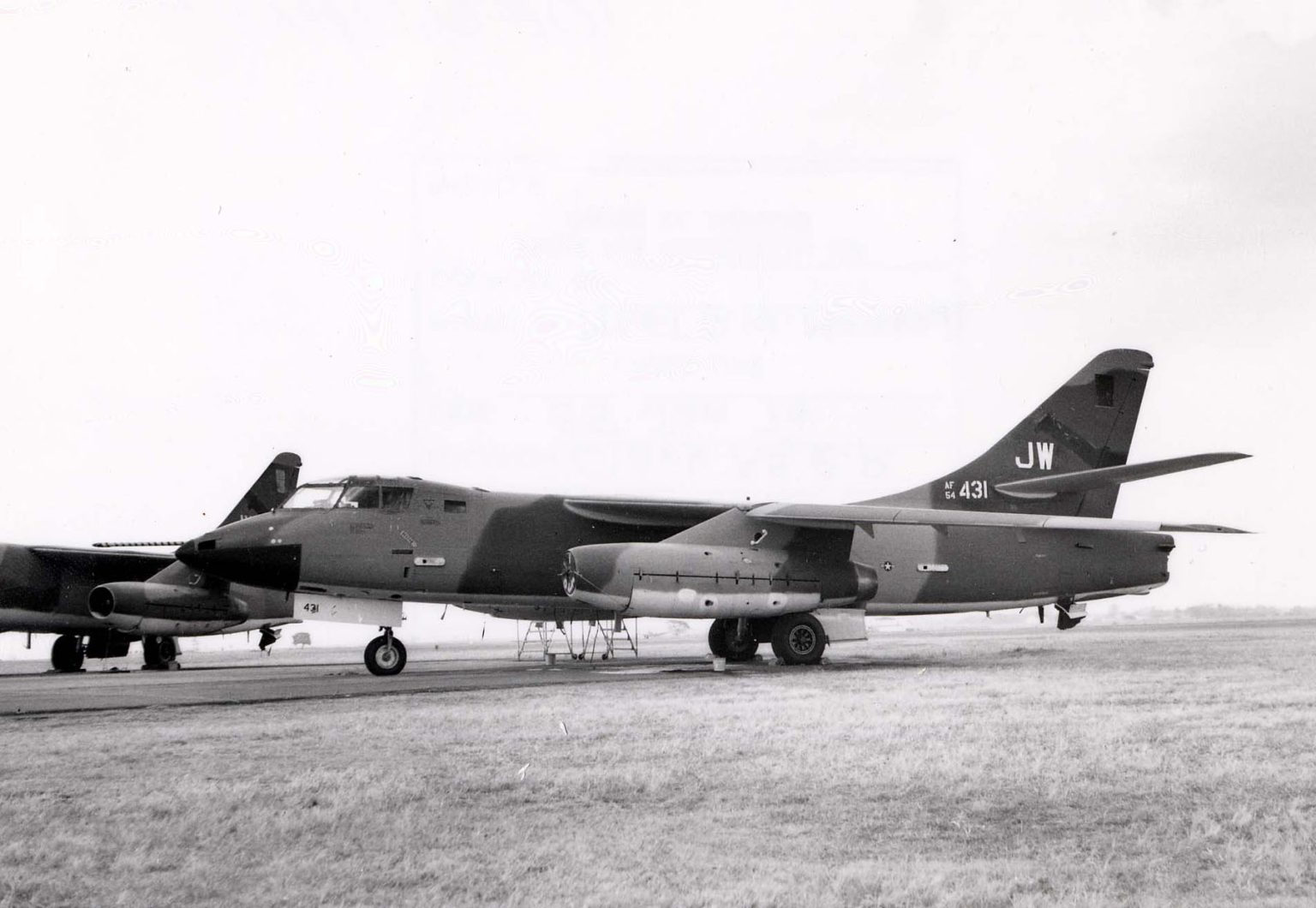
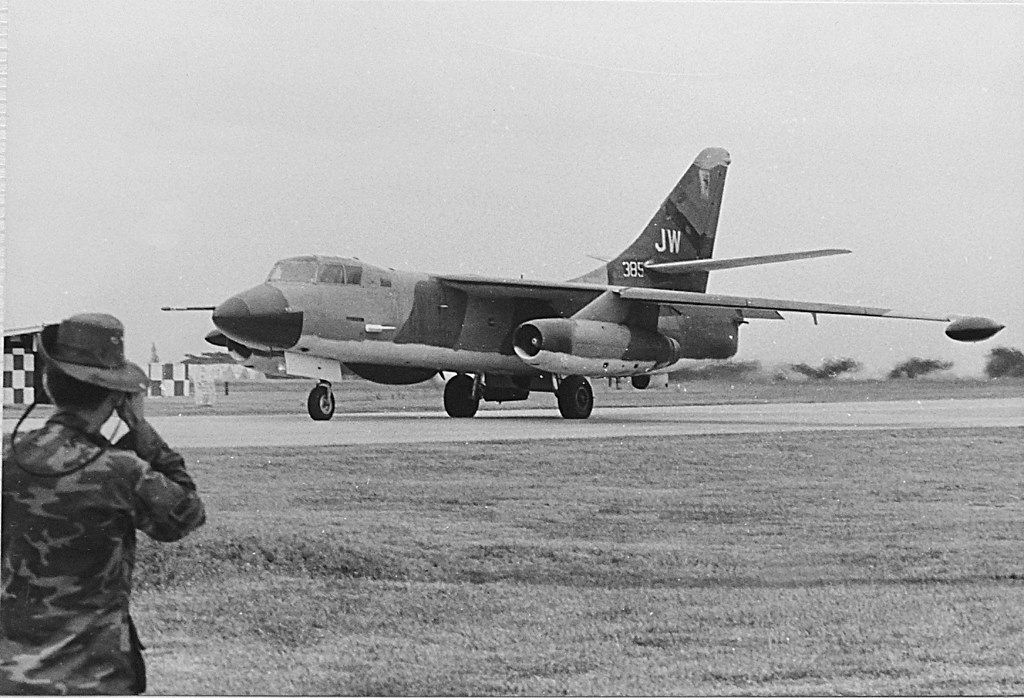
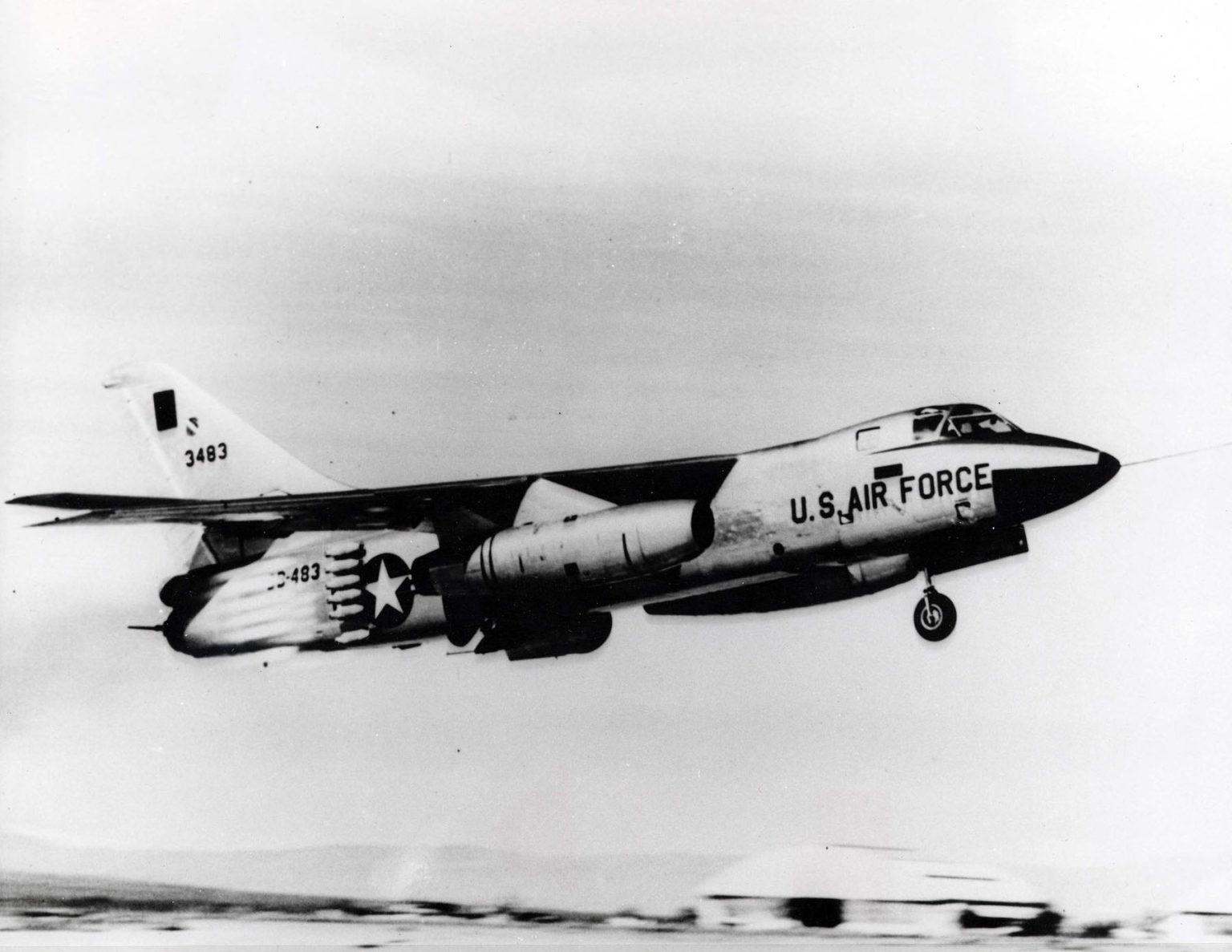
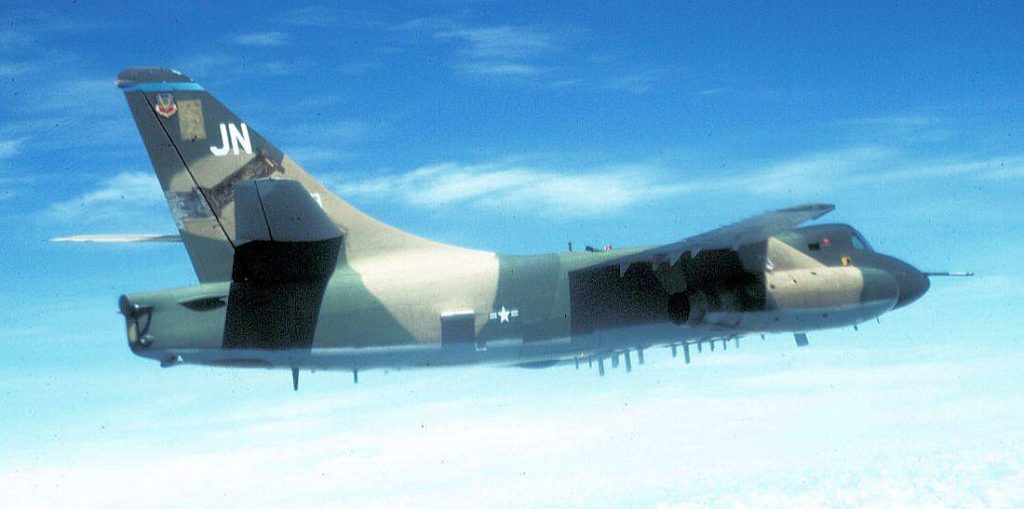
US Air Force and museum photographs of the Destroyer and its variants, each credited to its source and licence. Click any photo to enlarge.
On Film
The Douglas B-66 Destroyer on video: a documentary history
A look at the Douglas B-66 Destroyer — its Skywarrior origins, its reconnaissance work and its vital electronic-warfare role over Vietnam.
“Douglas B-66 Destroyer” by Dark Skies (approx. 166,000 views at time of writing; running time ~9 minutes) — a documentary on the Destroyer, its Skywarrior origins and its reconnaissance and electronic-warfare career.
Operations Overview
Where the Douglas B-66 Destroyer flew: an operator map
Designed, built and flown by the United States alone. The Destroyer had no export customer and no foreign operator — every aircraft served the US Air Force, so this is a single-nation map. Hover or tap for detail.
Categories: Design, Manufacture & USAF Service (United States) · Surviving Airframes (United States). The Destroyer was operated only by the US Air Force, so both categories fall on a single country.
Service Record
The Destroyer’s record: the jammer that shielded the strikes
The B-66’s significance lies in the breadth of its roles and, above all, in the electronic-warfare work that made it indispensable over Vietnam.
Questions & Answers
Douglas B-66 Destroyer: your questions answered
Can I fly in a Douglas B-66 Destroyer?
No — there is no bookable B-66 flight experience, and MiGFlug does not offer one. The type was retired in the mid-1970s and the survivors are static museum aircraft, none of which fly. If what you actually want is the real thing — strapping into a genuine military jet and flying it — you very much can do that today in other types. MiGFlug arranges flights in real fighter jets and warbirds around the world. Start here: migflug.com/flights-prices.
Why is the Douglas B-66 Destroyer historically important?
The B-66 was the US Air Force’s twin-jet tactical bomber, reconnaissance and electronic-warfare aircraft of the 1950s and 60s. Its most important legacy is the EB-66 electronic-warfare version, which became vital in the Vietnam War — jamming North Vietnamese radar and surface-to-air missiles and helping protect American strike aircraft in some of the most heavily defended airspace ever fought over.
How is the B-66 different from the A-3 Skywarrior?
They are separate aircraft from a common ancestor. The A-3 Skywarrior was a US Navy carrier-based strategic bomber; the B-66 Destroyer was a US Air Force land-based tactical aircraft derived from it, but redesigned so extensively — different engines, revised structure, tactical equipment and, crucially, ejection seats for all three crew (which the A-3 lacked) — that it shared few actual parts with the Navy machine. Close cousins, not the same aircraft.
What was the EB-66’s role in Vietnam?
The EB-66 was an electronic-warfare aircraft. Over North Vietnam it jammed enemy early-warning and missile-guidance radars, degrading the dense air-defence network built around the Soviet SA-2 surface-to-air missile. Flying with or near the strike packages of F-105s and F-4s, it helped blind the defences and protect the strike crews — a force multiplier that made it one of the most important support aircraft of the air war.
Were any B-66s lost in combat?
Yes. Because the EB-66 was so valuable, it operated in dangerous airspace and was actively hunted. Some were lost — to the SA-2 missiles they were built to counter, and at least one to a MiG interceptor. The most famous loss came in 1972, when a downed EB-66 triggered one of the largest and most costly search-and-rescue operations of the war to recover its sole survivor, a story later told in books and on film. These losses are remembered with respect.
What were the main versions of the B-66?
The main versions were the B-66B tactical/nuclear bomber; the RB-66A and RB-66B photographic-reconnaissance aircraft (the RB-66B was built in the largest numbers); the RB-66C electronic-reconnaissance and intelligence aircraft; the WB-66D weather-reconnaissance aircraft; and the EB-66B, C and E electronic-warfare versions, many converted from the reconnaissance aircraft, which saw such heavy use in Vietnam.
Who operated the B-66 Destroyer?
The B-66 was operated only by the United States Air Force. There was no export customer and no foreign operator. Around 294 were built across all versions, and they served from 1956 until the mid-1970s, when the last EB-66 electronic-warfare aircraft were retired.
Was the Douglas B-66 Destroyer a good aircraft?
As a pure bomber it was unremarkable, and it was never fast or glamorous. But judged by what it actually did, the Destroyer was very successful: an excellent reconnaissance platform and, above all, a superb electronic-warfare aircraft whose EB-66 version proved genuinely indispensable over Vietnam. Its worth lay in its sensors and jammers, not its performance — and by that measure it more than earned its place.
Fly For Real
You can’t fly the B-66 Destroyer — but these, you can
No B-66 is a bookable ride today. The urge behind it — to strap into a real military aircraft and actually fly — is very much still bookable. MiGFlug puts you in genuine fighters and warbirds around the world.
Fighter Jet Flights
Take the controls of a real ex-military jet with an experienced pilot.
All flights are operated by MiGFlug’s vetted partners with professional pilots. Browse every option and current pricing at migflug.com/flights-prices. MiGFlug does not operate Douglas B-66 Destroyer flights — no bookable example exists.
Related Aircraft
If the Douglas B-66 Destroyer interests you, explore these
Sources & Further Reading
Where this Douglas B-66 Destroyer history comes from
Note on figures: dimensions, performance and production numbers for the B-66 vary between sources and by variant, and are hedged here as approximate. Cost fields are listed as not reliably recorded because trustworthy 1950s procurement cost data is not consistently available. Combat losses and the 1972 search-and-rescue operation are summarised respectfully and factually; readers seeking full accounts should consult the specialist histories. The B-66 was derived from, but is a distinct aircraft from, the US Navy’s A-3 Skywarrior. A number of Destroyers are preserved in US museums.