
Grumman F3F
The last biplane fighter the United States Navy and Marine Corps ever ordered into service — a stubby, barrel-bodied Grumman with hand-cranked retractable gear that guarded America's carrier decks in the late 1930s, then quietly bowed out to the very monoplane it fathered: the F4F Wildcat.
The Grumman F3F story: the last biplane fighter to fly from an American carrier
By the mid-1930s the fighter world was already turning to the sleek all-metal monoplane. Yet the aircraft that guarded the flight decks of the United States Navy in those last peacetime years was something older in shape and younger in engineering than it looked: a rotund little biplane with an open cockpit, two wings braced by struts and wires — and, folded into the sides of its deep fuselage, a set of retractable wheels cranked up by hand. The Grumman F3F is generally regarded as the last biplane fighter ordered into service by the US Navy and Marine Corps, and it wore that distinction with an odd, likeable dignity.
It was also the end of a family. Grumman had entered the fighter business only a few years earlier with the FF-1 of 1931 — a two-seat biplane nicknamed "FiFi" that is often cited as the first US Navy fighter with a retractable undercarriage. From the FF came the single-seat F2F of 1935, and from the F2F came the refined F3F. All three shared the same unmistakable silhouette: a barrel of a fuselage wrapped around a big radial engine, so portly that the line earned the affectionate nickname "Flying Barrel". Where rivals chased streamlining, Grumman chased a different set of virtues — strength, a wide and forgiving landing gear, the ability to take the brutal punishment of carrier landings, and a climb rate that made the little fighter a delight in a dogfight.
The F3F entered service in 1936 and quickly equipped the front-line carrier fighter squadrons of both the Navy and the Marine Corps. Pilots who flew it tended to love it. It was strong, agile, honest and pleasant, with a tight turn and a healthy roll rate; its hand-cranked gear and open cockpit were relics, but its handling was thoroughly modern for a biplane. For roughly five years it was the aircraft American naval aviators trusted between the wars — the mount on which a whole generation of future Wildcat and Hellcat pilots learned the demanding art of landing a fighter on a moving ship.
And then the world it was built for vanished. The monoplane arrived in earnest: first the Brewster F2A Buffalo, then Grumman's own F4F Wildcat — a design that grew directly out of this same barrel-bodied biplane lineage. By the time Japanese aircraft appeared over Pearl Harbor in December 1941, the F3F was already thoroughly obsolete and had been withdrawn from front-line squadrons. It never fired its guns in the Second World War. Instead the survivors went quietly to work as advanced trainers, utility hacks and station aircraft, teaching the men who would fly the Wildcats and Hellcats into battle.
It was a fitting last act for a fighter whose greatest legacy was not a victory but a lineage: the F3F taught Grumman how to build carrier fighters, and Grumman would spend the rest of the war proving it. And in one of aviation's stranger epilogues, the very ruggedness that defined the type gave several individual aircraft a second life — pulled from the seabed decades after they sank, rebuilt, and flown again. The last US Navy biplane fighter is, improbably, one of the rarest airworthy warbirds on earth.
01The Grumman F3F's "Flying Barrel" lineage: from the FF-1 "FiFi" to the F2F to the F3F+
The F3F cannot be understood in isolation — it is the third and final refinement of a single idea. In 1931 Grumman, then a small Long Island firm better known for building aircraft floats, won a US Navy contract for the FF-1, a two-seat biplane fighter. Its defining innovation was a retractable main undercarriage that cranked up into the fuselage, reducing drag in an era when almost every naval fighter still had fixed wheels. The FF-1 — universally called "FiFi" — is frequently described as the first US Navy fighter with retractable landing gear, and it gave Grumman both its house style and its foothold in naval aviation.
Grumman then distilled the concept into a single-seater, the F2F of 1935, which was faster and more agile but gained a reputation for touchy spin recovery and directional instability. The F3F was the fix: a slightly larger wing, a longer fuselage and refined aerodynamics tamed the handling while keeping the family's strength and climb. Because the fuselage was so deep and rounded — a barrel wrapped around a radial engine — the whole family, and the F3F in particular, picked up the nickname "Flying Barrel." Some accounts tie the name specifically to the fatter cowling of the later Cyclone-engined variants, so treat the exact origin as folklore rather than documented fact.
What matters is the through-line. Retractable gear, a fat and immensely strong fuselage, a big radial, an emphasis on agility and deck-friendliness over outright speed: every one of those traits was established on the FF, honed on the F2F, perfected on the F3F, and then carried — minus one wing — into the F4F Wildcat. The Flying Barrel was the prototype for the way Grumman would build carrier fighters for the next fifteen years.
02The Grumman F3F's hand-cranked retractable gear: the Grumman signature that outlived the biplane+
The single most Grumman thing about the F3F is the way its wheels disappeared. The main legs did not fold outward into the wings, as on most retractable-gear fighters; they were drawn up and inward into wells in the sides of the deep fuselage, leaving the tyres partly exposed. The pilot did the work by hand, winding a crank in the cockpit — commonly cited as around thirty turns — to raise or lower the gear. It was heavy, slow and unglamorous, and it demanded a free hand at exactly the moments a carrier pilot was busiest, but it was rugged and it worked.
That fuselage-stowed, manually operated gear became a Grumman trademark. The same basic arrangement carried straight over into the F4F Wildcat, which retained a hand-cranked, narrow-track undercarriage well into the Second World War — a direct inheritance from the biplanes, and a recognised handful for green Wildcat pilots. The narrow track that came with stowing the legs in the fuselage rather than spreading them under the wings would give both the F3F and the Wildcat a reputation for being tricky on the ground and on deck, an ancestral quirk that outlived the biplane itself. The F3F's gear is therefore not a quaint dead end but a piece of design DNA that flew into carrier combat long after the last biplane fighter had left the fleet.
The Grumman F3F's design: an old shape wrapped around modern ideas
Look past the two wings and the F3F is a surprisingly sophisticated machine for its day — a stressed-skin metal structure, retractable gear, an enclosed engine and, in its final form, a powerful supercharged radial. It was a biplane by choice, not by backwardness: the extra wing bought lift, a tight turn and a slow, safe approach speed onto a pitching carrier deck, exactly the qualities the Navy prized before the monoplane's speed advantage became overwhelming.
Twin Wasp Junior, then Wright Cyclone
The first production F3F-1 used a Pratt & Whitney R-1535-84 Twin Wasp Junior of roughly 650–700 hp. The improved F3F-2 and F3F-3 switched to the larger, more powerful nine-cylinder Wright R-1820-22 Cyclone of about 950 hp — a substantial jump that lifted the F3F-2's top speed to around 264 mph (425 km/h) and gave the little fighter a genuinely strong climb.
Built like a Grumman bridge
Grumman's obsession was strength. The F3F used an all-metal, semi-monocoque fuselage and metal-framed, fabric- and metal-covered wings, stressed for the violence of carrier operations and hard aerobatics. The reputation the firm earned here — "the Grumman Iron Works" — began with these biplanes and would define the Wildcat, Hellcat, Avenger and Bearcat that followed.
Agile, honest and forgiving
Two wings meant a small turning circle and a low stall speed, ideal for deck work. The F3F cured the earlier F2F's edgy stability with a stretched fuselage and enlarged wing, producing a fighter pilots described as delightful — quick to turn, easy to land, and strong enough to be flung around the sky with confidence.
03The Grumman F3F's armament: one rifle-calibre gun, one heavy — and why that was normal in 1936+
By the standards of 1942 the F3F was pitifully armed; by the standards of 1936 it was conventional. The typical fit was a pair of cowl-mounted, synchronised Browning machine guns firing through the propeller arc: one 0.30-inch (7.62 mm) rifle-calibre gun and one 0.50-inch (12.7 mm) heavy machine gun. Some aircraft and some references list two 0.30-calibre guns instead, and the exact mix varied between airframes and variants — so treat the armament as "one light and one heavy Browning, with variation" rather than a fixed specification.
A small underwing rack could carry light practice or anti-submarine bombs, reflecting the fighter's secondary utility role. Two guns was simply the interwar norm: contemporaries like the Boeing P-26 and early Hawker biplanes carried a comparable battery, and gunnery doctrine still assumed short bursts against lightly built opponents. It was the sudden leap to six- and eight-gun monoplanes at the end of the decade — and the armoured, self-sealing targets of WWII — that made the F3F's pair of Brownings look feeble in hindsight. In its own era, the armament was unremarkable.
04The Grumman F3F's civilian cousins: the G-22 "Gulfhawk II" and the racing G-32+
Grumman turned the F2F/F3F formula into a small number of civil demonstrators. The most famous was the G-22 "Gulfhawk II," a one-off aerobatic aircraft built in 1936 for Major Al Williams, the celebrated demonstration pilot of the Gulf Oil Company. Blending F2F and F3F features — an F2F-style fuselage with F3F wings and tail, and a Wright Cyclone up front — the vivid orange-scarlet Gulfhawk II thrilled airshow crowds across the United States and Europe for over a decade, flying punishing inverted and low-level routines that advertised both Gulf's aviation fuels and the strength of the Grumman barrel.
A second civil machine, the G-32A, served as a company hack and testbed. The Gulfhawk II survives today in the Smithsonian's National Air and Space Museum collection — one reason the type's tiny band of survivors includes a machine that is technically a civilian G-22 rather than a military F3F. These civilian barrels matter because they kept the design in the public eye and, in the Gulfhawk's case, preserved an intact example of the family's engineering long enough for later generations to study.
05The Grumman F3F on the carrier deck: why a biplane made sense at sea in the 1930s+
It is easy, from the far side of the monoplane revolution, to assume the F3F was chosen out of conservatism. It was not. In the mid-1930s a carrier fighter had to do something no land fighter did: approach a small, pitching, moving deck slowly enough to catch an arrestor wire and stop in a few dozen metres, then be flung off again with minimal run. Low approach speed, docile stall behaviour, a strong undercarriage and a tight turning circle for the landing pattern were worth more at sea than a few extra miles per hour in level flight.
The biplane delivered exactly those qualities. Its generous wing area gave lift at low speed and a gentle stall; its strength let it survive hard deck arrivals; its agility suited the cramped choreography of carrier flying. The Navy's early monoplanes — the Buffalo above all — would prove that the monoplane's higher wing loading brought faster, less forgiving approaches that were genuinely dangerous around a carrier. The F3F was the last, best expression of the pre-monoplane compromise: an aircraft optimised for the deck rather than the dogfight, at the precise moment the two priorities were about to swap places.
06The Grumman F3F's predecessors: how the FF-1 "FiFi" and F2F wrote the rulebook+
The FF-1 of 1931 was a genuine landmark. A two-seat biplane fighter with an enclosed cockpit and, above all, a retractable undercarriage, it was faster than the single-seat fighters it served alongside — an embarrassing state of affairs that proved Grumman's ideas worked. Its retractable gear, cranked up into the fuselage, immediately became the firm's signature and its competitive edge. The FF-1 (and the SF-1 scout derived from it) put Grumman on the map as a naval aircraft builder almost overnight.
The F2F that followed in 1935 took the concept single-seat and shorter, chasing agility and rate of climb. It was a capable little fighter and popular with some pilots, but its short fuselage and concentrated mass gave it unpleasant spin and stability characteristics that made it a handful at the edges of the envelope. The Navy liked the performance but wanted the vices fixed — and that request is precisely what produced the F3F. Lengthen the fuselage, enlarge the wing, refine the aerodynamics, and the F2F's quirks largely disappeared while its strengths remained. The F3F was, in the most literal sense, the F2F with its homework done: the same idea, third time lucky.
Grumman F3F specifications, performance and cost
Figures below are for the Wright Cyclone-engined F3F-2 unless noted, and are drawn from museum and naval-aviation references. Interwar figures vary between sources, so approximate values are flagged.
Baseline note: the figures describe the F3F-2, the Cyclone-engined mark that made up half of all F3F production and gave the type its barrel silhouette. Deltas for the Twin Wasp Junior-powered F3F-1 and the aerodynamically cleaned-up F3F-3 are in grey. Published F3F figures are unusually inconsistent, because several widely copied tables attach F3F-3 performance to the F3F-2; where that has happened it is flagged below.
Dimensions & weights
- Crew
- 1
- Length
- 7.03 m (23 ft 1.5 in); F3F-1 7.01 m (23 ft 0 in)
- Wingspan
- 9.75 m (32 ft 0 in), identical on all three marks and 1.07 m (3 ft 6 in) greater than the F2F it was drawn to replace
- Height
- 2.84 m (9 ft 4 in). Several tables give 3.27 m (10 ft 9 in); the difference is whether the aircraft is measured sitting tail-down or with a propeller blade vertical.
- Wing area
- 24.2 m² (260 sq ft)
- Wing configuration
- Single-bay biplane with N-interplane struts and the ailerons on the upper wing only
- Empty weight
- 1,478 kg (3,258 lb); F3F-1 1,305 kg (2,876 lb); F3F-3 1,486 kg (3,276 lb)
- Maximum take-off weight
- 2,155 kg (4,750 lb); F3F-1 1,997 kg (4,403 lb); F3F-3 2,175 kg (4,795 lb)
- Maximum external load
- 105 kg (232 lb) — two bombs, one under each wing, and nothing else
- Wing loading at maximum weight
- 89.0 kg/m² (18.2 lb/sq ft), light even for 1937 and the reason the type turned as well as it did
- Power loading at maximum weight
- 3.04 kg/kW (5.0 lb/hp); F3F-1 4.12 kg/kW (6.8 lb/hp), which is the single clearest measure of what the Cyclone bought
- Undercarriage
- Main wheels retract aft and inward into wells in the fuselage sides, wound up by a hand crank beside the pilot's right hip. Inherited from the FF-1 of 1931 and carried into the F4F Wildcat almost unaltered.
- Production
- 162 aircraft in three marks, plus the much-rebuilt prototype (54 F3F-1, 81 F3F-2, 27 F3F-3). Munson gives 164 for the family; the total of 147 repeated in many places cannot be reconciled with either the mark figures or the bureau number blocks.
Performance
- Maximum speed
- 412 km/h (256 mph) at about 5,330 m (17,500 ft). Quoted as 255 or 256 mph depending on source; the widely reproduced 264 mph at 15,250 ft is the F3F-3 figure, wrongly attached to this mark.
- Maximum speed, F3F-1
- 372 km/h (231 mph) at 2,290 m (7,500 ft)
- Maximum speed, F3F-3
- 423 km/h (263 mph) at 4,630 m (15,200 ft) — about 8 mph better than the F3F-2 for the same engine, bought entirely by cleaning up the forward fuselage
- Cruising speed
- 241 km/h (150 mph)
- Rate of climb
- 14.2 m/s (2,800 ft/min) at sea level
- Service ceiling
- 9,235 m (30,300 ft). Published between 30,300 and 33,200 ft; the highest figures again belong to the F3F-3.
- Range
- 1,424 km (885 miles); F3F-3 1,577 km (980 miles). All internal — the F3F had no drop tanks and no external fuel of any kind.
- Load recorded in the fatal prototype dive
- 14 g at the pull-out from about 2,440 m (8,000 ft) on 22 March 1935, which broke the aircraft up in mid-air
- Spin behaviour
- The F2F's poor spin recovery was the reason the F3F was ordered at all, and the rebuilt prototype was nonetheless lost in a ten-turn right-hand spin at Anacostia in May 1935. Production aircraft recovered cleanly.
- Terminal-velocity dives
- Cleared by the third rebuild of the prototype, the US Navy accepting the aircraft on 10 July 1935. Nothing in the type's service life ever failed structurally in the way the first prototype had.
- Against its replacement
- The Brewster F2A monoplane that displaced it in 1940–41 was faster and better armed but markedly less manoeuvrable, which is the argument that kept biplanes in US Navy fighter squadrons as late as it did
Propulsion & systems
- Engine
- One Wright R-1820-22 Cyclone, nine-cylinder single-row air-cooled radial, 708 kW (950 hp) for take-off
- F3F-1 engine
- Pratt & Whitney R-1535-84 Twin Wasp Junior, fourteen-cylinder two-row air-cooled radial, 485 kW (650 hp) (prototypes flew with the R-1535-72 and -84; some sources rate them at 522 kW / 700 hp)
- Why the engine changed
- The Cyclone was far larger in diameter but lighter and much more powerful. Take-off run shortened and climb improved, and the fat cowling that followed is how you tell an F3F-2 from an F3F-1 at a glance. Grumman started the work without a contract, so confident was it of the result.
- Supercharging
- Single-stage geared supercharger, which is why the F3F-2's best speed occurs at around 5,330 m (17,500 ft) rather than near the ground
- Propeller
- Hamilton Standard two-blade constant-speed. The F3F-1 had a hydraulic controllable-pitch unit; the F3F-3 took a larger diameter.
- Undercarriage and its lineage
- The Grumman signature, and the whole reason the fuselage is that shape. Wheels fold into wells in the deep fuselage sides, driven by a hand crank in the cockpit. FF-1 to F2F to F3F to F4F Wildcat: Grumman only ever stopped stacking wings on this fuselage, it never redesigned the fuselage.
- Structure
- Aluminium semi-monocoque fuselage; metal-framed, fabric-covered wings and tail surfaces
- Flaps
- None on the F3F-1 or F3F-2; split landing flaps introduced on the F3F-3
- Forward fuselage (F3F-3)
- Reskinned from the aft cabane strut forward after full-scale wind-tunnel work in the NACA Langley 9.1 by 18.3 m (30 by 60 ft) tunnel, both to clean up the aerodynamics and to stop exhaust gas leaking into the cockpit
- Cockpit
- Enclosed sliding canopy with a telescopic sight projecting through the windscreen; the F3F-3 introduced a curved windscreen
- Carrier equipment
- Arrester hook and catapult provision. The type served aboard Ranger, Saratoga, Yorktown, Enterprise and Wasp, and every US Navy and Marine Corps fighter squadron flew Grumman biplanes by 1939.
07The Grumman F3F's operating costs: why the honest answer is "not reliably recorded"+
Any confident dollar-per-hour figure for a 1930s carrier biplane should be treated with suspicion. The US Navy of the interwar years did not track and publish cost-per-flight-hour the way modern air arms do, and the F3F was retired long before such accounting became routine. Contemporary unit prices for Navy fighters of the period sat in the low tens of thousands of dollars each, but reliable, apples-to-apples operating costs simply were not kept in a form we can quote today.
Today the relevant cost is a completely different animal: the eye-watering price of restoring and maintaining one of the handful of airworthy survivors. Recovering a corroded airframe from the sea, rebuilding it around period-correct components, and keeping a rare 1930s radial and its bespoke systems airworthy is a warbird exercise measured in the hundreds of thousands of dollars — utterly unlike what the Navy paid to fly the type in 1938. Rather than invent a number that would be false in either era, we record the cost rows as "not reliably recorded." It is the honest answer, and it will be revisited if primary-source figures surface.
08The Grumman F3F variants: F3F-1, F3F-2 and F3F-3 compared+
F3F-1 (1936, ~54 built): the first production version, powered by the ~700 hp Pratt & Whitney Twin Wasp Junior. It equipped the first front-line Navy and Marine squadrons and established the type in fleet service. Top speed was around 231 mph.
F3F-2 (1937–38, ~81 built): the definitive version, re-engined with the ~950 hp Wright Cyclone in a fatter cowling. Faster (about 264 mph) and stronger, it became the most numerous variant and the one most survivors represent. The extra power transformed the fighter's climb and altitude performance.
F3F-3 (1938–39, ~27 built): a final refinement of the F3F-2 with aerodynamic tweaks, a revised cowling and an improved propeller — the last new-build biplane fighters delivered to the US Navy. Production totals vary slightly between sources; the figures above are the commonly cited ones, and the ~162 grand total should be read as "about 160," not an exact count.
Armament & payload
The F3F carried the same two guns as the fighters of 1918, in the same place, aimed the same way
One .30 in and one .50 in Browning in the upper cowl, synchronised to fire through the propeller disc, with a telescopic sight between them: in armament terms the last biplane fighter the US Navy ever bought was a First World War aeroplane. The contract of 15 October 1934 also demanded a ground-attack capability, and that was met with a single light bomb under each wing. Against the eight guns of a Hurricane or the four of a Zero this was already obsolete when the F3F reached squadrons in 1936, and the Navy knew it. What the money bought instead was manoeuvrability, deck handling and reliability while the monoplane fighters were still being argued over — and in the event, no F3F ever fired at an enemy. Sources disagree over the F3F-1's guns: some give it the same mixed pairing as the F3F-2, others two .30 in Brownings. Squadron practice may well have covered both.
Gun
- One 7.62 mm (.30 in) Browning M1919 with 500 rounds and one 12.7 mm (.50 in) Browning M2 with 200 rounds, both in the upper cowl ahead of the pilot.
- Both were synchronised to fire through the propeller arc, an arrangement unchanged in principle since 1916 and by 1936 the last such installation on a new American fighter.
- The mixed calibre was a compromise forced by weight, not a preference: the .30 gave volume of fire and tracer for aiming, the .50 gave whatever hitting power there was.
- Aiming was through a telescopic sight projecting through the windscreen; reflector sights arrived on the type only late in its life.
- Charging handles were in the cockpit, so a jam could sometimes be cleared in flight — which mattered rather a lot when two guns leave no redundancy at all.
Air-to-air
- The two cowl guns were the whole of it. Air-to-air missiles did not exist, and an F3F pilot fought exactly as a 1918 scout pilot did: from close astern, inside 200 m.
- Firing time was short. Two hundred rounds of .50 in at roughly 750 rounds a minute is about sixteen seconds of ammunition, and there was no second chance.
- Gunnery against towed sleeves was the peacetime squadrons' main occupation, and the type trained a generation of aces-to-be — Gregory Boyington, Henry Elrod and Robert Galer among them.
- No F3F ever fired its guns in anger. Every one had left front-line squadrons before Pearl Harbor.
Air-to-surface guided
- None. Guided air-to-surface weapons did not exist anywhere in the world during the F3F's service life.
- The ground-attack requirement written into the XF3F-1 contract of 15 October 1934 was met with two light bombs and the two cowl guns, and nothing else was ever fitted.
- Dive-bombing practice with that load was routine, and dangerous in an aeroplane whose prototype had already come apart in a dive. An F3F-1 lost both port wings pulling out of a dive-bombing run at 460 m (1,500 ft) over Border Field, San Diego on 30 October 1936, killing the pilot.
Bombs
- Two 52.6 kg (116 lb) Mk IV bombs, one under each wing, on simple racks with mechanical release.
- Some references give 110 lb or a 200 lb total. The differences are between bomb marks rather than between aircraft.
- That load is about five per cent of the aircraft's maximum weight. It was meant for strafing-and-bombing attacks on shore targets, not for anything a dive bomber would be sent to do.
- For comparison, the Vought SBU and Curtiss SBC biplanes operating alongside the F3F carried more than four times as much, which is exactly why the Navy kept separate scout-bomber squadrons.
Rockets
- None, on any mark. Aircraft rockets did not reach US Navy service until the 127 mm (5 in) HVAR of 1944, by which time the last F3Fs had been struck off.
- Nothing in the wing structure was stressed for them, and the training and utility aircraft of 1942–43 were never modified to carry any.
- The absence is worth stating because it marks the gap: the F3F belongs to the armament generation before rockets, drop tanks and reflector gunsights, and it was retired rather than updated.
Pods & other stores
- None in the modern sense. No drop tanks, no pods, no external fuel whatever, which is why the F3F-2's 885-mile range is entirely internal and entirely fixed.
- The two underwing bomb racks were the only external stations on the aeroplane.
- The civil G-22 Gulfhawk II built for Al Williams of Gulf Oil in 1936 carried no armament at all, only a smoke system and a paint scheme, and flew airshows until 1948.
- The two-seat G-32A carried a passenger roughly where the ammunition boxes had been — the only F3F derivative that carried anything the Navy had not asked for.
Three typical loadouts
- Fleet fighter patrol, VF-6 aboard USS Enterprise, 1938
- Both guns loaded, nothing hung under the wings, telescopic sight, full internal fuel. This was the F3F's normal condition and the one it was designed for: a clean interceptor launched over the fleet with no external load to slow it down.
- Ground-attack practice, VMF-2, 1939
- Two 116 lb bombs on the underwing racks with both guns loaded. The Marine squadrons took the attack clause of the 1934 contract rather more seriously than the carrier squadrons did, and VMF-2 also supplied the aircraft filmed for Warner Brothers' Dive Bomber in 1941.
- Advanced training, NAS Miami and NAS Corpus Christi, 1942–43
- Guns removed or unloaded, no stores, and 117 airframes flown hard by students and utility pilots until late 1943. This, and not combat, is where the overwhelming majority of F3F flying hours were spent.
Sourcing caveat: F3F armament is described inconsistently because the F2F, F3F-1, F3F-2 and F3F-3 are routinely conflated. The ammunition figures of 500 rounds for the .30 in and 200 for the .50 in are well attested; bomb weights are given variously as 100, 110 and 116 lb, reflecting different bomb marks rather than different aircraft. Prototype accident dates are also unreliable — the fatal dive is dated 20 or 22 March 1935 depending on the source, and the second loss 9, 15 or 17 May 1935.
Variants
The F3F is the last Navy biplane and the direct structural ancestor of the Wildcat
Grumman's line begins with the FF-1 of 1931, a two-seat fighter with a deep, fat fuselage whose depth existed for one reason: to swallow the main wheels. The single-seat F2F followed in 1933 and proved unstable and reluctant to come out of a spin, which is why the Navy ordered the XF3F-1 on 15 October 1934 — before F2F deliveries had even begun. The F3F is a lengthened, larger-winged, better-behaved F2F, and the last biplane fighter any American service ever bought.
The prototype killed a test pilot and was written off twice inside two months. On 22 March 1935, two days after its first flight, Jimmy Collins pulled out of the tenth of a series of dive-recovery flights at about 2,440 m (8,000 ft); the accelerometer recorded 14 g, the aircraft came apart in the air, and the wreck fell into a cemetery. A strengthened rebuild was lost in May when Lee Gehlbach failed to recover from a ten-turn spin at Anacostia and took to his parachute. The lesson bought with those two aeroplanes was structural and Grumman applied it: the third rebuild flew on 20 June 1935, completed the terminal-velocity dive programme, and was accepted on 10 July. Nothing in the type's service career ever broke that way again.
The fat fuselage, the hand-cranked wheels folding into its sides, the deep round cowling and the layout of the cockpit run in an unbroken line from the FF-1 through this aeroplane into the F4F Wildcat — whose first proposal, the F4F-1 of 1935, was itself a biplane development of the F3F before it was abandoned in favour of a monoplane. Look at a Wildcat's undercarriage and you are looking at an F3F.
- XF3F-1 (1934–35, one airframe built three times)
- Ordered 15 October 1934 and carrying BuNo 9727 throughout. Pratt & Whitney R-1535 Twin Wasp Junior, longer fuselage and larger wings than the F2F, smaller wheels for streamlining. Destroyed on 22 March 1935 and again in May 1935, and rebuilt each time under the same number.
- F3F-1, Grumman G-11 (1935–36, 54)
- Ordered 24 August 1935 after the flight test programme was completed. R-1535-84 of 485 kW (650 hp). The first aircraft went to the test group at NAS Anacostia on 29 January 1936 and squadron service began that March with VF-5B aboard Ranger and VF-6B aboard Saratoga; the last six went to the Marines' VF-4M in January 1937.
- XF3F-2 (1936, 1)
- Built by Grumman on its own account, without a contract, to take the Wright Cyclone. First flight 27 July 1936.
- F3F-2, Grumman G-19 (1937–38, 81)
- The most numerous and most satisfactory mark, delivered between 27 July 1937 and 11 May 1938. Wright R-1820-22 of 708 kW (950 hp) and the deep cowling that goes with it. The production order is dated March 1937 by most sources; the 25 July 1936 sometimes given is the day before the XF3F-2 first flew.
- XF3F-3 (1938, 1 conversion)
- The 65th F3F-2, rebuilt in May 1938 after full-scale wind-tunnel work at NACA Langley: larger propeller, reskinned forward fuselage, curved windscreen and a single cowl flap on each side.
- F3F-3 (1938–39, 27)
- Ordered 21 June 1938 only because the Brewster F2A and Grumman's own F4F were running late. Delivered 16 December 1938 to 10 May 1939, mostly to VF-5 aboard Yorktown and VF-7 aboard Wasp. Split flaps and the cleaned-up nose.
- Grumman G-22 Gulfhawk II (1936, 1)
- A civil single-seat hybrid of F2F and F3F features with a 746 kW (1,000 hp) Cyclone, built for Major Al Williams, display pilot for Gulf Oil. Flown at airshows for twelve years and retired to the National Air Museum in October 1948.
- Grumman G-32A (1938, 2)
- Two-seat civil version for Gulf Oil, combining F3F-2 and F3F-3 features with a rear cockpit where the military aircraft carried ammunition.
- Grumman F4F-1 (1935–36, proposal only)
- The Wildcat began as a biplane development of the F3F and was ordered as such before being abandoned in favour of the monoplane XF4F-2. The point is not that the proposal failed but that the aeroplane which succeeded it kept the F3F's fuselage logic wholesale.
Production, withdrawal and survivors: 162 production F3Fs were delivered — 54 F3F-1, 81 F3F-2 and 27 F3F-3 — plus the much-rebuilt prototype; Munson gives 164 for the family, and the figure of 147 repeated in several places cannot be reconciled with either the mark totals or the bureau number blocks. By 1939 every US Navy and Marine Corps fighter squadron flew Grumman biplanes. The last F3F-1 unit gave them up on 10 February 1941 and the last front-line F3F-3s went from VF-5 on 20 June 1941, replaced by the Brewster F2A; 117 airframes then went to naval air stations, chiefly NAS Miami and NAS Corpus Christi, as trainers and hacks until late 1943 — November or December, depending on the source. Five airframes survive, and the distinction between them matters. Only one is an unrebuilt original in a museum: F3F-2 BuNo 0976, ditched off Del Mar, California on 29 August 1940 by 1st Lieutenant Robert E. Galer while attempting to land aboard USS Saratoga after a fuel selector valve failed — a fault confirmed during restoration half a century later, which cleared him of the pilot error he had been assumed to have committed. It was found in June 1988 at about 550 m (1,800 ft) by the deep-submergence vehicle Turtle, which was looking for a lost helicopter, and lifted by USNS Narragansett on 5 April: 1990 by the most detailed account, 1991 by others. Around 60 per cent of its skin had to be replaced during a three-and-a-half-year restoration at the San Diego Aerospace Museum, and it stands today in the National Naval Aviation Museum at Pensacola. The three airworthy F3F-2s — BuNos 0972, 1028 and 1033 — are a different case, and the common description of them as Texas Airplane Factory new-build reproductions is only half right. All three flew into Mount Haleakala on Maui on the night of 24 June 1941, killing their VMF-2 pilots. The wrecks were recovered in the 1980s by Alan Decoite, acquired by Doug Champlin, and rebuilt between 1988 and 1993 by Herb Tischler's Texas Airplane Factory in Fort Worth. They carry original Grumman data plates and salvaged components, but the great majority of their structure was newly manufactured — which is why they are called restorations in some places and reproductions in others, and why neither word is quite adequate. BuNo 0972 is now with Lewis Air Legends in Texas by way of the Lone Star Flight Museum, Hurricane Ike in 2008, and Chris Prevost's Vintage Aircraft Company, which put a correct R-1820-22 and the original hand-cranked undercarriage back into it; 1028 is at Fantasy of Flight in Polk City, Florida; 1033 is with the National Museum of World War II Aviation in Colorado Springs. The fifth survivor is an unquestioned original: the civil G-22 Gulfhawk II of 1936, at the Smithsonian's Steven F. Udvar-Hazy Center. A two-seat G-32A rebuilt in the same Texas Airplane Factory programme also flies, in Texas. No F3F has ever been built from scratch without an original identity behind it.
The Grumman F3F versus the monoplane: why the last biplane fighter had to go
The F3F did nothing wrong. It was strong, nimble and reliable, and its pilots trusted it. What condemned it was not a flaw but arithmetic: two wings, struts and bracing wires impose drag that no amount of engine power can fully overcome, and the future of air combat belonged to the speed, firepower and diving performance that only a clean cantilever monoplane could deliver.
The comparison that mattered most was with the aircraft that replaced it. The Brewster F2A Buffalo, America's first monoplane carrier fighter, began pushing the F3F out of front-line squadrons from 1940. More decisively, Grumman's own F4F Wildcat — a design that started life as a biplane proposal in this very lineage before being reworked into a monoplane — took over the fleet's fighter squadrons. The Wildcat was faster, better armed with four to six 0.50-calibre guns, could dive with the enemy and eventually carried armour and self-sealing tanks; it kept the F3F's rugged Grumman structure and hand-cranked gear but shed the second wing. By December 1941 the choice had been made everywhere: the biplane era was over, and the F3F had been retired from the carriers it once defended.
Crucially, the F3F was never tested in that comparison in anger. It had left the front line before the shooting started, so we will never know how it would have fared against a Mitsubishi Zero. On paper the outcome is not hard to guess — the F3F was slower, more lightly armed, and could not dive away from a modern monoplane — and it would almost certainly have been massacred, as the Buffalo was over Midway. But that battle never happened. Unlike the Buffalo, which was thrown into the Pacific meat-grinder and destroyed, the F3F retired undefeated precisely because it retired unfought. Its clean reputation is partly a gift of timing.
There is a deeper point here about how aircraft are judged. The Buffalo and the F3F were near-contemporaries built to similar Navy requirements, yet history remembers one as a punchline and the other with fondness — largely because of what each was asked to do. The F3F was allowed to bow out gracefully while it was still good at its actual job; the Buffalo was kept in the line until it was hopelessly outclassed and then sent to die. The F3F's story is a quiet argument that reputation is written as much by circumstance as by engineering.
The Grumman F3F's timeline: from Navy contract to museum airworthy
Grumman's first fighter, the two-seat FF-1 "FiFi" biplane, flies — often cited as the first US Navy fighter with retractable landing gear, and the start of the "Flying Barrel" family.
The single-seat F2F enters service; the Navy asks Grumman for an improved version to cure its handling quirks.
The prototype XF3F-1 makes its first flight. Days later, on 22 March, it is lost in a fatal terminal-velocity dive test that kills company test pilot Jimmy Collins; a second prototype is also destroyed before the design is proven.
The first production F3F-1 is delivered to the Navy test group at NAS Anacostia on 29 January; squadron deliveries begin in March.
The F3F-1 equips front-line Navy and Marine carrier fighter squadrons aboard USS Ranger, Saratoga, Yorktown and Enterprise.
Grumman builds the civilian G-22 "Gulfhawk II" for airshow pilot Al Williams — a barrel-bodied cousin of the F3F that will fly for over a decade.
The Wright Cyclone-powered F3F-2 arrives — the definitive, most numerous variant, ~950 hp and ~425 km/h.
The final F3F-3 is delivered — the last new biplane fighters built for the US Navy.
Monoplanes take over: the Brewster F2A Buffalo and Grumman F4F Wildcat begin replacing the F3F in front-line squadrons. A Marine F3F-2 flown by Lt. Bob Galer ditches in the Pacific off San Diego.
By the time of Pearl Harbor the F3F is obsolete and gone from the front line. It never sees WWII combat; survivors serve as trainers, utility hacks and station aircraft.
The last F3Fs are struck from US service, ending the biplane fighter's career.
Galer's F3F-2 is discovered and raised from the seabed off San Diego, later restored — one of several F3Fs recovered from the water and returned to airworthy condition by warbird collectors.
A small number of F3Fs survive; a handful are airworthy and appear at warbird airshows, making the last US Navy biplane fighter one of the rarest flying military aircraft in the world.
Twelve Grumman F3F stories: from a fatal dive test to a Medal of Honor
The dive that killed Jimmy Collins
The XF3F-1's first flight in March 1935 was followed within days by a fatal terminal-velocity dive test.
Read the full story
The XF3F-1 first flew on 20 March 1935. To clear the airframe for carrier service, the Navy demanded punishing terminal-velocity dive tests — power-on plunges to the aircraft's absolute limit, followed by a maximum-g pull-out. On 22 March, company test pilot Jimmy Collins took the prototype through a programme of these dives. On the final, most violent recovery the structure failed under the enormous loads and the aircraft broke up in the air, killing him.
Collins was no anonymous test hand. He was a well-known barnstormer and aviation writer whose posthumously published essays, collected as Test Pilot, laid bare the fatalism of the profession — he had, by some accounts, a clear sense of the danger of the assignment. A second prototype was later built and also lost before the strengthened design was finally proven and ordered into production. The F3F's remarkably clean service record and its improbable airworthy survivors are all the more striking set against how bloody and expensive its birth actually was.
Why they called it the Flying Barrel
A fuselage so deep and round it looked like a keg with wings gave the whole Grumman family its name.
Read the full story
Wrap a compact airframe around a big radial engine and you get a very fat fuselage. Grumman's FF, F2F and F3F all shared that rotund, barrel-like body, and crews duly nicknamed them the "Flying Barrel" — sometimes the "Beer Barrel." The look was accentuated on the later Cyclone-powered F3F-2 and F3F-3, whose broader cowling made the barrel fatter still.
It was never a term of abuse. The shape came from a deliberate engineering choice: packing real structural strength, a powerful engine and a retractable undercarriage into the smallest, strongest possible package, at the cost of a fashionable silhouette. Pilots wore the nickname with affection, the way people name a stocky, dependable working dog. In an age when the sleek monoplane was becoming the symbol of progress, the Flying Barrel was a reminder that at sea, in 1936, toughness and agility still beat elegance.
Thirty turns to raise the wheels
The F3F's gear folded into the fuselage — and the pilot wound it up and down by hand.
Read the full story
Unlike fighters whose wheels swung into the wings, the F3F drew its main gear up and inward into wells in the sides of its deep fuselage. There was no hydraulic system for it: the pilot turned a crank in the cockpit — commonly remembered as about thirty turns — to raise or lower the wheels. On every take-off, one hand flew the aeroplane while the other wound the gear up; on every approach, the process reversed, at the busiest and most dangerous phase of a carrier landing.
It was slow, heavy and demanding, but it was tough and reliable, and it hid the wheels well enough to matter aerodynamically. Most importantly, the arrangement carried straight over into the F4F Wildcat, which kept a hand-cranked, narrow-track undercarriage into WWII combat — a quirk that caught out many a green Wildcat pilot and traced directly back to these biplanes. Forget one detail about the F3F and you can still recognise its family by the wheels.
Guarding the peacetime carriers
From 1936 the F3F equipped the front-line fighter squadrons of America's carriers.
Read the full story
The F3F was no museum piece in its day — it was the fleet's fighter. It flew with US Navy squadrons aboard USS Ranger, Saratoga, Yorktown and Enterprise, and with Marine squadrons such as VMF-1 and VMF-2. In the late 1930s, if you saw an American carrier fighter turning over the fleet in its bright pre-war squadron colours, it was very likely one of these stubby biplanes.
Those years were the crucible of US carrier aviation. Doctrine for deck-launched interception, formation tactics and gunnery was being written in real time, and the F3F was the aircraft it was written on. The young officers who mastered the Flying Barrel — its narrow gear, its hand crank, its slow deck approach — were the same men who, a few years later, would take Wildcats and Hellcats into the largest carrier battles in history. The F3F's most important sorties were the thousands of unremarkable training flights that built the fleet's fighter arm.
The biplane that became the Wildcat
Grumman's F4F Wildcat began as a biplane in this family before being reborn as a monoplane.
Read the full story
When the Navy sought the F3F's successor in the mid-1930s, Grumman's first answer was not a leap into the future but another biplane — the XF4F-1, essentially an evolved Flying Barrel. The Navy, increasingly convinced by the monoplane, was unenthusiastic. Grumman scrapped the biplane and redesigned the airframe as the monoplane XF4F-2 and then XF4F-3: the Wildcat.
The Wildcat kept the F3F's rugged structure, its barrel-ish fuselage and its hand-cranked, narrow-track gear, but shed the second wing and gained speed, guns and range. The F3F is therefore the direct ancestor of the Wildcat — and through the Wildcat, of the Hellcat and Bearcat that dominated the late-war Pacific. The entire Grumman carrier-fighter dynasty of World War II, the "cat" line that helped win the naval air war, traces its bloodline straight back to this obsolete little biplane. Few aircraft that never fired a shot in the war did more to shape it.
Bob Galer: from ditched F3F to Guadalcanal ace
The Marine who ditched an F3F-2 off San Diego in 1940 won the Medal of Honor two years later in its successor.
Read the full story
In August 1940, First Lieutenant Robert "Bob" Galer of the US Marine Corps was forced to ditch his F3F-2 in the Pacific off San Diego after an engine problem. He got out; the aircraft sank into deep water and was written off. It was, at the time, an unremarkable peacetime mishap.
Galer's war was anything but unremarkable. Commanding a Marine Wildcat squadron over Guadalcanal in 1942, he shot down more than a dozen Japanese aircraft — often against the odds and while badly outnumbered — and was awarded the Medal of Honor, eventually retiring as a brigadier general. Then, in 1988, came the epilogue: his sunken F3F-2 was located on the seabed off San Diego and raised. The restoration reportedly revealed that a valve failure, not pilot error, had brought him down half a century earlier. One officer's career neatly threads the whole story together — the biplane, the monoplane that replaced it, the war the F3F never fought, and the strange resurrection of a fighter from the ocean floor.
Al Williams and the scarlet Gulfhawk II
A civilian barrel-bodied cousin of the F3F became one of the most famous airshow aircraft in the world.
Read the full story
In 1936 Grumman built a one-off civil aerobatic aircraft, the G-22 "Gulfhawk II," for Major Al Williams, the celebrated demonstration pilot of the Gulf Oil Company and a former Navy racing pilot. It blended F2F and F3F features and wore a vivid orange-scarlet Gulf livery. For more than a decade Williams flew the Gulfhawk II across the United States and Europe, performing gruelling inverted-flight and low-level routines that doubled as advertising for Gulf's aviation fuels and as a very public stress test of Grumman's engineering.
The Gulfhawk II's endurance in the punishing airshow circuit was itself a testament to the barrel's strength, and it kept the family's design in the public eye long after the military F3Fs had retired. It survives, beautifully preserved, in the Smithsonian's National Air and Space Museum — and it is the reason one of the type's handful of survivors is technically a civilian G-22 rather than a US Navy F3F.
Teaching the men who would fight
Pushed off the carriers, F3Fs spent the early war years as advanced trainers and station hacks.
Read the full story
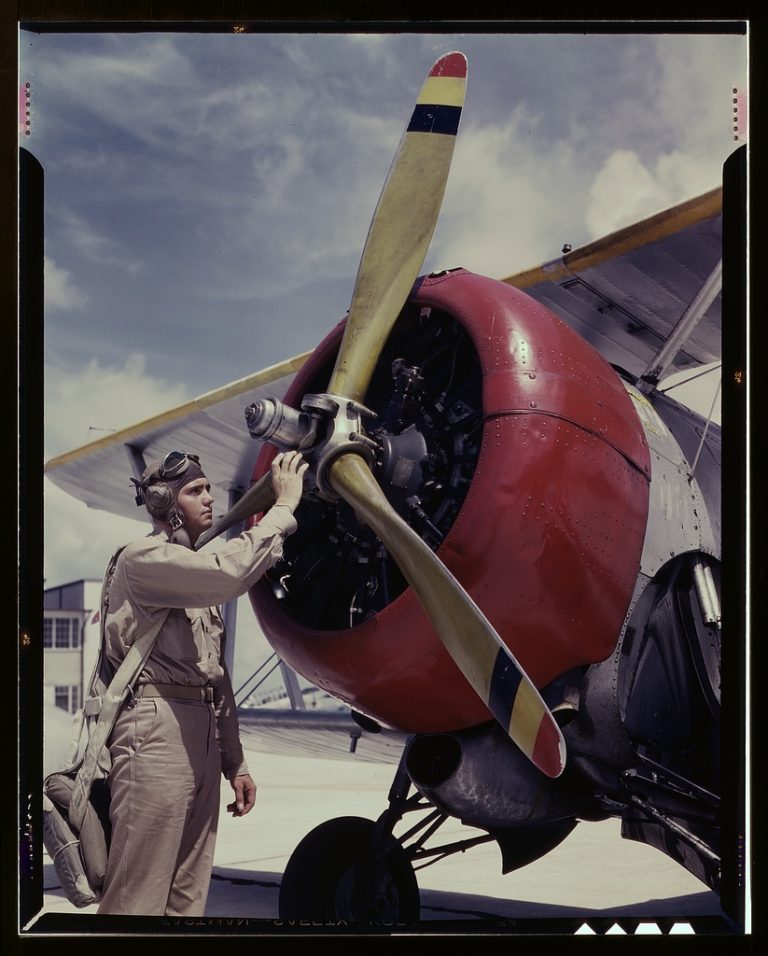
Obsolete as a fighter by 1941, the F3F still had real value as a hot, honest advanced trainer. A powerful radial, a tail-dragging stance, a retractable undercarriage and genuine fighter agility made it an ideal stepping-stone for pilots about to graduate onto the Wildcat. Survivors were sent to naval air stations such as Corpus Christi, Texas, and Miami, Florida — the famous 1942 Kodachrome photographs of colourful F3Fs at Corpus Christi date from exactly this period.
Others became utility and communications hacks, ferrying people and priorities around the sprawling wartime training establishment. It was unglamorous, invisible work, far from any headline. But in those quiet flights the last biplane fighter helped forge the very pilots who would win the carrier war it never saw — a second career arguably more consequential than its first.
Where "the Grumman Iron Works" was forged
The reputation for indestructible carrier aircraft that carried Grumman through WWII began with these biplanes.
Read the full story
Grumman fighters earned a wartime nickname — "the Grumman Iron Works" — for their uncanny ability to absorb battle damage and still bring their pilots home. That culture of deliberate over-building did not appear fully formed with the Wildcat; it was established with the FF, F2F and F3F, whose airframes were stressed for the brutal, repeated shock of carrier landings and for hard peacetime aerobatics.
The proof is literally underwater. The F3F's structure was strong enough that, decades after individual aircraft sank, corroded airframes could be salvaged from the seabed and rebuilt to fly again — something almost no contemporary type could survive. When Grumman engineers later built the Wildcat and Hellcat to shrug off cannon fire, they were applying a philosophy first worked out on a fat little biplane. The Iron Works began as a barrel.
Fighters pulled from the seabed
Several of today's airworthy F3Fs were recovered from the ocean floor decades after they sank.
Read the full story
The F3F's survival story is unusually literal: a number of the airframes flying today were recovered from underwater. Galer's F3F-2 came up off San Diego in 1988, and other flyable examples were rebuilt using the wreckage of F3F-2s that had gone down in Hawaiian waters in the late 1930s, when pre-war training accidents put more than one Flying Barrel on the sea floor.
Cold, comparatively low-oxygen water preserved enough of the rugged Grumman structure — and enough of the harder-to-replace fittings — to make restoration possible where a lesser airframe would simply have dissolved. The result is a remarkable second life for a fighter type that had been written off half a century earlier, and the direct explanation for why anyone alive today can watch a 1930s US Navy biplane fighter actually fly. The sea took these aircraft; decades later, it gave a few of them back.
The fighter that missed its own war
By December 1941 the F3F was already gone from the front line — it never fired a shot in WWII.
Read the full story
Timing is everything, and the F3F's timing spared it. Had the Pacific war begun two or three years earlier, the last US Navy biplane fighter would have met the Mitsubishi Zero over the fleet, and the result would almost certainly have been grim — the F3F was slower, more lightly armed, and could not dive with a modern monoplane. Its virtues, agility and toughness, would not have saved it from an opponent that simply refused to fight on its terms.
But by the time of Pearl Harbor the F3F had already been retired from carrier squadrons in favour of the Buffalo and the Wildcat. It never saw combat, and so it never suffered the reputational massacre that befell the Buffalo over Midway. The F3F retired undefeated precisely because it retired in time — an accident of the calendar that turned a fighter which would have been slaughtered into one remembered with affection. There is a lesson in that about how thin the line between "beloved classic" and "flying coffin" can be.
A biplane fighter you can still watch fly
At a handful of airshows, the last US Navy biplane fighter still takes to the sky in private hands.
Read the full story
Fewer than a handful of F3Fs are airworthy, owned by dedicated warbird collectors and museums, and their appearances are genuine events rather than routine. To see one is to watch aviation history breathe: an open-cockpit, hand-cranked, radial-engined biplane fighter — the very last of its kind in US Navy service — hauling around the sky in the sunshine, its fat fuselage and braced wings unmistakable against a modern airshow line-up.
It is single-seat, effectively priceless, and emphatically not for hire — you cannot buy a ride in one, and no operator offers F3F flights. But it is real and it flies, which is more than can be said for many far more famous aircraft of its generation. For an aviation enthusiast, catching one of these barrels in the air is a rare privilege; if the flying itself is what you are after, that is where a genuine, bookable warbird or fighter-jet experience comes in.
The Grumman F3F in photographs
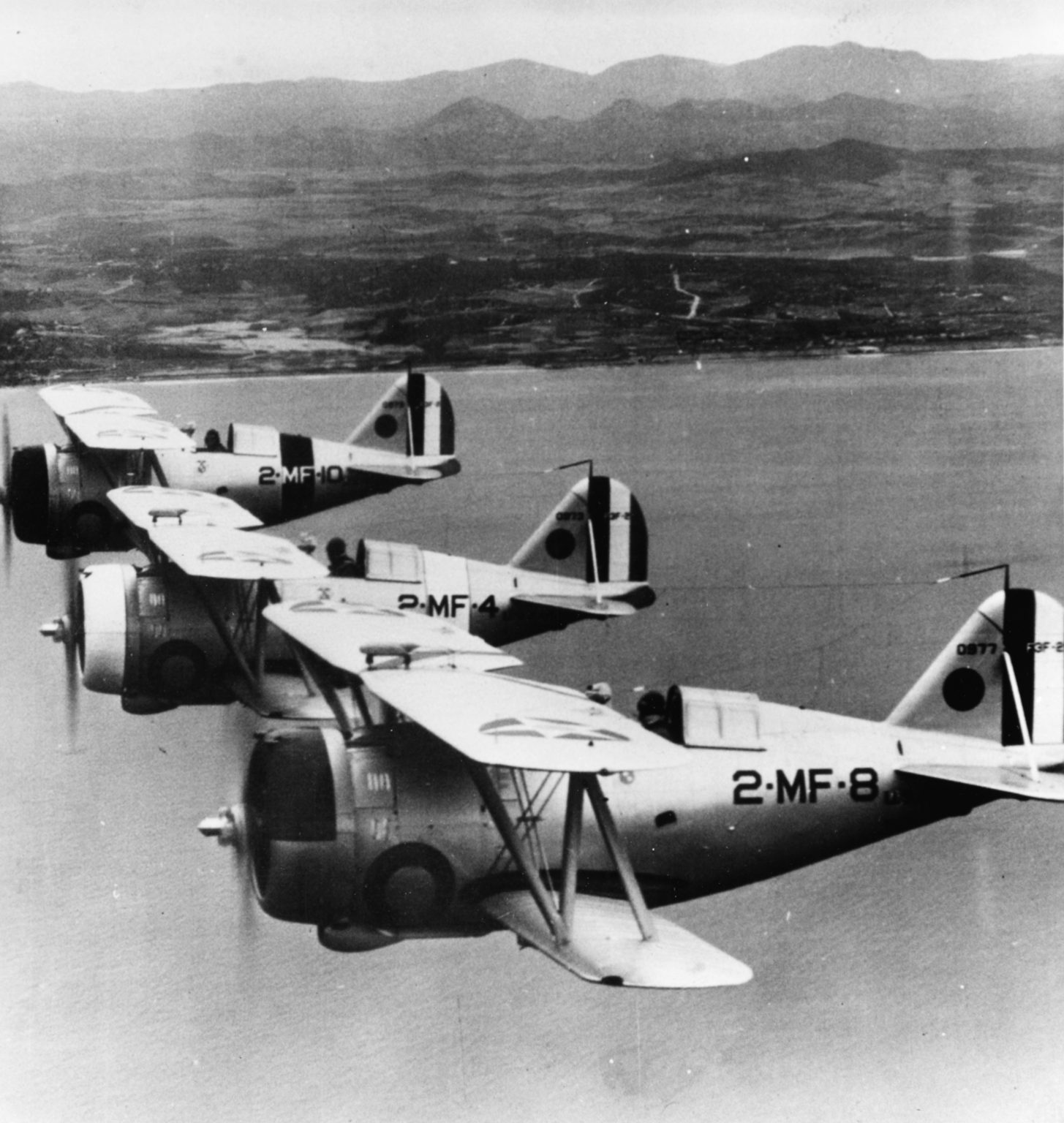
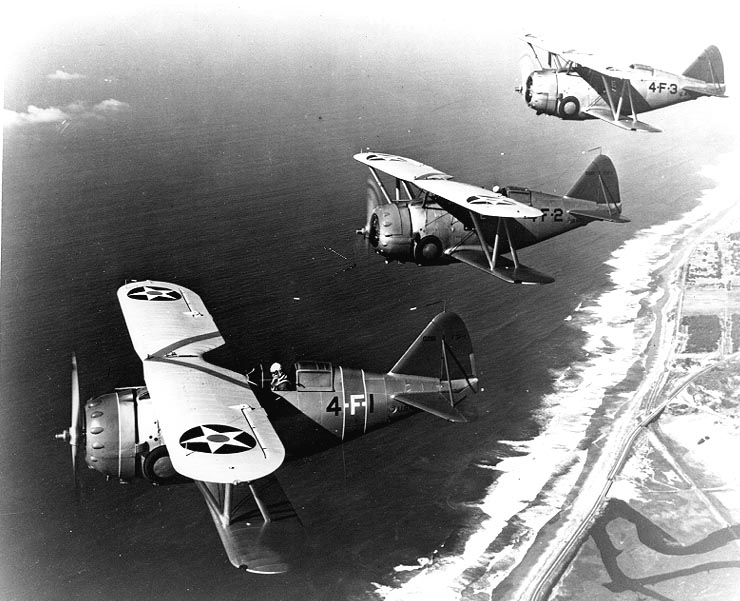
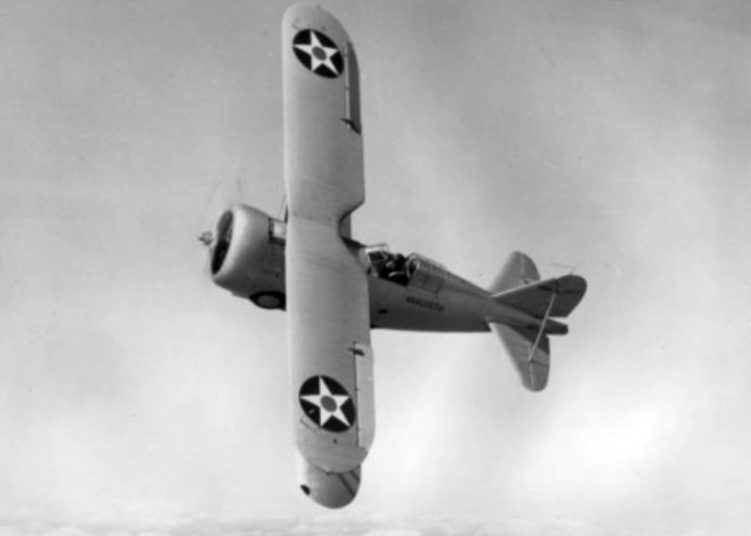
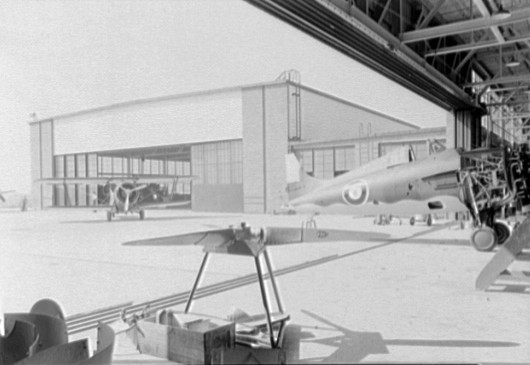
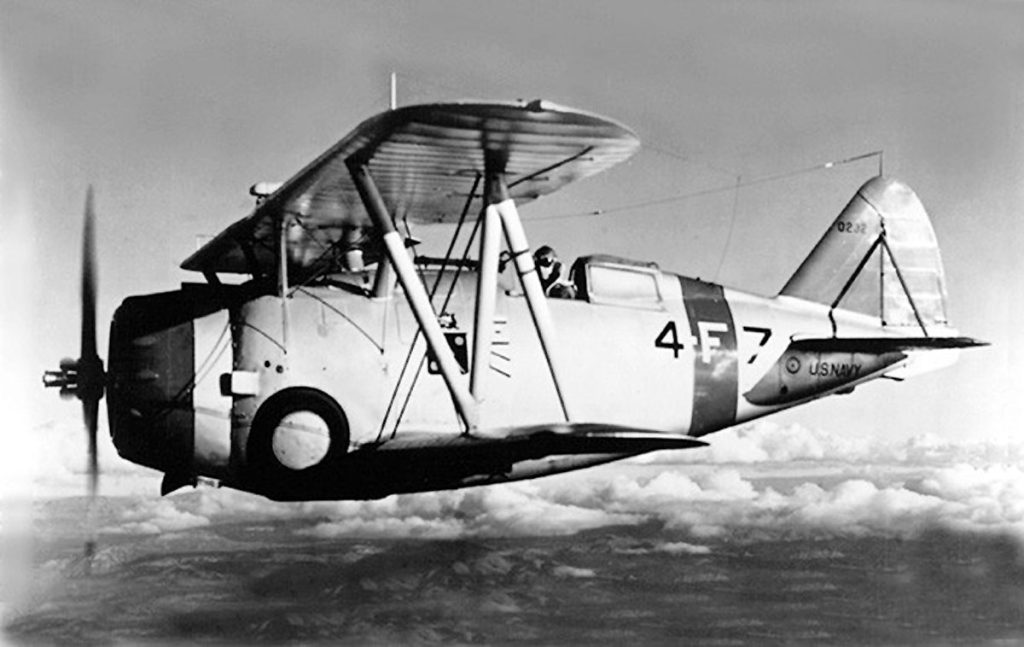
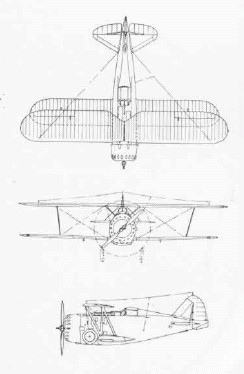
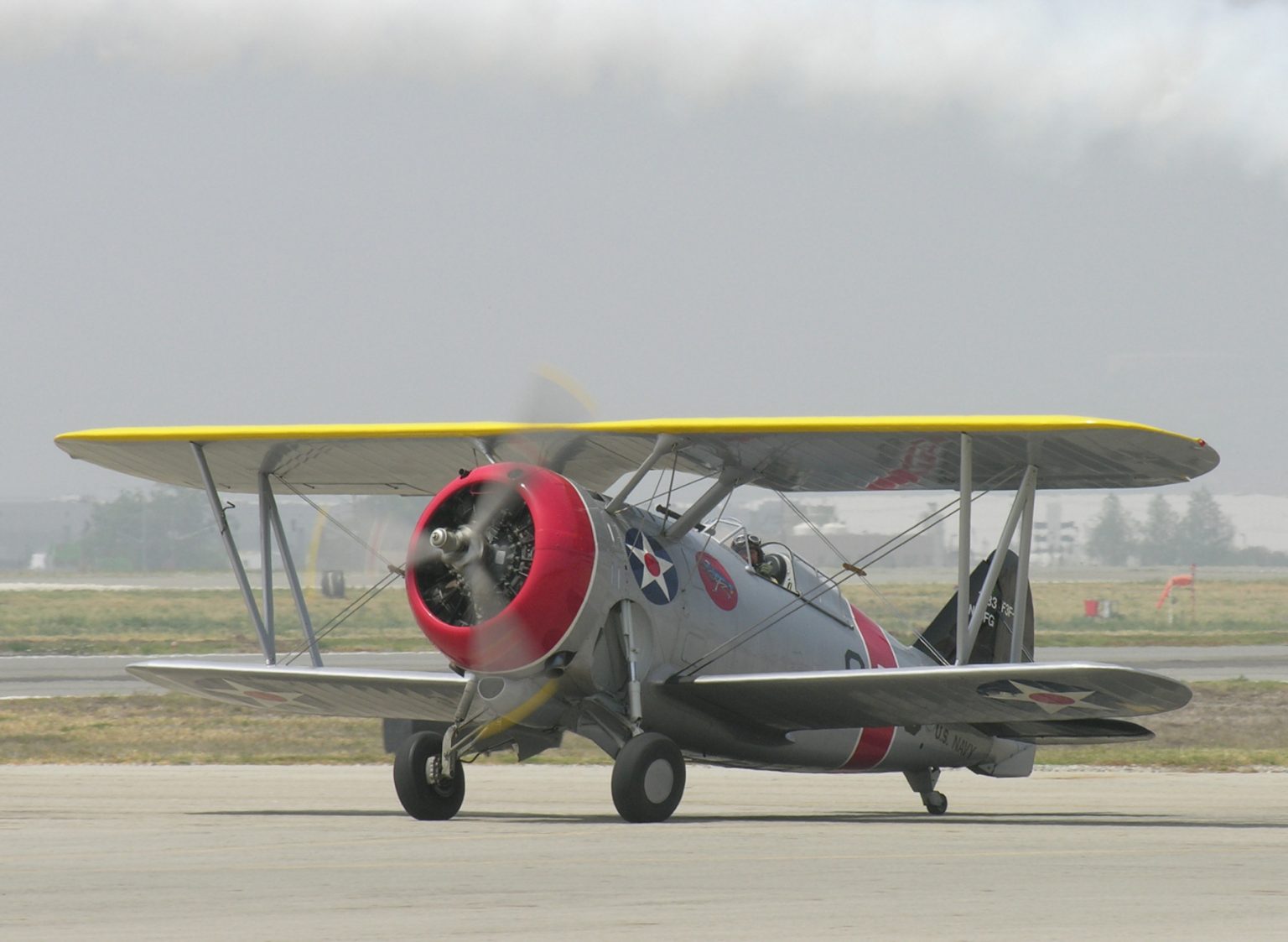
The Grumman F3F on film: a rare look at the Flying Barrel
"A Look at the Grumman F3F" from Fantasy of Flight — the aviation collection of Kermit Weeks, one of the world's foremost warbird custodians. It is one of the very few close-up films of a genuine Flying Barrel, walking through the type's design, its hand-cranked gear and its place as the US Navy's last biplane fighter. (We chose it for the authority of the source rather than raw view count, which we could not independently verify at the time of writing.)
Where the Grumman F3F served — and where its lineage went to war
The F3F was an all-American fighter: designed and built by Grumman in Bethpage, New York, flown only by the US Navy and Marine Corps, and never exported or used in combat. The map therefore centres on the United States. The lighter "lineage & successor context" markers show where the F3F's monoplane successor, the F4F Wildcat, carried this Grumman bloodline into Pacific combat — the war the F3F itself never fought. Hover or tap a country for detail.
Who flew the Grumman F3F
The F3F's operator list is short and entirely American — one of the clearest signs of how domestic and how brief its career was. It was never sold abroad, never licence-built elsewhere, and never met a foreign air force in the air. In an era when British, Japanese and continental navies were fielding their own carrier biplanes, the Flying Barrel stayed home.
Military operators
| United States Navy | Carrier fighter squadrons, 1936–1941 primary |
| US Marine Corps | Fighter squadrons incl. VMF-1, VMF-2 |
| Carriers embarked | USS Ranger, Saratoga, Yorktown, Enterprise |
| Late-war role | Advanced trainers & station hacks to 1943 |
| Export operators | None |
Civil & survivors
| Gulf Oil (Al Williams) | G-22 "Gulfhawk II" demonstrator, 1936 |
| Grumman company | G-32A hack / testbed |
| Survivors today | ~4 airframes (sources vary) |
| Airworthy | A handful, in private warbird hands |
| On display | NASM (Gulfhawk II), NNAM Pensacola |
That short list is exactly why the operations map above is so concentrated: to trace the F3F's geographic footprint you have to follow its bloodline rather than its logbook. The aircraft itself lived and died within US naval aviation; its influence crossed oceans only through the Wildcat and the "cat" fighters that came after.
09The surviving Grumman F3Fs: which airframes are left, and how they came back+
Because the F3F was never exported and was scrapped in quantity after the war, its survivors are few and their stories are unusually dramatic. Figures vary between sources, but the commonly cited survivor count is around four aircraft — a mix of genuine military F3F-2s and the civil G-22.
The most famous single airframe is Lt. Bob Galer's F3F-2, ditched off San Diego in 1940 and raised from the seabed in 1988, then restored — a project that reportedly cleared its pilot of blame by revealing a mechanical valve failure. Other airworthy F3F-2s were rebuilt using wreckage recovered from Hawaiian waters, where pre-war training losses had put more than one Flying Barrel on the sea floor. Restored to fly by warbird specialists, these examples have appeared in the colours of pre-war Navy and Marine squadrons, and a small number remain airworthy in private and museum hands today. The civil G-22 "Gulfhawk II" is preserved statically in the Smithsonian's National Air and Space Museum, and the National Naval Aviation Museum at Pensacola holds F3F material as part of its interwar collection. Treat every specific count as approximate — this is a rare type whose exact tally of "extant" and "flyable" airframes shifts as restorations begin, finish, change hands or are grounded.
The Grumman F3F's record in numbers
Grumman F3F: frequently asked questions
Can I fly in a Grumman F3F? +
Realistically, no. The Grumman F3F is a single-seat aircraft, and only a handful of airworthy examples survive — all in the hands of private warbird collectors and museums. There is no passenger seat and no F3F you can book a ride in anywhere in the world. If you are very lucky, you may see one fly at a major warbird airshow.
What you can do is fly in a genuine ex-military aircraft yourself. MiGFlug arranges authentic fighter-jet and warbird flights around the world — from Cold War jet trainers like the L-39 Albatros to supersonic interceptors such as the MiG-29 — where you strap in, pull real g and take the controls. Explore what is bookable at migflug.com/flights-prices.
Was the Grumman F3F really the last US Navy biplane fighter? +
It is very widely described as the last biplane fighter ordered into service by the US Navy and Marine Corps, and that is the honest headline. The F3F-3 of 1938–39 was the final new-build biplane fighter delivered to the Navy; every fighter that followed it into service was a monoplane. As always with "last" and "first" claims, exact definitions matter — but as a practical statement about front-line US naval fighters, the F3F earns the title.
Why did they call it the "Flying Barrel"? +
Because it looked like one. Grumman wrapped a compact, immensely strong airframe around a big radial engine, producing a very deep, rounded fuselage. The FF, F2F and F3F all shared this rotund shape, and crews nicknamed the family the "Flying Barrel" (and sometimes the "Beer Barrel"). The later Cyclone-powered F3F variants, with their broader cowling, looked barrel-fatter still. The nickname was affectionate, not an insult.
Did the Grumman F3F fight in World War II? +
No. By the time the United States entered the war in December 1941, the F3F was already obsolete and had been withdrawn from front-line carrier squadrons, replaced by the monoplane Brewster F2A Buffalo and Grumman F4F Wildcat. It never fired its guns in anger during WWII. Surviving aircraft served away from the front as advanced trainers, utility hacks and station aircraft until about 1943.
How is the F3F related to the Grumman F4F Wildcat? +
Directly. When the Navy wanted the F3F's successor, Grumman's first proposal (the XF4F-1) was another biplane from this same family. Grumman then redesigned it as a monoplane — the Wildcat — while keeping the F3F's rugged structure and hand-cranked, narrow-track landing gear. The F3F is therefore the direct ancestor of the F4F Wildcat, and through it the whole Grumman carrier-fighter dynasty: the Hellcat and the Bearcat.
What engine and armament did the F3F have? +
The first F3F-1 used a Pratt & Whitney R-1535 Twin Wasp Junior of roughly 650–700 hp; the definitive F3F-2 and F3F-3 switched to a Wright R-1820 Cyclone of about 950 hp, giving a top speed near 425 km/h. Armament was light by later standards — typically one 0.30-calibre and one 0.50-calibre Browning machine gun in the cowling, though the exact fit varied and some references cite two 0.30-calibre guns. Light bombs could be carried on underwing racks.
How many Grumman F3Fs survive, and are any airworthy? +
Only a few. Commonly around four airframes survive, and a handful of those are airworthy — genuinely remarkable for a 1930s biplane fighter. Several of the flying examples were recovered from the sea decades after they sank: one F3F-2 (flown by Lt. Bob Galer) was raised off San Diego in 1988, and others were rebuilt from wreckage recovered in Hawaiian waters. The civilian G-22 "Gulfhawk II" cousin is preserved in the Smithsonian. Exact numbers vary between sources, so treat the figures as approximate.
How fast was the Grumman F3F? +
The Wright Cyclone-powered F3F-2 had a top speed of about 264 mph (roughly 425 km/h) at 15,000 feet — genuinely fast for a biplane, and enough to keep it competitive with early monoplanes for a few years. The earlier, less powerful F3F-1 topped out around 231 mph (about 372 km/h). These are approximate period figures and vary slightly between sources.
How does the F3F compare to the Brewster Buffalo? +
They were near-contemporaries built to similar US Navy needs, but they represent opposite sides of a technological divide. The F3F was the last, most refined biplane — agile, tough and deck-friendly, but slow and lightly armed. The Buffalo was America's first monoplane carrier fighter — faster on paper but heavier, with a demanding carrier approach, and it was thrown into hopeless odds over Midway. Ironically the older biplane is remembered more fondly, largely because it retired before it could be sent to fight a war it would have lost.
The Grumman F3F is out of reach. A real fighter flight isn't.
You'll almost certainly never fly a Grumman F3F — the handful of airworthy examples are single-seat and privately owned. But you can still strap into a genuine ex-military jet, pull real g and take the controls yourself. MiGFlug arranges authentic fighter-jet and warbird experiences around the world — from Cold War jet trainers to supersonic interceptors.