
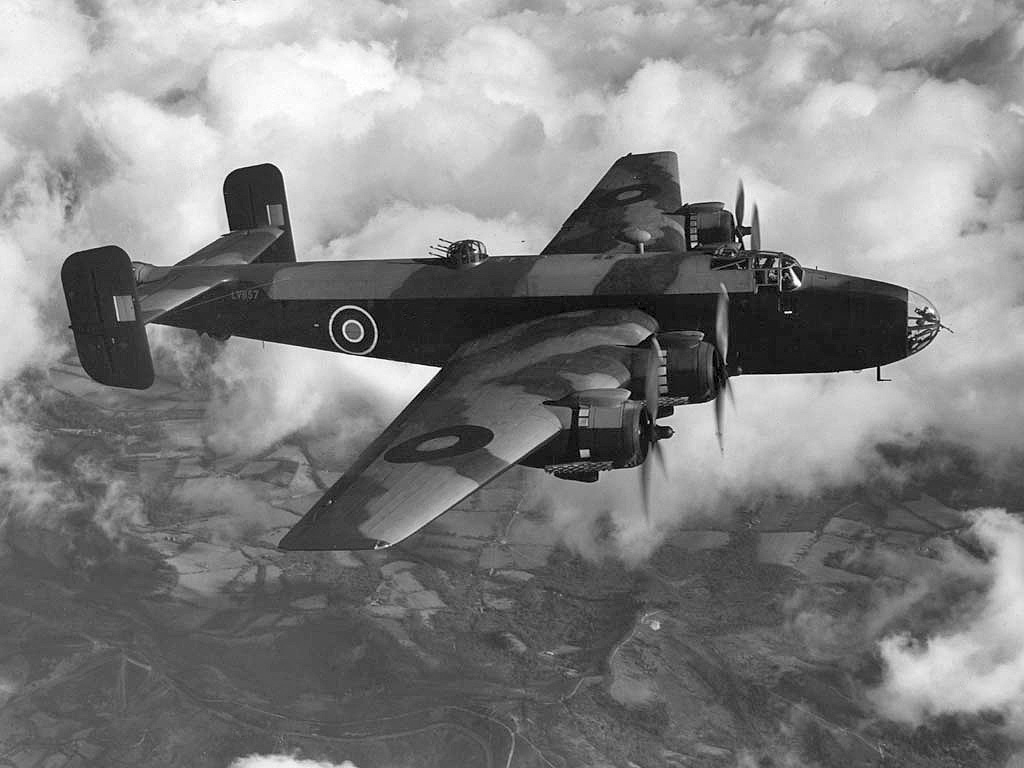
Handley Page Halifax
Britain’s hard-working four-engine heavy bomber — overshadowed by the Lancaster, yet flown on more kinds of mission than any other RAF heavy of the Second World War.
At a Glance
Handley Page Halifax: key facts
The Story
The Handley Page Halifax: Bomber Command’s other heavy
When people picture the RAF’s night bomber offensive, they usually picture the Avro Lancaster. But for much of the war the burden was shared with another four-engine heavy that flew more sorties in more roles than almost any British aircraft of its generation: the Handley Page Halifax. It bombed Germany, hunted U-boats over the Atlantic, towed the gliders that carried airborne troops into Normandy and Arnhem, dropped secret agents and supplies into occupied Europe, and finished its career hauling freight and passengers across a battered postwar continent.
The Halifax began, oddly, as a twin-engine design. Handley Page tendered it against Air Ministry Specification P.13/36, which called for a fast, twin-engine medium-heavy bomber built around the troubled Rolls-Royce Vulture engine. When the Vulture faltered, the design was recast around four of the reliable Rolls-Royce Merlins instead — the same engine that powered the Spitfire and Hurricane. The prototype first flew on 25 October 1939, weeks after war broke out. Deliveries began in late 1940, No. 35 Squadron reformed on the type that November, and the Halifax flew its first Bomber Command operation on the night of 11–12 March 1941 against Le Havre. It was, chronologically, the second of the RAF’s three four-engine heavies to reach the squadrons — after the Short Stirling and before the Lancaster.
Early service was not smooth. The first Merlin-powered marks — the Mk I, Mk II and Mk V — were underpowered for their weight and suffered a dangerous handling flaw: under certain conditions the rudders could over-balance and lock hard over, flicking the aircraft into an unrecoverable spin. A string of losses was eventually traced to this problem, and it was cured by redesigning the tail with larger rectangular fins. The bigger transformation came with the Mk III of 1943, which swapped the Merlins for four Bristol Hercules air-cooled radials. The Hercules Halifax was faster, climbed better, carried its load higher, and was far more popular with crews. From then on the Halifax was a genuine front-rank heavy rather than a compromised one.
What set the Halifax apart was its sheer versatility. Bomber Command was only part of the story. Coastal Command flew Halifaxes on long anti-submarine and maritime-reconnaissance patrols over the Bay of Biscay and the Atlantic. Specialist squadrons used it to tow Airspeed Horsa and General Aircraft Hamilcar gliders, and to drop paratroops — work that put the Halifax over Normandy on D-Day and over Arnhem during Operation Market Garden. Other squadrons flew clandestine Special Operations Executive missions, parachuting agents, weapons and radios to resistance movements across France, Norway, Poland and the Balkans. Few aircraft of the war wore so many different hats.
Around 6,176 Halifaxes were built by a national consortium of factories before production ended in 1946 — a total second only to the Lancaster among British heavies. Its reputation has always suffered by comparison with the Lancaster, which could lift a heavier load higher, and Bomber Command’s chief, Sir Arthur Harris, made no secret of preferring the Avro design. Yet the Halifax was more survivable in some respects: its crews had a better chance of escaping a stricken aircraft, and the type’s adaptability kept it useful long after the bombing campaign ended.
Peace did not retire it. Bomber Halifaxes were converted into the Handley Page Halton airliner and freighter, which flew for BOAC and independent operators and took part in the 1948–49 Berlin Airlift. Military transport and meteorological-reconnaissance versions soldiered on into the early 1950s. Today not one Halifax remains airworthy, and only a handful of restored airframes survive — but the aircraft that carried a third of Bomber Command’s effort deserves to be remembered as far more than the Lancaster’s understudy.
The Halifax also earned a quieter distinction that mattered enormously to the men who flew it. Analysis of the bomber offensive showed that a crew forced to abandon a Halifax stood a better chance of getting out alive than one baling out of a Lancaster, whose narrow fuselage and single main escape hatch could become a death-trap in a spinning, burning aircraft. For an airman weighing the odds of surviving a tour, that difference was not academic.
By the war’s end the Halifax had flown on every front the RAF fought on in Europe and the Mediterranean, from the industrial cities of the Reich to the fjords of Norway, the fields of France and the mountains of the Balkans. It had been a bomber, a tug, a spy-carrier, a submarine-hunter and a transport. If the Lancaster won the fame, the Halifax arguably won the versatility contest — and shared the danger in full measure.
01The Handley Page Halifax’s origins: from twin-engine gamble to four-engine heavy+
Specification P.13/36 was one of the most consequential the Air Ministry ever issued. It asked for a twin-engine bomber able to carry a heavy bomb load over long range at high speed, and both Handley Page and Avro answered it. Both intended to use the 24-cylinder Rolls-Royce Vulture, and both were forced to rethink when that engine proved unreliable. Avro re-engined its design with four Merlins to create the Lancaster; Handley Page did the same, arriving at the Halifax. The two great British night bombers were therefore twins separated at birth by the same failed powerplant.
The Halifax that emerged was a big, slab-sided aircraft with a deep fuselage and a capacious bomb bay supplemented by wing cells. Its first flight on 25 October 1939 was followed by a rapid move into production spread across Handley Page, English Electric, Fairey, Rootes and the London Aircraft Production Group — a genuinely national effort that would eventually turn out more than 6,000 machines.
02Why the early Handley Page Halifax struggled — and how the Hercules Mk III fixed it+
The first Halifaxes were tail-heavy performers. Loaded, the Merlin-engined Mk I and Mk II could not reach the altitudes the Lancaster managed, and their triangular fins hid a lethal trap: in a corkscrew or a tight turn the rudders could over-balance, slam to full deflection and hold there, throwing the bomber into a flat spin from which recovery was often impossible. The cure was a redesigned tail with larger, rectangular vertical surfaces, retrofitted and built into later airframes.
The decisive change was the switch to the Bristol Hercules radial for the Mk III of 1943. The air-cooled Hercules gave more power, better high-altitude performance and improved reliability, lifting the Halifax’s top speed to around 454 km/h (282 mph) and its ceiling markedly. Combined with extended, squared wingtips, the Hercules marks — III, VI and VII — turned the Halifax into an aircraft crews trusted.
Design & Engineering
How the Handley Page Halifax was built to fight
A conventional aircraft made exceptional by adaptability: a roomy airframe, two very different engine families, and a layout that let one design bomb, tow, patrol and drop.
Two engine families in one airframe
Designed around four Rolls-Royce Merlins after the Vulture failed, the Halifax was later re-engined with four Bristol Hercules air-cooled radials from the Mk III. The radial marks were faster, climbed higher and were far more reliable — a rare mid-war transplant that transformed a whole type, lifting its speed, ceiling and reliability at a stroke.
A deep fuselage and a divided bomb bay
The Halifax carried its load in a long fuselage bay supplemented by six cells in the wing centre-section, for a maximum bomb load of about 13,000 lb (5,900 kg). The same voluminous fuselage that swallowed bombs could equally carry paratroops, supply canisters or agents — the single feature that made the Halifax the RAF’s most adaptable heavy.
Defended by turrets, built to be escaped
Later marks carried nose, dorsal and tail turrets with up to nine .303 in Browning machine guns. Crucially, the Halifax’s layout gave its seven-man crew a better statistical chance of baling out of a doomed aircraft than the Lancaster — a grim but real measure of merit that endeared the type to the men who trusted their lives to it.
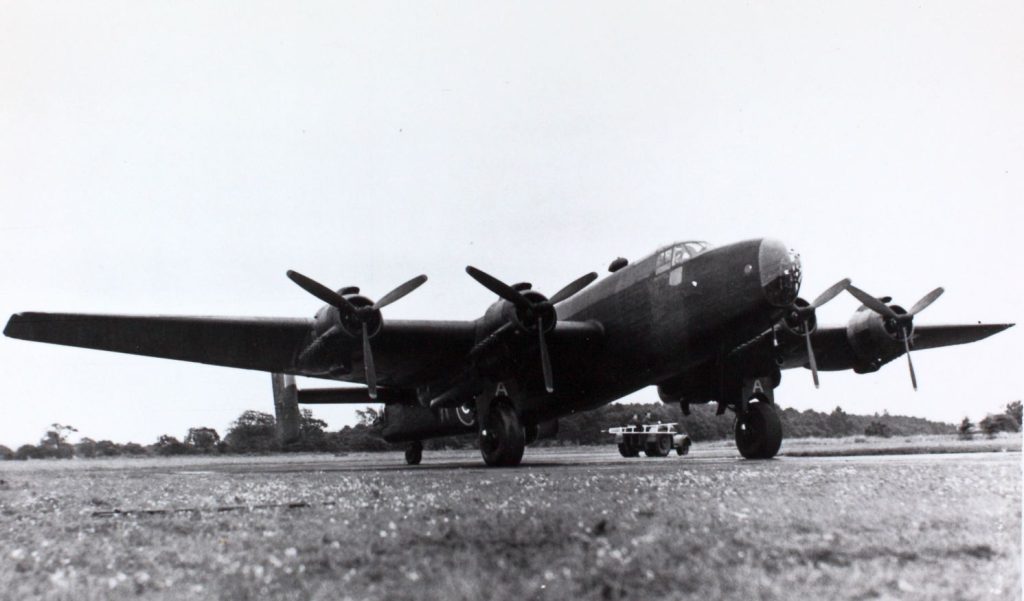
03Beyond bombing: the Handley Page Halifax with Coastal Command, airborne forces and the SOE+
No British heavy bomber was pressed into more secondary roles. Coastal Command’s Halifaxes flew gruelling maritime patrols, hunting U-boats and shadowing shipping far out over the Bay of Biscay and the North Atlantic, some fitted with air-to-surface radar and extra fuel.
Airborne-forces squadrons used the Halifax as a glider tug, hauling the big Hamilcar and Horsa gliders whose loads — jeeps, guns and troops — landed at Normandy on D-Day and at Arnhem during Operation Market Garden. The same squadrons dropped paratroops and, working with the Special Operations Executive, parachuted agents, arms and radio sets to resistance networks in France, Norway, Poland, Italy and the Balkans. It is this breadth — bomber, tug, patrol aircraft and clandestine transport — that makes the Halifax one of the most widely used Allied aircraft of the war.
Full Specifications
Handley Page Halifax B Mk III — specifications
Figures are for the Bristol Hercules-powered B Mk III, the most-produced variant. Values vary between marks and sources; approximate and disputed figures are flagged. Where marks differed significantly — particularly between the Merlin and Hercules versions — the Hercules-engined figures are used as the definitive standard.
Baseline note: the figures below describe the Halifax B Mk III of 1943–45 — Bristol Hercules XVI radials, the extended rounded wingtips and the enlarged D-type fins. This is the mark that mattered: 2,091 were built, more than any other, and it is the aeroplane on which the type’s reputation should rest rather than on the Merlin-engined marks that preceded it. Deltas for the Merlin B Mk I and B Mk II, and for the Hercules 100-engined B Mk VI, are given in grey. Published Halifax data vary more than most: wing area, engine ratings and sortie totals differ between Handley Page figures, Air Ministry data sheets and postwar histories, and those disagreements are flagged where they change the picture.
Dimensions & weights
- Crew
- 7 — pilot, flight engineer (who doubled as second pilot on a folding seat for take-off), navigator, bomb-aimer, wireless operator, mid-upper and rear gunners
- Length
- 21.82 m (71 ft 7 in)
- Wingspan
- 31.75 m (104 ft 2 in) with the rounded extended tips; earlier marks and the first few Mk III airframes span 30.12 m (98 ft 10 in) with square tips
- Height
- 6.32 m (20 ft 9 in)
- Wing area
- 111 m² (1,190 sq ft) as quoted in the standard data tables; several reference works give 1,250–1,275 sq ft for the extended-tip wing, which moves every derived wing-loading figure with it
- Fuselage bomb bay
- 6.71 m (22 ft) long, divided into six separate cells, with three more cells in each inboard wing — the single most consequential dimension on the aeroplane
- Empty weight
- 17,178 kg (37,870 lb)
- Normal loaded weight
- 24,675 kg (54,400 lb)
- Maximum take-off weight
- 29,484 kg (65,000 lb); the Mk I began life cleared to 26,308 kg (58,000 lb) and the weight grew with every mark
- Maximum tug weight
- 26,943 kg (59,400 lb) at take-off towing a glider, against 23,950 kg (52,800 lb) for a Lancaster Mk II — the margin that made the Halifax the RAF’s heavy tug
- Wing loading
- 223 kg/m² (45.7 lb/sq ft) at normal loaded weight, on the 1,190 sq ft figure
- Crew escape hatch
- 610 × 673 mm (24 × 26.5 in), against 559 × 673 mm (22 × 26.5 in) in the Lancaster. About 25 per cent of Halifax crews got out of a stricken aircraft; the Lancaster figure was about 15 per cent. Two and a half inches of hatch was worth several hundred lives
- Undercarriage
- Retractable tailwheel type, Messier hydraulics as standard; Dowty-built legs were fitted when Messier supply failed, and because the two were not interchangeable the resulting aircraft were redesignated Mk V with a reduced 18,144 kg (40,000 lb) landing weight
Performance
- Maximum speed
- 454 km/h (282 mph) at 4,115 m (13,500 ft)
- Maximum speed, B Mk I
- 426 km/h (265 mph) at 5,335 m (17,500 ft) — the Merlin-engined aeroplane was slower and, worse, could not hold height
- Maximum speed, B Mk VI
- 497 km/h (309 mph) at 5,940 m (19,500 ft) in full-supercharger gear, with the Hercules 100
- Cruising speed
- 346 km/h (215 mph); the B Mk VI cruised at 426 km/h (265 mph)
- Rate of climb
- 3.8 m/s (750 ft/min) at operational weight
- Service ceiling
- 7,315 m (24,000 ft); loaded Merlin marks struggled to hold 5,500 m (18,000 ft), which put them under the Lancaster stream and inside the flak and the night fighters
- Range, reduced bomb load
- 2,990 km (1,860 miles) with 2,630 kg (5,800 lb) of bombs and full tanks
- Range, maximum bomb load
- ~1,660 km (~1,030 miles) with 5,900 kg (13,000 lb) — enough for the Ruhr, not for Berlin
- Typical sortie
- 7–9 hours to a German target from a Yorkshire airfield, much of it above 5,000 m in unheated positions at −40 °C
- Loss rate, No. 4 Group
- 4.2 per cent in 1943 (485 aircraft from 11,607 sorties), falling to 1.6 per cent in 1944 (402 from 25,454) as the Mk III replaced the Merlin marks — the clearest single measure of what the Hercules bought
- For comparison: Lancaster B Mk I
- Roughly the same 454 km/h (282 mph), but 6,350 kg (14,000 lb) of bombs in an unobstructed 10 m (33 ft) bay. Harris reckoned the average Lancaster delivered 154 long tons in its life against the Halifax’s 100
- Dive behaviour
- The Mk III recovered from a dive of its own accord as speed built, where a Lancaster tended to tighten into it — a quality crews valued in the corkscrew
Propulsion & systems
- Engines
- 4 × Bristol Hercules XVI 14-cylinder sleeve-valve air-cooled radials
- Take-off power
- 1,204 kW (1,615 hp) each; some references quote 1,650 hp, the difference being boost rating and fuel grade rather than a different engine
- Earlier and later powerplants
- Merlin X (B Mk I), Merlin XX and 22 (B Mk I Srs III, B Mk II, B Mk V), Hercules 100 of 1,342 kW (1,800 hp) in the B Mk VI. A Merlin 65 two-stage installation flown as the B Mk IV reached 521 km/h (324 mph) but no such engines could be spared
- Why the change
- The Merlin XX was needed for Lancasters, Mosquitoes and fighters, and it never suited the Halifax: the aircraft was draggier than Handley Page had calculated and the liquid-cooled installation added frontal area and vulnerability without the power to pay for it. The Hercules gave more power, less to shoot at, and released Merlins elsewhere
- Supercharger
- Two-speed single-stage on the Hercules XVI; the Hercules 100 raised full-throttle height and gave the B Mk VI a genuine high-altitude cruise
- Propellers
- de Havilland Hydromatic three-blade constant-speed (Mk III); Rotol compressed-wood units on Merlin marks
- Nacelle design
- Handley Page designed its own square-section "power egg" rather than adopting Rolls-Royce’s slimmer unit. It cost drag — part of why the early aircraft underperformed — but it took a Hercules with far less redesign than a Merlin nacelle would have
- Internal fuel
- ~10,190 l (~2,242 imp gal) in wing tanks, with provision for auxiliary tanks in the bomb bay for long-range and Coastal Command work
- Fins and rudders
- Twin fins and rudders. The original triangular fin allowed the rudder to overbalance and lock hard over in a sideslip, most often with an engine out; the enlarged D-type fin, some 40 per cent larger, with a modified rudder, cured it from the Mk II Series IA and Mk III onward
- Navigation and bombing aids
- Gee (TR1335) from March 1942, H2S Mk II and III in a ventral radome, Oboe on Pathfinder aircraft. The first airborne H2S set flew in Halifax V9977, lost with Alan Blumlein aboard in June 1942
- Electronic warfare fit
- Monica and Fishpond tail warning, Airborne Cigar and Mandrel jamming, Window dispensers — No. 100 Group flew Halifaxes specifically for this work
- Structure
- All-metal stressed skin with fabric-covered control surfaces, built in large sub-assemblies deliberately sized for dispersed manufacture by firms with no aircraft experience
04The Handley Page Halifax’s variants: from Merlin Mk I to Hercules Mk VII and the Halton airliner+
Merlin marks (Mk I, II, V): the original in-line engined bombers, later fitted with the enlarged rectangular tail that cured the rudder-overbalance problem. The Mk V differed mainly in its undercarriage.
Hercules marks (Mk III, VI, VII): re-engined with Bristol Hercules radials from 1943, with extended wingtips and much improved performance — the definitive bomber versions.
Airborne & special-duties (A Mk III/V/VII): glider tugs and paratroop/SOE aircraft used at Normandy, Arnhem and on clandestine drops.
Coastal Command GR/Met: maritime reconnaissance and meteorological versions with radar and extra fuel.
Transport & civil (Mk VIII/IX, Halton): postwar freight and passenger conversions; the Handley Page Halton airliner flew for BOAC and in the Berlin Airlift.
05The Handley Page Halifax’s operating costs: what a wartime heavy actually cost+
Reliable unit-cost figures for the Halifax are hard to pin down. Wartime aircraft costs were quoted inconsistently — sometimes airframe-only, sometimes with engines and equipment, in shifting 1940s pounds — and no single authoritative figure is widely accepted, so we mark it not reliably recorded rather than repeat a dubious number.
A cost-per-flight-hour figure — a standard field on these pages — simply does not apply to the Halifax today. Unlike a warbird still flying air-show hours, not one Halifax is airworthy anywhere in the world. The survivors are static museum restorations, so any “per hour” number would be pure estimate. The real modern cost of a Halifax is measured instead in the years and volunteer hours poured into recovering and restoring the handful of airframes that remain.
Armament & payload
The Halifax’s bomb bay was six cells and a structural beam, and the biggest thing that would fit was the 4,000 lb cookie
The Halifax carried a nominal 5,900 kg (13,000 lb), and a maximum of 6,580 kg (14,500 lb), spread across a 22-foot fuselage bay divided into six compartments plus three cells in each inboard wing. That division was the design’s original sin. It made the aeroplane superb at carrying many medium stores — small bomb containers of incendiaries, 500 lb medium-capacity bombs, sea mines, supply containers — and it made it structurally incapable of swallowing the big thin-cased blast bombs on which Bomber Command’s area-attack doctrine came to depend.
The 4,000 lb High Capacity "cookie" could be got in, and from the Mk II Series IA onward the bay door sealing was improved to accept it, but it was the ceiling. The 8,000 lb HC, the 12,000 lb Tallboy and the 22,000 lb Grand Slam were Lancaster work, because the Lancaster’s 33-foot bay had nothing in it. That single geometric fact, more than speed or ceiling, is why Harris preferred the Lancaster and why he calculated the average Halifax would drop 100 long tons in its career against a Lancaster’s 154.
Defensively the Halifax was armed almost entirely with rifle-calibre guns, which by 1943 was close to useless against an armoured night fighter and worse than useless in the way it encouraged crews to fight rather than evade. What it had instead was a big escape hatch, a rugged airframe and, from the Mk III, the height and speed to be somewhere else. Turret fits, ventral gun installations and bomb-bay clearances varied by mark, by production batch and by group modification, and photographs of squadron aircraft routinely contradict the official drawings.
Gun
- 8 × .303 in Browning machine guns on the standard B Mk III: four in a Boulton Paul Type A Mk VIII dorsal turret and four in a Boulton Paul Type E tail turret
- 1 × .303 in Vickers K hand-held in the moulded Perspex nose, fired by the bomb-aimer; the powered two-gun Boulton Paul Type C nose turret was deleted from the Mk II Series IA onward as drag not worth its weight
- Early B Mk I aircraft carried the nose turret, a four-gun tail turret and two hand-held Vickers K in beam positions; the beam guns gave way to a twin-gun dorsal turret on the Mk I Series III
- Some Mk III aircraft carried a Preston-Green ventral cupola with a single .50 in Browning to cover the blind spot below — the position from which German night fighters with upward-firing Schräge Musik cannon attacked. Where H2S was fitted, the radome took the same space and the gun was deleted
- The .303 in round was the fundamental weakness: it could not reach far enough or hit hard enough to trouble a Ju 88 or Bf 110 at night, and unlike the Lancaster the Halifax never received the Rose-Rice twin .50 in tail turret in quantity
Air-to-air
- No guided air-to-air weapon existed; the turrets were the entire air-to-air armament and their real function was warning rather than killing
- Gunners were trained to call the corkscrew — a violent diving and climbing reversal — rather than trade fire, and the Halifax corkscrewed better than most heavy bombers, recovering from the dive without being hauled out
- Monica rearward-looking radar and, later, Fishpond fed from the H2S set gave a contact warning; both proved to be homing beacons for German Flensburg and Naxos receivers and Monica was withdrawn in 1944
- Halifax crews of No. 100 Group flew as bait and jammer rather than as bombers, carrying Airborne Cigar and Mandrel to blind the German fighter-control system
- Only one Victoria Cross went to a Halifax pilot: Pilot Officer Cyril Barton of No. 578 Squadron, attacked by fighters en route to Nuremberg on 30/31 March 1944, who pressed on to bomb with three crew gone and died crash-landing the aircraft in County Durham
Air-to-surface guided
- None. No Halifax carried a guided weapon of any kind, and the card is kept because the absence explains the aeroplane’s later career
- The nearest thing to a precision store was the Royal Navy 1,000 lb spherical mine, four of which each Halifax carried against Tirpitz in Fættenfjord in April 1942, rolled towards the ship to sink under her hull. W1048, now in the RAF Museum, was lost carrying them
- Pathfinder Halifaxes carried target indicators — pyrotechnic markers rather than weapons — laid on H2S or Oboe to steer the Main Force
- Coastal Command attacked surfaced U-boats with shallow-set depth charges dropped visually or on ASV radar, which is precision of a sort but owes nothing to guidance
- The type had left front-line service everywhere except Pakistan before guided air-to-surface weapons became routine
Bombs
- Nominal load 5,900 kg (13,000 lb), maximum 6,580 kg (14,500 lb), in six fuselage cells and six wing cells
- Largest single store: the 4,000 lb HC "cookie", a thin-cased blast bomb. Nothing bigger was carried: the 8,000 lb HC, the 12,000 lb Tallboy and the 22,000 lb Grand Slam all needed the Lancaster’s unobstructed bay
- Typical Ruhr load: one cookie plus small bomb containers of 4 lb and 30 lb incendiaries — blast to open roofs, incendiaries to set what was underneath alight
- Also 500 lb and 1,000 lb medium-capacity and general-purpose bombs, 2,000 lb HC, and 1,500 lb and 1,850 lb parachute sea mines for the "gardening" sorties that closed Axis ports
- Merrick records that the bomb-bay doors could not be closed fully on the largest HC bombs, and lists an 8,000 lb capability that operational records do not bear out; the safe statement is that the 4,000 lb cookie was the Halifax’s practical and habitual maximum.
Rockets
- None. No Halifax carried rocket projectiles in RAF service, in either the bomber or the maritime role
- Coastal Command’s rocket-armed anti-shipping and anti-submarine work went to Beaufighters, Mosquitoes and Swordfish; the Halifax GR variants attacked with depth charges and bombs instead
- The wing was full of bomb cells and fuel and offered no useful hardpoints for external ordnance
- The type’s only external load-carrying fitting of consequence was the tow hook at the tail, and it earned its keep
Pods & other stores
- H2S ground-mapping radar in a ventral radome, Gee receivers, Oboe on Pathfinder aircraft, and ASV Mk III radar in the same fairing on Coastal Command GR variants
- Glider tow hook and tow-release gear: the Halifax was the only British aircraft that could tow the 16-ton General Aircraft Hamilcar, the glider that delivered a Tetrarch tank
- SOE supply containers and packages loaded in the fuselage and wing cells, dropped through the bay or through a fuselage hatch by a despatcher
- C Mk VIII cargo pannier of 3,630 kg (8,000 lb) fitted in place of the bomb bay, with seating for eleven; the A Mk IX carried sixteen paratroops
- Long-range fuel tanks in the bomb bay, and bulk petrol tankage — Halifaxes flew roughly half a million gallons of fuel into Brussels for the Second Army in 1944
Three typical loadouts
- Main Force area attack, Ruhr, mid-1944
- One 4,000 lb HC cookie in the centre fuselage cells and small bomb containers of 4 lb incendiaries in the wing and remaining fuselage cells, roughly 5,900 kg (13,000 lb) total; full ammunition for eight .303 in guns, H2S, Gee, Window bundles for the wireless operator to dispense on a timed schedule.
- SOE supply drop, Warsaw, August 1944
- Twelve to fifteen parachute containers and several free-drop packages of weapons, ammunition and medical stores in the bomb bay and wing cells, extra fuel for a round trip of some 1,750 km each way from Brindisi, and a run at 150 m over a burning city. The Polish, South African and RAF crews who flew these sorties took losses that no bombing operation of the war exceeded.
- Glider tug, Operation Varsity, 24 March 1945
- No bombs; tow rope and intercom line to a General Aircraft Hamilcar or Airspeed Horsa, take-off at up to 26,943 kg (59,400 lb), and a low, slow, straight run across the Rhine into flak with nothing to do but hold the course until the glider released.
Sourcing caveat: bomb-load tables for the Halifax are unusually inconsistent, because the six-cell bay allowed dozens of authorised combinations and squadrons varied them further by target and fuel state. Figures here follow Merrick and the Air Ministry data sheets where they agree, and the disagreement over 8,000 lb capability is flagged rather than resolved.
Variants
Handley Page rebuilt the Halifax around a different engine and a different tail, and the second aeroplane was the good one
The Halifax divides cleanly in two. The Merlin marks — Mk I, Mk II and the Dowty-legged Mk V — were underpowered, draggy, unable to hold height with a full load, and until the D-type fin arrived they could lock a rudder over and spin in. They took the type’s worst losses and earned it Harris’s contempt. The Hercules marks — Mk III, Mk VI, Mk VII — were a different aeroplane in everything but outline, and No. 4 Group’s loss rate fell from 4.2 to 1.6 per cent as they came in.
Alongside that ran a second, less-told story: airborne forces, Coastal Command, special duties and transport. The Halifax’s big fuselage, its tow-weight margin and its willingness to fly low and slow made it the RAF’s general-purpose heavy in a way the Lancaster never was, and the transport and civil marks kept it flying into the 1950s.
All 6,176 airframes were built in Britain, by five sources: English Electric at Preston 2,145, Handley Page at Cricklewood and Radlett 1,589, Rootes Securities at Speke 1,070, the London Aircraft Production Group at Leavesden 710, and Fairey at Stockport 662. At peak, 41 factories and dispersed units, 600 subcontractors and 51,000 people were turning out one Halifax an hour.
- B Mk I, Series I / II / III (1940–41, 84 built: 50, 25 and 9)
- Merlin X, deep circular Gallay radiator intakes, nose and tail turrets and beam guns; Series II stressed for higher gross weight, Series III took Merlin XX, extra fuel and a twin-gun dorsal turret in place of the beam guns.
- B Mk II Series I and I (Special) (1941–43; 1,966 Mk II of all series)
- Merlin XX, higher weights and fuel. The Special deleted the nose turret and faired the nose over, and often the dorsal turret too — a straightforward exchange of guns for speed and ceiling, and the basis of the SOE aircraft.
- B Mk II Series IA (1943)
- The turning point: moulded Perspex nose, square Morris radiators, four-gun Boulton Paul Type A dorsal turret, improved bomb-bay door sealing and, crucially, the enlarged D-type fin and rudder that ended the overbalance and the spins.
- B Mk V (1942–44, 904 built)
- A Mk II with Dowty cast undercarriage substituted for scarce Messier units. Not interchangeable, hence the separate mark; the castings cut landing weight to 18,144 kg (40,000 lb), so most went to Coastal Command, training and airborne forces.
- B Mk III (1943–45, 2,091 built)
- Bristol Hercules XVI radials, de Havilland Hydromatic propellers, D-fins and, on all but the first few, the extended rounded wingtips. The most numerous mark and the one that made the Halifax competitive.
- B Mk VI and B Mk VII (1944–45, 643 Mk VI)
- Mk VI: Hercules 100, pressurised fuel system, tropicalised for the intended Pacific war, 497 km/h (309 mph) — the definitive bomber. Mk VII reverted to the Hercules XVI when Hercules 100 supply lagged.
- GR Mk II, GR Mk V, GR Mk VI (1942–52)
- Coastal Command conversions: ASV Mk III radar, a .50 in gun in the glazed nose, long-range fuselage tanks and on most a ventral turret with a single .50 in. Anti-submarine and meteorological work; No. 202 Squadron flew Halifax Met 6 from Gibraltar until 1952, the last in RAF service.
- A Mk III, A Mk V, A Mk VII, A Mk IX (1942–46)
- Airborne forces conversions with tow gear and paratroop provision. These flew Operation Freshman in 1942, Tonga on D-Day, Market Garden and Varsity, and were the only tugs cleared for the Hamilcar. The purpose-built A Mk IX took sixteen paratroops.
- C Mk VIII (1945–46)
- Unarmed transport with a detachable 3,630 kg (8,000 lb) ventral freight pannier replacing the bomb bay and cabin seating for eleven. The mark that carried the type into civil life.
- Halton 1 and Halton 2 (1946–52)
- Civil conversion of the C Mk VIII with a proper passenger cabin over the pannier, taken up by BOAC and then by the independent freight operators. The BOAC batch is usually given as twelve aircraft, though counts differ. The Halton 2 was a one-off VIP machine for the Maharaja Gaekwar of Baroda.
On production and survivors, two things are widely got wrong. First, no Halifax was ever built in Canada: all 6,176 came from the five British sources listed above, and the four-engined bomber built at Victory Aircraft in Malton, Ontario was the Lancaster Mk X. The Canadian connection is No. 6 Group RCAF — fifteen squadrons, 40,822 sorties, 814 aircraft lost and 4,203 aircrew killed — and the fact that the most complete Halifax anywhere now stands in Canada. Second, there are exactly three Halifaxes and only two are survivors. NA337, an A Mk VII built by Rootes and lost on a supply drop to the Norwegian resistance in April 1945, was raised from 230 m (750 ft) of Lake Mjøsa in 1995, restored at Trenton and unveiled in 2005; it is the most complete original airframe in existence. W1048, a B Mk II Series I built by English Electric, was hit by flak attacking Tirpitz on 27 April 1942 and force-landed on frozen Lake Hoklingen; recovered in 1973, it is displayed unrestored at the RAF Museum London, corroded and torn, as a deliberate memorial rather than an exhibit. The Yorkshire Air Museum aircraft at Elvington is a reconstruction, not a survivor: the fuselage of HR792, recovered from the Isle of Lewis where a crofter had used it as a hen house, married to centre section and intermediate wings from a Handley Page Hastings and a great deal of new structure, completed in 1996 and finished as LV907 "Friday the 13th" of No. 158 Squadron, which flew 128 operations. A fourth airframe, LW682 of No. 426 Squadron RCAF, was dug out of a Belgian bog in 1997; three crew were recovered and buried, usable parts went into NA337, and the remaining metal was melted down for the ceiling of the RAF Bomber Command Memorial in Green Park, unveiled in 2012. Bomber Command sortie and tonnage totals for the type are themselves disputed — commonly cited as about 75,500 sorties and 227,610 tons, or 82,773 sorties and 224,207 tons for 1,833 aircraft lost, depending on whether non-Bomber-Command work is counted.
Reference Data
Handley Page Halifax: dimensions, structure and systems
A fuller technical reference for the Halifax, drawn largely from the Hercules-engined B Mk III. Figures vary by mark and source and are approximate; readers comparing marks should treat them as representative rather than exact.
| Wing area | ~118.5 m² (1,275 sq ft) |
|---|---|
| Aspect / planform | Mid-set wing; extended square tips on Hercules marks |
| Fuselage | Deep slab-sided structure with long internal bomb bay |
| Tail | Twin fins — triangular on early marks, enlarged rectangular after the rudder-stall fix |
| Undercarriage | Retractable tailwheel type; Dowty gear on the Mk V |
| Fuel capacity | ~1,880 imp gal internal (varies by mark) |
| Powerplant (Mk III) | 4 × Bristol Hercules XVI 14-cyl sleeve-valve radial, ~1,615 hp each |
| Powerplant (early) | 4 × Rolls-Royce Merlin XX, ~1,390 hp each |
| Propellers | Three-blade constant-speed |
| Max bomb load | ~5,900 kg (13,000 lb) |
| Typical range with load | ~1,660 km (1,030 mi) with a heavy load; ~3,000 km (1,860 mi) reduced |
| Rate of climb / ceiling | Markedly improved on Hercules marks; ceiling ~7,315 m (24,000 ft) |
| Defensive guns | Up to 9 × 0.303 in Browning in nose, dorsal and tail turrets |
Powerplant & Heritage
Engines, and the Halifax’s place in history
25The Handley Page Halifax’s engines: Merlin versus Hercules+
The Halifax’s two engine families define its history. The Rolls-Royce Merlin — the liquid-cooled V12 that powered the Spitfire, Hurricane, Mosquito and Lancaster — drove the early marks. It was a superb engine, but four of them could not lift the heavy Halifax airframe to the altitudes the lighter, cleaner Lancaster reached, and the Merlin Halifaxes suffered for it.
The answer was the Bristol Hercules, a big 14-cylinder air-cooled sleeve-valve radial. Fitted from the Mk III, it gave more power, better high-altitude performance and greater reliability, and it freed up Merlin production for other types. The change was so effective that it is fair to say the Halifax only became a truly first-class heavy bomber once it stopped sharing the Lancaster’s engine and adopted its own.
26The Handley Page Halifax in the Handley Page story+
Handley Page was one of the oldest names in British aviation, a pioneer of large aircraft since before the First World War, when its O/400 was among the first true heavy bombers. The Halifax was the firm’s masterpiece of the Second World War and, by production numbers, the most important aircraft it ever built.
The company went on to the jet-powered Victor, one of Britain’s three V-bombers, before its independent existence ended in 1970. But the Halifax remains the aircraft most associated with Handley Page’s wartime contribution — a design that carried the firm’s tradition of big, capable aircraft through the hardest years of the century.
Variants
Every major Handley Page Halifax mark
From the troubled Merlin-engined first marks to the radial-engined bombers and post-war transports, the Halifax was developed through a dozen major versions across bomber, airborne, maritime, meteorological and transport duties.
| Mark | Engines | Primary role | Notes |
|---|---|---|---|
| B Mk I | 4 × Rolls-Royce Merlin X | Bomber | The first production Halifaxes; triangular fins, later found prone to rudder overbalance. |
| B Mk II | 4 × Merlin XX / 22 | Bomber | Improved bomber; Series I(Special) and Series IA introduced the enlarged rectangular tail and a streamlined nose. |
| B Mk V | 4 × Merlin | Bomber / special duties | As Mk II but with Dowty landing gear; many passed to Coastal Command and special-duties work. |
| B Mk III | 4 × Bristol Hercules XVI | Bomber | The definitive version: radial engines, extended square wingtips, much improved performance. |
| B Mk VI | 4 × Hercules 100 | Bomber | Higher-altitude engines and tropicalised systems; late-war production. |
| B Mk VII | 4 × Hercules XVI | Bomber / airborne | Late bomber and airborne-forces airframe with Hercules XVI engines. |
| A Mk III / V / VII | Merlin or Hercules | Airborne forces | Glider tugs and paratroop aircraft used at Normandy, Arnhem and on SOE drops. |
| GR Mk II / V | Merlin | Coastal Command | Maritime reconnaissance and anti-submarine versions with radar and extra fuel. |
| Met Mk III / VI | Hercules | Meteorological | Long-range weather-reconnaissance aircraft. |
| C Mk VIII | Hercules | Transport | Post-war freighter with a detachable ventral cargo pannier. |
| A Mk IX | Hercules | Paratroop / transport | Final airborne-forces and transport variant. |
| Halton | Hercules | Civil airliner / freighter | Civil conversion for BOAC and independent operators; flew in the Berlin Airlift. |
Notable Operations
The Handley Page Halifax in action
First operation
The Halifax’s combat debut, a raid on the docks at Le Havre by No. 35 Squadron.
Tirpitz raids
Halifaxes attacked the German battleship in a Norwegian fjord; W1048, now at the RAF Museum, was lost on one such raid.
Peenemünde
Halifaxes joined the precision night attack on the German rocket-research establishment on the Baltic coast.
Battle of Berlin
The type took part in the long, costly winter campaign against the German capital.
Nuremberg
On Bomber Command’s most expensive night of the war, Halifax squadrons were among the heavy losses.
D-Day
Halifaxes towed gliders and dropped paratroops onto the flanks of the Normandy beachhead.
Arnhem
Airborne squadrons hauled gliders and flew resupply during Operation Market Garden.
Warsaw supply drops
Special-duties Halifaxes flew perilous long-range missions to drop supplies to the Warsaw Rising.
In Context
The Handley Page Halifax among the Allied heavies
How the Halifax compared with its British stablemates and the American heavy bombers. Figures are typical/approximate and vary by mark, load and source.
| Aircraft | Engines | Max bomb load | Ceiling | Crew |
|---|---|---|---|---|
| Handley Page Halifax B III | 4 × Bristol Hercules | ~13,000 lb | ~24,000 ft | 7 |
| Avro Lancaster B I | 4 × Rolls-Royce Merlin | ~14,000 lb (up to 22,000 lb special) | ~21,400 ft | 7 |
| Short Stirling | 4 × Bristol Hercules | ~14,000 lb | ~16,500 ft | 7–8 |
| Boeing B-17 Flying Fortress | 4 × Wright Cyclone | ~4,500–8,000 lb typical | ~35,000 ft | 10 |
| Consolidated B-24 Liberator | 4 × Pratt & Whitney | ~8,000 lb typical | ~28,000 ft | 10 |
The British heavies carried far larger bomb loads at lower altitude by night; the American heavies flew higher and were more heavily gunned for daylight formation defence. The Halifax sat between the Stirling and the Lancaster in capability, and outlasted the Stirling in front-line bomber service. Only the Lancaster carried more of Bomber Command’s weight, and no other Allied heavy matched the Halifax for the sheer range of roles it took on.
Timeline
The Handley Page Halifax: a wartime service record
Stories & Eyewitnesses
The Handley Page Halifax in twelve stories
“Friday the 13th” — the Halifax that mocked bad luck
Defying every superstition, the 158 Squadron Halifax LV907 was named “Friday the 13th” and marked with an inverted horseshoe and a scythe. It completed a remarkable tour of operations and survived the war.
Read more
The Yorkshire Air Museum at Elvington displays a full-size Halifax restored in the exact markings of “Friday the 13th,” built from original sections including the fuselage of a genuine wartime airframe — the only complete Halifax in that configuration in Britain.
W1048 “S for Sugar,” raised from a frozen lake
A Halifax Mk II of 35 Squadron, W1048 was shot down over Norway in April 1942 during a raid on the battleship Tirpitz and sank through the ice of Lake Hoklingen.
Read more
Recovered largely intact in 1973, it is displayed unrestored — battle-damaged and corroded — at the Royal Air Force Museum, a deliberately preserved relic rather than a rebuild.
NA337, thirty years underwater in Norway
Halifax Mk VII NA337 was lost in a supply drop and lay at the bottom of Lake Mjøsa, Norway, for half a century.
Read more
Raised in 1995 and painstakingly restored, it is now the centrepiece Halifax of the National Air Force Museum of Canada at Trenton, Ontario.
The tail that could kill its own crew
Early Merlin-engined Halifaxes hid a deadly trap: the rudders could over-balance and lock hard over, flicking the bomber into an unrecoverable spin.
Read more
Test pilots and engineers traced the losses to the fin shape; a redesigned rectangular tail, retrofitted and built into later marks, finally cured it.
Leonard Cheshire and 35 Squadron
Before his Victoria Cross and the Dambusters-era Lancaster raids, Leonard Cheshire flew Halifaxes with 35 Squadron, winning early decorations for bringing back badly damaged aircraft.
Read more
35 Squadron was among the first Halifax units and later joined the Pathfinder Force, marking targets for the main bomber stream.
Towing the gliders to Arnhem
Halifax squadrons hauled the heavy Hamilcar and Horsa gliders that delivered jeeps, guns and troops to the airborne battlefields of 1944.
Read more
Over Normandy on D-Day and over Arnhem during Market Garden, the Halifax was the muscle behind Britain’s airborne assault.
Dropping agents into the dark
Special-duties Halifaxes flew low and slow over occupied Europe, parachuting SOE agents, weapons and radios to resistance networks.
Read more
Missions ran to France, Norway, Poland, Italy and the Balkans — among the most dangerous and least publicised flying of the war.
Hunting U-boats over the Atlantic
Coastal Command Halifaxes flew endless patrols over the Bay of Biscay and the North Atlantic, radar-equipped to find and attack surfaced submarines.
Read more
These long over-water sorties, far from land, were a world away from the night bombing the type is remembered for.
The Canadian and Australian squadrons
Much of the Halifax force was flown by Commonwealth crews — notably the RCAF’s No. 6 Group, plus Australian and other Allied squadrons within Bomber Command.
Read more
For thousands of Canadian and Australian airmen, the Halifax, not the Lancaster, was the aircraft they went to war in.
A better chance of getting out
Crews and post-war analysis credited the Halifax with a higher chance of successful escape from a stricken aircraft than the Lancaster.
Read more
Its layout and escape hatches meant that, statistically, a Halifax crewman was more likely to bale out and survive — a grim but genuine advantage.
From bomber to Berlin Airlift
With the war over, hundreds of Halifaxes were converted into Handley Page Halton freighters and airliners.
Read more
Haltons flew for BOAC and independent operators and hauled vital cargo into the city during the 1948–49 Berlin Airlift.
Built by a nation
More than 6,000 Halifaxes were produced by a consortium spanning Handley Page, English Electric, Fairey, Rootes and the London Aircraft Production Group.
Read more
It was one of the great feats of British wartime mass production, drawing in factories and workers with no previous aircraft experience.
Named for a Yorkshire town
The Halifax followed Handley Page’s tradition of naming bombers after towns — in this case Halifax, in the West Riding of Yorkshire, close to the county from which many of its squadrons flew.
Read more
Handley Page had earlier named the Hampden and Hereford after English towns; the Halifax continued the pattern, and the West Yorkshire connection is marked at the Yorkshire Air Museum today.
From twin to four engines
Uniquely among the RAF’s heavies, the Halifax was conceived as a twin-engine bomber and redesigned around four engines before it ever flew — the same story as its rival the Lancaster.
Read more
The failure of the Rolls-Royce Vulture forced both Handley Page and Avro to rework their P.13/36 designs, and the two great British night bombers emerged from that shared setback.
Ten hours in the freezing dark
A deep-penetration raid could keep a Halifax crew airborne for eight, nine or ten hours, much of it at high altitude in temperatures far below freezing, on oxygen, under blackout.
Read more
Frostbite, oxygen failure and sheer exhaustion were as much a threat as the enemy; the physical demands of a long sortie are easily forgotten beside the danger of flak and fighters.
One of the most-built British aircraft
With about 6,176 completed, the Halifax was one of the most-produced British aircraft of the war, second only to the Lancaster and the Spitfire families among combat types.
Read more
That total, spread across a national consortium of factories, represents an extraordinary concentration of industrial effort in a few short years.
The Halifax in Depth
The Handley Page Halifax, mission by mission
Ten deeper dives into the aircraft’s campaigns, crews, controversies and survivors. Together they tell the fuller story of a bomber that was always more than the sum of its bomb load — expand any topic to read more.
06The Handley Page Halifax over the Ruhr: the heart of the strategic bombing campaign+
For much of 1942 and 1943 the Halifax was one of the two aircraft carrying Bomber Command’s main effort against Germany, and nowhere was that effort more concentrated than the Ruhr — the dense industrial valley the crews grimly nicknamed “Happy Valley” for its ferocious flak and searchlight defences. Halifax squadrons flew night after night against Essen, Duisburg, Dortmund and the other cities of the German armaments heartland, pressing home attacks through some of the most heavily defended airspace on earth.
The Battle of the Ruhr (March–July 1943) saw the Halifax operate alongside the Lancaster and the fast Mosquito Pathfinders, part of the “bomber stream” tactic that funnelled hundreds of aircraft over a target in a matter of minutes to swamp the defences. Losses were heavy, and it was in this period that the shortcomings of the early Merlin marks — their lower ceiling and heavier loss rate compared with the Lancaster — became impossible to ignore, accelerating the switch to the Hercules-engined Mk III.
Yet the Halifax endured, and by the later campaigns of 1944–45 the improved marks were bombing accurately and surviving at rates comparable to their Avro rival. The type’s contribution to the strategic air offensive — measured in tens of thousands of sorties and hundreds of thousands of tons of bombs — was second only to the Lancaster among British aircraft.
07Investigating the Handley Page Halifax rudder stall: the fault that puzzled the RAF+
The early Halifax’s most notorious problem was subtle, intermittent and deadly. Aircraft were being lost in circumstances that suggested loss of control, often during evasive manoeuvres or in cloud, and for a time the cause was a mystery. The answer lay in the shape of the aircraft’s twin triangular fins and the aerodynamic loads on its rudders.
Under a hard bootful of rudder — exactly what a pilot might apply while corkscrewing away from a night fighter — the rudder could over-balance: the airflow would seize it and slam it to full deflection, holding it there against the pilot’s efforts. The aircraft would flick into a spin from which, at night and heavily laden, recovery was frequently impossible. Test pilots reproduced the behaviour in controlled trials, and the cure was a redesign of the vertical tail surfaces to larger rectangular fins that restored positive control feel.
The episode is a reminder that the aircraft of the Second World War were developed under fire, their flaws discovered and corrected in the middle of operations rather than in leisurely peacetime testing. The men who first flew the Halifax operationally were, in a real sense, still test-flying it.
08The Handley Page Halifax on D-Day and at Arnhem: the airborne workhorse+
When the Allies returned to occupied Europe, the Halifax went with them — not as a bomber but as the muscle of the airborne forces. Specially equipped squadrons towed the large gliders that carried the heavy equipment paratroops could not: the General Aircraft Hamilcar, big enough to disgorge a light tank, needed a four-engine tug, and the Halifax was the RAF’s answer.
On the night before D-Day, 6 June 1944, Halifaxes were over Normandy towing gliders and dropping paratroops onto the flanks of the invasion beaches. Three months later, during Operation Market Garden, they were back over the Netherlands hauling gliders to the airborne landings around Arnhem and Nijmegen. The same aircraft also flew resupply missions to the beleaguered troops, braving intense ground fire to drop containers of ammunition and stores.
This airborne role, often overlooked, kept the Halifax central to Allied operations even as the bomber campaign continued. Few aircraft could claim to have dropped bombs on Germany, agents into France and paratroops into the Netherlands, all in the same year.
09The Handley Page Halifax and the SOE: the secret war by moonlight+
Among the most secret uses of the Halifax was its service with the special-duties squadrons that worked for the Special Operations Executive and the resistance movements of occupied Europe. Flying alone, low and slow on moonlit nights, these aircraft parachuted agents, weapons, radios and money to underground networks across the continent.
The missions demanded extraordinary navigation — finding a single field marked by a handful of torches, deep inside enemy territory, with no radio aids — and extraordinary nerve, since a special-duties aircraft caught by a night fighter had little chance. Halifaxes ranged as far as Poland, where they flew long-range supply drops to the resistance, and across France, Norway, Italy and the Balkans.
This clandestine flying rarely features in the popular image of the heavy bomber, but it was some of the war’s most demanding and dangerous work, and the Halifax’s long range and capacious fuselage made it well suited to the task.
10The Handley Page Halifax with Coastal Command: the Bay of Biscay U-boat war+
Not every Halifax served over land. Coastal Command flew the type on long maritime patrols, hunting the U-boats that threatened the Atlantic convoys on which Britain’s survival depended. The Bay of Biscay, through which German submarines transited to and from their French bases, became a killing ground where radar-equipped Halifaxes searched for surfaced boats by day and night.
These sorties were a world away from the concentrated violence of a bombing raid: hours of monotonous flying over grey water, ended in an instant by the sighting of a wake or a conning tower and a diving attack with depth charges. The Halifax’s endurance and load-carrying ability made it a capable ocean patroller, and its maritime and meteorological-reconnaissance variants extended the type’s usefulness well beyond the bombing campaign.
11The Commonwealth crews of the Handley Page Halifax: Canada, Australia and the Free French+
The Halifax was, to an unusual degree, a Commonwealth aircraft. The Royal Canadian Air Force’s No. 6 Group operated large numbers of Halifaxes, and for many thousands of Canadian airmen it — not the Lancaster — was the aircraft in which they went to war. Australian squadrons such as Nos. 462 and 466 flew the type within Bomber Command, as did Free French and other Allied units.
This international character reflected the vast training and manpower effort behind the bomber offensive, drawing young men from across the Commonwealth and occupied Europe into the night skies over Germany. It also explains why Halifax survivors and memorials are scattered so widely — from Yorkshire to Ontario — and why the aircraft is remembered with particular affection in Canada.
12Handley Page Halifax versus Avro Lancaster: the debate that never ends+
No discussion of the Halifax escapes the shadow of the Lancaster, and the comparison has been argued ever since. On paper the Lancaster won: it lifted a heavier bomb load higher and further, and Sir Arthur Harris pressed for Halifax production to be switched to Lancasters wherever possible. The Halifax’s early marks genuinely were inferior, and that reputation stuck even after the Hercules versions closed much of the gap.
But the case for the Halifax rests on more than payload. Its adaptability let one airframe serve as bomber, glider tug, maritime patroller and clandestine transport. Its crews are widely credited with a materially better chance of escaping a stricken aircraft — a difference measured in the survival of men. And the improved marks were, by 1944–45, thoroughly effective front-line bombers.
The honest verdict is that both aircraft were essential and that the RAF was fortunate to have both. The Lancaster was the better bomber; the Halifax was the more versatile aeroplane, and it shouldered a share of the campaign no account of Bomber Command can leave out.
13Recovering the Handley Page Halifax survivors: from lake beds to museums+
That any complete Halifax survives at all is thanks to remarkable acts of recovery. W1048, a Mk II of 35 Squadron, was shot down during a raid on the battleship Tirpitz in April 1942 and came to rest on the bottom of a frozen Norwegian lake. Recovered in 1973, it was deliberately left unrestored — battered, corroded and unmistakably a survivor of combat — and is displayed that way at the Royal Air Force Museum.
NA337, a Mk VII, lay in the depths of Lake Mjøsa in Norway for fifty years before being raised in 1995. Years of painstaking restoration followed, and it is now the centrepiece of the National Air Force Museum of Canada at Trenton, Ontario. In England, the Yorkshire Air Museum’s complete Halifax, wearing the famous markings of “Friday the 13th”, was assembled from original components including a genuine wartime fuselage.
Between them these three aircraft — one preserved as wreckage, one rebuilt to gleaming completeness, one reconstructed from surviving parts — represent the full spectrum of aircraft preservation, and ensure that a type once numbered in thousands is not forgotten.
14From bomber to Handley Page Halton: the Halifax after the war and the Berlin Airlift+
Victory did not mean the scrapyard for every Halifax. With the bombing over, the type found a second career as a transport. Bomber airframes were converted into the Handley Page Halton, a freighter and airliner version with a ventral pannier for cargo and, in some cases, passenger seating.
Haltons and surplus Halifax transports flew for BOAC and a host of independent post-war operators, hauling freight across a Europe rebuilding from the war. When the Soviet Union blockaded Berlin in 1948, Halifax-derived transports joined the great airlift that kept the city supplied, flying coal, food and fuel into Gatow and Tempelhof.
Military transport and meteorological-reconnaissance Halifaxes lingered in RAF and other service into the early 1950s before the type finally bowed out. It was a quiet end for an aircraft that had done so much, but a fitting one for the most versatile of Britain’s wartime heavies.
15Flying the Handley Page Halifax: crew stations and the seven-man team+
A Halifax went to war with a crew of seven, each with a distinct and vital job. In the nose, the bomb aimer lay prone over his sight during the run-in and manned the front turret at other times. Above and behind him sat the two pilots’ position — in RAF heavies a single pilot, with the flight engineer alongside managing the four engines, fuel and systems from a panel of dials and cocks.
Behind them the navigator worked at his chart table in a curtained-off glow, responsible for finding the target and the way home, while the wireless operator handled communications and, later, electronic countermeasures. Far aft, isolated in the cold and dark, the tail gunner kept his lonely watch, joined by the mid-upper gunner in his dorsal turret — the crew’s eyes and defence against the night fighters that were the bomber’s deadliest enemy.
It was cramped, freezing and exhausting work, often lasting eight or nine hours, flown at night and under fire. The teamwork it demanded forged bonds between crew members that lasted a lifetime — for those who survived a tour that, for much of the war, the odds were against completing.
More on the Halifax
The Handley Page Halifax: tactics, technology and cost
16The Handley Page Halifax’s defensive armament: turrets, the corkscrew and the night-fighter threat+
The Halifax defended itself with power-operated turrets mounting rifle-calibre 0.303 in Browning machine guns — typically a nose turret, a mid-upper dorsal turret and a four-gun tail turret. These guns were light against the cannon-armed German night fighters, and their real value was less in shooting down attackers than in spotting them and warning the pilot in time.
The bomber’s standard defence was the “corkscrew”: on the gunner’s call, the pilot would fling the heavy aircraft into a violent diving, weaving descent to spoil the fighter’s aim and break contact. It was exhausting, disorientating work in the dark, and it was precisely this manoeuvre that had exposed the early Halifax’s lethal rudder-overbalance fault. Later in the war the Germans fielded upward-firing Schräge Musik cannon that let a fighter attack unseen from below, a threat the bombers only slowly came to understand.
17Finding the target: the Handley Page Halifax, radar and the Pathfinder Force+
Hitting a blacked-out city at night was one of the hardest problems of the air war. Early raids often missed their targets by miles. The answer was a combination of electronic aids — the Gee and later H2S ground-mapping radar — and the creation of the Pathfinder Force, elite squadrons that flew ahead of the main stream to find and mark the aiming point with coloured flares.
Halifax squadrons served both as main-force bombers following the markers and, in the case of units like No. 35 Squadron, as Pathfinders laying them. The precision of a raid depended on this marking, and the technology and tactics of target-finding evolved continuously through the war, with the Halifax as one of the principal aircraft carrying it into practice.
18Building the Handley Page Halifax: a bomber assembled by a nation+
The scale of Halifax production is easy to overlook. More than 6,000 were built by a consortium that reached far beyond the aircraft industry: Handley Page itself, English Electric, Fairey, Rootes Securities and the London Aircraft Production Group, the last a combine led by the London Passenger Transport Board — the organisation that ran the city’s buses and Underground.
Thousands of workers with no previous aircraft experience, a great many of them women, were trained to build precision components and complete airframes. Bomber production became a genuinely national enterprise, dispersed against bombing and drawing in the whole industrial base. That effort — as much as any raid — was part of the Halifax’s story.
19The Handley Page Halifax in the Mediterranean and Middle East+
The Halifax did not fight only from British bases. Squadrons operated from North Africa and the Middle East, striking Axis targets across the Mediterranean theatre and supporting the campaigns in the desert and Italy. No. 462 Squadron, an Australian unit, was among those that flew Halifaxes from Egyptian and North African airfields.
These detachments extended the type’s reach across southern Europe and the Mediterranean, bombing ports, supporting armies and flying supply missions to partisans in the Balkans. It is a further reminder of how widely the Halifax ranged — a British heavy bomber equally at home over the Ruhr, the Alps or the Sahara.
20The odds of a tour: losses and survival in the Handley Page Halifax+
For much of the war, completing a tour of operations — usually thirty sorties — was a statistical long shot. Bomber Command lost around 8,300 aircraft on operations and more than 55,000 aircrew killed across the whole campaign, and the Halifax squadrons paid a full share of that price; roughly 1,833 Halifaxes were lost on operations.
Behind each of those figures were seven-man crews, many of them very young, flying repeatedly into the most dangerous airspace of the war. The Halifax’s better escape odds meant a few more of them came home from disaster than might otherwise have done. It is why the aircraft, for all the Lancaster’s greater fame, is remembered with deep respect by the families and veterans of Bomber Command and its Commonwealth allies.
Equipment & Operations
The Handley Page Halifax: load, life and the electronic war
21The Handley Page Halifax’s bomb bay: what it carried to Germany+
The Halifax carried its offensive load in a long fuselage bomb bay supplemented by six cells built into the wing centre-section, giving a maximum load of about 13,000 lb (5,900 kg). What went into that space varied enormously with the mission. A typical area-bombing load mixed a large high-capacity blast bomb — the 4,000 lb “cookie” that could level buildings — with clusters of small incendiaries designed to start the fires that did the greatest damage.
Other sorties called for general-purpose bombs, sea mines laid in enemy waters, or, on special-duties flights, supply canisters and parachute containers in place of bombs. The bomb aimer, lying prone in the nose over his sight, released the load on the run-in, calling the corrections that held the shuddering aircraft straight and level through the most dangerous seconds of the whole flight.
22Life on a Handley Page Halifax squadron: the airfield and the ground crew+
Every sortie flown by a seven-man crew rested on the work of far more people on the ground. Fitters, riggers, armourers, electricians and instrument specialists worked in all weathers to keep the big bombers serviceable, bombing-up, refuelling and repairing battle damage between operations. The bond between a crew and their ground team — who watched them take off and counted them back — was one of the war’s quiet institutions.
The airfields themselves, scattered across eastern England and Yorkshire, were small towns of Nissen huts, dispersals and runways carved out of farmland. Life there swung between long stretches of waiting and the concentrated tension of an operational night: the briefing, the ritual of dressing and drawing kit, the take-off at dusk and the anxious wait for the ragged return at dawn, when the gaps told their own story.
23The Handley Page Halifax and the electronic war: Window, jamming and 100 Group+
The bomber offensive was also a war of electronics, and the Halifax was in the thick of it. From 1943 the bombers scattered “Window” — strips of metallised paper that swamped German radar with false echoes — and carried an expanding suite of countermeasures to confuse the enemy’s night-fighter control.
Specialist Halifaxes served with No. 100 (Bomber Support) Group, flying radio-countermeasures and jamming missions to blind and deceive the German defences, and homing on the enemy’s own radar transmissions. This invisible battle, fought with valves and aerials rather than guns, did as much to protect the bomber stream as any turret, and the roomy Halifax was well suited to carrying the bulky equipment it required.
24After the last raid: the Handley Page Halifax’s final years+
When the bombing stopped, the vast Halifax fleet had no obvious peacetime purpose, and most were quickly scrapped — melted down in their thousands as the wartime air force demobilised. A fortunate minority found second lives as Halton transports and freighters, and small numbers soldiered on in RAF service in transport and meteorological roles into the early 1950s.
Foreign operators, including France, Pakistan and Egypt, flew ex-RAF Halifaxes for a few more years. But the type’s day was done, overtaken by more modern designs, and one of the most numerous aircraft of the war all but vanished. That so complete a disappearance was followed, decades later, by the painstaking recovery of a handful of survivors is what makes those few remaining Halifaxes so precious.
Photo Gallery
The Handley Page Halifax in photographs
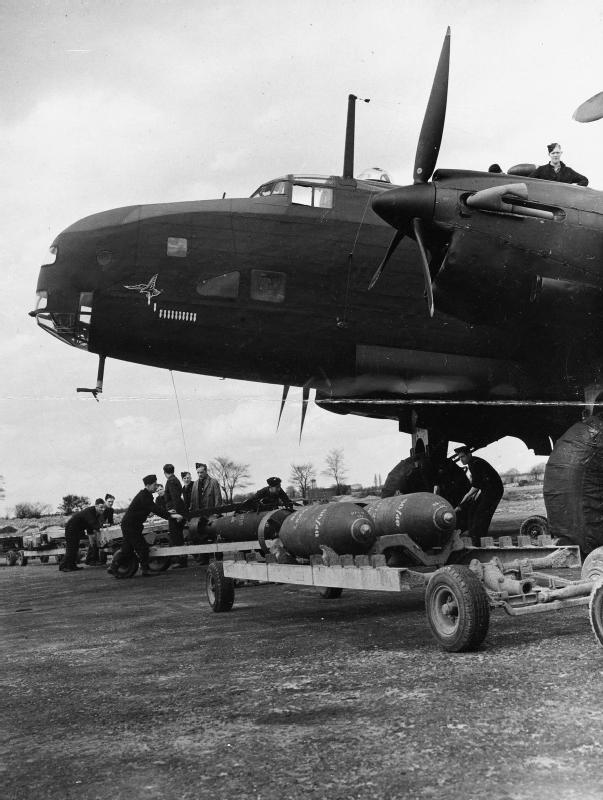
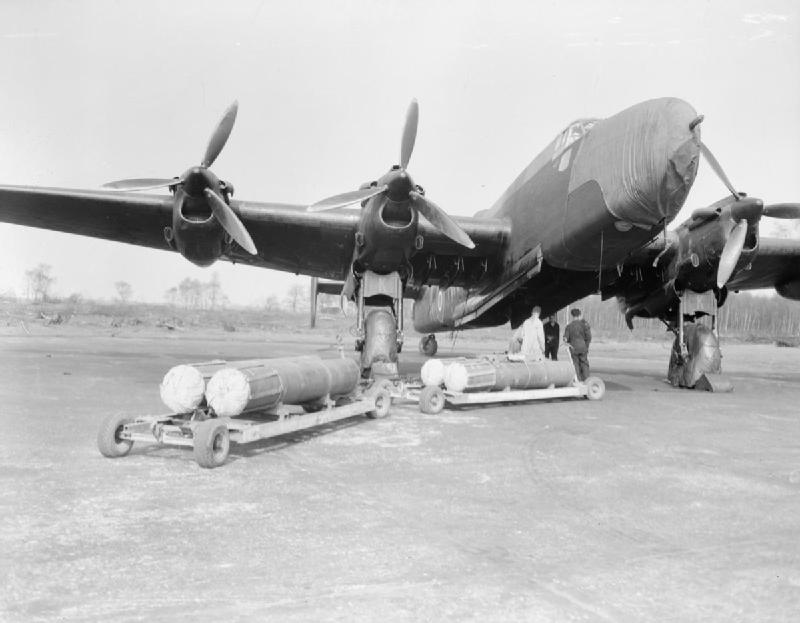
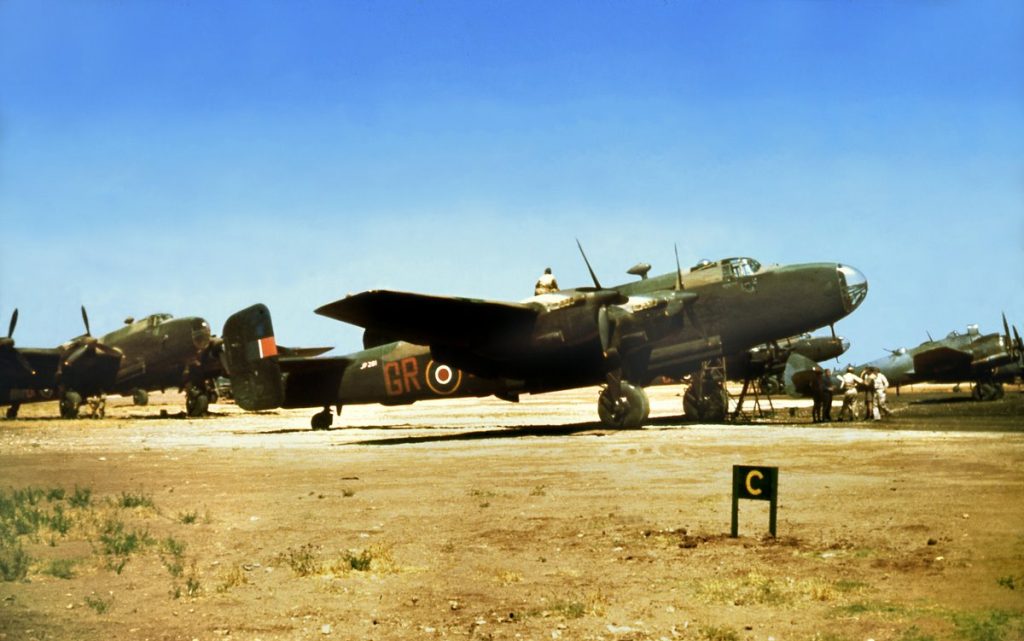
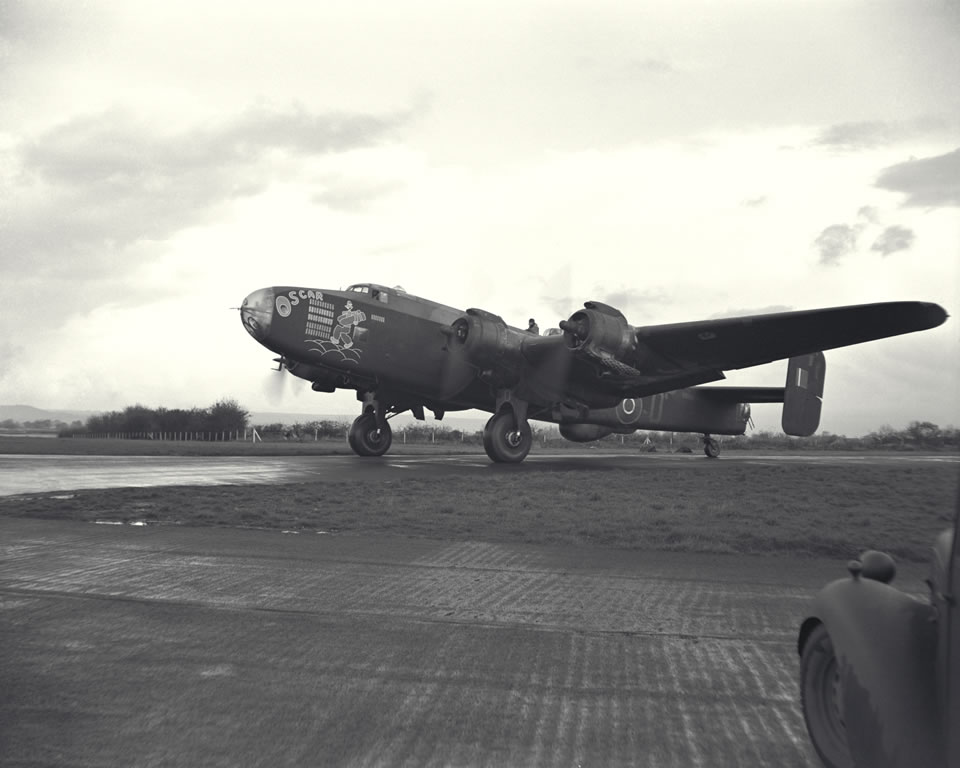
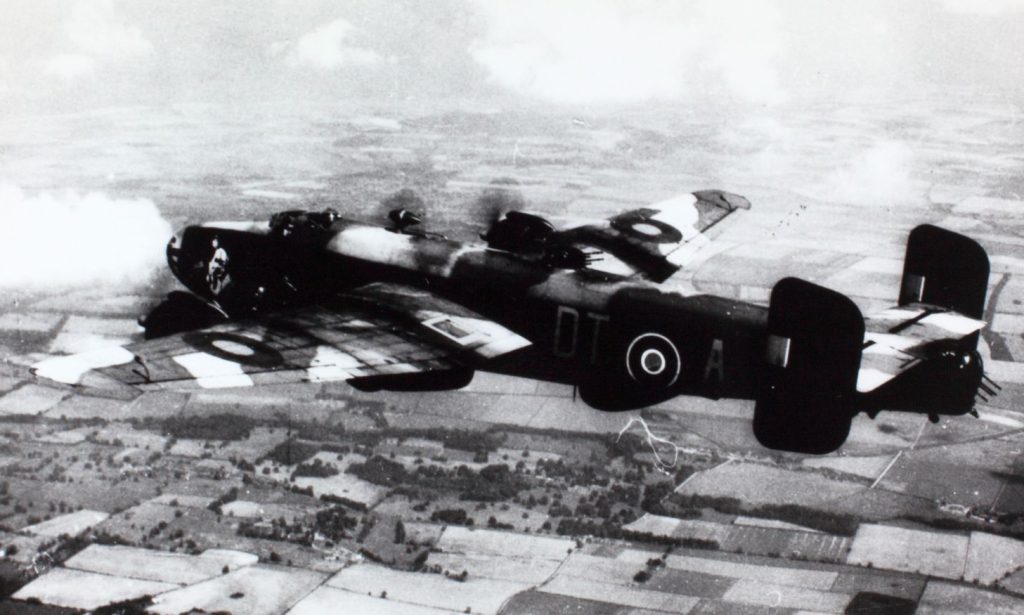
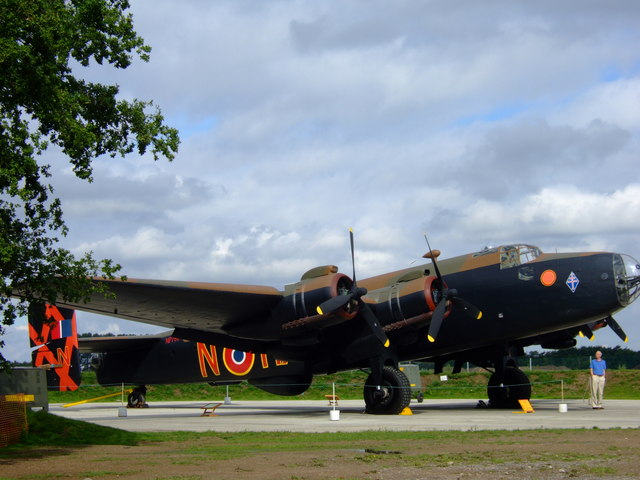
All images sourced from Wikimedia Commons. Public-domain wartime photographs and openly licensed images, credited individually above.
On Film
Inside the Handley Page Halifax
A detailed walkthrough of the Halifax’s crew stations, turrets and guns from a leading aviation-history channel — a rare chance to see the cramped, complex interior in which seven men fought the night war over Germany.
“Inside a Halifax Heavy Bomber: Crew, Turrets and Guns” — Military Aviation History, an established aviation-history channel (approx. 876,000 views at time of writing).
Operations Map
Where the Handley Page Halifax served
An overview of the Halifax’s world: its home in RAF service, the theatres it fought over, the Allied and post-war air forces that flew it, and where its survivors stand today. The Halifax was overwhelmingly a Royal Air Force aircraft, but it was flown by Commonwealth and Allied crews and ranged across the whole European and Mediterranean theatre. Tap or hover a country for detail.
Combat Record
The Handley Page Halifax by the numbers
Commonly cited figures for the Halifax’s contribution to RAF Bomber Command. Totals vary between sources and are approximate; the Halifax flew roughly a third of Bomber Command’s four-engine sorties over the course of the war.
Where to See One
Surviving Handley Page Halifaxes on display
No Halifax flies today, but three complete airframes survive in public collections — each recovered or rebuilt against the odds. If you want to stand next to a real one, these are the places to go.
Yorkshire Air Museum
Elvington, England
A complete Halifax displayed in the markings of “Friday the 13th”, built from original sections including a genuine wartime fuselage. The museum occupies a former Halifax bomber station, making it the natural home of the type.
Royal Air Force Museum
Cosford / London, England
Halifax B Mk II W1048 “S for Sugar”, shot down over Norway in 1942 and recovered from a frozen lake in 1973. It is preserved unrestored — corroded and battle-marked — as a deliberate memorial to the reality of the air war.
National Air Force Museum of Canada
Trenton, Ontario, Canada
Halifax Mk VII NA337, raised from Lake Mjøsa in Norway in 1995 after half a century underwater and painstakingly restored. A fitting centrepiece in the country whose airmen flew so many Halifaxes.
Various other collections hold Halifax sections, turrets and recovered relics. Please check each museum’s website for opening times and the current location of aircraft, which occasionally move between sites.
Legacy
Remembering the Handley Page Halifax
For decades after the war the Halifax lived in the Lancaster’s shadow, its contribution quietly understated in the popular memory of Bomber Command. That has slowly changed. The dedicated campaigning of veterans’ associations, the recovery and restoration of survivors, and museums such as the Yorkshire Air Museum — built on the wartime bomber station at Elvington, from which Halifax squadrons flew — have restored the aircraft to its proper place in the story.
In Canada, where so many of the type’s crews came from, the Halifax is remembered with particular pride; the restoration of NA337 at Trenton was a national undertaking. In Britain, the unrestored hulk of W1048 at the RAF Museum speaks more eloquently than any polished exhibit of the reality of the air war. And of the roughly 6,176 Halifaxes built, these few survivors carry the memory of the tens of thousands of airmen who flew and died in the type.
The Halifax deserves to be remembered not as the Lancaster’s understudy but as one of the most versatile and hard-worked Allied aircraft of the Second World War — a bomber that was also a tug, a spy-carrier, a submarine-hunter and, finally, a bringer of relief in the peace it had helped to win.
Questions & Answers
Handley Page Halifax: your questions answered
Can I fly in a Handley Page Halifax?
No. There is no airworthy Handley Page Halifax anywhere in the world — not one of the roughly 6,176 built is in flying condition today. The type survives only as static museum restorations: the Yorkshire Air Museum at Elvington displays a complete Halifax in the markings of “Friday the 13th”; the Royal Air Force Museum holds W1048, recovered unrestored from a Norwegian lake; and the National Air Force Museum of Canada at Trenton, Ontario, displays the restored NA337. All are museum exhibits — you can walk around them, but not fly in one.
If it is the experience of flying in a genuine piece of military aviation history you are after, that is still very much possible. MiGFlug arranges flights in real, airworthy ex-military jets — see migflug.com/flights-prices for what you can actually fly today.
How many Handley Page Halifaxes survive today?
Only a handful of complete airframes survive, all static. The best known are the Yorkshire Air Museum’s “Friday the 13th” restoration in England, the unrestored W1048 at the RAF Museum, and NA337 at the National Air Force Museum of Canada in Trenton — both of the latter recovered from Norwegian lakes decades after being lost. Various other sections, nose turrets and relics are held in collections, but none is airworthy.
Was the Handley Page Halifax better than the Avro Lancaster?
It depends on the measure. The Lancaster could carry a heavier bomb load higher and further, and Bomber Command’s chief Sir Arthur Harris clearly preferred it. But the Halifax was more versatile — flying as bomber, glider tug, maritime patroller and clandestine transport — and crews are widely credited with a better chance of escaping a stricken Halifax. Both were essential; they were, in effect, rivals born from the same specification.
Why did the early Handley Page Halifax have a poor reputation?
The first Merlin-engined marks (I, II and V) were underpowered for their weight and suffered a dangerous rudder-overbalance fault that could throw the aircraft into an unrecoverable spin. A redesigned rectangular tail cured the handling problem, and the switch to Bristol Hercules radial engines in the Mk III of 1943 transformed the type’s performance and its standing with crews.
What roles did the Handley Page Halifax fly besides bombing?
A great many. Beyond the night bombing of Germany, Halifaxes flew Coastal Command anti-submarine and maritime-reconnaissance patrols, towed gliders and dropped paratroops for airborne operations at Normandy and Arnhem, and flew Special Operations Executive missions dropping agents and supplies across occupied Europe. After the war, converted Haltons carried freight and passengers and served in the Berlin Airlift.
How many Handley Page Halifaxes were built, and how many were lost?
About 6,176 Halifaxes were built by a consortium of British factories between 1940 and 1946 — second only to the Lancaster among British heavies. Roughly 1,833 were lost on operations, a figure that reflects the extreme dangers of the night bombing campaign. Exact totals vary by source.
You can’t fly the Handley Page Halifax. These, you can.
No Halifax will ever fly again — the last airworthy example is long gone, and the survivors are static museum pieces. But you can still strap into a genuine, airworthy ex-military jet and feel what it is to fly a real piece of military aviation. MiGFlug makes it real.
Fighter Jet Flights
Take the controls of a real ex-military jet with an experienced fighter pilot.
See flights & pricesL-39 Albatros
The classic jet trainer — aerobatics and low-level fun, in several countries.
See flights & pricesRelated Aircraft
More from the Aircraft Museum
Sources & Further Reading
Where this page’s facts come from
Figures for speed, range, weights, sorties and losses are drawn from the museum and reference sources above; where sources differ, values are given as approximate and marked as estimates. Images are from Wikimedia Commons and credited individually in the gallery.