
HAL HF-24
“Marut”
India’s first indigenous jet fighter — a clean, supersonic-capable airframe drawn by the German designer of the Fw 190, and let down only by the powerful engine it was never given.
India’s first fighter, built from scratch
In the mid-1950s a newly independent India set out to do something no other developing nation had attempted: design and build its own supersonic jet fighter. With almost no aeronautical industry to draw on, Hindustan Aircraft (later Hindustan Aeronautics, HAL) turned to one of the great names of piston-era aviation — Kurt Tank, the German engineer behind the Focke-Wulf Fw 190. Tank arrived in Bangalore in 1956 to lead a design office that started life barely fifty people strong, with no proper prototype shop or flight-test facilities.
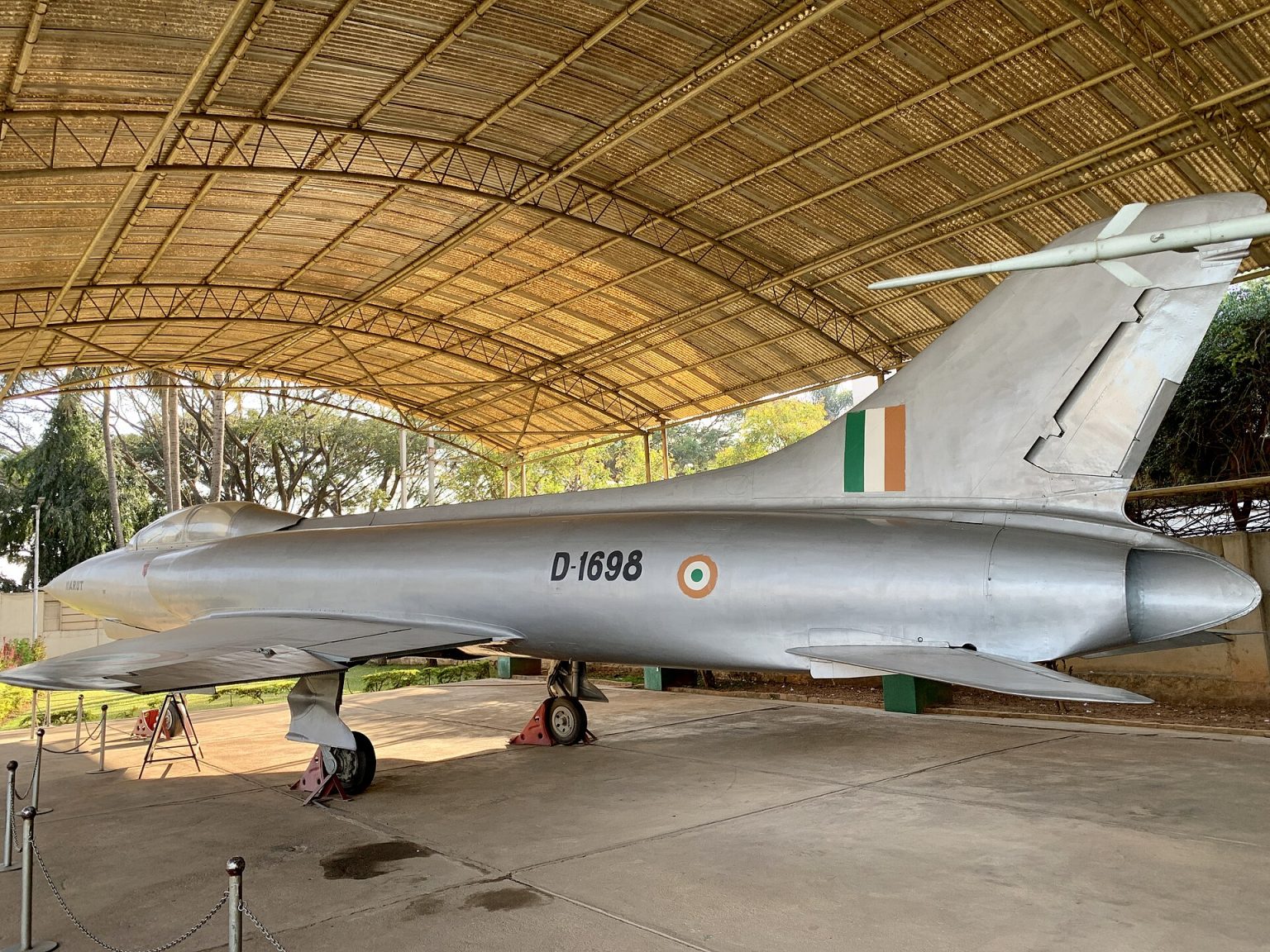
What that small team produced was remarkable. The HF-24 Marut — the name comes from the Maruts, the storm gods of Vedic myth — was a clean, twin-engined, area-ruled design that first flew on 17 June 1961 in the hands of test pilot Wing Commander Suranjan Das. Aerodynamically it was sound and genuinely supersonic-capable: it was the first jet fighter designed in Asia outside the Soviet bloc, and by some distance the most ambitious.
The tragedy of the Marut was written into its engines. Tank had designed the airframe around a reheated (afterburning) version of the Bristol Orpheus, the BOr.12, which would have given roughly the thrust needed for the intended Mach 2. But developing that engine required money India chose not to spend, and the reheated Orpheus was never funded. The Marut instead flew on two non-afterburning Orpheus 703 turbojets of about 21.6 kN each — far short of what the design called for. The result was an aircraft that looked like a Mach-2 fighter and handled like one, but topped out at barely Mach 1.
Underpowered or not, the Marut proved its worth where it mattered. In the 1971 Indo-Pakistani War two IAF squadrons flew it hard in the low-level ground-attack role over the desert of the western front. Pilots praised its ruggedness, stability as a gun and rocket platform, and high serviceability; one Marut even shot down a Pakistani F-86 Sabre, and none was lost in air-to-air combat. Repeated attempts to give the aircraft the engine it deserved all failed, and the type was finally retired in 1990 — an airframe that was always better than its powerplant allowed it to be.
01The HF-24 Marut’s engine problem: the reheated Orpheus that was never funded
Kurt Tank sized the Marut around a reheated Bristol Orpheus, the BOr.12, which with afterburner promised roughly 8,000 lbf of thrust per engine — enough to push the clean airframe toward its designed Mach 2. That engine, however, had been developed for a wider light-fighter effort and needed a substantial further investment (commonly cited at around £13 million) to bring to production. India declined to fund it, and no other government picked up the bill.
Left without its intended powerplant, the Marut entered service on two non-afterburning Orpheus 703 engines of about 4,850 lbf (21.6 kN) each — roughly 40% less thrust than the design assumed. HAL and its partners spent years chasing an alternative: a Soviet RD-9F, an Egyptian “E-300” turbojet developed at Helwan (abandoned after the 1967 war), and HAL’s own reheated Orpheus 703R, which flew in test airframes but never entered series production. The Marut therefore never reached the performance its aerodynamics allowed — the central “what if” of the whole programme.
What makes it special
A clean, area-ruled supersonic airframe
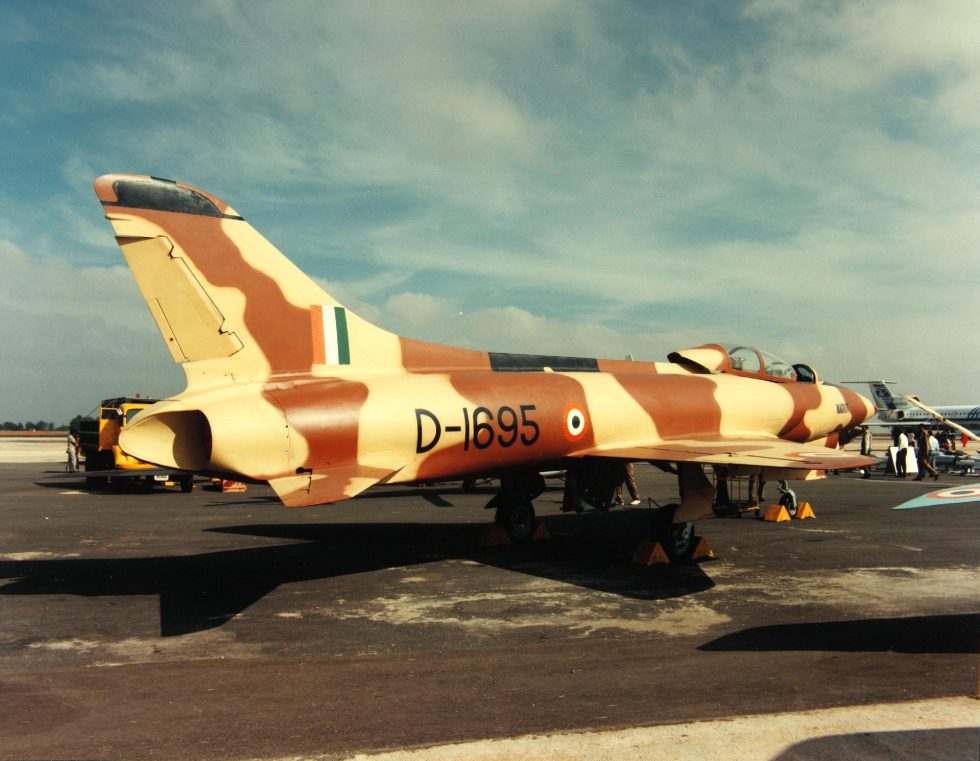
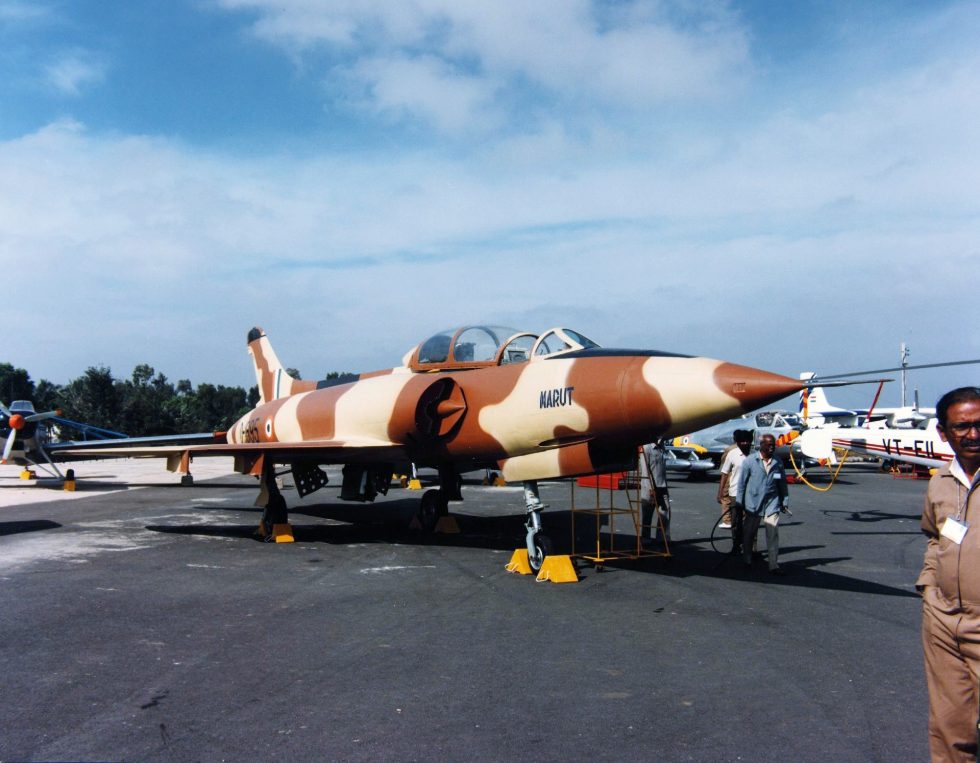
The Marut was the first jet fighter designed in Asia outside the Soviet bloc, and it looked the part: a sharply swept wing, a slim “coke-bottle” area-ruled fuselage to cut transonic drag, and twin side intakes feeding two engines. Aerodynamically the design was genuinely sound and supersonic-capable — a serious achievement for a country with almost no jet-industry base in the 1950s.
Designed for Mach 2, flown at Mach 1
Kurt Tank drew the Marut around a reheated Bristol Orpheus that was never funded. Flying instead on two non-afterburning Orpheus 703 turbojets, the aircraft was chronically short of thrust and topped out at about Mach 1.02 rather than its intended Mach 2. The airframe could handle far more than its engines could deliver.
A concentrated ground-attack punch
The Marut carried a heavy nose battery of four 30 mm ADEN cannon plus a retractable Matra pack of 50×68 mm SNEB rockets that deployed from the belly and faded back into the fuselage, with bombs and rockets on four underwing pylons. It made a rugged, hard-hitting low-level strike aircraft.
02The HF-24 Marut’s Kurt Tank connection: from the Fw 190 to Bangalore
Kurt Tank had designed the Focke-Wulf Fw 190, one of the best fighters of the Second World War, and the jet Ta 183 project. After years working in Argentina, he was recruited by Hindustan Aircraft in 1956 to create India’s first jet fighter. He inherited a design office of only around fifty engineers and virtually no test infrastructure, yet within five years had a supersonic-capable prototype flying. The Marut is, in a real sense, the last aircraft to carry the design signature of one of the great figures of Second World War aviation.
03The HF-24 Marut’s armament: four cannon and a retractable rocket pack
For its ground-attack role the Marut mounted four 30 mm ADEN cannon in the nose — a genuinely heavy gun battery — backed by a distinctive retractable belly rocket pack holding fifty 68 mm SNEB rockets that extended to fire and then retracted flush to preserve the aircraft’s clean lines. Four underwing hardpoints carried bombs and additional rockets, up to roughly 1,800 kg of external stores. In 1971 this concentrated firepower, combined with the airframe’s stability at low level, made the Marut an effective and popular strike platform.
Full specifications
Baseline note: the figures below describe the HF-24 Marut Mk 1, the single-seat ground-attack aircraft Hindustan Aeronautics built at Bangalore around two non-afterburning Bristol Siddeley Orpheus 703 turbojets. Deltas for the two-seat Mk 1T, for the reheat testbeds Mk 1A and Mk 1R, for the Egyptian-engined Mk 1BX and for the never-built Mk 2 are in grey. Four warnings belong in front of the tables, because with this aeroplane the specification sheet is not a description but an indictment. First, the Performance column is the whole argument of the Marut. Kurt Tank and his team at HAL sized the airframe around the Bristol Siddeley Orpheus 12 — the BOr.12, a reheated Orpheus of roughly 30.3 kN (6,810 lbf) dry and 36.3 kN (8,170 lbf) with afterburner. Britain had funded that engine for the NATO light-strike competition; when the requirement was settled by the Fiat G.91 on plain Orpheus power, the reheated development lost its purpose and its money and was cancelled. Bristol Siddeley offered to finish it if India paid the balance, a sum usually quoted at about three million pounds or dollars depending on the account, and the Indian government declined. What flew instead was the plain Orpheus 703 at 21.6 kN, no afterburner, about forty per cent short of the design assumption. Every number in the Performance table therefore measures an underpowered aeroplane rather than the aeroplane that was drawn, and comparisons with contemporaries that got their intended engines are not like for like. Second, the maximum-speed entries. Mach 0.93, or 1,112 km/h at sea level, is the level-flight figure and is well attested. Mach 1.02 is the number quoted everywhere for what a Marut could reach in a dive, and it is the number that makes the point — an airframe stressed and shaped for Mach 2, complete with area-ruled fuselage and thin swept wing, that could only creep past the speed of sound by pointing downhill. It is also a figure repeated far more often than it is sourced; no published flight-test record supports it in detail, and it should be read as service folklore that happens to be consistent with the physics. Third, the thrust rating wobbles. Both 4,850 lbf and 4,900 lbf appear in print for the Orpheus 703. The metric value 21.6 kN converts to 4,856 lbf, so 4,850 is the honest rounding and 4,900 is a secondary error that has propagated widely. Fourth, weights and range. The empty and maximum figures are for a clean aircraft; the combat range of 396 km is a lightly loaded radius quoted by HAL, and squadron experience in 1971 was that a usable war load and a usable radius competed for the same four wing pylons. Where authorities disagree the more conservative figure is given here, with the dispute flagged in the row.
Dimensions & weights
- Crew
- 1 (2 in tandem, Mk 1T)
- Length
- 15.87 m (52 ft 1 in)
- Wingspan
- 9.00 m (29 ft 6 in)
- Height
- 3.60 m (11 ft 10 in)
- Wing area
- 28.00 m² (301.4 sq ft)
- Aspect ratio
- 2.90
- Wing and fuselage
- Mid-set swept wing on an area-ruled fuselage (published sweep figures disagree, between 45 and 50 degrees; thin section of about 6 per cent thickness/chord)
- Empty weight
- 6,195 kg (13,658 lb)
- Max take-off weight
- 10,908 kg (24,048 lb)
- Internal fuel
- ~2,491 litres usable (548 imp gal; 658 US gal)
- Max external ordnance
- ~1,814 kg (4,000 lb) across four wing pylons
- Wing loading, max
- 390 kg/m² (79.8 lb/sq ft)
- Thrust-to-weight, max
- 0.40 (0.40 at MTOW on 43.1 kN total; the design engine would have given about 0.68 in reheat)
Performance
- Max speed, sea level
- 1,112 km/h (691 mph, 600 kn)
- Max Mach, level flight
- Mach 0.93
- Highest Mach recorded
- Mach 1.02 in a dive (the standard figure; widely repeated, thinly sourced)
- Design requirement
- Mach 2 (Air Staff Requirement of 1956; the airframe was built for it, the engines never came)
- Stall speed
- 248 km/h (154 mph, 134 kn), undercarriage and flaps down
- Rate of climb, sea level
- 22.5 m/s (4,430 ft/min)
- Time to 12,000 m
- 9 min 20 s (to 40,000 ft)
- Service ceiling
- 12,192 m (40,000 ft)
- Combat range
- ~396 km (246 miles, 214 nmi)
- Range, ferry
- ~997 km (620 miles) on internal fuel and tanks; figures vary by source and profile
- Handling
- Steady and pleasant at low level, a good gun and rocket platform, with light controls and no vices reported in the strike regime (qualitative pilot assessment rather than a measured figure; the Marut was liked by the men who flew it and disliked by the staff who costed it)
Propulsion & systems
- Engines
- 2 × Bristol Siddeley Orpheus Mk 703 turbojets, licence-built by HAL, no afterburner
- Rated thrust
- 21.6 kN each (4,850 lbf; 43.1 kN / 9,700 lbf total. Some sources round to 4,900 lbf)
- Design engine, never delivered
- Bristol Siddeley Orpheus 12 (BOr.12), 30.3 kN dry and 36.3 kN reheated (6,810 and 8,170 lbf; cancelled when NATO funding lapsed, offered to India for completion, declined)
- Indian reheat attempt
- HAL Orpheus 703R with 18 per cent boost, 25.4 kN (5,720 lbf; flown on the Mk 1A and two Mk 1R aircraft, never put into production)
- Engines tested or studied
- Brandner E-300 (Egypt), Tumansky RD-9F, Rolls-Royce RB.153, Rolls-Royce Turbomeca Adour (none adopted; the Adour was to have powered the projected Mk 2)
- Air intakes
- Fixed-geometry lateral intakes (no variable ramps or cones, a hard ceiling on supersonic capability even had the thrust arrived)
- Flight controls
- Hydraulically powered, with automatic reversion to manual on hydraulic failure (several Maruts were flown home in manual after battle damage)
- Battle survivability
- Twin-engine redundancy; on at least three occasions in 1971 a Marut returned to base after losing one engine to ground fire
- Avionics
- No airborne intercept radar; reflector gunsight for guns and rockets, UHF radio, basic navigation fit
- Escape system
- Martin-Baker ejection seat (the mark is reported inconsistently in the literature and is not settled here)
- Undercarriage and deceleration
- Retractable tricycle gear, HAL-built, with a tail-mounted brake parachute
04The HF-24 Marut’s operating costs: why the numbers are elusive
The Marut was a state programme, produced in modest numbers by a young national industry and never sold on an open market, so no reliable flyaway unit price or cost-per-flight-hour figure exists in the public record. The most commonly repeated qualitative claim is that it cost more to build each Marut at home than it would have to buy a more capable foreign fighter — a judgement on the economics of self-reliance rather than a sourced accounting figure. Any precise dollar cost attached to the type should be treated as an estimate.
Armament & payload
The Marut fought with four ADEN cannon, iron bombs and a retractable belly pack of rockets, and never in 23 years carried a guided weapon of any kind
The Marut’s armament is the armament of a 1950s light strike aircraft, because that is when it was specified. Four 30 mm ADEN revolver cannon in the lower nose gave it the heaviest fixed gun battery in Indian Air Force service, and a retractable Matra pack of fifty 68 mm rockets in the forward fuselage — extended to fire, faired flush the rest of the time — was a genuinely elegant answer to the drag problem that plagued rocket-armed jets. Beyond that there were four wing pylons and nothing clever: general-purpose bombs, napalm, rocket pods, drop tanks, all aimed through a fixed reflector sight by a pilot with no radar of any kind in front of him. In the Rajasthan and Sindh sector in December 1971 this proved to be enough, because the targets were armour, transport, rail stock and airfields rather than anything that needed precision. Ammunition states, bomb types and pylon fits varied between No. 10 and No. 220 Squadrons and between sorties, and Indian squadron records for 1971 have never been published in a form that would let a loadout be reconstructed with confidence.
The armament was tested in one war. Between 3 and 16 December 1971 Maruts flew more than 300 combat sorties in the western sector, working the Rajasthan and Sindh front from Jodhpur and Uttarlai: close support around Longewala and Ramgarh in the first days, then interdiction across the border towards Naya Chor and Umarkot as the Indian advance developed. Two squadrons flew them, No. 10 Winged Daggers and No. 220 Desert Tigers. No. 31 Squadron, the Lions, is often listed as a third Marut unit of the war and was not one — it flew Mystère IVAs from Sirsa in 1971 and did not convert to the Marut until 1973. Not one Marut was lost to an enemy aircraft. Losses came from the ground: three shot down by anti-aircraft fire and one destroyed on the ground is the usual accounting, though some sources give four and two. Three Marut pilots received the Vir Chakra.
The type’s single air-to-air claim needs stating precisely, because it has hardened into legend in India and is denied outright in Pakistan. What is documented on the Indian side: Squadron Leader K. K. Bakshi of No. 220 Squadron, leading a pair of Maruts on a strike in the Naya Chor area of Sindh, engaged Pakistani F-86 Sabres with his 30 mm cannon and was credited with destroying one, the Sabre’s pilot ejecting. The date is given as 7 December 1971 in most Indian sources and 6 December in others. The victim is usually named as Flying Officer Hamid Khwaja of No. 15 Squadron, Pakistan Air Force. What is disputed: Pakistan does not acknowledge losing a Sabre to a Marut at all, attributing the relevant airframe’s loss to an engine flameout during a pursuit of a Hawker Hunter. That counter-account places the loss over Khushalgarh, several hundred kilometres north of the Sindh desert where Bakshi was flying, which suggests the two sides are not describing the same event and that at least one of the two records has been mis-assembled. No independent reconciliation exists. The honest statement is that the Indian Air Force credits the Marut with one Sabre, that the Pakistan Air Force does not concede it, and that the claim is neither proven nor refuted. The rank is worth fixing too: Bakshi is Squadron Leader in the Indian records, not Flight Lieutenant, a demotion that circulates in secondary accounts.
Gun
- 4 × 30 mm ADEN Mk 2 revolver cannon in the lower nose, 120 rounds per gun, 480 rounds total
- Licence-produced in India; the same gun as the Hunter and the Folland Gnat, which kept armourers and the ammunition chain common across the fighter force
- Four barrels firing together made a short burst devastating against soft-skinned transport, rail wagons and parked aircraft — the Marut’s best weapon by some distance
- Aimed through a fixed reflector gunsight with no radar ranging; range estimation was the pilot’s problem
- The type’s only air-to-air claim, in December 1971, was made with these guns
Air-to-air
- None. No air-to-air missile was ever integrated on the Marut — not the Matra R.550, not the K-13 (AA-2 Atoll) that the Indian Air Force held in quantity for its MiG-21s
- No airborne intercept radar was ever fitted, so there was no sensor to cue a missile with even had one been cleared
- Air combat was consequently visual, gun-only and opportunistic, undertaken when a strike formation was bounced rather than sought
- The projected Mk 2 and the later HF-73 would have carried radar and missiles; neither was built
- This is not a footnote but the type’s defining limitation: a fighter-shaped aeroplane with no fighter armament and no engine to chase anything
Air-to-surface guided
- None, at any point in the aircraft’s service life. No anti-ship or anti-tank missile, no guided bomb, no anti-radiation weapon, no designation pod
- Every Marut attack from 1967 to 1990 was made with unguided ordnance aimed by eye through a fixed sight
- Unremarkable for a light attack aircraft specified in the 1950s, but it meant the type never acquired a standoff capability that might have offset its short radius
- India’s first guided air-to-surface capability arrived on other types — the Jaguar and the MiG-23BN generation that replaced the Marut in the squadrons
Bombs
- Up to ~1,814 kg (4,000 lb) of stores across four underwing pylons
- 1,000 lb, 500 lb and 250 lb general-purpose bombs of British pattern and Indian manufacture
- Napalm tanks for area targets, used against dispersed vehicles and dug-in positions in the desert sector
- The paper maximum was rarely the operational load: with a combat range under 400 km, fuel and ordnance competed for the same four stations, and outboard tanks routinely cost half the bomb load
Rockets
- Retractable Matra pack of 50 × 68 mm SNEB rockets housed in the lower forward fuselage, lowered into the airstream to fire and retracted flush afterwards
- The retracting installation is the Marut’s cleverest single feature: a heavy salvo weapon carried with no cruise drag penalty, on an aircraft that could not spare a single knot
- Podded 68 mm rockets could also be carried on the wing pylons in the Indian Air Force’s standard fit of the period
- Against the soft targets of the Sindh sector in 1971 — transport columns, fuel, rail infrastructure — rockets and guns did more of the work than bombs
Pods & other stores
- Drop tanks on the wing pylons, effectively mandatory on any sortie of useful depth
- No electronic countermeasures pod, no radar warning receiver of consequence, no chaff or flare dispenser in the 1971 fit
- No reconnaissance pod and no targeting or navigation pod at any stage; the Marut never became a multi-role airframe
- Brake parachute in the tail, standard on every sortie from the hot, high-density-altitude desert bases at Jodhpur and Uttarlai
- Four pylons and one internal rocket bay is the entire external inventory — a narrower store list than almost any contemporary strike aircraft
Three typical loadouts
- Battlefield interdiction, Sindh sector, December 1971
- Full gun ammunition (480 rounds of 30 mm), 2 × 1,000 lb bombs on the inboard pylons, 2 × drop tanks outboard. The standard deep-ish strike fit against rail, road and dump targets across the border from Jodhpur and Uttarlai.
- Close air support over the Longewala–Ramgarh front
- Full gun ammunition, the retractable pack of 50 × 68 mm rockets loaded, 4 × 500 lb bombs or napalm on the wing pylons, no tanks. A short-radius load flown against armour and vehicles within a hundred kilometres of base, where every pylon could carry ordnance instead of fuel.
- Scramble and self-defence
- Guns only, tanks retained, rocket pack loaded or empty. There was no alternative: with no missile and no radar the Marut’s air-to-air configuration was the aeroplane as it came off the line, and its one Sabre claim was made from exactly this state during a strike sortie.
Sourcing caveat: the gun, rocket-pack and pylon figures are consistent across HAL literature and the standard reference works and can be treated as firm. The three loadouts above are reconstructions from squadron accounts and published mission narratives of the 1971 campaign, not transcriptions of loading sheets, and the split between bombs, rockets and tanks on any given sortie is inferred. Indian Air Force operational records for December 1971 remain largely closed, and Pakistani accounts of the same actions differ on what was carried and what was hit.
Variants
Every Marut variant after the Mk 1 was an attempt to find the aeroplane an engine, and every one of them failed
The variant list of most aircraft records growing capability. The Marut’s records a twenty-year search for thrust. Kurt Tank came to Hindustan Aircraft in 1956 at Nehru’s invitation, with a team of German engineers and a design lineage running from the Focke-Wulf Ta 183 through the Argentine Pulqui II; the Air Staff Requirement asked for a Mach 2 multi-role fighter and the resulting airframe — area-ruled, thin-winged, twin-engined — was capable of it. A full-scale wooden glider, the HAL X-241, was towed aloft behind a Dakota on 3 April 1959 and flew 86 times to prove the aerodynamics. The prototype flew on 17 June 1961 in the hands of Group Captain Suranjan Das, who would be killed in a Marut at Bangalore on 10 January 1970. None of it mattered, because the engine did not exist.
What followed was a decade of substitutions. HAL built its own reheat for the Orpheus 703 and got 18 per cent more thrust, not the 68 per cent the design wanted. India sent a team to Egypt to work with Ferdinand Brandner on the E-300, the engine intended for Messerschmitt’s Helwan HA-300; a Marut was fitted with one and flown from March 1967, the Indian team was recalled in July 1969, and the aeroplane was abandoned where it stood. The Tumansky RD-9F was examined and rejected. The Rolls-Royce RB.153 and the Adour were studied and not bought. The Gas Turbine Research Establishment was founded partly on the lesson and produced nothing the Marut could use in time. The government ordered production before any of this was resolved — 16 pre-production and 60 production aircraft on Orpheus 703 power — which locked in the compromise permanently.
A note on designations: the HSS-73 named in some accounts is the same project as the HF-73, and it was not an engine collaboration but an airframe one — a HAL/Messerschmitt-Bölkow-Blohm strike fighter agreed in 1972 and designated in 1973. It died for exactly the reason the Marut had been crippled: the RB199 it needed could not be obtained, and the Indian Air Force would not accept a second underpowered fighter. India bought Jaguars instead.
- HAL X-241 (1959, 1 built)
- Full-scale two-seat wooden glider, towed behind a Douglas Dakota to validate the planform. First flight 3 April 1959; 86 flights before it was damaged in a landing accident.
- HF-24 prototypes (1961–1962, 2 built)
- HF-001 first flew 17 June 1961 (a few sources give 24 June), the second in October 1962. Orpheus 703 power from the outset, because there was nothing else.
- HF-24 Marut Mk 1 (from 1964, about 129 single-seaters within a total of 147)
- The production single-seat ground-attack aircraft. Entered Indian Air Force service with No. 10 Squadron on 1 April 1967. Planned production was 214 airframes; roughly 147 of all marks were completed.
- HF-24 Marut Mk 1A (1 aircraft, converted)
- The third pre-production airframe fitted with an afterburning Orpheus 703 giving 18 per cent boost to 25.4 kN (5,720 lbf). Proof that HAL could build a reheat; also proof that 18 per cent was not the answer.
- HF-24 Marut Mk 1R (2 aircraft, converted)
- Two airframes with a pair of reheated Orpheus 703R engines. The best-performing Maruts ever flown, and still short of the Mach 2 the airframe was drawn for. Never ordered into production.
- HF-24 Marut Mk 1BX (1967–1969, 1 aircraft)
- Single airframe converted as flying testbed for the Egyptian Brandner E-300, flown from 29 March 1967. Left in Egypt when the Indian team withdrew in July 1969 and never recovered.
- HF-24 Marut Mk 1T (from 1970, 18 built)
- Two-seat tandem operational trainer, fully combat-capable, marginally longer and heavier with a modest performance penalty. Kept the squadrons converting through the 1970s and outlasted the single-seaters in the training role.
- HF-24 Marut Mk 2 (projected, never built)
- The re-engined production Marut that never happened: Rolls-Royce Turbomeca Adour in the definitive study, with the Brandner E-300, Tumansky RD-9F and Rolls-Royce RB.153 evaluated at various points. Repeatedly proposed from the mid-1960s, never funded.
- HF-25 (projected, never built)
- Single-engine derivative around one Tumansky R-25-300 from the MiG-21bis, with redesigned intakes and tail. Substantially heavier than the twin, and dropped.
- HSS-73 / HF-73 (1972–late 1970s, projected)
- HAL and Messerschmitt-Bölkow-Blohm joint strike fighter of about 17,000 kg, designated in 1973, SNECMA M45 for prototypes and Turbo-Union RB199 for production. Cancelled when the RB199 could not be secured. India bought the SEPECAT Jaguar instead.
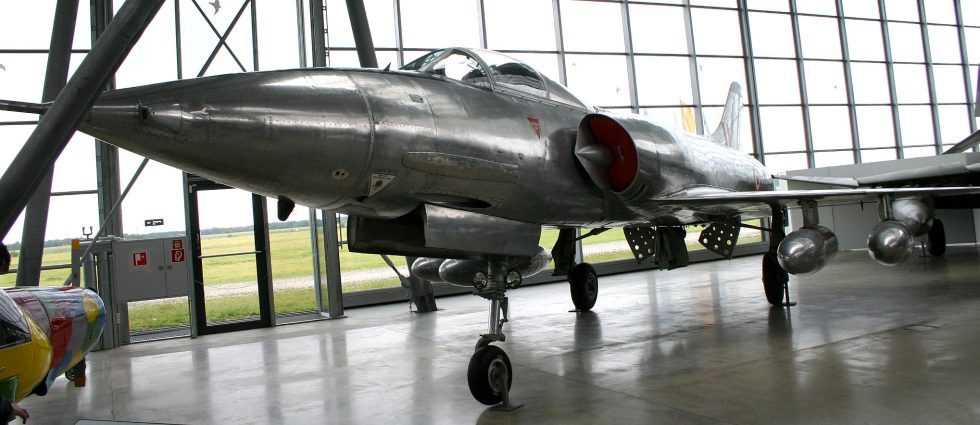
Closing note on survivors and disposition. No Marut is airworthy anywhere and none has flown since the type left Indian Air Force charge, usually dated to 1990; squadron histories complicate that date, since No. 10 Squadron converted to the MiG-23 in January 1981, No. 220 in June 1981 and No. 31 in 1983, which leaves the last years to trials and second-line airframes rather than a front-line unit, and some sources give 1985 for the operational end. Between a dozen and twenty original airframes survive, all of them genuine production or pre-production aircraft — no Marut reproduction has ever been built and none is likely to be, so any example encountered is the real thing. Confirmed holdings include the Indian Air Force Museum at Palam, the HAL Heritage Centre and the Visvesvaraya Industrial and Technological Museum in Bangalore, the Aircraft and Systems Testing Establishment at Bangalore, the Air Force Academy at Dundigul, the Nehru Science Centre in Mumbai, the Periyar Science and Technology Centre in Chennai, Kamla Nehru Park in Pune, and Sainik School at Kazhakootam in Kerala. Others stand as gate guardians at Indian Air Force stations, where the count is not published and cannot be verified from open sources. One aircraft went to Germany, to the Deutsches Museum’s Flugwerft Schleissheim and subsequently to the Museum für Luftfahrt und Technik at Wernigerode — the only Marut outside India, and a fitting place for it, since the man who drew it went home to Germany in 1967 without ever seeing his aeroplane get its engine.
From Kurt Tank’s drawing board to retirement
Kurt Tank hired
Hindustan Aircraft recruits the Fw 190 designer Kurt Tank to lead India’s first indigenous jet-fighter project in Bangalore.
First flight
The prototype flies on 17 June, piloted by Wing Commander Suranjan Das — a supersonic-capable design airborne within five years.
The reheat engine is shelved
The afterburning Bristol Orpheus the Marut was designed around goes unfunded, condemning the aircraft to non-afterburning engines.
Enters service
No. 10 Squadron “Winged Daggers” forms on the type; the Marut becomes the IAF’s home-built ground-attack fighter.
War over the desert
Two squadrons fly the Marut in low-level ground attack over the Naya Chor sector; one downs a PAF F-86 Sabre with no air-to-air losses.
The re-engining that failed
Soviet, Egyptian and HAL reheat engines are all trialled to fix the thrust shortfall; none reaches production.
The HF-73 that never was
A proposed Mach-2 re-engined successor, the HF-73, is studied and cancelled, leaving India without a follow-on indigenous fighter for decades.
Retired
The last Maruts are withdrawn from IAF service — the end of India’s first, hard-won attempt at a home-grown jet fighter.
From the programme: twelve Marut stories
A nation decides to build its own fighter
Newly independent India set out to design a supersonic jet with almost no aircraft industry to build on.
Read the full story
Kurt Tank comes to Bangalore
The man who designed the Focke-Wulf Fw 190 led the Marut project from 1956.
Read the full story
Suranjan Das takes it up
The Marut first flew on 17 June 1961 in the hands of one of India’s finest test pilots.
Read the full story
Marut: the storm gods of the Veda
The fighter was named for the Maruts, the wind-and-storm deities of Hindu mythology.
Read the full story
The engine that never came
The Marut was designed for a reheated Orpheus that India chose not to fund.
Read the full story
The coke-bottle fuselage
The Marut used area-ruling to tame transonic drag — advanced thinking for a first-generation design.
Read the full story
A decade chasing thrust
Soviet, Egyptian and HAL engines were all tried to cure the Marut’s thrust shortfall.
Read the full story
The tempests of Uttarlai
Two Marut squadrons flew hard in the ground-attack role on the western front.
Read the full story
A Marut downs an F-86
In early December 1971 a Marut shot down a Pakistani F-86 Sabre in air combat.
Read the full story
Tough, steady and no losses in the air
The Marut proved rugged and survivable in combat, losing none of its number in air-to-air fighting.
Read the full story
The HF-73 successor
A proposed Mach-2 re-engined Marut was studied and then cancelled.
Read the full story
A hard lesson in self-reliance
Retired in 1990, the Marut taught India that an airframe is only as good as its engine.
Read the full story
The Marut in pictures
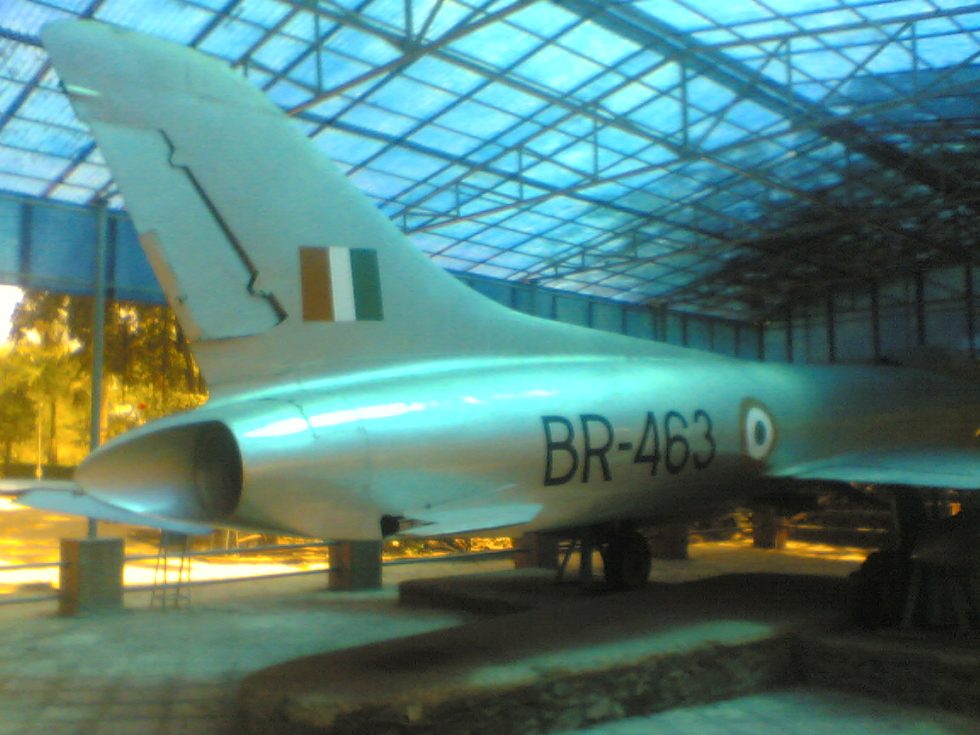
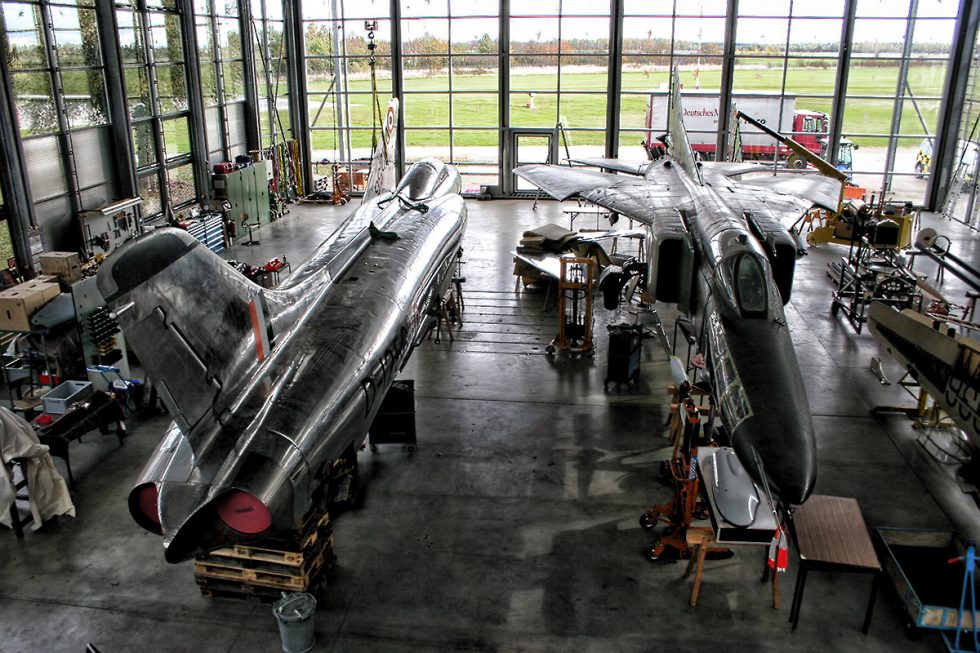
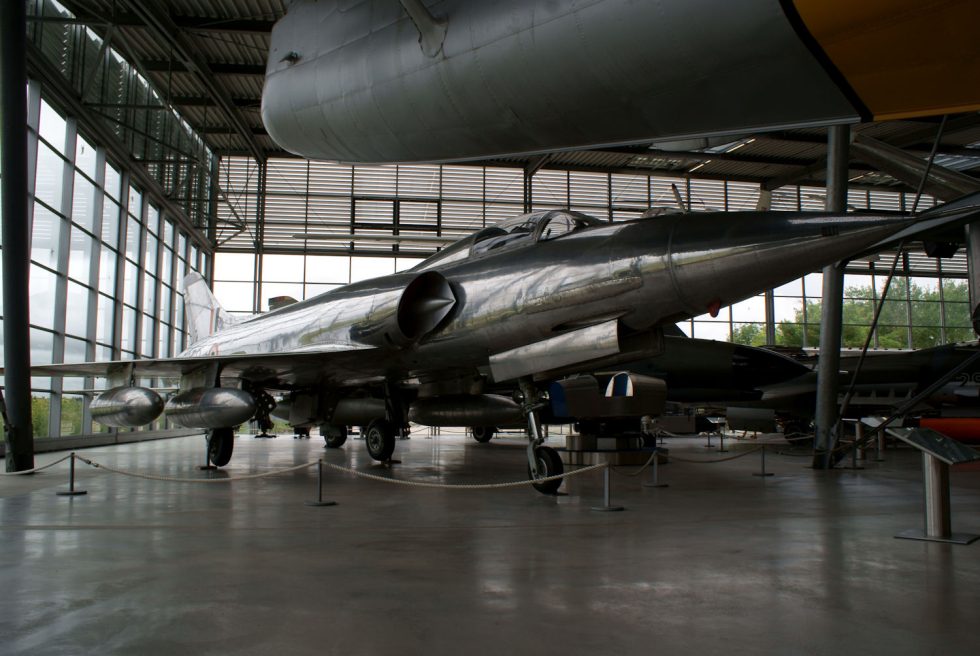
Where the Marut flew
The score that defines it
The Marut was a ground-attack aircraft, and its combat record was written at low level in the 1971 Indo-Pakistani War. Two IAF squadrons flew well over a hundred close-support and interdiction sorties across the western desert in a fortnight of war, and the type proved rugged and dependable. Remarkably for a strike aircraft, it also scored an air-to-air kill — and lost none of its own in air combat.
Compare the combat record of every military aircraft. Figures as of July 2026.
Everything people ask about the HF-24 Marut
Can I fly in an HF-24 Marut?
Who designed the HF-24 Marut?
Why was the Marut underpowered?
Did the Marut see combat?
How fast was the HF-24 Marut?
How many HF-24 Maruts were built?
Is the HF-24 Marut still in service?
You can’t fly the Marut.
These, you can.
Some legends only live in museums — others are fuelled and waiting. MiGFlug has put civilians in real military jet cockpits since 2004.
 Fly the L-39 AlbatrosThe world’s most-flown jet trainer — aerobatics included
 Fly the F-104 Starfighter“The missile with a man in it”
 Fly the MiG-21The Cold War’s most-produced jet
 Fly the T-33 Shooting StarAmerica’s first jet trainer
 Fly the DH VampireA piece of early jet history
 Fly the S.211Agile Italian jet trainer
 Fly the MB-326The classic Aermacchi jet
 Fly the MiG-15The Soviet legend of the Korean War
Continue the tour
Every fact, checked
- HistoryNet — Kurt Tank’s Indian StormKurt Tank’s arrival, the HAL design team, first flight and the reheat-engine shortfall.
- The National Interest — The Marut Jet FighterThe unfunded reheated Orpheus, the “barely Mach 1” performance and the HF-73 successor.
- Centre for Air Power Studies (CAPS)The Marut’s 1971 war service: squadrons, sorties, the Sabre kill and combat losses.
- Military Factory — HAL HF-24 MarutDimensions, weights, engine thrust, armament and production numbers.
- GlobalSecurity.org — HF-24 MarutAlternative-engine trials (RD-9F, E-300, Orpheus 703R) and the area-ruled airframe.
- Vintage Aviation News — First Flight of the HF-24The 17 June 1961 first flight and the Marut’s place as Asia’s first indigenous jet fighter.
- Defence Update — When the Marut Scored a KillSquadron Leader K. K. Bakshi’s F-86 Sabre shootdown in the 1971 war.
- Bharat Rakshak — IAF History: MarutIndian service history, variants and the type’s retirement in 1990.