
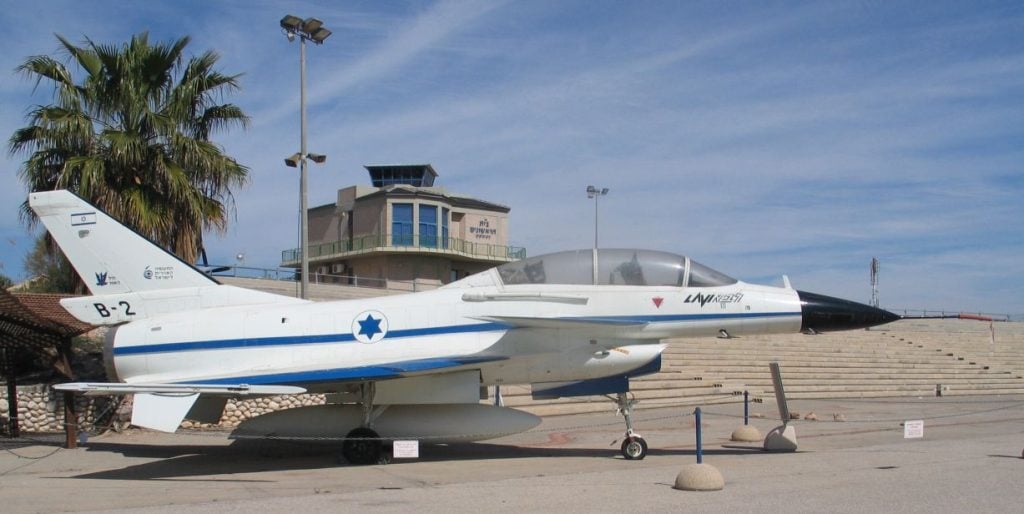
IAI Lavi
“Young Lion”
Israel’s ambitious home-grown multirole fighter — a close-coupled canard delta with fly-by-wire and a single PW1120 engine, flown in 1986 and then killed by a single cabinet vote under American pressure and spiralling cost.
The IAI Lavi: the indigenous fighter Israel built — then cancelled
By the late 1970s Israel had already proved it could build fighters. The IAI Kfir — a Mirage airframe rebuilt around an American J79 engine — equipped its squadrons, but it was a derivative, not an original design. Israel wanted more: a modern, home-designed multirole fighter tailored to its own doctrine, one that would keep Israel Aircraft Industries at the technological frontier and reduce dependence on foreign suppliers. That aircraft became the Lavi (Hebrew for “Young Lion”), formally launched around 1980.
The design that emerged was strikingly modern for its era: a tailless delta wing paired with close-coupled canards, made deliberately unstable for agility and tamed by a quadruplex digital fly-by-wire flight-control system — a configuration in the same broad family as the later Eurofighter, Rafale and Gripen. It was to be powered by a single Pratt & Whitney PW1120 afterburning turbofan, a derivative of the F100 that powers the F-15 and F-16, and packed with advanced Israeli avionics and a wide-angle head-up display. On paper the Lavi was a genuine fourth-generation lightweight fighter.
Crucially, much of the money was American. Under a special arrangement, the United States allowed a large share of its military aid to Israel to be spent on the Lavi, and US firms supplied the engine and key systems. That funding made the programme possible — and, ultimately, gave Washington a powerful say in its fate. The first prototype flew on 31 December 1986, and a second followed in March 1987; by all accounts the aircraft handled well.
But the costs kept climbing. As the projected production run shrank — from around 300 aircraft toward as few as 80 — the unit price soared, and the Lavi began to look like an unaffordable luxury for a small country. In Washington there was unease that a US-funded fighter might one day compete with the F-16 on the export market, and pressure grew for Israel to buy American aircraft instead. The debate split the Israeli defence establishment and cabinet down the middle.
The reckoning came on 30 August 1987. In a divided national-unity cabinet, ministers voted to cancel the Lavi by the narrowest possible margin — reportedly 12 votes to 11, with one abstention often cited as decisive. It remains one of the most contentious defence decisions in Israeli history. The fallout was brutal for IAI: more than 4,000 employees, including over 1,500 engineers, were laid off. Israel instead procured additional F-16s, and two flying prototypes were preserved as museum pieces.
The Lavi’s story did not quite end there. The engineering talent and technology it created flowed into Israel’s avionics, radar and UAV industries for decades afterward. More controversially, US officials later alleged that Lavi-derived expertise and even American technology found its way into China’s Chengdu J-10 fighter, which shares a broadly similar canard-delta layout. Israel and China have denied any improper transfer, and the claim remains disputed and unproven — but the visual resemblance keeps the theory alive to this day.
01The IAI Lavi’s cancellation: how one cabinet vote in August 1987 ended the programme
The decision to cancel the Lavi on 30 August 1987 was as close as a decision can be. Israel’s national-unity government was deeply divided: defence-industrial and nationalist voices argued the Lavi was essential to Israeli independence and to IAI’s future, while others — including then-defence-minister Yitzhak Rabin — concluded the aircraft had simply become unaffordable. As the planned buy shrank, the projected unit cost climbed steeply, and a US Government Accountability Office estimate of development cost around $1.9 billion did little to reassure sceptics once per-aircraft figures ballooned.
The United States, which was funding much of the work, made clear it would rather Israel buy American F-16s — and there was genuine concern in Washington about a subsidised competitor to the F-16 appearing on export markets. When the cabinet finally voted, the tally is most often reported as 12 to 11 against continuing, with a single abstention treated as decisive. IAI laid off thousands; the programme’s defenders never fully forgave the decision. Whether cancelling the Lavi was a hard-headed act of fiscal realism or a strategic mistake is still argued in Israel today.
What made the Lavi special
Close-coupled canard delta with fly-by-wire
The Lavi paired a tailless delta wing with close-coupled canard foreplanes just behind the cockpit — a layout that generates strong lift and agility in hard manoeuvring. To make it controllable, the aircraft was deliberately relaxed-stability and flown through a quadruplex digital fly-by-wire system, cutting-edge technology in the early 1980s and part of the same design philosophy later seen on Rafale and Gripen.
A single PW1120 — an F100 in Israeli service
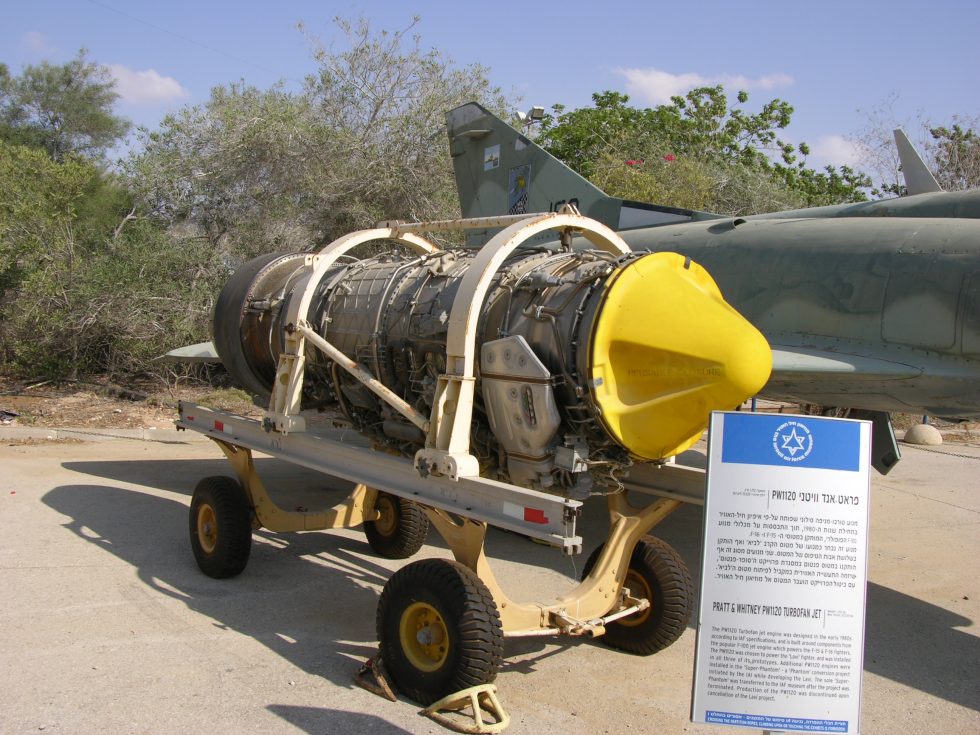
Power came from one Pratt & Whitney PW1120 afterburning turbofan of roughly 91.7 kN (20,600 lbf), derived from the F100 that powers the F-15 and F-16. It was partly built in Israel by Bet Shemesh Engines, giving the Lavi commonality with the engines Israel already knew — and tying the programme tightly to American technology and consent.
Indigenous avionics and composites
The Lavi was built to carry advanced Israeli-designed avionics — radar, mission computers and a wide-angle HUD — and made extensive use of composite materials in its wings and tail to save weight. This home-grown electronics and materials expertise was arguably the programme’s most valuable legacy: it survived the cancellation and fed Israel’s avionics, UAV and upgrade industries for decades.
02The Lavi and the F-16: why Israel wanted its own fighter instead of buying American
On raw performance the single-engine, ~19-tonne Lavi was broadly in the class of the F-16 — a lightweight multirole fighter optimised for agility and ground attack rather than raw speed or long range. Its advocates argued it would be better tailored to Israeli needs, with Israeli avionics and weapons integration, and that building it kept thousands of high-end engineering jobs and know-how inside the country.
The counter-argument was money. The F-16 was already in mass production, its development costs long since paid down; the Lavi had to amortise its entire development over a tiny Israeli order. As the buy shrank, the Lavi’s unit cost rose above what buying more F-16s would cost. That is the core tension the 1987 cabinet vote turned on: strategic independence versus affordability — and affordability, narrowly, won.
03The Lavi and China’s J-10: a widely repeated but disputed technology-transfer claim
After the Lavi was cancelled, some of IAI’s engineering expertise looked for new work, and China was building an indigenous fighter of its own — the Chengdu J-10, which entered service in the 2000s with a canard-delta layout superficially similar to the Lavi. US officials have alleged that Israeli assistance to the J-10 programme included the unauthorised transfer of American technology originally shared for the Lavi, and the episode reportedly caused friction between Washington and Jerusalem.
It is important to be precise about what is known. The visual resemblance between the Lavi and the J-10 is real, and Israeli-Chinese defence cooperation in that era is well documented. But a direct, proven line from the Lavi to the J-10 is not established in open sources; Israel and China have denied improper transfer, and aviation analysts differ on how much the J-10 actually owes to the Lavi versus independent Chinese development with other foreign input. Treat the connection as reported and plausible, but disputed and unproven.
Full IAI Lavi specifications
Baseline note: the figures below describe the Lavi as the programme stood on 30 August 1987 — the single-seat production standard the Israeli Air Force had specified in February 1980 and refined through full-scale development from October 1982, measured against the two prototypes that were actually flying when the cabinet killed it. One correction has to come first, because it changes what the reader is looking at. No single-seat Lavi ever existed. B-01 and B-02 were both tandem two-seaters, the rear cockpit occupied by test instrumentation rather than a pilot, and B-03 — completed after cancellation from parts robbed out of the first two airframes and flown on 25 September 1989 — was the third machine, not the first single-seater. Five airframes were laid down; three were completed and flew; B-04 and B-05 were never finished. Not one of them ever carried a weapon. Deltas for the Pratt & Whitney PW1120 engine, for the Kfir that preceded the Lavi and for the Chengdu J-10 that is alleged to descend from it are in grey. Five published disagreements need settling before the tables begin. First, the weights. The 9,991 kg routinely printed as "gross weight" is the design gross weight — clean aeroplane, internal fuel, no stores — and not a loaded weight of any kind: the published wing loading of 303.2 kg/m2 is 9,991 divided by 33, and the published thrust-to-weight of 0.94 is 91.5 kN divided by that same weight in newtons. Maximum take-off weight is 19,277 kg, very nearly double it. Second, the thrust. Three numbers circulate — 91.5 kN (20,600 lbf) in the Lavi tables, 20,260 lbf in Charles Fleming’s 1983 Flight International account, and 91.56 kN (20,585 lbf) on the PW1120’s own data sheet. These are successive ratings of one engine as it matured, not three engines, and roughly 20,600 lbf is the figure to quote. Third, the speed. Mach 1.8 and 1,912 km/h at 11,000 m are the same statement, since Mach 1.8 in the standard atmosphere at 36,000 ft is 1,912 km/h; the Mach 1.85 that also appears is a design limit rather than a measured result. Fourth, and most important, the status of the performance column as a whole. Between 31 December 1986 and August 1987 the two flying prototypes accumulated 82 sorties. That is enough to explore a significant part of an envelope and nowhere near enough to certify one, so ceiling, climb rate, radius and top speed below are design predictions carried forward from the specification, not flight-test results, and they should be read that way. Fifth, the thrust-to-weight ratio is quoted both as 0.94 and as "1.1:1 with a combat payload". The second cannot describe a heavier aeroplane than the first; it describes an air-combat configuration at part fuel, and the two figures have been kept apart below rather than averaged into a fiction.
Dimensions & weights
- Crew
- 1 — in the production single-seater that was never built. All three Lavis that flew were tandem two-seaters. The Israeli Air Force requirement was for about 300 aircraft, of which some 60 were to be fully combat-capable two-seat trainers, so the two-seat airframe was never a mere trainer afterthought
- Length
- 14.57 m (47 ft 10 in), probe excluded. Shorter than an F-16C by roughly a metre, and 2.3 m shorter than the Chengdu J-10 it is said to have fathered
- Wingspan
- 8.78 m (28 ft 10 in) across the delta, wingtip missile rails included. The Kfir spanned 8.22 m; the J-10 spans 9.8 m
- Height
- 4.78 m (15 ft 8 in) to the fin tip
- Wing area
- 33 m2 (355 sq ft). Some tables round to 33.05 m2 or to 360 sq ft; the metric figure is the primary one and the 360 is a soft conversion
- Wing planform
- Cropped delta, 54° leading-edge sweep — the Kfir’s planform reworked rather than reused, with a thinner section, full-span leading-edge flaps and trailing-edge elevons
- Canards
- Two all-moving close-coupled canards — mounted high on the intake shoulders, well forward and close in, so their shed vortex energised the wing upper surface rather than merely trimming the aeroplane. Kfir canards were fixed; the Lavi’s were driven by the flight-control computers, which is the whole difference. No reliable published figure exists for canard area
- Empty weight
- 7,031 kg (15,501 lb) — almost exactly 1,300 kg lighter than a contemporary F-16 Block 30 at 8,300 kg. That gap is the single most persuasive number in the Lavi’s favour and the composite structure is most of the reason for it
- Design gross weight
- 9,991 kg (22,026 lb) — clean, internal fuel, no external stores. This is the weight from which the published wing loading and thrust-to-weight figures are derived
- Max take-off weight
- 19,277 kg (42,499 lb) — a load factor of 2.74 over empty weight, which is a very high figure for a single-engined fighter of this size and reflects the strike role the aeroplane was primarily built for
- Max external stores
- 7,257 kg (16,000 lb) across eleven stations: seven under the fuselage, four under the wing, plus wingtip rails for air-to-air missiles. Four of the fuselage stations were semi-conformal, the aeroplane’s cleverest single idea
- Composite content
- ~22 per cent of structural weight — wing skins and substructure, fin and large areas of fuselage skin in carbon-fibre composite. For a mid-1980s fighter that was at the leading edge; the F-16 of the day used composites for control surfaces and little else. The wings were built under subcontract in the United States, which was one of the programme’s quiet dependencies
- Internal fuel
- Not reliably published — IAI never released a figure and none of the standard reference blocks carries one. The delta gave generous internal volume, and B-02 added a conformal belly tank and a fixed air-refuelling probe. Treat any internal fuel number you meet for the Lavi with suspicion
Performance
- Maximum speed
- 1,912 km/h (1,188 mph, 1,032 kt) at 11,000 m (36,000 ft), which is Mach 1.8. A predicted figure; the flight-test programme ended long before the aeroplane was taken there
- Design Mach limit
- Mach 1.85 — the number Fleming reported in 1983. The Lavi was never intended as a Mach 2 interceptor: it was optimised for transonic manoeuvre and low-level penetration, and the fixed chin intake reflects that choice honestly
- Rate of climb
- 254 m/s (50,000 ft/min) initial, at design gross weight. In the same class as an F-16C and a consequence of the light empty weight rather than of exceptional thrust
- Service ceiling
- 15,240 m (50,000 ft)
- Ferry range
- 3,700 km (2,300 miles, 2,000 nmi) with external tanks. The 2,100 km sometimes quoted as "operational range" is a different and unstated measure; the two are not in conflict so much as incommensurable
- Combat radius, heavy load
- ~463 km (250 nmi) carrying eight 750 lb bombs. From the 1983 specification
- Combat radius, light load
- ~1,204 km (650 nmi) with a 2,000 lb bomb load. That reach on one engine, from Israeli bases, is the number that made the aeroplane strategically interesting and the number the Israeli Air Force was most reluctant to give up
- Wing loading
- 303 kg/m2 (62.1 lb/sq ft) at design gross weight. High, as delta wing loadings usually are; the canard vortex and the leading-edge flaps were what turned that into acceptable turn performance
- Thrust-to-weight
- 0.94 at design gross weight — and quoted as 1.1:1 in an air-combat configuration at reduced fuel. Both figures are published; neither is wrong; they describe different aeroplanes on different days
- Design load factor
- +9 g sustained with a combat payload, a demanding requirement for an airframe this light and one that drove the composite wing rather than the other way round
- Handling
- Relaxed static stability, controlled by quadruplex digital fly-by-wire — test pilot Menachem Shmul called the handling "excellent" after the 26-minute first flight of 31 December 1986, singling out stability in crosswind landings. Praise from the man flying the company’s own prototype is worth what it is worth, but no contrary account has ever appeared
- Flight testing completed
- 82 sorties by August 1987 across B-01 and B-02. B-03 added an unrecorded number after September 1989 as a systems testbed. That total is the honest boundary of what is known rather than predicted about this aeroplane
Propulsion & systems
- Powerplant
- 1 × Pratt & Whitney PW1120 afterburning turbofan — developed from June 1980 to Israeli Air Force specification, full-scale testing from June 1982, flight clearance testing August 1984
- Thrust
- 91.5 kN (20,600 lbf) with afterburner; 61.2 kN (13,530 lbf) military. Specific fuel consumption 0.8 lb/lb/hr military, 1.856 with full afterburner
- Engine lineage
- A low-bypass derivative of the F100 — about 70 per cent commonality, retaining the F100 core, gearbox, fuel pump, forward ducts and digital electronic control. Three fan stages, ten compressor stages, two low- and two high-pressure turbine stages, bypass ratio 0.36:1. The same engine as the F-16’s in all but the fan and the afterburner, which is exactly why Israel could not build it alone
- Engine size and weight
- 4.11 m long, 1.02 m diameter (161.8 in × 40.2 in), 1,292 kg (2,848 lb) dry, thrust-to-weight 7.23
- Engine manufacture
- Co-production with Beit Shemesh Engines — but classified sections had to be made in the United States. Menachem Eine, who ran the Lavi programme, named the engine as the single American dependency he could not design out. It was also the lever Washington held
- Intake
- Fixed-geometry chin intake with a splitter plate — the forward fuselage was shaped to feed the duct naturally and to resist inlet blanking in sideslip, which is a demanding condition for a chin inlet and one the shaping addressed rather than avoided
- Flight controls
- Quadruplex-redundant digital fly-by-wire, no mechanical reversion — co-developed by Lear Siegler and IAI. Had it entered service the Lavi would probably have been the first operational fighter with fully digital flight controls; the F-16C’s digital system and the F/A-18’s arrived in the same window, so the claim of primacy is a matter of months and of what one counts
- Radar
- Elta EL/M-2032 pulse-Doppler multimode — planar array, programmable signal processor, air-to-air and air-to-ground modes including high-resolution ground mapping, terrain avoidance and look-down/shoot-down. Designed for the Lavi and the single most successful thing to come out of the programme: by 2009 it had been integrated on nine fighter types including the F-16, F-5, F-4, Mirage III, MiG-21, Sea Harrier, A-4, T-50/FA-50 and HAL Tejas
- Electronic warfare
- Elta integrated self-protection suite — rapid threat identification with automated response, active and passive countermeasures, power-managed noise and deception jamming, in both internal and podded form. The internal fit was the ambitious part: most fighters of the period hung their jamming under a wing
- Cockpit and avionics architecture
- Wide-angle head-up display, multifunction displays, hands-on-throttle-and-stick — Eine’s claim that the Lavi was "more computerised than any other system in the world" was a designer talking about his own aeroplane, but the underlying point stands: IAI deliberately put its advantage into software and systems integration rather than into airframe novelty, and that is the bet the next thirty years vindicated
- Structure
- Composite wing, fin and skins over a conventional metal primary structure — the airframe itself was described by its own designers as largely traditional. The wing and the flight-control computers were both American subcontracts, capabilities Israel did not yet have in-house
- Refuelling
- Fixed air-refuelling probe from B-02 onwards — fitted along with a conformal belly tank and additional avionics on the second prototype, which flew around March 1987
04The IAI Lavi’s operating costs: what a cancelled prototype programme actually reveals
Because the Lavi never entered production, it has no service-life operating cost and no meaningful cost-per-flight-hour figure — only three prototypes ever flew. What it does have is a well-documented development and unit-cost story, and that story is exactly why it was cancelled. A US Government Accountability Office estimate put development at around $1.9 billion in 1985 dollars, and at the original 300-aircraft target the projected flyaway cost was roughly $17.8 million per aircraft.
The problem was that the order kept shrinking. Cutting the planned buy toward 150 aircraft was estimated to raise unit cost by more than half, and the cabinet ultimately weighed an even smaller ~80-aircraft run — at which point buying more F-16s was simply cheaper. Any precise operating-cost figure you see attached to the Lavi is therefore an extrapolation, not a measured number: the aircraft was cancelled precisely to avoid ever paying it.
Armament & payload
The Lavi was designed around eleven stations and semi-conformal carriage, and never released a single store
Everything in this section is design intent. No Lavi fired its gun, launched a missile or dropped a bomb; in 82 sorties the two flying prototypes did envelope expansion, handling and systems work and nothing else. The six cards below therefore describe what the Israeli Air Force specified and what IAI had integrated on paper and on the rig, with a plain note wherever the distinction between a fitted weapon and a promised one matters.
The one genuinely original idea in the armament layout was semi-conformal carriage. Four of the seven under-fuselage stations were recessed so that bombs sat partly buried in the belly rather than hanging in the airstream on pylons. That is not styling. A fighter carrying six or eight retarded bombs on conventional racks loses a great deal of its clean performance to drag, and the penalty is worst exactly where a strike aircraft needs speed most, low down over defended ground. Recessing the stores bought back a large part of that loss, and it is the reason the Lavi’s advertised combat radius with a heavy bomb load held up as well as it did on one engine. The idea was not unique — the F-4 carried Sparrows the same way and the Tornado used shoulder pylons for similar reasons — but no other single-engined fighter of the era built its whole under-fuselage around it.
The rest of the fit was Israeli, and that was the point. Rafael missiles, Israeli Military Industries bombs, Israeli guided-weapon kits, an Elta radar and an Elta jammer, all talking to an IAI mission computer. A Lavi squadron would have depended on no foreign release authority for anything except the engine and the wing. Published station counts and weapon lists differ, because the aeroplane was cancelled before any operational loadout table was issued, and because several of the weapons named in 1980s sources — the Popeye stand-off missile above all — were themselves still in development and were fitted to the Lavi only in planning documents.
Gun — one internal 30 mm cannon
- One 30 mm DEFA-type revolver cannon, mounted internally in the forward fuselage. The standard reference blocks give a single gun; the Kfir carried two.
- The 30 mm choice follows French practice inherited through the Mirage and Kfir line rather than the American 20 mm M61, and reflects a doctrine that valued round weight over rate of fire.
- No ammunition capacity was ever published for the Lavi installation, and any figure quoted for it is almost certainly borrowed from the Kfir.
- The gun was never fired from an aeroplane. Gun-gas ingestion into a chin intake is a real design problem and one there is no record of the Lavi having tested in flight.
- By 1987 the gun was, in Israeli service thinking, a last-ditch weapon; the aeroplane was built for the missile and the guided bomb.
Air-to-air — Israeli infra-red missiles, no BVR round in existence
- Rafael Python 3 on the wingtip rails and outer wing stations — the best all-aspect infra-red missile of its generation and the weapon that had dominated the Bekaa Valley in 1982.
- Rafael Shafrir 2 as the older alternative, and AIM-9L Sidewinder for commonality with the American stocks Israel already held.
- The EL/M-2032 offered look-down/shoot-down and the tracking to support a radar-guided missile, but Israel had no such missile in 1987. The Derby did not appear until the following decade. The Lavi’s beyond-visual-range capability was a socket waiting for a plug.
- Air-to-air was explicitly the secondary role. The Lavi was to supplement the F-15 fleet in a fight for air superiority, not to lead it.
- No air-to-air missile was ever carried aloft by a Lavi, captive or otherwise, in any documented sortie.
Air-to-surface guided — the mission the aeroplane existed for
- AGM-65 Maverick in its television and imaging-infrared variants, already in wide Israeli use.
- Rafael Popeye, the 1,360 kg television-guided stand-off missile later bought by the United States as AGM-142 Have Nap. In 1987 it was still in development; its pairing with the Lavi was planned rather than achieved.
- Israeli laser and electro-optical guidance kits of the Guillotine and Griffin families, turning ordinary Mk 82 and Mk 84 bombs into precision weapons at modest cost.
- Anti-radiation weapons were part of the intended suppression-of-air-defences role, which the EW suite and the radar warning fit were sized for.
- High-speed penetration and accurate first-pass delivery were the stated design drivers of the whole aeroplane. Everything from the semi-conformal stations to the terrain-avoidance radar mode points at this card.
Bombs — recessed under the belly
- Mk 82 (500 lb), Mk 83 (1,000 lb) and Mk 84 (2,000 lb) general-purpose bombs, the standard Western family and locally produced in Israel.
- Eight 750 lb bombs was the reference heavy load, quoted with a 250 nmi combat radius; a 2,000 lb load was quoted with 650 nmi.
- Four of the seven under-fuselage stations were semi-conformal, carrying bombs partly recessed into the airframe to cut drag — the distinguishing feature of the aircraft’s stores layout.
- Israeli TAL-series cluster munitions and retarded low-drag bombs for the low-level attack profile the aeroplane was optimised around.
- Maximum external load 7,257 kg (16,000 lb), a remarkable figure against an empty weight of 7,031 kg — the Lavi could in principle lift more than it weighed.
Rockets — provision retained, priority low
- Unguided rocket pods of the standard 2.75 in and 68 mm classes on the underwing stations.
- These were legacy provision rather than a design driver. Israeli experience from 1973 onwards had pushed hard away from unguided area weapons delivered by fast jets over modern air defences.
- No rocket installation was ever flown, cleared or photographed on a Lavi.
- Where sources list rocket armament for the Lavi they are generally reproducing a generic multirole stores list rather than an Israeli Air Force requirement.
- The doctrine the Lavi was built for — one pass, precise, from stand-off range where possible — had no real place for them.
Pods & other stores — and the things the Lavi never had
- Elta electronic-warfare pods, complementing rather than replacing the internal self-protection suite.
- Reconnaissance pods, a role Israel has always loaded onto its fast jets rather than buying dedicated aircraft for.
- External fuel tanks on the wing and centreline, plus the conformal belly tank first flown on B-02, and a fixed air-refuelling probe from the same airframe.
- Not carried: any targeting pod of the later Litening generation, which Rafael did not field until the 1990s. The Lavi’s precision weapons would initially have been cued by the aircraft’s own radar and by third-party designation.
- Not carried, and this is the honest summary of the card and of the section: anything at all. Every store listed above is a specification, a mock-up, a rig test or a drawing.
Three typical loadouts
- Interdiction, as specified
- Eight 750 lb bombs, four of them semi-conformal under the belly, two Python 3 on the wingtip rails, two 1,100-litre wing tanks and the internal jammer. Combat radius about 250 nmi (463 km). This is the load the aeroplane was designed around and the reason its belly looks the way it does.
- Long-range strike, as specified
- One 2,000 lb guided bomb or a Popeye stand-off missile, two Python 3, centreline and wing tanks, refuelling probe. Combat radius about 650 nmi (1,204 km) — the figure that put Israeli targets of strategic interest inside single-engine reach without tanker support at the far end.
- Air defence, as specified
- Four Python 3 or AIM-9L, full gun ammunition, one centreline tank, clean wings. In this fit the quoted thrust-to-weight approaches 1.1:1 and the aeroplane becomes the supplement to the F-15 force that the requirement asked for. No Lavi ever flew it.
Sourcing caveat: the weapons above are drawn from the Israeli Air Force requirement as reported in the contemporary trade press, from IAI’s own marketing material and from the standard specification blocks that descend from both. Because the programme was cancelled during flight test, no service loadout table, no weapons clearance and no store-separation trial exists for any of it. Where a source states a specific ammunition count, station rating or missile clearance for the Lavi, it is extrapolating — usually from the Kfir. That has been said here rather than smoothed over.
Variants
Three Lavis flew, none was armed, and the programme’s real output was an avionics industry
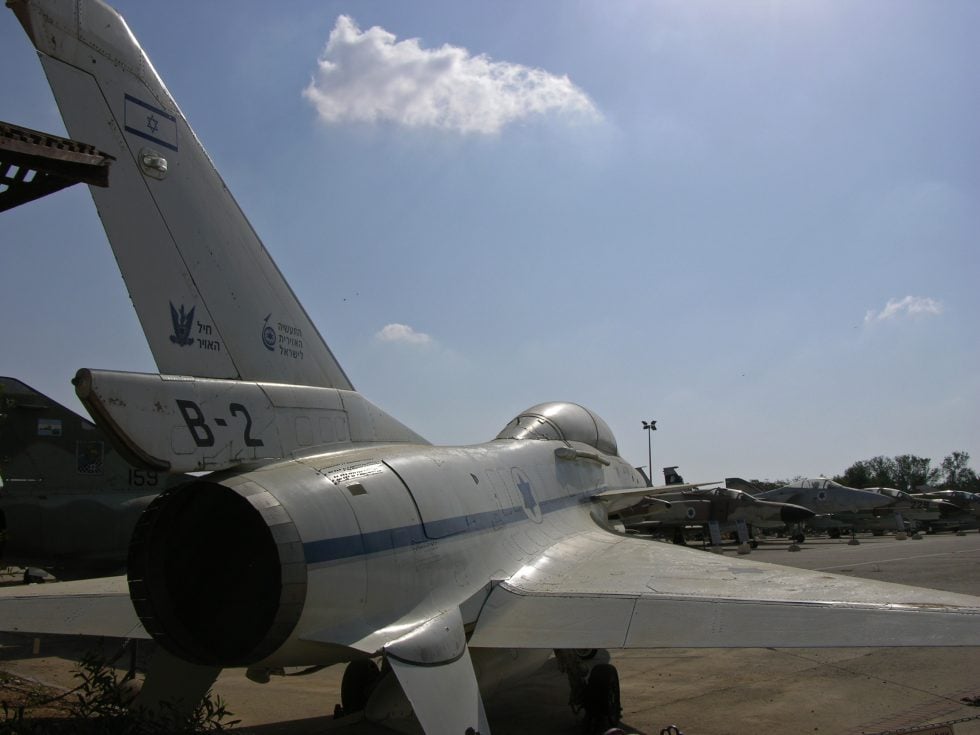
The Lavi is the most expensive aeroplane Israel ever cancelled and, by a wide margin, the most consequential. Five airframes were laid down. B-01 and B-02 were completed as tandem two-seaters with the rear cockpit filled by test instrumentation, and flew on 31 December 1986 and around March 1987. B-03, B-04 and B-05 were unfinished when the cabinet voted, and B-03 was subsequently completed using parts stripped from the first two aeroplanes, flying on 25 September 1989 as a technology demonstrator. B-04 and B-05 were scrapped. That is the whole fleet: three flying machines, 82 sorties before cancellation, no armament, no squadron, no export.
The money is the part most often stated loosely, so it is worth stating precisely. Of roughly $1.5 billion spent on development between 1980 and 1986, about $1.3 billion was American — on the order of 87 per cent, which is where the familiar "90 per cent US-funded" shorthand comes from. Congress earmarked some $1.8 billion for the Lavi through the 1987 fiscal year, and the mechanism was unprecedented: Israel was permitted to spend a slice of its Foreign Military Sales credits inside Israel rather than in the United States, initially about $300 million a year. Total development cost was estimated at around $3 billion, against a programme to build roughly 300 aircraft for delivery between 1993 and 2003. An American taxpayer, in other words, was funding a fighter that American manufacturers would then have to compete against for export orders in Chile, Taiwan, Argentina and South Africa, where IAI optimistically projected sales of 407 aircraft. Put that way, the Pentagon’s hostility needs no conspiratorial explanation at all.
Both sides of the cost argument were honest, and both were partly right. The Lavi’s defenders pointed at a genuinely lighter aeroplane — 7,031 kg empty against 8,300 kg for an F-16 Block 30 — with a projected lifecycle cost below the F-16’s, built to an Israeli requirement no American aircraft precisely met, and free of foreign release constraints on its weapons and software. Its opponents pointed at an economy where military spending had reached about 18.9 per cent of GDP in 1984 for a country of four million people, a figure Bank of Israel governor Michael Bruno called unaffordable in public and in those words: Israel could not have "the luxury of producing fighter-aircraft" without damaging its growth. Inside the air force, Major General Avihu Ben-Nun argued for cancelling and buying 75 F-16s instead, on the straightforward ground that the F-16 offered comparable performance, existed already, and would not consume the procurement budget of every other IDF branch for a decade. The State Comptroller thought the threatened job losses were being overstated. Nobody has ever publicly reconciled the competing per-aircraft cost estimates, because the answer depended entirely on assumptions nobody could test: the learning curve over a 300-aircraft run, whether sunk development cost was amortised into the unit price, and whether the binding constraint was dollars, which America was supplying, or shekels, which Israel was not.
The vote on 30 August 1987 was 12 to 11 with one abstention, and the mechanics of it still rankle. Prime Minister Yitzhak Shamir expected to win. Foreign Minister Shimon Peres, who had once said the Lavi was "better for security than holding onto the Gaza Strip", led the cancellation camp; Labour ordered its ministers to vote against the project; Likud’s own Finance Minister Moshe Nissim crossed and voted to cancel; and Health Minister Shoshana Arbeli-Almozlino, persuaded by Peres during a recess, abstained rather than support continuation. That abstention was the aeroplane. Moshe Arens, the aeronautical engineer who had championed the Lavi from the start, resigned from the cabinet rather than be associated with the decision. Some 5,000 to 6,000 IAI staff lost their jobs; there were demonstrations, a mock funeral procession at the Defence Ministry, and queues at the American embassy for visas. Within months Israel had ordered 90 F-16Cs, and asked Washington for $450 million towards termination costs.
What happened next is the reason the Lavi is remembered as something other than a failure. Around 5,000 scientists and engineers were released into an economy that had nowhere obvious to put them, and they went into the Arrow anti-ballistic missile programme, into the satellite work that put Ofeq-1 into orbit in September 1988, and into the start-up sector that defined Israel in the 1990s. The subsystems were sold. The EL/M-2032 radar became a global export business in its own right. The cockpit, display and mission-computer work reappeared in IAI’s upgrade programmes for other people’s fighters and in the heavily Israelised F-16s the air force bought instead. Arens maintained to the end that cancellation "sentenced IAI to remain a medium-sized player" and that Israel would otherwise have been flying the world’s most advanced fighter; the counter-argument, that a country of four million cannot sustain a fighter production line and everything else at once, has the harder evidence behind it. Both propositions can be true.
- Lavi B-01 (1986, one built)
- The first prototype. Tandem two-seat, rear cockpit filled with test instrumentation. Rolled out July 1986, first flight 31 December 1986 with Menachem Shmul at the controls, airborne 26 minutes from 13:21. Later stripped for parts to complete B-03, and scrapped.
- Lavi B-02 (1987, one built)
- Second prototype, also tandem two-seat, first flown about three months after B-01. Added a conformal belly fuel tank, a fixed air-refuelling probe and further avionics. Partly cannibalised for B-03; the gutted airframe survives.
- Lavi B-03 "Technology Demonstrator" (1989, one built)
- Completed two years after cancellation from parts of the first two aeroplanes, first flight 25 September 1989. Flew for years as IAI’s systems and avionics testbed — the aeroplane on which a good deal of the company’s subsequent export avionics was proved — and ended its life as a ground rig.
- Lavi B-04 and B-05 (never completed)
- The fourth and fifth airframes, unfinished at cancellation and scrapped. The development plan had called for five prototypes, three of them two-seat.
- Production single-seat Lavi (planned 1993–2003, none built)
- The aeroplane in the specification table and the one that never existed in metal: about 240 single-seaters within a requirement of roughly 300 aircraft, to replace the A-4 Skyhawk and the Kfir.
- Production two-seat Lavi (planned, none built)
- Around 60 of the 300, fully combat-capable rather than trainer-only. The Lavi was regarded as easy to fly and was also considered for the advanced training role outright.
- IAI Nammer (1988–early 1990s, one prototype)
- The most direct descendant. A private-venture export fighter that put the Lavi’s avionics — EL/M-2032 radar, weapon management system, solid-state engine instrumentation, a four-display HOTAS cockpit — into a Kfir-derived delta-canard airframe, offered with a customer’s choice of F404, RM12, M53, PW1120 or the original Atar 9K50. Preliminary design complete early 1988, prototype first flight 21 March 1991, minimum order 80 aircraft, projected unit cost under $20 million. Not one was sold and the programme was quietly dropped.
- Kfir C.7, C.10 and Block 60 upgrades (1990s onwards)
- The Lavi’s systems inheritance applied to the aeroplane it was meant to replace: EL/M-2032 radar, new displays, mission computer and helmet-cueing offered to Colombia, Ecuador, Sri Lanka and others, and leased to the United States as adversary aircraft. The Kfir outlived its successor by four decades on the strength of it.
- Israeli F-16 avionics upgrades (1988 onwards)
- The 90 F-16Cs bought in place of the Lavi, and everything after them, were progressively fitted with the systems the Lavi programme had produced — Israeli displays and mission computers, Elisra electronic warfare, the DASH helmet-mounted sight, and Elta radar offered as an F-16 fit as late as 1998. The F-16I Sufa of the 2000s, roughly half Israeli by value with conformal tanks and a wholly Israeli cockpit, is the closest thing that exists to a Lavi: an American airframe carrying the aeroplane Israel could not afford to build.
- Chengdu J-10 (disputed; first flight 23 March 1998)
- The persistent claim that the J-10 is a Lavi derivative. What the evidence supports: the two aircraft share a single-engined canard-delta layout with a chin intake; Israeli and Chinese defence-industrial contact in this period was extensive and later cost Israel the Phalcon sale; China was reported in 1987 to be interested in continuing Lavi development; and in 2008 Jane’s reported that the J-10 "benefited from technical information" from the Lavi, sourced to Russian engineers relaying what Chinese colleagues had told them. What the evidence does not support: no contract, drawing transfer or document has ever surfaced; Israel’s defence minister denied a 1988 Sunday Times report of a jointly developed Lavi derivative; Chengdu’s canard-delta work runs back to the cancelled J-9 of the 1960s and 1970s, and chief designer Song Wencong, who had worked on it, denied the connection in 2007, as did PLAAF Major General Zhang Weigang in 2012. The airframes are also not the same aeroplane: the J-10 is 16.9 m long against 14.57 m, spans 9.8 m against 8.78 m, grosses about 14,000 kg against 9,991 kg, uses a rectangular multi-shock intake rather than a chin inlet, and is powered by an AL-31F of roughly 27,000 lbf against the PW1120’s 20,600. The defensible reading is that Israeli consultancy on subsystems, design methods and flight-control practice is plausible and unproven, that Russian assistance to the programme is separately documented, and that the airframe itself is Chinese.
- M-346 "Lavi" (2013 onwards, 30 aircraft)
- Not a variant at all, but worth listing because it causes confusion: in July 2013 the Israeli Air Force gave the name Lavi to its Alenia Aermacchi M-346 advanced trainers, in service from 2014. An Italian aeroplane wearing a dead Israeli one’s name.
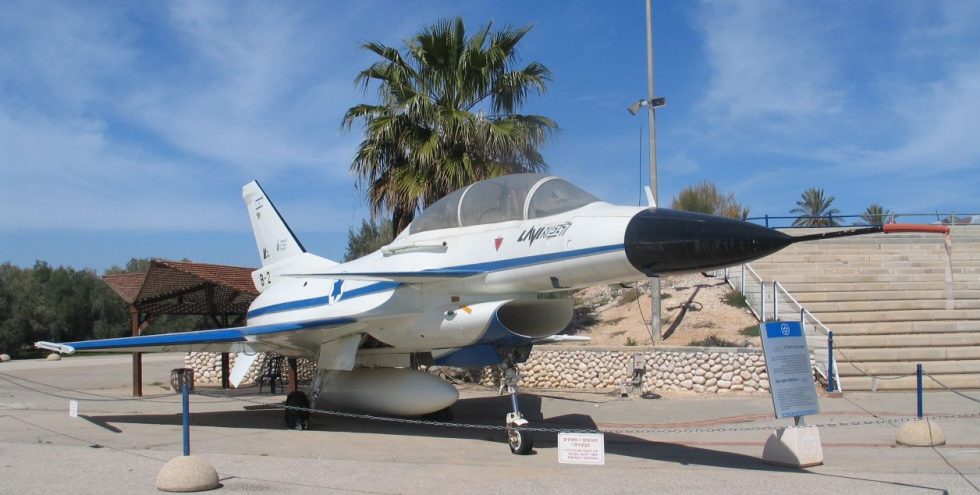
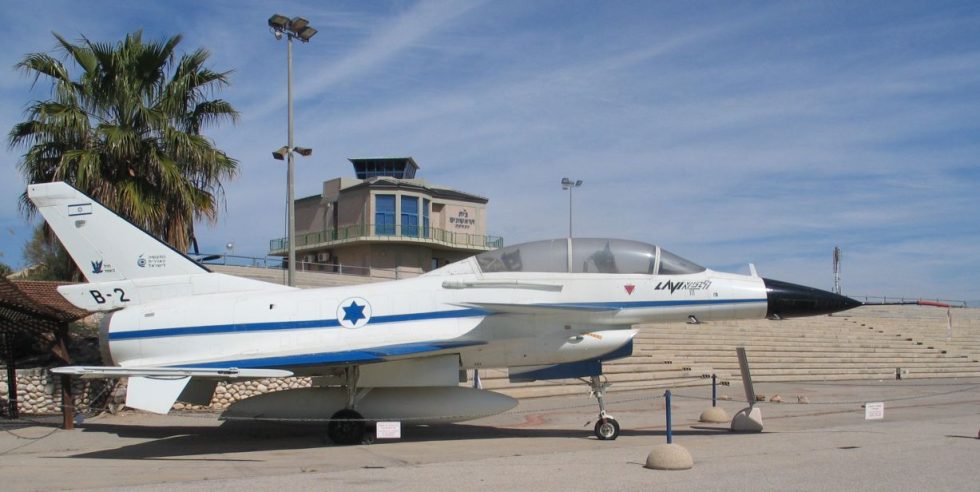
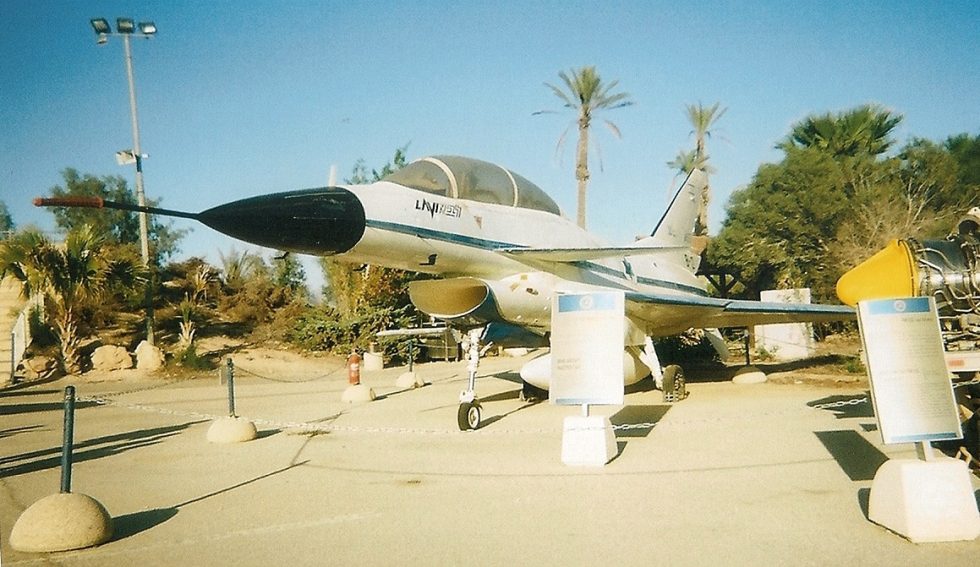
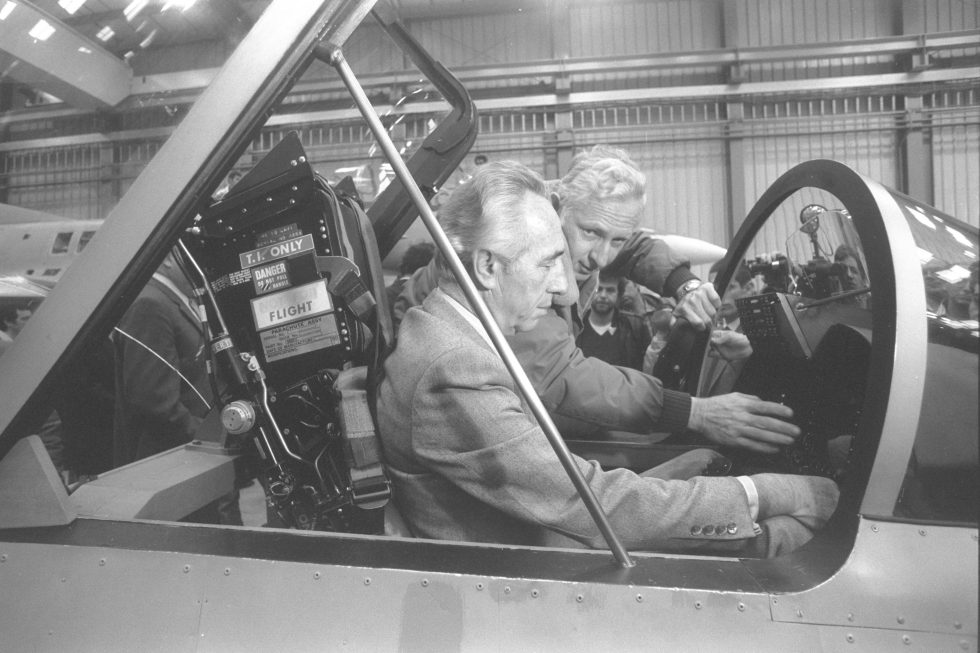
Survivors, precisely. Two of the five airframes exist and both are original; there is no reproduction of a Lavi anywhere, and the full-scale mock-up photographed with Shimon Peres in its cockpit in August 1985 is a mock-up and should not be counted. B-02, gutted of its systems, is on static display at the Israeli Air Force Museum at Hatzerim, outside Beer-Sheva, and is the aeroplane in almost every photograph captioned "preserved Lavi". B-03, the technology demonstrator, survived its flying and ground-rig careers in IAI’s hands; published accounts of exactly where it now stands do not agree, and it has never been part of the Hatzerim collection. B-01, B-04 and B-05 were scrapped, B-01 after being stripped to help complete B-03. Note also the two seats: the brief for this page described the flying aircraft as single-seaters and B-03 as the two-seater, and that is the wrong way round — B-01 and B-02 were both tandem two-seaters with instrumentation in the back, and the single-seat Lavi that fills the specification tables was never built at all.
From national ambition to a single cabinet vote
Programme launched
Israel formally begins the Lavi, an indigenous multirole fighter to succeed the Kfir and keep Israel Aircraft Industries at the technological frontier.
US funding secured
Washington agrees that a large share of US military aid may be spent on the Lavi; American firms supply the PW1120 engine and key systems.
First flight
The first prototype (B-1) takes to the air over Israel; the canard-delta, fly-by-wire fighter is reported to handle well.
Second prototype flies
A second flying prototype joins the test programme as the aircraft moves through its early flight envelope.
Cancelled by one vote
A divided Israeli cabinet votes to terminate the Lavi — reportedly 12 to 11 — on grounds of cost and under US pressure to buy F-16s instead.
The reckoning at IAI
Israel Aircraft Industries lays off more than 4,000 staff, including over 1,500 engineers; Israel orders additional F-16s.
The technology demonstrator flies
The two-seat Technology Demonstrator (B-3) makes its first flight on 25 September 1989 — the third and last Lavi to fly — and keeps testing the accumulated technology into the 1990s.
Legacy — and controversy
Lavi technology feeds Israel’s avionics and UAV industries; US officials later allege — disputed and unproven — that it influenced China’s J-10.
Twelve IAI Lavi stories
Beyond the Kfir
Israel wanted an original fighter, not another rebuilt Mirage.
Read the full story
The canard-delta gamble
A tailless delta and close-coupled canards, flown by wire.
Read the full story
An American heart
The single PW1120 tied the Lavi to Washington’s goodwill.
Read the full story
Paid for in Washington
US aid dollars, not just Israeli ones, built the Lavi.
Read the full story
New Year’s Eve, 1986
The first Lavi flew on the last day of the year.
Read the full story
When the numbers turned
A shrinking order sent the unit price soaring.
Read the full story
A rival to the F-16?
Washington feared a subsidised competitor on the export market.
Read the full story
12 to 11
Israel’s cabinet killed the Lavi by a single vote.
Read the full story
Four thousand jobs
The cancellation gutted IAI almost overnight.
Read the full story
The technology survived
The Lavi died, but its know-how lived on.
Read the full story
The J-10 question
Did the Lavi help shape China’s J-10? It is disputed.
Read the full story
The lion that never roared
A superb aircraft, remembered for the flight it never made.
Read the full story
The IAI Lavi in pictures
Where the Lavi was designed and built
A fighter that never went to war
The Lavi has no combat record and never entered squadron service — it was cancelled in 1987 after five prototype airframes were built, only three of which ever flew. Its story is measured not in kills or sorties but in test flights, technology and a single, decisive cabinet vote. Two prototypes proved the design in the air before the programme ended; a third, a two-seat technology demonstrator, flew in 1989. The Lavi’s real legacy lies in the Israeli avionics, radar and UAV expertise that outlived it.
Explore the wider combat record of every military aircraft. The Lavi never saw combat; figures here describe the programme, not operations.
Everything people ask about the IAI Lavi
Can I fly in a Lavi?
What was the IAI Lavi?
Why was the Lavi cancelled?
Did the Lavi lead to China’s J-10 fighter?
How many Lavi were built?
How did the Lavi compare to the F-16?
You can’t fly the Lavi.
These, you can.
Some legends only live in museums — others are fuelled and waiting. MiGFlug has put civilians in real military jet cockpits since 2004.
 Fly the L-39 AlbatrosThe world’s most-flown jet trainer — aerobatics included
 Fly the F-104 Starfighter“The missile with a man in it”
 Fly the MiG-21The Cold War’s most-produced jet
 Fly the T-33 Shooting StarAmerica’s first jet trainer
 Fly the DH VampireA piece of early jet history
 Fly the S.211Agile Italian jet trainer
 Fly the MB-326The classic Aermacchi jet
 Fly the MiG-15The Soviet legend of the Korean War
Continue the tour
Every fact, checked
- MilitaryFactory — IAI LaviDimensions, weights, PW1120 thrust, performance figures, first flight and prototype numbers.
- Tablet Magazine — Killing the LaviThe 1987 cancellation, GAO cost estimates, the shrinking order and IAI’s layoffs.
- Federation of American Scientists — The United States and the LaviUS funding of the programme and the American role in its cancellation.
- Jewish Virtual Library — IAI LaviProgramme history, design overview and Israeli-service context.
- The National Interest — The Lavi and the J-10The alleged Lavi-to-J-10 technology link, presented with its controversy.
- The Aviation Geek Club — Lavi cancellation and the J-10The one-vote cancellation and the US allegation of unauthorised technology transfer.
- Center for Israel Education — Cabinet Halts LaviPrimary reference for the 30 August 1987 cabinet decision and its politics.
- 19FortyFive — J-10, F-16 and the LaviThe Lavi as an F-16 rival and the disputed Israeli influence on the J-10.