
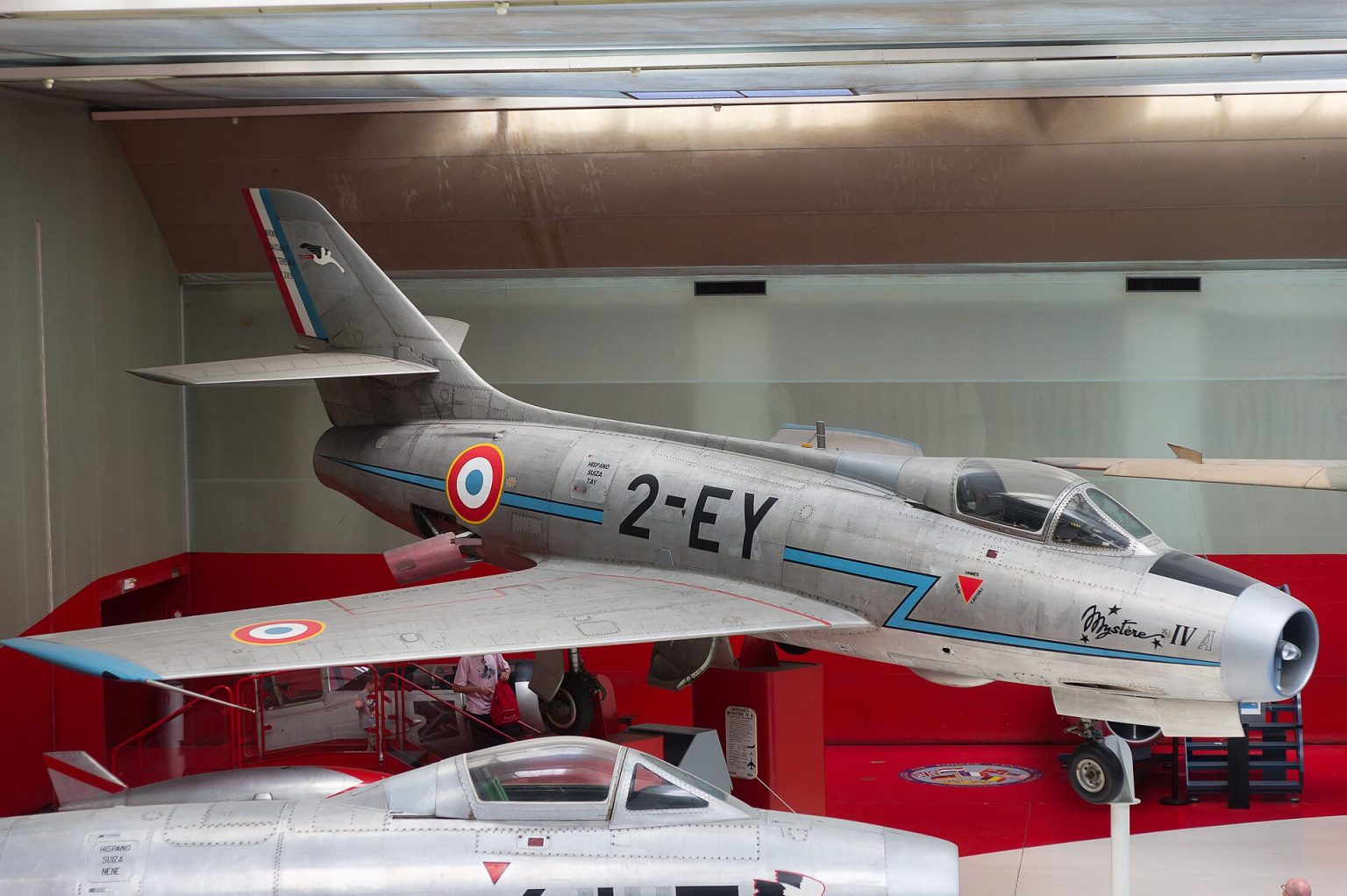
Dassault Mystère IV
France’s first transonic fighter
The swept-wing jet that carried France back into the front rank of fighter design — and then went to war in other people’s skies, from the Sinai in 1956 to the plains of the Punjab in 1965.
France gets its swept wing
When jet combat arrived, France was starting almost from zero. The occupation had gutted its aircraft industry, and Marcel Dassault’s first jet — the straight-winged MD.450 Ouragan of 1949 — was solid but already a generation behind the swept-wing MiG-15 and F-86 Sabre. The answer came in stages: the swept-wing Mystère II, and then a far more refined machine that was effectively a clean-sheet redesign — the MD.454 Mystère IV.
The prototype first flew on 28 September 1952. With a thinner, more sharply swept wing, a new oval-section fuselage and a redesigned tail, the Mystère IV looked a lot like the Sabre it was chasing — and it flew like a thoroughbred, becoming the first transonic aircraft to enter French Air Force service around 1955. Impressed, the United States funded a large batch through NATO’s offshore-procurement programme, paying for aircraft that equipped French squadrons.
The Mystère IV never fired its guns in French colours in a real war. Its combat record was written abroad — by Israel, which took it into the 1956 Suez campaign and the 1967 Six-Day War, and by India, whose Mystères became feared ground-attack aircraft in the 1965 war with Pakistan. At home the type was the stepping-stone to the supersonic Super Mystère, the first Western European fighter able to break Mach 1 in level flight.
01How the Mystère IV grew out of the Ouragan and Mystère II
Dassault’s post-war climb was fast and pragmatic. The straight-winged Ouragan (first flight 1949) gave France a home-built jet fighter and an export success. Bolting a swept wing onto that lineage produced the Mystère II, which in 1954 became the first French aircraft to exceed the speed of sound — in a dive. But the Mystère II was troublesome, and Dassault had already moved on.
The Mystère IV shared little more than a name with it. A thinner wing with greater sweep, a stronger fuselage, power controls and a French-built Hispano-Suiza Verdon turbojet turned an awkward transonic experiment into a genuinely capable fighter. It was this aircraft — not the II — that became the workhorse, and that pointed straight at the supersonic Super Mystère that followed.
What makes the Mystère IV special
A true swept wing at last
The Mystère IV’s wing was thin and swept back around 38 degrees — a decisive break from the straight-winged Ouragan. That geometry let it push right up to the edge of the sound barrier, cruising near Mach 0.9 and going supersonic in a dive. It made the Mystère IV the first transonic aircraft in French service and gave Dassault the aerodynamic confidence that led, within a few years, to the Mirage.
The Hispano-Suiza Verdon turbojet
The first 50 aircraft flew on the British Rolls-Royce Tay; the rest used the French-built Hispano-Suiza Verdon 350, a licensed and uprated development delivering about 34 kN (3,500 kgp) of thrust. Building the engine at home mattered as much as the airframe — it re-established a French supersonic-capable powerplant industry that the Atar would soon carry forward into the Mirage age.
Fighter one day, bomb-truck the next
Two 30 mm DEFA cannon made it a hard-hitting gun-fighter, while four underwing pylons could carry up to roughly 900–1,000 kg of bombs and rockets, plus a retractable pack of air-to-air rockets. That versatility is exactly why Israel and India valued it: it could dogfight when it had to, but it truly earned its reputation in the mud-moving ground-attack role.
02The Mystère IV and the F-86 Sabre: cousins, not copies
Line the two up and the family resemblance is obvious: nose intake, swept wing, bubble canopy. But the Mystère IV was its own design, and in several respects a harder-hitting one. Where most Sabres relied on six 0.50-cal machine guns, the Mystère carried two 30 mm DEFA cannon — far heavier punch per hit. In Israeli hands over Sinai in 1956, and in Indian hands against Pakistan’s Sabres in 1965, the type repeatedly proved it could hold its own against the American fighter it superficially resembled.
03Why America paid for a French fighter
In the early 1950s, NATO wanted its European members re-armed quickly, and the United States was willing to pay. Under the Mutual Defense Assistance Program and its offshore-procurement contracts, Washington ordered large numbers of European-built aircraft for European air forces — keeping local industries alive while filling out the alliance. The Mystère IV was a prime beneficiary: a substantial share of French production was bought with American dollars. Exact totals vary between sources, but the order ran into the low hundreds of aircraft.
Full specifications
Baseline note: the figures below describe the Dassault MD.454 Mystère IVA as built at Bordeaux-Mérignac with the Hispano-Suiza Verdon 350 turbojet, which was the later and by far the more numerous production standard and the engine fitted to every export aircraft. Deltas for the early Rolls-Royce Tay 250 machines, for the afterburning Mystère IVB and for the two-seat all-weather Mystère IVN are in grey. Seven warnings and a framing note before the numbers, because this is one of the most reliably garbled entries in the reference literature. First, the family. Four different Dassault aeroplanes are routinely collapsed into one another and they are not the same aircraft: the straight-winged Ouragan of 1949, the swept-wing Mystère II of 1952, the Mystère IV described here, and the Super Mystère of 1955, which was the first of the line able to exceed Mach 1 in level flight. The Ouragan and the Super Mystère have their own pages in this encyclopedia and their figures should not be borrowed for this one. Second, the production total. Dassault Aviation itself states 411 aircraft built and delivered between 1954 and 1958, the last in November 1958, and French sources agree; the English-language literature very commonly gives 421. We use 411. Third, the engine split. French sources divide those 411 airframes into 114 with the Rolls-Royce Tay and 297 with the Verdon 350, which at least adds up; the English figure of "the first 50 with the Tay" is widespread and does not reconcile with any published total. Fourth, the service-entry date. A great many English sources say the type entered service in April 1953. It did not. April 1953 is the month the United States placed its order. The prototype flew on 28 September 1952, the first production IVA flew in 1954, the 12e Escadre de Chasse at Cambrai was the first unit to receive the aircraft, and six fighter escadres were equipped from late 1955. Fifth, the American money. The order that paid for the aircraft was not French. It was placed in April 1953 by the United States under Mutual Defense Assistance Program offshore procurement, for 225 aircraft to be built in France and handed to the French Air Force — a figure given as 223 in some accounts. More than half of all Mystère IVAs ever built were bought with American dollars, and the arrangement is the single most important fact about the aeroplane’s existence. Sixth, the speed figure. The 1,110 km/h that appears in every published table is a sea-level maximum, and it is reproduced almost everywhere without that qualifier, which flatters the aeroplane badly. At altitude the Mystère IVA was limited by Mach number rather than by thrust, and Mach 0.91 at 12,000 m is about 970 km/h. It was a transonic fighter in the precise sense: fast at low level, comfortably subsonic where it actually fought, and supersonic only pointing at the ground. Seventh, the small numbers are thin. Internal fuel capacity, take-off and landing runs, g limits and armament installation weights for the IVA are not consistently published in any source accessible here, and rows that would normally carry them are either marked as derived or left out rather than filled with a number nobody can attest. And a framing note. The Mystère IVA had a remarkably short front-line life for an aircraft built in these numbers. It reached French squadrons from late 1955; the Super Mystère followed in May 1958 and the Mirage III in 1961, and by the middle 1960s the type had been pushed out of French air defence altogether. Its long tail — twenty-six years in French service, sixteen in Indian, fifteen in Israeli — is the tail of a training aeroplane and a cheap export fighter, not of a front-line interceptor. Read every figure below as describing a design that was state of the art for roughly thirty months.
Dimensions & weights
- Crew
- 1 — single-seat throughout. The IVN prototype was a two-seater, pilot and radar operator in tandem.
- Length
- 12.89 m (42 ft 3 in) — a few French sources give 12.85 m, a difference small enough to be a nose-probe convention.
- Wingspan
- 11.12 m (36 ft 6 in)
- Height
- 4.60 m (15 ft 1 in)
- Wing area
- 32.06 m² (345 sq ft)
- Wing sweep
- 38° (Dassault’s own published figure) — English references very often say 41°, which is most likely the leading-edge angle against Dassault’s quarter-chord figure. The Mystère II had 30°.
- Wing section
- Symmetrical biconvex, and thin — this, rather than the extra three degrees of sweep, is the change that separated the IV from the II and made the aircraft transonic.
- Empty weight
- 5,860 kg (12,919 lb)
- Maximum take-off weight
- 9,500 kg (20,944 lb) — a useful load of some 3,640 kg (8,025 lb) covering fuel, ammunition and every external store.
- Internal fuel
- Not consistently published. Working backwards from the 915 km clean range at a fuel flow appropriate to a 34 kN centrifugal turbojet gives something in the region of 1,900 litres, but that is an inference and it is stated here as one.
- Hardpoints
- Four underwing pylons. The two inboard stations habitually carried drop tanks, which is why the practical strike load was two weapons and not four.
- Maximum external load
- 1,000 kg (2,205 lb) — modest even for 1955, and the single hardest constraint on the type’s later career as a ground-attack aircraft in India.
- Useful load fraction
- 38 per cent of maximum take-off weight. Calculated from the empty and maximum weights above; a respectable figure that flatters the aircraft, because most of it had to be fuel.
- Production
- 411 aircraft, 1954–58 (Dassault’s own figure; 421 is widely quoted in English sources) — 241 to France, 110 to India, about 61 to Israel.
Performance
- Maximum speed
- 1,110 km/h at sea level (690 mph, 599 kn)
- Maximum Mach number
- About Mach 0.91 in level flight. The aeroplane was supersonic only in a dive; the prototype passed Mach 1 nose-down on 17 January 1953, the second French aircraft to break the sound barrier, and no production IVA ever did it in level flight.
- Speed at altitude
- Roughly 970 km/h (603 mph) at 12,000 m, that being Mach 0.91 in the stratosphere. Derived from the Mach limit rather than taken from a flight-test table.
- Rate of climb
- 40 m/s (7,874 ft/min) at sea level
- Time to altitude
- Roughly ten minutes to 12,000 m (39,400 ft), allowing for the sharp fall-off in climb rate above the tropopause. Derived; no period climb schedule for the IVA has been traced here.
- Service ceiling
- 15,000 m (49,200 ft)
- Range, clean
- 915 km (569 miles) on internal fuel
- Range, with external tanks
- 2,280 km (1,417 miles) — the tanks two-and-a-half times the range, which is the clearest possible statement of how little fuel the aircraft carried inside.
- Combat radius
- ~400 km (~250 miles) on a low-level strike profile with tanks and a pair of bombs. An estimate, and operator profiles varied widely.
- Wing loading
- 296 kg/m² (60.7 lb/sq ft) at maximum take-off weight; 183 kg/m² (37.5 lb/sq ft) empty. Calculated from the weights and wing area above.
- Thrust-to-weight ratio
- 0.37 at maximum take-off weight, 0.60 empty. Calculated. The Tay-engined aircraft sat at about 0.30 and 0.49 respectively, which is the whole reason the Verdon existed.
Propulsion & systems
- Engine
- One Hispano-Suiza Verdon 350 centrifugal-flow turbojet, 34.32 kN (7,720 lbf) dry
- Engine, early aircraft
- One Rolls-Royce Tay 250 (RB.44), about 28.0 kN (6,280 lbf) — roughly 18 per cent less thrust. French sources put 114 aircraft on the Tay, English sources 50.
- Engine ancestry
- The Verdon was a Hispano-Suiza development of the licence-built Tay, itself an enlarged Rolls-Royce Nene. The whole line descends from a 1944 British centrifugal design, which by 1955 was a generation behind the axial-flow engines going into the F-100 and the MiG-19.
- Afterburner
- None — and this is the type’s defining limitation. The IVB was built to fix it, with a reheated Rolls-Royce Avon RA.7R or SNECMA Atar 101F; that path led to the Super Mystère and away from the IVA entirely.
- Air intake
- Single oval nose intake with a long duct running under the cockpit floor — simple, draggy, and the reason the nose could never hold a radar of any size.
- Fuel system
- Fuselage and wing tanks feeding a single engine, plus two jettisonable underwing tanks. No in-flight refuelling capability of any kind; the aircraft has no probe and never had one.
- Flight controls
- Hydraulically powered irreversible controls with an all-moving one-piece tailplane — advanced for a 1952 design and essential at transonic Mach numbers, where a conventional elevator loses authority. Detail differences in the tailplane fit distinguish early from late airframes.
- Gunsight
- A gyro gunsight; French records distinguish Babaud and GGS installations across the production run. The IVB was to have radar ranging. The IVA never received it, so every gun kill it ever scored was aimed by a computing optical sight.
- Radar
- None. The IVN prototype carried an American AN/APG-33 interception radar in a lengthened nose; it was the only Mystère IV of any mark ever to carry radar, and it was cancelled.
- Airbrakes
- Perforated fuselage-mounted airbrakes — a necessity on a clean transonic airframe that would otherwise accelerate through its limits in a dive.
- Undercarriage
- Retractable tricycle gear, sized for the concrete of NATO bases in France and Germany and, in Israeli and Indian service, used off surfaces considerably rougher than that.
- Avionics
- A day fighter’s fit: VHF radio, basic navigation aids, gyro sight. No autopilot worth the name, no radar warning receiver, no countermeasures. Israeli and Indian aircraft flew their wars with essentially the equipment Dassault delivered in 1956.
- Manufacture
- Airframes built at Bordeaux-Mérignac, with Verdon engines from Hispano-Suiza at Bois-Colombes and Tay engines licence-built in France. A substantial share of the tooling and the production rate was financed by the United States under offshore procurement rather than by the French defence budget.
04The Mystère IV’s cost: why there is no clean price tag
Because much of the Mystère IV run was bought through NATO’s mutual-aid machinery rather than sold on an open market, there is no single reliable flyaway price in the public record, and no credible cost-per-flight-hour figure survives for a 1950s French jet. Contemporary accounts put unit costs in the order of a few hundred thousand mid-1950s US dollars, but any precise number should be treated as an estimate. What is well documented is that the United States funded a large portion of production through offshore procurement — so for France, a big share of the fleet effectively arrived without a domestic bill.
Armament & payload
The Mystère IVA fought three wars with two cannon and unguided ordnance, because that is all that existed when it was drawn
The Mystère IVA carried two 30 mm cannon and whatever iron could be hung on four pylons, and that is very nearly the whole inventory. It was designed in 1951 and 1952, before any Western air force had a usable guided air-to-air missile in squadron numbers and years before anyone had a guided air-to-surface weapon worth the name, and it left front-line service before either became routine. Everything it ever destroyed in the air, it destroyed with the gun; everything it ever destroyed on the ground, it destroyed with unguided bombs, unguided rockets or the same gun. Fits varied more by operator than by mark: French aircraft flew a French weapon set, Israeli aircraft mixed French and American ordnance and included a small camera-equipped reconnaissance batch, and Indian aircraft in 1965 leaned far harder on rockets than the Mystère was ever designed to.
The gun is the interesting part. The DEFA 551 was the first production member of a French revolver-cannon family descended directly from the wartime Mauser MG 213C, and at 150 rounds per gun the Mystère IVA carried an unusually deep magazine for a mid-1950s day fighter. That mattered: a Mach 0.9 fighter with no missiles and no radar ranging has exactly one way to kill anything, and Israeli pilots proved over Sinai in 1956 that two 30 mm cannon and a computing sight were enough against MiG-15s flown by less well-trained crews. Eleven years later, over the same desert, three claims in 610 sorties showed what the same weapon set was worth once the opposition had MiG-21s.
The ground-attack story is less flattering. A maximum external load of 1,000 kg across four pylons, two of which were usually carrying fuel, gave a practical war load of two bombs or two rocket pods. The Indian Air Force spent September 1965 sending Mystère IVAs against Pakistani armour and airfields with precisely that, in daylight, at low level, against alert anti-aircraft artillery, and paid for it. The aeroplane did the work asked of it, but it was a 1952 interceptor doing a 1965 attack aircraft’s job and the arithmetic never favoured it.
Gun — two 30 mm DEFA 551 revolver cannon, and nothing else that could kill a fighter
- Two DEFA 551 30 mm revolver cannon in the lower forward fuselage, beneath the intake duct, with 150 rounds per gun — 300 rounds in total.
- The 551 was the first production DEFA, developed from the German Mauser MG 213C revolver-cannon design captured in 1945. It fires the 30 × 113 mm round at roughly 800 m/s and cycles at something over a thousand rounds a minute.
- 150 rounds per gun is generous for a 1955 day fighter, and deliberately so: with no missiles and no radar ranging, ammunition was the whole air-combat capability.
- Nose mounting means no convergence problem and no wing-root harmonisation compromise — the guns shoot where the pipper is at every range, which is worth a great deal to a pilot with an optical sight.
- Every Mystère IVA air-to-air victory ever claimed, Israeli in 1956 and 1967 and Indian in 1965, was a gun kill.
Air-to-air — no guided missile was ever carried, on any mark, by any operator
- This card is kept because the absence is the point. The Mystère IVA had no air-to-air missile capability of any kind and none was ever fitted or seriously proposed for it.
- The timing is simply wrong. Matra’s R.511 and the American AIM-9B Sidewinder reached European squadrons on the next generation of airframes — the Super Mystère, the Mirage III, the F-100 — by which time the Mystère IV was already being pushed towards second-line work.
- Its notional bomber-killing weapon was the retractable rocket tray described under Rockets, an air-to-air weapon in intent and one with no recorded operational use.
- This was not a handicap in 1956: the Egyptian MiG-15 and MiG-17 it fought over Sinai had no missiles either, and the fight came down to sights, training and the gun.
- It was a fatal handicap by 1967, when the aircraft that shot one down over Sinai was a missile-armed MiG-21.
Air-to-surface guided — none, and the type was retired before it mattered
- No guided air-to-surface weapon was ever carried. The Mystère IVA has no data link, no television guidance, no laser designator and no provision for any of it.
- France’s first practical guided air-to-surface weapons, the Nord AS.20 and AS.30, went to the Super Mystère, the Mirage III and the F-100 — the generation immediately after this one.
- Everything the type dropped or fired at a ground target across three wars was unguided and aimed by the pilot in a dive.
- Indian attacks on Pakistani armour around Chawinda and on the Sargodha airfield complex in September 1965 were flown with rockets, iron bombs and cannon fire, nothing else.
- The absence should be read as a date stamp rather than a deficiency: no aircraft in French front-line service in 1955 had such a weapon.
Bombs — up to 1,000 kg of iron, on four pylons that were usually half full of fuel
- Maximum external stores load of 1,000 kg (2,205 lb) across four underwing hardpoints.
- Typical fits were two 250 kg French bombs or two American 500 lb bombs on the outboard stations, with drop tanks inboard.
- Napalm tanks were part of the standard repertoire and were used by Israeli aircraft in Sinai in 1956 and by Indian aircraft against Pakistani columns in 1965.
- The practical war load was therefore two weapons, not four — the range figures make clear that a Mystère IVA without tanks was not going far enough to be useful.
- By the standards of the aircraft that replaced it this is a trivial load: a Hunter FGA.9 of the same era carried roughly twice as much, and an Su-7 rather more.
Rockets — the weapon the aircraft actually fought with, and a belly tray that probably never fired in anger
- A retractable ventral tray of 55 Matra 68 mm rockets appears in almost every published armament list for the type, intended as an anti-bomber weapon fired as a salvo.
- That installation is firmly attested for the Mystère IVN prototype and is listed for the IVA in most references, but no operational use of it by any air force has been traced here, and it should be treated as a paper capability.
- Underwing pods of 68 mm SNEB rockets were the standard French air-to-ground rocket fit and became the type’s most-used weapon after the gun.
- Indian Mystère IVAs used rocket projectiles heavily against Pakistani tanks, vehicles and dispersed aircraft in September 1965; with no guided anti-armour weapon in existence, rockets were the only answer to a tank the gun could not open.
- Rocket attack meant a shallow dive inside the envelope of every light anti-aircraft gun on the target, which is where most of the type’s combat losses came from — five of the seven Israeli aircraft lost in 1967 fell to ground fire.
Pods & other stores — two fuel tanks, a handful of cameras, and a fit that never changed
- Two jettisonable underwing fuel tanks, which raised range from 915 km to 2,280 km and were fitted on very nearly every operational sortie the type ever flew.
- A small batch of camera-equipped reconnaissance Mystère IVAs was delivered to Israel in September 1956, arriving in time for the Sinai campaign.
- No electronic-warfare pod, no jammer, no chaff or flare dispenser, no targeting pod, no gun pod, no buddy refuelling store — and no refuelling probe to use one with.
- The external stores fit was essentially settled by 1956 and barely changed across twenty-six years of French service, which tells you how completely the type was frozen once the Mirage III arrived.
- In its last French role, advanced combat training at Cazaux from 1964 to 1982, most airframes flew with tanks and gun ammunition and nothing else.
Three typical loadouts
- Day air defence, Armée de l’Air, 1956
- Clean wing or two underwing drop tanks; 300 rounds of 30 mm. That is the entire fit. A NATO alert Mystère IVA at Cambrai or Dijon went up to intercept with two cannon and a gyro sight, and nothing on the aircraft could see a target the pilot could not.
- Airfield strike, Israeli Air Force, 5 June 1967
- Two bombs on the outboard pylons, tanks inboard, full gun ammunition. Mystère IVAs formed part of the mixed force that opened Operation Focus against Egyptian airfields, and by then the type was a bomb truck: 610 sorties across the war for three air-to-air claims and seven aircraft lost.
- Close air support, Indian Air Force, September 1965
- Two rocket pods or two 500 lb bombs, tanks inboard, guns loaded, flown low and in daylight against Pakistani armour in the Sialkot sector or against the Sargodha airfield complex. On 7 September the IAF put 33 sorties into Sargodha and lost two Mystères and three Hunters to the defending Pakistani squadrons.
Sourcing caveat. Armament detail for the Mystère IVA rests on French type summaries and on operator accounts rather than on any published weapons manual accessible here. The gun fit and the 1,000 kg store limit are firm. The 55-rocket ventral tray is repeated in almost every reference and demonstrated on the IVN, but its service use on the IVA is unevidenced. Bomb types are given as classes rather than as specific designations because Israeli and Indian aircraft drew on French, British and American stocks and no consistent clearance list has been traced.
Variants
One production fighter, two cancelled developments, and an American cheque that paid for more than half of them
The Mystère IV family is short and unusually clean, and it looks complicated only because three neighbouring Dassault types are habitually confused with it. There is one production version, the IVA, built in two engine standards. There is one afterburning development, the IVB, which was abandoned. There is one all-weather two-seater, the IVN, which was cancelled after a single prototype. Everything else called Mystère is a different aircraft.
What makes the type historically important is not the engineering but the finance. In April 1953 the United States ordered 225 Mystère IVAs under Mutual Defense Assistance Program offshore procurement — to be built in France, paid for in dollars, and delivered to the French Air Force. That is more than half the entire production run, and it is why a company that had built its first jet fighter four years earlier was suddenly running a production line at Bordeaux-Mérignac at a rate France could not have afforded on its own. Marcel Dassault’s position as the supplier of French fighter aircraft for the next forty years was underwritten, at the critical moment, by the United States Treasury.
The front-line career was correspondingly brief. The IVA reached French squadrons from late 1955 and equipped six escadres; the Super Mystère arrived in 1958 and the Mirage III in 1961, and by the mid-1960s the swept-wing transonic Mystère was obsolete as a fighter. It survived because it was a superb thing to teach on. The 8e Escadre de Chasse flew it at Cazaux from 1964 until 1982 as the advanced combat trainer between the Fighter School and the front line, so that a type withdrawn from air defence in the 1960s was still teaching French fighter pilots to fight when the Mirage 2000 was entering service.
- Mystère IV prototype (MD.454) (1952)
- Rolls-Royce Tay 250, first flight 28 September 1952 at Melun-Villaroche with Constantin Rozanoff at the controls. Passed Mach 1 in a dive on 17 January 1953, the second French aircraft to break the sound barrier. Rozanoff was killed on 3 April 1954 demonstrating a Mystère IV at low level.
- Mystère IVA, Tay-engined production (1954–55, 114 aircraft by French count)
- The first production standard, with the licence-built Rolls-Royce Tay 250 of about 28 kN. Underpowered for the airframe and superseded as soon as the Hispano-Suiza engine was ready. English-language sources put this batch at 50 aircraft; the French figure of 114 is the one that reconciles with a 411-aircraft total.
- Mystère IVA, Verdon-engined production (1955–58, 297 aircraft)
- The definitive aeroplane and the baseline for the tables above: Hispano-Suiza Verdon 350 of 34.32 kN, some 22 per cent more thrust than the Tay. Every export aircraft was of this standard. The last of 411 was delivered in November 1958.
- United States MDAP offshore order (April 1953, 225 aircraft)
- Not a variant but the reason the variant list exists. The United States ordered 225 aircraft for French use under offshore procurement, delivered ahead of schedule; some accounts give 223. French Air Force deliveries totalled about 241 aircraft, so the American contract paid for the overwhelming majority of France’s own fleet.
- Mystère IVA, Israeli Air Force (1956–71, about 61 delivered)
- Ordered in 1956 against a background of Egyptian MiG-15 deliveries; 24 arrived between April and June 1956, 36 more in August, and a small camera-equipped reconnaissance batch in September, weeks before the Sinai campaign. Flown by 101, 109 and 116 Squadrons. In 1956 the type flew 147 sorties for one loss, to ground fire on 2 November, with the first kill claimed against Egyptian MiG-15s on 30 October. In 1967 it flew 610 sorties, claimed two MiG-17s and a Jordanian Hunter, and lost seven aircraft — five to ground fire, one to an Egyptian MiG-21 and one to a Jordanian Hunter flown by the Pakistani pilot Saiful Azam. Retired 18 March 1971.
- Mystère IVA, Indian Air Force (1957–73, 110 delivered)
- The largest export fleet, ordered in 1957 and delivered from that year; No. 1 Squadron was raised on the type at Kalaikunda in 1957 and moved to Adampur in 1963. In September 1965 Indian Mystères were used overwhelmingly for ground attack — strikes on Pakistani armour at Chhamb and in the Sialkot sector, and on the Sargodha airfield complex on 7 September, which cost two Mystères. In that raid Squadron Leader Ajamada B. Devayya was shot down by, and himself brought down, a Pakistani F-104 Starfighter; his Maha Vir Chakra was awarded posthumously only decades later, after a Pakistani account of the engagement made his fate clear. Phased out by 1973.
- Mystère IVB (1954–56, six to ten airframes)
- The afterburning development, with a reheated Rolls-Royce Avon RA.7R or SNECMA Atar 101F, a redesigned nose and provision for a radar-ranging gunsight. It flew and it went supersonic in level flight. Sources disagree on how many were built — six pre-production aircraft in English accounts, ten prototypes in French ones — and on whether the IVB or the Super Mystère B.1 of March 1955 should be credited as the first French aircraft supersonic in level flight. The programme was abandoned in favour of the Super Mystère.
- Mystère IVN (1954, 1 prototype)
- A two-seat all-weather interceptor with an American AN/APG-33 radar in a lengthened nose and a retractable ventral tray of 55 Matra 68 mm rockets. First flight 19 July 1954. Cancelled; the all-weather role went to the Sud-Ouest Vautour IIN. The airframe is remembered chiefly because Jacqueline Auriol is credited with a women’s world speed record of 1,151 km/h in a Mystère IVN in 1955.
- Super Mystère B.2 (1957–59, about 180 built)
- The successor, and a separate aircraft with its own page in this encyclopedia. It grew out of the IVB rather than the IVA: thinner wing, 45° of sweep against the IV’s 38°, an afterburning SNECMA Atar 101G, and the ability to exceed Mach 1 in level flight rather than only in a dive. It entered French service in May 1958, just three years after the Mystère IVA, which is the clearest measure of how quickly this generation was overtaken.
- Dassault Ouragan (1949–54, over 350 built)
- The ancestor, also a separate aircraft with its own page. Straight-winged, Nene-powered, armed with four 20 mm cannon, and replaced in French squadrons by the Mystère IVA from May 1955. India and Israel both flew Ouragans before they flew Mystères, which is a large part of why the two types are so often confused in accounts of the 1956 and 1965 wars.
Survivors. No Mystère IV is airworthy anywhere and none has flown since the French withdrawal in 1982; every survivor is a static museum exhibit, a gate guard or a ground instructional airframe, and all of them are original production aircraft — no reproduction Mystère IV has ever been built and, the type never having entered the civil warbird market, there is no reason one ever would be. The largest concentration is in France, at the Musée de l’Air et de l’Espace at Le Bourget, at Savigny-lès-Beaune, and scattered across air-base gates and technical schools as the 1982 withdrawal fed dozens of airframes into preservation and instruction at once. The second concentration is a genuine oddity: an unusual number of ex-French aircraft crossed the Channel in the 1970s and 1980s and ended up in small British volunteer-run collections, so that a French fighter that never served with the RAF is preserved at the Midland Air Museum at Coventry, the Norfolk and Suffolk Aviation Museum at Flixton, Newark Air Museum, the City of Norwich Aviation Museum and the Dumfries and Galloway Aviation Museum. Elsewhere, aircraft are displayed at the Israeli Air Force Museum at Hatzerim, the Indian Air Force Museum at Palam, the Polish Aviation Museum in Kraków and the Pima Air and Space Museum at Tucson. No authoritative census exists; counts circulating online sit somewhere between thirty and fifty airframes, and the true figure depends entirely on whether hulks, cockpit sections and instructional shells are included.
From comeback fighter to foreign wars
The Ouragan
Dassault’s straight-winged MD.450 gives France its first home-built jet fighter — the ancestor of the Mystère line.
Mystère IV first flight
The MD.454 prototype flies on 28 September, a clean-sheet swept-wing design far ahead of the earlier Mystère II.
America pays the bill
The United States orders a large batch under NATO offshore procurement, funding aircraft for the French Air Force.
Enters French service
The Mystère IVA becomes the first transonic aircraft in French Air Force service, powered by the Hispano-Suiza Verdon.
Suez debut
Israeli Mystère IVAs fight over Sinai in the Suez campaign, tangling with Egyptian MiG-15s and Vampires.
India buys in
The Indian Air Force begins receiving around a hundred Verdon-powered Mystère IVAs for the strike role.
War over the Punjab
Indian Mystères hammer Pakistani armour in the Chhamb sector; Sqn Ldr A.B. Devayya famously downs an F-104 Starfighter.
Last battles, then retirement
Israeli Mystères fly ground attack in the Six-Day War (1967) and retire in 1971; France phases the type out by 1980.
From the cockpit: twelve Mystère IV stories
From Ouragan to swept wing
France rebuilt its fighter industry in a decade — the Mystère IV was the payoff.
Read the full story
The jet that looked like a Sabre
Nose intake, swept wing, bubble canopy — but the DEFA cannon hit far harder.
Read the full story
The fighter America bought
Washington funded a large share of Mystère IV production to re-arm NATO fast.
Read the full story
Combat debut over Sinai
Israeli Mystère IVAs went to war within months of delivery in Operation Kadesh.
Read the full story
The Vampire ambush
On 31 October two Mystères reportedly caught a formation of Egyptian Vampires.
Read the full story
More than a match for the MiG
Israeli pilots rated the Mystère IVA a genuine equal to Egypt’s MiG-15s.
Read the full story
Down in the mud
By 1967 the Mystère IV was a bomb-truck, pounding Arab armies as newer jets swept the skies.
Read the full story
The Chhamb strikes
Indian Mystères broke up Pakistani armour when it lunged toward Akhnoor.
Read the full story
Devayya versus the Starfighter
A Mystère pilot took on a Mach-2 F-104 — and both aircraft went down.
Read the full story
The Verdon at its heart
A French-built engine turned an imported design into a home-grown fighter.
Read the full story
A fighter for three flags
France, Israel and India between them flew every Mystère IVA built.
Read the full story
The road to Super Mystère
The IV’s success led straight to France’s first supersonic fighter.
Read the full story
The Mystère IV in pictures
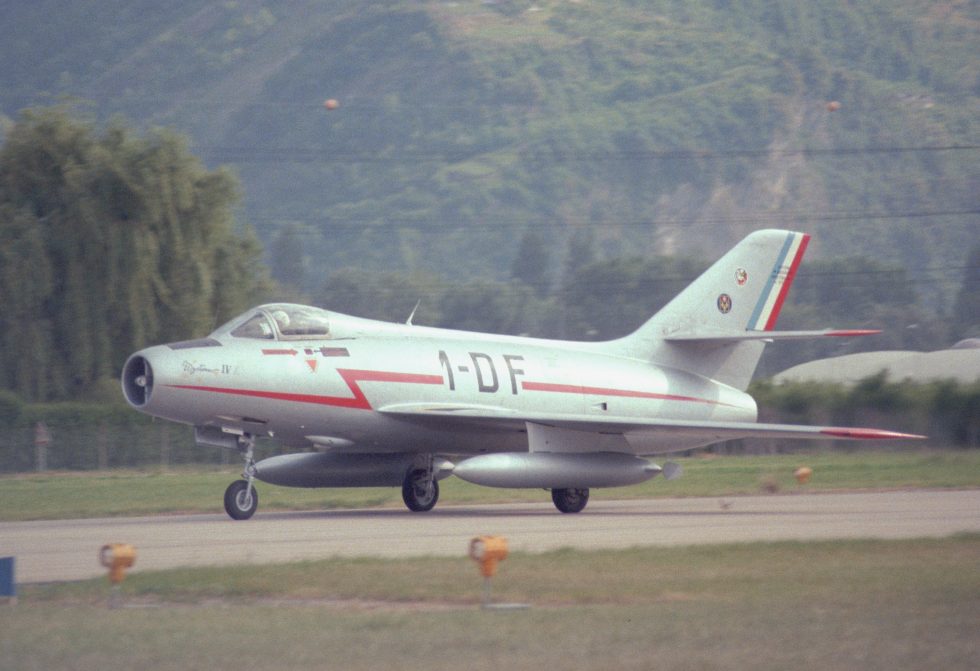
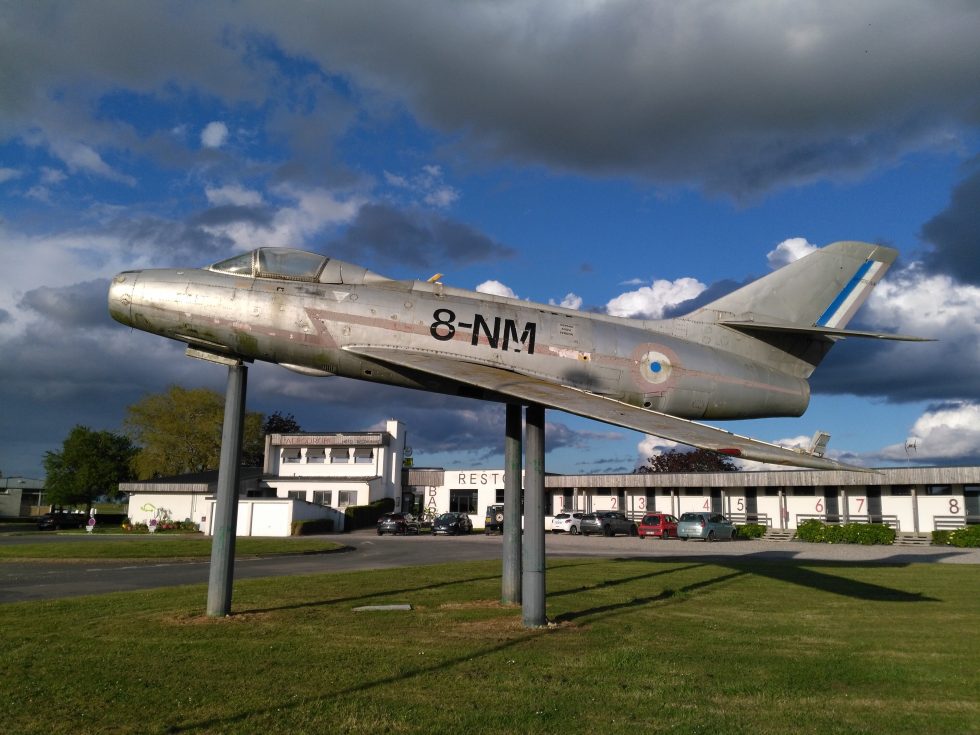
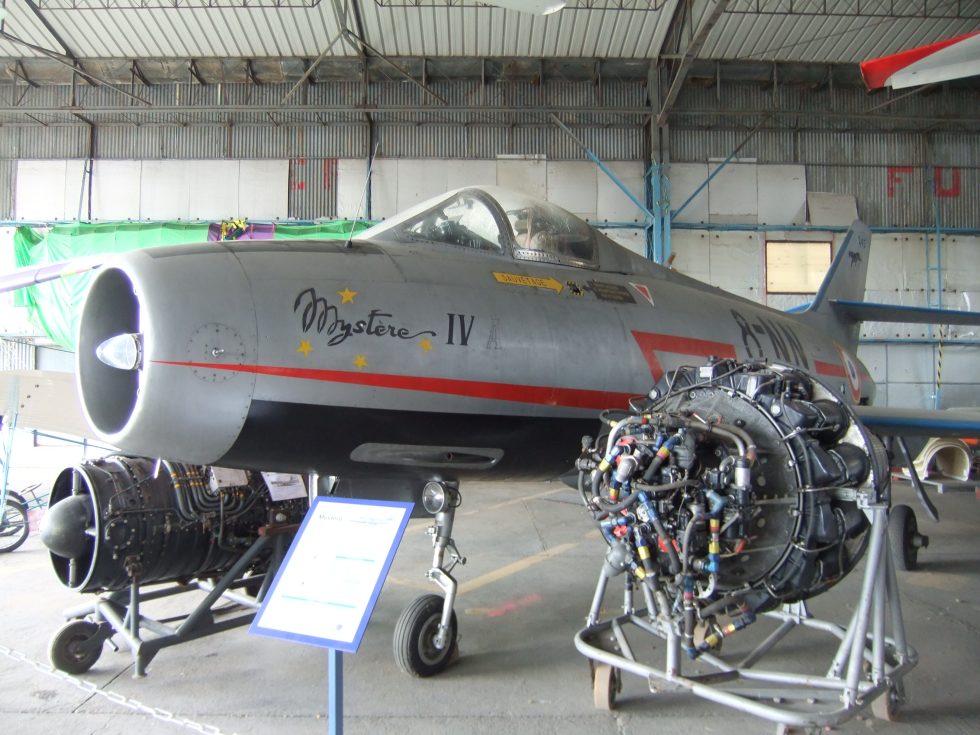
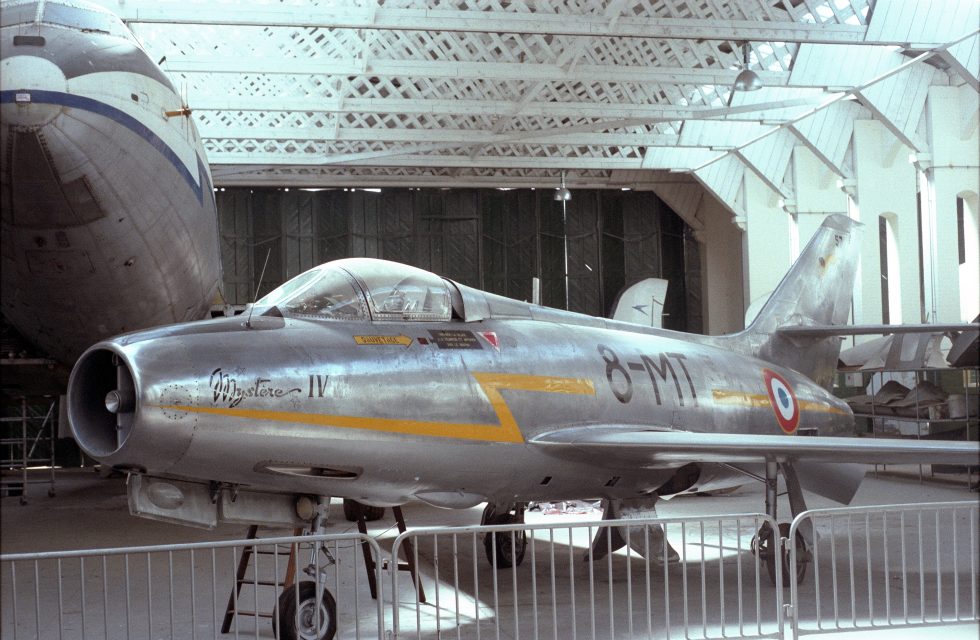
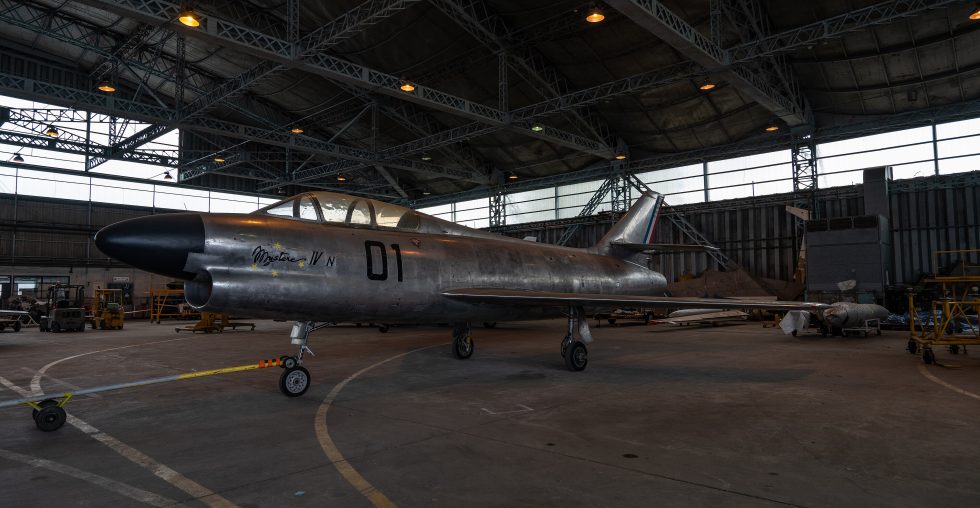
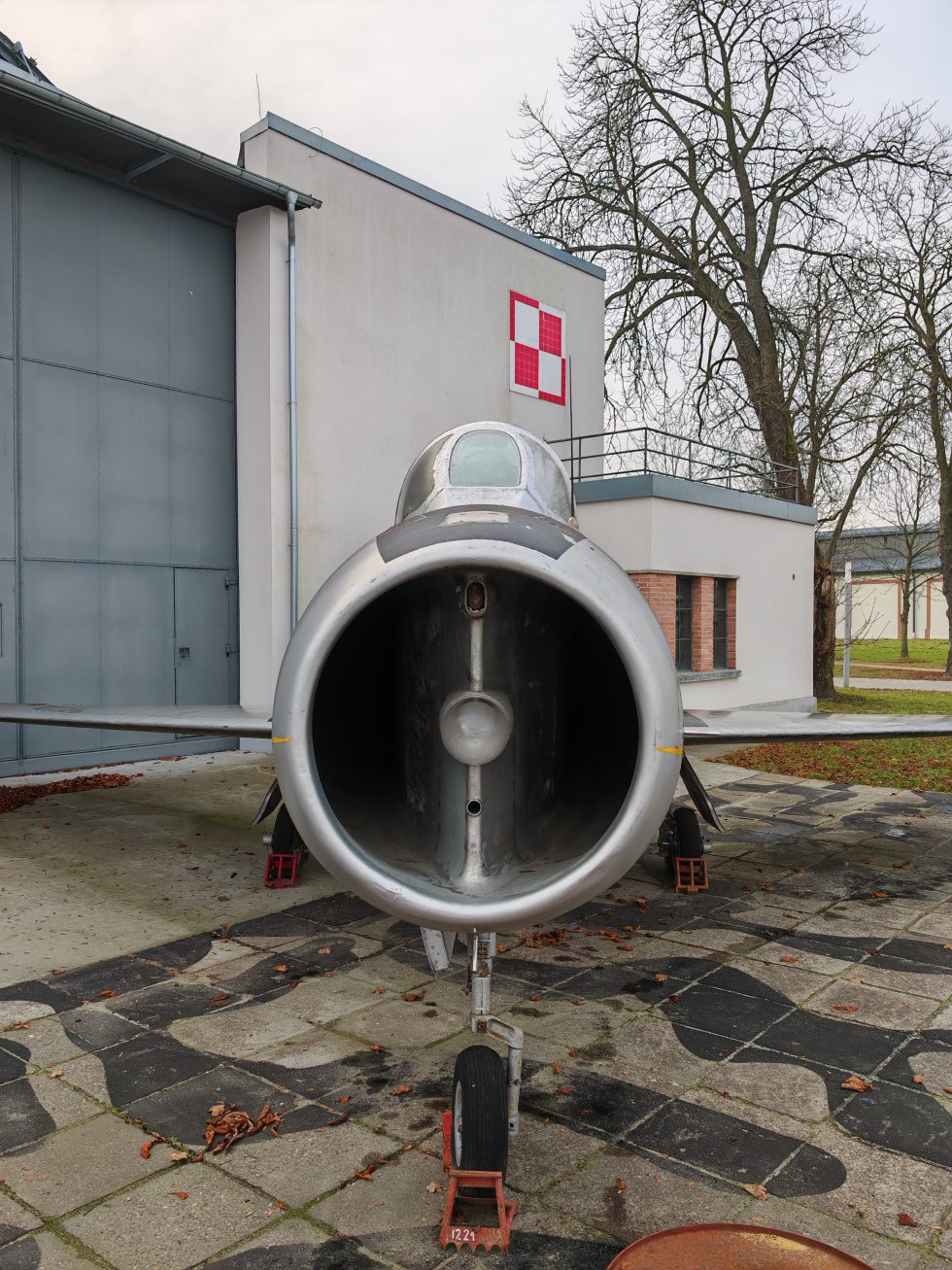
The Mystère IV in motion
A dedicated Mystère IV video feature is coming soon. In the meantime, explore the photo gallery above and the twelve stories from its combat career.
The Mystère IV in motion
Not A Pound For Air To Ground — one of the most-watched Mystère IV films on YouTube.
Where the Mystère IV flew
The wars it actually fought
Ironically, the Mystère IV never saw a real war in French service. Its combat reputation was earned entirely abroad — by Israel over Sinai and by India over the Punjab — where it proved a capable dogfighter and, above all, a rugged ground-attack aircraft. Air-combat tallies from these campaigns are contested and vary between national accounts; the figures below should be read as widely-cited claims rather than settled fact.
Compare the combat record of every military aircraft. Figures as of July 2026.
Everything people ask about the Mystère IV
Can I fly in a Mystère IV?
What was the Dassault Mystère IV?
How fast was the Mystère IV?
Did the Mystère IV see combat?
What engine did it use?
How many were built, and who flew it?
Did a Mystère really shoot down an F-104?
What replaced the Mystère IV?
You can’t fly the Mystère IV.
These, you can.
Some legends only live in museums — others are fuelled and waiting. MiGFlug has put civilians in real military jet cockpits since 2004.
 Fly the L-39 AlbatrosThe world’s most-flown jet trainer — aerobatics included
 Fly the F-104 Starfighter“The missile with a man in it”
 Fly the MiG-21The Cold War’s most-produced jet
 Fly the T-33 Shooting StarAmerica’s first jet trainer
 Fly the DH VampireA piece of early jet history
 Fly the S.211Agile Italian jet trainer
 Fly the MB-326The classic Aermacchi jet
 Fly the MiG-15The Soviet legend of the Korean War
Continue the tour
Every fact, checked
- Dassault Aviation — Mystère IVThe manufacturer’s own history, origins and performance data for the type.
- AirVectors — The Dassault Ouragan, Mystère & Super MystèreDetailed development and service history of the whole Mystère family.
- Military Factory — Dassault MD.454 Mystère IVSpecifications, armament and operator summary.
- Vintage Aviation NewsThe 1952 first flight and the aircraft’s place in Dassault history.
- Bharat Rakshak — Indian Air Force HistoryIndian Mystère operations in 1965, the Chhamb strikes and the Devayya action.
- Skytamer — Dassault MD-454 Mystère IVAAirframe data and variant reference.
- Israeli Air ForceReference for Israeli Mystère service in 1956 and 1967.