
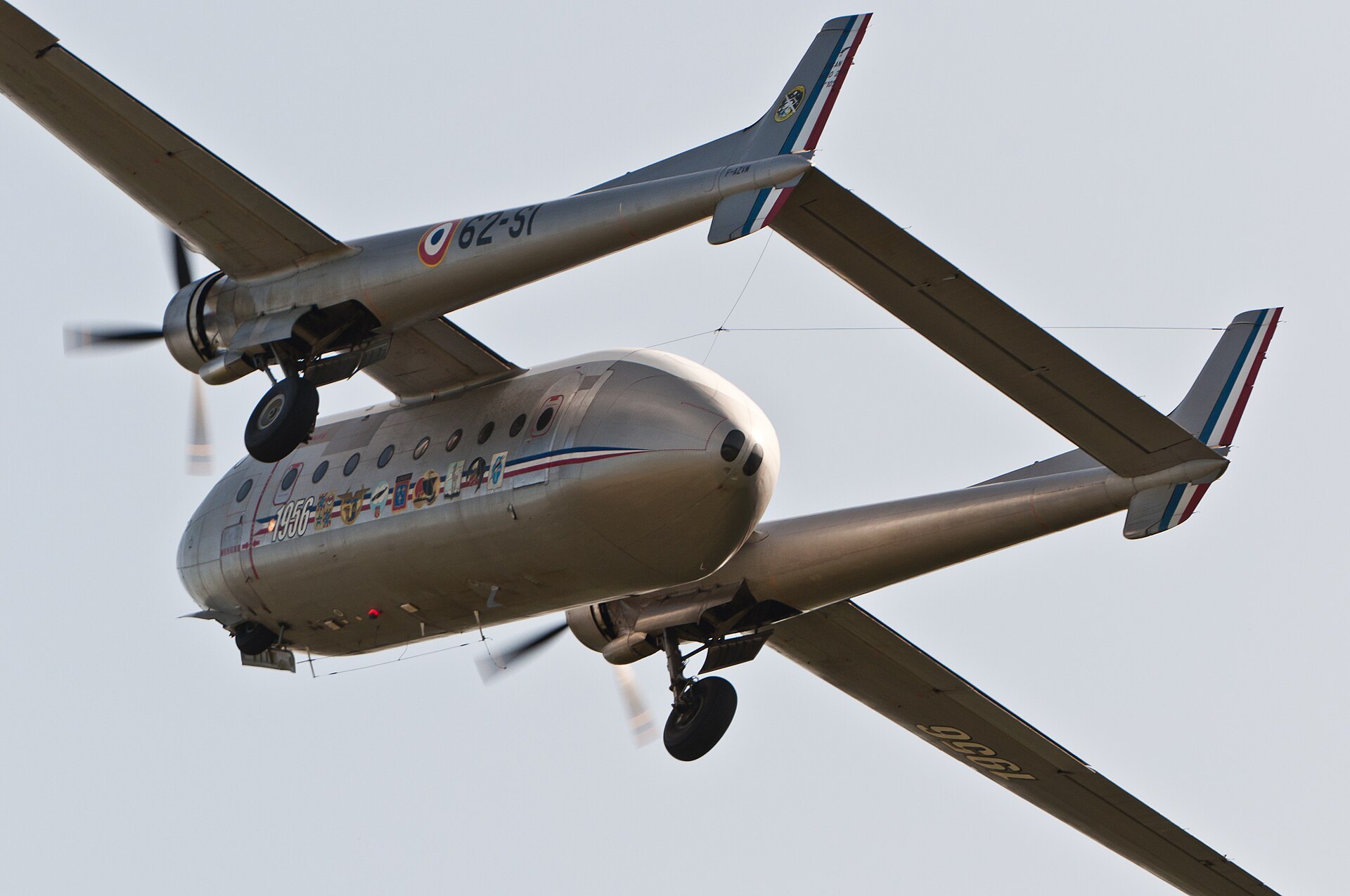
Nord N.2501 Noratlas
France’s Twin-Boom Airlifter
The twin-boom French transport that dropped paratroopers over Suez, carried Portugal’s wars across Africa, flew Greek commandos into Cyprus and still jumps skydivers over Provence from the last airworthy example.
The Noratlas: how France built its first post-war airlifter
In 1945 the French Air Force moved its cargo in two kinds of aircraft: the Junkers Ju 52, still being built in France as the AAC.1, and war-surplus Douglas C-47s. Both had tailwheels, so their floors sloped steeply at rest, both loaded through narrow side doors, and both carried little. In 1947 the Direction Technique Industrielle asked industry for something better. The state-owned SNCAN, later Nord Aviation, answered with the Nord 2500: a high-wing twin with a pod-like fuselage slung between twin tail booms, so that clamshell doors at the back of the pod opened at truck-bed height. It was the layout of the American Fairchild Packet, and it solved the loading problem at a stroke. The DTI ordered two prototypes in April 1948.
The first prototype flew on 10 September 1949 with Gnome-Rhône 14R radials and proved too slow. Nord fitted the second with licence-built Bristol Hercules sleeve-valve engines of about 2,040 hp and four-bladed propellers, and as the N.2501 it was transformed. Pre-production aircraft beat the Fairchild C-82 Packet in comparative trials, and a first order for 34 followed in July 1951. In 1952 the first N.2501 prototype crashed during testing; on 9 January 1953 the aircraft was christened Noratlas by the widow of the pilot killed in that accident. It entered service on 6 December 1953, and the Armée de l’Air eventually took 228. West Germany followed, buying a French-built batch and licence-building 161 more at Hamburger Flugzeugbau.
The Noratlas became the paratroop and supply aircraft of France’s late colonial wars. It dropped French paratroopers at Port Said and Port Fouad during the 1956 Suez operation, flew throughout the Algerian war, and was sold or passed on to Israel, Portugal, Greece and a string of African air forces. Israel used it in two wars; Portugal flew it across Angola, Mozambique and Guinea for fourteen years; Greece sent fifteen into Cyprus on a desperate night in 1974. Some 425 were built before production ended in 1961, and the type’s successor, the Transall C-160, was a direct product of the Franco-German partnership that the Noratlas had started. The last French electronic warfare Noratlas retired in 1989, and one aircraft, F-AZVM, still flies today.
01The Noratlas in Portugal’s colonial wars: fourteen years in Africa
Portugal bought its first Noratlases in 1960, six civil N.2502s from the French airline UAT, converted for military use. Six more came direct from Nord, and later the Portuguese Air Force bought ex-Luftwaffe N.2501Ds. As historian John P. Cann describes in Flight Plan Africa (2015), the type became the backbone of intra-theatre transport in the Portuguese Colonial War from 1961 to 1975.
Squadrons were based at Luanda in Angola (Esquadra 92, 1961–75), Beira in Mozambique (Esquadra 102, 1962–75) and Bissalanca in Portuguese Guinea (Esquadra 123, 1969–74), with a home unit at Tancos. Crews flew supplies and troops between remote garrisons on rough strips and dropped Portuguese paratroopers in airborne assaults against independence movements. Cann notes that the German aircraft came with four different sets of cockpit instruments and systems, a legacy of their complex procurement. After independence in 1975 a handful of ex-Portuguese Noratlases were handed to the new governments of Angola and Mozambique, and Portugal withdrew its last examples by September 1977.
02The Noratlas in Israel: a forced purchase that paid off
Israel did not want the Noratlas at first. In 1956, according to Bill Norton’s Air War on the Edge (2004), France would only release twelve Dassault Ouragan jet fighters if Israel also bought at least three Noratlases. With few other suppliers willing to arm Israel, the government accepted. The aircraft proved their worth almost immediately in the Suez campaign, and in 1959 Israel bought three more N.2501IS. Before the Six-Day War of 1967 the Israeli Air Force added ex-German N.2501Ds, building a fleet of more than twenty.
The Israeli Noratlases were used mainly for cargo and paratroop transport, but crews also found other jobs for them. At the start of the Six-Day War some flew maritime reconnaissance, and a declassified US National Security Agency history records that Israeli Noratlases tracked the American signals ship USS Liberty before it was attacked on 8 June 1967. Some were reportedly used as improvised bombers on long-range missions. The last Israeli Noratlases retired in 1978, and examples are preserved at the Israeli Air Force Museum at Hatzerim.
What makes the Noratlas special
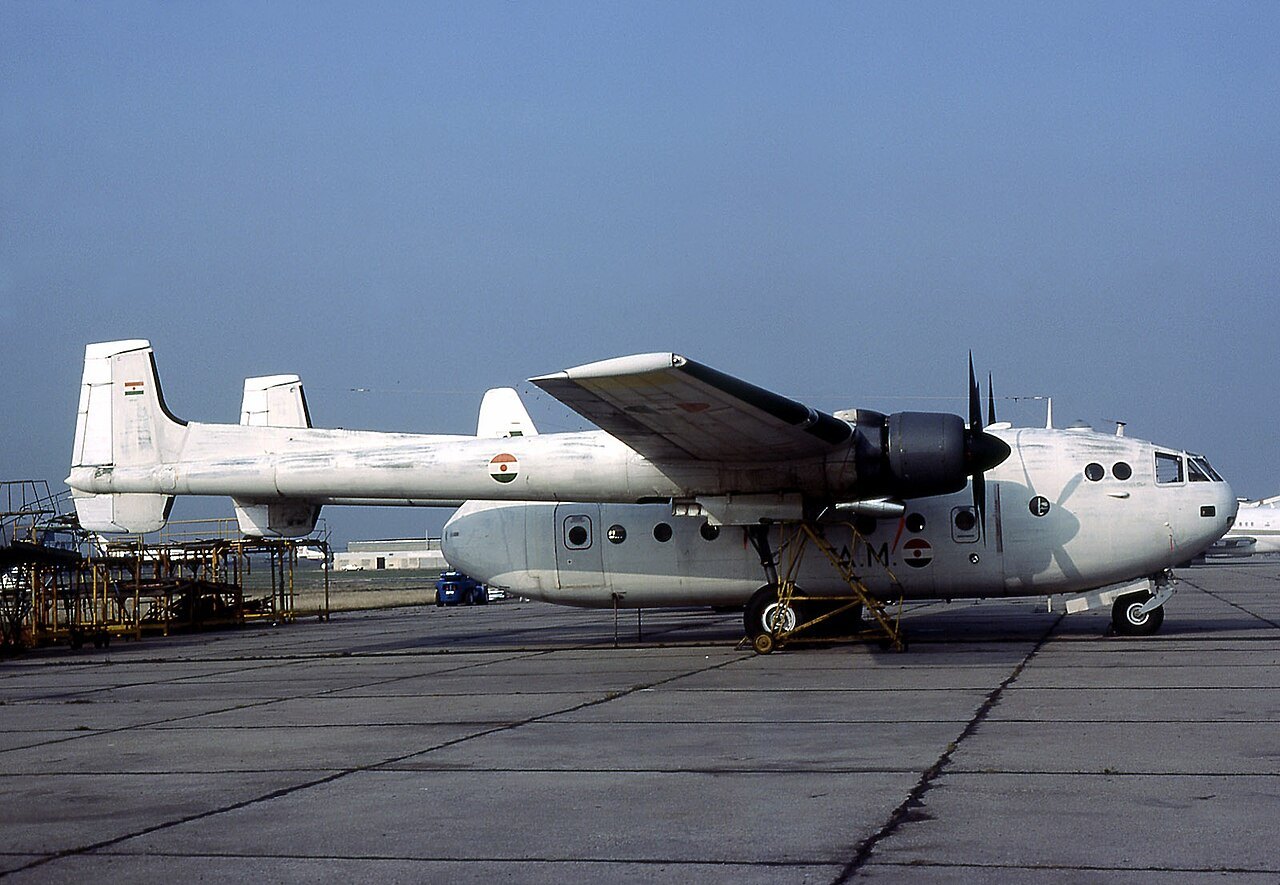
Twin booms and clamshell doors
The Noratlas’s fuselage is a pod slung beneath a shoulder-mounted wing, with the tail carried on two booms. That left the back of the pod free for clamshell doors positioned close to the ground, so vehicles and freight could be loaded straight in and paratroopers could jump clear of the tail. It was a huge improvement on the side doors and sloping floors of the Ju 52 and C-47 it replaced, and the same logic later led to the rear ramps of the Transall and Hercules.
Built for rough fields
Nord designed the Noratlas to operate from austere strips. The main gear was widely spaced, with large low-pressure tyres, for stability on uneven ground, and the propellers had generous ground clearance. Jane’s gave a take-off run of about 660 m and a landing run of about 420 m with reverse pitch. That made the aircraft at home on the improvised airfields of Algeria, Angola and Mozambique, where many of its missions began and ended.
Hercules power, French built
The production N.2501 used Bristol Hercules 14-cylinder sleeve-valve radials, licence-built by SNECMA, of about 2,040 hp each, driving four-bladed propellers. They replaced the Gnome-Rhône 14Rs of the first prototype, which had left it too slow. Civil N.2502s added two small Turbomeca Marboré turbojets at the wingtips to boost take-off performance, an unusual hybrid of piston and jet power for its day.
03The Noratlas’s variants: from N.2500 to the Gabriel
- N.2500: first prototype with Gnome-Rhône 14R engines, first flown 10 September 1949.
- N.2501: main French military production version with SNECMA-built Hercules 738/739 engines.
- N.2501D: version for the West German Air Force, with German equipment; French- and German-built.
- N.2501IS: six built for the Israeli Air Force.
- N.2501 Gabriel: eight electronic intelligence aircraft flown by escadron électronique 1/54 Dunkerque, the last Noratlases in French service, retired in 1989.
- N.2502: civil passenger and cargo version with wingtip Marboré turbojets for UAT and Air Algérie; about ten built, several later militarised for Portugal as the N.2502F.
- N.2504: anti-submarine training version for the French Navy; one built.
- N.2506: assault transport with improved short-field performance; two examples.
- N.2508: re-engined with Pratt & Whitney R-2800s and Marboré jets; not ordered.
Nord N.2501 Noratlas specifications
Specifications
- Crew
- 4–5
- Capacity
- 45 soldiers, 36 paratroopers, 18 stretchers or about 7.5 t of freight
- Length
- 21.96 m (72 ft 1 in)
- Wingspan
- 32.50 m (106 ft 8 in)
- Height
- 6.00 m (19 ft 8 in)
- Wing area
- 101.2 m² (1,089 sq ft)
- Empty weight
- 13,075 kg (28,826 lb)
- Max take-off weight
- 20,603 kg (45,422 lb)
- Powerplant
- 2 × SNECMA-built Bristol Hercules 738/739 14-cylinder sleeve-valve radials, about 2,040 hp (1,520 kW) each
- Maximum speed
- 440 km/h (273 mph)
- Cruise speed
- 324 km/h (201 mph) at 1,500 m
- Range
- 2,500 km (1,550 mi)
- Service ceiling
- 7,500 m (24,600 ft)
- Climb rate
- 6.25 m/s (1,230 ft/min) at sea level
- Take-off run
- 660 m (2,165 ft)
- Armament
- None
Costs & production
- Cost per flight hour
- No historical military figure published. A hedged estimate for the sole airworthy example today is in the low thousands of euros per hour, based on two large radial engines burning in the order of several hundred litres of avgas an hour plus volunteer-supported maintenance; actual costs are not disclosed by its operator
- Production
- About 425 built 1949–1961: 228 for France (including prototypes) and 161 licence-built in West Germany, plus French-built German and export aircraft
- Programme
- DTI competition 1947; prototypes ordered April 1948; first production order July 1951; service entry December 1953; French retirement 1989
04The Noratlas today: what it takes to keep the last one flying
The only airworthy Noratlas, N.2501F No. 105, flies as F-AZVM with the volunteer association Le Noratlas de Provence from Marseille Provence Airport. Classified as a French historic monument, it takes part in parachute operations, air shows, military commemorations and heritage flights, and the association marks its 70th anniversary in 2026. Its crews and mechanics are volunteers.
Running a 1950s transport is expensive. Its two Hercules sleeve-valve radials are large, thirsty and complex engines, and spares must be found or manufactured. The association funds the aircraft through paid parachute drops, events, memberships and donations. We do not give a precise hourly figure because none has been published; any estimate depends heavily on fuel prices, engine overhaul reserves and the value of volunteer labour.
The Noratlas from 1947 to the last airworthy example
Competition
The DTI seeks a modern medium cargo aircraft; Nord’s N.2500 wins.
First flight
The N.2500 prototype flies on 10 September, but proves underpowered.
Production order
After beating the Fairchild C-82 in trials, the N.2501 receives an order for 34 aircraft on 10 July.
Named and in service
Christened Noratlas on 9 January; service entry with the Armée de l’Air on 6 December.
Suez and Germany
French Noratlases drop paratroopers at Port Said and Port Fouad; West Germany orders the type; Israel buys its first.
Production ends
The last of about 425 aircraft is built; Portugal begins using the type in its African wars.
Six-Day War
Israeli Noratlases fly transport and maritime reconnaissance missions.
Greece
The Hellenic Air Force receives ex-German Noratlases for 354 Squadron at Elefsis.
Operation Niki
Greek Noratlases fly commandos from Crete to Nicosia during the Turkish invasion of Cyprus.
Israel retires the type
The Israeli Air Force withdraws its last Noratlases.
French retirement
The last Gabriel electronic warfare Noratlas leaves French service.
Stories & eyewitnesses: the Noratlas in war and peace
A name given by a widow
The aircraft was christened after a fatal crash.
Read the full story
Suez, November 1956
French paratroopers jumped from Noratlases over Egypt.
Read the full story
Operation Niki: the night flight to Cyprus
Fifteen Greek Noratlases set out; twelve landed.
Read the full story
Shadowing the USS Liberty
Israeli Noratlases on maritime patrol, June 1967.
Read the full story
Paratroopers over Angola and Mozambique
Portugal’s Noratlases flew for fourteen years of war.
Read the full story
The Gabriels: listening for the Cold War
The last French Noratlases were spy planes.
Read the full story
A forced purchase for Israel
No Noratlases, no Ouragans.
Read the full story
Jets on the wingtips
The civil Noratlas carried two extra turbojets.
Read the full story
F-AZVM: the last one flying
A 1950s transport still drops parachutists over France.
Read the full story
Niger’s desert Noratlases
The type served on in Africa long after France retired it.
Read the full story
The Noratlas in pictures
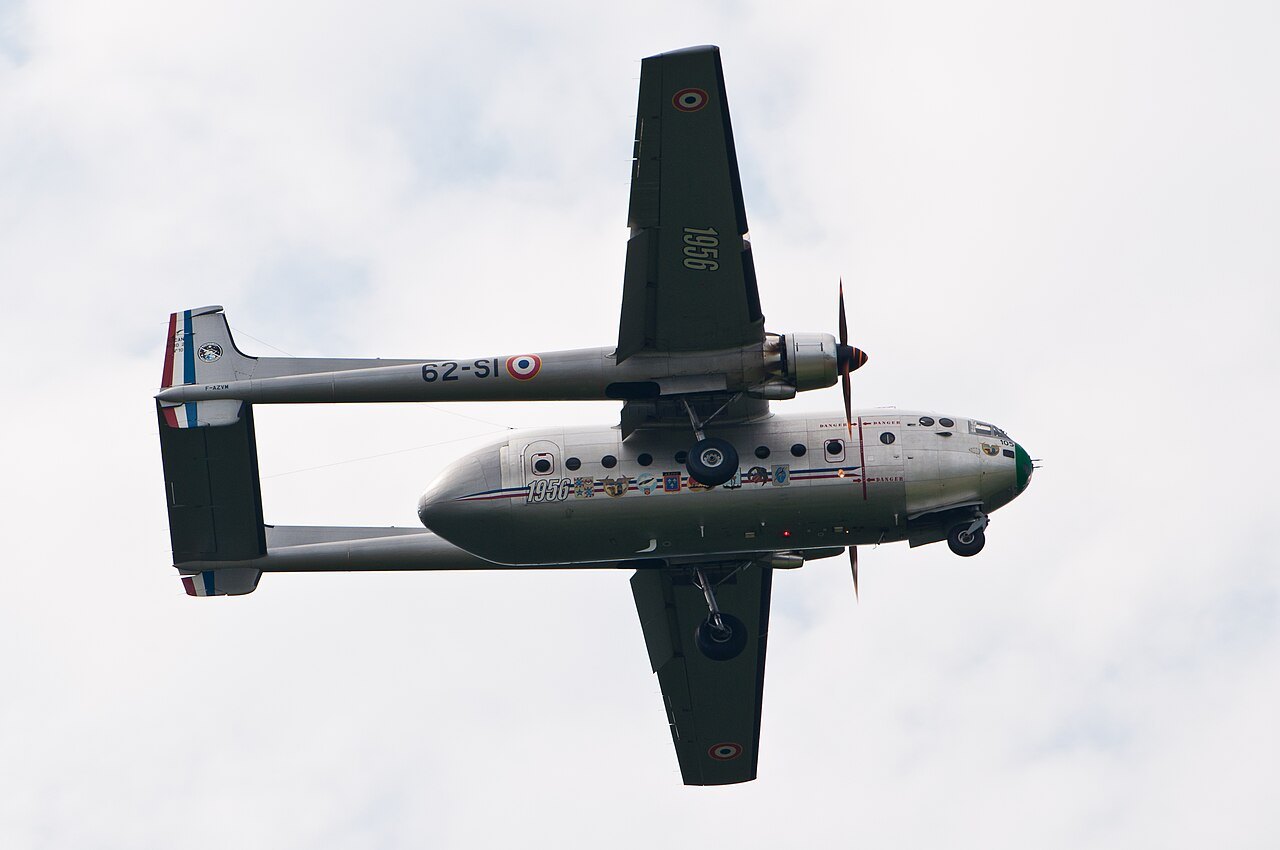
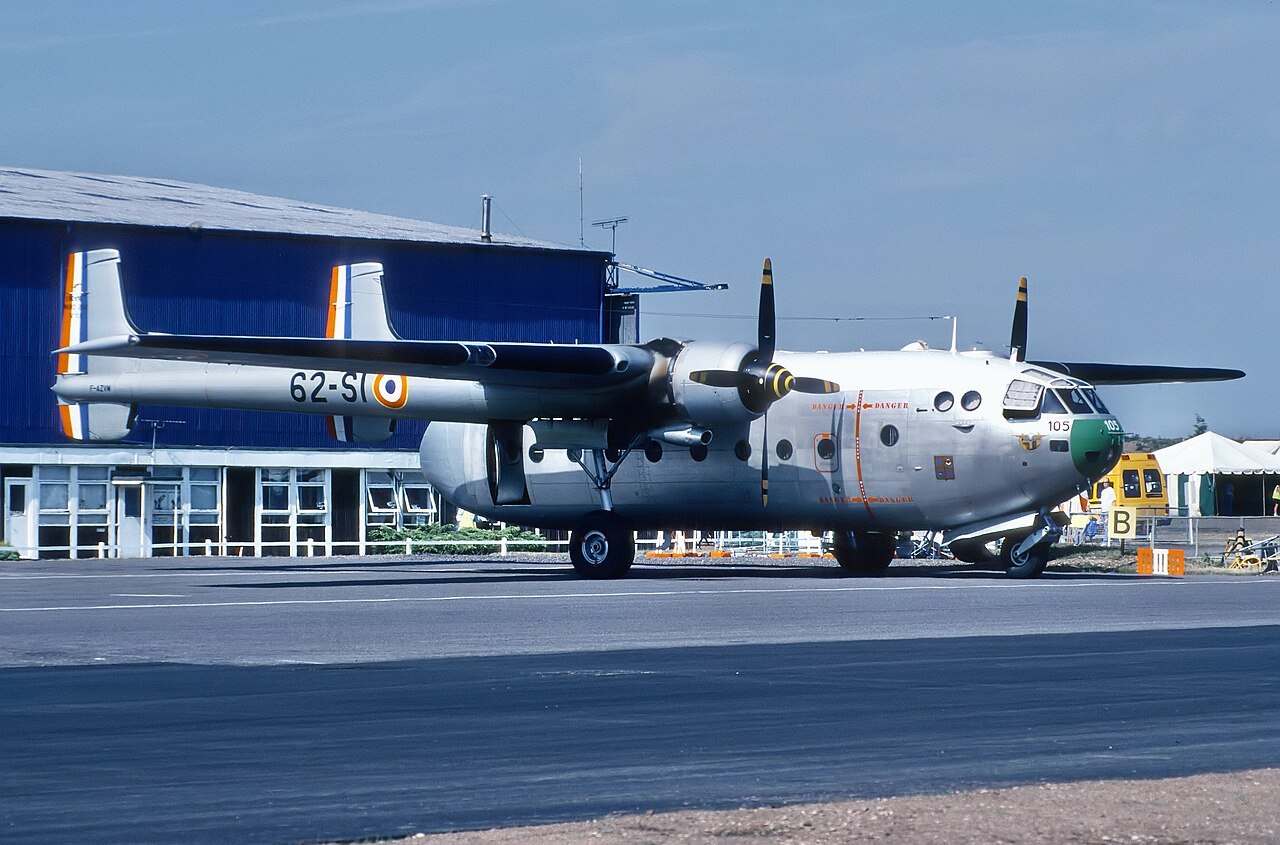
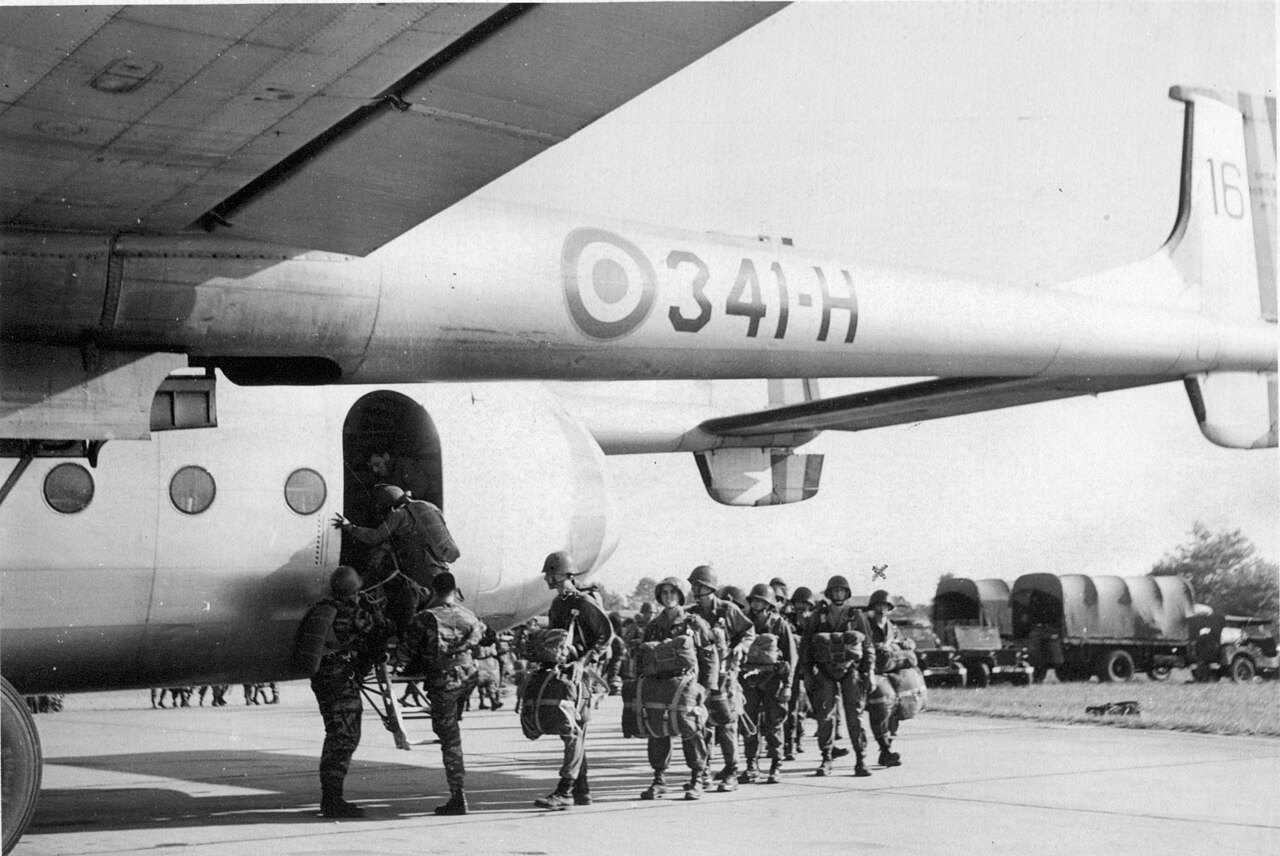
Where the Noratlas flies and flew
The Noratlas’s record
The Noratlas was a transport, not a combat aircraft, but it flew in more wars than many fighters: Algeria, Suez, the Portuguese Colonial War, the Six-Day War and the 1974 Cyprus crisis. Its contribution was measured in paratroopers dropped and outposts supplied rather than in kills.
See how training and combat types compare in the military aircraft statistics database. Figures are approximate.
Everything people ask about the Noratlas
Can I fly in a Nord N.2501 Noratlas?
Why does the Noratlas have twin booms?
How many Noratlases were built?
Which countries flew the Noratlas?
Is any Noratlas still flying?
What replaced the Noratlas?
Where can I see a Noratlas?
You can’t fly the Noratlas.
These, you can.
Most of this museum you can only look at. These genuine military jets you can fly yourself with MiGFlug — with aerobatics and time on the controls.
 Fly the L-39 AlbatrosThe world’s most-flown jet trainer — aerobatics included
 Fly the F-104 Starfighter“The missile with a man in it”
 Fly the MiG-21The Cold War’s most-produced jet
 Fly the T-33 Shooting StarAmerica’s first jet trainer
 Fly the DH VampireA piece of early jet history
 Fly the S.211Agile Italian jet trainer
 Fly the MB-326The classic Aermacchi jet
 Fly the MiG-15The Soviet legend of the Korean War
Continue the tour
Every fact, checked
- Le Noratlas de ProvenceAssociation operating F-AZVM, the last airworthy Noratlas
- Attack on a SIGINT Collector, the USS LibertyUS National Security Agency history (Gerhard, 1981) recording Israeli Noratlas tracking
- Cypriot officials say they may have found Greek aircraft shot down in 1974The Guardian (2015) on the Operation Niki loss and Makedonitissa
- Niger’s desert warriorsKey.Aero (Delalande, 2018) on Niger’s air arm, including Noratlases
- SNCAN N2501 NoratlasAiles Anciennes Toulouse museum page on its Noratlas
- Nord 2501Morbihan Aero Musee page on its boardable Noratlas