
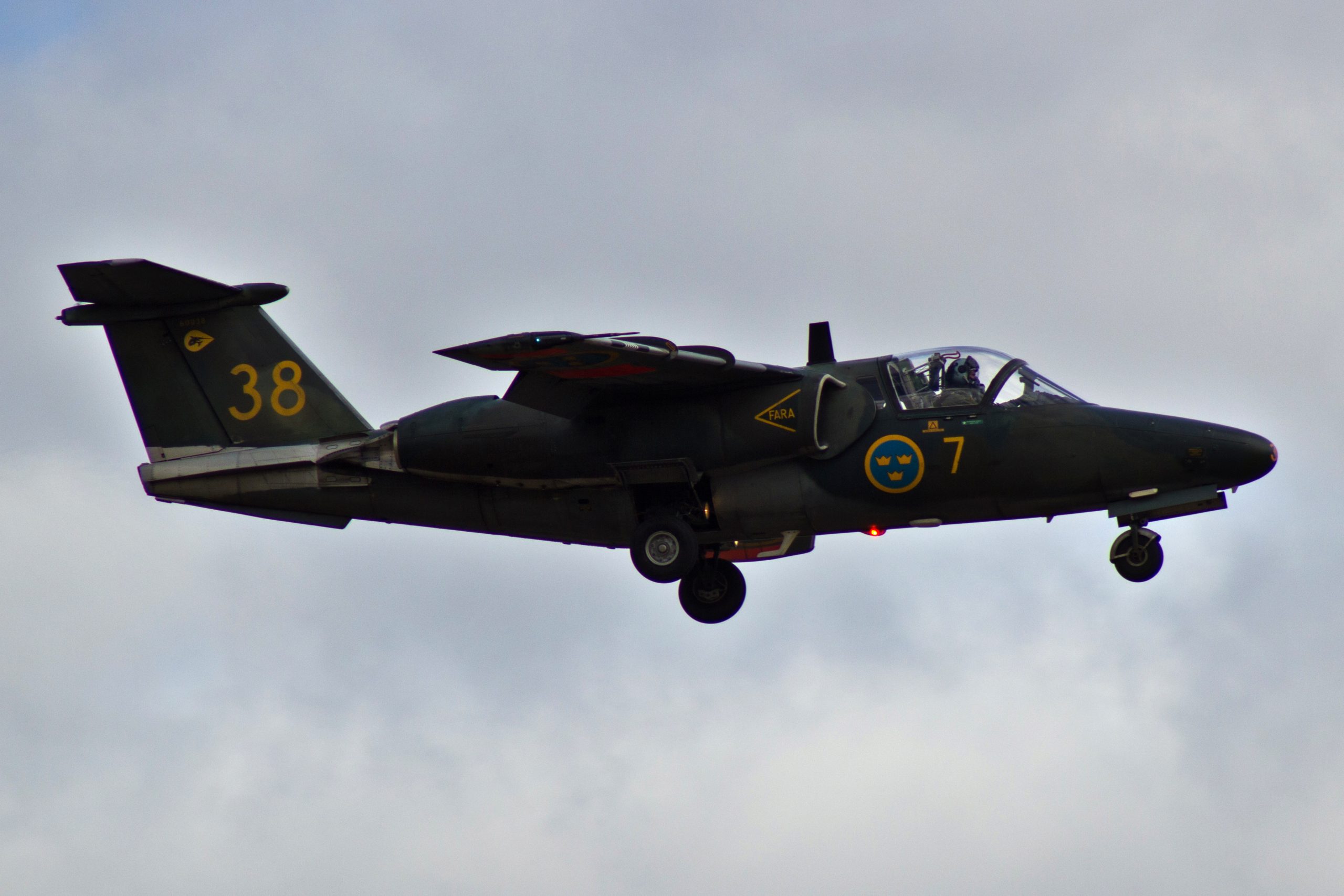
Saab 105
“Sk 60”
The twin-engine, side-by-side jet Saab built on its own initiative — Sweden’s Sk 60 trainer, light-attack and liaison aircraft, and the longest-serving Saab aeroplane ever flown.
The jet Saab built before anyone ordered it
By the early 1960s Saab was riding high on the success of the Mach-2 J 35 Draken, and the company decided to gamble. With no government order in hand, it began a private venture — a compact twin-engine jet that could replace Sweden’s ageing de Havilland Vampire trainers and, Saab hoped, sell to civil and export customers as well. The Swedish Air Force signed a development contract in 1962, and the first of two prototypes made its maiden flight on 29 June 1963.
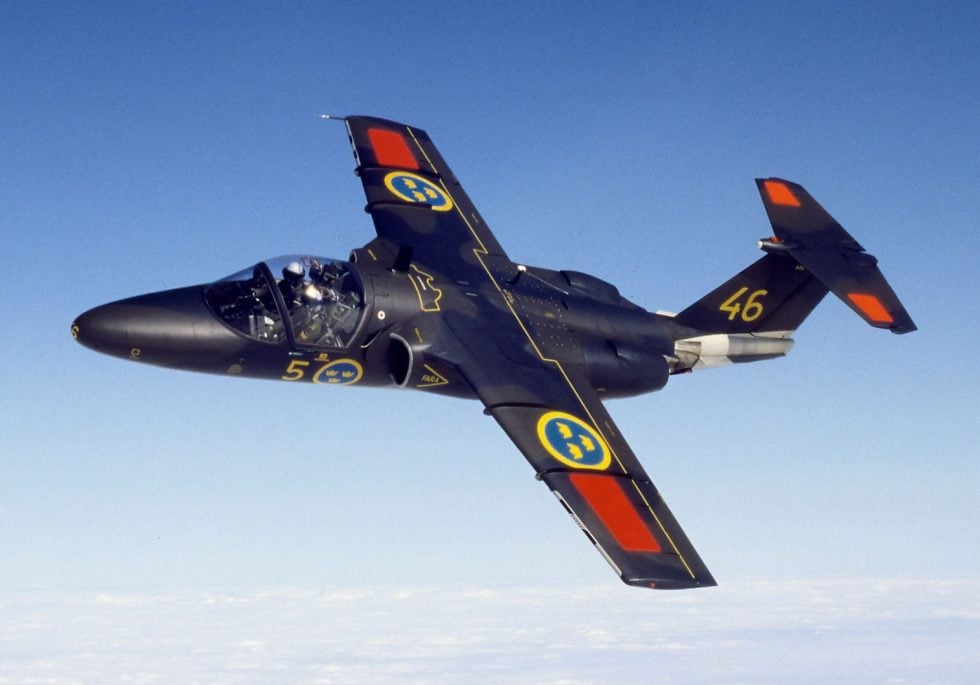
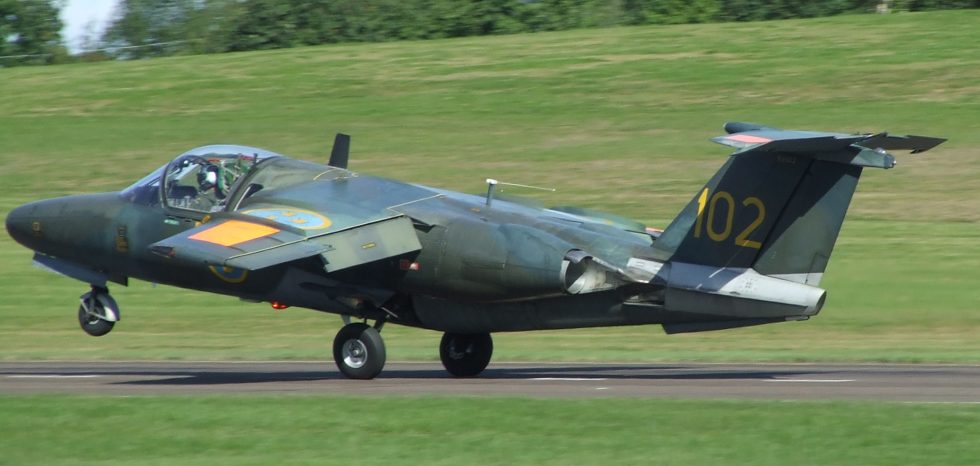
The design that emerged was unusual for a light jet: a shoulder-mounted wing with pronounced anhedral, a T-tail, two small turbojets buried in the fuselage, and — most distinctively — a side-by-side cockpit under a wide bubble canopy. Instructor and student sat shoulder to shoulder, and with the ejection seats removed the cabin could carry four for liaison work. Swedish service began in 1966–67 under the designation Sk 60.
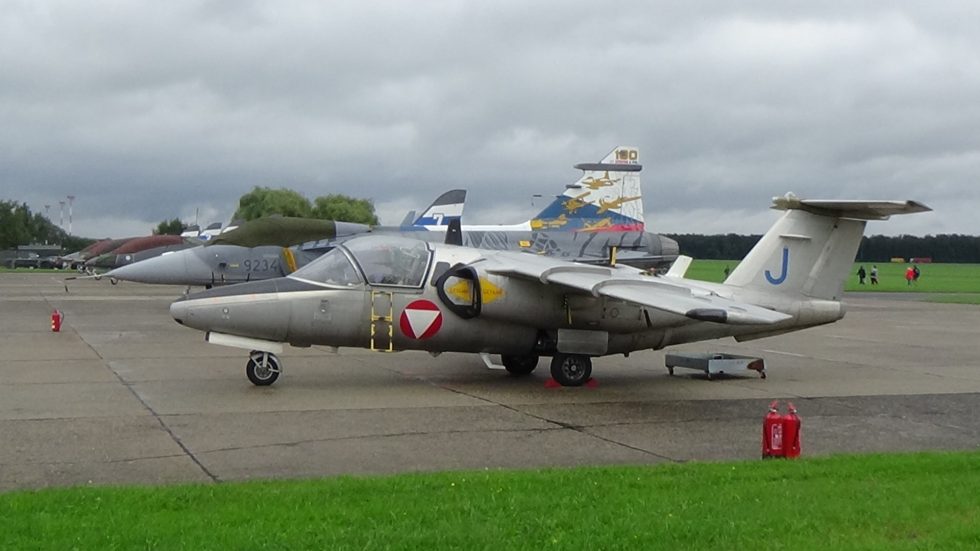
What kept it flying was versatility. The same airframe trained pilots, carried guns and rockets as the light-attack Sk 60B, and flew photo-reconnaissance with a camera nose as the Sk 60C. When its original French engines became uneconomical, Sweden re-engined much of the fleet with the modern Williams FJ44 turbofan in the 1990s — a single upgrade that carried the type all the way to its retirement on 18 June 2024, roughly 57 years after it entered service. Austria, the only export buyer, flew its own version into 2020.
01The Saab 105’s private-venture gamble: how a company bet became a 60-year career
Saab conceived the 105 in the late 1950s and early 1960s without a firm requirement to build to. The company reasoned that Sweden would soon need to replace its Vampire trainers and that a nimble twin-jet might also find civil buyers as an executive or liaison aircraft. The civil market never materialised, but the military bet paid off spectacularly: Sweden ordered the type, Austria became an export customer, and the aircraft was continually adapted — attack, reconnaissance, liaison and, in the 1990s, a complete new engine. What began as a speculative side-project became one of Saab’s most enduring products, serving for the better part of six decades.
What makes it special
Two engines, sitting side by side
Most jet trainers of the era used a single engine and seated the instructor behind the student. The Saab 105 did the opposite: two turbojets for thrust and a safety margin, and a side-by-side cockpit under a wide canopy so the instructor could watch the student’s hands, eyes and instruments directly. The roomy fuselage doubled as a four-seat cabin for liaison flights once the ejection seats were removed.
A schoolroom jet that carried guns
The trainer was never just a trainer. Fitted with ejection seats and six hardpoints, the same airframe flew as the light-attack Sk 60B — gunsight, podded 30 mm cannon, 135 mm rockets and bombs — and as the camera-nosed reconnaissance Sk 60C. In Swedish war planning the fleet was a genuine dispersed light-strike reserve, not a paper one.
A new heart at thirty: the FJ44 re-engining
When the original Turboméca Aubisque engines became uneconomical to support, Sweden re-engined much of the fleet with the modern Williams FJ44 turbofan (Swedish designation RM15) from the mid-1990s, redesignating the aircraft Sk 60W. Lighter, thriftier, quieter and more powerful, the new engine extended the type’s life by roughly two more decades.
02The Saab 105’s side-by-side cockpit: why Saab broke with the tandem tradition
Tandem seating — student in front, instructor behind — was the norm for jet trainers, and it survives on the Hawk and Alpha Jet today. Saab chose a side-by-side layout instead. The advantage is pedagogical: an instructor sitting next to the student can see exactly where the student is looking, what the hands are doing and which instruments are being scanned, and can intervene more naturally. The wide fuselage that made this possible also gave the aircraft a genuine second life as a four-seat liaison and staff-transport machine — simply remove the ejection seats and add passenger chairs. The trade-off is a slightly wider, draggier fuselage than a slim tandem trainer, but for a subsonic multirole jet that mattered little.
03The Saab 105’s engine swap: how the Williams FJ44 bought two extra decades
By the early 1990s the Saab 105’s original Turboméca Aubisque turbofans were reaching the end of their supportable life — parts were scarce and running costs were climbing. Rather than retire the airframe, Sweden signed a contract (commonly dated to November 1993) to re-engine the fleet with the Williams FJ44, a clean-sheet small turbofan originally developed for business jets. Around 96 aircraft were converted to Sk 60W standard, with re-deliveries running from about 1996; budget cuts had trimmed the programme from an original plan of roughly 115. The FJ44 was lighter, far more fuel-efficient, quieter and cleaner, and delivered a little more thrust. It is the single main reason the Sk 60 was still flying front-line training sorties in the 2020s. (Programme dates vary slightly between sources; treat them as approximate.)
Full specifications
Baseline note: the figures below describe the Swedish Sk 60A/B/C as the Flygvapnet actually flew it for its last quarter-century — the 1963 airframe rebuilt around a pair of Williams-Rolls FJ44 turbofans under the 1993 contract, informally the Sk 60W. That re-engining is the central fact of this aeroplane’s long life: the original Turboméca Aubisque was a bespoke engine built for one aircraft type and nothing else, and when its supply chain died in the early 1990s Sweden had to choose between scrapping the fleet and finding a business-jet engine that would fit. Deltas for the original Aubisque-powered Sk 60 of 1966 and for the General Electric J85-powered Saab 105XT and Austrian 105OE are given in grey. One warning before the numbers: a widely reproduced English-language specification block for the Saab 105 mixes the two aeroplanes, quoting 970 km/h, a 13,700 m ceiling and a 2,300 km ferry range alongside Swedish weights. Those performance figures belong to the J85-powered export machine, not to the Sk 60. They are separated here.
Dimensions & weights
- Crew
- 2, side by side — the defining oddity. Almost every jet trainer of the era sat student and instructor in tandem, because that is how a fighter cockpit is shaped. Saab chose the wider fuselage deliberately: the 105 was a private venture pitched at trainer, liaison, light attack and executive transport work all at once, and side-by-side seating serves three of those four. In the training role it meant the instructor could see the student’s hands, point at an instrument and be heard without an intercom — genuinely useful early on, and a poor rehearsal for the single-seat Draken or Viggen the student was heading towards
- Length
- 10.50 m (34 ft 5 in). The Sk 60C reconnaissance nose is longer; published lengths of 10.8 m in some tables reflect that nose or a pitot fit rather than a different fuselage
- Wingspan
- 9.50 m (31 ft 2 in)
- Height
- 2.70 m (8 ft 10 in) — low enough that groundcrew work on the engines standing up
- Wing area
- 16.30 m² (175 sq ft)
- Wing layout
- Shoulder-mounted, mildly swept, with pronounced anhedral and a T-tail — the drooped wing and high tailplane are the recognition features, and the anhedral is there to restore the lateral stability that a shoulder wing gives away for free
- Empty weight
- 2,849 kg (6,281 lb) for the Swedish trainer as usually tabulated. Figures between about 2,510 and 2,850 kg circulate for the same aeroplane; the spread is equipment fit, not disagreement about the airframe
- Maximum take-off weight
- 4,635 kg (10,218 lb) for the Sk 60
- Maximum take-off weight, Austrian 105OE
- 6,500 kg (14,330 lb). The 105XT and 105OE had a strengthened wing and far more thrust, and the extra 1,865 kg is the whole difference between a trainer that can carry weapons and a light attack aircraft that can also train
- Wing loading
- 284 kg/m² (58 lb/sq ft) at Swedish maximum weight — light, which is why it turns pleasantly and why it never went anywhere near the speed of sound
- External load
- ~700 kg (~1,540 lb) across six underwing hardpoints on the Swedish aircraft. Austrian and export machines with the strengthened wing are credited with up to ~2,000 kg (~4,400 lb); the higher figure is quoted more often than it is substantiated, and no Austrian sortie is known to have flown near it
- Alternative cabin
- Four seats — on the Sk 60D and Sk 60E the two ejection seats came out and four fixed seats went in, turning a jet trainer into a small staff transport in an afternoon. Ten aircraft were converted permanently. Very few trainers of any generation could do this, and it is a direct consequence of the side-by-side cabin
Performance
- Maximum speed
- 770 km/h (478 mph, 416 kn) at 6,000 m for the Swedish aircraft. The FJ44 re-engining did not change this materially — the limit is the airframe and the drag of a fat side-by-side fuselage, not the thrust
- Maximum speed, Saab 105XT / 105OE
- 970 km/h (603 mph, 524 kn) at sea level. Two J85 turbojets in place of two small turbofans is a 74 per cent thrust increase, and it buys 200 km/h
- Cruising speed
- 680–700 km/h (423–435 mph). Austrian squadron figures give 680 km/h as the working cruise
- Rate of climb
- 70 m/s (13,800 ft/min) is the published figure for the J85-powered aircraft. The Aubisque-powered Sk 60 climbed far more slowly; the FJ44 conversion recovered a useful part of that gap and improved hot-day and high-altitude performance noticeably, which is the change instructors talked about most
- Service ceiling
- 13,500 m (44,300 ft) for the Sk 60; 13,700 m (44,900 ft) is quoted for the J85 machines
- Range
- 1,400 km (870 miles, 755 nmi) on internal fuel
- Ferry range
- ~2,300 km (~1,430 miles, ~1,240 nmi). This figure travels with the J85 export specification and should not be read onto a Swedish trainer
- Combat radius
- ~350–400 km (~190–215 nmi) with a light attack load, on a low-level profile — an estimate reconstructed from range and fuel, not an official figure. Swedish planning did not need more: the Sk 60’s wartime targets were troops coming ashore on Swedish soil
- Endurance
- ~2 hours on a normal training sortie — the FJ44 conversion cut fuel burn appreciably, and the practical effect was more circuits per tank rather than longer transits
- Airfield performance
- Cleared for Sweden’s dispersed road-base system — the Bas 90 concept assumed every combat aircraft could work from a stretch of motorway with a tent and a fuel bowser, and the Sk 60 was built to that rule like everything else in the Flygvapnet
- Career utilisation
- Austria’s 40 aircraft flew 156,517 hours over roughly 254,000 sorties in 50 years — an average of just under 3,900 hours per airframe. The Swedish fleet, larger and worked harder, has no comparably published total
Propulsion & systems
- Engines, Sk 60W (baseline)
- 2 × Williams-Rolls FJ44 turbofans, Swedish designation RM15, 8.45 kN (1,900 lbf) each, with digital engine control. The engine is usually identified as the FJ44-1C, whose civil rating is elsewhere quoted at 6.7 kN (1,500 lbf) in derated form under the military designation F129. Sources genuinely disagree; the 8.45 kN figure is the one Saab and the Swedish Air Force published, and it is consistent with every account that the conversion gave more thrust than the engine it replaced
- Engines, original
- 2 × Turboméca Aubisque low-bypass turbofans, licence-built by Volvo Flygmotor as the RM9, 7.3 kN (1,640 lbf) each, 285 kg dry. About 300 were made and the Saab 105 was the only aircraft that ever used one — a bespoke engine for a single airframe, which is precisely why the type needed rescuing thirty years later
- Engines, Austrian 105OE and Saab 105XT
- 2 × General Electric J85-GE-17B turbojets, 12.7 kN (2,850 lbf, about 1,290 kp) each — the same engine family as the T-38 Talon and F-5, without afterburner. Noisier, thirstier and far more powerful than anything the Swedes flew. Note that some reference works, including some widely reproduced English-language variant lists, wrongly describe the Austrian aircraft as Aubisque-powered; every Austrian and German source, and the aircraft’s own noise signature, say J85
- Engine installation
- Two nacelles faired into the fuselage sides, below and behind the cockpit — short intakes, short jet pipes, easy access, and engine changes measured in hours
- Re-engining programme
- Contract signed November 1993; first flight of a Williams-powered aircraft August 1995; first re-delivery September 1996 — 115 conversions were contracted and between 106 and 115 Sk 60A, B and C aircraft were completed by the end of the decade. Sources differ on the exact count
- Ejection seats
- Two lightweight seats, removable — taken out entirely on the four-seat Sk 60D and Sk 60E conversions, which then flew with fixed passenger seating and no escape system at all
- Weapons sight
- Ferranti ISIS gyro sight in the Sk 60B — the single item that turned a trainer into a light attack aircraft on paper, and the reason the B is a separate designation rather than a loadout
- Reconnaissance fit, Sk 60C
- Fairchild KB-18 panoramic camera in a lengthened, reshaped nose — one new-build aircraft and 29 conversions. The KB-18 sweeps horizon to horizon, so a single low pass covers a wide strip; the Sk 60C was a genuine tactical reconnaissance asset, not a trainer with a camera bolted on. Austria flew its aircraft in the reconnaissance role until November 1992
- Avionics update
- Sk 60AU trial installation, 2013 — GPS navigation, new displays and audio warnings aligned with JAS 39 Gripen practice, so that a student’s habits transferred. Applied to the fleet only in part before the retirement decision
- Hardpoints
- Six underwing stations, three per side — present from the start on Swedish aircraft, stressed higher on the export wing
- Special-mission fit, Austria
- Air-sampling pods for atmospheric radioactivity monitoring — a small neutral country’s standing requirement after Chernobyl, and one of the few jobs the 105OE did that nothing else in Austrian service could
04The Saab 105’s operating costs: why no reliable price exists
The Saab 105 was procured mainly by two national air forces under state contracts, and no consistent public flyaway unit price or cost-per-flight-hour figure exists for it in open sources. What is documented is the logic of its economics: the whole point of the 1990s Williams FJ44 re-engining was to cut running and maintenance costs, and Sweden judged the upgraded Sk 60 cheap enough to keep flying basic training for another two decades rather than buy a new type. Any precise dollar figure attached to a Saab 105 should be treated as an estimate.
Armament & payload
The Sk 60 was a school aeroplane with a war plan: six pylons, a gyro sight and a set of orders to fly to a road base and attack a landing force
Sweden did not buy trainers that only trained. Neutral, unallied and planning to defend a long coastline with a small air force, the Flygvapnet treated its whole inventory as mobilisation stock, and the Saab 105 was armed accordingly from the outset: six underwing hardpoints, a strengthened attack variant with a Ferranti gyro sight, and a wartime role attacking troops and vehicles coming ashore. The pilots would have been the flying instructors themselves. It is a very Swedish arrangement and it explains an armament fit that looks disproportionate for a side-by-side trainer.
In practice the weapons were simple and short-ranged: podded 30 mm cannon under the wings, Bofors unguided rockets in several calibres, light bombs and napalm. The one sophisticated weapon associated with the type is the Saab Rb 05A, a rocket-powered command-guided air-to-surface missile that the Swedish sources say was developed from 1967 for the Viggen and the Saab 105, and that the Rb 05 literature lists as carried by the Sk 60B and Sk 60C. Guiding it meant flying straight at the target while steering the missile with a thumb controller onto a tracer flare — a job the side-by-side cockpit made far easier than the Viggen’s single seat did, because the man beside the pilot could do nothing but fly the missile.
Austria’s aircraft were a different proposition: more thrust, a stronger wing, and for sixteen years the only jet combat aircraft the country had. What Austria actually hung on them, from 1970 to the last flight in 2020, was a 30 mm gun pod under each wing and unguided rockets — nothing more. Fits varied by mark, by decade and by operator, and Swedish weapon designations are inconsistently rendered in English-language sources; where a store is contested it is flagged in the cards below.
Gun
- No internal gun on any variant. Every gun the type ever fired was in a pod on a wing pylon
- 30 mm akankapsel — the Swedish podded installation of the akan m/55, the licence-built ADEN revolver cannon, roughly 150 rounds per gun. Carried by the Sk 60B, and by the AJ 37 Viggen for the same reason: neither aircraft had a gun of its own
- Austria’s 105OE flew with two 30 mm cannon pods, one under each wing, and this was its standing armament to the end. Austrian squadron accounts of the retirement name the 30 mm pod as the aircraft’s only routinely carried weapon in its final decades
- Light-calibre pods of 12.7 mm and 7.62 mm appear in several published armament lists for the type. They are plausible for training and were marketed with the export aircraft, but they are poorly attested in either air force’s operational use
- No 27 mm Mauser BK-27 pod. This is a persistent error worth killing: no Austrian, German or Swedish source records a BK-27 on the Saab 105, at any date. The confusion has two roots — the Alpha Jet A, which really did carry a BK-27 in a removable ventral pod, and Austria’s own Eurofighters, which carry the BK-27 internally. The 105OE carried 30 mm, and only 30 mm
Air-to-air
- Rb 24 — the Swedish designation for the AIM-9B Sidewinder. Cleared in principle on the export aircraft, on LAU-7-type rails, and quoted in almost every published capability list for the Saab 105
- German-language sources describe the Austrian Sidewinder installation as tested only, and Austrian accounts written at the aircraft’s retirement state flatly that the 105OE was never equipped with Sidewinders in service. Both statements can be true: a cleared capability that was never fielded
- The consequence matters. From 1972, when the Saab 29 Tunnan went, until the Draken arrived in 1988, the Saab 105OE was the only jet combat aircraft Austria possessed — and its air defence weapon was a subsonic aeroplane with a gun pod
- Austria used it the same way again after the Draken retired in 2005, flying identification and shadowing sorties alongside leased F-5Es and later the Eurofighter. A 970 km/h trainer intercepting an airliner is a diplomatic instrument, not a tactical one, and Austria was open about that
- Swedish Sk 60s carried no air-to-air weapon. Their wartime task pointed at the ground
Air-to-surface guided
- Saab Rb 05A — a 305 kg-class rocket-powered missile with a hypergolic liquid motor, steered by radio in manual command to line of sight while the operator watched a tracer flare in its tail. Issued for operational use in 1972
- The English-language Rb 05 literature is explicit that the missile was developed from 1967 for the Saab 37 Viggen and the Saab 105, and that the Swedish Air Force operated it on the AJ, AJS and AJSF 37 and on the Sk 60B and Sk 60C
- This corrects a common claim that the Sk 60 never carried the Rb 05. On the published evidence the Sk 60B and C were designated carriers. How routinely they flew with it is a separate and much weaker question — the Saab 105 type literature does not list the missile among its usual stores, and no photographs of a loaded operational Sk 60 are commonly reproduced
- Nothing else guided was ever carried. No laser designation, no data link, no targeting pod, on any variant, in either air force
- The Rb 05 left Swedish service with the AJS 37 Viggen; nothing replaced it on the Sk 60, which spent its last thirty years unarmed in Swedish hands
Bombs
- Light free-fall bombs in the 50–250 kg class on the underwing pylons — the Swedish and Austrian inventories of the period, carried in singles rather than on multiple ejector racks
- Napalm tanks appear in every capability list for the type and were part of the anti-landing repertoire that the aircraft was bought to support. Sweden withdrew napalm from service long before the Sk 60 retired
- Cluster and submunition dispensers are credited to the export aircraft with the strengthened wing; the Swedish trainer’s ~700 kg external limit constrained what was worth hanging
- Practice bomb carriers were the fit that actually flew, week in and week out, for fifty years — the Sk 60B existed as much to teach weapons delivery cheaply as to perform it
- Swedish bomb designations of the 1960s are rendered inconsistently in English-language references, and this card is deliberately general rather than falsely precise
Rockets
- 13.5 cm srak m/56 Bofors attack rockets — the heavy end of the Swedish unguided inventory, shared with the J 35 Draken, and the weapon that gave the Sk 60B a genuine anti-vehicle punch
- 7.5 cm Bofors rockets in the m/49 to m/57 families, in tube launchers. These were Austria’s ground-attack weapon too; the Austrian Air Force fired its last 7.5 cm rockets in 1998 and never fired them again in 22 further years of service
- 6.3 cm övningsrak m/70 practice rockets — cheap, small, and the round on which generations of Swedish students learned dive angle and sight picture
- English-language sources habitually list the type’s rockets as "135 mm, 127 mm and 75 mm". The 127 mm entry looks like a mistranslation of a Swedish 12 cm or 13.5 cm designation and should be treated with suspicion
- Rocket pods and gun pods were the standard combined fit: a pod on the inner station each side, rockets outboard
Pods & other stores
- Reconnaissance was built in, not podded: the Sk 60C carried a Fairchild KB-18 panoramic camera inside a lengthened nose, which is why the C is the easiest mark to identify on a ramp
- Air-sampling pods on the Austrian 105OE, for measuring atmospheric radioactivity — a standing national task rather than a military one, and one Austria kept flying long after the aircraft had stopped being credible as a combat type
- Reconnaissance and survey pods were offered on the export aircraft; Austria used the type for aerial survey and photographic work well into the 1990s
- The commonest "store" of all was four seats. Strip out the ejection seats, fit fixed seating, and the Sk 60D or E became a staff transport — ten Swedish aircraft were permanently converted, and this dual use is unique among Cold War jet trainers
- No external fuel tanks are documented in normal Swedish service; the quoted 2,300 km ferry range belongs to the export specification and its provenance is unclear
Three typical loadouts
- Advanced training sortie, Sweden, any decade
- Clean. No pylons loaded, no sight in use on the A, two crew side by side, roughly two hours of circuits, instrument work and formation. This is what more than 95 per cent of the type’s 60-year career looked like, and any honest armament section has to say so.
- Wartime light attack, Sk 60B, Bas 90 dispersal
- Two 30 mm akankapsel gun pods on the inner stations, 13.5 cm srak m/56 or 7.5 cm rockets outboard, Ferranti ISIS sight, launched from a road base against a landing force at low level. Never flown in anger; rehearsed for three decades.
- Austrian airspace surveillance, 2005–2020
- One 30 mm gun pod under each wing, no missiles, full internal fuel, launched to identify and shadow an unresponsive aircraft over Austrian territory. Subsonic, unradared and entirely visual — a legal and political capability rather than a military one, and Austria said as much when it retired the aircraft without a replacement.
Sourcing caveat: the Saab 105’s armament is documented far less precisely than that of any front-line type, because most of it was never used. Swedish weapon designations translate badly, capability lists in English reference works repeat one another’s errors, and War Thunder’s Saab 105OE — a common informal source — models loadouts that mix Swedish and Austrian stores in combinations neither air force ever flew. Where the references dealing specifically with the Rb 05 and with Swedish Air Force weapons agree with one another against general Saab 105 entries, they are followed here, and the disagreement is stated rather than hidden.
Variants
One airframe, two engines it was never designed for, and a family tree that runs from flying classroom to staff taxi to reconnaissance aircraft
Saab began the 105 as a private venture in 1959–61, without an order, betting that a small twin-jet with a roomy side-by-side cabin could be sold as a trainer, a light attack aircraft, a liaison machine and an executive jet. The bet half paid off: the Swedish Air Force took 150, Austria took 40, and nobody else bought one. The business jet and the Swiss and Finnish proposals came to nothing.
What kept the type alive was engines. The Aubisque was a one-aircraft engine; once it was out of support, Sweden either re-engined or scrapped. The Williams-Rolls conversion of the mid-1990s bought the fleet another 28 years, making the Sk 60 one of the longest-serving jet trainers ever operated by any air force. Austria, meanwhile, had gone the other way in 1970 and bought a J85-powered aircraft that was fundamentally a different performer. Two engine choices, one airframe, two very different aeroplanes.
- Saab 105 prototypes (1963–64, 2 built)
- First flight 29 June 1963. Private venture; established the shoulder wing with anhedral, the T-tail and the side-by-side cockpit.
- Sk 60A (1966–68, 149 of the 150 Swedish aircraft)
- The basic trainer and liaison version, and the standard from which every other Swedish mark was converted. Replaced the Vampire in Swedish training.
- Sk 60B (from 1967, ~46 conversions)
- Light attack conversion: Ferranti ISIS gyro gunsight and full weapons wiring, giving the flying school a mobilisation combat role.
- Sk 60C (1 new-build plus 29 conversions)
- Attack and tactical reconnaissance. Lengthened nose housing a Fairchild KB-18 panoramic camera; the only mark with a changed external outline.
- Sk 60D (mid-1970s, 10 conversions)
- Permanent four-seat staff transport: ejection seats removed, fixed seating fitted, weapons capability deleted.
- Sk 60E (small number)
- Four-seat conversion with civil-standard instruments and an instrument landing system, used to train reserve and airline-bound pilots in commercial procedures.
- Sk 60W (1993 contract, 1995–2000, 106–115 converted)
- The re-engining: two Williams-Rolls FJ44 turbofans (RM15) with digital control replacing the Aubisque. Quieter, cleaner, cheaper to run, better in the climb. The informal "W" was never a formal designation change and the aircraft stayed Sk 60A, B and C on paper.
- Sk 60AU (2013, trial installation)
- Avionics update with GPS, new displays and audio warnings harmonised with the JAS 39 Gripen, so that student habits carried forward.
- Saab 105XT and 105G (1967 and 1972, 1 each)
- Export demonstrators re-engined with General Electric J85 turbojets and given a strengthened wing; the G added updated attack avionics. The XT is the direct ancestor of the Austrian aircraft.
- Saab 105Ö / 105OE, Austrian J 105OE (1970–72, 40 built)
- Austria’s production version of the XT: two J85-GE-17B turbojets, strengthened wing, 6,500 kg maximum weight. Trainer, light attack, reconnaissance, air sampling and — from 1972 to 1988 — the only jet combat aircraft in Austrian service.
- Saab 105D, 105H, 105S (all unbuilt)
- The executive jet that found no buyers, the Swiss proposal that lost, and the Finnish offer that was not taken up. The 105’s commercial ambitions ended here.
Where they are now: no air force flies the Saab 105. Austria retired its last twelve 105OEs on 31 December 2020, with a farewell at Hörsching on 11 December and the jet-trainer squadron disbanded from 1 January 2021; no replacement was bought, and Austrian jet airspace surveillance passed entirely to the Eurofighter. Sweden formally retired the Sk 60 at Malmen on 18 June 2024 after 57 years, with about 25 airframes still active on the day — basic training passing to the Grob G 120TP (Sk 40) and advanced training to Italy’s International Flight Training School at Decimomannu. Of 192 built, survivors are widely distributed among Swedish and Austrian museums and gate guards, and every one of them is an original airframe: no Saab 105 reproduction has ever been built or proposed. Flying examples are the exception rather than the rule. The Swedish Air Force Historic Flight operates one, SE-DXG, on the civil register, and has announced plans to take three more from the retired fleet; a small number of other airframes have passed to private and civil owners in Sweden and Austria, but no organised civil operator flies the type in numbers, and claims of larger airworthy fleets do not survive checking.
From company gamble to Saab’s longest career
A private venture
Saab launches the 105 on its own initiative; the Swedish Air Force signs a development contract in 1962.
First flight
The first prototype makes its maiden flight on 29 June 1963.
Enters service as the Sk 60
The first production aircraft reach F 5 Wing at Ljungbyhed; operational training service begins as the Sk 60.
Attack, recon and export
Sk 60C reconnaissance conversions begin with a camera nose; Austria starts receiving 40 J85-powered Saab 105Ö (1970–72).
Team 60 takes to the sky
The Swedish Air Force forms the six-ship Team 60 display team; Sk 60D/E liaison conversions appear.
The FJ44 re-engining
A contract (dated to Nov 1993) re-engines around 96 aircraft with the Williams FJ44 as the Sk 60W; re-deliveries from ~1996.
Austria bows out
The Austrian Air Force retires its Saab 105Ö after about 50 years, thereafter relying on the Eurofighter.
A successor arrives
The first Grob G120TP turboprops (Swedish Sk 40) are delivered as the Sk 60’s basic-training replacement.
The long goodbye
Sweden formally retires the Sk 60 after ~57 years — the longest-serving Saab aircraft ever.
From the cockpit: twelve Saab 105 stories
The jet Saab built before anyone asked
The Saab 105 flew as a company gamble, not a government order.
Read the full story
Sitting side by side
An unusual cockpit choice that made teaching easier.
Read the full story
The trainer that carried guns
The Sk 60B turned the schoolroom jet into a striker.
Read the full story
The Sk 60C’s long nose
A camera-packed snout turned it into a photo-recon platform.
Read the full story
Team 60 over Sweden
Six trainers became one of Europe’s long-running display teams.
Read the full story
Guarding neutral skies
Austria’s Saab 105Ö stood alert when nothing else could.
Read the full story
A new heart at thirty
Swapping engines kept the Sk 60 flying into the 2020s.
Read the full story
Saab’s longest-serving aircraft
About 57 years in Swedish service — a company record.
Read the full story
Four seats, no ejection
Pull the ejection seats and it became a staff shuttle.
Read the full story
The ones that got away
Saab chased sales far beyond Austria — mostly in vain.
Read the full story
Finding an heir
Sweden spent years hunting for a Sk 60 successor.
Read the full story
The long goodbye
A heritage flight keeps a few Sk 60s aloft.
Read the full story
The Saab 105 in pictures
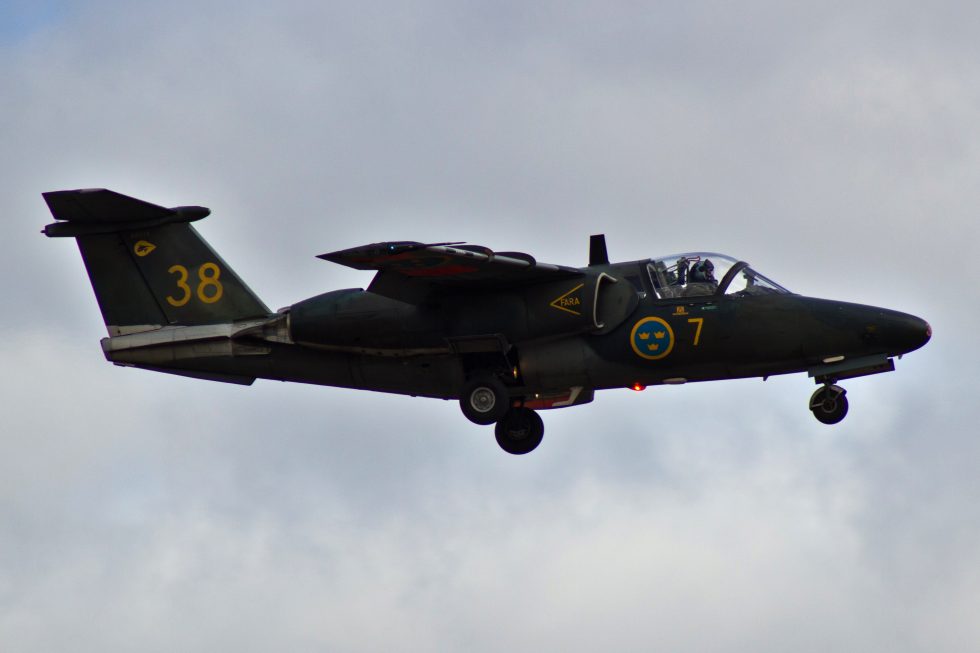
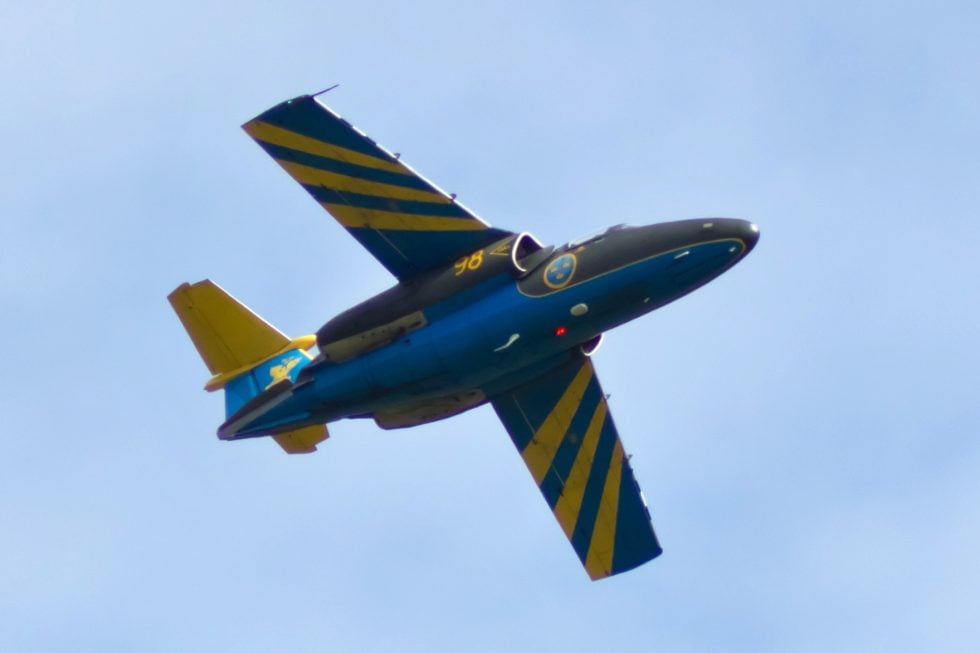
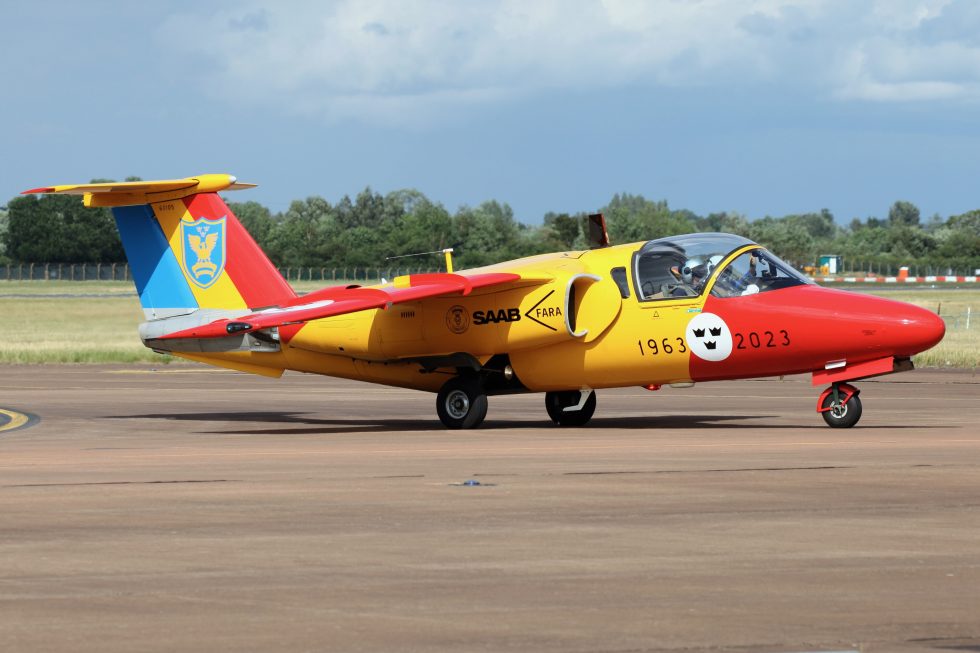
The Saab 105 in motion
A dedicated Saab 105 / Sk 60 video feature is on the way. Video coming soon. In the meantime, explore the photo gallery above and the twelve cockpit stories for the full picture of Sweden’s side-by-side jet.
Where the Saab 105 flew
A trainer that could fight
The Saab 105 never fought a war, but it was built to do far more than teach. Fitted with ejection seats and six hardpoints, the same jet trained Swedish and Austrian pilots, carried guns and rockets as a light-attack aircraft, flew photo-reconnaissance, and stood air-policing alert over neutral Austria. Its real record is one of endurance rather than kills.
Compare the combat record of every military aircraft. Figures as of July 2026.
Everything people ask about the Saab 105
Can I fly in a Saab 105?
How fast is the Saab 105?
Is the Saab 105 still in service?
Who flew the Saab 105?
What replaced the Sk 60?
Why did Saab build a twin-engine trainer?
What is the difference between the Sk 60 and the Saab 105Ö?
You can’t fly the Saab 105.
These, you can.
Some legends only live in museums — others are fuelled and waiting. MiGFlug has put civilians in real military jet cockpits since 2004.
 Fly the L-39 AlbatrosThe world’s most-flown jet trainer — aerobatics included
 Fly the F-104 Starfighter“The missile with a man in it”
 Fly the MiG-21The Cold War’s most-produced jet
 Fly the T-33 Shooting StarAmerica’s first jet trainer
 Fly the DH VampireA piece of early jet history
 Fly the S.211Agile Italian jet trainer
 Fly the MB-326The classic Aermacchi jet
 Fly the MiG-15The Soviet legend of the Korean War
Continue the tour
Every fact, checked
- GlobalSecurity — Saab 105 / Sk 60Development history, first-flight date, Aubisque engines, Sk 60C reconnaissance and Swedish fleet numbers.
- Vintage Aviation News — First Flight of the Saab 105First-flight date, 192 built, six hardpoints and the June 2024 Swedish retirement.
- The War Zone — Sweden’s Saab 105 retired after 57 yearsSide-by-side layout, roles by variant, Team 60 and the Grob G120TP / Sk 40 replacement.
- AeroTime — Sweden retires the Saab 105The 18 June 2024 retirement and the replacement training arrangements.
- Plane-Encyclopedia — Saab 105Private-venture origin, four-seat cabin, variant roles and export attempts including the Finnish 105S.
- HandWiki — Engineering: Saab 105Williams FJ44 re-engining detail (contract, numbers, Sk 60W) and J85 export-version thrust.
- flugzeuginfo.net — Saab 105 dataAirframe dimensions, weights, ceiling and J85 thrust for the 105Ö.
- Blog Before Flight — Austria says goodbye to the Saab 105Austrian farewell tour, end-2020 grounding and the shift to the Eurofighter.