
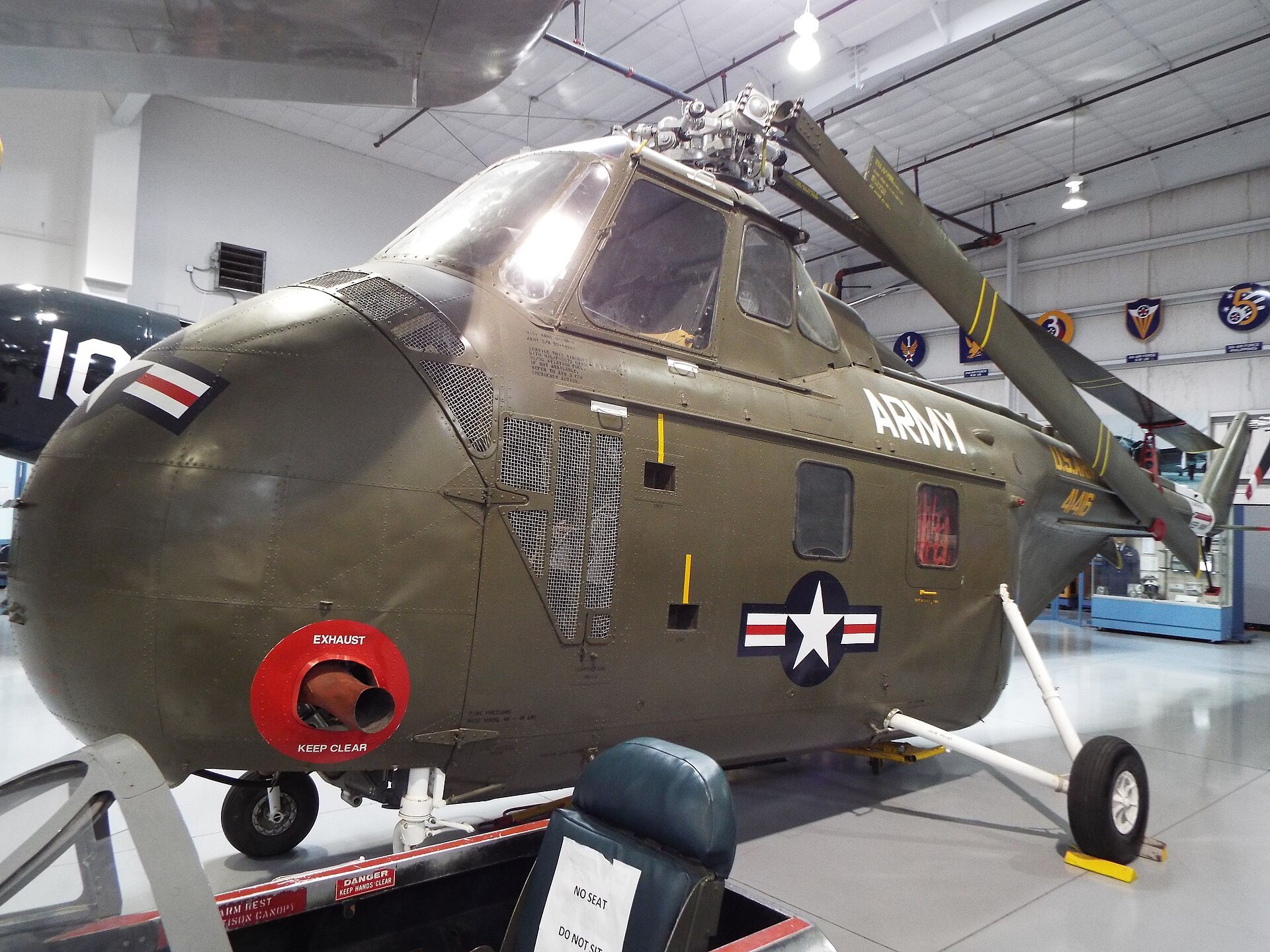
Sikorsky H-19 Chickasaw
The S-55 and Westland Whirlwind
The S-55 put the engine in the nose and the cabin under the rotor, and that layout made it the first true transport helicopter: it flew the first heliborne assault in Korea, crossed the Atlantic and became Britain’s Whirlwind.
The H-19: how Sikorsky moved the engine and invented the transport helicopter
Sikorsky’s early helicopters, the R-4, R-5 and R-6, had the engine under the rotor and the people in front, so every passenger or stretcher upset the balance. For the S-55, built with company money and no government contract, chief of advanced design Edward F. Katzenberger moved the radial engine into the nose, mounted at an angle below the cockpit, with the drive shaft running up between the pilots’ seats. That left a roomy cabin directly beneath the rotor, where load could go almost anywhere. Offset flapping hinges in the rotor head widened the centre-of-gravity range further, and hydraulic servos gave the pilots what Sikorsky called power steering. Mockup to first flight took less than a year: the first of five YH-19 evaluation aircraft for the US Air Force flew on 10 November 1949. Clamshell nose doors let mechanics change the engine in about two hours.
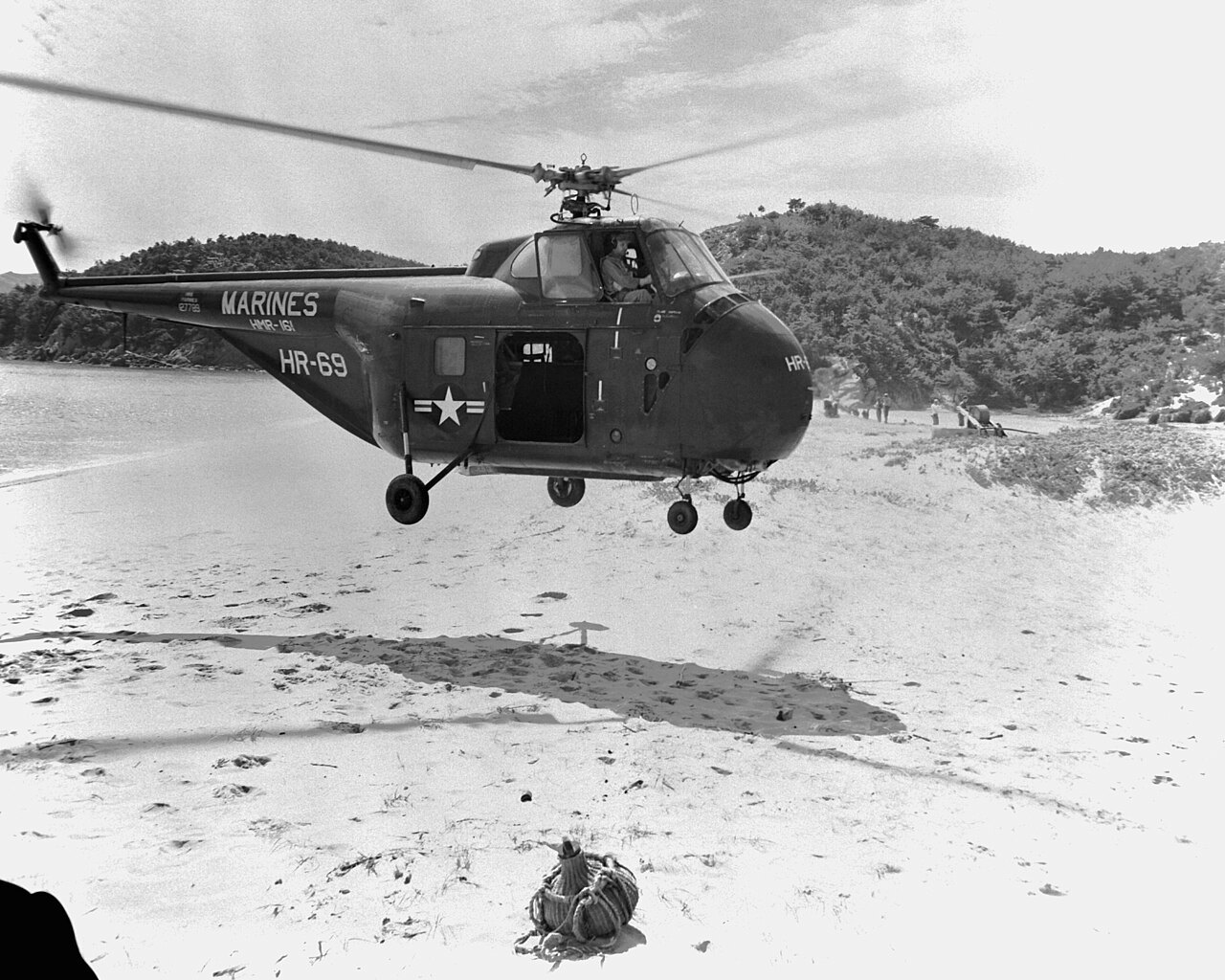
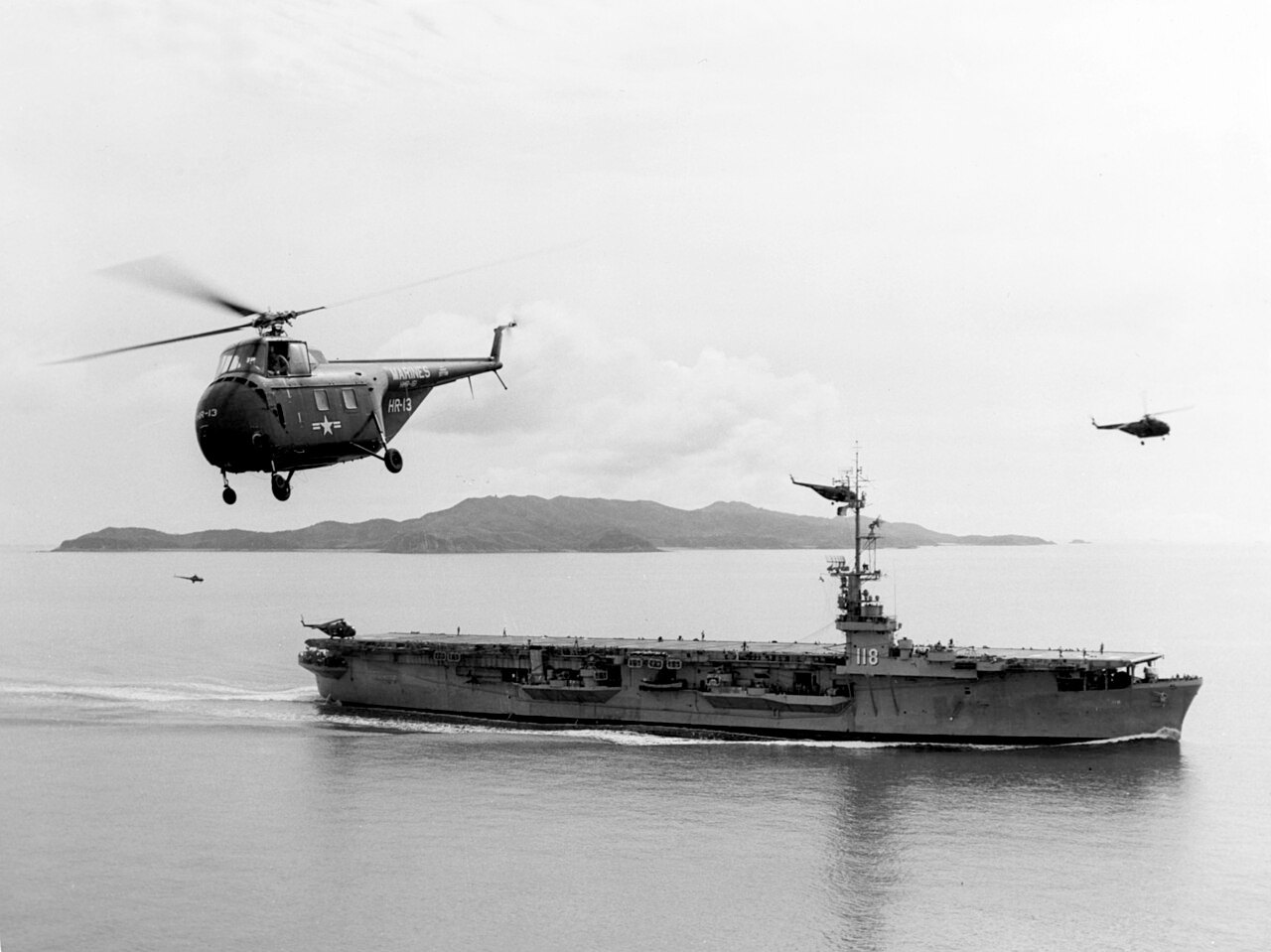
Every American service bought it under its own name: H-19 for the Air Force and Army, which called it Chickasaw, HO4S for the Navy and Coast Guard and HRS for the Marine Corps. Korea made its reputation. A YH-19 arrived for trials in March 1951 and helped evacuate paratroops the day after it landed. On 13 September 1951 the Marines’ HMR-161, in Korea for only eleven days, flew 74 men and 18,848 lb of equipment onto a ridgeline in Operation Windmill I. Air Force rescue H-19s plucked downed airmen from the Yellow Sea and from behind the lines, and Army H-19Cs of the 6th Transportation Company resupplied cut-off infantry and moved released prisoners after the armistice.
Sikorsky built 1,281 S-55s, and licensees added 477 more: Westland in Britain, SNCASE in France, whose crews nicknamed it the Elephant Joyeux, and Mitsubishi in Japan. Westland’s Whirlwind grew into a family of its own, from piston-engined rescue and anti-submarine versions to the turbine HAR.10, which flew British search and rescue into the 1980s and carried the Queen. Through more than forty countries the type built radar lines in the Arctic, landed in the Antarctic, opened the first scheduled helicopter airline in the United States and, as the HO4S-3, gave the US Navy its first workable anti-submarine helicopter. The last CH-19E left US military service with Navy squadron HC-5 on 26 February 1969.
01The H-19 in Korea: the first heliborne assault and the rescue war
Marine squadron HMR-161 reached Korea on 2 September 1951 with 15 HRS-1s and immediately set about proving what transport helicopters could do. In Operation Windmill I on 13 September it carried 74 Marines and 18,848 lb of gear to a ridgeline in the Punchbowl area. A week later it shuttled 224 men of a reconnaissance company and 17,772 lb of supplies onto a remote hilltop, an operation American newspapers reported widely as the first helicopter troop landing in combat. In Operation Haylift II, from 23 to 27 February 1953, the squadron lifted 1.6 million lb of cargo to resupply two regiments. It operated into hot landing zones without losing a single helicopter to enemy fire, reported 90 per cent availability, and moved rocket launcher batteries twice a day so their dust plumes could not be ranged by enemy guns. One HRS-1 reportedly flew home after losing 18 inches of a rotor blade to a tree.
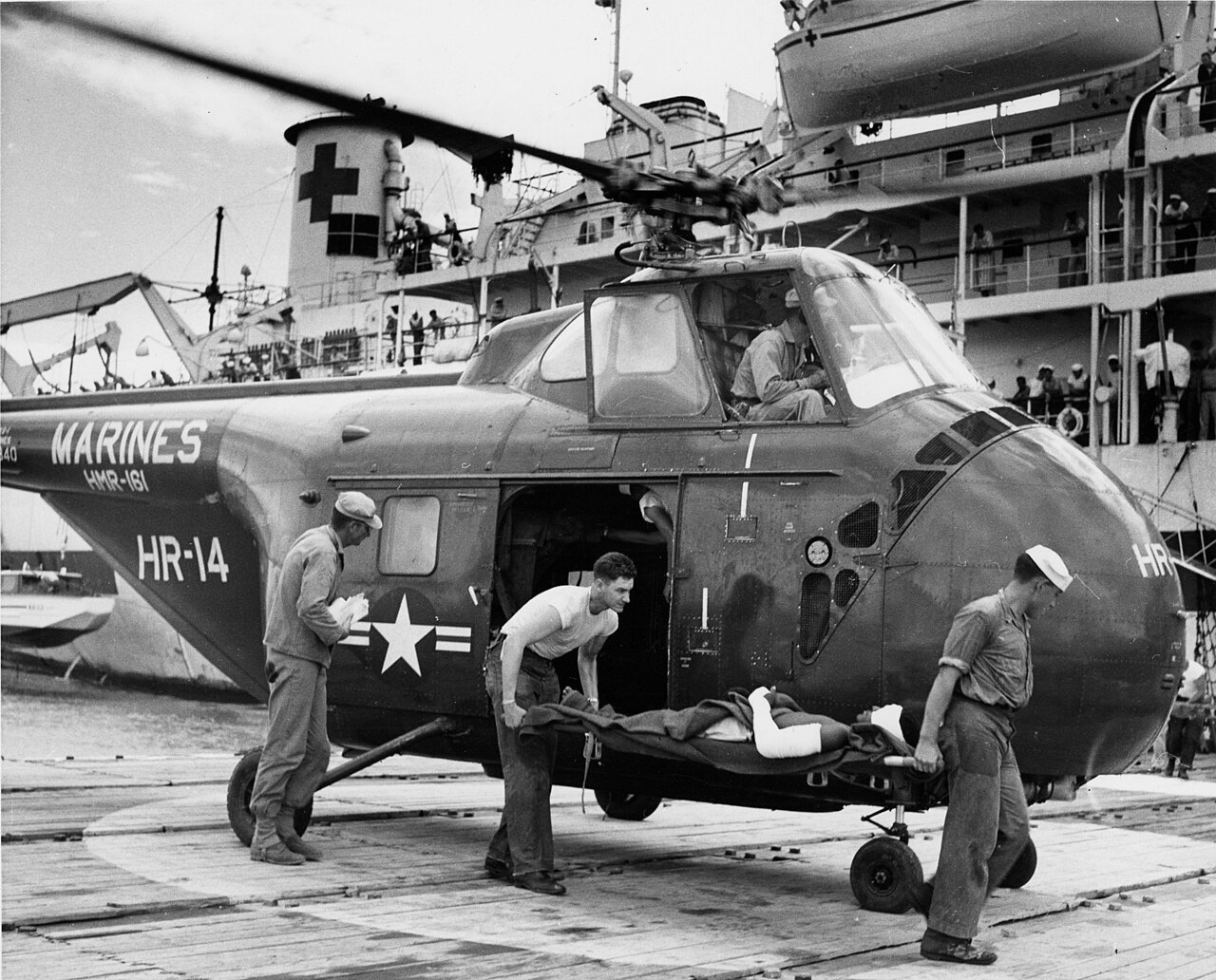
The Air Force’s 3rd Air Rescue Squadron, flying H-5s and H-19s, evacuated more than 7,000 wounded and rescued 170 pilots from behind enemy lines and from the Yellow Sea. The Army arrived late, after overcoming Air Force objections to it owning heavy helicopters: the 6th Transportation Company flew its first mission in March 1953, when ten H-19Cs made 30 round trips to deliver 33,925 lb of food, ammunition and charcoal to troops of the 3rd Infantry Division cut off by floods. In June 1953 Army and Marine helicopters together moved 800 South Korean troops in the largest helicopter operation of the war.
02The H-19 as the Westland Whirlwind: Britain’s rescue workhorse
Westland, already building the S-51 as the Dragonfly, signed a licence for the S-55 on 15 November 1950. Converting it to British standards took time, and the early Whirlwinds, with American Wasp and Cyclone radials, struggled in heat and altitude: five sent to Malaya in 1954 were withdrawn within months. The Royal Navy’s 848 Naval Air Squadron took the first HAR.1s from July 1954, and Royal Navy Whirlwinds flown from HMS Ocean and Theseus helped carry troops ashore at Port Said in November 1956, one of the first ship-borne helicopter assaults.
The Alvis Leonides Major radial powered the Series 2, including the HAS.7, Britain’s first front-line anti-submarine helicopter: it could carry either a dipping sonar or a torpedo but not both, so sonar “Hunters” worked with torpedo “Killers”. The answer to the power problem was the Gnome turboshaft. The turbine HAR.10 first flew on 28 February 1959, and No. 225 Squadron became operational with it on 4 November 1961. Westland built 68 new HAR.10s and HC.10s and re-engined older airframes. Painted yellow, they became the face of RAF search and rescue around the British coast, while HC.10s served in Borneo and the Mediterranean. The last unit, No. 84 Squadron in Cyprus, gave up its Whirlwinds for Wessex in March 1982, after 21 years of turbine Whirlwind service. More than 400 Whirlwinds were built, about a hundred of them for export.
What makes the H-19 special
The engine in the nose
Katzenberger’s layout is the S-55’s great legacy. A nine-cylinder Pratt & Whitney R-1340 sat at 35 degrees in the nose, installed back to front so its accessories faced the clamshell doors, and drove the main gearbox through a shaft between the pilots. The cabin below the rotor seated ten passengers or six stretchers and a medic, and a hatch in its floor let a crewman watch the 2,000 lb sling load. Sikorsky’s S-58 and the Soviet Mi-4 both followed the same pattern.
Blades that report their own cracks
The main rotor blades had aluminium spars, ribs and honeycomb-filled pockets, balanced against a master blade so replacements did not need manual tracking. Later blades had spars pressurised with nitrogen at 10 psi. If the smallest crack appeared, the pressure dropped and an indicator at the blade root changed colour, a Sikorsky invention called the Blade Inspection Method. First used on the S-58 and offered to S-55 operators, it gave crews a simple pre-flight check of the most critical part of the aircraft.
Built to be fixed in the field
The S-55 was designed around maintenance. An engine change took about two hours, the rotor head and main gearbox came out as a quick-change unit in three, and every major dynamic component could be replaced in 12 to 15 man-hours. The helicopter could be air-freighted in C-82, C-119 and C-124 transports. Later military models with the 700 hp Wright R-1300 introduced a hydro-mechanical clutch, letting the engine run at any speed while fully disconnected from the rotor.
03The H-19’s variants: from YH-19 to Whirlwind HCC.12
- YH-19: five Air Force service-test aircraft, first flight 10 November 1949.
- H-19A / UH-19A: Air Force utility, 600 hp R-1340; SH-19A / HH-19A rescue.
- H-19B / UH-19B: Air Force, 700 hp Wright R-1300, drooped tail boom; 264 built; SH-19B / HH-19B rescue.
- H-19C and H-19D: Army Chickasaw, 72 and 281 built (UH-19C, UH-19D after 1962).
- HO4S-1, HO4S-3: Navy utility and anti-submarine, later UH-19F; HO4S-1G, HO4S-3G: Coast Guard rescue, later HH-19G.
- HRS-1, HRS-2, HRS-3: Marine Corps assault transports, the HRS-3 becoming the CH-19E.
- S-55, S-55B, S-55C, S-55D: commercial and export models; S-55T and five-blade S-55QT turbine conversions.
- SNCASE S-55: French licence production for the army, navy and air force.
- Mitsubishi S-55C: over 40 for the Japan Self-Defence Forces.
- Westland Whirlwind: Series 1 (HAR.1 to HAR.4, American radials), Series 2 (HAR.5, HAS.7, HCC.8, Alvis Leonides Major), Series 3 (HAR.9, HAR.10, HC.10, HCC.12, Gnome turboshaft).
Sikorsky H-19B Chickasaw specifications
Specifications
- Crew
- 2
- Capacity
- 8 to 10 troops, or 6 stretchers and a medic; 2,000 lb (907 kg) on the sling
- Main rotor diameter
- 53 ft (16.15 m)
- Fuselage length
- 42 ft 2 in (12.85 m)
- Length overall
- 62 ft 2 in (18.95 m)
- Height
- 13 ft 4 in (4.07 m)
- Empty weight
- about 5,060 lb (2,295 kg)
- Max take-off weight
- 8,400 lb (3,810 kg)
- Powerplant
- 1 × Wright R-1300-3 seven-cylinder radial, 700 hp (522 kW)
- Maximum speed
- 112 mph (180 km/h)
- Cruise speed
- about 92 mph (148 km/h)
- Range
- 330 mi (531 km)
- Service ceiling
- about 12,900 ft (3,930 m)
- Climb rate
- about 985 ft/min (300 m/min)
- Armament
- Normally none; armed trials with rockets and a .50-calibre gun; Navy HO4S-3 and Whirlwind HAS.7 carried a torpedo
Costs & production
- Cost per flight hour
- No official figure survives for military service. A hedged modern estimate for a privately operated radial-engined S-55 is in the low thousands of US dollars per hour, based on the fuel burn and overhaul cost of a 600 to 700 hp radial; it is an estimate, not an operator figure
- Production
- 1,281 by Sikorsky; 477 under licence by Westland, SNCASE and Mitsubishi, Sikorsky Archives figures
- Programme
- Company-funded design; first flight 10 November 1949; Westland licence 15 November 1950; last US military CH-19E retired 26 February 1969
04The H-19’s operating costs: designed around the mechanic
The S-55 was conceived when helicopters were notorious for their maintenance hours, and Sikorsky attacked the problem directly. The clamshell nose doors exposed the engine at ground level; the rotor head and main gearbox came out as one quick-change unit; and a full change of engine, clutch, gearboxes and rotor heads could be done in as little as five hours elapsed time. Marine squadron HMR-161 reported 90 per cent aircraft availability in Korea, a remarkable figure for the time.
Its costs were still those of a big piston engine: aviation petrol by the drum and regular overhauls. That is why later operators converted surplus S-55s to turbine power, from the Whirlwind HAR.10 to the civil S-55T, which shed 900 lb of empty weight with its Garrett turboshaft. No military operator published a cost per flight hour, so the table gives only a hedged estimate.
The H-19 from first flight to the last Whirlwind
First flight
The first YH-19 flies on 10 November, less than a year after the programme began.
Westland licence
Sikorsky signs the S-55 licence with Westland on 15 November; the Navy takes its first HO4S-1s.
Korea and Windmill I
A YH-19 reaches Korea in March; HMR-161 flies Operation Windmill I on 13 September.
Across the Atlantic
Two H-19As fly from Massachusetts to Germany between 15 July and 4 August, the first transatlantic helicopter crossing.
Army in action
The 6th Transportation Company flies its first mission in March; New York Airways begins scheduled S-55 passenger service.
Whirlwind at sea
848 Naval Air Squadron takes the first Westland Whirlwind HAR.1s in July.
Floods and ice
A Coast Guard HO4S-3G rescues 138 people at Yuba City; Navy HO4S-3s support Operation Deep Freeze in Antarctica.
Suez
Royal Navy Whirlwinds help land troops at Port Said in November.
Turbine Whirlwind
No. 225 Squadron becomes operational with the Gnome-powered HAR.10 on 4 November.
UH-19
The new US tri-service system renames all versions as H-19 variants.
US retirement
Navy squadron HC-5 retires the last CH-19E in US military service on 26 February.
Last RAF Whirlwinds
No. 84 Squadron in Cyprus gives up the HAR.10 for the Wessex in March.
Stories & eyewitnesses: the H-19 in war, rescue and record flights
Hop-A-Long and Whirl-O-Way cross the Atlantic
Two helicopters flew themselves to Germany in 1952.
Read the full story
Windmill I
Eleven days after arriving, HMR-161 showed what an assault helicopter could do.
Read the full story
Seven thousand wounded and 170 pilots
The 3rd Air Rescue Squadron’s war.
Read the full story
Terry Blue: 33,925 pounds to a flooded division
The Army’s first H-19 mission in Korea.
Read the full story
Big Switch
After the armistice, H-19s flew prisoners home.
Read the full story
138 people from the Yuba City flood
One Coast Guard helicopter, one basket, fifteen hours.
Read the full story
To the South Pole region
Navy HO4S-3s flew from icebreakers in Operation Deep Freeze.
Read the full story
Port Said, 1956
Whirlwinds helped make the first ship-to-shore helicopter assault.
Read the full story
The Queen’s Whirlwinds
Britain’s royal helicopters began with the S-55.
Read the full story
Yellow Whirlwinds on the coast
For twenty years the HAR.10 meant rescue in Britain.
Read the full story
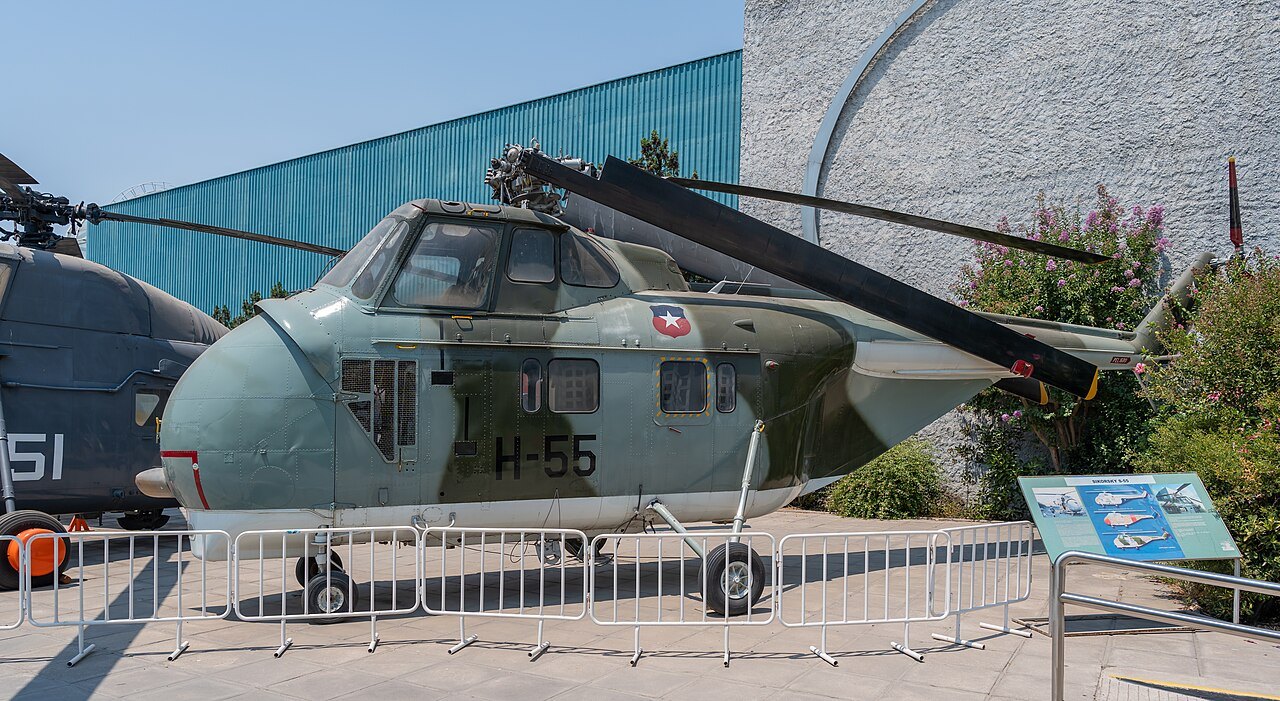
Where to see one
Museums on both sides of the Atlantic keep the S-55 alive.
Read the full story
The H-19 in pictures
Where the H-19 flies and flew
The H-19’s record
The H-19 flew throughout the second half of the Korean War with the Marines, Air Force and Army, and Whirlwinds served at Suez, in Malaya, Borneo, Cyprus and Yemen. HMR-161 lost no helicopters to enemy fire in Korea; the numbers below are as recorded by the Sikorsky Archives and the US Army.
See how training and combat types compare in the military aircraft statistics database. Figures are approximate.
Everything people ask about the H-19
Can I fly in a Sikorsky H-19 Chickasaw?
Is the H-19 the same as the Westland Whirlwind?
Why was it called Chickasaw?
How many H-19s were built?
What did the H-19 do in Korea?
Was the Mi-4 copied from the H-19?
When was the H-19 retired?
You can’t fly the H-19.
These, you can.
Most of this museum you can only look at. These genuine military jets you can fly yourself with MiGFlug — with aerobatics and time on the controls.
 Fly the L-39 AlbatrosThe world’s most-flown jet trainer — aerobatics included
 Fly the F-104 Starfighter“The missile with a man in it”
 Fly the MiG-21The Cold War’s most-produced jet
 Fly the T-33 Shooting StarAmerica’s first jet trainer
 Fly the DH VampireA piece of early jet history
 Fly the S.211Agile Italian jet trainer
 Fly the MB-326The classic Aermacchi jet
 Fly the MiG-15The Soviet legend of the Korean War
Continue the tour
Every fact, checked
- Sikorsky S-55Igor I. Sikorsky Historical Archives: design, Katzenberger layout, Korea, transatlantic flight, Yuba City rescue, production by model
- Sikorsky UH-19B ChickasawNational Museum of the US Air Force fact sheet: Air Force orders, rescue role and specifications
- Army helicopters in Korea, 1950 to 53US Army article on the 6th Transportation Company, Big Switch and Broadway
- UH-19 Chickasaw (encyclopedia entry)Ugolok Neba Russian aviation encyclopedia: Korean operations, Deep Freeze, armed H-19D trials, licence production
- Westland Whirlwind (encyclopedia entry)Ugolok Neba on Whirlwind variants, Malaya, Suez and exports
- Westland Whirlwind HAR10RAF Museum: turbine Whirlwind production, service entry 1961 and retirement 1982
- 1954 Sikorsky S-55 / UH-19B ChickasawConnecticut Air & Space Center: museum aircraft 52-7573 and HMR-161 in Korea