
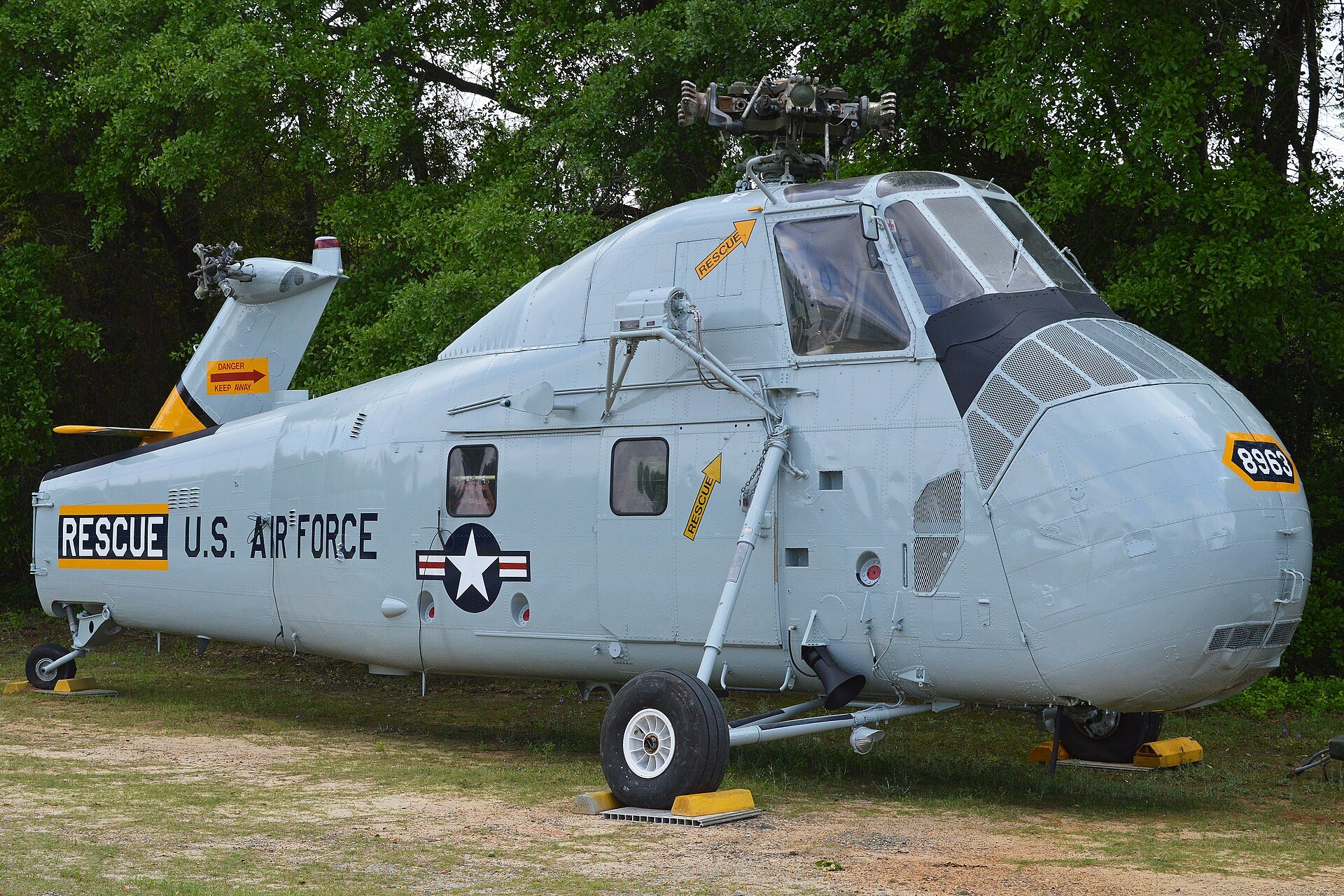
Sikorsky H-34 Choctaw
The S-58, Seahorse and Westland Wessex
Built as a submarine hunter, the S-58 became the last great piston helicopter: France’s gunship in Algeria, the Marines’ workhorse in early Vietnam, the presidents’ first helicopter and, with turbines, Britain’s Wessex.
The H-34: how a Navy submarine hunter became everybody’s helicopter
Sikorsky began the S-58 with its own money as a successor to the S-55: twice as powerful, much more streamlined and with a four-blade rotor that allowed higher speed with less vibration. At first neither target customer wanted it. The Navy chose a Bell design for anti-submarine work and the Marines preferred the giant S-56. When both programmes ran into trouble, the two services came back, and the Navy contracted for the HSS-1 Seabat in June 1952. The prototype flew at Bridgeport on 8 March 1954, the first production aircraft on 20 September, and the Seabat entered service in August 1955. With a dipping sonar, a Doppler navigator and an automatic stabilisation system that held a hover over the sonar without the pilot, it made night anti-submarine helicopter work possible. The Army ordered the H-34 Choctaw and the Marines the HUS-1 Seahorse.
The nose-mounted Wright R-1820 radial, conventional tailwheel undercarriage and folding rotor and tail made the S-58 at home on carriers and in the field. It carried 16 troops or a heavy sling load, and in July 1956 it set a speed record of 141.9 mph over a 100 km closed course. France bought it in quantity for the war in Algeria, where the Armée de l’Air used 215 and armed some with a cannon and machine guns firing from the doors. The Marines took their UH-34Ds to Vietnam in 1962 with HMM-362, and for the next four years they carried the early war: assaults, resupply, medical evacuation and rescue. Presidents Eisenhower and Kennedy travelled in VH-34s, and a Marine HUS crew hoisted Alan Shepard from the Atlantic in 1961.
Sikorsky built about 1,800 S-58s before production ended in January 1970, and close to 600 more were made under licence in France, Britain and Italy, taking the total past 2,300. In Britain Westland chose to rebuild the design around turbine power: the Wessex HAS.1 flew on 20 June 1958 with a Napier Gazelle, and the twin-Gnome HC.2 entered RAF service in January 1964. The Wessex fought in Borneo and the Falklands, flew over Northern Ireland for decades, carried the Royal Family from 1969 to 1998 and left RAF service only in 2003. Sikorsky’s own S-58T Twin-Pac conversion kept others flying long after the radial had become a museum piece.
01The H-34 in Algeria and Vietnam: the first helicopter wars
The war of independence in Algeria pushed France to expand its helicopter force fast. With no heavy-lift helicopter of its own, it imported close to a hundred H-34s from the United States, and Sud-Aviation then assembled or built 180 more at Marignane between 1957 and 1962, its first helicopter production line. The Armée de l’Air used 215 H-34As from 1956 to the late 1970s. In Algeria they carried 16 to 18 equipped soldiers, evacuated the wounded and lifted loads of up to 2,260 kg on a four-point sling, and some were armed with a cannon and machine guns firing through the door and windows, making them early helicopter gunships.
In Vietnam the Marine Corps arrived with the HUS, now the UH-34D, in 1962, when HMM-362 deployed. The Corps had bought it only as a stop-gap while it waited for a true assault helicopter, but it became the work-horse for troop lift, cargo and medical evacuation. Its engine, low in the nose, gave the crew some protection and could get the helicopter out of a hot landing zone even after heavy damage. Crews added door guns, armour and flak vests, because the high cockpit drew much of the fire on landing. The turbine CH-46 began to replace it in 1966, but the UH-34D returned to prominence in late 1967 when the CH-46 fleet was grounded for structural modifications. Marines turned its nickname, Huss, into slang for doing a buddy a favour.
02The H-34 as the Westland Wessex: turbines, royals and the Falklands
Westland’s licence allowed it to build the S-58, but it chose to re-engine it. The first Wessex HAS.1 flew on 20 June 1958 with a 1,450 hp Napier Gazelle turboshaft and entered Royal Navy anti-submarine service in 1961. The improved HAS.3, with radar in a dorsal radome and a 1,600 hp Gazelle, followed in 1967. For the RAF and the Royal Marines Westland produced versions with two coupled Bristol Siddeley Gnome turboshafts: the HC.2, which first flew in January 1962 and entered service with No. 18 Squadron at Odiham in January 1964, and the Navy’s commando HU.5. The HC.2 could carry 16 troops or a 4,000 lb underslung load such as a 105 mm pack howitzer, and could be armed with SS.11 missiles and machine guns.
Wessex helicopters carried troops in the Borneo confrontation, supported UN forces in Cyprus and became a familiar sight over Northern Ireland. In the 1982 Falklands War about 55 HU.5s took part. Two crashed on the Fortuna Glacier on South Georgia in a snowstorm while recovering special forces, six were lost when the Atlantic Conveyor sank, and a HAS.3 was destroyed aboard HMS Glamorgan when an Exocet struck. From 1976 converted HAR.2s flew search and rescue for No. 22 Squadron, and the last RAF Wessex, HC.2s in Cyprus, retired in 2003.
What makes the H-34 special
Four blades and a tailwheel
Sikorsky chose a four-blade, 56 ft main rotor for lower blade loading than the S-55’s three blades, so the S-58 could fly faster before blade stall and with less vibration. Main and tail blades used the NACA 0012 profile. A tailwheel undercarriage shrank the turning radius on deck and made the tail wheel, not the tail rotor, the first thing to touch in a quick stop. The rotor folded by hand and the tail pylon swung round so the helicopter fitted carrier lifts.
A hover the pilot did not have to fly
The Navy’s SH-34J combined a dipping AN/AQS-4 or -5 sonar with a Doppler navigator and Automatic Stabilisation Equipment, an early helicopter autopilot that could hold the aircraft in a hover over the sonar transducer without the pilot’s hands. That made anti-submarine missions possible at night and in poor visibility, a large step for the time. Weapons were two torpedoes, two mines or two depth charges. In 1956 a similar automatic stabilisation system was tried on the S-58 to stop heavy sling loads from swinging.
Magnesium and its price
To save weight, parts of the all-metal fuselage were skinned in magnesium alloy. It worked, but corrosion and the fire hazard experienced on some S-58 models persuaded Sikorsky not to use magnesium for airframe parts on later types. The nose-mounted R-1820, reached through clamshell doors, gave full power only up to about 700 ft; the S-58T’s Pratt & Whitney Canada Twin-Pac turbines delivered the same power up to 6,000 ft and added twin-engine safety, which is why surviving civil S-58s were so often converted.
03The H-34’s variants: Seabat, Seahorse, Choctaw and Wessex
- XHSS-1: four prototypes, first flight 8 March 1954.
- HSS-1 / SH-34G Seabat: Navy anti-submarine; HSS-1N / SH-34J night-capable with automatic hover; UH-34J utility conversions.
- HUS-1 / UH-34D Seahorse: Marine assault transport; HUS-1A / UH-34E with flotation gear; HUS-1L / LH-34D winterised for Antarctica; HUS-1Z / VH-34D executive transports.
- H-34A / CH-34A Choctaw: Army troop transport; CH-34C improved model; VH-34C VIP transport.
- HH-34F and HH-34J: Coast Guard and Air Force search and rescue.
- S-58A, C and D: commercial cargo and airline versions; S-58T Twin-Pac turbine conversion, FAA approved 1971.
- Sud-Aviation S-58 / H-34: French assembly and licence production for the navy, air force and army, and for Belgium.
- Westland Wessex: HAS.1 and HAS.3 (Napier Gazelle), HC.2, HCC.4, HU.5 and HAR.2 (twin Gnome), plus Australian and export versions.
Sikorsky UH-34D Seahorse specifications
Specifications
- Crew
- 2
- Capacity
- 16 troops, or 6 stretchers and a medical attendant
- Main rotor diameter
- 56 ft (17.07 m)
- Fuselage length
- 46 ft 9 in (14.25 m)
- Height
- 15 ft 11 in (4.85 m)
- Empty weight
- 7,900 lb (3,583 kg)
- Max take-off weight
- 14,000 lb (6,350 kg)
- Powerplant
- 1 × Wright R-1820-84 nine-cylinder radial, 1,525 hp (1,137 kW)
- Maximum speed
- 122 mph (196 km/h)
- Cruise speed
- 97 mph (156 km/h)
- Range
- 215 mi (346 km)
- Service ceiling
- 9,500 ft (2,896 m)
- Climb rate
- 1,100 ft/min (335 m/min)
- Armament
- Door guns and rockets added in Algeria and Vietnam; SH-34J two torpedoes, mines or depth charges
Costs & production
- Cost per flight hour
- No official figure is available. A hedged modern estimate for a privately operated radial-engined S-58 is several thousand US dollars per hour, dominated by the fuel burn and overhaul cost of a 1,525 hp R-1820; it is an estimate, not an operator figure
- Production
- About 1,800 by Sikorsky to January 1970 and close to 600 under licence in France, Britain and Italy; Westland built 356 Wessex according to the Sikorsky Archives
- Programme
- Navy contract June 1952; first flight 8 March 1954; Army order 1955; Marine HUS-1 service 1957; last RAF Wessex retired 2003
04The H-34’s operating costs: why the turbines took over
The S-58’s Wright R-1820 was a proven, rugged engine, but it was a big, thirsty radial that lost power quickly with height and heat: Sikorsky notes it delivered maximum power only up to about 700 ft. That limited payload in exactly the hot and high places where the helicopter was most needed, from Algeria to the Central Highlands of Vietnam, and every hour meant aviation petrol and engine wear.
Turbines changed the economics. Westland’s Wessex was designed from the start around a turboshaft, and in 1970 Sikorsky set up a line to remanufacture S-58s as the twin-turbine S-58T, which held its power to 6,000 ft and could continue at maximum weight on one engine up to 5,000 ft. No military operator published a cost per flight hour for the piston H-34, so the table gives a hedged estimate only.
The H-34 from submarine hunter to the last Wessex
Navy contract
The Navy orders the HSS-1 Seabat anti-submarine helicopter in June.
First flight
The XHSS-1 flies at Bridgeport on 8 March; the first production aircraft follows on 20 September.
Records and Algeria
An S-58 sets a 100 km closed-circuit speed record of 141.9 mph on 12 July; French H-34s begin service.
Wessex flies
Westland’s turbine Wessex HAS.1 first flies on 20 June.
Mercury
A Marine crew recovers Alan Shepard in May; in July the waterlogged Liberty Bell 7 capsule proves too heavy to lift and sinks.
Vietnam
HMM-362 takes the UH-34D to Vietnam.
Yankee Papa 13
Larry Burrows photographs a UH-34D crew’s deadly mission of 31 March for LIFE.
Royal Wessex
The Queen’s Flight Wessex HCC.4 makes its first official flight on 1 July, for the Investiture at Caernarfon.
Production ends
Sikorsky ends S-58 production in January and launches the S-58T turbine conversion.
Last Marine flight
The final Marine Corps UH-34 flight takes place.
Falklands
Wessex helicopters fight in the South Atlantic; nine are lost.
Last Wessex
The RAF retires its last Wessex HC.2s in Cyprus.
Stories & eyewitnesses: the H-34 from Algeria to the Falklands
One ride with Yankee Papa 13
A LIFE photographer flew a Marine assault that went badly wrong.
Read the full story
Operation Starlite, Landing Zone Blue
A UH-34D that served in Vietnam for almost five years.
Read the full story
The gunships of Algeria
France armed its H-34s and built its own.
Read the full story
Shepard comes home, Liberty Bell 7 does not
The H-34 could just lift a Mercury capsule.
Read the full story
Army One
The first presidential helicopters were H-34s.
Read the full story
Taro and Jiro
A Japanese S-58 flew in the Antarctic when two sled dogs were found alive.
Read the full story
The Queen’s Wessex
Red and blue helicopters carried the Royal Family for almost thirty years.
Read the full story
Fortuna Glacier
Two Wessex were lost recovering special forces in a South Georgia blizzard.
Read the full story
Yellow Wessex on the coast
From 1976 RAF Wessex took over search and rescue from the Whirlwind.
Read the full story
Seahorses on show
Dozens of H-34s survive, a few still flying.
Read the full story
The H-34 in pictures
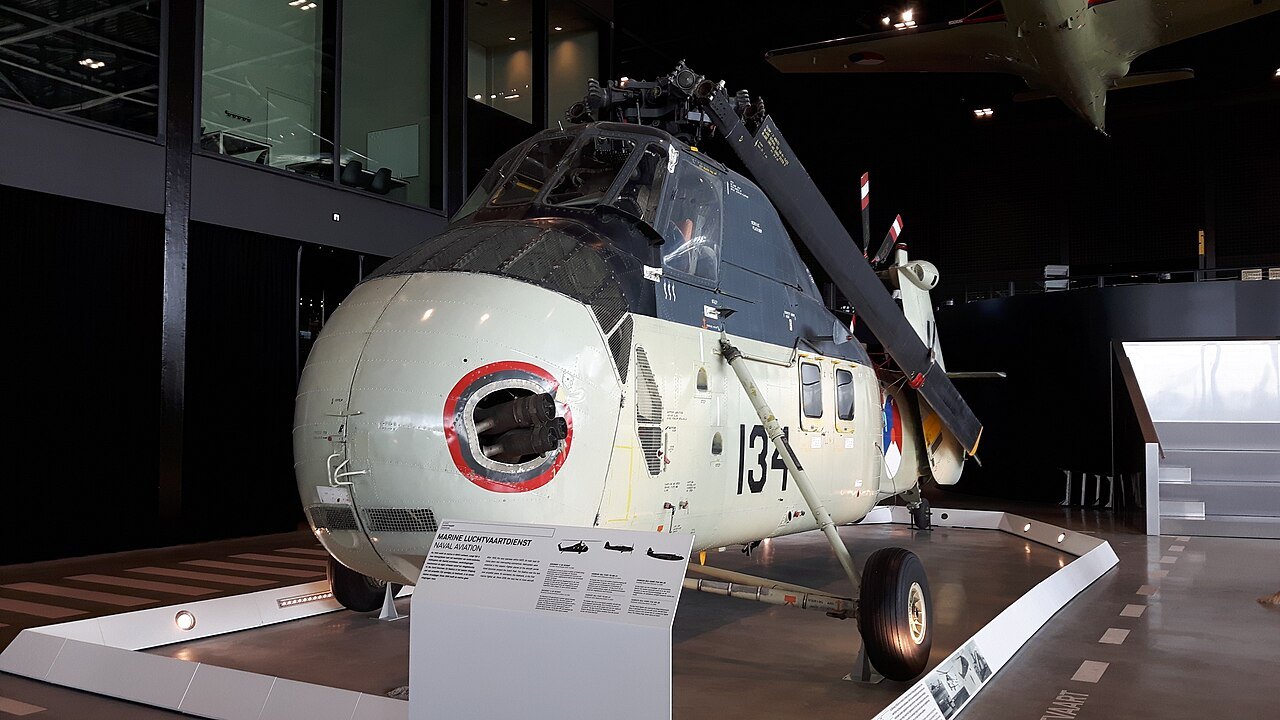
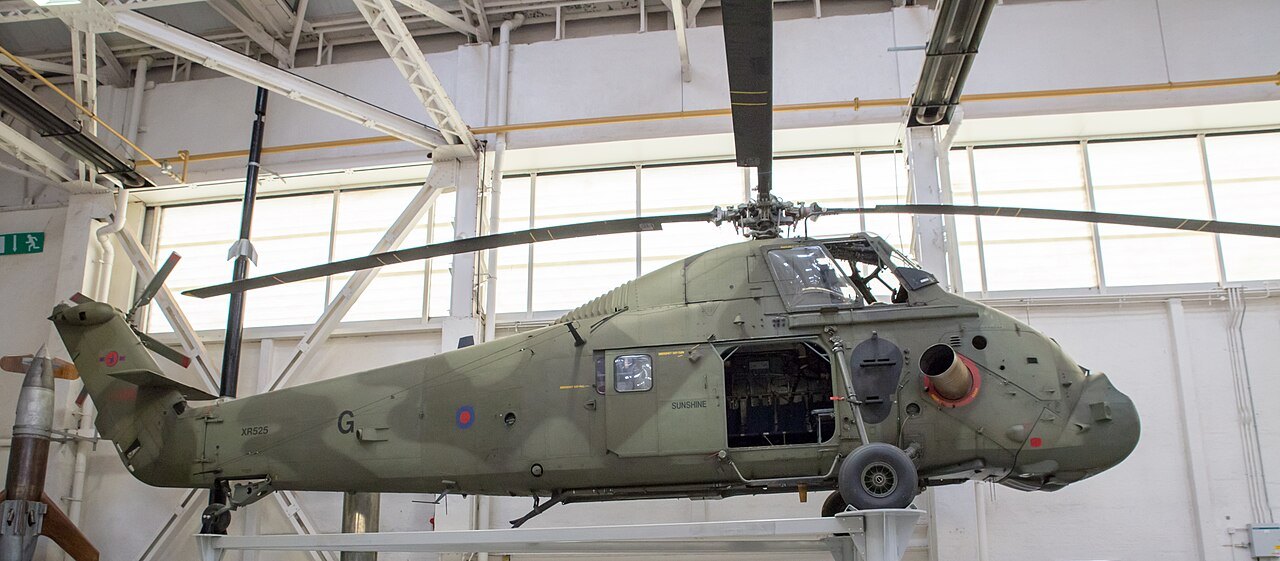
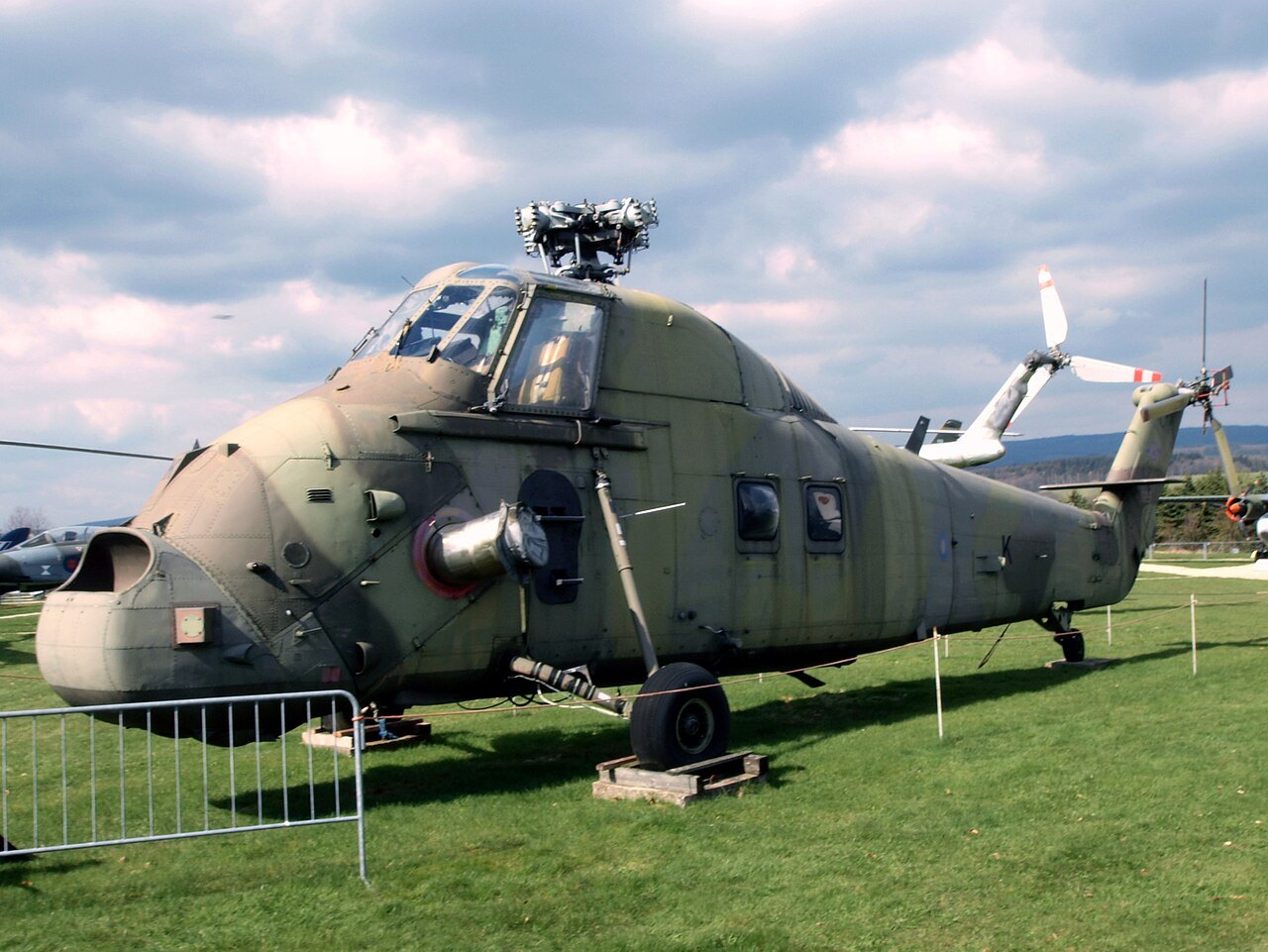
Where the H-34 flies and flew
The H-34’s record
The H-34 flew in Algeria, Lebanon in 1958, early Vietnam, the Dominican Republic and the Israeli wars of the 1960s, and as the Wessex in Borneo, Cyprus, Northern Ireland and the Falklands. Figures below are from the National Museum of the Marine Corps and published service histories.
See how training and combat types compare in the military aircraft statistics database. Figures are approximate.
Everything people ask about the H-34
Can I fly in a Sikorsky H-34 Choctaw?
Is the H-34 the same as the S-58?
Is the Westland Wessex an H-34?
How many H-34s were built?
Did the H-34 fight in Vietnam?
Did a president fly in an H-34?
When was the H-34 retired?
You can’t fly the H-34.
These, you can.
Most of this museum you can only look at. These genuine military jets you can fly yourself with MiGFlug — with aerobatics and time on the controls.
 Fly the L-39 AlbatrosThe world’s most-flown jet trainer — aerobatics included
 Fly the F-104 Starfighter“The missile with a man in it”
 Fly the MiG-21The Cold War’s most-produced jet
 Fly the T-33 Shooting StarAmerica’s first jet trainer
 Fly the DH VampireA piece of early jet history
 Fly the S.211Agile Italian jet trainer
 Fly the MB-326The classic Aermacchi jet
 Fly the MiG-15The Soviet legend of the Korean War
Continue the tour
Every fact, checked
- Sikorsky S-58Igor I. Sikorsky Historical Archives: development, variants, record, specifications, production and Wessex
- Sikorsky UH-34DNational Museum of the Marine Corps (Ben Kristy): Marine service, Vietnam and the history of BuNo 150570
- One Ride With Yankee Papa 13LIFE: Larry Burrows’ 1965 photo essay and account of the 31 March 1965 mission
- Sikorsky H-34AMusée de l’Air et de l’Espace: French Air Force use in Algeria and Sud-Aviation production
- Westland Wessex HC2RAF Museum: HC.2 capability, service entry, HAR.2 rescue and retirement
- Westland Wessex HCC4RAF Museum: The Queen’s Flight Wessex, 1969 to 1998
- 1955 Sikorsky S-58 / UH-34DConnecticut Air & Space Center: museum aircraft 147173 and presidential Army One use
- CH-34 Choctaw (encyclopedia entry)Ugolok Neba Russian aviation encyclopedia: Army, French, German and South Vietnamese service
- UH-34 Seahorse (encyclopedia entry)Ugolok Neba on Marine variants, Vietnam modifications and the Shepard recovery