
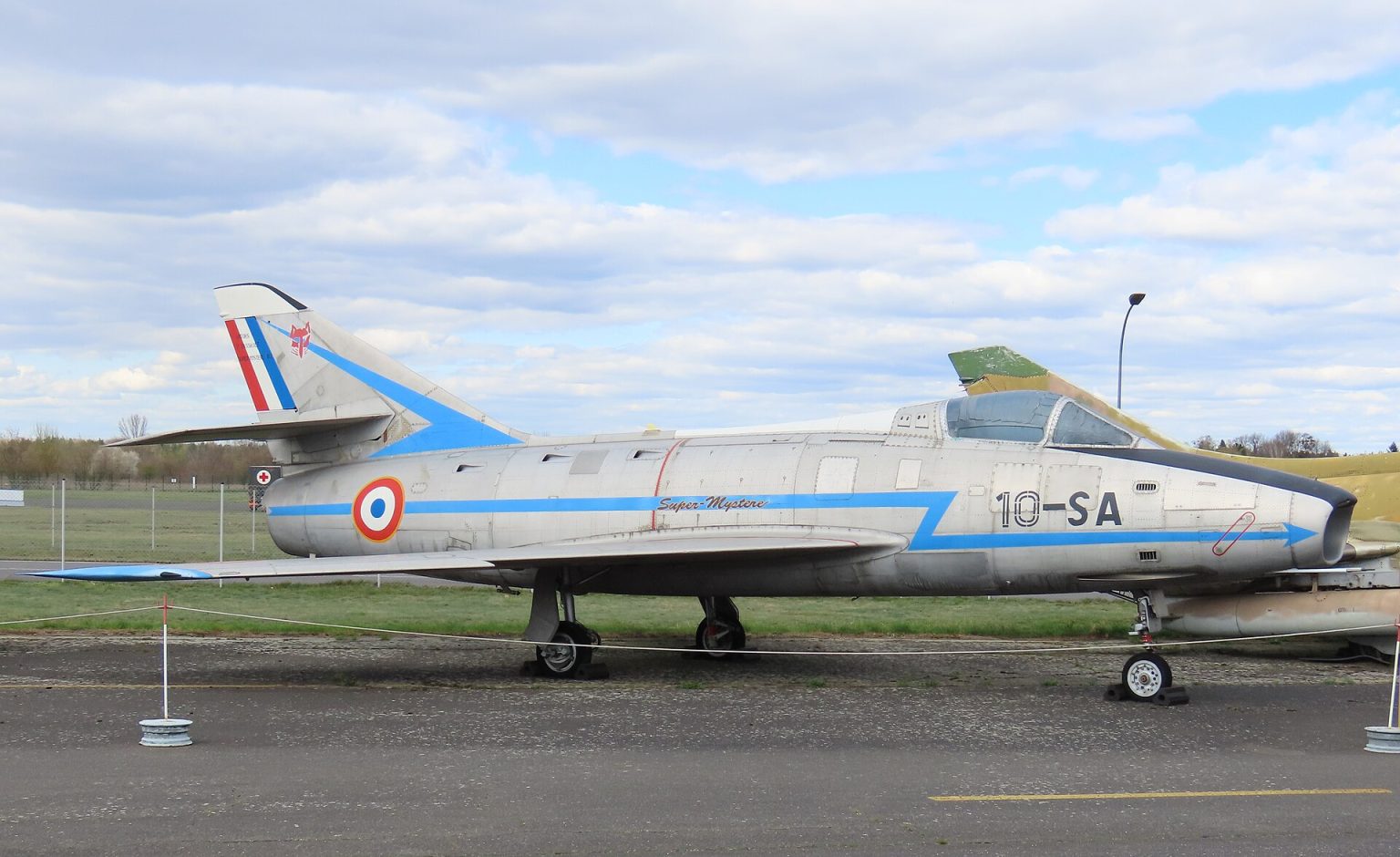
Dassault Super Mystère
Europe’s first supersonic
The first mass-produced supersonic aircraft built in Western Europe — a thin-winged, afterburning fighter-bomber that could hold Mach 1 in level flight, then went to war for Israel over Sinai and ended its days guarding Honduras.
Europe’s first supersonic, built for the everyday war
In the early 1950s Western Europe was still chasing an American and Soviet lead into supersonic flight. Dassault’s answer was not a revolutionary design but a careful, decisive evolution: take the successful Mystère IV day fighter, give it a thinner wing swept at 45 degrees, and bolt on an afterburning engine. The result, the Super Mystère, first flew on 2 March 1955 and reportedly went supersonic in level flight the very next day — something no earlier European production jet could do without diving.
That made it the first Western European aircraft to enter mass production capable of level supersonic flight. The prototype used a British Rolls-Royce Avon, but production Super Mystère B.2s switched to the home-grown SNECMA Atar 101G with reheat. Only around 180 were built between 1956 and 1959 — the type was quickly overtaken by Dassault’s own delta-winged Mirage III — yet it gave France, and then Israel, a genuine supersonic fighter-bomber years ahead of most of the continent.
Its real fame came far from France. Israel bought two dozen in 1958 and flew them hard through the 1967 Six-Day War, the War of Attrition and the 1973 Yom Kippur War, mostly as a ground-attack aircraft. Survivors were re-engined with an American Pratt & Whitney J52 as the Sa’ar, then sold to Honduras — which flew them into the mid-1990s, making the little Dassault the last of its kind in the sky.
01How the Super Mystère turned the Mystère IV into Europe’s first level-supersonic fighter
The jump from the Mystère IV to the Super Mystère looks small on paper but was decisive in the air. Dassault gave the new aircraft a wing that was both thinner and more sharply swept — roughly 45 degrees — which cut transonic drag, and paired it for the first time in the family with an afterburning engine. The Mystère IV could only exceed the speed of sound in a dive; the Super Mystère could sustain it in level flight.
That single capability is why the type matters historically. When the B.1 prototype flew in March 1955 and broke the sound barrier in level flight the next day, Western Europe had, for the first time, a production-bound fighter that did not need gravity’s help to go supersonic. It was a bridge aircraft — the last of Dassault’s swept-wing line before the delta Mirage III rewrote the rules — but for a few years it was the fastest thing the continent built in numbers.
What makes it special
A thin wing and an afterburner
The Super Mystère’s breakthrough was aerodynamic, not exotic. A thinner wing swept at about 45 degrees reduced transonic drag, and an afterburning engine finally gave the family the thrust to push through the sound barrier in level flight. Earlier Mystères needed a dive; this one did not — the change that made it Western Europe’s first level-supersonic production jet.
The SNECMA Atar 101G
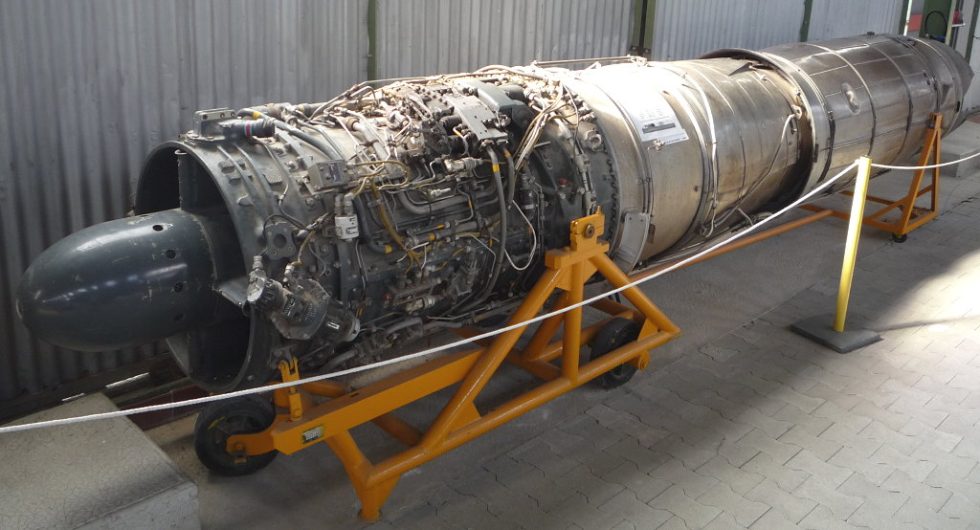
The prototype flew on a British Rolls-Royce Avon, but production aircraft used the French SNECMA Atar 101G-2 with reheat — about 44 kN (roughly 9,900 lbf) in afterburner. It was a milestone for French engine independence, an axial-flow turbojet whose Atar lineage would go on to power the Mirage III, Mirage F1 and beyond.
A true fighter-bomber
Armed with two 30 mm DEFA cannon and four hardpoints for bombs, rocket pods and later Shafrir missiles, the Super Mystère was built to fight air-to-air and hit the ground. That versatility is what kept it useful for decades — Israel and Honduras alike valued it far more as a rugged strike aircraft than as a pure interceptor.
02The Super Mystère’s engine: from Rolls-Royce Avon to the French Atar
The first Super Mystère prototype, the B.1, was powered by a British Rolls-Royce Avon RA.7R — a pragmatic choice while French engine development caught up. For the production B.2, Dassault fitted the home-grown SNECMA Atar 101G, an axial-flow turbojet with an afterburner producing around 44 kN of thrust in reheat. It was less powerful than the Avon but strategically vital: it kept the aircraft, and France’s fighter programme, independent of foreign engines. The Atar family matured into one of the most successful European jet engines ever, powering the entire Mirage dynasty.
03Why the Super Mystère fought as a bomber, not a dogfighter
On paper the Super Mystère was a supersonic day fighter, and Israeli pilots rated it a fair match for the MiG-19 in a turning fight. In practice, by the time it saw heavy combat in the late 1960s and 1970s it was outclassed in the air by newer types like the Mirage III and MiG-21. Its strength was as a fighter-bomber: fast, stable, hard-hitting with cannon, bombs and rockets, and rugged enough to absorb battle damage. Israel used it overwhelmingly for ground attack, and Honduras bought it for exactly the same reason — close air support over a contested border.
Full specifications
Baseline note: the figures below describe the Dassault Super Mystère B2 (company designation SMB2) as built at Bordeaux-Mérignac between 1957 and 1959 — a single-seat fighter-bomber built around one SNECMA Atar 101G-2 turbojet with afterburner, of which about 180 were completed. It is the right baseline because the B2 was the only version ever put into series production: everything else in the family was either a one-off prototype or a later rebuild of a B2 airframe. Deltas for the single Super Mystère B.1 prototype of 1955, the two B.4 prototypes of 1958 and, above all, for the Israeli Sa’ar rebuild of 1969–73, which threw the Atar away and put a non-afterburning Pratt & Whitney J52-P-8A in its place, are in grey. Five warnings before the numbers. First, the claim to fame, which is worth stating with some care. The Super Mystère B2 was the first series-produced Western European aircraft able to exceed Mach 1 in level flight. Every word in that sentence is load-bearing. It was not the first Western European aircraft to do it — the English Electric P.1A went supersonic in level flight on 11 August 1954, on its third flight and without reheat, roughly seven months before the Super Mystère B.1 prototype managed the same thing on 3 March 1955 — but the P.1A was a research prototype and the aircraft it became, the Lightning F.1, did not reach a squadron until 1960. It was not the first supersonic fighter anywhere: the North American F-100A was in USAF service in 1954 and the Soviet MiG-19 followed in 1955. And the supersonic run of 3 March 1955 was flown by the Avon-engined B.1 prototype, not by a production machine. What the Super Mystère B2 genuinely did was beat the Saab 35 Draken and the Lightning into squadron service by about two years, in May 1958, and so become the aeroplane that made level supersonic flight an ordinary condition of European front-line squadron life rather than a test-pilot’s achievement. Second, it was only just supersonic. Mach 1.12 to 1.13 in reheat above 11,000 m is the honest ceiling of the type’s performance, from a fixed-geometry intake and an engine of under 45 kN. A claim circulates in some French sources that the B2 could pass Mach 1 in level flight on dry thrust alone; with 33.3 kN against a 9,000 kg aeroplane that is very hard to credit and it is not repeated here. Third, ceiling and speed disagree between authorities. English-language references give a service ceiling of 17,000 m and a maximum of 1,195 km/h; French references give 14,800 m and 1,220 km/h. One Israeli source quotes Mach 1.3, which no other authority supports and which should be discarded. Both of the defensible values are given below. Fourth, the production total. One hundred and eighty is the figure usually quoted and the one used here; 178 also appears, and the difference is almost certainly a question of whether the two B.4 prototypes are counted in. A planned run of 370 was cut when the Mirage III arrived. Fifth, and it matters for the Central American half of this aeroplane’s life: no Super Mystère fought in the 1969 Football War. Honduras flew F4U-5 Corsairs and T-28 Trojans in July 1969 and El Salvador flew Corsairs and Cavalier-rebuilt Mustangs; that war was the last in which piston-engined fighters shot each other down. The Honduran Super Mystères were bought from Israel in 1976, seven years afterwards.
Dimensions & weights
- Crew
- 1 — single-seat in every version. No two-seat conversion trainer was ever built, in France or in Israel, so pilots converted on to the type from Mystère IVA and T-33 time and made their first supersonic flight solo
- Length
- 14.13 m (46 ft 4 in) — just over a metre longer than the Mystère IVA, most of that added behind the wing to house the afterburner can
- Wingspan
- 10.51 m (34 ft 6 in) — French sources generally round this to 10.52 m. It is very slightly shorter than the Mystère IVA’s span despite a larger wing area, because the sweep went up
- Height
- 4.55 m (14 ft 11 in) in French references; English-language tables usually give 4.60 m (15 ft 1 in). The discrepancy is the usual one about oleo compression and whether the fin-tip aerial is included
- Wing area
- 32.0 m² (344 sq ft) — a genuinely large wing for a 9-tonne aeroplane, and the reason the type remained a docile short-field machine even after it grew an afterburner
- Wing sweep
- 45° — against 41° on the Mystère IVA and 33° on the Mystère II. The progression from 33 to 41 to 45 degrees across a decade is the whole Dassault swept-wing story in three numbers
- Wing section
- Thin swept section, appreciably thinner than the Mystère IVA’s — published thickness-to-chord ratios for the Super Mystère wing vary between about 6 and 7 per cent and no clean primary Dassault figure is easy to cite, so no single number is asserted here. What is not in doubt is that reduced relative thickness, and not extra thrust alone, is what carried the type past Mach 1 in level flight
- Empty weight
- 6,930 kg (15,278 lb) — roughly 1,300 kg heavier than a Mystère IVA, the price of the afterburner, the heavier structure and the larger fuel load
- Gross weight
- 9,000 kg (19,842 lb) — clean, full internal fuel, full ammunition
- Maximum take-off weight
- 10,000 kg (22,046 lb) — the useful margin over gross weight is only a tonne, which tells you how modest the external load really was once tanks were carried
- Internal fuel
- ~2,000 kg (4,409 lb), on the order of 2,500 litres — adequate without reheat and consumed alarmingly fast with it. Reheat endurance, rather than any aerodynamic limit, is what made the type’s supersonic capability a matter of minutes at a time
- Maximum external load
- ~2,680 kg (5,900 lb) across four underwing pylons — the figure is usually quoted as an absolute maximum and was rarely approached, because carrying it meant sacrificing the drop tanks the aircraft needed for any useful radius
- Hardpoints
- 4 underwing pylons plus a retractable ventral rocket pack in the lower fuselage. The pack was a Dassault house feature inherited from the Mystère IVA and passed on to the Mirage III; on the Super Mystère it was progressively abandoned in service
Performance
- Maximum speed
- 1,195 km/h (743 mph, 645 kn) at 11,000 m in English-language sources; French sources give 1,220 km/h (758 mph). Both describe the same thing, a marginal but genuine supersonic dash in reheat
- Maximum Mach number
- Mach 1.12 — some tables say 1.13. The Israeli Air Force archive figure of Mach 1.3 is unsupported by any other authority and appears to be an error
- Level supersonic capability
- Yes, with afterburner, above about 11,000 m — this is the single fact the aeroplane exists in the history books for. It could not do it dry, it could not do it at low level, and it could not sustain it for long, but it could do it, in squadron service, from 1958
- Rate of climb
- 89 m/s (17,500 ft/min) at sea level — roughly double the Mystère IVA and the most immediately obvious improvement to a pilot converting on to the type
- Service ceiling
- 17,000 m (55,800 ft) in English-language tables; French references give 14,800 m (48,600 ft). The gap is large and neither camp shows its working. The lower figure is the more plausible steady-state ceiling; the higher one probably reflects a zoom
- Combat range
- 870 km (540 mi) — quoted as a range rather than a radius, so the usable combat radius on internal fuel was very much less. This is the number behind every complaint the Armée de l’Air ever made about the type
- Ferry range
- 1,175 km (730 mi) with drop tanks — short enough that repositioning a squadron across France was a planned exercise rather than a routine transit
- Wing loading
- 281 kg/m² (58 lb/sq ft) at gross weight — low by the standards of the supersonic generation that followed, which is why the aeroplane turned better than its performance figures suggest and why Israeli pilots rated it against the MiG-19
- Thrust-to-weight ratio
- 0.50 at gross weight in full reheat — adequate for transonic acceleration in a shallow climb, nothing more. There is no version of this aeroplane that accelerates vertically
- Maximum speed, Sa’ar
- High subsonic only. The J52-P-8A had no afterburner, so the Israeli rebuild deliberately gave up the type’s one historical distinction. It bought range, reliability and a far better dry thrust in exchange, which for a ground-attack aeroplane over Sinai was the correct trade and was understood as such at the time
- Range, Sa’ar
- 1,231 km (765 mi) — a gain of roughly 40 per cent over the Atar-engined aircraft on the same internal fuel, entirely from the J52’s lower specific fuel consumption. This is the number that kept the airframe employable into the 1990s
Propulsion & systems
- Powerplant
- 1 × SNECMA Atar 101G-2 axial-flow turbojet with afterburner. Later production aircraft had the Atar 101G-3. The 101G was the first afterburning engine to reach French series production, following the experimental 101F, and it is the component that defines this aeroplane
- Thrust, dry
- 33.3 kN (7,500 lbf) — already more than the Mystère IVA’s Hispano-Suiza Verdon could produce, before the afterburner is lit
- Thrust, with afterburner
- 44.1 kN (9,900 lbf) — a 32 per cent increase for a fuel flow increase of very much more. This is the margin that put the aircraft through Mach 1 and the reason it could not stay there
- Air intake
- Single flattened-oval nose intake — the most conspicuous borrowing from the North American F-100 Super Sabre, and a clear break from the circular intake of the Mystère IVA. It is fixed-geometry, with no variable ramp or centrebody, which is precisely why the type stopped at Mach 1.12: there was no way to manage the shock system at higher speed
- Radar and sighting
- No interception radar — the Super Mystère was a clear-weather day fighter-bomber with a gyro gunsight. Ranging radar is mentioned in some fits and cannot be confirmed across the fleet. There was no all-weather capability, no night interception capability and no blind attack capability of any kind, and this is the type’s deepest limitation as a fighter
- Flight controls
- Hydraulically powered, irreversible, with artificial feel — conventional for a Dassault swept-wing fighter of the period and unremarkable, which in a transonic aeroplane is high praise
- Airbrakes and brake parachute
- Fuselage airbrakes plus a tail-mounted brake parachute — the chute mattered. Landing speeds had risen sharply over the Mystère IVA and French runways of the late 1950s had not lengthened to match
- Fuel
- Internal tankage of ~2,000 kg with provision for two underwing drop tanks. Published tank capacities vary between sources and none is given here as fact
- Sa’ar powerplant
- 1 × Pratt & Whitney J52-P-8A non-afterburning turbojet of about 41 kN (9,300 lbf), taken from Israeli A-4H Skyhawk stocks. Israel Aircraft Industries described it as lighter, more reliable and 25 per cent more powerful than the Atar it replaced — true on dry thrust, and a straightforward loss against the Atar in reheat
- Sa’ar airframe changes
- Extended tailpipe and reworked rear fuselage to suit the J52, new avionics fit, and provision for Israeli weapons including the Rafael Shafrir air-to-air missile. The prototype, aircraft 909, completed ground running in January 1969 and first flew on 13 February 1969; the first production conversion was delivered in December 1969
- Ejection seat
- Ejection seat fitted from the outset — the specific mark varies by batch and by operator and published sources do not agree, so no type is asserted here. Israeli aircraft were re-equipped during the Sa’ar programme
04The Super Mystère’s cost: why no reliable dollar figure exists
The Super Mystère was a 1950s French military product, procured by France and then transferred between Israel and Honduras through government deals rather than sold on an open market. As a result there is no reliable public flyaway unit price or cost-per-flight-hour figure for the type, and any precise dollar number should be treated with caution. What can be said is that it was a relatively simple, single-engine aircraft — cheap enough that Honduras could buy and operate a handful into the 1990s, decades after France had retired the type. Several published specifications also disagree on small details such as height and empty weight; the figures here are given as approximate.
Armament & payload
The Super Mystère B2 was a two-cannon gun fighter that spent its career carrying iron bombs instead
The Super Mystère’s armament is a snapshot of the exact moment European fighter design stopped being about guns and had not yet become about missiles. Two 30 mm DEFA 552 revolver cannon with 150 rounds each sit in the lower forward fuselage; a retractable pack of 35 SNEB 68 mm rockets folds out of the belly; four underwing pylons take roughly 2,680 kg of bombs, rocket pods and drop tanks. There is no radar, so there is no radar-guided missile, and there is no guided air-to-surface weapon at all. Everything this aeroplane could do to a target, it did by pointing itself at the target.
What the type actually did in combat bears very little relation to what it was designed for. It was conceived as a supersonic day fighter for the air battle over central Europe, and it never fought that battle. It fought over Sinai and the Suez Canal instead, as a bomb truck, and it was a good one: large wing, docile handling, a heavy pair of cannon and enough thrust to leave a target area quickly. On 5 June 1967 the Israeli 105 Squadron flew 128 sorties with it in a single day and destroyed dozens of Egyptian aircraft on the ground. That is the type’s real combat record, and none of it involved supersonic flight.
The French aircraft, meanwhile, fired their guns almost exclusively on ranges. The Armée de l’Air never committed the Super Mystère to Algeria, where the Mystère IVA and the F-100D did the work, and the type was never given a nuclear role — that went to the Mirage IVA. Nineteen years of French service produced no combat sorties whatever. Fits varied enormously by operator and by decade: the ventral rocket pack was progressively deleted in French service, Israeli aircraft carried Rafael Shafrir missiles that no French aircraft ever saw, published maximum external loads range from 2,268 kg to 2,680 kg without any source explaining the difference, and Sidewinder provision on French machines is attested in the literature but very rarely seen in photographs of operational aircraft.
Gun
- Two 30 mm DEFA 552 revolver cannon in the lower forward fuselage, 150 rounds per gun, 300 rounds total — the standard French cannon of the era, shared with the Mystère IVA, the Étendard IV and the Mirage III
- The DEFA’s revolver action gave a rate of fire of around 1,300 rounds per minute per gun, far above the Hispano-class weapons it replaced, and a 30 mm shell that could open up a MiG or a soft ground target with very few hits
- Three hundred rounds is roughly seven seconds of continuous fire across both guns. The Super Mystère was built for the single decisive pass, not for a protracted engagement
- Israeli aircraft kept the guns unchanged through the Sa’ar rebuild, and cannon fire was the type’s principal weapon in the strafing attacks that made up most of its 1967 and 1973 work
- Guns were harmonised for both air-to-air and ground attack, with a gyro sight and no radar ranging that can be confirmed across the fleet — deflection shooting on this aircraft was a matter of the pilot’s eye
Air-to-air
- AIM-9B Sidewinder — provision existed on French aircraft and is listed in the standard references, but the Super Mystère was fundamentally a gun fighter and photographic evidence of operational Sidewinder carriage in Armée de l’Air service is thin
- Rafael Shafrir — the Israeli weapon, carried on a pair of pylons by Sambad and Sa’ar aircraft. The Shafrir 1 was a poor missile and the Shafrir 2 a much better one, but by the time the Shafrir 2 matured the Sa’ar had been relegated to ground attack
- No radar-guided air-to-air missile was ever carried, because there was no radar to guide one. The Matra R.511 and R.530 belonged to the Vautour and the Mirage III, not to this aeroplane
- The type’s only confirmed Israeli air-to-air victory before 1967 came on 28 April 1961. In the Six-Day War 105 Squadron added five aerial kills against a total of 507 sorties — a ratio that tells you exactly what the aircraft was being used for
- Israeli pilots regarded the Super Mystère as a fair match for the MiG-19 in a turning fight, which is a real compliment: the wing loading was low and the aeroplane was honest at high angle of attack
Air-to-surface guided
- None. No guided air-to-surface weapon was carried operationally by any Super Mystère, in any air force, at any point in the type’s thirty-eight-year career. The card is kept because its emptiness is the most important thing on this page
- The Nord AS.20 and AS.30 radio-command missiles that armed the Mystère IVA, the Étendard IV and the Mirage III were never integrated on this airframe, and no French source records a clearance
- There was no laser designator, no television-guided weapon and no anti-radiation missile. Israel put its AGM-45 Shrikes and later its AGM-78s on Vautours and Phantoms, never on the Sa’ar
- This is not a criticism of Dassault. The aircraft was designed in 1953 as an air-superiority fighter; guided ground-attack weapons were not part of the specification and the airframe had no sensor or display to support one
- The practical consequence is that the Sa’ar was, in 1973, a Second World War attack aeroplane with a jet engine: it hit what it could see, from close range, with unguided ordnance, in the face of Egyptian and Syrian SAM belts. Six were lost in that war
Bombs
- French SAMP general-purpose bombs of 250 kg and 400 kg, the standard Armée de l’Air ordnance of the period, on the four underwing pylons
- American 500 lb and 750 lb bombs, which became the norm in Israeli service as the IAF’s stockpile shifted to United States sources through the 1960s
- Napalm — carried and used. Israeli Super Mystères dropped napalm during the attack on the USS Liberty on 8 June 1967, following an initial cannon and rocket attack by Mirage IIICs; the incident remains contested in its intent and is not disputed in its facts
- Maximum external load is usually given as about 2,680 kg (5,900 lb), but this is a paper maximum. A realistic strike fit was two bombs and two drop tanks, because without the tanks there was nowhere useful to go
- Delivery was by dive attack or low-level laydown, aimed through the gyro sight. There was no bombing computer and no toss-bombing system of the kind the Étendard IVM carried
Rockets
- A retractable ventral rocket pack holding 35 SNEB 68 mm rockets, hinged into the lower fuselage behind the nosewheel bay — a Dassault signature, carried over from the Mystère IVA and forward into the Mirage III
- The pack was clever and unloved. It cost internal volume, it complicated the airframe, and a single salvo of unguided 68 mm rockets was a blunt instrument. French squadrons progressively stopped using it and many aircraft flew without it
- Matra pods on the underwing pylons, each holding 18 SNEB 68 mm rockets — the more practical arrangement, and the one that survived in service on both French and Israeli aircraft
- Rocket attack against airfield targets, vehicles and revetments was a substantial part of what the type actually did over Sinai in June 1967, alongside cannon fire
- Larger unguided rockets appear in some listings for Israeli aircraft but are not well attested and are not claimed here
Pods & other stores
- Underwing drop tanks on the inboard pylons — effectively mandatory for any sortie beyond the immediate area, and the single most commonly carried external store on the type
- Reconnaissance pods are listed among the external stores in the standard references. No dedicated reconnaissance variant of the Super Mystère was ever built, unlike the Étendard IVP, and podded reconnaissance appears to have been an occasional fit rather than a role
- Practice bomb carriers and gun-camera fits for the training role, which in French service was very nearly the whole of the type’s working life
- No targeting pod, no electronic countermeasures pod and no buddy refuelling store. The Super Mystère had no air-to-air refuelling capability of any kind, in any operator’s service, which is one more reason its radius was what it was
- The Honduran aircraft flew with essentially the Israeli fit as delivered: guns, iron bombs, rocket pods and tanks. Nothing was added by Honduras in twenty years of ownership
Three typical loadouts
- Operation Focus, 5 June 1967
- Two 250 kg bombs on the inboard pylons, drop tanks outboard, 300 rounds of 30 mm. Low-level ingress to an Egyptian airfield, one bombing pass at the runway, then repeated strafing runs at parked aircraft until the ammunition was gone. 105 Squadron flew 128 such sorties on the first day, and it is these sorties, not any air-to-air engagement, that made the Super Mystère’s reputation
- French air-defence alert, Creil or Cambrai, 1960
- Clean airframe, no external stores, full internal fuel, 300 rounds of 30 mm and the ventral rocket pack loaded. Scramble, climb in reheat, accelerate through Mach 1 at height, one gun pass. A short sortie by design, because reheat fuel flow allowed nothing else. This is the aeroplane the specification asked for, and it was never used in anger
- Honduran border patrol, 1980s
- Sa’ar with J52 power, two Matra rocket pods or a pair of 500 lb bombs, drop tanks, full cannon. Long, slow, subsonic patrols of the Nicaraguan frontier, and occasional strikes against Sandinista units that had crossed it. No afterburner, no radar, no guided weapon — and a good deal more useful in that role than the supersonic interceptor Dassault had drawn in 1953
Sourcing caveat: ammunition capacity, maximum external load and the exact composition of the ventral rocket pack differ between English-language and French sources, and Israeli weapon fits are documented mainly through photographs and unit histories rather than through published clearance lists. The 35-rocket figure for the ventral pack comes from French sources; other figures circulate. Honduran operational details in the 1980s, including strikes across the Nicaraguan border, rest on a thinner base of published evidence than the French and Israeli record and should be treated accordingly.
Variants
One production version, two dead-end prototypes, and one Israeli rebuild that outlived them all
The Super Mystère family is unusually simple to describe, because there is only one production version of it. The B.1 was a prototype, the B.4 was a prototype, and the B.2 was the aeroplane. Dassault planned 370 and built about 180, because by 1958 the Mirage III had appeared and made everything with a swept wing and a nose intake look immediately obsolete.
What makes the type interesting is what happened afterwards. The French aircraft simply wore out and were struck off through the 1970s, the last flight coming in November 1977 with Escadre de Chasse 12 at Cambrai. The Israeli aircraft, cut off from French spares by de Gaulle’s embargo, were rebuilt around an American engine and given a second life; the survivors of that rebuild were sold on to Honduras and given a third. An aeroplane designed in 1953 for the air battle over the Fulda Gap finished its career patrolling the Nicaraguan border in 1996.
- Super Mystère B.1 (1955, 1 built)
- The prototype, powered by a Rolls-Royce Avon RA.7R with afterburner because no French engine was ready. First flight 2 March 1955; supersonic in level flight on 3 March 1955, the day after. Note the singular — there was one B.1, not a batch.
- Super Mystère B.2, early production (1957–58)
- The only production version. SNECMA Atar 101G-2 in place of the Avon, first production aircraft flying in February 1957 after a B.2 development machine flew on 15 May 1956. Deliveries to the Armée de l’Air from 1957 and squadron service from May 1958.
- Super Mystère B.2, later production (1958–59)
- Atar 101G-3 in place of the G-2, with detail changes to equipment. Not a separate designation and not treated as one in French records; the two batches are distinguished by engine and by serial block rather than by mark number.
- Super Mystère B.4 (1958, 2 prototypes)
- The version that should have followed: 48° wing sweep, SNECMA Atar 9B, Mach 1.4. It flew, it worked, and it was abandoned — the Mirage III offered more for the same money and Dassault put its weight behind the delta. The B.4 is the point at which the swept-wing Mystère line stops.
- Sambad, Israeli Super Mystère B2 (1958–69)
- Not a modification but a service designation: the Hebrew acronym for Super Mystère B2. The first aircraft reached Hatzor on 4 December 1958 and equipped 105 "Scorpion" Squadron, giving Israel its first supersonic fighter and its first afterburning engine. Delivery totals disagree — 18 in 1958 with 24 more ex-French machines in April 1967 is one well-sourced account, 24 and 36 both appear elsewhere, and 39 were on strength in June 1967.
- IAI Sa’ar (1969–73, 26 converted)
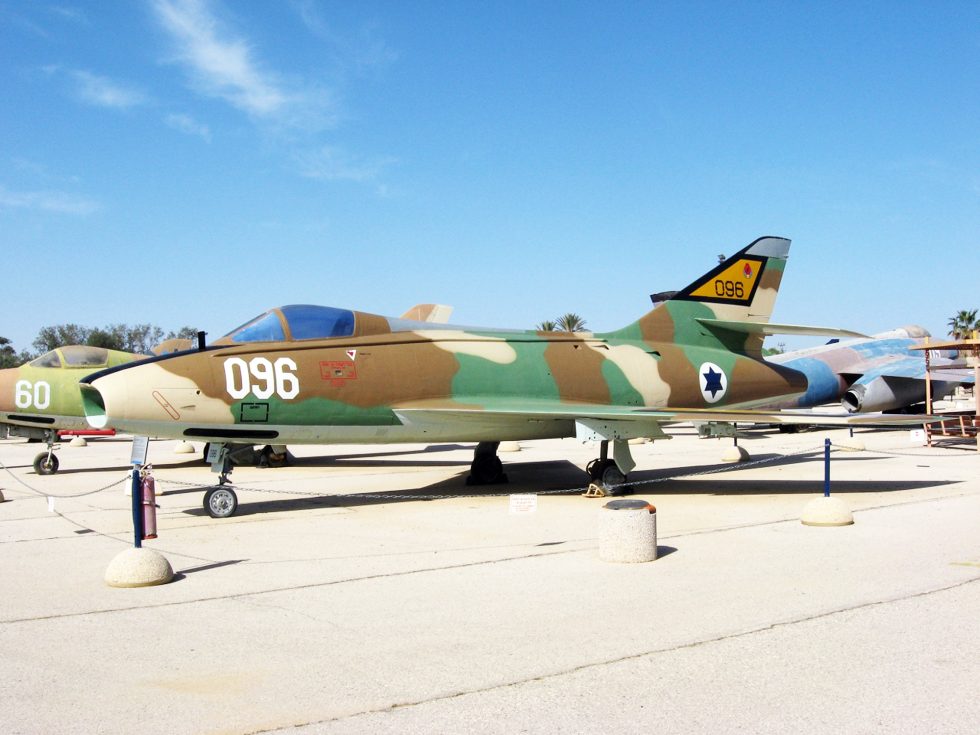
- The rebuild that matters, and the reason this airframe has a second half to its story. France embargoed Israel and the Atar became unsupportable, so Israel Aircraft Industries fitted a non-afterburning Pratt & Whitney J52-P-8A from A-4H Skyhawk stocks, with an extended tailpipe, reworked rear fuselage and new avionics. Prototype 909 flew on 13 February 1969, the first production conversion was delivered in December 1969, and all 26 surviving airframes were converted by early 1973. It flew 887 sorties in the Yom Kippur War for the loss of six aircraft, and the IAF retired the type in March 1975.
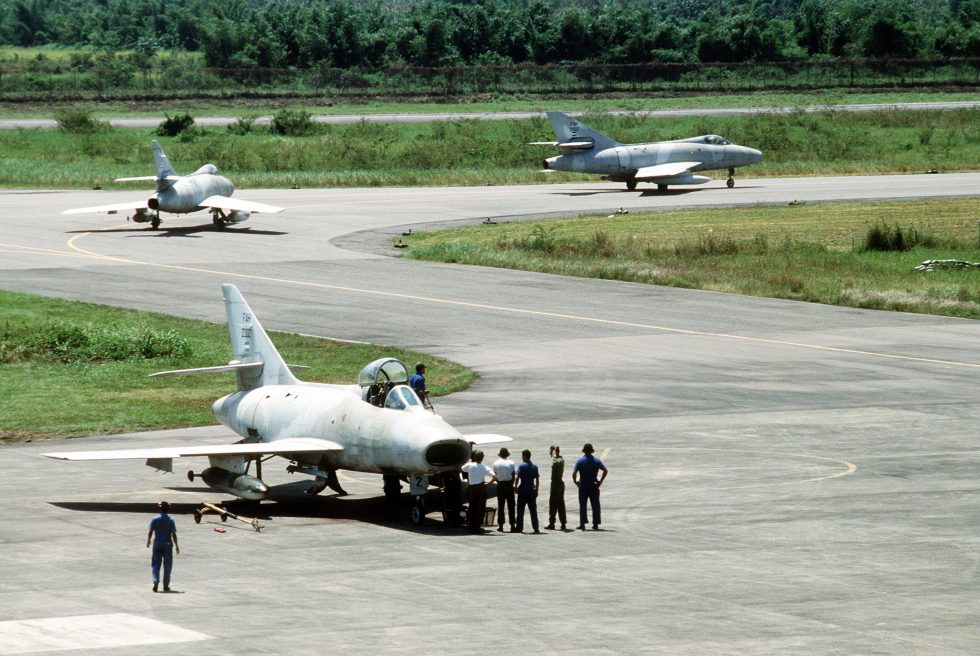
- Honduran Sa’ar (1976 and 1979, 16 delivered)
- Twelve refurbished ex-Israeli Sa’ars sold to the Fuerza Aérea Hondureña in 1976, with four more following in 1979. They were Honduras’s first supersonic-capable airframes on paper and its first jet fighters in practice — although with the J52 fitted they were no longer supersonic at all. Used through the Nicaraguan border tensions of the 1980s and withdrawn in January 1996, replaced by F-5E Tiger IIs that Honduras had in fact already had since 1987.
- French instructional airframes (1977 onwards, about 15)
- Not a variant so much as an afterlife: roughly fifteen retired Super Mystères went to the air technicians’ school at Rochefort as ground instructional airframes, which is where a good many French aircraft mechanics of the 1980s first learned what an afterburner looks like from the inside.
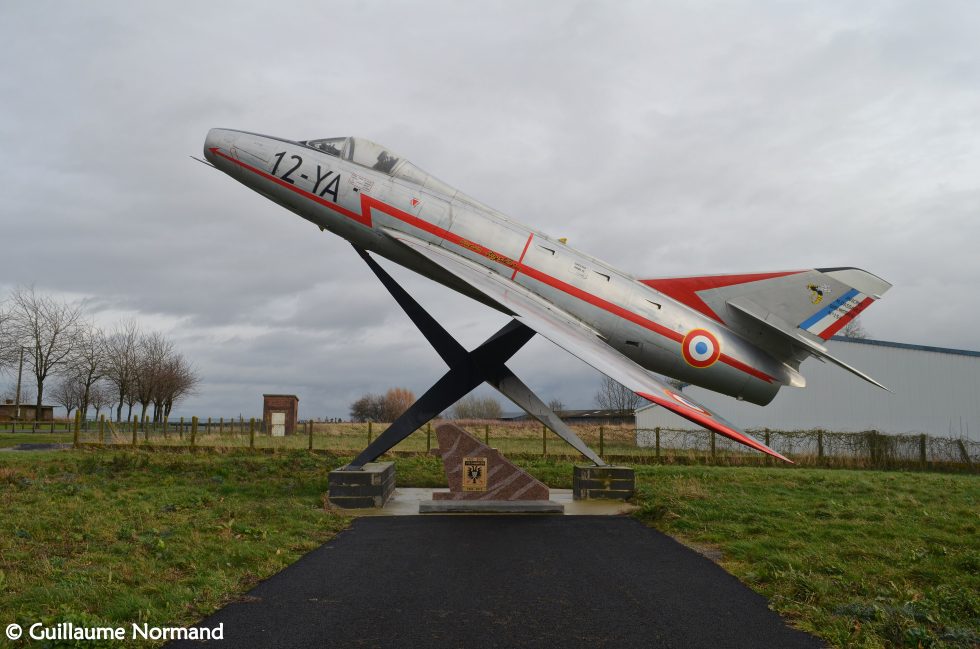
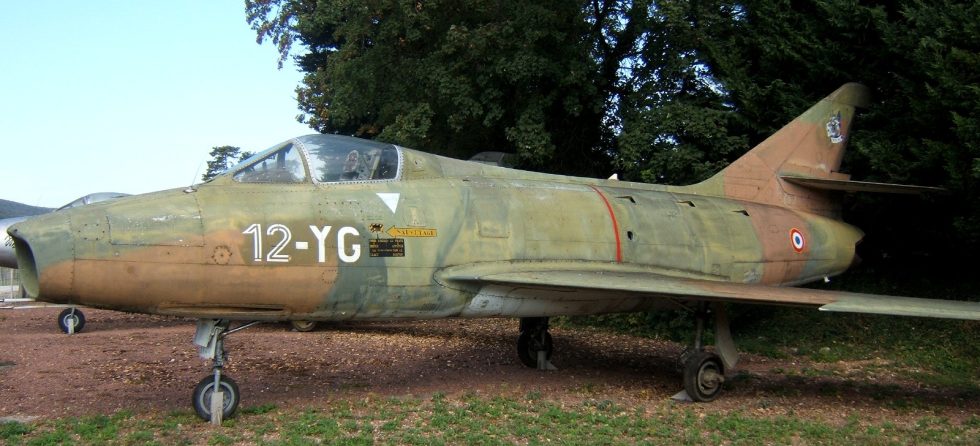
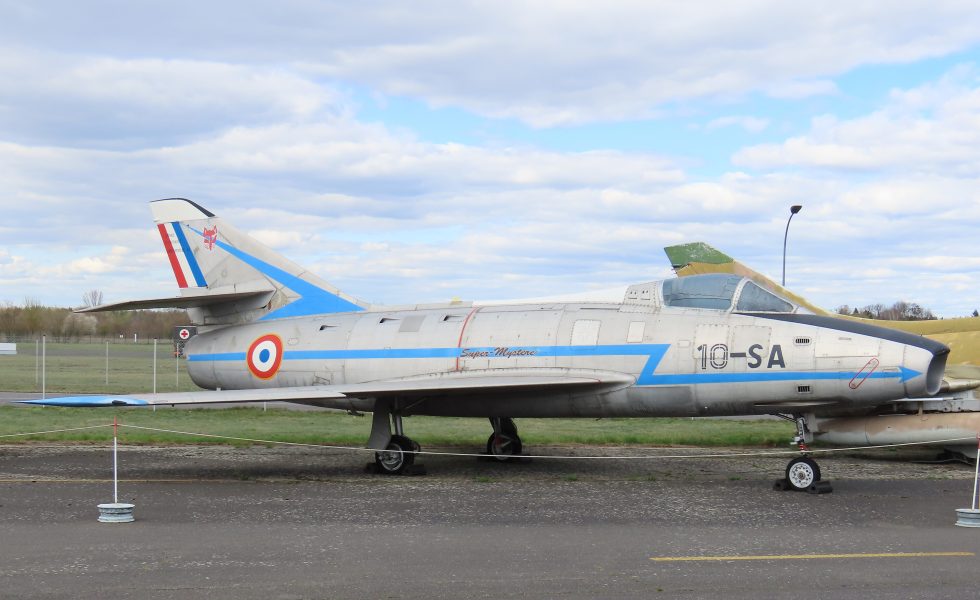
Survivors. No Super Mystère is airworthy anywhere and none has flown since the Honduran withdrawal in January 1996; every surviving airframe is a static exhibit, a gate guard, an instructional hulk or a cockpit section, and all of them are original production aircraft — no reproduction Super Mystère has ever been built, and given that the type was never a civil warbird there is no reason one ever would be. The best-documented survivors are in France: two at the Musée de l’Air et de l’Espace at Le Bourget, one at Aeroscopia at Toulouse-Blagnac, and a substantial cluster at the Château de Savigny-lès-Beaune, where several are complete aircraft and at least two are hulks and one is a cockpit section converted into a simulator. Others are preserved at the air bases of Orange-Caritat, Bordeaux-Mérignac and Vannes-Meucon, and two are in Germany, at the Militärhistorisches Museum Flugplatz Berlin-Gatow and the Flugausstellung at Hermeskeil. One Sa’ar, an aircraft withdrawn from Israeli service in March 1975, is displayed at the Israeli Air Force Museum at Hatzerim. In Honduras one airframe went to the Honduran Aviation Museum and around eleven more were offered for disposal as surplus after 1996; their fate is poorly recorded and the frequently repeated claim that ex-Honduran Super Mystères joined the American warbird circuit is not supported by any registry evidence traced here. Counts of survivors published online generally sit between fifteen and twenty airframes; the true figure depends entirely on whether hulks and cockpit sections are included, and no authoritative census exists.
From French prototype to the last supersonic in Central America
Development begins
Dassault starts work on a supersonic evolution of the Mystère IV, with a thinner swept wing and an afterburning engine.
First flight
The Super Mystère B.1 prototype flies on 2 March, powered by a Rolls-Royce Avon, and reportedly goes supersonic in level flight the next day.
French service
The production B.2, re-engined with the SNECMA Atar 101G, enters French Air Force service — Western Europe’s first mass-produced supersonic aircraft.
Israel buys in
Israel receives its first Super Mystères — 24 aircraft — its first supersonic fighter type.
Six-Day War
Israeli Super Mystères fly strike and ground-attack missions in the June 1967 war, hitting Arab airfields and armour.
Yom Kippur & the Sa’ar
The type flies its last major Israeli battles; survivors are re-engined with the Pratt & Whitney J52 as the IAI Sa’ar.
Sold to Honduras
Honduras buys about a dozen ex-Israeli Super Mystères, later adding more — the last export customer for the type.
The last ones retire
Honduras finally withdraws its Super Mystères, replacing them with F-5s — ending the career of the world’s first Western-European production supersonic jet.
From the flight line: twelve Super Mystere stories
Born from the Mystère IV
Dassault took its Mystère IV day fighter, gave it a thinner wing and an afterburner, and cracked Mach 1 in level flight.
Read the full story
Supersonic the next day
The B.1 prototype flew on 2 March 1955 and, by the most-repeated account, broke the sound barrier in level flight the following day.
Read the full story
From British Avon to French Atar
The prototype flew on a Rolls-Royce Avon; production Super Mystères switched to the home-grown SNECMA Atar 101G.
Read the full story
Israel’s first supersonic fighter
The Israeli Air Force bought 24 Super Mystères in 1958, its first supersonic type and a fair match for the MiG-19.
Read the full story
Into the opening strike
On 5 June 1967 Israeli Super Mystères joined the pre-emptive assault on Arab airfields, then flew ground attack for the rest of the war.
Read the full story
Duelling along the canal
Through 1967–1970 Super Mystères flew strike and patrol missions in the grinding artillery war along the Suez Canal.
Read the full story
The last Israeli battles
By October 1973 the Super Mystère was elderly but still flew ground-attack sorties; around six were lost in the war.
Read the full story
Re-engined as the ‘Storm’
Israel re-engined survivors with a non-afterburning Pratt & Whitney J52 and new avionics, renaming them the IAI Sa’ar.
Read the full story
A second life in Central America
Honduras bought about a dozen ex-Israeli Super Mystères in 1976, later adding a handful more.
Read the full story
Guarding the Nicaraguan border
In the 1980s Honduran Super Mystères flew patrol and support missions along a tense frontier with Sandinista Nicaragua.
Read the full story
The last Super Mystères in the sky
Honduras flew the type until 1996, making it the final operator of Western Europe’s first production supersonic aircraft.
Read the full story
The bridge to the Mirage
The Super Mystère was the last of Dassault’s swept-wing line before the delta Mirage III changed everything.
Read the full story
The Super Mystere in pictures
The Super Mystère in motion
Video coming soon. We are still sourcing a good, properly licensed film of the Dassault Super Mystère in flight and in service. In the meantime, explore the photo gallery, timeline and stories above for the full picture of Western Europe’s first production supersonic jet.
The Super Mystère in motion
Not A Pound For Air To Ground — one of the most-watched Super Mystère films on YouTube.
Where the Super Mystere flew
The score that defines it
The Super Mystère earned its combat reputation not in the record books but in the hard, repeated work of ground attack. In Israeli hands it fought through three wars — the 1967 Six-Day War, the War of Attrition and the 1973 Yom Kippur War — mostly striking airfields, armour and troops rather than duelling for air superiority. Precise air-to-air tallies for the type are contested and modest; its lasting mark is longevity, flying front-line missions for nearly four decades.
Compare the combat record of every military aircraft. Figures as of July 2026 and, for older conflicts, inevitably approximate.
Everything people ask about the Super Mystère
Can I fly in a Super Mystère?
Why is the Super Mystère historically important?
How is it different from the Mystère IV?
What is the IAI Sa’ar?
Did the Super Mystère see combat?
Who was the last operator?
How fast was it?
You can’t fly the Super Mystère.
These, you can.
Some legends only live in museums — others are fuelled and waiting. MiGFlug has put civilians in real military jet cockpits since 2004.
 Fly the L-39 AlbatrosThe world’s most-flown jet trainer — aerobatics included
 Fly the F-104 Starfighter“The missile with a man in it”
 Fly the MiG-21The Cold War’s most-produced jet
 Fly the T-33 Shooting StarAmerica’s first jet trainer
 Fly the DH VampireA piece of early jet history
 Fly the S.211Agile Italian jet trainer
 Fly the MB-326The classic Aermacchi jet
 Fly the MiG-15The Soviet legend of the Korean War
Continue the tour
Every fact, checked
- Vintage Aviation News — First Flight of the Dassault Super MystèreDevelopment from the Mystère IV, the 1955 first flight and the level-supersonic milestone.
- Military Factory — Dassault Super MystèreSpecifications, armament and operator history for France, Israel and Honduras.
- Fastest Planes — Dassault Super MystèrePerformance figures, Israeli combat service and the Sa’ar re-engining.
- Ailes Anciennes ToulouseFrench preservation notes and airframe history for the Super Mystère B.2.
- Jewish Virtual Library — IAI Sa’arThe Israeli Sa’ar conversion and its Pratt & Whitney J52 re-engining.
- The Little Aviation MuseumConcise type history, variants and service summary.
- National Museum of the US Air ForceReference for preserved supersonic fighter airframes on display.