
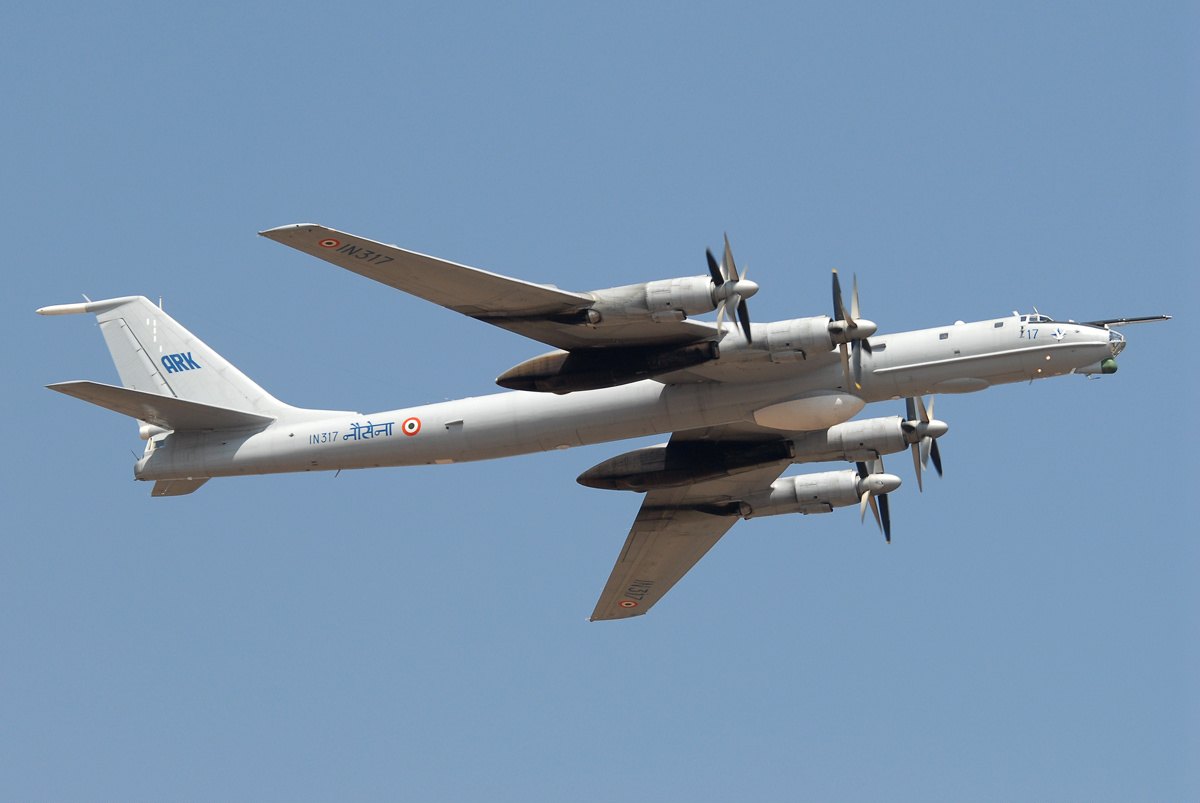
Tupolev Tu-142
“Bear-F” and “Bear-J”
The Bear that went to sea: a Tu-95 bomber rebuilt to hunt American missile submarines across whole oceans, flown by the Soviet and Russian navies since 1972 and by India for 29 years.
The Tu-142: how a strategic bomber learned to hunt submarines
The Tu-142 was born from fear of the Polaris submarine. In the early 1960s American missile boats could slip into the Norwegian Sea or the Mediterranean and launch against the Soviet Union from far beyond the reach of coastal patrol aircraft like the Il-38. The Soviet Navy needed something that could fly out over whole oceans, search for hours and come home. The obvious candidate was already in service: the Tupolev Tu-95 “Bear”, the long-range turboprop bomber with its four enormous contra-rotating propellers. On 28 February 1963 the Council of Ministers approved a maritime version, and the first Tu-142 flew on 18 June 1968, piloted by I.K. Vedernikov.
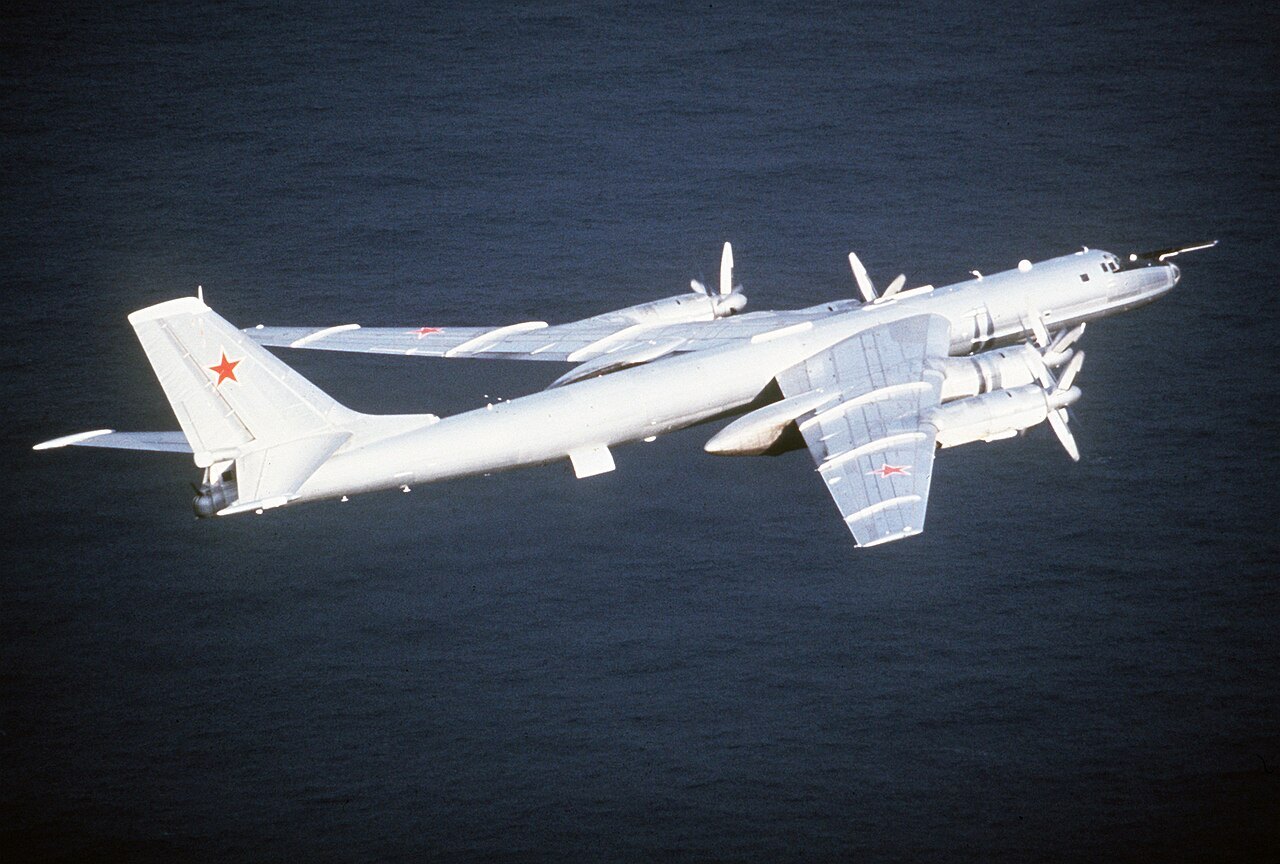
It was far more than a bomber with sonobuoys. The Tu-142 had a new, larger wing with more fuel, a reinforced airframe, a search radar under the nose, magnetic anomaly detection, a long weapons bay for torpedoes, depth charges and sonobuoys, and crew rest areas for missions lasting most of a day. The first aircraft entered naval service in May 1970 and the type was formally adopted on 14 December 1972. NATO called it the Bear-F. Production began at Kuibyshev, where 18 were built, then moved to Taganrog in 1975, and continued through ever more capable versions, the Tu-142M, MK, M3 and MZ, until 1994. In all, 100 were built.
The Tu-142 became the long arm of Soviet naval aviation, flying from Kipelovo in the north and from the Pacific coast, and, by Western accounts, from friendly airfields abroad. A communications relay version, the Tu-142MR “Bear-J”, trailed a very long wire aerial to talk to Soviet submarines underwater. India flew eight export Tu-142MK-Es from 1988 to 2017. Russia still operates around two dozen, and RAF and US fighters still meet them regularly, more than half a century after the first one flew. Few aircraft built to fight a specific Cold War threat have outlived that threat by so long, and fewer still remain so recognisable to the pilots sent up to meet them.
01The Tu-142 against Polaris: hunting submarines across oceans
For its crews, a Tu-142 mission was a marathon. The aircraft would fly out for many hours to a search area in the Atlantic, the Norwegian Sea or the Pacific, lay patterns of sonobuoys, and try to hold contact with a submarine designed above all to remain unheard. The results were hard won.
The early sensor suite was not good enough, and successive versions added better equipment: the Korshun search and targeting system on the Tu-142MK, improved NK-12MP engines on the Tu-142M3, and the Zarechye acoustic system on the Tu-142MZ. Each generation could search more water and track quieter boats. The race never ended, because American submarines kept getting quieter too.
The Tu-142’s range also made it a political tool. Deployments to friendly airfields abroad, reported by Western observers from Cuba to Vietnam, showed Soviet reach, and a Bear flying down the American east coast or along the Norwegian coast became one of the most familiar images of the Cold War.
02The Tu-142 in India: the Albatrosses of INAS 312
India became the type’s only export customer. Eight Tu-142MK-E aircraft, an export version with some systems downgraded, were bought for the Indian Navy, and the first three arrived at INS Hansa in Goa on 30 March 1988. They equipped INAS 312, the “Albatrosses”, which moved to INS Rajali at Arakkonam in Tamil Nadu in 1992.
For an Indian Navy watching a vast ocean, the Tu-142 brought a reach no other aircraft in the region could match. Within months of arrival it was in action: in November 1988, during Operation Cactus, Indian Tu-142s helped search for the ship in which mercenaries fled the Maldives and direct Indian frigates to it. Over the next three decades the Albatrosses flew long-range surveillance and anti-submarine missions across the Indian Ocean.
Supporting a small fleet of huge Soviet aircraft grew harder over time, and India bought the Boeing P-8I as their replacement. The last three Tu-142s were retired on 29 March 2017, after 29 years. One became a museum on the Beach Road in Visakhapatnam, opposite the INS Kursura submarine museum.
What makes the Tu-142 special
Contra-rotating turboprops
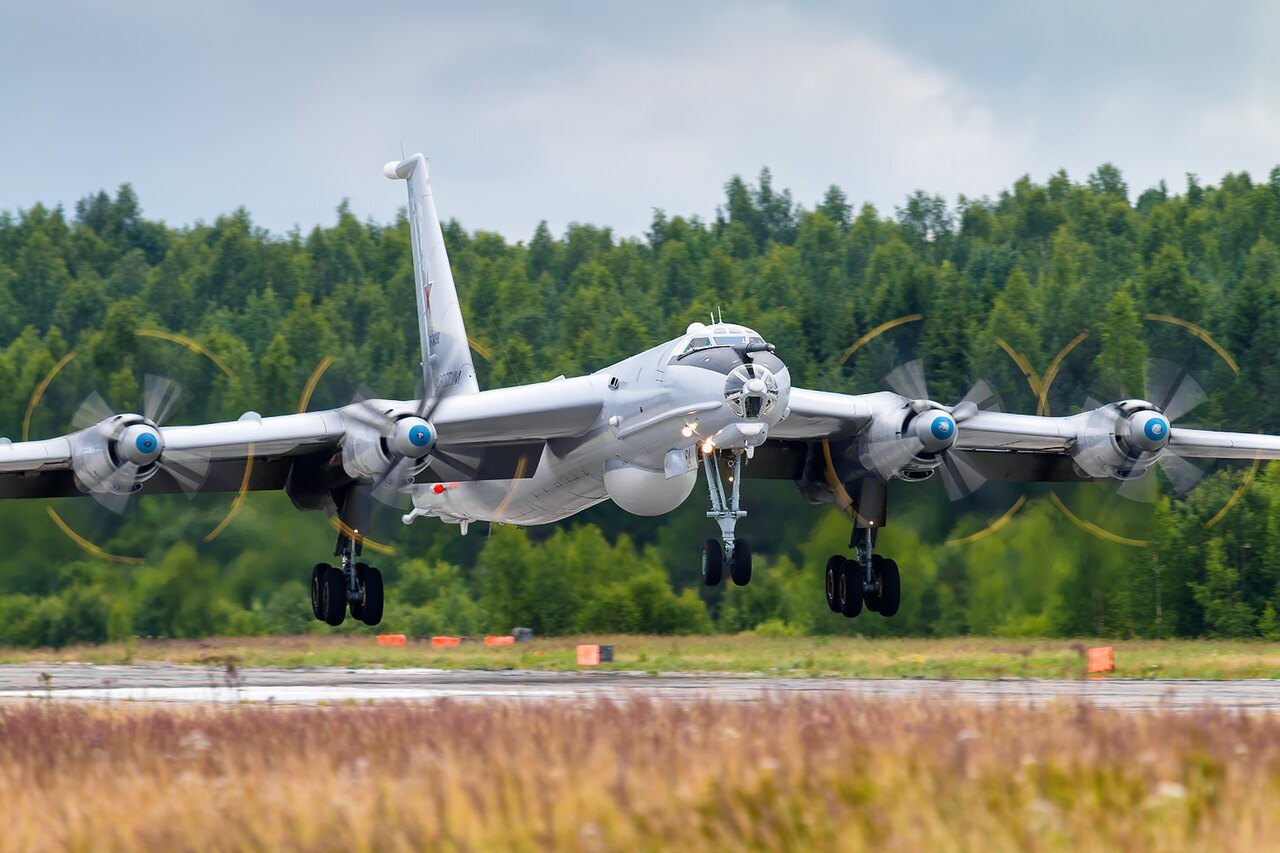
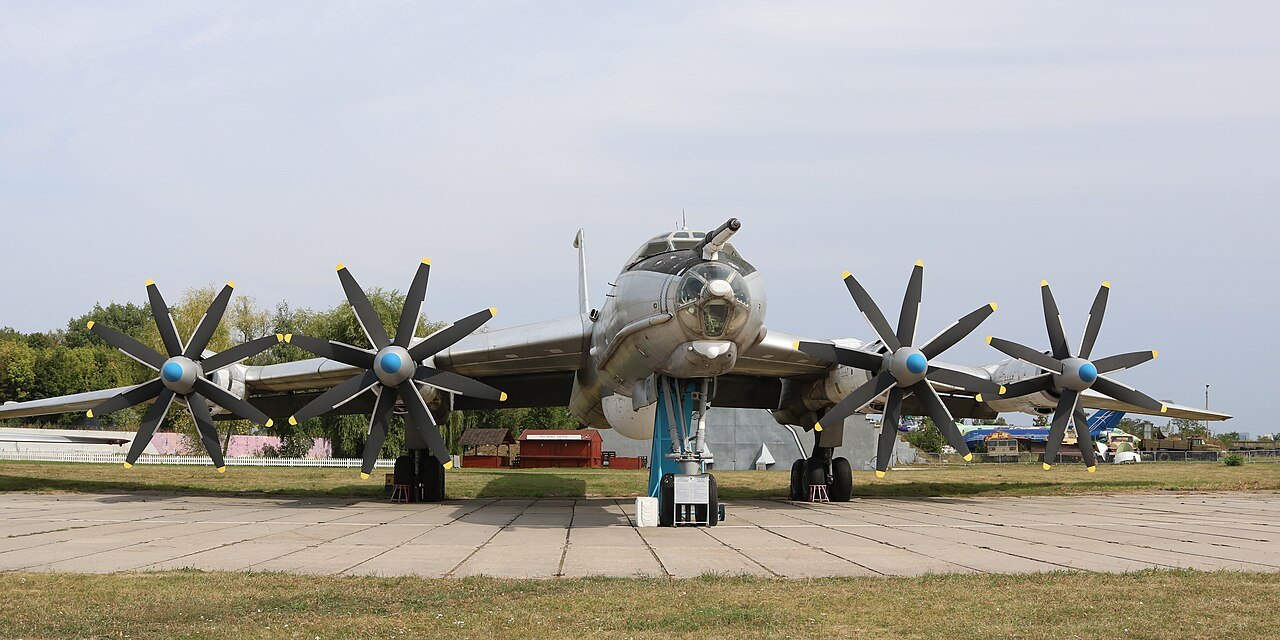
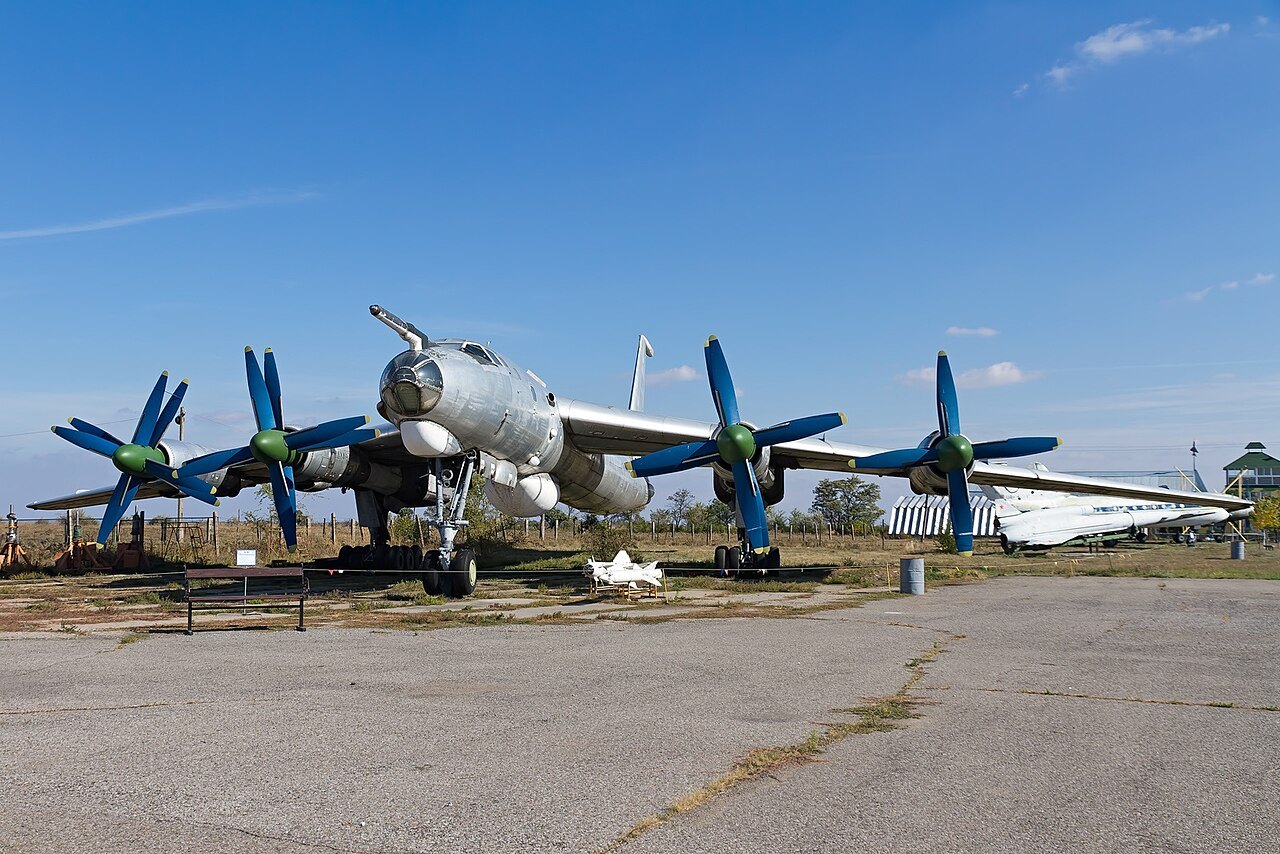
The Tu-142 inherited the Bear’s defining feature: four Kuznetsov NK-12 turboprops, among the most powerful ever built, each driving a pair of contra-rotating propellers. The combination gives a cruise speed close to that of jets with the fuel economy of a propeller aircraft, which is why the Bear family can cross oceans. It also makes the Tu-142 extraordinarily loud, and Western submarine crews were said to be able to hear the Bear family underwater, an awkward trait for an anti-submarine aircraft.
A new wing and a new mission
Although it looks like a Tu-95, the Tu-142 had a redesigned wing with a modified profile and more fuel, a stronger structure and new undercarriage. Early aircraft used large twelve-wheel main bogies for operations from poorer runways, later replaced by a four-wheel arrangement. The weapons bay was rebuilt for torpedoes, depth charges, mines and sonobuoys, and the fuselage was later stretched on the Tu-142M to improve the cockpit and crew space. Defensive armament remained a twin 23 mm tail gun position.
Bear-J: talking to submarines
The Tu-142MR, NATO’s Bear-J, is a different animal. It carries a very long trailing wire aerial that can be unreeled behind the aircraft to transmit very low frequency radio messages that penetrate seawater, allowing commanders to reach submerged missile submarines. It is the Soviet and Russian equivalent of the US Navy’s E-6 Mercury TACAMO aircraft, and it is the Bear-J, often together with a Bear-F, that RAF Typhoons have repeatedly met over the North Atlantic. Its long, thin aerial and dedicated crew make the Bear-J one of the rarest and most strategically important aircraft in the Russian Navy.
03The Tu-142’s crew and systems: a flying anti-submarine centre
A Tu-142 carries a crew of about eleven to thirteen: pilots, navigators, a flight engineer, radio and radar operators, acoustic operators and a tail gunner. The mission system integrates a search radar, sonobuoy receivers and processing, magnetic anomaly detection and navigation equipment so that contacts can be localised and attacked with homing torpedoes or depth charges.
Later versions continued to evolve. Russia has fitted the Gefest SVP-24 targeting system to improve weapons accuracy, and Jane’s reported plans to link Northern Fleet Tu-142s by datalink with Forpost drones so that unmanned aircraft could pass targeting data to the patrol aircraft. The basic airframe, however, is still that of a 1960s design flying on engines conceived in the 1950s.
Tupolev Tu-142M3 specifications
Specifications
- Crew
- 11–13
- Length
- 53.08 m (174 ft 2 in)
- Wingspan
- 50.00 m (164 ft 1 in)
- Height
- 12.12 m (39 ft 9 in)
- Empty weight
- 90,000 kg (198,416 lb)
- Max take-off weight
- 185,000 kg (407,855 lb)
- Powerplant
- 4 × Kuznetsov NK-12MP turboprops, about 11,000 kW (14,800 shp) each, with contra-rotating propellers
- Maximum speed
- Commonly given as 855–925 km/h (460–500 kn)
- Combat range
- About 6,500 km (3,500 nmi)
- Service ceiling
- About 12,000 m (39,000 ft)
- Armament
- Torpedoes, depth charges, mines and sonobuoys in an internal bay; twin 23 mm GSh-23 cannon in the tail
Costs & production
- Unit cost
- No reliable public figure; built only for the Soviet state and as a one-off export to India
- Cost per flight hour
- No published figure; given four NK-12 engines and a crew of a dozen, an estimate in the order of US$20,000 to 40,000 per hour is plausible, by analogy with other heavy four-engined military aircraft
- Production
- 100 aircraft, 1968 to 1994 (18 at Kuibyshev, the rest at Taganrog)
- Programme
- Russian upgrades including the SVP-24 Gefest targeting system and datalinks with drones
04The Tu-142’s variants: from Bear-F to Bear-J
- Tu-142: initial anti-submarine version, early aircraft with twelve-wheel main bogies.
- Tu-142M: stretched forward fuselage and improved cockpit.
- Tu-142MK: new Korshun search and targeting system.
- Tu-142MK-E: export version for India, eight delivered from 1988.
- Tu-142M3: improved version with NK-12MP engines and upgraded avionics.
- Tu-142MZ: final anti-submarine production version with the Zarechye acoustic system.
- Tu-142MR “Bear-J”: submarine communications relay aircraft with a trailing wire VLF aerial.
05The Tu-142’s operating costs: an expensive reach
Russia does not publish operating costs for the Tu-142. It is a heavy four-engined aircraft with a large crew, burning a great deal of fuel on missions that can last more than twelve hours, and its NK-12 engines and contra-rotating gearboxes are complex to maintain. India’s experience showed how hard it could be to keep a small export fleet supported over three decades. Any hourly figure is therefore an estimate; tens of thousands of dollars per hour is a fair order of magnitude for an aircraft of this class.
The Tu-142 from the Polaris scare to Shetland intercepts
Approved
On 28 February the Council of Ministers approves an anti-submarine version of the Tu-95.
First flight
The first Tu-142 flies on 18 June, piloted by I.K. Vedernikov.
First in service
The first Tu-142 enters operation with the Soviet Navy in May; crews train at Nikolayev.
Formally adopted
The Tu-142 is officially adopted on 14 December 1972.
Taganrog
After 18 aircraft at Kuibyshev, production moves to Taganrog.
India
The first three Indian Tu-142MK-Es arrive at Goa on 30 March; in November they take part in Operation Cactus.
Albatrosses move east
INAS 312 arrives at INS Rajali, Arakkonam, on 7 March 1992.
Production ends
The hundredth and last Tu-142 is completed.
Loss in the Strait of Tartary
A Pacific Fleet Tu-142 crashes in November, killing all eleven crew.
India retires its Bears
The Indian Navy retires its last three Tu-142s on 29 March after 29 years.
Off Shetland
RAF Typhoons intercept a Bear-F and a Bear-J north of Shetland in August.
Strike at Taganrog
On 30 May Ukraine claims two Tu-142s destroyed by drones at Taganrog.
Stories & eyewitnesses: the Tu-142 over three oceans
Cuba to Cam Ranh: the Bear abroad
The Tu-142 projected Soviet naval reach around the world.
Read the full story
Maldives, 1988: the Albatross’s first mission
Indian Tu-142s were in action within months of arrival.
Read the full story
Strait of Tartary, 2009: eleven lost
A Pacific Fleet Bear went into the sea during a training flight.
Read the full story
Iceland, 2003: Bears and Eagles
A post-Cold War return to old habits.
Read the full story
North of Shetland, 2023: Bear-F and Bear-J
RAF Typhoons met a pair of sea-going Bears.
Read the full story
India’s farewell: 29 years of the Albatross
The Indian Navy retired its last Bears in 2017.
Read the full story
Visakhapatnam: a Bear on the beach
India turned a Tu-142 into a museum.
Read the full story
Taganrog, 2026: drones over the Bears
Ukraine claimed two Tu-142s destroyed on the ground.
Read the full story
The Tu-142 in pictures
Where the Tu-142 flies and flew
The Tu-142’s record
The Tu-142 has never attacked a submarine in war, but it spent the Cold War tracking them across three oceans and still flies regular long-range patrols. In Indian service it took part in Operation Cactus in 1988, and in the Ukraine war its bases have become targets.
See how training and combat types compare in the military aircraft statistics database. Figures are approximate.
Everything people ask about the Tu-142
Can I fly in a Tupolev Tu-142?
What is the difference between the Tu-95 and the Tu-142?
What do Bear-F and Bear-J mean?
Is the Tu-142 still in service?
Did India fly the Tu-142?
How far can a Tu-142 fly?
Why is the Tu-142 so loud?
You can’t fly the Tu-142.
These, you can.
Most of this museum you can only look at. These genuine military jets you can fly yourself with MiGFlug — with aerobatics and time on the controls.
 Fly the L-39 AlbatrosThe world’s most-flown jet trainer — aerobatics included
 Fly the F-104 Starfighter“The missile with a man in it”
 Fly the MiG-21The Cold War’s most-produced jet
 Fly the T-33 Shooting StarAmerica’s first jet trainer
 Fly the DH VampireA piece of early jet history
 Fly the S.211Agile Italian jet trainer
 Fly the MB-326The classic Aermacchi jet
 Fly the MiG-15The Soviet legend of the Korean War
Continue the tour
Every fact, checked
- Tu-142 BearGlobalSecurity: 1963 decree, first flight 18 June 1968, adoption 14 December 1972, Kuibyshev and Taganrog production, fleet size, 2003 Iceland intercept
- Tu-142 (Russian-language encyclopedia entry)Ugolok Neba aviation encyclopedia: development history and variants (in Russian)
- TU-142M aircraft decommissioned after 29 yearsPress Information Bureau, Government of India, 2017: INAS 312, Rajali from 1992, 30,000 accident-free hours, Operation Cactus
- India poised to retire iconic Tu-142 fleetFlightglobal, 2017: Indian Navy Tu-142ME retirement at the end of March
- Russia conducts anti-submarine warfare exercise in AsiaThe Diplomat, 2017: Tu-142MZ fleet, production history and India’s eight Tu-142MK-Es
- Russian Navy to upgrade Tu-142 MPA with SVP-24 targeting systemArmy Recognition, 2018: SVP-24 Gefest upgrade announced by Igor Kozhin
- Indian Navy aircraft arrives in city, soon to be put in naval museumThe Statesman, 2020: Tu-142M for the New Town, Kolkata naval aircraft museum
- Ukrainian drones destroy two Russian Tu-142 aircraft, Iskander missile systemKyiv Independent, 30 May 2026: Ukrainian claim of a drone strike at Taganrog