
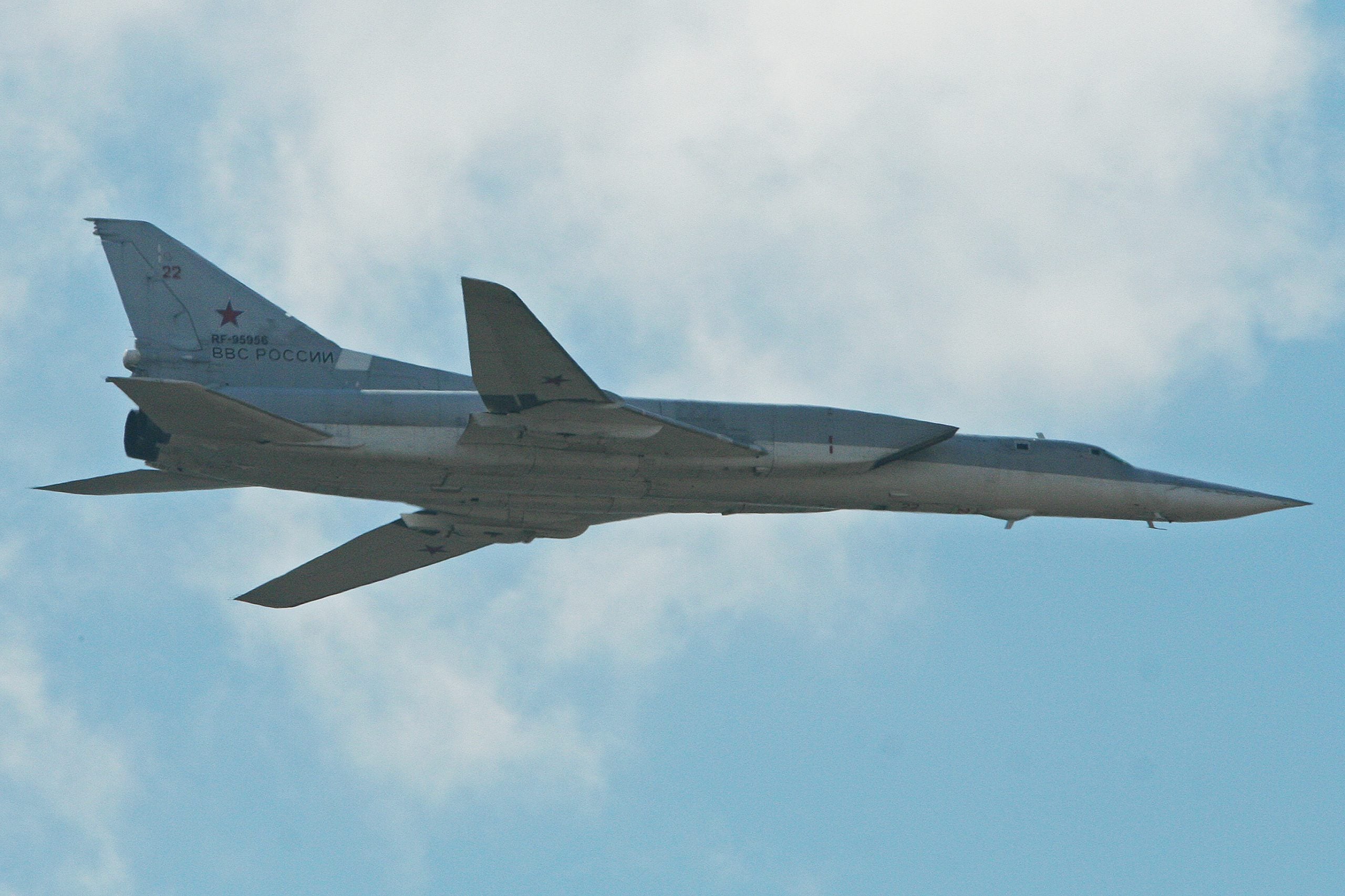
Tupolev Tu-22M
“Backfire”
A variable-sweep supersonic bomber built to hunt NATO carrier groups with heavy stand-off missiles — despite its designation, a largely new aircraft rather than a version of the earlier Tu-22, and one whose range once became a sticking point in Cold-War arms-control talks.
A new bomber wearing an old name
By the mid-1960s the Soviet Union’s first supersonic bomber, the fixed-wing Tupolev Tu-22 “Blinder,” had proved a disappointment — difficult to fly and short on range. Tupolev’s answer was a very different machine built around a variable-geometry “swing wing”: an aircraft able to take off and cruise economically with its wings spread, then sweep them back for a supersonic dash. It first flew as the Tu-22M0 on 30 August 1969 and, through successive versions, entered Soviet service during the 1970s. NATO named it “Backfire.”
Despite the shared “Tu-22” designation, the Backfire is largely a new design rather than a derivative of the Blinder. Several accounts suggest the “M” (modification) label was useful politically — it helped the programme through the Soviet bureaucracy and, during arms-control talks, could make the aircraft look like an upgrade of an existing type rather than a new strategic bomber. That framing should be treated as the widely reported explanation rather than documented certainty.
The Backfire was conceived above all as a stand-off missile carrier. Armed with the large, fast Kh-22 (NATO AS-4 “Kitchen”) missile, it was designed to threaten NATO aircraft-carrier groups and land targets from beyond the reach of their defences. The definitive version, the Tu-22M3 (“Backfire-C”), first flew in the late 1970s and became the main production model; roughly 500 Backfires of all versions were built before production ended in 1993. Russia continues to operate a fleet today and has been modernising survivors to Tu-22M3M standard.
01The Tu-22M Backfire versus the Tu-22 Blinder: why the names mislead
The earlier Tupolev Tu-22 “Blinder” was a fixed-wing supersonic bomber that entered service in the 1960s and earned a reputation as fast but troublesome, with limited range and demanding handling. When Tupolev developed its successor it adopted a variable-geometry wing and a substantially different airframe and mission profile, yet kept a designation in the “Tu-22” family — Tu-22M. The two aircraft are easy to confuse by name but are different machines: the Blinder is a slim, fixed-wing jet, while the Backfire is a larger swing-wing bomber optimised as a missile carrier. Some Western analysts at the time argued the “modification” designation understated how new and capable the Backfire really was. Treat the “deliberate disguise” version of the story as plausible but not firmly documented.
What makes it special
A variable-sweep wing and a supersonic dash
The Tu-22M3’s outer wing panels pivot from roughly 20° spread to about 65° swept. Spread, the long wing gives the lift and efficiency a heavy bomber needs for takeoff and cruise; swept back, drag falls away and the aircraft can dash to about Mach 1.88 at altitude. (The exact sweep angles are the commonly cited figures rather than a manufacturer-published table.) The swing wing is what lets one airframe both range far and sprint.
Heavy stand-off and anti-ship missiles
The Backfire was built around large stand-off missiles — principally the Kh-22 (NATO AS-4 “Kitchen”), a fast, long-range weapon designed to strike ships and land targets from well outside a defender’s reach. A Tu-22M3 can carry up to three Kh-22-class missiles, and later aircraft integrate the modernised Kh-32. Maximum ordnance is commonly cited at around 24,000 kg, including free-fall bombs.
A long-range maritime-strike role
More than a bomber, the Backfire was a naval threat. Soviet planners intended it to attack NATO aircraft-carrier battle groups and shipping in the North Atlantic and Pacific, closing at speed and launching heavy missiles from stand-off range. Its combat radius — commonly cited at roughly 2,400 km, though Cold-War estimates varied widely — made it a persistent concern for Western navies.
02The Tu-22M Backfire’s Kh-22 missile: an anti-ship weapon now used against land targets
The Kh-22 was designed in the Cold War as a supersonic anti-ship missile: launched from a Backfire, it would climb, accelerate to several times the speed of sound and dive onto a warship from stand-off range, with a large warhead intended to disable or sink major vessels. Its modernised successor, the Kh-32, is credited with improved range and guidance. In Russia’s war on Ukraine since 2022, Tu-22M3s have launched Kh-22 and Kh-32 missiles at ground targets — a role for which the anti-ship Kh-22 in particular was never designed. Western and Ukrainian assessments describe it as inaccurate against fixed land targets, and several deadly strikes on civilian buildings have been attributed to Kh-22-class missiles. Specific attributions are contested and are presented here factually, without endorsement.
03The Tu-22M Backfire and SALT: the arms-control fight over its range
During the SALT II negotiations of the 1970s, the Backfire became a point of dispute. US officials argued that with aerial refuelling the bomber might reach the continental United States, which would make it a strategic system that ought to count against treaty limits; Soviet officials maintained it was a medium-range theatre aircraft. The disagreement was politically significant. The Soviet side ultimately gave assurances about the aircraft’s production and range, and the aerial-refuelling probe was removed from Tu-22M aircraft to underline that it was not intended for intercontinental missions. Some Western sources later claimed the probes were retained and could be refitted — a claim that should be treated as unverified.
Full specifications
Baseline note: the figures below describe the Tu-22M3 (NATO Backfire-C), the only mark still flying and the aircraft behind every Russian Backfire sortie since the 1990s. Deltas for the earlier Tu-22M2 and the rebuilt Tu-22M3M in grey. One point of confusion has to be cleared first: the Tu-22M is not a Tu-22. The Tu-22 Blinder of 1958 was a fixed-wing three-crew bomber with its engines mounted either side of the fin, and it was so unpleasant to fly that the air force wanted it replaced almost at once. What Tupolev built instead was a new aeroplane — new fuselage, variable-geometry wing, four crew side by side and in tandem, different engines, different undercarriage — and then called it a modification of the old one. That framing helped get the money past a sceptical Soviet government, and it was useful again when Soviet negotiators sat down at SALT. There is a separate page for the Blinder.
Dimensions & weights
- Crew
- 4 — pilot and co-pilot side by side, navigator and weapon systems officer behind; the Tu-22 Blinder carried three
- Length
- 42.46 m (139 ft 4 in)
- Wingspan, wings forward
- 34.28 m (112 ft 6 in) at 20° sweep
- Wingspan, wings swept
- 23.30 m (76 ft 5 in) at 65° sweep
- Sweep range
- 20° to 65° — three working detents in practice: 20° for take-off and landing, 30° for cruise, 65° for the supersonic dash
- Height
- 11.05 m (36 ft 3 in)
- Wing area
- 183.6 m² (1,976 sq ft) spread; 175.8 m² (1,892 sq ft) swept
- Empty weight
- 58,000 kg (127,900 lb)
- Internal fuel
- ~54,000 kg (~119,000 lb) — nearly as much fuel as the aircraft weighs empty, and the reason the loss of the refuelling probe mattered so much
- Normal take-off weight
- 112,000 kg (246,900 lb)
- Maximum take-off weight
- 124,000 kg (273,400 lb); 126,400 kg (278,700 lb) with SPRD rocket-assisted take-off bottles, a fit rarely used in service
- Maximum ordnance
- ~24,000 kg (~52,900 lb) across the internal bay and four external stations — a theoretical figure that costs most of the range
- Wing loading
- 688 kg/m² (141 lb/sq ft) at normal take-off weight
Performance
- Maximum speed, altitude
- 2,000 km/h (1,240 mph), Mach 1.88 at 11,000 m — Frawley’s figure and the best-attested one. Tupolev and much of the Russian literature publish Mach 2.05, about 2,300 km/h (1,430 mph), for the M3; the M2 on its weaker NK-22s was limited to about Mach 1.65
- Maximum speed, low level
- ~1,050 km/h (~650 mph) — subsonic on the deck, unlike the Su-24 or the F-111
- Cruising speed
- 900 km/h (560 mph)
- Service ceiling
- 13,300 m (43,600 ft)
- Rate of climb
- 15 m/s (2,950 ft/min) at normal take-off weight
- Combat radius
- ~2,400 km (~1,490 mi) with a 10,000 kg (22,000 lb) load, unrefuelled
- Maximum range
- 6,800 km (4,225 mi); 7,000 km (4,350 mi) is quoted for the ferry case
- Combat radius, Western estimates
- 4,000–5,000 km (2,500–3,100 mi) per the Defense Intelligence Agency, 3,360–3,960 km (2,090–2,460 mi) per the CIA — the gap between those two numbers was the SALT argument about whether the Backfire counted as strategic
- Take-off run
- 2,000–2,100 m (6,560–6,890 ft) at normal weight — this is a big-runway aeroplane
- Landing
- Twin drag chutes, always deployed — the pair of canopies streaming behind a landing Backfire is the type’s visual signature
- Load factor limit
- +2.5 g — a bomber’s airframe, however fast it goes
- Thrust-to-weight
- 0.45 at normal take-off weight
Propulsion & systems
- Engines
- 2 × Kuznetsov NK-25 afterburning turbofans (Tu-22M2: NK-22, about 215 kN / 48,300 lbf each, with the distinctive raked intake ramps that identify a Backfire-B at a glance. The Tu-22M3M takes the NK-32-02 from the Tu-160M, about 245 kN / 55,100 lbf)
- Thrust, each
- 247.9 kN (55,730 lbf) with reheat — the M3 also received new wedge intakes and a reprofiled nose, worth roughly a third more range than the M2 on the same mission
- Fuel and refuelling
- ~54,000 kg internal, no drop tanks. A retractable probe sat in the upper nose on the M0, M1 and M2; it was removed in 1979 because in-flight refuelling made the aircraft look intercontinental to American negotiators. The airframe provision remained, and the Tu-22M3M reinstates the probe.
- Attack radar
- Leninets PNA family (NATO "Down Beat"), a dual-channel panoramic and aiming set for ship search and missile cueing; the PNA-D fit on the M3 improved low-altitude work. The M3M gets the phased-array NV-45M.
- Nav/attack system
- NK-45 Vakhta-2 complex — from 2015 a growing number of aircraft carry the Gefest SVP-24-22 bombing computer instead, the same family of retrofit that transformed Su-24 accuracy, credited with the tighter free-fall bombing seen over Syria
- Defensive fit
- Tail gun directed by a PRS-4KM Krypton radar, with chaff and flare dispensers and jammers. The Tu-22M3M deletes the gun entirely and puts an electronic self-defence suite in the tail cone.
- Crew escape
- 4 × KT-1M upward-firing ejection seats — a genuine improvement on the Tu-22 Blinder, whose crew were fired downwards and had no chance at low level
- First flight
- 30 August 1969 (Tu-22M0 pre-production aircraft); the definitive Tu-22M3 flew on 20 June 1977
- Service entry
- Tu-22M0 and M1 aircraft reached the Dyagilevo training centre in February 1973; the Tu-22M2 was in production from 1972 and the Tu-22M3 entered operational service in 1983 (the M3 was not formally adopted by state decree until the end of the decade, a common Soviet pattern)
- Number built
- 497 all marks — 9 Tu-22M0, 9 Tu-22M1, 211 Tu-22M2 (1972–1984) and about 268 Tu-22M3, production ending at Kazan in 1993. No Tu-22M was ever exported, unlike the Tu-22 Blinder, which went to Iraq and Libya.
- Unit cost
- Never published. In March 2025 the Ukrainian commander-in-chief valued a single Tu-22M3 at about US$100 million when one was destroyed on the ground at Shaykovka — a replacement-value claim rather than an accounting figure, and no line exists to build another.
04The Tu-22M Backfire’s cost: why no reliable price exists
The Tu-22M was a Soviet state product, never sold on an open market, so no firm flyaway unit price exists in the public record. Any dollar figure attached to the type is, in practice, an estimate — and Soviet-era production costs do not translate cleanly into Western accounting. No credible cost-per-flight-hour number exists for the aircraft in open sources either. Modernisation of survivors to Tu-22M3M standard has been described by Russian officials in rouble terms, but those are state-programme figures for a subsidised upgrade rather than a market price, and should be read as order-of-magnitude only.
Armament & payload
The Tu-22M was designed to sink American aircraft carriers and now throws 1960s anti-ship missiles at Ukrainian cities
Everything about the Backfire’s armament follows from one idea: a regiment of supersonic bombers launching enormous rocket-powered missiles from beyond the range of a carrier’s fighters, saturating the escort screen and letting arithmetic do the rest. The Kh-22 is the purest expression of that doctrine — nearly six tonnes, Mach 4.6, a one-tonne shaped-charge warhead that Soviet tests showed would punch a hole five metres wide and twelve metres deep. Against a 90,000-tonne warship radiating in the middle of an empty ocean, it was a serious weapon. Against a city block it is something else entirely: the missile’s terminal radar seeker was built to find the largest radar-bright object in a clear seascape, and over land it finds whatever it finds. At Kremenchuk in June 2022 two Kh-22s aimed at the same point landed 450 metres apart, one of them in a shopping centre; at Dnipro in January 2023 one demolished a nine-storey block of flats and killed at least 44 people. Fits vary sharply by mark and by decade: the M2 typically carried one or two Kh-22s, the M3 added the Kh-15 rotary launcher and the heavy free-fall loads, and the M3M is being cleared for the Kh-32 and for weapons Russia has announced but not demonstrated.
Gun
- One Gryazev-Shipunov GSh-23 twin-barrel 23 mm cannon in a remotely controlled UKU-9K-502 tail turret, aimed by the PRS-4KM Krypton radar or a television sight
- Rate of fire about 3,400 rounds per minute — a genuinely dangerous weapon at close range, and by the 1980s an almost entirely symbolic one against the missile-armed fighters it would actually meet
- The gunner’s position was folded into the weapon systems officer’s station; there is no dedicated tail gunner as on the Tu-95
- Some Russian Tu-22M3s have been seen with the turret faired over, and the Tu-22M3M deletes the gun outright, filling the tail cone with electronic countermeasures instead — a tacit admission that a tail gun on a modern bomber is dead weight
Air-to-air
- None carried. The Tu-22M has never had an air-to-air missile capability of any kind on any mark
- Its entire self-defence answer is the tail cannon, the jammers and the chaff and flare dispensers — and, in doctrine, a fighter escort that in practice was almost never available at the ranges the bomber worked at
- A dedicated interceptor derivative, the Tu-22DP, was studied on both the M2 and M3 airframes as a long-range killer of NATO maritime patrol and airborne early warning aircraft. It never left the drawing board
- This matters in Ukraine: the Backfire has no way to defend itself against a fighter or a long-range surface-to-air missile except distance, which is why Russian crews launch from deep inside Russian airspace
Air-to-surface guided
- Raduga Kh-22 and Kh-22M/MA (AS-4 Kitchen) — 5,820 kg, 11.65 m long, liquid-fuel rocket burning Tonka-250 and red fuming nitric acid, Mach 4.6 in the high dive, about 600 km range, one-tonne conventional or a 350–1,000 kt nuclear warhead. Up to three carried: one semi-recessed in the bay, one under each wing glove
- Raduga Kh-32, in service since 2016 — the same airframe with a new motor and a new seeker, a lighter 500 kg warhead, a claimed 1,000 km range and a profile that climbs to about 40 km before diving. Inertial plus radar homing, with no satellite navigation to jam
- Raduga Kh-15 (AS-16 Kickback) short-range air-launched ballistic missile — six on an MKU-6-1 rotary launcher in the bay plus four underwing, ten in all. Built for defence suppression and for nuclear use; not seen in the Ukraine war
- Kh-47M2 Kinzhal carriage is claimed but not established. Russian state media reported a Tu-22M3 test launch in 2018 and Tu-22M-launched "Kinzhal-type" strikes on Odesa in May 2022, and the Tu-22M3M is advertised as carrying four. No clear imagery of a Kinzhal on a Backfire has emerged, and every well-documented operational launch of the weapon has come from a MiG-31K
- The Kh-55 (AS-15 Kent) long-range cruise missile was test-flown on the Tu-22M but never adopted — almost certainly because a Backfire carrying strategic cruise missiles would have destroyed the arms-control fiction the aircraft’s designation was built to protect
Bombs
- Up to 69 × FAB-250 (250 kg) — the classic Afghanistan and Syria load, dropped in a single ripple from the internal bay and the two multiple-ejector fuselage racks
- Up to 18 × FAB-500 (500 kg) in the bay and on the wing pylons, or 8 × FAB-1500 (1,500 kg)
- FAB-3000M-46 (3,000 kg) — wartime stocks were reactivated in 2022 for use against the Azovstal works at Mariupol, the heaviest conventional bombs Russia has dropped in the war
- Free-fall nuclear weapons in the bay. The nuclear mission was always the reason the West cared about this aeroplane, whatever the negotiators agreed to write down
- Accuracy with unguided bombs was poor until the Gefest SVP-24-22 computer retrofit, which used satellite navigation and continuously computed release points to bring a 1970s bomber up to something like modern free-fall standards
Rockets
- None. No unguided rocket pod has ever been a service fit on any Tu-22M
- The omission is not an oversight. A 124-tonne bomber does not make shallow strafing passes, and the Backfire has no forward-firing gun and no gunsight for one
- Over Afghanistan the type was used precisely as a heavy bomber — level deliveries of large tonnages from medium altitude against fixed positions and supply routes, with the close-in work left to MiG-27s and Su-25s
- The nearest thing to a short-range attack weapon in the Backfire’s arsenal is the Kh-15, which is a ballistic missile, not a rocket
Pods & other stores
- Naval mines — a core Soviet Naval Aviation task and one the type still practises. In the 1980 Warsaw Pact exercise that first revealed the aircraft publicly, naval Tu-22M2s mined stretches of the Baltic to simulate blocking an amphibious landing
- MKU-6-1 rotary launcher for six Kh-15s, and multiple-ejector racks under the fuselage for the heavy free-fall loads
- Internal jammers and chaff and flare dispensers rather than podded countermeasures; nothing is hung externally that does not have to be, because external stores cost this aeroplane range it cannot spare
- Tu-22MR conversions carry the Shompol side-looking airborne radar and electronic intelligence equipment in place of the strike fit — perhaps twelve aircraft, one of which was shot down by a Georgian Buk-M1 in August 2008
- No targeting pod of any kind. The Backfire cannot self-designate for laser-guided weapons and never has been able to
Three typical loadouts
- Carrier-group strike, North Pacific 1982
- One Kh-22M semi-recessed in the weapons bay and one under each wing glove, three missiles in all, wings at 65° for the run-in. A regiment would launch dozens of these together against a battle group, accepting heavy losses among the bombers to saturate the escorts. Eight Tu-22Ms locked up USS Enterprise and USS Midway in exactly this way between 30 September and 1 October 1982, closing to within about 190 km.
- Area bombing, Afghanistan 1988 and Syria 2016
- A full internal and external free-fall load — typically 69 × FAB-250 or a mix of FAB-500s and FAB-1500s — released from medium altitude in a single pass. Sixteen Tu-22M3s covered the Soviet withdrawal from Afghanistan this way in October 1988; six aircraft flew the same profile against targets around Palmyra in July 2016, staging from Russia and later from Iran’s Hamedan airbase.
- Stand-off strike on Ukraine, 2022 to date
- Two or three Kh-22 or Kh-32 missiles, launched from well inside Russian or Belarusian airspace and often over the Sea of Azov or the Caspian. The aircraft never enters Ukrainian air defence coverage. Ukraine’s commander-in-chief reported in August 2024 that of 362 Kh-22 and Kh-32 missiles fired since 2022, precisely two had been intercepted.
Sourcing caveat: the Kh-22’s published circular error is an anti-ship figure derived from tests against radar-reflective targets at sea and should not be read across to land attack, where the miss distances actually observed in Ukraine run to hundreds of metres. Russian claims about Kinzhal carriage on the Tu-22M rest almost entirely on TASS and ministry statements. Weapon fits described here are drawn from published Russian and Western reference works and from open-source verification of strikes in Ukraine; where a claim comes only from one side it is flagged as such above.
Variants
Nine Backfires and a supersonic business jet that never was
The Tu-22M line is unusually clean for a Soviet aircraft: two small pre-production batches, two large production marks, and then thirty years of trying to modernise the second one. The break between the M2 and the M3 is the important one — new engines, new intakes, a reprofiled nose and a third more range — and it is what separates a 1970s aeroplane that could barely reach its patrol areas from one that is still flying strike missions today.
The genuinely interesting entries are the failures. The Tu-22M4 would have put Tu-160 engines and radar into the airframe in 1990 and was killed by the collapse of the Soviet Union eighteen months later. The Tu-22DP would have turned a bomber into an interceptor of NATO maritime patrol aircraft. The Tu-344 would have carried a dozen executives at Mach 2. None of them happened, and the fleet flying in 2026 is a fleet of forty-year-old M3s with new computers bolted on.
- Tu-22M0 (1969–1971, 9 built)
- Pre-production aircraft, first flight 30 August 1969. Delivered to the Dyagilevo combat training centre in February 1973; crews were type-rated within twenty days.
- Tu-22M1 (1971–1972, 9 built)
- Pilot-production batch, NATO Backfire-A. Longer wings than the M0 and a lighter structure. Still carried the nose refuelling probe.
- Tu-22M2 (1972–1984, 211 built)
- First full production mark, NATO Backfire-B. NK-22 engines, area-ruled fuselage, four crew, main undercarriage moved from wing-mounted pods into the wing glove. Top speed about Mach 1.65; usually one or two Kh-22s. Some were re-engined with NK-23s as the Tu-22M2Ye.
- Tu-22M3 (1977–1993, about 268 built)
- NATO Backfire-C and the definitive aircraft. NK-25 engines, wedge intakes, reprofiled nose, NK-45 nav/attack system for improved low-altitude flight, Kh-15 rotary launcher. A third more range than the M2. Everything Russia flies today is one of these.
- Tu-22M3 with SVP-24-22 (from 2015, roughly a dozen aircraft)
- Gefest & T bombing-computer retrofit — new onboard computer, satellite navigation receiver, collimator display, solid-state recorder. Cheap, quick, and by far the most consequential upgrade the fleet has actually received. Deliveries: 5 in 2015, 2 in 2017, 1 in 2018, 2 in 2019, 2 in 2022.
- Tu-22MR (from the 1980s, perhaps 12 converted)
- Reconnaissance and electronic intelligence conversion with the Shompol side-looking radar. One was shot down over South Ossetia by a Georgian Buk-M1 on 9 August 2008, killing two of the four crew.
- Tu-22M4 (1983–1991, 1 prototype)
- Deep modernisation with Tu-160 NK-32 engines, new intakes, the Obzor radar and Kh-32 or ten Kh-15s. Prototype 4504 was built at Kazan in 1990 and the programme was stopped in November 1991. The aircraft survives in the Dyagilevo museum.
- Tu-22DP (project only, 1980s)
- Long-range interceptor study on the M2 and later the M3, intended to hunt NATO maritime patrol and airborne early warning aircraft far out over the ocean while keeping a strike capability. Never built.
- Tu-344 (project only, later 1990s)
- Supersonic business jet for ten to twelve passengers on the M3 airframe, drawn up when Tupolev was desperate for conversion work. It could not have met international noise or emissions rules and went nowhere.
- Tu-22M3M (from 2018, up to 30 planned)
- The current rebuild: NK-32-02 engines, phased-array NV-45M radar, glass cockpit, GLONASS, new electronic warfare suite, the tail gun replaced by defensive electronics, and the refuelling probe restored. Rolled out at Kazan on 16 August 2018, first flight 28 December 2018. Deliveries were expected from 2021 and the programme has slipped badly.
Fleet numbers, in place of a chart: Russia is the only operator and always has been, so there is nothing to compare it against. The IISS Military Balance counted 57 Tu-22Ms in Russian service in 2024 and 55 Tu-22M3s plus one Tu-22MR in overhaul in 2025, spread across Olenya, Belaya, Shaykovka and the Dyagilevo training unit. Ukraine’s military intelligence directorate put the number actually flyable at 27 as far back as August 2023, and the fleet has been attacked repeatedly on the ground since: aircraft damaged or destroyed at Dyagilevo in December 2022, Soltsy in August 2023, Olenya in 2024, Shaykovka in March 2025, and at least four destroyed at Belaya in Operation Spiderweb on 1 June 2025. One was lost in the air near Stavropol on 19 April 2024 — Russia called it a technical malfunction, Ukraine claimed an S-200 shot from roughly 300 km away, and if the Ukrainian account holds it is the only Backfire ever shot down by a fighter or missile in air combat. Ukraine inherited 60 Tu-22M2s and M3s in 1991 along with 423 Kh-22s and scrapped all of them under the Nunn–Lugar programme, the last in January 2006. No Tu-22M was ever exported; talks with India, Iran and China all came to nothing. Production ended in 1993 and the line no longer exists, so every airframe lost is permanent.
From Cold-War carrier-hunter to modern missile carrier
Blinder’s shortcomings
The fixed-wing Tu-22 “Blinder” proves fast but short-ranged and hard to fly, prompting Tupolev to design a swing-wing successor.
First flight
The Tu-22M0 prototype makes its maiden flight on 30 August 1969, introducing the variable-geometry wing.
Into service & SALT dispute
Early Backfires enter Soviet service; the aircraft’s range becomes a contested issue in SALT II talks, and its refuelling probe is later removed.
The definitive Tu-22M3
The Tu-22M3 (“Backfire-C”) becomes the main production version, with more powerful NK-25 engines and the Kh-22 missile.
Afghanistan
Tu-22Ms fly conventional bombing missions, most intensively during the Soviet withdrawal from Afghanistan.
First combat loss
A Tu-22M3 is shot down over Georgia on 24 August 2008 during the Russo-Georgian War — the type’s first known combat loss.
Syria
Tu-22M3s conduct conventional bombing strikes in Syria from Russian territory.
Ukraine war & reported losses
Russia uses Tu-22M3s to launch heavy Kh-22/Kh-32 missiles at Ukrainian ground targets; a Tu-22M3 is lost in April 2024 in circumstances Russia and Ukraine describe differently.
Twelve stories of the Backfire
A swing wing for a failed bomber
The disappointing Tu-22 Blinder drove Tupolev to a very different successor.
Read the full story
Why the designation misleads
Despite the shared “Tu-22” label, the Backfire is largely a new aircraft.
Read the full story
Built to hunt carriers
The Backfire was designed to threaten NATO carrier groups with heavy missiles.
Read the full story
The swing wing
Variable-geometry wings let one airframe both range far and dash fast.
Read the full story
The SALT argument
US and Soviet negotiators clashed over whether the Backfire was strategic.
Read the full story
The Kh-22 “Kitchen”
A large supersonic missile designed to sink ships from stand-off range.
Read the full story
Conventional bombing
Backfires flew heavy bombing missions late in the Soviet-Afghan War.
Read the full story
The first combat loss
A Tu-22M3 was shot down during the 2008 Russo-Georgian War.
Read the full story
A late combat debut abroad
Tu-22M3s bombed targets in Syria from Russian territory.
Read the full story
Missiles against ground targets
Since 2022 Backfires have launched heavy Kh-22/Kh-32 missiles at Ukraine.
Read the full story
A downing both sides describe differently
A Tu-22M3 came down in southern Russia in April 2024.
Read the full story
Ageing fleet, slow upgrade
Russia keeps a Backfire fleet and is modernising survivors to Tu-22M3M.
Read the full story
The Backfire in pictures
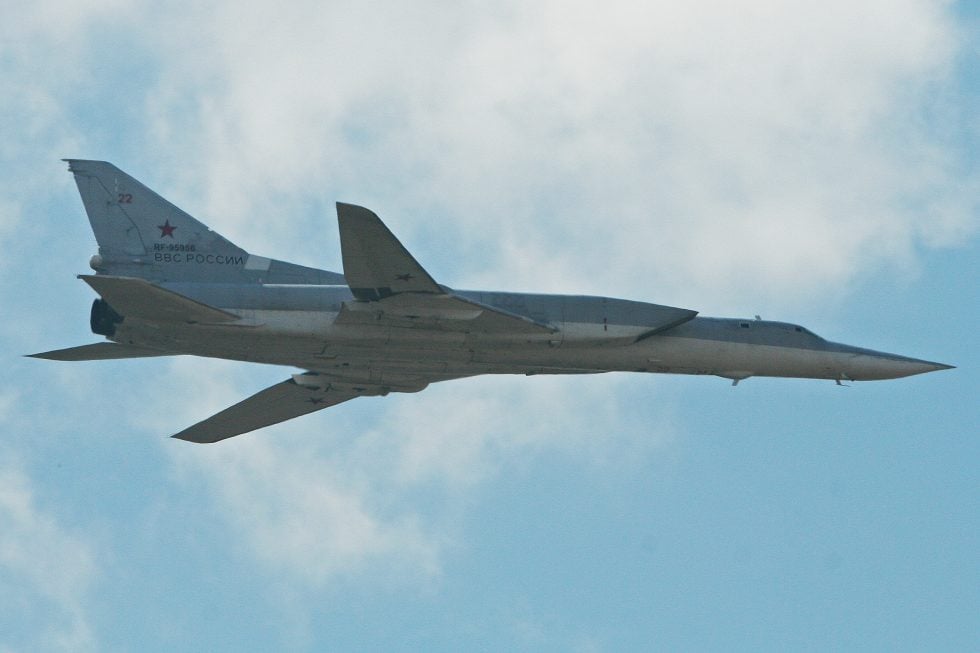
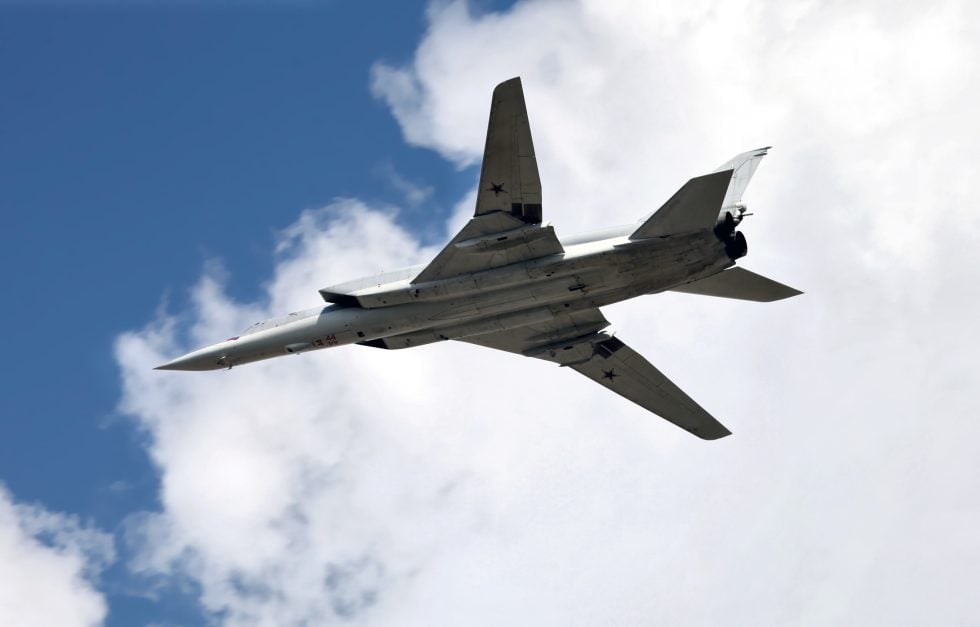
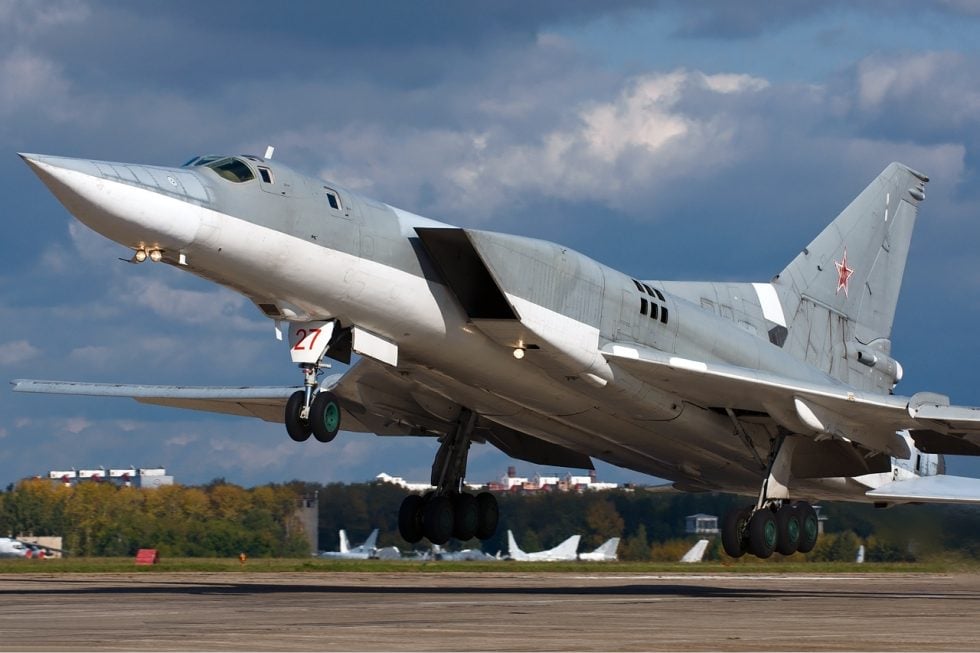
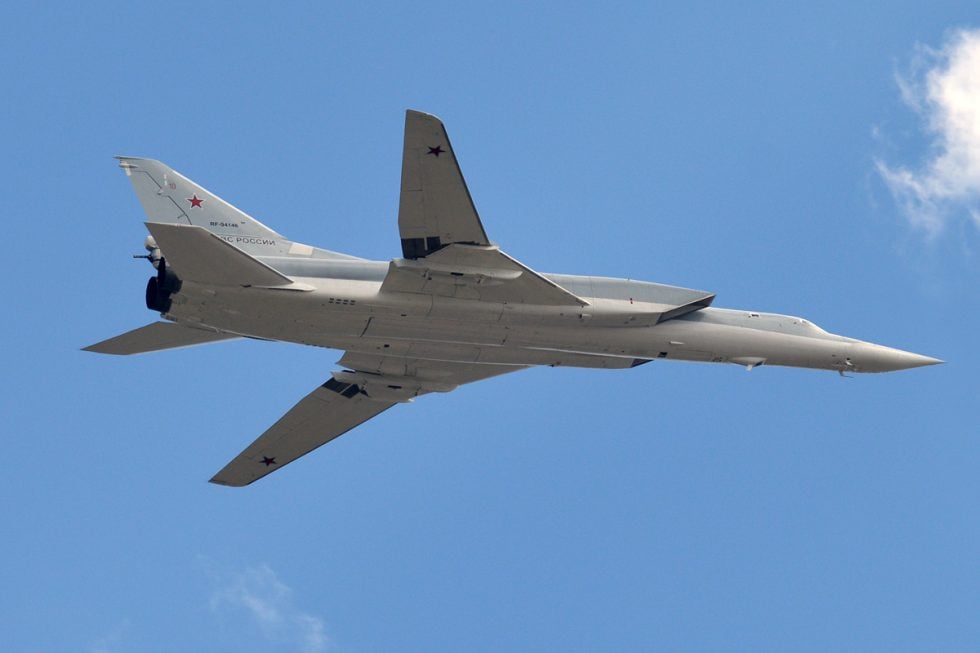
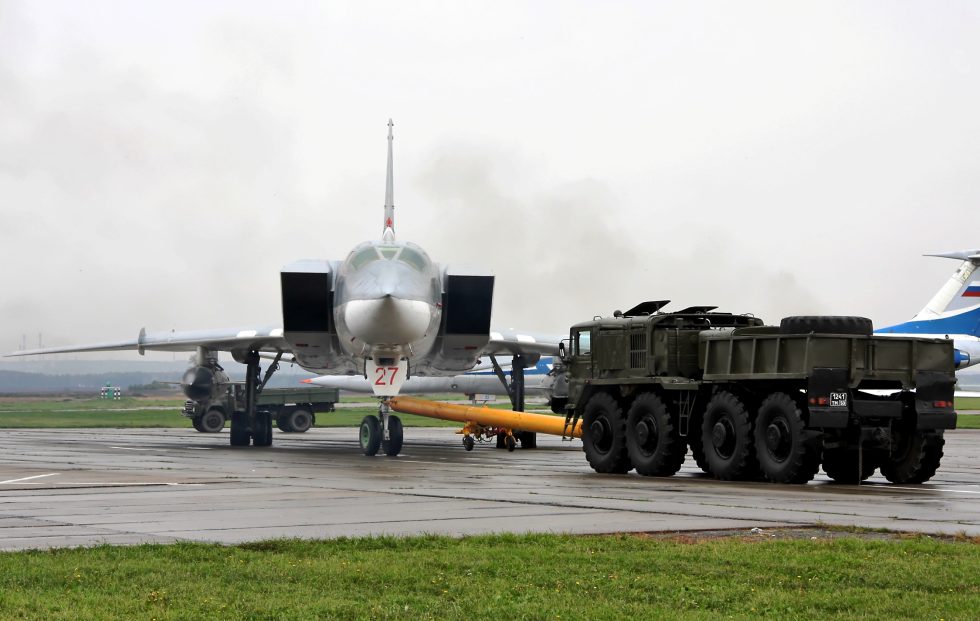
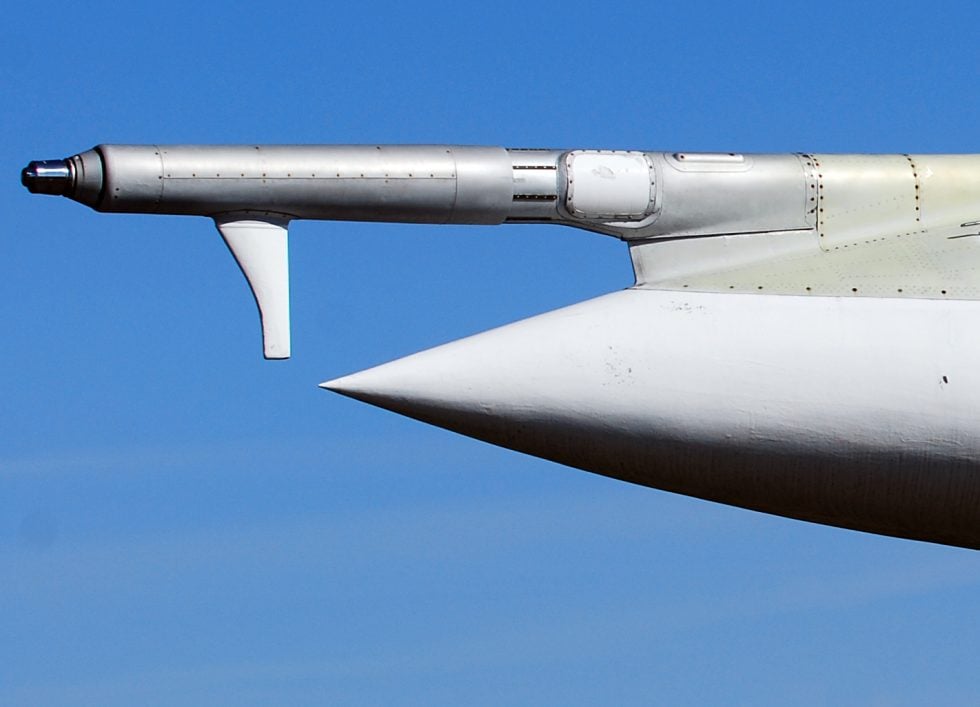
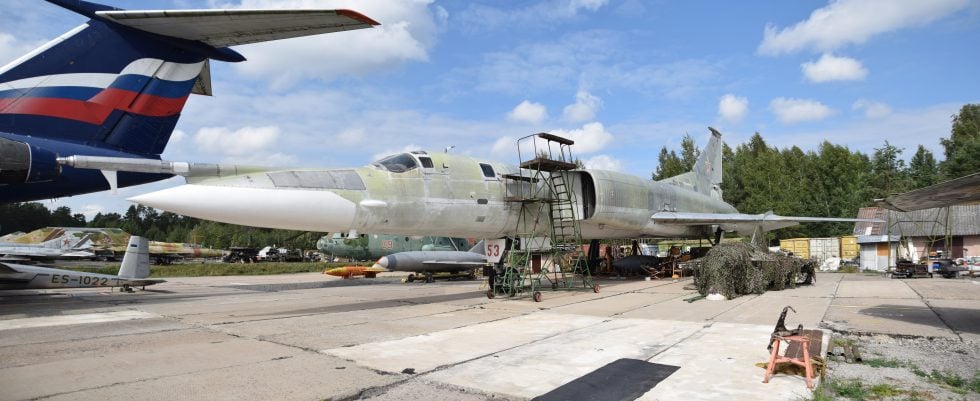
The Backfire in motion
A verified, high-authority video feature for the Tu-22M is still being selected — video coming soon. In the meantime, the photo gallery above and the stories carousel cover the aircraft in depth.
Where the Backfire operates
The record that defines it
For most of the Cold War the Tu-22M was a deterrent and a maritime-strike threat that never fired in anger. Its later record is written in conventional bombing and, more recently, in the use of heavy stand-off missiles against ground targets — a role for which its anti-ship Kh-22 was not designed. Claims arising from its combat use are contested; we present them factually and without endorsement.
Compare the combat record of every military aircraft. Figures as of July 2026.
Everything people ask about the Tu-22M
Can I fly in a Tu-22M?
How fast is the Tu-22M?
Is the Tu-22M the same as the Tu-22 Blinder?
What is the Tu-22M’s main weapon?
Why was the Tu-22M an issue in arms-control talks?
Has the Tu-22M been used in combat?
Did Ukraine ever operate the Tu-22M?
How many Tu-22Ms were built, and is it still in service?
You can’t fly the Tu-22M.
These, you can.
Some legends only live in museums — others are fuelled and waiting. MiGFlug has put civilians in real military jet cockpits since 2004.
 Fly the L-39 AlbatrosThe world’s most-flown jet trainer — aerobatics included
 Fly the F-104 Starfighter“The missile with a man in it”
 Fly the MiG-21The Cold War’s most-produced jet
 Fly the T-33 Shooting StarAmerica’s first jet trainer
 Fly the DH VampireA piece of early jet history
 Fly the S.211Agile Italian jet trainer
 Fly the MB-326The classic Aermacchi jet
 Fly the MiG-15The Soviet legend of the Korean War
Continue the tour
Every fact, checked
- Federation of American Scientists — Tu-22M BackfireDevelopment history, variants, the SALT/refuelling dispute and production numbers.
- Airforce Technology — Tu-22MSpecification sheet: NK-25 engines, tail gun, dimensions and the Chechnya bombing use.
- Military Factory — Tu-22MCross-checked specifications, NATO reporting names and the ~497 production figure.
- Popular ScienceAccessible development and combat overview, including current fleet estimates.
- The War Zone (TWZ)Reporting on the contested April 2024 loss — crash versus S-200 shoot-down claims.
- NewsweekThe Kh-22’s inaccuracy against ground targets and the Dnipro strike attribution.
- Defense ExpressContext on the 2008 Georgia shoot-down and later loss claims.
- The National InterestThe Tu-22M3M modernisation programme and the type’s current role.