
Tupolev Tu-4
The Soviet Union's first modern strategic bomber was not a Soviet design at all: it was a bolt-for-bolt reverse-engineered copy of the American Boeing B-29 Superfortress, and it carried the USSR's first atomic deterrent aloft.
The Story
The Tupolev Tu-4: how the Soviet Union copied America's most advanced bomber
In the last year of the Second World War, three of the most sophisticated aircraft in the world fell, almost intact, into Soviet hands. What Stalin did with them changed the shape of the Cold War.
The Boeing B-29 Superfortress was the pinnacle of 1940s aeronautical engineering: pressurised, computer-aided in its gun-laying, capable of carrying heavy loads across oceanic distances at high altitude. It was so advanced, and so strategically valuable, that the United States refused to supply it to the Soviet Union even at the height of the wartime alliance. Then geography intervened. During 1944, B-29s raiding Japanese-held targets in Manchuria and Korea began diverting to the Soviet Far East when battle damage or fuel shortage made the long flight home impossible. Because the USSR and Japan were not yet at war, the Soviets were obliged under international law to intern the aircraft and their crews. Three repairable B-29s came into Soviet possession near Vladivostok.
Andrei Tupolev, the Soviet Union's foremost bomber designer, had his own advanced projects in hand. Stalin brushed them aside. The instruction that came down was uncompromising: reproduce the B-29 exactly, as fast as possible, and resist the temptation to improve it. It was a decision that valued certainty over pride. A faithful copy carried little technical risk and promised, in the shortest possible time, a modern long-range pressurised bomber capable of carrying the atomic bomb that Soviet scientists were themselves racing to build.
What followed was one of the most remarkable industrial feats of the twentieth century. One B-29 was flown as a reference aircraft, one was preserved untouched as a master pattern, and the third was carefully taken apart, every component weighed, measured and analysed. Each part then had to be re-drawn - and here lay the first great obstacle. The B-29 was designed in imperial units; Soviet industry worked in metric. Aluminium sheet, in particular, was rolled to metric thicknesses that did not exactly match the American gauges, forcing engineers to select the nearest equivalent and then recalculate the structure so that weight and strength stayed within limits. The programme reportedly generated on the order of 105,000 drawings and pulled in hundreds of factories and research institutes. Along the way it dragged Soviet aviation manufacturing, metallurgy and electronics up to a new standard - arguably a more lasting prize than the bomber itself.
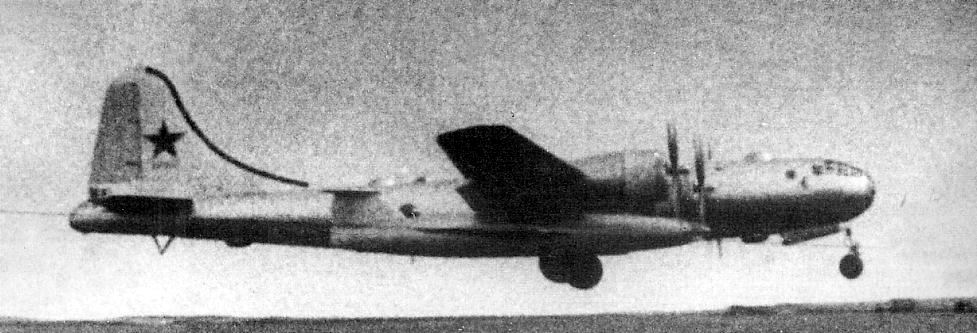
The result flew on 19 May 1947. To Western eyes the Tu-4 was almost eerie: the same slim fuselage, the same greenhouse nose, the same four podded engines. When examples were paraded over the Tushino Aviation Day display later that year, foreign attaches understood at once what they were looking at. Yet the Tu-4 was never the perfect clone of legend. Under the cowlings sat four Soviet Shvetsov ASh-73TK radials, unrelated to the B-29's Wright R-3350. The defensive battery was uprated to ten 23 mm cannon in place of the American .50-calibre machine guns. Soviet radios, oxygen systems, instruments and materials went in throughout. It looked American; it was thoroughly Soviet.
Its true significance was strategic. Entering service around 1949, the Tu-4 gave the Soviet Union its first credible means of delivering an atomic bomb by air. The nuclear-capable Tu-4A dropped the USSR's first air-delivered nuclear weapon in 1951, and for several tense years the aircraft was the physical embodiment of the young Soviet deterrent. Its great limitation was range: it could reach the northern United States only on a one-way flight, a shortfall that drove the development of the longer-ranged Tu-80, Tu-85 and ultimately the intercontinental Tu-95.
The Tu-4's arrival did not go unnoticed abroad. When the aircraft appeared over the 1947 Tushino display, and again as Western intelligence pieced together its numbers, it forced a reassessment of Soviet strategic capability. Coupled with the first Soviet atomic test in 1949, the message was unmistakable: the USSR now possessed both a bomb and an aircraft that could carry it. For the United States, which had counted on a monopoly of both, the Tu-4 was an early, sobering marker of the nuclear stand-off to come.
Overtaken by jets and turboprops, the Tu-4 slipped from the front line by the late 1950s at home - but its story was far from over. China, which received the type from 1953, kept it flying until 1988, converting examples along the way into radar-dome early-warning aircraft and drone carriers and re-engining others with turboprops. Few aircraft have travelled a stranger road: born as a copy of an enemy's bomber, salvaged from forced landings and rebuilt by a rival superpower, it ended its long career as a genuine pioneer in the hands of a third nation.
01The Tu-4's origins: why Stalin chose to copy the B-29 instead of building his own+
Tupolev's bureau had been sketching pressurised, long-range bombers throughout the war, and a home-grown design would eventually have flown. But an indigenous aircraft meant years of prototyping, testing and teething troubles at a moment when the United States already had an atomic bomb and the means to deliver it. Copying the B-29 collapsed that timeline. It also solved a subtler problem: it forced Soviet industry to master a complete, coherent, state-of-the-art aircraft rather than a patchwork of promising but immature national technologies.
The cost was pride and, arguably, innovation - Tupolev is said to have resented spending years reproducing another nation's work. But the strategic calculus was sound. Within a few years the USSR had a fleet of modern bombers and, just as importantly, factories that knew how to build them.
02The Tu-4's reverse-engineering programme: measuring, re-drawing and the metric problem+
The single most-quoted detail of the Tu-4 story is the aluminium. American sheet came in imperial thicknesses; the nearest Soviet metric gauges were slightly thinner or thicker. Simply substituting them would have thrown off the aircraft's weight and structural margins, so engineers had to recompute the affected structure. Similar puzzles arose across the airframe, from fasteners to wiring to instruments calibrated in different units.
This is why the popular image of blind, slavish copying is misleading. Reproducing the B-29 in the Soviet Union was not photocopying - it was a vast exercise in translation, in which tens of thousands of small engineering decisions were made to reach the same result with different materials and standards.
It is worth pausing on the sheer coordination involved. Engine plants, instrument makers, radio and radar workshops, metallurgical institutes and the airframe bureau all had to converge on a single coherent design, to a common set of tolerances, at the same time. Programmes of that complexity routinely fail. That the Soviet Union pulled this one off in only a couple of years, starting from three foreign bombers, remains one of the great feats of twentieth-century industrial organisation - regardless of what one thinks of copying a rival's aircraft.
03The apocryphal Tu-4 'patch' legend and the real differences from the B-29+
You will often read that Soviet engineers copied a repair patch, a bullet hole, or an antenna scar from one of the interned bombers onto every production Tu-4. It is a marvellous illustration of over-literal copying - and it is almost certainly folklore. No reliable source documents it, and it sits uneasily with the genuine, well-attested differences between the two aircraft.
Those real differences matter more than the myth: Shvetsov ASh-73TK engines rather than Wright R-3350s; ten 23 mm NS-23 cannon rather than Browning .50-calibre machine guns; Soviet avionics, oxygen and de-icing systems; and metric materials throughout. The Tu-4 was a convincing look-alike, not a molecular duplicate.
Design & Engineering
How the Tupolev Tu-4 was built: the engineering decisions that defined it
Copying an aircraft sounds simple until you try it. Reproducing the B-29 meant recreating not just its shape but its engines, its guns, its electronics and its structure - each in a Soviet industry that used different materials, different units and different standards.
The decisions below are the ones that mattered most: where the Tu-4 stayed faithful to the original, and where the realities of Soviet manufacturing forced genuine change. Together they explain why the Tu-4 was a convincing look-alike rather than a molecular duplicate.
A Soviet heart in an American airframe
Four Shvetsov ASh-73TK turbo-supercharged radials of roughly 2,400 hp each powered the Tu-4 - a Soviet engine, not a copy of the B-29's Wright R-3350. Matching an unfamiliar powerplant to a foreign airframe was one of the programme's hardest tasks.
Ten cannon instead of machine guns
The Tu-4 kept the B-29's remote-controlled defensive concept but replaced the .50-calibre machine guns with ten 23 mm NS-23 cannon in paired turrets - harder-hitting and longer-ranged, and a clear sign the Soviets were willing to change what mattered.
Pressurisation and metric structure
Like the B-29, the Tu-4 was pressurised for high-altitude flight, with crew tunnels linking the compartments. Rebuilding that structure in metric gauges of Soviet aluminium was the quiet triumph of the whole project.
Copied radar, re-built fire control
The Tu-4's Kobalt bombing radar was derived from the American AN/APQ-13 found on the interned bombers, and the remote-turret fire-control system was re-engineered to drive Soviet cannon - forcing the USSR to master airborne electronics at speed.
A heavier clone
The metric material substitutions left the Tu-4 slightly heavier than the B-29, with a small performance penalty. It was the unavoidable price of translating an imperial aircraft into a metric industry.
Built for numbers
The programme was designed not to produce a handful of copies but to put a modern bomber into mass production. That industrial ambition - hundreds of aircraft, a whole supply chain - was as important as the airframe itself.
04The Tu-4's powerplant: the Shvetsov ASh-73TK radial explained+
The ASh-73TK was a large 18-cylinder twin-row radial fitted with turbo-superchargers to preserve power at altitude, exactly the regime in which a high-flying strategic bomber operates. Delivering around 2,400 hp, it gave the Tu-4 performance broadly comparable to the B-29 while keeping the aircraft firmly within the Soviet industrial base. Its development and mass production were achievements in their own right, and variants of the engine went on to power other heavy Soviet types.
05The Tu-4's derivatives: from the Tu-70 airliner to the Tu-85+
The Tu-4 was a fertile parent. The Tu-70 adapted the wings, engines and tail to a wide new fuselage for a pressurised airliner; the Tu-75 did the same for a military transport. Neither reached production, but both proved the airframe's versatility. More significantly, the search for the range the Tu-4 lacked produced the enlarged Tu-80 and the much larger Tu-85 - the ultimate piston-engined Soviet bomber - before the jet and turboprop age made big pistons obsolete and led to the Tu-16 and Tu-95.
Full Specifications
Tupolev Tu-4 specifications, performance and cost data
The Tu-4's numbers mirror the B-29's closely, as you would expect of a faithful copy - with real divergences in powerplant, armament and, because Soviet accounting worked differently, cost. Figures below are drawn from standard references and hedged where sources disagree.
Baseline note: the figures describe the production Tu-4 as delivered from 1949, the standard bomber against which the derivatives are measured. Deltas for the Tu-4A nuclear carrier and for the Tu-70 airliner and Tu-75 transport, which used the wings, engines and tail of the bomber on an entirely new fuselage, are given in grey. Where Russian and English-language sources disagree — and on range they disagree substantially — both figures are shown.
Dimensions & weights
- Crew
- 11 (commander, pilot, navigator, navigator-bombardier, flight engineer, radio operator, radar operator and four gunners)
- Length
- 30.18 m (99 ft 0 in)
- Wingspan
- 43.05 m (141 ft 3 in)
- Height
- 8.46 m (27 ft 9 in)
- Wing area
- 161.7 m² (1,741 sq ft)
- Aerofoil and planform
- RAF-34 section; aspect ratio 11.5, taper ratio 2.36
- Undercarriage track
- 8.68 m (28 ft 6 in), wheelbase 10.44 m (34 ft 3 in)
- Empty weight
- 36,850 kg (81,240 lb)
- Normal take-off weight
- 47,850 kg (105,490 lb)
- Maximum take-off weight
- 63,600 kg (140,210 lb); some sources give a lower 55,600 kg (122,580 lb) normal maximum
- Internal fuel
- 20,180 l (5,331 US gal, 4,439 imp gal), plus three 2,420 l ferry tanks in the forward bomb bay
- Maximum bomb load
- 11,930 kg (26,300 lb); the normal load was 6,000 kg (13,230 lb)
- Wing loading
- 400 kg/m² (82 lb/sq ft) at normal weight
Performance
- Maximum speed
- 558 km/h (347 mph, 301 kt) at 10,250 m (33,630 ft)
- Maximum speed at sea level
- 435 km/h (270 mph, 235 kt)
- Landing speed
- 160 km/h (99 mph, 86 kt)
- Rate of climb
- 4.6 m/s (905 ft/min) at 1,000 m
- Time to altitude
- 18.2 min to 5,000 m (16,400 ft)
- Service ceiling
- 11,200 m (36,750 ft)
- Range with 3,000 kg of bombs
- 6,200 km (3,853 miles, 3,348 nm) at maximum take-off weight; Gordon and Rigmant give 5,400 km (3,355 miles) at 3,000 m with a 10 per cent fuel reserve, and the difference between the two is essentially whether reserves are counted
- Range with 9,000 kg of bombs
- 4,100 km (2,548 miles, 2,214 nm)
- Take-off run
- 960 m (3,150 ft)
- Landing run
- 920 m (3,020 ft)
- Power loading
- 0.11 kW/kg (0.067 hp/lb) at normal take-off weight
Propulsion & systems
- Engines
- Four Shvetsov ASh-73TK 18-cylinder air-cooled radials, 1,790 kW (2,400 hp) each for take-off at 2,600 rpm; nominal 1,470 kW (2,000 hp) at 2,400 rpm. Dry weight 1,340 kg, diameter 1,375 mm.
- Engine ancestry
- Not a copy of anything on the B-29. The ASh-73 descends from the Wright R-1820 Cyclone line by way of Shvetsov's own work, and is unrelated to the B-29's Wright R-3350 Duplex-Cyclone. It was chosen because it was more powerful and already in production.
- Supercharging
- A gear-driven centrifugal supercharger plus two TK-19 exhaust-driven turbochargers per engine. The turbo and bearing designs were the parts that genuinely were taken from American practice.
- Fuel
- 98 to 100 octane petrol; 815–885 kg/h per engine at take-off power, 630–675 kg/h at nominal
- Propellers
- Four-blade V3-A3 or V3B-A5, 5.06 m (16 ft 7 in) diameter
- Radar
- Kobalt panoramic bombing and navigation radar, a Soviet rendering of the American AN/APQ-13, with a retractable ventral antenna platform. Over 15 separate units and roughly a kilometre of cabling. Successively Kobalt-M, Rubidiy, Kometa and Kometa-M.
- Defensive fire control
- PV-20 system on early aircraft, PV-23 from around the 30th production series. Remotely controlled barbettes aimed from sighting blisters, with control of a barbette transferable between stations — the single most advanced feature of the B-29 and the one the Soviets most wanted.
- Autopilot
- AP-5, a Soviet development rather than a direct copy
- Pressurisation
- Pressurised forward and rear crew compartments joined by a crawl tunnel over the bomb bays, with a separately pressurised tail gunner's position
- Radio and IFF
- The radio was an RSB-series set already in use on Lend-Lease B-25s, not a copy of the B-29 installation. The American identification-friend-or-foe equipment was obviously useless and was replaced outright.
- The metric problem
- Soviet sheet aluminium came in metric gauges that did not match the B-29's imperial thicknesses, so almost every skin panel had to be re-engineered and official strength margins were reduced to avoid a full redesign. The prototype came out 340 kg heavier than a B-29, a difference of under 1 per cent.
- Aerial refuelling
- Four different systems were trialled to extend the bomber's reach; only a handful of aircraft were ever equipped before the Tu-16 made the question moot
06The Tupolev Tu-4's operating costs: what the numbers do and don't tell us+
Unlike Western aircraft of the period, the Tu-4 has no publicly reliable unit price, cost-per-flight-hour or programme total. Soviet defence accounting did not work in comparable terms, and the figures that circulate are estimates at best. What can be said is qualitative: the reverse-engineering effort consumed enormous national resources across hundreds of enterprises, and operating a fleet of four-radial-engined heavy bombers was expensive in fuel, spares and skilled manpower. We have marked every cost field as "not reliably recorded" rather than repeat unsupported numbers.
07Tu-4 variants: the bomber, the tanker, the drone carrier and the KJ-1+
Beyond the baseline bomber and the nuclear-capable Tu-4A, the fleet spawned tanker and receiver conversions for refuelling trials, the Burlaki parasite-fighter tow aircraft, missile-carrier experiments and drone-director versions. In China the type was reworked most radically of all: the KJ-1 airborne-early-warning conversion mounted a large rotating radar dome and AI-20 turboprops, while the drone-carrier conversions lofted La-17 target drones. Not all of these entered service, but together they show how much life was wrung from the airframe.
08The Tu-4's radar and avionics: copying the AN/APQ-13 and building a Soviet electronics base+
The B-29 was not just an airframe; it was a flying electronics suite, and reproducing it forced the USSR to master radar, radio and remote-turret fire control at once. The Tu-4's Kobalt bombing-and-navigation radar was derived from the American AN/APQ-13 carried aboard the interned aircraft, while the remote-controlled gun system had to be re-engineered to drive Soviet 23 mm cannon.
This electronics dimension is often overlooked in the 'they copied a bomber' summary. Arguably the avionics were harder to reproduce than the aluminium, and the capabilities the USSR built to do it seeded a domestic industry in airborne radar and fire control that mattered long after the Tu-4 was gone.
09The Tu-4 and the Soviet atomic programme: delivery for a new kind of weapon+
An atomic bomb is only a deterrent if it can be delivered. The USSR tested its first nuclear device in August 1949, and the Tu-4A gave the growing arsenal its first credible air-delivery platform. In October 1951 a Tu-4 dropped the RDS-3 in a live test, demonstrating the full chain from aircraft to detonation.
For the first half of the 1950s, before missiles and longer-ranged bombers matured, the Tu-4 fleet was the visible edge of Soviet nuclear power. Its numbers and readiness were watched closely in the West, and its limitations - above all range - shaped how both superpowers thought about the balance of terror.
10The Tu-4 in Chinese service: from Soviet gift to home-grown testbed+
China received its first Tu-4s in 1953 and made them the core of the PLAAF's strategic bomber force at a moment when the country had almost no heavy-bomber capability of its own. Over the following decades the aircraft flew bombing, reconnaissance, transport and survey missions and became a familiar sight in Chinese service.
What makes the Chinese chapter remarkable is how far the aircraft was developed locally. When Soviet engine support became uncertain, China re-engined Tu-4s with domestically-supported AI-20 turboprops. It built the KJ-1 radar-dome early-warning conversion, and it turned others into drone carriers. The last Chinese Tu-4 was retired only in 1988, closing nearly four decades of service.
11Why the Tu-4 was retired so quickly at home: the jet and turboprop revolution+
The Tu-4 entered service around 1949, and within less than a decade it was obsolete for front-line strategic work. The reason was the extraordinary pace of aeronautical progress in the 1950s. The swept-wing, jet-powered Tu-16 Badger offered far higher speed, and the turboprop Tu-95 Bear delivered the intercontinental range the Tu-4 had always lacked.
By the late 1950s the piston-engined Tu-4 had been pushed out of the first line at home, continuing in transport, tanker, trials and second-line duties. Its rapid eclipse is a measure of just how fast the technology moved - and of how sensible Stalin's original decision to copy rather than innovate had been, given that any home-grown 1940s piston bomber would have been overtaken just as quickly.
12The B-29 Superfortress: the aircraft the Tu-4 was copied from+
To understand the Tu-4 you have to understand what made the Boeing B-29 worth copying. It was the most sophisticated bomber of the Second World War: pressurised so its crew could operate in shirtsleeves at high altitude, defended by remote-controlled gun turrets aimed through an analogue fire-control computer, and able to carry heavy loads over very long ranges. It was the aircraft that dropped the atomic bombs on Hiroshima and Nagasaki.
Reproducing it handed the USSR not just a bomber but a template for modern aircraft manufacturing. If you want to see the original and the copy side by side, our B-29 Superfortress exhibit tells the American half of the story.
13Air-to-air refuelling and the Burlaki parasite experiments on the Tu-4+
Because the Tu-4 lacked intercontinental range, the Soviet air force used it to explore ways of extending reach. Tu-4s trialled both wingtip-to-wingtip 'wing-to-wing' refuelling and hose-and-drogue methods, building the expertise that later made in-flight refuelling routine on Soviet jet bombers.
Stranger still were the Burlaki experiments, in which a Tu-4 towed a fighter behind it on a cable so the escort could conserve fuel and be 'delivered' fresh to the target area. It was a literal parasite-fighter concept, and while it never entered service, it typifies how the copied bomber became a platform for genuinely original Soviet ideas.
14Flying the Tu-4: the eleven-man crew and the pressurised compartments+
The Tu-4 carried a crew of about eleven, distributed like the B-29's through pressurised compartments connected by a crawl tunnel over the bomb bay. Up front sat the two pilots, the navigator, the bombardier in the glazed nose and the flight engineer, who had the demanding job of nursing four large radial engines and their turbo-superchargers.
Gunners operated the remote-controlled cannon turrets from sighting stations rather than sitting in the turrets themselves - an advanced arrangement for the 1940s that the Soviets had to reproduce and adapt to their own 23 mm guns. High-altitude, long-endurance flying in a piston bomber was cold, noisy and exhausting work, and crew endurance was a real operational limit.
15'Bull': the NATO reporting name and how the West tracked the Tu-4+
NATO assigned the Tu-4 the reporting name 'Bull', following the convention of using a word beginning with 'B' for bombers. For Western intelligence the aircraft was a priority target of study: how many existed, where they were based, and above all whether they could reach North America.
The answer to that last question - not on a two-way mission - shaped Western threat assessments in the early 1950s and fed the debates about air defence, early-warning radar lines and the bomber balance that dominated the period. The Tu-4 was, in that sense, as important for the anxiety it created as for anything it ever did.
16The interned B-29 crews: how the Americans got home+
The airmen whose B-29s came down in the Soviet Far East in 1944 presented Moscow with a diplomatic problem. The USSR was neutral in the Pacific war and could not simply hand the crews or aircraft back to the United States without provoking Japan.
The solution was a piece of theatre: the interned Americans were moved to Soviet Central Asia and allowed to 'escape' across the border, a fiction that let the crews return home while the Soviet Union kept the bombers. The men went home; the aircraft became the seeds of the Tu-4.
17How accurate is the '847 built' figure for the Tu-4?+
Production totals for Soviet-era aircraft are notoriously slippery, and the Tu-4 is no exception. The figure most often cited is around 847 aircraft built between roughly 1949 and 1952, but you will also see totals quoted a little higher or lower depending on how derivatives, prototypes and conversions are counted.
We use '~847' and flag it as an estimate. What is not in doubt is the order of magnitude: this was a mass-produced bomber built in the high hundreds, not a handful of hand-made copies - which is exactly what made it strategically significant.
18The Tu-4 and the birth of Soviet Long-Range Aviation+
The Tu-4 did more than equip existing units; it helped define what Soviet Long-Range Aviation would become. Operating a large fleet of complex, four-engined pressurised bombers demanded new bases, new maintenance and logistics chains, new training, and new command structures for strategic air power.
By the time the jet Tu-16 and turboprop Tu-95 arrived, the USSR already had the institutional machinery to absorb them, thanks in large part to the Tu-4 years. The aircraft trained a generation of aircrew and ground staff in modern strategic operations.
19Myths, movies and the Tu-4 in popular memory+
The Tu-4 occupies an outsized place in aviation folklore precisely because its story is so cinematic: forced landings, an autocrat's order, a bolt-for-bolt copy, an atomic first. That drama is also why the myths - the copied patch above all - have proved so durable.
The honest version is more interesting than the legend. The Tu-4 was neither a mindless clone nor a Soviet original, but a vast act of technical translation that changed an industry and helped set the terms of the nuclear age. Retiring the myths does not diminish the aircraft; it lets the real achievement show.
20The Tu-4's remote turrets: reproducing analogue fire control+
One of the B-29's most advanced features was its defensive system: gunners aimed remote-controlled turrets from sighting stations, with an analogue computer correcting for range, lead and parallax. Reproducing this in the Tu-4 was a serious challenge, and the Soviets had to re-engineer the whole system to drive their heavier 23 mm cannon rather than the American machine guns.
Getting a 1940s electromechanical fire-control system to work with different weapons and Soviet-made components was arguably as demanding as any part of the airframe copy, and it pushed Soviet precision engineering and electronics forward in the process.
21Reading a Tu-4 today: what the museum survivors reveal+
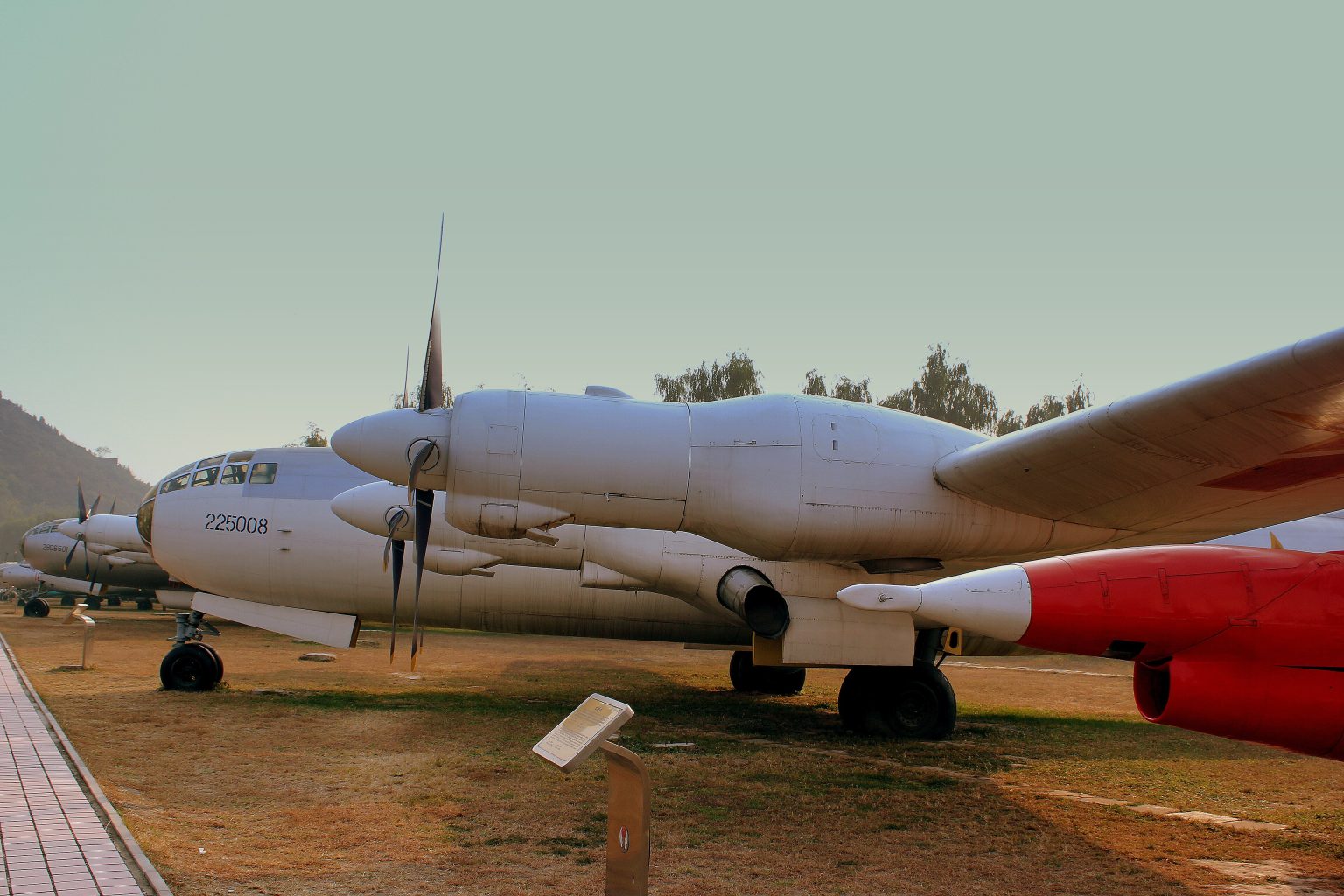
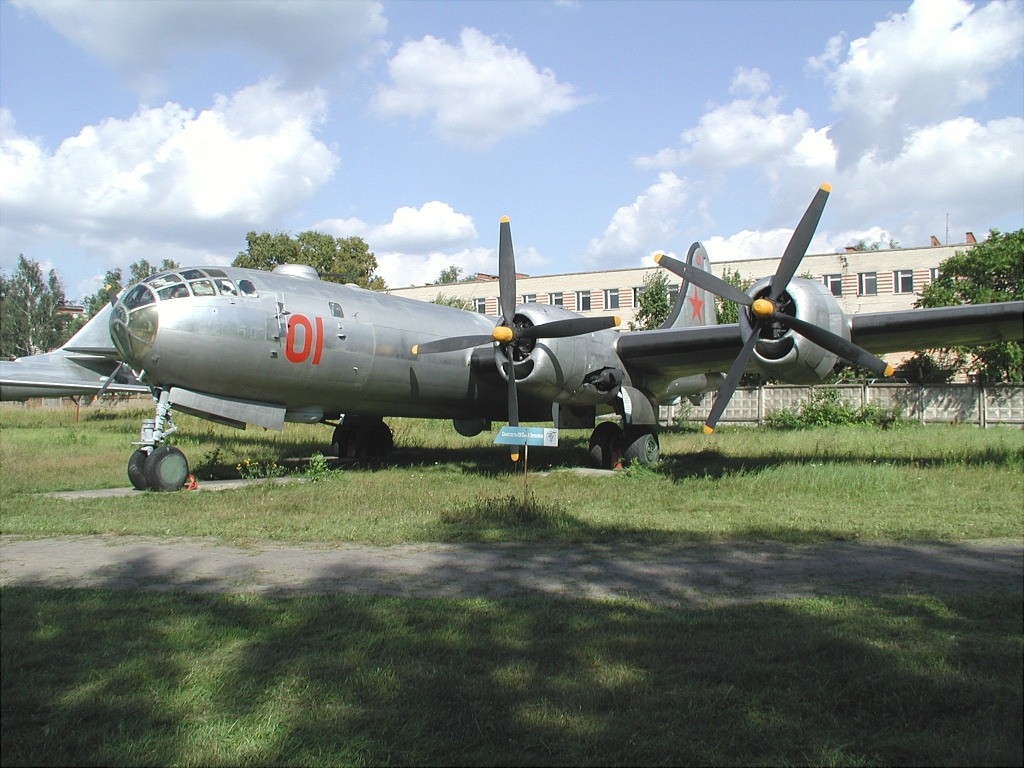
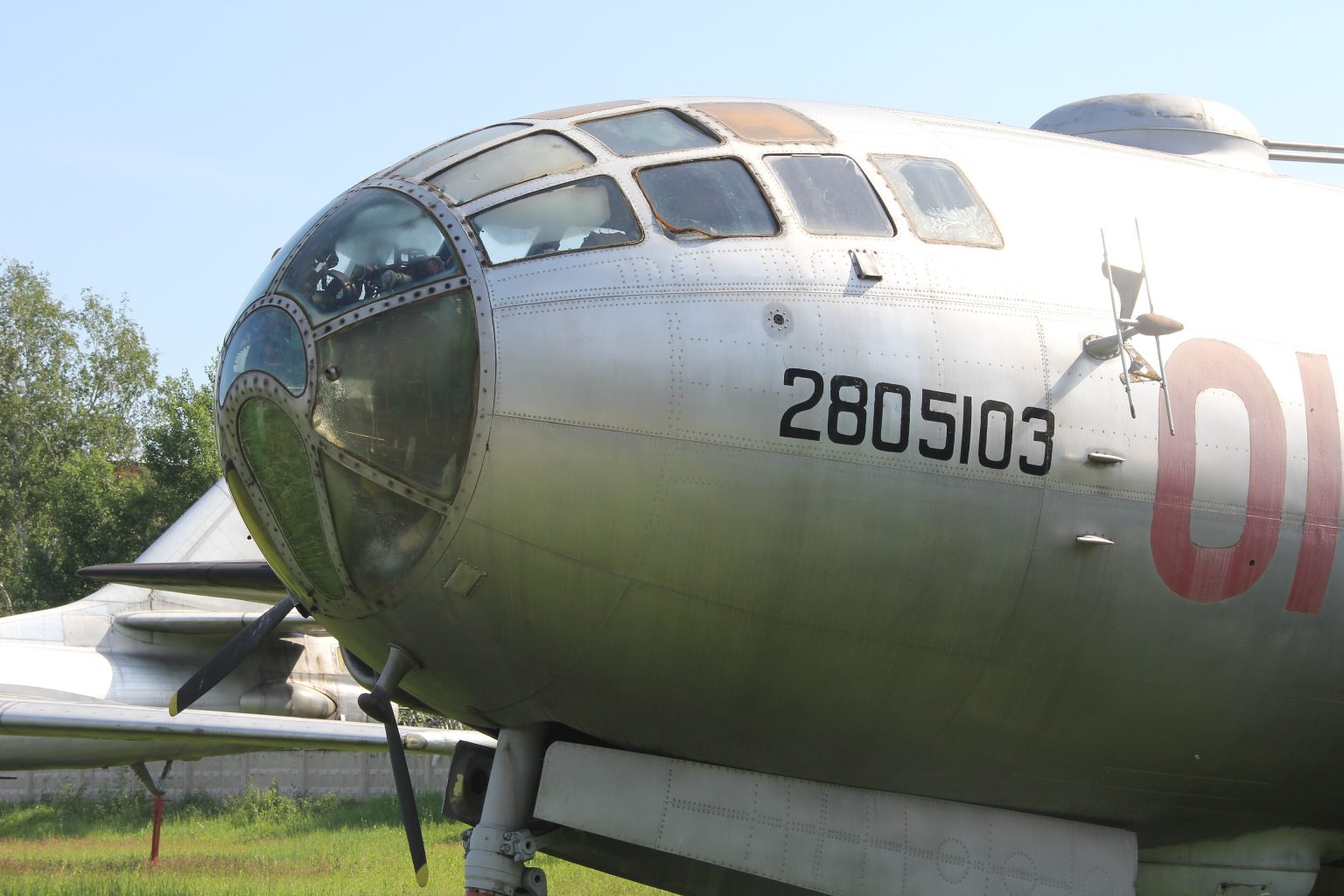
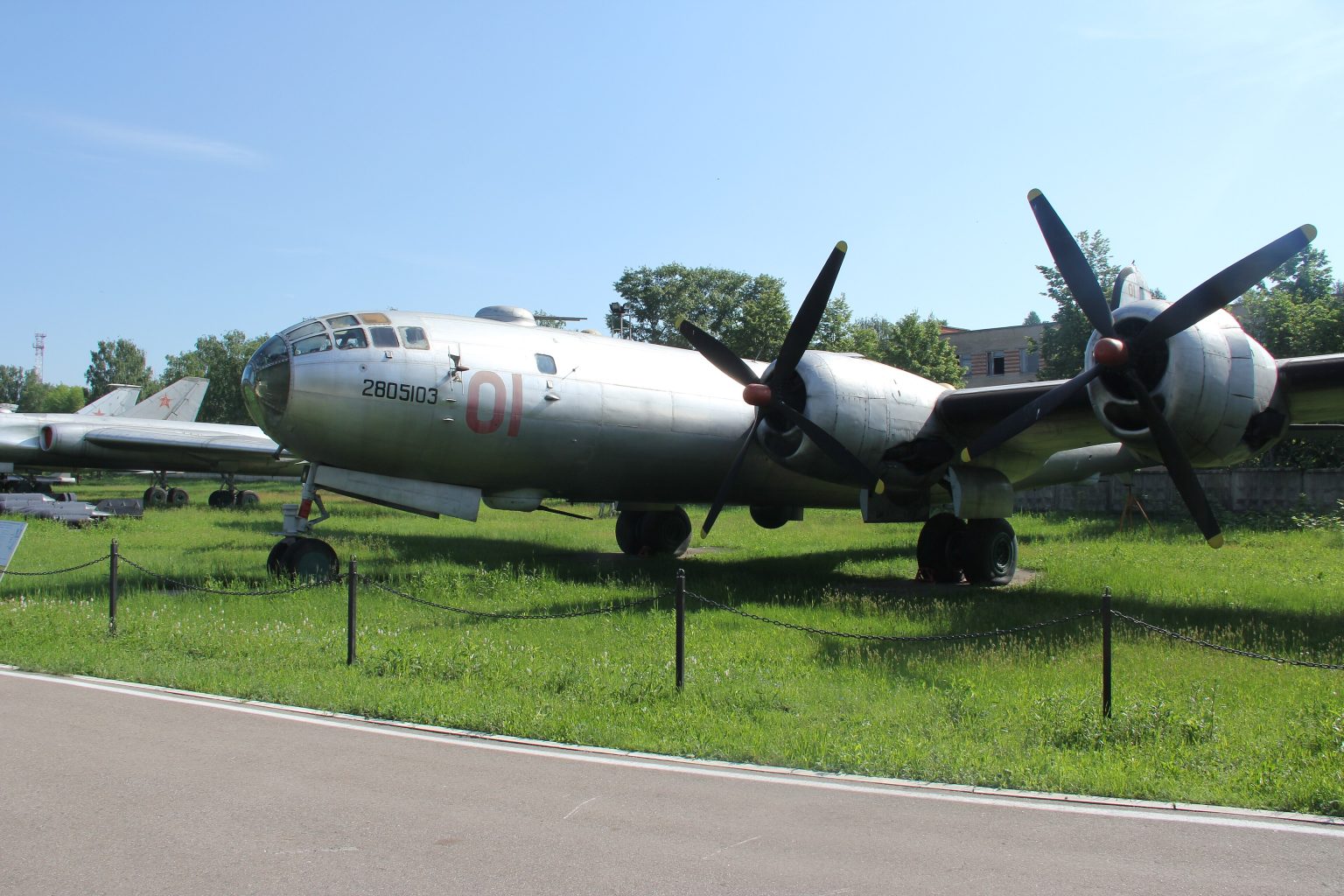
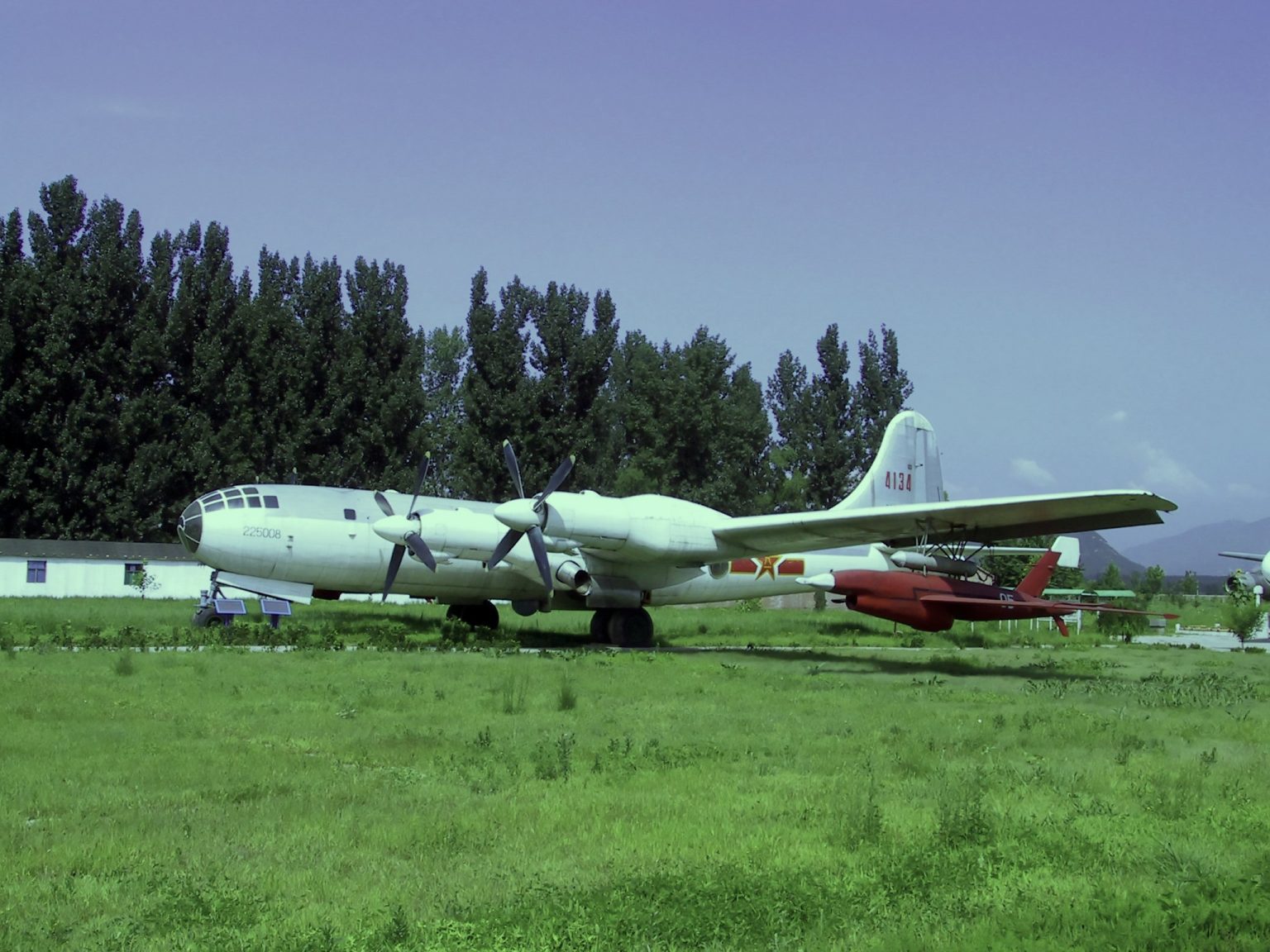
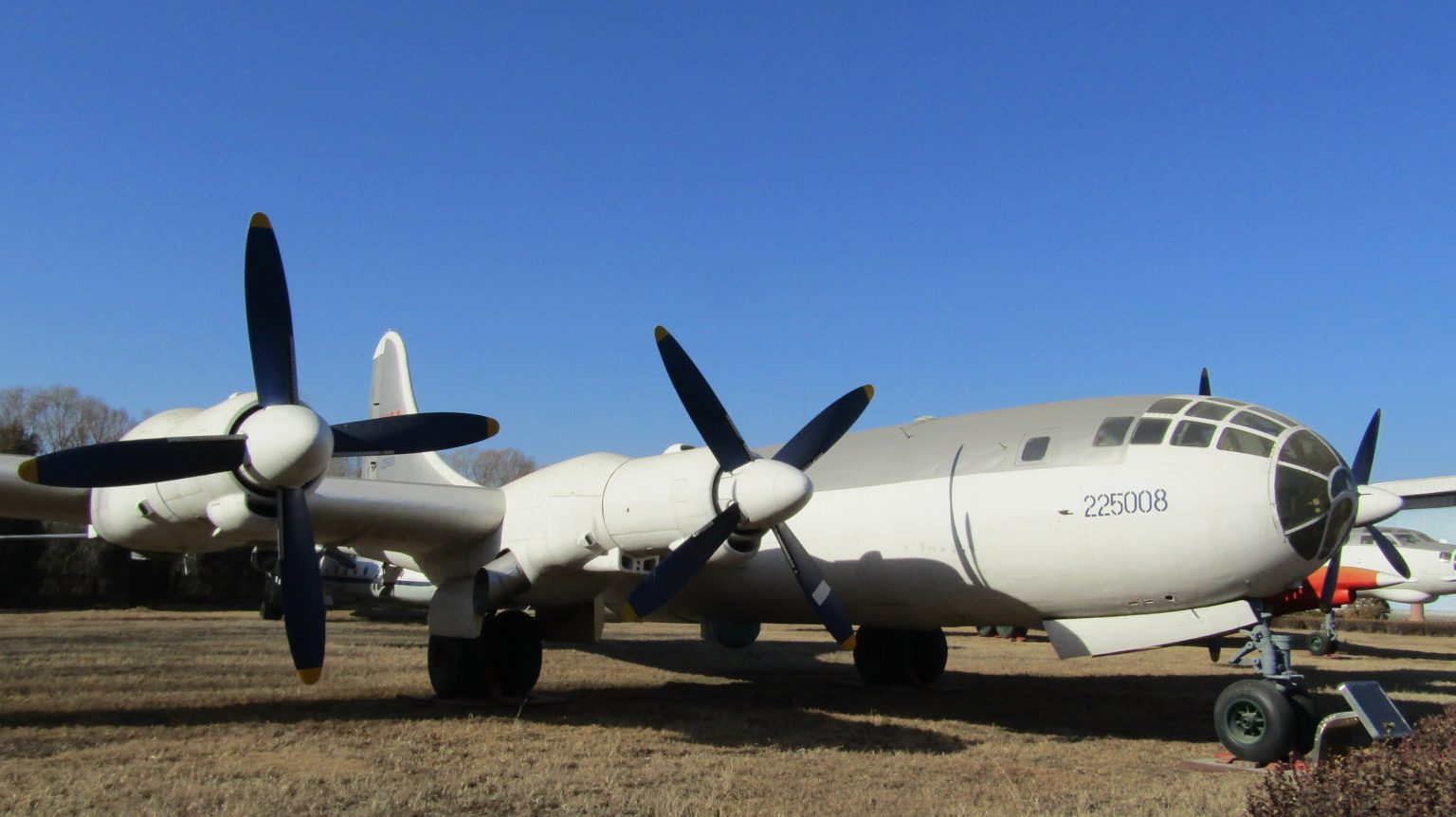
Standing beside a preserved Tu-4 at Monino or Datangshan, the first impression is simply how much it looks like a B-29 - the glazed nose, the slim aluminium fuselage, the four engine nacelles. Look closer and the differences emerge: the cannon barrels of the 23 mm turrets, the details of the engine cowlings, the Cyrillic stencilling.
These aircraft are the most tangible evidence of the whole story. They let you see, in a single glance, both the faithfulness of the copy and the quiet ways in which a Soviet aircraft asserted itself inside an American shape.
Armament & payload
Tu-4 armament is where the copy stopped being a copy
Stalin's instruction to Tupolev was to duplicate the B-29 exactly and quickly, and the pressure to do so was extreme — Tupolev's deputy Leonid Kerber recalled needing a general's authorisation to fit Soviet parachutes. Three things were changed anyway: the sheet-metal gauges, because there was no choice; the engines, because the Shvetsov ASh-73TK was more powerful and already in production; and the guns, because nobody in Moscow was going to build a bomber armed with rifle-calibre American machine guns. Everything else, down to a patch on a wing where the donor aircraft had been repaired, was reproduced.
The result was a bomber with the B-29's remotely controlled barbette system — genuinely the most advanced part of the American aircraft, and the part the Soviets most wanted — firing cannon instead of machine guns. Gun designations and counts vary between authorities, and the fit changed during production; the ranges below are given as the sources give them.
Gun
- Early production aircraft, from Tu-4 number 220004, carried the PV-20 system with eleven 20 mm B-20E cannon: two in each of four remotely controlled barbettes and three in the tail. Total ammunition 3,150 rounds.
- From around the 30th production series the PV-23 system replaced these with the 23 mm gun then known as the 150-P, in service as the Nudelman-Rikhter NR-23. Most English-language accounts instead name the Nudelman-Suranov NS-23; both were Nudelman designs, and Russian production records point to the NR-23.
- Published counts of ten or eleven guns both appear, and both are defensible: the tail position carried two or three weapons depending on the installation.
- The 23 mm guns had longer barrels than the 20 mm they replaced. In the stowed position the lower forward barbette fouled the forward bomb bay doors, so an electrical interlock and hinged clearance panels had to be added — a small illustration of how much re-engineering an "exact copy" actually required.
- Any barbette could be handed to another sighting station, so a wounded or blinded gunner did not cost the aircraft an arc of fire.
Air-to-air
- None. The Tu-4 carried no air-to-air missiles; the type was withdrawn from front-line service before Soviet air-to-air weapons were mature.
- Its only air-to-air capability was the barbette cannon, and against the jet fighters that appeared within two years of its debut that was thin protection.
- The Tu-4 did, however, generate air-to-air work for everyone else: from 1948 the RAF Central Fighter Establishment flew Meteors and Vampires against co-operating USAF B-29s specifically to develop attacks on Tu-4-shaped targets.
- Project Burlaki went the other way, testing a Tu-4 towing a fighter to extend escort range. It did not enter service.
Air-to-surface guided
- Tu-4K and Tu-4KS only: two KS-1 Komet anti-ship missiles, NATO reporting name AS-1 Kennel, carried between the engines under each wing.
- The KS-1 was effectively a scaled-down swept-wing fighter airframe with a radar seeker, beam-riding out to the target on the launch aircraft's radar.
- The pairing was a stop-gap. It moved almost immediately to the Tu-16, where the combination became the Soviet Navy's standard anti-ship system for a generation.
- No other guided weapon was carried operationally on the Tu-4.
Bombs
- Two bomb bays fore and aft of the wing carry-through, normal load 6,000 kg (13,230 lb), maximum 11,930 kg (26,300 lb).
- Typical fits: two FAB-6000, four FAB-3000, eight FAB-1500 or FAB-1000, fourteen FAB-500, forty FAB-250 or forty-eight FAB-100.
- The Tu-4A was the nuclear carrier, modified with a heated and shielded bay, special suspension and release gear. A standard Tu-4 could not carry these weapons at all.
- It could take the RDS-1, RDS-3 or RDS-5. The first Soviet air-dropped atomic bomb was an RDS-3, codenamed Maria, released by a Tu-4A over Semipalatinsk on 18 October 1951 by the crew of Lieutenant-Colonel K. Urzhuntsev — the RDS-1 of August 1949 was a tower shot, not an air drop.
- The Tu-4's only combat sorties were Chinese: two aircraft bombed Tibetan positions in Sichuan during the 1956 uprisings.
Rockets
- None. The Tu-4 carried no unguided rocket armament of any kind, offensive or defensive.
- This is not an omission in the sources. A high-altitude strategic bomber of this generation had no use for them, and the B-29 it was copied from carried none either.
- Rocket-assisted take-off was likewise not used; the Tu-4 got off on 960 m of runway on engine power alone.
Pods & other stores
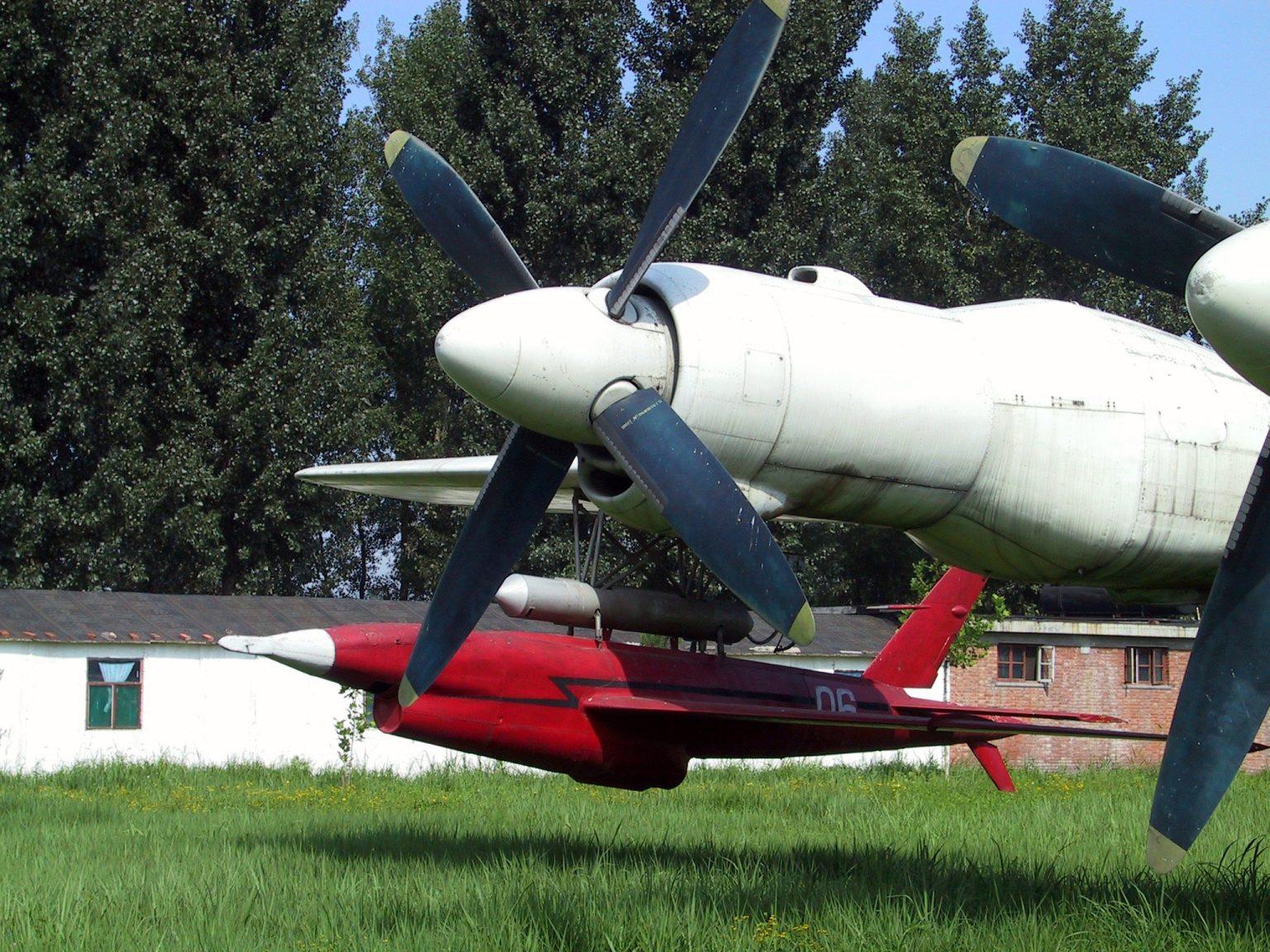
- Tu-4NM: launch aircraft for Lavochkin La-17 target drones carried under the wings.
- Tu-4 mothership for the DFS 346 rocket research aircraft, a role shared with one of the interned B-29s.
- Tu-4LL engine testbed, flying the Mikulin AM-3 turbojet, the Ivchenko AI-20 and Kuznetsov turboprops, the Dobrynin VD-3K radial and contra-rotating propellers — a workhorse for the whole Soviet engine industry.
- Tanker and receiver conversions for the four aerial refuelling trials, plus a liquid-oxygen tanker variant.
- ELINT, ECM, radiation reconnaissance and communications relay conversions, and time-expired airframes turned into radio-controlled target drones.
Three typical loadouts
- Maximum-range conventional sortie
- 3,000 kg of bombs, full internal fuel and ferry tanks in the forward bay, take-off at 63,600 kg. Around 6,200 km of range — enough to reach Chicago or Los Angeles from Chukotka, and not enough to come home. That arithmetic, not the bomb load, is the whole strategic story of the Tu-4.
- Nuclear strike, Tu-4A
- One RDS-3 in a modified, heated forward bay, no conventional load, eleven crew, full defensive ammunition. The USSR's first means of delivering an atomic weapon by air, and for several years its only one.
- Anti-shipping, Tu-4K
- Two KS-1 Komet missiles slung between the engines, guidance radar in the bomb bay, bomb load deleted. Aimed at carrier groups in the Norwegian and Mediterranean seas, and superseded by the Tu-16KS almost as soon as it worked.
Sourcing caveat: the Tu-4 is unusually badly served by English-language reference works, most of which reproduce a single armament line without noting that the fit changed twice in production. Where this page differs from the common account — eleven 20 mm B-20E cannon on early aircraft, 23 mm NR-23 rather than NS-23 later — it follows the Russian production literature summarised by Gordon and Rigmant and by Rigmant's 1996 account in Aviatsiya i Kosmonavtika. Bomb loadings are from the same source and describe capability, not any single authorised fit.
Variants
The Tu-4 mattered less as a bomber than as an industrial forcing function
The origin story is nearly always told slightly wrong. Four B-29s came down in Soviet territory during 1944 after raids on Japan, not three; one crashed after its crew took to their parachutes, and three repairable aircraft were flown to Moscow. Under the Soviet-Japanese Neutrality Pact the Soviet Union was not at war with Japan, so the bombers were interned and, despite American demands, never returned. One was dismantled for measurement, one flown for tests and training, and one kept intact as a reference standard. They were not even the same model: two Boeing-Wichita B-29-15-BWs, one Wichita-built B-29-5-BW and the wreck of a Renton B-29-1-BN, from two production lines, only one of them fitted with de-icing boots.
What followed involved 900 factories and research institutes and produced 105,000 drawings in the first year. The interesting argument is not whether the Tu-4 was a good bomber — it was obsolete on delivery, could not reach the United States and return, and was replaced within five years by the Tu-16 — but what the programme did to the industry that built it. To copy a B-29 the Soviet Union had to master pressurised airframes, remotely controlled fire-control systems, turbo-supercharging, airborne radar, precision electrical systems and mass production to aircraft tolerances it had never previously held. Almost every one of those capabilities went straight into the Tu-16, the Tu-95 and the Tu-104. That, rather than the 847 bombers, is what the effort actually bought.
It should also be said that Tupolev did not copy blindly. Kerber's memoirs record continuous argument with officials who wanted absolute fidelity against engineers who wanted to use Soviet equipment that was in some cases better. The engineers won on engines, guns, radio and identification gear, and lost nearly everywhere else.
- Tu-4, originally B-4 (1949–52, 847)
- The production bomber, NATO reporting name Bull. First flight 19 May 1947 with Nikolai Rybko. Revealed at the Tushino flypast of 3 August 1947, where Western observers counted three aircraft, assumed they were the interned B-29s, and then saw a fourth.
- Tu-4A (from 1951)
- The nuclear carrier: modified bomb bay with heating and shielding, special suspension and release gear, cleared for RDS-1, RDS-3 and RDS-5. The standard Tu-4 could not carry any of them. This was the Soviet Union's first air-delivered nuclear capability.
- Tu-4K and Tu-4KS
- Anti-shipping conversion carrying two KS-1 Komet (AS-1 Kennel) standoff missiles under the wings between the engines, with guidance radar aboard.
- Tu-4D, also called Tu-76 (about 300 conversions)
- Troop transport conversions of withdrawn bombers, plus the one-off Tu-4T paratroop aircraft. By the early 1960s transport and flying-laboratory work was all the Soviet Tu-4 fleet did.
- Tu-4R, Tu-4UShS and ELINT conversions
- Long-range photographic reconnaissance, navigation trainers, and electronic intelligence and countermeasures aircraft. The 121st Guards received Tu-4Rs in 1953.
- Tu-4LL, Tu-4NM and Project Burlaki
- Flying testbeds and launch aircraft. The Tu-4LL flew the AM-3 turbojet, AI-20 and Kuznetsov turboprops and the VD-3K radial; the Tu-4NM launched La-17 drones; Burlaki tested towing an escort fighter. Others served as motherships for the DFS 346 and as radio-controlled targets.
- Tu-70 (1946, 1)
- Airliner derivative, NATO reporting name Cart. Tu-4 wings, engines, tail and undercarriage on a new wide pressurised fuselage — the first pressurised fuselage built in the Soviet Union. Flew 27 November 1946 and was recommended for production, but Aeroflot had no route for it and the factories had military orders.
- Tu-75 (1950, 1)
- Military transport on the same basis, with a rear loading ramp and paratroop doors — the first Soviet aircraft of the type. It could lift 12,000 kg, 120 troops or 96 paratroopers. Rejected because converting existing Tu-4s was cheaper.
- Tu-80 and Tu-85 (1949 and 1951, prototypes only)
- Successive attempts to stretch the design into a genuine intercontinental bomber. The Tu-85 (NATO: Barge) very nearly worked, and was killed by the arrival of the jet-powered Tu-16 and the turboprop Tu-95.
- Chinese Tu-4, turboprop conversions and KJ-1 (1953–88)
- Ten aircraft were handed over on Stalin's order in February 1953 and two navigation trainers followed in 1960. Eleven were re-engined with Ivchenko AI-20K turboprops between 1970 and 1973, which is why Chinese Tu-4s look wrong in late photographs. They flew as drone motherships for WZ-5 reconnaissance vehicles and as radar pickets, and one was rebuilt in 1969 as the KJ-1 airborne early warning aircraft with a Type 843 rotodome. Ground clutter defeated it and the project was cancelled in 1979. The last PLAAF Tu-4 was retired in 1988.
Production and survivors: 847 Tu-4s were built, production ending in the Soviet Union in 1952. Withdrawal from front-line Soviet bomber regiments began in 1954 as the Tu-16 arrived and continued with the Tu-95 from 1956; by about 1960 the surviving Soviet aircraft flew only as transports and flying laboratories, and they were gone from the inventory during the 1960s. Chinese service outlasted Soviet service by nearly thirty years, ending in 1988 — the last piston-engined strategic bomber of the B-29 lineage in military hands anywhere. Three complete airframes are known to survive, and all three are original aircraft; no reproduction exists. One Tu-4 stands at the Central Air Force Museum at Monino, and two are at the China Aviation Museum at Datangshan, one of them the sole KJ-1 conversion and the other displayed with a WZ-5 drone under the wing. Not one of the four interned B-29s survives.
Copy vs Original
Tupolev Tu-4 vs Boeing B-29: how the copy compared
Seen side by side, the two aircraft are almost indistinguishable in shape and size - and clearly different where it counted, in engines, guns and units of measurement.
| Origin | USSR (reverse-engineered) |
|---|---|
| Engines | 4 x Shvetsov ASh-73TK radials |
| Defensive guns | 10 x 23 mm NS-23 cannon |
| Units of design | Metric |
| First flight | 1947 |
| Bombing radar | Kobalt (derived from AN/APQ-13) |
| Numbers built | ~847 |
| Origin | United States (original design) |
|---|---|
| Engines | 4 x Wright R-3350 radials |
| Defensive guns | .50-calibre machine guns (plus a tail cannon on some) |
| Units of design | Imperial |
| First flight | 1942 |
| Bombing radar | AN/APQ-13 |
| Numbers built | ~3,970 |
Dimensions were near-identical by design - wingspan around 43 m and length around 30 m for both. The visible giveaways of a Tu-4 are the engine cowlings and the cannon barrels; almost everything else was faithfully reproduced.
Timeline
The Tupolev Tu-4 timeline: from interned B-29s to Chinese retirement
B-29s raiding Japanese targets divert to the neutral Soviet Far East and are interned near Vladivostok; three repairable aircraft are retained.
Stalin orders Andrei Tupolev to reverse-engineer the B-29 exactly rather than pursue an indigenous design; the OKB begins measuring and re-drawing every part in metric.
First flight of the Tu-4 on 19 May; three examples and the Tu-70 airliner derivative are shown at the Tushino Aviation Day display, stunning Western observers.
The Tu-4 (NATO reporting name 'Bull') enters service with Soviet Long-Range Aviation; series production ramps up.
A Tu-4 becomes the first Soviet aircraft to drop a live nuclear weapon, the RDS-3, cementing its role in the early Soviet deterrent.
Roughly 847 aircraft are built (figures vary); trials of air-to-air refuelling, the Burlaki parasite-fighter tow and missile carriage begin.
The Soviet Union transfers Tu-4s to China; the type becomes the backbone of the PLAAF bomber force.
The jet Tu-16 and turboprop Tu-95 enter service and begin displacing the piston-engined Tu-4 from the first-line strategic role.
The Tu-4 is withdrawn from front-line Soviet strategic duty, continuing in transport, tanker, trials and second-line roles.
China converts Tu-4s into the KJ-1 AEW platform and re-engines examples with AI-20 turboprops; others become La-17 drone carriers.
China retires its last Tu-4, closing nearly four decades of service for the reverse-engineered Superfortress.
Survivors remain on display at Monino (Russia) and the China Aviation Museum at Datangshan.
The Second Life
The Tupolev Tu-4 in Chinese service: the Superfortress that flew until 1988
The Tu-4's most surprising chapter was written not in the Soviet Union but in China, where the reverse-engineered bomber found a second career that lasted three decades longer than its front-line service at home.
When the People's Republic of China turned to building a modern air force in the early 1950s, it had almost no heavy-bomber capability. The Soviet transfer of Tu-4s from 1953 changed that at a stroke. A first batch of around ten aircraft - later supplemented - became the backbone of the PLAAF's strategic bomber arm, giving China a long-range platform for bombing, maritime patrol, reconnaissance, transport and survey work. For a country with vast, remote frontiers, the Tu-4's range and payload were genuinely useful, and the type reportedly supported operations over western and border regions where few other aircraft could reach.
Keeping a 1940s piston bomber flying into the 1970s and 1980s took ingenuity, and this is where China's Tu-4 story becomes distinctive. As Soviet support for the original ASh-73 engines became unreliable, Chinese engineers re-engined Tu-4s with Ivchenko AI-20 turboprops - the same family of engines used on other Soviet and Chinese types - transforming the aircraft's maintenance picture and, incidentally, its appearance. The turboprop conversion was not merely a repair; it turned the Tu-4 into a testbed and a workhorse for a new generation of Chinese aviation engineers.
The boldest conversion was the KJ-1, China's first airborne-early-warning aircraft. Engineers mounted a large rotating radar dome above a Tu-4 fuselage and paired it with the turboprop engines, attempting to give the PLAAF a flying radar picket at a time when such aircraft were rare and closely guarded technology. The KJ-1's radar struggled to separate aircraft from ground clutter and the type never entered squadron service - but the programme was far from a failure. It taught Chinese industry hard lessons about airborne radar, systems integration and the aerodynamics of a large dome, knowledge that fed directly into the successful AEW aircraft China fields today. Other Tu-4s were adapted to carry and launch La-17 target drones, extending the airframe's usefulness into roles its American designers never imagined.
There is a neat symmetry in China's inventiveness with the type. The Tu-4 existed because the Soviet Union had chosen the pragmatic path of copying a proven design rather than gambling on an untried one. China, inheriting that copy, then did the opposite - it experimented boldly, re-engining airframes, mounting radar domes and hanging drones under the wings, treating the aircraft as a platform to learn on rather than a museum piece to preserve. Between them, the two operators wrung nearly every possible use out of a single 1940s airframe.
When the last Chinese Tu-4 was finally retired in 1988, it closed a story that had begun with forced landings in 1944. An aircraft designed in Seattle, copied in the Soviet Union and reborn in China had served, in one form or another, for the better part of half a century.
Stories & Eyewitnesses
Fifteen stories behind the Tupolev Tu-4
The Tu-4's history is a chain of extraordinary episodes - forced landings, an impossible order, a metric headache, an atomic first, and a second life in China. Tap a card to read each one.
+The interned SuperfortressesThree B-29s that never went home
In the summer and autumn of 1944, American B-29s raiding Japanese targets in Manchuria and Korea began diverting to...
In the summer and autumn of 1944, American B-29s raiding Japanese targets in Manchuria and Korea began diverting to Soviet territory when they were damaged or short of fuel. The USSR and Japan were not yet at war, so under international law the Soviets were obliged to intern the crews and impound the aircraft.
Several B-29s came down in the Soviet Far East near Vladivostok. Among the aircraft usually named in the story are the 'Ramp Tramp', the 'General H.H. Arnold Special' and 'Ding Hao', which arrived between July and November 1944. One badly damaged machine was written off; the rest were flyable or repairable.
The crews were eventually spirited out through Soviet Central Asia in a diplomatic fiction that let both sides save face - they were reported to have 'escaped'. The bombers stayed behind, and three repairable examples became the raw material for one of the most audacious industrial projects of the twentieth century.
+Stalin's orderCopy it, exactly
Andrei Tupolev had his own advanced bomber designs on the drawing board, including the projected Tu-64. Stalin swept...
Andrei Tupolev had his own advanced bomber designs on the drawing board, including the projected Tu-64. Stalin swept them aside. The order, as it has come down to us, was blunt: reproduce the B-29 precisely and quickly, and do not try to improve it.
The logic was cold and correct. A faithful copy removed technical risk and delivered, in the shortest possible time, a modern pressurised long-range bomber that could carry the atomic bomb the USSR was racing to build under Igor Kurchatov.
Tupolev is said to have chafed at the assignment - a designer of his stature spending years reproducing another nation's aircraft. But he understood the stakes, and he understood that the exercise would drag the whole Soviet aviation industry up to a new level of precision.
+Re-drawing an aircraft in metric105,000 drawings and a nation of factories
One B-29 was flown as a reference aircraft, one was kept intact as an untouched master pattern, and the third was...
One B-29 was flown as a reference aircraft, one was kept intact as an untouched master pattern, and the third was carefully dismantled, part by part, and measured. Every component then had to be re-drawn in metric units and matched to Soviet materials and manufacturing methods.
The effort reportedly drew in hundreds of factories and research institutes across the Soviet Union and generated on the order of 105,000 drawings. Exact figures vary between sources, but every account agrees the programme reshaped Soviet aviation industry itself.
The management challenge alone was staggering: coordinating engine plants, instrument makers, metallurgists, electronics workshops and the airframe bureau to reproduce a single foreign aircraft to a common, coherent standard. In doing so the USSR modernised capabilities that outlasted the Tu-4 by decades.
+The metric problemWhen the aluminium didn't fit
The B-29's skin was built up from aluminium sheet in American imperial gauges. Soviet mills rolled metric thicknesses,...
The B-29's skin was built up from aluminium sheet in American imperial gauges. Soviet mills rolled metric thicknesses, and there was no exact match. Engineers had to choose the nearest metric gauge and then recalculate the affected structure to keep weight and strength within limits.
Multiply that decision across the whole airframe - skins, stringers, fasteners, fittings - and the scale of the translation becomes clear. The finished Tu-4 reportedly came out slightly heavier than the B-29, a direct consequence of these substitutions.
This is the grain of truth behind the 'they copied everything blindly' legend. The Tu-4 was not a perfect clone at all, precisely because the metric conversion forced thousands of small, deliberate engineering decisions that no photocopier could have made.
+The patch that probably never wasA legend worth retiring
The most-told Tu-4 story claims Soviet engineers faithfully reproduced a repair patch, a bullet hole, or an antenna...
The most-told Tu-4 story claims Soviet engineers faithfully reproduced a repair patch, a bullet hole, or an antenna scar from one of the interned originals onto every production aircraft. It is a wonderful image of over-literal copying, endlessly repeated in books and online.
It is also almost certainly apocryphal or heavily exaggerated. No reliable primary source documents it, and it sits awkwardly with the well-attested reality that the Tu-4 differed in engines, guns, avionics and materials.
The legend endures because it captures a feeling of truth - the programme really was an extraordinary act of copying. But the specific anecdote belongs in the folklore column, not the history column.
+Soviet engines, Soviet gunsWhere the Tu-4 genuinely diverged
Under the cowlings sat four Shvetsov ASh-73TK radials, a Soviet engine unrelated to the B-29's Wright R-3350. Matching...
Under the cowlings sat four Shvetsov ASh-73TK radials, a Soviet engine unrelated to the B-29's Wright R-3350. Matching that unfamiliar powerplant to the copied airframe, complete with turbo-superchargers for high-altitude power, was one of the hardest parts of the whole job.
The defensive armament was uprated too: ten 23 mm cannon replaced the American .50-calibre machine guns, giving heavier hitting power and longer range in the remote-controlled turrets.
Soviet radios, oxygen systems, gunsights and instruments went in as well, and the bombing radar was derived from the American AN/APQ-13 carried by the interned aircraft. The Tu-4 looked like a B-29 from fifty metres, but it was a Soviet aircraft under the skin.
+First flight, May 1947A B-29 shape over Soviet skies
The first Tu-4 lifted off on 19 May 1947, only about two years after the programme began - a remarkable pace for an...
The first Tu-4 lifted off on 19 May 1947, only about two years after the programme began - a remarkable pace for an aircraft of such complexity built almost from scratch by a new supply chain.
To Western observers who later saw it, the aircraft was uncanny: the same slender fuselage, the same glazed greenhouse nose, the same four podded engines and tall fin.
When three Tu-4s flew over the 1947 Aviation Day display at Tushino alongside the Tu-70 airliner derivative, foreign attaches realised in a single afternoon that the Soviet Union had, in effect, reproduced America's most advanced bomber - and could now build it in numbers.
+Carrying the bombThe Tu-4A and the deterrent
The nuclear-capable Tu-4A was modified with a heated, insulated bomb bay and the release and arming gear for an atomic...
The nuclear-capable Tu-4A was modified with a heated, insulated bomb bay and the release and arming gear for an atomic weapon. It was the delivery half of a deterrent whose other half, the bomb itself, the USSR first tested in 1949.
In October 1951 a Tu-4 became the first Soviet aircraft to drop a live nuclear bomb, the RDS-3, in a weapons trial - a milestone in the militarisation of the Soviet atomic programme.
For a few crucial years the Tu-4 was the physical embodiment of the Soviet nuclear deterrent, even though planners understood it could not fly a two-way mission to the United States and back.
+The range problemWhy the Tu-4 could not threaten America both ways
With a combat radius built around a roughly 5,400 km range, the Tu-4 could reach the northern United States only on a...
With a combat radius built around a roughly 5,400 km range, the Tu-4 could reach the northern United States only on a one-way trajectory. Soviet planners studied exactly that grim option, including the possibility of crews not returning.
The shortfall was strategic, not merely technical: a deterrent that cannot strike the adversary's homeland and come back is a blunt instrument.
The gap drove the next generation of Soviet bombers - the longer-ranged Tu-80 and the large Tu-85 pistons, and ultimately the intercontinental Tu-95 turboprop that still patrols today.
+Flying laboratoryRefuelling, parasites and missiles
The Tu-4 fleet became a testbed for ideas the USSR would need for a true intercontinental force. Aircraft trialled...
The Tu-4 fleet became a testbed for ideas the USSR would need for a true intercontinental force. Aircraft trialled wingtip-to-wingtip and hose-and-drogue air-to-air refuelling techniques that later matured on jet bombers.
The extraordinary Burlaki experiments saw a Tu-4 tow a fighter behind it on a cable to extend the escort's reach - a literal parasite-fighter concept.
Others were adapted to carry early cruise missiles such as the KS-1 Komet and to launch and direct drones, turning the copied bomber into a springboard for genuinely new Soviet weapons.
+China's SuperfortressTwo decades of PLAAF service
From 1953 the Soviet Union handed Tu-4s to China - an initial batch of around ten, later added to - where they became...
From 1953 the Soviet Union handed Tu-4s to China - an initial batch of around ten, later added to - where they became the backbone of the young People's Liberation Army Air Force's strategic bomber arm.
Chinese Tu-4s flew bombing, maritime reconnaissance, transport and survey missions, and reportedly supported operations over remote border and western regions where their range and payload were invaluable.
They stayed in service far longer than in the USSR, soldiering on into the late 1980s and outliving the aircraft's front-line career in its country of origin by three decades.
+KJ-1 and the drone carriersChina's radical conversions
China turned at least one Tu-4 into the KJ-1, its first airborne-early-warning aircraft, mounting a large rotating...
China turned at least one Tu-4 into the KJ-1, its first airborne-early-warning aircraft, mounting a large rotating radar dome above the fuselage and re-engining the airframe with Ivchenko AI-20 turboprops for the extra power and reliability the radar demanded.
The KJ-1's radar struggled with ground clutter and the type never entered squadron service, but the programme taught Chinese engineers lessons that fed directly into the country's later, successful AEW aircraft.
Other Chinese Tu-4s carried La-17 target drones under the wings, launching and controlling them in flight - a role that kept the reverse-engineered Superfortress flying well into the jet-and-missile age.
+The civil SuperfortressThe Tu-70 and Tu-75
Almost as soon as the bomber flew, Tupolev's bureau adapted its wings, engines, tail and landing gear to an entirely...
Almost as soon as the bomber flew, Tupolev's bureau adapted its wings, engines, tail and landing gear to an entirely new, wide fuselage to create the Tu-70, a pressurised airliner intended to seat dozens of passengers.
A military transport version, the Tu-75, followed with a rear cargo ramp. Neither reached production - the post-war USSR had other priorities and other transport designs - but both proved how versatile the copied airframe had become in Soviet hands.
The exercise also gave Tupolev valuable experience in large pressurised-fuselage design that would inform later Soviet airliners.
+The ultimate piston bomberThe Tu-80 and Tu-85
The Tu-4's range problem was never going to be solved by tinkering, so Tupolev built bigger. The Tu-80 refined the...
The Tu-4's range problem was never going to be solved by tinkering, so Tupolev built bigger. The Tu-80 refined the design, and the much larger Tu-85 stretched the concept to its limit - a genuinely intercontinental piston-engined bomber able to reach the United States and return.
Both flew as prototypes and both were superb pistons. But they arrived exactly as the jet and turboprop age dawned, and neither entered production.
The lesson was clear: the future belonged to the jet Tu-16 and the turboprop Tu-95, not to ever-larger radials. The Tu-85 is remembered as the magnificent end of a line the Tu-4 had begun.
+SurvivorsWhere to see a Tu-4 today
Only a handful of Tu-4s survive, and none is airworthy. The best-known sits at the Central Air Force Museum at Monino,...
Only a handful of Tu-4s survive, and none is airworthy. The best-known sits at the Central Air Force Museum at Monino, near Moscow, among the most complete collection of Soviet strategic aircraft anywhere.
The China Aviation Museum at Datangshan, north of Beijing, preserves more than one Tu-4, including airframes connected to China's early-warning and drone experiments.
Standing beside one of these aircraft is the clearest way to grasp the Tu-4 story: the shape is pure B-29, yet everything about how it came to exist is pure Cold War.
Photo Gallery
Tupolev Tu-4 in photographs
Every image below is a genuine Tu-4, credited to its photographer. Click any photo to enlarge.
Video
Watch: how the Soviets reverse-engineered the B-29
"How the Soviets Reverse-Engineered the B-29 Superfortress" by Paper Skies - an authoritative aviation-history documentary with more than 1.28 million views, covering the interned bombers, Stalin's order and the making of the Tu-4.
Operations Overview
Where the Tupolev Tu-4 flew
The Tu-4 had only two operators in its career - the Soviet Union that created it and the China that flew it longest. The map below shows origin and Cold-War service, Chinese export operations, and where survivors are preserved today.
That short operator list is itself part of the story. Unlike many Cold-War aircraft that were exported widely, the Tu-4 was a closely-held strategic asset, transferred only to the USSR's most important early ally. Toggle the categories below to see how the same two countries fill different roles: the Soviet Union as designer, manufacturer and front-line operator, and China as the long-serving export operator and the boldest modifier of the type.
Hover (or tap on mobile) a highlighted country for details. Colour priority runs origin > Cold-War service > export > survivors; a country in several categories shows the highest-priority colour and lists all of them in the tooltip.
Legacy in Numbers
The Tupolev Tu-4 by the numbers
Four figures capture the arc of the Tu-4 story - from the three salvaged bombers that started it to the Chinese retirement that ended it nearly half a century later.
Strategic Context
The Tupolev Tu-4 and the birth of the nuclear balance
For a few years in the early 1950s, the Tu-4 was the aircraft that made Soviet nuclear power real - and it changed how the Cold War was fought and feared.
In 1945 the United States alone possessed the atomic bomb and, in the B-29, the aircraft to deliver it. That monopoly was brief. The Soviet Union tested its own device in 1949, and with the Tu-4 already in production it suddenly had both halves of an air-delivered nuclear capability. The strategic picture shifted almost overnight from American dominance to the beginnings of a two-sided nuclear confrontation.
The Tu-4's limitations shaped that confrontation as much as its capabilities. Because it could reach North America only on a one-way flight, it was a credible threat to allies and forward bases far more than to the American heartland - which in turn drove both the Soviet push for genuinely intercontinental bombers and the American investment in continental air defence, radar early-warning lines and interceptors. The anxieties of the early 1950s bomber age, and the vast defensive infrastructure they produced, owe a great deal to this single reverse-engineered aircraft.
It is a striking thought: an aircraft that never dropped a bomb in anger did more to shape the Cold War than many that did. The Tu-4's role was to exist, to be counted, and to force the other side to plan around it. In the strange logic of deterrence, that was its entire purpose - and it fulfilled it completely.
Questions & Answers
Tupolev Tu-4: frequently asked questions
Can I fly in a Tupolev Tu-4?+
No. The Tu-4 was retired from front-line Soviet service in the late 1950s and from the Chinese air force in 1988, and no Tu-4 is airworthy anywhere today. The handful of survivors are static museum exhibits at Monino near Moscow and the China Aviation Museum at Datangshan. MiGFlug does not operate the Tu-4 and it is not a bookable ride. You can, however, fly in several genuine Cold-War military jets today. See the current line-up at https://migflug.com/flights-prices/.
Is the Tupolev Tu-4 really a copy of the B-29?+
Yes, to a remarkable degree. After three Boeing B-29s made emergency landings in the Soviet Far East in 1944 and were interned, Stalin ordered Andrei Tupolev to reverse-engineer the aircraft rather than continue an indigenous design. Soviet engineers reportedly took the bombers apart, re-drew every part in metric units and reproduced the airframe with great fidelity. It is widely described as one of the most ambitious reverse-engineering programmes in history.
Did the Soviets really copy a bullet hole or a repair patch onto the Tu-4?+
That is one of aviation's favourite legends, and it is almost certainly apocryphal or heavily exaggerated. The oft-repeated tale that engineers slavishly copied a field repair, a patch or drilled holes to match the originals makes a good story, but there is little solid evidence for it. What is well documented is that the Tu-4 differed from the B-29 in real ways: Soviet Shvetsov ASh-73TK engines instead of the American Wright R-3350, ten 23 mm cannon instead of Browning .50-calibre machine guns, and Soviet materials cut to metric gauges.
What engines and armament did the Tu-4 use?+
The Tu-4 was powered by four Shvetsov ASh-73TK turbo-supercharged radial piston engines of roughly 2,400 hp each, a Soviet design unrelated to the B-29's Wright R-3350. For defence it carried ten 23 mm Nudelman-Suranov NS-23 cannon in remote-controlled turrets, a harder-hitting battery than the B-29's .50-calibre machine guns. Figures vary slightly between sources.
Could the Tu-4 drop an atomic bomb?+
Yes. The nuclear-capable Tu-4A gave the Soviet Union its first credible means of delivering an atomic bomb by air, and a Tu-4 was the first Soviet aircraft to drop a live nuclear weapon, in an October 1951 test. It underpinned the early Soviet nuclear deterrent, although its range was too short for a two-way mission against the continental United States, which fuelled the search for longer-legged bombers such as the Tu-95.
How many Tu-4s were built and when did it fly?+
The Tu-4 first flew on 19 May 1947 and entered service around 1949. Roughly 847 were built between about 1949 and 1952, though production figures vary between sources and some totals include derivatives. It was the most-produced Soviet strategic bomber of its era.
Did China operate the Tu-4?+
Yes, and for a long time. The Soviet Union transferred Tu-4s to China from 1953, and the People's Liberation Army Air Force flew them into the late 1980s. China converted some airframes into the KJ-1 airborne-early-warning platform, re-engined others with Ivchenko AI-20 turboprops, and used some as carriers for La-17 target drones, making China one of the type's most inventive operators.
What replaced the Tu-4?+
As jet and turboprop bombers matured, the Tu-4 was rapidly overtaken. The jet-powered Tupolev Tu-16 Badger and the turboprop Tupolev Tu-95 Bear entered service in the mid-1950s and pushed the piston-engined Tu-4 out of the first-line strategic role by the late 1950s, though it lingered in second-line and trials duties for years.
Where can I see a Tu-4 today?+
Surviving Tu-4s are on display at the Central Air Force Museum at Monino, near Moscow, and at the China Aviation Museum at Datangshan, north of Beijing, which preserves more than one airframe. These are the best places to appreciate just how closely the aircraft mirrors the B-29.
Was the Tu-4 used for anything besides bombing?+
Extensively. Beyond its nuclear-strike role the Tu-4 served as a flying laboratory for air-to-air refuelling experiments, the Burlaki parasite-fighter towing trials, early cruise-missile carriage, and drone operations, and it spawned the Tu-70 airliner and Tu-75 transport prototypes as well as the longer-ranged Tu-80 and Tu-85 bomber developments.
How did the West react when it discovered the Tu-4?+
With considerable alarm. When Tu-4s were displayed over the Tushino Aviation Day parade in 1947, Western observers realised the Soviet Union had reproduced the most advanced bomber of the age and could build it in quantity. Combined with the 1949 Soviet atomic test, the Tu-4 signalled that the USSR now had both a bomb and a way to deliver it, sharpening the emerging Cold War arms race.
Did the Tu-4 ever see combat?+
The Tu-4 is best understood as a deterrent rather than a combat aircraft; the Soviet fleet was never committed to a major bombing campaign. Chinese Tu-4s are reported to have flown operational missions over remote and border regions, but the type's real weight was strategic and psychological. Its job was to exist, to be counted, and to make an adversary think twice.
What did the Tu-4's crew of eleven actually do?+
Like the B-29, the Tu-4 was a pressurised aircraft with a large crew spread through connected compartments: two pilots, a navigator, a bombardier in the glazed nose, a flight engineer managing the four radials, a radio operator, and several gunners operating the remote-controlled cannon turrets through sighting stations. A crawl tunnel over the bomb bay linked the forward and rear pressurised sections.
Is the Tu-4 the same as the Tu-95 or the Tu-16?+
No, though they are relatives in the same Tupolev strategic-bomber lineage. The Tu-4 is a piston-engined 1940s design copied from the B-29. The Tu-16 Badger is a swept-wing jet bomber of the mid-1950s, and the Tu-95 Bear is a swept-wing turboprop of the same era with genuine intercontinental range. The Tu-16 and Tu-95 are the aircraft that replaced the Tu-4 in Soviet service.
Why didn't the Soviets just design their own bomber instead of copying the B-29?+
They could have, and Tupolev had designs in progress. But an original aircraft meant years of prototyping and risk at the very moment the United States held a monopoly on both the atomic bomb and the means to deliver it. Copying the proven B-29 collapsed the timeline and, as a bonus, forced Soviet industry to master modern aircraft manufacturing across metallurgy, engines and electronics. It was a pragmatic decision to buy time and capability at once.
How fast and how high could the Tu-4 fly?+
The Tu-4 had a maximum speed of around 558 km/h (about 347 mph) at altitude and a service ceiling of roughly 11,200 m (about 36,700 ft), broadly comparable to the B-29. These are typical figures for a large piston-engined bomber of the late 1940s; performance fell off with heavy loads and at extreme range, and sources vary slightly on the exact numbers.
What is the KJ-1, and how is it related to the Tu-4?+
The KJ-1 was China's first airborne-early-warning aircraft, created by mounting a large rotating radar dome on a Tu-4 airframe re-engined with AI-20 turboprops. The radar could not reliably pick targets out of ground clutter and the KJ-1 never entered service, but the experiment gave Chinese engineers foundational experience in airborne radar that informed the country's later, successful AEW aircraft.
You can't fly the Tu-4 - these, you can
No Tu-4 flies today. But you can still get airborne in a genuine Cold-War jet.
The Tu-4 lives on only in museums. If the itch to fly a piece of Cold-War aviation is real, MiGFlug puts you in the cockpit of aircraft that still take to the sky - from Soviet-built jets to Western classics.
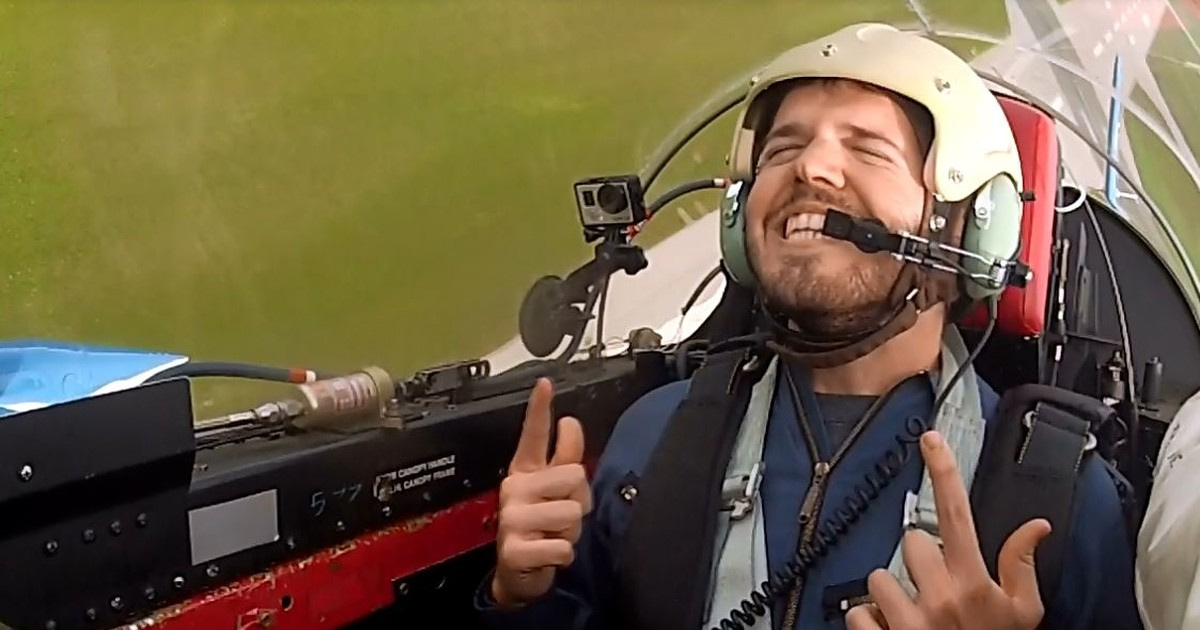 MiG-15 FagotCzech Republic - fly a Soviet Cold-War jetView this flight
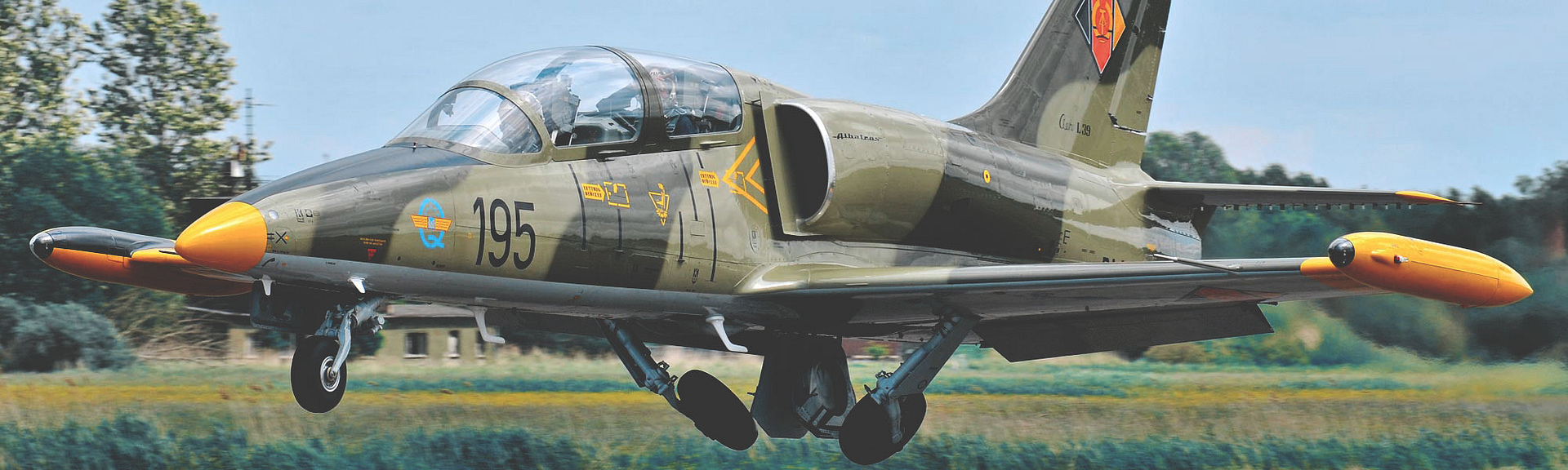 L-39 AlbatrosFlorida, USAView this flightF-104 StarfighterThe missile with a man in itView this flight
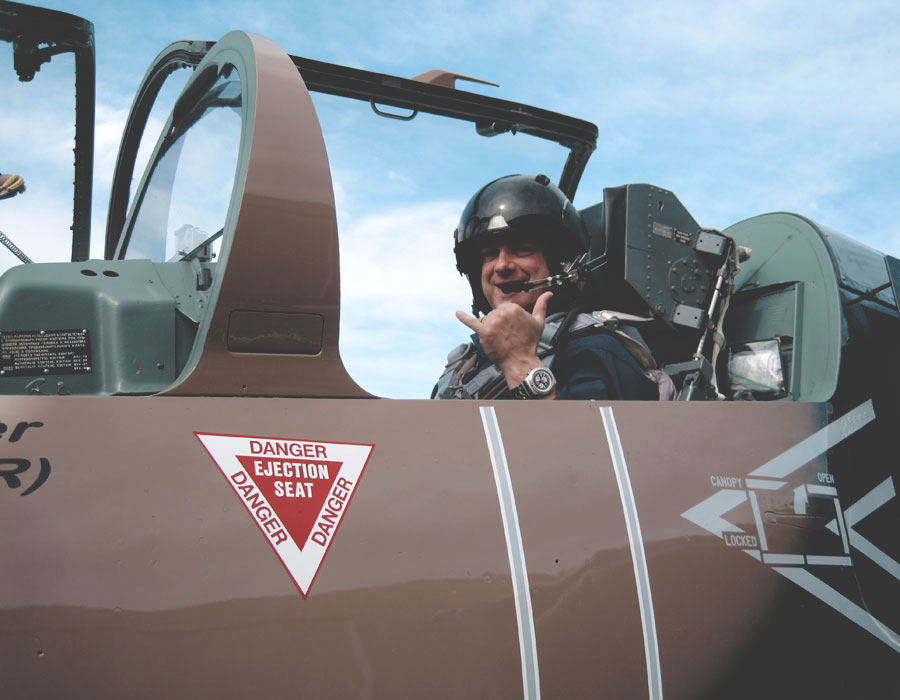 L-39 AlbatrosCalifornia, USAView this flightT-33 Shooting StarCanadaView this flight
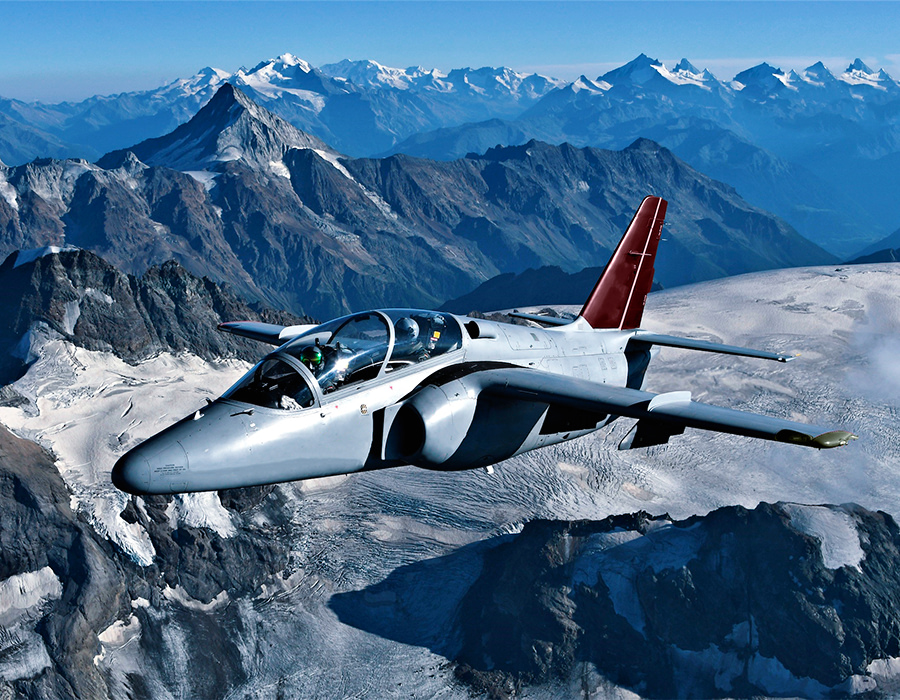 SIAI-Marchetti S-211Munich, GermanyView this flight
Legacy & Assessment
What the Tupolev Tu-4 really achieved
Judged as an aircraft, the Tu-4 was already obsolescent when it entered service. Judged as a strategic and industrial project, it was one of the most consequential aircraft the Soviet Union ever built.
It is easy to be dismissive of a copy. The Tu-4 broke no performance records, pioneered no new configuration, and was overtaken within a decade by the jets and turboprops that followed it. Had the Soviet Union set out in 1945 to build the most advanced bomber it could imagine, the Tu-4 is not what it would have produced.
But that was never the point. The Tu-4 gave the USSR, in the shortest possible time and with the least possible risk, a fleet of modern strategic bombers capable of carrying the atomic bomb. It closed a dangerous capability gap at the dawn of the nuclear age, and in doing so it helped establish the uneasy balance of deterrence that defined the Cold War. Whatever one thinks of that balance, the Tu-4 was a load-bearing part of it.
Its deeper legacy was industrial. To reproduce the B-29, the Soviet Union had to raise its whole aviation sector - metallurgy, electronics, engines, precision manufacturing and, above all, the discipline of building a complex aircraft to a single coherent standard in large numbers. Those capabilities did not retire with the Tu-4. They underwrote the Tu-16, the Tu-95 and the Soviet aircraft industry that followed. In that sense Stalin's blunt order to copy the B-29 exactly bought far more than a bomber; it bought a modern aerospace industry.
And there is the sheer strangeness of the story - a tribute, in its way, to the aircraft it copied. The B-29 was so good that a rival superpower judged the fastest route to modernity was to reproduce it bolt for bolt. Few aircraft have ever received a stranger, or greater, compliment.
Related Aircraft
Explore related aircraft
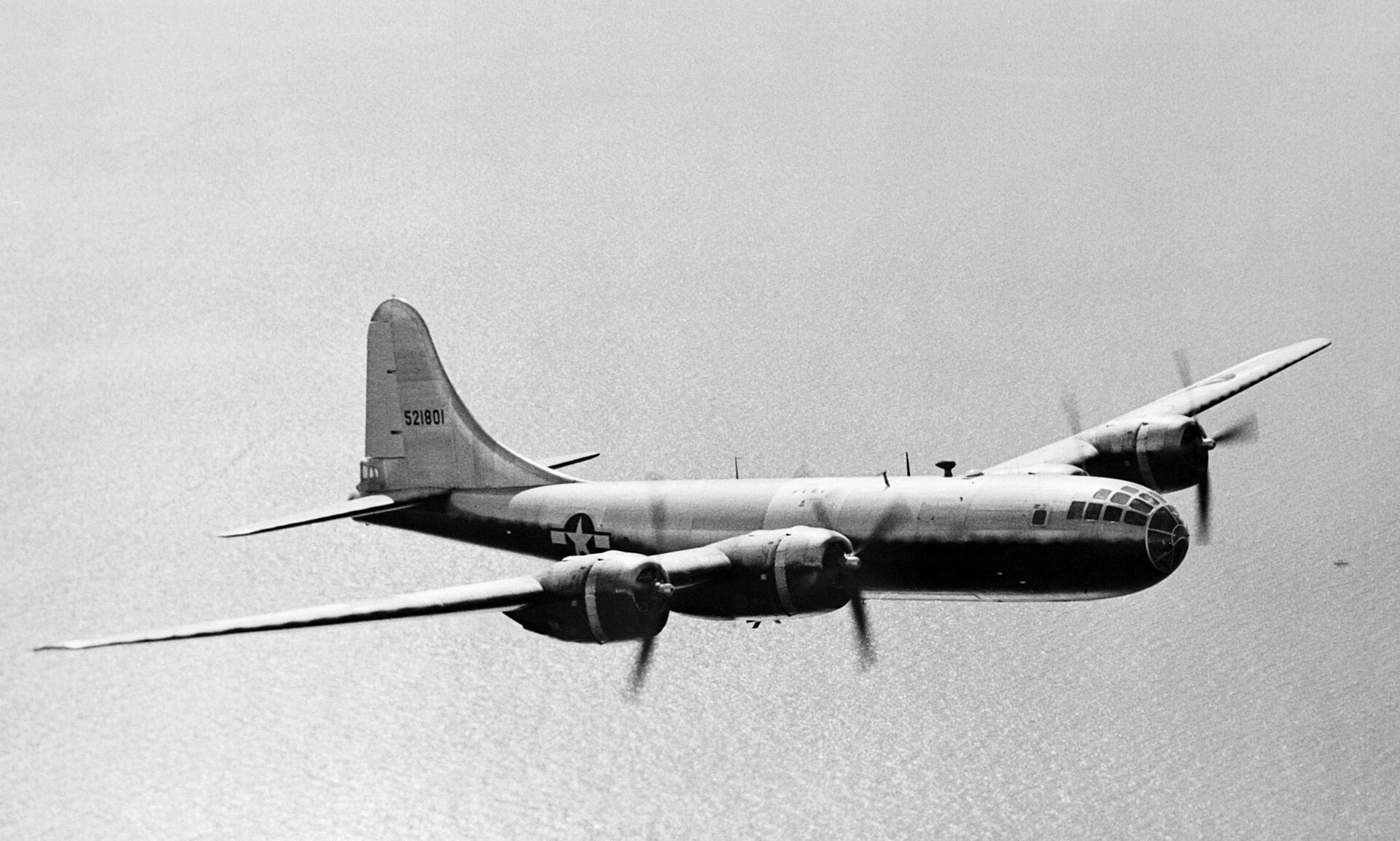 Boeing B-29 SuperfortressThe American original the Tu-4 was reverse-engineered from, and the aircraft that dropped the first atomic bombs.
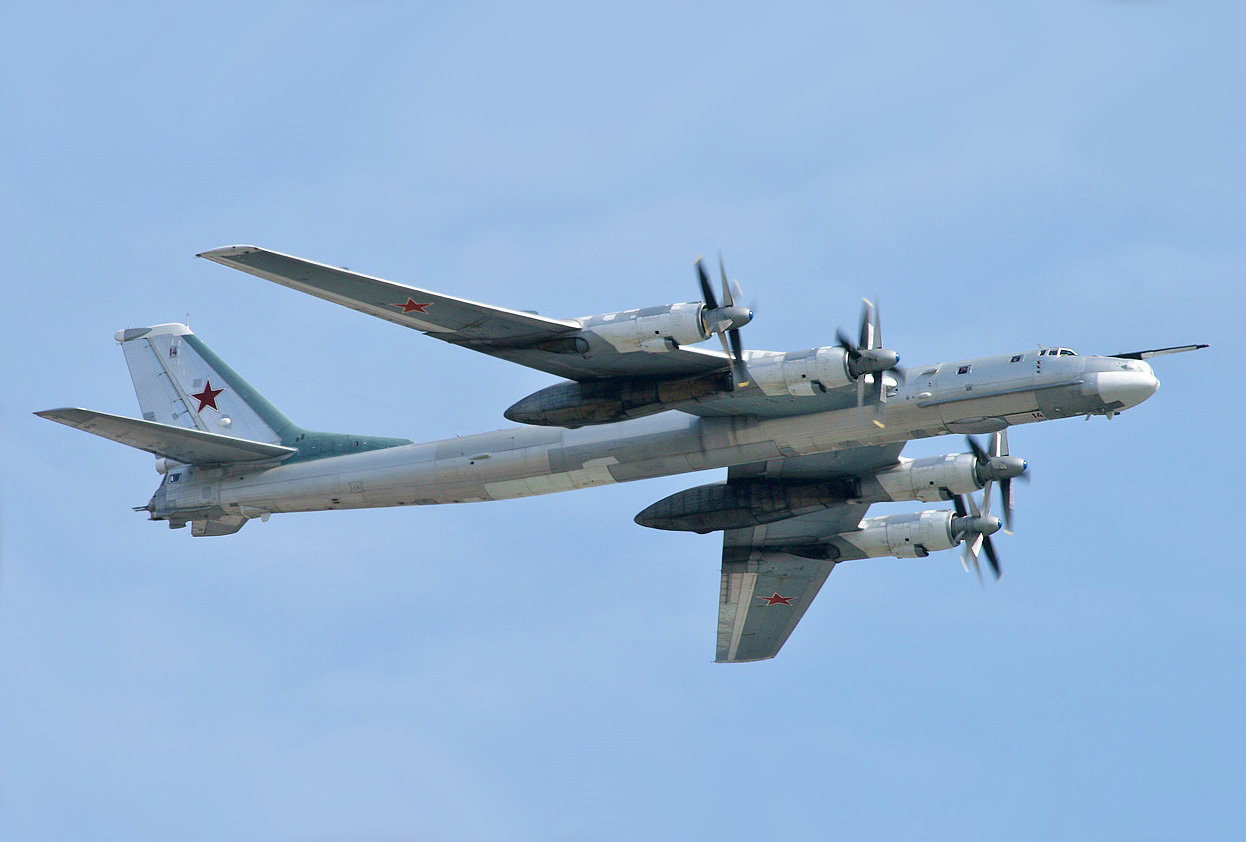 Tupolev Tu-95 BearThe intercontinental turboprop that gave the USSR the transatlantic reach the Tu-4 never had, and still flies today.
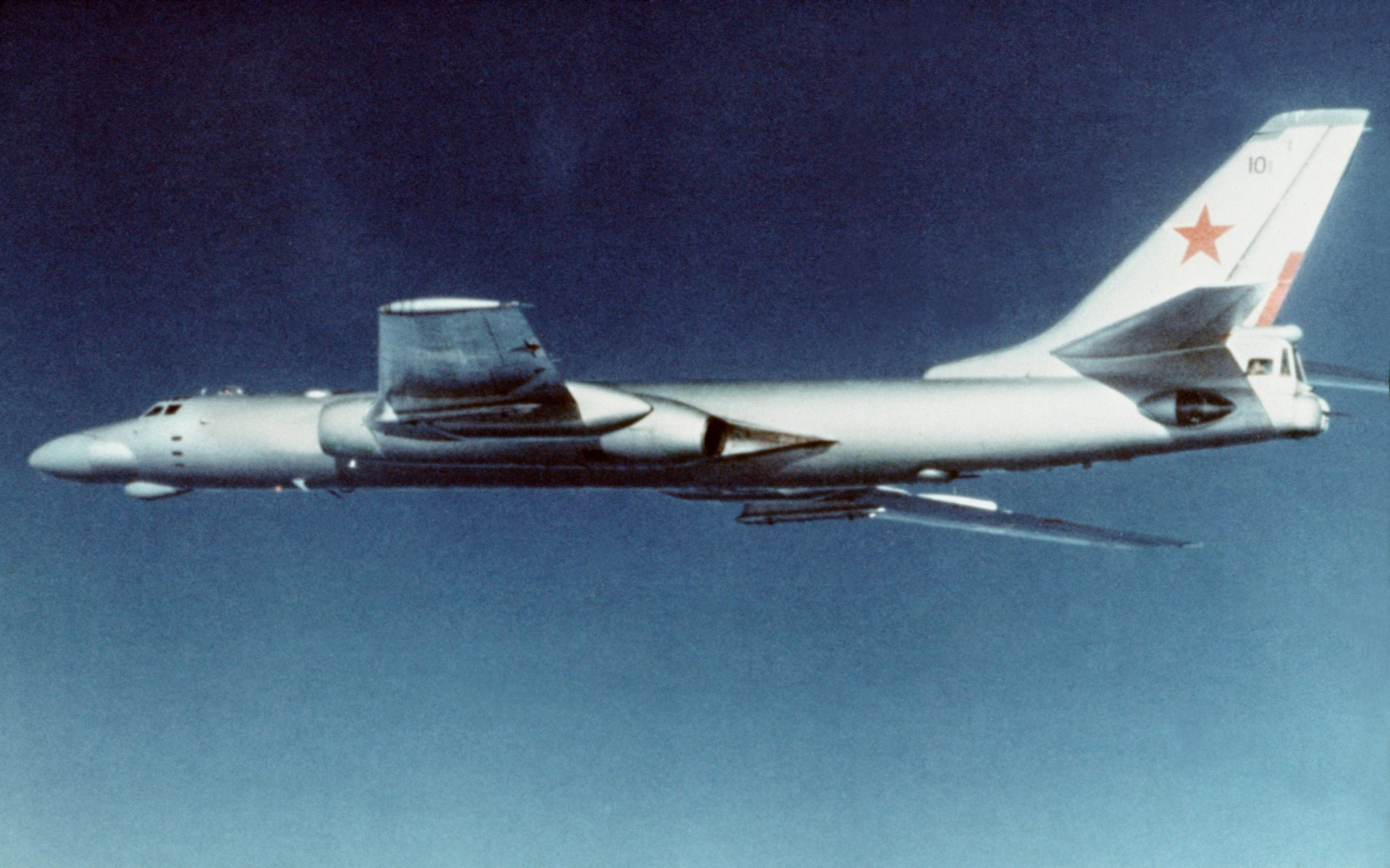 Tupolev Tu-16 BadgerThe jet bomber that pushed the piston-engined Tu-4 out of the Soviet first-line strategic role in the mid-1950s.
Sources & Further Reading