
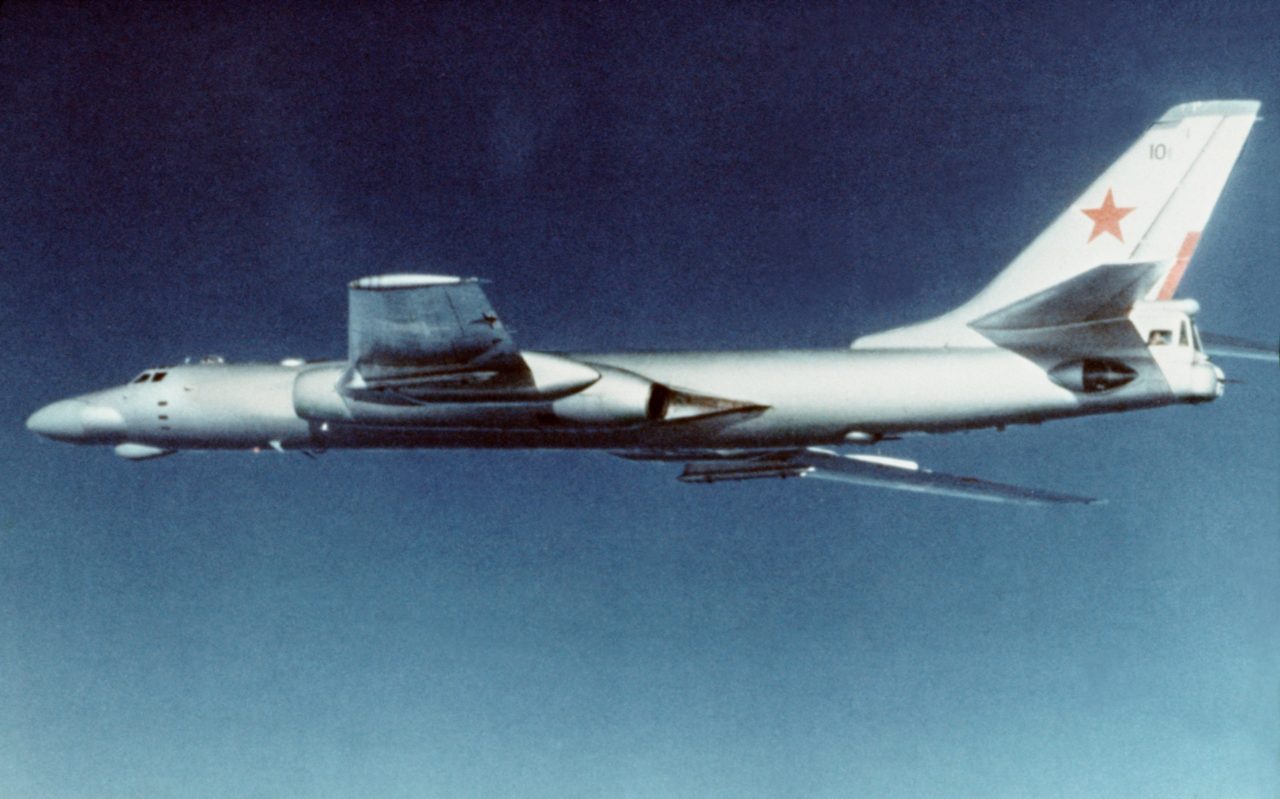
Tupolev Tu-16
“Badger”
A Soviet swept-wing twin-jet medium bomber of the early 1950s — a Cold War mainstay for nuclear strike, anti-ship missile carriage, reconnaissance and electronic warfare, and the ancestor of China’s still-flying Xian H-6.
The Soviet jet bomber that defined a Cold War generation
By the late 1940s the Soviet Union wanted a jet bomber that could carry a heavy load a long way at high subsonic speed. The answer came from the Tupolev design bureau and was made possible by one component above all: the powerful Mikulin AM-3 turbojet. The definitive prototype, known internally as aircraft “88,” first flew on 27 April 1952 and entered service in 1954. NATO gave it the reporting name “Badger.” Its Western public debut came when nine flew over Red Square on May Day 1954.
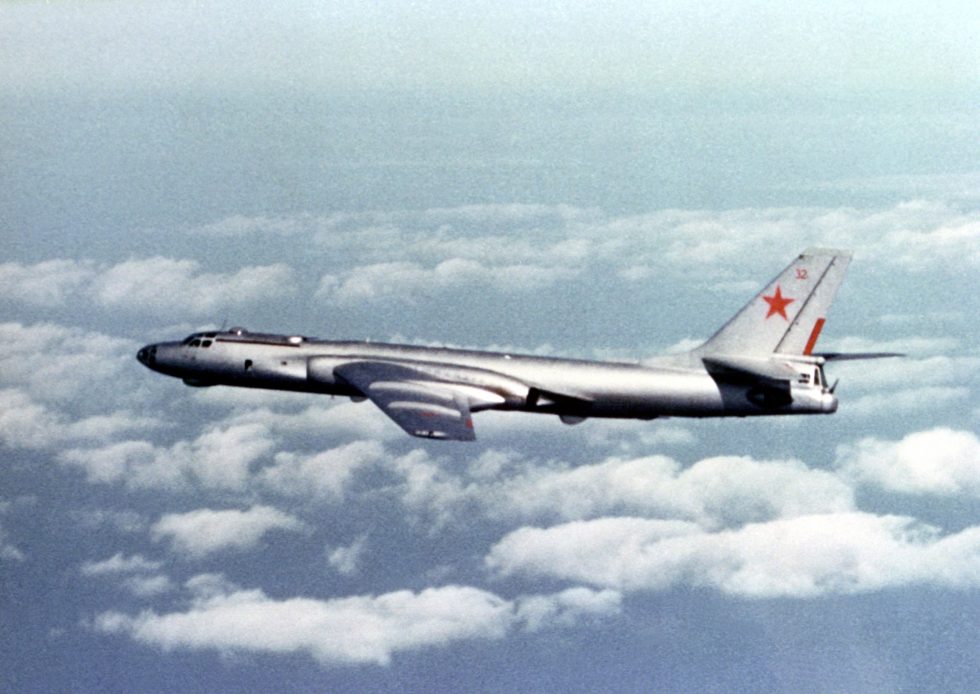
The Tu-16 was built around a 35-degree swept wing with the two large engines set into the wing roots against the fuselage. In its first role it was a free-fall nuclear and conventional bomber. But its most lasting significance was as a platform that kept changing jobs: as air defences improved and a subsonic bomber became harder to push over a target, the Soviets repeatedly re-engineered it to launch large anti-ship and land-attack cruise missiles — the AS-1 Kennel, AS-5 Kelt and AS-6 Kingfish — from standoff range. Reconnaissance, electronic-warfare, ELINT and tanker versions followed, so that a single airframe spawned a dozen distinct sub-types.
Roughly 1,509 were built in the USSR between 1953 and 1963, and the type served for decades in Soviet long-range and naval aviation before Russia retired it around 1993. It was exported to Egypt, Iraq and Indonesia, and saw combat in the Arab–Israeli wars and the Iran–Iraq War. Its design also outlived its parent air force: in 1957 the USSR licensed production to China, where it became the Xian H-6 — a separate aircraft, covered in its own exhibit, that remains in front-line Chinese service today.
01The Tu-16 Badger’s family tree: one airframe, a dozen missions
Few Cold War aircraft were adapted as widely as the Tu-16. The baseline Badger-A was a free-fall bomber, some with a heated bomb bay for nuclear weapons. Missile carriers followed — the Badger-B (Tu-16KS) with the AS-1 Kennel, the Badger-C with the large K-10 anti-ship missile, and the Badger-G with the AS-5 Kelt and later AS-6 Kingfish. Alongside these came dedicated photo-reconnaissance and maritime-reconnaissance versions (Badger-E/F), a family of electronic-warfare and ELINT aircraft (Badger-D/H/J/K/L) for jamming and signals collection, and tanker variants.
The airframe even crossed into civil aviation: Tupolev reused the Tu-16’s wing, engines and structure to create the Tu-104, one of the world’s first operational jet airliners, which flew in 1955. Exact variant counts and dates differ between sources and are best read as approximate, but the breadth is not in dispute — the Badger was less a single bomber than a whole toolbox built on one design.
What makes it special
Big engines buried in the wing roots
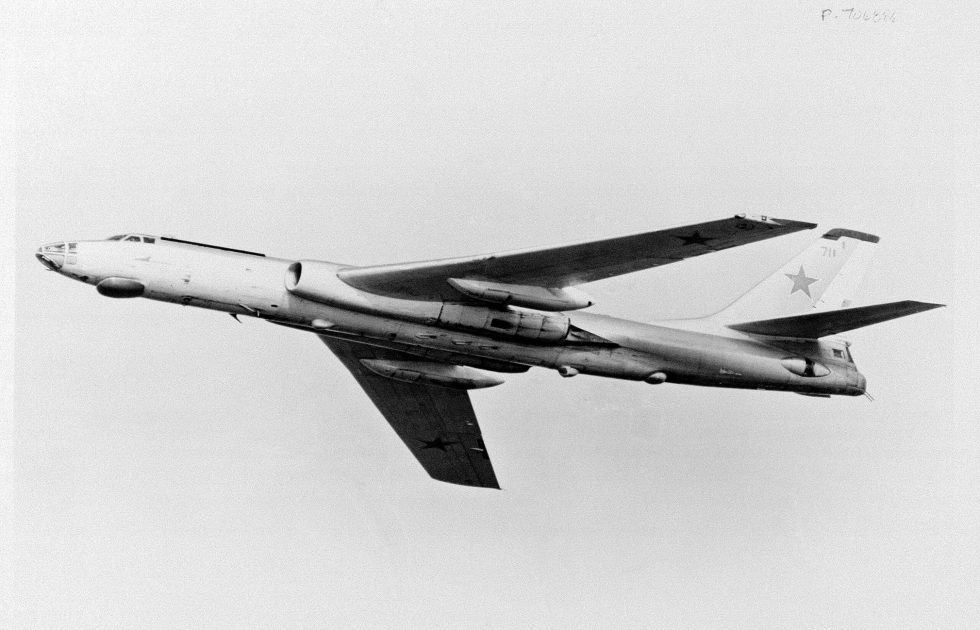
The Tu-16’s two large Mikulin AM-3 turbojets (later RD-3M) were set into the wing roots, tight against the fuselage, rather than hung in separate underwing pods. Combined with a 35-degree swept wing, this kept the wing aerodynamically clean for high subsonic speed and placed the thrust close to the centreline — which helped keep the heavy aircraft controllable if one engine failed.
From free-fall bomber to standoff missile carrier
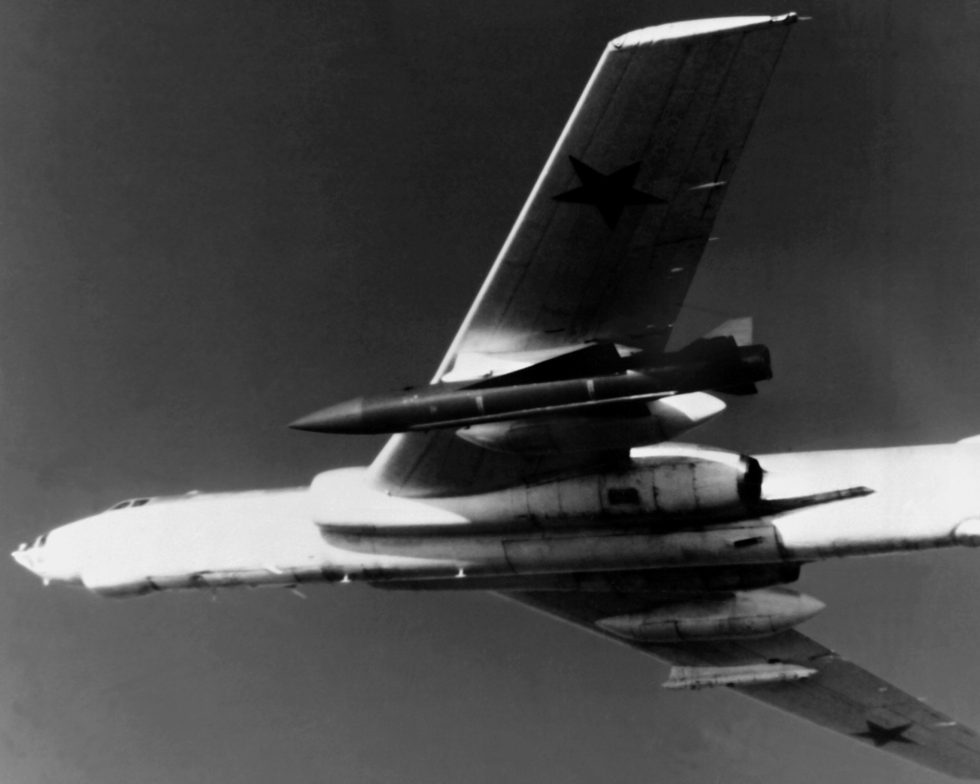
The Tu-16’s most important evolution was doctrinal. As defences improved, a subsonic bomber over a target became a liability, so the Soviets turned it into a launch platform. Successive variants carried large cruise missiles — the AS-1 Kennel, AS-5 Kelt and AS-6 Kingfish — letting it strike ships and land targets from well beyond gun and short-range missile defences without flying over them.
Wingtip-to-wingtip aerial refuelling
Some Tu-16 tankers used a refuelling method with no Western equivalent: fuel was passed from one aircraft’s wingtip to another’s, rather than through a trailing hose-and-drogue behind the tanker. It was a demanding technique that extended the bomber’s reach; later variants adopted a more conventional probe-and-drogue system.
02The Tu-16 Badger as a missile carrier: Kennel, Kelt and Kingfish
The anti-ship mission was where the Tu-16 mattered most in later life. Soviet Naval Aviation used it to carry heavy cruise missiles that could be launched from tens of kilometres away, turning a 1950s bomber into a credible threat to surface ships — a doctrine later inherited by the supersonic Tu-22M Backfire. The AS-1 Kennel was an early turbojet-powered missile resembling a small swept-wing jet; the AS-5 Kelt was used in anger by Egypt in 1973; and the larger, faster AS-6 Kingfish gave the type a long-range, high-speed weapon. Precise ranges and performance figures for these weapons vary between sources and were often classified, so they should be treated as approximate.
03The Tu-16 Badger and the Xian H-6: how the design outlived the USSR
In September 1957 the Soviet Union agreed to licence Tu-16 production to China. The first Chinese-assembled aircraft flew in 1959, and the first fully Chinese-built example — designated H-6 — flew in 1968. Where the USSR retired its Tu-16s by the early 1990s, China kept the basic airframe in production and service, repeatedly upgrading it into modern cruise-missile-carrying variants such as the H-6K and H-6N.
The two aircraft are best kept distinct: the H-6 is a licence-built descendant, not the same aircraft, and its modern forms differ substantially in engines, avionics and weapons. The Xian H-6 has its own exhibit in this museum. What the shared lineage shows is the durability of the original Tupolev design — roughly seventy years after the Tu-16’s first flight, its direct descendant is still flying.
Full specifications
Figures are broadly for the standard Soviet Tu-16 and mix official and estimated data. Several values — weight, ceiling, speed and engine thrust — differ between sources and are hedged accordingly.
Baseline note: the figures below describe the Tu-16K-10-26 as Soviet Naval Aviation flew it from 1969 — a Tu-16K-10 rebuilt to carry one K-10S semi-recessed under the fuselage and two KSR-5 on underwing pylons. That is the configuration in which the type mattered most, and the one American carrier groups actually planned against. Deltas for the Tu-16A free-fall nuclear bomber, the Tu-16KS with two KS-1 Kometa, the Tu-16R reconnaissance aircraft and the Tu-16Z tanker are given in grey. Four cautions apply before a single number below is quoted. First, the airframe barely changed: 1,507 aircraft left Kazan, Kuibyshev and Voronezh between 1954 and 1962 to essentially one set of external dimensions, so the dimensional rows hold for almost every mark — but the weight, speed and range rows do not. A missile carrier with four tonnes of Raduga hardware hanging in the airflow is a slower, shorter-legged aeroplane than the clean bomber whose figures fill most English tables. Second, the NATO letters are not Soviet designations and do not map onto them: "Badger" suffixes were handed out on observed external features, so one Soviet mark can appear under two letters and one letter can cover several unrelated Soviet marks. Third, range is quoted three different ways in the literature — ferry range at maximum fuel, combat range with a stated bomb load, and radius with one wingtip refuelling — and tables routinely print one beside another without saying which is which. Fourth, the Tu-16 and the Chinese H-6 are not the same aeroplane. The H-6K has different engines, a different nose, a different structure and a different mission, and no figure below should be read across to it.
Dimensions & weights
- Crew
- 6 — captain and co-pilot side by side, a navigator/bombardier in the glazed nose, a navigator-operator at the radar station behind the pilots, a radio operator who also worked the dorsal and ventral barbettes, and a tail gunner in his own pressurised compartment at the back. On the K-10 carriers the nose station became the missile operator’s post; seven appears where a second gunner is counted separately, and reconnaissance and jamming conversions carried extra equipment operators in a pressure capsule slung in the bomb bay
- Length
- 34.80 m (114 ft 2 in) over the airframe. Figures from 34.8 to 36.5 m circulate because sources differ over whether the tail cannon barrels and the nose pitot boom are included; the K-10 carriers swapped the glazed nose for the bulged YeN radome, which changed the profile without materially changing the length
- Wingspan
- 33.00 m (108 ft 3 in) — unchanged across the family, and modest for the weight. A B-47E spans 35.36 m and a Vickers Valiant 34.85 m, both on lighter airframes
- Height
- 10.36 m (34 ft 0 in) to the top of the fin
- Wing area
- 164.65 m² (1,772 sq ft) — a small wing worked hard. It is the reason the Tu-16 was fast at altitude and unforgiving near the ground, and the reason the approach was flown at 270 to 300 km/h
- Wing sweep
- 35° at quarter chord — the TsAGI figure of the period, shared with the MiG-15 and the Myasishchev M-4, with a sharper 41° on the inboard leading edge where the engine ducts pass through the root. Upper-surface fences held the boundary layer in place at high angles of attack
- Empty weight
- 37,200 kg (82,010 lb) for the bomber. Missile carriers ran two to three tonnes heavier once the YeN or Rubin radar, the pylons and the guidance racks were installed. The Tu-16Z tanker gained the hose drum and transfer tanks and gave back most of its bombing equipment
- Normal take-off weight
- 72,000 kg (158,730 lb) — the weight at which the published climb and ceiling figures were measured
- Maximum take-off weight
- 79,000 kg (174,165 lb), the structural and runway limit, and reached routinely on maritime sorties. SPRD-63 solid rocket units could be strapped to the rear fuselage for hot-and-high fields and short strips
- Internal fuel
- ~36,000 kg (~79,370 lb, roughly 44,000 litres) in wing and fuselage cells. Published tank counts and capacities disagree by several tonnes, partly because tankage differed between marks and partly because some tables quote usable and others total. The tilde is honest; this is one of the least reliable numbers on the aeroplane
- Weapon load
- 3,000 kg normal, 9,000 kg maximum (6,610 lb / 19,840 lb) for the bomber — a single FAB-9000M-54 filled the bay by itself. On the K-10-26 the offensive load is one K-10S of some 4,500 kg plus two KSR-5 of about 3,950 kg each, heavier still but hung largely outside, which is why the missile carrier lost so much performance
- Wing loading
- 437 kg/m² at normal weight, 480 kg/m² at maximum (89.5 and 98.3 lb/sq ft) — high for a bomber of 1954, and the arithmetic behind the long take-off run, the flat fast approach and the twin brake parachutes the type could not land without
Performance
- Maximum speed
- 1,050 km/h (652 mph, 567 kn) at 6,000 m for the clean bomber — about Mach 0.86, and genuinely fast for 1954. With a K-10S under the belly and two KSR-5 on the wings the same airframe is held to roughly 850 km/h (528 mph, 459 kn). That drag penalty is the single most consequential number on this page: it decided how long the run-in to a carrier group took and how much of it happened inside the fighter screen
- Cruising speed
- 800 km/h (497 mph, 432 kn) — the long-range cruise the maritime regiments actually flew, quoted between 780 and 850 km/h depending on weight and mark
- Service ceiling
- 12,300 m (40,350 ft) at normal weight. Figures of 12,800 to 13,100 m (42,000 to 43,000 ft) appear for light aircraft late in a sortie; the release band for the K-10S was 10,000 to 11,000 m, which put the launch aircraft exactly where a Talos or a Terrier battery wanted it
- Combat range
- 5,925 km (3,682 miles, 3,200 nmi) with 3,000 kg of bombs. The missile carriers lose roughly a fifth of that; the Tu-16K-10 is generally credited with about 3,900 km before launch, and the K-10-26 with its underwing pair rather less again
- Ferry range
- 7,200 km (4,474 miles, 3,888 nmi) at maximum fuel with no weapon load — the figure most often reprinted as though it were combat range, which it is not, and the source of the persistent belief that the Tu-16 could reach targets it could not reach
- Combat radius
- ~2,000 km (~1,240 miles, ~1,080 nmi) unrefuelled with a useful load. One wingtip refuelling from a Tu-16Z pushed that out by some 30 to 40 per cent, and that increment is what put carriers in the Norwegian Sea and the Philippine Sea inside the envelope in the first place
- Rate of climb
- 19 m/s (3,740 ft/min) initial at normal weight, falling away sharply above 10,000 m. Russian data tables more often quote time to height — of the order of twenty minutes to 10,000 m (32,800 ft) on a standard day — and the two are not always reconcilable
- Take-off run
- 1,900 m (6,230 ft) at normal weight, extending past 2,100 m (6,890 ft) at maximum. This is a big-runway aeroplane: the Egyptian and Iraqi fleets were confined to a handful of fields, which is precisely why the Israeli Air Force found all of them on the first morning of June 1967
- Landing run
- 1,655 m (5,430 ft) with the twin brake parachutes streamed. The Tu-16 was landed flat and fast and punished pilots who tried to fly it onto the runway slowly; the type’s accident record in the 1950s is dominated by approach and landing
- Endurance
- about 7 hours unrefuelled, and beyond twelve on the long Atlantic and Pacific shadowing sorties with a wingtip top-up. Crew comfort over those sorties was minimal and the tail gunner sat alone in his own cabin for the duration
- Load factor
- +2.0 g operational limit — a bomber structure, not a manoeuvring one. Crews were forbidden hard turns with missiles aboard, and the type had no meaningful capacity to evade once committed to a run-in
Propulsion & systems
- Engines
- 2 × Mikulin RD-3M-500 turbojets, 9,500 kgf (93.2 kN, 20,950 lbf) each — single-shaft, eight-stage compressor, no afterburner and no thrust reverser. The engine is the AM-3M under the designation it acquired after Mikulin was removed from his post in 1956; the same family powered the M-4 and 3M and the Tu-104 airliner, which is a great deal of Soviet aviation resting on one 1950s turbojet
- Earlier engines
- 2 × AM-3A, 8,750 kgf (85.8 kN, 19,290 lbf) on early production, and the AM-3 of 8,700 kgf on the prototypes. The first Tu-88 prototype was overweight and underpowered on that thrust; the second aeroplane won its competition against the Ilyushin Il-46 largely on a savage weight-reduction programme rather than on any new engine
- Engine installation
- Buried in the wing roots, thrust lines splayed outboard — intakes in the leading edge of the root, jet pipes emerging alongside the rear fuselage and angled away from it so the efflux cleared the tailplane. It kept the wing aerodynamically clean and left the aircraft flyable on one engine. The price was that an engine bay fire was a fire inside the wing root, next to the fuel
- Fuel consumption
- about 1.0 kg/kgf·h in cruise — the AM-3 family was powerful and very thirsty. That figure is why the Tu-16 was a medium bomber with intercontinental ambitions and no means of realising them, why roughly a third of the fleet was wired for wingtip refuelling, and why the Soviet Union built the Tu-95 as well rather than instead
- Undercarriage
- Tricycle, twin-wheel nose and four-wheel main bogies — the mains retract rearwards into the streamlined fairings projecting behind the wing trailing edge that became a Tupolev signature and reappeared on the Tu-104, Tu-114 and Tu-95. Levered suspension and low-pressure tyres allowed operation from packed earth and steel matting; twin brake parachutes lived in the tail cone
- Bombing and navigation radar
- RBP-4 Rubidiy MM-2 (NATO Short Horn) in a ventral radome, with the OPB-11R optical bombsight in the glazed nose for visual work and the later RBP-6 Lyustra on updated aircraft. The Tu-16 remained fundamentally an optical bomber when the weather allowed and a radar bomber when it did not, with the accuracy that implies — which is why Iraqi raids on Iranian cities in the 1980s were area attacks whatever the target folder said
- Missile guidance radar
- YeN on the K-10 carriers, Rubin-1K on the K-16 and K-26 — the YeN set (NATO Puff Ball) filled the nose of the Tu-16K-10, acquired the target and flew the K-10S by radio command until the missile’s own seeker took over. Rubin-1KV searched to some 200 km for the KSR-2 and KSR-5. The Ritsa passive receiver did the targeting for the anti-radar KSR-11 and KSR-5P, and needed the enemy radar to be transmitting
- Gun-laying radar and sights
- PRS-1 Argon in the tail — a combined tail-warning and gun-laying set for the rear mounting, backed by PS-53 optical sighting blisters on the fuselage sides and a dorsal astrodome from which the two barbettes were aimed remotely. The whole arrangement descends conceptually from the Tu-4, which descends from the B-29, and it was designed against interceptors with guns
- Electronic warfare
- SPS-1 and SPS-2 jammers, ASO chaff dispensers, Sirena warning receivers — and on the dedicated aircraft the SPS-22, SPS-33, SPS-44 and SPS-55 Buket suite in a ventral canoe. Soviet Naval Aviation treated jamming as a regimental asset rather than a per-aircraft fit: a strike went in behind its own escort of Tu-16P and Tu-16 Yolka machines, and the rest of the formation carried very little of its own
- Refuelling system
- Wingtip-to-wingtip on the Tu-16Z — a hose streamed from the tanker’s starboard wingtip and was caught in a receptacle at the receiver’s port wingtip. It is unique to Soviet practice, was tried on nothing else at this scale, and is described without exception by the crews who flew it as frightening; formation-keeping errors put two large aeroplanes into each other. The Tu-16N used a conventional Konus probe-and-drogue unit instead, to serve the Tu-22 and later the Tu-22M
- Crew escape
- Downward ejection for the forward crew, hatches for the rear — the men in the forward pressure cabin went out through the nosewheel bay, the radio operator through the ventral hatch and the tail gunner rearwards through his own. Downward ejection is useless below a few hundred metres, which is exactly where most of the type’s fatal accidents happened
- Structure
- All-metal stressed skin, two pressurised cabins — D16T alloy, a forward cabin for four and a separate tail cabin for the gunner, with an unpressurised bomb bay between them. The structure proved remarkably durable: Ukrainian and Egyptian airframes were still flying forty years after they were built, and Chinese derivatives of the same basic box are in production today
04The Tu-16 Badger’s operating costs: why no reliable price exists
The Tu-16 was a Soviet state military product, never sold on an open dollar market, so there is no credible public flyaway unit price or cost-per-flight-hour figure for the type. Any specific dollar amount attached to it should be treated as an estimate rather than a sourced number.
What can be said is that the aircraft was built in large numbers — around 1,500 in the USSR alone — and served for roughly four decades, which points to a design that was economical to produce and maintain by the standards of its era. The same logic of stretching an established, affordable airframe is why the licence-built Chinese H-6 line was kept alive and upgraded long after the original.
Armament & payload
The Tu-16 was built to drop one nuclear bomb, was obsolete at that job within five years, and spent the next three decades being rebuilt around whatever missile Raduga could hang underneath it
The original weapon was a free-fall bomb, and the type made history with one: on 22 November 1955 a Tu-16 released RDS-37 over the Semipalatinsk range, the first Soviet two-stage thermonuclear weapon delivered from an aeroplane, deliberately down-rated to about 1.6 Mt because the full design yield was judged unsafe to drop. Four hundred and fifty-three Tu-16A were built with the heated, lined and shielded bay such weapons needed. But a subsonic medium bomber that had to fly over its target was already losing the argument by 1958, and what saved the Tu-16 was not the bomb bay. It was the pylon.
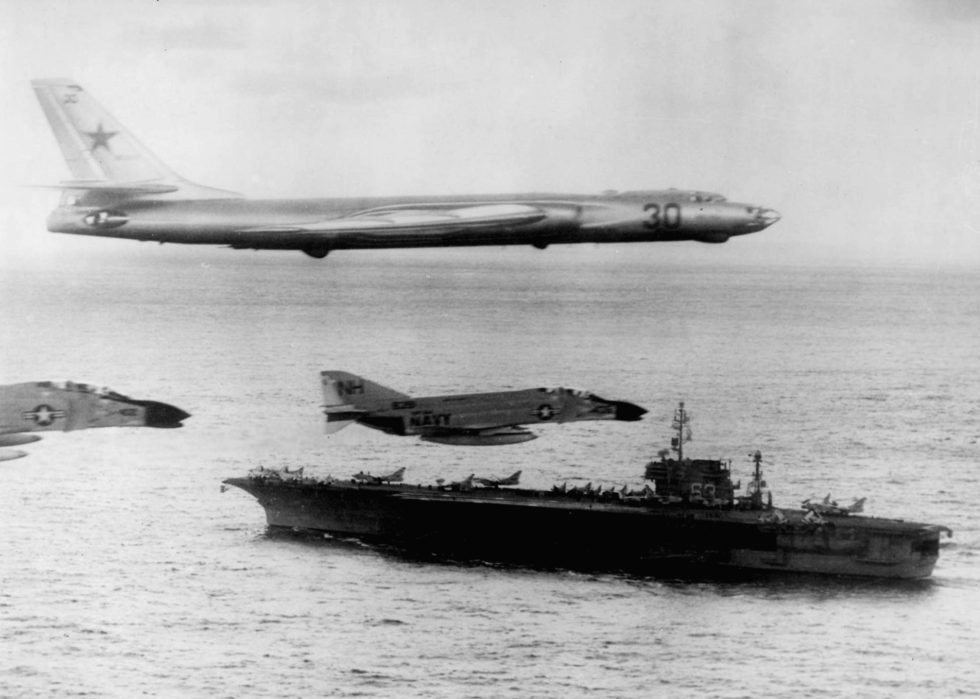
The missile lineage runs KS-1 Kometa, K-10S, KSR-2 and KSR-5, each larger and faster than the last, all of them Raduga designs from the same aerodynamic school, and all of them aimed at one target set: American and British aircraft carriers. The concept was sound and the arithmetic was brutal. A naval missile regiment could put twenty or more Tu-16s over the horizon and launch two dozen supersonic weapons from beyond the range of the carrier’s fighters, accepting that some of the launch aircraft would not come home. What the concept required was knowing where the carrier was, and that meant Tu-16R and Tu-95RTs shadowers loitering in plain sight, being escorted by Phantoms, for hours. The Soviet Navy practised this relentlessly and never had to do it, and the honest verdict is that nobody knows whether it would have worked.
Defensively the aircraft was armed like a piston bomber, because it was designed like one: seven 23 mm cannon in three power mountings and a fixed nose gun, laid by a tail radar and optical blisters, on an aeroplane that could not manoeuvre past two g. Against a MiG-17 that was reasonable. Against an F-4 firing Sparrows from eight miles it was scenery. Fits varied sharply by mark and operator: the nose gun vanished from most missile carriers and reconnaissance aircraft, giving the six-gun total English tables usually quote; tanker and jamming conversions were often stripped of guns altogether; Egyptian and Iraqi aircraft were re-equipped piecemeal from Soviet and later Chinese sources, so a photograph of an export Badger proves very little about what that particular airframe carried.
Gun
- 7 × 23 mm Afanasyev-Makarov AM-23, about 1,250 rounds a minute each: one fixed in the starboard side of the nose and fired by the captain, a twin dorsal barbette, a twin ventral barbette and a twin tail mounting
- The tail mounting was laid by the PRS-1 Argon radar and worked by its own gunner; the dorsal and ventral barbettes were aimed remotely by the radio operator from PS-53 optical sighting blisters on the fuselage sides and a dorsal astrodome
- Total ammunition of the order of 2,300 rounds, the split between mountings varying between marks and between published accounts; early aircraft and some export machines are recorded with the older NR-23 rather than the AM-23
- The fixed nose gun was deleted from most missile carriers, reconnaissance aircraft and jammers, which is where the widely quoted six-gun figure comes from
- It was a well-executed answer to the wrong question. The mountings were reliable and the field of fire close to spherical, but the scheme was sized against interceptors closing to about a kilometre with cannon, and that world ended while the type was still in production
Air-to-air
- None. No Tu-16 variant of any nationality ever carried an air-to-air missile, and no serious attempt was made to give it one
- The cannon were the whole air-to-air armament, and the doctrine built on them was numbers and geometry rather than individual defence: regimental formations, dedicated jamming escorts, approach on unexpected bearings, and the acceptance of losses
- The Tu-16 could not run and could not turn. Its survival case rested on the enemy being late, and against carrier-borne interceptors with radar missiles that case was never strong
- The only air-to-air result in the type’s combat record belongs to the other side: Israeli fighters and gunners shot Tu-16s down in 1967 and 1973, and an Israeli fighter intercepted one of the KSR-2 fired at Tel Aviv in October 1973
Air-to-surface guided
- KS-1 Kometa (AS-1 Kennel) on the Tu-16KS: 8.29 m long, about 3,000 kg, a 600 kg armour-piercing warhead, some 90 km at Mach 0.9, riding the carrier aircraft’s radar beam before switching to active radar homing. Two on underwing pylons; in service from 1955 and, in its ground-launched Sopka form, one of the most widely exported Soviet weapons of the era
- K-10S (AS-2 Kipper) on the Tu-16K-10: one weapon of roughly 4,500 kg carried semi-recessed under the fuselage, about 300 to 350 km at Mach 1.7 to 2.0 with a 940 kg conventional or a nuclear warhead. Radio command from the YeN radar, then active homing, then a dive to the waterline. In service 1961; never fired in anger
- KSR-2 (AS-5 Kelt) and the anti-radar KSR-11: about 4,080 kg, some 200 km from high release, Mach 1.2, an 850 to 1,000 kg high-explosive or a nuclear warhead, two under the wings, in service from 1962. The KSR-11 swapped the active seeker for a passive one cued by the Ritsa receiver. These are the only Tu-16 missiles ever launched in war
- KSR-5 (AS-6 Kingfish) and KSR-5P on the K-26 complex: about 3,950 kg, 400 km at Mach 3 from altitude or 250 km at Mach 2 low down, with a 1,000 kg conventional or a 350 kt warhead, in service from 1969. Roughly 300 were still on Soviet bomber strength in June 1991; the nuclear versions of both KSR-2 and KSR-5 were retired by 1993 and much of the stock became target drones
- Never the Kh-22 (AS-4 Kitchen), despite what a good deal of English writing says. The Kh-22 was a Tu-22K, Tu-95K-22 and Tu-22M weapon; the KSR-5 is its smaller relative and is what the Tu-16 carried. The Chinese line went its own way: the H-6D fired the C-601/YJ-6, a KS-1 descendant, and fifty of them went to Iraq in 1987
Bombs
- Nuclear: the Tu-16A carried the RDS-series fission bombs and their successors in a conditioned bay, 453 aircraft built to that standard. The RDS-37 drop of 22 November 1955 was the first Soviet thermonuclear weapon delivered by air, and a Chinese Tu-16 or its H-6 derivative delivered China’s air-dropped nuclear tests of the 1960s, including the thermonuclear shot of 17 June 1967
- Free-fall conventional: FAB-250, FAB-500, FAB-1500, FAB-3000, FAB-5000 and the FAB-9000M-54, which occupied the bay by itself. Normal load 3,000 kg, maximum 9,000 kg, with clusters of the smaller sizes on internal racks
- Naval mines: AMD-500 and AMD-1000 and the later bottom and moored families. Mining was a first-class task for Soviet Naval Aviation, exercised constantly and planned as a pre-war measure rather than a wartime one, and the Tu-16 was its principal carrier for two decades
- Torpedoes: the rocket-propelled RAT-52 and the 45-36MAN on the 76 Tu-16T built. The torpedo-bomber role was abandoned by the early 1960s once missiles arrived, and the aircraft were converted to Tu-16S rescue machines and tankers
- The unglamorous truth is that the type spent more of its combat life dropping iron than launching missiles. Egyptian raids in Yemen and in 1967 and 1973, and Iraqi attacks on Iranian cities through the 1980s, were flown with ordinary FAB-series bombs aimed by radar
Rockets
- None, on any variant, in any air force. The Tu-16 had no pylons for rocket pods, no sighting system for the delivery and a 2.0 g structural limit that ruled out the dive a rocket attack needs. This card exists to say so plainly rather than to invent a capability
- The nearest thing to a rocket weapon was the RAT-52 torpedo of the Tu-16T, which used a solid rocket motor for its short underwater run after a shallow-angle release
- Rockets did appear on the aeroplane, but for getting it off the ground: SPRD-63 solid boosters could be attached to the rear fuselage to shorten the take-off run at heavy weights or from hot and high fields
- The Chinese H-6 has followed the same rule for more than six decades. It has carried nuclear bombs, cruise missiles, anti-ship missiles and an air-launched ballistic missile, and never a rocket pod
Pods & other stores
- Reconnaissance: pallets of AFA-series day and night cameras in the bomb bay with photoflash bombs, and SRS-series electronic intelligence receivers in blisters and bay capsules on the Tu-16R, Tu-16RM-1 and Tu-16RM-2. These were the aircraft that shadowed NATO task groups, and their real payload was a radio and a good pair of eyes
- Jamming: the SPS-22/33/44/55 Buket suite in a long ventral canoe on the Tu-16P, and bomb bays packed with ASO-16 chaff dispensers on the Tu-16 Yolka, which existed purely to fill a strike corridor with metal
- Refuelling: the wingtip hose drum and transfer tanks of the Tu-16Z, and the Konus hose-and-drogue unit of the Tu-16N. Around 500 airframes were wired to receive fuel and a substantial minority converted to give it
- Search and rescue: the Fregat parachute-dropped powered lifeboat carried under the Tu-16S, released to survivors and then conned to them by radio from the circling aircraft — one of the more humane uses any Cold War bomber was put to
- Trials and targets: the Tu-16LL engine testbed, which lowered a development engine from the bay into the airflow; the Tu-16KRM launching target drones; and time-expired KSR-2 and KSR-5 rebuilt as targets for the air-defence forces to shoot at
Three typical loadouts
- Anti-carrier regimental strike, Tu-16K-10-26, Northern Fleet, mid-1970s
- One K-10S semi-recessed under the fuselage and two KSR-5 on the wing pylons, full internal fuel, one wingtip refuelling outbound from a Tu-16Z. Targeting handed over from a Tu-95RTs or a Tu-16RM already in contact with the group; the regiment climbs to 10,000 to 11,000 m, spreads into launch order, releases at between 250 and 400 km depending on weapon and profile, and turns away. Tu-16P jammers and Yolka chaff aircraft work the corridor throughout. The plan accepted that the second wave would meet an alerted combat air patrol and that a meaningful fraction of it would not return.
- Nuclear alert, Tu-16A, Soviet Baltic, early 1960s
- One weapon in a sealed and conditioned bay, full guns, full fuel, target folders for airfields, ports and headquarters in Scandinavia, the Federal Republic and the United Kingdom. Radar bombing from height on a single pass, RBP-4 for the run-in, OPB-11R if the weather allowed a visual release. No stand-off, no terrain masking and no realistic expectation of surviving Bloodhound and Nike belts — the aircraft was a delivery vehicle in the literal sense.
- Egyptian missile strike, Tu-16K-11-16, October 1973
- Two KSR-2 or KSR-11 under the wings, launched from over Egyptian territory against Israeli radar sites and command posts in Sinai and, in one case, at Tel Aviv. Twenty-five missiles were fired across the war — thirteen KSR-2 and twelve KSR-11 — scoring hits on radar installations and a supply dump. One was intercepted in flight by an Israeli fighter, one of very few occasions on which a fighter has shot down an air-launched cruise missile. Egypt kept its Tu-16s well behind the canal and out of Israeli fighter range, having learned the 1967 lesson the hard way.
Sourcing caveat: weapon nomenclature and loads for this type come mainly from Russian-language monograph literature and from Gordon and Rigmant’s Red Star volume in English, supplemented for the export aircraft by Israeli and Iranian accounts that were written from the receiving end and are not neutral. Ammunition splits, the exact composition of the nuclear inventory and the conversion totals for individual missile complexes differ between sources; where they conflict, both figures are given above rather than an average. Missile performance figures are as published by their designers or by Soviet reference works and were never independently verified in combat, with the single exception of the KSR-2 and KSR-11 fired by Egypt in 1973.
Variants
Tupolev built 1,507 Tu-16s in nine years, and Xian is still rolling the same basic aeroplane out of the factory today
The prototype, Tu-88, first flew on 27 April 1952 in the hands of Nikolai Rybko. It was overweight and its competitor, the Ilyushin Il-46, was cheaper and safer. What won the contest was not a new engine but an unusually ruthless weight-reduction programme on the second aeroplane, which cut some five tonnes out of the structure and turned a marginal design into a fast one. Production began in 1953, nine aircraft flew over Moscow on May Day 1954, and by the time the line closed 1,507 had been built at three plants: Kazan, Kuibyshev and Voronezh. A handful of sources give 1,509 or 1,511, the difference being how prototypes and rebuilds are counted.
What followed is the most prolific variant tree in Soviet aviation. Something close to fifty modifications are recognised, and the reason is unromantic: the airframe was large, cheap, structurally sound and available in quantity, so every time Soviet Naval Aviation or Long-Range Aviation needed a platform for something new, it got a Tu-16. Bomber, missile carrier, torpedo bomber, photographic and electronic reconnaissance, stand-off jammer, chaff layer, tanker, rescue aircraft, engine testbed and drone launcher — all the same aeroplane, often the same individual airframe converted twice. Soviet naval aviation ran on this one airframe for thirty years, and it is fair to say that no other Soviet aeroplane was asked to do so many unrelated jobs.
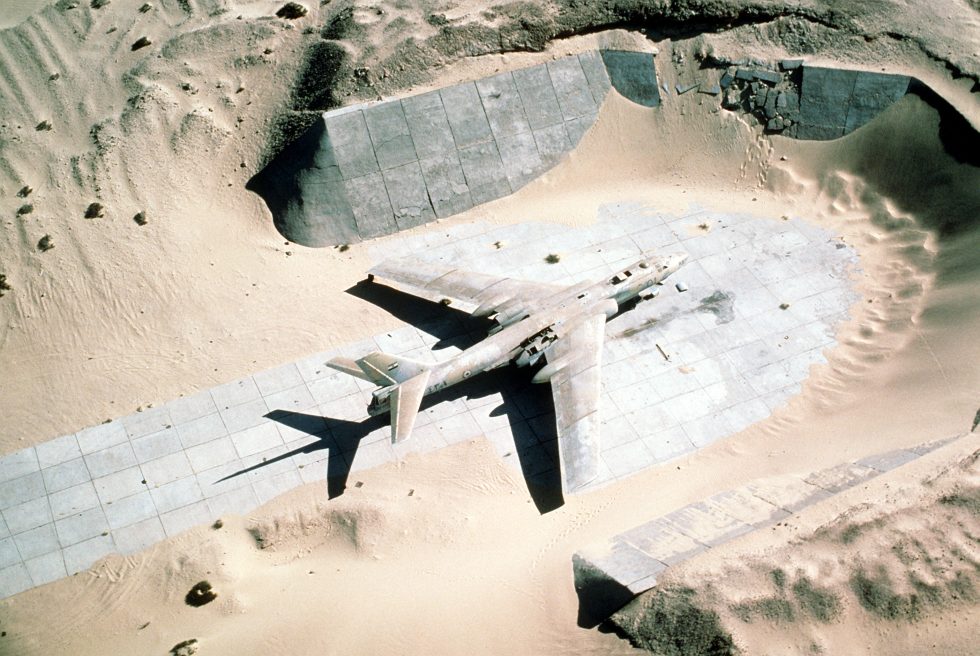
The export aircraft are where the type actually went to war, and it went badly. Egypt received Tu-16s from 1963 and first used them over Yemen; on the morning of 5 June 1967 the Israeli Air Force caught the fleet on the ground at Cairo West and Beni Suef and destroyed 23 of 25 with napalm and cluster munitions. That remains among the most efficient destructions of a bomber force in the jet age, and it is a permanent lesson about basing a large, runway-dependent aeroplane within reach of a first strike. The only Arab bombing raid to reach Israel proper in that war was flown by an Iraqi Tu-16, which attacked Netanya on 6 June and was shot down. Re-equipped with Tu-16K-11-16, Egypt launched twenty-five KSR-2 and KSR-11 in October 1973 from well behind the canal, having learned where not to fly, and used the type again against Libya in 1977. Iraq bombed Iranian cities including Tehran throughout the 1980s and, after buying four Chinese H-6D and fifty C-601 missiles in 1987, began sinking merchant ships with them: the Iranian freighter Entekhab on 5 February 1988 was the first of some fifteen vessels hit. Soviet crews themselves finally used the type in anger over Afghanistan, thirty-six Tu-16s moving to southern bases in March 1984 and opening the Panjshir offensive on 20 April with mass high-level bombing — heavy free-fall ordnance released through cloud onto a valley, which is what a strategic bomber looks like when it is being used because nothing else can carry that weight of explosive.
Then there is China, and this is the part that makes the Tu-16 unusual among aircraft of its generation. A licence agreement was signed in the late 1950s; two pattern aircraft and knock-down kits arrived, and the first Chinese-assembled machine flew in 1959, put together in sixty-seven days. The Sino-Soviet split then removed all Soviet support, and the Chinese finished the job themselves: the first wholly domestically built H-6 flew on 24 December 1968. Production has never really stopped. Around 231 had been built by late 2020, and the H-6K of 2007 with D-30KP-2 turbofans, a solid radar nose and six pylons for CJ-20 cruise missiles, together with the H-6N carrying an air-launched ballistic missile, are current front-line equipment. A design that first flew in April 1952 is still in production seventy-four years later. Boeing stopped building B-52s in 1962; nothing in the West comes close to that continuity.
- Tu-16 and Tu-16A (Badger-A, 1953–63; 453 Tu-16A)
- The free-fall bomber. The Tu-16A added the conditioned, shielded bay and release gear for nuclear weapons and became the most numerous single mark. This is the aircraft that dropped RDS-37 in November 1955, that Egypt and Iraq used as a conventional bomber into the 1980s, and whose figures fill the specification tables of the whole family.
- Tu-16KS (Badger-B, 1954–58, 107 built)
- The first missile carrier: two KS-1 Kometa on underwing pylons, a Kobalt-series guidance radar in a ventral radome and an operator to fly the missile down the beam. Exported to Indonesia from 1961 and to Egypt, and the ancestor by direct descent of every Chinese anti-ship missile carrier that followed.
- Tu-16K-10 (Badger-C, 1958–63, 216 built)
- Built new rather than converted: the glazed nose replaced by the large YeN radome, one K-10S carried semi-recessed in a modified bay. The definitive Soviet anti-carrier aircraft of the 1960s and the reason the American surface fleet spent that decade buying long-range surface-to-air missiles.
- Tu-16K-11-16 and Tu-16KSR-2 (Badger-G, from 1962, several hundred converted)
- The K-16 complex: two KSR-2 or anti-radar KSR-11 under the wings with the Rubin-1K radar, applied as a conversion to existing Tu-16 and Tu-16A airframes so that the bomber fleet acquired a stand-off capability without new production. Egypt received this configuration and fired it in 1973.
- Tu-16K-26 and Tu-16K-10-26 (Badger-G Mod and C Mod, from 1969)
- The K-26 complex with two KSR-5, and the hybrid K-10-26 that kept the K-10S under the belly and added a KSR-5 on each wing — three supersonic missiles from one aeroplane, and the peak of the type’s striking power. The Tu-16K-26P carried the anti-radar KSR-5P for suppressing a task group’s air-defence radars ahead of the main wave.
- Tu-16R, Tu-16RM-1 and Tu-16RM-2 (Badger-D, E and F; 23 RM-1 converted from Tu-16K-10)
- Photographic and electronic reconnaissance with camera pallets, SRS receivers and ELINT blisters. These aircraft did the work the missile carriers depended on: finding and holding contact with NATO task groups in the Norwegian Sea, the Mediterranean and the western Pacific, often escorted wingtip to wingtip by carrier fighters for hours at a time. Colonel Pliyev’s Badger-F went into the sea beside USS Essex in the Norwegian Sea on 25 May 1968 doing exactly this.
- Tu-16 Yolka, Tu-16P Buket and Tu-16Ye (Badger-H, J, K and L)
- The electronic warfare family: Yolka with bomb bays full of ASO chaff dispensers to open a corridor, Buket with the SPS-22/33/44/55 jamming suite in a ventral canoe as a stand-off escort jammer, and the Tu-16Ye as a heavy electronic intelligence gatherer. The NATO letters here map particularly badly onto the Soviet designations and are best treated as descriptions of what an observer saw.
- Tu-16Z and Tu-16N (from the late 1950s and 1963; several hundred converted)
- Tankers. The Tu-16Z used the wingtip-to-wingtip system, trailing a hose from its starboard tip for the receiver to catch with its port tip, while keeping its bomber role; the Tu-16N was a dedicated probe-and-drogue tanker for the Tu-22 and later the Tu-22M. Wingtip refuelling was a genuinely dangerous procedure and the Soviet Union abandoned it once the Konus unit matured, but it is what gave the Tu-16 fleet the reach its engines denied it.
- Tu-16T, Tu-16S, Tu-16LL and the odd jobs (1955 onwards; 76 Tu-16T built)
- Tu-16T torpedo bombers and minelayers, made redundant by missiles and converted onward; Tu-16S search-and-rescue aircraft carrying the radio-controlled Fregat lifeboat; Tu-16LL engine testbeds that lowered a development turbojet into the airflow from the bay; Tu-16KRM drone launchers. The same airframe also fathered the Tu-104, the world’s second jet airliner to enter service, which married Tu-16 wings, engines, tail and undercarriage to a new pressurised fuselage.
- Xian H-6 (China, 1959 to the present; some 231 built by 2020 and still in production)
- Licence-built and then progressively re-engineered: H-6A nuclear bomber, H-6D naval strike with C-601 missiles, H-6E and H-6F, HY-6 tanker, H-6M and H-6H cruise missile carriers, the H-6K of 2007 with D-30KP-2 turbofans and a solid nose, the naval H-6J with YJ-12, and the H-6N with an air-launched ballistic missile and a refuelling probe. It is no longer a Tu-16 in any meaningful engineering sense, but the wing, the fuselage cross-section and the bicycle of Tupolev thinking underneath are all still there.
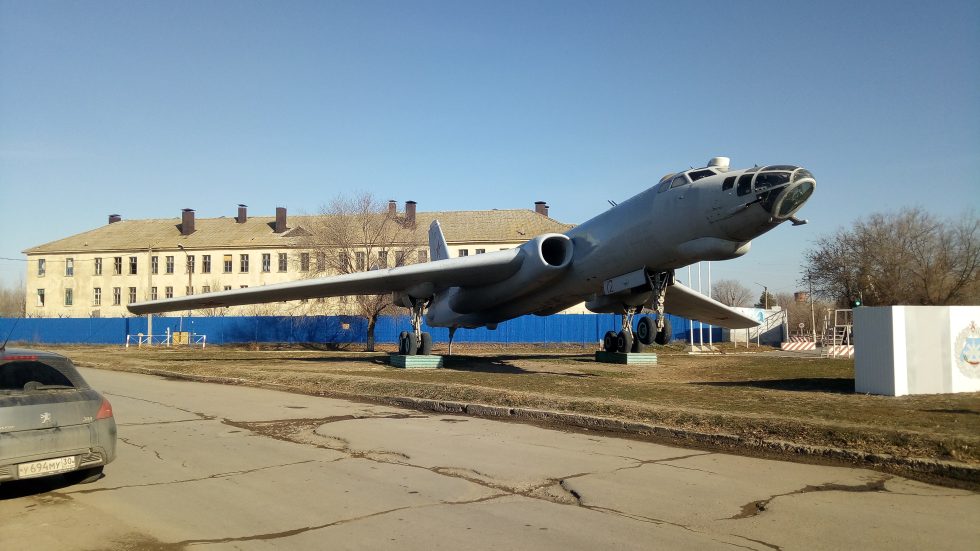
Disposition: the Tu-16 itself is extinct in service everywhere. Russian Air Force and Naval Aviation units retired the type in 1993, with a small number of trials airframes flying on to about 2001; Ukraine inherited some 121 and scrapped them; Armenia with about 30, Georgia with about 20, Belarus with 18 and Azerbaijan with 10 were all out by 1995. Indonesia grounded its aircraft in 1969 and struck them off in 1970. Iraq lost its last three H-6D at Al-Taqaddum in the 1991 Gulf War. Egypt, the final operator, retired its mixed Tu-16 and Chinese-supplied fleet in 2000. What survives is museum property and not fleet: original Soviet-built airframes stand at Monino outside Moscow, at Dyagilevo near Ryazan and at Engels in Russia, at the State Aviation Museum in Kyiv and the Museum of Long-Range Aviation at Poltava in Ukraine, at the Riga Aviation Museum in Latvia, at Datangshan outside Beijing, and a Tu-16KS at the Dirgantara Mandala museum in Yogyakarta. Every one of those is an original airframe: no reproduction of this aircraft exists anywhere, no replica has ever been built, and not one example is airworthy. The point most often got wrong deserves stating flatly — a Chinese H-6 in squadron service is not a surviving Tu-16. Roughly 120 or more serve with the PLAAF’s bomber divisions and the naval air arm’s H-6G and H-6J units, and new H-6K and H-6N airframes are still leaving Xian carrying turbofans, cruise missiles and a ballistic weapon the original design never imagined. That is a separate aeroplane with a separate page. The Tu-16 stopped flying; only its drawings did not.
From jet bomber to Cold War missile carrier
Design begins
The Tupolev bureau works on a swept-wing jet bomber, made possible by the powerful new Mikulin AM-3 turbojet.
First flight
The definitive prototype, aircraft “88,” flies on 27 April, reaching over 1,000 km/h on test.
Enters service
The Tu-16 joins Soviet long-range aviation; nine make a public debut over Red Square on May Day.
An airliner is born
Tupolev reuses the bomber’s wing and engines for the Tu-104, one of the world’s first jet airliners.
Missiles and exports
Missile-carrier variants enter service; the USSR licences the design to China (1957) and exports to Indonesia (1961).
Destroyed on the ground
In the opening strike of the Six-Day War on 5 June, Israel destroys Egypt’s entire Tu-16 bomber force on the ground.
Standoff strike
In the Yom Kippur War, Egyptian Tu-16s launch AS-5 Kelt cruise missiles at Israeli targets from a distance.
The Iran–Iraq War
Iraqi Tu-16s and Chinese-built H-6s fly long-range bombing raids on Iranian cities and targets.
Soviet type retired
Russia withdraws its Tu-16s; the Chinese H-6 derivative carries the basic design on into the present day.
Twelve Tu-16 Badger stories
“Badger” from the West
NATO slotted the new bomber into its B-for-bomber reporting-name scheme.
Read the full story
Faster than predicted
On its 1952 tests the prototype exceeded the speed its engineers had forecast.
Read the full story
The airliner inside the bomber
The Tu-16’s wing and engines became the basis for the Tu-104 jetliner.
Read the full story
The Navy’s ship-killer
Soviet Naval Aviation turned the Badger into a cruise-missile platform against ships.
Read the full story
Wingtip to wingtip
Soviet Tu-16 tankers passed fuel from one aircraft’s wingtip to another’s.
Read the full story
Badgers over the equator
Indonesia received missile-armed Tu-16s in the early 1960s.
Read the full story
Grounded by politics
Indonesia’s Badger fleet was grounded when Soviet spares dried up.
Read the full story
Thirty bombers, one morning
Egypt’s Tu-16 force was destroyed on the ground in the Six-Day War.
Read the full story
Kelt missiles at a distance
In 1973 Egyptian Tu-16s struck back by launching standoff missiles.
Read the full story
The long-range raider
Iraqi Tu-16s and H-6s bombed deep into Iran in the 1980s.
Read the full story
A dozen aircraft in one
From the same airframe came bombers, spies, jammers and tankers.
Read the full story
The design that outlived its country
The USSR retired the Tu-16, but its Chinese descendant still flies.
Read the full story
The Tu-16 in pictures
The Tu-16 in motion
A curated video feature for the Tupolev Tu-16 is coming soon. In the meantime, explore the photo gallery above and the operator map below.
Where the Tu-16 flew
The record that defines it
The Tu-16’s combat history is bound up with the Cold War’s regional conflicts. In Egyptian hands it suffered one of the war’s starkest losses — an entire bomber force destroyed on the ground on the first morning of the 1967 Six-Day War — before a rebuilt force launched AS-5 Kelt standoff missiles at Israeli targets in 1973. Iraq flew Tu-16s and Chinese H-6s on long-range raids in the Iran–Iraq War. For its main operator, the Soviet Union, the type’s significance lay less in air-to-air combat than in its role as a nuclear-capable bomber and, above all, a naval missile carrier able to threaten ships from standoff range.
Compare the combat record of every military aircraft. Figures as of July 2026.
Everything people ask about the Tu-16
Can I fly in a Tu-16?
Is the Tu-16 the same as the Chinese H-6?
How fast is the Tu-16?
What missiles did the Tu-16 carry?
Was the Tu-16 used in combat?
How many Tu-16s were built?
Is the Tu-16 still in service?
You can’t fly the Tu-16.
These, you can.
Some legends only live in museums — others are fuelled and waiting. MiGFlug has put civilians in real military jet cockpits since 2004.
 Fly the L-39 AlbatrosThe world’s most-flown jet trainer — aerobatics included
 Fly the F-104 Starfighter“The missile with a man in it”
 Fly the MiG-21The Cold War’s most-produced jet
 Fly the T-33 Shooting StarAmerica’s first jet trainer
 Fly the DH VampireA piece of early jet history
 Fly the S.211Agile Italian jet trainer
 Fly the MB-326The classic Aermacchi jet
 Fly the MiG-15The Soviet legend of the Korean War
Continue the tour
Every fact, checked
- GlobalSecurity.org — Tu-16 Badger overviewDesign origin, service history and the type’s Soviet operational record.
- GlobalSecurity.org — Tu-16 specificationsDimensions, weights and performance figures used for the spec table.
- GlobalSecurity.org — Tu-16 variantsThe Badger A-to-L family: bomber, missile, recon, ELINT and tanker versions.
- Federation of American Scientists — Tu-16 BadgerThe nuclear-strike and naval missile-carrier roles in Soviet forces.
- MilitaryFactory — Tupolev Tu-16Specification baseline, armament and production overview.
- AirVectors (Greg Goebel) — The Tupolev Tu-16 “Badger”Detailed development history, variants and the wingtip-refuelling technique.
- Warfare History Network — The Sinai Air Strike, 5 June 1967The destruction of Egypt’s Tu-16 bomber force in the Six-Day War.
- Aces Flying High — The Soviet Era of the Indonesian Air ForceIndonesia’s Tu-16KS fleet, the West New Guinea dispute and its retirement.