
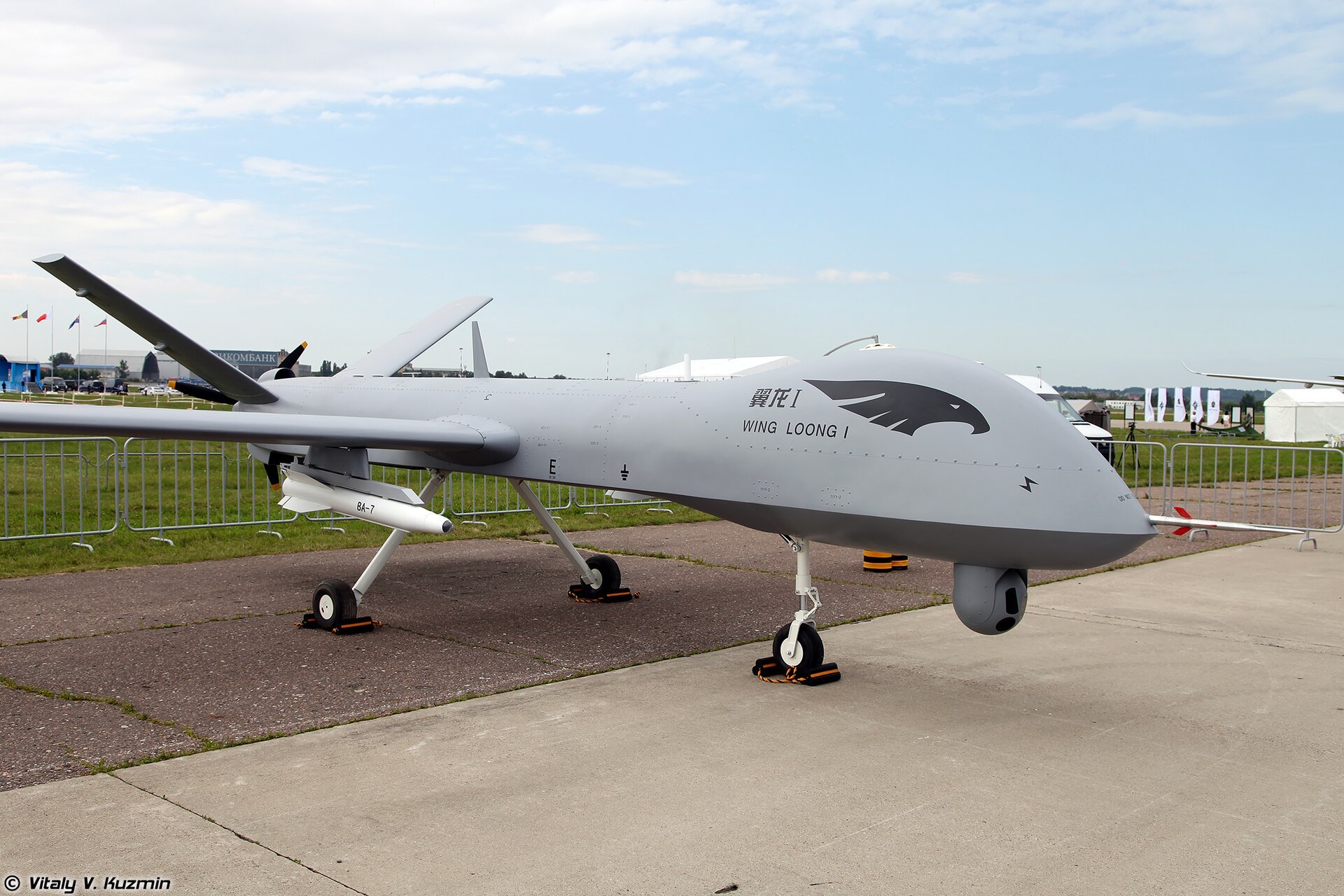
CAIG Wing Loong II
and Wing Loong I
China’s best-selling armed drone family, the Wing Loong has flown strikes for the UAE, Egypt, Saudi Arabia, Pakistan and others in Libya, Yemen, Sinai and beyond, often far from public scrutiny.
The Wing Loong II: how China became an exporter of armed drones
Seen from below, the Wing Loong looks so much like an American Predator or Reaper that it is often called the Chinese Predator: a bulbous nose for the satellite antenna, a long straight wing, a V-tail and a pusher propeller. It was developed by the Chengdu Aircraft Design and Research Institute, part of the state-owned aviation group AVIC, which began work in 2005. The first Wing Loong I flew in 2009 and entered service in 2011, a 1.1-tonne aircraft with a 100 hp engine and two weapon stations. Its larger successor, the Wing Loong II, was unveiled in 2015 and flew in February 2017: a 4.2-tonne turboprop with six weapon stations, 480 kg of external stores and an endurance of up to 32 hours.
What made the Wing Loong important was not technology but availability. The United States sold its armed drones to very few countries, and only under strict conditions. China sold the Wing Loong to the United Arab Emirates, Egypt, Saudi Arabia, Kazakhstan, Nigeria, Pakistan, Algeria, Morocco and others. CSIS counted about 96 Wing Loongs sold to 13 countries between 2008 and 2018, more than half of China’s drone exports, and estimated the Wing Loong II at about US$1–2 million each. The UAE was the launch customer for the Wing Loong II in 2017, Pakistan agreed in 2018 to co-produce 48, and China’s own air force took it into service in 2018 as the GJ-2.
The record that followed is a hard one to read. In Libya, UAE-operated Wing Loongs flew for General Khalifa Haftar’s forces in breach of a UN arms embargo, fought a drone war against Turkish TB2s and, in January 2020, killed 26 unarmed cadets at a military academy in Tripoli. A UAE-operated drone killed a senior Houthi leader in Yemen in 2018, and Egypt used Wing Loongs in North Sinai. Several have been shot down. The same airframe has also relayed mobile telephone signals over flooded Chinese cities. This page sets out the facts as they are known, sober about how much remains undisclosed. Most operators publish nothing about their sorties, and much of the record comes from wreckage, investigations and UN reports.
01The Wing Loong II in Libya: a proxy drone war
Libya became the place where the Wing Loong was used most intensively. Air & Cosmos reported that the UAE deployed Wing Loongs to el-Khadim air base in eastern Libya in June 2016, alongside light attack aircraft and helicopters, in support of Khalifa Haftar’s Libyan National Army. In late 2016 UAE aircraft flew most of the air strikes in the region. A UN Panel of Experts report in 2019 documented the presence of Wing Loong IIs in Libya in violation of the arms embargo.
When Haftar launched his offensive on Tripoli in April 2019, the internationally recognised Government of National Accord received Turkish Bayraktar TB2s, and the two sides’ foreign-supplied drones fought for months over the city. The South China Morning Post reported analysts’ view that Haftar’s Chinese drones, provided by the UAE, were his answer to Turkey’s. The Wing Loong II’s satellite link gave it reach beyond the TB2’s line-of-sight radius, and it carried Chinese Blue Arrow 7 anti-tank missiles. Losses were heavy on both sides; several Wing Loongs were shot down over Misrata and elsewhere in 2019 and 2020. The deadliest single incident came in January 2020, when a strike on a military academy in Tripoli killed 26 cadets; a BBC investigation later attributed it to a UAE-operated Wing Loong II.
02The Wing Loong in Yemen, Sinai and beyond
In Yemen, the UAE and Saudi Arabia operated Wing Loongs as part of the coalition against the Houthis. In April 2018 a UAE drone strike, using a Chinese Blue Arrow 7 missile, killed Saleh al-Samad, president of the Houthis’ Supreme Political Council and the most senior Houthi figure killed in the war to that point, Foreign Policy reported. The Houthis in turn claimed several Wing Loongs shot down over Saada and other areas.
In Egypt the Wing Loong was officially inducted in 2018, and the Egyptian Air Force used it in strikes on militants in El Arish, Rafah and Sheikh Zuweid in North Sinai in March 2017. Later users have flown it against Boko Haram in Nigeria, against militants in Somalia, and, in Pakistan’s case, in strikes inside Iran in January 2024. In April 2026, during the war involving Iran, wreckage that open-source analysts identified as a Wing Loong II was found near Shiraz; who operated it has not been confirmed.
What makes the Wing Loong II special
A Reaper-class airframe
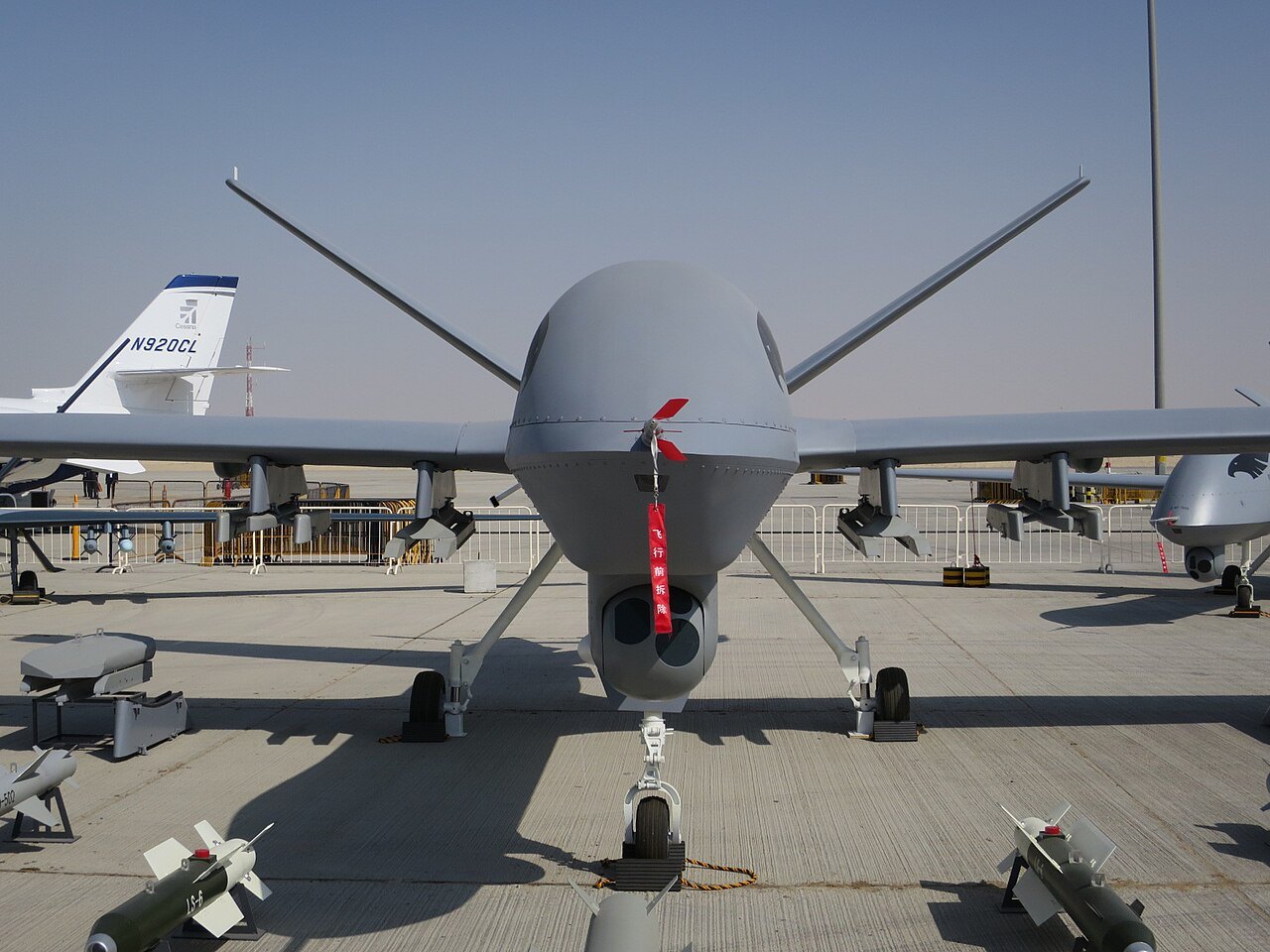
The Wing Loong II has an 11 m fuselage, a 20.5 m wing and a maximum take-off weight of 4.2 tonnes, close to the American MQ-9 in layout and size, with a V-tail and a three-bladed pusher propeller. Army Recognition and Chinese sources give a maximum speed of 370 km/h, a ceiling of 9,900 m, an operational radius of 1,500 km and up to 32 hours in the air, though endurance falls sharply with a full weapons load: Chinese figures give about 20 hours at maximum speed.
Six weapon stations
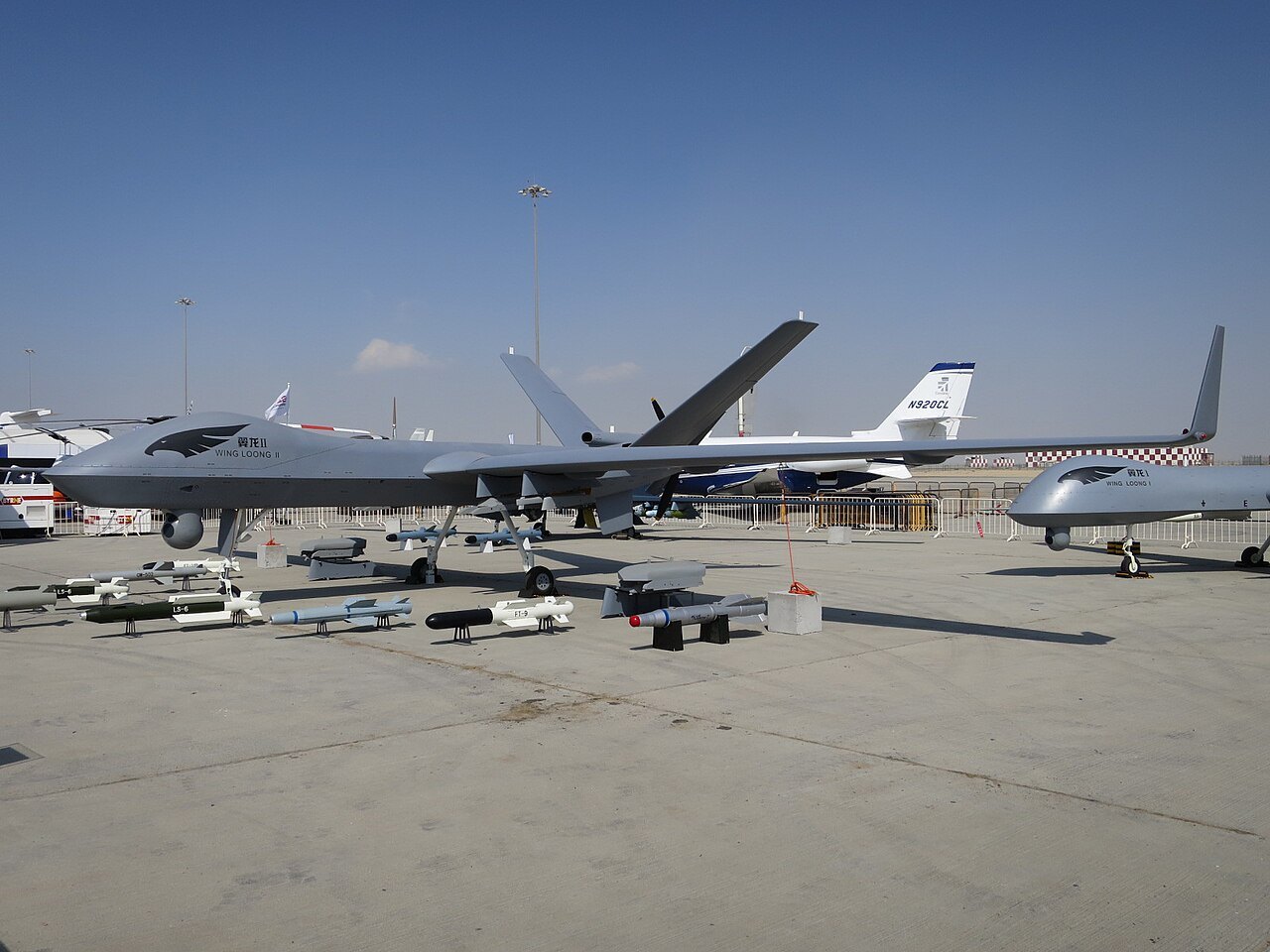
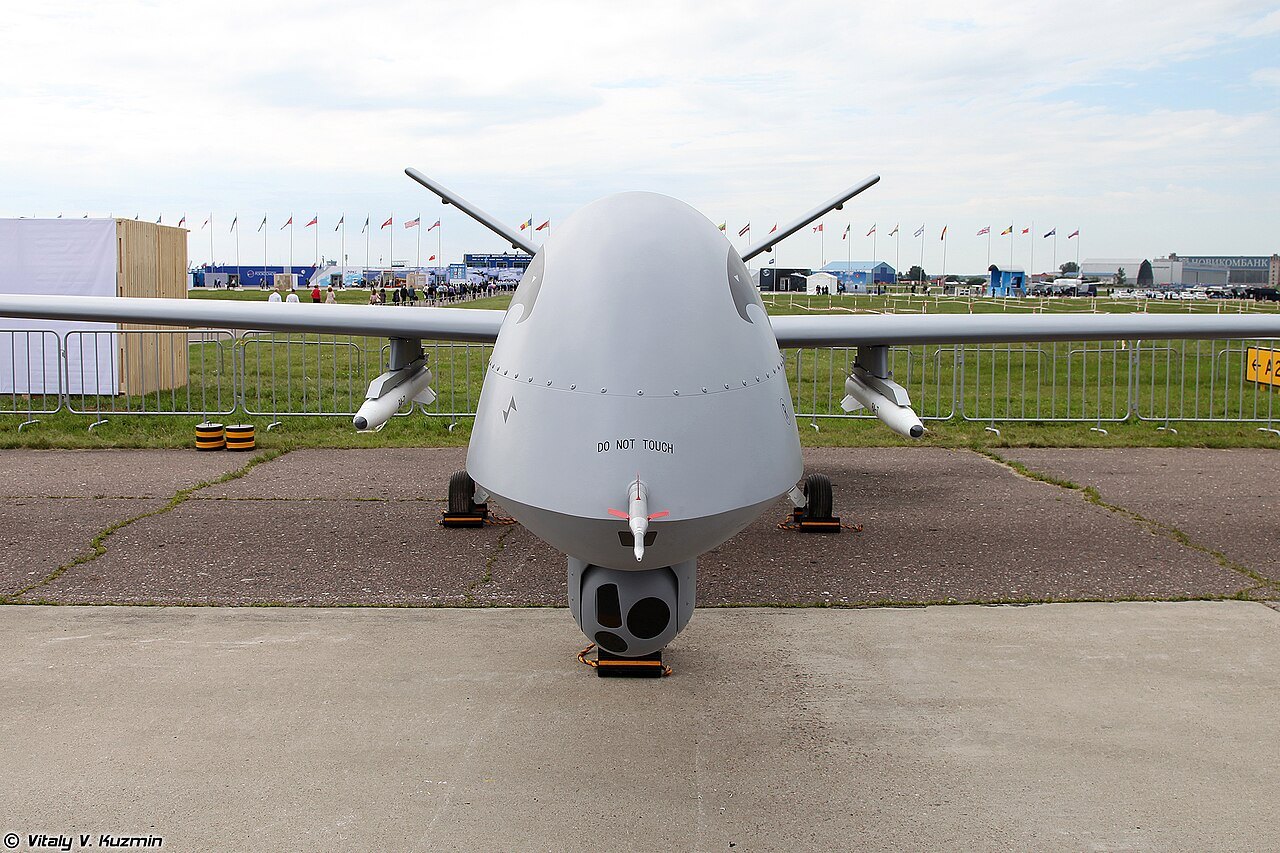
The Wing Loong II has three hard points under each wing, against two on the first Wing Loong, and can carry up to 480 kg of external stores, typically up to twelve laser-guided bombs or missiles. The most widely reported weapon is the Blue Arrow 7 anti-tank missile, alongside small guided bombs. An electro-optical turret with day and infrared cameras and a laser designator sits under the nose, and synthetic aperture radar can be fitted. Weapons and sensors are of Chinese origin, so no American export approval is needed.
Satellite reach
Like the American drones it resembles, the Wing Loong II has a satellite communications antenna in its bulged nose, which lets crews control it far beyond the range of a line-of-sight data link, quoted at about 150 km. RUSI’s Drones Project gives a range of more than 1,000 km with satellite communications. In Libya that let operators fly from bases far from the front, a practical advantage over the line-of-sight TB2. The same link can also carry video to commanders far from the ground station.
03The Wing Loong family: I, ID, II and 2H
The Wing Loong I (also called Pterodactyl I) has a 14 m wing, a 9.05 m length, a maximum take-off weight of 1,100 kg and a 100 hp turbocharged engine, giving more than 20 hours of endurance and a ceiling of about 5,000 m, with two hard points for 200 kg of stores. The Wing Loong ID is an improved, all-composite version with a longer wing and double the payload; Egypt announced plans to buy 32 in 2018.
The Wing Loong II is a new, larger turboprop design. Chinese service versions are designated GJ-2. The Wing Loong 2H is a civil emergency version: in July 2021, during the floods in Henan province, China’s Ministry of Emergency Management sent one to restore mobile telephone coverage over areas where networks had failed, flying for about six hours as an airborne relay. A much larger successor, the Wing Loong 3, was shown in 2022.
CAIG Wing Loong II specifications
Specifications
- Crew
- None on board; flown from a ground control station
- Length
- 11 m (36 ft 1 in)
- Wingspan
- 20.5 m (67 ft 3 in)
- Height
- 4.1 m (13 ft 5 in)
- Max take-off weight
- 4,200 kg (9,260 lb)
- Payload
- 480 kg (1,060 lb) external on six hard points
- Powerplant
- 1 × turboprop with three-bladed pusher propeller
- Maximum speed
- 370 km/h (200 kt)
- Endurance
- Up to 32 hours
- Service ceiling
- 9,900 m (32,500 ft)
- Range
- about 1,500 km operational radius; data link about 150 km line of sight, more than 1,000 km via satellite
- Armament
- Up to 12 laser-guided bombs or missiles, including Blue Arrow 7 anti-tank missiles
Costs & production
- Unit cost
- CSIS estimated US$1–2 million per Wing Loong II; the Wing Loong I was commonly put at about US$1 million; both figures are estimates and exclude ground stations and support
- Cost per flight hour
- Hedged estimate: in the order of US$1,000–3,000, based on a single small turboprop, satellite link time and a ground crew; no official figure is published
- Production
- About 96 Wing Loongs sold to 13 countries in 2008–18 (CSIS); the 50th Wing Loong II was reported delivered in December 2020
- Programme
- Wing Loong I first flight 2009; Wing Loong II first flight February 2017; PLAAF service 2018
04The Wing Loong II’s operators
- China: People’s Liberation Army Air Force, as GJ-2, from 2018; Wing Loong 2H for the Ministry of Emergency Management.
- United Arab Emirates: launch customer in 2017; aircraft used in Libya and Yemen.
- Saudi Arabia: Wing Loong purchases and a reported licence for local production.
- Pakistan: 48 to be co-produced, announced 2018.
- Egypt, Algeria, Morocco, Nigeria and others in Africa and Asia; the Libyan National Army received aircraft from the UAE.
- Wing Loong I users include the UAE, Saudi Arabia, Egypt, Kazakhstan, Serbia, Nigeria, Pakistan, Indonesia and Uzbekistan.
05The Wing Loong II’s operating costs: a cheaper way in
Price was the Wing Loong’s main selling point. CSIS estimated the Wing Loong II at US$1–2 million each, compared with about US$4 million for a Predator, though such figures are rough and exclude ground stations, satellite services, training and weapons. Armada International noted that lower cost and fewer political conditions were advantages in the Gulf and Africa.
Running costs follow from a single turboprop of modest power and a small ground crew. Satellite airtime and sensor maintenance are the main extras. No official per-hour figure has been published; the estimate in the cost table is an order of magnitude only.
The Wing Loong from first flight to the Gulf
Wing Loong I flies
The first Wing Loong makes its first flight, four years after development began.
Into service and export
The Wing Loong I enters service; the UAE becomes an early customer.
Wing Loong II unveiled
The larger turboprop design is shown at the Aviation Expo China in Beijing in September.
Libya
The UAE deploys Wing Loongs to el-Khadim air base in eastern Libya in June.
First flight and Sinai
The Wing Loong II flies in February; Egyptian Wing Loongs strike militants in North Sinai in March.
Yemen, Pakistan, PLAAF
A UAE drone kills Houthi leader Saleh al-Samad in April; Pakistan agrees to co-produce 48; the PLAAF takes the GJ-2 into service.
Drone war over Tripoli
UAE-operated Wing Loong IIs fly for Haftar against Turkish-supplied TB2s.
Tripoli military academy
A January strike kills 26 cadets in Tripoli; the 50th Wing Loong II is reportedly delivered in December.
Henan floods
A Wing Loong 2H restores mobile coverage over flooded areas in July.
Seized in Italy
In June Italian authorities seize Wing Loong parts disguised as wind turbine components bound for eastern Libya.
Down near Shiraz
Wreckage identified by analysts as a Wing Loong II is found near Shiraz in Iran on 2 April.
Stories & eyewitnesses: the Wing Loong at war
First flight and a big order
The Wing Loong II flew in February 2017 with a buyer already signed.
Read the full story
Over North Sinai, March 2017
Egypt used Wing Loongs against militants in its own territory.
Read the full story
The strike on Saleh al-Samad
In April 2018 a drone killed the Houthis’ political leader.
Read the full story
Drones against drones over Tripoli
Libya became a war between Chinese and Turkish drones.
Read the full story
Twenty-six cadets
The deadliest Wing Loong strike killed unarmed students.
Read the full story
A flying phone mast over Henan
In 2021 a Wing Loong restored mobile coverage after floods.
Read the full story
Disguised as wind turbines
In 2024 Italy intercepted drones bound for eastern Libya.
Read the full story
Wreckage near Shiraz
In April 2026 Iran claimed a Reaper; analysts saw a Wing Loong.
Read the full story
The Wing Loong II in pictures
Where the Wing Loong II flies and flew
The Wing Loong II’s record
Wing Loongs have been used in combat in Libya, Yemen, North Sinai, Nigeria, Somalia and, by Pakistan, against targets in Iran in 2024. Operators rarely publish details, and much of what is known comes from wreckage, investigations and UN reports. Losses have been significant wherever opponents had air defences.
See how training and combat types compare in the military aircraft statistics database. Figures are approximate.
Everything people ask about the Wing Loong II
Can I fly in a CAIG Wing Loong II?
Is the Wing Loong a copy of the Predator?
Which countries use the Wing Loong II?
How much does a Wing Loong II cost?
What is the difference between the Wing Loong I and II?
Where has the Wing Loong been used in combat?
You can’t fly the Wing Loong II.
These, you can.
Most of this museum you can only look at. These genuine military jets you can fly yourself with MiGFlug — with aerobatics and time on the controls.
 Fly the L-39 AlbatrosThe world’s most-flown jet trainer — aerobatics included
 Fly the F-104 Starfighter“The missile with a man in it”
 Fly the MiG-21The Cold War’s most-produced jet
 Fly the T-33 Shooting StarAmerica’s first jet trainer
 Fly the DH VampireA piece of early jet history
 Fly the S.211Agile Italian jet trainer
 Fly the MB-326The classic Aermacchi jet
 Fly the MiG-15The Soviet legend of the Korean War
Continue the tour
Every fact, checked
- China’s AVIC achieves first flight of Wing Loong II UAVAviation International News, February 2017
- Wing Loong II / Pterodactyl IIGlobalSecurity: dates, deliveries, Libyan losses
- Wing Loong unmanned aerial vehicleAirforce Technology: Wing Loong I development, specifications and operators
- Is China at the forefront of drone technology?CSIS China Power: export numbers and price estimates
- Libya: drones test laboratory for a new type of air warfareAir & Cosmos International: UAE Wing Loongs at el-Khadim
- Chinese drones hunt Turkish drones in Libya air warSouth China Morning Post, 2019
- Drone wars: how the UAE’s Chinese-made drone is changing the war in YemenForeign Policy, April 2018: the al-Samad strike
- Egypt inducts armed Chinese dronesArabian Aerospace: Egyptian Wing Loongs and Sinai strikes
- Chinese Wing Loong drones disguised as wind turbines seized by ItalyThe War Zone, 2024: seizure and Tripoli academy background
- Wing Loong II: market success and a tougher test in the fieldArmada International, August 2026: UN reporting, markets and vulnerability
- Iran shoots down Saudi/UAE Wing Loong II over ShirazDefence Security Asia, April 2026: disputed identification