
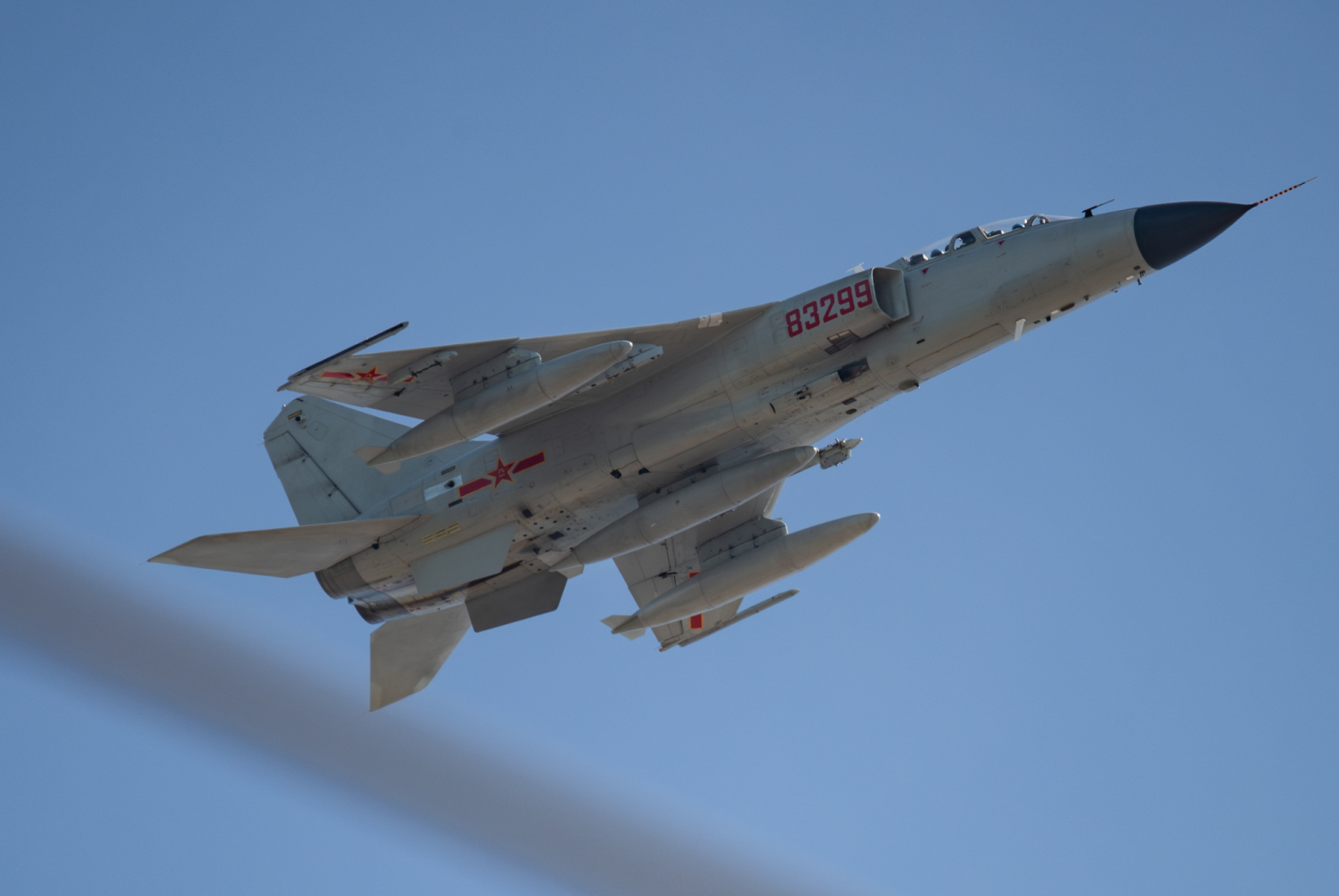
Xian JH-7
“Flying Leopard”
China’s twin-engine, two-seat, all-weather fighter-bomber — a dedicated maritime-strike and ground-attack aircraft built around licence-built Rolls-Royce Spey engines, still in front-line PLA service after more than three decades.
The JH-7 Flying Leopard: China’s dedicated strike jet
The Xian JH-7 (Jian Hong-7, “fighter-bomber 7”), known in China as the Flying Leopard and offered for export as the FBC-1, is a twin-engine, two-seat, all-weather fighter-bomber developed by the Xian Aircraft Industrial Corporation. Where most of China’s Cold-War-era combat aircraft were interceptors and day fighters derived from Soviet designs, the JH-7 was conceived as something the People’s Liberation Army lacked: a purpose-built strike aircraft able to carry a heavy weapons load over long distances, in poor weather, and against ships at sea.
Development traces back to a 1970s requirement for a replacement for the ageing H-5 (Il-28) and Q-5 attack fleets. Progress was slow — China’s aviation industry was recovering from the upheavals of the era — and the first prototype did not fly until 14 December 1988. The early JH-7 entered limited service with the PLA Naval Air Force in the early-to-mid 1990s as an anti-ship platform, carrying YJ-8-series sea-skimming missiles. It was, by most accounts, a capable but troubled first attempt, produced only in modest numbers.
The aircraft that made the type a mainstay was the much-improved JH-7A, which entered service from around 2004. A substantially reworked design — with digital fly-by-wire controls, a partial glass cockpit, a lighter and stronger airframe, extra hardpoints and a modern fire-control radar — the JH-7A could deliver precision-guided munitions and a wider range of missiles. This time both the Naval Air Force and, after initially declining the original JH-7, the PLA Air Force adopted it in quantity.
Powering the Flying Leopard is one of its most distinctive features: a pair of turbofans descended from the British Rolls-Royce Spey, licence-built in China as the WS-9 Qinling. The engine was acquired in the 1970s but took decades to fully localise, and it links this modern Chinese strike jet to a 1960s British design. More than three decades after its first flight, the JH-7 remains in front-line service — a workhorse of Chinese maritime and land-attack aviation rather than a headline air-superiority fighter.
01The JH-7 and JH-7A: how the second version rescued the programme
It is easy to treat “JH-7” as a single aircraft, but the difference between the original JH-7 and the later JH-7A is large. The first-generation JH-7, fielded by the Navy from the early 1990s, was produced only in small numbers and is widely described as having had reliability and systems shortcomings. The JH-7A, in service from about 2004, was a comprehensive redesign: a reinforced yet lighter airframe with more composite structure, digital fly-by-wire flight controls, a glass cockpit, additional weapons pylons and a new fire-control radar able to cue precision-guided weapons. Most Flying Leopards in service today are JH-7A or later, and it is this variant that turned a promising but limited prototype-era aircraft into a mainstay of Chinese strike aviation.
What makes the JH-7 Flying Leopard notable
A British engine, built in China
The Flying Leopard is powered by two WS-9 Qinling turbofans — a licence-built version of the Rolls-Royce Spey Mk 202, the same engine family used in the British F-4K Phantom. China acquired the Spey in the mid-1970s but took decades to fully domesticate its manufacture, and reliable local production is generally dated to the mid-2000s. Each engine produces roughly 54 kN dry and about 91 kN with afterburner, giving the twin-engine JH-7 the thrust to lift a heavy weapons load over long range.
Built for maritime strike
The JH-7 was designed first and foremost to sink ships. Its core weapon is the YJ-8 (Yingji-8) family of sea-skimming anti-ship missiles, later joined by the longer-ranged YJ-83. Paired with a surface-search and fire-control radar, and a two-seat crew that splits flying and weapons duties, the aircraft gave the PLA Naval Air Force a genuine stand-off maritime-strike capability — able to launch missiles from beyond a ship’s close-in defences.
Two seats, all weather, long legs
Unlike China’s single-seat day fighters of the era, the JH-7 carries a crew of two in tandem — a pilot and a dedicated weapons systems officer — and was built for all-weather operations. With a combat radius commonly cited at over 1,700 km and a large external weapons load across nine (JH-7) or eleven (JH-7A) hardpoints, it was intended to reach targets far beyond the range of shorter-legged Chinese tactical aircraft.
02The JH-7’s Spey engine: a 1960s British design at the heart of a Chinese jet
In 1975 China contracted with Rolls-Royce to licence-produce the Spey Mk 202 turbofan, a design already in British service. A batch was assembled from British-supplied parts, but fully indigenous production — under the designation WS-9 Qinling — proved difficult and dragged on for many years, with reliable Chinese manufacture generally reported only in the mid-2000s. The long delay is often cited as one reason the original JH-7 was produced in such small numbers, and why the mature JH-7A arrived well over a decade after the type first flew. It is a striking example of how hard it can be to fully absorb a foreign engine technology.
03The JH-7’s weapons: from anti-ship missiles to precision strike
The early JH-7 was essentially an anti-ship platform, carrying YJ-8K missiles and little else in the way of guided weapons. The JH-7A broadened this considerably: reporting credits it with the longer-ranged YJ-83 anti-ship missile, the YJ-91 anti-radiation missile for suppressing enemy air defences, laser- and satellite-guided bombs, unguided bombs and rockets, plus short-range PL-5 and PL-8 air-to-air missiles for self-defence. A twin-barrel 23 mm cannon is fitted for close-in work. The exact loadouts and missile performance figures come largely from Chinese sources and defence-analysis outlets, and specific numbers should be read as reported rather than confirmed.
Full specifications
Figures below are drawn from open defence-reference sources and refer chiefly to the JH-7A. China has released little official data, so dimensions, weights and performance should be treated as widely cited estimates rather than confirmed values.
Baseline note: the figures below describe the JH-7A, the second-generation aircraft that reached People’s Liberation Army Naval Air Force units in early 2004 and Air Force units at the end of the same year, and which accounts for the great majority of the roughly 270 airframes built. Deltas for the original JH-7 and for the later JH-7AII are given in grey. Three warnings before the numbers. First, almost none of this is official. China has never published a performance handbook for this aeroplane in any language, and the tables that circulate descend from Zhuhai display placards, Chinese trade-press articles and Western estimates that copy one another; treat every figure as best-attested rather than authoritative. Second, the JH-7 and the JH-7A are constantly conflated in those tables, and the conflation matters most for stores: the 9,000 kg external limit and the nine stations belong to the JH-7A, while the original aircraft had six stations and carried appreciably less. Third, the engine ratings quoted here are the Rolls-Royce Spey Mk 202’s, because the Xian WS-9 Qinling is a licence copy of that engine down to the compressor stage count. Whether Chinese-built Speys actually made book thrust is a separate question, and for most of the type’s life the honest answer was no — which is the single fact that explains the JH-7’s extraordinary twenty-eight-year gestation better than any other.
Dimensions & weights
- Crew
- 2 — pilot and weapon systems officer in tandem under a long two-piece canopy, the back-seater raised for a view forward over the pilot. Side-by-side seating in the manner of the Su-24 and the F-111 was studied in the 1970s and rejected; tandem kept the fuselage narrow at the price of a very long nose and a heavy forward structure
- Length
- 22.32 m (73 ft 3 in) including the nose probe. That is longer than an F-15E Strike Eagle and within half a metre of a Su-24. Nothing about the JH-7 is small: it is a purpose-built medium strike aeroplane, not a fighter with bomb racks bolted on
- Wingspan
- 12.80 m (42 ft 0 in), no folding — the JH-7 has always been a land-based aircraft. Chinese naval aviation flew it from concrete, never from a deck, and the type was never proposed for a carrier
- Height
- 6.22 m (20 ft 5 in), to the top of the single swept fin
- Wing area
- 42.2 m² (454 sq ft)
- Aspect ratio
- 3.88 — high for a supersonic aircraft, and deliberately so. The wing was drawn for radius and load, not for a dash; compare the Mitsubishi F-1 at 2.93 or the Su-24 at roughly 5.6 with its wings spread
- Wing planform
- Shoulder-mounted, swept roughly 45° at quarter chord, with marked anhedral, a leading-edge dogtooth and near-full-span leading- and trailing-edge high-lift devices — the shoulder mounting is the type’s signature and its most useful single feature. It leaves the whole underwing volume clear for large stores, which is precisely what an aeroplane designed to carry sea-skimming missiles needs, and it puts the wing structure above the engine bays. The anhedral is there to claw back the excess lateral stability a high wing gives you free of charge
- Empty weight
- 14,500 kg (31,967 lb)
- Maximum take-off weight
- 28,475 kg (62,777 lb). The original JH-7 is usually quoted a little under this, around 27,500 kg, on a heavier all-metal structure with fewer stations
- Maximum external stores
- ~9,000 kg (~20,000 lb) across nine stations on the JH-7A. The JH-7 is generally credited with about 5,000 kg on six. Reaching 9,000 kg means filling every station with iron, and no operational photograph shows anything close to it
- Wing loading
- 675 kg/m² (138 lb/sq ft) at maximum take-off weight — high, and a fair summary of the aircraft’s character. It is stable, fast in a straight line, and has no business in a turning fight with anything built after 1970
- Internal fuel
- ~6,500 kg (~14,300 lb). The generous internal tankage is what buys the radius; the Spey’s modest specific fuel consumption in dry thrust helps more than its reheat rating hurts
- External fuel
- Up to three tanks — 800 litres under each inboard wing station and 1,400 litres on the centreline — the maritime configuration almost always shows two wing tanks plus missiles, which is the trade the aircraft was designed around
- Hardpoints
- 9 on the JH-7A — six underwing, two wingtip rails and one under-fuselage. The JH-7 had six: four underwing and the two wingtip rails. Those three extra stations are most of what the "A" suffix means in daily practice
Performance
- Maximum speed
- 1,808 km/h (1,123 mph, 976 kn) at altitude, Mach 1.52 — and clean. With four anti-ship missiles and two tanks hung on it, the JH-7 is a high-subsonic aeroplane and every mission plan treated it as one
- Speed at low level
- Not published — conspicuously. The fixed intakes and the drag of a maritime-strike load put a firm transonic lid on the run-in. The profile the type actually flies is a high-subsonic ingress at a few hundred feet over water, not a supersonic dash
- Service ceiling
- 16,000 m (52,000 ft)
- Rate of climb
- Not officially published — Chinese tables carry figures in the region of 200 m/s at sea level for a clean airframe, and nothing independent corroborates them. Given the thrust available at realistic weights, treat such numbers with suspicion
- Thrust-to-weight ratio
- 0.65 in reheat at maximum take-off weight — rising to about 0.87 at a typical two-missile strike weight. Adequate for the job; nowhere near a fighter’s
- Combat radius, maritime strike
- ~900 km (~560 mi, ~490 nmi) on internal fuel with a war load. This is the figure most often quoted and the one that matters: it is what puts the first island chain and the approaches to the Taiwan Strait inside reach from mainland airfields
- Combat radius with one aerial refuelling
- ~1,760 km (~1,090 mi, ~950 nmi). Real but conditional — only later JH-7A carry a refuelling probe, and for two decades the PLA’s handful of tankers, not the aeroplanes, was the binding constraint on Chinese reach
- Maximum ferry range
- ~3,650 km (~2,270 mi, ~1,970 nmi) with external tanks and nothing else. A Chinese published figure; Western estimates cluster somewhat lower
- Take-off run
- 920 m (3,020 ft) at normal take-off weight. The figure appears in Chinese tables and has not been independently confirmed
- Landing run
- 1,050 m (3,440 ft) with the brake parachute streamed — the parachute is not optional on a short runway, and the approach speed is high
- Design load factor
- +6.9 g — a strike aeroplane’s number rather than a fighter’s, and the limit that quietly rules out the air-combat role Chinese publicity occasionally implied for the type
- In-flight refuelling
- Probe-and-drogue, later JH-7A only — a fixed probe on the starboard side of the nose. Early JH-7 and most early JH-7A have none
Propulsion & systems
- Engines
- 2 × Xian WS-9 Qinling afterburning turbofan — a licence copy of the Rolls-Royce Spey Mk 202, the reheated version developed for the British Phantom. China bought the licence in 1975, in a sale that ran straight through the spirit of the COCOM export controls, together with a batch of complete British-built engines. Those imported Speys, and a further tranche of surplus ex-Royal Air Force units acquired around 2001, powered the JH-7 for most of its early service life
- Domestic production
- Chinese-built WS-9 certified for series production in 2003 — the central fact of this aeroplane’s history. Xian assembled its first Chinese Speys at the end of the 1970s and had two sent to Britain for altitude testing, then the programme went dormant for well over a decade as the aircraft it was meant to power stalled. Twenty-eight years elapsed between buying a 1960s engine and building it reliably. Exact dates in this chronology vary between Chinese and Western accounts
- Engine architecture
- Two-shaft turbofan, five-stage LP and twelve-stage HP axial compressors, bypass ratio 0.62:1 — low bypass by airliner standards, high by the standards of the 1960s military turbojets it replaced, which is why the JH-7 has such good dry-thrust economy and such indifferent reheat performance
- Dry thrust
- 54.29 kN (12,200 lbf) each — 108.6 kN total
- Reheat thrust
- 91.26 kN (20,520 lbf) each — 182.5 kN (41,040 lbf) total. An improved WS-9A of about 97 kN has been reported in development; no confirmed service application
- Engine dry weight
- 1,856 kg (4,093 lb) each — very heavy for the thrust, and one of the reasons the JH-7 is a big aeroplane. Two Speys weigh almost as much as an empty MiG-21
- Air intakes
- Fixed-geometry lateral intakes with boundary-layer splitter plates — no variable ramps, no half-cone centrebodies. This is the hard ceiling on the aircraft’s Mach number and a deliberate choice: a strike aeroplane that lives at low level gains nothing from Mach 2 intakes and pays for them in weight and complexity
- Radar
- JL-10A Shan Ying J-band pulse-Doppler on the JH-7A — with a ground-mapping and sea-search capability the earlier set lacked. The original JH-7’s radar is given variously as the Type 232H and the Type 243H depending on the source; the two designations appear interchangeably in otherwise reputable references and the disagreement has never been resolved in open literature
- Flight control
- Digital fly-by-wire on the JH-7A — the JH-7 flew on a conventional mechanical system with limited stability augmentation. The change is a large part of why the later aircraft is a better weapons platform in rough air at low level
- Cockpit
- Two colour multi-function displays, head-up display and a domestic helmet-mounted sight on the JH-7A — the JH-7 was an analogue cockpit of electromechanical instruments. The JH-7A was also the first Chinese combat aircraft designed entirely without paper drawings, on CATIA V5, which mattered to the industry well beyond this one type
- Self-protection
- BM/KJ-8605 radar warning and jamming suite replacing the earlier Type 960-2, with chaff and flare dispensers and provision for podded jammers
- Navigation and attack
- Inertial platform with satellite update, Type 271 radar altimeter — the Type 265A on the JH-7. A radar altimeter is not a footnote on an aircraft whose whole trade is flying low over water at night
- Ejection seats
- Two zero-zero rocket-assisted seats of the HTY-4 family — reported rather than confirmed; Chinese seat designations for this type are inconsistently given
- Recovery
- Brake parachute at the base of the fin, twin-wheel nose unit, single main wheels — conventional, robust, sized for the concrete runways of coastal China
04The JH-7’s cost: why no reliable price exists
There is no reliable public unit-cost or cost-per-flight-hour figure for the JH-7. It is a Chinese state programme built for the PLA rather than sold on an open market, and Beijing has disclosed neither procurement prices nor operating costs. The export FBC-1 was marketed internationally but attracted no confirmed foreign buyers, so even an export price point is speculative. Production totals are likewise uncertain: open-source estimates commonly range from around 200 to more than 270 aircraft across all variants, but these are inferences, not official data.
Armament & payload
The JH-7 was built around the YJ-8 anti-ship missile, and everything else it carries was added later
The JH-7 was designed around an anti-ship missile and everything else it carries is a later addition to that idea. China decided in the mid-1970s, with the Paracel Islands clash of January 1974 fresh in mind, that it needed an aeroplane able to reach a hostile surface group well out to sea and put a sea-skimming missile into it, and the weapon that answered was the YJ-8 family — solid-propellant, high-subsonic, inertially guided in the cruise with active radar homing at the end, the Chinese equivalent of an Exocet. The air-launched YJ-81 gave the original JH-7 a pair of them. The JH-7A’s two extra underwing stations gave it four, and four missiles from one airframe is not an incremental change: it doubles the salvo a regiment can put on a target, and a salvo is what defeats a ship’s defences.
What arrived after 2004 was a genuinely different weapons suite. The JH-7A can carry the longer-ranged YJ-83K, the turbojet-powered KD-88 land-attack missile derived from it, the YJ-91 anti-radiation missile developed from the Russian Kh-31P, laser-guided bombs with a podded designator, and satellite-guided glide weapons of the LS-6 family. That list turns a single-mission anti-ship platform into a workmanlike interdiction and defence-suppression aircraft, and it is why the JH-7A rather than the JH-7 is the aeroplane worth taking seriously. What is still absent is instructive: no beyond-visual-range air-to-air capability at all, no internal targeting system independent of pods, and a self-defence fit that amounts to two short-range heat-seekers on the wingtips. The JH-7 was never intended to fight its way in. It was intended to go where fighters were not, at low level over water, and leave. Stores clearances have never been published by China, fits vary between Air Force and Naval Air Force units and between production batches, and several weapon associations below rest on airshow photographs rather than documents.
Gun
- One 23 mm twin-barrel cannon in the lower forward fuselage with about 300 rounds — the Soviet GSh-23L pattern, built in China as the Type 23-3
- A gun of the previous generation on an aircraft of this size and mission: useful against small craft and soft targets ashore, close to irrelevant in the maritime strike role the type exists for
- Rate of fire around 3,000 rounds per minute, so the magazine is spent in roughly six seconds of continuous firing — in practice it is fired in short bursts or not at all
- It was retained through every variant, including the JH-7A, when a heavier 30 mm weapon or no gun at all would both have been defensible choices
- Some late JH-7A airframes have been photographed with the gun port faired over, which would suggest deletion in electronic-warfare and reconnaissance-configured aircraft; this is observed rather than documented
Air-to-air
- Two PL-5E infrared-homing missiles on the wingtip rails — the standard self-defence fit and, in most photographs, the only air-to-air weapon present
- The PL-8, China’s licence-derived Python 3, is credited to the type in some references; the association is plausible and not firmly documented
- No beyond-visual-range capability whatsoever. Neither the Type 232H nor the JL-10A provides the illumination or datalink a radar-guided missile needs, and no PL-12 fit has ever been shown on this aeroplane
- This is the JH-7’s hardest limit and the clearest reason the J-16 is replacing it. A modern strike aircraft is expected to defend itself; this one cannot
- In exercises the type is escorted, and in the PLA’s own Golden Dart competitions the JH-7A is scored on strike accuracy and not on air combat
Air-to-surface guided
- YJ-81 and YJ-8K (export designation C-801K) anti-ship missiles — the original armament, roughly 50 km of range with a warhead in the region of 165 kg, two on the JH-7 and four on the JH-7A
- YJ-83K on the JH-7A — the same family grown up, turbojet-powered, credited with about 180 km, cruising at Mach 0.9 and accelerating to roughly Mach 1.4 in the terminal dive. This is the weapon that keeps the type relevant
- KD-88 stand-off land-attack missile, derived from the YJ-83 airframe with a television or imaging infrared seeker and a range of the order of 200 km — the JH-7A’s principal precision land-attack weapon
- YJ-91 anti-radiation missile, the Chinese development of the Russian Kh-31P: Mach 3-plus, around 110 km, an interferometer seeker for radar emitters. The JH-7A is one of the PLA’s few dedicated defence-suppression platforms
- LT-2 laser-guided bombs and LS-500J guided weapons, cued by an external designator pod. No internal designator exists, so precision attack always costs a station
Bombs
- Free-fall 250 kg and 500 kg general-purpose bombs on multiple ejector racks — the everyday training load and the reason the 9,000 kg external figure is quoted at all
- LT-2 laser-guided bombs in the 500 kg class, the JH-7A’s entry into guided attack from 2004
- LS-6 satellite-guided glide bombs, in 250 kg and 500 kg classes, with wing kits giving stand-off from outside short-range air defences
- Retarded and cluster stores are shown in Chinese publicity material; specific designations are poorly attested in open sources
- Nuclear delivery has never been claimed for this type by any credible source, and no Chinese account associates it with the role
Rockets
- 57 mm and 90 mm unguided rocket pods on the underwing stations — carried, exercised, and of essentially no relevance to the missions the aeroplane was bought for
- The 90 mm pods are the heavier of the two and appear in ground-attack training imagery from both services
- Rockets on a 28-tonne supersonic aircraft with fixed intakes and no armour are a legacy of the Q-5 attack aeroplane the JH-7 was originally meant to replace, and of a doctrine that expected to support ground forces on Chinese soil
- No guided rocket of the kind now common on helicopters and light attack aircraft has been shown on the type
- In practice the close-support role passed to attack helicopters and to the JH-7A’s guided weapons, and the rocket pods have become a rarity in recent photographs
Pods & other stores
- Blue Sky low-altitude navigation pod — the terrain-following and navigation aid that makes the low-level over-water profile practicable at night and in weather
- K/JDC01 laser designation pod for the LT-2 family; without it the JH-7A has no organic precision capability
- KG600 and KG300G electronic countermeasures pods — the basis of the type’s second career. JH-7A airframes fitted with multiple jamming pods serve as the PLA’s stand-off jammers, a role the J-16D is now taking over
- Reconnaissance pods carrying optical and infrared sensors, giving a tactical reconnaissance variant that has never received a separate public designation
- Drop tanks of 800 litres on the inboard wing stations and 1,400 litres on the centreline; the maritime configuration is missiles plus two wing tanks, and it is the configuration in almost every published photograph
Three typical loadouts
- Maritime strike, Naval Air Force
- Four YJ-83K anti-ship missiles on the underwing stations, two 800-litre tanks, two PL-5E on the wingtip rails, full gun. The reason the aeroplane exists, and the load that appears in almost every PLAN Air Force publicity photograph. Flown low over water at high subsonic speed, launching from outside the target group’s inner defences.
- Precision interdiction, Air Force
- Two KD-88 stand-off missiles or four LT-2 laser-guided bombs, one K/JDC01 designation pod, one KG600 jamming pod, a 1,400-litre centreline tank and two PL-5E. This is the JH-7A doing the job the JH-7 could not do at all, and it costs two stations to sensors and self-protection before a single weapon is hung.
- Defence suppression and stand-off jamming
- Two YJ-91 anti-radiation missiles with multiple electronic countermeasures pods, wing tanks and wingtip missiles. The variant of this fit with jammers in place of weapons is the PLA’s stand-off electronic-attack aircraft, flown in company with strike packages rather than into the target area itself.
Sourcing caveat: China publishes no stores clearance list for this aircraft. The weapons above are drawn from Zhuhai airshow displays, official service imagery and Western reference works; ranges and warhead weights for the YJ-8 family in particular are open estimates that vary by a factor of two between sources, and export figures for the C-801 and C-802 should not be assumed identical to the versions in Chinese service.
Variants
The JH-7A is a different aeroplane from the JH-7 in almost every way that matters
The JH-7’s development is one of the longest of any combat aircraft that eventually entered service. Xian submitted its proposal in November 1977 for an aeroplane explicitly compared to the F-111, the Su-24 and the Tornado; Deng Xiaoping authorised the programme on 19 April 1983; the first flight came on 14 December 1988 and ended in an emergency landing after engine vibration knocked out the instruments; the first supersonic flight followed in November 1989; a type certificate was not issued until 1998 and series deliveries did not begin until 2001. Twenty-four years separate the proposal from the first production delivery. The Falklands conflict of 1982 is usually credited with saving the project, by demonstrating in public what a subsonic sea-skimming missile does to a warship and giving the naval version the political argument it needed after the air force’s H-7 bomber variant was cancelled.
The cost of that delay was paid in blood and in capability. Test pilot Lu Jun died in a prototype crash on 4 April 1994; a fourth prototype was lost with both crew in 1995 or 1996 to engine failure. Huang Bingxin, who flew the first flight, brought an aircraft home in August 1992 after its rudder departed at 5,000 m, flying on differential engine thrust with four live missiles still aboard. The type has continued to suffer: a JH-7 crashed in front of spectators at an air show in Shaanxi on 14 October 2011, in what remains the most widely seen accident in Chinese military aviation; further losses followed at Yiwu in June 2014, near Weinan in December 2014, at Liuzhou in October 2016, in Hainan in March 2019 — where the crew, Ren Yongtao and Nian Jinxin, stayed with the aircraft to steer it away from a school and were killed — and at Weihai in May 2019. No official accident findings have been published for any of them.
Where the type sits now is not in doubt. The JH-7A is a competent, cheap, long-legged missile truck with a good wing, a large payload and an engine design older than most of its pilots, and it has no way to defend itself against a modern fighter. The Shenyang J-16 does everything the JH-7A does, carries more, flies faster, and can fight; the J-16D does the electronic-attack job better. The JH-7A will not disappear quickly — there are too many of them, they are paid for, and a maritime strike aeroplane whose main enemy is a ship rather than a fighter ages more gracefully than most — but no one is arguing it has a future. Its real legacy is industrial: it forced China to learn to build a Western turbofan, and that lesson, expensive and humiliating as it was, underwrites everything Chinese aero-engine work has achieved since.
- H-7 / JH-7 programme (1977–1983, studies)
- The original twin-track proposal: a tandem-seat naval fighter-bomber and a side-by-side Air Force tactical bomber. The bomber variant was cancelled and the naval aircraft became the sole line of development after November 1982.
- JH-7 (first flight 1988, deliveries from 2001, small numbers)
- The original aircraft: all-metal structure, six stations, two YJ-81 missiles, analogue cockpit, mechanical flight controls and a radar variously identified as the Type 232H or Type 243H. Naval Air Force only, and always regarded as a service-test batch as much as an operational fleet.
- JH-7A (service 2004, the great majority of about 270 airframes)
- The aeroplane that matters. Composite structure saving weight, digital fly-by-wire, JL-10A pulse-Doppler radar, colour displays, a helmet-mounted sight, a one-piece windscreen in place of the three-piece original, and nine stations instead of six. Designed on CATIA V5 with no paper drawings, a first for the Chinese industry.
- JH-7AII (in service from 2019)
- A further avionics and weapons upgrade, externally near-identical, associated with improved air-to-ground munitions and a modernised cockpit. Chinese sources also refer to a JH-7A2 shown publicly at Zhuhai in 2021; whether these are the same aircraft under two labels is not clear from open material.
- JH-7A electronic-warfare conversions (no separate public designation)
- JH-7A airframes configured as stand-off jammers with multiple KG600-family pods, flown by both services as the PLA’s principal escort-jamming asset before the J-16D. Never given a distinct designation in public, and identifiable only by its external fit.
- JH-7A reconnaissance conversions (no separate public designation)
- Podded optical and infrared reconnaissance fits carried on otherwise standard airframes, giving a tactical reconnaissance capability the PLA had long lacked. Again a role rather than a variant.
- FBC-1 Flying Leopard (export offer from 1998, no sales)
- The export designation of the JH-7, first shown at Zhuhai in 1998. No customer was ever found, at a period when the aircraft’s engines were themselves imported and could not have been re-exported freely.
- FBC-1M Flying Leopard II (export offer, no sales)
- Export designation of the JH-7A, marketed alongside Chinese precision weapons. Also unsold.
- JH-7E (shown 2018, no confirmed orders)
- The most recent export offering, displayed at Zhuhai. Reported interest has never turned into a confirmed contract, and the type has no foreign operator of any kind — unusual for a Chinese combat aircraft of this generation, and a fair verdict on how the market judged it.
- Test and trials airframes (various, from the 1990s)
- JH-7 and JH-7A airframes used by Chinese flight-test establishments as sensor, engine and weapons testbeds, the two-seat layout and large payload making them convenient carriers for equipment under development.
Closing caveat: Chinese variant nomenclature for this type is unusually loose. JH-7AII and JH-7A2 are used interchangeably in some sources and distinguished in others; the electronic-warfare and reconnaissance aircraft have no published designations at all; and production totals — around 270 built, of which roughly 215 to 240 were assessed as remaining in service in 2021 — are estimates that no Chinese source confirms. Nothing in this section should be read as an official listing.
Operators today
China is the JH-7’s only operator, and it splits the fleet almost evenly between two air arms
The JH-7 has never been exported. Every airframe ever delivered went to the People’s Liberation Army, and the fleet is divided between the Naval Air Force, which bought the aircraft first and for which it was designed, and the Air Force, which took it from 2004 once the JH-7A gave it a land-attack capability worth having. That two-service split is genuinely unusual and it shaped the aeroplane: the naval units fly maritime strike with anti-ship missiles, the air force units fly interdiction, defence suppression and stand-off jamming. The two rows below are close enough together that the difference between them should not be over-read; what the chart really shows is a fleet of a little over two hundred aircraft, held roughly in half, and shrinking as J-16 brigades stand up.
These are estimates. Both figures sit inside a single 110 to 120 band in the sources, so the ordering above carries less information than the bars suggest, and many airframes counted on paper are stored, in deep overhaul or used for training rather than operational. Sources: IISS The Military Balance and FlightGlobal World Air Forces for the service totals, cross-checked against the published 2025 operator figures for both PLA air arms and against an independent assessment of 215 to 240 airframes in service in 2021 from a total production run of roughly 270. No export operator exists and none has ever been confirmed, so no further rows are shown; the JH-7E has been offered abroad without result.
From 1970s requirement to front-line workhorse
Requirement issued
China defines a need for a dedicated all-weather fighter-bomber to replace the H-5 and Q-5 in the strike and anti-ship roles; Xian is assigned the programme.
Spey engine licensed
China contracts with Rolls-Royce to licence-produce the Spey Mk 202 turbofan — the engine that, as the WS-9 Qinling, will eventually power the JH-7.
First flight
The first JH-7 prototype makes its maiden flight on 14 December, after a long and repeatedly delayed development.
Enters naval service
The early JH-7 begins limited service with the PLA Naval Air Force as an anti-ship platform, carrying YJ-8-series missiles, in modest numbers.
FBC-1 shown at Zhuhai
The export-oriented FBC-1 Flying Leopard is unveiled at the Zhuhai Airshow, though it attracts no confirmed foreign orders.
JH-7A enters service
The heavily improved JH-7A — fly-by-wire, glass cockpit, extra hardpoints, precision weapons — enters service; the PLA Air Force adopts the type alongside the Navy.
Fatal airshow crash
A JH-7 crashes at an airshow near Pucheng, Shaanxi; the incident is widely reported and one crew member is killed, the other ejecting safely.
Exercises and upgrades
JH-7As feature in major Chinese and joint Russia-China exercises such as Vostok 2018 and Aviadarts, and electronic-warfare and upgraded variants are reported as the type stays in front-line service into the mid-2020s.
Twelve things to know about the JH-7 Flying Leopard
Why “Flying Leopard”
The JH-7 carries an unusually evocative Chinese nickname for a strike aircraft.
Read the full story
Filling a strike-aircraft gap
China had interceptors and day fighters, but lacked a modern dedicated strike jet.
Read the full story
Fourteen years to first flight
The programme began in the 1970s but the prototype did not fly until December 1988.
Read the full story
A Spey at its heart
The JH-7 is powered by a Chinese-built version of a 1960s British Rolls-Royce engine.
Read the full story
Built to sink ships
The Flying Leopard’s original reason for being was anti-ship warfare.
Read the full story
The version that mattered
The improved JH-7A transformed a limited aircraft into a mainstay.
Read the full story
Navy first, air force later
The PLA Air Force initially passed on the JH-7, then adopted the improved version.
Read the full story
Beyond the anti-ship missile
The JH-7A broadened the type from ship-killer to multi-role striker.
Read the full story
A very public accident
A JH-7 came down at an airshow in 2011 in a widely seen incident.
Read the full story
The FBC-1 that found no buyers
China marketed an export Flying Leopard, but no foreign customer is confirmed.
Read the full story
A regular at big drills
JH-7As appear frequently in major Chinese and joint exercises.
Read the full story
A three-decade workhorse
More than 30 years after its first flight, the JH-7 remains in front-line use.
Read the full story
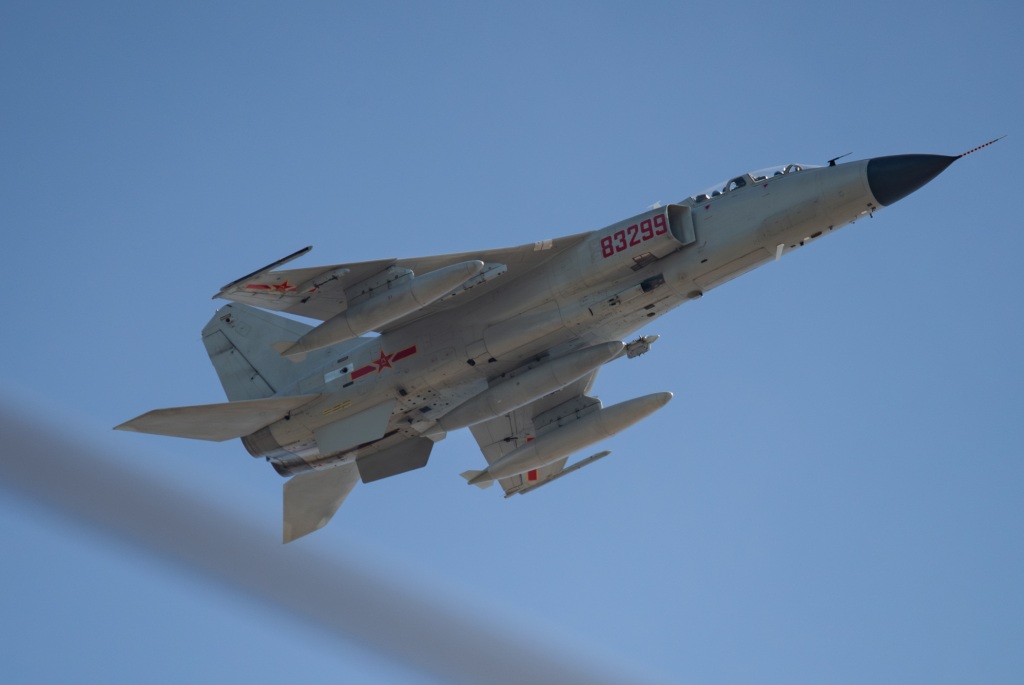
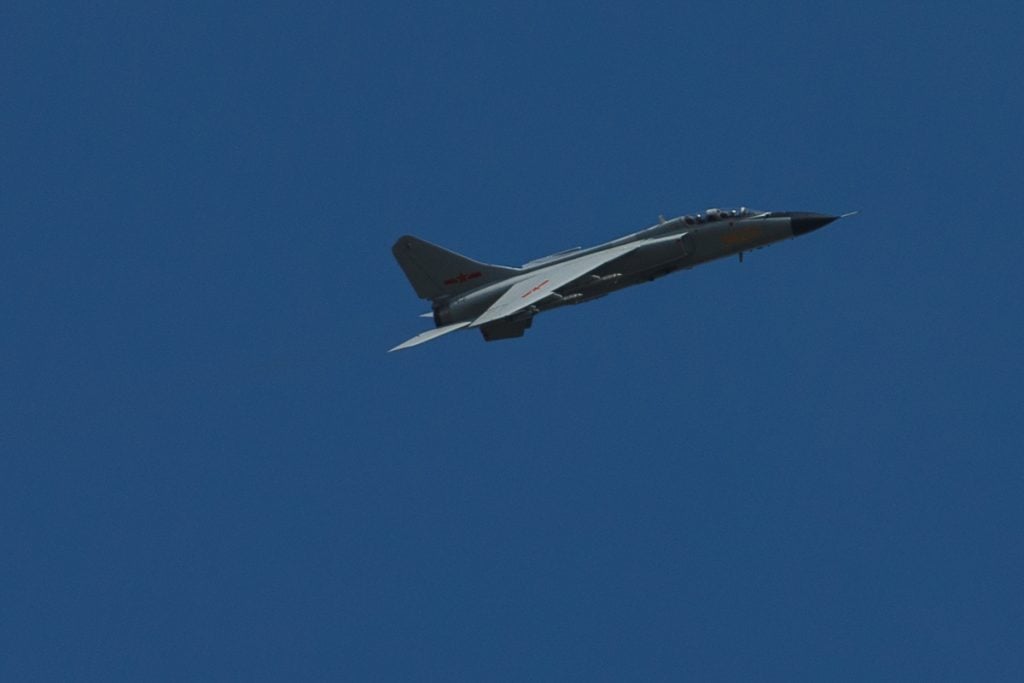
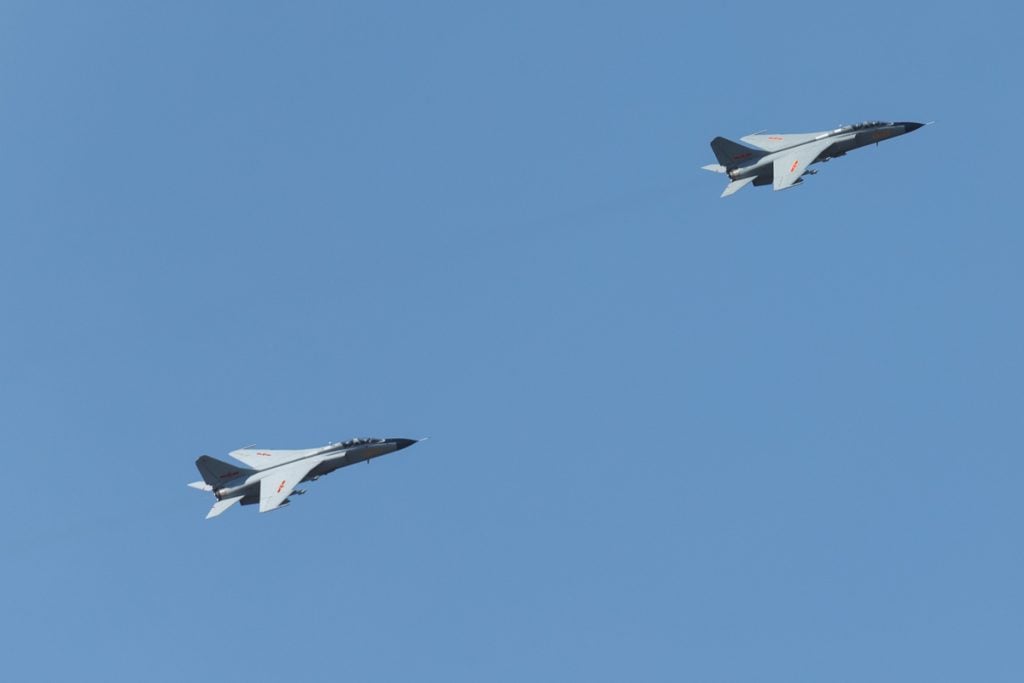
The Flying Leopard in pictures
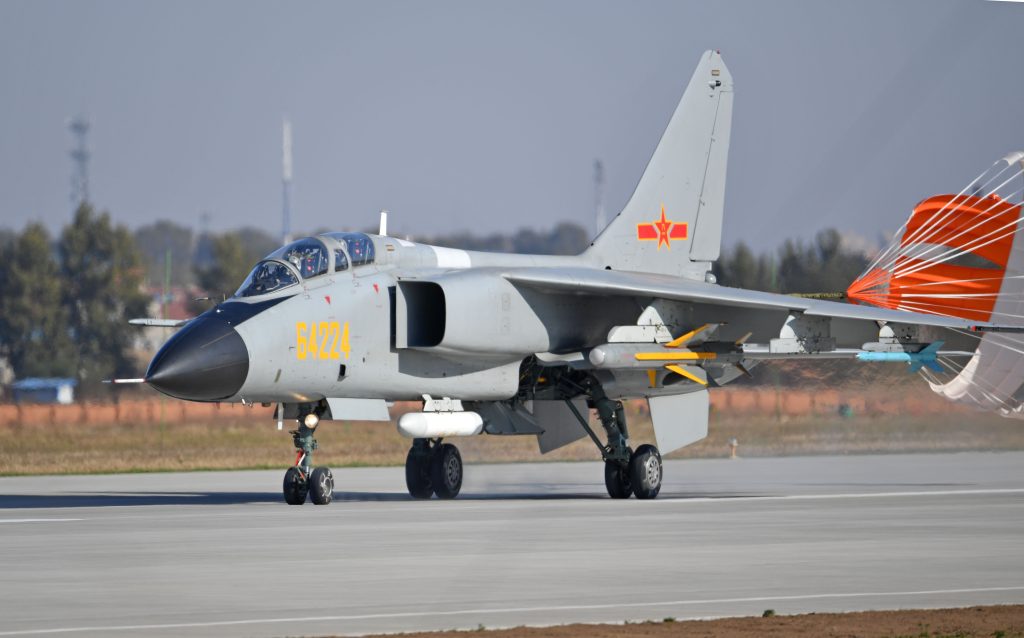
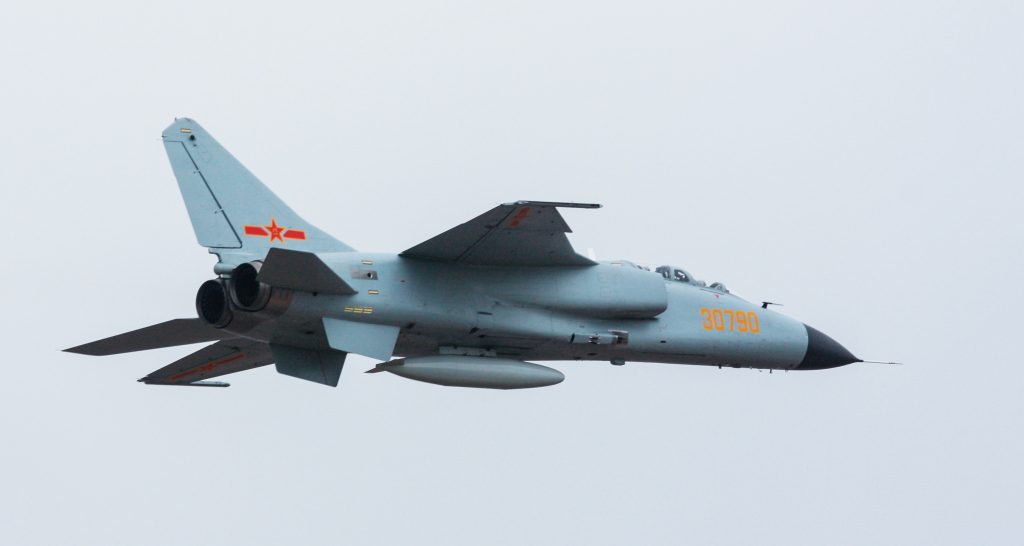
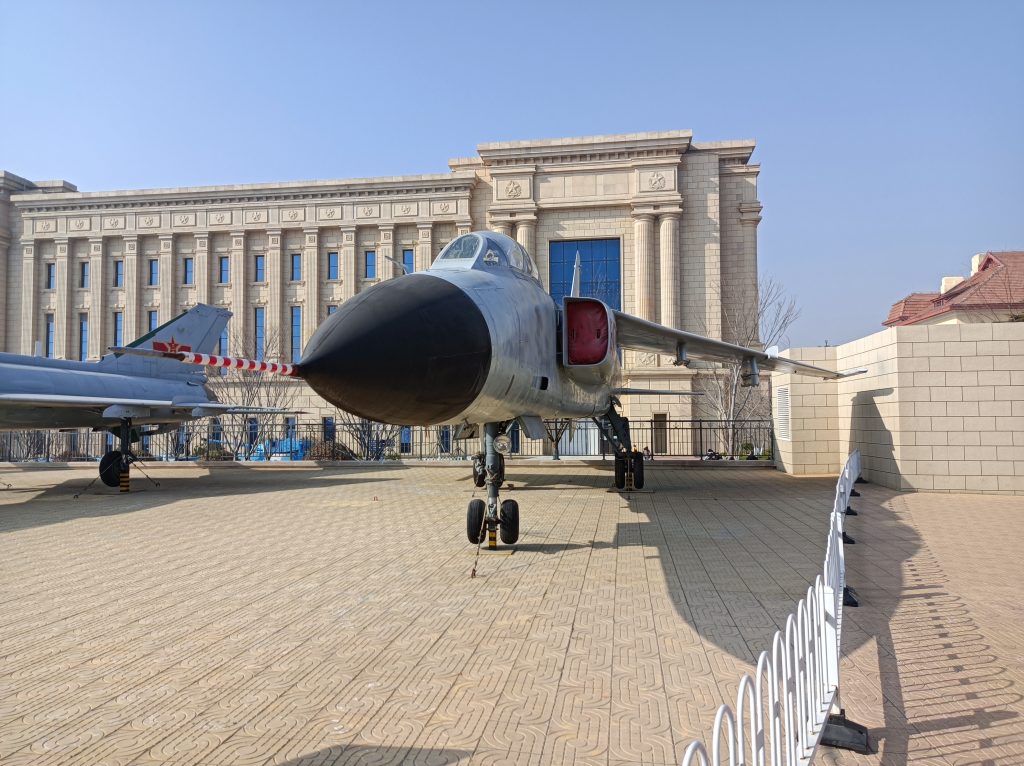
Where the JH-7 Flying Leopard operates
A strike aircraft in service, untested in war
The JH-7 has served for more than three decades as a maritime-strike and ground-attack platform, but it has no confirmed record of air-to-air combat. Its career has been one of deterrent patrols, weapons trials and large-scale exercises rather than shooting wars. What can be said is deliberately narrow, and Chinese-source figures should be read with caution.
Compare the combat record of every military aircraft. Figures as of July 2026; JH-7 data is largely reported or estimated.
Everything people ask about the JH-7
Can I fly in a JH-7?
What is the JH-7 Flying Leopard?
What is the difference between the JH-7 and JH-7A?
What engines does the JH-7 use?
How fast is the JH-7 and how far can it fly?
What weapons does the JH-7 carry?
Is the JH-7 still in service?
Did any other country buy the JH-7?
You can’t fly the JH-7.
These, you can.
Some legends only live in museums — others are fuelled and waiting. MiGFlug has put civilians in real military jet cockpits since 2004.
 Fly the L-39 AlbatrosThe world’s most-flown jet trainer — aerobatics included
 Fly the F-104 Starfighter“The missile with a man in it”
 Fly the MiG-21The Cold War’s most-produced jet
 Fly the T-33 Shooting StarAmerica’s first jet trainer
 Fly the DH VampireA piece of early jet history
 Fly the S.211Agile Italian jet trainer
 Fly the MB-326The classic Aermacchi jet
 Fly the MiG-15The Soviet legend of the Korean War
Continue the tour
Every fact, checked
- Airforce Technology — Xian JH-7 Fighter BomberReference overview of the type’s development, variants, engines, dimensions, radar and weapons.
- Military Factory — Xian JH-7 / FBC-1 Flying LeopardSpecifications, first-flight and service dates, and JH-7 versus JH-7A differences.
- Fly a Jet Fighter — Xian JH-7 (Flounder)Background on the aircraft’s role, nickname and operational history.
- The DiplomatAnalysis of Chinese naval aviation and the JH-7’s maritime-strike role in PLA service.
- 19FortyFiveDefence commentary on the Flying Leopard’s capabilities, engines and place in the PLA.
- The AviationistCoverage of JH-7 appearances at exercises such as Aviadarts and Vostok, and incidents.
- JanesDefence-reference material on Chinese combat aircraft, weapons and service status.
- The National InterestFeature articles placing the JH-7 within China’s wider strike and anti-ship strategy.