
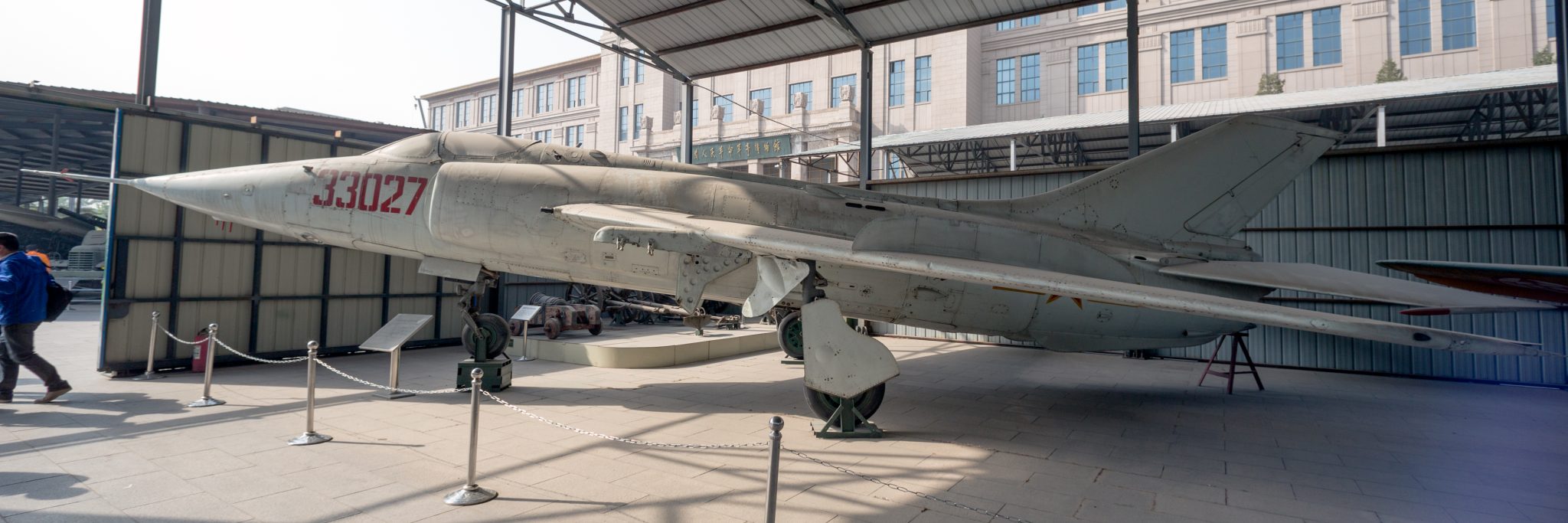
Nanchang Q-5
“Fantan”
China’s first home-designed supersonic ground-attack aircraft — a heavily reworked MiG-19 with a solid nose, side intakes and an internal bomb bay, exported as the A-5 and flown from Pakistan to Sudan.
The Nanchang Q-5: China’s first home-grown supersonic attacker
By the late 1950s China’s young aircraft industry had learned to build Soviet fighters under licence, but it had no dedicated aircraft for the battlefield-support mission — a fast jet to strike troops, armour and airfields at low level. Around 1958 the Nanchang factory (NAMC, later part of Hongdu) was tasked with designing one, and it took as its starting point the aircraft it already knew best: the MiG-19, built in China as the Shenyang J-6. The new attacker would keep the J-6’s wings, tail surfaces and twin engines, but almost everything forward of the wing would be redrawn.
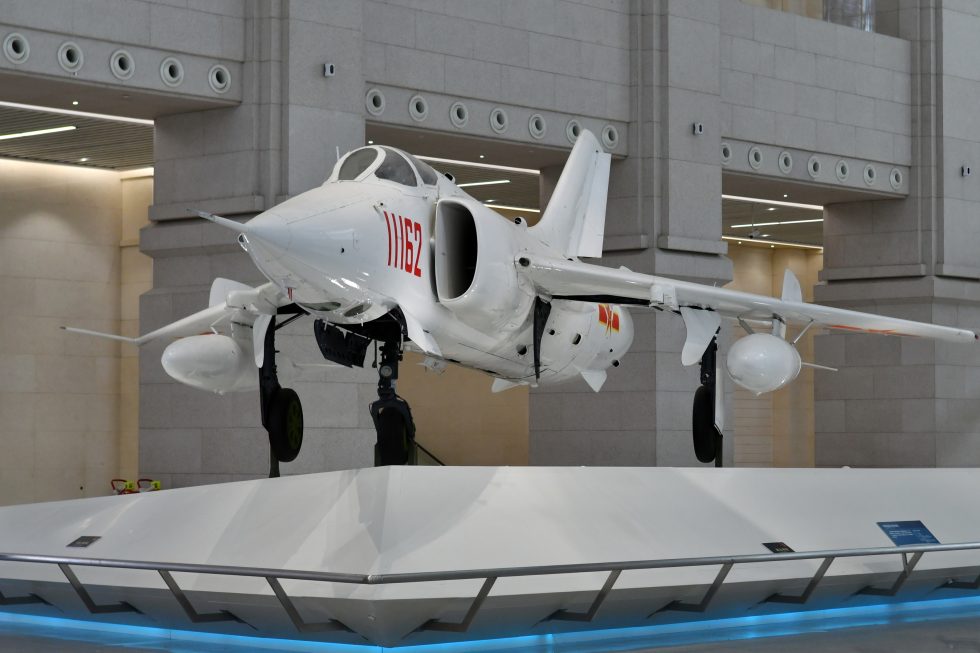
That redraw is what makes the Q-5 a distinct aircraft rather than a J-6 variant. Engineers deleted the MiG-19’s single nose intake and moved the air inlets to twin semicircular ducts on the fuselage sides, which freed the nose for a solid, pointed radome and gave the pilot a clear view downward for aiming at ground targets. The fuselage was lengthened and area-ruled — given the pinched “wasp-waist” shaping that eases the jump through the sound barrier — and a small internal weapons bay was built in, an unusual feature for a light attack jet of its generation. The changes added weight and shaved a little off the top speed, but they turned an interceptor airframe into a supersonic attacker.
Progress was anything but smooth. The programme was suspended amid the economic turmoil of the early 1960s, then revived; the prototype finally flew on a date commonly cited as 4 June 1965, after which the disruption of the Cultural Revolution slowed the aircraft’s path into squadrons. The Q-5 (from Qiang-5, “attack aircraft No. 5”) entered service around 1970, and over the following decades roughly 1,300 were built in a long line of variants for the PLA Air Force and Navy.
One branch of the family took on a very different task. A small number of Q-5A airframes were modified to carry a single tactical nuclear bomb, delivered by a toss or “loft” manoeuvre that flung the weapon ahead of the aircraft so the pilot could turn and escape the blast; these machines reportedly wore an all-white anti-flash scheme. Chinese and secondary accounts state that a Q-5 carried out an aircraft-delivered nuclear test in January 1972, though the exact details are hard to verify from open sources, and the nuclear-delivery role was reportedly wound down by the end of the 1970s.
Where the Q-5 became best known internationally was as an export product. Sold abroad as the A-5 (the upgraded A-5C being the main export model), it was bought by Pakistan, which became the largest foreign operator, and by Bangladesh, Myanmar and Sudan; North Korea is also reported to have received the type, though this is not well documented. The A-5C could be fitted with Western-compatible pylons and, for some customers, Western short-range missiles, bolting newer weapons onto a fundamentally 1960s airframe.
The Fantan’s combat career was written mostly in other air forces’ colours. Sudan used its A-5s for ground-attack sorties during the conflict in Darfur, and Myanmar employed the type in counter-insurgency operations; Pakistan’s A-5Cs served in the strike role but have no confirmed record of combat use. In China the type was steadily replaced by newer aircraft such as the JH-7, and the PLA is generally reported to have retired its remaining Q-5s around 2017, closing out nearly half a century of service.
01The Nanchang Q-5’s lineage: how it relates to the MiG-19 and Shenyang J-6
The Q-5 is best described as heavily derived from the MiG-19 — the Soviet fighter China built as the Shenyang J-6 — rather than a copy of it. From the wing root aft, the two aircraft are closely related: the Q-5 shares the J-6’s swept wing, tail surfaces and its pair of WP-6 turbojets. Forward of the wing, it is essentially a new design.
The defining differences are structural. The MiG-19/J-6 breathes through a nose intake; the Q-5 moves the intakes to the fuselage sides and fits a solid nose. The Q-5’s fuselage is longer and area-ruled, and it carries a small internal bomb bay the fighter never had. The result is a dedicated attack aircraft: heavier and slightly slower than the J-6, but configured to find and hit targets on the ground. Calling it a “J-6 copy” understates the redesign; calling it “all-new” overstates it. Heavily reworked from a shared foundation is the accurate description.
What makes the Q-5 special
Side intakes and a solid nose
The single most consequential change from the MiG-19 was moving the air intakes from the nose to the fuselage sides. That freed the nose for a solid, pointed radome housing avionics and gave the pilot a clear downward view for ground attack. Combined with a lengthened, area-ruled fuselage, it turned an interceptor airframe into a supersonic attacker — at the cost of a little top speed.
An internal weapons bay
Unusually for a light attack jet of its era, the Q-5 was built with a small internal bomb bay in the fuselage, enlarged on the Q-5A to a load commonly cited at around 1,000 kg. The same bay allowed a semi-recessed fit for the tactical nuclear weapon carried by the specially modified nuclear-delivery airframes.
Twin WP-6 engines for the low-level dash
Power came from two Shenyang/Liming WP-6 afterburning turbojets, each around 31.9 kN (about 3,250 kgf) in reheat — the same engine family as the J-6. Two engines gave the thrust for a low-altitude supersonic run-in and the redundancy a single-engine attacker would lack, making the Q-5 China’s first indigenous supersonic dedicated ground-attack aircraft.
02The Q-5’s nuclear mission: the anti-flash Fantan and the 1972 test
A small number of Q-5A airframes — reportedly a few dozen — were modified as tactical nuclear-weapon carriers. The delivery method was a toss or loft manoeuvre: the aircraft would pull up and release the bomb on an upward arc, throwing it several kilometres ahead so the pilot could reverse and escape the detonation. These aircraft reportedly wore an all-white anti-flash finish to reflect the heat of a nuclear flash.
Chinese and secondary sources state that a Q-5 conducted an aircraft-delivered nuclear test in January 1972, using the loft technique. The precise date, yield and number of nuclear-capable airframes vary between accounts and are difficult to confirm from open sources, so the episode is best treated as reported rather than firmly documented. The dedicated nuclear-delivery role was reportedly suspended toward the end of the 1970s.
03The A-5C export Fantan: Western pylons on a Chinese airframe
The main export version, the A-5C, was tailored for foreign customers whose weapons and standards differed from China’s. It could be fitted with NATO-compatible pylons and, for operators such as Pakistan, Western short-range air-to-air missiles like the AIM-9 Sidewinder or the French R550 Magic, alongside the aircraft’s own bombs and rockets. Export A-5Cs typically carried more hardpoints than the early Chinese Q-5 — up to around ten — and improved avionics.
The effect was to graft newer weapons and equipment onto what remained a 1960s design. It made the A-5C a serviceable low-cost strike aircraft for smaller air forces through the 1980s and beyond, even as more modern types rendered the basic airframe obsolete in first-rank service.
Full Nanchang Q-5 / A-5 specifications
Baseline note: the figures below describe the Q-5A of the early 1970s and the Q-5C that succeeded it — between them the bulk of the roughly 1,000 to 1,300 airframes Nanchang built between 1969 and 2012. Deltas for the Q-5D, the Q-5E and Q-5F, the Q-5L and the export A-5C are given in grey. Four warnings before the numbers. First, the designations are a genuine mess and most published tables make the same mistakes: the Chinese factory sequence runs Q-5I, Q-5IA, Q-5II, Q-5III in Roman numerals, Western writers renamed those Q-5A, Q-5B, Q-5C and Q-5III/A-5C, and separately from both there are the Q-5 Jia and Q-5 Yi — the first two Chinese cyclical characters used the way English uses A and B — which were the nuclear carrier and the naval torpedo aircraft and are not the same machines as the Western Q-5A and Q-5B at all. Second, China has never published a performance handbook for this aeroplane in any language; the tables in circulation descend from a small number of export brochures and Jane’s entries that copy one another, so treat everything here as best-attested rather than authoritative. Third, the aircraft changed underneath its own name. It entered service with a 4 m internal weapons bay and left service with a fuel tank welded into that bay, which means the same designation covers two rather different aeroplanes and most specification tables silently mix them. Fourth, the engines: the Q-5A and Q-5C flew on the WP-6, the Chinese copy of the Tumansky RD-9B rated at 3,250 kgf in reheat, while the 36.78 kN figure that appears in most online tables belongs to the later WP-6A III and to the marks from the Q-5I onwards. Using the higher number with the earlier weights inflates the thrust-to-weight ratio by about a seventh.
Dimensions & weights
- Crew
- 1 — one pilot, no navigator and no second crewman at any point in the type’s life except in the Q-5J trainer. For an aeroplane whose whole job was low-level navigation to a battlefield target with no radar and no moving map, that was the single hardest design decision to live with, and Chinese accounts of Q-5 training are largely accounts of teaching men to do a two-man job alone at 200 m
- Length
- 15.65 m (51 ft 4 in) fuselage; 16.26 m (53 ft 4 in) over the nose probe. The J-6 it descends from was 12.60 m without probe, so more than three metres of new structure was inserted forward and aft of the wing — the area-ruled waist and the weapons bay account for most of it
- Wingspan
- 9.68 m (31 ft 9 in), no folding and no provision for it. The Q-5 Yi torpedo aircraft was meant for the naval air arm but always from concrete; China had no carrier and the type was never proposed for one
- Height
- 4.33 m (14 ft 2 in) to the top of the fin. Some export data give 4.52 m (14 ft 10 in) for the A-5C, most likely measured at a different weight and tyre pressure rather than reflecting a structural change
- Wing area
- 27.95 m² (300.9 sq ft), against 25.0 m² (269 sq ft) for the J-6. The new wing is bigger, slightly less swept and carries the outboard pylons; it is the reason the Q-5 lifts a useful load off a short strip and the reason it lost about Mach 0.23 at height
- Wing planform
- Mid-set, swept, with boundary-layer fences and no leading-edge high-lift devices — a 1950s wing in every respect, drawn before anyone in China had a transonic wind tunnel worth the name. It is honest but crude: no manoeuvre flaps, no camber changes, nothing to help it turn with a load on
- Empty weight
- 6,375 kg (14,054 lb). About 1,360 kg heavier than the J-6, which is the price of the solid nose, the longer area-ruled fuselage, the weapons bay structure and the ten stores stations
- Normal take-off weight
- 9,486 kg (20,913 lb) — clean, internal fuel, guns loaded
- Maximum take-off weight
- 11,830 kg (26,081 lb). Export A-5C brochures quote 12,000 kg (26,455 lb); the difference is within the noise of how the two figures were defined rather than a real structural gain
- Internal fuel
- ~2,155 litres (474 imp gal) on the Q-5A, plus up to 1,560 litres (343 imp gal) in drop tanks. From the Q-5I onwards the weapons bay was plated over as a tank and total internal capacity rose to about 3,720 litres (818 imp gal), an increase of roughly seventy per cent — the single most consequential modification ever made to the aircraft
- Internal weapons bay
- 4 m (13 ft) long, rated at 1,000 kg (2,205 lb). This is the feature that makes the Q-5 interesting and the feature the air force eventually threw away. No other Chinese combat aircraft of the period had one, and no fighter-derived attack aircraft in the world of the 1960s carried its bombs internally except the Q-5 and the F-105
- Maximum external stores
- 2,000 kg (4,410 lb) on ten stations, four under the fuselage and six under the wing. The early Q-5 had six stations only; the ten-station arrangement belongs to the Q-5I and everything after it, including the A-5C
- Wing loading
- 423 kg/m² (86.7 lb/sq ft) at maximum take-off weight, 339 kg/m² (69.4 lb/sq ft) at normal. High for an aircraft with no high-lift devices, and the reason Q-5 pilots flew wide, flat attack patterns rather than tight ones
- Runway performance
- No reliable published figure — and it is worth saying so rather than repeating a number nobody can source. The one firm data point in the open literature is Chinese: the Q-5I, with its plated-over bay, larger tanks and revised systems, shortened the landing distance by 130 m against the aircraft it replaced. A brake parachute was standard throughout
Performance
- Maximum speed, sea level
- 1,210 km/h (752 mph, 653 kn), Mach 0.99. This is the number that matters, and it is the whole point of the area-ruled fuselage: down on the deck the Q-5 is as fast as the J-6 fighter it came from, despite being 1,360 kg heavier
- Maximum speed at altitude
- Mach 1.12, 1,190 km/h at 11,000 m (739 mph, 643 kn at 36,000 ft). Supersonic, just, and never usefully so — the Q-5 had no radar, no beyond-visual-range weapon and no reason to be at height
- Speed penalty against the J-6
- About Mach 0.23 — the J-6 topped Mach 1.35, the Q-5 Mach 1.12. That is what the nose, the side intakes and the extra structure cost. Lu Xiaopeng’s team traded high-altitude dash for a bomb bay and a forward view, which for a battlefield attack aircraft was the right trade and was recognised as such at the time
- Rate of climb
- 103 m/s (20,300 ft/min) at sea level, clean. Respectable, and a straightforward consequence of two afterburning turbojets in a small airframe. With a war load it collapses; the Q-5 was never a high-energy aeroplane once the pylons were full
- Service ceiling
- 16,500 m (54,100 ft). Export data for the A-5C give 15,850 m (52,000 ft); both are academic for a type that spent its operational life between 100 and 1,000 m
- Combat radius, low-low-low
- 400 km (250 miles, 216 nm) with a full external load. This is the Q-5’s defining weakness. Four hundred kilometres is a tactical radius, not an operational one, and it confined the type to the immediate battlefield for its entire career
- Combat radius, high-low-high
- 600 km (370 miles, 324 nm). The Q-5I claimed a thirty-five per cent improvement on radius from the extra internal fuel alone, which gives a sense of how tightly fuel constrained everything the aircraft could do
- Ferry range
- 2,000 km (1,240 miles, 1,080 nm) with drop tanks and no war load
- Thrust-to-weight ratio
- 0.69 at normal take-off weight, 0.55 at maximum — calculated here from two WP-6 at 31.87 kN in reheat, because the widely quoted 0.588 mixes WP-6A thrust with Q-5A weights. On WP-6A engines the same airframe reaches roughly 0.79 and 0.63
- Endurance
- Roughly 1 hour 30 minutes on internal fuel at low level — an estimate, not a published figure, and consistent with the quoted radii. Two afterburning turbojets designed in 1953 are thirsty engines, and reheat on a Q-5 is measured in seconds rather than minutes
- Handling
- Stable, heavy in roll, unforgiving in the circuit — the consensus of Pakistani and Bangladeshi accounts. Pilots praised the view over the nose and the low-level ride, and disliked the approach speed, the absence of leading-edge devices and an accident record that in Pakistani service was poor even by the standards of 1980s attack aircraft
Propulsion & systems
- Engines
- 2 × Liming (Shenyang) WP-6 afterburning turbojets — the same engines as the J-6, and the same engines as the MiG-19 before it. Nothing about the Q-5’s powerplant was new; the aeroplane is a new airframe wrapped around an existing engine bay, which is exactly why it could be built in China in the 1960s at all
- Rated thrust
- 25.5 kN (2,600 kgf, 5,730 lbf) dry, 31.87 kN (3,250 kgf, 7,165 lbf) with afterburner, each — WP-6, Q-5A and Q-5C. From the Q-5I the WP-6A III raised this to 29.42 kN (6,614 lbf) dry and 36.78 kN (8,270 lbf) in reheat, and it is the later figure that appears in almost every online table regardless of which mark is being described
- Engine ancestry
- Chinese-built Tumansky RD-9B — an axial turbojet designed in the early 1950s, nine compressor stages, no bypass, and a specific fuel consumption that belongs to that decade. Every range and endurance limitation of the Q-5 traces back to this engine
- Air intakes
- Fixed-geometry lateral intakes with boundary-layer splitter plates — the visible break with the MiG-19 and the whole reason for the redesign. Moving the inlets to the sides freed the nose for a ranging radar. The radar was never fitted, so for fifty years the Q-5 flew with an empty nose cone bought at the price of Mach 0.23
- Radar and sensors, baseline
- None — an optical gunsight, a radio compass and a barometric system. The Q-5A and Q-5C had no radar, no laser, no inertial platform and no night capability whatever. A Chinese aviation journal made the point with unusual bluntness: a Q-5 attacking an ordinary bridge with unguided bombs from low level needed twenty-four sorties, where an aircraft with Western guidance needed four
- Navigation and attack, later marks
- Q-5D: integrated Doppler and satellite navigation, ALR-1 laser rangefinder accurate to 5 m from 20 to 10,000 m, QHK-10 head-up display, twin central computers — introduced as an interim fit around the 1996 Taiwan Strait crisis. Q-5E added laser-guided bomb carriage, Q-5F a dedicated designator pod on an enlarged starboard belly pylon, Q-5L a low-light television and infra-red set with Russian-supplied elements for a genuine night capability. Thirty years late, and only ever fitted to a minority of the fleet
- Self-protection
- Radar warning receiver and chaff and flare dispensers from the Q-5IA of 1985; omnidirectional warning coverage on the Q-5II — before that, nothing at all. Aircraft delivered in the 1970s went to war with no warning gear of any kind
- Ejection seat
- Chinese rocket-assisted seat with a low-speed, low-altitude envelope — adequate rather than good. The export A-5C substituted a Martin-Baker PKD10 zero-zero seat at Pakistani insistence, which is the clearest single statement of what customers thought of the original
- Fuel system
- Gravity refuelling on early aircraft, pressure refuelling from the Q-5IA — a mundane change with a large operational effect on sortie generation. No provision for air-to-air refuelling was ever fitted to any Q-5
- Landing gear
- Retractable tricycle, the nose unit rotating through ninety degrees to lie flat in the fuselage — a genuine Chinese design innovation forced by the weapons bay, and cited in Chinese accounts as one of the three engineering firsts of the programme alongside the conical nose and the application of area rule
- Brake parachute
- Standard, housed at the base of the fin — necessary rather than optional given the wing loading and the absence of high-lift devices
04The Q-5’s operating costs: why no reliable price exists
The Q-5 was a Chinese state product built for the PLA, and where it was sold abroad it was through government-to-government arms deals rather than an open market. As a result there is no meaningful published flyaway unit price and no credible cost-per-flight-hour figure for the type. Its appeal to export customers was precisely that it was cheap to buy and simple to operate — a low-cost supersonic strike aircraft for air forces that could not afford Western or later Soviet types — but the actual contract values were rarely disclosed. Any precise dollar figure attached to a Q-5 or A-5 online should be read as an estimate.
Armament & payload
The Q-5 carried its bombs inside itself, and then China filled the bay with fuel
The Q-5 is the only fighter-derived attack aircraft of its generation outside the United States to carry its bombs inside itself, and that bay is the key to the whole design. Nanchang cut a four-metre bomb bay into the belly, rated it at 1,000 kg, and hung a further tonne on external racks — six stations at first, ten from the early 1980s. The reasoning was drag: a MiG-19 airframe with a tonne of iron bombs slung underneath is a slow aeroplane, and the People’s Liberation Army wanted something that could run in at low level fast enough to survive. Area-ruling the fuselage and putting half the load inside it gave the Q-5 sea-level speed within a whisker of the fighter it came from.
It also gave China a nuclear delivery aircraft. A small number of Q-5s were rebuilt as the Q-5 Jia to carry the Kuangbiao-1, a miniaturised fission weapon of eight to twenty kilotons developed after the 1969 Sino-Soviet border fighting to break up Soviet armoured formations. The bomb was too big for the bay and was carried semi-recessed in it instead, doors removed. On 30 December 1971 Yang Guoxiang ran the first live drop at Lop Nur and the weapon refused to release; he made three passes, tried all the backup releases, and then landed with a live nuclear bomb on the aeroplane and most of its safeties off while Zhou Enlai put ten thousand people into tunnels. The fault was traced to a temperature-sensitive release mechanism. On 7 January 1972 he flew it again and it worked: run in at 300 m, pull up through forty-five degrees, release at about 1,200 m in the climb, roll out and run, with the weapon lobbing on for some twelve kilometres and detonating about a minute later. That is the whole argument for an internal bay in one sortie.
Everything else about the Q-5’s armament is a story of what it did not have. For thirty-five years it carried nothing guided: iron bombs, rocket pods, two 23 mm cannon and a pair of heat-seeking missiles for self-defence. Guided air-to-surface weapons arrived only with the Q-5E and Q-5F in the mid-2000s, by which time the airframe was forty years old. And in 1983 the air force did something revealing — it filled the bomb bay with fuel. Range mattered more than drag, the bay had never been used for much beyond training loads, and from the Q-5I onwards the feature that distinguished the Q-5 from every other Chinese aircraft simply ceased to exist. Chinese stores clearances have never been published, export fits differed from People’s Liberation Army fits in almost every particular, and several of the weapon associations below rest on export brochures and photographs rather than documents.
Gun
- Two 23 mm cannon in the wing roots, 100 rounds per gun — Type 23-1 on early aircraft, the lighter Type 23-2K on later ones. Both are single-barrel weapons of Soviet ancestry
- The wing-root position was chosen because the prototype’s two 30 mm nose cannon fouled the new intake ducting and blinded the pilot at night; moving them outboard cost accuracy and gained everything else
- Two hundred rounds total is a very small magazine. It buys roughly four seconds of firing, which is one strafing pass and no more
- Against soft targets, trucks and troops in the open, this was the Q-5’s most-used weapon for its first decade, simply because it was the only one that did not require the pilot to guess the wind
- No gun pods were ever carried, and the cannon armament was never upgraded to 30 mm across the type’s whole production life
Air-to-air
- PL-2 — the Chinese copy of the Soviet K-13, itself a copy of the AIM-9B Sidewinder. Rear-aspect infra-red, useless off the boresight, and standard on the Q-5 for years
- PL-5 — a considerably better rear-aspect heat-seeker, fitted to later Chinese aircraft
- PL-7 — derived from the French Matra R.550 Magic, and the first Q-5 weapon with a usable off-boresight capability
- Export A-5C aircraft were wired for the AIM-9P Sidewinder and the Matra R.550 Magic, and Pakistani aircraft flew with both
- This is self-defence armament and nothing more. The Q-5 has no radar, no beyond-visual-range weapon and no realistic air-to-air role; two missiles on the outboard stations were there to spoil a fighter’s first pass
Air-to-surface guided
- Nothing at all on the Q-5A, Q-5C and A-5C. For the first thirty-five years of its service the Q-5 could not deliver a single guided weapon against a ground target, which by the 1990s was a disqualifying limitation
- Q-5E, from about 2005: LS-500J laser-guided bombs, the Chinese equivalent of a Paveway II, using a 500 kg warhead
- Q-5F: carriage of a laser designator pod on an enlarged starboard belly pylon, so that a pair could self-designate — one aircraft marking, one dropping
- Q-5L: laser designation combined with low-light television and infra-red sensors, with Russian-supplied elements, giving the type a night attack capability for the first time in 2008 or thereabouts
- No anti-radiation missile, no anti-ship missile and no stand-off weapon was ever cleared on any Q-5 variant that entered service
Bombs
- Chinese low-drag bombs of 50, 100, 250 and 500 kg — the 250-2, 250-3 and 500-3 families were the operational stock in trade
- Up to 1,000 kg internally in the four-metre bay on the Q-5 and Q-5A; on the Q-5I and everything after it, that bay is a fuel tank and the whole load goes outside
- Kuangbiao-1 tactical nuclear bomb on the Q-5 Jia — eight to twenty kilotons, carried semi-recessed in the bay, delivered by a toss manoeuvre. Test-dropped 7 January 1972; the programme was stopped by the Central Committee in March 1979
- Export A-5C aircraft were cleared for the British BL755 cluster bomb and the French Matra Durandal anti-runway weapon, both bought by Pakistan — a far more useful magazine than anything the People’s Liberation Army had
- Practice bombs and a training carrier were standard; Yang Guoxiang made two hundred practice drops before the live nuclear sortie
Rockets
- 57 mm unguided rockets in eight-round pods — the Type 57-1, and the single most common Q-5 store in Chinese service
- 90 mm rockets in seven-round pods, for harder point targets
- 130 mm rockets in smaller pods, the heaviest calibre routinely carried
- Rockets suited the Q-5 because they suited the aircraft’s only real sighting solution: put the nose on the target, hold it there, and fire. Nothing in the cockpit could do better than that until the 1990s
- They also suited its customers. Myanmar, Sudan and North Korea all bought an aircraft whose principal weapon against irregular opponents was a rocket pod
Pods & other stores
- Drop tanks of 400, 760 and 1,100 litres, on the inboard wing and fuselage stations. On a type with this radius, two tanks were close to mandatory on any real sortie
- Laser designator pod on the Q-5F and Q-5L only, on a dedicated enlarged belly station
- Chaff and flare dispensers from the Q-5IA of 1985, integrated with the radar warning receiver
- No reconnaissance pod, no electronic countermeasures pod, no targeting pod on any mainstream variant, and no buddy refuelling of any kind. What the Q-5 could not carry defines it more sharply than what it could
- The one exotic store never fitted: the naval Q-5 Yi of 1970 was built to carry a torpedo, with a widened radar nose. It flew, a handful entered limited service, and it was abandoned once it became clear that a subsonic torpedo run against a defended ship was suicide
Three typical loadouts
- Battlefield interdiction, People’s Liberation Army Air Force, 1970s
- Two 250 kg bombs in the internal bay, two 250 kg bombs and two 57 mm rocket pods under the wings, two 760 litre drop tanks inboard, two PL-2 missiles outboard. Roughly 1,500 kg of ordnance, a radius of about 400 km, and a delivery accuracy that depended entirely on how many times the pilot had flown that valley before.
- Nuclear strike, Q-5 Jia, 1972
- One Kuangbiao-1 fission bomb of eight to twenty kilotons carried semi-recessed in the bay with the doors removed, no external stores except fuel. Run in at 300 m and about 900 km/h, pull up through forty-five degrees, release in the climb at roughly 1,200 m, let the weapon loft to about 3,000 m and travel some twelve kilometres while the aircraft escapes. Detonation about sixty seconds after release.
- Close support, Pakistan Air Force A-5C, 1980s
- Four 250 kg bombs or two BL755 cluster bombs on the wing stations, two AIM-9P Sidewinders outboard, two 760 litre tanks, full internal fuel in the plated-over bay, guns loaded. The Matra Durandal anti-runway weapon replaced the bombs in the counter-air role. This was the best-armed Fantan anyone ever flew, and the only one with a zero-zero ejection seat under the pilot.
Sourcing caveat: no Chinese stores clearance document for the Q-5 has ever been published. The internal bay capacity, the ten-station arrangement and the 2,000 kg external limit come from export brochures for the A-5C and from Chinese factory histories, which do not always agree with each other on which mark got what. The Kuangbiao-1 figures come from Chinese accounts of the 1971 and 1972 trials as reported in Western aviation press interviews with the pilot; those accounts describe the weapon variously as a hydrogen bomb and an atomic bomb, and the weight is given as both one tonne and two. The technically defensible reading is that it was a miniaturised fission device intended as the primary for later thermonuclear weapons, of eight to twenty kilotons, and that the confusion arises because Yang Guoxiang had also dropped China’s first true hydrogen bomb from an H-6 in June 1967. Rocket calibres and drop tank sizes are well attested; the Q-5E, Q-5F and Q-5L weapon fits rest largely on photographs.
Variants
Nanchang rebuilt the MiG-19 from the wing forwards, then spent forty years trying to give it a nose worth having
The Q-5 began as a request, made in August 1958, for a Chinese jet attack aircraft, and it took eleven years to answer. Lu Xiaopeng’s team had production drawings finished by 1960; the programme was killed in 1961 in the collapse that followed the Great Leap Forward, kept alive by a skeleton crew, restarted in 1963 at Nanchang, flown on 4 June 1965, and only cleared for series production at the end of 1969 with deliveries from 1970. What emerged was not a modified J-6. The wing, the tail surfaces, the undercarriage geometry, the engine bay and the systems architecture carried over; the entire forward fuselage did not. The nose intake was deleted and replaced by a solid conical nose and lateral intakes, the fuselage was lengthened and waisted to the transonic area rule, a four-metre weapons bay was cut into the belly, the wing was enlarged and slightly unswept, and the nose gear was made to rotate flat to clear the bay. Chinese engineering histories describe the conical nose, the area rule and that nose gear as the three firsts of the programme, and they are right to.
The variant sequence that follows is confusing because two naming systems overlap. Nanchang used Roman numerals — Q-5I, Q-5IA, Q-5II, Q-5III — and Western sources relabelled the same aircraft Q-5A, Q-5B, Q-5C. Running underneath both are the Chinese cyclical characters Jia and Yi, used the way English uses A and B, which produced a Q-5 Jia that was the nuclear carrier and a Q-5 Yi that was the naval torpedo aircraft. Neither is the same machine as the Western Q-5A or Q-5B, and a great deal of published confusion about "the Q-5A that dropped the bomb" comes from that collision. The two foreign modernisation programmes, one Italian and one French, both died: one to the arms embargo that followed June 1989, the other to money and to the customer losing interest.
- Q-5 (first flight 4 June 1965; production from late 1969)
- The original aircraft: solid nose, lateral intakes, 4 m internal weapons bay, six external stations, two 23 mm cannon in the wing roots. The prototype’s two 30 mm nose guns were deleted before production.
- Q-5 Jia (first flight 1 August 1970; small number converted)
- The nuclear carrier. Modified to take the Kuangbiao-1 semi-recessed in the bay and to fly the toss delivery, with the release sequencing and safeties that implies. Live drop at Lop Nur on 7 January 1972 after the failed attempt of 30 December 1971; the tactical nuclear programme was stopped in March 1979.
- Q-5 Yi (1970; a handful, limited service only)
- The naval torpedo variant, with an enlarged rounded nose housing a search and fire-control radar — the only Q-5 ever to carry radar. Withdrawn once it was accepted that a low-level torpedo run against modern shipborne air defences could not be survived.
- Q-5I (design certified 3 December 1983; the great majority of the fleet)
- The bay plated over as a fuel tank, main tank enlarged, a flexible cell added, WP-6A III engines, ten stores stations and a 2,000 kg external load. Range up twenty-six per cent, combat radius up thirty-five per cent, landing distance down 130 m. Western sources usually call this the Q-5A, and it is the version most Q-5 photographs show.
- Q-5IA and Q-5II (certified January 1985; often labelled Q-5B and Q-5C)
- Q-5IA added a radar warning receiver, chaff and flare dispensers, a tail warning device, a new fire-control sight, electrical bomb release and pressure refuelling. Q-5II extended the warning coverage to omnidirectional. These are the first Q-5s with any self-protection at all.
- Q-5III / A-5C (contract April 1981, first flight 7 September 1982; the principal export model)
- Built for Pakistan and then sold onwards: Martin-Baker PKD10 zero-zero ejection seat, Rockwell Collins flight instrumentation, NATO-standard pylons and wiring for AIM-9P and Matra R.550 Magic, improved radios, IFF and altimeters, and clearance for BL755 and Durandal. The best-equipped Fantan of its generation, and none of it Chinese.
- Q-5M / A-5M and Q-5K / A-5K (1986–1993; prototypes only)
- Two attempts to give the Q-5 a Western nose. The Sino-Italian A-5M borrowed the AMX attack aircraft’s avionics suite from Aeritalia and died with the post-Tiananmen arms embargo of 1989. The Sino-French A-5K "Kong Yun", with Thomson-CSF and SAGEM equipment, flew in 1991 and was terminated by 1993. Neither reached production, and their cancellation is the reason the Q-5 spent the 1990s obsolete.
- Q-5D (introduced around the 1996 Taiwan Strait crisis)
- The domestic answer to the two dead foreign programmes, using what could be salvaged of the Q-5M work: twin central computers, integrated Doppler and satellite navigation, an ALR-1 laser rangefinder, a QHK-10 head-up display and RW-30 warning receivers. An interim aircraft, described as such at the time.
- Q-5E and Q-5F (from about 2005)
- The first Q-5s able to use a guided weapon. Q-5E carries LS-500J laser-guided bombs; Q-5F carries the designator pod on an enlarged starboard belly station so a pair can work as marker and shooter. Roughly a hundred and twenty C, D and E standard aircraft were the last in Chinese front-line service.
- Q-5J and Q-5L (mid-2000s onwards)
- Q-5J is the tandem two-seat conversion trainer, forty years after the type entered service and a fair comment on how it had been trained on until then. Q-5L adds low-light television and infra-red sensors with Russian-supplied elements to the laser designation fit, giving the type a night and adverse-weather capability at the very end of its life.
Disposition today. Nanchang built somewhere between about 1,000 and 1,300 Q-5s, with production running from 1969 to 2012; the discrepancy between the two figures is real and unresolved in the open sources, and probably turns on whether unfinished and rebuilt airframes are counted. China has gone. The People’s Liberation Army Navy gave up its Q-5s around 2011, the Air Force wound down its last regiments with roughly 120 C, D and E standard aircraft on strength; English-language sources give 2017 as the end of front-line service while IISS counts of around 150 airframes persisted into 2019, and no final-flight date has ever been publicly confirmed. Take the honest answer to be that the Q-5 was out of the Chinese order of battle by the early 2020s. Pakistan retired its last A-5Cs from No. 16 Squadron in April 2011, No. 26 Squadron having given them up in February 2010, replaced by the JF-17; the total Pakistani buy is variously reported as 42 accepted in February 1983, 52 or 54 in the first batch, 58 across all deliveries to 2003, and 98 to 100 ordered overall, and these figures cannot be reconciled from open sources. Bangladesh retired its A-5Cs, sixteen or twenty bought in 1986, in November 2014. Sudan bought fifteen to twenty from 2003 and used them in Darfur; recent listings describe the survivors as stored rather than flying. North Korea is credited with about forty aircraft delivered in the 1970s and 1980s and a residual handful today, but no photograph of a North Korean Q-5 has ever surfaced and the whole fleet should be treated as unconfirmed. That leaves Myanmar as the only operator that can be shown to be flying the type: between 24 and 36 A-5Cs were delivered in the 1990s, around twenty remain listed as in service, and they have been used continuously against insurgents — including in March 2015, when Myanmar Air Force A-5Cs bombed a village in Gengma County on the Chinese side of the border and killed four people. Because only one operator can be corroborated as currently flying the Fantan, no fleet chart is shown here; a chart with one honest row and three unverifiable ones would mislead more than it informs. Museum survivors are numerous in China and are original airframes, not reproductions; no Q-5 has ever flown in civilian hands.
From drawing board to export attacker
Programme launched
Nanchang is tasked with designing China’s first dedicated supersonic attack aircraft, taking the MiG-19 / Shenyang J-6 as its structural starting point.
First flight
After a suspension and revival in the early 1960s, the prototype flies on a date commonly cited as 4 June 1965.
Enters service
The Q-5 joins the PLA Air Force and Navy as a low-level supersonic attacker, its development slowed by the Cultural Revolution.
Nuclear delivery test
A specially modified Q-5A reportedly carries out an aircraft-delivered nuclear test in January, using a toss-bombing manoeuvre; details are hard to verify from open sources.
Nuclear role wound down
The dedicated nuclear-delivery mission is reportedly suspended as China’s tactical nuclear posture evolves.
Pakistan buys the A-5C
Pakistan begins receiving around 52 A-5C Fantans, becoming the largest export operator; further deliveries follow into the 1980s.
More export customers
Bangladesh (from 1986), Myanmar (from the mid-1990s) and Sudan (from 1989) acquire the A-5; North Korea is also reported to have received the type.
Retirement
Newer aircraft such as the JH-7 replace the Q-5; the PLA is generally reported to have retired its remaining Fantans around 2017, while some export operators fly on.
Twelve Q-5 Fantan stories
China’s first home-grown attacker
The Fantan was the PLA’s first indigenously designed supersonic ground-attack jet.
Read the full story
Not a copy: redesigning the MiG-19
The Fantan shares wings and engines with the J-6 but is a new aircraft from the wing forward.
Read the full story
The wasp-waist and the side intakes
Area-ruling and relocated inlets were the surgery that made supersonic attack possible.
Read the full story
The bomb bay nobody expected
A light attack jet with an internal weapons bay — unusual for its class and era.
Read the full story
The white Fantan
A handful of Q-5s were painted anti-flash white to drop a nuclear bomb and run.
Read the full story
Fantan for sale
When Cold War arms markets were closing, the cheap A-5 found buyers across Asia and Africa.
Read the full story
The largest foreign operator
Pakistan flew more than fifty A-5Cs across three squadrons for nearly three decades.
Read the full story
Fire over Darfur
The Fantan’s clearest combat use flew under Sudanese, not Chinese, colours.
Read the full story
Two guns in the wing roots
The Fantan kept a pair of 23 mm cannon for the close-in strafing pass.
Read the full story
One airframe, many missions
From naval torpedo carriers to upgraded avionics, the Q-5 spawned a long family.
Read the full story
The bombs that crossed a border
A Myanmar Fantan strike spilled across the Chinese frontier in 2015.
Read the full story
Flown to 2017
The Fantan faded slowly, from front-line striker to museum static and export veteran.
Read the full story
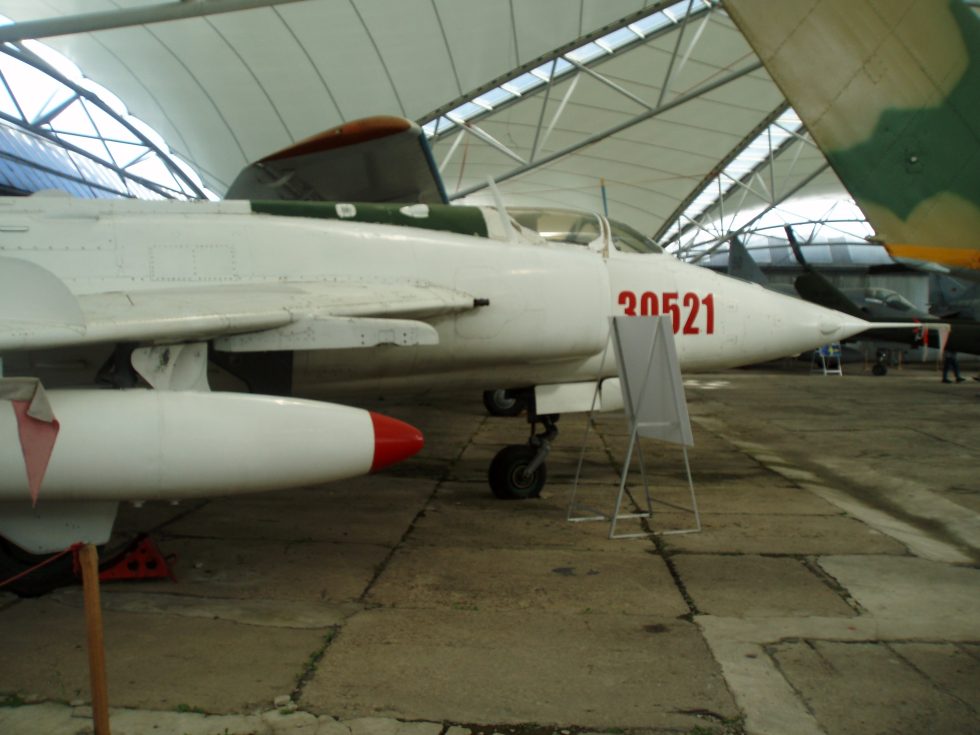
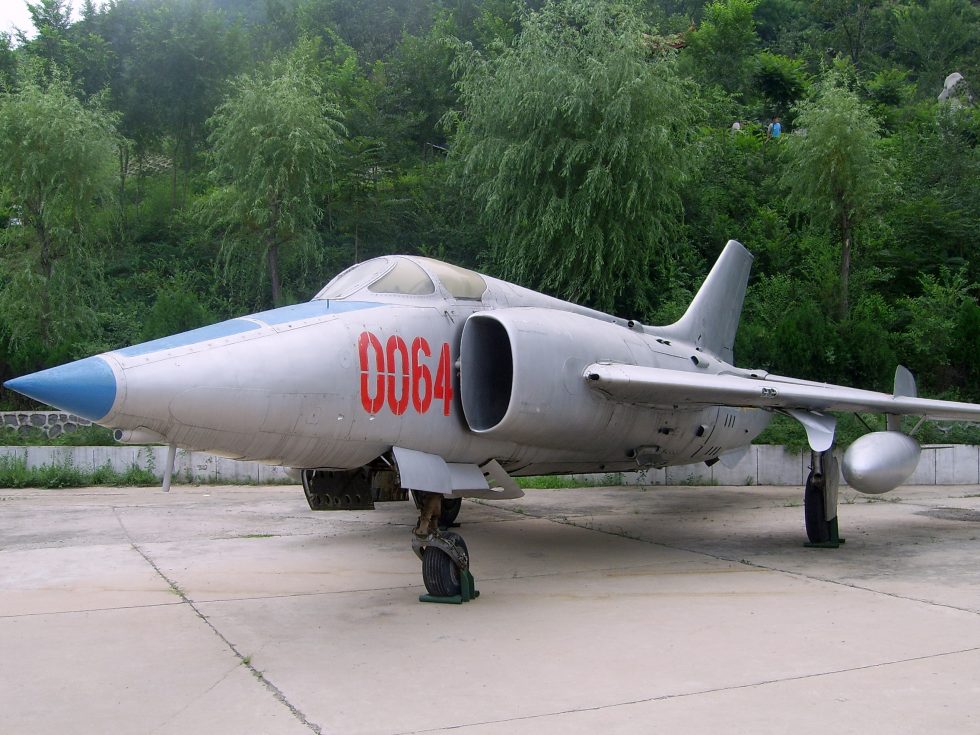
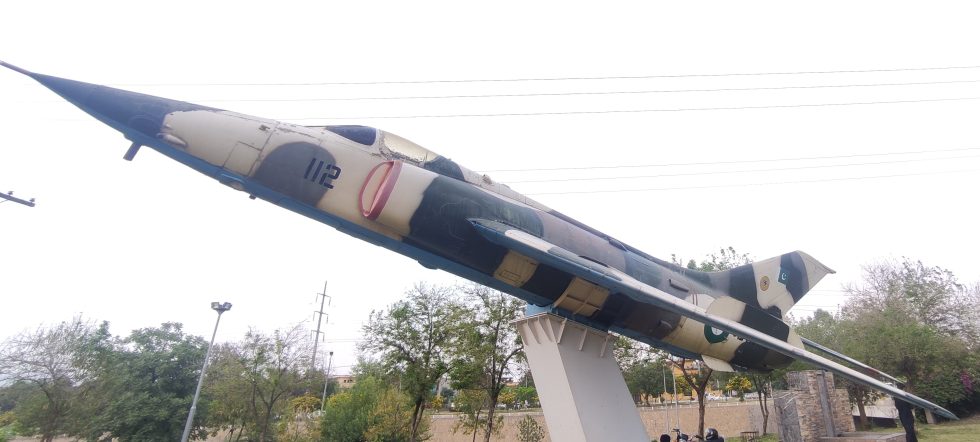
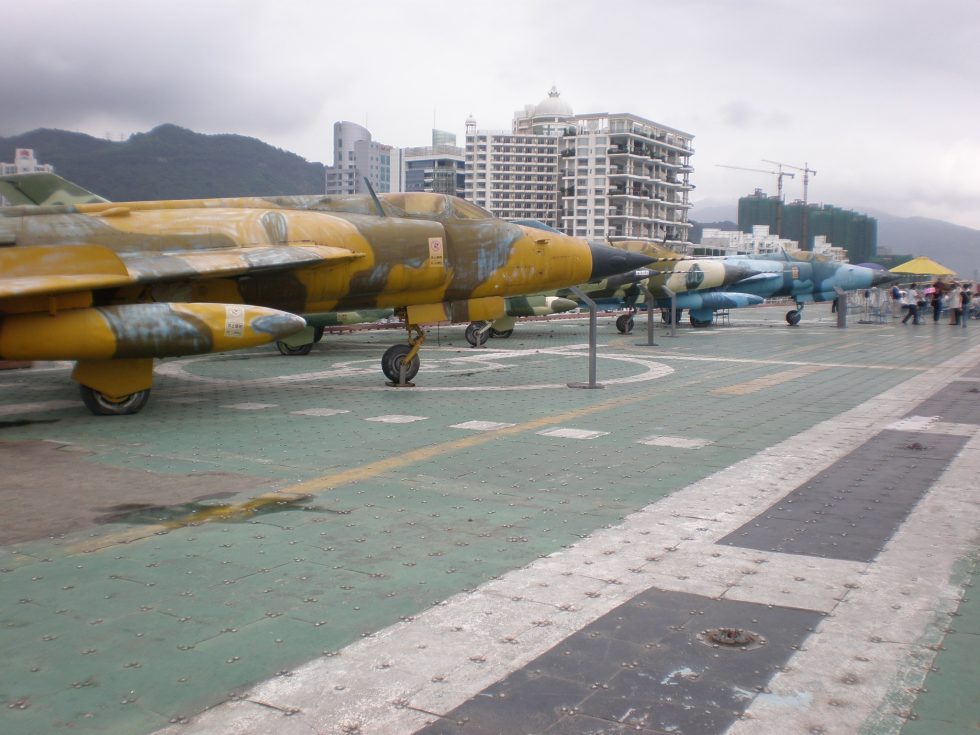
The Q-5 Fantan in pictures
Where the Q-5 Fantan flew
An attacker used more abroad than at home
The Q-5 has no record of air-to-air victories — that was never its job. As a ground-attack aircraft its service is measured in strike sorties, and most of its actual combat use came in the hands of export customers rather than China. Sudan flew its A-5s in the ground-attack role during the conflict in Darfur, and Myanmar used the type in counter-insurgency operations, including a 2015 strike whose ordnance spilled across the border into China. Pakistan, the largest operator, flew the A-5C in the strike role for nearly three decades but has no confirmed record of combat use.
See the wider combat record of every military aircraft. Combat use is described here neutrally and at the level the open sources support.
Everything people ask about the Q-5 Fantan
Can I fly in a Q-5?
What is the Nanchang Q-5 (A-5 Fantan)?
Is the Q-5 the same as the MiG-19 or J-6?
Could the Q-5 carry nuclear weapons?
Which countries flew the A-5?
Is the Q-5 still in service?
You can’t fly the Q-5.
These, you can.
Some legends only live in museums — others are fuelled and waiting. MiGFlug has put civilians in real military jet cockpits since 2004.
 Fly the L-39 AlbatrosThe world’s most-flown jet trainer — aerobatics included
 Fly the F-104 Starfighter“The missile with a man in it”
 Fly the MiG-21The Cold War’s most-produced jet
 Fly the T-33 Shooting StarAmerica’s first jet trainer
 Fly the DH VampireA piece of early jet history
 Fly the S.211Agile Italian jet trainer
 Fly the MB-326The classic Aermacchi jet
 Fly the MiG-15The Soviet legend of the Korean War
Continue the tour
Every fact, checked
- GlobalSecurity.org — Q-5 DesignThe MiG-19 / J-6 redesign, area-ruling, side intakes, dimensions and the loss of top speed.
- GlobalSecurity.org — Q-5 VariantsVariant breakdown, the internal bay, and the nuclear-carrier role and January 1972 test.
- GlobalSecurity.org — Pakistan A-5Pakistani A-5C numbers, squadrons and service.
- MILAVIA — Q-5 / A-5C specificationsA-5C dimensions, weights, WP-6 thrust, speed, ceiling and armament.
- MilitaryFactory — Nanchang Q-5First-flight date, production total, performance figures and operator list.
- War Thunder Wiki — History of the export Fantan (A-5C)Detailed export and operator numbers for Pakistan, Bangladesh, Myanmar, Sudan and North Korea.
- Federation of American Scientists — Q-5 special weaponsReference for the nuclear-modified Q-5A and the tactical delivery role.
- The National Interest — The Nanchang Q-5Anti-flash scheme, combat use in Darfur and Myanmar, and PLAAF service into the 2010s.