
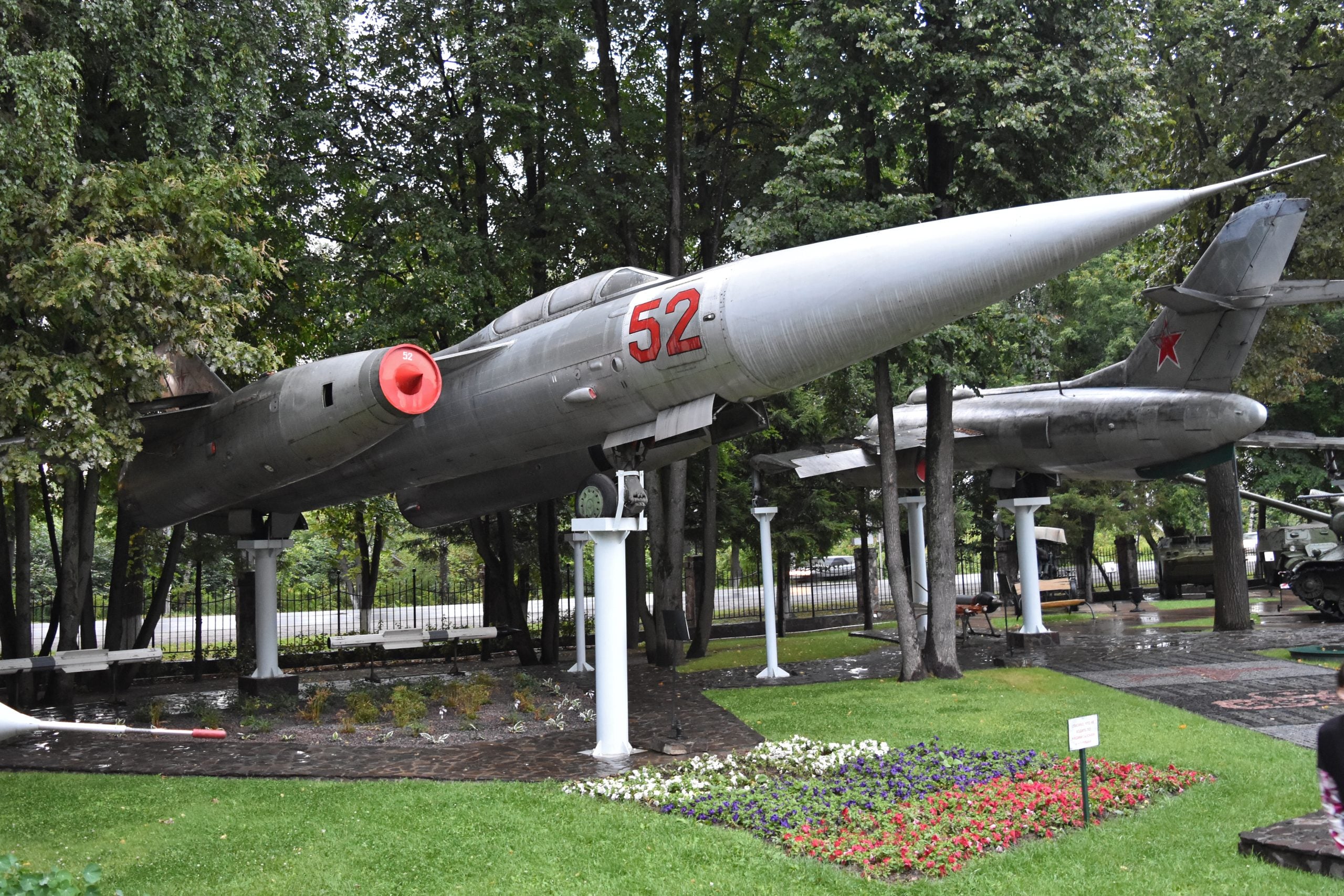
Yakovlev Yak-28
“Brewer · Firebar · Maestro”
A swept-wing, twin-jet Soviet workhorse of the 1960s — one airframe family stretched into a tactical bomber, an all-weather interceptor, a reconnaissance platform, an electronic-warfare jammer and a trainer.
The Yak-28: one Soviet jet, a whole air force’s worth of jobs
By the mid-1950s the Yakovlev bureau had built a family of twin-engine jets — the Yak-25, Yak-26 and Yak-27 — that shared an unusual signature: a slim fuselage riding on bicycle (tandem) landing gear, with the two engines hung in pods under the wings and small outrigger wheels near the wingtips. The Yak-28 grew directly out of that lineage, but with a thinner, more sharply swept wing and afterburning engines it became a genuinely supersonic machine. Western observers, who first saw it at the Tushino display in 1961, initially mistook it for another Yak-25 derivative before realising it was effectively a new aircraft.
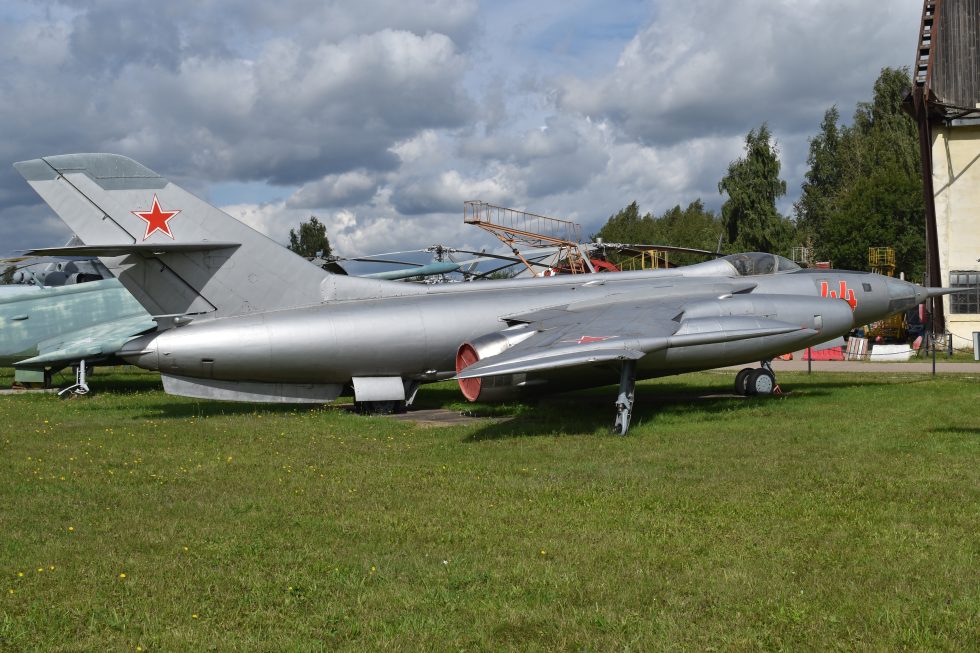
What set the Yak-28 apart was not a single record but its sheer versatility. The prototype (designated Yak-129) first flew on 5 March 1958, and over the following decade the design was pulled in five directions at once. The core “Brewer” family were tactical bombers and reconnaissance jets with a glazed nose for a navigator-bombardier; the Yak-28P “Firebar” swapped that glass nose for a radar and became an all-weather missile interceptor for Soviet air defence; the Yak-28PP “Brewer-E” was a dedicated electronic-warfare jammer; and the two-seat Yak-28U “Maestro” trained the crews who flew them all.
The Yak-28 was very much a Soviet-only aircraft — it was never exported to Warsaw Pact allies in the way the MiG-21 was, and roughly 1,180 were built before production wound down around 1971. It served through the 1960s, 1970s and 1980s, reportedly including reconnaissance and jamming work during the Soviet–Afghan War, before the last examples were retired from Russian and successor-state service in the early 1990s. Today the type survives only in museums — but it left one indelible mark on Cold War history, in the waters of a West Berlin lake.
01The Yak-28’s most famous day: the 1966 Havelsee crash in West Berlin
On 6 April 1966 a Yak-28P suffered engine failure over the divided city of Berlin. Rather than eject immediately over the built-up British Sector, the two-man crew — pilot Captain Boris Kapustin and navigator Lieutenant Yuri Yanov — are widely reported to have stayed with the failing aircraft and steered it away from apartment blocks, before it came down in Lake Stössensee, part of the Havel lakes. Both men were killed and later received a posthumous Order of the Red Banner; their sacrifice became a well-known story in the Soviet Union.
Because the wreck lay in the British Sector, it also became one of the best-documented Western technical-intelligence recoveries of the Cold War. British forces, with US help, cordoned the lake while specialists examined the interceptor’s radar and engines — and, by several accounts, quietly flew parts to Britain for study before returning the aircraft to the Soviets. The exact details are told differently by different sources, but the episode is remembered on both sides as the “Firebar affair.”
What makes the Yak-28 special
Bicycle landing gear with wingtip outriggers
Instead of conventional tricycle gear, the Yak-28 carried a two-wheel nose leg and a two-wheel rear leg in line down the belly, with small single outrigger wheels in fairings near each wingtip to keep the wings level. It gave the jet a distinctive nose-high stance and demanded careful handling on takeoff and landing — a trait inherited straight from the earlier Yak-25 family.
Two Tumansky turbojets in underwing pods
Power came from a pair of Tumansky R-11 afterburning turbojets slung in nacelles under the swept wing rather than buried in the fuselage. The layout kept the fuselage slim and made engine access easy, but early installations were dogged by afterburner-related reliability problems that were only gradually reduced over the type’s service life.
Two very different noses, two mission sets
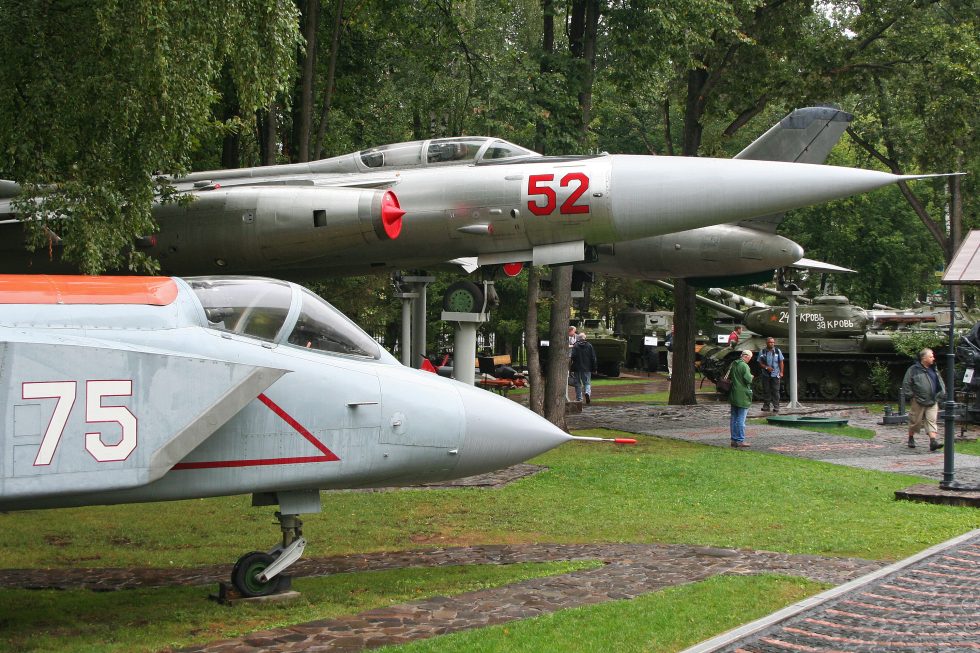
The same basic airframe wore two faces. Brewer bomber and recon variants had a glazed nose housing a navigator-bombardier; the Yak-28P “Firebar” interceptor deleted the glass for a solid radar nose (the “Orel” / NATO “Skip Spin” set) feeding its air-to-air missiles. It is the quickest way to tell a Yak-28 bomber from a Yak-28 fighter at a glance.
02The Yak-28 variant families: Brewer, Firebar and Maestro explained
NATO sorted the Yak-28 into three reporting-name families by role. “Brewer” covered the tactical-bomber, reconnaissance and electronic-warfare jets — the base Yak-28 and Yak-28B/L/I bombers (Brewer-A/B/C), the Yak-28R reconnaissance aircraft (Brewer-D) and the Yak-28PP jammer (Brewer-E). “Firebar” was reserved for the radar-nosed Yak-28P interceptor, of which several hundred were built. “Maestro” was the two-seat Yak-28U conversion trainer. Exact production splits vary between sources, so treat sub-variant totals as approximate.
03The Yak-28P Firebar: radar, missiles and the air-defence mission
The Yak-28P was Soviet air defence’s answer to gaps in its interceptor coverage. It carried a two-man crew, a nose radar, and typically a pair of R-8 / K-8 family missiles (R-98/R-98M, NATO AA-3 “Anab”) — commonly one infrared-homing and one semi-active radar-homing round — sometimes supplemented by short-range missiles. Unlike many contemporaries it carried no internal gun. Popular sources muddle the exact missile designations, so the loadout below should be read as representative rather than definitive.
Yak-28P Firebar: full specifications
Baseline note: the figures below describe the Yak-28I (izdeliye 28I, NATO Brewer-C), the Initsiativa-2 radar bomber built at Irkutsk from 1963. It is the right baseline for three reasons: at 223 aircraft it was the most numerous of the strike marks, it was the only member of the family formally taken on charge by the Soviet Air Force, and it sits in the middle of a lineage whose sub-types differ from one another far more than the shared designation suggests. Deltas for the Yak-28B, the Yak-28L, the reconnaissance Yak-28R, the Yak-28PP jammer, the Yak-28U trainer and above all the Yak-28P Firebar interceptor are in grey. Four warnings before any number is read. First, the Yak-28P is not a variant of this aeroplane in any useful sense: different nose, different span, different fuel system, no bomb bay, no gun, and a different customer — it served the PVO air-defence force, not Frontal Aviation — so the common English-language habit of quoting bomber and interceptor figures in one column produces an aircraft that never existed. Second, the widely reproduced data set pairing a 21.6 m length and 12.5 m span with a 20,000 kg maximum weight and a 16,750 m ceiling matches no single Soviet sub-type; the Russian archival figures used here are quoted mark by mark. Third, empty weight is genuinely contested: 9,970 kg is the Russian figure and the only one consistent with the published loaded weights, while several German and Western works print about 13,600 kg (29,980 lb), which cannot be reconciled with a 16,160 kg normal take-off weight carrying 4,600 kg of fuel and 1,200 kg of bombs. Fourth, the requirement this aircraft was built against changed repeatedly between 1956 and 1963, so early prototype numbers — 1,500 km/h, a 16,300 m ceiling — are often printed alongside late-production ones; they should not be mixed.
Dimensions & weights
- Crew
- 2 — pilot under a rearward-sliding canopy and a navigator-bombardier prone-seated in the fully glazed nose, on K-5MN and K-7MN ejection seats. The Yak-28P interceptor seated pilot and radar operator in tandem under a common canopy with dual controls; the Yak-28U trainer put the instructor in a second cockpit grafted on ahead of the pilot's, in place of the navigator's glasshouse
- Length
- 20.02 m (65 ft 8 in) for the Yak-28I. Greg Goebel's data give 20.2 m (66 ft 3 in) for the same mark. The Yak-28P grew to 21.70 m (71 ft 2 in), and late Firebars with the extended Orel-D radome are quoted at up to 23.0 m (75 ft 6 in) — the single largest source of confusion in this family's published dimensions
- Wingspan
- 11.78 m (38 ft 8 in), with 44° of sweep on the inboard panels and 35° outboard, a leading-edge dogtooth at the break and one boundary-layer fence per side. The wing was set at 2° of incidence. The Yak-28P was widened to 12.95–13.00 m (42 ft 6 in to 42 ft 8 in) to recover ceiling with the heavier nose; the Yak-28PP reverted to 11.64 m (38 ft 2 in)
- Height
- 4.30 m (14 ft 1 in) on the ground at a static angle of about 5°. Sources that print 3.95 m (13 ft 0 in) are quoting the Yak-28P
- Wing area
- 35.25 m² (379.4 sq ft) — unchanged across every bomber, reconnaissance and jammer mark, which is why wing loading rather than wing area is the number that separates them. The 37.6 m² (405 sq ft) figure in circulation belongs to no Soviet document this survey could trace
- Empty weight
- 9,970 kg (21,980 lb). The Yak-28PP, stuffed with jamming transmitters, weighed 11,000 kg (24,250 lb) empty
- Normal take-off weight
- 16,160 kg (35,630 lb) with 1,200 kg of bombs and full internal fuel. Russian encyclopaedia entries for the plain Yak-28 quote 14,600 kg (32,190 lb), which is the same aeroplane at a reduced fuel state. The Yak-28P sat at 15,980 kg (35,230 lb), the Yak-28PP at 16,200 kg (35,720 lb)
- Maximum take-off weight
- 18,080 kg (39,860 lb). Figures of 16,500 kg (36,380 lb) appear for the early Yak-28B and 19,000 kg (41,890 lb) in some German tables for the Yak-28I; 18,080 kg is the value the Irkutsk documents use. The Yak-28P was cleared to 18,400 kg (40,570 lb)
- Internal fuel
- 4,600 kg (10,140 lb), roughly 5,750 litres (1,265 imp gal) in fuselage cells. The Yak-28R gained 550 litres; the Yak-28U put a 1,350-litre tank in the empty weapons bay; the Yak-28P, with the bay replaced by a 4,570-litre cell, carried about 6,570 litres (1,445 imp gal) and was the long-legged member of the family
- Bomb load
- 1,200 kg normal, 3,000 kg maximum (2,650 lb and 6,610 lb), all of it internal. A handful of Western tables print 4,000 kg; no Russian source supports it
- External stores
- two underwing pylons — hung at a slight nose-down angle so that a released store cleared the nacelle cleanly. In squadron use they almost always carried 1,000-litre (220 imp gal) drop tanks rather than weapons
- Wing loading
- 458 kg/m² (94 lb/sq ft) at normal take-off weight — high for 1963, and the reason the Yak-28 needed long, hard runways and a brake parachute it could not do without
Performance
- Maximum speed, altitude
- 1,850 km/h (1,150 mph; 999 kn) at about 12,000 m (39,370 ft), roughly Mach 1.74 clean. State acceptance trials recorded 1,830 km/h (1,137 mph). The Yak-28P is quoted at 1,840 km/h (1,143 mph); the one-off Yak-28PM with R-11AF3-300 engines reached 2,400 km/h (1,491 mph) in 1963 and was never built
- Maximum speed, sea level
- 1,050 km/h (650 mph). The second prototype managed 950 km/h (590 mph) on the deck in 1959 before the definitive nacelles were fitted
- Cruising speed
- 975 km/h (606 mph). German sources give 920 km/h (572 mph) at 11,000 m, which is the more economical setting of the two
- Rate of climb
- 142 m/s (27,950 ft/min) at sea level. Crews remembered that a clean, unarmed Yak-28 with both afterburners lit would climb away almost vertically — the one thing about the aeroplane nobody complained about
- Time to 10,000 m
- 3 min 30 s on afterburner, measured on the Yak-129 prototype in 1958 and comfortably inside the 3 to 3.5 minutes the 1956 requirement demanded
- Service ceiling
- 14,500 m (47,570 ft). Russian entries for the plain Yak-28 give 15,300 m (50,200 ft) and the Yak-28L 15,600 m (51,180 ft); the Yak-28P, on its bigger wing, reached 16,000 m (52,490 ft). The 20,000 to 21,000 m demanded by the 1956 VK-11 requirement was never approached, because the VK-11 engine was never delivered
- Range, internal fuel
- 2,070 km (1,286 miles; 1,118 nmi). The Yak-28P managed 2,150 km (1,336 miles) clean and about 2,700 km (1,678 miles) with tanks; the Yak-28R, with extra fuel and pylon tanks, is credited with 2,680 km (1,665 miles)
- Combat range, 1,200 kg load
- 1,100 km (684 miles; 594 nmi). The 1956 specification had asked for 2,200 to 2,400 km at 10,000 m with the same load; the aircraft as built never came close, which is why the drop tanks were carried so routinely
- Maximum endurance
- 2 hours 46 minutes — short, and shorter still in practice because supersonic acceleration between Mach 1.3 and Mach 1.6 burned fuel so fast that early trials crews risked not having enough left to get home
- Take-off run
- 1,150 m (3,770 ft) at normal weight, 1,550 m (5,090 ft) at maximum. Unstick came at 270–280 km/h (168–174 mph); because the bicycle undercarriage cannot rotate, the wing's built-in incidence gave roughly 9° of angle of attack on the roll and the aeroplane flew itself off. Two SPRD-118 rocket bottles cut the Yak-28P's run to about 400 m (1,310 ft)
- Landing run
- 850 m (2,790 ft) with the brake parachute, which deployed automatically when a probe lowered from the rear fuselage touched the runway. Yak-28P trials in 1966 with a twin-canopy chute recorded 650–750 m (2,130–2,460 ft) and a required runway length of 1,280 m (4,200 ft)
- Limit load factor
- 3 g — a bomber's limit on an aircraft the size of a fighter. Aerobatics and deliberate spinning were forbidden throughout the type's service life
- Spin behaviour
- recovery delayed by 2–3 turns with a tendency to reverse direction; height loss including the ensuing dive reached 8,000 m (26,250 ft). The flight manual ordered the crew to abandon the aircraft if it had not recovered by 4,000 m (13,120 ft)
Propulsion & systems
- Engines
- two Tumansky R-11AF2-300 afterburning turbojets — a nacelle-mounted derivative of the MiG-21's R-11, with the accessory gearbox relocated to suit an underwing pod. The Yak-129 prototype flew on R-11A-300 of 4,850 kgf; early production used the R-11AF-300 at 5,750 kgf, improved in service to 5,900–6,050 kgf
- Rated thrust
- 46.0 kN (4,690 kgf; 10,340 lbf) dry, 59.8–60.8 kN (6,100–6,200 kgf; 13,450–13,670 lbf) with afterburner, each — note that Russian tables frequently label the 6,100 kgf figure "non-afterburning", which is a transcription error repeated across the internet
- Intakes and nozzles
- oval intakes with a two-position translating centrebody that extended at Mach 1.45, fitted after trials showed acceleration from Mach 1.3 to Mach 1.6 was unacceptably slow and thirsty. The Yak-28L introduced fully variable exhaust nozzles. Yak-28P intakes were later lengthened by 760 mm to keep stones out on unpaved strips
- Thrust-to-weight ratio
- 0.76 at normal take-off weight — exceptional for a 1963 tactical bomber, and the source of the type's reputation for spectacular departures
- Rocket-assisted take-off
- two SPRD-118 solid-propellant boosters on fuselage attachments between frames 34 and 37, trialled on a production Yak-28B in March 1962 and adopted in series
- Radar
- Initsiativa-2 ground-mapping and bombing radar in a chin fairing. The Yak-28B had the earlier RBP-3 (rendered RPB-3 in some Russian texts); the Yak-28R used Initsiativa-2R and later Initsiativa-3; the Yak-28BI carried the Bulat side-looking radar; the Yak-28P carried Orel-D, the set whose antenna British divers removed from the wreck in the Stössensee in April 1966 before the aircraft was handed back
- Bombing and navigation
- OPB-116 optical bombsight (OPB-115 on the Yak-28B), RSBN short-range radio navigation and an ARK radio compass. The Yak-28L instead used the DBS-2S Lotos hyperbolic radio-command system, which computed a release point from ground transmitters — accurate in theory, easily jammed, and useless beyond the reach of its own beacon network
- Autopilot and controls
- AP-28K1 autopilot coupled to the bombing system, with an adjustable-incidence tailplane the crew had to remember to reset. An AK-2A yaw-compensation unit was added to catch asymmetric thrust after take-off; it was unreliable and was itself implicated in several fatal accidents
- Radio and warning
- SOD-57M transponder, SPU-7 intercom and a Sirena-3 radar-warning receiver with a tail-mounted sensor. The Yak-28P added the Lazur datalink for ground-controlled interception; the Yak-28PP carried Buket, Strela, Fasol-1 and Siren jammers with ASO-2I flare and KDS-19 chaff dispensers
- Undercarriage
- bicycle layout — nose and main units on the fuselage centreline with outrigger wheels in fairings at the wingtips, inherited from the Yak-25. The rear unit could be made to "kneel" to raise the nose for take-off; KT-82 braked nosewheels were standardised from 1962. The fairings looked flimsy and were not: on more than one occasion they alone kept a Yak-28 upright after the rear leg failed to extend
- Structure
- all-metal stressed-skin semi-monocoque with steel skinning at the wing root. The fuselage flexed enough under a full load that the canopies would not close, so crews had to be strapped in and sealed before fuelling and bombing-up. Cracking in the airframe was chronic from the first squadron deliveries and never entirely cured
04The Yak-28’s operating costs: why no reliable price exists
The Yak-28 was a Soviet state product, built for the Soviet armed forces and never sold on an open dollar market. As a result there is no credible flyaway unit price or cost-per-flight-hour figure for the type in the public record — unlike Western aircraft of the era, its true programme economics were never published in convertible currency. Any precise dollar cost you see attached to a Yak-28 is, in practice, a modern estimate rather than a sourced figure.
Armament & payload
The Yak-28 fought with one bay, two pylons and a gun it had never really wanted
The Yak-28 was designed around a single proposition: put a 1,200 kg tactical nuclear bomb over a NATO airfield at high subsonic speed and 10,000 m, then run home supersonic, in an aeroplane cheap enough to build in hundreds. Every choice in its armament follows from that. There is one internal bay sized for a single large store, two underwing pylons that in service carried fuel far more often than weapons, and one fixed forward-firing cannon that survived only because the tail gun it was meant to replace had been deleted. The interceptor took the same logic to its conclusion and carried nothing but missiles. What the aircraft never acquired — and what killed it — was any guided air-to-ground weapon at all. Fits varied sharply between marks and between the two customers: the gun was NR-23 on early bombers and GSh-23Ya later, absent altogether on the R, U and P; and no two published loadout tables for this family agree with one another.
Gun
- One 23 mm Nudelman-Richter NR-23 with 50 rounds, fixed and firing forward from the starboard side of the forward fuselage. It began life in the 1956 requirement as a tail gun for rear defence; when the tail installation was dropped, the gun stayed and turned into a strafing weapon nobody had asked for.
- From the Yak-28L onward the NR-23 gave way to the twin-barrel Gryazev-Shipunov GSh-23Ya of the same calibre with about 150 rounds, firing at roughly 3,000–3,600 rounds per minute.
- Some German-language references list a 30 mm NR-30 with 80 rounds as an alternative installation. Russian sources do not corroborate it and it should be treated as doubtful.
- Deleted entirely on the Yak-28R, which was unarmed and earned the squadron nickname golub mira, the dove of peace; also deleted on the Yak-28U trainer and on the Yak-28P interceptor.
- Fifty rounds is about four seconds of firing. Nobody expected a Brewer to win a gunfight, and none ever did.
Air-to-air
- None on the bomber. The Yak-28I had no air-to-air weapon of any kind and no self-defence missile; its answer to interception was to be somewhere else at 1,850 km/h.
- Yak-28P Firebar: two Bisnovat R-8M-1 (AA-3 Anab) on PU-1-8 rails outboard of the nacelles, normally one semi-active radar-homing R-8M1R paired with one infrared R-8M1T, so that a single pass offered two guidance methods against one countermeasure.
- From about 1966 the improved K-98 system substituted R-98R and R-98T rounds, and two further pylons were added inboard for R-3S (K-13A, AA-2 Atoll) short-range missiles on BD3-60-21U racks, giving a four-missile aircraft.
- A few sources extend the fit to the R-60 (AA-8 Aphid) on late Firebars. The claim is thin, and the type was leaving PVO service around the time the R-60 became common.
- No Yak-28P is credited with a confirmed air-to-air kill. Its one recorded contribution was vectoring a MiG-17 onto a defecting An-2 in 1967, and a bloodless encounter with a Luftwaffe Phantom.
Air-to-surface guided
- Nothing in squadron service, at any point in the type's career. This card exists to record an absence, and the absence is the whole reason the Yak-28 died young.
- Yak-28N: a Yak-28I converted in 1965 to carry two Raduga Kh-28 (AS-9 Kyle) anti-radiation missiles on underwing pylons with the matching passive-homing receiver. It tested successfully and was not put into production.
- Yak-28-64: the abandoned 1964 interceptor redesign, with both engines buried in a widened fuselage, was to have carried the K-28P system using the same Kh-28 round.
- Yak-28IM: one airframe, No. 4940503, modified in 1973 with four additional pylons for a broadened weapon fit. Work stopped as unpromising.
- The Su-24 that replaced the Yak-28 arrived able to deliver guided weapons from the outset. The Yak-28 could only ever drop iron, and by 1975 that was no longer a tactical bomber.
Bombs
- One internal bay loaded through the belly, cleared for free-fall stores from 100 kg to 3,000 kg. Normal load 1,200 kg, maximum 3,000 kg.
- Documented fits: one FAB-3000; two FAB-1500; two FAB-500, BetAB-500ShP concrete-piercers or RBK-500 cluster bombs; four FAB-250 or OFAB-250; eight FAB-100. Stores up to 500 kg hung on a cassette rack inside the bay.
- One tactical nuclear bomb of roughly 1,200 kg — the spetsizdeliye, or special store, that the entire 1956 requirement had been written around. The Yak-28I was Frontal Aviation's nuclear carrier of the mid-1960s.
- Supersonic release was cleared and demonstrated on the range near Saratov. In squadron hands the accuracy collapsed so completely that crews were missing the range, not merely the target; it took years of dedicated trials to bring the system back to the standard of a subsonic bomber.
- A few Western tables give 4,000 kg maximum. Russian documents consistently say 3,000 kg, and the aircraft's meagre ground clearance — loading big bombs required purpose-built pits or jacks — argues for the lower figure.
Rockets
- The bomber carried no rocket pods as a standard fit. Unguided rockets formed no part of the Yak-28I's cleared armament, and this is one card that cannot honestly be filled.
- Yak-28PP: two UB-16-57UM pods on the underwing racks, each holding sixteen 57 mm S-5P (PARS-57) rounds.
- Those rounds were chaff rockets, not attack weapons. They were fired ahead of a strike package to seed a corridor of dipoles across the defending radars — jamming delivered by ballistics rather than by transmitter.
- That installation is the only rocket armament in regular use anywhere in the family.
- The gap is structural, not an oversight: with the fuselage sitting barely clear of the concrete and only two pylons available, there was nowhere convenient to hang attack pods.
Pods & other stores
- Two underwing pylons, angled slightly nose-down for clean separation, in practice reserved for 1,000-litre drop tanks. Range, not firepower, was the scarce commodity.
- Yak-28R: five interchangeable reconnaissance packs replacing the bomb bay — AFA-54 cameras in rocking mounts with AFA-42/20 for low-level daylight work; AShchAFA-8 strip cameras; a TAU-M mount with AFA-41/10 for topographic survey; NAFA night cameras with SOU-2 flash units; or the Romb-4A ELINT receiver, good for 365 km at 10,000 m over a 50° sector.
- Yak-28RR: RR8311-100 filter pods under the wings for sampling airborne radioactivity, a design later standardised across other Soviet reconnaissance types.
- Yak-28SR: SPS-141 or SPS-143 Siren active jammers added to the reconnaissance fit. The transmitters ran so hot that a dedicated trials programme was flown in 1971 simply to measure cockpit temperature.
- Yak-28PP: Buket, Strela and Fasol-1 jammers filling the fuselage, with a DISS-3A Doppler set and NVU-B12 navigation computer to keep the aircraft on a jamming track it could not see.
Three typical loadouts
- Nuclear strike, Yak-28I, Frontal Aviation, mid-1960s
- One tactical bomb of about 1,200 kg in the bay and nothing outside it. Initsiativa-2 mapping an offset aim point, OPB-116 for the visual release, AP-28K1 flying the run-in at 10,000 m and 1,000 km/h. This was the mission the airframe existed for, and the only one for which its short radius was politically acceptable.
- Conventional interdiction
- 1,200 kg internal — typically four FAB-250 or two FAB-500 — with a 1,000-litre tank on each pylon and 50 rounds for the NR-23. High-altitude transit, a supersonic dash across the last stretch, and an accuracy problem the crews never entirely solved.
- Firebar combat air patrol, PVO, about 1970
- Two R-98 rounds, one radar-homing and one infrared, plus two R-3S inboard on four-pylon aircraft. No gun at all. Orel-D searching ahead, the Lazur datalink taking steers from a ground controller, and 6,570 litres internal for the long, dull Arctic patrols that were the type's real work.
Sourcing caveat: the bomb and store lists here are assembled from Russian type histories, the OKB-115 and GK NII VVS trials records summarised on airwar.ru, and the German-language type literature. They describe what the aircraft was cleared to carry, not what any given regiment actually loaded. Soviet nuclear store designations for the Yak-28 remain unpublished; the 1,200 kg figure is the weight quoted in the requirement, not a weapon name. Where the Kh-28 and R-60 appear in the record they are trials or claimed fits, and are flagged as such above.
Variants
The Yak-28 was five different aeroplanes wearing one number, and only one of them was ever formally accepted
About 1,180 Yak-28s were built between 1960 and 1971, at Irkutsk, Novosibirsk and briefly Saratov. That single total conceals a bomber, a reconnaissance aircraft, a jammer, a trainer and an interceptor that shared a wing and an undercarriage and very little else. It also does not quite add up: the published sub-type figures — 111 Yak-28L, 223 Yak-28I, 183 Yak-28R, 183 Yak-28U and 435 Yak-28P — total 1,135, leaving barely forty-five airframes for every early Yak-28 and Yak-28B, every Yak-28SR and every Yak-28PP combined. One of those numbers is wrong, and the sources do not say which.
Two facts about this family are routinely got wrong. The first is service status: despite more than a thousand aircraft flying with front-line regiments for thirty years, the Yak-28 as a type was never formally adopted, in part because one broke up in supersonic flight during a demonstration to the state commission. Only the Yak-28I was officially taken on charge. The second is export: there was none. No Yak-28 was ever sold abroad, none was licence-built, and there are no foreign designations to list. The only non-Soviet operators were the successor states that inherited aircraft in place in 1991 — Russia, Ukraine, Belarus and Turkmenistan.
The type is remembered in Germany for one aircraft. On 6 April 1966 a Yak-28 from Finow, near Eberswalde, suffered a double engine failure over West Berlin. Captain Boris Kapustin and Senior Lieutenant Yuri Yanov stayed with it to steer clear of the housing below and went into the Stössensee with the aeroplane. British forces raised the wreck and the bodies, stripped the radar antenna and both engines for examination, and returned the engines on 2 May. Both men received the Order of the Red Banner posthumously, and a song about them, The Enormous Sky, is still sung in Russia. Russian accounts identify the aircraft as a Yak-28P, which fits the Orel-D antenna the British recovered but sits awkwardly with the bomber regiment usually named; German records say only "a Yak-28".
- Yak-129, flown as Yak-28-1, -2 and -3 (1958–1959 / three conversions)
- Prototypes rebuilt from small-series Yak-26 airframes. The wing moved to the shoulder to cut the pitch-up couple from the underslung engines, root chord grew, the ailerons moved outboard and a brake parachute was added. First flight 5 March 1958 by V. M. Volkov. Yak-28-1 had R-11A-300 engines of 4,850 kgf; the second and third machines introduced the R-11AF-300 of 5,750 kgf in wholly new nacelles.
- Yak-28 izdeliye B and Yak-28B Brewer-A (1960–1962 / small batches)
- The first production standard had no radar at all and only an optical sight, so the order was deliberately kept small. The Yak-28B added the RBP-3 bombing radar in a fairing under the pilot's cockpit, an OPB-115 optical sight, autopilot-driven attack steering and the 50-round NR-23. It was shown at Tushino in 1961 and was the aircraft the West first named Brewer.
- Yak-28L Brewer-B (1962–1963 / 111 built)
- Built around the DBS-2S Lotos hyperbolic radio-command bombing system, which fixed the aircraft against ground transmitters and computed the release point for it. Accurate on paper, easily jammed, and worthless outside the coverage of its own beacon chain. The navigator's station was cramped and disliked. Never formally accepted into service.
- Yak-28I Brewer-C (from 1963 / 223 built)
- The baseline of this page and the family's centre of gravity: Initsiativa-2 radar, OPB-116 sight and AP-28K1 autopilot as an integrated attack system, giving the crew a genuine all-weather capability against point targets. Nuclear-capable. The only Yak-28 variant officially taken on charge.
- Yak-28R Brewer-D (prototype 1963, production 1966–1970 / 183 built)
- Reconnaissance, developed from the Yak-28I to replace the Yak-27R and Il-28R. Taller canopy, more nose glazing, 550 extra litres of fuel and three bays taking five interchangeable sensor packs. Unarmed. Consensus among Russian historians is that this was the best aircraft of the whole family — more versatile than the MiG-21R and more reliable than the early Su-24MR that succeeded it.
- Yak-28SR, Yak-28RR, Yak-28RL and Yak-28TARK (1964–1971 / small numbers)
- Reconnaissance sub-marks. SR added SPS-141 or SPS-143 Siren active jammers, tested in 1970 and built in modest numbers. RR carried RR8311-100 filter pods for radiation sampling. RL was a radio-intelligence trials machine converted from a Yak-28L. TARK-1 was a television reconnaissance system that transmitted imagery live to a command post while filming on 190 mm stock; accepted and fitted to some Yak-28Rs.
- Yak-28PP Brewer-E (from 1970 / small numbers)
- The first Soviet dedicated electronic-warfare aeroplane: Buket, Strela and Fasol-1 jammers replacing every removable system, DISS-3A Doppler and NVU-B12 navigation, ASO-2I and KDS-19 dispensers, and two UB-16-57UM pods firing S-5P chaff rockets. It combined the Yak-28R's cockpit with the Yak-28L's glazed nose, and it outlived every other member of the family.
- Yak-28P Firebar, izdeliye 40 (1962–1967 / 435 built)
- The most numerous mark and a wholly different aeroplane: solid pointed radome over the Orel-D radar, no bomb bay, no gun, tandem crew with dual controls, a wider wing and 6,570 litres of internal fuel. Built at Novosibirsk alongside the rival Su-11. State trials dragged on until 1965 and it was never formally accepted, yet it served the PVO for two decades. Squadron nicknames were Pterodactyl and the Comb.
- Yak-28U Maestro (1962 onward / 183 built)
- Conversion trainer, designed as the Yak-129U. The navigator's glasshouse gave way to a second, stepped cockpit for the instructor with full dual controls, a metal nose cap and a 1,350-litre tank in the weapons bay. Given the type's handling, it was not a luxury: few pilots could be trusted with a Brewer without time in a Maestro first.
- Experimental and dead ends (1962–1973 / prototypes only)
- Yak-28BI with the Bulat side-looking radar for mapping; Yak-28N with Kh-28 anti-radar missiles; Yak-28PD and Yak-28PM interceptor refinements, the latter reaching 2,400 km/h on R-11AF3-300 engines that never entered production; Yak-28URP with rocket boost for high-altitude interception; Yak-28UVP for short-field work; Yak-28VV, a vertical take-off study; and the Yak-28-64, a rebodied interceptor with buried engines that lost to the Su-15 in 1966.
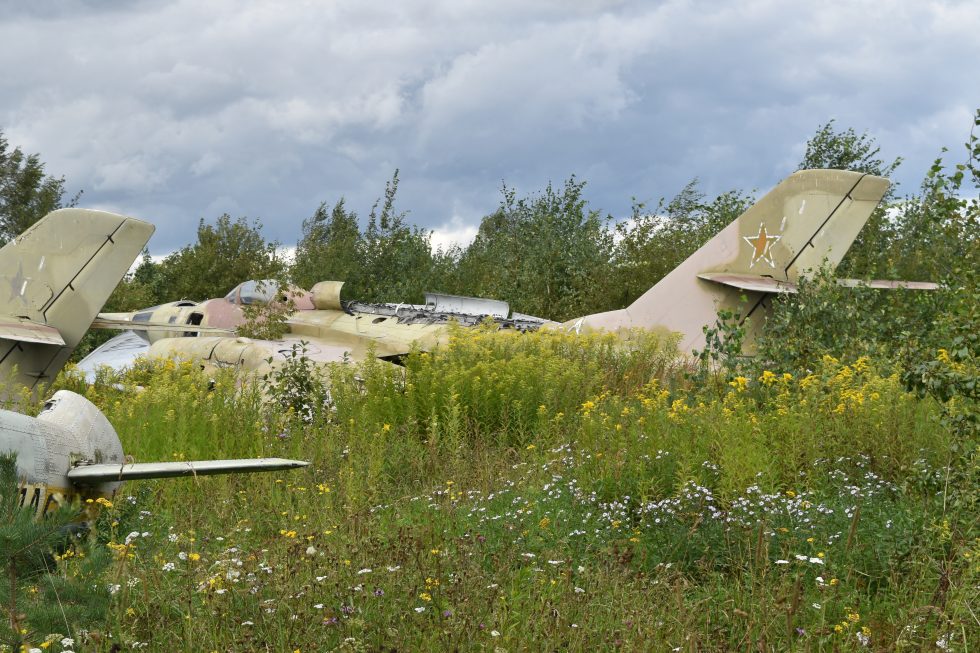
Closing note on survivors and retirement. Soviet Yak-28s flew until the collapse of the country; Russia held about forty Yak-28R and Yak-28PP until 1993; Ukraine flew 35 Yak-28PP and Yak-28U with the 118th Independent Electronic Warfare Regiment at Chortkiv into the second half of 1994, then ferried them to the storage and scrapping base at Ovruch; Belarus disbanded its 26-aircraft 151st EW Regiment at Shchuchyn in 1992; Turkmenistan kept a handful of Yak-28P at Türkmenabat. Around seventeen airframes are known to survive, all of them original aircraft — no reproduction of any Yak-28 has ever been built — and not one is airworthy. The best-known are a Yak-28 at Monino, a Yak-28P at the Zadorozhny museum near Moscow, a Yak-28L at Kubinka, a gate guardian at the Irkutsk plant that built most of them, a Yak-28U at the State Aviation Museum in Kyiv, a Yak-28PP at Vinnytsia, a Yak-28R at Riga and another at Finowfurt, on the airfield the Berlin aircraft flew from. The condition of the Ukrainian examples at Luhansk and in Vinnytsia oblast since 2014 cannot be verified from open sources.
From Yak-25 offspring to Cold War relic
Born from the Yak-25 family
Yakovlev develops a supersonic successor to its Yak-25/26/27 twin-jets, keeping the bicycle gear and wing-pod engines but adding a thinner swept wing.
First flight
The Yak-129 prototype makes its maiden flight on 5 March 1958.
Enters service
The Yak-28 begins reaching Soviet Air Force units as a tactical bomber; some sources date operational interceptor service a little later.
Tushino debut
Shown publicly at the Tushino air display, where Western observers at first misidentify it as another Yak-25 derivative.
The variants multiply
Specialised versions enter service: Brewer bombers, the Yak-28R recon jet, the Yak-28U “Maestro” trainer and the Yak-28P “Firebar” interceptor.
The Havelsee crash
On 6 April a Yak-28P goes down in a West Berlin lake after engine failure — the crew are killed and the wreck triggers a Cold War intelligence recovery.
Electronic warfare
The Yak-28PP “Brewer-E” dedicated jamming aircraft enters service, supporting Soviet strike packages.
Afghan service
Reconnaissance and electronic-warfare Yak-28s are reportedly employed during the Soviet–Afghan War.
Retirement
The last Russian and successor-state examples are withdrawn; the Yak-28 passes into museums.
Twelve Yak-28 stories
The Havelsee crash
A Yak-28P went down in a West Berlin lake; the crew reportedly steered it clear of homes and died.
Read the full story
The Firebar affair
Because the wreck lay in the British Sector, Western specialists examined its radar and engines before it went back.
Read the full story
A jet on a bicycle
The tandem main gear plus wingtip outriggers gave the Yak-28 its unmistakable nose-high stance.
Read the full story
Engines under the wing
Hanging the Tumansky turbojets in underwing pods kept the fuselage slim — but the afterburners gave trouble.
Read the full story
Flown with care
Accounts describe a relatively fragile airframe and advise against aerobatics.
Read the full story
The Firebar’s job
The radar-nosed Yak-28P filled gaps in Soviet air defence with missiles instead of a glazed bomber nose.
Read the full story
Eyes over the front
The Yak-28R turned the bomber into a dedicated tactical spy plane.
Read the full story
The jammer of the family
The Yak-28PP “Brewer-E” existed to blind enemy radars ahead of a strike.
Read the full story
Checking out the crews
The two-seat Yak-28U “Maestro” taught pilots the family’s tricky handling.
Read the full story
Work over Afghanistan
Recon and jamming Yak-28s were reportedly used in the Soviet–Afghan War.
Read the full story
Soviet through and through
Unlike the MiG-21, the Yak-28 was essentially never exported.
Read the full story
Remembered in a lake
The 1966 crew are commemorated to this day, and the wreck recovery is still studied.
Read the full story
The Yak-28 in pictures
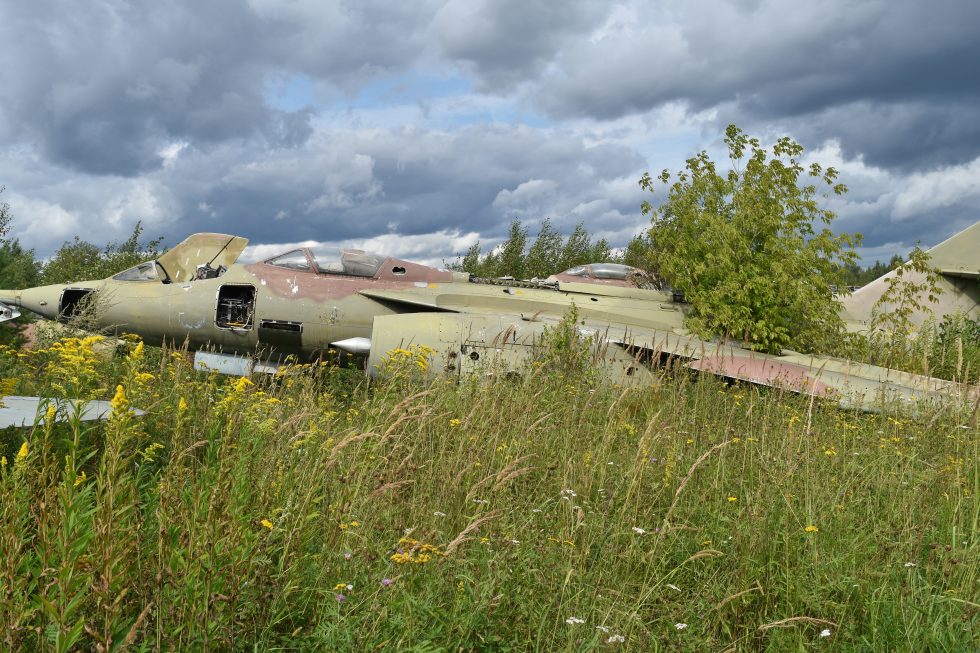
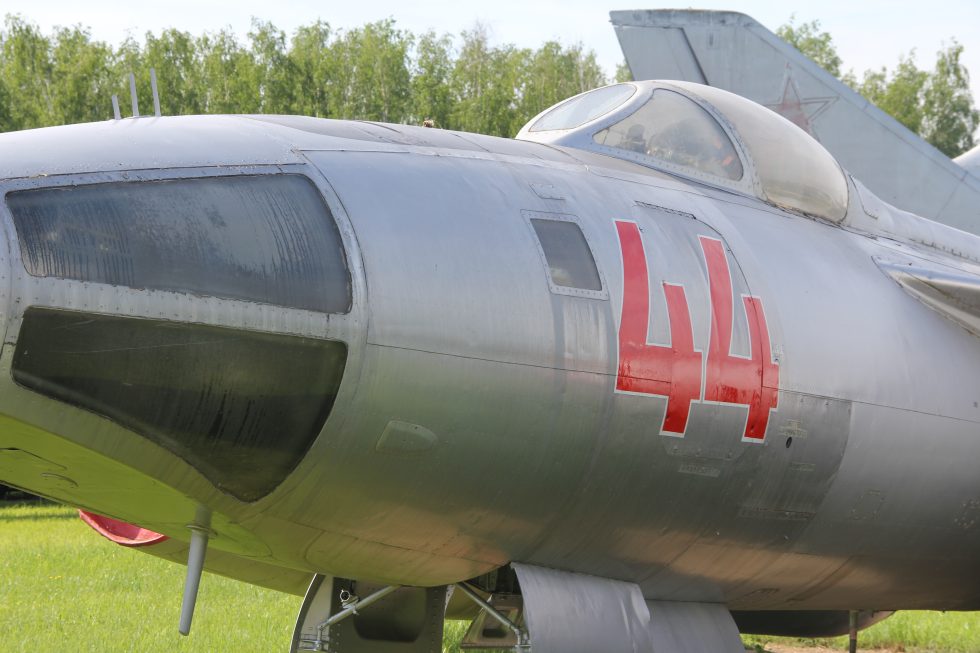
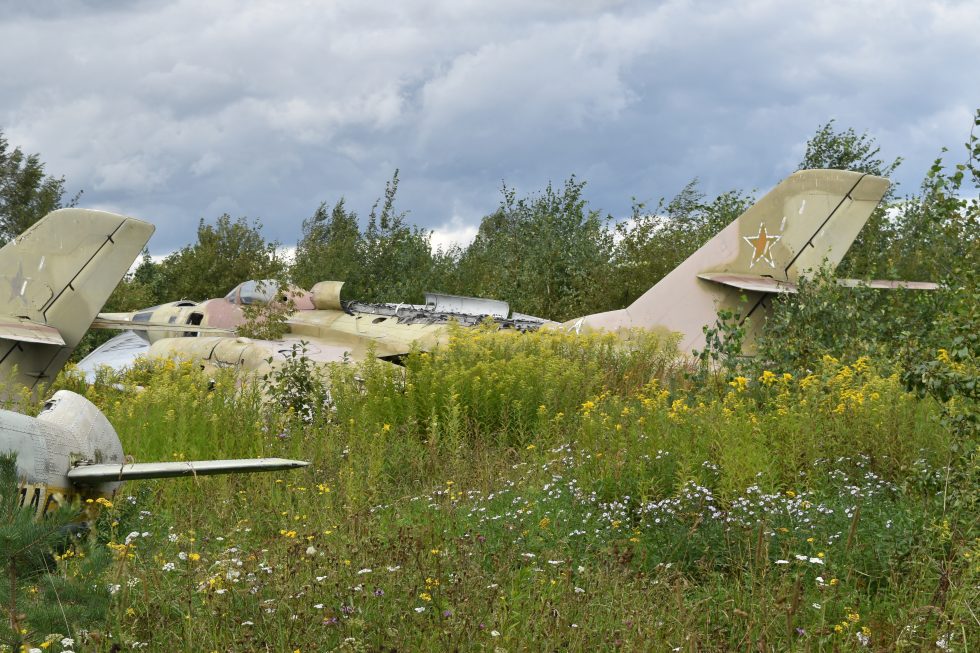
The Yak-28 in motion
A verified, high-authority video feature for the Yak-28 is still being sourced — video coming soon. In the meantime, explore the gallery and stories above for how this five-role Soviet jet looked and worked.
Where the Yak-28 flew
The record of a workhorse, not a duellist
The Yak-28 is not remembered for air-to-air kills — that was never really its story. Its record is one of breadth: a single airframe that carried bombs, cameras, jammers and missiles for the Soviet armed forces across three decades, and one famous crash that made it a fixture of Cold War history.
Compare the combat record of every military aircraft. Figures are approximate and drawn from open sources.
Everything people ask about the Yak-28
Can I fly in a Yak-28?
Is the Yak-28 still in service?
Who operated the Yak-28?
How fast was the Yak-28?
What do “Brewer,” “Firebar” and “Maestro” mean?
Why is the Yak-28 famous in Cold War history?
What made its landing gear unusual?
How many Yak-28s were built?
You can’t fly the Yak-28.
These, you can.
Some legends only live in museums — others are fuelled and waiting. MiGFlug has put civilians in real military jet cockpits since 2004.
 Fly the L-39 AlbatrosThe world’s most-flown jet trainer — aerobatics included
 Fly the F-104 Starfighter“The missile with a man in it”
 Fly the MiG-21The Cold War’s most-produced jet
 Fly the T-33 Shooting StarAmerica’s first jet trainer
 Fly the DH VampireA piece of early jet history
 Fly the S.211Agile Italian jet trainer
 Fly the MB-326The classic Aermacchi jet
 Fly the MiG-15The Soviet legend of the Korean War
Continue the tour
Every fact, checked
- Military Intelligence Museum — “1966: The Firebar Incident”Authoritative account of the Berlin crash and the British/US recovery and examination.
- Vulcan to the Sky Trust — “Red Steer: The Firebar Affair”Narrative of the crash, the crew and the radar recovered from the lake.
- Western Allies Berlin — “Jak-28 Crash”Local Berlin account of the origin airfield, handover dates and BRIXMIS role.
- Military Factory — Yakovlev Yak-28Variant table, NATO names, production totals and Yak-28P performance figures.
- Global Military — Yak-28 Brewer/FirebarSpecification table (weights, thrust, wing area) and operator-status reference.
- Fly a Jet Fighter — Yakovlev Yak-28First-flight, service and retirement dates plus a variant and NATO-name summary.
- Aviation Safety Network — accident record 180558Database entry for the 6 April 1966 Berlin crash.
- Cold War Decoded — “A Brilliant Deception”Crew names, the engine-flameout account and the recovery-and-deception detail.