
Tupolev Tu-160
“Blackjack”
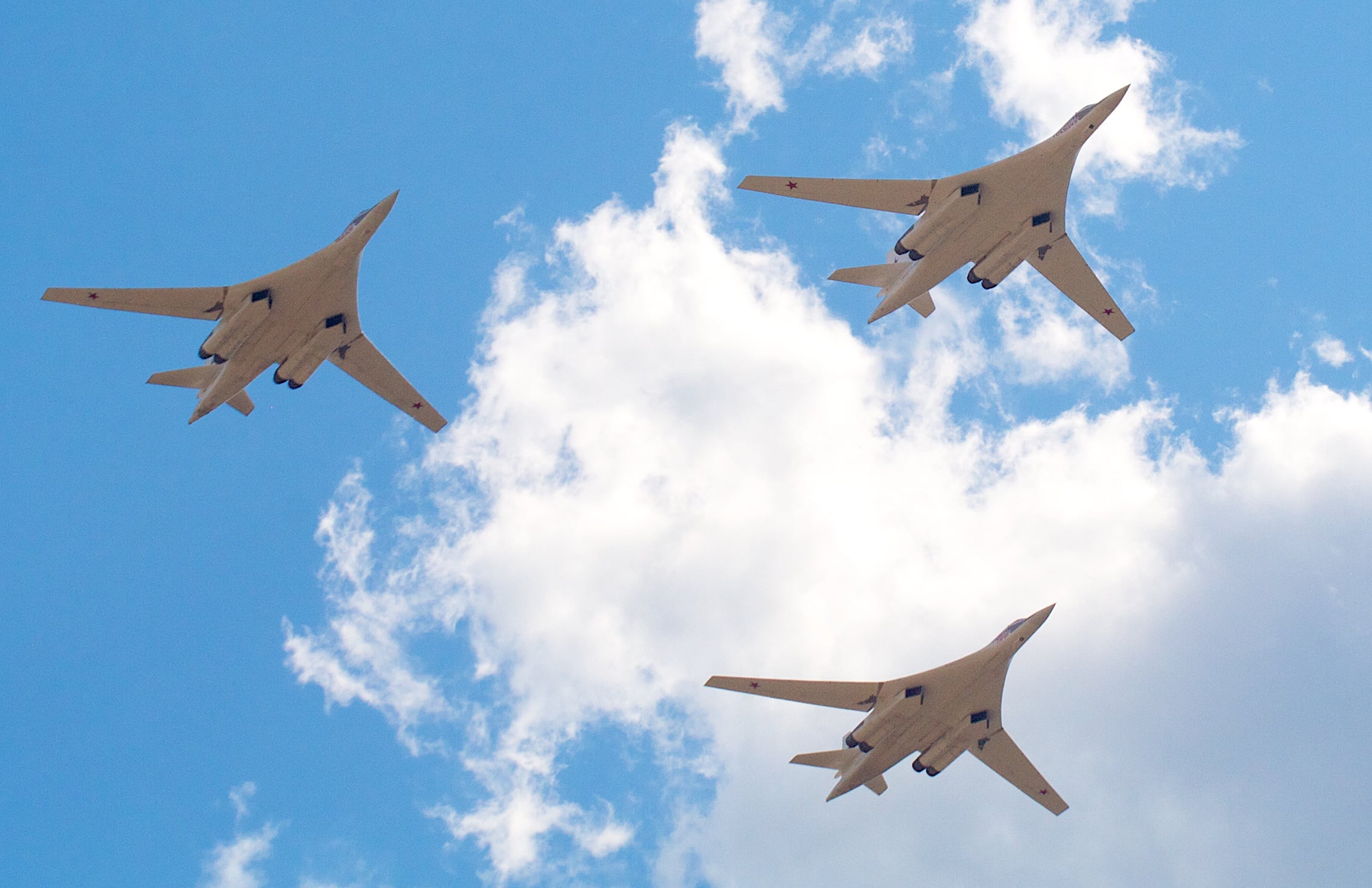
The largest and heaviest combat aircraft ever built — a variable-sweep supersonic strategic bomber the Soviets fielded as their answer to the American B-1, and, in white anti-flash paint, the jet Russian crews call the “White Swan.”
The Soviet answer to the B-1
In the 1970s, as the United States developed the Rockwell B-1 low-level penetration bomber and the abortive B-70, Soviet planners wanted a strategic aircraft that could match it: a machine able to carry a heavy nuclear payload across intercontinental distances, dash through defences at supersonic speed, and launch stand-off missiles from far outside an enemy’s borders. The Tupolev design bureau won the competition, and the result — first flown on 18 December 1981 and in service from 1987 — became the Tu-160, known to NATO as “Blackjack.”
The Tu-160 is a giant. At roughly 54 metres long, with a wingspan of about 55.7 metres fully spread, and a maximum takeoff weight near 275 tonnes, it is the largest and heaviest combat aircraft ever built and the heaviest supersonic aircraft ever to fly. Its blended, area-ruled fuselage and gleaming white anti-flash finish earned it an affectionate Russian nickname: “Bely Lebed,” the White Swan. To Western eyes it looked like a larger cousin of the B-1, though the two designs were developed independently.
Superficial resemblance aside, the Tu-160 was built around a different idea. Where the B-1B was optimised for low-level penetration, the Tu-160 kept the variable-geometry “swing wing” and the enormous afterburning turbofans needed for a genuine supersonic dash to around Mach 2, then leaned into the role of a stand-off missile carrier — a launch platform for long-range cruise missiles rather than a jet meant to fly over its targets. Only about 35 were completed before the Soviet collapse; today Russia operates a small fleet, has modernised survivors to Tu-160M standard, and — controversially and at great cost — restarted production of essentially new-build aircraft in the 2020s.
01The Tu-160 Blackjack and the B-1: two swing-wing bombers, built apart
The Tu-160 and the American B-1 look strikingly alike — both are large, blended, variable-sweep bombers — and the resemblance has fed decades of “copy” claims in both directions. In reality the two programmes ran in parallel and converged on similar answers because they faced similar physics: a swing wing lets a heavy bomber take off from moderate runways with wings spread, then sweep them back for low drag at high speed. The Tu-160 is substantially larger and heavier than the B-1, is designed for a higher supersonic dash speed (about Mach 2 versus the B-1B’s roughly Mach 1.2), and emphasises stand-off missiles rather than the B-1B’s low-altitude penetration. Treat the “which copied which” stories with caution: independent development toward a shared requirement is the better-supported explanation.
What makes it special
A variable-geometry wing and a Mach 2 dash
The Tu-160’s outer wing panels pivot from about 20° spread to 65° swept. Spread, the long wing gives the efficiency and lift a 275-tonne aircraft needs to get airborne and to cruise economically over intercontinental distances; swept fully back, drag falls away and the bomber can dash to roughly Mach 2.05. That makes it the fastest bomber in operational service — a genuinely supersonic strategic aircraft, not just a fast subsonic one.
Four NK-32s — the most powerful engines on any combat jet
Power comes from four Kuznetsov NK-32 afterburning turbofans, each rated around 245 kN (about 55,000 lbf) in reheat. They are commonly described as the most powerful engines ever fitted to a combat aircraft. That thrust, fed from a fuel load of well over 100 tonnes, gives the Tu-160 an unrefuelled range commonly cited at about 12,300 km — and far more with aerial refuelling.
A stand-off cruise-missile arsenal
The Tu-160 is fundamentally a missile truck. Two internal weapons bays hold rotary launchers carrying up to 12 long-range cruise missiles — the nuclear-capable Kh-55 family and, more recently, the conventional Kh-101/Kh-555 — letting it strike targets from more than a thousand kilometres away without entering defended airspace. Its up-to-40-tonne payload can also be filled with free-fall bombs.
02The Tu-160 Blackjack’s NK-32 engines: the most powerful ever on a combat aircraft
Each of the Tu-160’s four Kuznetsov NK-32 turbofans produces on the order of 245 kN of thrust with afterburner — roughly 137 tonnes of thrust from the quartet. Aviation writers routinely call them the most powerful engines ever installed on a combat aircraft, and the figure is credible: no other bomber or fighter has fielded anything comparable. The modernised Tu-160M flies with an upgraded variant, the NK-32-02, which Russian sources say improves fuel efficiency and adds around 1,000 km of range. As with much Russian defence data, exact performance figures should be read as manufacturer or ministry claims rather than independently verified numbers.
03The Tu-160 Blackjack’s modernisation: the Tu-160M and a restarted production line
With only about 35 airframes ever built and a fleet worn by decades of service, Russia launched a two-track programme: upgrade existing aircraft to Tu-160M standard with new avionics, radar and weapons, and — the more remarkable step — restart series production at Kazan after some 30 years. A first newly assembled Tu-160M reportedly made its maiden flight in January 2022, and Russia has spoken of building dozens more, though independent analysts have long questioned whether the ambitious numbers and timelines are realistic given cost and industrial constraints. Treat announced production totals as goals, not deliveries.
Full specifications
Baseline note: the figures below describe the Tu-160 as the 121st Guards Heavy Bomber Aviation Regiment has flown it from Engels-2 — the production aeroplane of 1984–1992 with four Kuznetsov NK-32 turbofans, the Obzor-K attack radar and two MKU-6-5U rotary launchers in tandem weapons bays. That is the aircraft nearly every published table describes, and the one the superlatives below belong to. Deltas for the Tu-160M (existing airframes rebuilt with NK-32 series 02 engines and new avionics) and the Tu-160M2 (new-build aircraft from the restarted Kazan line) are given in grey. Four cautions apply before a single number is quoted. First, the superlatives are real but need care: at a maximum take-off weight of 275,000 kg the Tu-160 is the heaviest combat aircraft ever built and the heaviest supersonic aircraft of any kind ever flown — the North American XB-70 Valkyrie, its only serious rival, grossed about 246,000 kg and never entered service. It is also the longest combat aircraft ever built at 54.10 m. It is not the widest: with the wings fully spread it spans 55.70 m against the B-52H’s 56.39 m, so the old Boeing keeps that one record by about 700 mm. Second, Russian and Western sources disagree on wing area, fuel load and ceiling by margins far too large to average, and the disagreements are flagged row by row rather than smoothed over. Third, almost every performance figure in circulation traces to Soviet-era manufacturer data that has never been independently verified; treat the range and radius rows as claims, not measurements. Fourth, no Tu-160M has been shown publicly with its full new-standard equipment fit, so the grey deltas describe what has been announced and photographed, not what has been demonstrated. Figures current to September 2026.
Dimensions & weights
- Crew
- 4 — pilot and co-pilot side by side, with the navigator/bombardier and the defensive systems and communications officer behind them, all four in one pressurised compartment on K-36DM zero-zero ejection seats. There is no separate flight deck and no relief crew station; the four men entering through the nose undercarriage bay are the whole complement for a flight that may run past twenty-four hours
- Length
- 54.10 m (177 ft 6 in) — longer than any other combat aircraft ever flown, and 5.6 m longer than a B-52H. The Rockwell B-1B, which the Tu-160 superficially resembles, is 44.5 m
- Wingspan, wings spread (20°)
- 55.70 m (182 ft 9 in) — the take-off, landing and long-range cruise setting
- Wingspan, wings swept (65°)
- 35.60 m (116 ft 10 in) — the supersonic dash setting. An intermediate 35° detent is used for high-subsonic cruise, and the outer panels carry full-span leading-edge slats and double-slotted trailing-edge flaps that work in the spread position only
- Height
- 13.10 m (43 ft 0 in) to the top of the fin
- Wing area
- 360 m² (3,875 sq ft) with the wings swept, rising to roughly 400 m² at minimum sweep. A figure of 232 m² appears in several Russian tables and is almost certainly the exposed movable panels alone rather than the gross area including the fixed glove and carry-through; the two are not interchangeable and any wing loading derived from them differs by a factor of more than 1.5
- Empty weight
- 110,000 kg (242,500 lb) — roughly the empty weight of two fully loaded Tu-22M3s
- Normal take-off weight
- 267,600 kg (589,950 lb)
- Maximum take-off weight
- 275,000 kg (606,300 lb) — the number that carries the record. A B-52H grosses about 221,350 kg, a B-1B 216,400 kg and an XB-70 about 246,000 kg
- Maximum landing weight
- 155,000 kg (341,700 lb) — barely more than half the take-off figure, which is why a mission aborted early means dumping or burning off fuel rather than turning straight back
- Internal fuel
- ~148,000 kg (~326,300 lb) in thirteen tanks, roughly 171,000 litres. English-language tables commonly print 130,000 kg instead; the lower figure appears to be a normal rather than a maximum load. Fuel is pumped fore and aft between tanks to trim the aircraft as the centre of lift moves with wing sweep
- Maximum weapon load
- ~45,000 kg (~99,200 lb) across two tandem bays, ~22,500 kg per bay; 40,000 kg is the figure quoted in Russian sources and is probably the normal rather than the overload case. Nothing is carried externally — there are no wing or fuselage pylons at all
- Wing loading
- 764 kg/m² (156 lb/sq ft) at maximum weight with the wings swept — high, and the reason the spread-wing setting and the full-span slats matter so much on take-off
Performance
- Maximum speed at altitude
- 2,220 km/h (1,380 mph; 1,200 kn) at 12,200 m (40,000 ft), Mach 2.05. This makes the Tu-160 the fastest bomber in service anywhere, and the fastest aircraft of its weight class ever flown. In practice the speed is a wartime dash figure: the fleet is flown subsonically almost all of the time because supersonic cruise burns fuel at a rate that destroys the range on which the mission depends
- Maximum speed at sea level
- 1,030 km/h (640 mph), Mach 0.84 — the Tu-160 was never intended as a low-level penetrator in the B-1B mould, and its terrain-following capability is used for approach rather than for a whole sortie
- Cruising speed
- 850–960 km/h (528–597 mph), Mach 0.7–0.9. Sources split between the two ends; the lower figure is a maximum-endurance number and the higher one a long-range cruise number
- Practical range, unrefuelled
- 12,300 km (7,640 mi; 6,640 nmi) at cruise with a normal weapon load. Russian tables print 13,950 km, evidently for a lighter aircraft
- Combat radius, subsonic
- 7,300 km (4,540 mi; 3,940 nmi) — and with a Kh-101 adding 3,500 km of standoff on top of that, the combination is what makes the aircraft genuinely intercontinental without leaving Russian airspace
- Combat radius, supersonic
- 2,000 km (1,240 mi) at Mach 1.5 — a fifth of the subsonic figure, which is the whole argument against using the speed
- Endurance, unrefuelled
- ~15 h — the reason for the rest bunk, the lavatory and the food-warming cupboard in the crew compartment
- Longest recorded flight
- 25 h 25 min — two aircraft, 19–20 September 2020, Engels to Engels over the Arctic and North Pacific, more than 20,000 km (12,400 mi) with three air-to-air refuellings from six Il-78 tankers. It beat the type’s own 2010 mark of 24 h 24 min and roughly 18,000 km. Russia claims both as world records for range and duration in class; they have not been ratified by the FAI
- Service ceiling
- 16,000 m (52,500 ft). Russian sources routinely print 22,000 m, which is a dynamic-zoom figure rather than a sustained one and should not be quoted as a cruise altitude
- Rate of climb
- 70 m/s (13,800 ft/min) at low weight in afterburner
- Take-off run
- 2,200 m (7,220 ft) at maximum weight. A figure of 900 m circulates in Russian tables and cannot be right for a 275-tonne aeroplane; it is plausible only for a light aircraft, and the Tu-160’s basing has always assumed a long, heavy-duty runway
- Landing run
- 1,600 m (5,250 ft) at normal landing weight with braking parachutes streamed
- Thrust-to-weight ratio
- 0.37 at maximum take-off weight in full afterburner — unremarkable for a fighter, extraordinary for something this heavy
Propulsion & systems
- Engines
- 4 × Kuznetsov NK-32 afterburning turbofan (factory designation izdeliye NK-321; sources also print "Samara NK-321" after the Kuznetsov design bureau’s home city). Three-shaft, bypass ratio about 1.4, mounted in pairs in nacelles under the wing glove. Tu-160M/M2: NK-32 series 02, with a restored production line at Kuznetsov in Samara, a new compressor and hot section, and a claimed fuel-burn reduction of some 10 per cent worth roughly 1,000 km of range. Five aircraft were reported re-engined by August 2022 and the fit has not been independently verified since
- Thrust, dry
- 137.3 kN (30,870 lbf) each
- Thrust, afterburning
- 245 kN (55,100 lbf) each — the most powerful engine ever fitted to a combat aircraft, by a wide margin. A Eurojet EJ200 in an Eurofighter Typhoon manages 90 kN
- Total installed thrust
- 980 kN (220,300 lbf) in afterburner, 549 kN dry
- Wing sweep
- 20° / 35° / 65° — hydraulically driven pivots outboard of a wide fixed glove that blends into the fuselage. The Tu-160 is the largest and heaviest variable-geometry aircraft ever built; the mechanism is what allows one airframe to take off at 275 tonnes on a short-ish runway, cruise economically for fifteen hours and still reach Mach 2
- Flight controls
- Quadruplex fly-by-wire with mechanical reversion, and a fighter-type centre control stick rather than the yoke or wheel usual on aircraft this size. The throttles sit on the console between the pilots
- Attack radar
- Leninets Obzor-K (NATO Clam Pipe) in the nose radome, with a separate Sopka terrain-following radar and an OPB-15T television bomb sight in a fairing under the nose for free-fall weapons. Tu-160M: the Obzor is replaced by a Novella-series set with new displays, an NV-70 navigation suite and a glass cockpit; published detail is thin and mostly comes from manufacturer statements
- Defensive suite
- Baikal integrated complex — radar warning receivers, active jammers and chaff and flare dispensers in the tail cone, which also houses a rearward-looking warning radar. There are no guns and no defensive missiles; survivability rests entirely on standoff range, electronic warfare and not being seen
- Auxiliary power
- TA-12 APU — gives the aircraft autonomous engine starting and ground power, so it can be turned round at a dispersal field without a ground cart
- In-flight refuelling
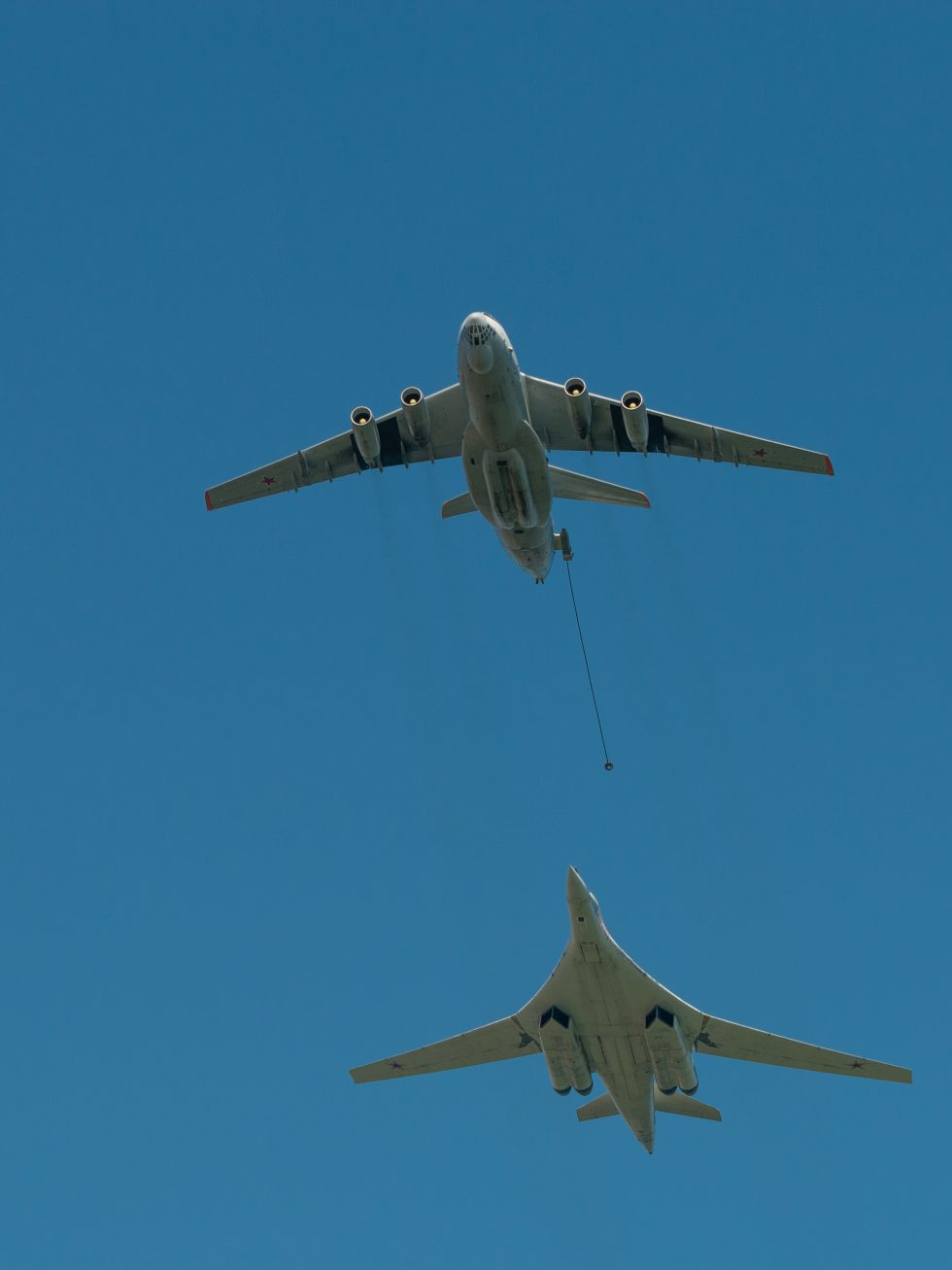
- Retractable probe-and-drogue probe housed behind the radome ahead of the cockpit, normally faired over. Tanking is from Il-78 and Il-78M aircraft; the probe is what turns a 12,300 km range into the 20,000 km demonstrated in 2020
- Crew accommodation
- Rest bunk, lavatory and a heating cupboard for food — the clearest evidence in the airframe of what the aircraft was designed to do. Almost no other combat aircraft has ever carried a galley and a toilet, and they are there because a mission from Engels to a launch box over the Norwegian Sea and back is a working day, not a sortie. Entry is by a ladder through the nose undercarriage bay
- Finish
- Anti-flash white — a nuclear-blast reflective coating, and the origin of the Russian crews’ name for the aircraft, Belyi Lebed, "White Swan". Individual aircraft are named after people rather than numbered alone: Ilya Muromets, Aleksandr Molodchiy, Valentin Bliznyuk after the type’s chief designer, Petr Deinekin after the first commander of the Russian Air Force
04The Tu-160 Blackjack’s cost: why no reliable price exists
The Tu-160 has never been sold on an open market, so no firm flyaway unit price exists in the public record. Russian officials have quoted figures for the restarted Tu-160M programme in the range of roughly 15–16 billion roubles per aircraft in mid-2010s terms — very loosely a few hundred million US dollars once development is spread across a small run — but these are state figures for a subsidised programme, not a market price, and should be treated as order-of-magnitude only. No credible cost-per-flight-hour number exists for the type in open sources. Any precise dollar figure attached to a Tu-160 is, in practice, an estimate.
Armament & payload
The Tu-160 carries nothing on the outside and everything on two rotary drums inside
Every weapon a Tu-160 has ever carried operationally has come out of one of two tandem internal bays, each holding a single MKU-6-5U rotary launcher with six stations. Twelve cruise missiles is the whole armoury, and it has been the whole armoury since 1987. There are no wing pylons, no fuselage stations and no gun — the Tu-160 was the first Soviet bomber since the Second World War designed with no defensive armament at all, on the reasoning that a tail turret is dead weight against an aircraft firing from 3,000 km away.
The doctrine changed underneath the aeroplane. It was built as a nuclear standoff platform for the Kh-55SM, and for two decades that is all it was. The Kh-101 turned it into a conventional precision weapon, and since 2015 — Syria first, then Ukraine from 2022 — it has been used almost exclusively that way. The airframe did not need to change for this; only the missile did. Weapon fits differ sharply between the original Tu-160, the Tu-160M rebuilds and the new-build Tu-160M2, and Russian statements about what the modernised aircraft can carry considerably outrun what has been seen on one.
The combat record is short and entirely one-sided. The Tu-160 first fired in anger on 17 November 2015, when Tu-160s and Tu-95MSs launched Kh-101s and Kh-555s from over the Mediterranean and the Caspian at targets in Idlib and Aleppo provinces in Syria — the Kh-101’s combat debut, with between 34 and 83 missiles fired across the whole package. Since 24 February 2022 the aircraft has been used steadily against Ukraine, firing Kh-101s from Russian and Caspian airspace as part of mixed cruise-missile packages: eight missiles on 6 March 2022, a strike on Kyiv on 26 June 2022, and a long series since, including the salvo of 8 July 2024 in which a Kh-101 struck the Okhmatdyt children’s hospital in Kyiv. In every case the bomber launched hundreds or thousands of kilometres from the target and returned home unopposed. That is precisely the mission it was designed for, and it is worth being clear about what it demonstrates and what it does not: the Tu-160 has never been tested against an opponent able to reach it.
Gun
- None. The Tu-160 carries no gun of any kind, the first Soviet bomber since 1945 built that way.
- By contrast the Tu-95MS it flies alongside kept a twin GSh-23 tail barbette, and the Tu-22M3 a single GSh-23L.
- The rear fuselage cone that would have housed a turret holds the Baikal defensive suite’s jammers, dispensers and warning radar instead.
- The trade was deliberate: at standoff ranges of thousands of kilometres a tail gun defends against nothing the aircraft is likely to meet.
Air-to-air
- None carried. The Tu-160 has never had an air-to-air capability of any sort in service.
- The Tu-160P (also designated Tu-161) was a 1980s proposal for a long-range escort interceptor carrying R-33 or R-37 missiles to shepherd bomber streams over the Arctic. It was never built.
- Self-defence is entirely passive: standoff launch range, the Baikal jammers, chaff and flares, and fighter escort when one is available.
- This is the aircraft’s clearest vulnerability. A Tu-160 intercepted before its launch point has no answer at all.
Air-to-surface guided
- Kh-55SM (NATO AS-15 Kent-B) — the original armament. Subsonic turbofan cruise missile, 3,000 km range, 200 kT nuclear warhead, terrain-contour matching guidance. Twelve carried, six per drum.
- Kh-555 (AS-22 Kluge) — conventionally armed Kh-55 conversion with an improved guidance set and a reduced range of roughly 2,000 km. Used over Syria in 2015–2016.
- Kh-101 — the current conventional weapon. 7.45 m long, about 2,400 kg, roughly 3,500 km range, radar-cross-section-reduced airframe, INS with GLONASS update and optical terminal correction, 400 kg warhead. An 800 kg twin-warhead version appeared in 2024 at the cost of fuel and range. Twelve carried.
- Kh-102 — the nuclear Kh-101, reportedly with a warhead of around 250 kT. Never used in combat.
- Kh-15 and Kh-15S (AS-16 Kickback) — short-range Mach 5 ballistic-trajectory missiles of about 300 km range, twenty-four carried on MKU-6-1 drums. A defence-suppression weapon of the 1980s, long since withdrawn from routine use.
Bombs
- Both bays are plumbed and wired for free-fall stores up to roughly 22,500 kg each, with a stated maximum of about 40,000–45,000 kg.
- Conventional FAB-series high-explosive bombs from 500 kg to 1,500 kg, cluster munitions and naval mines are all listed in the manuals.
- Free-fall nuclear bombs were part of the original clearance but are not associated with the aircraft’s current role.
- In practice the Tu-160 has never dropped free-fall bombs in anger. The Syrian free-fall campaign was flown by Tu-22M3s and Tu-95MSs; the Tu-160s fired missiles. Removing the rotary launchers to fit bomb racks costs days of work and throws away the aircraft’s only real advantage.
Rockets
- None. No unguided rocket pod has ever been carried or cleared.
- There is nowhere to hang one: the aircraft has no external stores stations, and a rocket pod cannot be fired from inside a weapons bay.
- The nearest equivalent in the inventory is the Kh-15, a rocket-powered missile fired from the rotary drum — guided, not a barrage weapon.
- The card is kept for consistency across this encyclopedia; it is genuinely empty for this type.
Pods & other stores
- No external pods of any kind. Targeting, navigation and electronic warfare are all internal, which is one reason the aircraft is as fast and as long-legged as it is.
- The Baikal defensive complex, the OPB-15T television bomb sight fairing and the Sopka terrain-following radar are permanent fit, not stores.
- Kh-BD — an extended-range development of the Kh-101 shown publicly in 2019 with a claimed range beyond 6,500 km. Russian sources describe it as Tu-160 armament; operational carriage is not independently confirmed. Treat as announced rather than fielded.
- The Tu-160SK proposal of 1994 would have carried the Burlak air-launched satellite booster semi-recessed under the fuselage. It was offered commercially, attracted no customer and was never flown.
Three typical loadouts
- Strategic nuclear alert, the design case
- 12 × Kh-55SM, six on each MKU-6-5U rotary launcher, each with a 200 kT warhead and 3,000 km of range; full internal fuel of about 148 tonnes; wings at 20° for take-off and 35° for the cruise. Launch from a box over the Barents or Norwegian Sea without entering NATO airspace. On the modernised fleet the same drums hold 12 × Kh-102. This is the load the aircraft exists for and the one it has never fired.
- Conventional standoff strike, Ukraine 2022 onwards
- 8–12 × Kh-101 with 400 kg conventional warheads, launched from over the Caspian Sea, the Volga region or Russian airspace north of Ukraine at ranges of 1,000–2,000 km from the target. Sorties are flown as mixed packages with Tu-95MSs, timed so that many missiles arrive together to saturate the defences. The bomber never approaches the front and is not itself at risk; the missiles are the thing that gets shot at.
- Defence suppression, the Cold War penetration profile
- 24 × Kh-15 on two MKU-6-1 drums, twelve per bay — a Mach 5 ballistic-trajectory weapon of about 300 km range meant to be fired in salvo at radars and surface-to-air missile batteries to open a corridor. It is the load that best explains the Mach 2 dash capability and the terrain-following radar, and it is also the load that Soviet planning quietly abandoned once standoff cruise missiles made corridor-cutting unnecessary.
Sourcing caveat: weapon-load figures for the Tu-160 come almost entirely from Russian manufacturer and ministry statements, which are not audited. Missile ranges in particular should be read as design or advertised figures — the 3,500 km often quoted for the Kh-101 is a maximum under ideal conditions, and operational launch ranges observed against Ukraine have been far shorter. Carriage of the Kh-BD and the exact weapon fit of the Tu-160M have not been independently corroborated.
Variants
Thirty-five airframes, one basic design, and a production line switched back on after twenty-five years
The Tu-160 has almost no variant history in the ordinary sense. Production ran at Kazan from 1984 to 1992 and stopped after 35 aircraft — against an original plan for a hundred — leaving one configuration and a long list of paper proposals. Everything genuinely different about the type happened after 2015, when Sergei Shoigu ordered the line restarted and the programme split into rebuilding old airframes and building new ones to the same external shape.
The other half of the story is Ukrainian. When the Soviet Union dissolved, 19 of the 35 aircraft — the best and newest of them — were at Pryluky in Ukraine, and only 13 in Russia. Ukraine could not maintain them, could not use them and had no reason to want them, but held them as leverage. Scrapping began in April 1998 under the American-funded Nunn–Lugar programme. Then on 8 September 1999 an intergovernmental agreement was signed at Yalta: eight Tu-160s, three Tu-95MSs, 575 Kh-55SM cruise missiles and the associated ground equipment, valued at $285 million, set against Ukraine’s natural gas debt to Russia. The first aircraft left Pryluky on 5 November 1999 and the transfer was complete by mid-February 2000. The remaining eleven Tu-160s were cut up. It is one of the strangest transactions of the post-Soviet era: a country paid its heating bill in supersonic strategic bombers, and the aircraft it handed over are among those firing cruise missiles at it today.
- Tu-160, izdeliye 70 (1981–1992 / 35 built, of which 8 prototype and development airframes)
- The production aircraft: NK-32 engines, Obzor-K radar, two MKU-6-5U rotary launchers, Kh-55SM armament. First flight 18 December 1981, first delivery to the 184th Guards Heavy Bomber Regiment at Pryluky in April 1987. Some sources count 36 by including an incomplete airframe.
- Tu-160S (from 1987)
- Designation used for the serial-standard aircraft as distinct from the development machines; not a separate configuration, and rarely used outside Tupolev documents.
- Tu-160M1 (2006–2008 / 2 aircraft)
- A modest first refurbishment. Valentin Bliznyuk entered service on 5 July 2006 and Vitaly Kopylov on 29 April 2008, both completed from stored components rather than newly built, taking the Russian fleet from 14 back to 16. Confusingly, some sources use Tu-160M1 for an interim update standard applied more widely.
- Tu-160M (2014 onwards / conversions of existing airframes)
- Existing aircraft rebuilt with NK-32 series 02 engines, a Novella-series radar, new navigation, communications and defensive systems, glass-cockpit displays and clearance for Kh-101 and Kh-102. The first delivery was in December 2014; Ilya Muromets and Aleksandr Molodchiy were shown in rebuilt form at Kazan in February 2024.
- Tu-160M2 (2017 onwards / new-build)
- Newly manufactured aircraft to the Tu-160M standard, reportedly around 80 per cent new or modernised equipment inside an unchanged airframe. Petr Deinekin, rolled out on 16 November 2017, was assembled largely from a stored 1990s hull; the first genuinely new aircraft flew on 12 January 2022. A January 2018 contract covers ten aircraft. The distinction between Tu-160M and Tu-160M2 is applied inconsistently in Russian sources and is increasingly ignored in favour of Tu-160M for everything.
- Tu-160P / Tu-161 (1980s proposal / none built)
- Long-range escort interceptor to carry R-33 or R-37 air-to-air missiles and protect bomber formations over the Arctic. Never left the drawing board.
- Tu-160PP (1980s proposal / none built)
- Dedicated electronic warfare and stand-off jamming variant. A mock-up was built; nothing more.
- Tu-160R (1980s proposal / none built)
- Strategic reconnaissance conversion with the weapons bays given over to sensors.
- Tu-160SK (1994 proposal / none built)
- Commercial satellite launcher carrying the Burlak air-launched booster semi-recessed under the fuselage, offered on the international market after the Cold War. No customer appeared.
- Tu-160V and Tu-160NK-74 (studies / none built)
- Liquid-hydrogen-fuelled and alternative-engine research proposals from the late Soviet period, of a piece with the Tu-155 cryogenic testbed. Neither progressed beyond study.
Closing note, and why there is no operators chart on this page: Russia is the only operator the Tu-160 has ever had apart from Ukraine’s brief and unwilling custody in the 1990s, so a fleet chart would be a single bar and is omitted. The numbers instead: the Federation of American Scientists put the active inventory at about 15 Tu-160 and Tu-160M in May 2026; other counts through 2025 ran to 16–18 including aircraft in deep overhaul, and estimates diverge chiefly over whether airframes at Kazan for modernisation are counted as fleet strength. All are with the 121st Guards Heavy Bomber Aviation Regiment at Engels-2, Saratov Oblast, though the fleet has been dispersed across additional airfields since 2025. Production: the restarted Kazan line has delivered very little against its promises — the 2015 talk of at least 50 aircraft became a firm order for ten in 2018, four aircraft were handed over on 21 February 2024, and Defence Minister Belousov announced two more on 26 December 2025 without saying whether they were new-build or rebuilt. Losses: one aircraft, Mikhail Gromov, was destroyed near Stepnoye in Saratov Oblast on 18 September 2003 during a post-engine-change test flight, killing all four crew. On the June 2025 drone attacks, the record needs correcting: Operation Spiderweb on 1 June 2025 struck five bases — Belaya, Olenya, Dyagilevo, Ivanovo Severny and Ukrainka — and Engels-2, the only Tu-160 base, was not among them. Ukraine claimed 41 aircraft hit; satellite and radar imagery analysed by Jane’s, Maxar and open-source researchers corroborates roughly a dozen, all of them Tu-95MS, Tu-22M3, An-12 and possibly A-50 airframes. No Tu-160 loss has been independently confirmed, and the consensus among analysts is that the Tu-160 fleet came through intact. Reports that several Tu-160s were destroyed or damaged in that raid are claims, not corroborated fact.
From Cold-War giant to modern missile carrier
Requirement set
As the US develops the B-1, Soviet planners call for a supersonic, variable-sweep strategic bomber. Tupolev wins the competition.
First flight
The prototype makes its maiden flight on 18 December 1981 from the Ramenskoye test field near Moscow.
Enters service
The Tu-160 joins Soviet Long-Range Aviation as a nuclear-armed cruise-missile carrier.
Record flights
Crews set dozens of recognised speed-and-payload records in the type’s weight class.
The Soviet collapse
Newly independent Ukraine inherits 19 Tu-160s at Priluki; production at Kazan winds down with about 35 built.
Ukraine gives them up
Eight Ukrainian Tu-160s are transferred to Russia in a debt settlement; the rest are scrapped under a US-funded programme, one kept as a museum piece.
First combat use
Tu-160s launch Kh-101 cruise missiles at targets in Syria — the type’s combat debut, nearly 30 years after entering service.
Ukraine war & new production
Russia uses Tu-160s to launch stand-off missiles in its war on Ukraine; a first new-build Tu-160M flies (2022); Ukrainian drones strike bomber bases deep inside Russia.
Twelve stories of the White Swan
The answer to the B-1
The American B-1 bomber programme drove the Soviet requirement that became the Tu-160.
Read the full story
Why they call it the White Swan
Its clean lines and white anti-flash paint gave the Tu-160 its affectionate Russian name.
Read the full story
The biggest combat aircraft ever
At roughly 275 tonnes fully loaded, nothing heavier has ever flown into combat.
Read the full story
The swing wing
Variable-geometry wings let a 275-tonne jet both cruise efficiently and dash at Mach 2.
Read the full story
The most powerful engines on any combat jet
Four NK-32 turbofans give the Tu-160 thrust unmatched by any other combat aircraft.
Read the full story
Dozens of world records
In its weight class the Tu-160 set a long list of recognised speed-and-payload marks.
Read the full story
Stranded in Ukraine
The Soviet collapse left 19 of the newest Tu-160s in newly independent Ukraine.
Read the full story
The debt-for-bombers deal
Eight Tu-160s went back to Russia to settle a gas debt; most of the rest were scrapped.
Read the full story
A late combat debut
The Tu-160 first fired in anger in Syria, almost 30 years after entering service.
Read the full story
A stand-off role
Since 2022 Russia has used Tu-160s to launch cruise missiles into Ukraine from long range.
Read the full story
Drones reach the bomber bases
Ukrainian drone raids have struck the airfields where Tu-160s are parked.
Read the full story
New swans off the line
Russia has restarted Tu-160 production and upgraded survivors to Tu-160M standard.
Read the full story
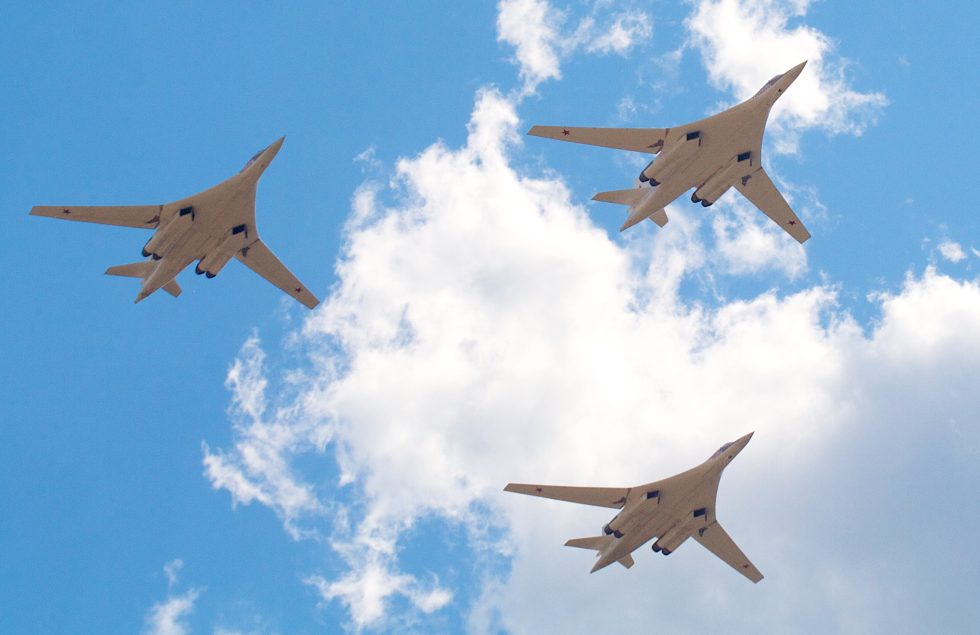
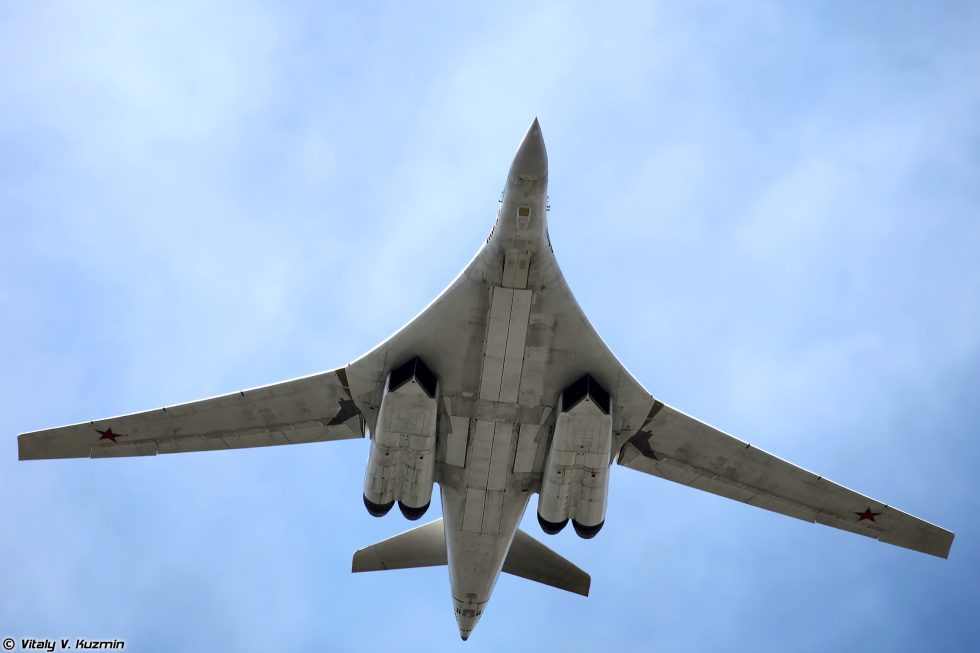
The White Swan in pictures
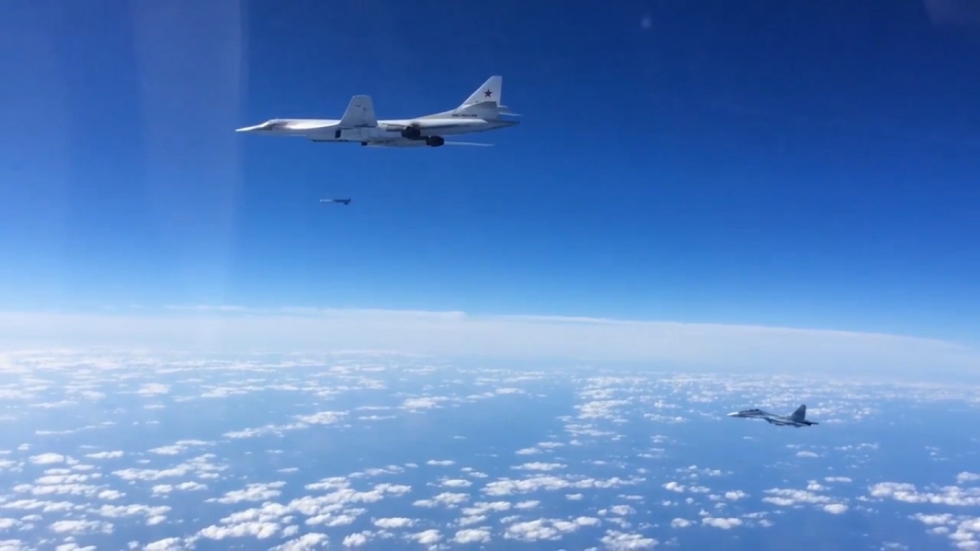
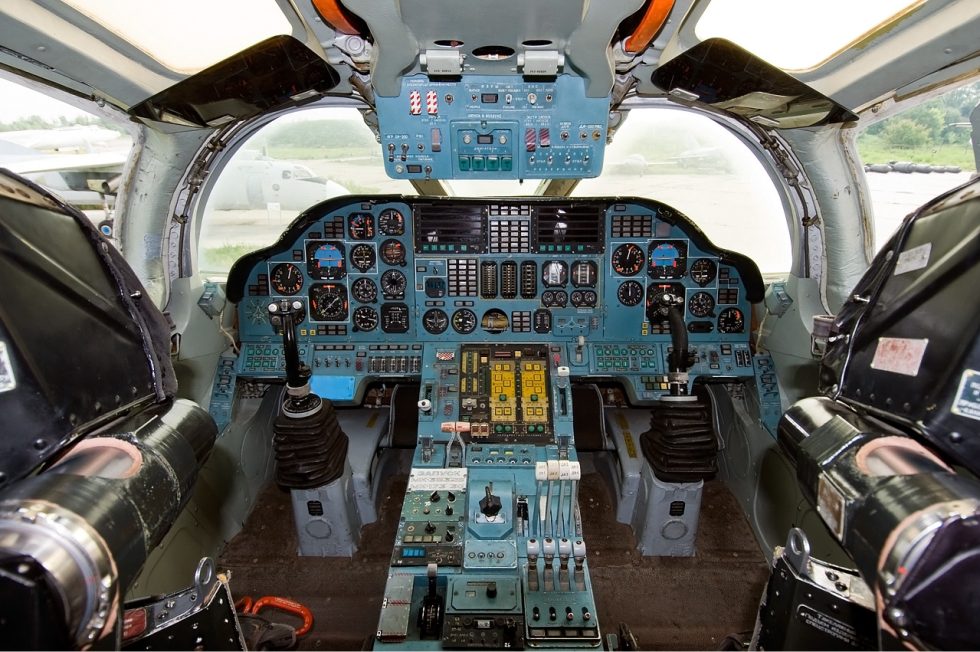
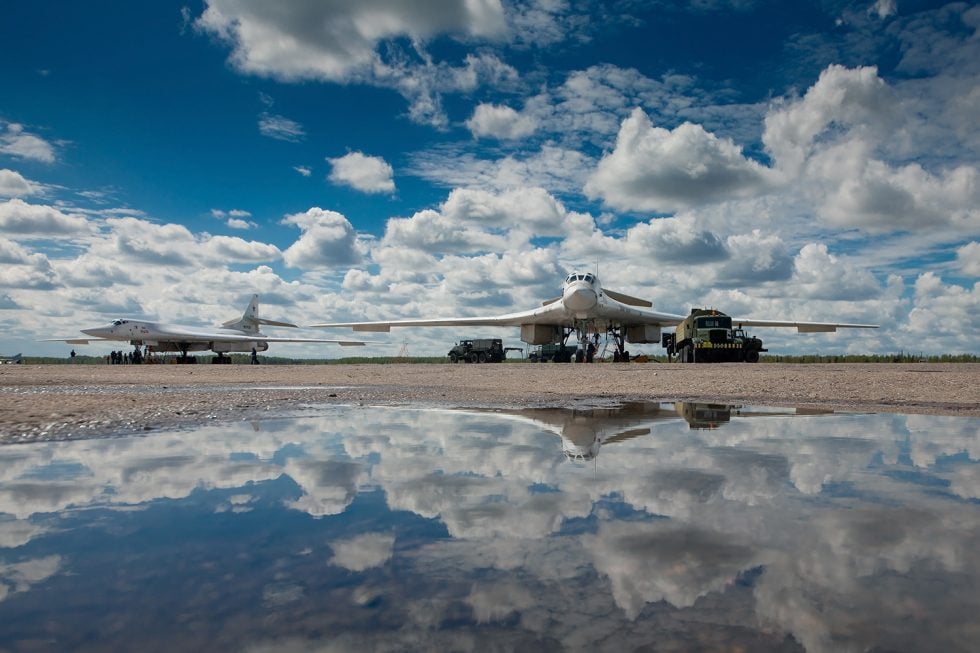
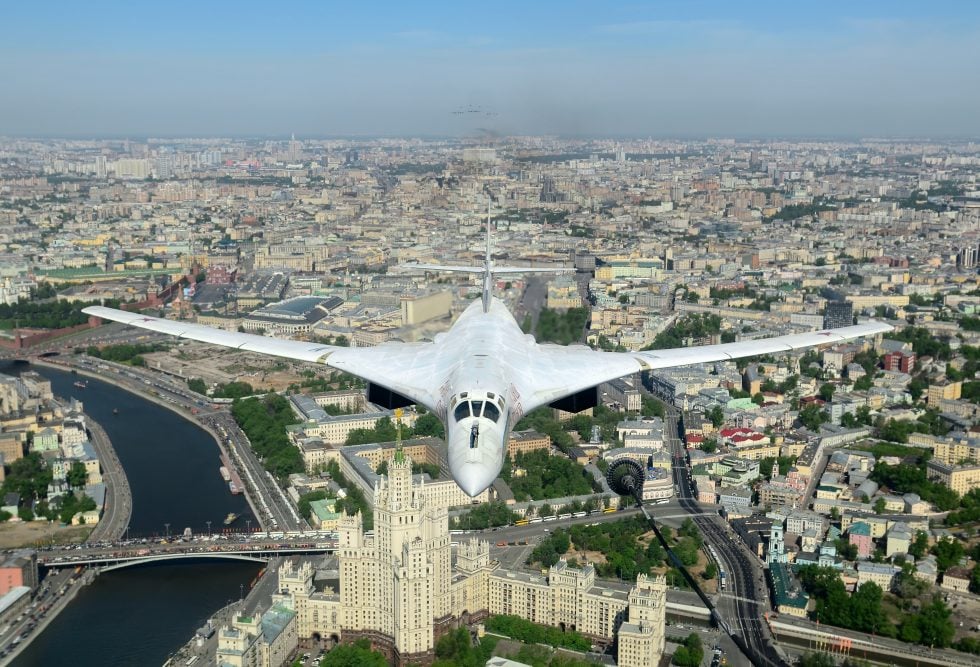
The Tu-160 in motion
A verified, high-authority video feature for the Tu-160 is still being selected — video coming soon. In the meantime, the photo gallery above and the stories carousel cover the aircraft in depth.
Where the Tu-160 operates
The record that defines it
For most of its life the Tu-160 was a Cold-War deterrent that never fired a shot. Its story is written less in air-to-air kills than in superlatives of size, speed and reach — and, more recently, in its use as a stand-off cruise-missile platform. Claims arising from its combat use since 2015 are contested; we present them factually and without endorsement.
Compare the combat record of every military aircraft. Figures as of July 2026.
Everything people ask about the Tu-160
Can I fly in a Tu-160?
How fast is the Tu-160?
Is the Tu-160 the biggest bomber ever?
Why is the Tu-160 called the White Swan?
Is the Tu-160 a copy of the B-1?
Has the Tu-160 been used in combat?
Is Russia really building new Tu-160s?
Did Ukraine once operate the Tu-160?
You can’t fly the Tu-160.
These, you can.
Some legends only live in museums — others are fuelled and waiting. MiGFlug has put civilians in real military jet cockpits since 2004.
 Fly the L-39 AlbatrosThe world’s most-flown jet trainer — aerobatics included
 Fly the F-104 Starfighter“The missile with a man in it”
 Fly the MiG-21The Cold War’s most-produced jet
 Fly the T-33 Shooting StarAmerica’s first jet trainer
 Fly the DH VampireA piece of early jet history
 Fly the S.211Agile Italian jet trainer
 Fly the MB-326The classic Aermacchi jet
 Fly the MiG-15The Soviet legend of the Korean War
Continue the tour
Every fact, checked
- Airforce Technology — Tu-160 BlackjackAirframe dimensions, weights, engine and performance figures.
- The War Zone (The Drive)The NK-32 engine and its restarted production for new-build bombers.
- New AtlasRestart of full Tu-160M production at Kazan and the 2022 new-build first flight.
- National Security JournalThe largest-and-heaviest superlatives and current fleet estimates.
- 19FortyFiveModernisation, the Tu-160M and the type’s strategic role.
- Military Watch MagazineReporting on the Tu-160’s use launching stand-off missiles against Ukraine.
- Military FactoryCross-checked specification and production data.
- Federation of American ScientistsReference on the Tu-160 in Russian and Soviet nuclear forces.