
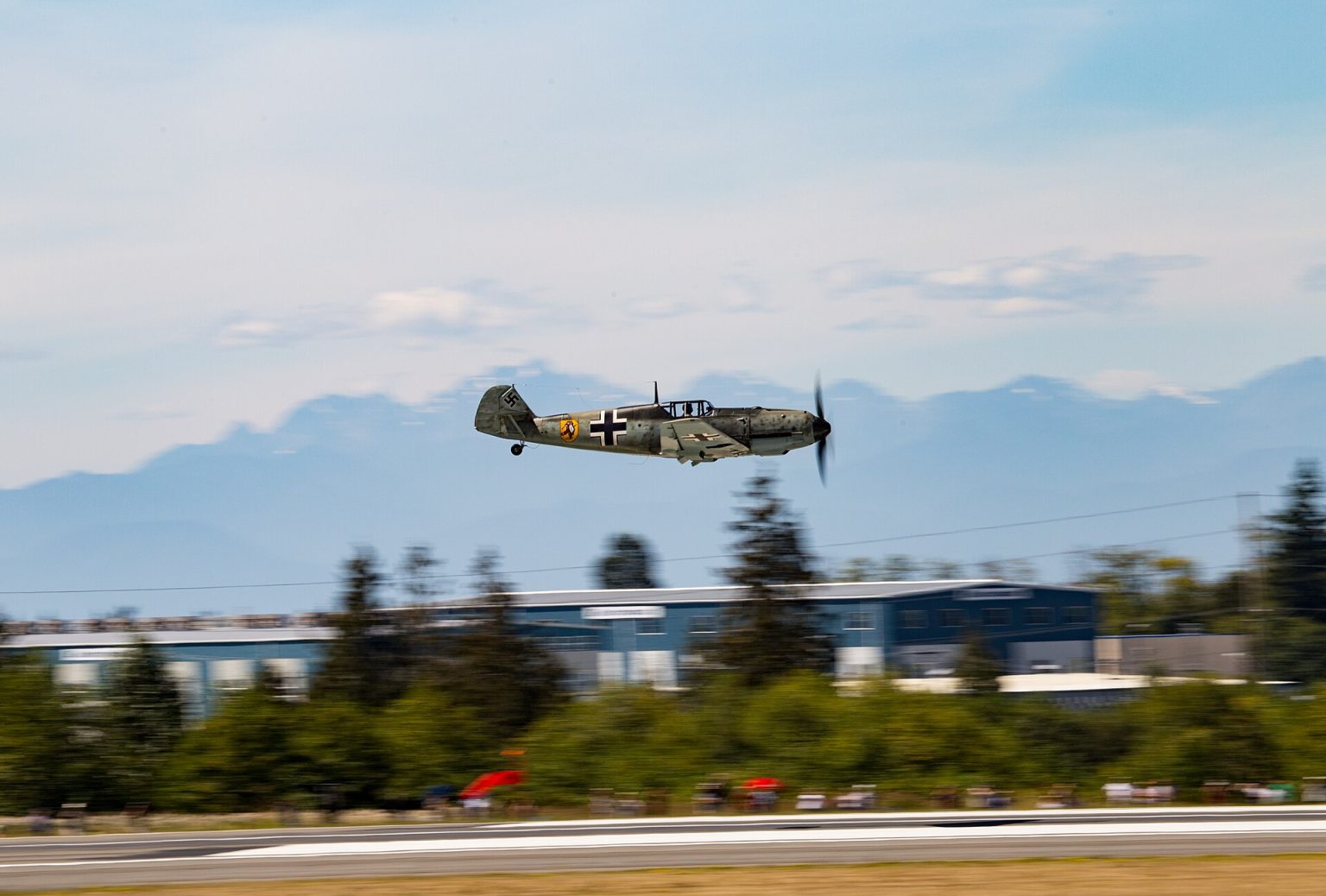
Messerschmitt
Bf 109
The most-produced fighter aircraft in history — a small, light, fuel-injected monoplane that fought from the Spanish Civil War to 1945, became the great rival of the Spitfire in the Battle of Britain, and lived on after the war as the Spanish Buchón and the Czech-built Avia S-199.
The most-produced fighter ever built
The Messerschmitt Bf 109 was designed by Willy Messerschmitt and Robert Lusser at the Bayerische Flugzeugwerke — the source of the “Bf” prefix — in answer to a 1934 German requirement for a modern single-seat fighter. It was one of the first genuinely modern combat aircraft: an all-metal, low-wing cantilever monoplane with a stressed-skin structure, an enclosed cockpit, retractable gear and automatic leading-edge slats. The design philosophy was simple and radical: wrap the smallest, lightest possible airframe around the most powerful available engine.
The prototype first flew in late 1935 — on an imported Rolls-Royce Kestrel, for want of a ready German engine. The type matured through the E “Emil”, the refined F “Friedrich”, the mass-produced G “Gustav” and the final K “Kurfürst”, its Daimler-Benz inverted-V12 defining it throughout. With roughly 34,000 built across all marks, it is the most-produced fighter aircraft in history.
It stayed in front-line service from the Spanish Civil War through the entire Second World War, a span few contemporaries matched, and in 1940 it was the principal fighter opponent of the Supermarine Spitfire. Its story did not end in 1945: Czechoslovakia built the Avia S-199 and Spain the Hispano HA-1112 “Buchón”, the latter famously re-engined with the very Rolls-Royce Merlin it had once fought.
01The Bf 109’s numbers: how a small 1935 fighter became the most-produced ever
Production totals for the Bf 109 are large enough that sources disagree at the margins — figures cluster around 34,000, with some references citing closer to 35,000. What is undisputed is the ranking: no other fighter aircraft has been built in greater numbers. From 1937 to 1945 the type poured out of German and licensed factories in a continuous stream of marks — B, D, E, F, G and K — and production actually peaked late in the war despite Allied bombing.
That scale shaped the entire air war Germany fought. It also outlived the parent state: post-war licence and derivative production in Czechoslovakia (Avia S-199) and Spain (Hispano HA-1112) kept 109-pattern airframes rolling out and flying into the 1960s, and it is those Spanish Buchóns that make up many of the “109s” still seen flying today.
What makes the Bf 109 special
A small, light airframe with slats
Messerschmitt minimised size and weight, then added automatic leading-edge slats that deployed at low speed to delay the stall and preserve aileron control in tight turns. The result was an exceptional power-to-weight ratio and lively performance from a compact structure — a genuinely advanced approach for 1935 that let a highly loaded wing stay controllable at the edge of flight.
The injected DB inverted-V12
The Daimler-Benz DB 601/605 was an inverted-V12: mounting the cylinders below the crankshaft lowered the thrust line and improved forward visibility. Crucially, its direct fuel injection kept the engine running smoothly under negative-g manoeuvres, where early carburettor-fed Merlins would momentarily cut out — a real early-war tactical edge, later mitigated on the Merlin side by “Miss Shilling’s orifice”.
The narrow, splayed undercarriage
To keep the wing simple and light, the main gear attached to the fuselage and splayed outward on a very narrow track. That eased wing manufacture and off-wing servicing, but made the aircraft notoriously twitchy on take-off and landing — a design trade-off that contributed to a high rate of ground and taxiing accidents throughout its long career.
02The Bf 109’s injected engine: the negative-g advantage of 1940
In the Battle of Britain the Bf 109E’s DB 601 had a small but real edge over the Spitfire and Hurricane: pushed into a sudden dive, its direct fuel injection kept feeding the engine, while the carburettor-fed Merlin could briefly starve of fuel under negative g and splutter. RAF pilots learned to half-roll and pull rather than simply bunt into a dive to follow. It was never decisive on its own — but it was exactly the kind of detail that separated closely matched fighters flown by well-trained crews.
03The Bf 109’s short legs: a fighter that ran out of sky over England
The same light-airframe philosophy that made the 109 nimble also gave it limited internal fuel. Over southern England in 1940 that meant only minutes of combat time before Luftwaffe pilots had to turn for home, a constraint that shaped and limited the German bomber-escort campaign. Range was the persistent strategic weakness of an otherwise excellent short-range fighter — a recurring theme for aircraft optimised above all for climb and dash.
Full Bf 109 specifications
Dimensions & weights
- Crew
- 1 single-seat fighter; the two-seat G-12 was a conversion trainer
- Length
- 8.95 m (29 ft 4 in) — Bf 109G-6
- Wingspan
- 9.92 m (32 ft 7 in) — near-constant from the B of 1937 to the K-4 of 1945
- Height
- 2.60 m (8 ft 6 in) on its undercarriage, tail down
- Wing area
- 16.05 m² (173 sq ft) — small even by 1940s standards, which is why wing loading climbed hard as weight grew
- Empty weight
- 2,247 kg (4,954 lb) — Bf 109G-6
- Loaded weight
- 3,148 kg (6,940 lb); the 1940 E-4 loaded at roughly 2,600 kg (5,730 lb)
- Max takeoff weight
- 3,400 kg (7,495 lb) with gondola cannon or a fuselage bomb
- Internal fuel
- ~400 L (~106 US gal / ~88 imp gal) in one self-sealing fuselage tank behind the pilot
Performance
- Max speed
- 640 km/h (398 mph) at 6,300 m (20,700 ft) — Bf 109G-6; the E-4 of 1940 managed about 570 km/h (354 mph) and the K-4 reached 710 km/h (441 mph) at 7,500 m with MW 50
- Cruise speed
- 590 km/h (367 mph) at 6,000 m — fast (max-continuous) cruise; economical cruise was far lower
- Rate of climb
- 17.0 m/s (3,345 ft/min) at sea level, Bf 109G-6; late marks on MW 50 climbed better still
- Service ceiling
- 12,000 m (39,370 ft) — high-altitude G and K sub-types with pressurised cockpits or GM-1 boost did better
- Range
- ~850 km (~530 mi) on internal fuel — short, and the defining tactical limit of the type
- Range with drop tank
- ~1,000 km (~620 mi) with the 300 L (~79 US gal) ventral tank
- Takeoff run
- 400 m (1,310 ft) at loaded weight on a hard surface; period figures vary with surface, flap setting and boost
- Landing run
- 450 m (1,480 ft); the narrow, splayed undercarriage punished heavy braking and crosswinds
- Load factor
- +7 g design limit at fighter weight; sources differ, and above roughly 650 km/h it was heavy elevator and aileron forces, not the structure, that set the practical limit
Propulsion & systems
- Engine
- Daimler-Benz DB 605A-1 inverted V-12, liquid-cooled, direct fuel injection — Bf 109G-6. Earlier: Junkers Jumo 210 on the B/C/D, DB 601 on the E and F; the K-4 used the DB 605D
- Power
- 1,475 PS (1,455 hp / 1,085 kW) for takeoff, DB 605A; with MW 50 methanol-water injection late G models reached roughly 1,800 PS, and the K-4 on DB 605D with MW 50 about 2,000 PS. The Jumo 210 of 1937 gave only around 680 PS — the airframe absorbed a near-threefold power increase over eight years
- Propeller
- VDM three-blade metal constant-speed 3.00 m (9 ft 10 in) diameter, electrically actuated pitch, normally set to manual by pilots who did not trust the automatic unit; the K-4 used a broader-chord blade
- Guns
- 1 × 20 mm MG 151/20 and 2 × 13 mm MG 131 Bf 109G-6 baseline: the cannon fires through the propeller hub, the machine guns through the cowling. See the armament section for gondolas, the 30 mm MK 108 option and earlier fits
- Cockpit & canopy
- Cramped, side-hinged hood the cockpit was narrow enough that tall pilots flew with their heads against the canopy, and the heavily framed early hood gave poor rearward view. The clear-view Erla Haube, fitted from 1943, removed most of the framing and was the single most-appreciated late-war comfort change; the canopy hinged to starboard and could not be opened in flight at speed
- Undercarriage
- Narrow-track, outward-retracting track of about 2.06 m (6 ft 9 in), legs attached to the fuselage and splayed outward, which made the wing easy to build and ship but left the aircraft twitchy on the ground. Combined with a strong swing on takeoff and limited forward view over the nose, it produced a notorious ground-loop and takeoff/landing accident record; a figure of roughly 1,500 aircraft lost in takeoff and landing accidents is frequently cited, though wartime loss accounting is incomplete
- First flight
- 28 May 1935 prototype V1, flown at Augsburg on an imported Rolls-Royce Kestrel engine because the intended German engine was not ready
- Service entry
- February 1937 Bf 109B with Jagdgeschwader 132; combat debut with the Condor Legion in the Spanish Civil War the same year
- Built
- ~34,000 (about 33,900–34,000 across all marks and licence production) — the most-produced fighter aircraft in history, of which roughly 30,000 were G models. Late-war output depended heavily on dispersed factories staffed by forced and slave labourers, including concentration-camp prisoners; the production totals cited here were reached on that basis
- Unit cost
- ~RM 50,000–60,000 per airframe in the mid-war years is the range most often quoted, down from higher early-war figures as the design was rationalised. Treat these numbers cautiously: they are administered wartime prices in a closed economy, and they do not price the coerced labour described above
- Cost per flight hour
- ~USD 5,000–10,000 today, as a privately operated warbird, once engine overhaul reserve, insurance, hangarage and maintenance are counted; no authoritative public figure exists and owners quote widely different numbers. Note that most airworthy "Bf 109s" are in fact Hispano HA-1112 Buchóns — Spanish-built airframes with Rolls-Royce Merlin engines — so the aircraft most people photograph at airshows carries a British engine; several have since been rebuilt with Daimler-Benz power
04The Bf 109’s cost and figures: why the numbers carry footnotes
Representative specifications here are for a mid-war G-6, but the type varied widely across two decades of production, so single figures are always approximations. Length is cited between 8.85 and 8.95 m; G-6 top speed between about 620 and 640 km/h depending on engine rating and loadout. The often-repeated unit cost of around 42,000 Reichsmarks is poorly documented and varied by mark and year — treat it as indicative only. Where sources disagree we have used common mid-range values and flagged them, in keeping with a neutral engineering-history treatment.
Armament & payload
Bf 109 armament: a hub cannon, two cowl guns and a hard choice about everything else
The Bf 109 was a small aeroplane with a small wing, and that governed its weapons. The designers put the heavy gun where the airframe could carry it without stressing the wing — in the engine vee, firing through the propeller hub — and left the wing largely empty. Everything beyond that baseline came at a measurable cost in handling, and the late-war marks show a type being asked to do more than its 1935 airframe was sized for.
Guns (engine-mounted)
The Motorkanone sat between the cylinder banks and fired through the hollow propeller shaft, so its rounds went where the pilot pointed the nose with no convergence problem at all. Early attempts with the 20 mm MG FF/M were unreliable and the gun was often removed from E-series aircraft; from the F onwards the installation worked properly, first with the MG 151/15 and then the 20 mm MG 151/20 with about 200 rounds. Some G and K aircraft carried the 30 mm MK 108 instead — a short-barrelled, low-velocity weapon with roughly 60 rounds whose mine shells could destroy a heavy bomber in a handful of hits, but which was hard to aim against a manoeuvring fighter.
Guns (cowl & wing)
Two synchronised 7.92 mm MG 17 machine guns sat above the engine from the beginning. By 1942 rifle-calibre guns were nearly useless against armoured targets, so the G-5 and G-6 replaced them with 13 mm MG 131 with about 300 rounds each. The larger breeches would not fit under the old cowling, and the fairings added to clear them gave the G-6 the pair of bulges German crews called Beulen — a small aerodynamic penalty accepted for real hitting power. Wing guns appeared mainly on the E series (two MG 17, or two 20 mm MG FF/M in the E-3 and E-4) and were deleted from the F onwards to clean up the wing.
Gondola cannon
The R6 field conversion hung a 20 mm MG 151/20 in a fairing under each wing, with roughly 135 rounds apiece. Against a four-engined bomber the effect was decisive; the aircraft was nicknamed Kanonenboot. Against fighters it was close to a liability — several hundred kilograms of weight and drag well outboard, slowing roll response and costing speed and climb at exactly the altitudes where escorting Mustangs and Thunderbolts were waiting. Units frequently flew mixed formations, some aircraft with gondolas to attack the bombers and clean aircraft to cover them.
Bombs
A ventral ETC rack carried one 250 kg SC 250 bomb, or four 50 kg SC 50 on a cluster adapter. The E-4/B, E-7, F-4/B and G-6/R1 were the main fighter-bomber fits, used over the Channel in 1940–41, in North Africa and on the Eastern Front. With a bomb aboard the aircraft was slow, short-legged and easy prey, and Jabo missions were typically flown as fast, shallow, single-pass attacks rather than as dive bombing.
Rockets
The Werfer-Granate 21, a 21 cm army rocket mortar adapted for air use, was carried in a single tube under each wing from 1943. It was aimed at the box formations of American heavy bombers: the intention was not accuracy but to burst a large warhead inside the formation and break it up so that individual bombers could be attacked. The tubes were heavy and draggy and were normally jettisoned or fired before the escorts arrived.
Other stores
The same ventral rack took a 300 L drop tank, the standard answer to the type's chronic shortage of fuel. Chemical boost systems were the other common addition: GM-1 nitrous oxide for high altitude on some F and G sub-types, and MW 50 methanol-water injection for low- and medium-altitude power on late G and K aircraft. Reconnaissance sub-types such as the G-8 carried a vertical camera in the rear fuselage in place of some armament.
Bf 109 representative loadouts
- Battle of Britain interceptor, Bf 109E-4 (1940)
- Two 7.92 mm MG 17 in the cowling and two 20 mm MG FF/M in the wings, no external stores. Well matched to the Spitfire in the fight itself, but with internal fuel only it could spend roughly ten to twenty minutes over southern England before turning for France — the limitation that shaped the whole campaign.
- Bomber-destroyer, Bf 109G-6/R6 (1943–44)
- MG 151/20 through the hub, two MG 131 in the cowling, two MG 151/20 in underwing gondolas, sometimes with a pair of Werfer-Granate 21 tubes as well. Formidable against B-17 and B-24 formations and badly outclassed by their escorts, which is precisely the trade the Luftwaffe was forced to make.
- Fighter-bomber, Bf 109F-4/B or G-6/R1
- Standard gun fit plus one SC 250 on the ventral rack, delivered in a fast shallow attack. Used against shipping, airfields and troop positions when dedicated ground-attack aircraft were unavailable.
Armament on the Bf 109 is mark-dependent to an unusual degree, and factory conversion sets (Umbau-Bausatz) and field kits (Rüstsatz) mean two aircraft of the same sub-type could be armed differently. Any single "Bf 109 armament" figure is a snapshot of one variant in one configuration — the G-6 fit above is the most representative single answer because more G-6s were built than any other version.
Variants
Bf 109 variants: from a 680 PS Jumo prototype to a 2,000 PS last stand
- Bf 109B / C / D (1937–38)
- The Jumo 210-powered first generation, around 680–700 PS, two or four rifle-calibre machine guns, a few hundred of each built. Blooded with the Condor Legion in Spain, where German pilots worked out the fighting tactics — the loose pair and finger-four — that the type carried into 1939.
- Bf 109E "Emil" (1939–41)
- DB 601 engine, roughly 1,100 PS, wing cannon on the E-3 and E-4, squared-off wingtips. Around 4,000 built. The mainstay of the Battle of France and the Battle of Britain and the version against which the early Spitfire was measured.
- Bf 109F "Friedrich" (1941–42)
- Rounded wingtips, a cantilever tailplane without bracing struts, a cleaned-up cowling and retractable tailwheel, wing guns deleted in favour of a reliable hub cannon. Roughly 2,200 built. Widely regarded, then and now, as the aerodynamic and handling peak of the family, even though it carried the lightest armament.
- Bf 109G "Gustav" (1942–45)
- DB 605 engine and by far the most-produced version — on the order of 30,000 aircraft, dominated by the G-6. Faster and much better armed than the F, but heavier, with worse low-speed handling and the drag penalties of bulges, gondolas and racks. The version most people mean when they say "Bf 109".
- Bf 109K-4 (late 1944–45)
- The final production version: DB 605D with MW 50, a tidied-up airframe, 30 mm MK 108 hub cannon and 710 km/h (441 mph) top speed. Genuinely competitive on paper, delivered into a force short of fuel, spare parts and trained pilots. Production numbers are uncertain; figures in the region of 1,500–2,000 are commonly quoted.
- Bf 109T (1940–41)
- Navalised version for the aircraft carrier Graf Zeppelin, with extended wings, folding outer panels, catapult points and arrester gear; roughly 70 built. The carrier was never completed, so the aircraft never operated as intended — instead the short-field wing made them useful from cramped strips in Norway and on Heligoland.
- Avia S-99 / S-199 (1947–49)
- Czechoslovak post-war production from wartime tooling. The S-99 used leftover DB 605s; when a store of them was destroyed, the S-199 was fitted with a Jumo 211F bomber engine and a coarse paddle propeller. The result had ferocious torque, a vicious swing on takeoff and a habit of biting on landing, earning the nickname Mezek (mule). Roughly 550 built; a small batch was bought by Israel and flew in the 1948 war, making it the first fighter of the Israeli air force.
- Hispano HA-1112 Buchón (1950s–60s)
- Spanish licence development that ended, after its own engine troubles, with a Rolls-Royce Merlin 500-45 driving a four-blade propeller — a Messerschmitt airframe with the engine of its old opponent. Around 170 built. Their survival in Spanish service into the 1960s is why so many appeared in the film Battle of Britain (1969) and why so many exist today.
The Bf 109 has been out of military service for decades. Its last military operator was Spain, which flew the Merlin-engined HA-1112 Buchón into the 1960s; no air force has operated the type since. Very few original Daimler-Benz-powered aircraft are airworthy today — most flying "109s" are Buchóns, and several of those have been rebuilt with DB 605 engines and authentic canopies in recent decades. The airworthy total is small, in the low double figures at most, and it changes with each restoration completed and each aircraft lost, so any exact count quoted here would be out of date quickly.
Operators
The Messerschmitt Bf 109 was the Luftwaffe’s fighter, but a dozen other air forces flew it in combat and three kept it flying into the 1950s and 1960s.
Germany built almost 34,000 Bf 109s, and its allies Finland, Hungary, Romania, Bulgaria, Croatia, Slovakia, Italy and Spain received or licence-built hundreds more; neutral Switzerland and Yugoslavia bought it before the war. After 1945 Czechoslovakia’s Avia S-199 fought for Israel, Spain’s Hispano Buchon served until 1965 and Finland’s Gustavs lasted to 1954. Captured aircraft evaluated by Britain, the United States, the Soviet Union and France are not counted as operators; wartime totals are deliveries, not strength.
In service with
- No current military operator
- —
Formerly operated by
- LuftwaffeGermany · the main operator from the Spanish Civil War to the end of the Second World War; production about 33,984
- ~33,000 · 1937–1945
- Royal Hungarian Air ForceHungary · 3 D-1, 50 E-3/E-4, 66 F-4 and about 490 G-series, many licence-built in Hungary
- ~600 · 1942–1945
- Czechoslovak Air ForceCzechoslovakia · captured Bf 109G and postwar Avia S-99 and S-199 production
- ~570 · 1945–1957
- Royal Romanian Air ForceRomania · E-3/E-4/E-7, F-2/F-4, 200-plus G-series and 124 IAR-assembled Ga-2/4/6; postwar Romanian Air Force use into the early 1950s
- ~400 · 1940–
- Aeronautica Nazionale RepubblicanaItaly · 300 G-6/G-10/G-14, 2 G-12 and 3 K-4 for the Italian Social Republic
- 305 · 1944–1945
- Bulgarian Air ForceBulgaria · 19 E-3 and 145 G-2/G-6/G-10; retained for a short period after the war
- 164 · 1940–
- Finnish Air ForceFinland · 48 G-2, 111 G-6 and 3 G-8 ordered, three lost in transit; 663 victories claimed 1943–44
- 159 · 1943–1954
- Swiss Air ForceSwitzerland · 10 D-1, 89 E-3a, 2 F-4 and 14 G-6
- 115 · 1939–1949
- Royal Yugoslav Air ForceYugoslavia · E-3a bought before the German invasion of April 1941
- 73 · 1939–1941
- Slovak Air ForceSlovakia · 16 E-3, 14 E-7 and 30 G-6; three G-6 flown by the Slovak Insurgent Air Force in 1944
- 60 · 1942–1945
- Spanish Air ForceSpain · Legion Condor B/C/D/E handed over in 1939 and 15 F-4 in 1943, plus 200-plus Hispano HA-1109/1112 licence derivatives flown to 1965
- ~60 · 1939–1965
- Air Force of the Independent State of CroatiaCroatia · E-4, F-2, G-2/G-6/G-10 and K
- 50+ · 1943–1945
- Yugoslav Air ForceYugoslavia · ex-Croatian and Bulgarian Bf 109G flown by the postwar SFR Yugoslav Air Force
- ~50 · 1945–
- Regia AeronauticaItaly · several tens of G-series in the first half of 1943
- ~30 · 1943–1943
- Israeli Air ForceIsrael · Avia S-199 bought from Czechoslovakia; eight victories claimed in the 1948 war
- 25 · 1948–1949
- Imperial Japanese Army Air ForceJapan · five E-7 bought for tests and trials
- 5 · 1941–
16 operators, 0 current. Quantities are airframes taken on charge; dates are first delivery to last retirement. Air forces with a MiGFlug Order of Battle page are linked (1 so far); the rest follow as the database grows.
The Bf 109 through the years
The requirement
The German air ministry issues a specification for a modern single-seat monoplane fighter.
First flight
The prototype Bf 109 V1 flies, powered — for want of a German engine — by an imported Rolls-Royce Kestrel.
Service and combat debut
The B variant enters Luftwaffe service and is combat-tested by the Condor Legion in the Spanish Civil War.
The Emil at war
The DB 601-powered E “Emil” is in wide service at the outbreak of the Second World War.
Battle of Britain
The 109E fights the Spitfire and Hurricane over England — closely matched rivals whose edge shifted with altitude and tactics.
Friedrich and the wider war
The refined F enters service; the type deploys on the Eastern Front and in North Africa.
The Gustav
The DB 605-powered G “Gustav” becomes the most-produced variant of the whole family.
Peak output
The final K “Kurfürst” is fielded and production peaks despite heavy Allied bombing.
Life after the war
Derivatives are built abroad: the Avia S-199 in Czechoslovakia (flown by Israel in 1948) and the Merlin-engined Hispano HA-1112 “Buchón” in Spain, which flew into the 1960s.
Twelve Bf 109 stories
The most-produced fighter ever
About 34,000 airframes — no fighter has been built in greater numbers.
Read the full story
Bf 109 versus Spitfire
The Battle of Britain’s headline matchup.
Read the full story
The injected V12 that did not cough
A small negative-g advantage in 1940.
Read the full story
The gear that bit back
A narrow track and a hard reputation on the ground.
Read the full story
The Spanish Buchón with a British heart
A Messerschmitt powered by a Rolls-Royce Merlin.
Read the full story
Stars of “Battle of Britain” (1969)
Spanish Buchóns played the Luftwaffe on screen.
Read the full story
Israel’s first fighter was a “109”
The Avia S-199, 1948.
Read the full story
The record tallies
The highest individual scores in aviation history.
Read the full story
Slats that saved the stall
Automatic leading-edge devices.
Read the full story
Blooded over Spain
The Condor Legion, 1937.
Read the full story
The short-legs problem
A fighter that ran out of sky.
Read the full story
The warbirds that still fly
A handful airworthy in 2026.
Read the full story
The Bf 109 in pictures
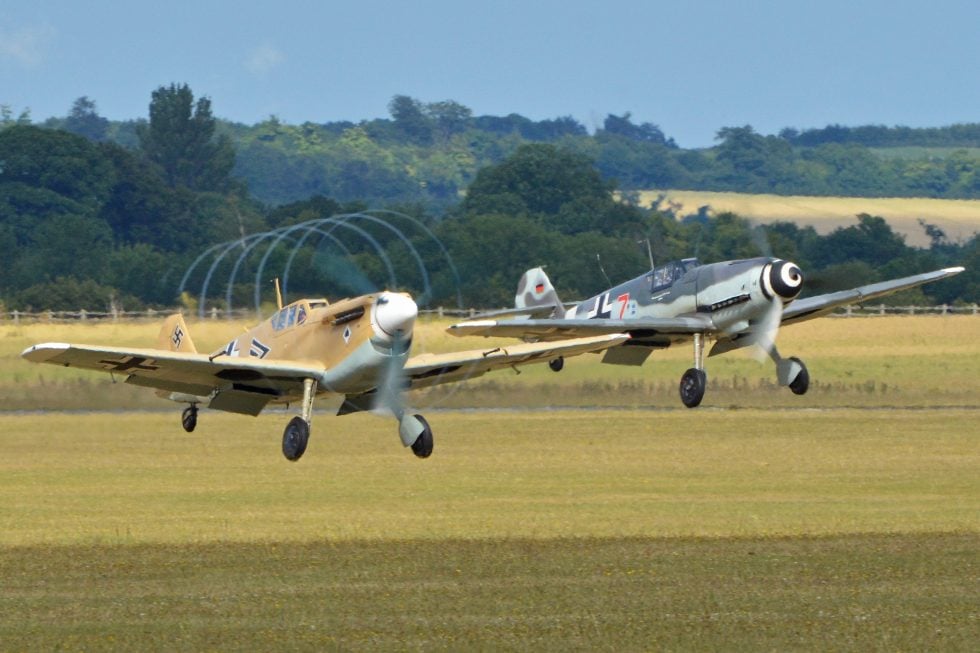
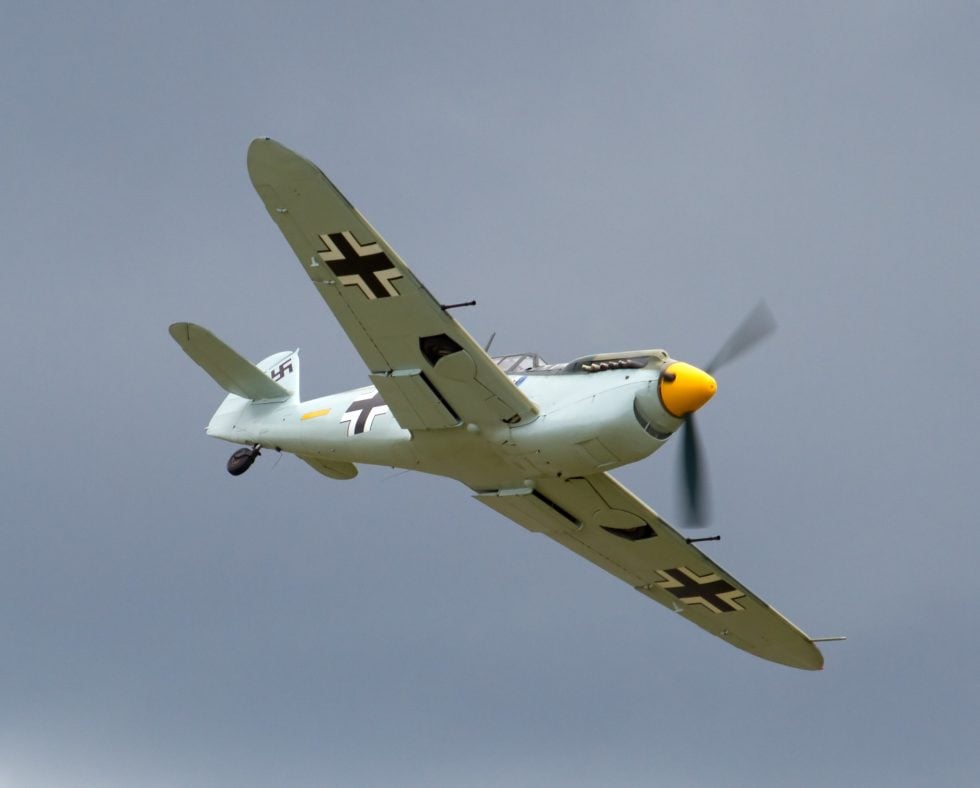
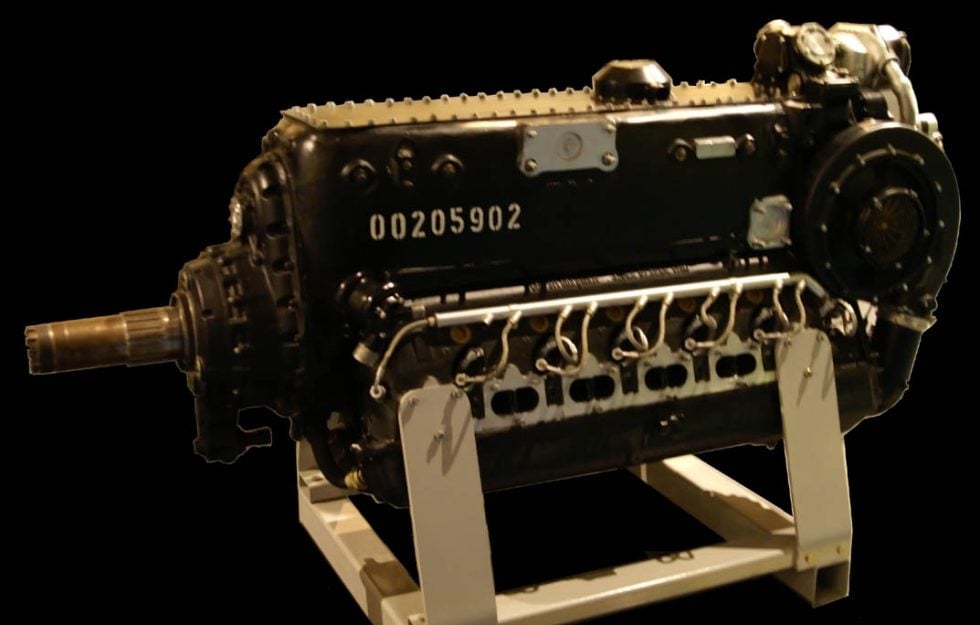
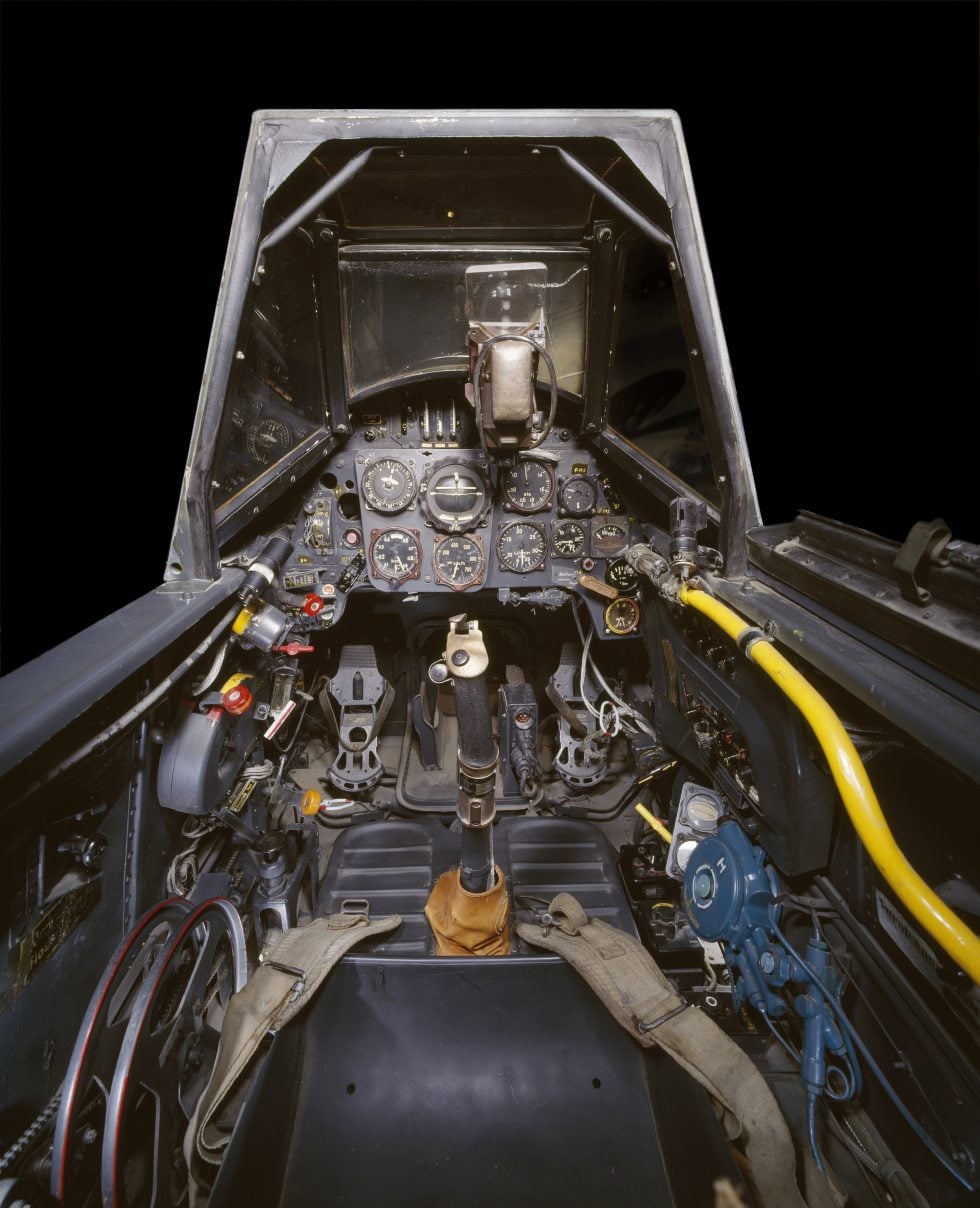
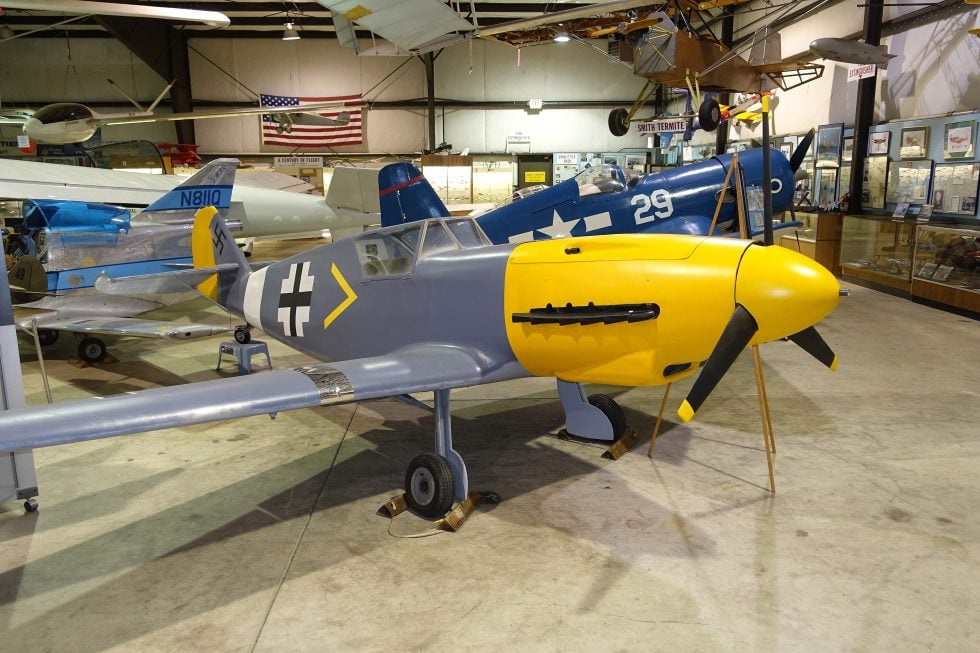
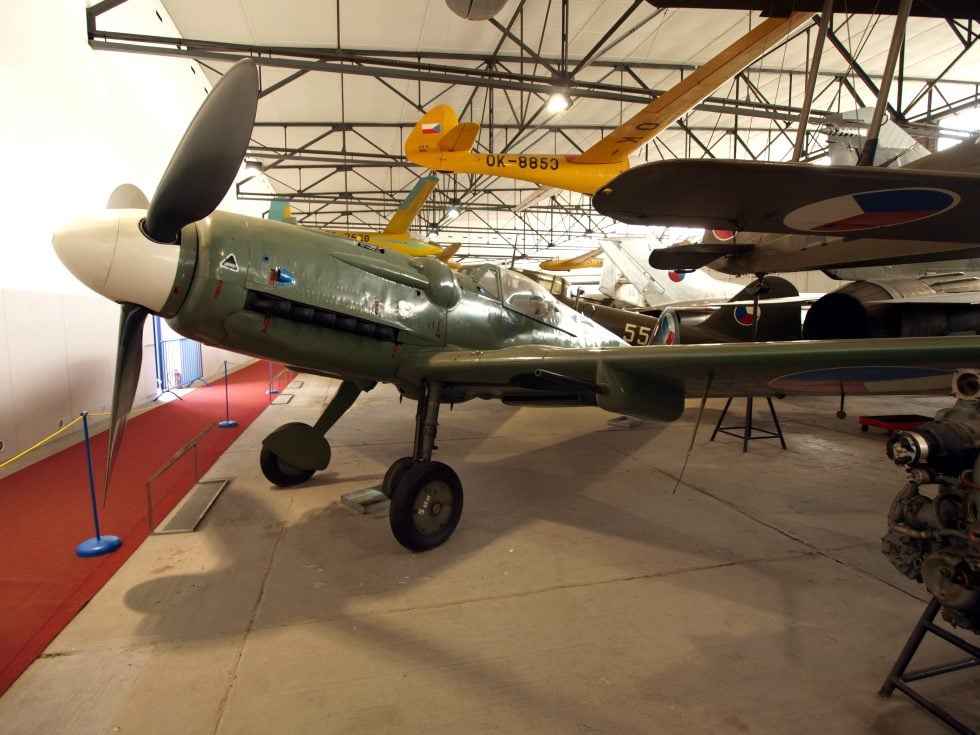
The Bf 109 in motion
A flying-display video of a surviving Bf 109 warbird will be added here.
The Bf 109 in motion
Imperial War Museums — one of the most-watched Bf 109 films on YouTube.
Where the Bf 109 flew
A fighter in every wartime sky
The Bf 109 fought from the Spanish Civil War in 1937 to the last day of the Second World War, on every front Germany contested — the Battle of Britain, North Africa, the Mediterranean, the Eastern Front and the Defence of the Reich. Its published victory records are among the highest in aviation history, but individual WWII tallies rely on wartime claim records and are best cited as credited claims rather than audited totals.
Compare the combat record of every military aircraft. Figures as of July 2026.
Everything people ask about the Bf 109
Can I fly in a Bf 109?
How fast was the Bf 109?
Is the Bf 109 still flyable today?
How did it compare to the Spitfire?
How many Bf 109s were built?
How does the Buchón relate to the Bf 109?
What was the Avia S-199?
You can’t fly the Bf 109.
These, you can.
Some legends only live in museums — others are fuelled and waiting. MiGFlug has put civilians in real military jet cockpits since 2004.
 Fly the L-39 AlbatrosThe world’s most-flown jet trainer — aerobatics included
 Fly the F-104 Starfighter“The missile with a man in it”
 Fly the MiG-21The Cold War’s most-produced jet
 Fly the T-33 Shooting StarAmerica’s first jet trainer
 Fly the DH VampireA piece of early jet history
 Fly the S.211Agile Italian jet trainer
 Fly the MB-326The classic Aermacchi jet
 Fly the MiG-15The Soviet legend of the Korean War
Continue the tour
Every fact, checked
- Encyclopaedia Britannica — Bf 109History, design and specifications overview.
- flugzeuginfo.net — Bf 109 technical dataIndependent specification and production cross-check.
- Smithsonian Magazine — the Avia S-199The Czech fighter that helped Israel win its War of Independence.
- Planes of Fame — Hispano HA-1112-M1L BuchónThe Merlin-engined Spanish 109 derivative.
- The Aviationist — the 1969 film’s aircraftHow Spanish Buchóns stood in for the Luftwaffe on screen.
- Smithsonian Magazine — Erich HartmannThe most successful fighter pilot of all time, in context.
- Dinger Aviation — the engines of the Bf 109DB 601/605 and the fuel-injection story.
- National Air and Space Museum — Bf 109 G-6/R3Smithsonian object record.