
Aermacchi MB-339
Italy’s jet trainer
The docile, stepped-cockpit trainer that taught generations of Italian pilots, became the smoke-trailing heart of the Frecce Tricolori, and went to war over the South Atlantic in Argentine hands.
The trainer that became a national symbol
By the early 1970s the Italian Air Force needed a modern jet to replace the Aermacchi MB-326, the straight-wing trainer that had carried Italian and export pilots through the jet age since the 1950s. Rather than start from a clean sheet, Aermacchi’s designers at Varese reworked the MB-326’s proven airframe into a new machine with a raised, stepped tandem cockpit and swept tail. The result, the MB-339, first flew on 12 August 1976 and entered service in 1979.
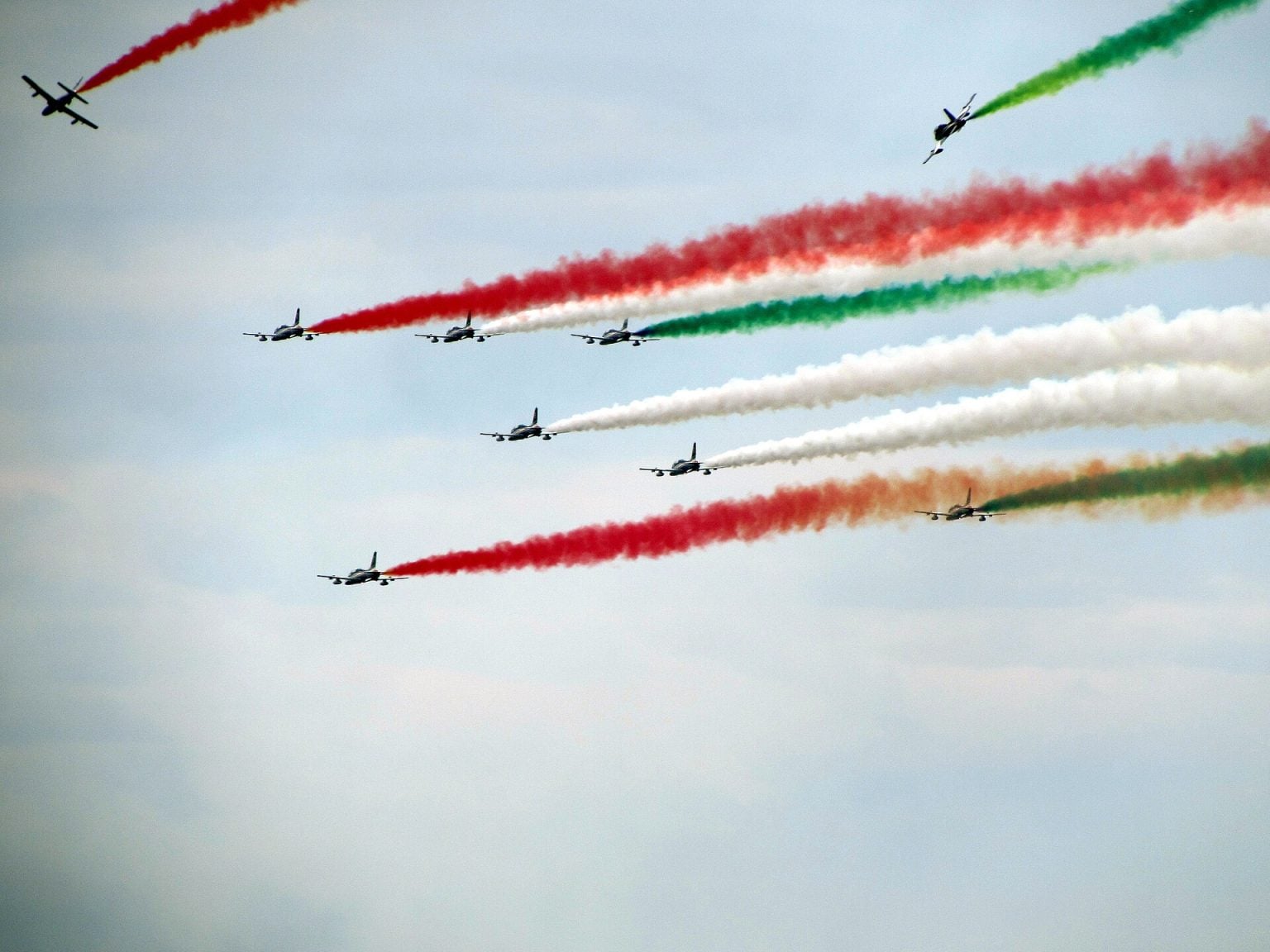
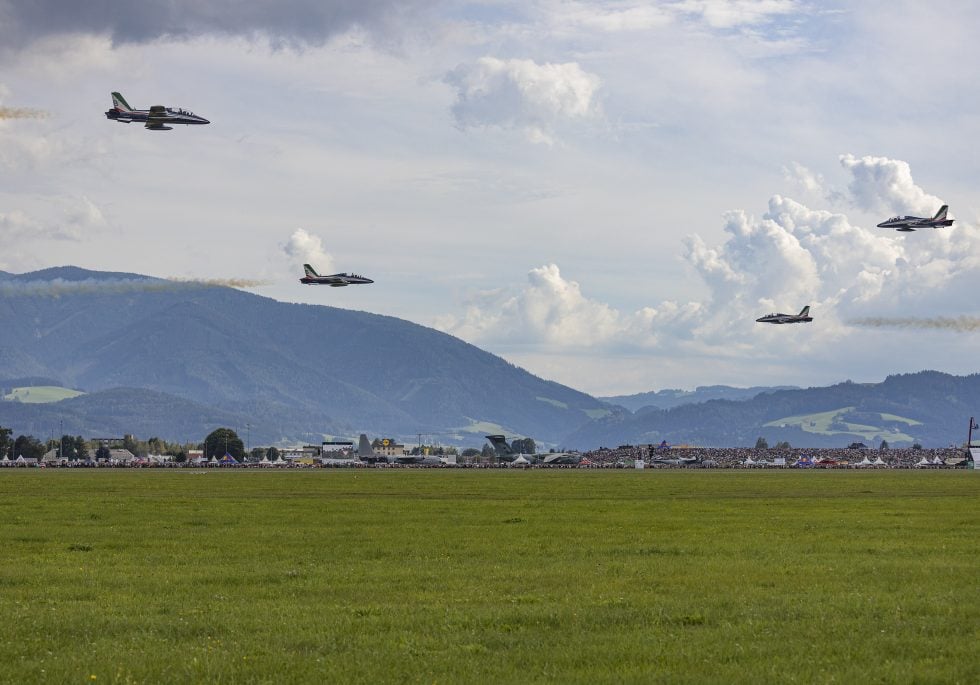
It was never meant to be fast or fierce. The MB-339 was built to be honest — forgiving enough for a student on an early solo, yet capable enough to teach weapons delivery and formation flying. That same docility made it the natural choice for Italy’s Frecce Tricolori display team, who adopted the type in 1982 and still fly ten of them — nine in formation and a soloist — making them the largest aerobatic team in the world.
But the MB-339 also went to war. Argentina’s Navy flew it in ground attack during the 1982 Falklands conflict; Eritrea used armed examples against Ethiopia at the end of the 1990s. And the type is bound up with one of aviation’s worst public tragedies — the 1988 Ramstein air-show disaster. Nearly half a century after its first flight, the MB-339 is only now being retired in Italy in favour of the Aermacchi M-346.
01From MB-326 to MB-339: how Aermacchi evolved a Cold-War classic
The MB-339 is best understood as a deep evolution of the MB-326 rather than an all-new aircraft. Aermacchi kept the earlier jet’s wing and much of its structure — a decision that cut cost and risk — but raised the rear (instructor) seat and reshaped the forward fuselage to give both crew a proper view over the nose, the classic stepped tandem cockpit. A new swept fin and rudder improved handling at the margins of the envelope. Power came from an uprated Rolls-Royce Viper. The lineage runs on: the related MB-326 is covered in its own exhibit, and the two aircraft together trace Aermacchi’s long dominance of the Western jet-trainer market.
What makes the MB-339 special
A stepped cockpit built to teach
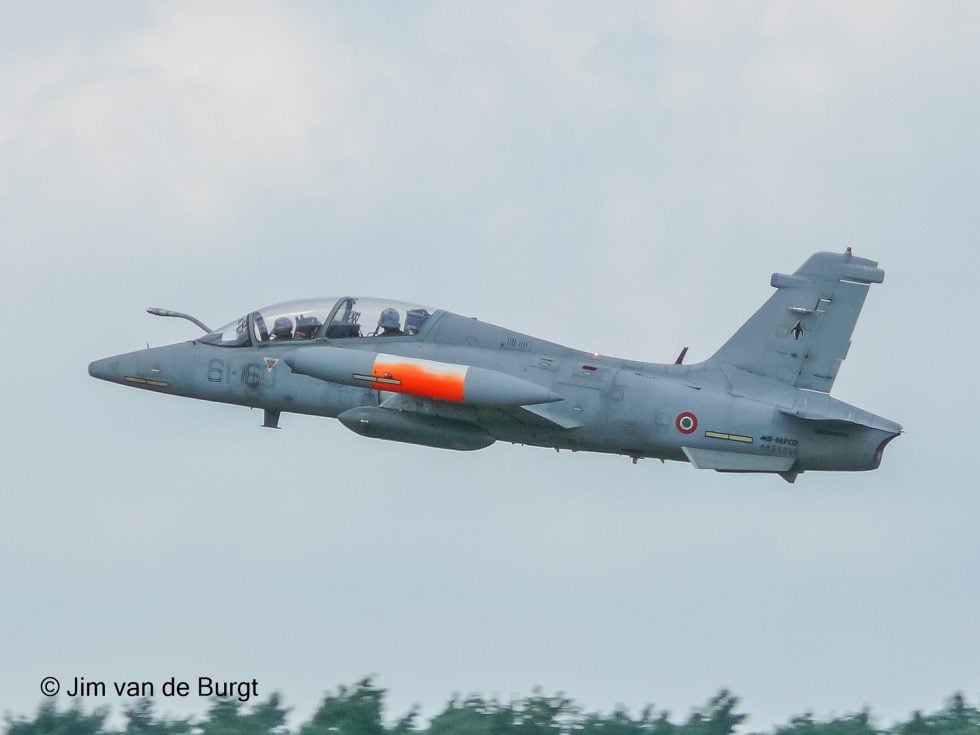
The MB-339’s defining feature is its raised rear seat. On the MB-326 the instructor sat low, with a poor view forward; on the MB-339 the back-seater is stepped up behind the student, giving a clear sightline over the nose for landings and weapons work. Combined with docile, honest handling and Martin-Baker Mk 10 ejection seats, it made an ideal machine for taking a pilot from first solo to combat-ready.
The Rolls-Royce Viper — simple and robust
Power comes from a single Rolls-Royce Viper turbojet — the Mk 632 of about 4,000 lbf (17.8 kN) in the MB-339A, and the more powerful Viper 680 (~4,300 lbf) in the C/CD and Eritrean CE variants. It is an old, un-reheated design, but it is cheap to run, tolerant and easy to maintain — exactly what an air force wants in a jet that logs thousands of training hours.
Trainer by day, light striker by need
Six underwing hardpoints let the MB-339 carry up to about 1,815 kg of stores: gun pods, bombs, rockets, air-to-air missiles and, on the C/CD, the Marte anti-ship missile. The single-seat MB-339K Veltro 2 pushed this furthest with two 30 mm DEFA cannon, though it found no buyers. In practice the type’s war record was written by lightly-armed trainers pressed into attack.
02The MB-339’s cockpit: why a raised back seat mattered
Training accidents often happen in the circuit and on approach, where an instructor who cannot see what the student sees is nearly helpless. The MB-339’s stepped layout — the rear seat lifted well above the front — was a direct answer, giving the instructor a genuine view of the runway during the most dangerous phases of flight. The wide, uncluttered canopy and gentle stall behaviour reinforced the design goal: an aircraft that lets a student make mistakes and recover from them. It is unglamorous engineering, but it is the reason the MB-339 endured for decades as a primary and advanced trainer.
03The MB-339’s versatility: anti-ship missiles on a trainer
The dedicated attack subtypes gave the MB-339 a punch out of proportion to its trainer roots. The MB-339C/CD added a digital nav/attack system and could carry the Marte Mk 2 sea-skimming anti-ship missile — a genuine maritime-strike capability on an airframe designed to teach students to fly. The one-off MB-339K Veltro 2 deleted the second seat entirely for a pair of 30 mm cannon and a heavier weapons load. Few of these attack versions sold, and the type’s real combat use came from ordinary armed trainers — but the versatility was real, and it is why small air forces bought the MB-339 as a do-everything jet.
Full specifications
Baseline note: the figures below describe the MB-339A as delivered to the Aeronautica Militare from 1979 — the tandem two-seat trainer with the raised rear cockpit, the unswept MB-326K wing, permanent tip tanks and a single Rolls-Royce Viper Mk 632-43 turbojet of 17.79 kN (4,000 lbf). Deltas for the MB-339C and the Italian MB-339CD, for the MB-339PAN of the Frecce Tricolori and for the single-seat MB-339K Veltro II are given in grey. Four disagreements between reputable sources are worth settling before the tables begin. First, height: the specification table on the English-language encyclopaedic account, sourced to Jane’s All the World’s Aircraft 1980–81, prints 3.60 m (11 ft 10 in), while Aermacchi’s sales material and the trade references give 3.99 m (13 ft 1 in) for the A and 3.9 m for the C. The entire purpose of the MB-339’s redesigned forward fuselage was to lift the instructor above the pupil, so the taller figure is the credible one and it is the one used here. Second, span: 10.86 m is the A over its original tip tanks and 11.22 m is the C over the larger tanks introduced on the MB-339B — two aeroplanes, not two errors. Third, the engine of the Italian MB-339CD: the Aeronautica Militare and the encyclopaedic accounts give the 4,000 lbf Viper 632-43, while several trade references assume the 4,400 lbf Viper 680-43 fitted to the C, CB, CE and CM. The Italian digital aircraft kept the smaller engine, which is why a modernised MB-339CD climbs no better than a 1979 MB-339A. Fourth, production: Aermacchi never published a final total. Counts run from about 200 to 231 depending on whether the prototypes, the PAN conversions and the calibration aircraft are counted once or twice.
Dimensions & weights
- Crew
- 2 in tandem, the rear seat raised 0.32 m above the front one under a single upward-hinging canopy. This is the difference between an MB-326 and an MB-339 that you can see from the ramp: Aermacchi kept the wing and rebuilt the nose so that the instructor could actually watch the approach the pupil was flying. The MB-339PAN of the Frecce Tricolori is flown solo from the front seat on display; the MB-339K Veltro II deleted the rear station entirely and put fuel and ammunition in the space
- Length
- 10.97 m (36 ft 0 in). The C-series grew to 11.24 m (36 ft 10 in) to swallow the avionics bay ahead of the front cockpit, and the MB-339CD adds a fixed in-flight refuelling probe on the starboard side of the nose that is not included in the quoted length
- Wingspan
- 10.86 m (35 ft 8 in) over the tip tanks. The MB-339B introduced larger tanks and took the C, CB, CE, CM and CD family to 11.22 m (36 ft 10 in). The Frecce Tricolori fly the PAN with the tip tanks removed altogether, which is why the team’s aeroplanes look subtly wrong to anyone who knows the type
- Height
- 3.99 m (13 ft 1 in); 3.9 m (12 ft 10 in) is quoted for the C-series. A figure of 3.60 m circulates in one widely copied table and is almost certainly a transcription error
- Wing area
- 19.30 m² (207.7 sq ft) — the MB-326K wing, unswept, unchanged, and the single most important reason the MB-339 exists at all. Aermacchi studied seven clean-sheet designs under the MB-338 label in 1972 and chose the derivative because the wing was paid for
- Aspect ratio
- 5.26 — low by trainer standards and deliberately so. A stubby wing gives crisp roll response and a docile stall at the cost of cruise efficiency, which is the correct trade for an aeroplane whose working day is a 45-minute sortie in the circuit
- Aerofoil
- NACA 64A-114 (modified) at root, NACA 64A-212 (modified) at tip — a laminar-flow section chosen in the 1950s for the MB-326 and carried across unaltered
- Empty weight
- 3,075 kg (6,779 lb). The C-series, with a second-generation cockpit, a heavier engine and more structure, comes out at 3,414 kg (7,527 lb) — a 340 kg penalty for going digital, paid for by 400 lbf of extra thrust
- Gross weight, clean
- 4,400 kg (9,700 lb) in the trainer configuration with full internal fuel and no external stores. This is the weight at which every published MB-339A performance figure was measured
- Max take-off weight
- 5,897 kg (13,001 lb) with external stores. The C-series is cleared to 6,350 kg (14,000 lb), and 5,030 kg (11,090 lb) is its clean take-off weight
- Max external load
- 1,815 kg (4,000 lb) across six underwing pylons, four of them wet. Reaching that figure means accepting a take-off run and a climb rate that would embarrass a Cessna, which is why armed MB-339 sorties in practice carried perhaps half of it
- Wing loading
- 228 kg/m² (46.7 lb/sq ft) at clean gross weight, rising to 305 kg/m² fully loaded. The low figure is what makes the type pleasant to fly and hopeless as a fast jet
- Undercarriage
- Tricycle, hydraulically retractable, wide track with low-pressure tyres and a steerable nosewheel. The MB-339 was built to operate from semi-prepared strips, and in May 1982 six of them proved it by flying armed sorties off the short runway at Port Stanley
Performance
- Max speed
- 898 km/h (485 kn, 558 mph) at sea level, clean. The MB-339 is a subsonic aeroplane with a straight wing and it never pretended otherwise
- Never-exceed speed
- 926 km/h (500 kn) or Mach 0.82, whichever comes first. The Italian flight manual quotes Mach 0.60 at sea level and Mach 0.80 at altitude as normal limits
- Stall speed
- 148.5 km/h (80 kn) clean. Approach is flown at about 100 kn, which is the number that makes the type usable as an ab-initio jet
- Rate of climb
- 33.5 m/s (6,595 ft/min) at sea level. The C-series, with the 4,400 lbf Viper 680-43, manages 35 m/s (6,900 ft/min); the Italian MB-339CD, which kept the 632-43, does not
- Service ceiling
- 14,630 m (48,000 ft) for the A. The heavier C-series is quoted at 14,020 m (46,000 ft), and Italian sources give 15,000 m (46,000 ft) for the A without distinguishing between the two
- Range, internal fuel
- 1,760 km (950 nmi) at economical cruise altitude. This is a ferry-style figure, not a mission radius, and it assumes nothing on the pylons
- Ferry range
- 2,110 km (1,140 nmi) with two 325 litre drop tanks. Italian sources quote a transfer range of 3,600 km for the aircraft configured for delivery flights, which involves ferry tanks and a great deal of optimism about the weather
- Combat radius
- ~370 km (200 nmi) lo-lo-lo with roughly 1,000 kg of stores — the figure Aermacchi quoted for the armed marks. Hi-lo-hi with two 30 mm gun pods and rockets it is better, but the number that mattered in 1982 was that Port Stanley to San Carlos Water is 80 km, which any MB-339 could do twice
- Take-off run
- 460 m (1,510 ft) at clean gross weight; the C-series at higher weights is quoted at 550 m (1,805 ft). Italian sources round the short-field figure to about 500 m
- Landing run
- 460 m (1,510 ft); 480 m (1,575 ft) for the C-series. There is no drag chute and no thrust reverser — wheel brakes and airbrakes only
- g limits
- +8.0 / −4.0 at trainer weights, reduced to +7.33 / −4.0 on the heavier C-series. The high positive limit is what made the type acceptable to the Frecce Tricolori, who fly it harder every summer afternoon than most air forces fly a fighter
- Turn performance
- 20°/sec instantaneous, 12°/sec sustained at 4,570 m (15,000 ft) for the C-series, with a minimum turn radius quoted at 410 m (1,350 ft). Respectable for a trainer, irrelevant against anything built after 1970
Propulsion & systems
- Engine
- 1 × Rolls-Royce Viper Mk 632-43 single-shaft, eight-stage axial turbojet, 17.79 kN (4,000 lbf) dry. No afterburner, no bypass, no fan — a 1950s engine of legendary simplicity, licence-built in Italy by Piaggio, with a fuel consumption that would horrify a modern operator and a maintenance manual a conscript could follow
- Engine, later marks
- Rolls-Royce Viper Mk 680-43, 19.57 kN (4,400 lbf) on the MB-339B, C, CB, CE and CM. The Italian MB-339CD is the odd one out: it received the full digital cockpit and kept the 632-43, so it is the only aeroplane in the family whose avionics are a generation ahead of its engine
- Thrust-to-weight
- 0.41 at clean gross weight, falling to 0.31 fully loaded. That second number is the honest description of an armed MB-339 leaving a hot runway
- Internal fuel
- 1,413 litres (311 imp gal, 373 US gal) in fuselage bag tanks and integral tip tanks. The C-series carries 1,430 kg internally and up to 522 kg externally. The PAN’s underwing tanks are divided between fuel and smoke oil, which is why the display aircraft has less endurance than the trainer
- External fuel
- 2 × 325 litre drop tanks on the inboard wet pylons. The MB-339CD adds a fixed in-flight refuelling probe, the single most useful thing anybody ever bolted to the type — it turned a short-legged trainer into an aircraft that could accompany Tornado and Eurofighter crews on realistic sorties
- Ejection seats
- 2 × Martin-Baker Mk IT-10F rocket-assisted, zero-zero, command-ejection linked. They worked at Ramstein, where two of the three pilots were seen to eject inside the fireball and did not survive it, and they worked over Turin on 16 September 2023, where the pilot of Pony 4 got out of a dead aeroplane at very low level
- Avionics, MB-339A
- Analogue — VOR/ILS, TACAN, ADF, UHF/VHF, a simple gyro gunsight and a camera. Nothing in the cockpit of a 1979 MB-339A would puzzle a pilot who had left an MB-326 the week before, and that was the selling point
- Avionics, MB-339C and CD
- MIL-STD-1553B dual-redundant databus with a Kaiser/VDO head-up display, three Sextant colour liquid-crystal multifunction displays, a Honeywell H-764 ring-laser inertial reference system with embedded GPS, radar altimeter, laser rangefinder, a computerised stores management system and a night-vision-goggle-compatible cockpit. There is still no radar in any MB-339, which sets a hard ceiling on what the type can be taught to do
- Self-protection
- Elettronica ELT-555 jamming pod, AN/ALE-40 chaff and flare dispensers — available, rarely fitted, and irrelevant against a modern surface-to-air system. The MB-339 has no radar warning receiver as standard on the early marks
- Smoke system, MB-339PAN
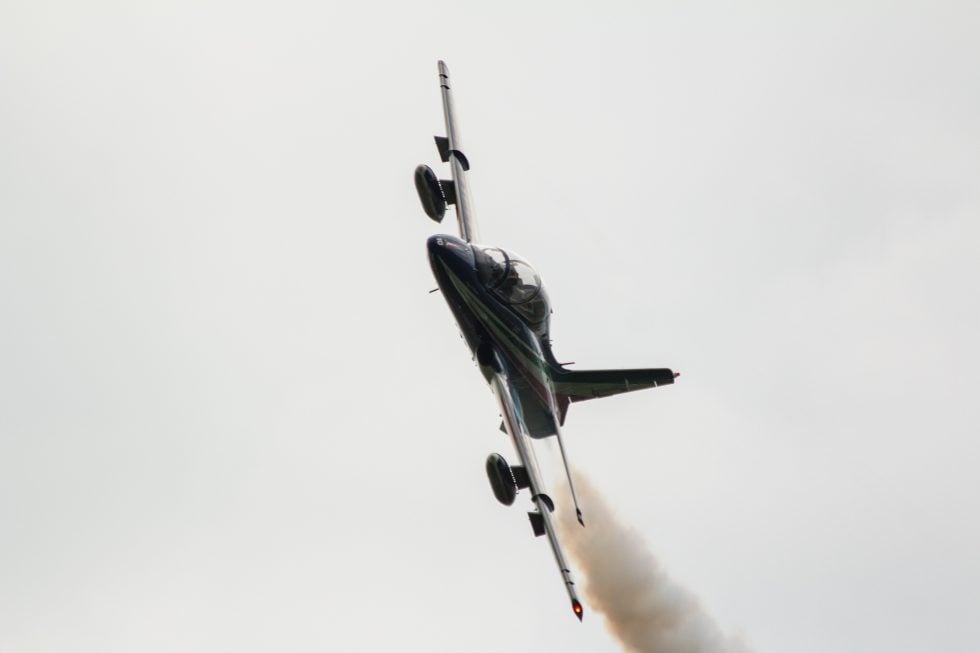
- Vaseline oil injected into the jet pipe with non-polluting pigment for green, white and red. It occupies part of the underwing tankage, and it is the only ordnance most people have ever seen an MB-339 carry
- Structure and life
- Conventional light-alloy stressed skin, unpressurised wing, pressurised cockpit with liquid-oxygen supply. Aermacchi quoted a 5,000-hour design life for the attack marks and the fleet had accumulated close to 500,000 flying hours by the late 1990s. Italian airframes have since been through a mid-life update that took several of them past 40 years of service
04The MB-339’s numbers: why specs vary between sources
Published MB-339 figures differ because the family spans two decades and several distinct variants. The early MB-339A trainer, the uprated MB-339C/CD, the smoke-equipped PAN of the Frecce Tricolori and the single-seat Veltro 2 carry different engines, weights and dimensions, so a length of ~10.97 m for the A can become ~11.24 m for the C, and empty and maximum weights shift with fuel, tip tanks and stores. The values here are typical mid-range figures; treat any single precise number as variant-dependent. No credible open cost-per-flight-hour figure exists for the type.
Armament & payload
The MB-339 carries its gun in a pod, and that one fact tells you what kind of aeroplane it really is
Aermacchi built the MB-339 as a trainer and then discovered, as every builder of a cheap jet discovers, that customers wanted it to shoot. There is no gun inside the aeroplane. Everything it carries hangs from six underwing pylons rated at 1,815 kg (4,000 lb) in total, and the gun is a pod like any other store. That arrangement is honest about what the type is: a 4,000 lbf trainer with hardpoints, not a light fighter. The one attempt to build a real attack aeroplane out of it, the single-seat MB-339K Veltro II with two internal 30 mm DEFA 553 cannon, flew on 30 May 1980, impressed everyone who saw it and sold to nobody.
And yet the MB-339 has killed people, in two wars that could hardly be less alike. On 21 May 1982 a single Argentine Navy MB-339A on armed reconnaissance flew down Falkland Sound into the British landing fleet, fired rockets and cannon at HMS Argonaut, damaged her Type 965 radar and got away. Between 1998 and 2000 Eritrean MB-339CEs dropped cluster bombs on Tigrayan towns, and on 5 June 1998 one such raid on Mekelle killed dozens of civilians, many of them children at a primary school. Neither episode makes the MB-339 a combat aircraft in any serious sense. Both show what a trainer with pylons does when it is the only jet an air arm can get into the air. Weapon fits vary enormously by mark and by customer: an Italian MB-339A MLU carries practice bombs and nothing else, a New Zealand MB-339CB was cleared for AIM-9L and AGM-65, and the Frecce Tricolori aircraft has no weapon stations at all. Read every line below as "on some marks, for some operators".
Gun
- No internal gun on any two-seat MB-339. The standard fit is a 30 mm DEFA 553 cannon pod with 120 rounds on an inboard pylon, usually carried singly or in pairs.
- 12.7 mm (0.50 in) Browning AN/M3 machine-gun pods with about 350 rounds each — the lighter alternative, and the one most training establishments used for gunnery.
- MB-339K Veltro II: 2 × 30 mm DEFA 553 mounted internally in the nose with 125 rounds per gun, the space freed by deleting the rear cockpit. One aircraft was built.
- The Argentine Navy aircraft at Port Stanley in 1982 flew with 30 mm pods, and Lieutenant Guillermo Owen Crippa used his against HMS Argonaut on 21 May.
- Gunnery on the Italian MB-339CD is now largely synthetic: the sight, the target and the score exist in the mission computer.
Air-to-air
- AIM-9B, AIM-9L and AIM-9P Sidewinder on the outboard pylons — two rounds, cleared on the C-series and on some upgraded A-model exports.
- Matra R550 Magic, the usual French alternative for customers outside the American supply chain.
- There is no radar in any production MB-339. Every air-to-air shot is a visual, rear-hemisphere, close-range affair, and the laser rangefinder added to the C-series does nothing to change that.
- In practice the air-to-air fit is a point-defence gesture for small air forces and a training aid for everyone else. No MB-339 has ever fired a missile in anger at another aircraft.
- The type has, however, been shot at: an Eritrean MB-339 was brought down north of Mekelle on 6 June 1998, and the pilot ejected.
Air-to-surface guided
- AGM-65 Maverick, up to two rounds, integrated on the MB-339C family. New Zealand’s MB-339CB was bought with this capability and the laser rangefinder that supports it.
- MBDA Marte Mk 2A anti-ship missile, offered on the C-series for the coastal-defence role. No operator is known to have fielded it on the type.
- No laser-guided bomb has ever been a service fit. The MB-339CD can carry a forward-looking infrared targeting pod, but Italy uses it for training rather than for delivering weapons.
- This is the card where the light-attack claim runs out. Almost no MB-339 operator has ever held a guided air-to-ground weapon in its magazines, and the aircraft that went to war carried iron.
Bombs
- Mk 82 500 lb and Mk 83 1,000 lb general-purpose bombs, and the Italian and French equivalents.
- BAP-100 anti-runway penetrators and BAT-120 tactical support bomblets in dispensers — the French low-level stores the C-series was cleared for.
- Cluster bombs. Eritrean MB-339CEs used them over Tigray from June 1998, including in the attacks on Adigrat on 12 June 1998, and the weapon is the reason the Mekelle raid of 5 June killed as many civilians as it did.
- Practice bomb carriers with 3 kg and 12 kg heads — overwhelmingly the most common bomb an MB-339 has ever carried, and the only one most airframes have seen.
Rockets
- 68 mm SNEB and Brandt rockets in Matra and Aerea pods — the standard European fit and the type’s first clearance.
- 2.75 in (70 mm) rockets in LAU-series launchers for customers in the American supply chain; 50 mm and 81 mm pods also cleared.
- 5 in Zuni rockets. These are what Lieutenant Crippa fired into HMS Argonaut’s superstructure on the morning of 21 May 1982, alongside his cannon.
- Rocket pods with inert heads remain the workhorse weapons-training store wherever armed MB-339s still fly.
Pods & other stores
- 325 litre drop tanks on the inboard wet pylons, and on the MB-339CD a fixed in-flight refuelling probe that makes the tanks matter less.
- Elettronica ELT-555 electronic countermeasures pod and AN/ALE-40 chaff and flare dispensers — available, seldom fitted.
- Reconnaissance camera pods, offered from the outset and the cheapest tactical reconnaissance capability a small air force could buy.
- The MB-339PAN’s smoke installation: vaseline oil and pigment fed into the jet pipe, carried in the underwing tanks that would otherwise hold fuel.
- The French SDTS conversion, which strips the aircraft of everything and turns it into an optionally piloted target for missile trials — the last operational role the airframe has left.
Three typical loadouts
- Falkland Sound armed reconnaissance, 21 May 1982
- One MB-339A of the Argentine Navy’s 1st Naval Attack Squadron, operating off the 1,250 m strip at Port Stanley: a pair of 30 mm DEFA gun pods and 5 in Zuni rocket launchers, no drop tanks, full internal fuel. Lieutenant Guillermo Owen Crippa was sent to look at Falkland Sound, found the British amphibious landing underway beneath him, and attacked HMS Argonaut alone with everything he had. He damaged her Type 965 radar and returned. It is the only attack any Argentine aircraft made on the landing force from the islands themselves, and it was made by a trainer.
- Advanced weapons phase, 61° Stormo, Lecce-Galatina
- An MB-339CD with a practice bomb carrier on one inboard pylon, a rocket pod with inert heads on the other, a gun pod on the centreline station and no external fuel. Forty-five minutes on the Torre Veneri range, four passes, a debrief off the mission recorder. This is the sortie the aeroplane was designed for and the one it has flown roughly half a million times.
- Frecce Tricolori display
- An MB-339PAN with the tip tanks removed, the underwing tanks divided between fuel and coloured vaseline oil, no pylons, no weapons, reduced fuel and a pilot flying solo from the front seat. Nine aeroplanes in formation and a soloist, the largest display team in the world by aircraft count, flying an airframe that first displayed in 1982 and is still doing it more than forty years later.
Sourcing caveat: MB-339 weapon clearances are contract-specific and Aermacchi never published a consolidated list. Manufacturer literature describes what the airframe can be cleared to carry, which is not what any air force actually held. Where a store is named above it is because a specific customer or a specific action attests to it; marketing options are labelled as such. Casualty figures for the Eritrean air attacks of 1998 come from Ethiopian and international reporting and remain contested by Asmara.
Variants
Every MB-339 is a rebuilt MB-326, and the letter after the number tells you which decade of avionics you are buying
The MB-339 is a second draft. Aermacchi’s MB-326 had been the standard Western advanced jet trainer of the 1960s, sold to fifteen air forces and licence-built in Australia, Brazil and South Africa, and when the Italian Air Force asked in September 1972 for a replacement the company compared seven clean-sheet designs, collectively labelled MB-338, against a rebuilt MB-326. The rebuild won on cost. The MB-339 keeps the MB-326K’s wing, tail and much of its structure, and redesigns the forward fuselage to raise the instructor’s seat. The prototype flew on 12 August 1976, production aircraft in July 1978, and deliveries began in 1979.
The designations run in blocks and the block is the fact that matters. The A is the analogue aeroplane with the 4,000 lbf Viper 632-43, and it accounts for well over half of all production. The B introduced the 4,400 lbf Viper 680-43 and larger tip tanks. The C is that aircraft with a 1553B databus, a head-up display and colour screens, sold to New Zealand, Eritrea and Malaysia. The Italian CD is the C’s cockpit on the A’s engine, with an in-flight refuelling probe. The K is a single-seat attack aeroplane that nobody bought. Roughly 230 airframes of all marks were built between 1978 and the last Malaysian deliveries in 2009, though Aermacchi never published a final figure and reputable counts run as low as 200.
Two things killed the export line. The first was the Hawk, which was faster, bigger and backed by a British export machine the Italians could not match; the MB-339 sold about a third as many. The second was politics: the MB-339FD sale of twelve aircraft to Venezuela in the mid-2000s collapsed under American pressure over the aircraft’s United States-origin components, and the MB-339 T-Bird II offered with Lockheed for the American JPATS competition lost to the turboprop T-6. Leonardo’s answer was to start again: the M-345, a new aeroplane with a turbofan, entered Italian service formally in June 2025 and is replacing the MB-339A.
One mark has to be treated separately, because of what happened to it. The Frecce Tricolori took the MB-339PAN in 1982 and on 28 August 1988 flew it into the worst air display disaster in European history. At Flugtag ’88 at Ramstein Air Base in West Germany the team was performing the Cardioide, the pierced heart: two groups cross at the base of a heart traced along the runway while the soloist flies through the gap between them. The soloist, Lieutenant Colonel Ivo Nutarelli in Pony 10, reached the crossing point early and low. He struck the aircraft of Captain Giorgio Alessio and that of Lieutenant Colonel Mario Naldini, and all three machines were down within seconds. One tumbled across the runway into a densely packed spectator enclosure and into a waiting United States Army UH-60. All three pilots were killed. Thirty-odd people died at the scene and the toll rose over the following weeks to 70, of whom 66 were spectators, three were the pilots and one was the American helicopter pilot, Kim Jon Strader, who died of burns on 17 September. About 346 people were seriously injured and roughly a thousand hurt in all, some 450 of them treated across 46 hospitals. The precise sequence of the collision is still described differently by German and English sources, which disagree over whether Nutarelli struck Pony 1 or Pony 2 first; and a persistent Italian theory connects the deaths of Nutarelli and Naldini, both of whom had flown F-104s on the night of the Ustica disaster in 1980 and were due to give evidence, to that inquiry. No investigation has ever supported it.
Ramstein changed the rules everywhere, and that is the part of the story worth keeping. West Germany banned military display flying outright the following day. When displays resumed three years later it was under conditions that are now simply how air shows work in Europe: mandatory minimum heights and crowd-line separation, no manoeuvre flown over or towards spectators, and every sequence approved in advance. Military jet teams remained restricted in Germany until 2009, and opposed passes and formation breaks were not permitted again until the Berlin air show of 2012. The disaster also rebuilt German emergency medicine: the ambulances were initially refused entry to the base, no one had overall medical command for the first hour, and German and American intravenous fittings would not connect. Out of that came the Leitender Notarzt, the incident-commander doctor who directs rather than treats, the replacement of the German Rekord syringe taper with the international Luer standard, and the first formal crisis-counselling and rescuer-aftercare services in the country. It is an unusual epitaph for an aeroplane accident, and a real one.
- MB-339X and MB-339A (1976–1995, about 107 for Italy including PAN and RM conversions)
- The baseline: three prototypes, first flight 12 August 1976, then 101 MB-339As for the Aeronautica Militare and a handful of exports. Analogue cockpit, Viper 632-43, six pylons. Almost half of all MB-339s ever built are this mark in Italian markings.
- MB-339PAN (1982–, 21 built or converted)
- The Frecce Tricolori aircraft. Tip tanks deleted for roll response and formation visibility, underwing tanks split between fuel and coloured smoke oil, no weapon stations. Ten aeroplanes fly each display, nine in formation and a soloist. Replaced the Fiat G.91PAN in 1982 and is still in service in 2026, which makes it one of the longest display careers of any jet. It is also the mark that carries the type’s worst day, at Ramstein in 1988, and a second one at Turin-Caselle on 16 September 2023, when Pony 4 suffered an engine failure on take-off, the pilot ejected, and the falling aircraft struck a car and killed a five-year-old girl. The team was chosen to fly the M-346 in September 2024; the MB-339PAN has not gone yet.
- MB-339RM (1981, 3 built)
- Radio and navigation-aid calibration aircraft for the Italian Air Force, later converted back to MB-339A standard. A footnote, but the reason Italian delivery totals never quite reconcile.
- MB-339AM, AN, AP and the Ghanaian and Dubai aircraft (1981–1990, roughly 52 aircraft)
- Export MB-339As: 16 MB-339AP to Peru from November 1981, 13 MB-339AM to Malaysia from 1983, 12 MB-339AN to Nigeria from June 1984, four to Ghana and seven to Dubai. All are now retired or stored. Nigeria’s aircraft, bought for advanced training and light strike, were largely grounded by spares shortages within a decade and no longer appear in the national inventory; Peru’s went the same way; Malaysia flew its MB-339AMs from Kuantan for thirty years and gave them to the Smoky Bandits display team before moving on. Ten more aircraft went to the Argentine Navy in 1981 and are dealt with separately below.
- MB-339A for the Argentine Navy (1980 order, 10 delivered 1981)
- Ordered by the Comando de Aviación Naval in 1980 for the 1st Naval Attack Squadron. Six were flown to Port Stanley in late April 1982 and were, with the Navy’s T-34C Turbo Mentors and the Air Force’s Pucarás, the only combat aircraft based on the islands. One was lost on approach on 3 May killing Lieutenant Benítez, one was shot down by a Royal Marines Blowpipe at Goose Green on 28 May killing Sub-Lieutenant Daniel Miguel, and three airframes were captured intact at Stanley. Withdrawn in the 1990s.
- MB-339K Veltro II (first flight 30 May 1980, 1 built)
- Single-seat attack aircraft: rear cockpit deleted, two 30 mm DEFA 553 cannon with 125 rounds each mounted internally, extra fuel, six pylons for up to 2,000 kg, a design life quoted at 5,000 hours. It was a genuinely capable cheap strike aeroplane and it attracted not a single order, because by 1980 every air force that wanted one had already bought an A-4, an Alpha Jet or a Hawk.
- MB-339B and MB-339C (1985–2000)
- The B was a single demonstrator with the 4,400 lbf Viper 680-43 and enlarged tip tanks. The C added a MIL-STD-1553B databus, head-up display, colour multifunction displays, inertial navigation and a laser rangefinder, and became the export standard from 1991.
- MB-339CB, CE and CM (1991–2009, 32 aircraft)
- C-series exports. New Zealand took 18 MB-339CBs from March 1991 for No 14 Squadron, cleared for AIM-9L and AGM-65. Eritrea ordered six MB-339CEs in 1996 and used them over Tigray from June 1998. Malaysia added eight MB-339CMs on a contract signed in late 2006, the last new-build MB-339s of all. The New Zealand aircraft never fired a shot and were retired for domestic political reasons after ten years; the Eritrean ones opened their account on 5 June 1998 by bombing Mekelle, went back on 12 June to attack Adigrat with rockets and cluster munitions, and lost one of their number to Ethiopian defences on 6 June. It is a fair summary of the type: built to train, used to bomb wherever nothing better was available.
- MB-339CD (1996–2004, 30 for Italy)
- The full digital cockpit on the original 632-43 engine, with a fixed in-flight refuelling probe, embedded GPS, night-vision-goggle compatibility and provision for a targeting pod. Built to teach Tornado and Eurofighter crews, and still the backbone of Italian advanced training alongside the M-346.
- MB-339FD, T-Bird II and MB-339 SDTS (1989–present)
- The commercial dead ends and the afterlife. The T-Bird II was offered with Lockheed and General Motors for the American JPATS competition of 1989 and lost. The MB-339FD "full digital" export version attracted a Venezuelan order for twelve that collapsed under American pressure. Eight ex-New Zealand MB-339CBs, sold through Draken International, now fly in France as SDTS optionally piloted target aircraft for missile trials, one of which was lost at Nîmes-Garons on 10 October 2023.
Closing caveat and survivors: of the ten Argentine Navy aircraft, three were captured at Port Stanley in June 1982 and only one came to Britain — 4-A-116, which was displayed at the Fleet Air Arm Museum, then used by Rolls-Royce in white, and is now at the South Yorkshire Aircraft Museum at Doncaster in restored Argentine markings. Of New Zealand’s 18 MB-339CBs, 17 survived to be stored at Woodbourne after No 14 Squadron disbanded on 13 December 2001; a 2005 sale to an American training firm fell through, eight went to Draken International in 2013 and thence to France, and the remainder were dispersed to museums and collectors in New Zealand and Australia. The sole MB-339K Veltro II survives in Italy. Production totals should be treated with caution: the figure of about 230 is a reconciliation of national delivery records, and published totals range from 200 to 231 depending on how prototypes, conversions and re-designations are counted.
Operators today
Four operators still fly the MB-339, and one of them flies it without a pilot on board
The MB-339 is at the very end of its life as a military aeroplane. Of the nine air arms that bought it, six have given it up entirely: Argentina withdrew its survivors in the 1990s, Ghana and Peru and Nigeria let theirs decay into storage, New Zealand disbanded its air combat force in December 2001, and Malaysia has moved to the FA-50. A seventh is nearly done — in 2025 the Emirati display team Al Fursan re-equipped with the Hongdu L-15 after fifteen years on the type, leaving only a few trainers at the academy. What is left is Italy, which is steadily replacing its MB-339As with the M-345 and has chosen the M-346 to succeed the Frecce Tricolori’s MB-339PAN; Eritrea, whose handful of MB-339CEs have not been credibly reported airborne in years; a residue of trainers at Al Ain; and eight aircraft in France that are no longer really aeroplanes at all. The counts here were checked in September 2026, against sources whose most recent underlying dataset is FlightGlobal’s World Air Forces 2026.
That French entry is the strangest afterlife any jet trainer has had. Eight ex-Royal New Zealand Air Force MB-339CBs, sold to the American adversary-air contractor Draken International in 2013 and passed to France, now fly as the SDTS — optionally piloted target aircraft for missile trials at the DGA ranges, taking off with a pilot and, when required, without one. One was lost at Nîmes-Garons on 10 October 2023. It is a fitting last job for an airframe whose whole career was standing in for something more expensive.
These are estimates, and the Italian one is the least certain figure on the page. Italy is credited here with roughly 40 airframes actually flying: about 30 MB-339CDs at 61° Stormo, Lecce-Galatina, and 10 MB-339PANs with the 313° Gruppo at Rivolto, plus a dwindling number of MB-339A MLU trainers being displaced as T-345A deliveries continue. Reference works that credit Italy with 126 aircraft — 72 MB-339A MLU, 30 MB-339CD, 21 MB-339PAN and 3 MB-339RM — are quoting cumulative deliveries since 1979, not a fleet. Eritrea is listed at five of six MB-339CEs delivered in 1997, one having been shot down north of Mekelle on 6 June 1998; serviceability is unknown and probably very low. The Emirati figure covers trainers at the Al Ain air academy reported as approaching replacement, and does not include the seven Al Fursan aircraft retired in 2025. France operates eight MB-339CBs converted to SDTS target configuration and these are not an air force fleet. Dropped for want of corroboration: Argentina, Ghana, Malaysia, Nigeria and Peru, all of which appear in older lists but none of which now shows the type in a current national inventory; and Austria, which has never owned an MB-339 — Austrian pilots train on Italian Air Force MB-339s and M-346s at Lecce under contract, which is a different thing. Sources: IISS The Military Balance and FlightGlobal World Air Forces 2026, cross-checked against national air force and manufacturer statements; entries that could not be corroborated are omitted.
From drawing board to long goodbye
Requirement & selection
The Italian Air Force seeks an MB-326 replacement; Aermacchi’s MB-339 design is chosen in 1975.
First flight
The prototype flies on 12 August 1976, powered by a single Rolls-Royce Viper turbojet.
Enters service
The MB-339A becomes the Italian Air Force’s standard advanced trainer.
Frecce Tricolori & the Falklands
Italy’s display team adopts the MB-339PAN; the same year Argentine Navy MB-339s see combat in the South Atlantic.
The C/CD generation
The digital nav/attack MB-339C first flies, adding modern avionics and, later, an aerial-refuelling probe.
Ramstein disaster
Three Frecce Tricolori MB-339s collide during a display in West Germany; 70 people are killed, hundreds injured.
Combat over the Horn
Eritrean MB-339CEs fly bombing missions during the war with Ethiopia.
The M-346 succession
Italy confirms the Aermacchi M-346 will replace the MB-339, including with the Frecce Tricolori.
Twelve stories from the MB-339
Born from the MB-326
Aermacchi reworked its proven MB-326 into a modern stepped-cockpit trainer.
Read the full story
Into the air over Varese
The prototype MB-339 first flew on 12 August 1976.
Read the full story
The world’s largest aerobatic team
The Frecce Tricolori fly ten MB-339s — nine in formation plus a soloist.
Read the full story
Crippa’s lone attack run
A single MB-339 burst over the San Carlos landings and strafed HMS Argonaut.
Read the full story
A jet lost near Goose Green
The same day, an armed MB-339 was shot down and its pilot killed.
Read the full story
The Ramstein disaster
Three Frecce Tricolori MB-339s collided over a crowded air show; 70 people died.
Read the full story
The honest trainer
Pilots praise the MB-339 for doing exactly what they expect.
Read the full story
One Viper, endlessly reliable
The Rolls-Royce Viper is old and simple — and that is its virtue.
Read the full story
The single-seat striker that never sold
The MB-339K deleted the back seat for two cannon and a heavier load.
Read the full story
Bombing over the Horn
Eritrean MB-339CEs flew strike missions against Ethiopia.
Read the full story
A trainer that went global
Argentina, Malaysia, Nigeria, Peru, the UAE, Ghana, New Zealand and others bought the MB-339.
Read the full story
Handing over to the M-346
After nearly 50 years, Italy is replacing the MB-339 with the M-346.
Read the full story
The MB-339 in pictures
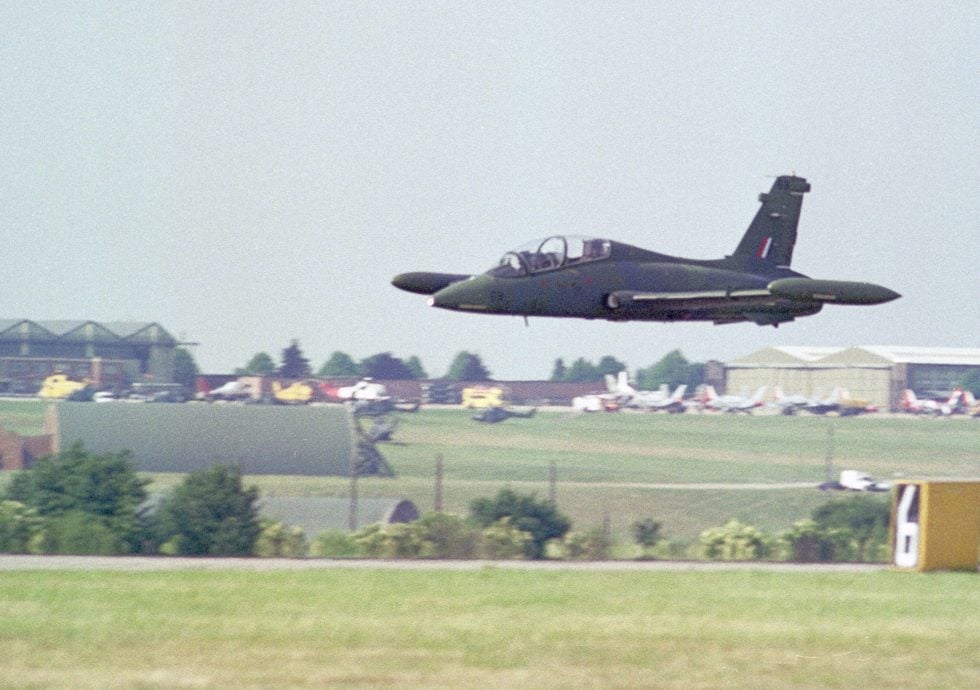
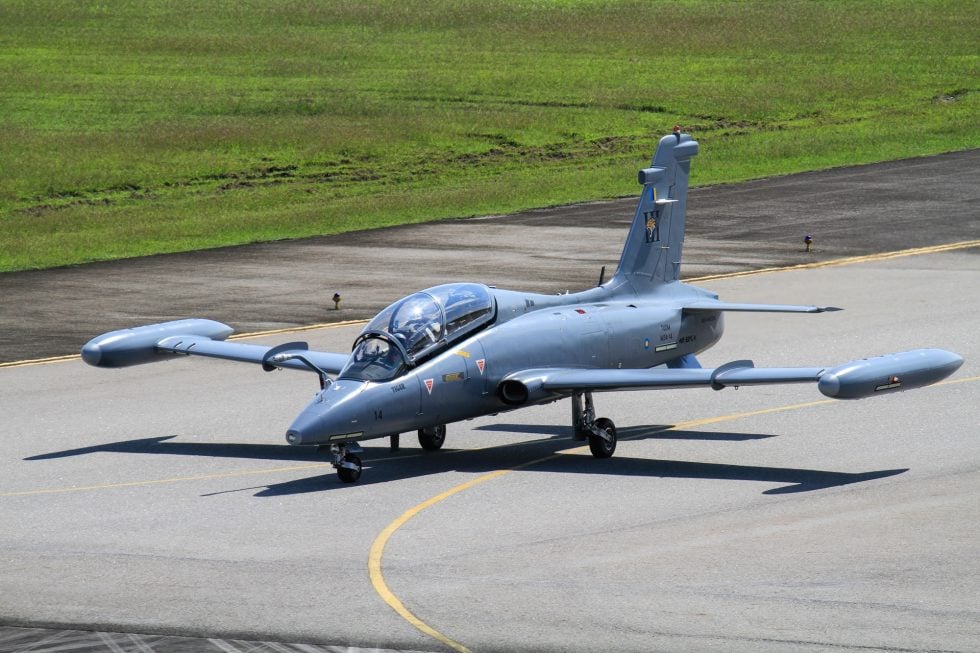
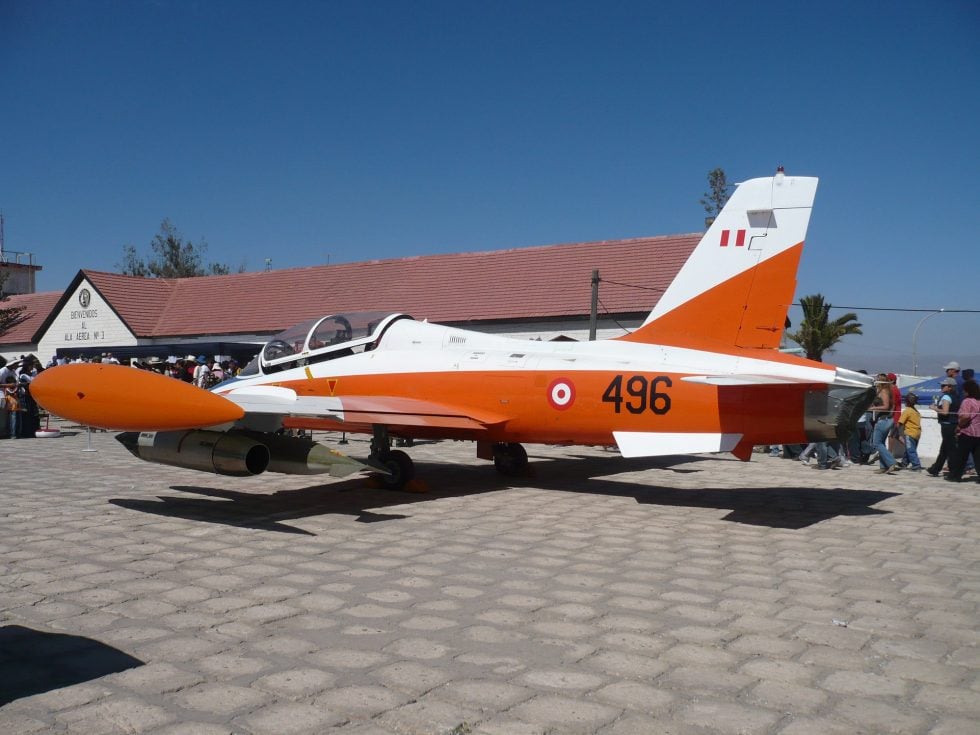
The MB-339 in motion
Video coming soon. We are selecting a suitable clip of the Aermacchi MB-339 — Frecce Tricolori display flying and Italian Air Force training sorties — to feature here. In the meantime, explore the gallery above and the stories below.
The MB-339 in motion
Growling Sidewinder — one of the most-watched MB-339 films on YouTube.
Where the MB-339 flies
A trainer that went to war
The MB-339 was never designed to fight, and its combat record is modest and sober. It saw action in Argentine hands during the 1982 Falklands War — most famously a single, daring attack on a British frigate — and again in Eritrean service against Ethiopia at the close of the 1990s. Its losses were real, and its story is inseparable from tragedy on the ground at Ramstein.
Compare the combat record of every military aircraft. Figures as of July 2026.
Everything people ask about the MB-339
Can a civilian fly in an MB-339?
What is the Aermacchi MB-339?
Why do the Frecce Tricolori fly the MB-339?
Did the MB-339 see combat?
What happened at the Ramstein air show?
How fast is the MB-339?
Who else flew the MB-339?
Is the MB-339 still in service?
You can’t fly the MB-339.
These, you can.
Some legends only live in museums — others are fuelled and waiting. MiGFlug has put civilians in real military jet cockpits since 2004.
 Fly the L-39 AlbatrosThe world’s most-flown jet trainer — aerobatics included
 Fly the F-104 Starfighter“The missile with a man in it”
 Fly the MiG-21The Cold War’s most-produced jet
 Fly the T-33 Shooting StarAmerica’s first jet trainer
 Fly the DH VampireA piece of early jet history
 Fly the S.211Agile Italian jet trainer
 Fly the MB-326The classic Aermacchi jet
 Fly the MiG-15The Soviet legend of the Korean War
Continue the tour
Every fact, checked
- GlobalSecurity.org — Aermacchi MB.339Development history, variants and service overview.
- Global Military — MB-339 specifications & operatorsSpecifications, variants and operator listing.
- Military Factory — Aermacchi MB.339Airframe data and armament options.
- Difesa Online — The Argentine MB-339s of the MalvinasDetailed account of Crippa’s attack and the 21 May 1982 loss.
- Key.Aero — A Frecce Tricolori pilot recalls RamsteinFirst-hand account of the 1988 disaster.
- The Aviationist — Frecce Tricolori historyThe team’s adoption of the MB-339 and its display record.
- flugzeuginfo.net — MB.339 technical dataCross-reference for dimensions and performance.
- Naval-History.net — San Carlos air battles, 21 May 1982Falklands air-action reference for the MB-339 sorties.