
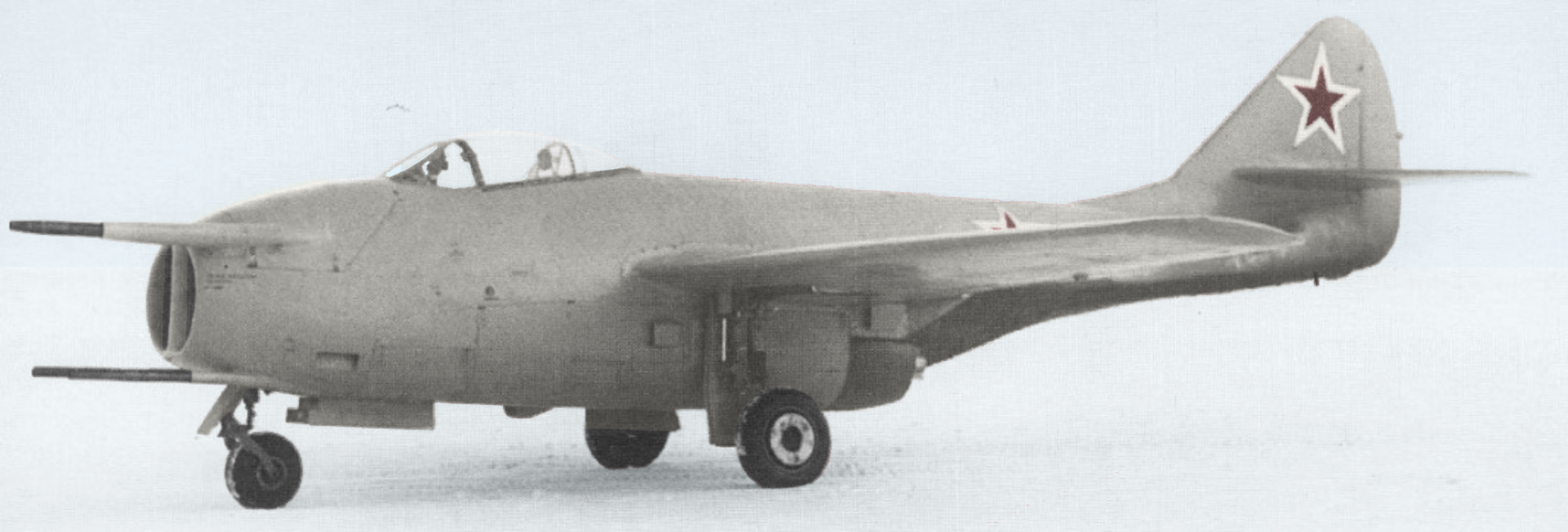
Mikoyan-Gurevich MiG-9
“Fargo”
The Soviet Union’s first jet fighter — a straight-winged interim design flown on two reverse-engineered German turbojets, overtaken within three years by the swept-wing MiG-15 it helped make possible.
The Soviet Union’s first jet fighter
When the Second World War ended, the Soviet Union had no jet fighter and no jet engine of its own worth the name. What it did have, after the fall of Germany, was access to German turbojet technology — captured hardware, drawings and, in some cases, the means to build the engines outright. Out of that windfall came the Mikoyan-Gurevich I-300, the prototype that would enter service as the MiG-9: the first jet fighter the USSR ever fielded.
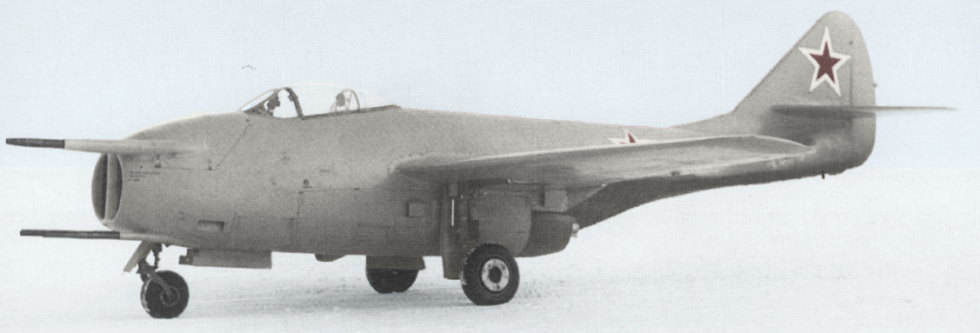
The engineering choice at its heart was pragmatic. Rather than wait for an indigenous engine, the design bureau built the aircraft around two copies of the German BMW 003 axial turbojet, produced in the Soviet Union as the RD-20. Two of these slim engines sat side by side in the lower fuselage, fed by a single nose intake — a simple, conventional layout with an unswept wing. It was not radical; it was buildable, quickly.
The MiG-9 first flew on 24 April 1946, and it did so on the same day as its rival, the Yakovlev Yak-15. A widely repeated story — popularised by the aviation writer Bill Gunston — holds that the two design teams tossed a coin to decide which jet would fly first. Whether or not the coin toss happened, the record is that the MiG-9 (as the I-300) lifted off that morning, ahead of the Yak-15 in the afternoon, making it the first Soviet jet aircraft to fly. Both are counted as the country’s first-generation jets.
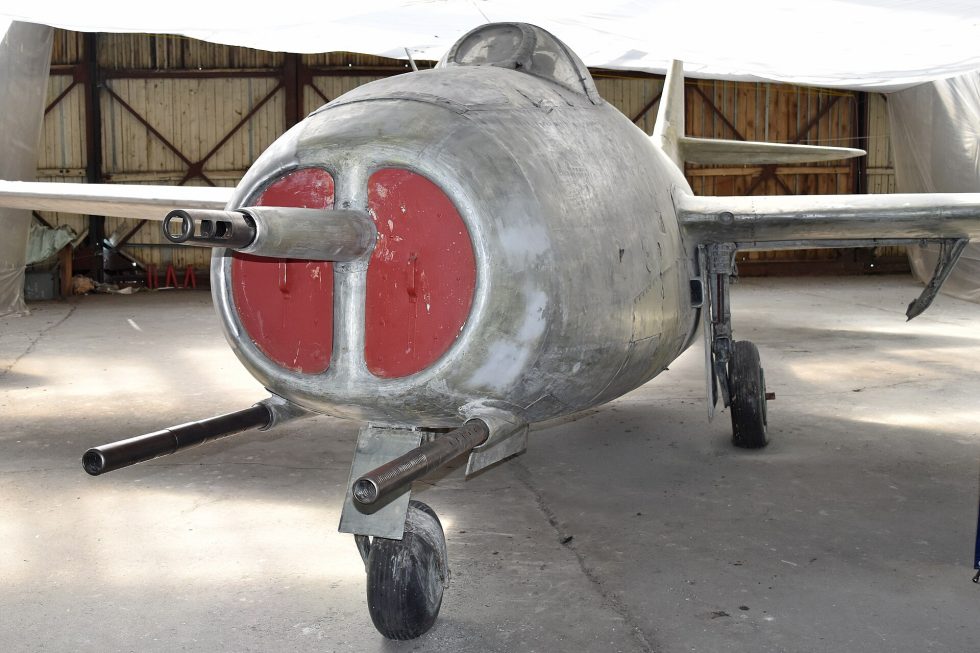
The aircraft carried unusually heavy gun armament for its day — a single large-calibre cannon flanked by two smaller ones, grouped in the nose around the intake. That concentration of firepower brought a notorious problem: at high altitude, the gas from the guns could be swallowed by the engine intake and cause the engines to flame out, a fault that took considerable work to tame. Combined with modest handling and the limitations of a first attempt, it marked the MiG-9 clearly as a transitional type.
Its service life was short. The straight-winged MiG-9 was rapidly overtaken by the swept-wing MiG-15, which flew in 1947 and transformed Soviet fighter aviation. In Soviet hands the MiG-9 was largely relegated within a few years. Its most substantial operational chapter came abroad: in 1950 several hundred were transferred to the People’s Republic of China, where they briefly equipped air-defence units before they too were superseded. Roughly 600 were built in all.
Judged on its own terms the MiG-9 was unremarkable — a cautious, conventional aircraft that borrowed its engines wholesale. Judged historically it is anything but: it is the jet on which the Soviet Union learned to fly jets, the immediate ancestor of the aircraft that would meet UN forces over Korea a few years later.
01The MiG-9’s German engines: how captured BMW 003 turbojets powered the first Soviet jet
The MiG-9 flew on two RD-20 engines — the Soviet production version of the German BMW 003 axial-flow turbojet, an engine that had powered late-war German aircraft such as the Heinkel He 162. With no comparable engine of its own ready in 1945–46, the Soviet aviation industry leaned directly on captured German designs: the MiG-9 used the BMW-derived RD-20, while its rival the Yak-15 used the RD-10, a copy of the Junkers Jumo 004. Each RD-20 produced only around 800 kgf (roughly 7.8–8 kN) of thrust, so two were needed. This borrowed foundation let the USSR field jets years earlier than a from-scratch programme would have allowed — but it also meant the first Soviet jet fighters were, at heart, flying on someone else’s engine.
What makes the MiG-9 special
Twin reverse-engineered turbojets
The MiG-9 was built around two RD-20 engines — Soviet-built copies of the German BMW 003. Mounted side by side low in the fuselage and fed by a single nose intake, they gave only about 800 kgf of thrust each, so the design needed a pair. It was the aircraft on which Soviet industry first put jet propulsion into a fighter.
A conventional straight wing
Unlike the swept-wing MiG-15 that soon replaced it, the MiG-9 kept an unswept, straight wing and orthodox aerodynamics. That made it straightforward to build and fly but capped its speed near 910 km/h and left it firmly in the subsonic, first-generation class — a design overtaken almost as soon as it entered service.
Heavy nose-cannon battery
The MiG-9 packed a hard punch: a single 37 mm N-37 cannon in the intake splitter, flanked by two 23 mm NS-23 cannon. Grouped tightly in the nose, this was formidable firepower for 1946 — and the source of the type’s most famous flaw, engine flameouts when the guns were fired at height.
02The MiG-9’s gun-gas problem: why firing the cannon could kill the engines
Grouping three cannon around the nose intake created an unexpected hazard. When the guns fired — especially the big 37 mm N-37 — the propellant gases were drawn straight into the engine intakes. At higher altitudes, where the air was already thin, that gas could disrupt combustion and cause the engines to flame out. For a fighter whose whole purpose was to close and shoot, an armament that could stall its own engines was a serious defect. Soviet engineers worked on the problem through modifications to gun installation and firing, but it remains the single detail most often cited about the MiG-9, and a textbook example of the teething troubles of early jet design.
03The MiG-9 versus the MiG-15: why the first Soviet jet was obsolete almost at once
The MiG-9 entered a field that was moving faster than any single aircraft could keep up with. Wartime German research had shown that swept wings delayed the drag rise near the speed of sound, and both East and West raced to exploit it. Mikoyan-Gurevich’s own answer, the swept-wing MiG-15, flew in December 1947 — barely a year and a half after the MiG-9 — and was dramatically faster and more capable, helped further by a British Rolls-Royce Nene engine the USSR was able to licence and copy. The straight-winged MiG-9 was left as a brief stepping stone: valuable for training a generation of pilots and ground crews on jets, but outclassed almost from the moment it reached squadrons.
Full MiG-9 specifications
Baseline note: the figures below describe the production MiG-9 — the I-301, factory code izdeliye FS — as built at State Aviation Factory No. 1 at Kuibyshev in 1947 and 1948 on two RD-20 turbojets, the Soviet-manufactured BMW 003A. It is the only fair column, because it is the only version that reached squadrons: the three I-300 prototypes were a moving target that killed a test pilot, and every other suffix on the list below is a single airframe or a project that was overtaken by the MiG-15. Deltas for the MiG-9M (I-308, izdeliye FR) and the two-seat MiG-9UTI (I-301T, izdeliye FT) are in grey. Three cautions before the numbers. First, this aeroplane was in front-line hands for about three years and its flight-test reports stayed classified for forty; the published set descends from a small number of Soviet documents released in the 1990s and is repeated rather than re-derived, so the spread between sources is wider than the tidy tables suggest. Second, engine thrust and engine life moved constantly — an RD-20 A1 and an RD-20 A2 are the same nominal 800 kgf and very different propositions on a squadron flight line — so read the propulsion column as a nameplate rather than as what a regiment got on a cold morning at Kubinka. Third, the MiG-9 is judged here against what it was for. It was not meant to be a good fighter; it was meant to put Soviet pilots and Soviet factories into the jet age in eighteen months, and on that test it succeeded completely while failing on almost every other.
Dimensions & weights
- Crew
- 1 — two on the MiG-9UTI, in tandem under a lengthened canopy, with dual controls and an intercom. Fuel fell by about a third to make room for the instructor, which left a trainer with less endurance than a fighter that already had too little
- Length
- 9.75 m (32 ft 0 in). Some tables give 9.83 m; the difference is where the measurement stops at the tail cone rather than any change to the airframe
- Wingspan
- 10.00 m (32 ft 10 in) — almost exactly as long as it was wide, which is what a fuselage stuffed with two engines and a 37 mm gun does to a fighter
- Height
- 3.225 m (10 ft 7 in) on the nosewheel. The MiG-9 was the first Soviet fighter designed around a tricycle undercarriage, for the same reason the P-59 and the Me 262 were: no propeller to keep out of the ground
- Wing area
- 18.20 m² (196 sq ft) — small, and the reason the aeroplane landed fast and turned indifferently. Mikoyan bought speed with area and paid for it everywhere else
- Aspect ratio
- 5.49 — conventional for 1945 and irrelevant by 1948. The wing is straight because TsAGI’s swept-wing data was still being translated out of captured German reports when the drawings were frozen
- Aerofoil
- TsAGI 1A10 at the root, TsAGI 1V10 at the tip — a wartime Soviet laminar-ish family, ten per cent thick, chosen because it was understood rather than because it was fast. The MiG-15 would use a thinner section on a 35-degree sweep and gain 150 km/h on barely more thrust
- Wing sweep
- None — a straight two-spar wing with a mid-fuselage mounting. This single line separates the MiG-9 from the MiG-15 more completely than any performance figure, and it is why an aeroplane that entered service in 1948 was a museum piece by 1952
- Empty weight
- 3,283 kg (7,238 lb). Other tables give 3,420 kg, which is an equipped rather than a bare figure; both circulate as "empty"
- Gross weight
- 4,860 kg (10,714 lb) — about the loaded weight of a La-7 and a half, on two engines that together made less static thrust than one Nene
- Internal fuel
- ~1,625 litres (~429 US gal) in fuselage and wing cells. The tanks were not self-sealing and there was no fire-suppression system, which on an aeroplane with two hot turbines under the pilot’s seat was a decision rather than an oversight. Sources differ: 1,610 litres is also commonly quoted
- Armament weight
- 176.7 kg of guns plus 115.4 kg of ammunition (390 lb and 254 lb) — some 292 kg of the gross weight, or six per cent of the aeroplane, devoted to three cannon. The MiG-9 was armed like a bomber-destroyer because that is exactly what the Soviet Air Forces expected to need
- External stores
- None — no pylons, no drop tanks, no bomb racks were fitted in service. Everything the MiG-9 could carry, it carried inside
Performance
- Maximum speed, sea level
- 864 km/h (537 mph) — genuinely fast for 1946 and far beyond any Soviet piston fighter. The Yak-15 that flew the same afternoon managed about 100 km/h less on one engine
- Maximum speed, altitude
- 910 km/h at 4,500 m (565 mph at 14,760 ft), Mach 0.74. This is within a whisker of the state requirement of 910 km/h at 5,000 m, one of the very few boxes the programme ticked exactly
- Never-exceed speed
- 1,050 km/h (650 mph), Mach 0.85 — a limit imposed by compressibility on a straight wing, and one the aeroplane could approach in a dive. Pilots reported the controls going heavy and the nose wanting to tuck well before the placard figure
- Rate of climb
- 22 m/s (4,330 ft/min) at sea level — roughly double a wartime Yak-3 and about half what the MiG-15 would deliver two years later
- Time to 5,000 m
- 4 min 18 s to 16,400 ft. The specification demanded four minutes flat and the aeroplane never quite made it; this is the shortfall that mattered least to anybody
- Service ceiling
- 13,000 m (42,650 ft) — and a cockpit that was not pressurised, so the pilot went there on a mask and stayed cold. The MiG-9M was to have fixed that; it never entered production
- Range
- 800 km (497 mi) on internal fuel — the type’s crippling number. With no drop tanks, an interceptor regiment could defend the airfield it stood on and very little else. First-generation axial turbojets were ruinously thirsty and the MiG-9 carried a fighter’s fuel load
- Endurance
- About 1 h 25 min at height — less at low level, and less again in the MiG-9UTI, whose reduced tankage made the trainer a notably short-legged aeroplane for the job of teaching
- Wing loading
- 267 kg/m² (55 lb/sq ft) at gross weight — high for the period and rising, which made the approach fast and unforgiving for pilots stepping straight off a Yak-9 or a La-7
- Thrust-to-weight
- 0.33 at gross weight on two engines of 800 kgf. Acceleration was leisurely and throttle response slower still: early axial jets took many seconds to spool, and a mishandled go-around had no second chance
- g limit
- +6 — a figure written after, not before, the first prototype shed its wing leading-edge fairings and killed Aleksei Grinchik on 11 July 1946. The wing structure and the tailplane were both reinforced before the type went to squadrons, and production was halted mid-1947 to do it again
- Altitude limit on gunfire
- 10,100 m with the "butterfly" vane fitted (33,100 ft) — the single most revealing performance number the MiG-9 has. Below that height all three guns could be fired together without flaming out the engines; above it they could not, and even the vane that bought the concession disintegrated after 813 rounds
Propulsion & systems
- Engines
- two RD-20 axial-flow turbojets — the Soviet production form of the German BMW 003A, developed for manufacture by S. D. Kolosov at Factory No. 16 in Kazan. The first aircraft flew on captured German-built engines outright; there were not enough of them to equip a regiment, which is why the copy mattered more than the original
- Rated thrust
- 7.8 kN (800 kgf, 1,754 lbf) each, 15.7 kN (1,600 kgf) total. The afterburning RD-20F and RD-21 developed for the I-307 and the MiG-9M reached 1,000 to 1,050 kgf, and the Rolls-Royce Nene that ended the whole line offered 2,230 kgf from a single engine
- Engine architecture
- seven-stage axial compressor, annular combustor, single-stage axial turbine, pressure ratio about 3.1:1 at roughly 9,500 rpm — an axial layout, unlike the centrifugal Derwents and J31s the West began with. It was the harder road and the right one, and Soviet engine design took it first because that is what the captured drawings showed
- Engine life
- 10 hours, rising to 50 and later about 75 — the RD-20 A1 came off the line with a ten-hour overhaul interval, the A2 reached fifty, and later series about seventy-five. A ten-hour engine is not a weapon, it is a laboratory instrument with an air force wrapped round it, and this figure explains the type’s short service life better than any tactical shortcoming
- Installation
- both engines side by side in the lower fuselage, fed by a nose intake split by a vertical wedge — a pod-and-boom layout with the jet pipes exiting under a raised rear fuselage and the tailplane lifted clear of the efflux. It kept the wing aerodynamically clean and let the aeroplane fly on one engine, and it put the 37 mm gun in the splitter, which is where all the trouble came from
- Structure
- all-metal stressed-skin semi-monocoque, mid-mounted two-spar wing, retractable tricycle undercarriage — conventional 1945 practice throughout, with manual controls and no hydraulic boost. Airbrakes and a strengthened tail were retro-fitted during the 1947 production halt, having been left out of the original design
- Crew protection
- None to speak of — no ejection seat, no armour, no self-sealing tanks, no fire-suppression system and no cabin pressurisation on the production fighter. The MiG-9UTI trainers got ejection seats derived from Heinkel He 162 practice and the MiG-9M was to have a pressurised cockpit and a seat; neither reached the squadrons that needed them
- Sighting and avionics
- optical reflector gunsight, HF radio, no radar of any kind — an all-weather interceptor it was not. The one MiG-9 that ever carried real electronics was the MiG-9L testbed of 1949, fitted with a second cockpit and both a target-illuminating and a rearward-looking radar to develop guidance for the KS-1 Kometa anti-ship missile
- Production
- 610 airframes, 1946–1948, of which 604 were production machines — 48 fighters plus one OKB aircraft in March and April 1947, a halt for modifications, 243 more through the rest of 1947 and 302 in 1948, when the line was cleared for the MiG-15. A figure of about 600 is also widely quoted and the difference is whether prototypes are counted
- Factory
- State Aviation Factory No. 1, Kuibyshev — the evacuated Moscow plant that had built MiG-3s and Il-2s, and which would go on to build MiG-15s and, eventually, the R-7 rocket. Engine production was at Factory No. 16 in Kazan
- Unit cost
- Not reliably published — Soviet aircraft of this period were costed in internal rouble accounts that do not convert meaningfully, and no audited figure for the MiG-9 has entered the open literature. Any dollar price quoted for one should be treated as invention
- Service dates
- In Soviet service 1948–1952 — regiments in the 1st, 7th, 14th, 15th and 16th Air Armies, and the 177th Fighter Aviation Regiment of the 303rd Fighter Aviation Division near Yaroslavl in 1949. Chinese service ran into the middle 1950s, almost entirely as a conversion trainer
04The MiG-9’s operating costs: why no reliable price exists
The MiG-9 was a Soviet state product of the late 1940s, built for the air force and never sold on an open market, so no meaningful flyaway unit price or cost-per-flight-hour figure exists in the public record. Unlike Western aircraft of the era, its programme costs were absorbed into the centrally planned Soviet economy and were never expressed in comparable dollar terms. Any specific cost figure attached to a MiG-9 today should be treated as an estimate or a conversion of doubtful precision, not a sourced number.
Armament & payload
The MiG-9 carried the heaviest gun battery of any 1946 jet fighter, in the one place it could not use it
The Soviet Air Forces asked for a bomber-killer and got one. The production MiG-9 carried a 37 mm Nudelman N-37 with forty rounds and two 23 mm Nudelman-Suranov NS-23K with eighty rounds apiece, all three grouped in the nose around the intake — a heavier throw-weight than the Meteor F.4, the P-80A or the Vampire could manage, and enough that a single N-37 shell was expected to bring down a four-engined aeroplane. Then Mikoyan mounted the N-37 in the splitter wedge that divided the nose intake between the two engines, so that its muzzle blast fired directly into the airflow feeding both. Above roughly 7,000 m the gun gas was enough to stall the compressors and flame out both engines at once, leaving the pilot high, cold and gliding a 4.8-tonne aeroplane with no relight guarantee. The OKB tried a muzzle brake, an extended barrel, a hollow "butterfly" vane on the barrel that raised the safe firing height to 10,100 m before disintegrating after 813 rounds, and on the I-302 it moved the cannon out to the fuselage side altogether. Nothing worked, and the aeroplane went to squadrons with a firing restriction rather than a fix. Fits varied: the original 1945 requirement specified a 57 mm N-57 with 28 rounds alongside the pair of 23 mm guns, prototypes flew with several arrangements, the I-307 was trialled with a 45 mm weapon, and the MiG-9M rearranged the whole battery around a pressurised cockpit. Ammunition counts in particular differ between Soviet documents.
Gun
- One 37 mm Nudelman N-37 autocannon with 40 rounds, in the intake splitter under the nose — about 400 rounds per minute, a 735 g high-explosive incendiary shell, and roughly six seconds of firing
- Two 23 mm Nudelman-Suranov NS-23K autocannon with 80 rounds each, one in each side of the nose beside the intake lips
- Guns and ammunition together weighed some 292 kg, about six per cent of the loaded aeroplane
- A 57 mm N-57 with 28 rounds was in the original specification and flew on prototypes; it was dropped as unmanageable in an airframe this size
- The I-307 was trialled with a 45 mm cannon, and the I-302 moved the big gun off the centreline — neither experiment reached production
Air-to-air
- None beyond the guns. No guided air-to-air weapon existed in Soviet service in the MiG-9’s lifetime, and none was fitted or planned
- The MiG-9 has no recorded air-to-air victory and no combat loss. No Soviet regiment took it to war, and the Chinese kept theirs at home
- In 1951, under Soviet pressure, the PLAAF weighed sending MiG-9 units to Korea; its own commanders reported that retraining the pilots onto MiG-15s would be a better use of them, and that view prevailed
- Against the B-29 the battery was well judged; against an F-86 the straight wing settled the matter before the guns were relevant
Air-to-surface guided
- None carried. The MiG-9 had no pylons and no ground-attack role of any kind
- Its one real contribution to guided weapons was as a laboratory: the MiG-9L of 1949, factory code izdeliye FK, was rebuilt with a second cockpit for a guidance operator, a target-illuminating radar and a rearward-looking set
- The MiG-9L flew for about four years developing the guidance chain for the KS-1 Kometa, the air-launched anti-ship missile that armed the Tu-16KS — a far longer and more useful career than most MiG-9s had
- No production MiG-9 ever launched a missile of any kind
Bombs
- None. The production MiG-9 had no bomb racks, no shackles and no bombing sight
- This was deliberate rather than an omission: the type was procured as a point-defence interceptor to meet high-flying bombers, and there was neither fuel nor thrust to spare for anything else
- With 800 km of range and no external tankage, an offensive radius simply did not exist
- Soviet ground attack in these years belonged to the Il-10 and the piston-engined fighter regiments, and stayed there until the MiG-15bis and MiG-17 made jets useful for it
Rockets
- None carried in service. No underwing rocket rails were fitted to production aircraft
- Soviet wartime practice with the RS-82 and RS-132 did not transfer to the MiG-9: the wing was thin, small and structurally busy, and the aeroplane had already shed leading-edge fairings once with fatal results
- The only rocketry associated with the type is propulsion research on other airframes of the same generation, not stores carried on this one
- Unguided rockets returned to Soviet fighters with the MiG-15 and the ORO-57 pods, after the MiG-9 had left the front line
Pods & other stores
- Nothing external at all. No drop tanks, no gun pods, no camera nose and no reconnaissance conversion entered service
- The absence of a drop tank is the single most consequential gap in the list, and it is why the MiG-9 could not escort, patrol or deploy
- Internally the fit was a reflector gunsight, a gun camera and an HF radio: no radar, no pressurisation and no ejection seat on the fighter
- Muzzle devices count as the type’s real stores programme — the brake, the extended barrel and the "butterfly" vane were the only add-ons anyone fitted in numbers, and all three were attempts to stop the guns killing the engines
- The MiG-9UTI carried an instructor and an intercom in place of a third of the fuel, which is as close to a payload as this aeroplane came
Three typical loadouts
- Point defence, low and medium level
- One N-37 with 40 rounds · two NS-23K with 160 rounds · full internal fuel, clean airframe. The only combat configuration the MiG-9 ever had, and the one condition in which all three guns could be fired together without consequence: below about 7,000 m, or below 10,100 m once the vane was fitted.
- High-altitude interception, guns restricted
- Same battery, same fuel, with an operating limitation instead of a fix. Above the flameout height the pilot was expected to fire the 23 mm guns only, or to accept a double flameout and a relight attempt in the descent — an interceptor conditionally forbidden to shoot at the altitude interceptors work.
- Conversion training, Soviet and Chinese regiments, 1947–1954
- MiG-9UTI with two crew and roughly two-thirds fuel, or a single-seater with guns installed and unloaded. This was the type’s real work on both sides of the border: teaching pilots off Yak-9s and La-11s about spool-up lag, fast approaches, nosewheel technique and the fact that a jet does not slow down when the throttle closes.
Sourcing caveat: ammunition capacities, gun weights and the flameout altitudes quoted here come from Soviet test reports that were classified when written and only summarised in the open literature from the 1990s. The 7,000 m figure for unrestricted firing is an approximation that varies with air temperature, engine condition and which gun is fired; the 10,100 m figure with the butterfly vane is precise because it comes from a specific trials report. No MiG-9 ever fired its guns in anger.
Variants
Every MiG-9 variant was an attempt to make the first Soviet jet worth keeping, and the MiG-15 answered the question first
The MiG-9 has an unusually long variant list for an aeroplane that served four years, and almost every entry on it is a single airframe. That is the signature of a design bureau learning in public: two engines or one, afterburner or not, cannon here or there, pressurised or open. The OKB was not refining a successful fighter but running experiments on a platform that happened to exist, because in 1947 it was the only Soviet jet fighter that existed in numbers.
The pivot came from Britain. In 1946 a Labour government approved the export of Rolls-Royce Nene and Derwent centrifugal turbojets to the Soviet Union; the Nene gave 2,230 kgf where two RD-20s together gave 1,600, and it was reverse-engineered as the Klimov RD-45. Mikoyan’s I-320, izdeliye FN, was to be a Nene-engined MiG-9. Construction started late in 1947 and was abandoned, because by then the swept-wing S-01 that became the MiG-15 had flown on the same engine and made the whole straight-wing line pointless in a single afternoon. The MiG-9 production line at Kuibyshev was cleared for MiG-15s during 1948.
What the type left behind was not a lineage but a cadre. Roughly 600 airframes taught Soviet squadrons, and then Chinese ones, what a jet demanded of a pilot, a mechanic and a runway — and they learned it on an aeroplane whose guns could stop its engines, which concentrates the mind.
- I-300, izdeliye F (1945–1946, 3 prototypes)
- The prototypes, ordered by a Council of People’s Commissars decree of 26 February 1946 and an NKAP order of 27 March, on captured German BMW 003A engines. F-1 first flew at Khodynka on 24 April 1946 with Aleksei Grinchik at the controls, six minutes in the air, a few minutes ahead of the Yak-15 after the two teams tossed a coin for the honour. Grinchik was killed in the same aircraft on 11 July 1946 when wing leading-edge fairings tore away and struck the tailplane; Mark Gallai and Georgi Shiyanov resumed the programme on the rebuilt F-2 and F-3 that August.
- MiG-9, I-301, izdeliye FS (1947–1948, 604 production aircraft)
- The production fighter and the baseline above: two RD-20s, one N-37 and two NS-23K, unpressurised, no ejection seat. Built at Factory No. 1 in Kuibyshev in three tranches, with a halt after the first 48 to reinforce the tail, add airbrakes and revise the fuel system.
- MiG-9UTI, I-301T, izdeliye FT (1947, 2 built)
- Two-seat conversion trainer with tandem cockpits, dual controls, an intercom and ejection seats owing something to Heinkel He 162 practice, at the cost of a third of the fuel. The first aircraft was delivered on 17 January 1947 and rejected for hopeless visibility from the rear seat; the second, on 15 July, passed state acceptance trials and was recommended for production, by which time the aeroplane it trained pilots for was obsolete. Ten had been ordered; two were built.
- I-302, izdeliye FP (1947, 1 prototype)
- The N-37 moved off the intake splitter to the port side of the fuselage, the most direct attack on the flameout problem. It did not solve it, and the aeroplane was not proceeded with.
- I-305, izdeliye FL (1947, 1 airframe, not completed)
- A single-engined MiG-9 around one Lyulka TR-1 of 1,500 kgf, with a pressurised cockpit — the first attempt to build a Soviet fighter on a Soviet-designed turbojet rather than a German copy. Cancelled once the MiG-15 was flying.
- I-307, izdeliye FF (1947, 2 prototypes)
- Afterburning RD-20F and then RD-21 engines of 1,000 to 1,050 kgf, and trials with a 45 mm cannon. The first aircraft crashed on 19 August during state acceptance trials. Reheat bought speed the straight wing could not use.
- MiG-9M, I-308, izdeliye FR (1947–1948, 1 prototype)
- The definitive rework and the one that should have been built: RD-21 engines, a pressurised cockpit, an ejection seat, a raised canopy and rearranged armament with the big gun clear of the intake. It failed its state acceptance trials, and by then the MiG-15 had made the argument moot.
- I-320, izdeliye FN (1947, not completed)
- A MiG-9 around a single Rolls-Royce Nene I of 2,230 kgf, the engine Britain had just sold to Moscow. Construction began late in 1947 and stopped: the same engine had gone into a swept-wing aeroplane instead, and that aeroplane was the MiG-15.
- MiG-9L, izdeliye FK (1949, 1 conversion)
- A production fighter rebuilt as a guidance testbed for the KS-1 Kometa anti-ship missile, with a second cockpit for an operator, a K-1M target-illuminating radar and a rearward-looking set. It flew in this role for about four years, outlasting the type’s front-line career.
- Export and licence production (none)
- There was no licence-built MiG-9 and no export designation. The only foreign operator was the People’s Liberation Army Air Force, which received at least 372 second-hand Soviet airframes when six Soviet divisions — each of two regiments of 31 aircraft, at Shenyang, Tangshan, Guangzhou, Shanghai, Gongzhuling and Peking — handed over their equipment in November and December 1950. They gave the PLAAF its first jet units and its first jet-qualified pilots; Chinese licence production of jets began later, with the MiG-15 and the MiG-17.
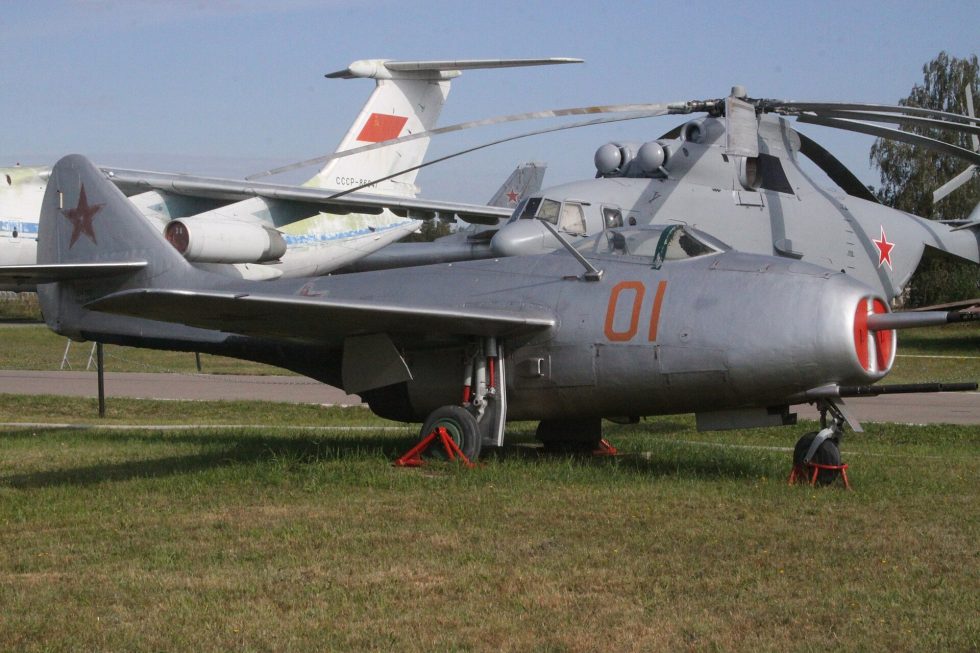
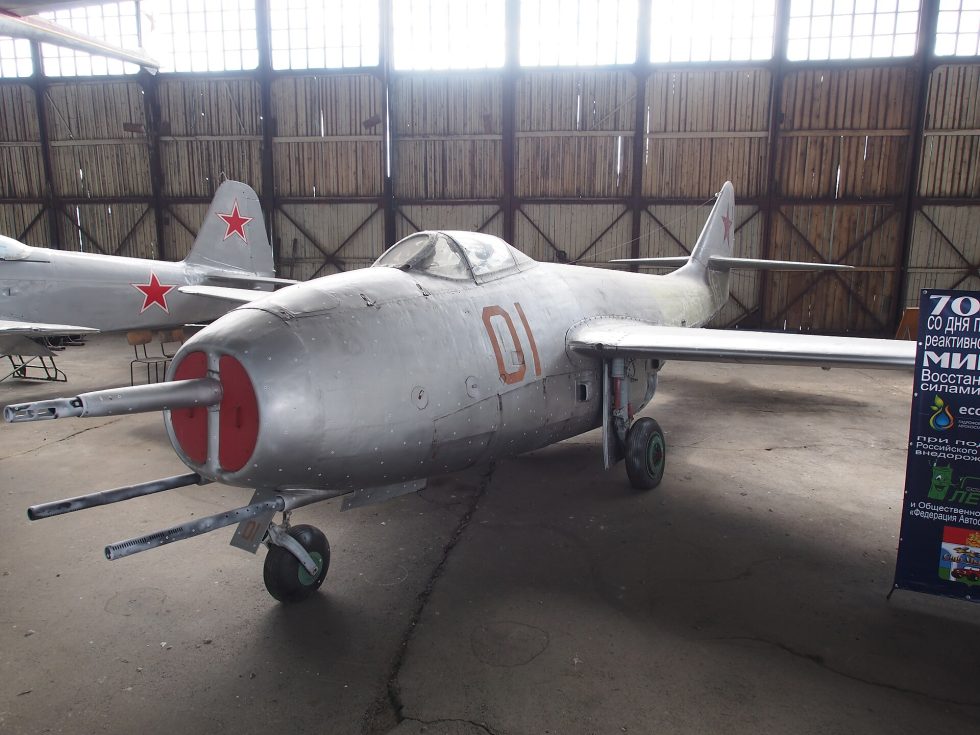
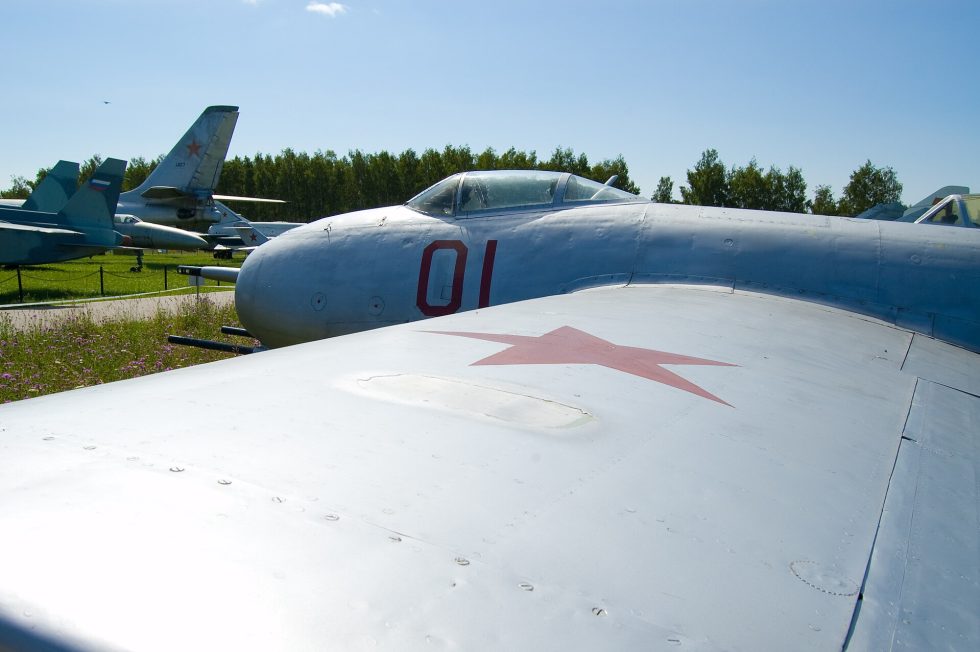
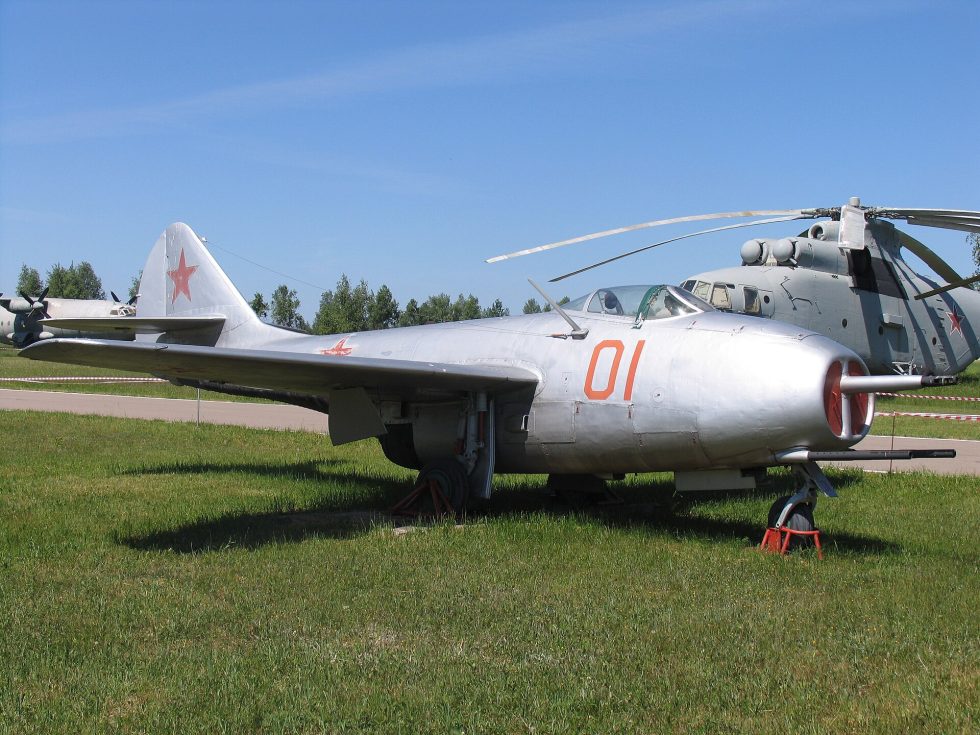
Survivors, stated precisely. Of roughly 610 built, the standard references say three survive, and only two can be pinned to an address with confidence. The first is Red 01, construction number 114010, at the Central Air Force Museum at Monino outside Moscow, displayed indoors among the OKB collection. The second is White 30 at the China Aviation Museum at Datangshan, north of Beijing, one of the aircraft handed over in 1950 and the only MiG-9 outside Russia. The third airframe commonly counted in the total is not consistently identified in the published sources, and no location for it can be corroborated here; readers should treat "three survive" as a count that outruns its evidence. All of these are original airframes — there are no MiG-9 reproductions, no replicas and no composite rebuilds, because nobody has ever had a commercial reason to make one. None has flown since the 1950s, and none is airworthy or under restoration to fly. For a type built in six hundred examples and operated by two air forces, that is an unusually thin survival, and it is the ordinary fate of an aeroplane that was obsolete before it was worn out: the MiG-9s were not preserved, they were scrapped for the metal and the engines.
From German engines to Chinese air defence
German jet technology captured
With the fall of Germany, the USSR gains access to BMW 003 and Junkers Jumo 004 turbojets — the basis of the first Soviet jet engines.
First flight, 24 April
The Mikoyan-Gurevich I-300 flies from Ramenskoye, ahead of the Yak-15 the same day — the first Soviet jet aircraft to take off.
Ordered into production
The type is rushed into series production as the MiG-9, the Soviet Union’s first operational jet fighter.
Public debut
MiG-9s appear in Soviet aviation displays and begin equipping fighter units as jets enter front-line service.
The MiG-15 arrives
The swept-wing MiG-15 flies in December 1947 and enters production — immediately outclassing the straight-winged MiG-9.
Transfer to China
Several hundred MiG-9s are supplied to the People’s Liberation Army Air Force to help defend Chinese cities.
Withdrawn
Overtaken by the MiG-15 and later types, the MiG-9 is quickly relegated to training and second-line duties, then retired.
A single survivor
One intact MiG-9 is preserved at the Central Air Force Museum at Monino, near Moscow — the type’s main surviving example.
Twelve MiG-9 stories
A jet fighter from captured engines
With no jet engine of its own, the USSR built its first fighter around German turbojets.
Read the full story
The same-day first flight
On 24 April 1946 the MiG-9 and the Yak-15 both made their maiden flights — hours apart.
Read the full story
The coin-toss story
A famous tale says the two design teams tossed a coin to decide who flew first.
Read the full story
Guns that stalled the engines
Firing the cannon at altitude could make the MiG-9’s engines flame out.
Read the full story
A 37 mm cannon in the nose
The MiG-9 carried a big 37 mm N-37 flanked by two 23 mm cannon.
Read the full story
Why it kept a straight wing
The MiG-9 used conventional unswept wings just as the swept-wing revolution arrived.
Read the full story
Overtaken by the MiG-15
The swept-wing MiG-15 flew in 1947 and made the MiG-9 obsolete almost at once.
Read the full story
Defending Chinese cities
In 1950 several hundred MiG-9s were transferred to the Chinese air force.
Read the full story
About six hundred built
Roughly 610 MiG-9s were produced, including prototypes.
Read the full story
More than one MiG-9
Several sub-variants explored two-seat, uprated and modified configurations.
Read the full story
The Monino survivor
One intact MiG-9 survives, at the Central Air Force Museum near Moscow.
Read the full story
The jet that taught the USSR jets
The MiG-9 mattered less for what it did than for what it started.
Read the full story
The MiG-9 in pictures
Where the MiG-9 flew
A fighter that barely fought
The MiG-9 saw almost no air combat. It reached service just as the far superior MiG-15 arrived, and was withdrawn from front-line Soviet units within a few years. Its most substantial use was as an interim air-defence type — in the Soviet Union and, from 1950, in China — rather than as a combatant. The type is not credited with confirmed air-to-air victories.
Compare the combat record of every military aircraft. Figures as of July 2026.
Everything people ask about the MiG-9
Can I fly in a MiG-9?
Why is the MiG-9 historically important?
What engines did the MiG-9 use?
Did the MiG-9 really fly the same day as the Yak-15?
Why could firing the guns stop the engines?
What replaced the MiG-9?
Did China use the MiG-9?
Are any MiG-9s left?
You can’t fly the MiG-9.
These, you can.
Some legends only live in museums — others are fuelled and waiting. MiGFlug has put civilians in real military jet cockpits since 2004.
 Fly the L-39 AlbatrosThe world’s most-flown jet trainer — aerobatics included
 Fly the F-104 Starfighter“The missile with a man in it”
 Fly the MiG-21The Cold War’s most-produced jet
 Fly the T-33 Shooting StarAmerica’s first jet trainer
 Fly the DH VampireA piece of early jet history
 Fly the S.211Agile Italian jet trainer
 Fly the MB-326The classic Aermacchi jet
 Fly the MiG-15The Soviet legend of the Korean War
Continue the tour
Every fact, checked
- PlaneHistoria — The MiG-9, Russia’s First Jet FighterDevelopment, RD-20 engines, armament and service overview.
- Afterburner.com.pl — 24 April 1946: first flight of Yak-15 and MiG-9The same-day first flights, flight times and the coin-toss legend.
- Military Factory — MiG-9 “Fargo”Specifications, NATO reporting name and variant list.
- AeroCorner — Mikoyan-Gurevich MiG-9Dimensions, weights, performance figures and production numbers.
- The Little Aviation Museum — MiG-9Production total, gun-flameout note and the 1950 transfer to China.
- HistoryNet — History of MiGsContext on the Mikoyan-Gurevich bureau and the early Soviet jet programme.
- National Museum of the US Air ForceReference for early Soviet jet fighters and the MiG lineage.
- Wikimedia Commons — MiG-9 mediaSource and licensing for the preserved-aircraft and archival photographs used here.