
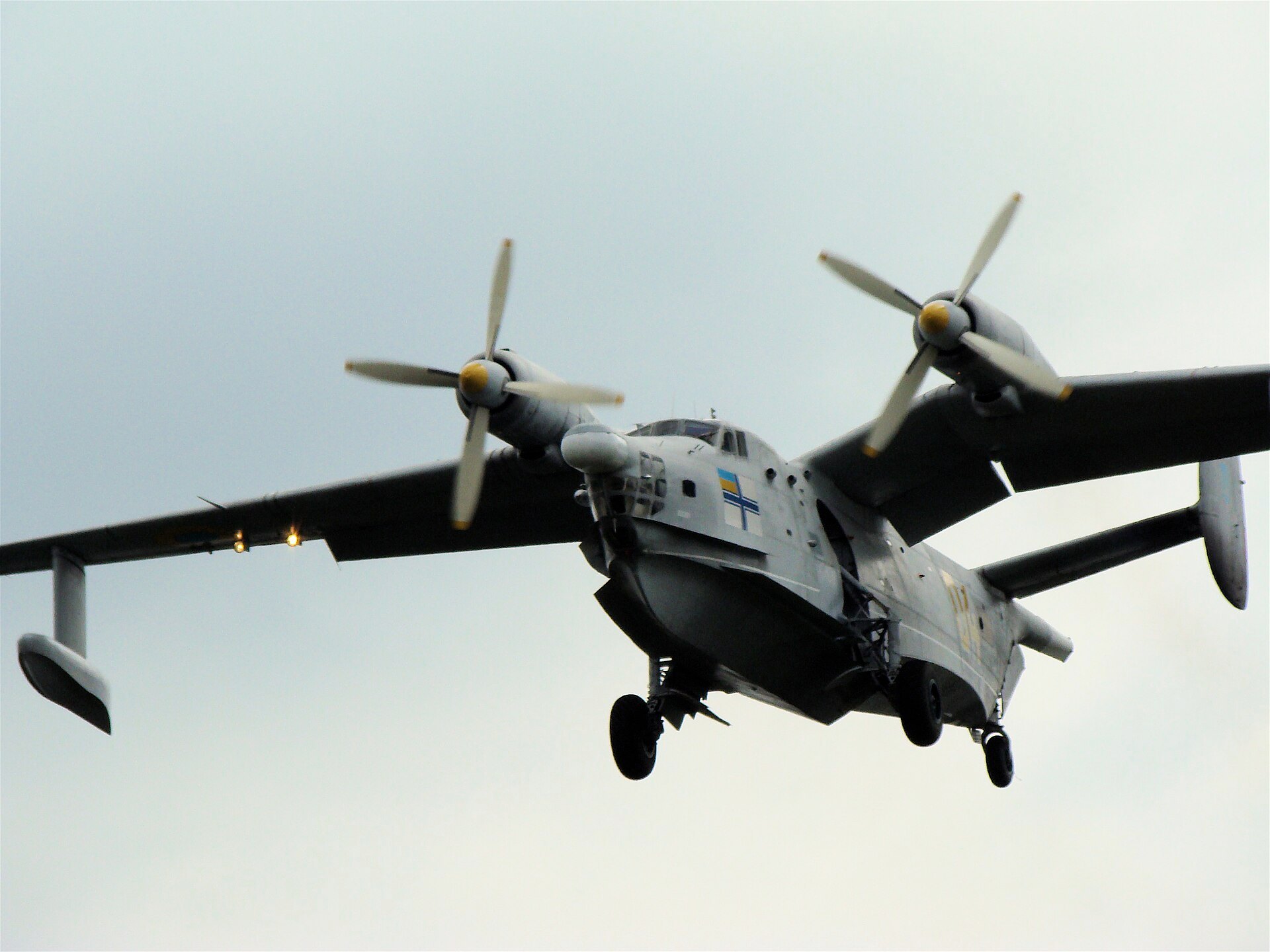
Beriev Be-12 Chayka
“Mail” Amphibian
The gull-winged Soviet amphibian that hunted submarines from water and land, set dozens of world records, and is still patrolling the Black Sea more than sixty years after its first flight.
The Be-12: how the last great military flying boat went to war against submarines
On the shores of the Sea of Azov at Taganrog, Georgy Beriev’s design bureau had been building flying boats since the 1930s. Its post-war piston-engined Be-6 served the Soviet Navy well, but by the late 1950s the submarine threat demanded something faster, longer-ranged and better equipped. Beriev’s answer was the Be-12 Chayka, or “Seagull”: a twin-turboprop amphibian with a deep boat hull, retractable landing gear and a striking gull wing that lifted the propellers high above the spray. The prototype flew from Taganrog on 18 October 1960. NATO called it “Mail”. It was the last large military flying boat to enter series production in the Soviet Union, and one of the last anywhere.
The Be-12 was designed to do the Il-38’s job closer to shore, and to do it from either a runway or open water. It carried a search radar in a long nose fairing above a glazed navigator’s station, a magnetic anomaly detector in a tail sting, sonobuoys, and torpedoes, depth charges and mines in a bay in the bottom of the hull. A crew of about four flew it: two pilots, a navigator and a radio operator. The type was formally accepted by the Navy in 1965, and production at Taganrog ran until 1973, with figures usually given between about 140 and 150. Be-12s served with all four Soviet fleets, and crews used it to set a long string of world records for amphibious aircraft.
As submarines grew quieter and faster, the Be-12’s anti-submarine role faded and many were converted for search and rescue, transport and even firefighting. Small numbers went to Egypt, Vietnam and, after the Soviet collapse, Ukraine and Azerbaijan. Yet the Chayka refused to die. Since 2022 Russia’s last handful of Be-12s have flown patrols off Crimea, watching for Ukrainian sea drones, and in September 2025 Ukrainian drones struck them on the ground for the first time. Few military aircraft of the 1960s have remained so busy for so long. Its survival owes much to its simplicity and to the scarcity of anything else that can do the job: a modern replacement amphibian for the Russian Navy has been discussed for years but never bought in numbers.
01The Be-12’s world records: a Soviet showcase
The Soviet Union liked to demonstrate its aviation achievements through world records, and the Be-12 was a prolific record-breaker. Russian sources credit it with 46 world records over its career, while GlobalSecurity gives 42; the exact number depends on how records in different categories are counted. They were set in the categories for amphibians and seaplanes.
The records served several purposes. They showed off a new type to the world without revealing its military equipment, they gave test and service crews a chance to push the aircraft, and they kept Beriev’s name in the news at a time when most of its work was secret.
The Be-12 also proved the hydrodynamic and aerodynamic principles that Beriev would apply to its much later jet amphibians. A firefighting Be-12P was used to test systems for the Be-200, and the Taganrog factory remains the world’s best-known builder of large amphibians. Records also served the bureau internally: they built confidence in the hull, engines and structure that service crews would rely on far out at sea, and they gave Beriev a prestige that helped it survive into the post-Soviet era.
02The Be-12 in the Black Sea war: an old boat finds a new job
By the 2020s the Be-12 should have been a museum piece. Its anti-submarine equipment dated largely from upgrades in the 1970s, and The War Zone noted in 2022 that it lacked any self-protection equipment. But Ukraine’s war at sea created a new mission. With Ukraine using uncrewed surface vessels to attack Russian ships and bases, Russia needed eyes over the waters around Crimea, and the Be-12’s glazed nose, long endurance at low level and ability to operate far from shore made it useful in airspace Russia controlled.
From summer 2022 the Be-12s at Kacha, near Sevastopol, were seen patrolling off Crimea. The International Institute for Strategic Studies counted six in Russian service in early 2023, and satellite imagery later showed seven or eight airframes at Kacha, only four or five of them airworthy. On 21 September 2025 Ukraine’s military intelligence said its special forces had struck Kacha with drones and destroyed two Be-12s and damaged a Mi-8 helicopter. For a fleet that had not been built for half a century, every loss was irreplaceable.
What makes the Be-12 special
The gull wing
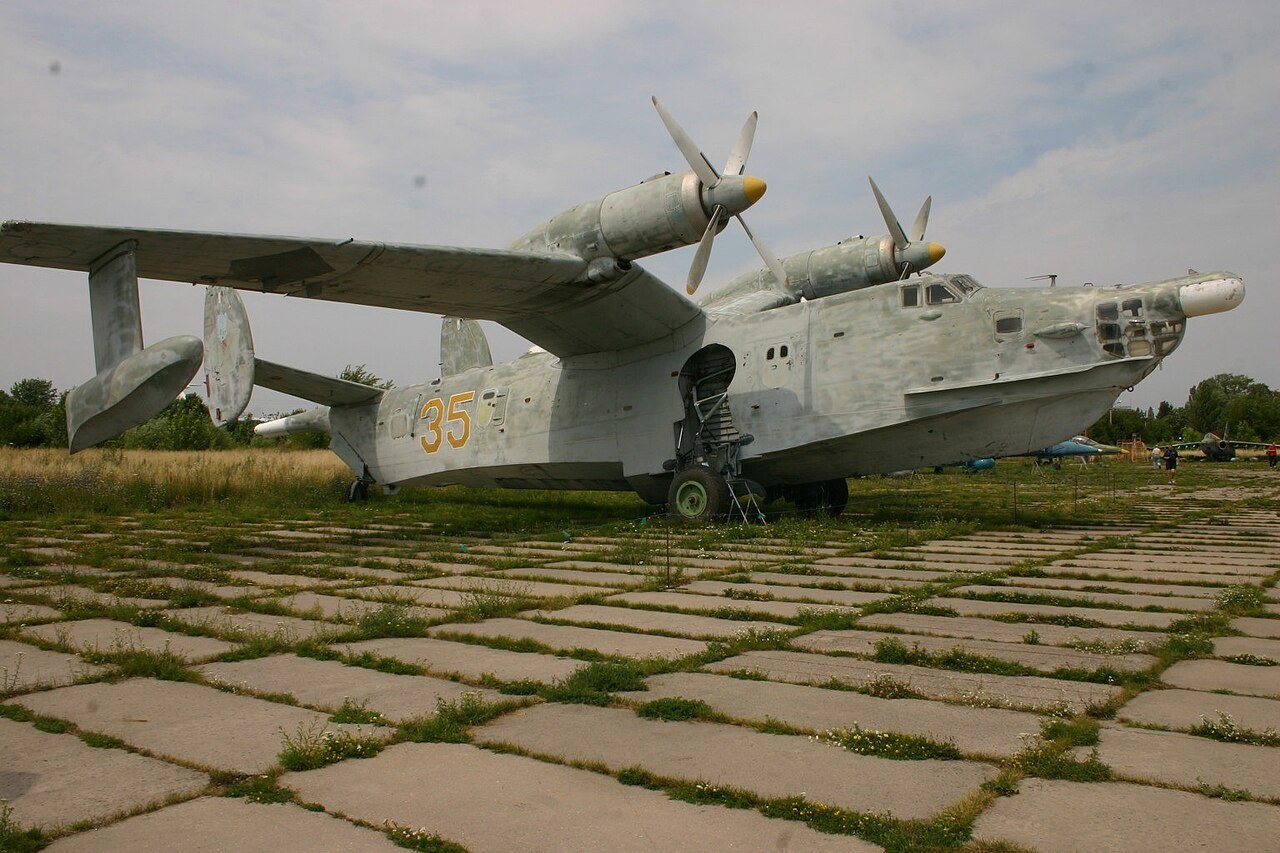
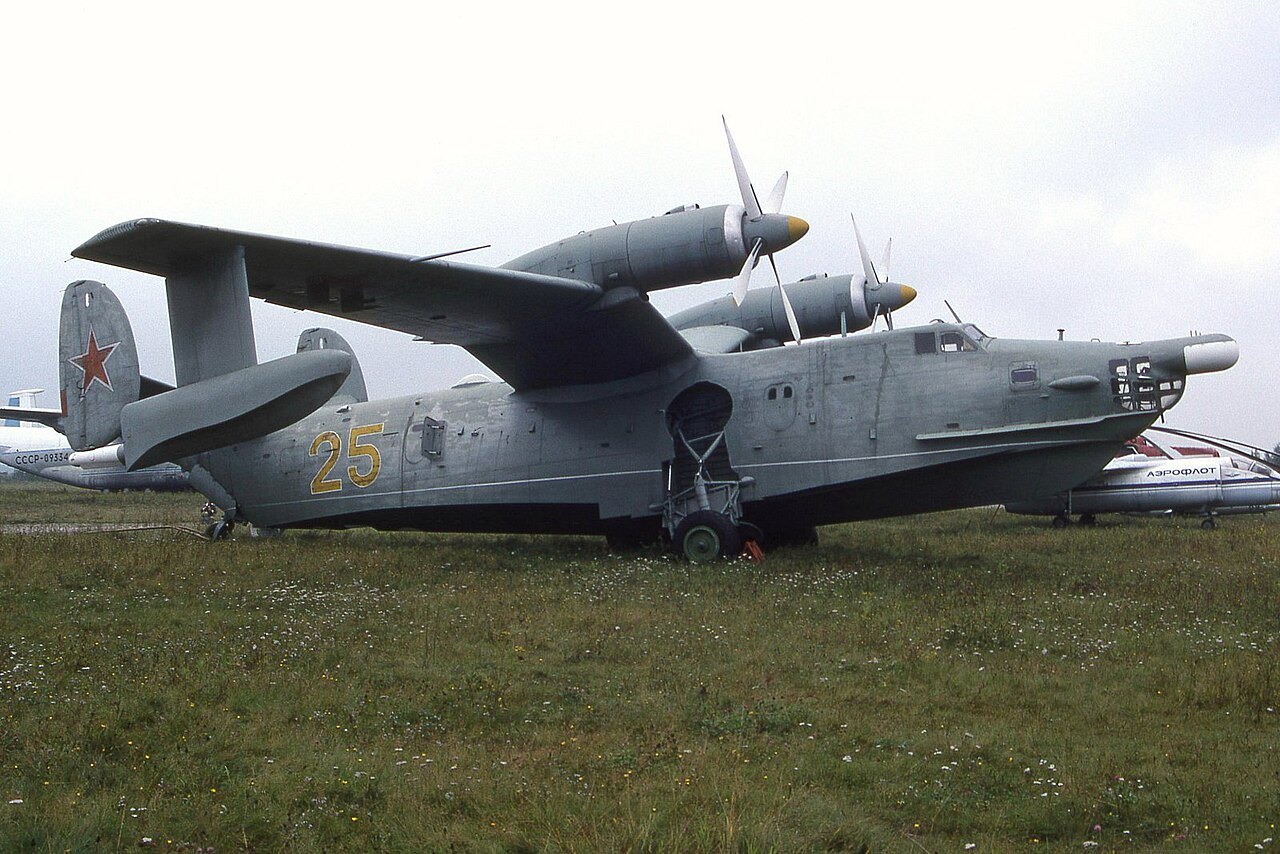
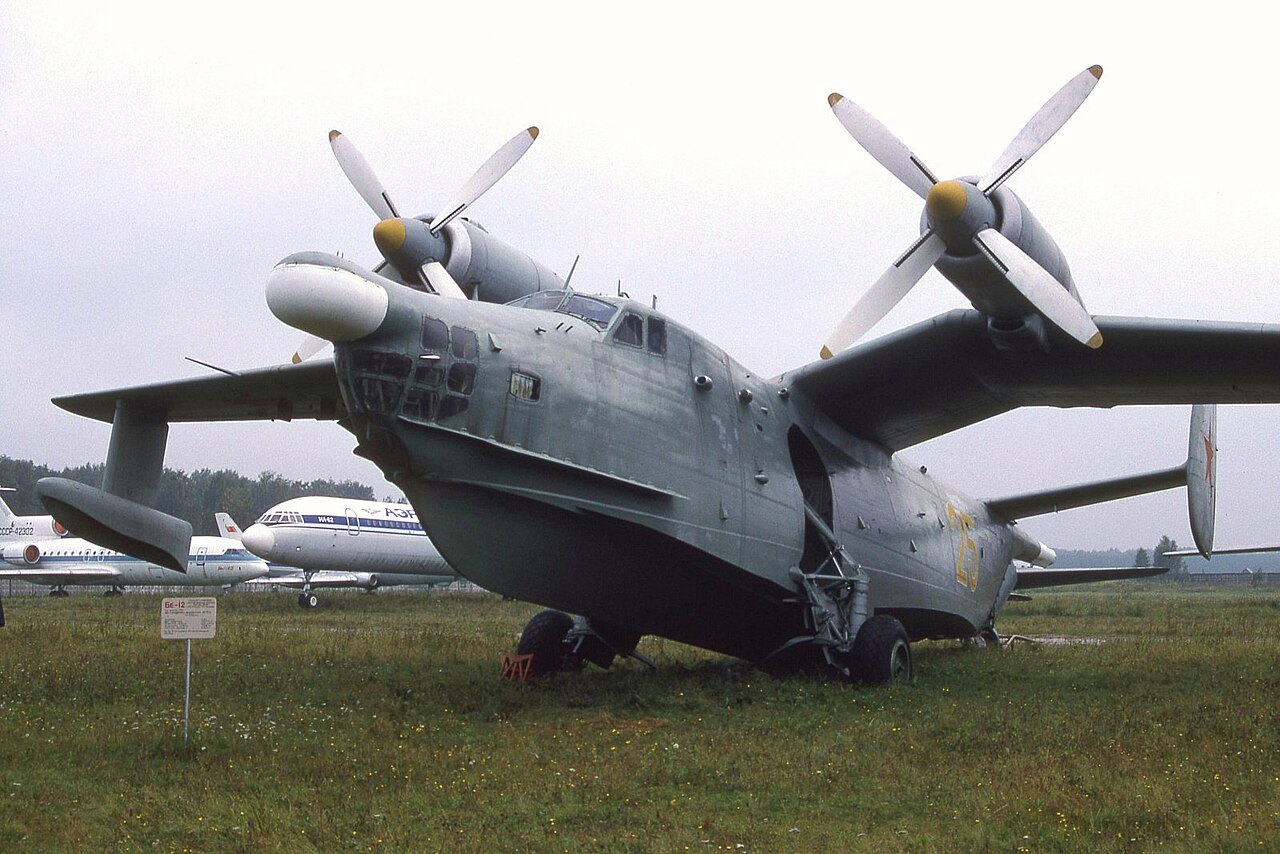
The Be-12’s most recognisable feature is its gull wing, sharply cranked upwards from the hull and then running out level. The shape places the two big turboprops and their propellers as high as possible above the water, keeping them clear of spray during take-off and landing at sea. Small floats under the outer wings stabilise the aircraft on the water, and a twin-fin tail sits clear of the waves. It is a classic flying boat solution, applied to a turboprop aircraft built at the dawn of the jet age.
Water or land
Unlike many flying boats, the Be-12 is a true amphibian, with a retractable tailwheel undercarriage that lets it operate from ordinary airfields as well as from the sea. In practice it was most often based on land, but the ability to alight on open water gave commanders options: it could land beside a downed crew to rescue them, or operate from sheltered bays if airfields were lost. The deep boat hull also housed the weapons bay, opening in the bottom of the fuselage behind the step.
A hunter’s nose and tail
The front of the Be-12 combines a glazed nose for the navigator and observer with a long radar fairing above it, giving it an unusual layered profile. At the other end, a long tail sting houses the magnetic anomaly detector. In between, the aircraft carried sonobuoys, depth charges, torpedoes and mines, with a combat load of about 1.5 to 3 tonnes according to GlobalSecurity. A special version, the Be-12SK, was configured to carry a nuclear depth bomb. The radar, sonobuoys and magnetic anomaly detector together made the Be-12 a complete anti-submarine system in one airframe.
03The Be-12’s second careers: rescue, transport and fire
As the anti-submarine role passed to the Il-38, Tu-142 and helicopters, the Be-12 found other work. The Be-12PS was a search and rescue version that could carry rescue equipment and alight beside survivors. The Be-12NKh was a utility transport conversion. The Be-12P was converted to scoop water from lakes or the sea and drop it on forest fires, and a further aircraft, the Be-12P-200, tested the firefighting system for Beriev’s jet-powered Be-200.
These conversions kept the airframes useful long after their original purpose had faded. They also explain why the type survived the post-Soviet collapse: an amphibian that can fight fires, carry cargo and rescue people at sea has value even to a navy with little money.
Beriev Be-12 Chayka specifications
Specifications
- Crew
- 4
- Length
- 30.11 m (98 ft 9 in)
- Wingspan
- 29.84 m (97 ft 11 in)
- Height
- 7.94 m (26 ft 1 in)
- Empty weight
- 24,000 kg (52,911 lb)
- Max take-off weight
- 36,000 kg (79,366 lb)
- Powerplant
- 2 × Ivchenko AI-20D turboprops, commonly given as about 5,000 to 5,500 shp each
- Maximum speed
- About 530–550 km/h (286–297 kn); some sources quote up to about 610 km/h (329 kn)
- Patrol speed
- About 320 km/h (173 kn)
- Range
- About 3,300 km (1,780 nmi) typical; up to about 4,200 km practical and 7,500 km maximum in some sources
- Service ceiling
- About 8,000 m (26,250 ft); some sources give up to 11,280 m (37,000 ft)
- Armament
- About 1.5 to 3 tonnes of torpedoes, depth charges, mines and sonobuoys in an internal hull bay and underwing hardpoints
Costs & production
- Unit cost
- No reliable public figure; built only for the Soviet state
- Cost per flight hour
- No published figure; as an order-of-magnitude estimate, roughly US$3,000 to 8,000 per hour, based on the costs of twin-turboprop military aircraft of similar size
- Production
- About 140 to 150 aircraft (including prototypes), Taganrog, early 1960s to 1973
- Programme
- Conversions to search and rescue, transport and firefighting versions; no major modernisation since the 1970s
04The Be-12’s variants: hunters, rescuers and firefighters
- Be-12: original anti-submarine version.
- Be-12N: upgraded anti-submarine version with improved search equipment.
- Be-12SK: version configured to carry a nuclear depth bomb.
- Be-12PS: search and rescue version.
- Be-12NKh: utility transport conversion.
- Be-12P: firefighting conversion.
- Be-12P-200: testbed for the Be-200’s firefighting systems.
05The Be-12’s operating costs: the price of a boat hull
Flying boats are notoriously expensive to keep. Salt water attacks the airframe, engines and systems, and every landing on the sea demands careful washing and inspection afterwards. For that reason most Be-12s flew mainly from land. Neither Russia nor Ukraine publishes operating costs, and any hourly figure is an estimate; a few thousand US dollars per hour is a reasonable order of magnitude for a twin-turboprop aircraft of its size, excluding the additional corrosion work that water operations bring.
The Be-12 from Taganrog to the drone war
First flight
The Be-12 prototype flies from Taganrog on 18 October 1960.
Production
Series production begins at Taganrog.
Accepted
The Soviet Navy formally accepts the Be-12 into service.
Egypt
A small number of Be-12s operate in Egyptian markings around this time.
Production ends
The last Be-12s leave Taganrog after about 140 to 150 have been built.
Vietnam
Vietnam receives four Be-12s.
The Soviet split
After the Soviet collapse, Be-12s pass to Russia, Ukraine and Azerbaijan.
Azerbaijan bows out
Azerbaijan retires its inherited Be-12s around this time.
Patrols off Crimea
Russian Be-12s begin regular patrols off Crimea, watching for Ukrainian sea drones.
Struck at Kacha
On 21 September Ukraine says drones destroyed two Be-12s at Kacha in Crimea.
Stories & eyewitnesses: the Be-12 at sea and at war
A record-breaking seagull
The Be-12 set more world records than almost any other military amphibian.
Read the full story
Egypt, around 1970: seagulls over the Mediterranean
The Be-12 followed the Il-38 to the Middle East.
Read the full story
Vietnam, 1981: an amphibian for the South China Sea
Hanoi received four Be-12s.
Read the full story
The nuclear seagull: the Be-12SK
Some Be-12s were configured to carry nuclear depth bombs.
Read the full story
Firefighter: the Be-12P
A submarine hunter learned to scoop water.
Read the full story
Ukraine’s Chaykas
The Soviet split divided the Be-12 fleet.
Read the full story
Off Crimea, 2022: hunting sea drones
A Cold War submarine hunter took on a new enemy.
Read the full story
Kacha, 21 September 2025: struck on the ground
Ukrainian drones hit the Be-12 for the first time.
Read the full story
Monino, Kyiv and Taganrog: Be-12s on display
The Chayka can be seen in museums in Russia and Ukraine.
Read the full story
The Be-12 in pictures
Where the Be-12 flies and flew
The Be-12’s record
The Be-12 spent the Cold War hunting submarines without ever attacking one in war, and much of its later life rescuing people and fighting fires. Its first real combat role came in the Russia-Ukraine war, patrolling off Crimea, where two were destroyed on the ground in 2025.
See how training and combat types compare in the military aircraft statistics database. Figures are approximate.
Everything people ask about the Be-12
Can I fly in a Beriev Be-12 Chayka?
What does Chayka mean?
Can the Be-12 land on water?
Why does the Be-12 have a gull wing?
Is the Be-12 still in service?
How many Be-12s were built?
What replaced the Be-12?
You can’t fly the Be-12.
These, you can.
Most of this museum you can only look at. These genuine military jets you can fly yourself with MiGFlug — with aerobatics and time on the controls.
 Fly the L-39 AlbatrosThe world’s most-flown jet trainer — aerobatics included
 Fly the F-104 Starfighter“The missile with a man in it”
 Fly the MiG-21The Cold War’s most-produced jet
 Fly the T-33 Shooting StarAmerica’s first jet trainer
 Fly the DH VampireA piece of early jet history
 Fly the S.211Agile Italian jet trainer
 Fly the MB-326The classic Aermacchi jet
 Fly the MiG-15The Soviet legend of the Korean War
Continue the tour
Every fact, checked
- Be-12 Chaika (Mail)GlobalSecurity: production, records, variants, transfers to Ukraine
- Be-12 specificationsGlobalSecurity: dimensions, weights and performance (figures vary between sources)
- Russia’s rickety Be-12 flying boats are still patrolling off CrimeaThe War Zone (Thomas Newdick, August 2022)
- Ukrainian drones strike Russia’s rare Be-12 flying boatsThe War Zone (Thomas Newdick, September 2025): Kacha strike and fleet size
- State Aviation Museum named after O.K. AntonovKyiv-Zhuliany museum with a preserved Be-12
- Ilyushin IL-38 May: the Russian OrionMarco P.J. Borst, Airborne Log 1996: context on Soviet naval aviation