
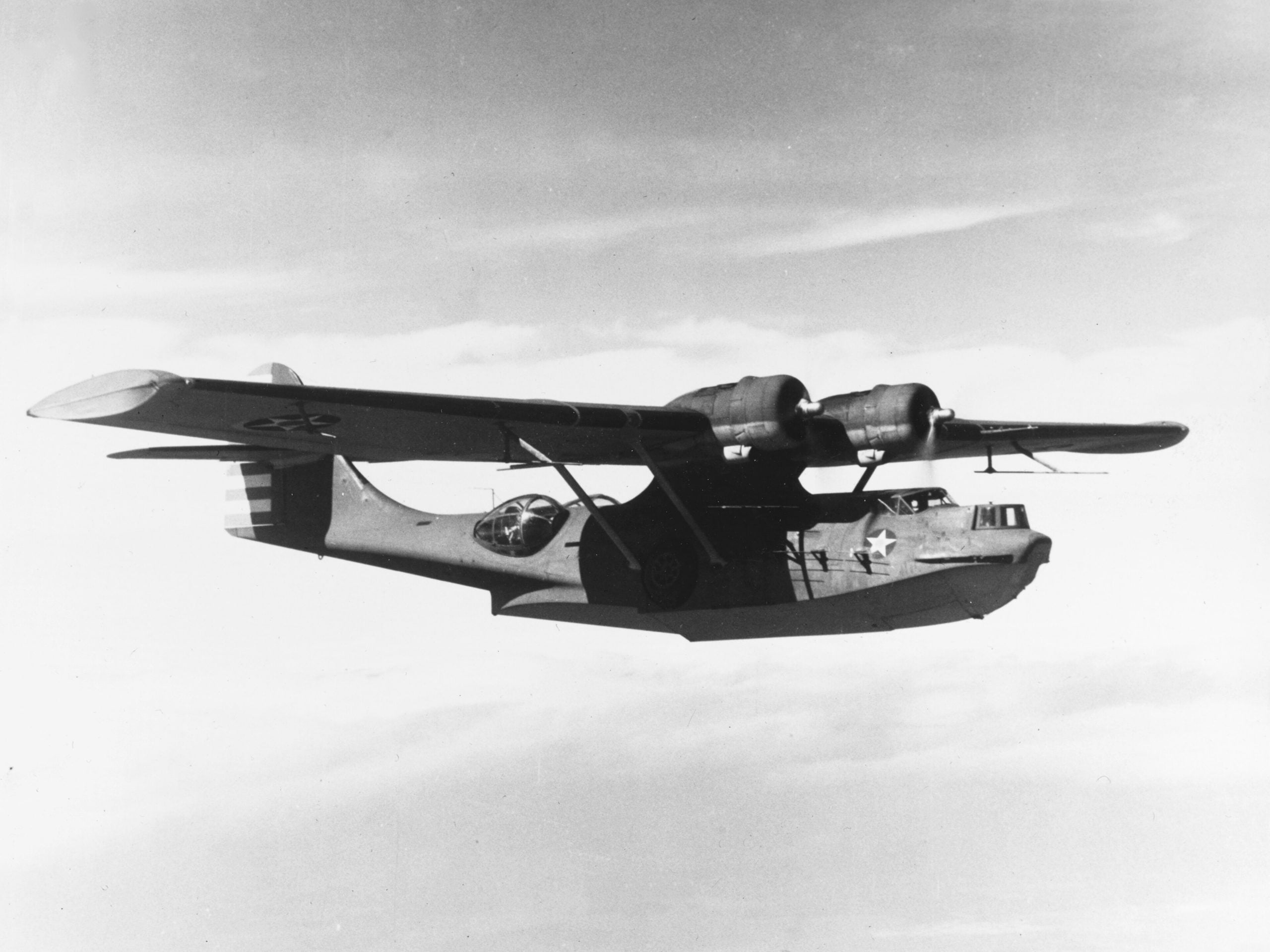
Consolidated PBY
Catalina
A slow, ungainly twin-engine flying boat that became one of the most important aircraft of the Second World War — the scout that shadowed the Bismarck, the patrol plane that found the Japanese fleet before Midway, the radar-guided Black Cat that hunted by night, and the Dumbo that plucked thousands of downed airmen from the open sea.
The Catalina: the flying boat that did everything
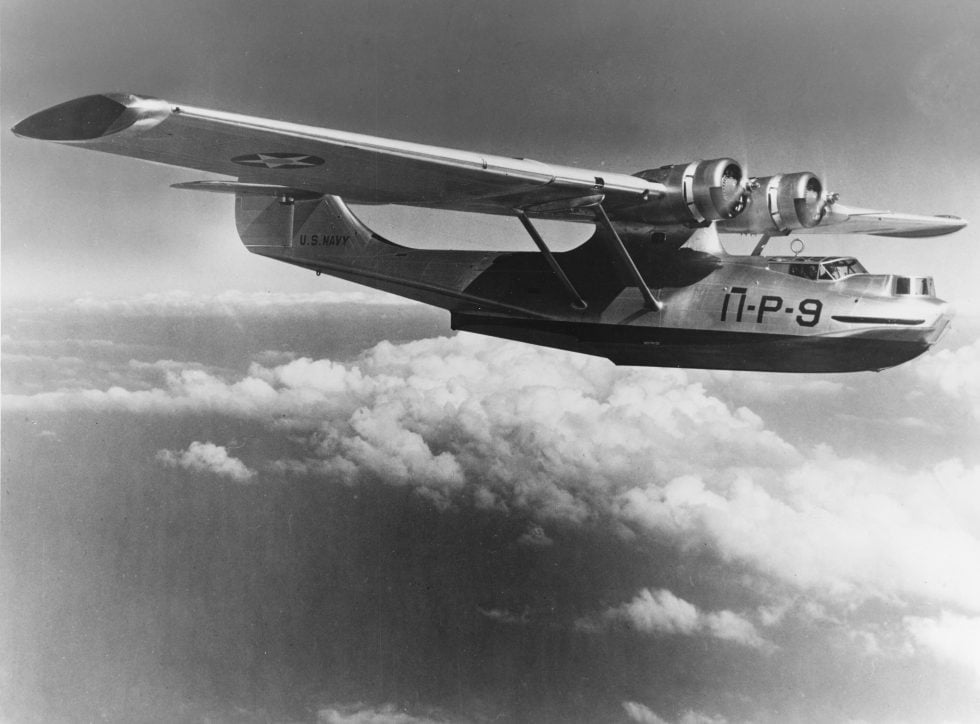
In the early 1930s the US Navy wanted a patrol flying boat that could range far out over empty ocean, find an enemy fleet and shadow it for hours. Consolidated Aircraft’s chief engineer Isaac Laddon answered with the Model 28: a big, twin-engined monoplane with a high parasol wing braced on a single pylon, carrying two Pratt & Whitney Twin Wasp radials. Its cleverest trick was a pair of wingtip floats that retracted in flight to become the wingtips themselves, cutting drag and stretching range. It first flew in 1935 and entered service in 1936.
It was never fast — barely 200 mph flat out, often cruising at little more than half that — and it was lightly built and lightly armed. But it could stay airborne for the better part of a day, cross oceans, and set down on the open sea. Britain’s Royal Air Force adopted it too and gave it the name that stuck: Catalina. Built under licence in the Soviet Union as the GST and assembled in Canada as the Canso, it was produced in enormous numbers — commonly cited at more than 3,300 airframes, making it one of the most widely produced flying boats in history.
The Catalina’s war was extraordinary in its range of jobs. In May 1941 a Catalina relocated the German battleship Bismarck after the Royal Navy had lost her, helping seal her fate. A year later, PBYs flying long patrol arcs out of Midway spotted the approaching Japanese fleet, handing the US Navy the opening it needed. Catalinas hunted submarines across the Atlantic, Mediterranean and Pacific, sinking or sharing in the destruction of numerous U-boats. Painted flat black, the “Black Cat” squadrons stalked Japanese shipping at night by radar. And as “Dumbo” rescue aircraft they landed in open water under fire to save downed aircrew and shipwrecked sailors — thousands of them by war’s end.
Slow, patient and almost impossible to kill off, the Catalina outlived the war by decades. Surplus aircraft became airliners, survey planes and, above all, water-bombing firefighters — a role some flew into the 21st century. Few aircraft have been loved by so many air forces, or asked to do so many different things so well.
01Why the PBY Catalina mattered so much: range, patience and versatility
The Catalina’s value was never in speed or firepower — it was in reach and endurance. A single PBY could fly a patrol arc of well over a thousand miles, loiter for many hours, and return, covering areas of ocean that faster aircraft could only glimpse. That made it the ideal scout, convoy escort and submarine deterrent: a U-boat that had to stay submerged to avoid a circling Catalina could not race ahead of a convoy. The same qualities — long range, the ability to land on water, and a roomy hull — let the type reinvent itself as a night raider and a rescue aircraft. Versatility, not performance, is why the PBY is remembered as one of the war’s decisive aircraft.
What makes the PBY Catalina special
A flying boat built to stay up all day
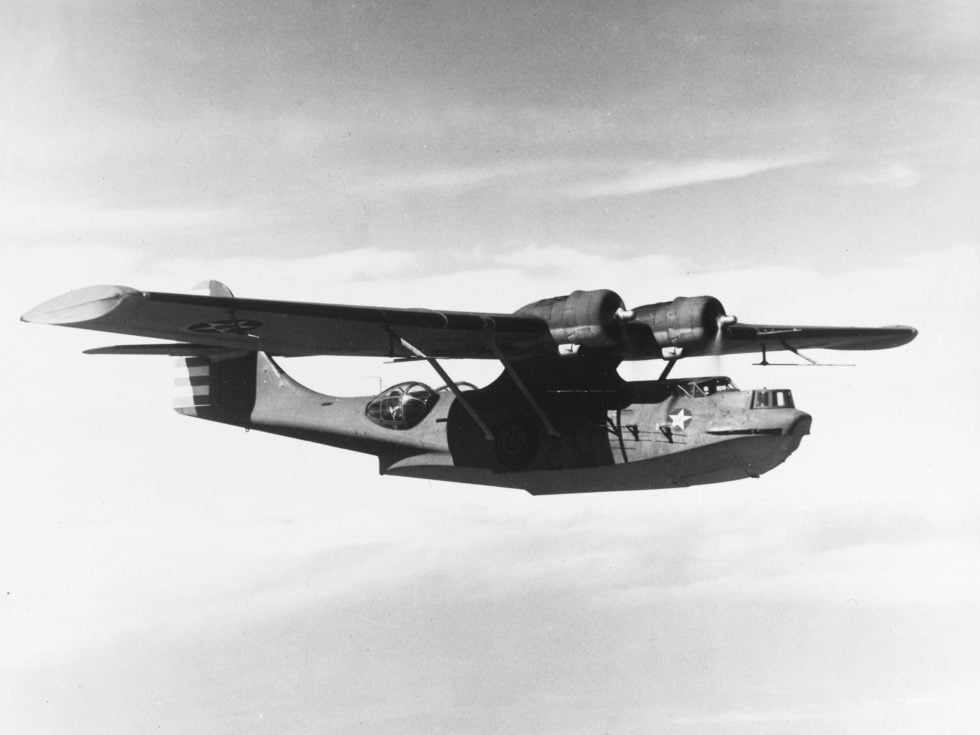
The Catalina’s high parasol wing and clean, lightly loaded airframe gave it exceptional range and endurance — a ferry range around 4,000 km and patrols of 20 hours or more. Wingtip floats that folded up into the wingtips in flight cut drag. It was slow, but it could cross oceans and loiter over a target long after other aircraft had gone home.
The ‘Black Cats’ — radar-guided night hunters
From 1942, matte-black PBYs fitted with ASV search radar prowled the Pacific at night, bombing Japanese shipping that felt safe in darkness. These “Black Cat” squadrons, together with radar- and MAD-equipped anti-submarine Catalinas in the Atlantic and Mediterranean, sank or helped sink large amounts of enemy shipping and numerous U-boats.
‘Dumbo’ — the rescue plane that saved thousands
Because it could land on the open sea, the Catalina became the war’s great air-sea rescue aircraft — call-sign “Dumbo.” PBY crews set down amid swells, often under fire, to lift downed airmen and shipwrecked sailors to safety. One such mission near Kavieng in 1944 earned pilot Nathan Gordon the Medal of Honor.
02The PBY Catalina’s retractable wingtip floats: a neat piece of engineering
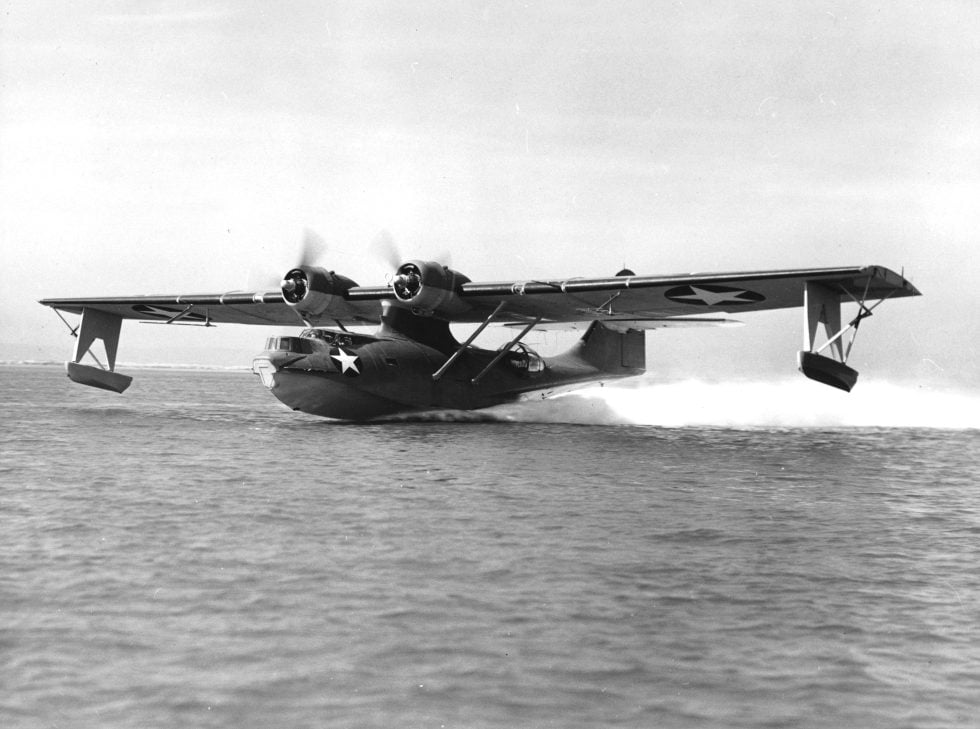
Most flying boats of the era carried fixed stabilising floats under each wing to keep the aircraft level on the water — and paid for them in drag. Consolidated’s design let each float swing up and outward in flight until it formed the streamlined wingtip, and swing back down for landing on water. It was a simple, robust mechanism that shaved drag and helped give the Catalina its remarkable range. The parasol wing, mounted above the hull on a central pylon, kept the propellers and engines clear of spray while leaving the deep hull free for fuel, crew and payload.
03The PBY Catalina at war: from the Bismarck to Midway to the Black Cats
On 26 May 1941 a Catalina of RAF Coastal Command relocated the Bismarck after contact had been lost — a US Navy officer, Ensign Leonard “Tuck” Smith, was at the controls as a “special observer.” The sighting let the Royal Navy close in for the kill. Thirteen months later, on 3–4 June 1942, PBYs on long patrols from Midway found the Japanese carrier force and even pressed home a night torpedo attack on a tanker — the first blows of a battle that turned the Pacific war. From late 1942 the black-painted Black Cat squadrons made the night their own, while Dumbo rescue crews saved airmen who would otherwise have been lost. No other aircraft type touched so many pivotal moments of the naval war.
Full specifications: Consolidated PBY-5A Catalina
Baseline note: the figures below describe the PBY-5A, the amphibious Catalina built in the largest numbers — 802 from Consolidated’s San Diego and New Orleans lines — and the mark most people mean when they say "Catalina". It is the honest baseline precisely because it is the compromised one: the retractable undercarriage cost weight, drag and range against the pure flying boat, and bought the ability to come home to a runway. Deltas for the boat-hulled PBY-5, the Naval Aircraft Factory PBN-1 Nomad, the PBY-6A, the Canadian-built PB2B and Canso A and the Soviet GST are in grey. American practice quoted this aeroplane in imperial units and the metric values here are converted from them, so the round number is usually the imperial one.
Dimensions & weights
- Crew
- 7–9 — pilot, co-pilot, bow gunner who doubled as bomb-aimer, flight engineer, radio operator, navigator and two waist gunners, with a second radio operator or relief pilot on the longest sorties — establishment varied by navy and by mark; RAF and RAAF crews of 8 to 10 were normal, and on a twenty-hour patrol the bunks were not a luxury
- Length
- 19.46 m (63 ft 10 in). The PBN-1 Nomad was about 0.6 m (2 ft) longer, its bow sharpened and extended to improve behaviour in a sea
- Wingspan
- 31.70 m (104 ft 0 in) — wider than a B-17’s 31.62 m, on an aeroplane of half the weight. Span is where range comes from
- Height
- 6.43 m (21 ft 1 in) standing on its undercarriage; the boat-hulled marks sat lower on a beaching cradle
- Wing area
- 130.1 m² (1,400 sq ft) — almost exactly the same as the far heavier Kawanishi H8K at 160.0 m² is not, and a fraction under the Short Sunderland’s 130.4 m²
- Aspect ratio
- 7.73 — a long, slender, high-lift wing of Consolidated’s own Davis-derived thinking, carried on a single faired pylon above the hull and braced by two struts a side
- Wing mounting
- parasol on a central pylon, which held the flight engineer’s station — he sat inside the wing root above and behind the pilots, with the engine and fuel controls in front of him. It is the single most distinctive feature of the aeroplane and the reason the propeller discs stayed out of the spray
- Hull
- two-step planing hull, all-metal stressed skin of aluminium sheet, ailerons and wing trailing edges fabric-covered — the fabric saved weight and was cheap to repair on a beach with no hangar
- Wingtip floats
- retractable, electrically actuated, folding upward and outward until they became the wingtips themselves — an elegant piece of 1933 engineering that recovered the drag every other flying boat of the era simply accepted
- Empty weight
- 9,485 kg (20,910 lb). The boat-hulled PBY-5 was roughly 900 kg (2,000 lb) lighter, all of it undercarriage
- Maximum take-off weight
- 16,066 kg (35,420 lb). The PBN-1 Nomad had strengthened wings that allowed a further 908 kg (2,000 lb) on top of that
- Wing loading
- 123.6 kg/m² (25.3 lb/sq ft) at maximum weight — very low, which is why it flew slowly, climbed adequately on one engine and could be held at a patrol speed all day
- Power loading
- 6.69 kg/hp (14.8 lb/hp) at maximum take-off weight. Overloaded and in a swell, that was marginal, and rocket-assisted take-off bottles were fitted for exactly this reason
Performance
- Maximum speed
- 315 km/h (196 mph, 170 kn) at 2,100 m (7,000 ft), clean and light. With radar aerials, blisters and a war load it was slower
- Cruising speed
- 201 km/h (125 mph, 109 kn). Search cruise was flown lower and slower still, at 160–185 km/h (100–115 mph), engines leaned right back
- Speed in context
- this was a slow aeroplane by 1941 and an alarmingly slow one by 1944. A Kawanishi H8K was 150 km/h faster; a Ju 88C sent out over the Bay of Biscay was faster by half again. The Catalina’s survival depended on cloud, darkness, distance and the good sense of its captain, never on performance
- Service ceiling
- 4,800 m (15,800 ft) — and it spent almost its whole career below 600 m, because that is where you can see a periscope
- Rate of climb
- 5.1 m/s (1,000 ft/min) at sea level, light
- Maximum range
- 4,060 km (2,520 miles, 2,190 nm) for the PBY-5A. The boat-hulled marks did better, and the PBN-1’s enlarged tanks were credited with a 50 per cent increase
- Endurance
- 15 to 20 hours was routine patrol practice, and the figure that actually mattered. RAAF mining sorties from Darwin and Morotai regularly exceeded 20 hours, and Qantas crews on the Indian Ocean run stayed airborne for 28 to 32 hours — the longest scheduled commercial flights ever flown
- Combat radius
- ~1,300–1,600 km (800–1,000 miles) out, a square or creeping-line search at the far end, and home with reserves. That geometry, not any single performance figure, is the Catalina
- Internal fuel
- ~6,600–7,000 litres (1,750–1,850 US gal, 1,460–1,540 imp gal) in integral tanks inside the wing, with self-sealing liners from the PBY-5 onward — sources differ over whether the higher figure is before or after the liners were fitted, and the liners cost capacity
- Record flight
- 5,541 km (3,443 miles) non-stop by the XPBY-1 in 1936, a world seaplane distance record that told the US Navy it had bought exactly what it asked for
- Maximum ordnance
- ~1,814 kg (4,000 lb) on four wing racks between the hull and the floats — and carrying it meant trading fuel, which in practice meant trading the aeroplane’s whole reason for existing
Propulsion & systems
- Engines
- two Pratt & Whitney R-1830-92 Twin Wasp 14-cylinder two-row air-cooled radials of 30.0 litres (1,830 cu in), 1,200 hp each for take-off, driving three-bladed Hamilton Standard constant-speed propellers — the same engine family as the B-24, the C-47 and the Wildcat, which meant spares and trained mechanics everywhere the Allies went
- Earlier ratings
- the PBY-1 flew behind R-1830-64s of 900 hp and the PBY-4 behind 1,050 hp -72s; the jump to 1,200 hp with the PBY-5 in 1940 is what made the heavier, better-armed wartime aircraft possible
- Flight engineer’s station
- inside the wing pylon, with throttles, mixture, cowl gills and the fuel cocks to hand. On a twenty-hour sortie the difference between getting home and not was a man whose whole job was leaning the mixtures
- Fuel system
- integral tanks in the wing structure rather than bag tanks in a bomb bay, feeding by gravity and pump; self-sealing liners from 1940. Long-range ferry and survey aircraft carried further tanks in the hull
- Undercarriage (PBY-5A)
- retractable tricycle gear, the nosewheel folding back into the bow and the mains upward into wells in the hull sides, the wheels sitting proud in the airflow. It cost weight, wetted area and range, and it made the Catalina the only long-range patrol aeroplane that could operate from a coral strip, a lake and a runway in the same week
- Radar
- British and Commonwealth aircraft carried ASV Mk II with its forest of Yagi masts along the wing and hull; American aircraft moved to centimetric AN/APS-2 and its successors, mounted in a radome above the cockpit from the PBY-6A. Some carried Rebecca and LORAN for navigation — radar is what turned a daylight scout into a night killer
- Autopilot
- a Sperry unit, and not a convenience. No crew could hand-fly a twenty-hour search pattern; the autopilot is a piece of anti-submarine equipment as surely as the depth charges
- Protection
- self-sealing tank liners and some armour at the crew stations on later marks; nothing that would save the aeroplane from a determined fighter. Catalinas were slow, large and full of petrol, and their loss rates on daylight patrol against opposition were bad
- Accommodation
- bunks, a galley with a hotplate, and a chemical toilet, because the sortie length demanded them. The two waist blisters were the best observation positions fitted to any aircraft of the war, and doubled as the loading hatches for survivors
- Take-off assistance
- JATO bottles on the after hull for overloaded or open-sea departures — the standard fit for air-sea rescue work, where an aircraft that had just taken twenty men aboard in a swell had to get off again
- Marine equipment
- sea anchor, mooring gear, an anchor and boat hooks stowed in the bow compartment, and beaching gear that bolted on in the shallows. A flying boat needs a small navy’s worth of seamanship kit, and every one of those items is weight
04The PBY Catalina’s cost: what a wartime flying boat was worth
The Catalina was a mass-produced wartime aircraft, and firm dollar figures are scarce and inconsistent. Period sources put the flyaway cost of a wartime PBY very roughly in the region of $90,000 — cheap by the standards of a large multi-engine aircraft, which was part of the point: it was affordable enough to build in the thousands. No credible cost-per-flight-hour figure exists in open sources for the type, and any precise modern-dollar number you see should be treated as an estimate rather than a documented figure.
Armament & payload
The Catalina carried five machine guns and 4,000 lb of bombs, but its real weapon was twenty hours of fuel and a pair of eyes in a blister
Judged as a gun platform the Catalina is unimpressive: a pair of rifle-calibre guns in the bow, a single half-inch in each waist blister, one more firing down through a hatch in the tunnel behind the step. Marks and operators varied the fit, and the late Naval Aircraft Factory and Boeing Canada aircraft improved the feed mechanisms and the mountings, but nobody ever pretended this was a Sunderland, let alone the cannon-armed Kawanishi H8K. Against a fighter the Catalina’s guns bought seconds, not survival, and the four aircraft lost out of six over Jolo on 27 December 1941 are the fair measure of what happened when Catalinas were sent into defended airspace by day.
Which matters less than it sounds, because the Catalina’s most decisive deliverable was never a weapon. It was a position report. At 10:30 on 26 May 1941 a Catalina of No. 209 Squadron, flown by Flying Officer Dennis Briggs with Ensign Leonard B. Smith of the still-neutral US Navy in the second seat, found the battleship Bismarck some 1,280 km (690 nm) north-west of Brest after the Royal Navy had lost her for more than thirty hours, and was promptly shot at for its trouble. Ten months later, on 4 April 1942, Squadron Leader Leonard Birchall of No. 413 Squadron RCAF sighted Nagumo’s carriers approaching Ceylon and got his signal away before being shot down; at Midway on 3 and 4 June 1942 it was Catalinas that found the occupation force and then the carriers. Four sightings, four battles turned. No aeroplane of the war did more with less.
Its offensive load was more serious than it looks. Four wing racks between the hull and the floats took up to 1,814 kg (4,000 lb) of bombs, depth charges, mines or two aerial torpedoes, and against the target the Catalina was actually built for — a surfaced submarine, a coastal freighter, a barge convoy at night — that was ample. Forty U-boats were destroyed by Catalinas of the American, British, Canadian, Australian, Brazilian and Soviet services. It was a Catalina of VP-84 that made one of the first successful attacks with the Mk 24 "mine", the acoustic homing torpedo whose cover name concealed the war’s first air-dropped guided weapon.
The genuinely lethal Catalina was the night one. From December 1942 the US Navy painted whole squadrons matte black, hung radar on them and sent them into the Solomons after Japanese shipping in the dark; the Black Cats attacked from a few hundred feet with bombs, depth charges and flares, and they were feared out of all proportion to their armament because they arrived unannounced and stayed for hours. The same aircraft, unarmed or nearly so, flew the Dumbo rescue sorties that made it famous in a different way. Gun and store fits varied enormously between the PBY-1 and the PBY-6A, between US Navy, RAF, RCAF, RAAF and Soviet practice, and between one squadron armourer and the next; almost every fit described below was locally modified somewhere.
Gun
- Bow position: one or two 0.30 in (7.62 mm) Browning M1919 guns, hand-held on early marks and in a shallow turret later, with the bomb-aimer’s window and sight below. The PBY-6A retained two 0.30 in bow guns even as it gained centimetric radar overhead
- Waist blisters: one 0.50 in (12.7 mm) Browning M2 in each, the aircraft’s only weapon with real hitting power. The teardrop blisters gave the gunners a field of view no other patrol aircraft matched
- Ventral tunnel: one 0.30 in gun firing aft and down through a hatch behind the hull step, covering the blind spot underneath
- The PBN-1 Nomad introduced continuous-feed mechanisms and better mountings, and Canadian-built aircraft for the RCAF and RAF were commonly re-armed with Vickers K or Browning guns to Commonwealth practice
- Total defensive battery, five guns, three of them rifle-calibre. Against a Ju 88 or an A6M this was a gesture; against a submarine’s conning-tower crew during a run-in it was decisive, and suppressing flak with the bow gun was standard doctrine
Air-to-air
- No air-to-air weapon and no fixed forward armament. Everything the Catalina had was defensive, and described in the gun card above
- It nevertheless drew first blood for US Navy aviation in the Pacific war: on 10 December 1941, after the attack on Cavite, Chief Boatswain Earl D. Payne shot down a Japanese fighter from the bow position of a Patrol Wing 10 Catalina
- Catalinas and Japanese flying boats met over empty ocean throughout the Pacific war, and those long, slow duels between patrol aircraft were a recognisable and largely unrecorded feature of it
- The correct tactic on sighting a fighter was to descend to wave-top height, where an attacker could not get underneath and had to pull out early, and to fly into any cloud available. Catalina captains were trained to run, and were right to
Air-to-surface guided
- Mk 24 "mine" — the FIDO passive acoustic homing torpedo, deliberately misnamed to conceal what it was. 308 kg (680 lb), 12 knots for about ten minutes, roughly 3,700 m (4,000 yd) of run, dropped into the swirl of a diving submarine and left to listen for its propellers
- A US Navy Catalina of VP-84 made one of the first successful attacks with it on 14 May 1943, in the North Atlantic — the victim is recorded in different sources as U-640 or U-657, an ambiguity that has never been fully resolved
- FIDO was used with strict rules: it could only be dropped when no surface vessel was in the water to confuse it, and never where the enemy might recover one. Across all Allied aircraft types it sank 37 submarines and damaged 18
- No other guided weapon was carried. The Catalina’s ship-killing store was the unguided Mk 13 aerial torpedo, two of which could go on the wing racks — a weapon of roughly 1,000 kg (2,200 lb) that four Midway-based Catalinas used to put a hit into the oiler Akebono Maru in a night attack on 4 June 1942, the only successful American air-launched torpedo attack of that battle
Bombs
- Up to 1,814 kg (4,000 lb) on four underwing racks: typically four 227 kg (500 lb) or 454 kg (1,000 lb) bombs, or a larger number of smaller weapons
- Depth charges were the staple, and the reason the type mattered in the Atlantic. Four 113 kg (250 lb) Torpex-filled charges, fused shallow and dropped in a stick across the swirl, was the standard British and Canadian anti-submarine load
- Mines: four RAAF squadrons — Nos 11, 20, 42 and 43 — flew a mining campaign from April 1943 to July 1945 that closed harbours from Borneo to the Philippines, on sorties that regularly ran past twenty hours. It was the least celebrated and arguably the most economically damaging use the Catalina was ever put to
- Black Cat crews improvised beyond the manual, dropping scrap metal, empty bottles and other noise-making rubbish on Japanese positions purely to keep men awake and heads down through the night
- The trade was always the same: every pound of ordnance came off the fuel load, and a Catalina at maximum bomb load was no longer a long-range aircraft
Rockets
- Essentially not a Catalina weapon. No rocket installation was ever standard on the type in any air force, and the underwing racks were plumbed and stressed for bombs, charges, mines and torpedoes instead
- Individual late-war Pacific aircraft are occasionally reported with improvised rails, but the claim is poorly documented and should not be taken as a service fit
- The contrast with contemporaries is instructive: Coastal Command’s rocket-armed Beaufighters and Mosquitos attacked shipping at high speed in daylight, a manoeuvre a 125 mph flying boat could not contemplate. The Catalina’s night equivalent was a low-level bomb run guided by radar and flares
- The only rocket motors routinely bolted to a Catalina fired backwards: JATO bottles on the after hull, to unstick an overloaded aircraft from a swell
Pods & other stores
- Radar: ASV Mk II with Yagi masts on Commonwealth aircraft, centimetric AN/APS-2 and successors in an overhead radome on American ones. Add LORAN and Rebecca for navigation on late aircraft
- Flares, float lights and smoke markers, carried in quantity — the Black Cats’ principal illumination, and the means by which a Dumbo marked a dinghy it could not immediately reach
- Air-sea rescue kit: survival packs, dinghies, medical stores, and on rescue-configured aircraft the armament reduced or deleted to make room for survivors. The waist blisters became the doorway through which men came aboard
- Cargo, mail and passengers — the Qantas Double Sunrise Catalinas crossed the Indian Ocean in radio silence with three passengers and 65 kg (143 lb) of diplomatic mail, and Soviet GSTs and civil MP-7s were transports from the start
- Postwar civil conversions replaced all of it with roll-on retardant and water tanks, survey gear, camera hatches and cabin fittings, which is why so many airframes still exist
Three typical loadouts
- Atlantic anti-submarine patrol, RAF Coastal Command, 1944
- Four 113 kg (250 lb) Torpex depth charges on the wing racks, ASV radar, full internal fuel, five guns manned. A fifteen-hour sortie from Sullom Voe or Castle Archdale over the Norwegian Sea or the Western Approaches, most of it flown at a few hundred feet with nothing whatever happening. This is the load John Cruickshank was carrying on 17 July 1944.
- Black Cat night anti-shipping, Solomons, 1943
- Matte black overall, radar, four 227 kg (500 lb) bombs or depth charges, a heavy load of parachute flares, and the guns kept. Loiter for hours over a barge route or an anchorage at 300 m, illuminate, attack from low level, and repeat until the fuel says go home.
- Dumbo air-sea rescue, Pacific, 1944–45
- No bombs. Extra fuel, dinghies, medical kit, JATO bottles fitted, guns retained for the crew’s own protection, and a captain willing to put an amphibian down in an open-sea swell it was never stressed for. Adrian Marks took 56 men off the water from the sunken USS Indianapolis this way in August 1945, lashing survivors to the wings when the hull was full and accepting that the aircraft would never fly again that night.
Sourcing caveat: gun fits are quoted from US Navy and RAF handbooks for particular marks and were widely altered in the field, and store loads are drawn from squadron practice rather than a single authority. The figure of 40 U-boats destroyed by Catalinas is the standard one but combines confirmed sinkings across six air forces and rests in part on postwar reassessment — Cruickshank’s victim, cited as U-347 in his Victoria Cross citation, is now generally identified as U-361.
Variants
Five factories in three countries built the Catalina, and the confusion between PBY-5A, Canso A and OA-10 is the single most common error written about the type
Consolidated’s Model 28 first flew as the XP3Y-1 on 21 March 1935 and reached the fleet in 1936. What followed was less a series of marks than a series of factories. San Diego and, from 1941, New Orleans built the bulk of the aeroplane; the Naval Aircraft Factory at Philadelphia built the improved PBN-1 Nomad; Boeing Aircraft of Canada in Vancouver built the PB2B; and Canadian Vickers at Cartierville in Quebec — the plant that would become Canadair — built the PBV-1A. The Soviet Union bought a licence in 1937 and built its own at Taganrog as the GST, with Soviet radials in place of Twin Wasps.
The naming needs stating plainly, because it is got wrong constantly. PBY is the US Navy designation for the boat-hulled aircraft; the suffix A, as in PBY-5A and PBY-6A, means amphibian, with retractable wheels. Catalina was a British name, applied by the RAF in 1941 after Santa Catalina Island and later adopted by the Americans themselves. Canso is the Royal Canadian Air Force name, after the Nova Scotia town, and follows the British convention of naming maritime aircraft after coastal places; a plain Canso is a flying boat and a Canso A is an amphibian. OA-10 is the US Army Air Forces designation for the aircraft it used for rescue. All of these are the same aeroplane wearing different paperwork.
Totals are contested. Around 3,300 airframes are usually credited to the American production lines, and figures near 4,000 — one widely quoted count gives 4,051 — are reached by adding Canadian and Soviet output. No single number commands agreement, partly because Lend-Lease transfers were counted twice in some tabulations and partly because Soviet records of GST production have never been satisfactorily reconciled.
- PBY-1 to PBY-4 (1936–1939, 208 built)
- The pre-war flying boats: 60 PBY-1s, 50 PBY-2s, 66 PBY-3s and 32 PBY-4s, engines rising from 900 to 1,050 hp. The PBY-4 introduced the waist blisters that became the type’s signature.
- PBY-5 (1940–1943, 684 built)
- The definitive wartime flying boat: 1,200 hp R-1830-92 engines, self-sealing tank liners, heavier armament. Supplied in quantity to the RAF, RAAF and RNZAF as the Catalina Mk I to Mk IV.
- PBY-5A (from 1941, 802 built)
- The amphibian, and the most-built single mark. Retractable tricycle undercarriage at a cost in weight, drag and range; in exchange, the aircraft could work from land bases, which is what most of the war actually required.
- PBN-1 Nomad (Naval Aircraft Factory, 156 built)
- The best Catalina nobody has heard of: bow lengthened and sharpened by 0.6 m for better sea behaviour, a much larger and differently shaped fin, bigger tanks for 50 per cent more range, stronger wings, an auxiliary power unit and improved guns. 138 of the 156 went to the Soviet Navy under Lend-Lease.
- PBY-6A (1945, 175 built)
- The last American production mark, an amphibian that took the Nomad’s tall tail and added a centimetric radar scanner in a radome above the cockpit. The last US Navy example was retired from a Reserve squadron on 3 January 1957.
- PB2B-1 and PB2B-2 (Boeing Aircraft of Canada, Vancouver, 362 built)
- 240 PB2B-1 flying boats, 55 PB2B-1A amphibians and 67 PB2B-2s with the Nomad tail. Most went to the RAF, RAAF and RNZAF; the PB2B-1A amphibians served the RCAF as Canso As.
- PBV-1A (Canadian Vickers, Cartierville, 380 built)
- Amphibians built in Quebec by the firm that became Canadair. 150 served the RCAF as Canso As; 230 went to the USAAF as OA-10As. Between them Boeing Canada and Canadian Vickers gave the RCAF 17 Canso flying boats and 205 Canso A amphibians.
- OA-10, OA-10A, OA-10B (USAAF, 1943–1948)
- Army rescue amphibians: 105 OA-10s from Navy PBY-5A stock, 230 OA-10As of Canadian Vickers build, 75 OA-10Bs from PBY-6As. Redesignated A-10 in 1948, and the direct ancestor of the USAF combat rescue mission.
- GST and MP-7 (USSR, Taganrog, from 1938)
- Licence-built from a 1937 agreement, engineered for Soviet production under Beriev’s plant and powered by Soviet radials rather than Twin Wasps; the MP-7 was the unarmed civil transport version for Aeroflot. Soviet Naval Aviation flew GSTs in the Arctic, the Baltic and the Black Sea and later added Lend-Lease PBN-1s. Published production figures for the GST vary by an order of magnitude and none is reliable.
- Model 28 civil boats and postwar conversions (1937 onward, hundreds of airframes)
- The exploration Catalinas came first. Richard Archbold’s Guba was sold to the Soviet Union in 1937 and flown by Sir Hubert Wilkins on the Arctic search for Levanevsky’s missing crew; its replacement, Guba II, carried Archbold’s third New Guinea expedition, from which a reconnaissance flight on 23 June 1938 sighted the unmapped Baliem Valley and its Dani population. Chartered afterwards by Australia to survey a wartime air route, with P. G. Taylor navigating, Guba II made the first east-to-west aerial crossing of the Indian Ocean and continued across Africa and the Atlantic to New York. After 1945 the surplus flood produced Landseaire and Paul Mantz flying yachts with picture windows and bars; Steward-Davis "Super Catalinas" re-engined with 1,700 hp Wright R-2600s; the four-engined Bird Innovator with a pair of Lycomings added outboard; and above all the water bombers, Cansos converted with roll-on tanks that scooped on the step and fought forest fires in Quebec, Saskatchewan, France, Spain and Chile into the 21st century. The Catalina that carried Jacques-Yves Cousteau’s diving expeditions was a PBY-6A; Sweden’s Tp 47 shot down by Soviet MiG-15s over the Baltic in June 1952 gave the "Catalina Affair" its name.
Survivors and a correction. The Catalina survives in unusual numbers because it had a forty-year second career: registries list well over 200 airframes worldwide, of which perhaps 100 to 150 are substantially complete, and of those only around a dozen have been airworthy at any one time in recent years — the number moves as engines, hulls and money come and go. The population is skewed by that civil career. Amphibians dominate, because wheels made an aeroplane employable after 1945: most survivors are PBY-5As, PBY-6As, or Canadian-built Canso As and PB2B-1As, and many were water bombers before they were exhibits. Boat-hulled PBY-5s and PB2B-1s are genuinely rare, PBN-1 Nomads and Soviet GSTs effectively extinct. Every airframe is an original; there are no Catalina reproductions, the type being far too large to reproduce. The best-known airworthy example, G-PBYA "Miss Pick Up" at Duxford, is a case study in the whole story: built by Canadian Vickers at Cartierville as RCAF Canso A 11005, flown on anti-submarine patrol from British Columbia in 1943–45, then a firefighter in France as "Pélican Bleu" and later a Saskatchewan water bomber, and now painted as a USAAF OA-10A — three designations, two countries and two careers on one aeroplane. One correction to the record: the Catalina is often said to have flown in the Berlin Airlift, but the flying boats on the Havel run in 1948 were RAF Short Sunderlands and civil Hythes operating from the Elbe, chosen for hulls that tolerated salt, and no documented Catalina participation has been found.
From patrol boat to legend — and firefighter
Design begins
Consolidated’s Isaac Laddon designs the Model 28 to a US Navy requirement for a long-range patrol flying boat.
First flight
The XP3Y-1 prototype flies on 28 March, introducing the retractable wingtip floats and parasol wing.
Enters service
The PBY joins the US Navy with patrol squadron VP-11F; Britain later adopts it as the “Catalina.”
The amphibian
The PBY-5A adds retractable landing gear, letting the flying boat operate from land as well as water.
Finding the Bismarck
On 26 May a Coastal Command Catalina relocates the German battleship Bismarck, helping the Royal Navy close in.
Midway and the Black Cats
PBYs spot the Japanese fleet before Midway; late in the year the radar-equipped Black Cat night squadrons form.
Dumbo rescues
Black Cat night raids and “Dumbo” air-sea rescue reach their peak across the Pacific and Atlantic.
Production ends
More than 3,300 Catalinas have been built across the US, Canada and the Soviet Union.
The water bomber
Surplus Catalinas become airliners, survey aircraft and firefighting water-bombers — some flying into the 2000s.
From the crews: twelve Catalina stories
A boat designed to stay out
Isaac Laddon’s Model 28 traded speed for reach — and it changed naval patrol.
Read the full story
How it became the “Catalina”
The Americans called it the PBY. The British gave it the name that stuck.
Read the full story
The Catalina that found the Bismarck
After the Royal Navy lost contact, a Catalina found the battleship again — with an American at the controls.
Read the full story
Eyes before Midway
Long PBY patrols found the approaching Japanese fleet — and one pressed a night torpedo attack.
Read the full story
Birth of the Black Cats
Painted flat black and fitted with radar, PBYs turned the night into a hunting ground.
Read the full story
The Dumbo that saved fifteen
Under fire near Kavieng, Nathan Gordon landed his Catalina on the open sea three times.
Read the full story
The Mad Cats
With magnetic detectors, Catalinas hunted U-boats where they thought they were safe.
Read the full story
Twenty hours aloft
A Catalina’s war was often measured not in speed but in the hours it could stay up.
Read the full story
A flying boat for a dozen air forces
American, British, Soviet, Australian, Canadian, Dutch and other crews all flew the Catalina.
Read the full story
The long mining missions
RAAF Catalinas flew some of the longest, most dangerous sorties of the Pacific war.
Read the full story
From warplane to water bomber
Surplus Catalinas found a second career fighting fires from the air.
Read the full story
The most useful flying boat ever built
Slow and plain, the Catalina outlasted faster, prettier aircraft by decades.
Read the full story
The Catalina in pictures
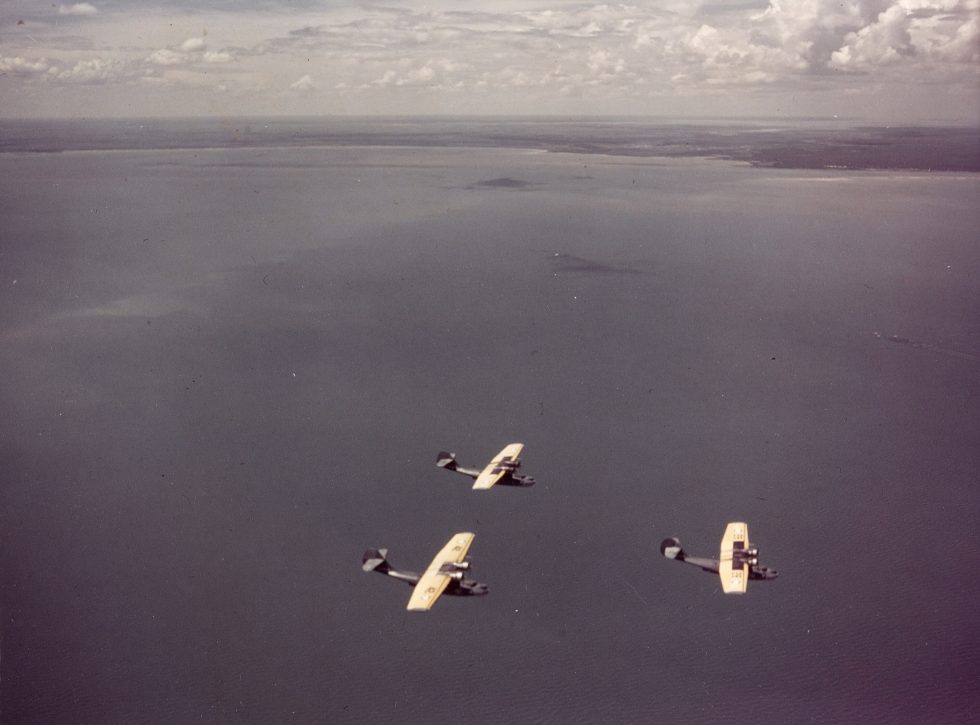
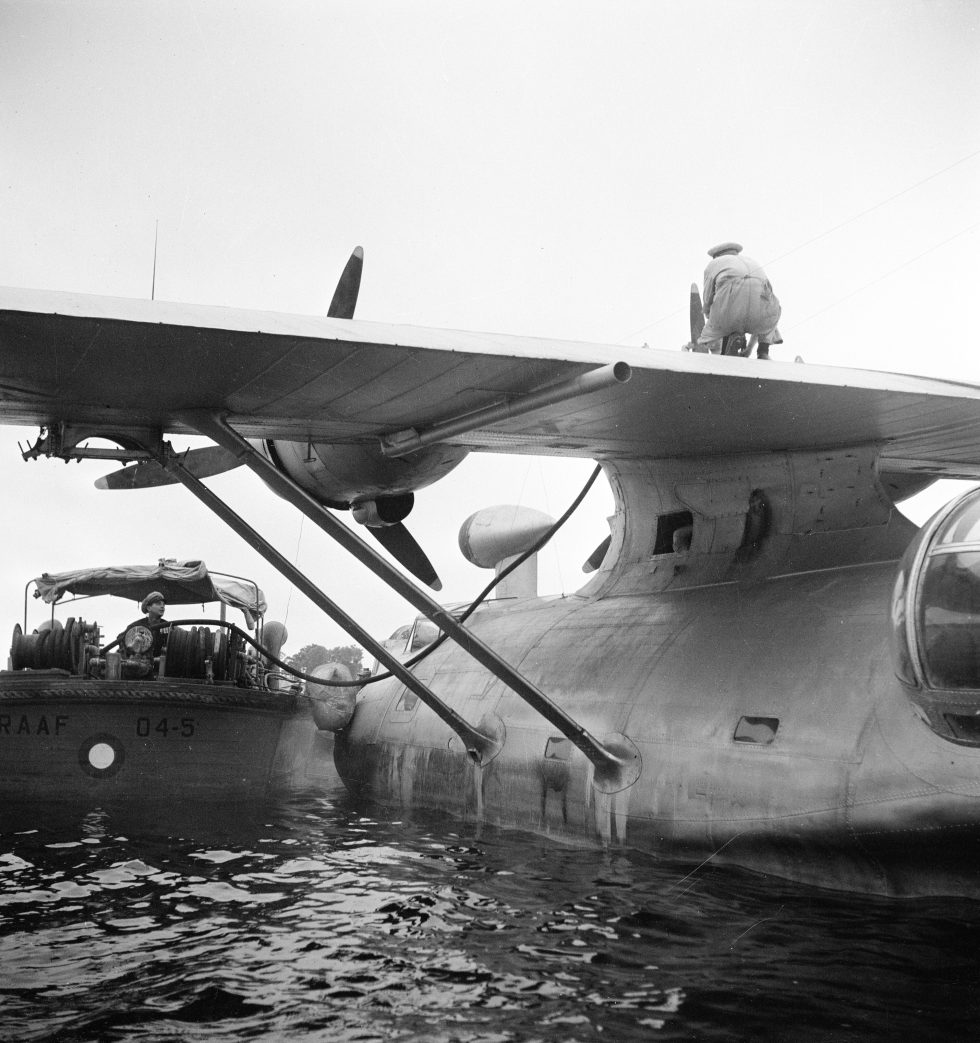
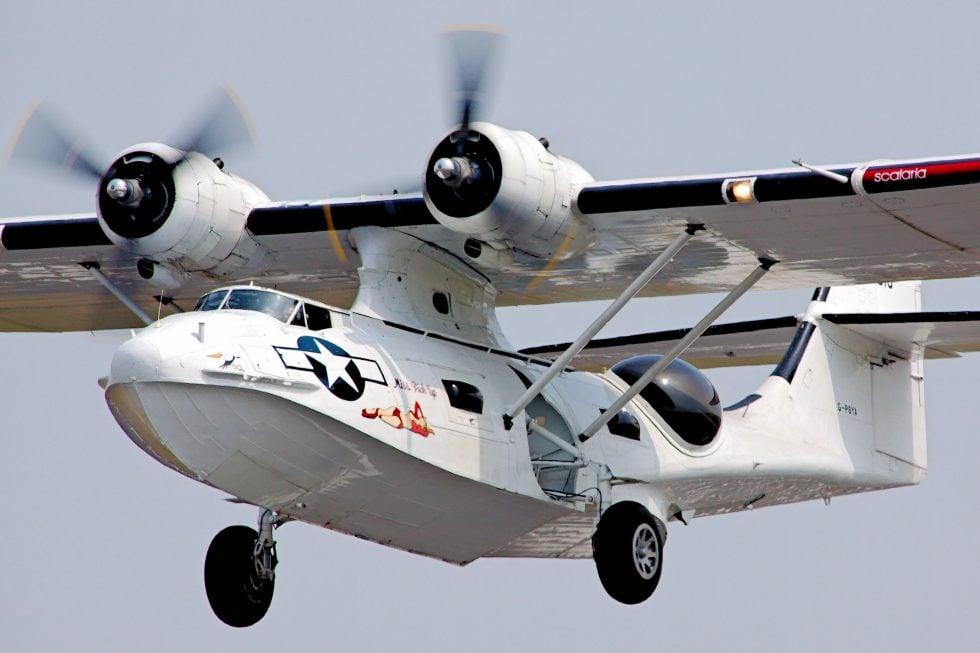
The Catalina in motion
A hand-picked Catalina documentary is on its way — video coming soon. In the meantime, explore the gallery above and the twelve crew stories for the full picture of the PBY’s war.
Where the Catalina flew
The record that defines the Catalina
The Catalina’s record is not measured in dogfight kills — it was a patrol boat, not a fighter. Its victories are the fleets it found, the submarines it forced under, the shipping the Black Cats sank by night, and above all the aircrew it pulled alive from the sea. Few aircraft can claim so decisive a hand in so many battles.
Compare the combat record of every military aircraft. Figures as of July 2026.
Everything people ask about the PBY Catalina
Can I fly in a PBY Catalina?
Why is the PBY Catalina so famous?
What does “PBY” stand for?
How fast was the PBY Catalina?
Did the Catalina really find the Bismarck?
What were the “Black Cats” and “Dumbos”?
How many PBY Catalinas were built?
Are any Catalinas still flying?
You can’t fly the Catalina.
These, you can.
Some legends only live in museums — others are fuelled and waiting. MiGFlug has put civilians in real military jet cockpits since 2004.
 Fly the L-39 AlbatrosThe world’s most-flown jet trainer — aerobatics included
 Fly the F-104 Starfighter“The missile with a man in it”
 Fly the MiG-21The Cold War’s most-produced jet
 Fly the T-33 Shooting StarAmerica’s first jet trainer
 Fly the DH VampireA piece of early jet history
 Fly the S.211Agile Italian jet trainer
 Fly the MB-326The classic Aermacchi jet
 Fly the MiG-15The Soviet legend of the Korean War
Continue the tour
Every fact, checked
- The National WWII Museum — The PBY Catalina in World War IIOverview of the PBY’s roles at Midway, the Black Cat campaign, anti-submarine work and Dumbo rescues.
- Naval History and Heritage Command — Catalina in DetailUS Navy history of the type: design, parasol wing, retractable floats and service.
- Smithsonian National Air and Space Museum — Consolidated PBY-5 CatalinaMuseum reference on the Catalina’s design, development and wartime service.
- Defense Media Network — The American Who Helped Sink the BismarckAccount of Ensign Leonard Smith and the Catalina that relocated the Bismarck in May 1941.
- Smithsonian Magazine — Legends of an Ocean-Crossing SeaplaneFeature on the Catalina’s long career, from wartime patrol to postwar water-bomber.
- Navy Times — Cat Tales: the story of WWII’s PBY flying boatNarrative history of the PBY’s wartime service and its crews.
- National Naval Aviation Museum — PBY-5 CatalinaReference on specifications, variants and preserved airframes.
- The Catalina Preservation SocietyDetailed history of the type’s variants, operators and surviving aircraft.