
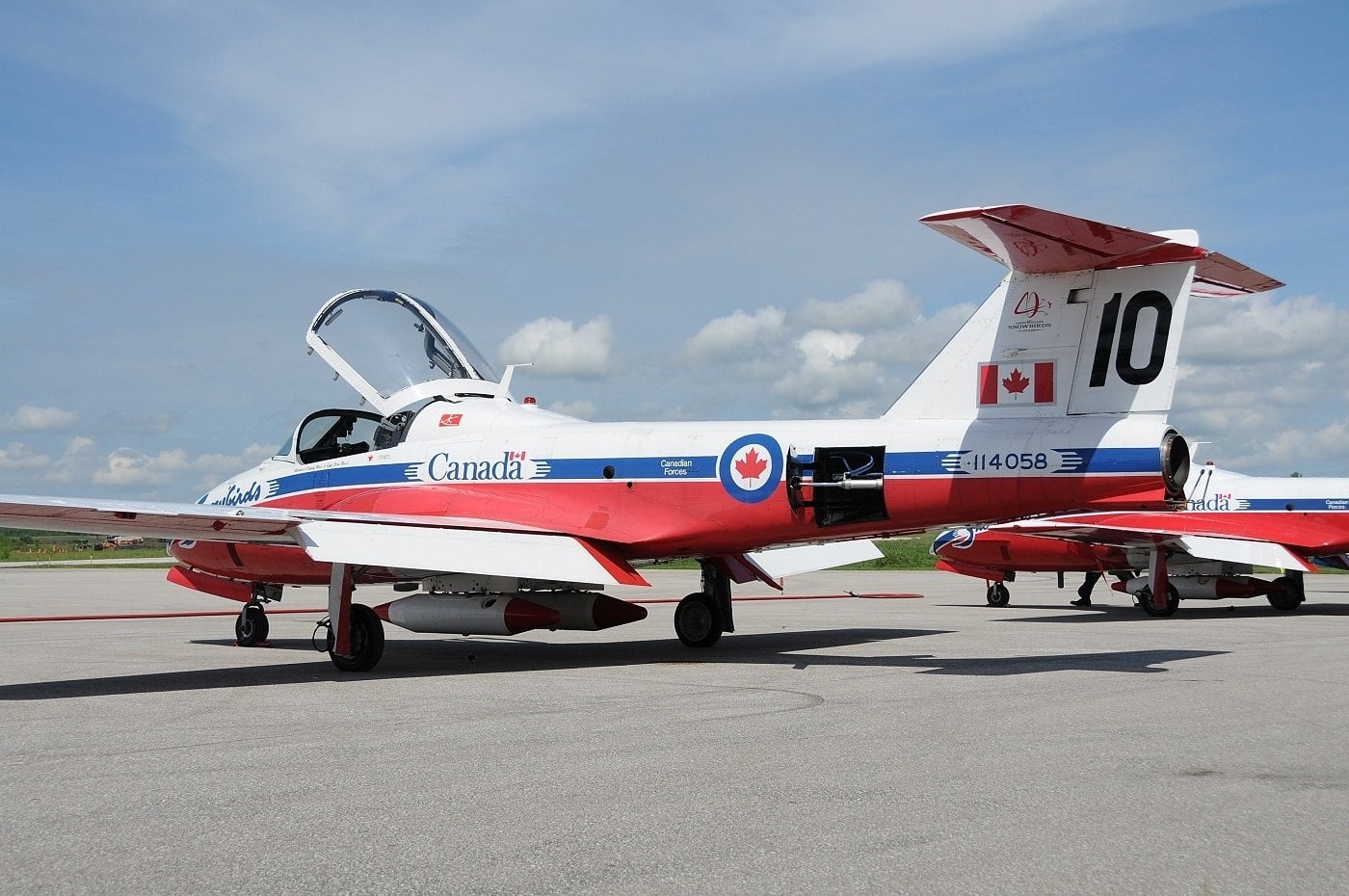
Canadair CT-114 Tutor
The Snowbirds’ Jet
Canada’s home-built side-by-side jet trainer taught the RCAF to fly jets for almost four decades, then carried the Snowbirds through more than 2,700 shows before its last season in 2026.
The Tutor: how a Montreal private venture became Canada’s jet classroom
On 13 January 1960 a small, stubby jet with a high T-tail and a bulbous, side-by-side cockpit made its first flight from Canadair’s plant at Cartierville, Montreal. The CL-41 was a private venture. Canadair, better known for building Sabres and Starfighters under licence, had bet that the Royal Canadian Air Force would soon need something better than the CT-133 Silver Star, a two-seat derivative of a 1940s fighter, to teach its pilots to fly jets. The design team chose manual flying controls, a pressurised cabin and seats placed side by side, so that instructor and student could see each other’s hands and faces. Wind-tunnel work pushed the tailplane to the top of the fin to keep it clear of the wing’s wake in a spin. In September 1961 Ottawa ordered 190 production aircraft as the CT-114 Tutor.
Deliveries ran from October 1963 to September 1966, and the Tutor became the jet in which almost every Canadian military pilot of the next generation went solo. Most of the work was done at CFB Moose Jaw in Saskatchewan, where the wide prairie sky and flat terrain suited a busy training base. Students arrived from piston trainers and left, roughly 200 hours later, ready for advanced and operational types: the CF-104, the CF-5, and in time the CF-18. Export success was modest. Malaysia bought 20 armed CL-41G aircraft, which it named Tebuan, Malay for wasp, and flew them from 1967 to 1986. A single CL-41R with a Starfighter-style radar nose was built to sell systems training, but nobody ordered it.
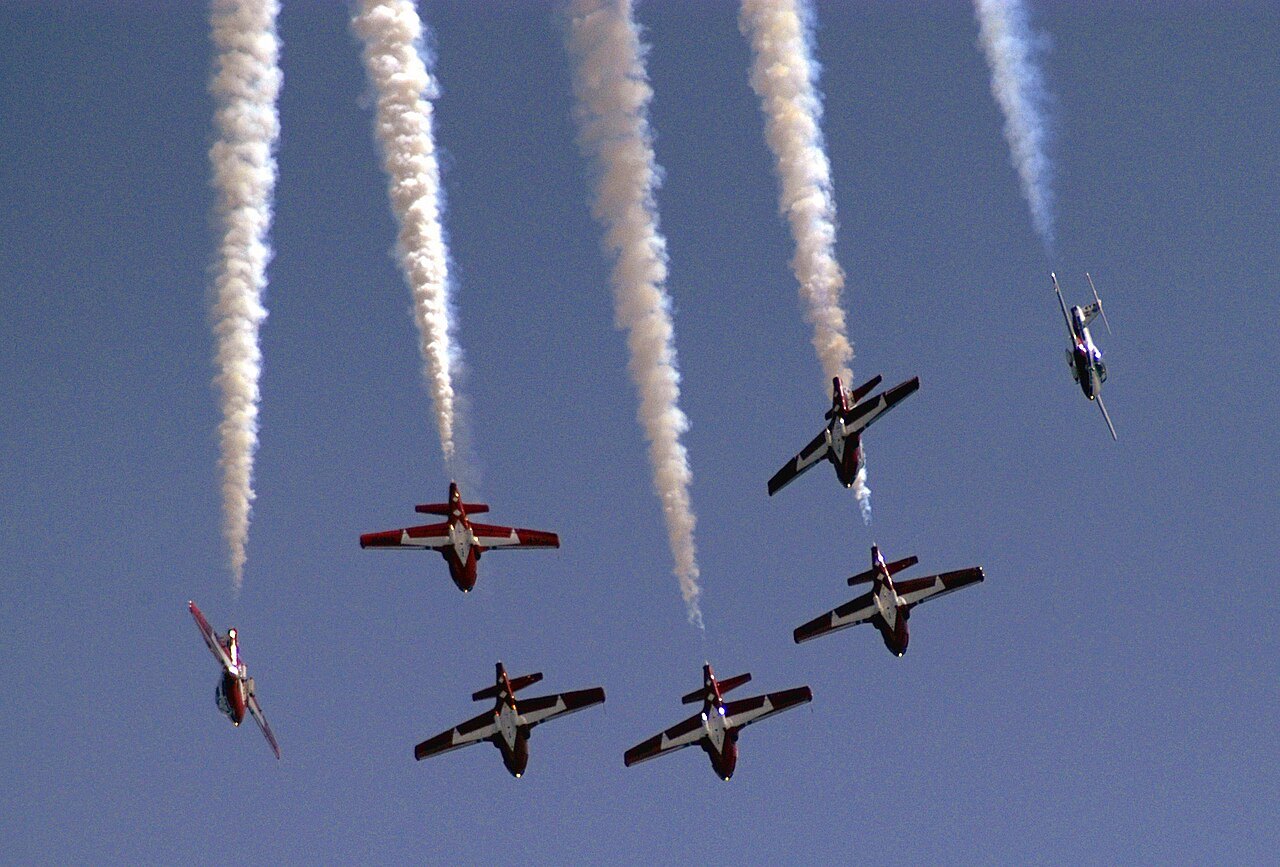
The Tutor’s second life began in 1967, when ten were painted gold for the Golden Centennaires, the team that celebrated Canada’s centennial. Four years later the base commander at Moose Jaw, Colonel O.B. Philp, formed an unofficial formation team with white Tutors and instructor pilots. Local schoolchildren named it the Snowbirds. The team became 431 Air Demonstration Squadron in 1978 and outlived the Tutor’s training career, which ended in 2000 when the NATO Flying Training in Canada programme brought the CT-155 Hawk and CT-156 Harvard II. In May 2026 the Defence Minister announced that the 2026 airshow season would be the Tutor’s last, with the team grounded until new aircraft arrive in the early 2030s.
01The Tutor’s origins: why Canadair built a trainer nobody had ordered
By the late 1950s Canadair had built hundreds of Sabres under licence and was tooling up for the CF-104 Starfighter. Its engineers could see a gap coming. The RCAF trained jet pilots on the CT-133 Silver Star, a Canadian-built development of the Lockheed T-33, which was heavy, thirsty and, by the standards of supersonic fighters, slow and old-fashioned as a classroom. Canadair decided to design its own purpose-built trainer and fund the first two prototypes itself.
The CL-41 that flew on 13 January 1960 reflected a clear philosophy. Side-by-side seating, which the US Air Force had also chosen for its Cessna T-37, put the instructor right next to the student. A single small turbojet kept fuel bills down. Manual controls kept maintenance simple and gave honest feedback. The high-set tailplane came out of wind-tunnel testing aimed at reliable spin recovery, the manoeuvre every trainer has to master. Production aircraft used the General Electric J85, built in Canada by Orenda as the J85-CAN-40.
The gamble paid off when the RCAF ordered 190 aircraft in September 1961, a large order by Canadian standards and enough to keep a training fleet flying for decades. The Tutor never achieved the export sales of jets such as the Jet Provost or the T-37, but it did exactly what Canada needed: a home-built aircraft for a home-grown air force.
02The Tutor and the Snowbirds: from Moose Jaw instructors to national symbol
The Golden Centennaires of 1967 proved that the Tutor could anchor a display team. Flying ten modified aircraft alongside other types during Canada’s centennial year, the team flew about 100 public demonstrations in a single season and then disbanded. The idea did not die. In 1971 Colonel O.B. Philp, commanding CFB Moose Jaw, put together a seven-aircraft formation using white Tutors and experienced instructors. Its first official show was the Saskatchewan Homecoming Airshow at Moose Jaw on 11 July 1971.
The name came from a competition among local elementary school children. In 1974 the jets took on the red, white and blue scheme that became their trademark, and that year the team became the first to perform north of the Arctic Circle. The Snowbirds were also, by their own account, the first team in the world to choreograph a show to music. Squadron status as 431 Air Demonstration Squadron followed on 1 April 1978.
The display Tutors were modified to inject diesel fuel into the exhaust for smoke; an early attempt at coloured smoke with red dye proved corrosive to the engines and was dropped. Eleven pilots and around 80 personnel formed the squadron, with nine aircraft in the show. By 2026 the team had flown more than 2,700 performances to audiences commonly put at over 140 million people.
What makes the Tutor special
Side by side, on purpose
The Tutor’s wide, rounded nose holds two ejection seats next to each other rather than in tandem. For an instructor this is a gift: every glance at the instruments, every hesitation on the stick and every flicker of nerves is visible at arm’s length. Communication is easier, demonstration is immediate, and the student learns cockpit management by watching rather than guessing. The layout costs some drag and gives a fatter fuselage, but in a basic jet trainer, where the job is teaching rather than speed, Canadair judged it the right trade, as Cessna did with the T-37.
A T-tail for clean spins
The most distinctive feature of the Tutor’s silhouette is its high-mounted tailplane, set on top of the fin. Canadair arrived at it through wind-tunnel testing aimed at good spin behaviour. With the tailplane lifted out of the turbulent wake of the wing at high angles of attack, the elevator and rudder keep their authority when a student has let the aircraft depart from controlled flight. For a trainer that would spend thousands of hours being stalled and spun on purpose by novices, predictable recovery mattered more than any performance figure.
One small, simple turbojet
Production Tutors used a single J85-CAN-40, a Canadian-built version of the General Electric J85, delivering about 2,650 lbf (11.8 kN) of thrust. The same engine family powered the Northrop T-38 and F-5, so it was well understood and widely supported. One engine meant lower fuel burn and simpler maintenance than a twin, and gave students a realistic introduction to jet handling: slow spool-up, careful energy management and the absence of propeller torque. The Snowbirds later added smoke-generation plumbing and upgrades to keep the ageing engines and airframes viable.
03The Tutor’s cockpit and systems: built for teaching
The Tutor’s cabin is pressurised, which allowed students to be taken to the high altitudes at which they would later fly fighters, and the fuel system and controls were designed to be robust in Canadian winters. Flying controls are manual, with no hydraulic boost, so the aircraft talks back to the pilot through the stick. Both seats are fitted with ejection seats, a feature that saved several Snowbirds pilots over the years but also became the focus of investigations after accidents at very low altitude.
Range and endurance figures vary widely between sources, from about 650 km for Snowbirds aircraft as published by the RCAF to more than 1,500 km quoted by museums for the standard trainer, a reflection of different fuel loads and mission profiles. Service ceiling is usually given at a little over 42,000 ft, enough to teach high-altitude handling in the pressurised cabin.
04The Tutor’s armed cousin: the CL-41G Tebuan
In 1966 Malaysia ordered 20 CL-41G aircraft, configured for light ground attack and counter-insurgency as well as training. The Royal Malaysian Air Force named them Tebuan, wasp, and flew them from 1967 until June 1986, when they were replaced by Aermacchi MB-339As. The G model had a strengthened structure, underwing stores stations for weapons and fuel, and a more powerful version of the J85.
A single CL-41R was also built, carrying a nose modelled on that of the CF-104 Starfighter so that it could train radar and systems operators for the fighter. No customer bought it, and the Tutor family remained a small one: 190 trainers for Canada, 20 Tebuans for Malaysia and the prototypes.
Canadair CT-114 Tutor specifications
Specifications
- Crew
- 2 (side by side, ejection seats)
- Length
- 9.75 m (32 ft 0 in)
- Wingspan
- 11.13 m (36 ft 6 in)
- Height
- 2.84 m (9 ft 4 in)
- Empty weight
- 2,220–2,409 kg (4,895–5,311 lb), depending on source and fit
- Max take-off weight
- 3,335 kg (about 7,350 lb)
- Powerplant
- 1 × Orenda J85-CAN-40 turbojet, about 2,650 lbf (11.8 kN)
- Maximum speed
- 782 km/h (486 mph); RCAF lists 763 km/h (474 mph) for Snowbirds aircraft
- Range
- About 650 km (400 mi) to 1,560 km (970 mi), depending on source and fuel load
- Service ceiling
- About 12,900–13,600 m (42,200–44,500 ft)
- Climb rate
- About 21.4 m/s (4,220 ft/min)
- Armament
- None on Canadian Tutors; CL-41G Tebuan carried underwing weapons for light attack
Costs & production
- Cost per flight hour
- No official figure published. An estimate in the low thousands of US dollars per hour is plausible, based on a single J85-class turbojet’s fuel burn plus the heavy maintenance a 60-year-old airframe needs; treat as indicative only
- Production
- 190 CL-41A (CT-114) for Canada, 20 CL-41G for Malaysia, plus prototypes and the single CL-41R
- Programme
- RCAF order September 1961; deliveries October 1963 to September 1966; training role ended 2000; display role ends after the 2026 season
05The Tutor’s variants: a small family
- CL-41 prototypes: first flight 13 January 1960, Canadair-funded.
- CL-41A / CT-114 Tutor: 190 basic jet trainers for the RCAF and Canadian Forces, J85-CAN-40 engine.
- CL-41G Tebuan: 20 armed trainer and light-attack aircraft for Malaysia, 1967 to 1986.
- CL-41R: one aircraft with a Starfighter-type nose for systems training, not produced.
- Snowbirds Tutors: modified with smoke systems and the red, white and blue scheme; about two dozen kept airworthy for the team and for test work at Cold Lake.
06The Tutor’s operating costs: why age finally won
The Tutor was cheap to run by jet standards: one small engine, manual controls and a simple airframe. By the 2020s, however, the aircraft were around 60 years old, and keeping a fleet of two dozen airworthy meant scavenging parts, re-engineering components and running an extensive life-extension effort. Critics in Parliament and the press repeatedly questioned how long that could continue. When Defence Minister David McGuinty announced on 19 May 2026 that the Tutors would retire after the season, the government cited the aircraft’s age and pointed to the CT-157 Siskin II as the basis of the team’s future. No public per-hour cost figure for the Tutor has been released.
The Tutor from 1960 to 2026
First flight
The Canadair-funded CL-41 prototype flies on 13 January at Montreal.
RCAF order
Canada orders 190 aircraft in September as the CT-114 Tutor to replace the CT-133 Silver Star.
Into service
Deliveries begin in October; they continue until September 1966.
Golden Centennaires and Malaysia
Ten gold Tutors fly Canada’s centennial display; Malaysia’s armed CL-41G Tebuans enter service.
Snowbirds formed
Col. O.B. Philp’s Moose Jaw team flies its first official show on 11 July.
431 Squadron
The Snowbirds become 431 Air Demonstration Squadron on 1 April.
Tebuan retired
Malaysia phases out its CL-41Gs in June, replacing them with MB-339As.
Training role ends
NATO Flying Training in Canada brings the CT-155 Hawk and CT-156 Harvard II; Tutors stay with the Snowbirds.
Kamloops
On 17 May a bird ingestion causes the loss of Snowbird 11 and the death of Capt. Jennifer Casey.
Final season
On 19 May the government announces the Tutors will retire after the 2026 airshow season, grounding the Snowbirds until the early 2030s.
Stories & eyewitnesses: the Tutor in the classroom and the sky
First flight at Cartierville
A trainer nobody had ordered takes to the air.
Read the full story
Moose Jaw, the jet school on the prairie
Where a generation of Canadian fighter pilots went solo in a jet.
Read the full story
The Golden Centennaires
One season, about 100 shows, and a seed for the Snowbirds.
Read the full story
Named by schoolchildren
How the Snowbirds got their name.
Read the full story
North of the Arctic Circle
1974 brings new colours and a first.
Read the full story
The Wasp of Malaysia
Canada’s only Tutor export went to Southeast Asia.
Read the full story
Kamloops, 17 May 2020
A single small bird, and a national tour cut short.
Read the full story
The price of formation flying
Nine people killed in Snowbirds service since 1971.
Read the full story
The last season
A minister, a prime minister and 27 final shows.
Read the full story
Tutors you can see
Museum examples across Canada.
Read the full story
The Tutor in pictures
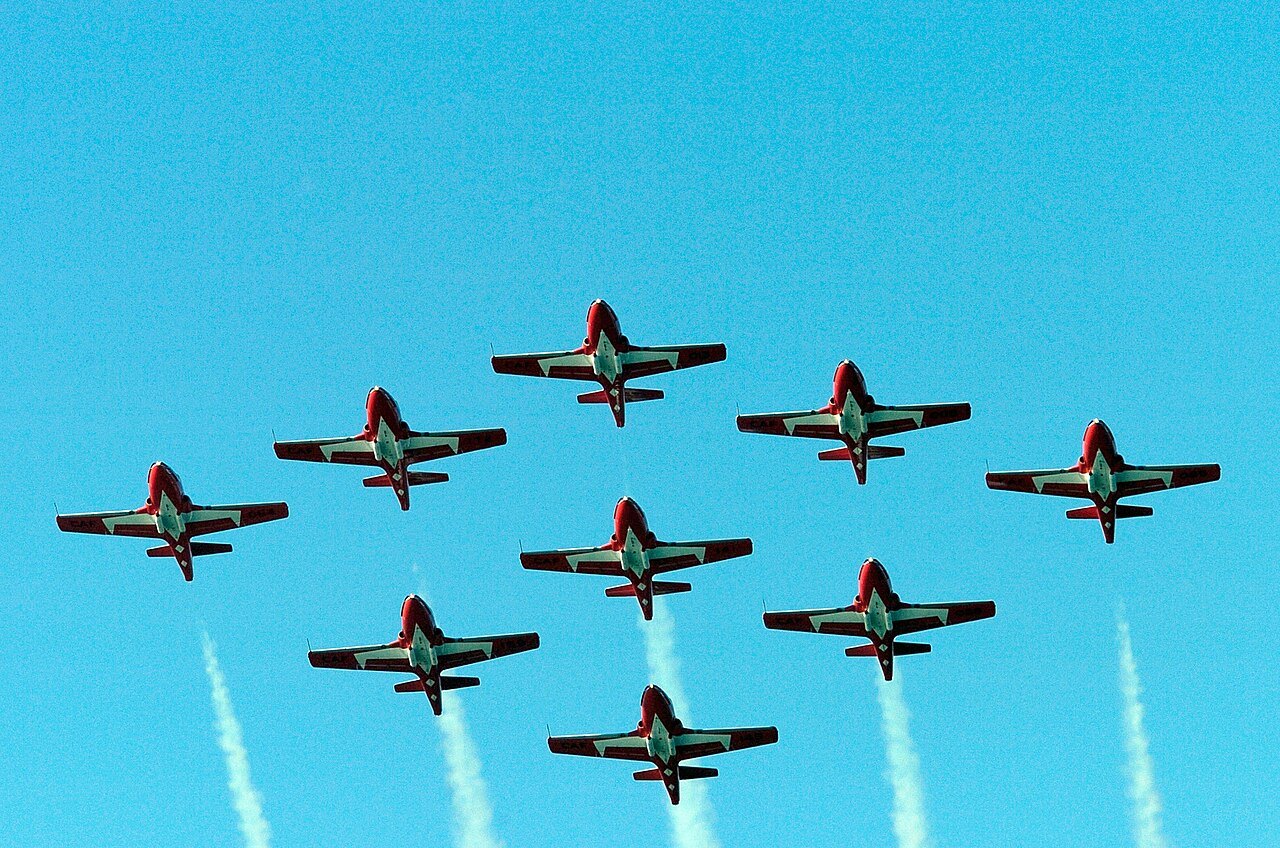
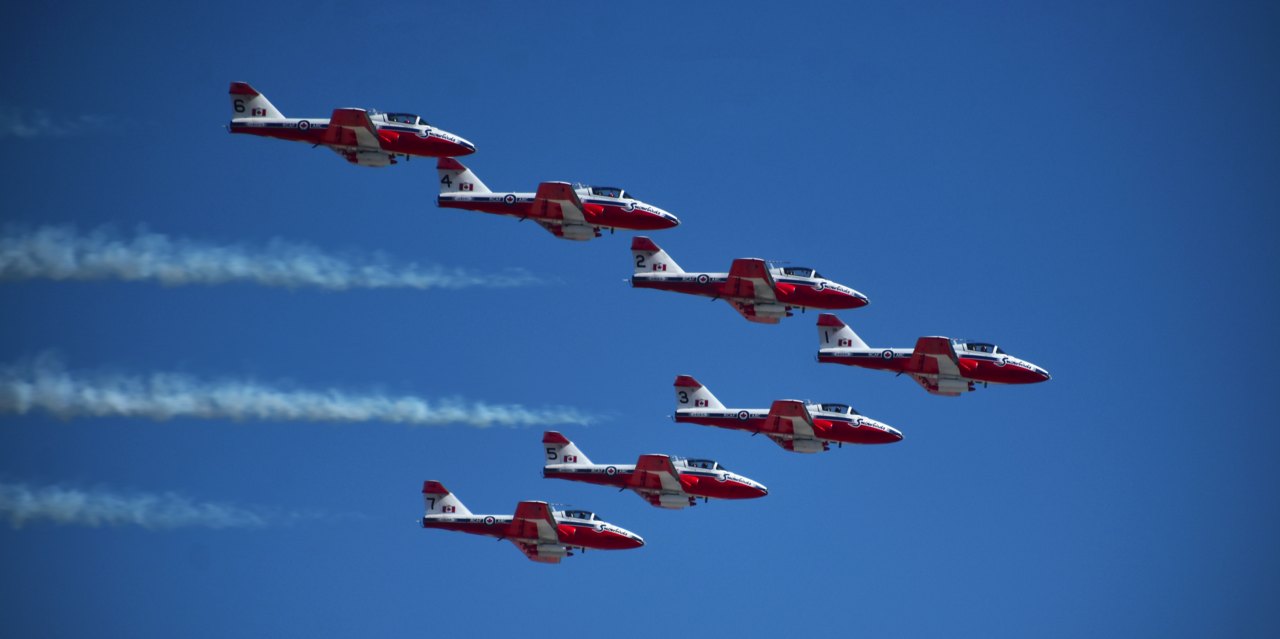
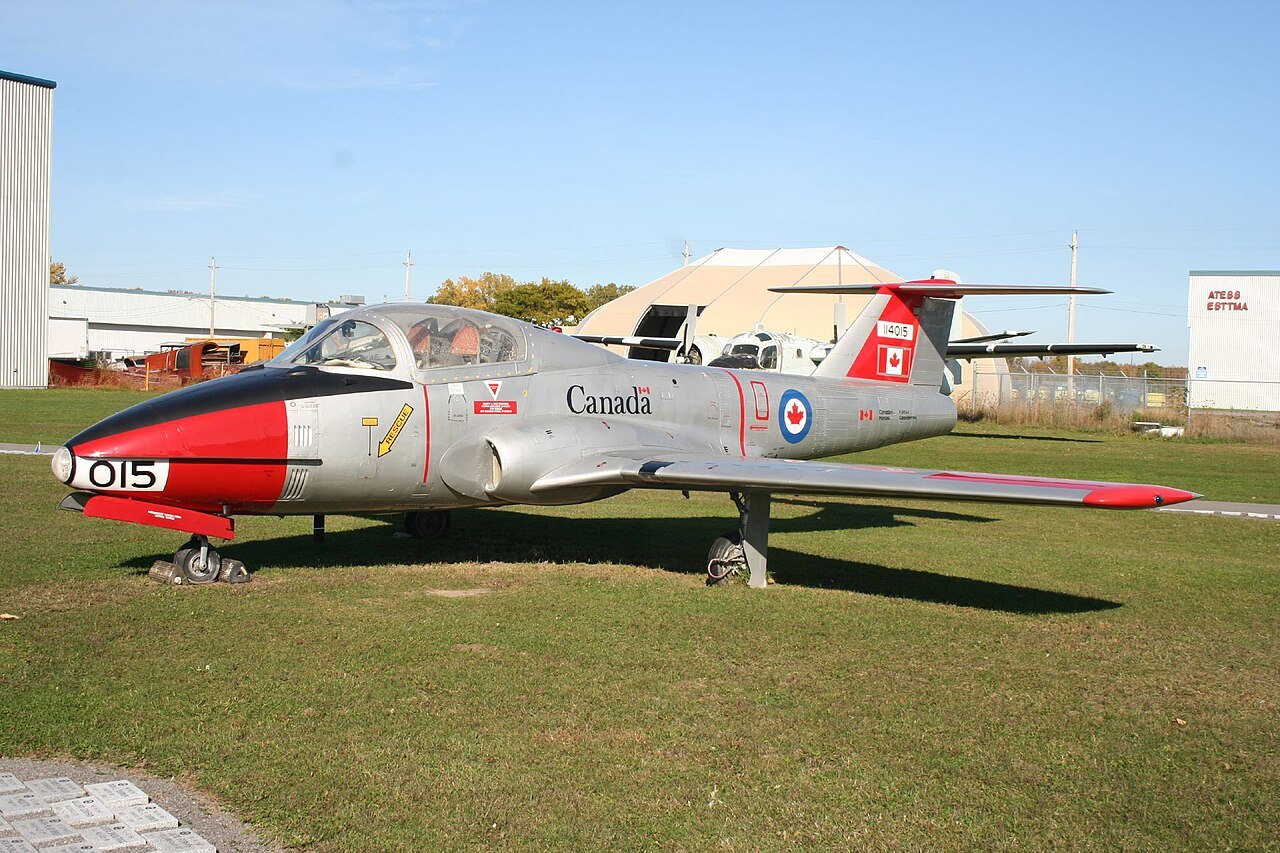
Where the Tutor flies and flew
The Tutor’s record
The Tutor’s record is one of training and display rather than war. Canadian Tutors were never armed; Malaysia’s CL-41G Tebuans were configured for light attack and counter-insurgency, but documented combat details are scarce. Its lasting achievement is generations of Canadian jet pilots and more than 2,700 Snowbirds performances.
See how training and combat types compare in the military aircraft statistics database. Figures are approximate.
Everything people ask about the Tutor
Can I fly in a Canadair CT-114 Tutor?
Why do the Snowbirds fly the Tutor?
When did the Tutor first fly?
How fast is the CT-114 Tutor?
What replaced the Tutor as a trainer?
Is the Tutor being retired?
Did any other country fly the Tutor?
You can’t fly the Tutor.
These, you can.
Most of this museum you can only look at. These genuine military jets you can fly yourself with MiGFlug — with aerobatics and time on the controls.
 Fly the L-39 AlbatrosThe world’s most-flown jet trainer — aerobatics included
 Fly the F-104 Starfighter“The missile with a man in it”
 Fly the MiG-21The Cold War’s most-produced jet
 Fly the T-33 Shooting StarAmerica’s first jet trainer
 Fly the DH VampireA piece of early jet history
 Fly the S.211Agile Italian jet trainer
 Fly the MB-326The classic Aermacchi jet
 Fly the MiG-15The Soviet legend of the Korean War
Continue the tour
Every fact, checked
- RCAF: CT-114 Tutor fact sheetOfficial dimensions, weights and performance of the Snowbirds aircraft
- National Air Force Museum of Canada: CT-114 TutorFirst flight, order and delivery dates, museum airframe 114015
- Canadian Museum of Flight: Canadair CT-114 TutorPrivate-venture origin, Tebuan exports, retirement from training
- Royal Aviation Museum of Western Canada: Canadair CL-114 Tutor 114004Moose Jaw service, smoke system, Malaysian CL-41G
- Detail & Scale: CT-114 Tutor1961 order, Malaysian order 1966, Golden Centennaires
- The Canadian Encyclopedia: SnowbirdsFounding, name, 1974 colours, 431 Squadron, fatalities
- National Defence: Flight Safety Investigation Report for Kamloops Snowbirds accidentCause and recommendations of the 2020 accident
- Regina Leader-Post: A history of Snowbirds mishaps (2020)Dates and names of fatal accidents
- Canadian Press via Castanet: Snowbirds grounded until early 2030s (2026)Retirement announcement, final season, Siskin II
- CTV News: Snowbirds to be grounded after 2026 season (2026)Retirement timeline