
Northrop Grumman E-2 Hawkeye
The Carrier’s Radar Picket
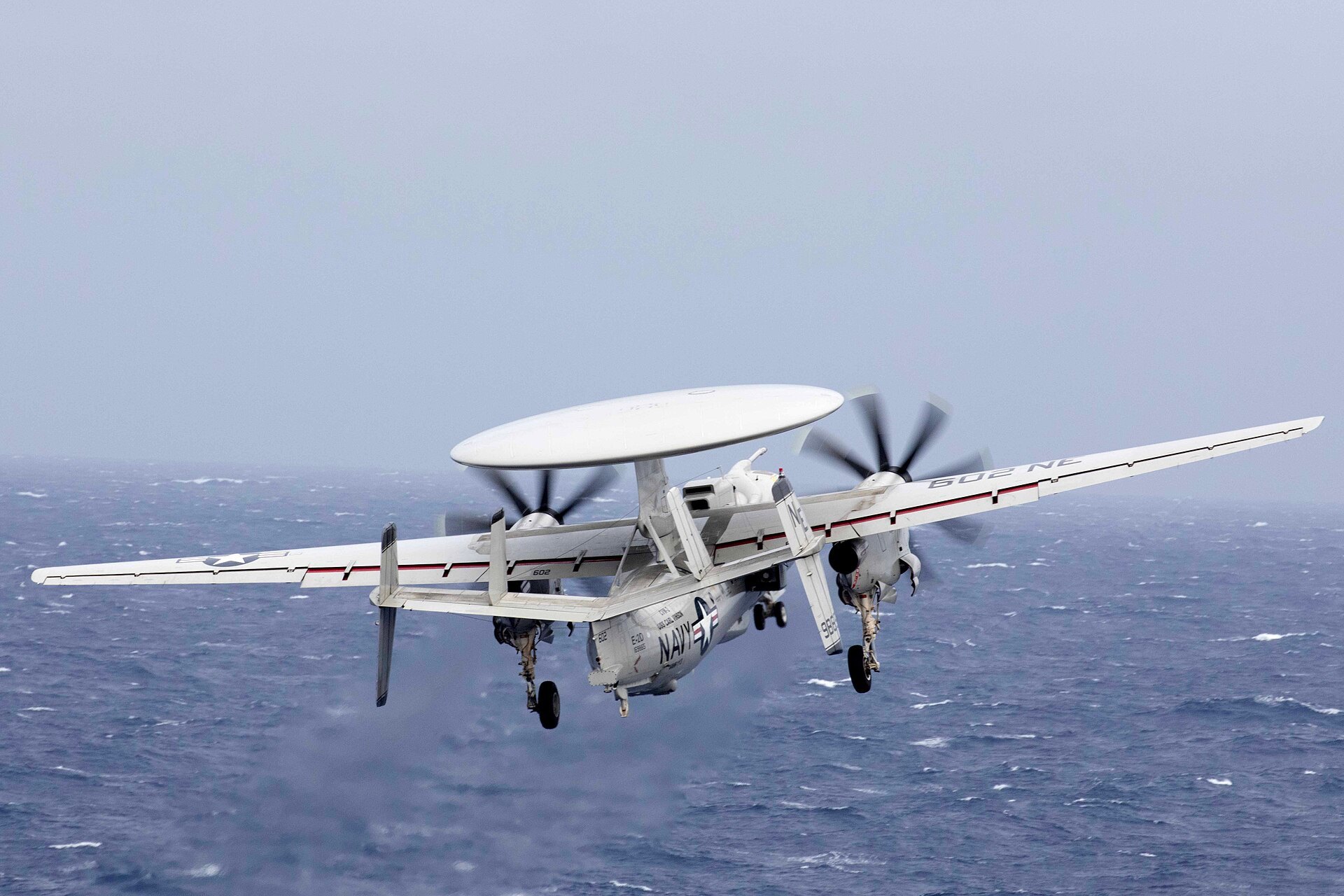
The four-finned turboprop with a radar disc on its back that has guarded US carrier groups since 1964 and, in its E-2D form, is still the eyes of the fleet more than six decades later.
The E-2 Hawkeye: how Grumman put a radar station on a carrier deck
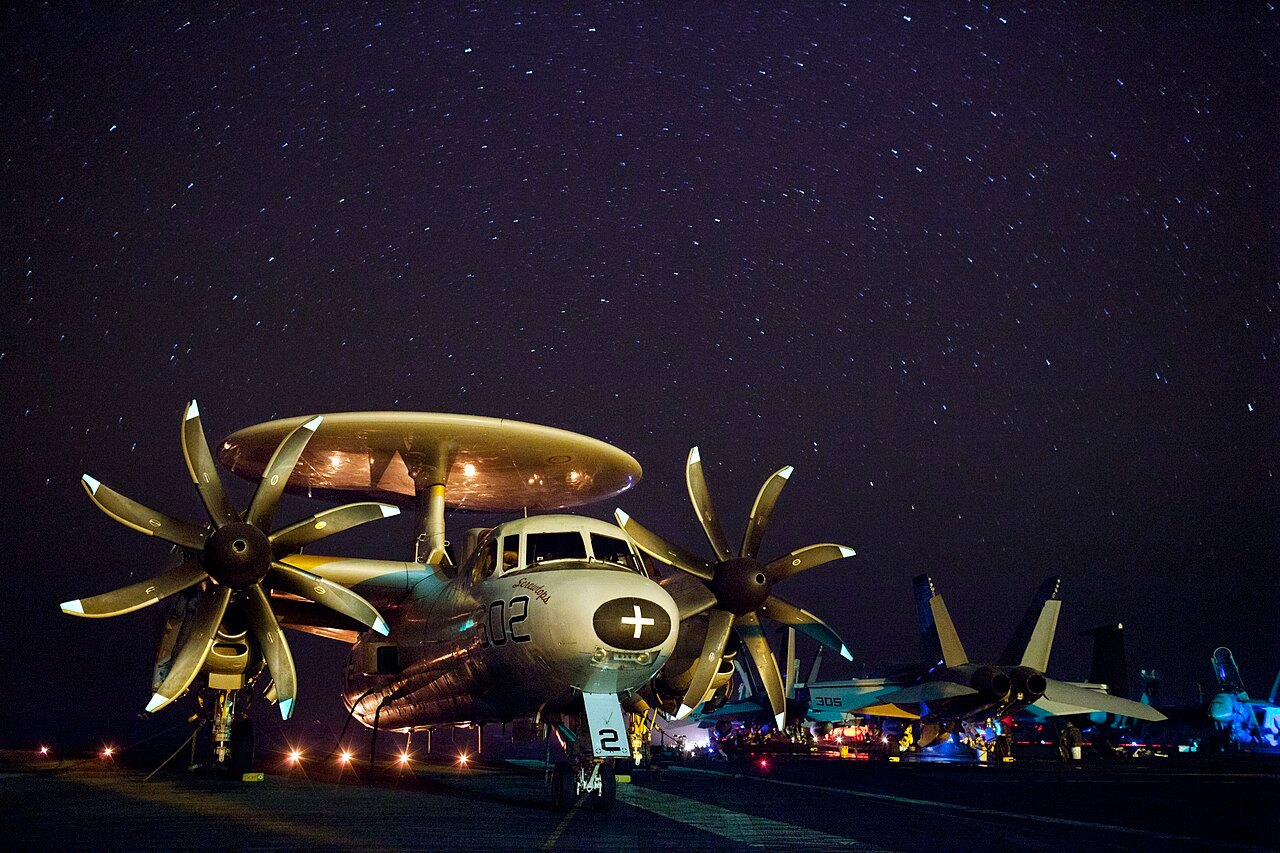
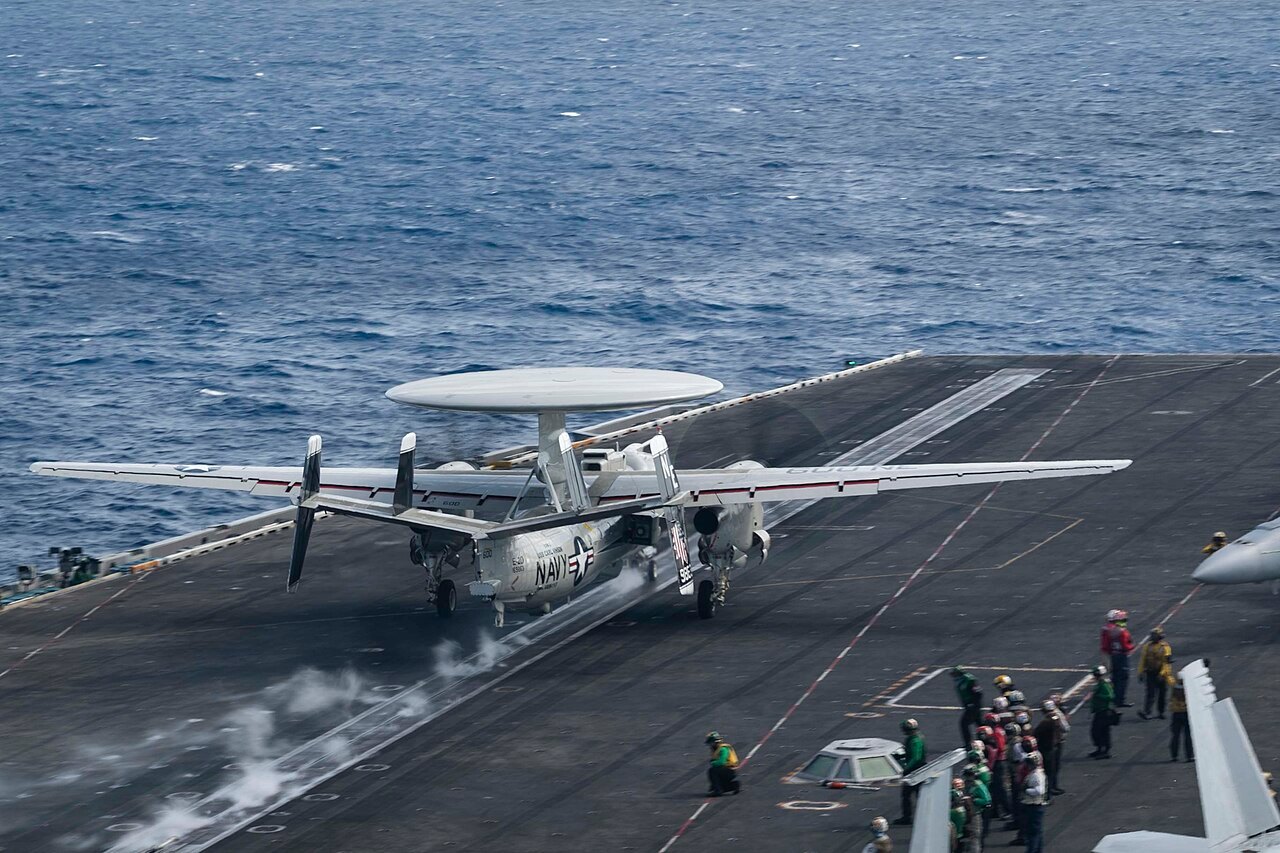
On a carrier at night, the launch order matters. Before the strike fighters go, the catapult flings a stubby, high-winged turboprop into the dark with a seven-metre disc on its back and a distinctive drone from its propellers. The E-2 Hawkeye climbs to its station ahead of the ship and, for the next few hours, becomes the carrier group’s eyes: it sees the incoming aircraft, the low-flying missiles and the ships beyond the horizon, and it tells the fighters where to go. Sailors call it the Hummer, after that sound. It is not glamorous, but no US carrier has deployed without it for sixty years, and the carrier rarely launches a major strike until the Hawkeye is already up.
Grumman designed the Hawkeye in the late 1950s as the first aircraft built from the start for carrier airborne early warning, rather than adapted from a bomber or patrol aircraft. The prototype, then called the W2F-1, flew on 21 October 1960, and the E-2A entered US Navy service in January 1964. Its shape was dictated by the ship: four short vertical fins and a rudder layout that kept the height low enough for carrier hangars, wings that fold back along the fuselage, and a rotodome that can be lowered to clear the hangar roof. The first deployment was aboard USS Kitty Hawk in 1965, off Vietnam, where the early aircraft proved valuable but notoriously hard to keep serviceable.
The definitive E-2C flew in 1971 and entered service in 1973, and over the next three decades it was steadily upgraded with better radars, computers and propellers. It was exported to Israel, Egypt, Japan, Singapore, Taiwan and France, and second-hand Israeli aircraft went to Mexico. In 1982 Israeli Hawkeyes helped direct one of the most one-sided air battles of the jet age over Lebanon. The current E-2D Advanced Hawkeye, which first flew in 2007 and became operational in 2014, keeps the familiar shape but carries an entirely new radar, a glass cockpit and air-to-air refuelling, and is now being bought by Japan and France as well as the US Navy.
01The E-2 Hawkeye’s design: built around a hangar door
The Navy’s earlier carrier radar aircraft, such as the Grumman E-1 Tracer derived from the S-2 Tracker, carried their antenna in a fixed radome and had limited range and processing. For the Hawkeye, Grumman started with a clean sheet and the hard limits of a carrier. The aircraft had to fit on the catapult and arresting gear, fold small enough for deck parking and hangar stowage, and carry a large rotating antenna above the fuselage where it would see in every direction.
The answer was a high-wing twin turboprop with wings that swing back and fold alongside the fuselage, a tail with four vertical surfaces to give enough fin area without excessive height, and a rotodome on a pylon that can be lowered by about 60 cm to clear hangar decks on older carriers. The same basic layout, without the radar, became the C-2 Greyhound carrier transport. The basic shape has hardly changed since 1960; almost everything inside it has been replaced more than once.
02The E-2 Hawkeye abroad: from Israel to Japan
Israel was the Hawkeye’s first export customer, buying four E-2Cs, and used them to devastating effect over Lebanon in 1982. Japan’s interest was sharpened in September 1976, when Soviet pilot Viktor Belenko flew a MiG-25 at low level into Hakodate, exposing gaps in Japanese radar coverage; the Japan Air Self-Defense Force went on to buy 13 E-2Cs and has since added E-2Ds. Egypt and Singapore each bought E-2Cs in the late 1980s, and Taiwan acquired four E-2T aircraft in 1995.
France bought E-2Cs for its nuclear carrier Charles de Gaulle, the only non-US carrier able to operate the type, and has ordered E-2Ds to replace them, with production of the first French aircraft under way by the end of 2024. Mexico’s navy acquired three former Israeli E-2Cs in 2004. Singapore later replaced its Hawkeyes with Gulfstream-based aircraft, and Israel retired its fleet, but the type remains in front-line service on three continents.
What makes the E-2 Hawkeye special
A radar that fits on a carrier
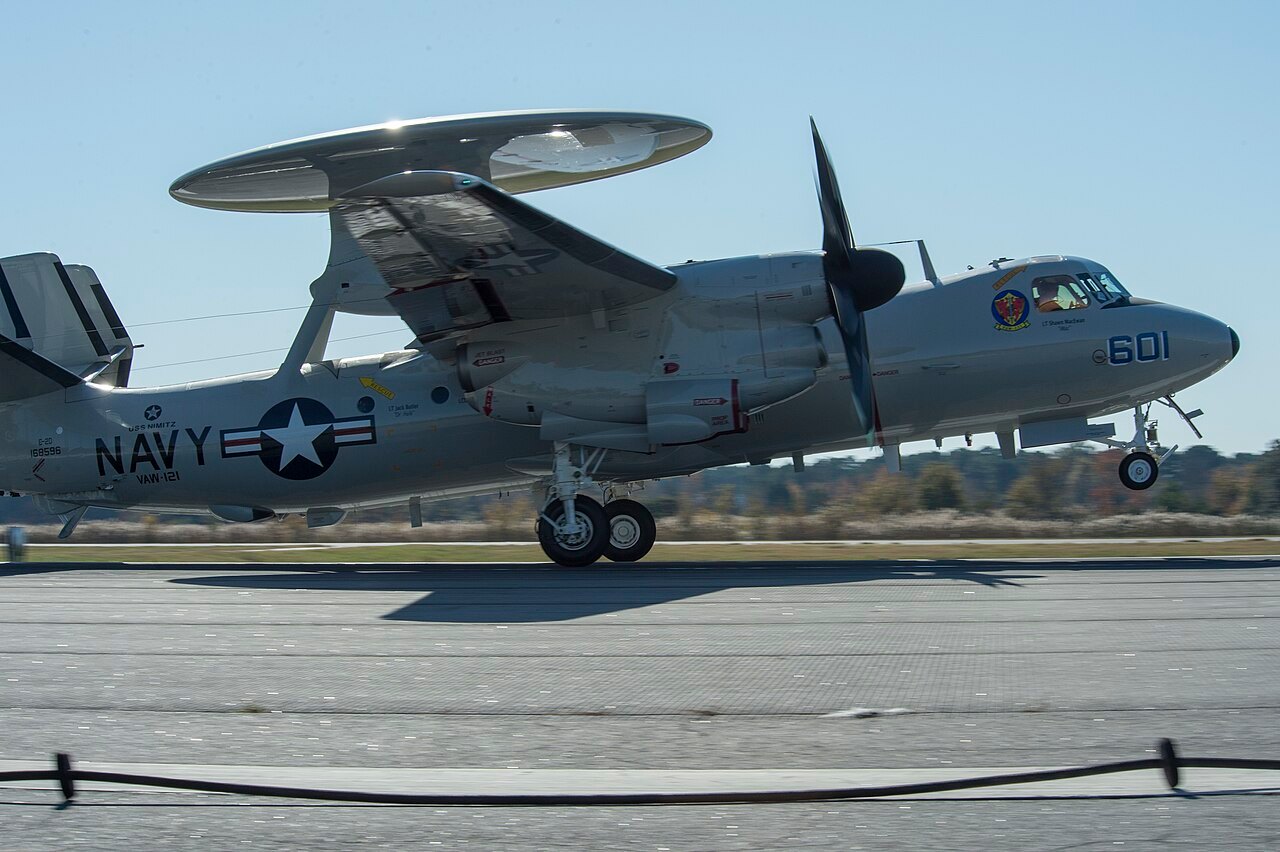
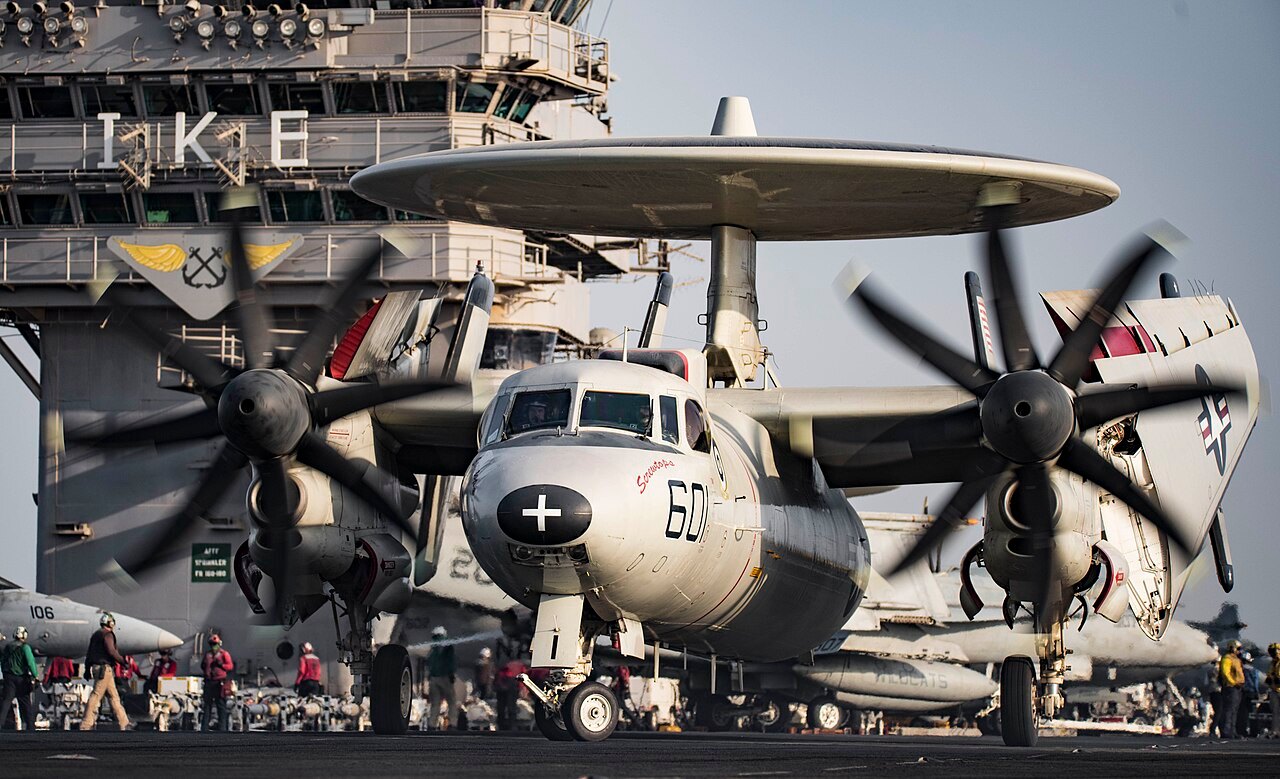
The Hawkeye is the only fixed-wing airborne early warning aircraft that operates from carrier catapults and arrested landings in large numbers. Its 7.3 m (24 ft) rotodome turns above a compact airframe that folds for stowage on a crowded deck. The US Navy says the E-2C can monitor millions of cubic miles of airspace and track hundreds of contacts at ranges beyond 200 miles, extending a carrier group’s view far past the horizon of its ships’ own radars.
The APY-9 radar
The E-2D’s AN/APY-9 is a UHF radar whose antenna combines mechanical rotation with electronic scanning, so operators can concentrate energy on a sector of interest without waiting for the dome to come round. Northrop Grumman says it can track more than 3,000 targets. UHF wavelengths are long, and some analysts argue that this gives the E-2D a better chance of detecting stealthy aircraft and cruise missiles than higher-frequency radars, a claim the Navy does not discuss in detail.
Five people, one picture
The Hawkeye carries a crew of five: two pilots and three naval flight officers, the radar officer, combat information centre officer and air control officer. Working at consoles in a cramped, windowless cabin, they build the air and surface picture, pass it by data link to the carrier and its escorts, and control fighters directly. In the E-2D the co-pilot can also run a mission display, effectively adding a fourth operator when the workload peaks. Missions are often flown at night and in poor weather, ending with an arrested landing.
03The E-2 Hawkeye’s evolution: E-2A to E-2D
The E-2A’s early computer and radar were troublesome, and most were rebuilt as the E-2B with a better computer from 1969. The E-2C, first flown on 20 January 1971, brought a new radar able to track targets over land and a passive detection system, and was improved in successive groups through the 1980s and 1990s. Later upgrades added eight-bladed NP2000 propellers, which reduced vibration and noise, and the Hawkeye 2000 mission system with new computers and the Cooperative Engagement Capability that lets ships fire at targets tracked by the aircraft.
The E-2D Advanced Hawkeye, first flown in August 2007, replaced the radar with the APY-9, added a glass cockpit and uprated engines, and later gained an air-to-air refuelling probe so it can stay on station well beyond its unrefuelled endurance of around six hours. It reached initial operating capability in October 2014.
Northrop Grumman E-2D Advanced Hawkeye specifications
Specifications
- Crew
- 5 (2 pilots, 3 naval flight officers)
- Length
- 17.6 m (57 ft 9 in)
- Wingspan
- 24.56 m (80 ft 7 in)
- Height
- 5.58 m (18 ft 4 in)
- Rotodome
- 7.3 m (24 ft) diameter
- Empty weight
- about 18,234 kg (40,200 lb)
- Max take-off weight
- about 26,083 kg (57,500 lb)
- Powerplant
- 2 × Rolls-Royce (Allison) T56-A-427A turboprops, 3,800 kW (5,100 shp) each, eight-blade propellers
- Maximum speed
- about 648 km/h (350 kt)
- Cruise speed
- about 474 km/h (256 kt)
- Ferry range
- about 2,708 km (1,462 nmi)
- Service ceiling
- about 10,600 m (34,700 ft)
- Endurance
- about 6 hours unrefuelled; extended by air-to-air refuelling
- Radar
- Lockheed Martin AN/APY-9 UHF (E-2D)
Costs & production
- Unit cost
- US$80 million for the E-2C (US Navy NAVAIR figure); the E-2D costs substantially more
- Cost per flight hour
- Hedged estimate: in the low tens of thousands of US dollars, an order of magnitude based on two turboprops, a five-person crew and carrier-aviation maintenance; well below four-engine AWACS jets but no official figure is used here
- Production
- E-2A 59 built; E-2C in production from the early 1970s into the 2000s; E-2D programme of record around 75 for the US Navy plus export orders
- Programme
- First flight 1960; service 1964; E-2C 1973; E-2D initial operating capability 2014
04The E-2 Hawkeye’s variants: a family over six decades
- W2F-1 / E-2A: original production version, in service from 1964.
- E-2B: E-2As rebuilt with a new computer from 1969.
- E-2C: new radar and passive detection system, first flown 1971, in service 1973; built in successive groups.
- E-2C Hawkeye 2000: new mission computer, workstations and Cooperative Engagement Capability.
- E-2T: Taiwanese E-2Cs, later upgraded to Hawkeye 2000 standard.
- E-2D Advanced Hawkeye: APY-9 radar, glass cockpit, air-to-air refuelling; first flight 2007.
- C-2 Greyhound: carrier transport derivative sharing the wing and engines.
05The E-2 Hawkeye’s operating costs: the price of a picture
Compared with land-based airborne early warning jets, the Hawkeye is cheap to run: two turboprops, a crew of five and a small airframe. Northrop Grumman stresses its smaller logistical footprint. But carrier operations are hard on aircraft, with catapult launches, arrested landings, salt air and cramped maintenance, and the E-2D’s radar and mission systems are complex.
No authoritative public cost per flight hour was found for this page, so the figure given is an order-of-magnitude estimate only. The E-2C’s US Navy unit cost was given as US$80 million; the E-2D is considerably more expensive.
The E-2 Hawkeye from Vietnam to the E-2D
First flight
The W2F-1 prototype flies on 21 October.
Into service
The E-2A joins the US Navy in January.
Vietnam debut
The first Hawkeye deployment sails aboard USS Kitty Hawk.
E-2C flies
The first E-2C prototype flies on 20 January; the type enters service in 1973.
Over the Bekaa
Israeli E-2Cs help direct the air battles over Lebanon.
Desert Storm
Navy Hawkeyes control carrier aircraft over Iraq, including two F/A-18s that shoot down MiG-21s.
Mexico
Three former Israeli E-2Cs are sold to the Mexican Navy.
Hurricane Katrina
Three Hawkeye squadrons support civilian relief on the US Gulf Coast.
E-2D first flight
The Advanced Hawkeye flies in August.
E-2D operational
The E-2D reaches initial operating capability in October.
French E-2D
Production of the first E-2D for France begins, for delivery later in the decade.
Stories & eyewitnesses: the E-2 Hawkeye on watch
Off Vietnam, 1965
The Hawkeye’s first cruise was a war cruise.
Read the full story
Lebanon, 1982: the Bekaa Valley
Israeli Hawkeyes helped direct one of the most one-sided air battles in history.
Read the full story
Belenko’s MiG and Japan’s Hawkeyes
A Soviet defector exposed a hole in Japan’s radar cover.
Read the full story
Desert Storm: two MiGs and a bombing run
A Hawkeye’s warning set up the US Navy’s only kills of enemy jets in the Gulf War.
Read the full story
Libya, 1986
Hawkeyes guarded the fleet during confrontations with Gaddafi’s forces.
Read the full story
Hurricane Katrina, 2005
A radar plane built for war became an air-traffic controller over a disaster zone.
Read the full story
The Hummer’s crew
Five people in a windowless tube, landing on a ship at night.
Read the full story
France and the Charles de Gaulle
The only foreign carrier to operate the Hawkeye.
Read the full story
Hawkeyes you can visit
Two museum aircraft show sixty years of the type.
Read the full story
The E-2D takes on fuel
Air refuelling transformed the endurance of a sixty-year-old design.
Read the full story
The E-2 Hawkeye in pictures
Where the E-2 Hawkeye flies and flew
The E-2 Hawkeye’s record
The Hawkeye is unarmed, but it has controlled carrier air operations in every US Navy war and crisis since Vietnam, and Israeli E-2Cs played a central part in the 1982 battles over Lebanon. Its service record also includes disaster relief at home.
See how training and combat types compare in the military aircraft statistics database. Figures are approximate.
Everything people ask about the E-2 Hawkeye
Can I fly in a Northrop Grumman E-2 Hawkeye?
Why does the E-2 Hawkeye have four tail fins?
Why is the Hawkeye called the Hummer?
What is the difference between the E-2C and the E-2D?
Which countries fly the E-2 Hawkeye?
How many people crew an E-2 Hawkeye?
Where can I see an E-2 Hawkeye?
You can’t fly the E-2 Hawkeye.
These, you can.
Most of this museum you can only look at. These genuine military jets you can fly yourself with MiGFlug — with aerobatics and time on the controls.
 Fly the L-39 AlbatrosThe world’s most-flown jet trainer — aerobatics included
 Fly the F-104 Starfighter“The missile with a man in it”
 Fly the MiG-21The Cold War’s most-produced jet
 Fly the T-33 Shooting StarAmerica’s first jet trainer
 Fly the DH VampireA piece of early jet history
 Fly the S.211Agile Italian jet trainer
 Fly the MB-326The classic Aermacchi jet
 Fly the MiG-15The Soviet legend of the Korean War
Continue the tour
Every fact, checked
- E-2C HawkeyeUS Navy NAVAIR: role, crew, dimensions, engines and unit cost
- E-2D Advanced HawkeyeManufacturer: radar capability, roles and French order
- E-2C early warning aircraft (JASDF)Japan Air Self-Defense Force equipment page
- E-2C HawkeyeCombat history: Vietnam, Libya 1986, Desert Storm, Kosovo
- E-2D Advanced Hawkeye fact fileUS Navy fact file (page blocked automated access; listed for checking)
- Navy declares IOC for E-2D Advanced HawkeyeUSNI News, October 2014
- E-2D hits IOC: Navy Hawkeyes take larger, more lethal roleBreaking Defense, October 2014
- U.S. Navy’s secret counter-stealth weapon hiding in plain sightUSNI News (Dave Majumdar, 2014) on the APY-9 UHF radar
- Japan seeking more E-2D HawkeyesAviation Week on Japanese E-2D purchases