
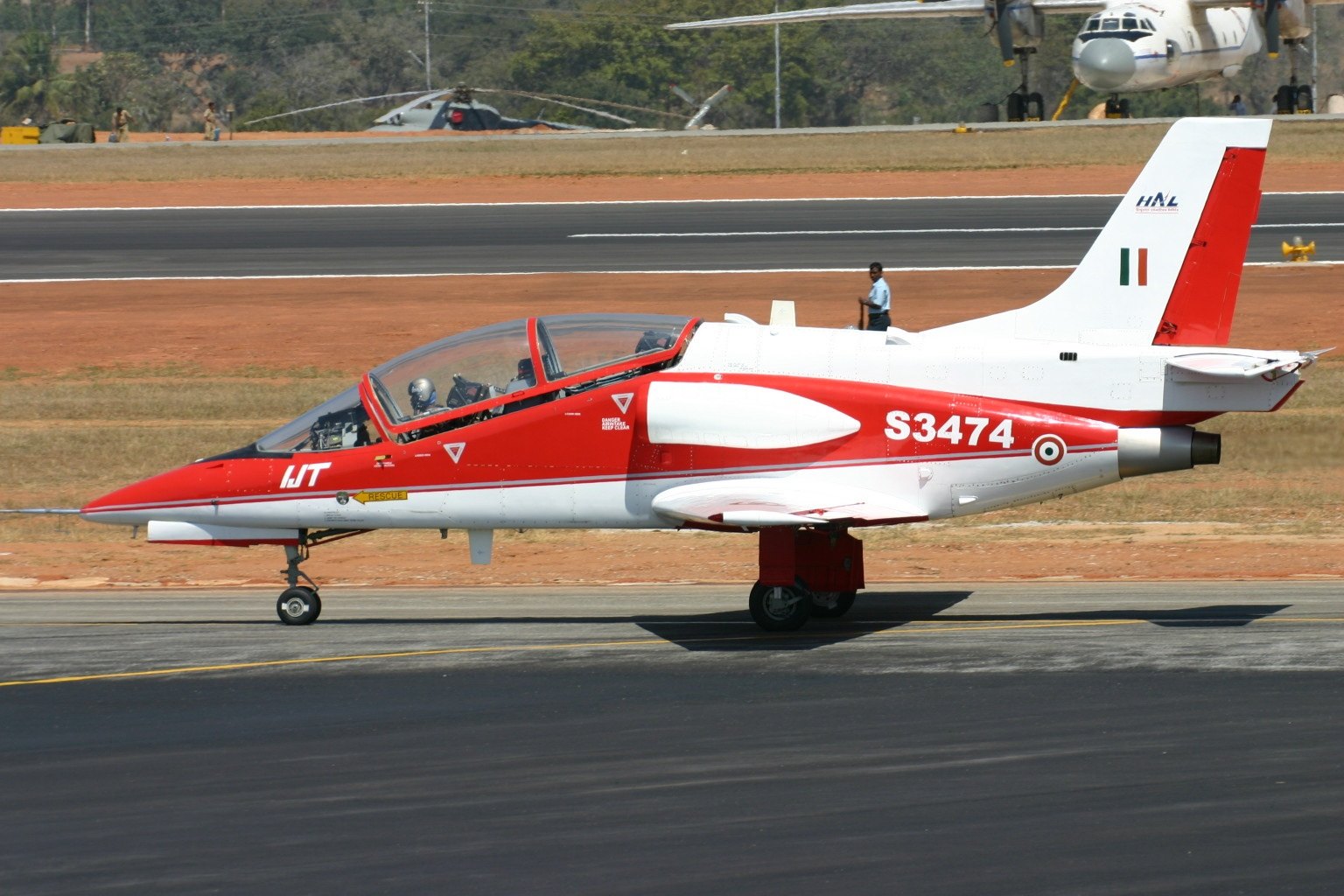
HAL HJT-36 Sitara
Reborn as the Yashas
India’s intermediate jet trainer flew in 2003 and was meant to replace the Kiran within years; crashes and a stubborn spin problem kept it out of service for more than two decades, until a redesign relaunched it as the Yashas.
The HJT-36: how India’s next jet trainer lost two decades to a spin
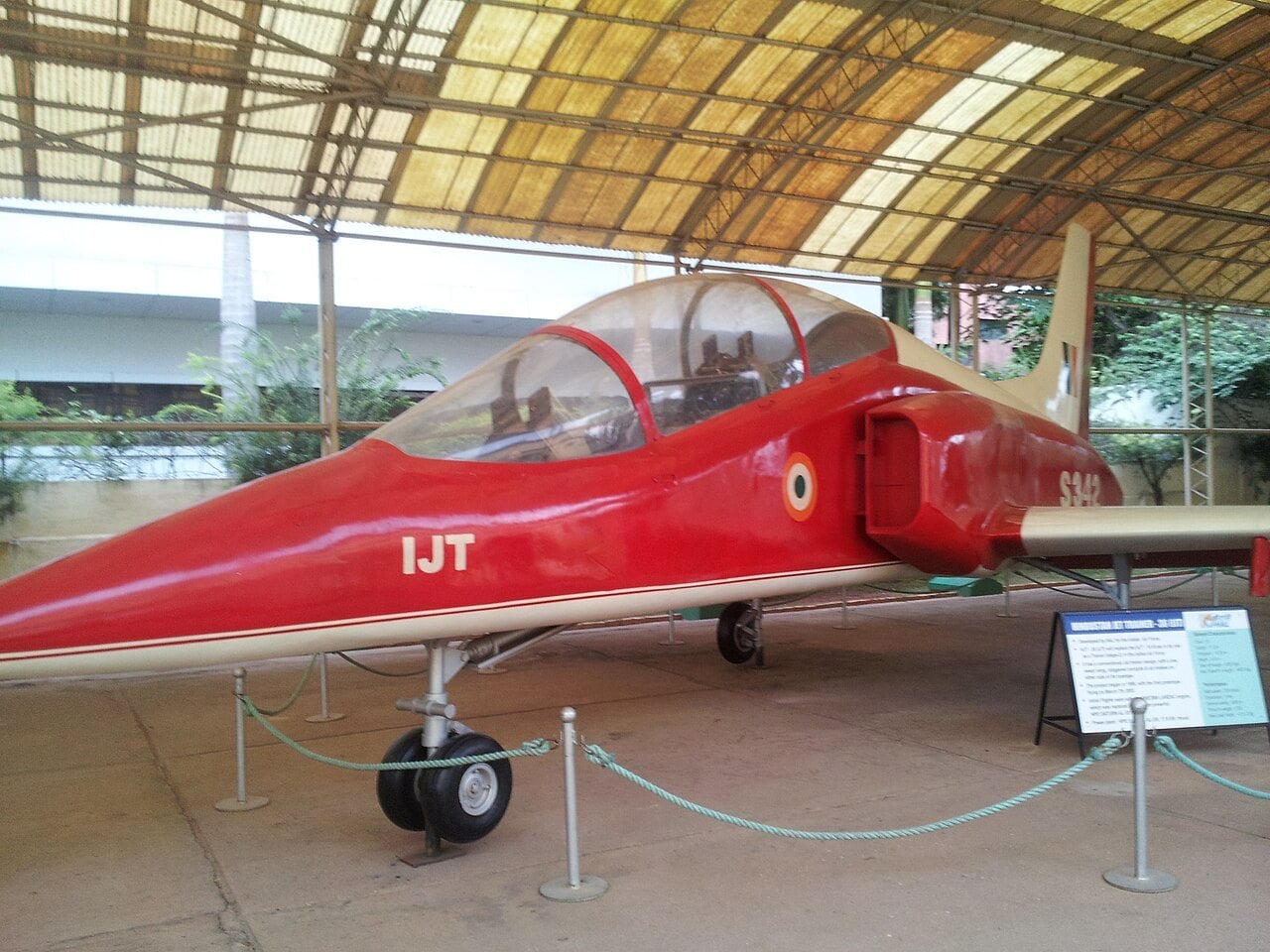
On 7 March 2003, at Bengaluru, HAL’s chief test pilot Squadron Leader Baldev Singh (retd) took the first HJT-36 into the air for about 20 minutes. Bharat Rakshak reported the flight as flawless, and it had come quickly: the project had been sanctioned in July 1999 and metal was cut only 20 months before. The aircraft, named Sitara, star, was intended to replace HAL’s own HJT-16 Kiran as the Indian Air Force’s intermediate jet trainer, the Stage II aircraft between basic propeller training and the advanced BAE Systems Hawk. Its designers, led by P. Jayasimha, gave it a swept wing, a tandem cockpit with a raised rear seat, a French Larzac turbofan from the Alpha Jet and five hardpoints. HAL talked of 200 to 250 aircraft and first deliveries in 2005.
Almost nothing went to plan. In February 2007 the first prototype ran off the runway during take-off at Aero India. A Russian AL-55I engine, chosen for more thrust, arrived two years late at the end of 2008. In February 2009 the second prototype suffered a landing gear failure, and on 28 April 2011 a prototype crashed near Hosur, both pilots ejecting safely. The air force, which had committed to limited-series and series production aircraft, grew openly frustrated. In 2012 the Chief of the Air Staff, Air Chief Marshal N.A.K. Browne, told Aviation International News: “We are concerned as we are not seeing significant progress on the IJT.” Underneath it all lay the hardest problem: the aircraft’s behaviour in stalls and spins.
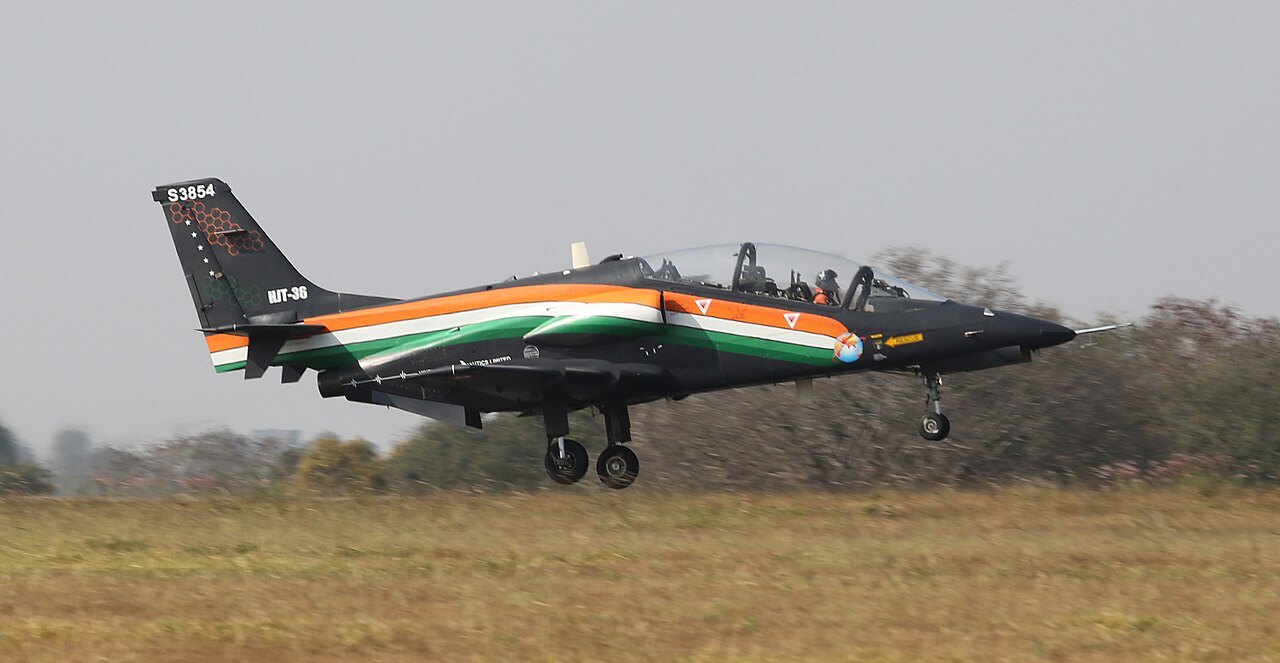
A trainer that students will spin every week must recover predictably, and the HJT-36 did not. After the aircraft departed from controlled flight during spin testing in 2016, the programme was halted and HAL called in outside help, including BAE Systems. Strakes, fins and fences were tried; the eventual cure was a reworked tail moved rearwards, an enlarged rudder and new strakes. The modified airframe flew in April 2019, and in January 2022 it completed six-turn spins in both directions. At Aero India on 10 February 2025 HAL relaunched the type as the HJT-36 Yashas, glory, with a new glass cockpit and FADEC-controlled AL-55I, and the Indian Air Force asked to lease about four aircraft for evaluation as a replacement for the ageing Kiran Mk II.
01The HJT-36’s spin problem: why a trainer must forgive
Stall and spin behaviour is not a niche concern in a trainer; it is the heart of the job. Students are taught to stall, to spin and to recover, deliberately and repeatedly, so that they will not be killed by an inadvertent departure later in their careers. An aircraft that drops a wing unpredictably, or that resists recovery, cannot be cleared for that syllabus however good its other qualities.
By February 2014 the HJT-36 had flown more than 800 test sorties, yet the Indian Ministry of Defence still reported that its stall characteristics needed refinement before final clearance. Six limited-series aircraft had been built but not delivered. Reports in 2017 described the aircraft as unfit for service and its spin problems as hard to solve. HAL tried nose strakes, ventral fins and wing fences without curing the wing drop.
The solution, verified in wind tunnels including France’s ONERA facility, was more radical: the vertical tail was moved back by about a metre, the rudder was extended down to the rear fuselage, increasing its area by about 30 per cent, and leading-edge strakes were added at the wing roots. An anti-spin parachute was fitted for the trials in 2020. In January 2022 the modified aircraft completed six-turn spins in both directions, the milestone the programme had been chasing for well over a decade, and the way was open for the relaunch as the Yashas.
What makes the HJT-36 special
A fighter-style cockpit for Stage II
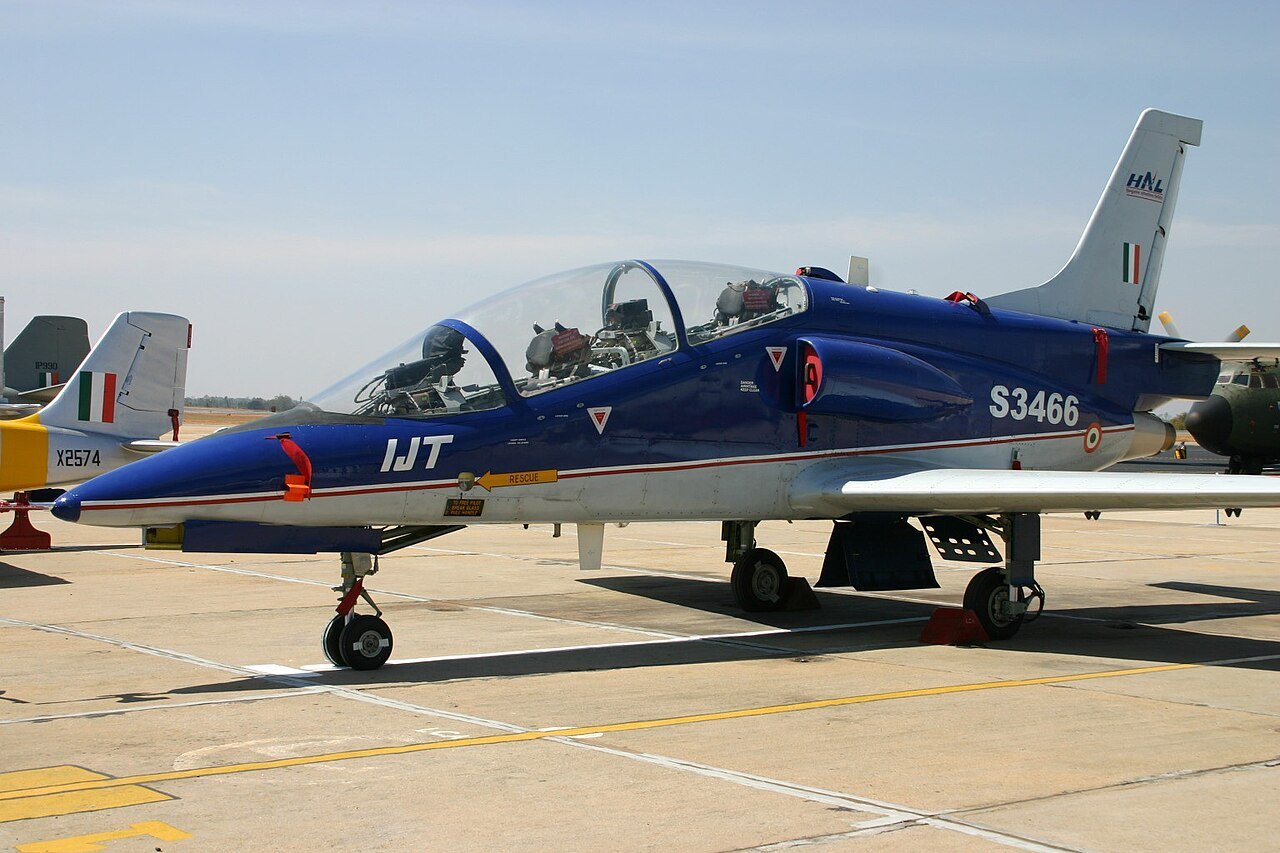
Unlike the side-by-side Kiran it was built to replace, the HJT-36 seats its crew in tandem, the student in front and the instructor in a raised rear seat, with a drooped nose and a one-piece canopy for all-round view. The layout is the one students will meet in the Hawk and in front-line fighters, and the cockpit, with multifunction displays and a head-up display, was designed to mirror current combat aircraft rather than the dials of the 1960s.
From Alpha Jet engine to Russian turbofan
The prototypes flew with the French Larzac 04-H20, the Alpha Jet engine, rated at about 14.1 kN. The production standard switched to the Russian NPO Saturn AL-55I, a small turbofan developed for the type and commonly given as about 17.3 kN. Early engines had a short life between overhauls, a major concern for the air force, but improved units delivered from 2021 were credited with a total technical life of 1,200 hours, more thrust and less weight, and HAL is to build the engine under licence.
A trainer that can fight
Like many intermediate trainers, the HJT-36 is designed to teach weapons delivery and to double as a light attack aircraft. It has five hardpoints, one under the fuselage and two under each wing, with a combined capacity of about 1,000 kg for rockets, gun pods and bombs. HAL markets the Yashas for Stage II training, armament training, aerobatics, counter-insurgency and operations against surface forces, although no air force has yet taken it into service in any role.
02The HJT-36’s cockpit and systems: from Smiths to Indian boxes
The original HJT-36 avionics suite was developed with Smiths Aerospace, later part of GE Aviation, and included a head-up display, mission computer and attitude and heading reference system, with the head-up display and repeater supplied by Elbit. The prototypes used Russian Zvezda K-26LT zero-zero ejection seats. HAL designed the aircraft with light alloys and composites, a tricycle undercarriage with a twin nosewheel, and an 18-degree swept wing, and it has said that about a quarter of its line-replaceable units are common with the Tejas trainer.
For the Yashas relaunch in 2025, HAL described a weight-reduction effort, a new glass cockpit with voice command, and the replacement of obsolete imported units with Indian equipment. The FADEC-controlled AL-55I gives the pilot carefree handling of the engine, an important point for students learning to manage power at jet speeds for the first time. HAL also used the design as the basis for its HLFT-42 lead-in fighter trainer project.
HAL HJT-36 Sitara specifications
Specifications
- Crew
- 2 (tandem)
- Length
- 11.0 m (36 ft 1 in)
- Wingspan
- 10.0 m (32 ft 10 in)
- Height
- 4.4 m (14 ft 5 in)
- Wing area
- 17.5 m² (188 sq ft)
- Gross weight
- 4,250 kg (9,370 lb)
- Max take-off weight
- 5,400 kg (11,905 lb)
- Powerplant
- 1 × NPO Saturn AL-55I turbofan, about 17.3 kN (3,900 lbf); prototypes 1 × Larzac 04-H20, 14.1 kN (3,175 lbf)
- Maximum speed
- 750 km/h (466 mph, 405 kt), Mach 0.75
- Range
- About 1,000 km (621 mi)
- Endurance
- More than 2.5 hours (HAL launch figure)
- Service ceiling
- 9,000 m (29,500 ft)
- g limits
- +7 / −2.5 g
- Armament
- Five hardpoints (one fuselage, four wing), about 1,000 kg (2,200 lb) of rockets, bombs or gun pods
Costs & production
- Unit cost
- No published flyaway price; a reported Rs 6,180 crore order for 73 series aircraft implies roughly Rs 85 crore each including support (2010 figures; an estimate, not a published price)
- Cost per flight hour
- No official figure; small single-engine jet trainers are commonly estimated at roughly US$3,000 to 6,000 per hour depending on what is counted (rough estimate by comparison with similar types)
- Production
- Prototypes and limited-series aircraft only; about four offered to the IAF on lease from 2025
- Programme
- Sanctioned 1999 at Rs 180 crore, revised to Rs 467 crore in 2005; total commitments reported at over Rs 4,000 crore by 2014
03The HJT-36’s airframes: prototypes and LSP aircraft
- PT-1: first prototype, first flight 7 March 2003 with the Larzac; first to fly with the AL-55I in May 2009.
- PT-2: second prototype, first flight March 2004; landing gear failure in February 2009.
- Prototype lost 28 April 2011: crashed near Hosur, Tamil Nadu; Group Captain Anant Mathur and Wing Commander Patra ejected safely.
- LSP aircraft: limited-series production airframes, six built by 2014 but not delivered.
- LSP-4 (S3854): the modified spin-test airframe, first flight with the new tail on 17 April 2019.
- HJT-36 Yashas: the relaunched production standard presented at Aero India 2025.
04The HJT-36’s operating costs: the price of delay
No operating cost has been published for the HJT-36, which has never entered squadron service. Single-engine jet trainers of its size are commonly estimated at roughly US$3,000 to 6,000 per flight hour, depending on whether fuel alone or full maintenance and support is counted; that is several times the cost of a turboprop basic trainer, and one reason air forces now push more of the syllabus onto propeller aircraft and simulators.
The heavier cost has been time. The project was sanctioned in 1999 at Rs 180 crore; by 2013 research and development spending was reported at about Rs 600 crore, and total commitments, including production advances, at more than Rs 4,000 crore. Early AL-55I engines needed overhaul after about 150 hours, far short of what the air force wanted, a gap later improvements were meant to close.
The HJT-36 from Sitara to Yashas
Project sanctioned
The Indian government sanctions an intermediate jet trainer in July at Rs 180 crore; HAL had begun design work in 1997.
First flight
Sqn Ldr Baldev Singh (retd) flies PT-1 from Bengaluru on 7 March, about 20 months after metal cutting.
Second prototype
PT-2 joins the flight test programme in March.
Aero India accident
On 8 February PT-1 runs off the runway at Yelahanka during take-off at the opening of Aero India.
New engine, new setback
PT-1 flies with the Russian AL-55I from May; PT-2 suffers a landing gear failure in February.
Prototype lost
A prototype crashes near Hosur on 28 April; both pilots eject safely.
Programme halted
The aircraft departs from controlled flight during spin testing and work stops pending a redesign, with BAE Systems consulted.
Redesign flies
LSP-4, with a relocated tail and enlarged rudder, flies on 17 April.
Spin cleared
In January the modified aircraft completes six-turn spins in both directions.
Reborn as the Yashas
Renamed at Aero India on 10 February; the Indian Air Force asks HAL for a proposal to lease about four aircraft for evaluation.
Stories & eyewitnesses: the HJT-36 and its long road
Twenty months from metal to flight
The Sitara started out as one of HAL’s fastest programmes.
Read the full story
Off the runway at Aero India
The Sitara’s first public setback came in front of the world’s aviation press.
Read the full story
The engine that came late
A switch to a Russian turbofan cost the programme years.
Read the full story
Ejection near Hosur
In 2011 the programme lost a prototype.
Read the full story
The air chief loses patience
By 2012 the customer was saying publicly what it thought.
Read the full story
Departure from controlled flight
In 2016 the spin problem stopped the programme.
Read the full story
A new tail
The cure was to move the fin back a metre.
Read the full story
Yashas
At Aero India 2025 the Sitara got a new name and a second chance.
Read the full story
The HJT-36 in pictures
Where the HJT-36 flies and flew
The HJT-36’s record
The HJT-36 has no combat or operational record. It has flown only as a development aircraft, with several prototypes damaged or lost in accidents, and its significance is as a lesson in how hard a good trainer is to design. Whether it finally enters service depends on the Indian Air Force’s evaluation of the leased Yashas aircraft.
See how training and combat types compare in the military aircraft statistics database. Figures are approximate.
Everything people ask about the HJT-36
Can I fly in a HAL HJT-36 Sitara?
What is the difference between the Sitara and the Yashas?
Why has the HJT-36 taken so long?
Is the HJT-36 in service?
What engine powers the HJT-36?
Can the HJT-36 carry weapons?
What aircraft does the HJT-36 replace?
You can’t fly the HJT-36.
These, you can.
Most of this museum you can only look at. These genuine military jets you can fly yourself with MiGFlug — with aerobatics and time on the controls.
 Fly the L-39 AlbatrosThe world’s most-flown jet trainer — aerobatics included
 Fly the F-104 Starfighter“The missile with a man in it”
 Fly the MiG-21The Cold War’s most-produced jet
 Fly the T-33 Shooting StarAmerica’s first jet trainer
 Fly the DH VampireA piece of early jet history
 Fly the S.211Agile Italian jet trainer
 Fly the MB-326The classic Aermacchi jet
 Fly the MiG-15The Soviet legend of the Korean War
Continue the tour
Every fact, checked
- HAL Intermediate Jet Trainer HJT-36, Bharat RakshakFirst flight, design team, launch specifications
- Sitara HJT-36 Intermediate Jet Trainer, GlobalSecurityProgramme costs, orders, accidents, engine life
- IJT problems add to Indian Air Force training woes, Neelam Mathews, AIN (2012)Air chief’s comments, requirement for 85 IJTs
- HJT-36 delivery slips again by two years, Siva Govindasamy, Flight International (2008)Delivery delays
- Warplanes, StrategyPage (16 March 2003)Contemporary report of the first flight
- HAL’s upgraded Hindustan Jet Trainer (HJT) 36 unveiled as Yashas, India Strategic (2025)Renaming and upgrades
- HAL relaunches HJT-36 as Yashas, Dynamite News (2025)HAL chairman on IAF leasing interest
- Indian Air Force seeks HAL proposal for leasing HJT-36 Yashas trainers, IDRW (2025)Four-aircraft lease request