
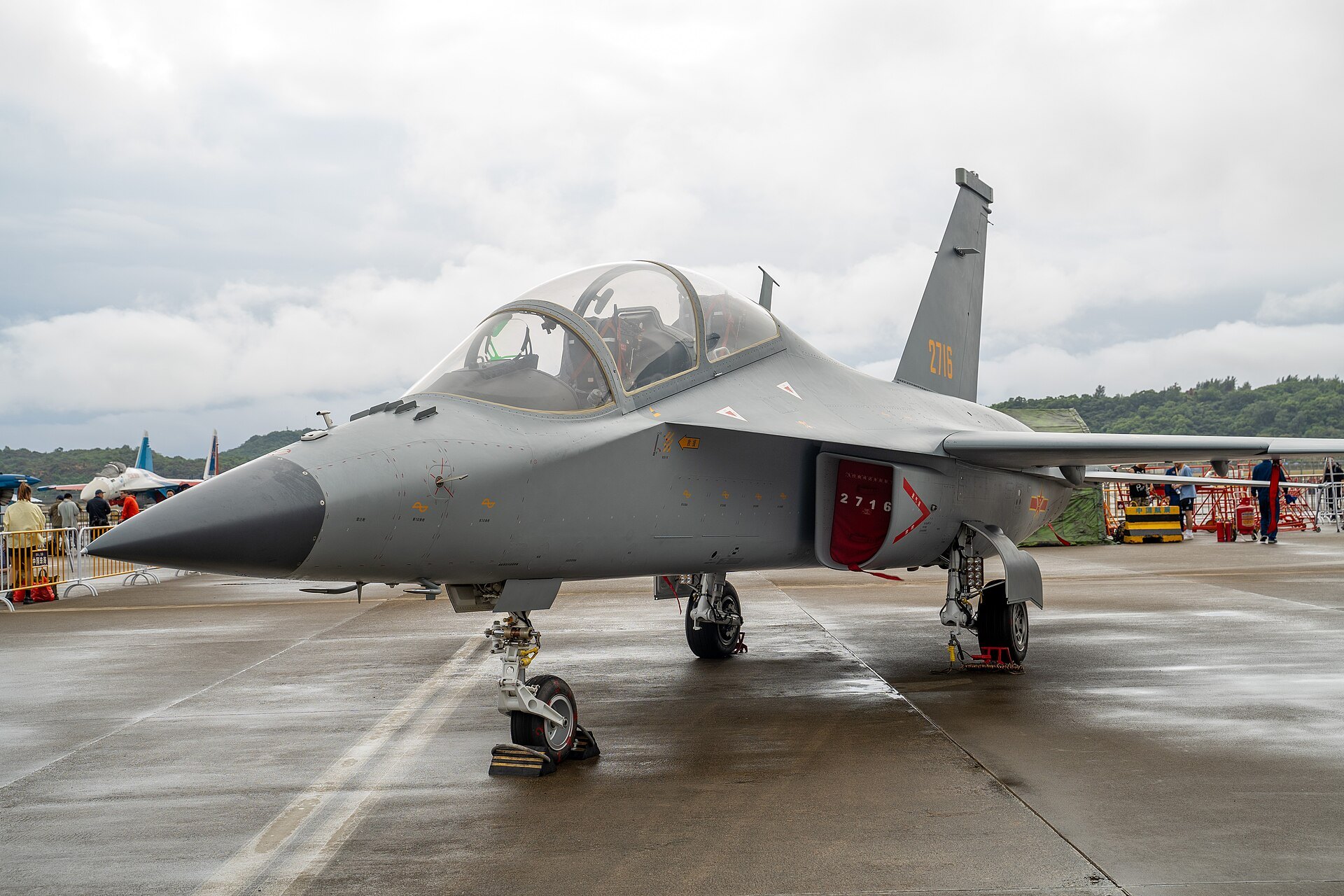
Hongdu L-15 / JL-10
China’s Falcon
China’s first supersonic-capable jet trainer prepares PLA pilots for the J-10, J-16 and J-20, and in 2025 it became the mount of the UAE’s national aerobatic team.
The L-15: how China built a trainer for its fourth-generation fighters
At the turn of the century the People’s Liberation Army Air Force had a problem. It was buying fly-by-wire fighters such as the J-10 and Su-27 family, but its pilots still graduated from trainers designed around the Soviet MiG-21. In 2000 the Hongdu works at Nanchang, maker of the K-8 Karakorum, began an advanced trainer of its own and hired the Russian Yakovlev design bureau as technical and scientific consultant. The family likeness to Yakovlev’s Yak-130 is obvious: twin engines, a long wing-root extension, a high-set stepped tandem cockpit. Hongdu showed the design at China Expo in 2001 and a full-scale mock-up at Zhuhai in 2004. The first prototype was rolled out in September 2005 and flew on 13 March 2006.
The L-15 had a rival at home. The Guizhou JL-9, a cheaper trainer derived from the MiG-21 lineage, won the first PLAAF selection in 2005, and Hongdu had to sell its aircraft on capability rather than price. That capability was considerable: a digital fly-by-wire control system that can be programmed to mimic the handling of different front-line fighters, a glass cockpit, and on later versions a radar and afterburning AI-222K-25F engines from Ukraine’s Ivchenko-Progress that push the aircraft to about Mach 1.4. The type entered Chinese service around 2013, first with the navy’s aviation university and then with the air force, which calls it the JL-10. By 2019 the PLAAF was using it to move lead-in fighter training out of the front-line regiments and into its flight academies.
Exports followed slowly. Zambia ordered six as the L-15Z in 2014 for a reported USD 100 million, and its jets appeared at the Africa Aerospace and Defence show in South Africa in September 2016 carrying Chinese weapons. The bigger prize came in February 2022, when the United Arab Emirates announced it would buy 12 with options for 36 more, a striking choice for an air force equipped with American F-16s and French Mirages. In November 2025 the UAE’s display team, Al Fursan, flew seven black-and-gold L-15s at the Dubai Airshow, replacing the Aermacchi MB-339 it had flown for some 15 years. In 2026 the team took them to New York, believed to be the first public display of a modern Chinese-built military aircraft in the United States.
01The L-15 and the Yak-130: cousins, not twins
Because the two aircraft look so alike, the L-15 is often described as a Chinese Yak-130. The relationship is less direct. Yakovlev worked as a paid consultant on the Hongdu programme from 2000, at the same time as it was developing its own trainer, and the shared aerodynamic thinking shows in the wing-root extensions, the high-mounted wing and the raised rear seat that gives the instructor a view over the student’s head.
Underneath, the paths diverged. The Yak-130 stayed subsonic, optimised for economy and for training on Russian fighters. Hongdu aimed higher. It wanted a trainer that could reach supersonic speed and carry a radar, so that a student could practise intercepts and weapons employment before ever touching a J-10 or J-16. The early prototypes flew with Slovak-built DV-2 turbofans, the engine of the Czechoslovak L-59, before Hongdu standardised on the Ukrainian AI-222 family, with an afterburner added for the supersonic versions.
The result sits between the Yak-130 and the Korean T-50 in concept: twin engines like the Russian jet, supersonic dash like the Korean one. Composites make up roughly a quarter of the structure, and the airframe is designed for a life of about 10,000 flying hours.
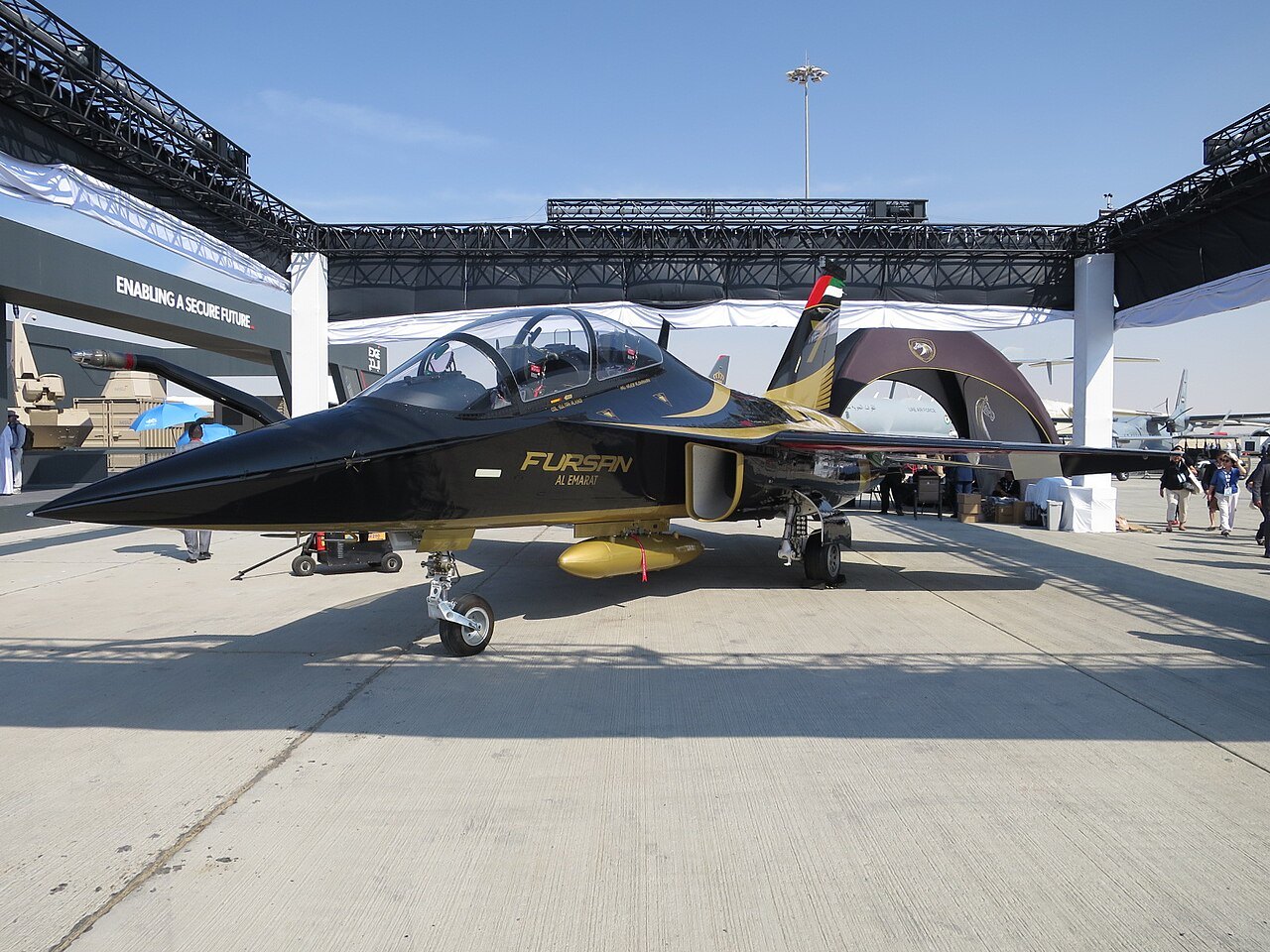
02The L-15 in Al Fursan’s colours: a Chinese jet over Dubai and New York
For most of its history the L-15 was seen in the West only on static display or in short demonstration slots at Zhuhai and Dubai. That changed when the UAE chose it to replace the MB-339 in Al Fursan, the Emirati air force display team formed in 2010. The UAE announced the purchase in February 2022, and the contract was confirmed at the IDEX exhibition in Abu Dhabi in 2023; Army Recognition put its value at about USD 440 million for the first dozen aircraft, a figure that includes support and training.
On 19 November 2025 seven L-15s, one for each emirate, flew a 29-minute routine at the Dubai Airshow, keeping the black-and-gold scheme the team had worn on its Italian jets. The following year Al Fursan brought the aircraft across the Atlantic to the FourLeaf Air Show at Jones Beach, New York, which Aviation Week described as believed to be the first public display in the United States by a modern Chinese-built military aircraft. For a type designed to train PLA fighter pilots, it was an unexpected second career as an ambassador.
What makes the L-15 special
The L-15’s fly-by-wire brain
The L-15 was designed from the outset around a digital fly-by-wire control system, and for a trainer this matters more than speed. The flight-control laws can be altered so that the aircraft behaves more like the fighter the student will fly next, and the computer protects against departures while the student learns to fly at high angles of attack. It is the same philosophy as the Yak-130 and M-346: one airframe, several personalities, and a far smaller jump to the front line.
The L-15’s two engines and afterburners
Most modern trainers are subsonic. The supersonic L-15 versions use two Ukrainian AI-222K-25F turbofans with afterburners, each producing about 41 kN with reheat, which gives the aircraft a top speed of about Mach 1.4. Subsonic L-15A and L-15AW aircraft use the dry AI-222-25. The dependence on a Ukrainian engine became a strategic issue after 2014, and Chinese sources have linked a domestic derivative, sometimes reported as the WS-17, to the type. Official details remain thin.
The L-15 as a light fighter
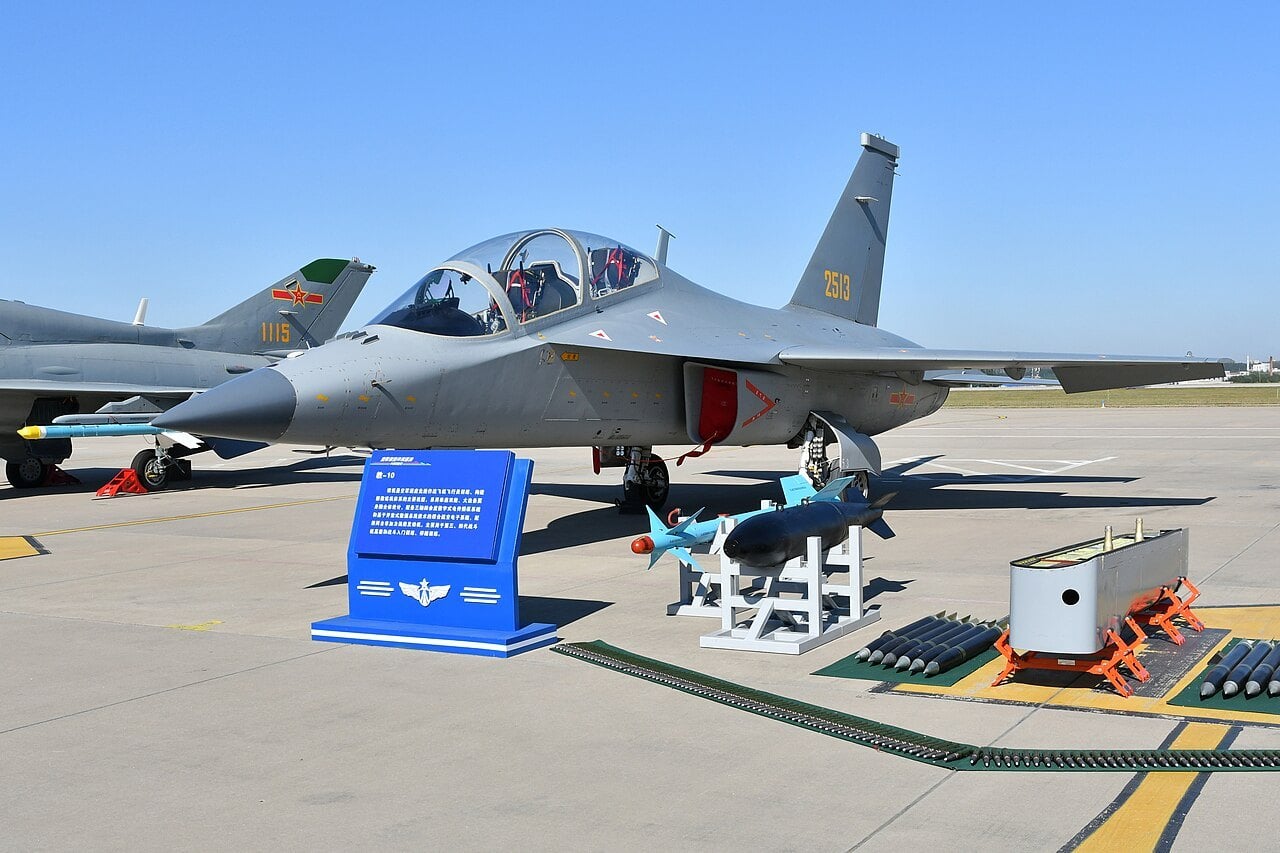
Hongdu always marketed the L-15 as more than a classroom. The L-15B, unveiled in April 2017 and first flown on 21 December 2017, adds a radar and nine hardpoints for about three tonnes of weapons, including PL-12 radar-guided and short-range infrared air-to-air missiles, LS-series guided bombs and rockets. Chinese commentators presented it as a cheaper replacement for ageing J-7 fighters and Q-5 attack jets. Zambia’s L-15Z were shown at AAD 2016 with Chinese weapons, underlining the light-attack pitch for export.
03The L-15’s cockpit: glass, HUD and an instructor who can see
The tandem cockpit is fully glass, with multifunction colour displays in both seats and a head-up display in front of the student. The rear seat is mounted well above the front one, so that the instructor can see forward over the student’s helmet during landings and formation work, the same arrangement used on the Yak-130 and M-346. Both crew sit on zero-zero ejection seats under a single canopy.
The avionics are built around a digital databus and are intended to work with ground-based simulators, so that a sortie can be planned, flown and debriefed as part of an integrated training system. Radar-equipped versions allow students to practise beyond-visual-range intercepts with simulated or real weapons, which is the core of lead-in fighter training: learning to run a radar and a weapons system before the student is let loose in a combat aircraft that costs several times as much to fly.
04The L-15’s versions: from trainer to carrier jet
- L-15 prototypes: first flown in 2006, with DV-2 engines; five aircraft had been built by the end of 2009.
- L-15A / L-15AW: subsonic advanced trainer with AI-222-25 engines; the AW is the export-oriented subsonic version with seven hardpoints.
- L-15 / JL-10: supersonic lead-in fighter trainer with afterburning AI-222K-25F engines; JL-10 is the PLA designation.
- L-15Z: six aircraft for the Zambian Air Force.
- L-15B: supersonic light combat version with radar and nine hardpoints, first flown on 21 December 2017.
- Naval versions: the PLA Navy uses the type for carrier pilot training, and a carrier-compatible derivative, reported as the JL-10J, has been linked to China’s newer carriers; details are not officially confirmed.
Hongdu L-15 / JL-10 specifications
Specifications
- Crew
- 2 (tandem)
- Length
- about 12.3–12.4 m (40 ft 4 in–40 ft 8 in)
- Wingspan
- about 9.4–9.5 m (30 ft 10 in–31 ft 1 in)
- Height
- about 4.7–4.8 m (15 ft 5 in–15 ft 9 in)
- Max take-off weight
- about 9,600–11,600 kg (21,200–25,600 lb), depending on version and source
- Powerplant
- 2 × Ivchenko-Progress AI-222K-25F afterburning turbofans, about 41 kN (9,300 lbf) each with reheat; AI-222-25 without afterburner on subsonic versions
- Maximum speed
- about Mach 1.4 (afterburning versions)
- Combat radius
- about 500 km (310 miles) for the L-15B, more with drop tanks
- Service ceiling
- commonly given as about 16,000 m (52,500 ft)
- g limits
- commonly given as +8 / −3 g
- Design life
- about 10,000 flying hours
- Armament
- up to about 3,000–3,500 kg (6,600–7,700 lb) on 7 hardpoints (L-15AW) or 9 (L-15B): PL-12 radar-guided and short-range infrared air-to-air missiles, LS-series guided bombs, rockets
Costs & production
- Unit cost
- not officially published; Zambia’s six aircraft were reported at about USD 100 million (2014) and the UAE’s first 12 at about USD 440 million including support (2023), while analysts have put the bare aircraft at roughly USD 10–15 million
- Cost per flight hour
- no official figure; an estimate of roughly USD 4,000–8,000 per hour, based on comparison with other twin-engined lead-in trainers such as the M-346 and Yak-130
- Production
- in series production since about 2013; total numbers built are not published
- Programme
- development from 2000 with Yakovlev as consultant; PLA Navy and PLAAF service, exports to Zambia and the UAE
05The L-15’s numbers: why the figures vary
Published specifications for the L-15 differ more than for most aircraft, because Hongdu has shown several versions with different engines and weights and Chinese official data is sparse. Maximum take-off weight is quoted anywhere from about 9.6 tonnes for the L-15B to 11.6 tonnes in some Western references. Length and span figures differ by around 10 cm between sources. The table above gives ranges where sources disagree.
What is consistent is the concept: a two-seat, twin-engined jet of roughly the size and weight of the Yak-130 and M-346, with a 10,000-hour design life, a top speed of about Mach 1.4 when fitted with afterburning engines, and a weapons load of about three tonnes.
06The L-15’s operating costs: what a trainer has to save
No operator has published the L-15’s cost per flying hour. Its economics have to be judged by what it replaces. A lead-in trainer exists to absorb hours that would otherwise be flown on expensive front-line fighters such as the J-10, J-16 or, in the UAE, the F-16 and Mirage 2000. Two afterburning engines make the supersonic L-15 more expensive to run than single-engined subsonic trainers such as the K-8 or Hawk, but still far cheaper than a fighter.
Our estimate of roughly USD 4,000–8,000 per hour is based on comparison with the twin-engined Yak-130 and M-346, which do similar jobs. Actual Chinese costs, where fuel, labour and spares are priced differently, may well be lower.
The L-15 from Nanchang drawing board to New York air show
Programme launched
Hongdu begins work on an advanced trainer and engages the Yakovlev design bureau as technical consultant.
Mock-up at Zhuhai
A full-scale mock-up of the L-15 is shown at the Zhuhai air show.
First flight
The first prototype, rolled out in September 2005, flies at Nanchang on 13 March 2006.
Abroad for the first time
The L-15 makes its first overseas appearance at the Dubai Airshow; five aircraft have been built by the end of the year.
Into service
The type enters Chinese service, initially in small numbers.
First export
Zambia orders six aircraft as the L-15Z, reportedly for about USD 100 million.
Zambian jets in South Africa
Zambian L-15Z aircraft appear at Africa Aerospace and Defence in September with Chinese weapons.
L-15B flies
The supersonic light combat L-15B is unveiled in April and makes its first flight on 21 December.
Lead-in role for the PLAAF
The PLAAF begins using the JL-10 for lead-in fighter training in its flight academies.
UAE choice
On 23 February the UAE announces it will buy 12 L-15s with options for 36 more.
Al Fursan debut
Seven L-15s fly Al Fursan’s first display on the type at the Dubai Airshow on 19 November.
United States debut
Al Fursan displays its L-15s at the FourLeaf Air Show at Jones Beach, New York.
Stories & eyewitnesses: the L-15 from Nanchang to the world
A Russian consultant in Nanchang
Yakovlev helped shape the L-15 while building its own rival.
Read the full story
Losing the first round
The PLAAF first chose a cheaper rival.
Read the full story
13 March 2006: first flight
Nanchang’s new trainer leaves the ground.
Read the full story
Dubai 2009: the first trip abroad
The L-15 is shown to foreign buyers.
Read the full story
Zambia: the first foreign customer
Six L-15Z for a small African air force.
Read the full story
The navy gets there first
Carrier pilots trained on the L-15.
Read the full story
Moving fighter conversion to school
The JL-10 changes how the PLAAF trains.
Read the full story
L-15B: the trainer with teeth
A radar and nine pylons.
Read the full story
The UAE surprise
An F-16 operator buys Chinese trainers.
Read the full story
Seven jets for seven emirates
Al Fursan unveils its new mounts at Dubai.
Read the full story
Jones Beach, 2026
A Chinese military jet displays in the United States.
Read the full story
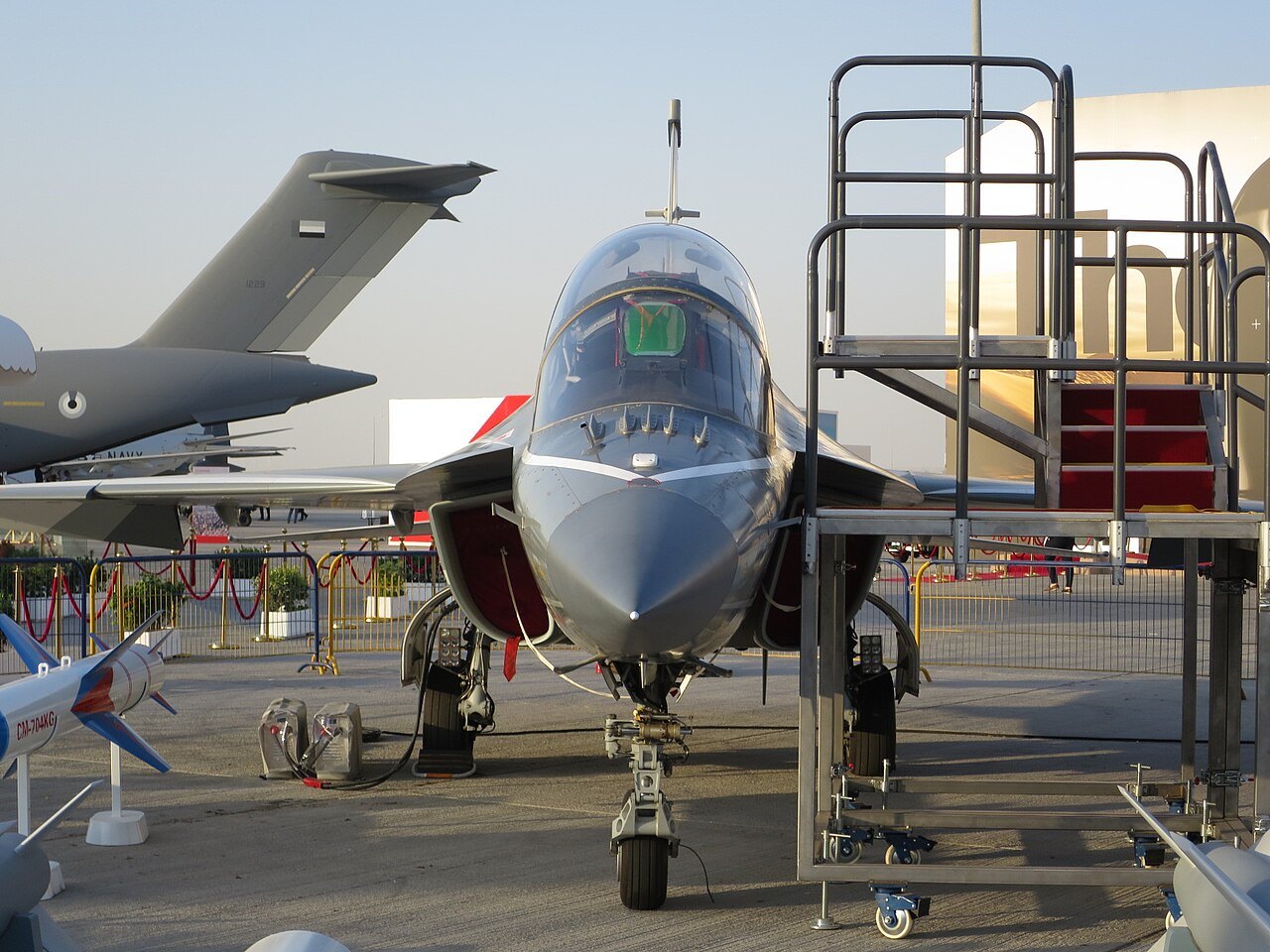
The L-15 in pictures
Where the L-15 flies and flew
The L-15’s record
The L-15 has no known combat record. Its importance lies in training: it carries much of the PLA’s lead-in fighter instruction for pilots heading to the J-10, J-15, J-16 and J-20, and it is now flown by two foreign air forces, one of them as its national display aircraft.
See how training and combat types compare in the military aircraft statistics database. Figures are approximate.
Everything people ask about the L-15
Can I fly in a Hongdu L-15?
Is the L-15 a copy of the Yak-130?
Is the L-15 supersonic?
What does JL-10 mean?
Who flies the L-15?
Which aerobatic team flies the L-15?
Has the L-15 seen combat?
You can’t fly the L-15.
These, you can.
Most of this museum you can only look at. These genuine military jets you can fly yourself with MiGFlug — with aerobatics and time on the controls.
 Fly the L-39 AlbatrosThe world’s most-flown jet trainer — aerobatics included
 Fly the F-104 Starfighter“The missile with a man in it”
 Fly the MiG-21The Cold War’s most-produced jet
 Fly the T-33 Shooting StarAmerica’s first jet trainer
 Fly the DH VampireA piece of early jet history
 Fly the S.211Agile Italian jet trainer
 Fly the MB-326The classic Aermacchi jet
 Fly the MiG-15The Soviet legend of the Korean War
Continue the tour
Every fact, checked
- China’s L-15 jet displayed by Zambia in South Africa (David Donald)AIN report on the Zambian L-15Z at AAD 2016
- L-15 lead-in fighter trainer (LIFT)Programme history, prototypes, PLAAF and naval orders
- China’s air force has a new ground attack plane (Jeffrey Lin and P.W. Singer)CASI republication on the L-15B, weapons and role
- Hongdu works on supersonic fighter trainerFlight International on the L-15’s origins at China Expo 2001
- UAE to buy Chinese jet trainer aircraftJanes on the 2022 UAE announcement
- UAE Air Force flies its first Chinese-made Hongdu L-15 jets at Dubai Airshow 2025Contract value, Al Fursan debut, Zambian fleet
- UAE’s Fursan Al-Emarat debuts Hongdu L-15 jets at Dubai AirshowAl Fursan’s first public L-15 display
- Debrief: China’s unlikely military aerospace debut in the US (Tony Osborne)Aviation Week on Al Fursan’s L-15s at Jones Beach, 2026
- AAD 2016: Hongdu L-15 Falcon makes big impact at the showTimes Aerospace on the Zambian debut