
Kawasaki T-4
Japan’s Blue Impulse Jet
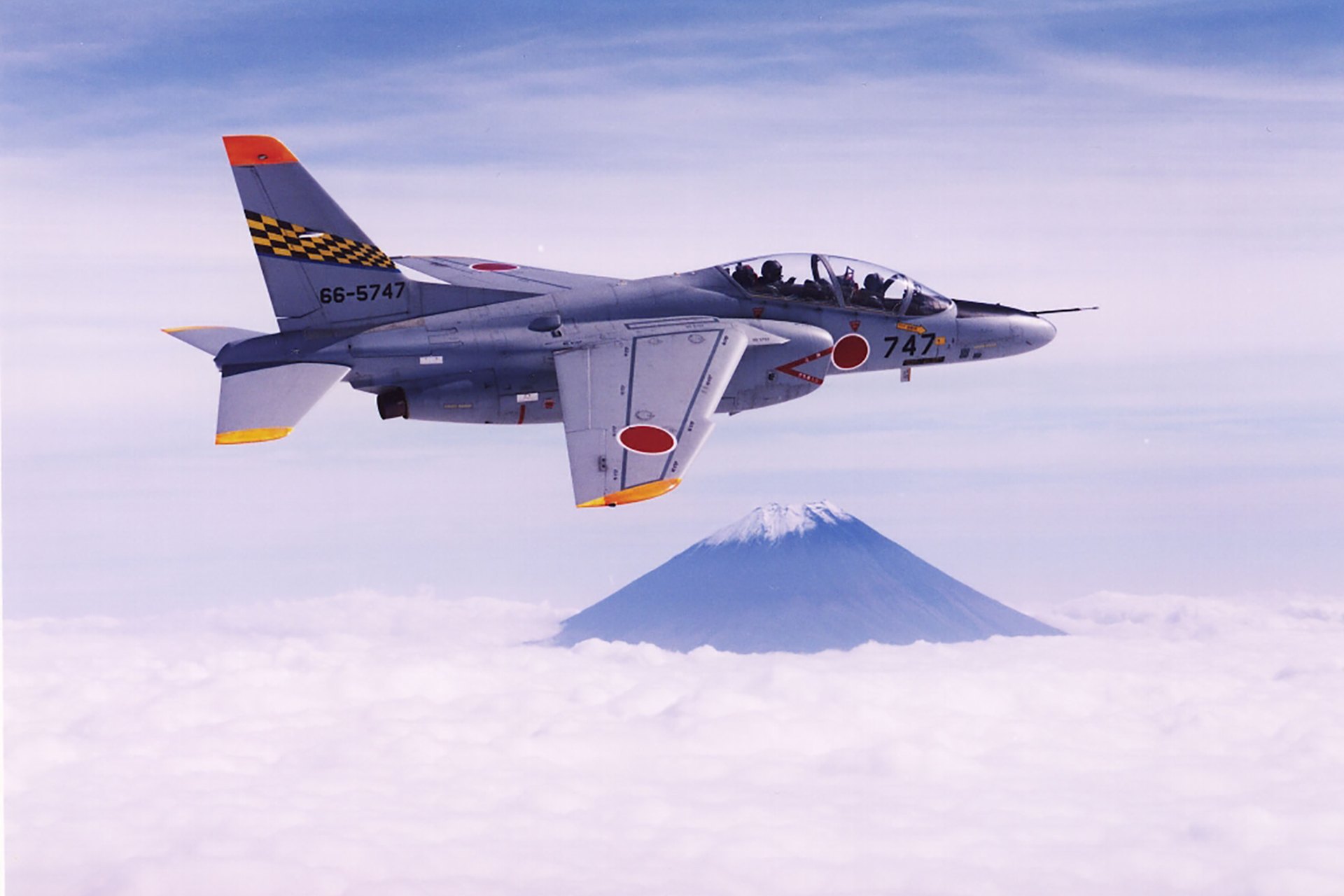
Japan’s home-grown intermediate jet trainer has taught every JASDF fighter pilot since 1988, flown the Blue Impulse team for three decades and drawn the Olympic rings over Tokyo.
The T-4: how Japan built its own jet classroom
By the start of the 1980s the Japan Air Self-Defense Force was still teaching jet flying on the Lockheed T-33, a design of the late 1940s, and on the Fuji T-1, Japan’s first post-war jet. Both had to go. In November 1981 the Defense Agency chose Kawasaki over Mitsubishi and Fuji to lead the MT-X programme for a new intermediate trainer, with the two losing bidders brought in as major partners. The brief was demanding: a subsonic jet that could take students from basic flying to the threshold of fighter conversion, fly for thousands of hours a year in Japanese weather, and be designed, built and powered in Japan. The prototype XT-4 flew on 29 July 1985, and the first production T-4 followed on 28 June 1988.
What emerged is a compact, twin-engined jet with shoulder-mounted wings, a transonic airfoil and a raised rear cockpit that gives the instructor a clear view past the student. Two IHI F3 turbofans, developed in Japan for the programme, give a safety margin in case one fails, and carbon composites in the fin and control surfaces save weight. Kawasaki says the airfoil lets students move smoothly on to advanced fighter training, and the aircraft can reach about Mach 0.9. Final assembly took place at Gifu, where Kawasaki’s aerospace works sits beside the JASDF test base. Deliveries began in September 1988 and ended in 2003, by which time 208 production aircraft had been built.
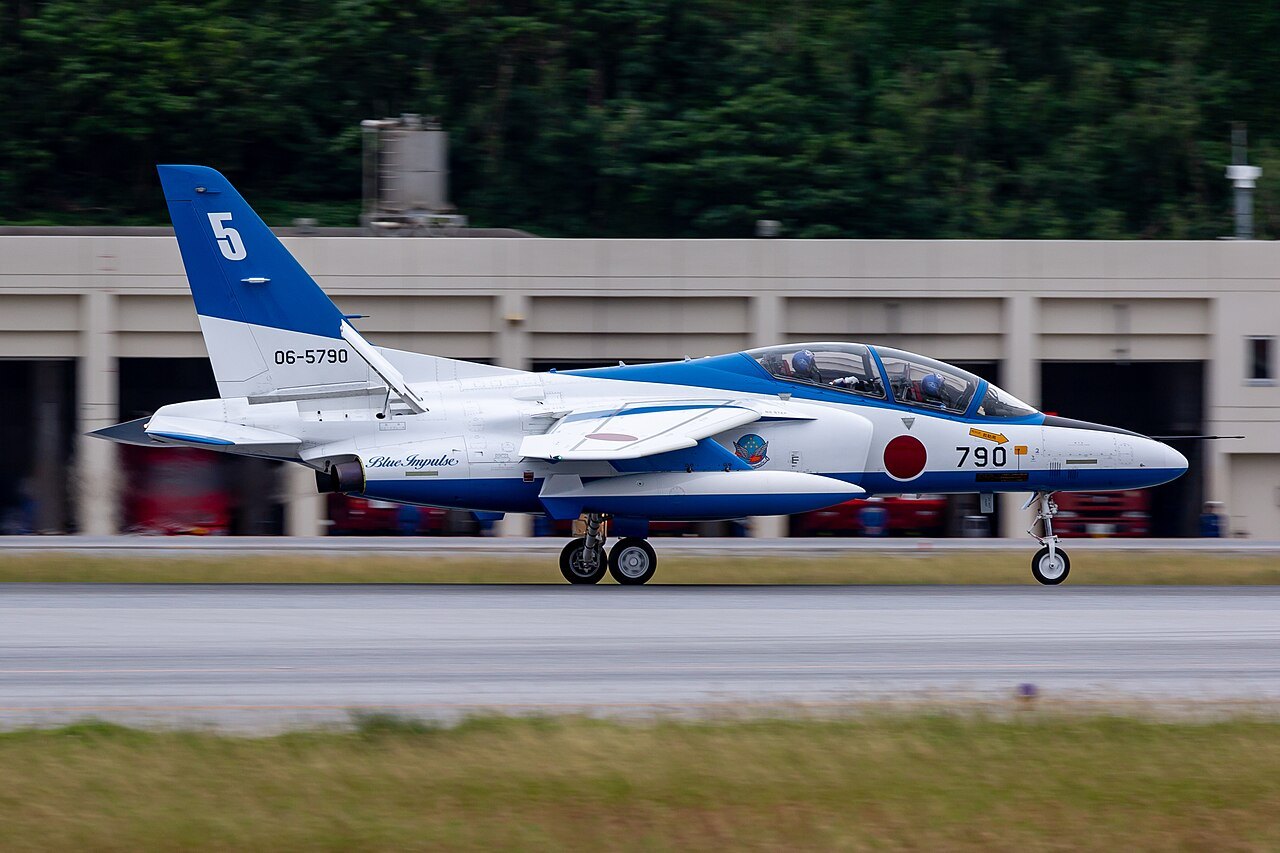
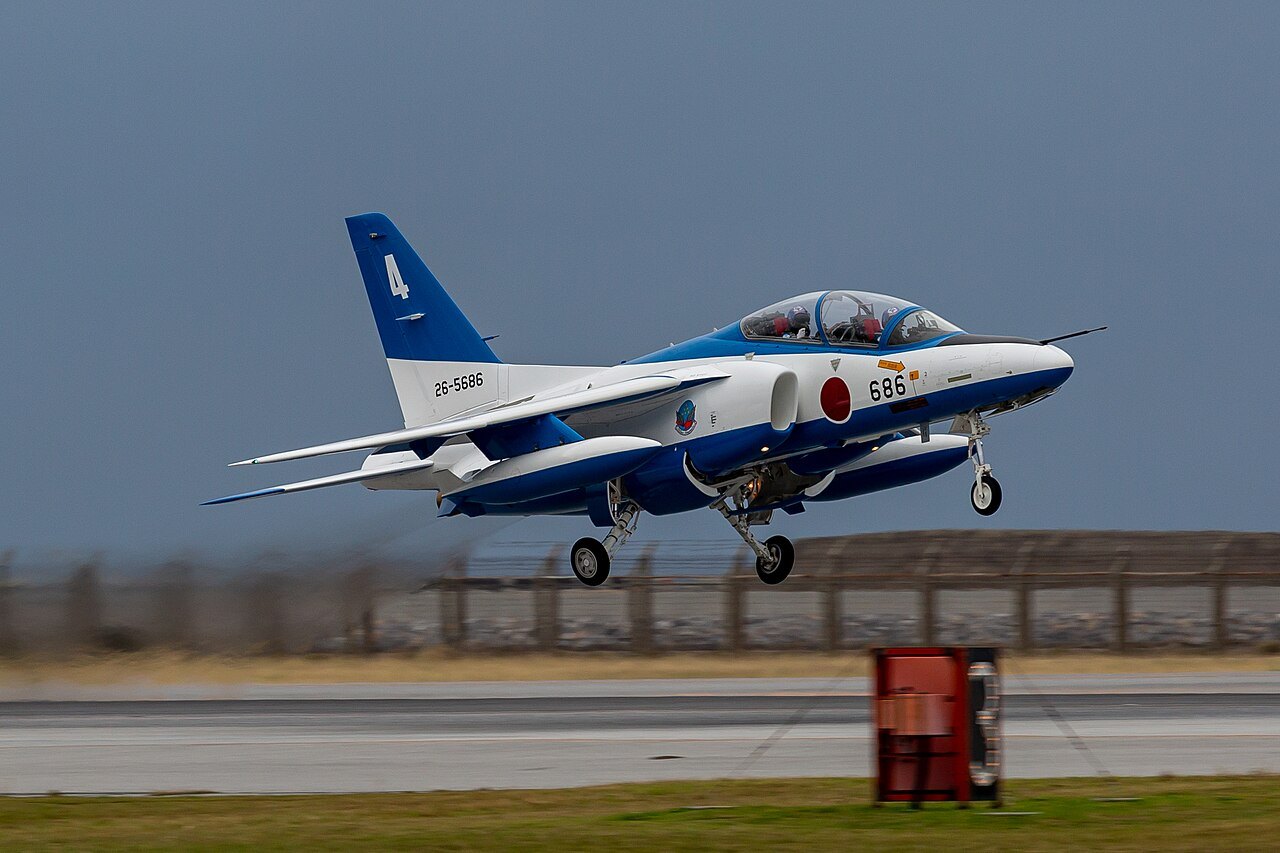
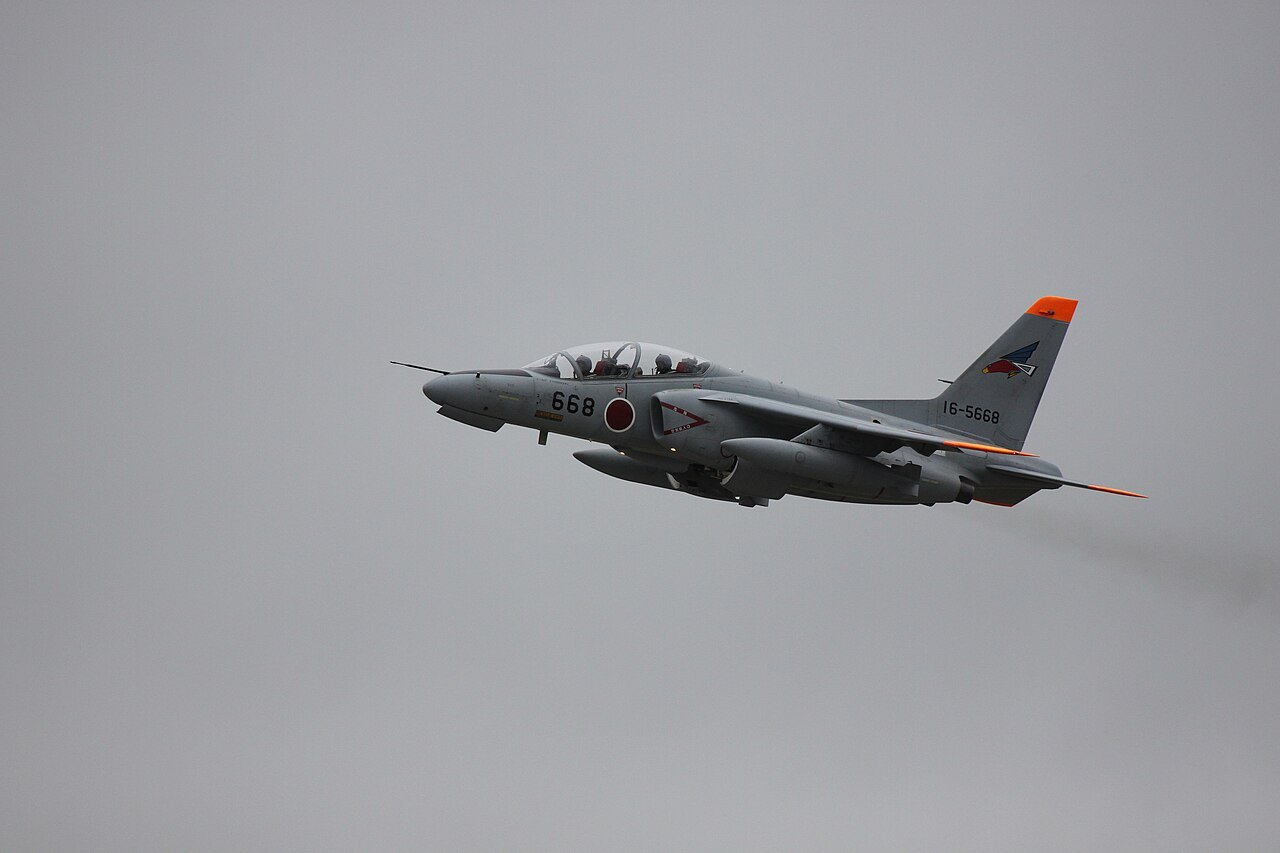
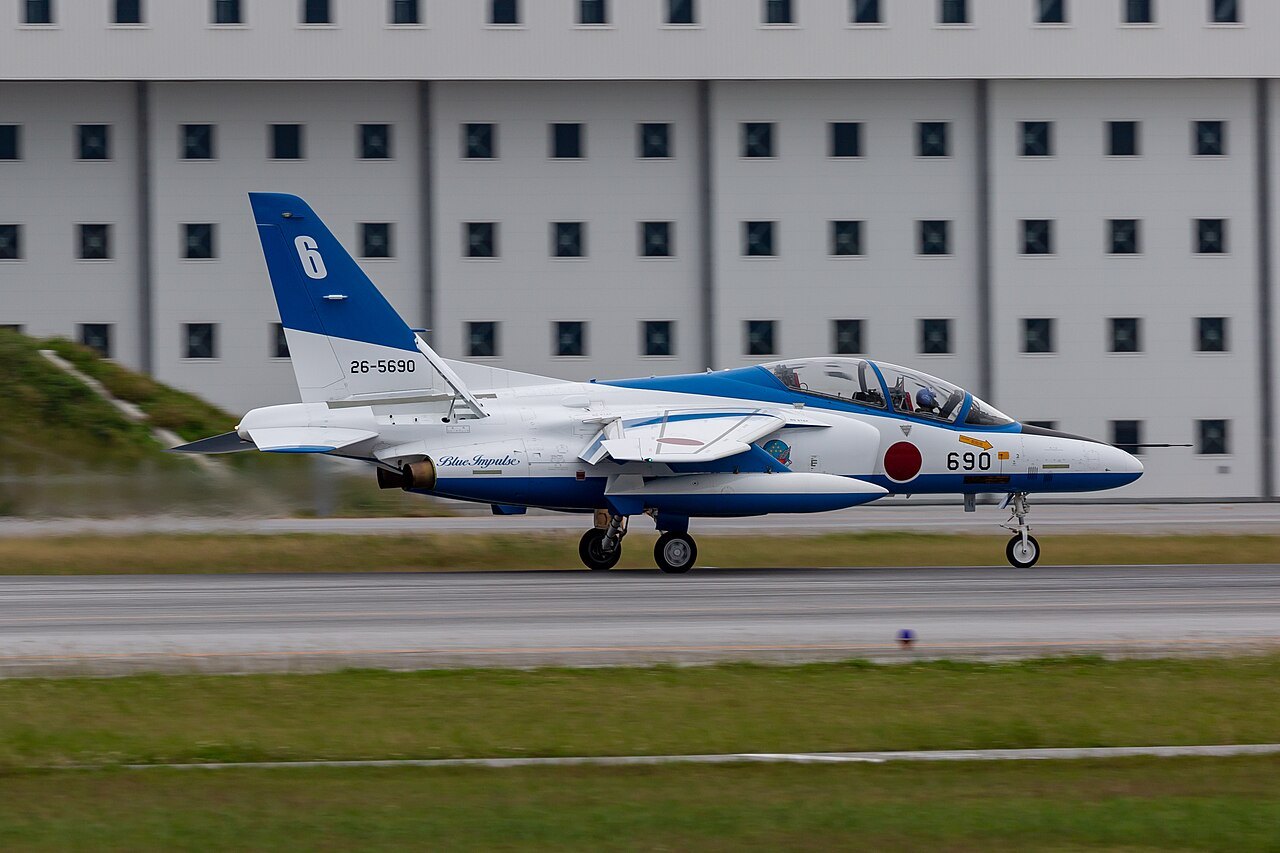
The T-4 became one of the most familiar aircraft in Japan, as much a part of the landscape around its bases as the bullet train. Training squadrons use it to turn graduates of propeller trainers into jet pilots, and almost every front-line fighter wing keeps a few as liaison and continuation-training jets, often painted in unit markings. Since 1996 it has also been the mount of Blue Impulse, the JASDF display team, whose white-and-blue T-4s have flown over earthquake zones, pandemic hospitals and two Olympic Games. Now the fleet is old. An engine problem grounded it in 2019, a fatal crash in May 2025 forced inspections of all 196 remaining aircraft, and Japan is studying a replacement with the United States.
01The T-4’s origins: the MT-X competition
Japan’s post-war jet training system was built on American aircraft and on the Fuji T-1, which had flown in 1958. By the late 1970s the T-33s that formed the bulk of the intermediate fleet were worn out, and the supersonic Mitsubishi T-2 was too expensive to use for every stage of training. The answer was an intermediate trainer, the MT-X, sitting between primary propeller training and the advanced and fighter conversion courses.
Three Japanese firms competed. In November 1981 Kawasaki won, but the programme was structured as a national effort: Kawasaki led and assembled the aircraft, while Mitsubishi and Fuji each built major sections. The engine went to IHI, whose F3 turbofan gave Japan a domestically designed powerplant for the type. The original plan called for around 220 aircraft and service entry in 1988, and the programme came close to that target, with four prototypes and 208 production aircraft. A heavier, supersonic development was studied but shelved, leaving the T-4 as a pure subsonic trainer.
02The T-4’s later years: an ageing fleet and the search for a successor
Designed for a long working life, the T-4 has now been in service for more than three decades. In 2019 a problem with a baffle inside the F3 engine caused internal damage and led to a grounding of the fleet, disrupting both pilot training and the Blue Impulse display schedule. Japanese commentators have linked the episode to the age of the engines, which were designed in the early 1980s.
Japan began studying replacement options in 2021. At an April 2024 summit, the United States and Japan agreed to explore joint development of a trainer to succeed the T-4, and Tokyo issued a request for information in October 2024. Reported contenders include the Boeing T-7A Red Hawk, the Leonardo M-346 and a Mitsubishi design. The crash of a T-4 near Inuyama on 14 May 2025, which killed both crew members, added urgency. The air force carried out emergency inspections of all 196 remaining aircraft, many of them now well over 30 years old.
What makes the T-4 special
Two engines for safety
Many intermediate trainers of its era made do with one engine. The T-4 has two IHI F3-IHI-30 turbofans of about 16.3 kN (3,670 lbf) each, mounted side by side in the rear fuselage. The choice was driven by safety over a crowded, mountainous country with long stretches of sea, and by the wish for a Japanese engine industry. The F3 was developed specifically for the programme, making the T-4 a fully domestic aircraft from airframe to powerplant.
A wing built for speed
The T-4’s shoulder-mounted wing uses what Kawasaki calls a transonic airfoil, giving good handling at high subsonic speed so that students can move on to fighter training without a large jump in performance. Leading-edge root extensions help at high angles of attack. The result is an agile jet with a top speed of about Mach 0.9, a climb rate of the order of 10,000 ft a minute and the manoeuvrability that made it suitable for formation aerobatics.
Built to be used everywhere
Five hardpoints, four under the wings and one under the fuselage, carry drop tanks, practice stores and target-towing equipment. Fighter units use the T-4 as a hack: a liaison aircraft for moving people and parts between bases and for keeping staff pilots current. That is why the type appears in the markings of squadrons from Hokkaido to Okinawa, and why Japanese spotters treat its colourful unit schemes as a collecting hobby of their own.
03The T-4’s cockpit and systems: a 1980s design that kept up
The T-4 seats its crew in tandem under a one-piece canopy, with the rear seat raised so the instructor can see forward over the student’s head. Ejection seats are fitted for both crew. The design made extensive use of computer-aided design and manufacture, and composite materials, including carbon fibre, appear in the radome, the vertical tail and the control surfaces to save weight.
The avionics were digital from the start, with ring-laser-gyro navigation equipment from Honeywell, and an on-board oxygen generating system under licence. The Blue Impulse aircraft differ from the training fleet mainly in their paint, a smoke-generating system and a strengthened canopy for protection against bird strikes during low-level display flying. There has been no export version and no major structural variant: the T-4 is essentially the same aircraft today as when it entered service, which is part of the reason Japan is now looking for a modern successor with a glass cockpit closer to the F-35.
Kawasaki T-4 specifications
Specifications
- Crew
- 2 (tandem)
- Length
- 13.00 m (42 ft 8 in)
- Wingspan
- 9.94 m (32 ft 7 in)
- Height
- 4.60 m (15 ft 1 in)
- Wing area
- 21.0 m² (226 sq ft)
- Empty weight
- 3,700 kg (8,157 lb)
- Max take-off weight
- 7,500 kg (16,535 lb)
- Powerplant
- 2 × IHI F3-IHI-30 turbofans, 16.32 kN (3,670 lbf) each
- Maximum speed
- About Mach 0.9; 1,038 km/h (645 mph) at sea level
- Range
- 1,300 km (810 mi); about 1,670 km (1,036 mi) with drop tanks
- Service ceiling
- 15,240 m (50,000 ft)
- Climb rate
- 51 m/s (10,000 ft/min)
- g limits
- About +7.3 (clean)
- Armament
- None fixed; 5 hardpoints for drop tanks, practice stores and target-towing gear
Costs & production
- Cost per flight hour
- Hedged estimate: roughly US$3,000–6,000, based on comparable twin-turbofan intermediate trainers such as the Alpha Jet; the JASDF does not publish a figure
- Production
- 212 built (4 prototypes and 208 production aircraft), 1985–2003
- Programme
- MT-X selection November 1981; first flight 29 July 1985; deliveries September 1988 to 2003
04The T-4’s versions: one airframe, many jobs
- XT-4: four prototypes, the first flying on 29 July 1985.
- T-4: the production intermediate trainer, 208 built.
- Blue Impulse T-4: standard airframes with a smoke system, strengthened canopy and display livery, flown by No. 11 Squadron at Matsushima since 1995.
- Liaison T-4s: aircraft allocated to fighter wings, test units and air command support flights for transport and continuation training.
05The T-4’s operating costs: what a training hour takes
The JASDF does not publish an hourly cost for the T-4, so any figure is an estimate. Two small turbofans of the 16 kN class burn far less fuel than a fighter engine, but twin engines mean twice the engine maintenance, and an ageing fleet adds inspection and spares costs. Comparable twin-engined trainers in European service are usually quoted at a few thousand US dollars per flight hour, which suggests something in the region of US$3,000 to 6,000 for the T-4. Japanese commentators note that maintenance costs probably began rising in the 2000s, as is typical of aircraft past 15 years of service, and the 2019 engine grounding and 2025 inspections are a reminder that an old trainer becomes steadily more expensive to keep flying.
The T-4 from MT-X to Olympic smoke rings
Kawasaki wins MT-X
Kawasaki is chosen in November over Mitsubishi and Fuji to build Japan’s new intermediate trainer.
XT-4 flies
The first prototype makes its maiden flight on 29 July.
Into service
The first production T-4 flies on 28 June, and deliveries begin in September.
Blue Impulse debut
Blue Impulse gives its first official T-4 display in April, replacing the Mitsubishi T-2.
Over Nevada
Blue Impulse flies its first overseas displays at Nellis AFB for the US Air Force’s 50th anniversary.
Tragedy at Oshika
Two Blue Impulse T-4s strike a hilltop in sea fog on 4 July; three aircrew are killed.
Production ends
The last of 208 production aircraft is delivered.
Tsunami
The team is away at Ashiya when the 11 March tsunami floods Matsushima; it returns home at the end of March 2013.
Engine grounding
An internal engine fault grounds the fleet and disrupts training.
Olympic rings
On 23 July Blue Impulse draws the five rings over Tokyo, 57 years after its F-86s did the same.
Inuyama crash
A T-4 from Komaki crashes into Iruka pond on 14 May, killing both crew; 196 aircraft are inspected.
Stories & eyewitnesses: the T-4 in Japanese skies
Blue Impulse changes jets
The national display team picked the T-4 as its third aircraft.
Read the full story
Nellis, 1997: the first trip abroad
A year after its debut, the team took the T-4 to America.
Read the full story
Sea fog over Oshika
The worst day in the team’s T-4 era.
Read the full story
Saved by a railway opening
The tsunami of 2011 drowned Matsushima, but not the team.
Read the full story
A salute to hospital workers
In May 2020 six T-4s flew over a city in lockdown.
Read the full story
Five rings, 57 years apart
Tokyo’s Olympic sky was painted by the same team twice.
Read the full story
The jet every fighter pilot meets
For 35 years the T-4 has been the first step up from propellers.
Read the full story
Lake Iruka, May 2025
A routine ferry flight ended minutes after take-off.
Read the full story
The T-4 in pictures
Where the T-4 flies and flew
The T-4’s record
The T-4 has never been armed for combat and has never seen action. Its record is measured in trained pilots, thousands of displays by Blue Impulse and decades of liaison work, set against a small number of serious accidents.
See how training and combat types compare in the military aircraft statistics database. Figures are approximate.
Everything people ask about the T-4
Can I fly in a Kawasaki T-4?
Who flies the Kawasaki T-4?
How many T-4s were built?
Does Blue Impulse fly the T-4?
Is the T-4 supersonic?
What will replace the T-4?
What engines does the T-4 have?
You can’t fly the T-4.
These, you can.
Most of this museum you can only look at. These genuine military jets you can fly yourself with MiGFlug — with aerobatics and time on the controls.
 Fly the L-39 AlbatrosThe world’s most-flown jet trainer — aerobatics included
 Fly the F-104 Starfighter“The missile with a man in it”
 Fly the MiG-21The Cold War’s most-produced jet
 Fly the T-33 Shooting StarAmerica’s first jet trainer
 Fly the DH VampireA piece of early jet history
 Fly the S.211Agile Italian jet trainer
 Fly the MB-326The classic Aermacchi jet
 Fly the MiG-15The Soviet legend of the Korean War
Continue the tour
Every fact, checked
- T-4 Intermediate TrainerKawasaki Heavy Industries: design features, dimensions, speed and range
- Extraordinary press conference by Defense Minister Nakatani, 14 May 2025Japan Ministry of Defense on the Inuyama crash
- Blue Impulse at the Tokyo 2020 Olympic and Paralympic GamesJASDF statement on the 2021 flights and the 1964 precedent
- Blue Impulse display team profileMILAVIA: T-4 debut in 1996, Nellis 1997, 2011 relocation
- ‘Blue’ flight team returns to revive economy of quake-ravaged regionJapan Disasters Archive news report on the 2013 return to Matsushima
- Blue Impulse aircraft 725 retires after 20 yearsNorimono News (Japanese) on the team during the 2011 tsunami
- T-4 engine problems and successor discussionNorimono News (Japanese) on the 2019 engine grounding and fleet age
- Kawasaki T-4 46-5727, 4 July 2000Aviation Safety Network record of the Blue Impulse accident
- Vendors line up to fill Japan’s F-35 pilot training gapDefense News (2025) on replacement candidates and the RFI
- Japan retrieves remains of service member after training plane crashArab News Japan (AP) on the 2025 crash and fleet inspections
- T-4 Middle TrainerGlobalSecurity: development, liaison role and end of deliveries