
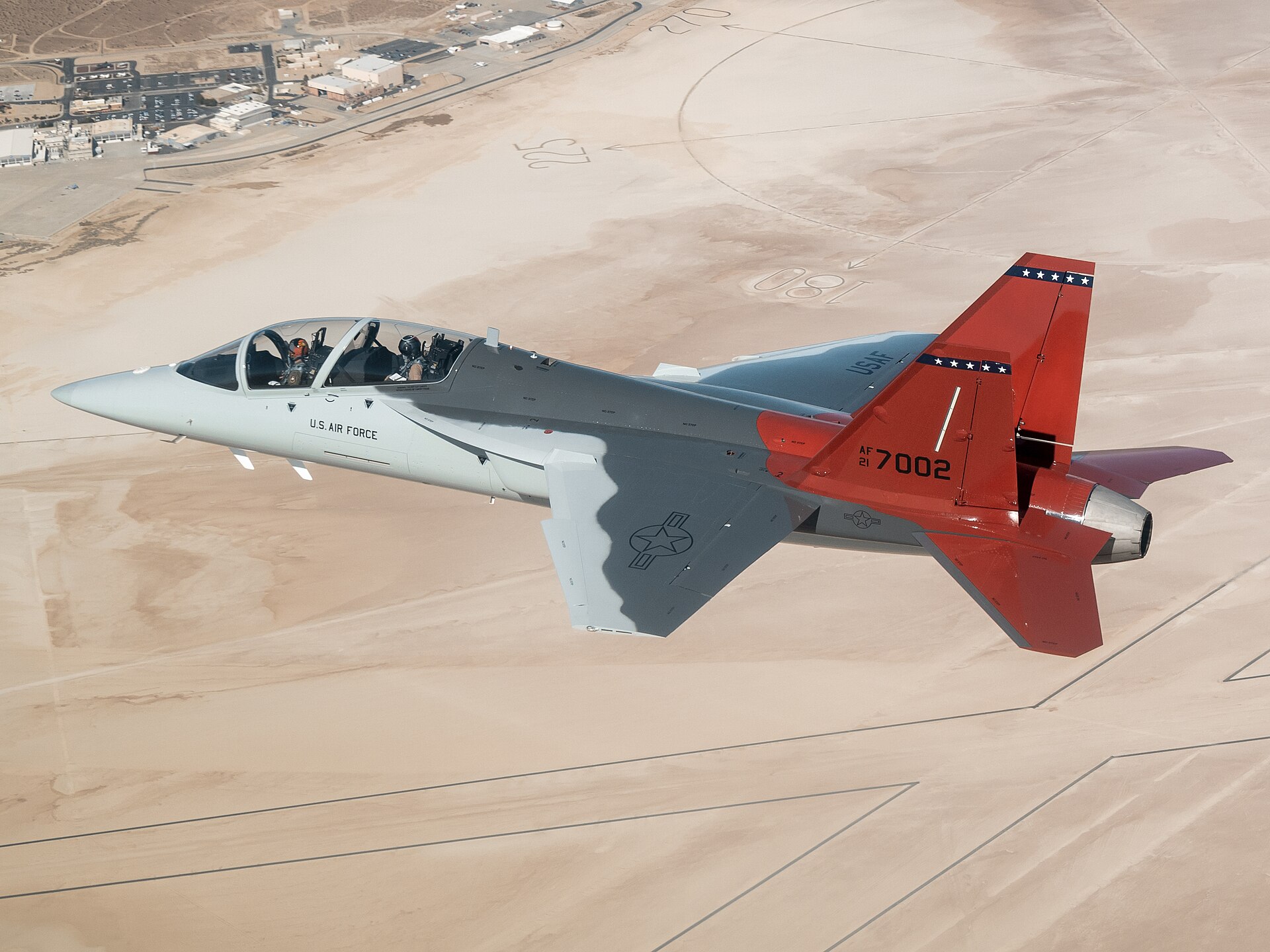
Boeing T-7A
“Red Hawk”
The U.S. Air Force’s clean-sheet, digitally engineered jet trainer — built to replace the ageing T-38 Talon and named for the red-tailed Mustangs of the Tuskegee Airmen.
The T-7A Red Hawk: America’s first clean-sheet jet trainer in a generation
For more than half a century, almost every U.S. Air Force fighter and bomber pilot learned to fly fast jets in the Northrop T-38 Talon, a needle-nosed trainer first flown in 1959. By the 2010s the fleet was ancient, expensive to keep airworthy and a poor match for teaching pilots headed to fly-by-wire, sensor-fused aircraft like the F-22 and F-35. The Air Force’s answer was the Advanced Pilot Training programme, better known as T-X.
Rather than offer a modified existing design, Boeing teamed with Sweden’s Saab in 2015 to build an all-new aircraft. Their clean-sheet prototype first flew on 20 December 2016, and on 27 September 2018 Boeing won T-X, beating a Leonardo T-100 and a Lockheed Martin/KAI T-50A bid. The award — commonly cited with a ceiling of about $9.2 billion for 351 aircraft and 46 simulators — came in billions below government estimates, a gap that later turned into large fixed-price losses for Boeing.
In September 2019 the jet was named the T-7A Red Hawk, honouring the Tuskegee Airmen and the red tails of their Second World War P-51 Mustangs. Boeing marketed the aircraft as a showcase of “digital engineering” — designed, assembled and tested against a shared digital model, which the company says cut development time and assembly labour dramatically. The reality has been more complicated: ejection-seat safety and flight-control software problems, together with supplier and instrumentation issues, pushed the schedule years to the right.
By 2026 the programme had turned an important corner. The Air Force approved Milestone C in April 2026, clearing the way for low-rate initial production, and the first jets began reaching training bases. Initial operational capability is targeted for around 2027, though on a still-maturing programme any such date should be read as a goal that can move. Figures on this page are current to mid-2026 and will evolve as the aircraft matures.
01The Boeing T-7A Red Hawk’s digital engineering: what “designed on a computer” really delivered
Boeing and the Air Force describe the T-7A as a landmark in model-based systems engineering and the “digital thread”: a single, shared 3-D model driving design, tooling and assembly, with full-size determinant assembly letting major sections mate without traditional jigs. Boeing has claimed the aircraft went from concept to first flight in roughly 36 months and that assembly required far fewer labour hours than conventional methods — figures worth treating as manufacturer claims rather than independently audited numbers.
In 2020 the Air Force gave digitally engineered systems an “e-series” prefix, and the T-7A became the first — the eT-7A in development (the “e” is dropped in production). But the years of trouble that followed made a wider point: digital design did not remove the need for extensive physical flight test. Wing-rock at high angle of attack and escape-system problems still had to be found and fixed the hard way, in the air and on the sled track.
What makes the T-7A Red Hawk special
A clean-sheet trainer for the digital age
The T-7A was designed from a blank page around a shared digital model rather than adapted from an older airframe. Boeing credits its digital thread and full-size determinant assembly with sharply reduced tooling and assembly hours. The twin-tailed, single-engine layout is deliberately fighter-like, so students meet high-performance handling early instead of on a front-line jet.
One GE F404 — real fighter thrust
Power comes from a single General Electric F404 afterburning turbofan (the F404-GE-103), the same engine family used by the F/A-18 Hornet and Saab Gripen. It gives roughly 17,000-plus pounds of thrust in afterburner — a high thrust-to-weight ratio for a trainer that lets the Red Hawk climb, sustain g and behave much like the fighters its students will graduate to.
Built to teach the F-35 generation
The Red Hawk is sold as a system, not just an airframe: ground-based training, high-fidelity simulators and embedded synthetic training are designed in from the start. Stadium seating raises the instructor in the rear cockpit for a clear forward view, and modern displays and controls mirror the sensor-fused cockpits of fifth-generation fighters.
02The Boeing T-7A Red Hawk’s engine: a single GE F404 shared with the Hornet and Gripen
Choosing an off-the-shelf, combat-proven engine was one of the T-7A’s lower-risk decisions. The General Electric F404-GE-103 is a member of a family that has powered the F/A-18 Hornet and the Saab JAS 39 Gripen for decades, giving the trainer mature reliability and a deep support base. With afterburner it produces on the order of 17,000-plus pounds of thrust (about 78 kN) — figures vary slightly by source and installation, so treat any single number as approximate. That surplus of power is deliberate: it lets a training aircraft reproduce the climb rates and sustained-g of a front-line fighter, so lessons transfer directly.
03The Boeing T-7A Red Hawk’s troubled test campaign: ejection seat and flight-control fixes
Two problems dominated the schedule. The escape system — a Collins ACES 5 seat with canopy-breaker and parachute sequencing — had to safely eject a very wide range of pilot body sizes; testing revealed excessive loads on lighter occupants and canopy-fracture and neck-injury risks, forcing redesigns and repeated high-speed sled and ejection tests into 2024-2025. Separately, production-relevant jets showed “wing rock” — a roll instability at high angle of attack — addressed with revised flight-control software and computers, which officials said was resolved around early 2024. Faulty test instrumentation and some part-quality issues added further delay. A pointed 2023 U.S. Government Accountability Office report flagged schedule risk and strain in the Boeing-Air Force relationship. These are contested, moving details; the account here reflects reporting as of mid-2026.
Boeing T-7A Red Hawk full specifications
Baseline note: the figures below describe the Boeing–Saab T-7A Red Hawk in the configuration cleared for low-rate initial production at Milestone C on 23 April 2026 — the aeroplane the US Air Force will actually buy, not the BTX-1 demonstrator that flew in December 2016. Deltas for the prototypes and for the proposed derivatives are given in grey. Two warnings before the numbers. First, neither Boeing nor the Air Force has published a full weights-and-performance table for the T-7A; there is no USAF fact sheet of the kind that exists for the T-38, so every specification list in circulation is an assembly of press figures and manufacturer marketing. Second, a great many of those lists are contaminated. An empty weight of 7,165 lb, a maximum take-off weight of 12,125 lb and a climb rate of 33,500 ft/min appear all over the internet under the T-7A’s name, including in one respectable trade reference — and every one of them is the Northrop T-38’s number, copied across. Where a figure below is not firmly attested, this page says so rather than inventing one.
Dimensions & weights
- Crew
- 2 — student in front, instructor behind, in tandem on the so-called stadium plan with the rear seat raised well above the front. This is a direct answer to the T-38, whose instructor sees very little over the student’s head; both T-7A cockpits are also near-identical in layout, so the back-seater flies the same aeroplane the front-seater does
- Length
- 14.30 m (46 ft 11 in). Boeing quotes 14.5 m (47.7 ft) overall and 14.0 m (46 ft) measured on the centreline; the spread is the nose probe and where you stop measuring
- Wingspan
- 9.32 m (30 ft 7 in) — a metre and a half more than the T-38 Talon it replaces, and the reason the T-7A can be flown slowly and at high incidence where the Talon cannot
- Height
- 4.11 m (13 ft 6 in), to the tip of the canted fins
- Wing and tail layout
- Moderately swept wing set high on the fuselage shoulder, with large leading-edge root extensions, an all-moving tailplane and twin canted vertical fins — sources describe the wing as mid-set or high-set depending on where they take the datum. The root extensions are the whole point of the configuration: they generate the vortex lift that makes 30° angle of attack a routine training exercise, and they are also what produced the wing rock that took a control-law rewrite to cure
- Wing area
- Not published — Boeing has never released it and the Air Force has not either. Any wing loading you see quoted for the T-7A has been derived from somebody’s estimate of the area, and should be read as such
- Maximum cross-section
- 3.5 m² (37.7 sq ft) — one of the very few airframe figures Boeing does publish, offered as evidence of a slim, low-drag fuselage around a single large engine
- Empty weight
- 8,165 kg (18,000 lb) is the figure most widely repeated. It is not a company figure and it does not reconcile with the other two published weights
- Gross weight
- 9,979 kg (22,000 lb). Here is the problem: 8,165 kg empty plus 2,041 kg of internal fuel plus two crew is already past 22,000 lb before anything else is loaded. One of these two numbers is wrong and Boeing has not said which. The safest reading is that the empty weight is overstated by something like 900 kg
- Maximum take-off weight
- Not published. Press tables offer figures up to about 12,700 kg (28,000 lb); none of them cites a source. The commonly circulated 12,125 lb is the T-38’s maximum take-off weight and has nothing to do with this aeroplane
- Internal fuel
- 2,041 kg (4,500 lb), carried in the fuselage. It is the one weight figure Boeing states plainly, and it is a lot of fuel for an aeroplane of this size — roughly a fifth more, in mass, than the whole internal load of a T-38
- External stores
- None. No pylons, no drop tanks, no travel pod, no gun pod on any airframe delivered to date. The structure is said to carry growth provision for underwing stations, but nothing has been fitted or cleared, and the armed derivatives remain drawings
Performance
- Maximum speed
- Mach 0.975 on Boeing’s own published figure, dated October 2023. This is the most awkward number on the aeroplane: the T-38 the T-7A replaces is genuinely supersonic, and the T-7A, by its manufacturer’s account, is not. Trade references and several specification sites list Mach 1.05 or even Mach 1.2; Wikipedia calls the type transonic. Boeing’s figure is used here because it is Boeing’s, and because nobody has published a supersonic flight-test point
- Maximum altitude
- 13,716 m (45,000 ft) on Boeing’s published envelope. Air Force trade press and most reference tables say 15,240 m (50,000 ft) or above; the disagreement has never been resolved in print, and 50,000 ft is again the T-38’s published ceiling
- Maximum angle of attack
- 30° — the requirement that shaped the whole design. A T-38 student is never taken anywhere near this; a fifth-generation fighter pilot lives there, and the T-X specification insisted the trainer go too
- Design load factor
- +8 g — full fighter-syllabus manoeuvring, sustained rather than snatched, on an airframe expected to fly several sorties a day for decades
- Rate of climb
- Not published. The 170 m/s (33,500 ft/min) that appears in most tables is the T-38’s initial climb rate, reproduced without checking. On thrust-to-weight grounds the T-7A should comfortably beat it, but no released figure says so
- Range
- About 1,835 km (1,140 miles) is the figure in general circulation. No authority states whether it is a ferry range, a clean range, or a range with reserves, and with no external tanks there is nothing to add to it in any case
- Thrust-to-weight ratio
- 0.78 at the published 9,979 kg gross weight in full afterburner, against roughly 0.65 for a re-engined T-38C and about 0.49 for the original T-38A. The margin is what lets an instructor demonstrate an energy fight rather than describe one
- Take-off and landing distances
- Not published — an odd omission for a training aeroplane whose entire working life is circuits, and a reminder of how little of this programme has been released
- High-incidence behaviour
- Departure-resistant by control law rather than by aerodynamics. Flight test in 2021 found wing rock — an uncommanded roll oscillation, coupled with airframe buffet, at high angle of attack. Boeing rewrote the flight-control laws, validated the change in the digital model first, and flew it in June 2021. High-angle-of-attack work nonetheless continued for four more years; the Air Force said the stability concerns were finally closed out in March 2025
- Availability requirement
- 80 per cent — and deliberately no higher. The T-X requirement capped the target on the reasoning that chasing 90 per cent would drive acquisition cost beyond what a trainer is worth. For context, measured T-38 availability has run nearer 60 per cent
- Weather limitation
- Restricted in rain as of the fiscal 2025 test reporting. External panels were not adequately sealed and water reached internal systems; engineers taped structural joints during climatic testing at the McKinley laboratory, where the aircraft was cycled between −25°F and 110°F. A trainer that cannot be flown in rain is not yet a trainer. The fix is understood and in hand, but it is a remarkable thing to find on an aeroplane entering production in 2026
Propulsion & systems
- Engine
- 1 × General Electric F404-GE-103 afterburning turbofan — a single-engine variant of the family that powers the F/A-18 Hornet, the KAI T-50 and, as the Volvo RM12, Saab’s own Gripen. Choosing one mature engine over two was the central cost decision of the airframe
- Dry thrust
- 49 kN (11,000 lbf)
- Afterburning thrust
- 77 kN (17,200 lbf). Several tables give 78.7 kN (17,700 lbf), which is the F404-102 rating of the T-50 Golden Eagle rather than the -103 fitted here
- Thrust against the T-38
- Boeing and the Air Force describe the T-7A as having three times the total thrust of the twin-engined T-38. That is true against the original T-38A’s two J85-GE-5s at 5,800 lbf combined; against a T-38C with the Propulsion Modernisation Programme engines at about 7,700 lbf combined it is closer to 2.2 times. Both statements are defensible; only one is quoted
- Flight controls
- Digital fly-by-wire with no mechanical reversion — the first American trainer built that way from the start. The consequence is that the aeroplane’s handling qualities are software, which is why the cure for wing rock was a code change and why flight-control software refinement has been on the programme’s critical path for years
- Cockpit and mission system
- Large-area reconfigurable display with an up-front controller, wide-angle head-up display, HOTAS, open-architecture mission software — deliberately built so that the syllabus, not the wiring, decides what the student sees. The embedded training suite generates synthetic radar contacts, threat emitters and weapon effects inside the cockpit
- Escape system
- Collins Aerospace ACES 5 seats with a canopy fracturing system, required to accommodate crew from 47 to 111 kg (103 to 245 lb), against the 64 to 96 kg (140 to 211 lb) the older ACES II was qualified for. That single requirement — written so that the Air Force could train the pilots it actually recruits, small women included — did more damage to this programme’s schedule than every other technical problem combined
- Escape-system qualification
- Roughly ten sled tests were budgeted; seventeen months of unplanned testing followed from January 2021, at something like $250,000 a shot. A high-speed run in June 2024 failed twice over: a seat hose fouled the sequencer switch, risking the wrong ejection mode, and the redesigned canopy fracturing system did not function. A 450 kn (518 mph) run at Holloman on 16 April 2025 with light and heavy manikins was the first clean high-speed qualification. The redesign added a canopy that breaks up safely and a sequencer that holds the drogue longer to reduce neck and spine loading on the smallest crew
- Airframe work share
- Aft fuselage by Saab, wings by Qarbon Aerospace, final assembly by Boeing at St Louis — the five development aft sections were built at Linköping in Sweden, the last delivered in May 2022, with series production moving to Saab’s purpose-built plant in West Lafayette, Indiana. That factory, alongside Purdue University in the Discovery Park District, opened in October 2021 on an initial US investment of about $37 million and is planned to reach some 300 staff by 2027. It is Saab’s first aerospace factory in the United States
- Digital design and build
- Full three-dimensional model-based definition with determinant assembly, so components locate on their own features rather than in hard tooling — Boeing claims a 75 per cent improvement in first-time quality and a 30-minute splice of the Saab aft section to the wing. The factory claims have broadly held. What did not hold was the wider promise attached to them
- Maintainability
- 144 doors and access panels, with drop-down panels for line work — a design driven by the 80 per cent availability requirement rather than by performance
- Ground-based training system
- 46 simulators in the programme of record, with 8K projection and integrated live, virtual and constructive training — the syllabus assumes the simulator does part of the flying. Test reporting scored the ground-based system at under 30 per cent success on key tests, and the system-level trial that links simulators to airborne aircraft has slipped to July 2027, three years later than planned and more than a year after production began
04The Boeing T-7A Red Hawk’s cost: what we do and don’t know
The programme is usually summarised by the 2018 award ceiling of about $9.2 billion for 351 aircraft and 46 simulators — but that is a contract ceiling, not a clean flyaway unit price. The first low-rate production lot, announced in 2026, was reported at roughly $219 million for 14 aircraft (about $15–16 million each), yet that figure bundles spares, support equipment and training, so it is not a like-for-like unit cost. Boeing bid T-X aggressively and has since booked reach-forward losses exceeding $1.8 billion on the fixed-price deal. Crucially, there is no mature, official cost-per-flight-hour figure for the T-7A: the aircraft is only entering service, so any operating-cost number in circulation is an estimate or projection rather than validated data. These figures are current to mid-2026.
Armament & payload
The T-7A carries nothing at all, and the only weapons it employs are the ones its training system invents
The Red Hawk is unarmed, and unarmed on purpose. When industry asked in 2016 whether the T-X should double as a light attack aircraft, the Air Force said no — it had a separate light-attack effort running and did not want the trainer diluted. So there is no gun, no gunsight, no pylon, no missile rail and no stores management system on any T-7A delivered so far. Even the modest compromise the T-38 eventually reached, the AT-38B with its single centreline pylon and practice-bomb dispenser, was not repeated.
What replaced it is synthetic. The T-7A’s embedded live, virtual and constructive suite generates radar contacts, threat emitters, wingmen and weapon effects inside the cockpit, so a student can fly an intercept, take a shot and be scored on it without anything ever leaving the aeroplane. This is the genuinely modern idea in the design, and it is the reason the ground-based training system is treated as part of the weapon system rather than as an accessory. It also means the programme’s armament risk sits in software, which is exactly where the schedule risk has sat.
Boeing has always intended to sell armed derivatives — the F-7 light combat aircraft, the F/T-7X offered for the Advanced Tactical Trainer requirement — and describes structural growth provision for underwing stations. None of it has been built, flown or cleared. No stores clearance document for any T-7 variant has been published; every weapon named in connection with an armed Red Hawk is a manufacturer’s projection, not a released capability.
Gun
- None. There is no internal cannon, no gun bay, no ammunition provision and no gunsight in either cockpit of the T-7A
- No gun pod either, because there is no pylon to hang one from — the aeroplane has no external station of any kind as delivered
- Air-to-air and air-to-ground gunnery are taught synthetically: the mission system draws a reticle, models a gun and scores the pass against a target that does not exist
- The proposed F-7 and F/T-7X would need a podded or internal gun added from scratch; neither exists in hardware
Air-to-air
- None carried. There are no wingtip launch rails, no missile umbilicals and no radar — the T-7A has no fire-control sensor of any kind
- Simulated AIM-9X Sidewinder and AIM-120 AMRAAM engagements are generated by the embedded training system, complete with synthetic seeker cues, launch envelopes and time of flight
- Constructive adversaries can be injected in flight, so a two-ship can fight a four-ship that is not airborne. This is the capability the T-38 could never offer and the reason the Air Force accepted a subsonic trainer
- The armed derivatives on offer are marketed with Sidewinder and AMRAAM; neither has been integrated, and integration would require a radar the trainer does not have
Air-to-surface guided
- None carried, and none proposed for the training variant. No targeting pod, no laser designator, no data link for a guided weapon
- Precision attack is flown entirely in the synthetic environment, against simulated coordinates and simulated designations
- The F-7 concept is pitched as a replacement for ageing F-5 and Alpha Jet fleets and would in principle carry GBU-class guided bombs; that is a sales proposition, with no cleared configuration behind it
- This card exists to be answered plainly: the T-7A does not do this mission, and the Air Force decided in 2016 that it should not
Bombs, rockets and practice stores
- None. No BDU-33 practice bombs, no SUU-20 dispenser, no 2.75 in rocket pod — nothing the AT-38B carried at Holloman for thirty years
- Weapons-delivery fundamentals have migrated out of the advanced trainer entirely, into the simulator and into the Introduction to Fighter Fundamentals syllabus flown synthetically
- The consequence is that a T-7A graduate will have released no physical ordnance of any description before reaching a fighter unit; whether that is an economy or a gap is a live argument inside Air Education and Training Command
- Inert stores are not carried either. The airframe is clean on every sortie
Hardpoints and external stores
- Zero external stations on the production T-7A. Not a centreline, not a wing pylon, not a travel pod
- All 2,041 kg (4,500 lb) of fuel is internal and there is no provision for a drop tank, which fixes the type’s radius of action at whatever internal fuel allows
- Boeing describes underwing growth provision in the structure. Nobody outside the programme has seen a wiring diagram, a pylon or a load calculation for it
- There is no in-flight refuelling receptacle confirmed in released Air Force material for the delivered configuration, although Boeing has argued that the twin canted fins make the receiver task easier — a claim about handling, not about fitted equipment
Synthetic weapons and the armed variants on paper
- The embedded suite is the T-7A’s real armament: synthetic radar, synthetic emitters, synthetic missiles, scored engagements, and a link to ground simulators so that airborne and simulated aircraft can fight the same fight
- That link is the piece that is late. The system-level test joining ground-based training to aircraft in flight is not scheduled until July 2027, three years behind the original plan
- F/T-7X was offered for the Advanced Tactical Trainer requirement at a notional 100 to 400 aircraft; F-7 is pitched as a fourth-generation-equivalent light fighter to hold force numbers as F-16s retire; T-7B was offered as a Navy tactical surrogate
- All three are proposals. As of September 2026 no armed T-7 has been ordered, built or flown by anyone
Three typical loadouts
- Advanced flying training sortie
- Clean airframe, 2,041 kg (4,500 lb) internal fuel, student and instructor. Nothing hangs anywhere. This is every T-7A sortie flown to date
- Fighter-fundamentals sortie with synthetic stores
- Clean airframe again, with the embedded training system loading virtual AIM-120 and AIM-9X rounds, synthetic threat emitters and constructive adversaries. The student shoots, is shot at, and is debriefed on both — and the aeroplane lands the same weight it took off, less fuel
- F/T-7X armed configuration as offered (notional, never flown)
- Boeing’s sales configuration for the armed derivative: underwing stations for short-range air-to-air missiles and guided bombs, with a podded or internal gun. No such aircraft has been built, no store has been cleared, and no customer has ordered one
Sourcing caveat: because the T-7A carries nothing, there is no stores clearance document, no weapons employment manual and no armament annexe to cite. Everything above about the training variant comes from Boeing and Air Force descriptions of the mission system; everything about the armed derivatives comes from trade-show material and programme office statements about competitions that have not been decided. Treat the last card as marketing until an airframe appears with a pylon on it.
Variants
Two prototypes, five development aircraft and a production line that took eight years to open
The T-X competition was decided on price. Leonardo offered a developed M-346 as the T-100; Lockheed Martin and Korea Aerospace Industries offered the T-50A, an aircraft explicitly designed with the T-38 replacement in mind; Sierra Nevada and Turkish Aerospace offered a clean-sheet Freedom Trainer; Northrop Grumman abandoned first the Hawk, on the grounds that it could not meet the high-angle-of-attack and sustained-acceleration requirements, and then its own Scaled Composites Model 400, withdrawing altogether in February 2017. Boeing and Saab, who had teamed in December 2013, built a clean sheet and flew it on 20 December 2016. On 27 September 2018 they won, with an award worth up to $9.2 billion for 351 aircraft and 46 simulators, options to 475 airframes — and a bid the Air Force said came in roughly $10 billion below its own estimate for the programme.
That gap is the story of the next eight years. The development contract was fixed-price, and Boeing took a $691 million pre-tax charge in the third quarter of 2018, partly against T-X, before it had built a production article. Charges followed quarter after quarter; by early 2026 press accounts put the cumulative loss at around $3.2 billion. Boeing does not break the T-7 out in its published accounts, so that total is a press aggregate rather than an audited figure, and different outlets have quoted anything from "over $1 billion" in 2024 to the $3.2 billion cited in 2026. Whatever the exact number, Boeing has now lost substantially more on this trainer than the Air Force originally expected to save by buying it.
The other claim to test is the digital one. Boeing and Saab went from firm concept to first flight in 36 months using three-dimensional model-based definition and determinant assembly; Air Force acquisition leadership adopted the aircraft as the first of its eSeries, the eT-7A, and presented it as proof that digital engineering would compress programmes generally. On the factory floor the claim substantially held: the aft section splices to the wing in half an hour, first-time quality improved, and tooling and drilling fell away. What did not hold was the inference drawn from it. A digital model cannot fire a seat down a rocket sled, cannot seal a panel against rain, and cannot qualify an escape system for a 47 kg pilot. Physics had to be met in hardware, and it was met late. The Government Accountability Office warned in May 2023 that Boeing’s recovery schedule rested on favourable assumptions unsupported by past performance, and it was right.
The name came on 16 September 2019, when Acting Secretary of the Air Force Matthew Donovan announced at the Air Force Association conference that the T-X would be the T-7A Red Hawk — for the Tuskegee Airmen, who painted their tails red, and for the P-40 Warhawk the 99th Fighter Squadron first took into combat. Colonel Charles McGee stood on the stage with him. The first production aircraft went, fittingly, to the 99th Flying Training Squadron.
- BTX-1 (2016–2018, 2 built)
- Company-funded T-X demonstrators, N381TX and N382TX. The first flew on 20 December 2016, 36 months from firm concept; the second joined testing in April 2017. Neither was a production-standard aircraft
- T-7A Red Hawk, engineering and manufacturing development (2021–2025, 5 aircraft)
- The EMD phase began in February 2021; the first airframe rolled out on 28 April 2022 and flew from St Louis in June 2023. APT-2 was handed to the Air Force on 21 September 2023 for testing at Edwards, APT-1 and APT-3 followed later that year, APT-4 slipped into 2024, and the fifth aircraft went to Air Education and Training Command in December 2025
- T-7A Red Hawk, low-rate initial production (from 2026, 14 aircraft in Lot 1)
- Milestone C was approved on 23 April 2026 and announced on 4 May, with a $219 million contract for the first fourteen aircraft. The Air Force structured it as a phased approach requiring programme office approval before each of the first three lots, precisely to contain the concurrency risk the GAO had flagged
- T-7A Block 10 (proposed)
- A capability standard offered to the Air Force bundling avionics and safety upgrades. Not contracted as a separate build
- T-7B (proposed, up to 64)
- Offered for the US Navy Tactical Surrogate Aircraft requirement, an adversary and surrogate-training role rather than undergraduate flying training. Not selected
- T-7 UJTS (proposed 2023–2026, withdrawn)
- A non-carrier-capable version offered for the Navy Undergraduate Jet Training System, replacing the T-45 Goshawk, at a minimum of 145 aircraft. Boeing withdrew in June 2026, stating plainly that the T-7A did not meet the requirement — the single F404 would have needed extensive redevelopment. Lockheed Martin and KAI had already withdrawn in April 2026 on the same grounds, leaving Sierra Nevada and the Textron–Leonardo M-346N to contest an order that had grown to 216 aircraft
- T-7 FJT, United Kingdom (proposed, from 2025)
- Boeing, Saab and BAE Systems signed a letter of intent on 18 November 2025 to offer the T-7 for the Royal Air Force Fast Jet Trainer requirement with final assembly in Britain — the first UK trainer assembly since the Hawk line closed in 2020. It competes against the Lockheed Martin TF-50, the Leonardo M-346, the TAI Hürjet and the Aeralis modular design, for a replacement needed around 2030 for the Hawk T1, the Hawk T2 and the Red Arrows
- T-7AJ (proposed, up to 200)
- A licence-built Japanese variant offered to replace the Kawasaki T-4, against the M-346 Block 20 and a Mitsubishi domestic design. No selection made
- F/T-7X (proposed, 100–400)
- Armed derivative offered for the USAF Advanced Tactical Trainer requirement, intended to bridge advanced training and adversary work. Paper only
- F-7 (concept)
- Light combat variant, conceived from 2023 as a way of holding fighter numbers as F-16s retire and pitched abroad against ageing F-5 and Alpha Jet fleets. It would need a radar, a gun, pylons and a stores management system that the trainer does not have. Nothing has been built
Orders, options and delivered airframes are three different things and are routinely confused in coverage of this programme, so: as of September 2026, seven T-7 airframes exist — two BTX-1 demonstrators and five engineering and manufacturing development aircraft, all five of the latter delivered to the US Air Force. Fourteen low-rate production aircraft are on contract from April 2026 at $219 million, none yet delivered. The Air Force plans to buy 23 in fiscal 2027, 36 in fiscal 2028 and 42 in fiscal 2029. The programme of record is 351 aircraft and 46 simulators, with contract options that could reach 475 airframes; at roughly $28 million apiece the fly-away cost is modest by fighter standards and unremarkable for a modern trainer. No export customer has ordered a single aircraft. Boeing’s stated ambition of selling more than 2,700 Red Hawks worldwide is a market forecast, not a backlog, and should never be quoted as an order figure. Initial operating capability is targeted for late 2027, with the first instructor-pilot students expected in the autumn of that year; the Government Accountability Office reported in July 2026 that the full-rate production decision has slipped from January 2027 to January 2029, with most developmental testing now finishing in April 2028 and the remainder running to May 2029. That is roughly a decade later than the 2017 initial operating capability the Air Force was chasing after the fatal T-38 fatigue failure of 2008, and the T-38 must keep flying until it arrives.
The T-7A Red Hawk: from T-X competition to the flight line
Boeing and Saab team up
Boeing partners with Sweden’s Saab to design a clean-sheet aircraft for the USAF Advanced Pilot Training (T-X) competition.
Clean-sheet prototype flies
The Boeing/Saab BTX-1 prototype makes its first flight on 20 December 2016.
Boeing wins T-X
On 27 September Boeing wins the competition — a ceiling near $9.2 billion for 351 aircraft and 46 simulators — to replace the T-38 Talon.
Named “Red Hawk”
On 16 September the jet is named T-7A Red Hawk, honouring the Tuskegee Airmen and their red-tailed P-51 Mustangs.
“e-series” designation
The USAF gives digitally engineered systems an “e” prefix; the aircraft becomes the eT-7A in development.
First production-representative jet
The first production-representative T-7A is rolled out in St. Louis on 28 April.
USAF pilot flies it; jet reaches Edwards
A USAF pilot flies the T-7A for the first time in June; the first jet arrives at Edwards AFB for developmental test in November.
Flight-control and escape-system work
Officials report the high-angle-of-attack “wing rock” resolved around early 2024; ejection-seat testing continues.
Cleared for production
The Air Force approves Milestone C on 23 April 2026, clearing low-rate initial production; first jets begin reaching training bases.
Targeted operational capability
Initial operational capability is targeted for around 2027 — a goal that, on a maturing programme, may still move.
From concept to flight line: twelve T-7A Red Hawk stories
The jet built to retire the T-38
The Air Force needed a modern replacement for a trainer designed in the 1950s.
Read the full story
Red Hawk: honouring the Tuskegee Airmen
The name and its red tail salute the first African-American military aviators.
Read the full story
Designed on a screen, flown in 36 months
Boeing says a shared digital model cut development time dramatically.
Read the full story
BTX-1: a clean sheet, not a rehash
Unlike its rivals, the Boeing/Saab entry was an all-new design.
Read the full story
How Boeing won T-X by bidding low
A rock-bottom fixed price secured the deal — and later hurt Boeing.
Read the full story
Saab, Sweden and a factory in Indiana
Boeing’s Swedish partner builds the aircraft’s aft fuselage.
Read the full story
The high-AoA wobble that had to be fixed
A roll instability at high angle of attack delayed the programme.
Read the full story
Making the escape system safe for every pilot
The seat had to protect very light and very heavy pilots alike.
Read the full story
Test flying at the edge of the envelope
Developmental testing at Edwards AFB expanded the flight envelope.
Read the full story
Freezing and baking the Red Hawk
Extreme-climate tests proved the jet in ice, heat and wind.
Read the full story
Cleared for production, at last
A 2026 decision opened the door to low-rate production.
Read the full story
Fighter and Navy-trainer ambitions
Boeing and the USAF have floated derivatives — none yet a programme.
Read the full story
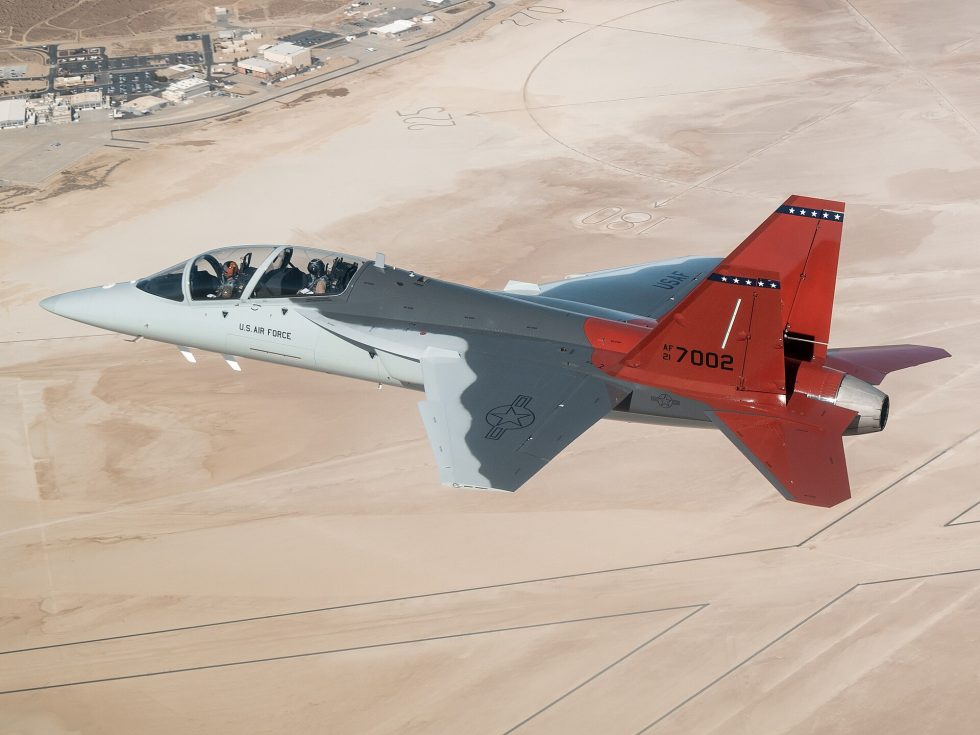
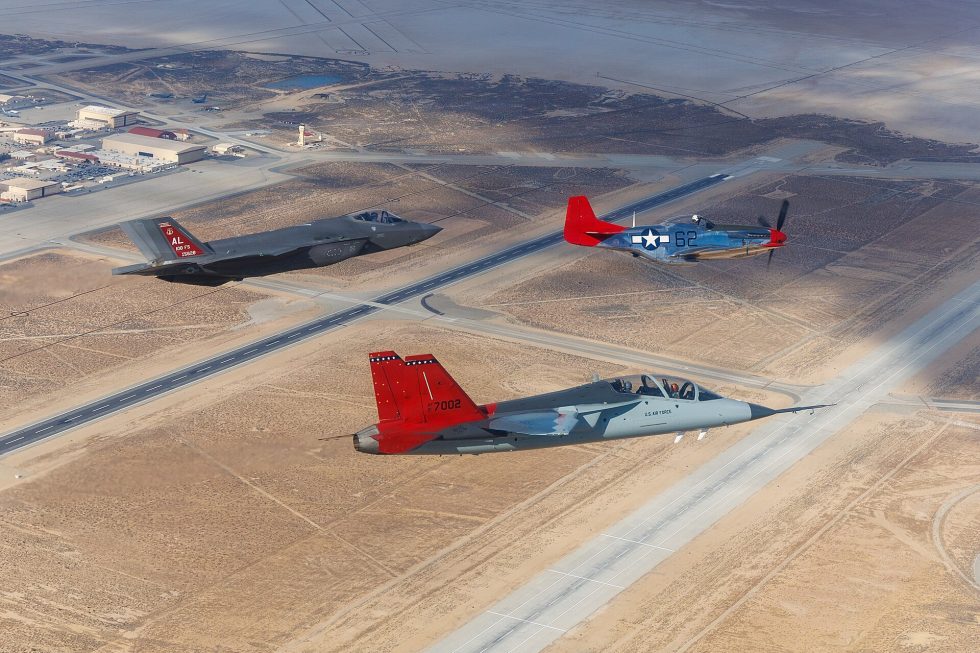
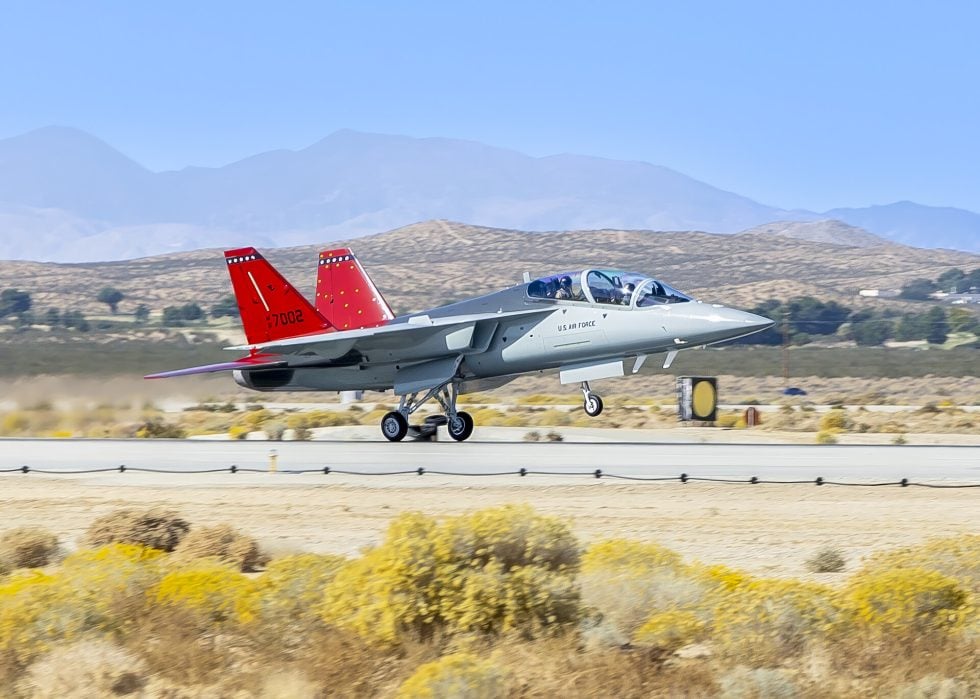
The T-7A Red Hawk in pictures
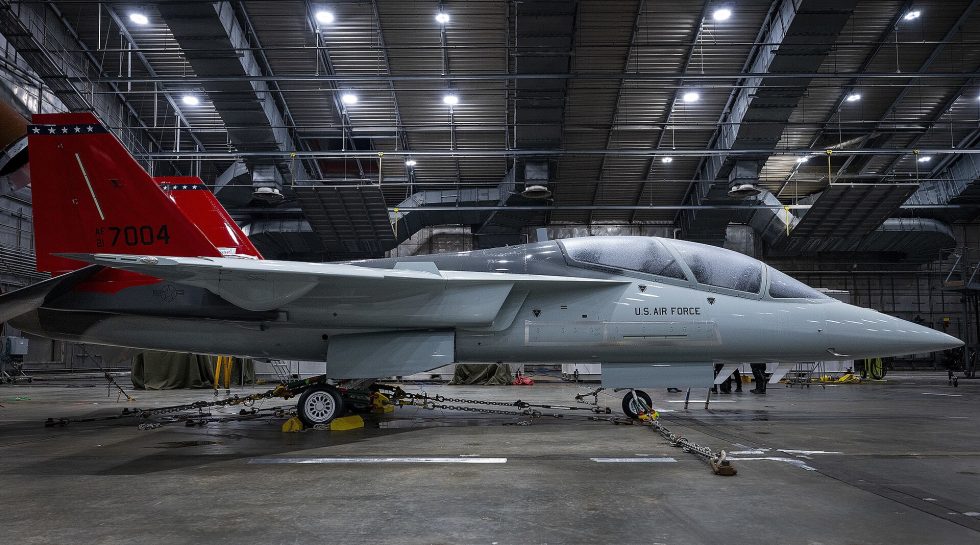
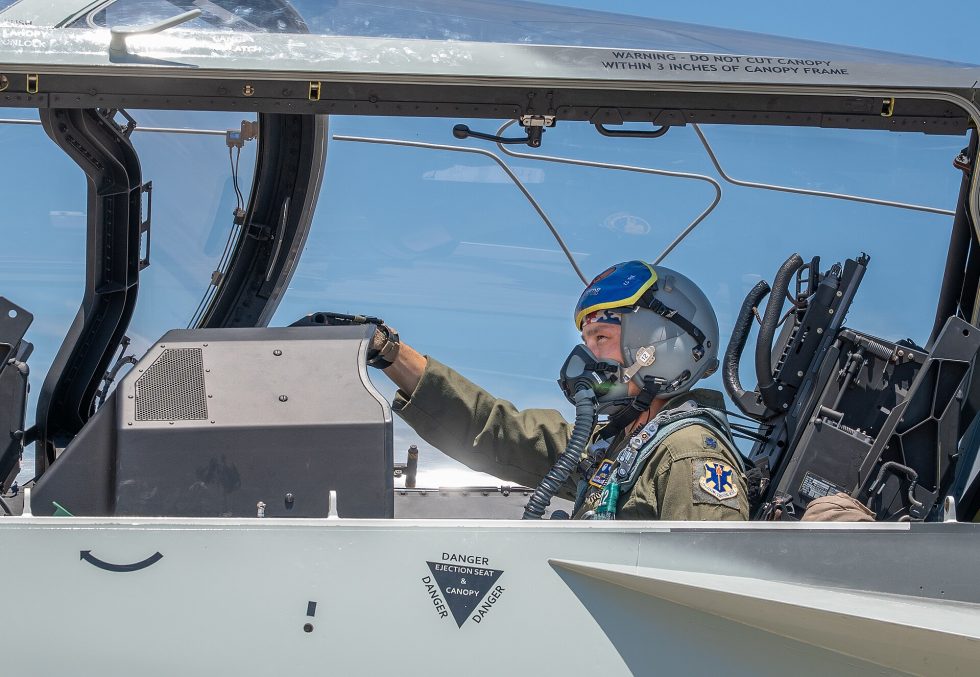
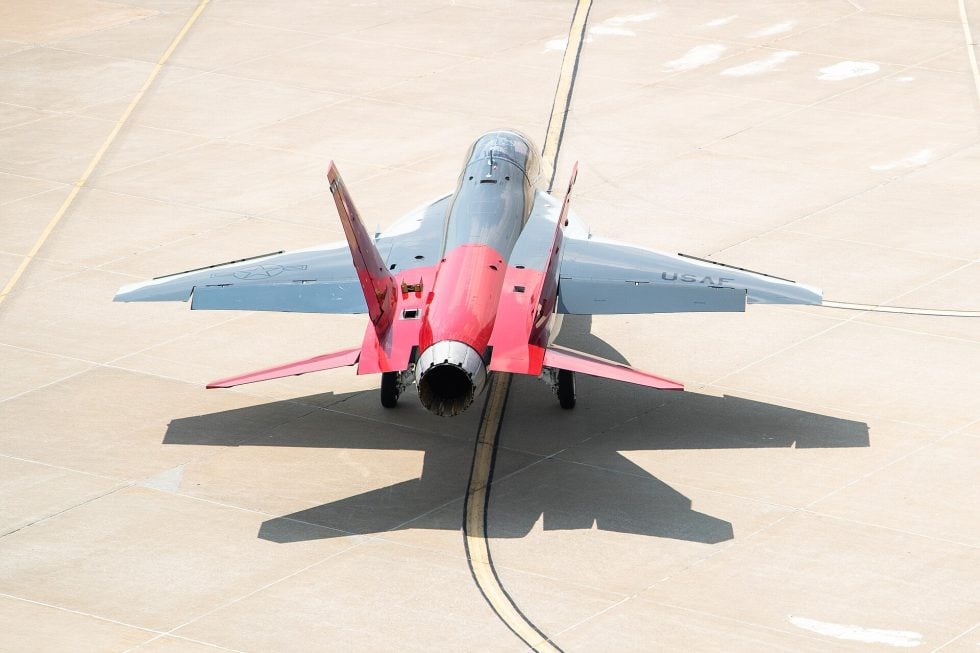
The T-7A Red Hawk in motion
Boeing: T-7A Red Hawk First Flight with the U.S. Air Force. The official Boeing video of the Red Hawk flying with an Air Force pilot at the controls — a clear look at the twin-tailed trainer in the air.
Where the T-7A Red Hawk operates
The T-7A Red Hawk by the numbers
The Red Hawk has no combat record — it is a trainer, built to make fighter and bomber pilots rather than to fight. Its story is measured instead in fleet size, milestones and the long road from a clean-sheet design to the flight line. Figures below are current to mid-2026 and will change as the programme matures.
Curious how the front-line jets its graduates will fly stack up? Compare the combat record of every military aircraft.
Everything people ask about the Boeing T-7A Red Hawk
Can I fly in a Boeing T-7A Red Hawk?
Who makes the T-7A Red Hawk?
Why is it called the Red Hawk?
What is the T-7A replacing?
What engine does the T-7A use?
Is the T-7A in service yet?
How fast is the T-7A Red Hawk?
Why has the T-7A been delayed?
You can’t fly the T-7A Red Hawk.
These, you can.
Some legends only live in museums — others are fuelled and waiting. MiGFlug has put civilians in real military jet cockpits since 2004.
 Fly the L-39 AlbatrosThe world’s most-flown jet trainer — aerobatics included
 Fly the F-104 Starfighter“The missile with a man in it”
 Fly the MiG-21The Cold War’s most-produced jet
 Fly the T-33 Shooting StarAmerica’s first jet trainer
 Fly the DH VampireA piece of early jet history
 Fly the S.211Agile Italian jet trainer
 Fly the MB-326The classic Aermacchi jet
 Fly the MiG-15The Soviet legend of the Korean War
Continue the tour
Every fact, checked
- Boeing — T-7A Red HawkManufacturer overview: digital engineering claims, programme milestones and configuration.
- Air & Space Forces Magazine — T-7ASpecifications, engine, first-flight and IOC dates.
- Air Force TimesMilestone C (April 2026), low-rate production lot and Boeing programme losses.
- Defense NewsEscape-system problems and the resulting schedule slips.
- The War ZoneEdwards AFB flight testing, wing-rock fixes and proposed derivatives.
- Flight GlobalThe e-series/eT-7A designation and Saab’s aft-fuselage production.
- U.S. Government Accountability OfficeIndependent assessments of T-7A schedule and programme risk.
- Breaking DefenseProgramme oversight reporting and the Boeing-Air Force relationship.