
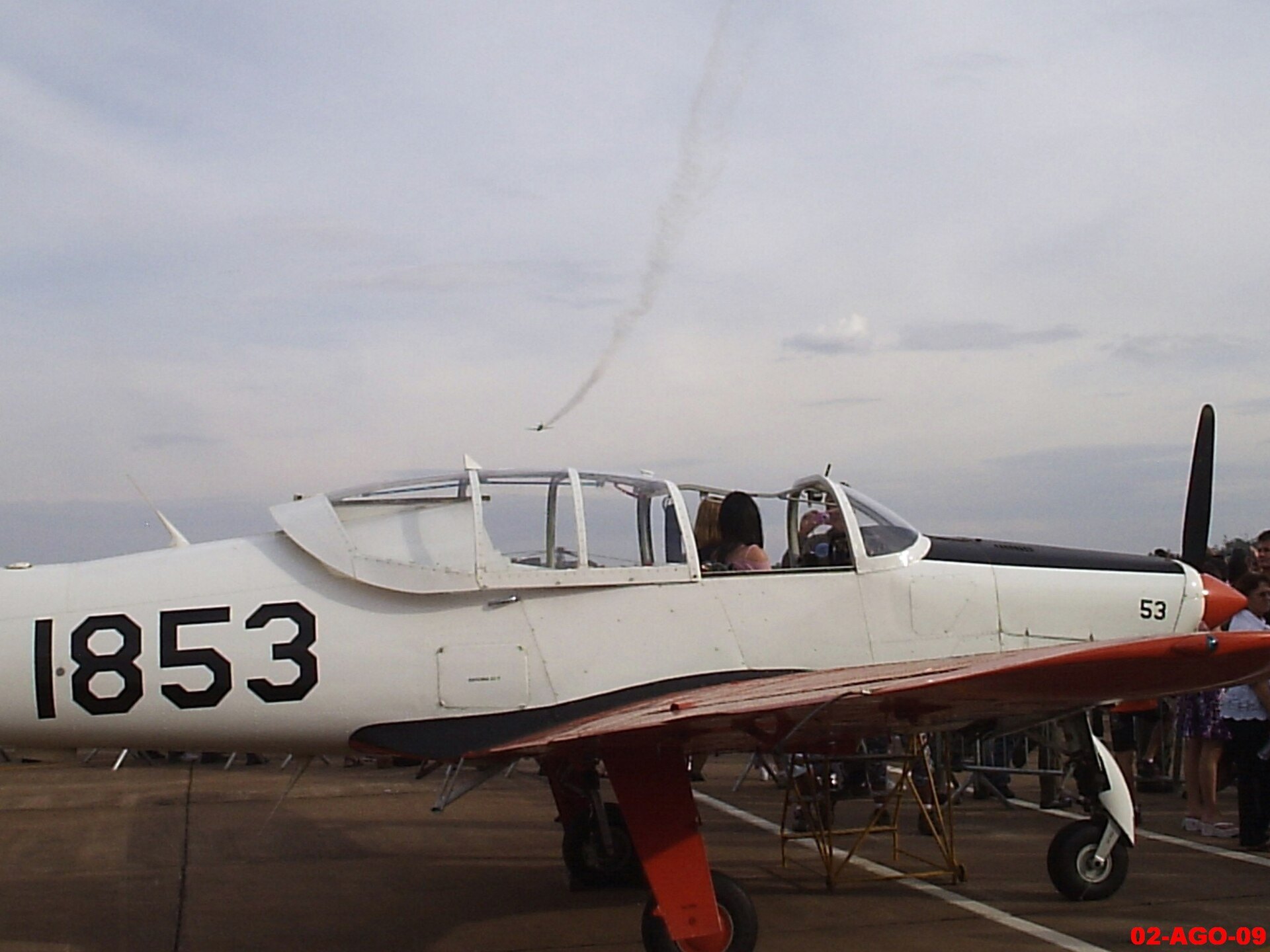
Neiva T-25 Universal
Brazil’s Classroom in the Sky
Designed by a Hungarian glider pilot in São Paulo, the Universal has taught Brazilian Air Force cadets to fly for more than half a century and is now being upgraded to fly on.
The T-25 Universal: how Brazil learned to build its own trainer
In the early 1960s the Força Aérea Brasileira (FAB) was still training its cadets on wartime designs: the North American T-6 Texan and the Fokker S-11 and S-12. In 1963 the small firm Sociedade Construtora Aeronáutica Neiva, best known for gliders and the Paulistinha light aircraft, answered the call for a replacement. Its designer was Joseph Kovács, a Hungarian engineer and glider pilot who had arrived in Brazil in 1948 at the age of 23. His Universal was Neiva’s leap from wood and fabric to all-metal construction: a sturdy low-wing monoplane with retractable tricycle gear, a 300 hp Lycoming six-cylinder engine and, unusually for a military trainer, side-by-side seating so that instructor and student could see each other’s every move.
The prototype, registered PP-ZTW, flew on 29 April 1966. In December 1967 the FAB ordered 150, built at São José dos Campos, and the first production aircraft, considerably modified to military requirements, reached the air force in 1971 as the T-25. A further 28 were ordered in 1978; total production is commonly given as about 180, though counts vary. The Universal took over the cadets’ basic course at the Academia da Força Aérea at Pirassununga, and armed versions with gun pods trained pilots in counter-insurgency work. In 1980 it even carried the reborn Esquadrilha da Fumaça display team back into the sky, flown by academy instructors in about 55 displays before the team moved on to the Tucano.
The Universal did more than teach pilots. It taught Brazil to build aircraft in series, and its designer went on to shape the Embraer EMB-312 Tucano after joining Embraer in 1973; Neiva itself became an Embraer subsidiary in 1980. Second-hand T-25s served in Chile, Paraguay and Bolivia, and operational FAB squadrons used the type for liaison and continuation flying. Yet the most remarkable fact is endurance. More than fifty years after delivery, the T-25 still gives FAB cadets their first military flying hours, and in December 2024 the first T-25M, rebuilt with a modern cockpit, flew at Lagoa Santa to keep the fleet going for years to come, with the first four handed to the academy a year later.
01The T-25’s designer: Joseph Kovács, from Budapest gliders to the Tucano
Joseph Kovács learned to fly gliders in Hungary at 15, launched off hillsides by rubber bungee. After the Second World War there was no flying to be had at home. As he later put it in a Brazilian gliding federation profile, “The first thing taken from a war loser is aviation. In Hungary we couldn’t even fly gliders.” He trained as an industrial engineer in Budapest and in 1948 arrived in Brazil, aged 23.
He worked first at São Paulo’s Technological Research Institute and from 1952 at the Aeronautical Technical Centre, the CTA, before joining Neiva in 1960. There he designed the Universal and the Regente liaison aircraft, each built in substantial numbers for the FAB. The Universal showed his priorities: structural toughness, straightforward handling and easy maintenance for a fleet that would be flown hard by students.
In 1973 Kovács moved to Embraer, where he led the design of the T-27 Tucano, the turboprop trainer with tandem ejection seats that would sell to air forces around the world and replace the T-25 in the advanced stages of FAB training. He was made a Commander of Brazilian Aviation in 2014 and died on 14 July 2019. Few designers can claim to have created both the trainer a nation’s cadets start on and the one they progress to.
What makes the T-25 Universal special
Side by side, not tandem
Most military trainers seat instructor and student one behind the other, mimicking a fighter cockpit. The T-25 seats them side by side. For a cadet’s first hours that is a teaching advantage: the instructor can see the student’s hands, scan and reactions directly and demonstrate at the next seat. Accounts of training at Pirassununga describe the layout as ideal for instructor and cadet. The trade-off is a wider fuselage and less of a fighter feel, which the FAB supplies later, when cadets move on to the tandem Tucano.
A big engine for a basic trainer
The Universal was conceived as an advanced trainer to replace the 600 hp T-6, so Neiva gave it a 300 hp Lycoming IO-540 fuel-injected six-cylinder and a two-bladed constant-speed Hartzell propeller. The result is a heavy, solid aircraft for its class, with a maximum take-off weight of about 1,700 kg, a top speed around 300 km/h and enough endurance, roughly three and a half hours, for long navigation exercises. The engine is a standard civil type, which has helped keep the fleet supportable for decades.
Built to be flown hard
The T-25 is an all-metal low-wing monoplane with retractable tricycle undercarriage and a simple, robust structure. At the Academia da Força Aérea cadets fly about 40 hours on it in their second year, covering basic manoeuvres, aerobatics, formation and navigation, before moving to the Tucano. Aviation News Journal’s account of academy training notes that its basic design makes it ideal for initial training and simplifies maintenance, which goes a long way to explaining why it has outlasted several of its own intended successors.
02The T-25’s variants: from Universal to T-25M
- XT-25 (IPD-6201): the prototype PP-ZTW, first flown on 29 April 1966 and now preserved at the Museu Aeroespacial in Rio de Janeiro.
- T-25 / T-25A: the production basic trainer delivered to the FAB from 1971.
- AT-25: armed version with two underwing hardpoints for 7.62 mm machine-gun pods, used to train pilots in counter-insurgency tactics.
- T-25C: later-standard aircraft, used both at the academy and by operational squadrons for liaison and continuation flying.
- YT-25B Universal II: a more powerful development first flown on 22 October 1978; it did not enter production.
- T-25M: modernisation by the Parque de Material Aeronáutico de Lagoa Santa, first flown on 5 December 2024, with GNSS navigation, terrain awareness and warning, new wiring and a redesigned panel some 50 kg lighter; 38 aircraft are planned, drawn from the T-25A and T-25C fleets, with the first four delivered to the academy in December 2025.
Neiva T-25 Universal specifications
Specifications
- Crew
- 2 (side by side)
- Length
- 8.60 m (28 ft 3 in)
- Wingspan
- 11.00 m (36 ft 1 in)
- Height
- 3.00 m (9 ft 10 in)
- Wing area
- 17.20 m² (185.1 sq ft)
- Empty weight
- 1,150 kg (2,535 lb)
- Max take-off weight
- 1,700 kg (3,748 lb)
- Powerplant
- 1 × Lycoming IO-540-K1D5 six-cylinder piston, 300 hp (224 kW), two-bladed Hartzell constant-speed propeller
- Maximum speed
- about 300 km/h (186 mph; 162 kn)
- Cruise speed
- about 280 km/h (174 mph; 151 kn)
- Range
- 1,500 km (932 mi), about 3.5 hours
- Service ceiling
- commonly given as 6,100 m (20,000 ft); some sources quote 5,000 m (16,400 ft)
- Climb rate
- 6.66 m/s (1,312 ft/min)
- Armament
- AT-25: two underwing hardpoints for 7.62 mm machine-gun pods
Costs & production
- Cost per flight hour
- Our estimate: roughly US$300 to 600, based on the fuel burn and maintenance of a 300 hp six-cylinder Lycoming and the operating costs of comparable civil aircraft
- Production
- About 180 (150 ordered in 1967, 28 more in 1978); published totals range from 135 delivered to 189 built
- Programme
- T-25M modernisation of 38 aircraft at Lagoa Santa; first flight 5 December 2024, first four delivered to the academy in December 2025
03The T-25’s operating costs: why Brazil keeps rebuilding it
The T-25 costs what a heavy civil single costs to run: avgas for a 300 hp Lycoming, routine piston maintenance and a simple metal airframe. The FAB does not publish an hourly figure, so the range given is an estimate based on comparable aircraft.
That economy is why the air force chose to modernise rather than replace. The T-25M programme keeps the proven airframe and engine but replaces analogue instruments and ageing wiring, adds satellite navigation and terrain warning, and saves around 50 kg. It is carried out in-house at the Parque de Material Aeronáutico de Lagoa Santa, and the first four upgraded aircraft reached the academy in December 2025.
The arithmetic also reflects how the FAB trains. The T-25 is the aircraft on which a cadet makes mistakes: hard landings, botched spins, rough formation. A simple piston airframe tolerates that treatment, and repairs are cheap. Expensive turbine hours are saved for the Tucano, later in the course, once the cadet has the basics. Simulators now take some of the load too, but the T-25 remains the academy’s first real aircraft.
The T-25 Universal from 1963 to the T-25M
A replacement for the T-6
Neiva begins designing a trainer to replace the FAB’s T-6 Texans and Fokker S-11 and S-12s.
First flight
The prototype PP-ZTW flies on 29 April.
Order for 150
In December the FAB contracts Neiva for 150 aircraft, to be built at São José dos Campos.
Into service
The first production T-25 is delivered to the FAB, much modified from the prototype.
More aircraft, and a Universal II
The FAB orders 28 more; the YT-25B Universal II flies on 22 October but is not produced.
Fumaça reborn; Embraer takes over
Academy instructors give the first T-25 display of the revived smoke team on 10 July; Embraer acquires Neiva.
Tucano takes the display role
After about 55 displays on the T-25, the team receives its first T-27 Tucanos and debuts them in December.
Hand-me-downs abroad
Second-hand T-25s go to Paraguay and Bolivia, joining a type also flown in Chile.
Designer dies
Joseph Kovács, creator of the Universal and the Tucano, dies on 14 July.
T-25M flies
The first modernised T-25M makes its maiden flight at Lagoa Santa on 5 December.
Back to the academy
The first four T-25Ms are delivered to the Academia da Força Aérea in December.
Stories & eyewitnesses: the T-25 Universal at work
The glider pilot from Budapest
The man who designed the T-25 came to Brazil because his own country had grounded him.
Read the full story
PP-ZTW, the first Universal
The prototype that started it all is on show in Rio de Janeiro.
Read the full story
From gliders to metal
The Universal turned a glider builder into a military supplier.
Read the full story
Forty hours in the second year
At Pirassununga the T-25 is where a cadet becomes a pilot.
Read the full story
The instructors who brought back the smoke
In 1980 a group of T-25 instructors revived Brazil’s famous display team.
Read the full story
Handing the smoke to the Tucano
The T-25 passed the display baton to an aircraft by its own designer.
Read the full story
Gun pods for counter-insurgency
The basic trainer also taught Brazilian pilots to attack.
Read the full story
Across the borders
T-25s found second careers with Brazil’s neighbours.
Read the full story
The T-25M takes off
Rather than retire its veteran, the FAB rebuilt it.
Read the full story
Fifty-four years on
In December 2025 the academy received its first modernised Universals.
Read the full story
The T-25 in pictures
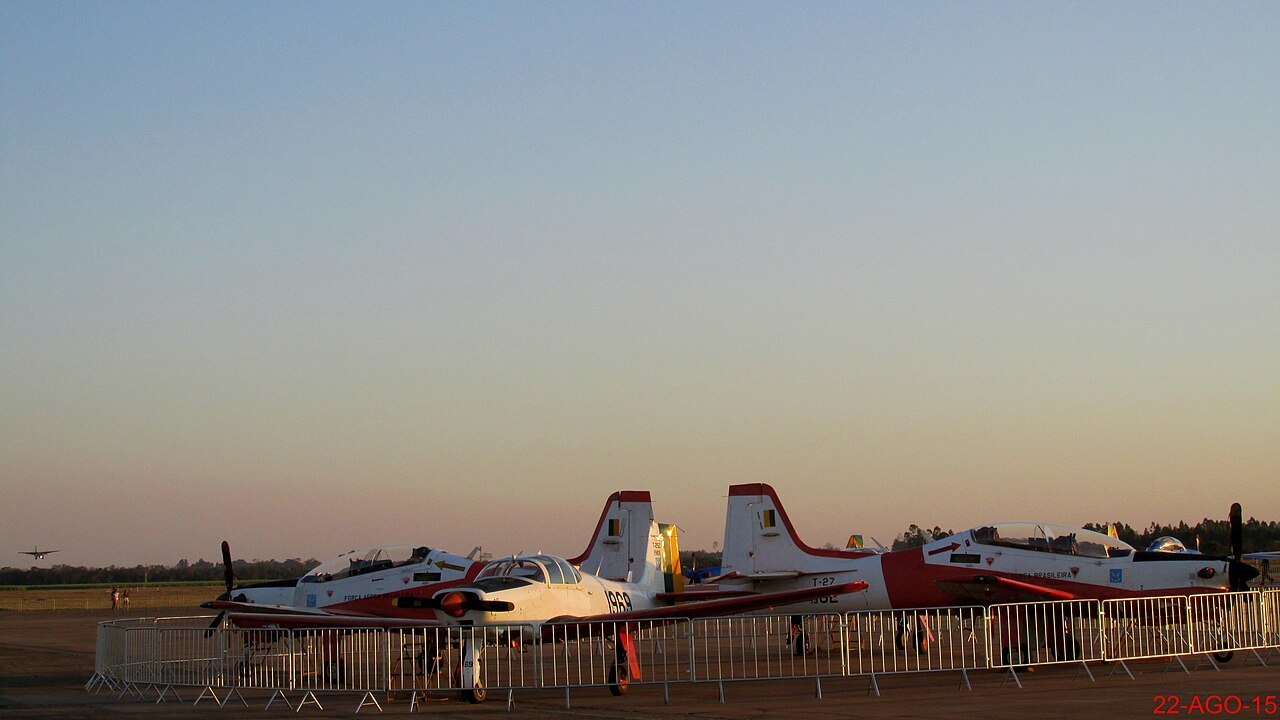
Where the T-25 flies and flew
The T-25 Universal’s record
The T-25 has no combat record. Its armed AT-25 form trained pilots for counter-insurgency in the 1970s, but the type’s real legacy is in training: it has given generations of Brazilian Air Force cadets their first military flying, revived the Esquadrilha da Fumaça, and outlasted its own successors at the academy.
See how training and combat types compare in the military aircraft statistics database. Figures are approximate.
Everything people ask about the T-25
Can I fly in a Neiva T-25 Universal?
Who designed the T-25 Universal?
Is the T-25 still in service?
Why does the T-25 have side-by-side seats?
How many T-25s were built?
Did the T-25 fly with the Esquadrilha da Fumaça?
Was the T-25 armed?
You can’t fly the T-25.
These, you can.
Most of this museum you can only look at. These genuine military jets you can fly yourself with MiGFlug — with aerobatics and time on the controls.
 Fly the L-39 AlbatrosThe world’s most-flown jet trainer — aerobatics included
 Fly the F-104 Starfighter“The missile with a man in it”
 Fly the MiG-21The Cold War’s most-produced jet
 Fly the T-33 Shooting StarAmerica’s first jet trainer
 Fly the DH VampireA piece of early jet history
 Fly the S.211Agile Italian jet trainer
 Fly the MB-326The classic Aermacchi jet
 Fly the MiG-15The Soviet legend of the Korean War
Continue the tour
Every fact, checked
- Aviation News Journal: Repetition makes perfectionT-25 training at the Air Force Academy, hours and syllabus
- Aviation Press: Força Aérea Brasileira, Academia da Força Aérea2nd Squadron, T-25M upgrade and deliveries
- Scramble: First flight T-25M UniversalT-25M first flight 5 December 2024
- Brazilian Gliding Federation: Eng. Joseph KovacsDesigner biography and quote
- AirHistory.net: Neiva XT-25 Universal 1830, Museu AeroespacialPreserved prototype
- Defesa Aérea & Naval: Parabéns Esquadrilha da FumaçaT-25 display period 1980 to 1983
- Key.Aero: Smokers on the roadFumaça history and Tucano conversion
- History of War: Embraer AT-25 / T-25 UniversalDevelopment dates and COIN use
- GlobalSecurity: T-25 / Neiva UniversalSpecifications and production
- Autoentusiastas: A indústria aeronáutica brasileira, parte 2Neiva company history