
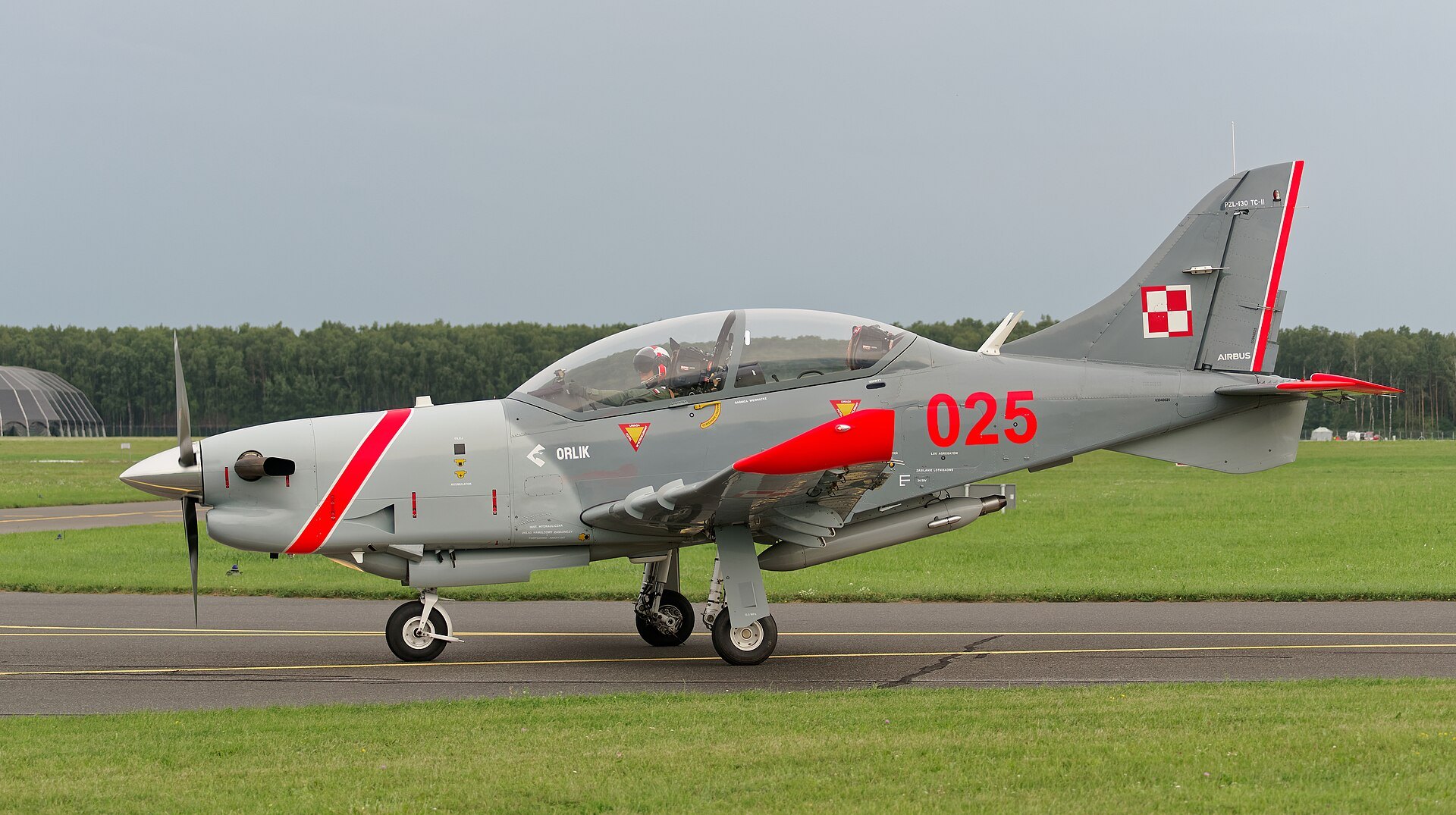
PZL-130 Orlik
Poland’s Eaglet
Conceived around a radial engine Poland could not make powerful enough, the Orlik became a turboprop and has given every Polish military pilot their first taste of aerobatics since 1994.
The Orlik: how a piston trainer became Poland’s turboprop school
In 1981 the design office at PZL Warszawa-Okęcie, on the edge of Warsaw’s main airport, presented a project for a new two-seat military trainer. The team was led by Andrzej Frydrychewicz, who also chose its designation and its name: Orlik, the eaglet, a nod to the air force academy at Dęblin known as the School of Eaglets. The concept was conservative and sensible for the Eastern bloc of the day: a low-wing, tandem-seat, all-metal aircraft driven by the Soviet Vedeneyev M-14Pm nine-cylinder radial, the same family of engine that powered the Yak-52. Okęcie test pilot Witold Łukomski took the first prototype into the air on 12 October 1984, with two more prototypes following by January 1985.
The radial was the problem. The plan was to build the aircraft around a Polish engine derived from the Ivchenko AI-14, but the home-built radials simply did not deliver enough power, and in 1990 the piston Orlik was abandoned. Okęcie had already hedged its bets. On 13 July 1986 the PZL-130T Turbo Orlik, a prototype re-engined with a 550 shp Pratt & Whitney Canada PT6A, made its first flight, and the turboprop transformed the design. Further prototypes tried the Czech Walter M601, and it was that engine, cheaper and available from a Warsaw Pact neighbour, which went into the production PZL-130TB. Deliveries to the Polish Air Force began in 1994, to the academy at Dęblin and the training regiment at Radom.
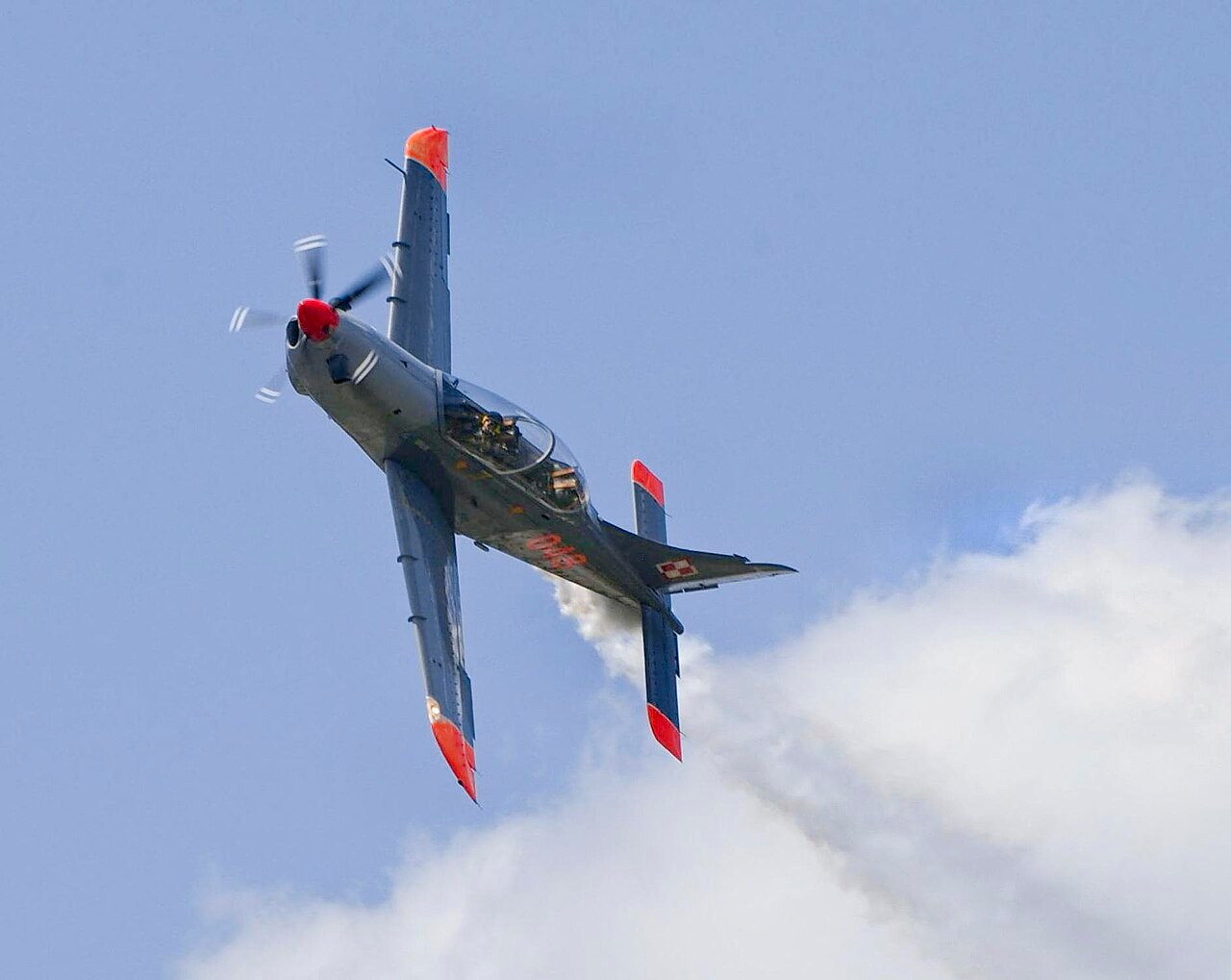
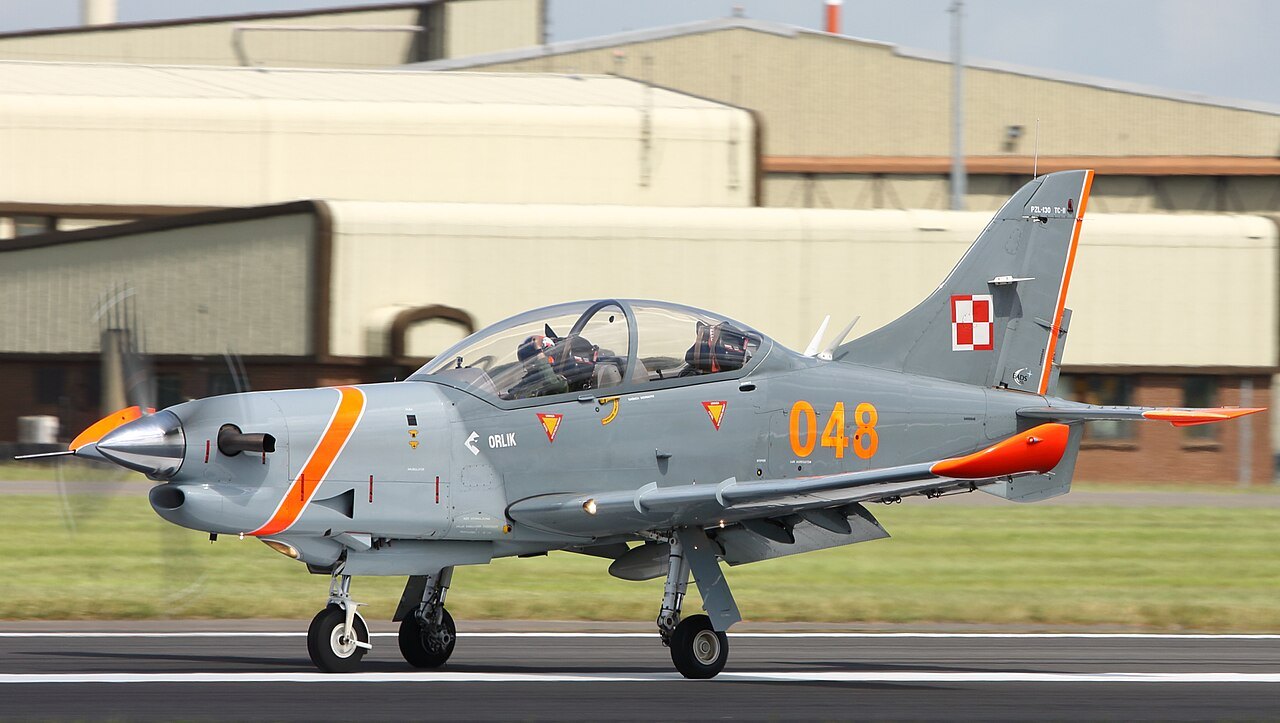
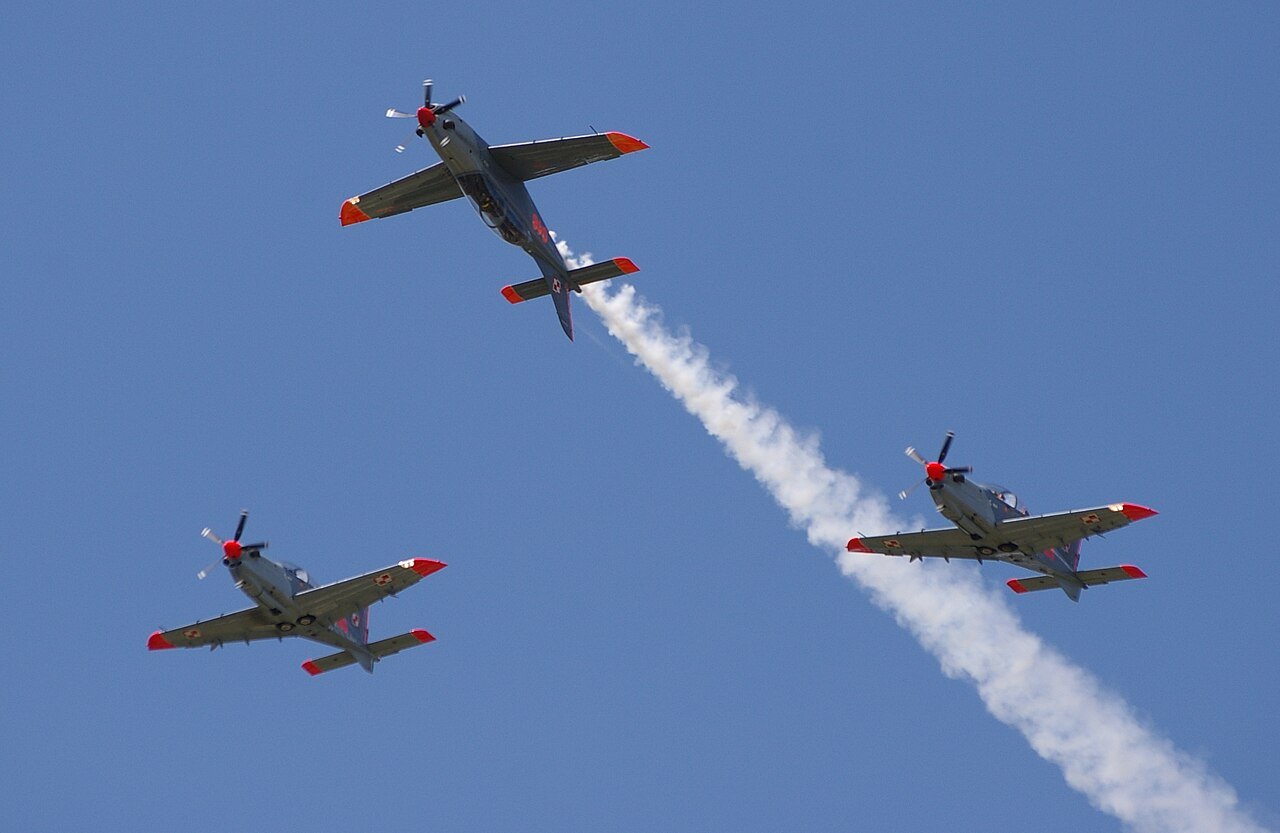
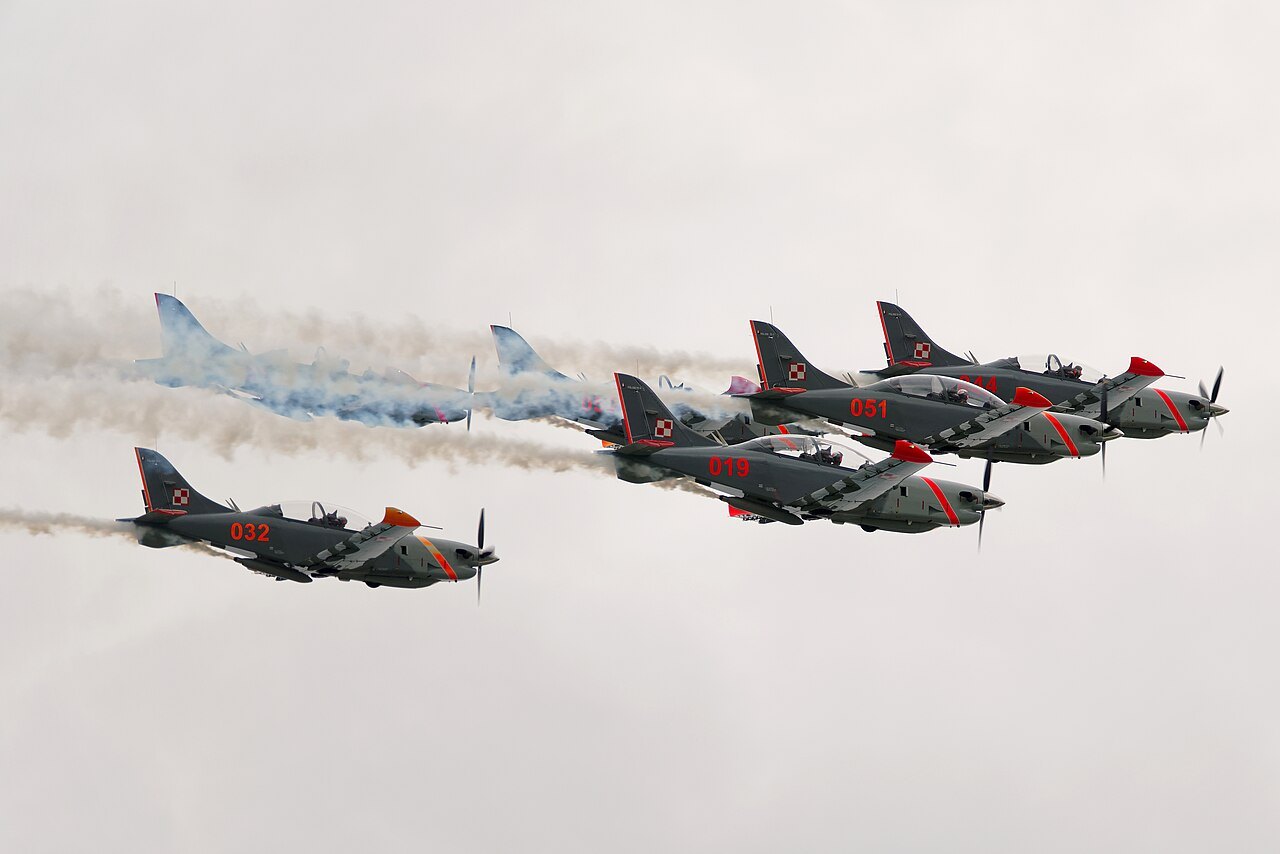
Production was modest: 50 series aircraft plus nine prototypes. What the Orlik lacked in numbers it made up in longevity. Fitted with Martin-Baker ejection seats it became the TC-I, and from 2004 a reworked TC-II appeared with a larger wing, a new rudder and a PT6A-25C. Between 2010 and 2022 Okęcie, by then part of Airbus, rebuilt 28 aircraft with new wings, tails, engines and glass cockpits, clearing each for 12,000 flying hours. Today every Polish fast-jet pilot, whether bound for the F-16, the FA-50 or the F-35, starts basic training in an Orlik at Radom, and the Orlik Aerobatic Team has carried the type to air shows across Europe since 1998.
01The Orlik’s engine saga: from radial to Walter to Pratt & Whitney
Few trainers have changed engines as often as the Orlik. The first three prototypes flew with the Soviet-designed M-14Pm radial, and the intention was to switch production aircraft to a Polish-built radial of Ivchenko AI-14 ancestry. That engine never produced the power the airframe needed, and by 1990 the piston programme was dead.
The way forward had been shown in July 1986, when the third prototype flew as the PZL-130T Turbo Orlik with a 550 shp PT6A-25P. The turboprop gave the aircraft the climb and smooth power delivery of a modern trainer, but it was a Western engine at a time when Poland was still inside the Warsaw Pact, and the prototype was lost in January 1987 while being demonstrated to a representative of the Colombian Air Force. Okęcie then tested the Czech Walter M601, and versions with both engines were developed in 1989 and 1990. The Walter won for the domestic order, so the PZL-130TB that entered service in 1994 was Czech-powered.
The story came full circle with modernisation. The TC-II, first tested in 2004, went back to Pratt & Whitney with the PT6A-25C, rated at about 750 shp and driving a four-bladed Hartzell propeller in its latest form. When Airbus Poland finished the last rebuild in 2022, the whole fleet of 28 had a common Canadian engine, a common wing and a common glass cockpit, the first time in its life that the Orlik fleet had been standardised.
What makes the Orlik special
Built for the student
The Orlik is a straightforward tandem trainer: student in front, instructor behind and slightly raised, under a long canopy that gives both a good view. Its job is the first military phase of training, from first solo through aerobatics, formation and navigation, before a cadet moves on to a jet. A turboprop of about 750 shp gives it more than enough performance for that task while keeping the handling honest and forgiving, and the low wing and wide-track retractable undercarriage make it tolerant of the rough landings every instructor expects.
Ejection seats in a basic trainer
The original PZL-130TB had no ejection seats. Adding Martin-Baker Mk 11 zero-zero seats turned it into the TC-I and gave students the same escape system logic they would meet in front-line jets. The seats proved their worth on 5 June 2002, when Orlik 39 suffered an engine failure on approach to Radom and both crew ejected safely. For a basic trainer, an ejection seat is still not universal, and its presence shapes the cockpit drills taught from the very first sortie.
A rebuilt, not renewed, fleet
Rather than buy a new trainer, Poland chose to rebuild the Orlik almost completely. The TC-II Advanced programme replaced wings, tail surfaces, engines, propellers, wiring, electrics and air conditioning, and added a glass cockpit with TAWS terrain warning and TCAS collision avoidance. Airbus quoted a fresh life of 12,000 flying hours per aircraft and maintenance moved to an on-condition basis, with the interval between checks doubling from 100 to 200 hours. In effect, most of each Orlik is now a twenty-first-century aircraft.
02The Orlik’s variants: from piston prototype to TC-II Advanced
- PZL-130: three piston prototypes with the M-14Pm radial, first flown in 1984 and 1985; abandoned in 1990.
- PZL-130T Turbo Orlik: turboprop prototype with the PT6A-25P, first flown 13 July 1986, lost in January 1987.
- PZL-130TB: initial production version with the Walter M601, delivered from 1994.
- PZL-130TM and TC: turboprop development and export-standard prototypes with Walter and Pratt & Whitney engines.
- PZL-130TC-I: TB aircraft fitted with Martin-Baker Mk 11 ejection seats and updated avionics.
- PZL-130TC-II: larger wing, modified rudder and PT6A-25C, tested from 2004; 16 TC-I were converted to TC-II Garmin standard under a 2010 contract completed in September 2013.
- Orlik MPT: Multi Purpose Trainer demonstrator with an integrated glass cockpit, unveiled by Airbus in November 2014.
- TC-II Advanced: the final standard, 12 TC-I rebuilt with new structure, engines and glass cockpits; the last was handed over in October 2022, giving a uniform fleet of 28.
PZL-130 Orlik specifications
Specifications
- Crew
- 2 (tandem)
- Length
- 9.30 m (30 ft 6 in), TC-II
- Wingspan
- 10.0 m (32 ft 10 in), TC-II
- Height
- 3.53 m (11 ft 7 in)
- Wing area
- 14.56 m² (156.7 sq ft)
- Empty weight
- about 1,825 kg (4,023 lb), TC-II
- Max take-off weight
- 2,950 kg (6,504 lb)
- Powerplant
- 1 × Pratt & Whitney Canada PT6A-25C turboprop, about 560 kW (750 shp)
- Maximum speed
- commonly given as 480 to 550 km/h (260 to 300 kt) depending on version and source
- Cruise speed
- about 490 km/h (265 kt)
- Range
- about 2,200 km (1,200 nmi) quoted for the TC-II
- Service ceiling
- 10,000 m (33,000 ft)
- Climb rate
- about 14.4 m/s (2,830 ft/min)
- g limits
- +6 / −3
- Armament
- six hardpoints, up to about 700 kg (1,500 lb), quoted for the TC-II; not used by the Polish Air Force in training
Costs & production
- Cost per flight hour
- Our estimate: roughly US$700 to 1,200, based on the fuel burn and maintenance of a 750 shp PT6A turboprop trainer and published operating costs of comparable aircraft such as the Pilatus PC-7
- Production
- 50 series aircraft plus 9 prototypes, deliveries from 1994
- Programme
- 28 aircraft rebuilt to TC-II standard: 16 TC-II Garmin (2010 to 2013) and 12 TC-II Advanced (contract announced December 2017, last delivered October 2022)
03The Orlik’s operating costs: why Poland rebuilt rather than replaced
No reliable new-build price for the Orlik has ever been published, and the type was never sold abroad, so there is no export contract to compare. What the record shows is a choice. Rather than buying a foreign turboprop trainer, Poland twice paid its own manufacturer to rebuild the fleet it had, first with Garmin avionics and then with almost entirely new structure in the TC-II Advanced programme.
The economics lie in the engine and the maintenance schedule. A PT6A turboprop of around 750 shp burns a small fraction of the fuel of a jet trainer, and Airbus said the TC-II rebuild halved the frequency of routine checks, moving from 100-hour to 200-hour intervals with on-condition maintenance. Our estimate of roughly US$700 to 1,200 per flight hour is based on the costs of comparable PT6A trainers and should be read as an order of magnitude rather than an official figure. For the basic phase, where students fly many short sorties, that is far cheaper than doing the same work in the M-346.
The Orlik from drawing board to glass cockpit
Project presented
PZL Warszawa-Okęcie, under Andrzej Frydrychewicz, unveils its design for a new military trainer.
First flight
Test pilot Witold Łukomski flies the first piston prototype on 12 October.
Turbo Orlik flies
The PT6A-powered PZL-130T makes its first flight on 13 July.
Prototype lost
The Turbo Orlik is destroyed in January during a demonstration for a Colombian Air Force representative.
Radial abandoned
Development of the piston Orlik ends because the Polish-built radial lacks power.
Into service
PZL-130TB deliveries begin to Dęblin and the training regiment at Radom.
Display team born
The Orlik Aerobatic Team flies its first public display on 15 April and appears at RIAT in July.
TC-II tested
A new wing, rudder and PT6A-25C engine begin flight trials.
Garmin upgrade complete
Sixteen TC-I aircraft finish conversion to TC-II Garmin standard in September.
Orlik MPT unveiled
Airbus shows a glass-cockpit Multi Purpose Trainer at Okęcie in November.
Uniform fleet
The last of 28 TC-II aircraft is handed over in October.
Collision at Radom
Two team aircraft touch wings on 27 April during a display; both land safely.
Stories & eyewitnesses: the Orlik and its pilots
The designer who named the eaglet
Andrzej Frydrychewicz chose both the number and the name.
Read the full story
First flight over Okęcie
Witold Łukomski took the radial-engined prototype aloft in October 1984.
Read the full story
The demonstration for Colombia
The first Turbo Orlik was lost while being shown to a foreign customer.
Read the full story
Into the School of Eaglets
From 1994 the Orlik took over the first military phase of Polish pilot training.
Read the full story
A hard first year
Within months of entering service, an Orlik was lost at Dęblin.
Read the full story
Engine failure at Radom
In 2002 the new ejection seats saved an Orlik crew.
Read the full story
From four instructors to nine aircraft
The Orlik Aerobatic Team began with four Dęblin instructors in 1998.
Read the full story
Grounded by the budget, back in a nine-ship
Money ran out in 2006; the team came back stronger.
Read the full story
Wingtips over Maków Nowy
A mid-air touch at the opening of Radom’s new airport ended without injury.
Read the full story
A thousand new pilots
The rebuilt Orlik is the first step towards Poland’s F-35s.
Read the full story
The Orlik in Kraków
A TC-I is preserved at the Polish Aviation Museum.
Read the full story
The Orlik in pictures
Where the Orlik flies and flew
The Orlik’s record
The Orlik has never been used in combat. Its record is a training one: three decades as the first military aircraft of the Polish Air Force, and more than a hundred air-show appearances with the Orlik Aerobatic Team.
See how training and combat types compare in the military aircraft statistics database. Figures are approximate.
Everything people ask about the Orlik
Can I fly in a PZL-130 Orlik?
What does Orlik mean?
What engine does the Orlik use?
How many Orliks were built?
Who flies the Orlik?
Does the Orlik have ejection seats?
Where can I see the Orlik?
You can’t fly the Orlik.
These, you can.
Most of this museum you can only look at. These genuine military jets you can fly yourself with MiGFlug — with aerobatics and time on the controls.
 Fly the L-39 AlbatrosThe world’s most-flown jet trainer — aerobatics included
 Fly the F-104 Starfighter“The missile with a man in it”
 Fly the MiG-21The Cold War’s most-produced jet
 Fly the T-33 Shooting StarAmerica’s first jet trainer
 Fly the DH VampireA piece of early jet history
 Fly the S.211Agile Italian jet trainer
 Fly the MB-326The classic Aermacchi jet
 Fly the MiG-15The Soviet legend of the Korean War
Continue the tour
Every fact, checked
- Polish Aviation Museum, Kraków: PZL-130 TC-I OrlikMuseum exhibit history, engines and service
- dlapilota.pl: PZL-130 Orlik, lesser-known historiesFrydrychewicz, naming, first flight pilot
- Vintage Aviation News: First flight of the PZL-130T Turbo OrlikPrototype dates, engines, production
- Airbus: PZL Warszawa-Okęcie to modernise Polish Air Force Orlik TC-IManufacturer; TC-II Advanced scope, 12,000-hour life
- Defence24: Orliki w komplecieLast delivery 2022, maintenance intervals, pilot demand
- Aviation Week: Airbus introduces the Orlik MPT trainerGlass-cockpit demonstrator, 2014
- Afterburner.com.pl: PZL-130 TC-II OrlikTC-II development and Garmin upgrade
- dlapilota.pl: Zespół Akrobacyjny Orlik ma już 23 lataTeam leaders, g limits, display record
- Aerobatic Teams: Orlik aerobatic team historyTeam founding, growth and suspension
- European Airshows: Team Orlik collision at Radom27 April 2023 incident
- Aviation Safety Network: Orlik 21, 30 April 1994Dęblin fatal accident
- Aviation Safety Network: Orlik 39, 5 June 2002Engine failure and ejection at Radom