
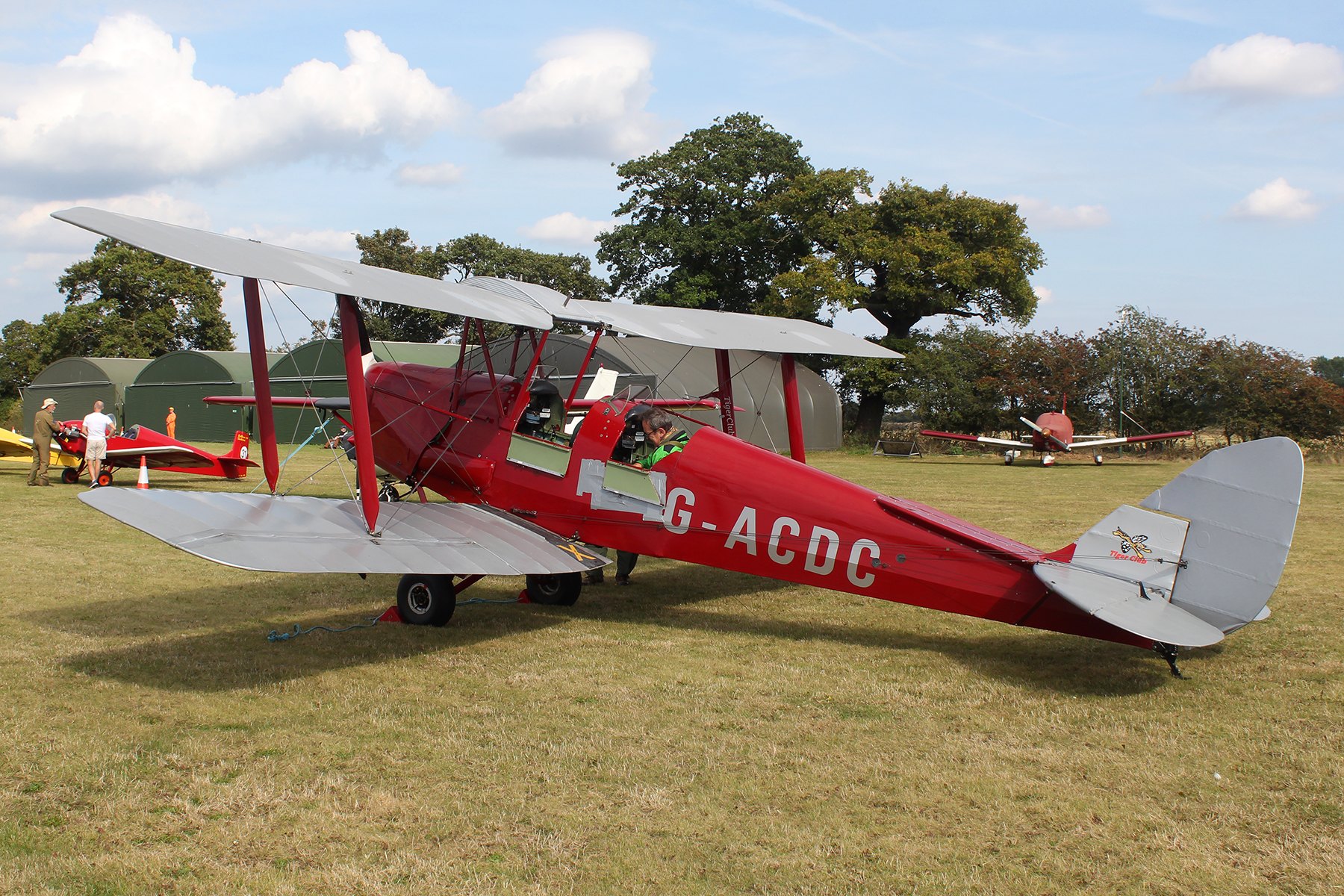
de Havilland DH.82 Tiger Moth
The Commonwealth’s Classroom
The biplane on which most RAF pilots of the Second World War first flew solo: more than 8,800 were built on four continents, and its gentle but honest handling shaped a generation of airmen.
The Tiger Moth: how a club biplane trained an empire’s air forces
On 26 October 1931 de Havilland’s chief test pilot Hubert Broad took a small silver biplane off from Stag Lane Aerodrome at Edgware, in north London. It was the first DH.82 Tiger Moth, and it looked like what it was: a militarised descendant of Geoffrey de Havilland’s hugely successful Moth family of club aircraft. The changes were practical rather than glamorous. The upper wing was moved forward and the wings were staggered and swept so that an instructor or student in the front cockpit could get out quickly with a parachute, and the inverted Gipsy engine improved the view over the nose. The RAF liked what it saw. In February 1932 the first Tiger Moths reached the Central Flying School at Upavon, the home of RAF instructional standards, and a type that would outlast its maker’s wildest expectations had entered service.
The Second World War turned the Tiger Moth into an industrial product. With Hatfield needed for other work, Morris Motors at Cowley built more than half of the wartime aircraft, while de Havilland’s overseas companies built their own: 1,548 in Canada, many as the enclosed, cold-weather DH.82C, and about 1,070 in Australia, with smaller runs in New Zealand, Norway, Sweden and Portugal. In all, more than 8,800 were built. The Tiger Moth became the principal elementary trainer of the British Commonwealth Air Training Plan and of the RAF’s home schools, and the US National Museum of the US Air Force notes that most RAF pilots of the war trained on it, including the Americans who flew with the Eagle Squadrons before Pearl Harbor.
The Tiger Moth was never meant to fight, but in 1939 and 1940 it was pressed into roles its designers never imagined. Tiger Moths flew coastal patrols to force U-boats under, and after Dunkirk some 350 were fitted with light bomb racks to attack invaders on the beaches. A radio-controlled derivative, the Queen Bee, served as a gunnery target and is credited with giving the word drone to unmanned aircraft. The RAF finally retired the type in 1959, replaced by the Chipmunk, but thousands flowed onto the civil register to tow banners and gliders, spray crops and teach new generations. Today a Tiger Moth trial lesson remains one of aviation’s classic rites of passage.
01The Tiger Moth’s war: patrols, bombs and the paraslasher
When war came in September 1939, Britain had several hundred Tiger Moths at its elementary schools and many more civil Moths that were quickly impressed. The trainer’s first operational job was at sea. In December 1939 RAF Coastal Command formed flights of Tiger Moths to patrol coastal waters in pairs. They carried no real armament, at most a Very pistol and occasionally a small bomb, plus a pair of homing pigeons in case they came down, and their purpose was simply to be seen: a U-boat commander who spotted an aircraft would dive and lose his chance to attack. No Tiger Moth is known to have attacked a submarine, but the so-called scarecrow patrols filled a gap until proper maritime aircraft arrived.
The summer of 1940 brought more desperate ideas. With invasion expected after Dunkirk, the RAF Museum records that in August 1940 some 350 Tiger Moths were fitted with light bomb racks, and well over a thousand rack sets designed to carry eight 20 lb bombs were distributed so that training aircraft could be thrown at landing barges and troops on the beaches. Stranger experiments followed: the paraslasher, a scythe-like blade meant to cut the canopies of descending paratroops, and a crop-sprayer conversion to dust poison over landing troops. None was ever used in anger, because the invasion never came. Elsewhere Tiger Moths served as communications aircraft with the British Expeditionary Force in France in 1940, and in the Far East some were modified to carry a single stretcher casualty.
What makes the Tiger Moth special
Easy to fly, difficult to fly well
The Tiger Moth’s reputation among instructors rests on a paradox. It is docile in ordinary flight, with a low stall speed and forgiving manners, yet it rewards only precise, co-ordinated handling. The ailerons are on the lower wing only and work through a differential linkage, so careless turns produce obvious adverse yaw that the student must cure with rudder. Spinning and stalling are part of the syllabus, and the aircraft shows mistakes plainly. That honesty made it an effective screening tool: a pupil who could fly a Tiger Moth tidily was ready for an advanced trainer.
Built from wood, steel tube and fabric
The structure is deliberately simple. The fuselage is a welded steel-tube frame shaped with wooden formers and covered in fabric, while the wings are all-wood and fabric-covered. Repairs could be carried out by any competent workshop, and production could be spread to a car factory like Morris Motors at Cowley without retooling a whole industry. The Canadian DH.82C added a sliding canopy, cockpit heating, wheel brakes and a tailwheel in place of the skid, while Canadian engine shortages produced the Menasco-powered Menasco Moth.
A parachute-friendly layout
The feature that separated the Tiger Moth from its DH.60 Moth ancestors was a matter of escape. The original Moth’s front cockpit sat under the upper wing and its bracing, making a bale-out awkward. On the DH.82 the upper wing was moved forward and the wings were given stagger and sweep, opening up the front cockpit so that a pilot wearing a parachute could climb out cleanly. The inverted Gipsy engine, with its cylinders hanging below the crankshaft, also lowered the nose line and improved the view ahead for both occupants.
02The Tiger Moth’s spin fix: strakes and mass balances
The Tiger Moth’s gentle reputation did not extend to every corner of the flight envelope. As wartime training expanded and students spun the aircraft deliberately, the RAF wanted more reliable spin recovery, particularly with heavier occupants and in fully developed spins. From 1941 military Tiger Moths, and many civil ones, were fitted with anti-spin strakes along the rear fuselage ahead of the tailplane, a change known as Modification 11. Later the aileron mass balances were removed, again to improve recovery.
The result was an aircraft that still demanded proper technique but recovered predictably when the correct inputs were made, which is exactly what a trainer must do. Restored aircraft flying today still carry the strakes, and their presence is one of the quickest ways to tell a wartime or post-war military airframe from an early pre-war example. The episode also illustrates a general truth about elementary trainers: handling that is merely charming for a club pilot has to be engineered to be safe for thousands of nervous novices flying several sorties a day.
de Havilland DH.82A Tiger Moth specifications
Specifications
- Crew
- 2 (tandem, open cockpits)
- Length
- 7.29 m (23 ft 11 in)
- Wingspan
- 8.94 m (29 ft 4 in)
- Height
- 2.67 m (8 ft 9 in)
- Wing area
- 22.2 m² (239 sq ft)
- Empty weight
- 506 kg (1,115 lb)
- Max take-off weight
- 828 kg (1,825 lb)
- Powerplant
- 1 × de Havilland Gipsy Major I inverted 4-cylinder inline, 130 hp (97 kW)
- Maximum speed
- about 167 to 175 km/h (104 to 109 mph), depending on source
- Cruise speed
- about 145 km/h (90 mph)
- Range
- about 480 km (300 mi)
- Service ceiling
- about 4,100 to 4,300 m (13,600 to 14,000 ft)
- Climb rate
- about 3.4 m/s (673 ft/min)
- Armament
- None as a trainer; 1940 emergency racks for up to eight 20 lb (9 kg) bombs
Costs & production
- Market value today
- Airworthy civil examples are commonly advertised in the region of £60,000 to £120,000 depending on history, hours and engine (2020s market, indicative only)
- Cost per flight hour
- Roughly £180 to £300 per hour for a privately or group-owned example: an estimate based on a Gipsy Major burning in the region of 25 to 30 litres of fuel an hour plus oil, insurance, hangarage and engine overhaul reserves
- Production
- 8,868 commonly given: UK (de Havilland and Morris Motors), Canada 1,548, Australia about 1,070, New Zealand about 132, Portugal 91, Norway about 38, Sweden 23
- Programme
- RAF service from February 1932 to 1959; Queen Bee target drone derivative built in parallel
03The Tiger Moth’s variants: from Tiger Moth I to Queen Bee
- DH.82 Tiger Moth I: original version with the 120 hp Gipsy III; early RAF batch.
- DH.82A Tiger Moth II: main production model from late 1934 with the 130 hp Gipsy Major.
- DH.82B Queen Bee: radio-controlled target drone using Tiger Moth wings and a wooden fuselage based on the DH.60 Moth; built at Hatfield and by Scottish Aviation at Prestwick.
- DH.82C: Canadian winterised version with sliding canopy, heating, brakes and tailwheel.
- Menasco Moth: Canadian aircraft fitted with American Menasco engines during Gipsy shortages.
- PT-24: 200 Canadian-built aircraft ordered for the USAAF under Lend-Lease and diverted to the RCAF.
- Sk 11: Swedish licence-built version.
- Thruxton Jackaroo: post-war four-seat cabin conversion.
- Super Tiger: Tiger Club racing modifications.
04The Tiger Moth’s operating costs: cheap engine, expensive wood
No air force published an hourly cost for the Tiger Moth that is meaningful today, so any modern figure has to come from civil operation. The Gipsy Major is frugal by warbird standards, burning in the region of 25 to 30 litres of avgas an hour, but it uses oil freely and its overhauls are specialist work. The real expense is the airframe: wooden wings and fabric covering need regular inspection, and a full rebuild is a long, skilled job.
Group and club owners in Britain typically spread these costs across many members, which is why hourly rates in the region of £180 to £300 are a reasonable estimate for self-fly operation. Trial lessons and pleasure flights from commercial operators cost more per minute, because they also carry the operator’s insurance, instructors and maintenance. Treat all of these figures as indicative: they vary with fuel prices, insurance and the individual aircraft.
The Tiger Moth from Stag Lane to the wing-walkers
First flight at Stag Lane
Hubert Broad flies the prototype from Stag Lane Aerodrome, Edgware, on 26 October.
RAF service begins
The first Tiger Moths reach the Central Flying School at Upavon in February.
The Tiger Moth II
The DH.82A with the 130 hp Gipsy Major becomes the main production version.
The Queen Bee
The radio-controlled Queen Bee target, built from Tiger Moth parts, enters service as an early military drone.
Coastal patrols
In December Coastal Command forms Tiger Moth flights to patrol inshore waters against U-boats.
Anti-invasion bomb racks
In August some 350 Tiger Moths are fitted with light bomb racks to attack an expected German landing.
Mass production
Morris Motors, de Havilland Canada and de Havilland Australia build thousands for the Commonwealth training schemes.
The Tiger Club
Norman Jones of Rollason Aircraft founds the Tiger Club, which keeps Tiger Moths at the heart of British sport flying.
RAF retirement
The Tiger Moth is officially retired from RAF service, long since replaced by the Chipmunk.
Wing-walking
The Tiger Club flies its first live wing-walk on a Tiger Moth on 4 March.
The last biplane deck landing
A Royal Navy Tiger Moth lands on HMS Eagle, commonly cited as the last biplane landing on an aircraft carrier.
Stories & eyewitnesses: the Tiger Moth in war and peace
Hubert Broad’s first flight
A modest Moth derivative took off from north London in 1931.
Read the full story
Built by a car factory
Morris Motors at Cowley built more than half of the wartime Tiger Moths.
Read the full story
Roald Dahl goes solo in Kenya
The future author soloed after seven hours and forty minutes.
Read the full story
The Eagle Squadron Americans
US volunteers learned the RAF way in a British biplane.
Read the full story
The scarecrow patrols
Unarmed trainers hunted U-boats by being seen.
Read the full story
Bombers for the beaches
After Dunkirk, trainers were readied to attack an invasion fleet.
Read the full story
The Queen Bee and the word drone
A Tiger Moth derivative became one of the first military drones.
Read the full story
A canopy for the Canadian winter
De Havilland Canada adapted the Tiger Moth to the prairies.
Read the full story
The Tiger Club and wing-walking
A club founded in 1956 kept the Tiger Moth flying for sport.
Read the full story
G-ACDC: more than 16,000 hours
The third Tiger Moth built is still flying.
Read the full story
The last biplane on a carrier
In 1967 a Tiger Moth landed on HMS Eagle.
Read the full story
The Tiger Moth in pictures
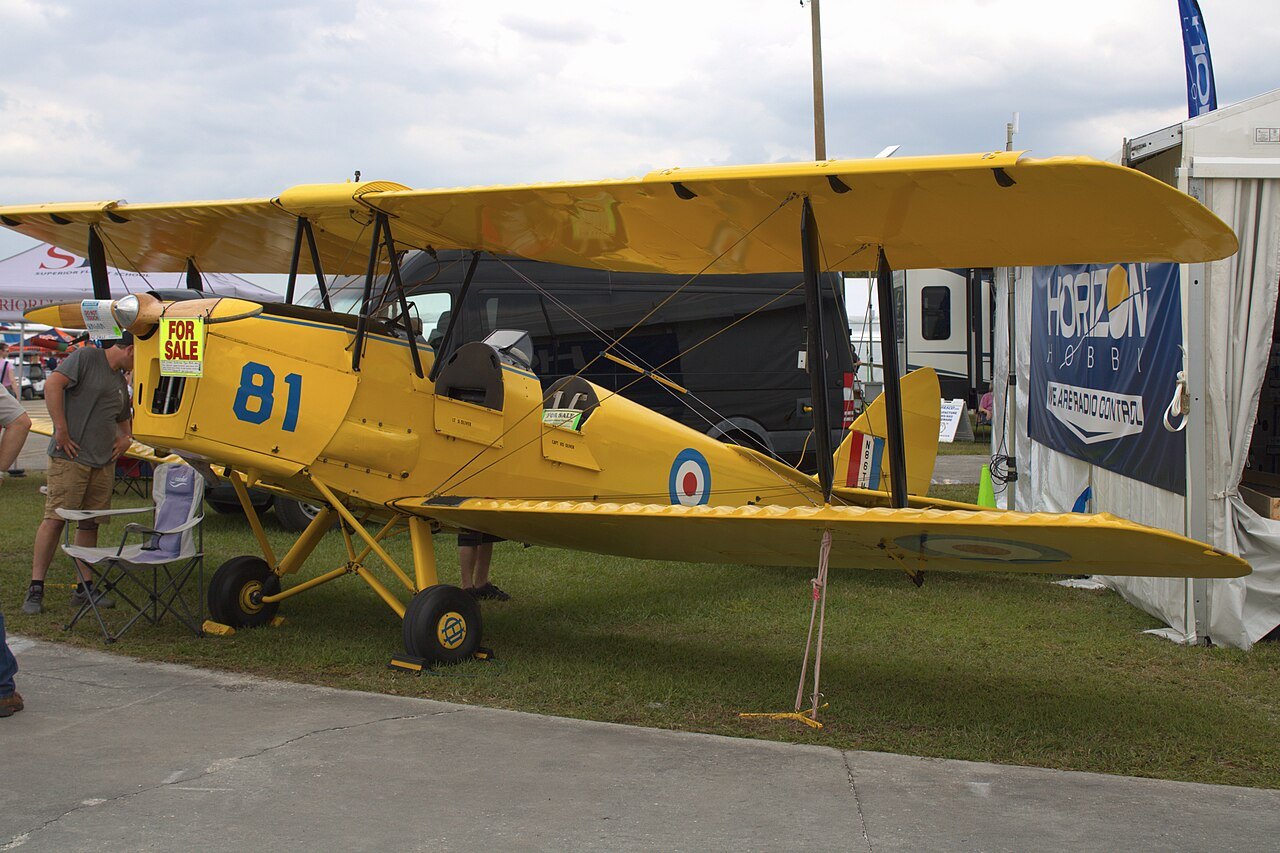
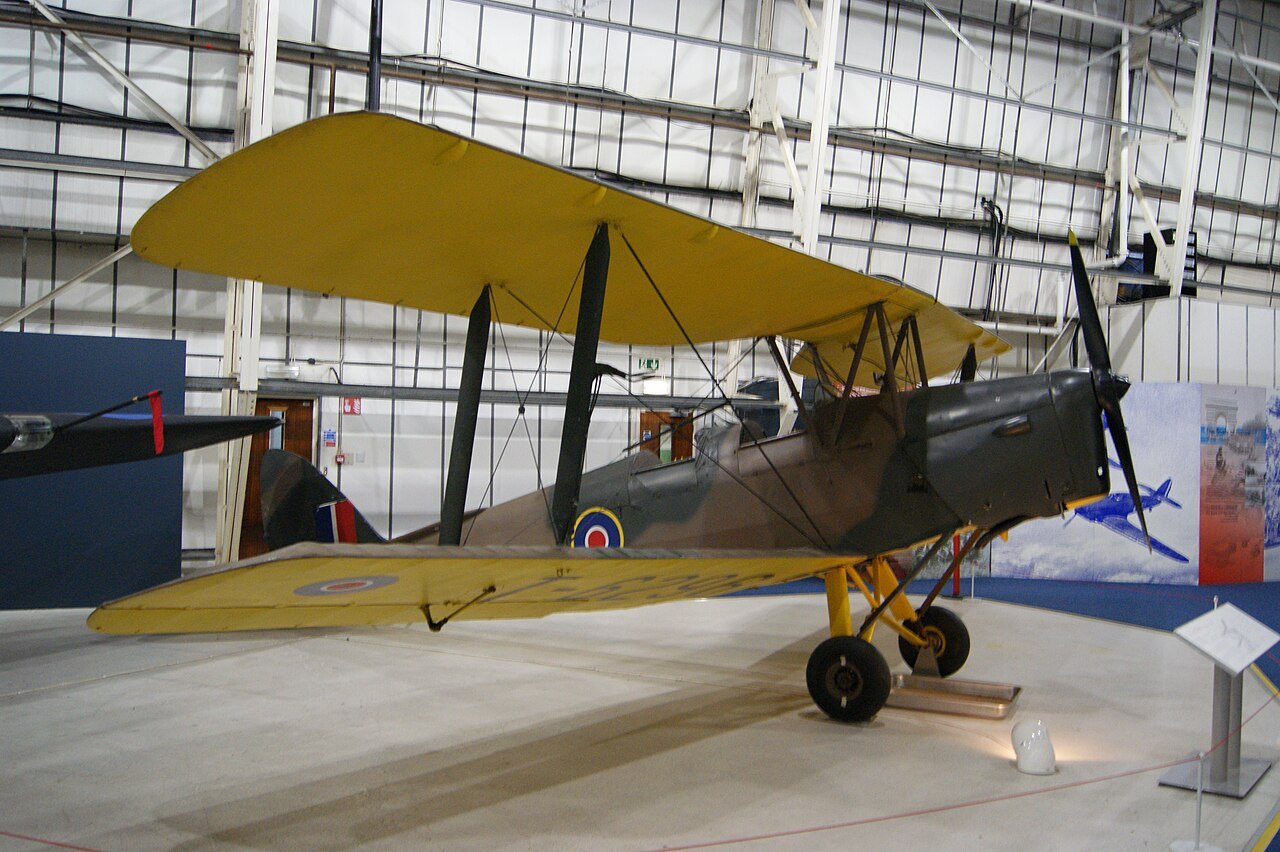
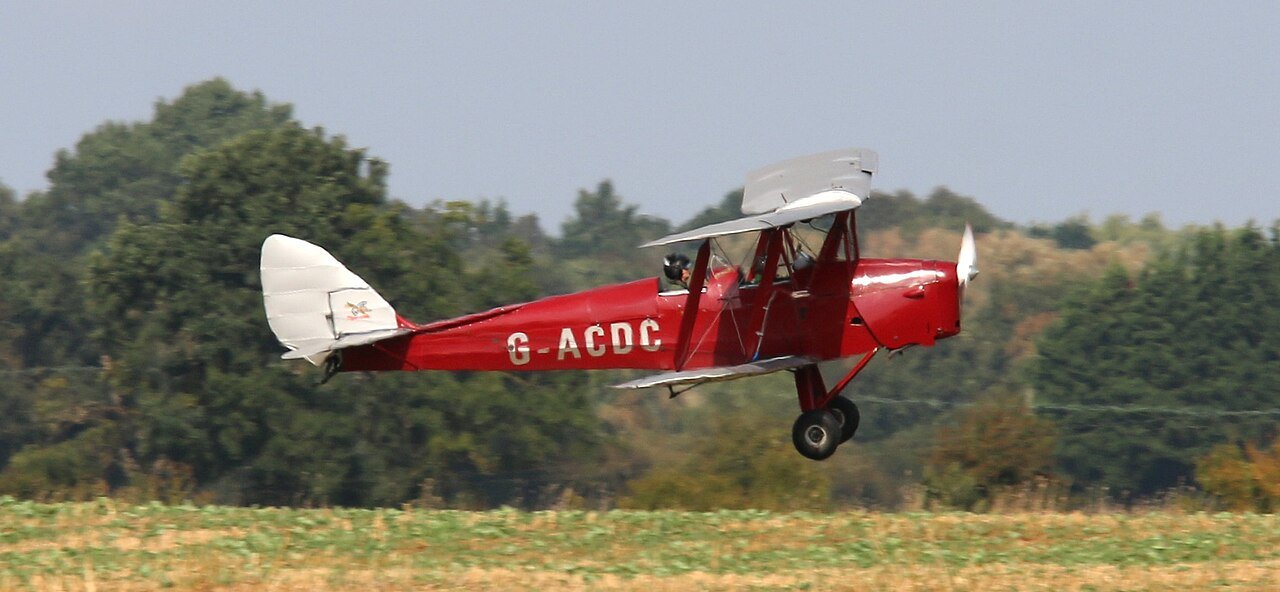
Where the Tiger Moth flies and flew
The Tiger Moth’s record
The Tiger Moth’s true record is in its students: it gave most RAF and many Commonwealth pilots of the Second World War their first solo. Its only operational use came in 1939 and 1940, with unarmed coastal patrols and emergency bomb racks fitted against an invasion that never came.
See how training and combat types compare in the military aircraft statistics database. Figures are approximate.
Everything people ask about the Tiger Moth
Can I fly in a de Havilland DH.82 Tiger Moth?
When did the Tiger Moth first fly?
How many Tiger Moths were built?
Why was the Tiger Moth such a good trainer?
Did the Tiger Moth see combat?
What replaced the Tiger Moth?
Are Tiger Moths still flying?
You can’t fly the Tiger Moth.
These, you can.
Most of this museum you can only look at. These genuine military jets you can fly yourself with MiGFlug — with aerobatics and time on the controls.
 Fly the L-39 AlbatrosThe world’s most-flown jet trainer — aerobatics included
 Fly the F-104 Starfighter“The missile with a man in it”
 Fly the MiG-21The Cold War’s most-produced jet
 Fly the T-33 Shooting StarAmerica’s first jet trainer
 Fly the DH VampireA piece of early jet history
 Fly the S.211Agile Italian jet trainer
 Fly the MB-326The classic Aermacchi jet
 Fly the MiG-15The Soviet legend of the Korean War
Continue the tour
Every fact, checked
- RAF Museum: de Havilland Tiger Moth II T6296First flight, CFS service, 1940 bomb racks and paraslasher, 1959 retirement
- BAE Systems Heritage: de Havilland DH.82 Tiger Moth and Queen BeeProduction figures, Morris Motors, Queen Bee and the word drone
- National Museum of the US Air Force: de Havilland DH 82A Tiger MothEagle Squadrons, PT-24, specifications
- Commonwealth Air Training Plan Museum: de Havilland Tiger MothCanadian production and BCATP role
- Classic Warbirds: de Havilland Tiger MothCoastal Command flights, anti-invasion rack sets, BEF use
- Tiger Club: historyFounding of the Tiger Club in 1956
- Tiger Club: Tiger MothsG-ACDC, Super Tigers, wing-walking from 1962
- Royal Australian Navy Sea Power Centre: de Havilland Tiger MothRAN instructional use, 1948 to 1958
- Donald Sturrock, Storyteller: The Authorized Biography of Roald Dahl (2010)Dahl’s Tiger Moth solo in Kenya; see also Dahl, Going Solo (1986)